Gold reserves and special drawing rights, held by the UK and the IMF, are the main assets Venezuela is looking to recover. (AFP)
Caracas, July 9, 2026 (venezuelanalysis.com) – Venezuelan Acting President Delcy Rodríguez has called on UK King Charles III to release her country’s gold reserves held at the Bank of England in order to finance relief and reconstruction efforts following the devastating earthquakes that struck Venezuela on June 24.
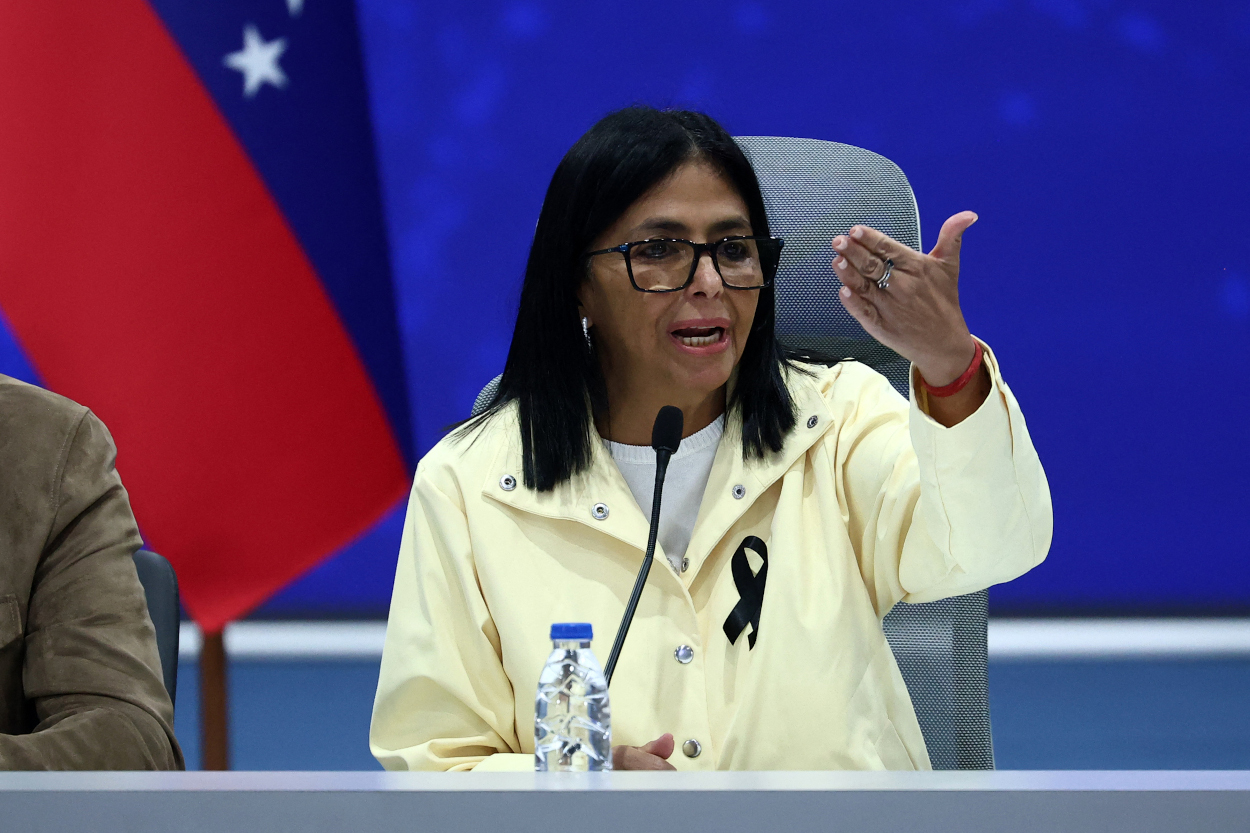
“I have decided to send a letter, among others, to the King of England asking for the release of the gold being held at the Bank of England. That gold belongs to our people and should be used to address the terrible, tragic consequences of the twin earthquakes,” Rodríguez said in a televised broadcast on Wednesday.
The acting president also revealed that she held a phone conversation with International Monetary Fund (IMF) Managing Director Kristalina Georgieva to discuss the release of Venezuelan resources that remain blocked by the institution.
Earlier on Wednesday, during a virtual meeting with the UN Office for the Coordination of Humanitarian Affairs (OCHA), Venezuelan Foreign Minister Yván Gil likewise urged countries holding Venezuelan assets abroad to “begin a process of releasing” those funds so they can be used for the country’s recovery.
Gil specifically referred to the gold reserves held by the Bank of England and Venezuelan funds blocked under US sanctions. Around 31 metric tons of gold, currently valued at approximately US $4.2 billion, remain frozen in London. In addition, nearly $5 billion in Special Drawing Rights (SDRs) allocated by the IMF in 2021 also remain inaccessible.
On Wednesday, Rodríguez and Georgieva reportedly discussed the use of Venezuela’s $350 million SDR reserve fund, which is different from the SDR allocation.
On June 25, the US Treasury’s Office of Foreign Assets Control (OFAC) issued General License 60, authorizing earthquake relief-related transactions until October. However, OFAC’s waiver does not authorize the unblocking of assets subject to US sanctions regulations or “any other transaction or activity prohibited by another Executive Order.”
Meanwhile, 113 prominent economists, including Isabella Weber, Jeffrey Sachs, and James K. Galbraith, signed an open letter calling for immediate action to “unfetter Venezuela’s humanitarian response and reconstruction from ongoing economic and financial sanctions, asset freezes, and onerous debt burdens.”
“We urge governments, international financial institutions, and creditors to act now, on the principle that lives, public health, and economic recovery take precedence over coercion and collection,” the statement read. The economists suggested mechanisms including emergency liquidity, sanctions relief, and debt cancellation as a “minimum response […] to allow Venezuelans to rebuild with dignity.”
Along similar lines, UN Emergency Relief Coordinator Tom Fletcher warned that the earthquakes are likely to generate “a very difficult economic situation” that could reduce Venezuela’s GDP by “several percentage points,” arguing that sanctions “must be eased so they do not hinder the arrival of humanitarian assistance or recovery efforts.”
Fletcher added that during emergencies, access to financial resources, banking channels, and international cooperation mechanisms can determine how quickly aid, supplies, and reconstruction funding reach affected communities.
Preliminary assessments by the United Nations Development Programme (UNDP) estimate infrastructure and essential services losses at approximately US$6.7 billion. However, the final figure could reach $8.7 billion, depending on housing and asset losses, and the estimates do not include the full extent of infrastructure damage or the long-term reconstruction costs.
For its part, the UN Office for Disaster Risk Reduction (UNDRR) estimates that rebuilding Venezuela will require approximately $37 billion. According to its assessment, $24 billion would be needed to replace damaged buildings—including homes, schools, businesses, and hospitals—while another $13 billion would be required to repair critical infrastructure such as telecommunications, highways, and electricity networks.
Different analyses have placed the recovery costs between $12 and $20 billion.
So far, however, the Trump administration has pledged $300 million in humanitarian assistance, whereas Venezuela’s US-based frozen assets are valued at $11-13 billion. The White House also retains control over Venezuela’s oil export revenues, returning a portion of the funds to Caracas at its discretion.
Rodríguez announced on Wednesday that countries offering humanitarian aid can monitor its distribution through a digital platform used to coordinate deliveries across the 87 temporary shelters established for displaced families throughout the country. The acting president has vowed to prioritize the well-being of families who lost their homes and to provide new housing solutions in the coming months.
The latest official update placed the death toll from the earthquakes at 3,889, while the number of injured remains at 16,740 and the number of displaced people stands at 17,907.
Edited by Ricardo Vaz in Caracas.