Sanctions

House passes bill to aid Ukraine and impose new sanctions on Russia

The House passed legislation Thursday that would aid Ukraine and sanction key segments of the Russian economy, overriding objections from Republican leaders who warned the bill would undermine negotiations designed to achieve a comparable but stronger result.

The legislation, sponsored by Rep. Gregory Meeks, D-N.Y., seeks to cement U.S. assistance for Ukraine by providing more than $1 billion in security and reconstruction aid. It would make another $8 billion available for Ukraine’s defense through loans.

The 226-195 vote is a sign of impatience with President Trump’s approach to the war and represents the House’s second major foreign policy break with Trump this week. The day before, the House, for the first time, approved a war powers resolution aimed at halting U.S. military action against Iran.

Supporters were able to force action on the Ukraine bill by gathering 218 signatures on a discharge petition, a legislative tool that allows a majority of the House to effectively bypass leadership.

Once rarely successful, House members have used the petition tool this Congress to pass bills on releasing the government’s files on Jeffrey Epstein and to extend health care subsidies to many of those who get health coverage through the Affordable Care Act, though the latter measure faltered in the Senate.

Meeks said the question before the House was simple. Would it help Ukraine negotiate from a position of strength or help Russia outlast American resolve?

“We all want this war to end,” Meeks said. “The question is how. Will we abandon Ukraine and force it into a terrible deal? That is what Vladimir Putin is counting on. Or will this body live up to the commitments we’ve made since the start of this war?”

The vast majority of Republicans opposed the measure. Rep. French Hill, the chairman of the House Financial Services Committee, said he is a steadfast supporter of Ukraine. However, the Arkansas Republican said the House was confronted with a flawed, outdated measure that actually calls for less funding for Ukraine security assistance compared to what Congress had agreed to as part of this year’s defense policy. Another section could lead to a decrease in defense spending by some NATO members, he warned.

Rep. Brian Mast, the chairman of the House Committee on Foreign Affairs, said he believed the bill was “a cudgel to fight against President Trump.”

“This bill, in my opinion, is an unserious bill that was crafted basically a year-and-a-half ago,” Mast, R-Fla., said.

Rep. Don Bacon, R-Neb., broke with most of his Republican colleagues in voicing support for the measure.

“Are we going to stand with good or are we going to stand with evil? That’s what this is about tonight,” he said.

In the end, 18 Republicans, 207 Democrats and one independent voted for the bill. Democratic Rep. Ilhan Omar joined with 194 Republicans in voting against it.

Lawmakers want to send a message

Supporters are hopeful that the House’s passage of the Ukraine bill would put pressure on the Senate to do the same. But they also know the Senate likely won’t go along unless Trump endorses the bill.

“It’s probably not going to get 60 votes in the Senate, but it’s going to hopefully force the Senate to address the issue,” said Rep. Brian Fitzpatrick, R-Pa., who signed the discharge petition and voted for the bill. “It’s going to send a great message to the soldiers of Ukraine.”

He said the vote would also send a message to Putin that “we do have a pulse here, that we do care about Ukraine and that we are going to utilize our authority to help them.”

As the war has dragged on, it’s gotten more difficult for supporters of Ukraine in Congress to provide additional financial support to help Ukraine defend itself.

The U.S. has approved some $195 billion for the Ukraine response, according to the latest quarterly inspector general report for Operation Atlantic Resolve, with roughly a quarter of that going to replenish weapons stockpiles for the U.S. military. The last major legislation designed to bolster the Ukraine response occurred in April 2024, though modest amounts have since been included in annual appropriations bills.

Republican leaders tried to stop the bill

Republican leaders urged their members to oppose the legislation. House Majority Leader Steve Scalise, R-La., said there are good-faith negotiations between members of Congress and the White House to boost Ukraine. He described the negotiations as complicated.

“I think they are going to yield positive results, but you set that back if you pass legislation that doesn’t go as far as the negotiations are going,” Scalise said.

The war that followed Russia’s full-scale invasion of its neighbor is more than four years old, with no end in sight. In recent days, both sides have sought an edge by launching long-range missile strikes.

U.S.-led peace efforts have fizzled out as the sides made no progress on key differences and after the war in Iran grabbed Washington’s attention. Ukrainian President Volodymyr Zelensky accepted an unconditional ceasefire demanded by Trump, but Putin refused.

Action in the Senate on Ukraine has revolved around a bill that would impose sweeping tariffs and secondary sanctions on countries that purchase Russia’s oil, gas, uranium and other exports, which are crucial to financing Russia’s military. But the bill has languished.

Freking writes for the Associated Press. AP writer Lisa Mascaro contributed to this report.

Source link

Venezuela: National Assembly Pushes Reform to Open Electricity to Private Sector

Private and mixed companies will be allowed to participate in electricity generation, transmission, distribution, and commercialization. (AFP)

Caracas, June 4, 2026 (venezuelanalysis.com) – The Venezuelan National Assembly preliminarily approved on Tuesday a reform to the country’s Organic Law of the National Electricity System and Service, proposing a structural overhaul of the National Electricity System (SEN).

One of the most significant changes is the incorporation of the private sector in electricity generation, transmission, distribution, and commercialization activities, breaking with two decades of state monopoly through the National Electric Corporation (Corpoelec).

According to the draft text seen by Venezuelanalysis, private corporations and joint ventures will be able to operate in the electric grid in what is termed a “diversification of actors in the service chain.” The mixed ventures, where the state can hold majority or minority stakes, will be approved directly by the government and not by the National Assembly.

“In recent decades, the electric system has showcased structural and financial limitations […] as a result of the productive reality and the negative impact of unilateral coercive measures,” the proposed law reads. “Faced with this reality, the Venezuelan state must assume an institutional and judicial reengineering.”

The bill establishes concessions with a maximum duration of 25 years, renewable for a further 15 years under specific conditions. Once a concession expires, all infrastructure, assets, substations, and data will automatically revert to the state in good condition and without compensation.

The proposed legislation announces the creation of a new tariff scheme “based on real costs and a reasonable return for investors.” Electricity, like most public services, has been heavily subsidized in recent decades in the Caribbean nation. The bill additionally introduces obligations for electricity distributors to compensate users for damages caused by blackouts or other failures.

The reform likewise establishes the possibility for the executive branch to grant tax exemptions to projects linked to renewable energy, rural electrification, or strategic investments in the electricity sector.

The 42-article legislation will now be subject to discussions and amendments before a second and decisive vote. 

If approved, it would repeal the Organic Law for the Reorganization of the Electricity Sector, enacted by former President Hugo Chávez on July 31, 2007, which merged the country’s seven existing electricity companies through the creation of the National Electric Corporation. The legislation also defined all stages of electricity generation and distribution as “strategic for the nation.”

During Tuesday’s parliamentary session, United Socialist Party (PSUV) lawmaker Orlando Miranda argued that the electricity reform represented a “mixed and private capital strategy under a rigorous regime of concessions and public supervision.” 

He noted that government plans to reinforce the grid with thermoelectric plants in the past 15 years were hampered by US economic sanctions. Miranda went on to add that increased tariffs are being studied to reflect the “real costs” of the system.

For his part, opposition legislator Ezio Angelini (Un Nuevo Tiempo) demanded that the reform address corruption, which he identified as a key factor behind Venezuela’s recurring power outages.

Angelini stated that in 2019 Venezuela generated around 20,000 megawatts (MW) while consuming approximately 12,000. Today, he claimed, the country produces close to 12,000 MW, roughly 40 percent of installed capacity, while demand has risen to 14,000. On May 11, Interior Minister Diosdado Cabello stated that electricity demand had surpassed 15,500 MW due to increased oil production.

Zulia state, considered the cradle of Venezuela’s oil industry, and other western regions have experienced daily blackouts lasting between eight and twelve hours in recent weeks. Supply instability also affects other services such as water pumping and cooking gas distribution.

Frequent power outages have also gripped oil fields in the Orinoco Belt, as crude extraction relies on electric motors that are vulnerable to tension fluctuations. According to Bloomberg, the Venezuelan government is urging international energy companies to generate their own electricity for oil and natural gas projects in an effort to shield the grid from the additional load.

Delegations from Siemens and General Electric visited the country in April and held talks with the Venezuelan government headed by Acting President Delcy Rodríguez. However, the two corporate giants are reportedly “hesitant” to take part in major projects due to doubts over Caracas’ financial capabilities.

Additionally, in mid-May, US Chargé d’Affaires in Venezuela John Barrett held a meeting with Electricity Minister Rolando Alcalá to discuss plans to “restore a reliable energy supply through US investment and collaboration.”

Electricity generation in Venezuela depends heavily on the 10 MW-capacity Guri hydroelectric complex in Bolívar state, making the system particularly vulnerable to climatic factors such as the high temperatures affecting the country. Venezuela suffered nationwide blackouts in 2019, with authorities blaming US-led cyberattacks.

The electricity reform follows legislative overhauls to the hydrocarbon and mining sectors that likewise curtailed the state’s role and responsibilities while granting private corporations expanded control over operations and sales, slashed royalties and taxes, and the ability to bring disputes to international arbitration bodies.

Edited by Ricardo Vaz in Caracas.


Source link

U.S. sanctions Cuban leader Miguel Díaz-Canel, military, Castro kin

Cuban President Miguel Diaz-Canel was slapped with sanctions by the United States on Thursday as Washington continued to ratchet up pressure of the island nation’s communist government. File Photo by Ley Royero/EPA-EFE

June 4 (UPI) — The United States on Thursday leveled sanctions against Cuban Miguel Díaz-Canel, members of former President Raul Castro‘s family, the Cuban military and other organizations as it continued a crackdown on the country’s communist government.

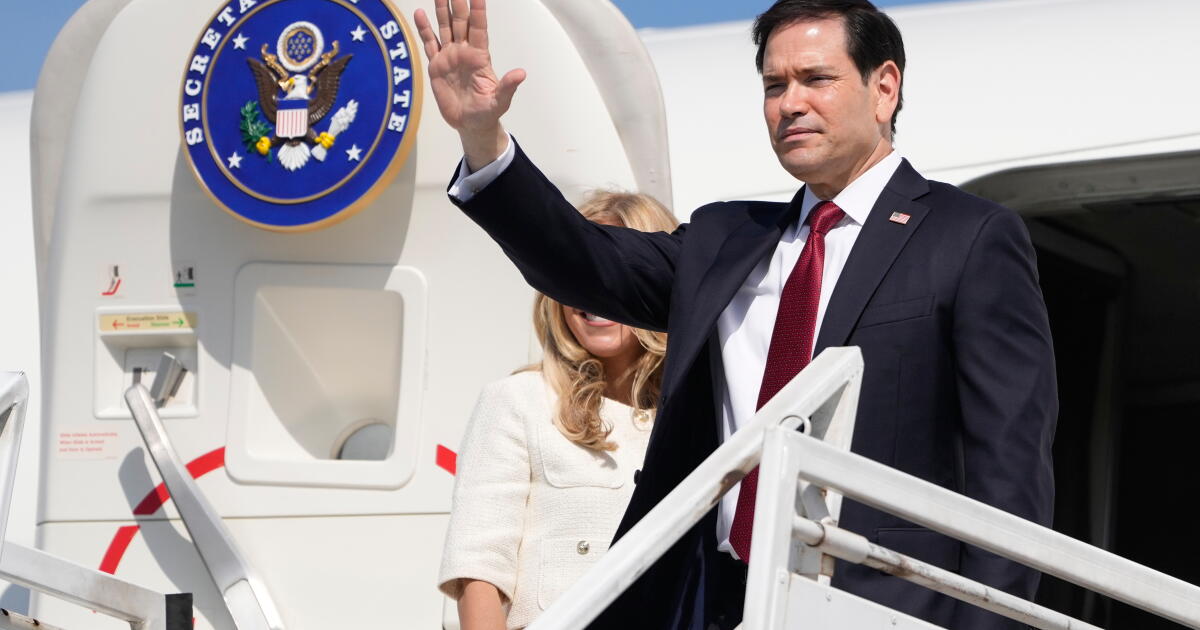
Secretary of State Marco Rubio announced the measures against Diaz-Canel the others in a statement, asserting they are being targeted because they “fund the [Cuban] regime and its efforts to mobilize its radical revolutionary movements in the United States and around the world.”

The Cuban president, Rubio said, poses a threat to U.S. national security, while the Ministry of the Revolutionary Armed Forces of Cuba, with its “many majority holdings and subsidiaries,” is also now “considered blocked.”

Other organizations newly added to the sanctions list are the Cuban Institute of Friendship with the Peoples, or ICAP, Amistur Cuba S.A., Committees for the Defense of the Revolution and Minera La Victoria S.A.

The individuals sanctioned include Alejandro Castro Espin, the former head of the Cuban intelligence services and the son of Raul Castro, and Raul Alejandro Castro Calis, Castro Espin’s son.

“For decades, Cuba has been the world capital for radical left-wing terrorism,” Rubio asserted. “The regime in Havana has recruited, trained and backed violent Marxist and ‘third-worldist’ movements across our hemisphere and beyond.

“Today, we are targeting the network that enables and funds Cuba’s subversive and radical operations.”

In a stated response, Diaz-Canel said the latest sanctions are “illegitimate” and are “aimed at reinforcing the blockade measures and the scenario of conflict between Cuba and the United States.

“This political blindness is added to the coercive measures applied in recent weeks against our country, designed to harm the Cuban people,” he added. “The aggressiveness and perversity of the Yankee government will clash with our determination to confront the worst scenarios and resist the imperialist onslaught.”

The newly issued sanctions are the latest in a series of moves designed to ratchet up pressure on the Cuban government.

The Trump administration has set a Friday deadline for foreign companies to sever ties with GAESA, the business conglomerate run by Cuba’s Armed Forces, sparking a mass exodus of tourism-related businesses from the island nation.

Meanwhile, Cuba is struggling with the effects of a January 2026 executive order issued by U.S. President Donald Trump imposing a fuel blockade against the nation on national security grounds.

The move has resulted in shortages of electricity, fuel, medicine and medical supplies across Cuba, according to the U.N. Office for the Coordination of Humanitarian Affairs and the World Health Organization, which says emergency care, blood banks, laboratories, immunization programs and maternal and child health services have all been “severely disrupted.”

Source link

Venezuelan Gov’t Orders Airlines, Shipping Companies to Deposit Fuel Payments in US Treasury Account

Airlines and shipping companies must send payment receipts to PDVSA to access fuel. (Archive)

Caracas, June 3, 2026 (venezuelanalysis.com) – The Venezuelan government headed by Acting President Delcy Rodríguez has instructed airlines and shipping companies to direct fuel payments to a US Treasury account.

Spanish newspaper El Diario published a May 28 letter from state oil company PDVSA addressed to “aviation and maritime customers” that laid out the “banking coordinates” for foreign currency payments concerning JET A1, MGO, and IFO 380 purchases.

JET A1 is a kerosene-based fuel widely used by commercial airplanes, while Maritime Gas Oil (MGO) and Intermediate Fuel Oil (IFO) 380 are standard for ship engines.

“We urge our customers to take the necessary precautions and forward the payment receipt to PDVSA sales representatives so that the payment is cleared and fuel supply is assured,” the letter read.

An attached US Treasury information sheet contains details for Fedwire payments to a “Venezuela custody account” and requires information about “source of funds, e.g., oil, gold, minerals, etc.”

The leaked letter is the first publicly available document from a Venezuelan state institution directing foreign currency payments to an account run by the US Treasury Department as opposed to the country’s Central Bank (BCV) or some alternative state-run mechanism.

Since the January 3 military strikes and kidnapping of Venezuelan President Nicolás Maduro, the Trump administration has seized control of the country’s export revenues. The White House has likewise extracted concessions in the form of pro-business reforms, preferential access for Western corporations to natural resources, and external audits of the Venezuelan Central Bank.

US Treasury general licenses allowing select Western corporations to engage in oil and gas activities mandate that all Venezuela-owed payments for royalties, taxes, and dividends be deposited in US Treasury accounts. Additional sanctions waivers imposed similar constraints on mining sector services and exports.

Neither US nor Venezuelan authorities have disclosed information about the funds, the timings of their disbursements back to Caracas, and the percentage kept by the Trump administration. The US president stated in a May interview that Washington has “made a fortune” from Venezuelan oil sales.

Both Washington and Caracas have acknowledged the use of Treasury-held Venezuelan revenues for the purchase of medicines and medical equipment from US manufacturers. In January, Secretary of State Marco Rubio said in a Senate hearing in January that Venezuela would need to submit a “budget request” to access its own funds.

According to reports, Washington is mandating that the Venezuelan Central Bank distribute the returned foreign currency to private sector importers via exchange table auctions run by public and private banks. The BCV has reportedly allocated more than US $5 billion thus far in 2026.

The Rodríguez acting government’s diplomatic rapprochement with the Trump White House, coupled with reforms to attract Western investment, has led to a growing number of international airlines reestablishing flights to the Caribbean nation. American Airlines currently runs two daily direct Caracas-Miami flights, while United Airlines will launch a Caracas-Houston connection in August. Jetblue, for its part, is set to initiate its first-ever Venezuela route later in the year.

Venezuelan authorities have likewise recorded increased shipping activity at the country’s ports.

Source link

EU sanctions ‘extremist’ Israeli settlers in occupied West Bank | Israel-Palestine conflict News

EU says the sanctioned individuals and groups violated a range of rights, from the right to physical and mental integrity, to the right to education.

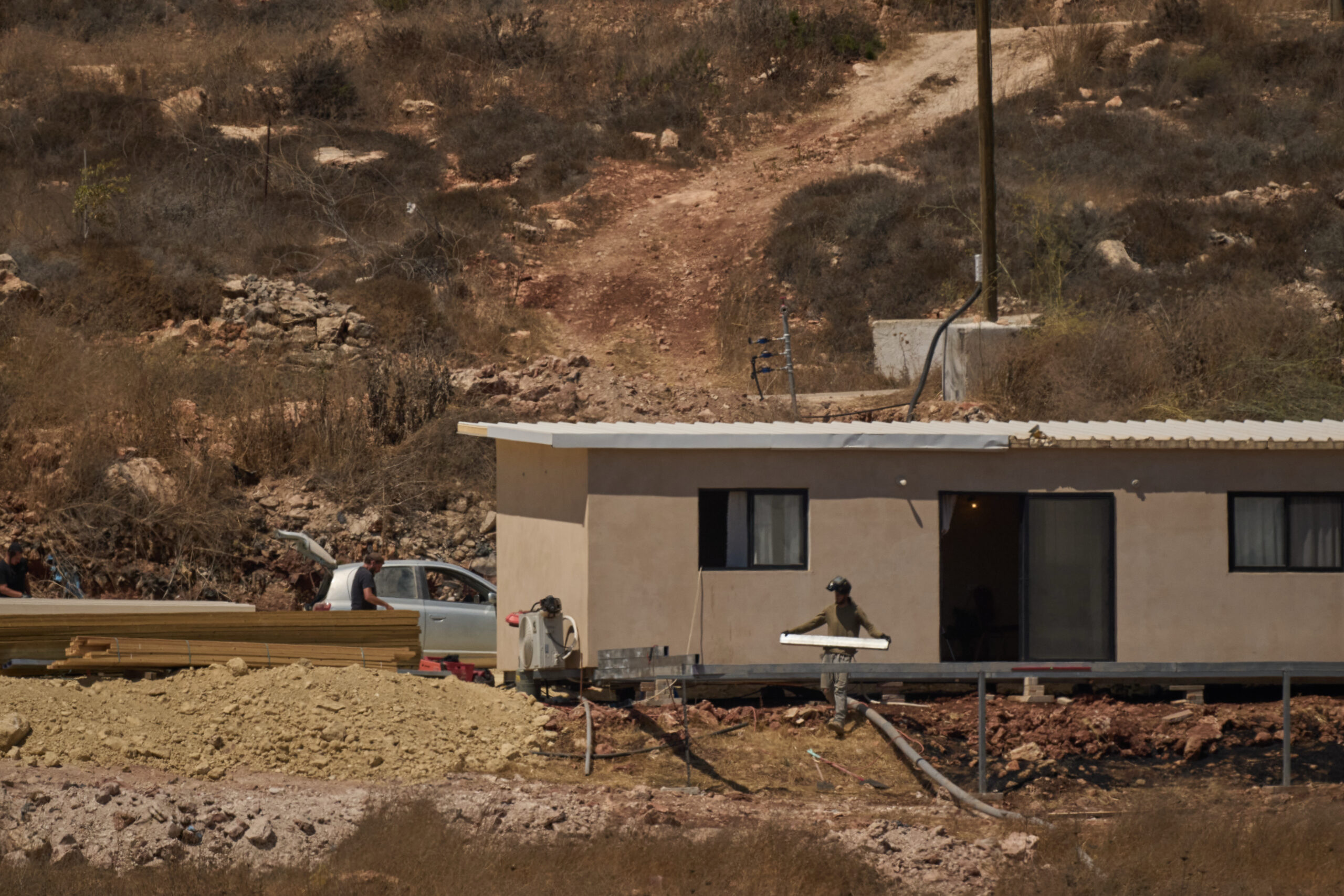
The European Union has sanctioned four entities and three individuals it says are “extremist Israeli settlers” responsible for “serious” human rights abuses against Palestinians in the occupied West Bank.

The EU said they had violated a range of rights, including the rights to physical and mental integrity, privacy and family life, freedom of religion and education.

Recommended Stories

list of 4 itemsend of list

The announcement on Thursday is part of an EU sanctions package agreed earlier this month to punish Israeli settlers and Hamas leaders.

The sanctions include the Nachala Settlement Movement and its director, Daniella Weiss. The EU says the group “encourages and facilitates coercive acts that lead to the forced displacement of Palestinians”.

Israeli NGO Regavim and its director, Meir Deutsch, are also on the sanctions list for lobbying “for the demolition of Palestinian property” in order to expand Israel’s control over the entirety of the West Bank, plus the demolition of an EU-funded Palestinian primary school.

Also sanctioned is the Hashomer Yosh NGO and its president, Avichai Suissa for supporting “at least 28 violent outposts and settlements”. It also recruits armed volunteers and provides guards who engage in violent attacks, the EU added.

The Amana cooperative association of the settler movement Gush Emunim was also sanctioned, the EU stating it had likewise “played a key role in initiating, financing, and facilitating at least 30 violent outposts and settlements”.

Long-awaited sanctions

With Thursday’s additions, the EU said it now sanctions 136 persons and 41 entities from a range of countries under its Global Human Rights Sanctions Regime.

The regime was created in 2020, and applies to acts such as genocide, crimes against humanity and other serious human rights violations or abuses.

The measures targeting Israeli settlers because of violence against Palestinians were long-awaited, having been blocked by the self-styled illiberal government of Hungary’s former premier Viktor Orban.

However, the appointment of new Prime Minister Peter Magyar saw the veto quickly lifted earlier this month.

Israel earlier condemned the sanctions, asserting that Jews have the right to settle in the occupied West Bank, despite that being in violation of international law.

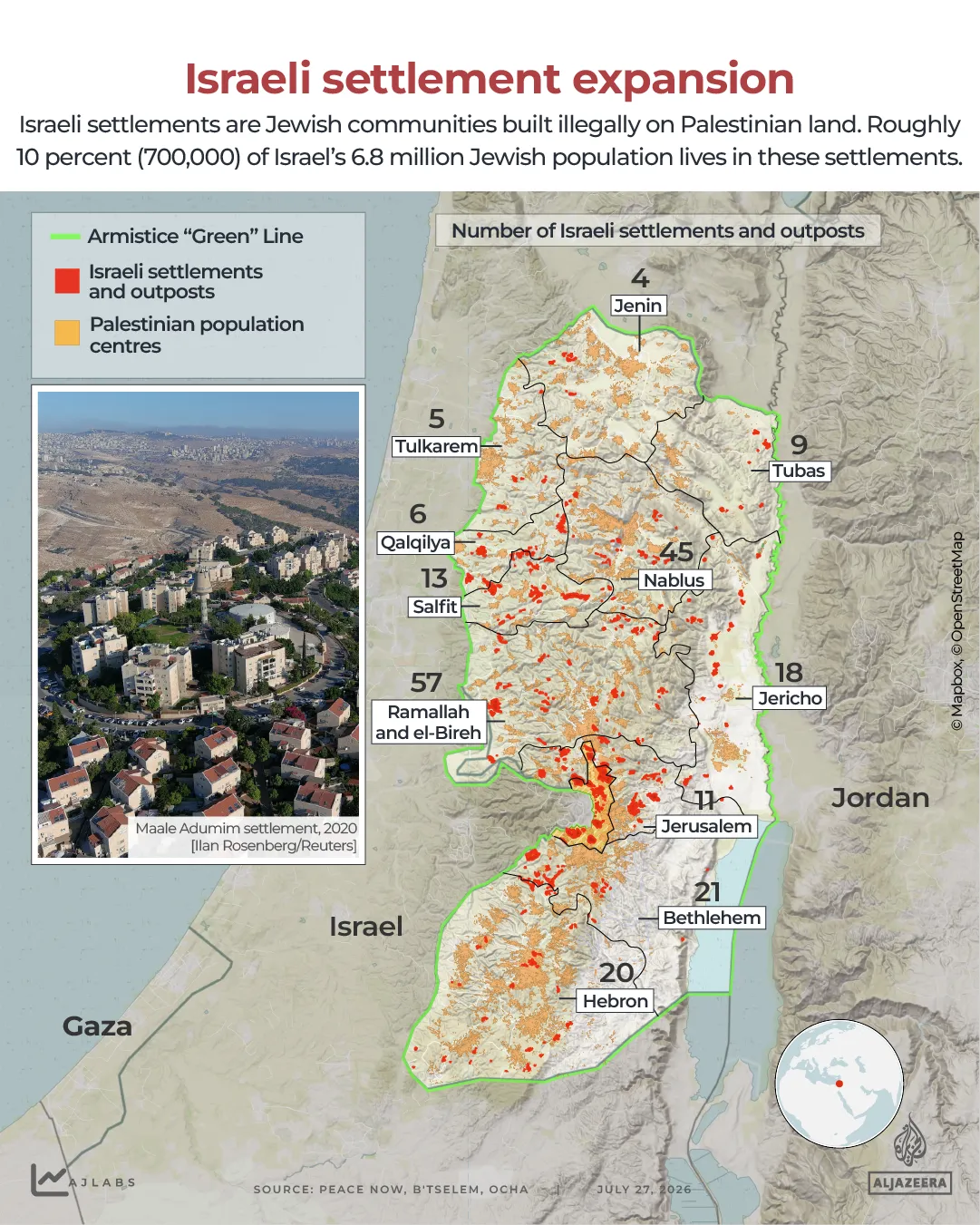
In 2025, the expansion of Israeli settlements reached its highest level since at least 2017, when the United Nations began tracking data.

Since the start of Israel’s genocidal war on Gaza, the West Bank has been gripped by almost daily violence involving Israeli troops and settlers. More than 1,000 Palestinians have been killed in the territory, according to the UN.

Source link

US Treasury threatens Oman with sanctions over Hormuz Strait | Donald Trump News

A top US official says Oman should know that Washington ‘will aggressively target’ actors that facilitate tolls in waterway.

The United States has warned that it would “aggressively” impose sanctions on Oman if it helps Iran establish a tolling system in the Strait of Hormuz, intensifying President Donald Trump’s threats against the Gulf ally.

US Treasury Secretary Scott Bessent said on Thursday that Washington will “not tolerate” either country imposing fees on commercial ships in the strategic waterway.

Recommended Stories

list of 3 itemsend of list

“Oman, in particular, should know that the US Treasury will aggressively target any actors involved — directly or indirectly — in facilitating tolls for the Strait and any willing partners will be penalized,” Bessent said in a social media post.

“All nations should reject outright any efforts by Iran to disrupt the free flow of commerce. Tehran’s days of terrorizing the region and the world are over.”

The statement comes less than 24 hours after President Trump threatened to bomb Oman, a key US ally known for its neutrality and mediation efforts in regional crises, including the war between the US and Iran.

While Iran has suggested that the governments in Tehran and Muscat could jointly manage the Hormuz Strait, Oman has not said that it is seeking control over the waterway, parts of which flow through its territory.

It is not clear what is driving Washington’s recent posture toward Oman. It is highly unusual for the US to threaten sanctions and military action against a close security and economic partner.

Since the US and Israel started bombing Iran without direct provocation on February 28, Iran has closed the strait and claimed sovereignty over it.

Around 20 percent of the world’s oil flowed through Hormuz before the conflict, so the Iranian blockade has put a major strain on energy supplies, sending prices soaring.

The US and Iran have been indirectly negotiating to reach an agreement for a comprehensive end to the war, and control over the Hormuz Strait has emerged as a major point of disagreement.

Trump has stressed that the strait must be a free passageway.

When asked whether he would accept joint Iranian-Omani control over the strait in the short term, the US president told reporters on Wednesday: “Nobody is going to control it. It’s international waters, and Oman will behave just like everybody else, or we will have to blow them up.”

Ali Bagheri, deputy secretary of Iran’s Supreme National Security Council, said on Thursday that Tehran will not allow Hormuz to be a source of insecurity for the country.

“The powers that have used this passage against Iran’s security must be held accountable,” he was quoted as saying by Iran’s public television.

Bagheri added that Iran seeks to “establish a just order that negates hegemony and domination and strengthens trust and cooperation” in the region.

Source link

U.S. sanctions Iran’s new Hormuz authority amid strait talks

May 28 (UPI) — The U.S. Treasury announced late Wednesday that it has sanctioned an Iranian entity, newly created to oversee and manage the Strait of Hormuz, as the Trump administration seeks to force Tehran to relinquish control over the vital energy trade route.

The strait has been an issue of contention between the United States and Iran, which are locked in negotiations to end the war.

Iran restricted navigation of the strait after the United States and Israel attacked the country in late February, igniting the war. Washington responded by imposing a military blockade of Iran’s ports, cutting it off from maritime trade.

Since imposing the restrictions, Iran has been adamant about maintaining control of the route, through which about one-fifth of the world’s energy trade flows. The Trump administration has repeatedly threatened that there will be free navigation of the strait again, one way or another.

Earlier this month, Iran launched the Persian Gulf Strait Authority to manage the strait.

The Treasury sanctioned the PGSA on Wednesday, accusing it of being an attempt by Iran’s Islamic Revolutionary Guard Corps to monetize the international waterway.

Treasury Secretary Scott Bessent described the mechanism in a statement as the Iranian military’s “latest attempt to extort global maritime trade.”

Bessent said the Wednesday blacklisting was part of Economic Fury, the Treasury’s rebranding of President Donald Trump‘s maximum pressure campaign of sanctions and other trade measures from his first administration seeking to coerce a new nuclear weapons deal from Iran.

The United States has been tightening its financial vise on Iran since 2018 when Trump first imposed sanctions on Tehran after unilaterally withdrawing the United States from a multinational Obama-era nuclear accord aimed at preventing Iran from securing a nuclear weapon.

Trump reimposed the campaign following his return to the White House in early 2025. It was renamed following the start of the military operation Epic Fury that began Feb. 28.

Treasury officials said Wednesday that through the maximum pressure campaign, the Trump administration has denied Iran access to tens of billions of dollars’ worth of revenue.

The sanctions generally prohibit those named from accessing the U.S. financial system and bar U.S. persons and companies from doing business with them. They also expose foreign financial institutions that knowingly facilitate significant transactions for those sanctioned to potential secondary sanctions.

Sen. Tom Cotton, a Republican from Arkansas, had over the weekend called on Bessent to sanction the PGSA, stating the United States “must ensure every actor enabling the terrorist Iranian regime is held accountable.”

“I support the use of existing authorities to impose sanctions on the PGSA, its officers and any foreign entity that pays, processes or facilitates tolls to Iran for passage through the Strait of Hormuz,” he said in a statement.

Iran has rejected the notion that it is running a toll. Iranian Foreign Ministry Spokesperson Esmaeil Baqaei has said that Iran charges fees to cover costs associated with navigational services and environmental protection measures.

Iranians rally after a ceasefire announcement at Enqhelab Square, in Tehran on April 8, 2026. Photo by Behnam Tofighi/UPI | License Photo

Source link

Delcy’s ‘Gatekeeper’: Sources Say ex-Trump Official Claver-Carone Holds Keys to Caracas

The US has leveraged threats to extract major concessions from Caracas, with Claver-Carone allegedly playing a key role. (Archive)

A mastermind of Trump’s hardline Latin American policies, Mauricio Claver-Carone no longer serves in the administration. But according to well-placed sources, he’s “picking who can operate” in Venezuela, controlling access to the government, and creating conflicts of interest.

Speaking with reporters on May 21, US Secretary of State Marco Rubio announced that Venezuelan President Delcy Rodriguez was on her way to New Delhi to discuss energy issues, and that he would be in India as well.

“This is an important trip, I’m glad we’re able to do it,” Rubio chirped after explaining the trio of nations would discuss how to increase Venezuelan oil sales to India.

His statement — and his announcement of Rodriguez’s trip before she had — perfectly illustrated Washington’s newfound dynamic with the Venezuelan government. Following over twenty years of hostile relations with Venezuela’s socialist-oriented leadership, the US Secretary of State was apparently so intimately involved with day to day affairs in Caracas that he was claiming responsibility for Rodriguez’s international itinerary.

In fact, according to an insider who enjoys close contacts within both the Venezuelan and US governments, Rubio’s influence over Rodriguez is said to be traced to one “gatekeeper”: former Trump Latin America envoy Mauricio Claver-Carone. “Mauricio [Claver-Carone] is picking who can operate and Delcy [Rodriguez] is taking instructions,” the source told The Grayzone. 

A former senior US official with access to leadership in both Caracas and Washington offered the same assessment, remarking to The Grayzone, “Mauricio’s calling the shots on private sector economic positions, and if anyone wants in, they have to go to him.”

Hand-selected by former National Security Advisor John Bolton to serve as his Latin America charge during Trump’s first term, Claver-Carone no longer occupies an official governmental role. Instead, he has leveraged his legacy in the public sector to establish a Miami-based investment firm called the Lara Fund which could become a key player in the MAGA financial feeding frenzy in Caracas.

Described by the New York Times as the “architect of Trump’s tough Latin America policies,” Claver-Carone is a Cuban-American regime change zealot who once engaged in fisticuffs with Cuban diplomats as a young man. During Trump’s first term, he unleashed a financial “flamethrower” on Cuba, issuing scores of new sanctions that unraveled the Obama-era normalization policy and plunged the island back into economic misery. 

Claver-Carone has similarly masterminded many of the policies that define Trump’s relationship with Venezuela, from its recognition of the previously unknown Juan Guaido as the country’s “interim president” to the deportation of hundreds of Venezuelan migrants from the US to El Salvador’s maximum security CECOT prison. Many of those migrants had been prompted to journey to the US by the economically crushing sanctions unleashed at Claver-Carone’s direction. 

The Grayzone’s sources described the Trump veteran as the architect of the military invasion that saw Maduro spirited away to a federal penitentiary and installed Rodriguez as president following a stand-down by Venezuelan security forces.

“If he was in charge of implementing the kinetic side, maybe [Rodriguez] thinks she has to listen to him on finance,” the Venezuela insider said of Claver-Carone.

report this January by investigative journalist Aram Roston described Claver-Carone as a “key backer” of Rodriguez following Maduro’s abduction, and cited sources who claimed he exercised decisive influence over Venezuela policy despite having left the administration.

Claver-Carone is now said to be at the heart of the most sensitive and consequential task Venezuela faces: the restructuring of its $170 billion in defaulted sovereign debt. Forced from several previous positions by corruption scandals and rancorous clashes, an operative with no official governmental position appears to be shaping the economic contours of Project Venezuela. 

“He’s got a lock on everything”

This May, the US Treasury Department authorized Caracas to hire a financial advisor to assist with the herculean task of restructuring its debt. The Venezuelan government selected Centerview Partners, a top-drawer investment and financial advisory firm based in New York City.

According to the former US senior official, Claver-Carone’s romantic partner and business colleague, Jessica Bedoya, boarded a private jet to Caracas soon after the big announcement, arriving with a top advisor from Centerview. It was her second trip to the Venezuelan capital, they said, after visiting in February to discuss financial matters. 

Claver-Carone did not respond to calls to his personal phone from The Grayzone, or to detailed questions sent by text and email. 

His partner, Bedoya, is the founder of the Lara Fund investment firm where he serves as managing partner. Her bio notes that she has also worked in the CIA and National Security Council.

Jessica Bedoya and Mauricio Claver-Carone’s headshots, as featured on Lara Fund’s webpage

Some insiders worry that her reported presence in the Venezuelan capital, together with Claver-Carone’s outsized influence, could represent a conflict of interest, allowing them to steer debt restructuring agreements to their own personal benefit.

“Now he’s got a lock on everything,” the Venezuela insider said of Claver-Carone. “He could say to anyone who wants to work in Venezuela, I’m the guy. I have the keys. If you want to play ball, invest with me.”

The former US official said Claver-Carone was raising capital for his Lara Fund while he served as a special government employee at the State Department. While Bedoya was running the firm, they said Claver-Carone was leveraging his position inside the Trump administration to pitch potential investors.

“Arbitrary and authoritarian actions that showed him to be a real thug”

When Trump appointed Claver-Carone to serve as the first American president of the Inter-American Development Bank (IDB) in 2020, he hired Bedoya as his chief-of-staff. The couple’s secret romance at the bank triggered an embarrassing ethics investigation after a hand-written contract was discovered showing they had agreed to pursue “absolute happiness,” and included a clause with punishments including “candle wax and a naughty box” if either party breached the deal. 

An independent probe ordered by the IDB discovered that Claver-Carone had increased his paramour’s salary by 40% – a $133,000 reward in less than a year. Investigators also found that the couple had racked up expenses on an IDB credit card during romantic getaways. 

Claver-Carone refused to participate in the investigation while accusing its authors of “fabrications.” In the end, IDB governors voted unanimously in favor of his firing. The US government endorsed their decision.

“President Claver-Carone’s refusal to fully cooperate with the investigation, and his creation of a climate of fear of retaliation among staff and borrowing countries, has forfeited the confidence of the bank’s staff and shareholders and necessitates a change in leadership,” they wrote.

The Argentine governor of IDB, Guillermo Francos, delivered a similarly harsh assessment of Claver-Carone’s tenure. “Claver was a disaster for several reasons,” Francos remarked in 2022. “For having an inappropriate relationship, for having disproportionately increased the salary of this inappropriate relationship, for having lied, and for these arbitrary and authoritarian actions that showed him to be a real thug.”

When Claver-Carone returned to the second Trump administration, it was not long before his proclivity for conflict jeopardized his position.

Throughout 2025, Claver-Carone’s spiteful attitude reportedly complicated Trump administration attempts to prop up a key right-wing ally in South America, Argentine President Javier Milei. Milei’s chief of staff happened to be Guillermo Francos – the former IDB governor whom Claver-Carone held personally responsible for outing his secret relationship with Bedoya. According to the Argentine paper Clarin, Claver-Carone attempted to retaliate by unsuccessfully pressuring Milei to fire Francos. He then attempted to undermine a major IMF loan package to Argentina by demanding the country first sever its credit line from China. This was met with an apparent rebuke from Treasury Secretary Scott Bessent, who visited Buenos Aires to express confidence in the IMF loan just weeks after Argentina’s central bank extended its credit line from Beijing.

The following month, in May 2025, Claver-Carone announced he was leaving the State Department to return to his Lara Fund. His departure gave the appearance that he had been forced out of his job. However, he maintained his clout through his direct line to Rubio.

The former US official told The Grayzone that Claver-Carone is now angling to become a Cuban American version of Jared Kushner, the Trump son-in-law who has leveraged his proximity to the president and role as Middle East negotiator to rake in billions from Israel and several Gulf monarchies despite having no official government title. To do so, he has allegedly inserted himself into the byzantine process of restructuring Venezuela’s debt.

When the Trump administration announced that Venezuela could hire a financial advisor to assist with its sovereign debt, Rodriguez initially planned a public bidding process for the coveted position. But then, according to the ex-US official, Claver-Carone issued support for Centerview, leading to the firm’s selection. (Opposition bloggers have speculated that Centerview was chosen because one of its partners, Matthieu Pigasse, is a self-described “pro-market socialist” who previously worked on deals with Maduro and Venezuela’s state owned PDVSA oil company.)

In recent weeks, according to sources, Claver-Carone has attempted to undermine financial advisors who had been working with the Venezuelan government to restructure its debt since 2014. 

They said that when Claver-Carone’s partner, Bedoya, arrived in Caracas this month, allegedly on a private jet with Pigasse, she began pushing to remove the advisory mandate from David Syed, a seasoned French lawyer who had advised Caracas on debt-related issues for over a decade, and is considered incorruptible. 

“The effort to push [Syed] out created a lot of tension,” remarked the Venezuela insider. “You can’t understand debt restructuring by parachuting in without his knowledge.”

Syed did not respond to The Grayzone’s request for comment. Hamouda Chekir, another Centerview partner who works on Venezuela’s debt, did not respond to calls and text messages sent to his personal phone.

Scandal-stained firms as vehicles for extracting profit from Venezuela

Just before leaving the State Department in May 2025, Claver-Carone convinced Rubio not to renew a sanctions waiver that allowed Chevron to sell Venezuelan oil in the US market. In doing so, he eliminated a mechanism which was explicitly designed to promote transparency and prevent local officials from skimming cash. 

This January, after abducting Maduro, the Trump administration granted confidential licenses to a pair of notoriously corrupt trading houses, Vitol and Trafigura, to export Venezuelan oil. The deal came months after Trump’s re-election campaign received a whopping $6 million donation from a senior trader at Vitol. 

Robert Bachmann, an analyst at the Swiss watchdog Public Eye, told the Washington Post at the time, “Trump is taking advantage of firms that know how to circumvent regulation.”

Both companies had been caught engaging in a series of elaborate bribery schemes across Latin America and Africa. In 2020, the Department of Justice (DOJ) forced Vitol to pay a $135 million penalty for bribing officials for licenses in Mexico, Ecuador and Brazil. Trafigura paid a similarly staggering fine in 2024 for a lucrative bribery scheme in Brazil. In the US, Vitol was rung up by the California Attorney General for manipulating spot market prices of oil.

But almost as soon as the Trump administration entered office, it neutered the DOJ corrupt foreign practices division charged with enforcing the judgments against Trafigura and Vitol on the grounds that it was “impeding America’s national security objectives.” 

Now, the profits these scandal-stained firms generate through oil sales abroad – including to Israel – are channeled back into a US-run account with little public oversight. A percentage of sales is then delivered back to the Venezuelan government. Where the rest goes is anybody’s guess. 

“The Venezuelans are the owners of the oil, and we know nothing. There is no transparency,” said José Guerra, an economist aligned with the Venezuelan opposition, complained to the Washington Post about the Trafigura and Vitol licensing agreements.

Trump, for his part, has essentially admitted Venezuelan oil profits are channeled into a slush fund for his international rampage. “We’ve taken out so much oil in Venezuela, we’ve paid for the cost of the war [with Iran] about 25 times over,” the president boasted during a May 23 campaign rally. While the president’s claim was absurd, as Venezuela is currently exporting only about one million barrels of oil a month – hardly enough to cover a full day of warfare – it revealed his avaricious attitude toward the entire operation.

Among certain Venezuelan opposition activists, Claver-Carone has become a figure of contempt who is partially blamed for Trump’s declaration that their de facto leader, the coup plotter and Nobel Peace Prize winner Maria Corina Machado, “doesn’t have the support within, or the respect within, the country.”

The Trump administration’s embrace of Delcy Rodriguez, and the Venezuelan president’s faithful compliance with Washington’s financial schemes, have prompted some top Democrats to adopt Machado as a partisan cudgel. This January, Chris Murphy, a ranking Democrat on the Senate Foreign Relations Committee, praised the opposition leader as “impressive” following a meeting on Capitol Hill, while taking a nasty swipe at Rodriguez. Machado “reminded us that Trump replaced Maduro with Maduro’s head of torture,” Murphy proclaimed.

If the Democrats take Congress after this year’s midterm elections, the Trump administration’s dealings in Venezuela will face intense scrutiny from the House Oversight Committee. Bipartisan pressure will then build for fresh elections to usher in a new government. “Delcy Rodríguez is a terrible person,” the regime change-obsessed Florida Republican Sen. Rick Scott told the Wall Street Journal this month. “We’ve got to have an election soon.”

In the meantime, a flock of MAGA-aligned financial vultures has swooped into Caracas to feast on the petro-state’s post-Maduro carcass. Donald Trump Jr. is said to be hunting for opportunities in the capital for his 1789 Capital fund, while a startup backed by pro-Trump tech oligarchs Peter Thiel and Palmer Luckey, Erebor Bank, just struck a lucrative deal to reconnect Venezuela’s central bank to the global economy. In the midst of this frenzy, a figure with no government title, Claver-Carone, appears to be establishing the new pecking order.

The views expressed in this article are the author’s own and do not necessarily reflect those of the Venezuelanalysis editorial staff.

Source: The Grayzone


Source link

US returns Palestinian rights expert Francesca Albanese to sanctions list | United Nations News

The Trump administration has sought to pressure international officials who scrutinise reported abuses by Israeli forces.

The United States government has returned UN human rights expert Francesca Albanese to a list of sanctioned individuals after a judge had granted a temporary injunction against the designation.

On Wednesday, an update appeared on the US Treasury Department’s Office of Foreign Assets Control (OFAC) website, indicating that Albanese had been added to the agency’s list of Specially Designated Nationals (SDN), without offering further details.

Recommended Stories

list of 3 itemsend of list

Albanese serves as the UN’s special rapporteur on the occupied Palestinian territory, and her criticism of Israeli policies has made her a target under US President Donald Trump.

In July 2025, Secretary of State Marco Rubio issued a statement announcing sanctions against Albanese, accusing her of “lawfare” and “biased and malicious activities” against Israel.

He also cited her recommendation that the International Criminal Court (ICC) should issue arrest warrants against Israeli Prime Minister Benjamin Netanyahu and former Minister of Defence Yoav Gallant, which it ultimately did in November 2024.

The announcement was one in a series of actions the Trump administration has taken against critics it sees as hostile to US and Israeli interests.

The sanctions barred Albanese from entering the US and froze her assets in the country. They also prevented any US-based entity from doing business with her.

Albanese, an Italian citizen, has close ties to the US: Her daughter is a US citizen, and the family maintains a residence in the country.

In February, members of Albanese’s family filed a lawsuit on her behalf, stating that the sanctions had disrupted her life, even preventing her from accessing her bank account.

The lawsuit also accused the Trump administration of trying to intimidate those who speak out against Israeli rights abuses.

Albanese has been vocal in her assessment that Israel has committed genocide in Gaza, a view echoed by leading human rights experts around the world. More than 75,000 Palestinians have been killed in the territory since 2023, when Israel launched its genocidal war on the Strip.

Albanese is not alone in facing economic penalties for her work. Since taking office for a second term, Trump is estimated to have issued sanctions against nine ICC judges, as well as prosecutors for the court.

The judges and prosecutors were reportedly involved in probes into abuses by US and Israeli forces.

Legal experts have condemned the sanctions as an assault on international law and an effort to shield the US and its allies from scrutiny.

On May 13, US District Judge Richard Leon, an appointee of former President George W Bush, ruled in favour of the Albanese family’s lawsuit, granting a temporary injunction against the sanctions.

Leon found that the Trump administration had used the penalties to curtail Albanese’s constitutionally protected speech. He also stated that Albanese could not be blamed for the ICC’s actions.

“It is undisputed that her recommendations have no binding effect on the ICC’s actions,” Leon wrote. “They are nothing more than her opinion.”

As a result of the ruling, Albanese was removed from the sanctions list this month.

But the Trump administration appealed Leon’s order. It also said it would restore her to the sanctions list as soon as it was able, though it is unclear what prompted Wednesday’s change.

Source link

Mexico beat Ghana as World Cup cohosts excel despite FIFA sanctions | World Cup 2026 News

Parts of the Puebla stadium for high-profile warm-up for 2026 edition were closed to spectators due to FIFA sanctions.

Mexico have beaten Ghana 2-0 ⁠in Puebla in a World Cup warm-up that offered a glimpse of the excitement building less than three weeks before the country opens ⁠the tournament.

While Puebla is not among Mexico’s World Cup host cities, fans in green shirts at Cuauhtemoc Stadium created an electric atmosphere throughout the night on Friday.

Recommended Stories

list of 4 itemsend of list

Repeated Mexican waves rolled ⁠around the stadium despite visible empty sections closed under FIFA sanctions linked to discriminatory chants at previous national team matches.

Brian Gutierrez set the tone immediately, curling home from the edge of the box after two minutes.

Teenage Liga MX ‌sensation Gil Mora struck the post in the first half, and Alexis Vega had a header ruled out for offside before the break.

“He’s a different player, we’ve always said that,” Mexico coach Javier Aguirre said of Mora, who made his first appearance for Mexico since November after returning from injury.

“He’s brave, direct, vertical … he gives us great joy because he’s Mexican and ⁠because he’s back without pain.”

Mexico and Ghana players walk onto the pitch before the match
The teams were met by a lively atmosphere at Estadio Cuauhtemoc [Henry Romero/Reuters]

Ghana, with recently appointed coach ⁠Carlos Queiroz absent and assistants leading from the bench, threatened an equaliser early in the second half after forcing a pair of saves from the Mexican goalkeeper and hitting the crossbar.

But substitute ⁠Guillermo Martinez ended the visitors’ hopes in the 54th minute, finishing off a counterattack to double Mexico’s lead.

Coach Aguirre ⁠used the friendly to continue evaluating players ahead ⁠of naming Mexico’s final World Cup squad on June 1, with Europe-based players Luis Chavez, Edson Alvarez and Jorge Sanchez making second-half appearances after recently joining training camp.

The coach praised the effort shown by ‌players battling for places in the final squad, saying: “The fact they tried and gave their best effort, for me, that’s already worthwhile.

“It’s not easy (to pick the ‌team), ‌it’s the most complex part of my job … It’s a bit about trying to see all the possible scenarios with my coaching staff.”

Source link

Venezuela and the Perils of Ceding Sovereignty

Washington has imposed a semi-colonial tutelage over Caracas. (Archive)

On January 3, the US bombed Venezuela’s capital region and kidnapped President Nicolás Maduro. The unprecedented attack represented the culmination of a quarter-century of imperialist hybrid war, including devastating unilateral sanctions, mercenary incursions, “color revolution”-style insurrections, media disinformation, and NGO infiltration.

The four months since have brought a flurry of developments, from renewed diplomatic ties with the US to an overhaul of key legislative pillars of the Bolivarian Revolution. Additionally, the Trump administration established semi-colonial control over Venezuelan oil revenues, with the amounts and timings of disbursements back to Caracas left entirely at US officials’ discretion. The arrangement is similar to the one Washington has forced on Iraq since the 2003 invasion.

This compromised sovereignty is a catalyst for other issues. On the one hand, it makes it tougher for the Venezuelan government to improve living standards without challenging business interests. On the other, the burden of Venezuela’s external debt might see Washington attempt to impose an IMF loan that will bury the country in debt and dependency for decades.

Venezuelan Acting President Delcy Rodríguez alongside US Energy Secretary Chris Wright at the presidential palace. (Credit: Presidential Press)

The holy grail of foreign investment

The acting Rodríguez government’s tenure has been marked by accelerated political and economic transformations. On the international front, Caracas has restored diplomatic ties with Washington and recently resumed dealings with the US-controlled International Monetary Fund (IMF) and World Bank.

Domestically, Rodríguez has changed key cabinet and military posts, while pushing through the National Assembly a number of reforms with the explicit goal of making the country more attractive for private sector investment, especially from Western multinationals.

Plans to reform pension, tax, housing, and the landmark 2012 labor law are in motion. Mining and hydrocarbons have already undergone pro-business overhauls, with slashed fiscal responsibilities, decreased oversight, and disputes subjected to international arbitration. In contrast to Chávez’s reassertion of oil sovereignty, which underpinned the massive sociopolitical achievements of the Bolivarian Revolution, the reformed energy law brings back the old concession model that puts operations and sales in the hands of private corporations.

In tandem, the Trump administration has issued licenses to pave the way for Western conglomerates to return to Venezuela, and several have already struck deals under the new highly favorable conditions. The licenses maintain and even double down on US sanctions by barring dealings with China, Cuba, Iran, North Korea, and Russia and mandating that all Venezuelan state revenues from oil and mining be deposited in US Treasury-run accounts.

The subordination to US impositions saw Venezuelan authorities extradite former diplomatic envoy and minister Alex Saab to face charges in the US with little to no explanation. The move was shocking but not out of context. In recent weeks, there has been a succession of ceremonies at Miraflores presidential palace where Trump officials get the red-carpet welcome and escort corporate executives to sign contracts under the new pro-business incentives. Far-right tech moguls, including Palantir founder Peter Thiel, are already taking advantage of Trump’s leverage to establish a lucrative foothold in the country. For his part, the US chargé d’affaires holds regular publicized meetings with Venezuelan cabinet ministers. 

Caracas’ technocratic and pragmatic approach has dovetailed with a corresponding shift in discourse. On foreign policy, the anti-imperialist rhetoric has all but vanished. As Trump unleashes a savage war against Iran and threatens to “take over” Cuba, Venezuelan leaders have refrained from condemning the escalating imperialist aggression while emphasizing their desire to build good relations with Washington. At the same time, references to Maduro have drastically decreased, as documented in a recent investigation. Domestically, the central focus has become macroeconomic stability and attracting foreign investment. Both Acting President Rodríguez and her brother, National Assembly President Jorge Rodríguez, acknowledged receiving “recommendations” and “suggestions” from oil majors amid the recent hydrocarbon overhaul. 

Rodríguez and the Bolivarian leadership, under ongoing US pressure, are betting that the pro-business opening will lead to accelerated economic growth that will trickle down into improved living conditions, thus allowing the government to rebuild social legitimacy and political prospects. However, this plan faces serious roadblocks.

US Chargé d’Affaires John Barrett meeting with Venezuelan Electricity Minister Rolando Alcalá. (Credit: @usembassyve) 

Rising domestic pressure

The first issue is that the acting authorities may not have a lot of time to improve the living conditions of the Venezuelan people. 

Over the previous seven years, with the economy asphyxiated by the US economic blockade, the Maduro government prioritized macroeconomic stability and reduced inflation first and foremost, through a strict monetarist policy package. While the approach, coupled with a modest oil industry recovery, did lead to slowed down inflation and modest economic growth, it came at a price of freezing wages, consumer credit, and public spending. The minimum wage, last raised in 2022, is now worth less than US $1 per month, with further increases replaced by non-wage bonuses that cheapen labor costs for employers.

Though these bonuses have increased periodically (the income floor is now $240/month for public sector workers), they are still far from covering living costs. On May 1, Rodríguez ignored growing calls for a minimum wage hike, the conversion of bonuses to wages, and the restoration of collective bargaining rights, instead doubling down on the bonus policy. With government officials announcing a labor reform soon, it is likely that the return of the minimum wage will come alongside a significant erosion of workers’ rights and employer responsibilities.

However, apart from its commitment to fiscal discipline, the Rodríguez acting government has little room to maneuver because of its lack of direct management over oil revenues. At the mercy of the Trump administration to return export earnings in the amount and timing of its choosing, Venezuelan authorities are unlikely to commit to anything that might unsettle the budget. Rodríguez herself warned that wage increases must be “responsible.”

There is a delicate balance to strike. To implement the current pro-business agenda, not to mention the US rapprochement, the government needs social peace, and only improved material conditions for the working-class majority can ensure that in the short term.

Venezuelan trade unions have mobilized to demand a restored minimum wage and labor rights. (Credit: La Izquierda Diario)

The specter of debt

It is not just the pressure for better living standards that looms large on Venezuela’s economic front. There is a growing expectation that creditors will soon reengage with Venezuelan authorities to collect on a sizable external debt: a combination of defaulted bonds, unpaid loans, and arbitration awards that, with interest accrued over years, may amount to as much as $170 billion. The Venezuelan government recently announced the launch of a debt restructuring process, while Washington issued a license allowing the hiring of financial and consulting services. 

Given the recent overtures to foreign capital, Venezuelan leaders will be hard-pressed to honor whatever commitments necessary to render the country a favorable investment climate. Nevertheless, a major chunk of this debt is illegitimate.

On the one hand, debt ballooned in the mid-2010s as Venezuela’s credit rating was unjustifiably downgraded and borrowing costs went up, as Washington slapped its first rounds of sanctions on the Caribbean country. The Maduro government made a strategic choice to prioritize debt service as the economy reeled following a collapse of global oil prices, hoping that this “discipline” would stave off a scenario where the country was shut out of financial markets. It turned out differently.

Venezuela was gradually locked out of global finance after the Trump administration’s 2017 financial sanctions. Bonds defaulted one after another and have been accruing interest ever since. And the notoriously corrupt US-backed “interim government” also played its part in running up Venezuela’s liabilities and pilfering state assets abroad.

The diverse group of bondholders and corporations owed arbitration awards is sure to receive the backing of the White House, which holds the purse of Venezuela’s export proceeds. This mechanism could be utilized to directly transfer Venezuelan state income to creditors in what would effectively amount to international wage garnishing. Given how Venezuelan bonds have risen in recent months, investors are eagerly eyeing a significant windfall.

Venezuela’s unsustainable debt burden opens the door for further US imperial predations. Even if there is an agreement to pay 50 cents on the dollar for Venezuela’s $170 billion debt for a period of 15 years, that comes to $5.6 billion a year, roughly a quarter of the present budget. It is simply unpayable.

While Caracas may be able to settle with some creditors by privatizing Venezuelan state assets, it will not amount to much. Venezuelan leaders will stress that, with the recent reforms and US opening, the economy will grow tremendously, and they will be able to honor all commitments. But creditors are not willing to wait when they can cash in now, especially given Venezuela’s weak bargaining position. The government cannot maintain a functioning country in the short term with a huge debt burden. As a result, the US might take advantage of the crisis to impose a major loan from the IMF or some lending coalition.

Trump has pushed for the return of Western corporations to Venezuela at the expense of Russian, Chinese and other counterparts. (Credit: VCG)

Sovereignty under threat

An IMF or similar loan program is more than just an agreement to lend some amount under certain repayment conditions. It is an opportunity to impose neocolonial arrangements on Global South countries. In Venezuela’s case it is even more symbolic: it would mean exacting the proverbial pound of flesh for Chávez’s revolutionary audacity to challenge US hegemony in the Western hemisphere.

An eventual long-term credit program would surely come alongside a structural adjustment package of mass privatizations, gutted social expenditure, and all-around liberalization of the economy. Given the current leverage over Venezuela, US officials may attempt to further entrench the rollback of the Caribbean nation’s sovereignty.

Between the growing domestic demands for improved living conditions and the specter of debt renegotiation, the acting Rodríguez government will find it increasingly difficult to walk the tightrope of maintaining social peace while continuing to make one concession after another to monopoly capital and the Trump White House. 

With the limits of US imperialism nakedly exposed in Iran, Trump needs a victory in Venezuela. But that victory does not entail a buoyant economic recovery with social justice, let alone the survival of a sovereign and revolutionary project. Victory for the US is a dependent country, mired in debt and underdevelopment, where Western corporations plunder natural resources and geopolitical rivals are kept at bay.

Ultimately, any long-term plan for sovereign development needs to start from the fact that US imperialism, to echo Che Guevara,  is “not to be trusted even a little bit,” much less considered a “partner” in a “cooperation agenda.” It will undoubtedly be a major hill to climb. But thankfully, even if it means starting over, the Bolivarian Revolution is not starting from scratch.

Source: Sovereign Media

Source link

Venezuelan Gov’t Announces New Popular Consultation, ‘Productive Pilgrimage’

Delcy Rodríguez kicks off the new “pilgrimage” stage at the Cabelum company in Bolívar State. (Presidential Press)

Mérida, May 21, 2026 (venezuelanalysis.com) – Venezuelan Acting President Delcy Rodríguez announced that on 12 July the country will conduct its second popular consultation of the year to fund local projects. 

The Venezuelan leader made the announcement during the inauguration of the “City of Entrepreneurship” at the Giant Cacique Tiuna commune in Caracas on Monday, an event with local small-scale entrepreneurs. The upcoming vote follows the first consultation of 2026, which took place on March 8 in 5,336 communal circuits.

“I am pleased to announce that the second popular consultation will take place on July 12. So, everyone should prepare for this national consultation,” Rodríguez stated. “It will be open to projects in any of the Seven Transformations,” she added, referring to the government’s development plan across different areas.

A significant development for the upcoming vote is the incorporation of new types of organizations into the process. The acting president announced that the consultation will include 120,000 condominium boards and 15,000 neighbor associations, emphasizing the importance of consolidating a “common effort” alongside traditional communal projects. Following the March 8 consultation, Rodríguez pledged to expand the process to traditionally middle-class areas where there is no grassroots organization.

Popular consultations have become the main mechanism of government policy to transfer funds to grassroots organizations. Prior to the vote, communities hold assemblies to identify the local priorities, traditionally focusing on infrastructure, public services, or supplying healthcare facilities.

The most-voted initiative receives the equivalent of US $10,000, with the local organizations charged with executing the projects and rendering accounts. According to official figures, the Venezuelan government supported 33,743 initiatives in 2025. On some occasions, state, regional, and municipal offices have funded the second-place projects in several communes.

The upcoming July vote will be the seventh national consultation since the mechanism was consolidated, following two rounds in 2024 and three in 2025.

Venezuelan authorities have yet to specify whether the condominium boards and neighbor associations will access similar funding and if all will be eligible to participate. Their jurisdiction and ability to access state funds have yet to be defined. The move to expand the consultation to organizations in traditionally middle-class apartment complexes and residential areas bypasses the communal instances envisioned by former President Hugo Chávez as “unit cells” for the construction of socialism.

New Phase of ‘National Pilgrimage’

The announcement of the July consultation coincided with the launch of a second phase of the “Great National Pilgrimage” to defend peace and oppose sanctions. The pilgrimage, a large-scale political mobilization strategy, began the new stage on 19 May with a special emphasis on dialogue with the productive sectors of the economy.

According to Interior Minister Diosdado Cabello, this new phase differs from the first stage, which concluded on April 30, by expanding its reach to non-metropolitan areas and focusing on specific regional economic activities such as fishing, agriculture, and the oil industry.

During a rally in the western state of Zulia on Tuesday, Cabello explained that the objective is to establish direct engagement with the population, independent of political affiliation, and to channel proposals on public services, security, and financing to the Rodríguez administration.

At the same time, the Caribbean nation’s acting president held meetings in Bolívar state with the aluminum conductor company Cabelum. She stated that the pilgrimage aimed to go “to the heart of productive Venezuela” to identify structural obstacles and promote productivity. In recent months, the Venezuelan National Assembly has approved several pro-business reforms with the stated purpose of attracting private sector investment, both national and foreign.

Rodríguez explicitly linked the pilgrimage’s goals to the need for diplomatic dialogue with the Trump administration to request a removal of unilateral coercive measures, which she lamented have imposed a “very high cost” on the Venezuelan population.

The pilgrimage, which also includes mass assemblies and the collection of proposals for public management, is expected to run alongside the preparations for the upcoming July consultation. Venezuelan authorities have defended the initiative as an effort to reach out to other political factions under common national goals.

Edited by Ricardo Vaz in Caracas.

Source link

United States imposes sanctions on Gaza flotilla activists

Some of the 20 ships taking part in an earlier Global Sumud Flotilla dock in September in the port in Barcelona. The U.S. Treasury on Tuesday imposed sanctions on four activists linked to the flotilla, which has been attempting to carry humanitarian aid to Gaza. File Photo by Quique Garcia/FlEPA

May 19 (UPI) — The U.S. Department of the Treasury on Tuesday announced that it is imposing sanctions on four activists for their alleged involvement in a flotilla seeking to carry humanitarian aid to Gaza during the Israeli blockade.

In a press release, the department said the flotilla was “pro-terror” and “operating in support of Hamas.” Those organizing the Global Sumud Flotilla say that it is a “legal, non-violent humanitarian mission.”

The Israeli military began to intercept the boats of the flotilla and detain the people aboard Monday as they were off the coast of Cyprus. More than 50 vessels are involved in the group.

Its organizers said that they were trying to deliver humanitarian aid while showing solidarity with the Palestinian population. Israel has continued bombing Gaza despite a cease-fire brokered by U.S. President Donald Trump late last year, Al Jazeera reported, and Palestinians are facing shortages in food and medical supplies.

The Treasury’s Office of Foreign Assets Control, however, said the flotilla was organized by Hamas-linked organizations.

“The pro-terror flotilla attempting to reach Gaza is a ludicrous attempt to undermine President Trump’s successful progress toward lasting peace in the area,” said Scott Bessent, secretary of the treasury. “Treasury will continue to sever Hamas’ global financial support networks, no matter where in the world they are.”

The sanctions targeted two people from the advocacy group Popular Conference for Palestinians Abroad and two from Samidoun, a Palestinian prisoners solidarity network. The Treasury said both groups are fronts for Palestinian terror organizations.

Those sanctioned are Saif Hashim Kamel Abukishek, a member of PCPA; Hisham Abdallah Sulayman Abu Mahfuz, president of the PCPA; Mohammed Khatib, European coordinator for Samidoun; and Jaldia Abubakra Aueda, a Samidoun coordinator in Spain.

The sanctions freeze the U.S. assets of those targeted and generally prohibit working with them.

Source link

U.S. extends temporary Russia sanctions relief for 3rd straight month

May 19 (UPI) — The Trump administration has issued temporary Russia sanctions relief for a third straight month, extending a waiver allowing the delivery and sale of Russian oil already loaded onto tankers at sea amid the ongoing energy crisis cause by the U.S. war with Iran.

Treasury Secretary Scott Bessent announced the 30-day reprieve on social media, saying it will “provide the most vulnerable nations with the ability to temporarily access Russian oil currently stranded at sea.”

“This extension will provide additional flexibility, and we will work with these nations to provide specific licenses as needed. This general license will help stabilize the physical crude market and ensure oil reaches the most energy-vulnerable countries,” he said in a statement.

The United States has imposed thousands of sanctions on Russia since it invaded Ukraine in February 2022, in an effort to cut it off from a lucrative revenue source to fund its war.

The sanctions relief — first issued on March 5 to permit the sale of Russian crude to India before being broadened March 12 — may have helped Russia generate ab additional $150 million per day in oil revenue, or $3.3 billion to $5 billion in the month of March alone, according to the Council on Foreign Relations.

Ukrainian President Volodymyr Zelensky said in mid-April that about $10 billion worth of Russian oil was at sea, condemning the sanctions relief by stating “every dollar paid for Russian oil is money for the war.”

Democrats and Ukrainians have been sharply critical about the sanctions relief, describing it as undercutting their years of work to try to hobble Russian President Vladimir Putin’s ability to make war.

Following the announcement of the extension on Monday, Democratic Sens. Jeanne Shaheen of New Hampshire and Elizabeth Warren of Massachusetts described the waiver as “delivering another dangerous and indefensible gift” to Putin.

“Every additional dollar the Kremlin earns from this license helps Putin finance his illegal war against Ukraine and kill innocent Ukrainians,” the Democratic pair said in a joint statement.

The Trump administration initially issued the waiver as oil prices surged in response to the war in the Middle East, which began Feb. 28 when the United States and Israel launched joint attacks on Iran.

Shaheen, ranking member of the Senate Foreign Relations Committee, and Warren, ranking member of the Senate Banking, Housing and Urban Affairs Committee, criticized the Trump administration over its reasoning that the waiver is to support vulnerable countries, stating that justification “would be more credible had it not launched this war, or if it had used policy tools to limit the prices Russia could push on those countries.”

“Instead, the Trump administration has helped Russia charge more for its oil cargoes by removing the risk of sanctions,” they said.

“Continuing to show weakness like this will only invite more aggression and put a just end to the war in Ukraine further away.”

Source link

U.S. imposes new Cuba sanctions as Caribbean tensions rise

May 19 (UPI) — U.S. Secretary of State Marco Rubio said he has imposed additional sanctions against Cuba, with more to come in the days and weeks ahead, as the Trump administration ratchets up the pressure on the communist government of President Miguel Diaz-Canel.

The sanctions announced Monday by the U.S. State Department target 11 Cuba officials and three Cuban security and intelligence entities, freezing any assets under U.S. jurisdiction and prohibiting U.S. persons from doing business with them.

Agencies blacklisted were Cuba’s Ministry of Interior, the National Revolutionary Police Force and its Directorate of Intelligence, Havana’s primary foreign intelligence agency.

Officials hit included the heads of the Revolutionary Police Force as well as various ministers, the chief of staff of military counterintelligence, the chief of the Central Army of Cuba, the chief of the Eastern Army of Cuba, and the president of Cuba’s National Assembly for People’s Power, among others.

Rubio described them as “Cuban regime elites” and officials who have been involved in repressing the Cuban people.

“Regime-aligned actors such as those designated today bear responsibility for the suffering of the Cuban people, the failing Cuban economy and the exploitation of Cuba for foreign intelligence, military and terror operations,” he said in a statement, while warning that more sanctions “can be expected” in the following days and weeks.

“Today’s designations further restrict the Cuban regime’s ability to suppress the will of the Cuban people.”

Late Monday, Diaz-Canel lashed out at the United States over the sanctions, saying no one in Cuba’s government, political party or military institutions has any assets or property to protect under U.S. jurisdiction — and the Trump administration knows this.

“The anti-Cuban rhetoric of hate tries to make people believe such things exist in order to justify the escalation of its total economic war,” he said in a social media statement.

“That’s why we will continue to denounce, int he firmest and most energetic way possible, the genocidal siege that seeks to strangle our people.”

He described Trump’s Cuban policy as “collective punishment” and “an act of genocide,” calling on the international community to prosecute those responsible for it.

President Donald Trump has been targeting Havana with sanctions and economic restrictions since early this year, when he declared a national emergency concerning Cuba on the grounds that it has aligned with “numerous hostile countries, transnational terrorist groups and malign actors adverse to the United States.”

Trump has blocked Venezuelan oil shipments to Cuba, adding to the decades-old economic embargo and worsening the island nation’s energy crisis. The country’s fuel oil stocks have run dry, according to officials, and blackouts are common.

Trump has repeatedly raised the prospect of military action against Cuba and has stopped short of directly calling for regime change as he seeks to extend the United States’ influence across the Western Hemisphere.

Cuba blames the United States for its current economic and energy situation, and the sanctions came as its foreign minister, Bruno Rodriguez Parrilla, on Monday, defended Havana’s right to self-defense in response to reports that claimed the island nation had purchased drones from Russia and Iran.

While some Republicans, including Sen. Rick Scott and Rep. Carlos Gimenez, both of Florida, celebrated the sanctions, several Democrats have condemned the Trump administration’s broader campaign, accusing it of manufacturing a pretext for war.

Reps. Delia Ramirez of Illinois and Nydia Velazquez of New York lambasted the administration in a joint statement, accusing it of attempting to justify another “unauthorized and unlawful military invasion,” seemingly referring to the U.S. military abduction of Venezuelan President Nicolas Maduro in January and Trump’s late February strikes on Iran, which triggered a war later halted by a fragile cease-fire.

“For the Trump administration, the goal is another military incursion. They will justify their actions by claiming it serves the freedom of Cubans,” the Democratic pair said, calling on Congress to pass a war powers resolution to curb Trump’s ability to make war without congressional authorization.

“Today, we must act to stop the destructive ambitions of imperialists and warmongers.”

Vice President JD Vance speaks during a news conference on anti-fraud initiatives in the Indian Treaty Room of the Eisenhower Executive Office Building at the White House on Wednesday. Photo by Daniel Heuer/UPI | License Photo

Source link

Venezuela: Oil Output Surpasses 1M BPD as Western Corporations Crowd in

Venezuelan oil revenues are currently controlled by the US Treasury Department. (Archive)

Caracas, May 15, 2026 (venezuelanalysis.com) – Venezuelan oil production has moved past 1 million barrels per day (bpd) for the first time in over seven years.

The latest OPEC monthly report placed the Caribbean nation’s April output at 1.031 million bpd, as measured by secondary sources. The figure increased by 46,000 bpd compared to the previous month.

For its part, state oil company PDVSA reported April’s production at 1.136 million bpd, up from 1.095 million bpd in March. Direct and secondary measurements have differed over time due to disagreements over the inclusion of natural gas liquids and condensates.

With the oil industry under crushing US coercive measures, crude production plummeted from around 1.9 million bpd when the first sanctions were levied against PDVSA. Following the US imposition of an export embargo in January 2019, output fell under 1 million bpd, hitting decades-lows around 350,000 bpd in 2020 before a steady recovery in recent years.

Since the January 3 US military strikes against Venezuela and kidnapping of President Nicolás Maduro, the Trump administration has imposed control over the nation’s energy sector, with revenues deposited in US Treasury-run accounts before being partially returned to Caracas at US officials’ discretion. 

US Secretary of State Marco Rubio stated on Thursday that “for the first time in over a decade the wealth of Venezuela is benefitting the people of Venezuela,” though he did not mention the impact of US sanctions first imposed in late 2014.

While US coercive measures remain in place, the White House has issued a series of licenses allowing Western corporations to return to the Venezuelan energy sector.

BP, Chevron, Eni, Repsol, and Shell are among the companies to have struck oil and natural gas contracts with the Venezuelan government led by Acting President Delcy Rodríguez in past weeks, taking advantage of a recent pro-business legislative overhaul that slashed royalties and taxes, granted private partners increased control over operations and sales, and opened the way for disputes to be settled in international arbitration bodies.

Lesser-known companies Overseas Oil and Crossover Energy have likewise inked agreements for energy projects in the South American country. 

ExxonMobil and ConocoPhillips are also evaluating prospects for a return to Venezuela, according to the Wall Street Journal. The two oil giants saw their assets nationalized by the former Hugo Chávez government in the 2000s after refusing to accept the country’s reforms asserting sovereignty over the industry. Both corporations would go on to secure compensation via international arbitration, with an award of over US $10 billion to ConocoPhillips still outstanding. 

The recent rebound in oil production coincided with an increase in US-sourced diluent imports. Exports also surged in April to 1.23 million bpd, the highest figure in over seven years. Apart from a growing number of cargoes to US refineries, Indian refiner Reliance is receiving increased shipments after securing US Treasury approval.

In contrast, two tankers reportedly headed to China and Cuba, respectively, will return their cargoes to Venezuelan ports after being intercepted by US naval forces. Prior to the January 3 operation and US control over oil exports, China had been the primary destination for Venezuelan crude. Caracas had likewise been the main supplier of oil to Cuba in the last two decades.

Venezuelan and US authorities have offered no clarity on the return of export proceeds to the South American country, with US Secretary of State Marco Rubio stating that Caracas needs to submit a “budget request” before accessing its funds. The Venezuelan Central Bank’s handling of US-disbursed resources will be subjected to outside auditing, with Pentagon and CIA contractor Deloitte reportedly among the companies hired.

Despite the absence of official data on Venezuelan export revenues and the portion being returned to the country, the Rodríguez administration’s injection of foreign currency into exchange tables run by public and private banks increased in April and May. US authorities reportedly mandated that PDVSA revenues be funneled directly to private sector importers via forex auctions as opposed to having the Venezuelan Central Bank run foreign currency assignments.

Edited by Lucas Koerner in Caracas.

Source link

Federal judge blocks US sanctions against UN rapporteur Francesca Albanese | Israel-Palestine conflict News

US sanctions imposed on UN expert Francesca Albanese by the Trump administration have been temporarily ⁠blocked by a judge.

A federal judge has temporarily ⁠blocked United States sanctions against Francesca Albanese, a United Nations expert on the occupied Palestinian territory.

UN Human Rights Council Special Rapporteur Francesca Albanese was sanctioned in July 2025 after she publicly criticised Washington’s policy on Israel’s genocidal war against Palestinians in Gaza.

Recommended Stories

list of 3 itemsend of list

Albanese’s husband and daughter filed a lawsuit in February against the Trump administration over the sanctions. It argued that the sanctions were an effort to punish Albanese for bringing attention to Israel’s rights abuses against Palestinians.

In his court order on Wednesday, US ⁠District Judge Richard Leon granted a preliminary injunction against the sanctions.

He found that the Trump administration sought to regulate ‌her speech because of the “idea or message expressed”.

“Albanese has done nothing more than speak,” judge Leon wrote in his memorandum opinion. “It is undisputed that her recommendations have no binding effect on the ICC’s actions – they are nothing more than her opinion.”

Albanese, who said the US sanctions were “calculated to weaken my mission” when they were first imposed, celebrated the ruling on social media.

“Thanks to my daughter and my husband for stepping up to defend me, and everyone who has helped so far,” Albanese said in a statement on X.

“Together we are One.”

Since 2022, Albanese, a legal scholar, has served as the special rapporteur for the West Bank and Gaza, where she monitors human rights abuses against Palestinians. The UN Human Rights Council selected her for the position.

The Trump administration sanctioned her last July, calling her “unfit” for her role and accusing her of “biased and malicious activities” against the US and its ally, Israel. Albanese had also recommended that the International Criminal Court (ICC) pursue war crimes prosecutions against Israeli and US nationals.

The sanctions barred the Italian lawyer and human rights expert from entering the US, using US banks and payment systems, and prevented anyone else in the US from doing business with her.

Albanese’s husband and her daughter, a US citizen, claimed in the lawsuit that the US ⁠sanctions were “effectively debanking her and making it nearly impossible to meet the needs of her daily life”.

Source link

Trump Administration Issues License Facilitating Venezuelan Debt Restructuring

Venezuela’s foreign debt is estimated to stand as high as US $170 billion. (Archive)

Caracas, May 6, 2026 (venezuelanalysis.com) – The US Treasury Department has issued a sanctions waiver allowing the provision of services related to the restructuring of Venezuelan debt.

General License 58 (GL58), issued on Tuesday, authorizes the provision of “legal, financial advisory, and consulting services” to the Venezuelan government and state oil company PDVSA in relation to “potential restructuring of debt” owed by the Venezuelan state, PDVSA, and PDVSA affiliates.

The license does not allow creditors to transfer or settle debt, nor directly engage with Venezuelan authorities. It additionally forbids any payment to consultants using cryptocurrencies or gold.

The Trump administration’s latest move is a necessary step to locate creditors and assess the size of Venezuela’s foreign debt, estimated to be as high as US $170 billion, split between defaulted bonds, unpaid loans, and international arbitration awards.

Venezuelan bonds, which have steadily increased in value in recent months, rallied again on Tuesday as investor confidence in a restructuring deal grows. Bonds that fell below 10 cents on the dollar are currently trading between 40 and 60 cents on the dollar. Creditor groups have also held meetings with the Trump administration as they seek to engage Caracas.

Though the Nicolás Maduro government prioritized debt service after the Venezuelan economy fell into deep recession after 2014, US economic sanctions beginning in 2017 accelerated the economic tailspin and shut Venezuela out of financial markets, making debt payments impossible. The defaulted state and PDVSA bonds, estimated at around $66 billion, have been accruing interest ever since.

The Venezuelan government, led by Acting President Delcy Rodríguez, has not publicly disclosed plans regarding the country’s external debt. In March, the Trump administration recognized Rodríguez as Venezuela’s “sole leader,” clearing another hurdle for creditors. 

Rodríguez, who previously served as vice president, took over the presidency following the US kidnapping of Maduro on January 3. In the four months since, the acting administration has fast-tracked a diplomatic rapprochement with Washington. Trump officials have made multiple visits to Caracas and have been hosted at the presidential palace.

In parallel, Venezuelan authorities have advanced multiple pro-business legislative reforms in a bid to attract foreign investment in sectors such as energy and mining. Projects to change the Caribbean nation’s labor, tax, and housing laws are currently underway. 

In parallel, Rodríguez has installed a commission to assess the “strategic” value of Venezuelan state assets and their possible privatization. The Cisneros Group, one of the country’s largest private sector conglomerates, has announced plans to raise funds ahead of potential sell-offs of state assets.

Caracas also reestablished ties with the International Monetary Fund (IMF) and the World Bank in April. Economy Vice President Calixto Ortega was recently appointed as the country’s representative before the IMF. Venezuelan leaders have stated that their priority is to access around $5 billion in IMF-issued Special Drawing Rights to address urgent needs in public services and infrastructure.

Rodríguez has stated that there are “no plans” to contract an IMF loan, though a debt-restructuring agreement would place a significant burden on Venezuelan finances. The government’s budget for 2026 was estimated at around $20 billion.

For her part, IMF Managing Director Kristalina Georgieva stated that the Washington-based institution is willing to support a loan program for Venezuela but that clarity on economic data and external debt is a necessary prior step.

Edited by Lucas Koerner in Caracas.

Source link

Venezuela’s Oil Reform: Governance, Sovereignty, and Recovery

Venezuela has gone through many stages in its assertion of ownership over natural resources and relationship with foreign corporations. (Venezuelanalysis / AI-generated image)

Venezuela’s recent Hydrocarbon Law reform has sparked fierce debates about its short- and long-term implications. In this essay, Blas Regnault, an energy policy analyst and researcher, offers an in-depth analysis of the new legislative framework, from the significant changes to the state’s governance over its natural resources to his perspective on a sovereign recovery of the oil industry.

The recent hydrocarbon reform: an overview

It is important to distinguish between two closely connected but analytically separate developments: first, US oversight of Venezuelan oil revenues after Maduro’s kidnapping; and secondly, the new Hydrocarbon Law itself. The first is an externally imposed mechanism that conditions oil sales, revenue collection, transport, and the distribution of oil proceeds to US interests. The second is a domestic legal reform whose constitutionality and political legitimacy have been widely questioned.

It remains unclear whether the new law is fully operative in practice, or whether it is only being applied selectively while its fiscal substance is displaced by the US revenue-control mechanism. But the outcome is largely the same: a loss of fiscal automaticity and a form of fiscal sovereignty under tutelage in relation to Venezuelan oil income.

In other words, the crisis of governance in the Venezuelan oil sector, together with its chronic lack of transparency since 2017, now culminates in a profound loss of sovereign control over all three dimensions of the business: its rentier dimension, belonging to the nation; its fiscal dimension, belonging to the state; and its shareholder dimension, linked to the role of the state oil company PDVSA as principal participant in extraction and commercialisation.

Therefore, the new law is not simply a technical reform. It is not merely about updating contracts, modernising procedures, or making the sector more attractive to investors. The deeper issue is that the reform changes the way the nation is compensated for the use of the subsoil and therefore alters the very governance of the sector. What is at stake is the relationship between sovereignty, ownership of the subsoil, and public income.

It is true that, on paper, the law formally preserves state ownership over the resource. But the business models it opens weaken the practical substance of that ownership. And that is the crucial point. Ownership is not a decorative legal formula. Ownership means that the state, acting on behalf of the nation, has the right to decide whether the resource remains underground or is extracted; and if it is extracted, under what conditions, with what public charge, and for whose benefit. The recent reform softens the link between ownership and the nation’s participation as owner of the subsoil, turning something that was once grounded in a general rule into something negotiable, adjustable, and highly discretionary.

A useful way of understanding the economic and social significance of the reform is to distinguish the different streams of public income historically associated with oil in Venezuela. Under the former hydrocarbon law, the nation participated in the oil business through three distinct channels: as owner, as tax authority, and as shareholder. The first channel, corresponding to ownership, was royalty. The second was taxation, arising from the state’s fiscal authority over the activity. The third was dividends, arising when the state participated through PDVSA and therefore received income in its capacity as stakeholder rather than as landlord or tax authority.

This distinction matters because the oil business has historically involved different claimants competing over the fruits of extraction. In a sector marked by extraordinary profitability and strategic importance, the owner of the rent, the fiscal authority, and the capitalist operator all seek to maximize their share of the value generated. In the Venezuelan framework that prevailed before 2026, those three roles were clearly present: the nation as owner of the subsoil, the state as fiscal authority, and the operator as capitalist actor. The new law alters the balance between them.

Illustration of the different revenue streams in the Venezuelan oil industry. (Venezuelanalysis)

Royalty

The royalty is where the change is most revealing. As already noted, royalty is the clearest expression of ownership. It is paid upfront. It does not depend on profit. It is charged before taxes are assessed and before the remaining income covers the factors of production; that is, wages, interest, profits, and the other claimants on the project. In other words, royalty is not part of the production costs. If the oil price is 100 dollars per barrel and the agreed royalty rate is 30 per cent, the owner receives 30 dollars per barrel straight away. That is the proprietorial logic in its purest form.This has long been a battleground in the global oil industry. The dispute over rent has historically taken place between the operating companies, whether private national oil companies acting as operators, and the owner of the resource, that is, the landlord. Depending on the property-rights regime, that owner may be a private individual, as in parts of Texas, or the state, as in Venezuela and in most oil-exporting countries. Whether in Texas, Alaska, Saudi Arabia, Kuwait, Norway, the United Kingdom, Nigeria, or Venezuela, the property-rights regime has been the principal legal instrument through which the owner secures a share of the rent. It is a legitimate exercise of sovereignty, recognised by all parties involved in the global oil business.

Table 1: Effect of royalty rates on the nation’s per-barrel income using Merey 16 prices, Venezuela, January–March 2026

Month (oil price)

30% royalty

10% royalty

1% royalty

Jan 2026 ($43.21)

$12.96

$4.32

$0.43

Feb 2026 ($52.31)

$15.69

$5.23

$0.52

Mar 2026 ($86.00)

$25.80

$8.60

$0.86

Source: author’s calculations based on OPEC-MOMR January – March 2026 for Merey 16

And yet the new law, in practical terms, empties out that proprietorial logic by turning royalty into a negotiable variable within a range of zero to 30 per cent, something highly unusual in the global oil business. The potential scale of the loss becomes immediately clear once one thinks in terms of export volumes. At an oil price of 86 dollars per barrel, a 1 per cent royalty leaves the nation with less than one dollar per barrel, whereas a 30 per cent royalty yields 25.8 dollars. If Venezuela exports 800,000 barrels per day, that means roughly 688,000 dollars per day under a 1 per cent royalty, compared with 20.64 million dollars per day under a 30 per cent royalty. This is a dramatic compression of the owner’s income. It shows that a high oil price cannot compensate for the hollowing out of the royalty. Put simply, under the new law, higher oil prices will no longer automatically translate into greater income for the nation if royalties are arbitrarily lowered to the benefit of transnational capital. This is not a marginal fiscal concession; it is a radical compression of the nation’s proprietorial income. 

Taxes

Turning to taxes, under the previous legal framework, the fiscal regime included not only taxes on profits, but also local and municipal taxes on oil activity, together with other parafiscal charges and special contributions linked to extraordinary profits. These different channels gave the public side several routes through which to capture value from extraction. Under the new law, much of that architecture is displaced and compressed into an integrated tax on gross income that will also be set in a discretionary fashion up to a fixed ceiling. According to supporters of the reform, this new framework is designed to ensure the project’s “economic equilibrium.” But the political significance of that shift is considerable. What was previously structured through several distinct legal claims can now be more easily absorbed into a flexible package, negotiated project by project. In that sense, this is not simply simplification; it is a substantial thinning of the fiscal claim. Once the fiscal architecture becomes thinner, the public claim over oil value becomes weaker, more flexible, and ultimately more negotiable.

Table 2 illustrates the magnitude of the change using the March 16, 2026, marker Merey 16 price. Under the previous regime, taxes and parafiscal charges alone could amount to about $31 per barrel, or 36 percent of the barrel price. Under the post-reform interim scenario, that could fall to about $17.6 per barrel, or 20.5 percent.

Table 2: Tax and parafiscal take per barrel before and after the reform

Fiscal Component

Former Law (reference model)

Post-reform scenario

Difference

Taxes and parafiscal charges per barrel (USD)

$31

$17.6

-$13.4

As share of barrel price (%)

36%

20.5%

-15.5%

Note: Figures are illustrative and based on the March 2026 Merey 16 price of US$86 per barrel, using the reference model for the former regime and the intermediate scenario for the post-reform regime.
Source: Authors’ calculations based on the comparative fiscal scenarios and March 2026 Merey 16 price data.

Dividends

Finally, there are dividends arising from state equity participation, and these too must be distinguished from both royalty and taxation. Dividends are not paid because the nation owns the subsoil, nor are they collected because the state exercises fiscal authority over the activity. They arise because the state participates in the business as shareholder and therefore receives part of the profits in its capacity as investor. In other words, dividends represent the state’s participation in the profits of the business itself. But that income is not necessarily available for immediate public use in the same way as royalty or taxation. Part of it may be retained within the company, used for reinvestment, capital expenditure, debt service, or the wider financial needs of the enterprise. So, unlike royalty, which expresses ownership, or tax, which expresses fiscal authority, dividends are tied to the corporate logic of the business. Depending on the ownership structure, this channel of participation may range, illustratively, from zero to 60 per cent of distributable profits.

International jurisdiction of potential oil litigation

There is also an important jurisdictional dimension. By reducing the fiscal share captured by the state and by placing greater weight on contractual flexibility, the reform moves the sector towards a framework that is more exposed to international arbitration. At the same time, the sanctions and licensing regime has become part of a broader architecture of control over the oil business: control over access to the fields, control over marketing channels, and control over financial access to revenues. So, this is not merely a domestic fiscal reform. It is also part of a broader reordering of the legal and financial chain through which Venezuelan oil is governed.

Key takeaways

Supporters of the new law argue that it delivers increased flexibility, greater operability, improved investment prospects, and greater bankability. And that is not a trivial argument. In a country that has experienced production collapse, sanctions, institutional erosion, and a loss of market share, it is understandable that policymakers would seek a framework that appears more attractive to capital. In that sense, the reform may indeed reduce perceived risk and make projects easier to finance. It may also simplify part of the gross take and make negotiations easier. In that sense, the reform should not be caricatured. But it also entails the abandonment of each of the nation’s and the state’s historic roles in the sector, undermining the institutional fabric that once gave the oil economy a degree of stability and rationality.

For that reason, the disadvantages of the reform ultimately outweigh its potential benefits. What is lost is fiscal automaticity. That means the nation is no longer guaranteed a stable share by rule, but must now negotiate it, justify it, or recover it through more uncertain channels. Put differently, the reform replaces payment-by-rule with payment-by-negotiation on a case-by-case basis. In practical terms, each contract will generate its own conditions over each of the principal sources of public income arising from oil activity.

What is also lost is the clarity of a system in which the state charges because it owns the resource, not because the project happens to be commercially convenient. Once royalties become variable and fiscal terms are subordinated to the “economic equilibrium” of the project, the centre of gravity shifts. The guiding principle is no longer the nation as sovereign owner; it becomes the financial viability for the investor/operator. That is a profound political change presented as technical pragmatism.

In summary: the 2026 reform does not abolish formal ownership, but it hollows it out in practice. It replaces a more proprietorial fiscal logic with a more contractualized and discretionary one. That may attract investment, but it also weakens the automatic link between national ownership and national income. Whatever mechanism one chooses to emphasize, the result is much the same: 

  • The nation no longer receives royalty by rule, but under externally conditioned arrangements. What is presented as flexibility is a retreat from ownership. 
  • The state compresses its fiscal participation at every level. 
  • The state oil company weakens its position as an investor. 

Once that happens, the central question is no longer simply, “How much is the state collecting?” but rather “Who decides, under what rules, with what traceability, and with what accountability?”

Shell oil wells in Lake Maracaibo, Western Venezuela, in the 1950s. (Archivo Fotografía Urbana)

The historical context of Venezuela’s oil legislation

Venezuela’s oil history is not just a history of contracts or companies; it is a history of how the nation has tried to define its authority over the subsoil. Venezuela did not begin from the same position as many oil-exporting countries in West Asia or North Africa. It was already an independent republic when it developed its mining and hydrocarbons legislation. That matters, because it means Venezuela built a national jurisdictional framework around state ownership of mines and deposits, rather than inheriting a colonial concessionary order imposed from outside. That distinction is central.

From the early twentieth century onwards, successive legal frameworks progressively consolidated the republic’s sovereign claim over oil-bearing land. In other words, Venezuelan oil law was historically moving towards a more explicit assertion of the nation’s right to charge for the extraction of its natural wealth. This is one reason Venezuela mattered so much internationally: not only because it was a major producer, but because it became a reference point for fiscal regimes and sovereign oil governance, including later in the wider OPEC environment. In that sense, Venezuela’s experience was historically complete in a way that few other oil-producing countries were.

Nevertheless, there is a paradox surrounding the 1975-1976 nationalization of the oil industry. On paper, it ought to have marked the culmination of national control, but it did not deepen sovereignty. In practice, it helped produce a shift towards a more internationalized governance structure. The Ministry, as representative of the owner-nation, was gradually displaced by state oil company PDVSA, and PDVSA increasingly operated under a logic of global business rather than one of public sovereign rule. So instead of the owner-state speaking directly, the national oil company became the intermediary, and that had long-term consequences. Put differently, PDVSA, together with international oil capital, gained ground in the long struggle to reduce the landlord’s direct grip over rent.

This is where the historical relationship with Western transnational corporations becomes more nuanced than a simple story of foreign domination versus nationalist resistance. The issue is not merely the presence of Western companies, but the governance structures they operate under. Venezuela moved from a more classic proprietorial regime towards a more cessionary one, and later, especially in the late 1980s and 1990s, towards more liberal or non-proprietorial arrangements. The oil opening (“Apertura Petrolera”) of the 1990s is especially important here, because it reduced the fiscal burden and shifted the framework in a way that centralized the operator’s conditions. That was already a major break.

The Chávez years brought a partial reversal. The restoration of the property right was not merely ideological posturing; it was a restoration of a more classical fiscal logic, in which the sovereign character of the state take was reaffirmed. But that restoration took place amid other contradictions, including the politicization of PDVSA and the accumulation of debt. So even that phase did not resolve the deeper institutional tensions.

The 2026 reform, then, does not emerge from nowhere. It is a new chapter of a long historical movement: from national jurisdiction, to nationalization, to cessionary governance, to the oil opening, to partial reassertion, to crisis and collapse, and now to a new form of contractualization from a position of weakness. Venezuela’s oil history has been a struggle not simply over who owns the oil, but over who governs the terms on which ownership is exercised. The present reform is the latest chapter in that struggle, but it is a particularly radical one because it comes after institutional erosion and under a global order that is far more contractual, litigious, and externally structured than the one Venezuela faced in the mid-twentieth century.

Chevron, Eni, Repsol, and Shell are among the corporations to have struck contracts under the new and improved conditions. (Venezuelanalysis)

Oil in the present geopolitical battle

The current geopolitical context of the US-Israeli aggression against Iran should, in principle, strengthen Venezuela’s bargaining position. When West Asia becomes more unstable, supply security rises as a strategic concern, and oil regains immediate geopolitical urgency, countries with large reserves and an established production history become more valuable. 

Venezuela has occupied that position before. Venezuelan oil played an important strategic role for the Allies during the Second World War, for example. Today, renewed disruption around Iran and the Strait of Hormuz has again tightened the market and raised the geopolitical value of accessible barrels.

That is precisely why the current outcome appears so paradoxical. If global conditions improve Venezuela’s leverage, one would expect the country to negotiate from a stronger position and to demand a larger participation. One would expect a legal framework that captures more rent, not less; that uses geopolitical scarcity to reinforce state take, not to dilute it. But the current reform, alongside the sequence of deals with foreign conglomerates, and combined with US control over revenues, seem to move in the opposite direction.

This leads to the second point: the geopolitical issue is not only price or supply. It is also about control. What is emerging is a form of sovereignty under tutelage. Venezuela may formally remain the owner of the resource, but effective control over commercialization, revenue channels, and external validation appears increasingly conditioned from outside. Whether one calls that tutelage, external supervision, or subordinated reintegration, the takeaway is the same: sovereignty over the resource is no longer identical to sovereignty over the business. Recent US licenses illustrate the point very clearly. Washington has opened the door to renewed oil transactions with PDVSA, but under Treasury oversight and with proceeds channelled into US-administered accounts. That is not normal sovereign control over national oil income.

This is where the distinction between the origin and the destination of rent becomes especially useful. Even before we ask what is done with oil income socially or politically, we first need to know how that income is generated: through what pricing, what discounts, what fiscal structure, and through which payment channels. If that first level is opaque, then both the origin and the destination of rent become politically indeterminate. In other words, the problem is not only that the country may receive less revenue. The problem is that the country may not even be able to clearly verify what it is owed, how, and why. That is a much deeper sovereignty problem.

As a result, a geopolitical context that would, in theory, favor Venezuela, sees the country re-entering global markets with weakened sovereignty, under a framework of greater flexibility for operators and less certainty for the nation. That is why the debate is no longer only about production volumes or export flows. The real debate is about the jurisdictional and political order that now governs Venezuelan oil: who authorizes, who commercializes, who arbitrates disputes, who tracks the proceeds, and who answers to the country.

Blas Regnault was a guest on the Venezuelanalysis Podcast.

What does a sovereign recovery look like?

Moving from critique to programme is difficult, and the first honest thing to say is that no one can predict the exact path ahead. Venezuela is emerging from collapse, sanctions, loss of market share, institutional erosion, and a deep social crisis. Any recovery scenario, therefore, is bound to be politically fraught. But one thing is clear: if the country does not rebuild the public intelligibility of oil income, then any so-called recovery may simply reproduce opacity, distrust, inequality, and social tension.

A sovereign recovery does not mean autarky. It does not mean excluding foreign firms, nor does it mean mechanically returning to an earlier model. It means something more precise: restoring the link between ownership, public rule, and accountable income capture. In other words, if the nation owns the resource, then the nation must be able to know, verify, and govern how value is extracted from it. That means transparency over net prices, discounts, taxes, royalties, exemptions, payment channels, and the destination of funds. Without that, there can be no recovery in any meaningful sovereign sense. It would simply be resumed extraction.

A sovereign recovery also requires stripping away some of the ideological confusion that usually surrounds debates on natural resources. As Bernard Mommer argued more than twenty years ago, the governance of natural resources is, in many ways, a more elementary question than the conventional left-right divide suggests. In the case of oil and minerals, the deeper divide is above versus below. It is the tension between those who live and work on the surface (the nation, society, the public realm) and those who make their living from the subsoil.

That is why the question of ownership comes before the question of distribution, that is, before the question of what is done with the income generated by oil activity. Only after establishing the governance over the resource and the rules over its extraction does the familiar left-right question properly arise: how that income is used, whether for social spending, public services, etc., or private accumulation. 

The first step, then, is transparency. Not as a slogan, but as an institutional obligation. Who is selling? At what net price? Under what discounts? With what deductions? Paid where? Audited by whom? These are not minor administrative questions. They are the very mechanics of sovereignty in an extractive economy. If the country cannot answer them, then the state is no longer exercising full command over its principal source of income.

The second step is to move away from excessive discretion and back towards intelligible general rules. Contracts will always matter in oil. But there is a difference between contracts operating within a strong public framework and contracts effectively replacing public rule. Once everything becomes negotiable in the name of investment or “economic equilibrium,” the public realm shrinks and the executive realm expands. That is politically dangerous in any country, but especially in one where oil historically underpinned a broader social pact.

The third step is to reconnect oil income with social legitimacy. This is not an abstract issue. It is whether oil wealth translates to salaries, living standards, public services, social protection, and some minimum sense of collective benefit. If the country enters a new extractive cycle in which more oil is produced but public income remains narrow, opaque, or externally conditioned, then social tensions are likely to intensify rather than diminish. That is why a sovereign recovery cannot be measured by production figures alone. It must be judged by whether the nation regains an intelligible and legitimate claim over the income stream.

In simple terms, the average Venezuelan citizen is aware of fluctuations in crude prices because they know they affect the national budget. Oil income is widely and legitimately perceived as income belonging to the nation, and therefore as something that ought to support public services and collective welfare. Even when that income is later misused (through corruption, clientelism, or mismanagement) the underlying perception remains: oil revenue belongs to all Venezuelans.

That is also why the current situation can be described as one of sovereignty under tutelage. The country may still be sovereign in formal terms, yet it operates under external supervision in practical terms. Unless that gap is closed, the language of recovery will remain politically fragile.

Blas Regnault is an oil market analyst and researcher based in The Hague, whose work explores how oil prices move across time and what they tell us about the global economy. Drawing on years of experience in central banking, energy research, and international consulting, he brings together political economy, business cycles, production costs, and petroleum governance in a way that is both rigorous and accessible.

He has spent much of his career studying the deeper forces behind oil price trends and fluctuations, always with an eye on the institutional and geopolitical realities of the global petroleum market. Later this year, he will publish his book, Political Economy of Oil Prices: Trends and Business Cycles in the Global Petroleum Market, with Routledge.

The views expressed in this article are the author’s own and do not necessarily reflect those of the Venezuelanalysis editorial staff.

Source link

China blocks US sanctions against five ‘teapot’ refineries | Business and Economy News

Ministry of Commerce says sanctions against refineries accused of importing Iranian oil violate international law.

China has announced an injunction to block US sanctions placed on five Chinese refiners accused ‌of buying oil from Iran.

The sanctions announced by the United States Department of the Treasury late last month bar the companies from the US financial system and seek to penalise anyone doing business with the firms.

Recommended Stories

list of 3 itemsend of list

In a statement on Saturday, China’s Ministry of Commerce said the sanctions “improperly” restrict business between Chinese enterprises and third countries “in violation of international law and the basic norms governing international relations”.

The Commerce Ministry said it had issued a “prohibition order” stipulating that the sanctions “shall not be recognized, enforced, or complied with” to “safeguard national sovereignty, security, and development interests”.

“The Chinese government has consistently opposed unilateral sanctions that lack UN authorisation and basis in international law,” the ministry added.

It said the order blocked US measures against Hengli Petrochemical (Dalian) Refinery and four other so-called “teapot” refineries: Shandong Jincheng Petrochemical Group, Hebei Xinhai Chemical Group, Shouguang Luqing Petrochemical and Shandong ⁠Shengxing Chemical.

Announcing the sanctions on April 24, the US Treasury Department called Hengli “one of Tehran’s most valued customers”, saying it had generated hundreds of millions of dollars in revenue for the Iranian military through crude oil purchases.

The Trump administration imposed sanctions on the other four refineries named by the Chinese ministry, among other facilities, last year.

China gets more than half of its oil from the Middle East, much of it from Iran.

According to commodities data firm Kpler, China bought more than 80 percent of the oil Iran shipped in 2025.

China’s “teapot” refineries operate independently and are generally smaller than the facilities run by state-owned oil giants, such as Sinopec.

The facilities, which have been crucial to China’s efforts to secure its oil supplies, capitalise on heavily discounted crude sold by countries under sanctions, such as Iran, Russia and Venezuela.

Teapots account for a quarter of Chinese ⁠refinery capacity, operate with narrow and sometimes negative margins, and have been squeezed recently by tepid domestic demand.

US sanctions have created additional hurdles for refiners, including difficulties selling refined products under their correct place-of-origin markings.

Source link