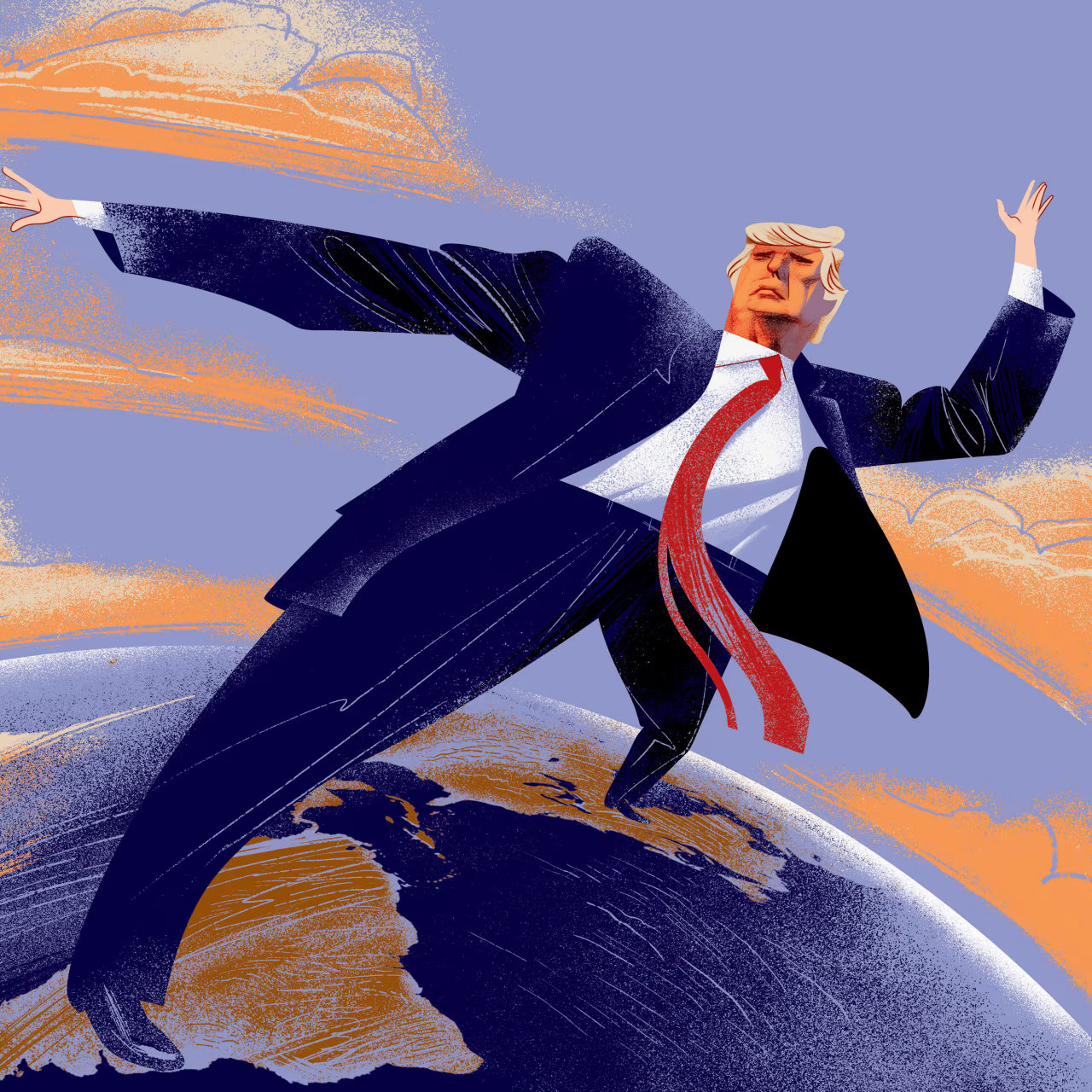
Sanctions

US Imperialism Enters a New Stage: The Left Needs to Take a Close Look at It

The US empire has opened multiple fronts in recent months. (Edgar Serrano)

Donald Trump’s rhetoric and actions against Iran, Venezuela and Cuba over the last year have few parallels in modern history. They have to be seen as marking a new stage. As such they call for a reevaluation of analysis and strategy on the part of the Left.

Trump’s repeated threat to bomb Iran “back to the Stone Ages where they belong” is unmatched by the rhetoric of even the most notorious and brutal heads of state over the recent past. Decapitating the entire leadership of a country to compel total submission, as Washington and Tel Aviv have done in Iran, is also a novelty in war strategy. The kidnapping of Venezuela’s president and First Lady as a first step in attempting to establish a colonial relationship by taking complete control of the country’s principal source of revenue, namely petroleum, represents a throwback to practices associated with centuries-old imperial rule

These are examples of “hyper-imperialism,” a concept theorized by Samir Amin to describe the United States “as the sole capitalist superpower.” More recently, the Tricontinental: Institute for Social Research has observed that U.S. hyper-imperialism persists despite a marked erosion of its economic and, though to a lesser extent, financial power. Its military supremacy is not only unrivaled, but is complemented by hybrid warfare, most notably “hyper-sanctions” and the use of lawfare.

What needs to be added to the concept of hyper-imperialism, particularly Trump’s version of it, is its sui generis nature. To find a parallel for the kind of hegemony the United States now exercises – highlighted by the continuous indiscriminate use of force and the threat of it – one would have to look back to the Roman empire or even earlier. One of Trump’s innovations is his deployment of the military to reinforce the system of economic sanctions, examples being the interdiction of oil tankers, the quarantine of Cuban oil, and full-scale war against Iran.

Trump II’s foreign policy hardly represents a complete break from the past. The groundwork was laid by past Democratic and Republican administrations. However, his actions force the Left not only to reformulate strategies, but to reconsider past evaluations and analyses of nations of the Global South subjected to extreme forms of imperialist aggression. The resistance to U.S. aggression must be given greater weight when evaluating governments. In addition, the popular desperation and exhaustion that erode revolutionary fervor and distance people from those same governments should be understood in light of the daily trauma people endure as a direct result of imperialist actions.

What Trump’s hyper-imperialism tells us

The starting point is to recognize that since Trump’s return to the White House, Iran, Venezuela and Cuba have been in a de facto state of war, which is an escalation of the multiple forms of hostility and aggression of past years. This is key to how all three nations should be judged. While the Left’s commitment to democracy needs to remain unquestionable and unwavering, in these cases primary responsibility for democracy’s somewhat uncertain prospects lies with the siege imposed by imperialist powers. No one other than James Madison said “Of all the enemies to public liberty, war is perhaps the most to be dreaded.”

The encirclement imposed by hyper-imperialism on Iran, Cuba, and Venezuela illuminates salient features of imperialism going back in time: first, Washington has honed the sanctions regime into a powerful tool, sometimes inflicting damage comparable to armed intervention; second, imperialism is the principal driver of the pressing economic problems facing the three nations; third, the justification for the actions taken against the three nations does not hold up under scrutiny; and fourth the brutality of the sanctions system underscores the need for its complete elimination. The discussion below looks at these points.

Tehran’s response to Operation Epic Fury underscores the crushing impact of sanctions. The nation’s leaders have made clear that the lifting of sanctions – as well as “international guarantees of U.S. non-interference” in the nation’s internal affairs – is a non-negotiable condition for ending the current conflict. That is to say, the Iranian leaders place the destruction caused by the sanctions on a similar footing as the bombs.

In the case of Venezuela, the events leading up to the abduction of Nicolás Maduro and Cilia Flores on January 3, 2026 reveal the far-reaching and highly coordinated machinery underpinning the sanctions regime. The second Trump administration’s tracking of the “ghost fleet” carrying Venezuela’s sanctioned oil—and its interdiction of several of those vessels— underscores how far Washington has gone in perfecting sanctions enforcement since the early years of the Cuban Revolution.

The first Trump administration pioneered in promoting “overcompliance” in which Washington’s well-publicized monitoring was designed to assure that companies and financial institutions world-wide would shun all transactions with Venezuela, even ones not specifically targeted by the sanctions. The aim was to impose a veritable blockade. Mike Pompeyo and Elliot Abrams spearheaded a campaign – drawing on the FBI, the Treasury, U.S. embassies, and the intelligence community – to scrutinize the dealings of companies worldwide with Venezuela, in what amounted to a warning shot to companies throughout the world. Even firms that engaged in oil-for-food swaps, which were not proscribed by the sanction regime, were warned that they ran risks. Companies under investigation were likewise told that penalties could be suspended if they halted all dealings with Venezuela.

A retrospective look at the first Trump administration’s sweeping enforcement measures and their devastating impact reinforces the argument that the sanctions have been so harmful that they need to be dismantled unconditionally and entirely. This position contrasts with that of liberals such as the Washington Office on Latin America (WOLA), which criticized the sanctions against Venezuela yet called for using “negotiations to flexibilize financial and oil sanctions” as leverage to secure concessions. Indeed, power brokers in Washington also favored sanctions relief as a bargaining tool to push the Maduro government to enact market-oriented reforms to the benefit of U.S. capital.

A full grasp of the scale and severity of Washington’s “war” on Venezuela undercuts the notion upheld by some on the left who argue that the sanctions were no more to blame for the nation’s pressing problems than government mismanagement. An even harsher position on the left affirms that the sanctions “do not explain the root causes of the societal collapse we have lived through.” 

Likewise, the forcible removal of Maduro and Flores demonstrates that Washington was intent on dismantling a government whose example and policies ran counter to U.S. interests. Prior to the January 3 kidnapping, some on the left in Venezuela and elsewhere denied that Washington sought to remove Maduro from power because they were convinced that he had effectively sold out. But they were wrong insofar as Washington clearly wanted Maduro out. Pedro Eusse, a leading member of the Communist Party of Venezuela (PCV), which broke with the Maduro government in 2020, wrote in July 2025, “Everything indicates that the true intention of the US and its allies’ policy of aggression toward the Venezuelan government has not been its overthrow, but its subordination.”

In the case of Cuba, the extreme measures of the Trump II administration against the nation also shine light on the cruelty and effectiveness of the system of sanctions per se. Trump’s navy-enforced quarantine on oil shipments is a first for the nation since the October 1962 missile crisis. The result has been recurring 16-hour blackouts that have disrupted water delivery, hospital operations, food production, and garbage collection.

The quarantine spotlights Cuba’s near total dependence on oil, in contrast to nearby Jamaica and the Dominican Republic, which generate a significant share of their electricity from coal and natural gas. The dependence stems precisely from the sanctions, which impeded imports and pushed Cuba into relying almost entirely on Venezuelan oil—only for Trump to cut off that supply too.

Indeed, the quarantine underscores Cuba’s reliance on Venezuelan oil and the reciprocal solidarity that saw fuel exchanged for Cuban medical personnel. That’s a plus for Maduro. The program undercuts the claim of some on the left that Maduro’s foreign policy, in the words of the PCV, never moved beyond an “anti-imperialist rhetoric” without substance.

The Washington-crafted narrative on Cuba and the reaction to it by the mainstream media and the Left are curious. In contrast to the demonization directed at Venezuela and Iran, Washington’s condemnation of Cuba has been relatively hollow and has gained little traction in mainstream outlets or left-leaning circles. The anti-Cuba vilification—driven by hardline anti-Communism—remains largely confined to the far right, epicentered in Miami. The official rhetoric is a departure from the wording in 1982 when the State Department designated Cuba as a State Sponsor of Terrorism due to “its long history of providing advice, safe haven, communications, training, and financial support to guerrilla groups and individual terrorists.” Now the Trump administration’s justification for the same designation is that the Cuban government grants “safe harbor to terrorists” and refuses to extradite them.

As false as the narco-terrorism case against Maduro is, it nonetheless offered a rationale that undoubtedly resonated with at least a slice of public opinion. Compare that to Marco Rubio’s line on Cuba which flatly denies the catastrophic effects of the oil quarantine. Rubio claims “we’ve done nothing punitive against the Cuban regime” and adds, the blackouts “have nothing to do with us.” Instead Rubio faults the Cuban leadership on grounds that “they want to control everything.” A classic case of victim-blaming, but with few buying into it. A YouGov survey in March found that only 28 percent of U.S. adults support the U.S.’s blocking of oil shipments to Cuba, as opposed to 46 percent opposed.

In addition, Rubio’s assertion that the only novelty is that Cuba is “not getting free Venezuelan oil anymore” is blatantly fallacious. Rubio is well aware of Venezuela’s swap with Cuba involving the latter’s International Medical Brigades, which maintain a sizeable presence in Venezuela and elsewhere. This is precisely why Rubio has vigorously attempted to sabotage the program throughout the region, unfortunately with a degree of success.

If the oil quarantine demonstrates anything it’s that the hardships facing the Cuban people are rooted in Washington’s war on Cuba, now going on 65 years. Criticism of Cuban government policies, or of socialism itself, comes in a distant second place.

The Trump II disaster should be an eye opener

Trump’s bullying offensive abroad has fueled mounting opposition to interventionism and has even fostered anti-imperialist sentiment in the United States. Just one week into the 2026 Iranian bombings, 53 percent of the U.S. population opposed the strikes, in sharp contrast to U.S. military involvement in Vietnam, the Gulf War, Afghanistan, and Iraq, which enjoyed large majority support at the outset. That the former editor of The New Republic called the U.S. war on Iran imperialistic is telling. In a New York Times op-ed, Peter Beinart wrote “Donald Trump’s foreign policy vision is imperialism.”

One lesson of recent events is particularly relevant for the Left: the demonization of heads of state is a sine qua non for military intervention. In the case of Iran and Venezuela, the discrediting combines some fact with a large dosage of fake news. In the case of Maduro, the demonization which dates back to shortly after he assumed office in 2013, was taken to higher levels as a result of the controversial presidential election of July 28, 2024, which the opposition claimed was fraudulent. Subsequently the corporate media consistently tagged the word “autocrat” and “dictator” onto Maduro’s name. Six months later, Trump was in office and the vilification escalated to a new pitch. Indeed, the branding of Maduro as a narco-terrorist was an indispensable prelude to the bombing of boats in the Caribbean and the subsequent kidnappings – notwithstanding the doubts raised by some media outlets regarding the veracity of the claim.

The takeaway is that the Left needs to distinguish between criticism and demonization and take cognizance of the possible dire consequences of the latter.

The demonization of Supreme Leader Ali Khamenei and his inner circle also set the stage for imperialist actions, but, of course, his government could not be placed in the same category as those of Cuba and Venezuela.

Furthermore, as in Venezuela and Cuba, harsh sanctions have been conducive to shadow economies, clientelistic networks, and fraudulent dealings, patterns well documented in numerous studies on sanctions throughout the world.

Eskandar Sadeghi-Boroujerdi, a prolific scholar on Iran who is highly critical of the government, told JacobinWhile the Islamic Republic is paranoid, it is also very much under siege from all sides.” He also notes the intrinsic relationship between the sanctions and the nation’s pressing problems: “Sanctions and structural weaknesses of the Iranian economy feed off one another — there’s a symbiotic relationship between them.”

In short, any serious reading of Iran must foreground the role of sanctions—an approach that inevitably tempers the tendency to cast its leadership in purely demonizing terms.

The lessons of July 28, 2024

The issue of the accurateness of the July 28, 2024 election tallies in Venezuela needs to be reframed. Those elections could not have been democratic, regardless of the announced results, because Venezuelan voters had a gun pointed at their heads: reelect Maduro and the sanctions continue; elect an opposition candidate and the sanctions will be lifted.

The overwhelming majority of Venezuelans knew full well what was at stake. Luis Vicente León – the nation’s leading pollster, himself a member of the opposition – reported that 92 percent of the population believed that the sanctions negatively impacted the economy, and most characterized the effect as “very negative.” (The poll puts the lie to the State Department’s repeated claim that the sanctions only harm government officials.)

A similar scenario played out in the Nicaraguan presidential elections of 1990 when opposition candidate Violeta Chamorro upset the Sandinistas in the midst of a devastating, U.S.-promoted civil war. But there was a fundamental difference. Far from demonizing the Sandinistas, Chamorro accepted a power-sharing transition agreement with them. In contrast, for over a decade prior to the July 28 elections the opposition’s main leader, María Corina Machado, had ruled out negotiations with those who had allegedly violated human rights. She never tired of voicing the slogans “no immunity,” ”no to amnesty,” “no agreements with criminals,” often with specific reference to the Chavistas and to Maduro himself. Maduro and his followers had every reason to fear the type of repression that the opposition initiated during the two-day abortive coup it staged in April 2002 against the Chavista government. Even opposition pollster León admitted that the fear was well-founded.

Marta Harnecker, the renowned leftist theoretician, wrote that the Sandinistas erred in holding the 1990 elections amid U.S. promoted violence and sabotage. Harnecker labeled the decision to organize elections “on terrain shaped by the counterrevolution” a “strategic error.”

A reevaluation and reinterpretation of the July 28 elections is instructive. The hard-core Chavistas accept the official results which showed Maduro winning with nearly 52 percent of the vote. The opposition refutes that claim. A third position is defended by supporters of Maduro who nevertheless express skepticism and point out that because of a massive hacking attack from outside the country, it may be impossible to ever know the true count.

The debate about the accuracy of the official results of July 28 sidesteps the overriding issue of whether the elections should have been held in the first place. Indeed, the idea of conditioning elections on the lifting of sanctions was not far-fetched. A year before the elections, Maduro, in a reference to the United States, declared: “If they want free elections, we want elections free of sanctions.” Subsequently, Elvis Amoroso, the Chavista head of the nation’s electoral council, tied the participation of European Union electoral observers to its lifting of sanctions. At the same time, the Biden administration indicated its willingness to bargain with the Venezuelan government along those lines.

Carlos Ron, a former vice-minister and currently an analyst for Tricontinental, told me that the Chavista leadership ruled out delaying the elections in order to demonstrate its democratic credentials in the face of the international smear campaign. Ron said “At that moment, greater importance was placed on the need to defend the democratic character of the Bolivarian political process and its continuity, and abide by the Constitution, in the face of imperialist pressures.”

Maduro’s intentions may have been commendable. But the decision overlooked one compelling reason to suspend the electoral process. Tying the holding of elections to the removal of the sanctions would have placed the entire blame for setbacks to democracy where it belonged: U.S. intervention in Venezuela’s internal affairs.

In defense of democracy

As a rule, the Left has always championed the defense of democracy. In this sense, the Left’s vision compares favorably with U.S.-style “liberal democracy,” shaped by the influence of big money and other inherently undemocratic practices such as gerrymandering, the Electoral College and voter suppression.

Historically, however, the Left has faced formidable obstacles on this front. For instance, it has come to power in countries like Russia, China and Cuba that were lacking in democratic tradition. That, however, was the least of the problem. Its main problem has been, and continues to be, imperialist hostility which limits options.

Precisely for that reason, the Left needs to tread cautiously in the way it frames the issue of democracy in nations that are in the crosshairs of imperialism. In the three countries discussed in this article, the Left can’t deny that democracy has been infringed upon. The Maduro government, for instance, stripped the PCV – the country’s oldest political party, forged in a history of militant struggle including two periods of clandestine resistance armed struggle in the 1950s and 1960s – of its legal status, transferring recognition to a marginal breakaway faction that appropriated its name and symbols.

Nor can it deny that discontent is currently widespread in the three nations, which became most evident in the Iranian “Woman, Life, Freedom” protests and those of the first days of this year. In Cuba and Venezuela, protests reflect widespread disillusionment, even while the mobilizations have been manipulated and financed from abroad.

One troubling sign in Venezuela is that the disturbances have spread out from upper-middle class neighborhoods where they were confined during the 4-month protests (the “guarimba”) of 2014 and, albeit less so, during those of 2017. The two days following the July 28, 2024 elections, for instance, protests were registered in Caracas barrios such as Petare, the city’s largest. Reflecting on the protests, long-standing Caracas resident and international commentator Phil Gunson reported “Petare is a traditionally Chavista zone, but ever since a few years ago, people have been distancing themselves from the government.”

The Left can’t turn its back on this reality. But nor can it join mainstream voices that channel dissatisfaction into blanket vilification of governments under imperial siege. Rather its line has to be basically: “What do you expect!” In the face of hyper-imperialist aggression these countries are at war, figuratively and in some cases literally speaking. Criticism needs to be framed within this context.

Lenin’s concept of democratic centralism – the principle designed to guide the internal workings of his political party – is instructive. In his writing throughout his political career, party democracy remained a constant, but the degree of centralism depended on the political climate in the nation. Along similar lines, the Left’s adherence to democracy can never be minimized. However, valid criticism of undemocratic practices in countries like Venezuela and Cuba in which the Left is in power needs to consider those actions as overreactions to imperialist aggression.

In this era of intensified hyper-imperialism, the Left is compelled to stand behind nations like Cuba and Venezuela, and recognize that the real blame for backsliding including violation of democratic norms lies with imperialism. The barbaric actions of Trump II are making this imperative clearer than ever.

Steve Ellner is a retired professor of the Universidad de Oriente in Venezuela where he lived for over 40 years and is currently Associate Managing Editor of Latin American Perspectives. He is the author and editor of over a dozen books on Latin American politics and history. In 2018 he spoke in over twenty cities in the U.S. and Canada as part of a Venezuelan solidarity tour.

The views expressed in this article are the author’s own and do not necessarily reflect those of the Venezuelanalysis editorial staff.

This article was originally posted in CounterPunch.

Source link

Iran’s currency falls to new low as US blockade, sanctions impact trade | US-Israel war on Iran News

Tehran, Iran – Iran’s national currency has plunged to new lows as authorities mobilise to dampen the impact of the naval blockade enforced by the United States.

The Iranian rial shot above 1.81 million to the US dollar on the open market by early afternoon on Wednesday before partially recovering. The embattled currency changed hands for about 1.54 million earlier this week, and its rate was about 811,000 per US dollar a year ago.

Recommended Stories

list of 3 itemsend of list

The rial had remained relatively stable over the past two months after experiencing an earlier drop as US forces amassed in the lead-up to the US-Israeli war on Iran, which began at the end of February.

The latest freefall follows on from unchecked inflation, which has been increasingly plaguing the Iranian economy as a result of mismanagement and sanctions, and continues to ravage households. Washington now has three aircraft carriers in the region and is bringing in more troops and equipment as Israel expresses readiness to restart fighting, three weeks after a ceasefire began.

Iran’s authorities this week projected a hardened stance on negotiations with Washington, and pledged to fight the naval blockade of Iran’s southern waters, which the US Central Command insisted on Tuesday had “cut off economic trade going into and coming out of” the country.

Amid threats by US President Donald Trump, the Iranian government has also tried to empower its own border provinces to import essential goods by reducing red tape. It has also allocated $1bn from the sovereign wealth fund to buy food, and made a partial policy U-turn to restart offering a preferential subsidised exchange rate with the goal of reducing prices, despite concerns about corruption.

Non-oil trade takes hit

According to customs data released by state media, Iran’s non-oil trade has been negatively affected after commercial ties were disrupted or cut off as a result of the war, and critical infrastructure was bombed.

Iran’s customs authority put the total value of non-oil trade in the Iranian calendar year that ended on March 20 at close to $110bn, with $58bn going to imports. The figure was about 16 percent lower than the year before.

The volume of non-oil trade was valued at approximately $9bn for the 11th month of the calendar year ending on February 19, and $6.46bn in the final month, indicating a drop of about 29 percent in connection with the war, which started on February 28. The final month was also about 50 percent lower than the more than $13bn estimated value for last year’s corresponding month.

Part of the drop is linked with the fact that shipping has been significantly disrupted through the Strait of Hormuz as Iran and the US spar over control of the strategic waterway. The US and Israel also directed some of their thousands of strikes against ports, naval facilities, airports, and railway networks across the country.

Iran’s top steel and petrochemical producers were also extensively bombed, as were oil and gas facilities, power stations, and major industrial zones. The US and Israel have threatened to take Iran “back to the Stone Age” through systematic bombing of civilian infrastructure like power plants.

To manage the impact and preserve domestic supply, Iranian authorities have imposed temporary restrictions on exports of steel, petrochemicals, polymers and other chemicals.

Oil exports in the crosshairs

The US is using its military capabilities and economic chokeholds to drive down Iran’s oil exports, a goal that it has also pursued over recent years through sanctions.

Since mid-April, the US military has been deploying its soldiers to take over or inspect ships transiting through waterways near Iran, in addition to targeting what is known as a shadow fleet of tankers used by Iran to circumvent sanctions and ship its oil.

Warships and thousands of troops could still launch a ground invasion or destructive aerial attacks against Iran’s Kharg and other critical islands, and the Trump administration expects increased pressure on Iran’s oil sector due to hampered access to export routes and supertankers keeping the oil stored on the water.

The US Treasury has been blacklisting refineries in China, the biggest buyers of Iranian crude oil, and going after the banking and cryptocurrency channels alleged to be facilitating Tehran’s oil trade, and having links to the IRGC – which Washington considers a “terrorist” organisation.

“We will follow the money that Tehran is desperately attempting to move outside of the country and target all financial lifelines tied to the regime,” said US Treasury Secretary Scott Bessent on social media.

Chinese refineries buy roughly 90 percent of Iran’s oil shipments, and imported a record 1.8 million barrels per day ⁠in March, according to Vortexa Analytics data cited by the Reuters news agency, which also said purchases were expected to slow due to worsening domestic refining and processing margins.

According to figures released by the General Administration of Customs of China, the volume of the country’s bilateral trade with Iran during the first quarter of 2026 stood at $1.55bn, down 50 percent year-on-year.

In March, the first month of the war, trade stood at $184m, which was nearly 80 percent lower than the year before and 64 percent lower than the month before. China’s imports from Iran and exports to the country were both considerably reduced as a result of the war.

The removal of the United Arab Emirates as a major trade partner and import market for Iran has also significantly affected the country’s economy, increasing its reliance on land neighbours like Turkiye and Iraq to the west and Pakistan to the east.

The UAE, a big part of the Trump-led Abraham Accords that saw multiple countries normalise relations with Israel, was heavily targeted by ballistic missiles and drones launched by Iran.

The UAE has closed down numerous Iranian institutions on its soil over the past two months, including financial facilitators, instructed Iranian citizens to leave, and has said it will take years to restore bilateral relations to previous levels.

Source link

U.S. sanctions Iran shadow banking network as peace talks stall

April 29 (UPI) — The United States has sanctioned 35 entities and individuals accused of overseeing a shadow-banking network that moved tens of billions of dollars for Iran, as the Trump administration flexes Washington’s financial might amid a stalemate in peace negotiations with Tehran.

The sanctions announced Tuesday come as U.S.-Iran peace negotiations came to a halt last week after Tehran said it would not participate in talks until the United States lifted its blockade of sea-based trade to the Middle Eastern nation.

Those blacklisted by the Treasury include several private companies known as rahbars, which manage thousands of overseas companies used by Iranian banks cut off from the international financial system to execute payments for Iranian trade.

According to the Treasury, these rahbar companies coordinate with Iranian exchange houses and front companies to conduct international trade on behalf of the Islamic Revolutionary Guard Corps, Iran’s Armed Forces General Staff, the National Iranian Oil Company and other sanctioned entities.

“By dismantling these financial channels, we advance the administration’s policy in the conflict with Iran and underscore our commitment to imposing maximum pressure on Iran,” State Department spokesman Thomas Pigott said in a statement.

The punitive action was part of what the Treasury calls Operation Economic Fury, a branded escalation of President Donald Trump‘s broader maximum-pressure campaign against Iran.

Coinciding with the sanctions on Tuesday, the Treasury’s Office of Foreign Assets Control issued an alert to financial institutions over the risks they face for doing business with so-called teapot oil refineries in China, primarily in Shandong Province, that import and refine Iranian crude oil.

According to the alert, China is the largest purchaser of Iranian oil, and the Treasury has designated multiple small China-based refineries since March of last year.

“The United States will further disrupt illicit funding streams that finance Iran’s malign activities,” Pigott said.

“We will not relent in our efforts to deny Iran and its proxies the resources they use to threaten U.S. interests and regional stability.”

Trump first employed the maximum-pressure campaign strategy to coerce Iran into negotiations over its nuclear program in 2018 after unilaterally withdrawing the United States from a landmark multinational accord that sought to prevent Tehran from obtaining a nuclear weapon.

Iran then breached its commitments under the deal, enriching uranium up to 60%, far exceeding the accord’s 3.67% but below weapons-grade levels.

Trump restored the maximum-pressure campaign after returning to office in 2025, and the United States bombed three major Iranian nuclear facilities that June.

The United States and Israel have since escalated their pressure campaign, attacking Iran in strikes that triggered a war now halted by a fragile cease-fire to permit peace talks.

Iran has imposed restrictions on energy trade through the Strait of Hormuz, prompting the United States to impose a blockade of Iran’s ports in response to what it describes as Tehran holding a major share of the world’s energy supplies hostage.

Source link

Taiwan Shrugs off China Sanctions on European Arms Firms

Taiwan has downplayed the impact of new Chinese sanctions targeting European defense companies involved in arms sales to the island. The measures, announced by China, restrict exports of dual use goods to seven firms, marking a rare move against European entities over Taiwan related issues.

Despite the escalation, Taiwan’s Defence Minister Wellington Koo said the sanctions would not disrupt the island’s ability to procure military equipment.

China’s Expanding Use of Sanctions

Beijing has increasingly used economic and trade restrictions to respond to foreign involvement in Taiwan’s defense. While similar sanctions have frequently targeted U.S. arms manufacturers, extending them to European companies signals a broader willingness to pressure multiple partners simultaneously.

The move reflects China’s ongoing effort to isolate Taiwan internationally and deter military cooperation with the island.

Limited European Military Role

Europe’s direct role in arming Taiwan has historically been limited. Major defense exports such as fighter jets have not been supplied for decades due to concerns about damaging relations with China.

However, smaller scale cooperation and component level trade have continued, making these sanctions symbolically significant even if their immediate practical impact is modest.

Diversified Supply Strategy

Taiwan relies heavily on the United States for its defense needs, but it has also worked to diversify procurement channels in recent years. According to Koo, this strategy ensures that disruptions from any single source, including sanctioned European firms, can be mitigated.

Growing support from parts of Central and Eastern Europe, particularly after Russia’s invasion of Ukraine, has also provided Taiwan with additional diplomatic and logistical avenues.

Geopolitical Context

The sanctions come amid heightened global tensions and shifting alliances. China views Taiwan as its own territory and strongly opposes any foreign military assistance to the island.

At the same time, Taiwan’s security concerns have intensified, prompting it to strengthen international partnerships and defense preparedness.

Analysis

China’s decision to target European companies represents an escalation in its economic statecraft, aiming to widen the cost of supporting Taiwan beyond the United States. While the immediate impact on Taiwan’s military capabilities appears limited, the move could have a chilling effect on future European involvement.

Taiwan’s confidence reflects its reliance on U.S. support and its broader diversification strategy. However, repeated sanctions and pressure campaigns could gradually narrow its options, especially if European firms become more risk averse.

For Europe, the sanctions pose a strategic dilemma between economic ties with China and growing political alignment with Taiwan and its partners. For China, they reinforce its stance on sovereignty while testing how far it can push back against international support for Taiwan without triggering broader backlash.

Overall, the episode underscores how economic tools are increasingly being used in geopolitical competition, even when their direct material impact remains limited.

With information from Reuters.

Source link

The Neocolonial Plunder of Venezuelan Resources

The Trump administration’s January 3 military strikes opened a new era of US imperialism in Venezuela built on the plunder of the country’s resources. This interactive infographic explains Venezuela’s recent pro-business reforms, US neocolonial impositions through licenses, and the conglomerates that have already taken advantage to strike agreements.

(Click on the crosses for additional information)

(Click here to download the full infographic)

Source link

Venezuela Begins ‘National Pilgrimage’ to Demand End to Sanctions

Rally outside a Catholic basilica in Zulia state. (Prensa Presidencial)

Mérida, April 20, 2026 (venezuelanalysis.com) – The Venezuelan government launched a “Great National Pilgrimage” to oppose economic sanctions on Sunday, April 19, coinciding with the 216th anniversary of the country’s declaration of independence.

The nationwide mobilization seeks to channel popular opposition to the US-led economic blockade into a sustained, nationwide movement. 

The pilgrimage was inaugurated in three Venezuelan regions, with a calendar of marches, assemblies, and cultural activities covering the remaining 21 states before a closing event in Caracas on April 30. 

In western Zulia state, Acting President Delcy Rodríguez led a rally through the streets of Maracaibo. Addressing a crowd, Rodríguez linked the historical struggle for independence to the modern-day resistance against Washington’s unilateral coercive measures.

“It is a date that marks the first cry for independence from a united people, and so, beginning with that historic date, I feel compelled to embark on this pilgrimage,” she declared to the crowd.

Venezuelan leaders have sought to highlight the impact of unilateral coercive measures on living standards and public services to push for their withdrawal.

“We want Venezuela to be free of sanctions, so that it can grow without restrictions,” Rodríguez affirmed at the Zulia rally. “I am speaking to the people of the United States, Europe, and the governments of those countries. Please stop levying sanctions against the Venezuelan people.”

In Puerto Ayacucho, Amazonas, National Assembly President Jorge Rodríguez led a parallel mobilization on Sunday. He emphasized that the pilgrimage is not merely a political event but a “spiritual and national defense” of the country’s right to self-determination. The campaign’s launch in border states highlighted the disruptions to public services that are generally more acute away from the capital and surrounding areas.

The government’s initiative was also backed by sectors of the moderate opposition. Timoteo Zambrano, deputy from the Democratic Alliance, vowed that his political faction would participate in the pilgrimage.

“[Pilgrimage] is a deeply religious term that unites the world’s religions. We are witnessing a new moment to fight together against sanctions and the blockade,” he said in a press conference in Caracas on Saturday.

For his part, Acción Democrática Secretary-General Bernabé Gutiérrez claimed that Caracas must ask the Trump administration to release proceeds from oil exports “so they reach the state coffers and allow for the solution of our problems.” 

Since January, the White House has imposed control over Venezuelan crude sales, with Venezuela-owed royalties, taxes, and dividends mandated to be deposited in US Treasury-run accounts before being returned to Caracas at US officials’ discretion.

The “Great National Pilgrimage” takes place against a backdrop of nearly a decade of economic pressure from Washington. The first Trump administration launched a “maximum pressure” campaign in 2017 with the goal of triggering regime change.

US Treasury sanctions targeted multiple economic sectors, from mining to banking, and particularly targeted the oil industry, causing an estimated US $25 billion in yearly revenue losses. The blockade also effectively gridlocked Venezuela from international credit markets and saw Venezuelan foreign assets frozen and seized. 

Since the January 3 US military attacks and kidnapping of President Nicolás Maduro, Caracas and Washington have fast-tracked a diplomatic rapprochement. Acting President Rodríguez has struck a conciliatory tone toward the US, recently thanking Trump and US officials for their efforts in reestablishing “cooperation.”

The US Treasury Department has maintained wide-reaching sanctions in place but issued a series of general licenses in the hydrocarbon, mining, and banking sectors, allowing Western entities to deal with Venezuelan counterparts under restricted conditions.

Edited by Ricardo Vaz in Caracas.

Source link

U.S. renews pause on Russian oil sanctions (CL1:COM:Commodity)

Apr 18, 2026, 8:42 AM ETCrude Oil Futures (CL1:COM), USO, CO1:COM, NG1:COM, , , , , , , , , , , , , , By: Dulan Lokuwithana, SA News Editor
Top view on Oil-storage tank with the tanker at a mooring.

KadnikovValerii/iStock Editorial via Getty Images

The U.S. Treasury Department has extended a waiver that will temporarily ease some sanctions on Russian oil shipments just two days after Secretary Scott Bessent said Washington would not renew the exemption despite surging oil prices caused by Middle Eastern tensions.

Source link

Venezuela: Trump Administration Issues Banking Licenses as Rodríguez Eyes ‘Long-Term’ US Energy Ties

Rodríguez hosted US Energy Assistant Secretary Kyle Haustveit at Miraflores Palace. (Presidential Press)

Caracas, April 15, 2026 (venezuelanalysis.com) – The US Treasury Department’s Office of Foreign Assets Control (OFAC) issued two new general licenses on Tuesday facilitating transactions with Venezuelan state institutions.

 for Venezuela on Tuesday: a commercial license (No. 56) and a financial license (No. 57), signaling a partial easing of restrictions while maintaining key controls.

General License 56 (GL56) authorizes US entities to negotiate and sign “contingent contracts” for future commercial operations in Venezuela. This allows firms to move forward with agreements, investments, or projects, though their final execution remains subject to separate OFAC approval.

The waiver maintains important restrictions, including a ban on payments in gold or cryptocurrencies, as well as prohibitions on transactions involving China, Russia, Iran, North Korea, and Cuba. It likewise forbids transactions involving Venezuelan debt and does not unblock currently frozen Venezuelan assets.

For its part, General License 57 (GL57) permits a broad range of financial operations with the Venezuelan Central Bank (BCV), as well as Venezuela’s public banks: Banco de Venezuela, Banco Digital de los Trabajadores, Banco del Tesoro, and entities in which these institutions hold a 50 percent or greater stake.

The allowed transactions include opening and managing accounts, conducting US dollar transfers, issuing loans, and providing banking services. The BCV was sanctioned in April 2019, effectively isolating Venezuela from international financial circuits and increasing costs for basic transactions.

The latest sanctions waivers are expected to facilitate financial flows to the Venezuelan economy, including the transfer of Venezuelan oil revenues that are currently controlled by the Trump administration. US authorities have returned a confirmed US $500 million out of an initial deal estimated at $2 billion, while US and Venezuelan officials have confirmed the purchase of US-manufactured medicines and hospital equipment using Venezuelan funds.

Analyst Hermes Pérez warned that reincorporation into the SWIFT system and establishment of US-based accounts could take several months due to security and technological requirements. Other economists argued that GL57 could allow the Central Bank to stabilize the Venezuelan foreign exchange system.

For several years, a parallel exchange rate between the US dollar and the Venezuelan bolívar has coexisted with the official one set by the Central Bank, often with a gap above 50 percent that fueled distortions in retail activities and currency speculation.

Since the January 3 military strikes and kidnapping of Venezuelan President Nicolás Maduro, the Trump administration has issued several licenses to expand US influence in the Caribbean nation, particularly in key economic sectors such as hydrocarbons and mining.

In parallel, Venezuelan authorities have promoted several pro-business reforms, while multiple Trump officials and corporate executives have come the South American country and held meetings with the acting government led by Delcy Rodríguez.

The latest waivers coincided with the visit to Caracas of a US Department of Energy delegation led by Assistant Secretary Kyle Haustveit. Rodríguez hosted the official on Wednesday in a work meeting at the presidential palace.

During a short, televised intervention, Rodríguez argued that OFAC licenses do not provide sufficient “legal certainty” and reiterated calls for Trump to lift unilateral coercive measures against the country.

“An investor requires greater legal certainty. A license does not provide long-term legal guarantees because it is subject to temporality,” she argued. Rodríguez claimed Washington and Caracas have “enough maturity” to establish “long-term” energy cooperation ties.

“We are working very hard on changes that can attract investment, and which can build an energy cooperation agenda with the United States,” she said.

Rodríguez additionally disclosed recent meetings with representatives from ExxonMobil and ConocoPhillips, stating that authorities have “taken into account recommendations” from oil majors in recent legislative overhauls. Both ExxonMobil and ConocoPhillips refused to accept hydrocarbon reforms under former President Hugo Chávez in the 2000s, later securing multi-billion-dollar arbitration awards against the Caracas as compensation for the nationalization of their assets.

Haustveit and the Energy Department delegation were also present on Monday during the signing of agreements with Chevron that granted the Texas-based conglomerate an increased stake in the Petroindependencia joint venture and awarded an additional extra-heavy crude bloc for exploration to the Petropiar mixed company. Chevron owns minority stakes in both joint enterprises with Venezuelan state oil company PDVSA.

Shell, Eni and Repsol are among the other energy giants to have recently advanced in deals with the Venezuelan government under the improved conditions of the new Hydrocarbon Law.

US Chargé d’Affaires in Venezuela Laura Dogu was also present at the Chevron deal-signing ceremony and the meeting with Haustveit’s delegation. However, the White House announced Wednesday that her post will be taken over by veteran diplomat John Barrett.

Barrett, who previously served as chargé d’affaires at the US Embassy in Guatemala since January 21, 2026, was recently accused by Guatemalan President Bernardo Arévalo of interference during judicial elections for the Constitutional Court held in March.

Edited by Ricardo Vaz in Caracas.

Source link