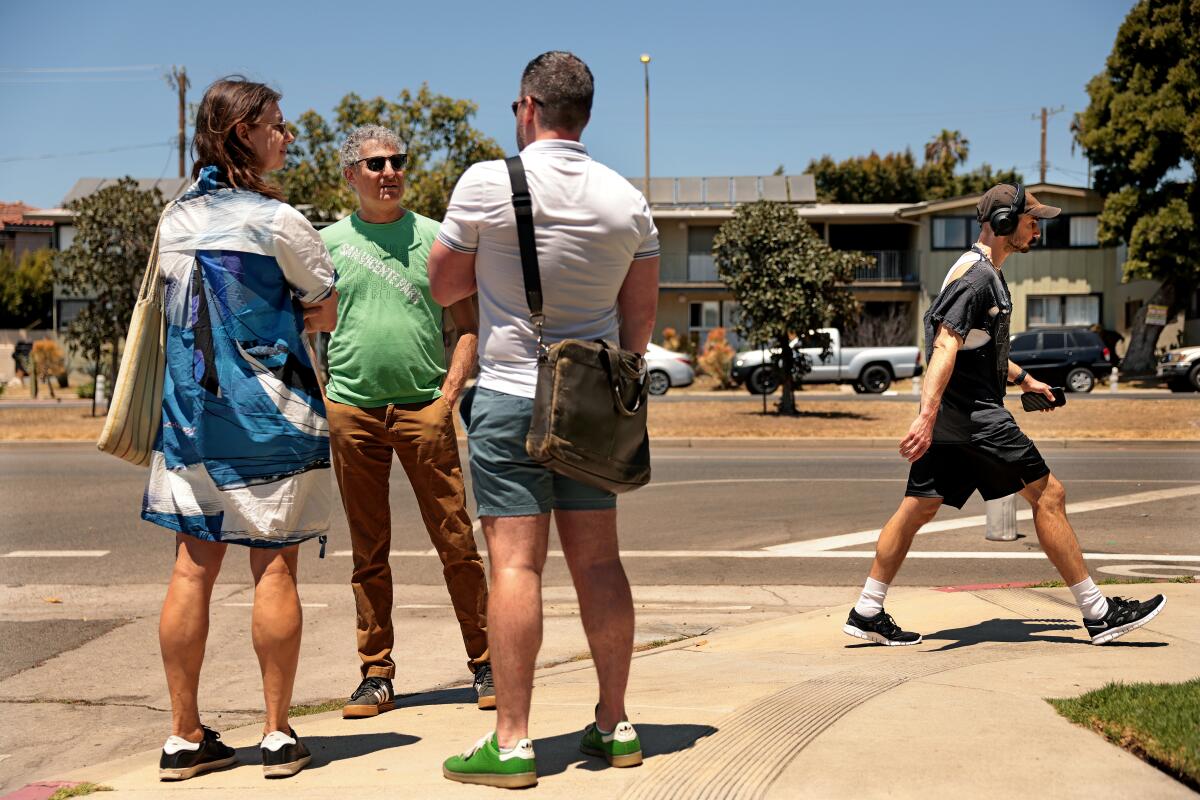
Just past noon, a young man appeared on the north side of San Vicente Boulevard, a block west of Hauser, and eyeballed the flow of westbound traffic.
When he saw an opening, he slid across to the median strip, where he waited for eastbound traffic to let up before crossing over to the south side of San Vicente to pick up some takeout food. And then he retraced his steps across the 150-foot wide thoroughfare that knifes through the heart of the city along what once was the Red Car line of the Pacific Electric Railway.
He should have used the nearby crosswalk, but there aren’t enough of those on the boulevard, so pedestrians routinely skitter and scoot across the street like they’re in a game of Frogger.
I watched this drama the other day from Dam Good Coffee, where I met with two guys who live in the neighborhood and, in their spare time, have been doing a lot of thinking. They’re fine-tuning a pitch to reengineer the boulevard, reduce traffic, improve access to two new transit lines and transform the Mid-City portion of San Vicente Boulevard — from the Beverly Center on the west to just past La Brea on the east — into a 3-mile, 30-acre linear park.
Ambitious. Outlandish. Insane.

From left, Catherine Geanacouras, Oren Hadar and Michael Wacht of the San Vicente Park Foundation have a plan to turn a stretch of San Vicente Boulevard into a greenway.
(Christina House / Los Angeles Times)
It’s all of that and a longshot undertaking, given the countless obstacles that can derail their dream. But Oren Hadar, a sound engineer, and Michael Wacht, an architect, are serious, along with a small coalition of neighborhood believers.
“One of the things I always say is L.A. needs to get back into the business of taking big swings,” Hadar said. He is motivated in part by the fact that his two young kids don’t have a nearby park to play in.
The big swing comes at a time when Los Angeles has just fallen from 90th to 93rd in terms of park acreage, investment and accessibility in the annual Trust for Public Lands ranking of the 100 largest cities in the U.S. You’d think a city with great weather and thousands of apartment dwellers with little or no outdoor space would fight its way into the top 10 rather than settle for sinking to the bottom of the heap.
“What if L.A.’s next great park was already here, hiding in plain sight?” a narrator asks in a video that appears on the group’s San Vicente Park website.

Local resident Jo and her dog Elle carefully cross San Vicente Boulevard in Los Angeles on Wednesday, June 17, 2026.
(Christina House/Los Angeles Times)
Sun-baked asphalt would give way to turf. Pedestrians and cyclists would have more breathing room. There’d be far less traffic.
“You can put in micro forests,” Wacht said. “You can do farmers markets. You can do growing areas. You can do fountains. Playgrounds.”
Catherine Geanuracos, a CicLAvia board member who was an advocate for turning the Silver Lake Reservoir into an aquatic park, joined our conversation and called the idea “eminently feasible.”
“I think this is what makes L.A. great,” Geanuracos said. She’s lived in New York City and San Francisco and thinks there’s greater opportunity here for engaged residents to advance their civic improvement ideas.
The advocates said they’d gotten some encouragement from Councilmembers Heather Hutt and Katy Yaroslavsky, whose districts include the area of the proposed park. Hutt’s office sent me a statement saying she supports “effrorts to create more walkable, green communities.” She said she has encouraged the group to keep exploring the vision, and she looks forward to hearing input from various other neighborhood groups.
Hadar writes a blog called The Future Is L.A., which is part love letter to Los Angeles and part lament on unmet potential.
“Just about every other major American city has a policy and research think tank dedicated to pursuing ideas that could make the city better,” Hadar recently wrote, calling for L.A. to have its own.
I don’t want to say the park idea’s chances are slim, but let’s look at a few hurdles.

Traffic passes through the intersection of San Vicente Boulevard and La Brea in Los Angeles on.
(Christina House / Los Angeles Times)
L.A. city government has trouble managing existing parks and even the open spaces around City Hall, so how can it build and care for another 30 acres of greenery?
The cost would be in the millions, and the cup does not runneth over.
And then there’s the biggest pothole of all on the road to pastoral wonder:
Creating the park would mean squeezing off one or two lanes of traffic in each direction of San Vicente. That would dump more cars onto surrounding streets and set up another road diet clash that pits car culture against growing demand for a city that is safer and more inviting for those who walk, bike and use transit.
All of this would be examined in a feasibility study the advocates are raising money for. But the supporters claim San Vicente is lightly traveled compared to Wilshire, Pico and Olympic, so stealing traffic lanes wouldn’t be catastrophic.
I mentioned that I’d think twice about sending kids to play in a median strip park. But the supporters said San Vicente would become more of a neighborhood service street than a thruway, with safer crossings into the new park, which by the way already has plenty of full-grown trees.
When I took a walk and polled people on the park idea, I got mixed reactions.
“That’s a bad idea,” said a man who was walking along the median strip. He said he thought that after the addition of bike lanes a few years ago squeezed vehicular traffic, San Vicente became more dangerous, and the idea of a park between lanes of traffic sounded disastrous to him.
Miguel Lopez looked like he was trying to bring the park vision to life. He sat on the median strip reading a book and smiled when he was shown a rendering of San Vicente Park.

Blanca Vanburian practices tai chi in her yard along San Vicente Boulevard on Wednesday.
(Christina House / Los Angeles Times)
Blanca Vanburian, who was doing a variation of Tai Chi on the lawn outside her apartment building, had several good questions, including one about whether the city could be trusted to maintain a new park. She said a lot of residents would be concerned about new traffic flows through side streets, and she wondered if the park would attract more homeless people.
Hadar told her the feasibility study would probe all of that, and the more she heard, the more Vanburian came around to the idea of the park.
“It’s up to us how we use public space,” Wacht said, looking out on a particularly unattractive stretch of roadway that generates so much exhaust and serves as a barrier, dividing two neighborhoods. “I get disappointed when I see so much of it devoted to this, and it’s keeping us from being more of a cohesive neighborhood.”

Margaret Free walks three basset hounds, named Bob, Doris and Ruth, along San Vicente Boulevard in Los Angeles on Wednesday.
(Christina House / Los Angeles Times)
Margaret Free was walking three Basset hounds — Bob, Doris and Ruth. She said she and the dogs could be counted as four votes in favor of the park.
A woman named Jo safely managed a Frogger crossing with her dog, Elle. Jo said she was absolutely in favor of a park and doesn’t think losing lanes of vehicle traffic is a bad thing, but she feared backlash from drivers who disagree and asked me to withhold her last name.
Joshua Mock, owner of Dam Good Coffee, said everyone would benefit from the park, especially neighborhood children. “It’d be dope,” he said, “and good for business.”
For all the doubters, the advocates point to several projects around the country where public spaces were repurposed, including the New York City High Line. And they note that several local projects are in the design or construction phase, including the L.A. River master plan, the Broadway-Manchester streetscape project and the park under the Sixth Street bridge.
If you have ideas for remaking your neighborhood, send them my way.
And take big swings.
steve.lopez@latimes.com