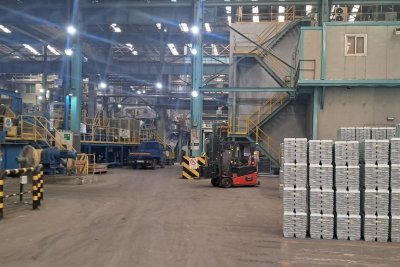

An autonomous forklift operates at Korea Zinc’s smelter in Ulsan, about 250 miles southeast of Seoul, on Wednesday. Photo by Tae-gyu Kim/UPI
ULSAN, South Korea, April 29 (UPI) — Founded in 1974, Korea Zinc began to churn out 50,000 tons of zinc in 1978 at its Onsan smelter about 250 miles southeast of Seoul. Over the next five decades, it expanded annual zinc capacity by more than 11-fold to 560,000 tons.
In addition, Korea Zinc added lead and copper into its production portfolio, a diversified smelting model it says underpins the competitive edge of the world’s largest non-ferrous metal manufacturer.
“In other smelters making just one substance, they have to deal with waste. But we take advantage of them to retrieve other materials,” Korea Zinc engineer Kang Ki-tae said. “That’s why our Onsan smelter is both competitive and environmentally friendly.”
That approach is evident on-site. Korea Zinc is reclaiming a former byproduct storage pond for the construction of a germanium plant targeted for operation in 2028, showing its reduced need for such storage facilities.
As a result, the company’s product portfolio extends beyond the three base metals of zinc, lead,and copper to include such precious and critical metals as gold, silver, indium, bismuth, antimony, gallium and germanium.
Among its customers are Hyundai Motor, Posco, Samsung Electronics, SK hynix and Lockheed Martin. In August, Korea Zinc signed a memorandum of understanding with Lockheed Martin to supply germanium.
Kang said the company aims to replicate those competitive strengths in its U.S. facility to support the efforts of Washington in securing a stable supply chain of critical minerals.
Late last year, Korea Zinc laid out plans to develop an integrated smelter in Clarksville, Tenn., in cooperation with the U.S. government. Called Project Crucible, it will cost up to $7.4 billion.
Groundbreaking is scheduled for next year at a 160-acre site, with the plant targeted to come online in 2029. The complex is slated to produce 13 materials, including 11 designated as critical minerals.
At full ramp-up, Korea Zinc expects the facility to generate about 300,000 metric tons of zinc annually, in addition to 200,000 tons of lead and 35,000 tons of copper, as well as such strategic metals as antimony, indium, bismuth, tellurium and gallium.
China holds a dominant position in the production of rare earths and other critical minerals, often facing criticism for using export controls as leverage in trade tensions, including with the United States.
Amid those concerns, the Trump administration has pushed to develop alternative supply chains for rare earths and other critical minerals beyond China’s influence.
Korea Zinc engineer Lee Sung-jung said that the company also has focused heavily on the environment and automation.
“Autonomous forklifts have already been deployed, and last week we introduced a dozen of fuel-cell forklifts at our facilities,” he said.
Win-win initiative
Korea Zinc Executive Vice President Jimmy Kim said the U.S. investment could also help improve the Onsan smelter.
“We plan to incorporate more advanced technologies, including AI automation and digital twin systems developed by our core engineers, to build an even more sophisticated facility in the United States,” said Kim, who oversees the Onsan plant.
“If AI transformation proves successful there, it could also accelerate AI transformation at our factory here. We believe this could become a win-win opportunity for both countries while helping upgrade Onsan, as well,” he said.
Kim also welcomed the initiative’s selection last week for FAST-41, a federal fast‑track program that accelerates environmental reviews and permitting for major infrastructure projects.
“It shows the project is being highly valued by the U.S. government. We hope that by 2029, this will become an opportunity to further contribute to Korea-U.S. cooperation in technology security and mineral security,” he said.
According to the U.S. Permitting Council, FAST-41 participants have secured federal approvals about 18 months faster on average than comparable developments not covered by the program.