MILAN — Milan’s two first-division soccer teams share a stadium, the majestic San Siro, and the top two spots in the Serie A standings. They each have American owners and fanatically loyal supporters. And both are among the most iconic and successful teams in history.
But that’s where the similarities wane. Because while Inter Milan believes it has a story to tell, AC Milan has locked the doors, drawn the drapes and taken the phone off the hook.
I know this because ahead of last month’s Milan-Cortina Winter Games I reached out to both clubs and asked if they might have some time to visit. AC Milan proved too busy to chat, but Inter Milan invited me to its training center, hidden among farm fields and quiet pastures 45 minutes from the city. Those humble surroundings proved to be at odds with the lofty global reach the team is trying to build.
“I would say it’s leveraging more around Italian history and then the history of the club,” Giorgio Ricci, Inter Milan’s chief revenue officer, said of the image the club is trying to market. “A city like Milano is now a real ambassador of that Italian culture, from lifestyle to design to food and whatever. But we [also] have the authentic history around the foundation of this club. It’s a story not of globalization but of internationalization.
“So there is always this dualism between being very strong[ly] rooted in the city of Milan, in the real core, and having this international attitude. It’s quite a unique and winning combination.”
The Inter in Inter Milan, after all, is short for Internazionale, Italian for international.
“It shall be called Internazionale, because we are brothers of the world,” said Giorgio Muggiani when he helped start the team in 1908. He later lent his talents as an artist and illustrator to the fascist movement of Benito Mussolini.
Inter Milan is in the fifth year of its latest and boldest transition, one that is taking it from being just a soccer club into being a lifestyle and fashion-focused brand, a transition that, as Ricci said, will trade on its history as an international club and its location in one of the fashion capitals of the world.
It’s a model that was pioneered by French club Paris Saint-Germain, which nine years ago began partnering with Dior, Jordan Brand, Levi Strauss and others. Inter has teamed with Italian menswear brand Canali, created a new digital ecosystem that has won it a significant increase in video views and user engagement and has launched non-sporting merchandise such as streetwear accessories to accompany the rebrand.
“We are a football club,” Ricci said. “But in order to grow, we need to become a global football brand.”
And it has begun to do that. Deloitte, the British professional services company which does an annual ranking of soccer club revenues, says Inter brought in more than $620 million in 2024-25, the most recent season for which figures are available. That’s 11th best in the world and a jump of about 70% and eight places from where the club was a decade ago, when it was just the fourth-most-profitable club in Italy.

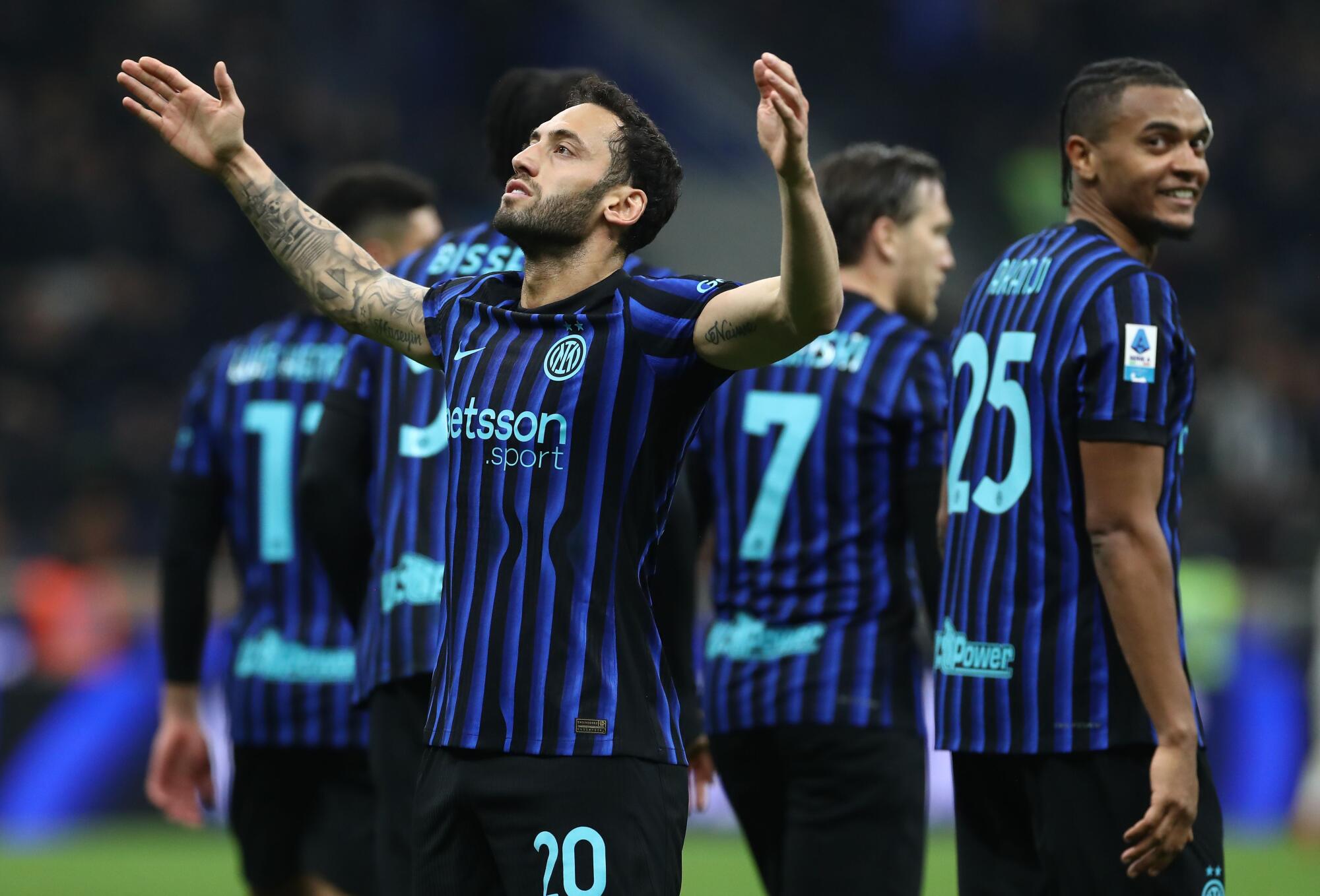
Inter Milan’s Hakan Calhanoglu celebrates after scoring on a penalty shot against Genoa on Feb. 28.
(Marco Luzzani / Getty Images)
In an effort to tell that story and continue that growth, Inter collaborated with Spike Lee on a short film titled “My Name Is My Story,” in which Lee narrated the club’s history and identity, introducing it to a U.S. audience during last summer’s Club World Cup.
Inter isn’t going it alone though. All of Italian football is in the midst of a long-needed overhaul.
A generation ago, Serie A was the best soccer league in the world. It had players like Roberto Baggio, Jurgen Klinsmann, Alessandro Del Piero, Ronaldo, George Weah and Diego Maradona and its wealthy, deep-pocketed owners sent Italian teams to nine Champions League finals between 1989-99.
Since then the league has struggled to market its product globally, lost many of its top players to better pay in other European leagues, found potential revenue streams closed off by aging, crumbling infrastructure, and saw its reputation and credibility damaged by the 2006 Calciopoli scandal, which centered on the manipulation of referee appointments to favor certain clubs.
An influx of U.S.-based owners is helping turn that around. Eight of Serie A’s 20 teams have American owners and Ricci says they have not only brought much-needed investment to the league but they’ve brought ideas on how to market Italian soccer.
“Some are only bringing money, yeah. Others are bringing also a vision and an ambition,” Ricci said. “Our ownership is exactly bringing that. Bringing the North American culture of not seeing only constraints and barriers in the development of a project [but] having the ambition, far-sighted[ness] and working on building a dream.
“That is exactly what Serie A needs: a bit of a dream and a bit of a vision to dare a bit more and not be too conservative. We need a few leading and having vision and bringing that dream.”
A big part of that dream and vision in Milan is a new stadium, one that will replace the century-old San Siro with a 71,500-seat arena at the center of a $1.4-billion urban-regeneration plan funded primarily by RedBird Capital, AC Milan’s New York-based owner, and Oaktree Capital Management, the Los Angeles-based company that owns Inter Milan.
For Inter Milan that investment, the club hopes, will transform the game-day experience not just for well-heeled corporate types but for the team’s diehard fans. I’m still waiting to hear what AC Milan’s plans are.
“I’m not only talking about corporate clients and things like that,” Ricci said. “That, of course, will benefit from a new state-of-the-art venue with the facilities, restaurants, whatever. But also for general [admission]. As soon as they step into a new venue with better seats, in terms of sound, in terms of video, audio and all the entertainment, we are going to increase the perception of each kind of spectator you have in the venue.”
Is it a gamble? Sure, but then very few things in sports are a sure bet. Yet for Inter Milan, at least, that vision and the story behind it are worth telling.
⚽ You have read the latest installment of On Soccer with Kevin Baxter. The weekly column takes you behind the scenes and shines a spotlight on unique stories. Listen to Baxter on this week’s episode of the “Corner of the Galaxy” podcast.