March 12 (UPI) — The recent, new delay in NASA’s moon landing program represents the latest in a string of technical, budgetary, workforce and public perception challenges that plague the space agency, a UPI analysis shows.
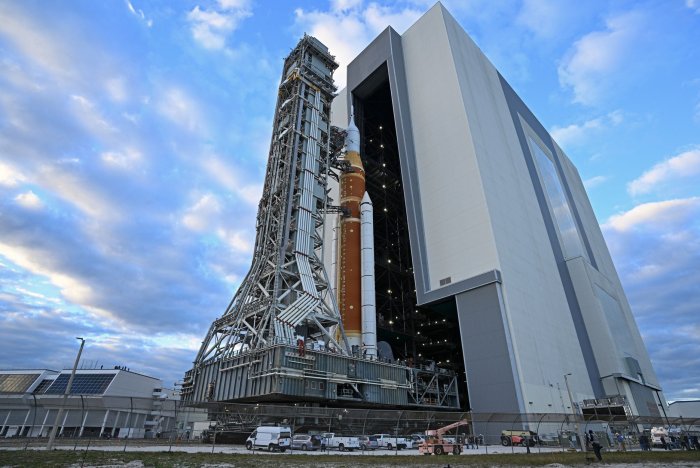
When flight officials pulled the Artemis II Space Launch System and Orion spacecraft off the launch pad at Kennedy Space Center on Feb. 25 after a recurrence of helium flow problems and pushed the launch back to April at the earliest, it served as another reminder of the space agency’s current assortment of formidable problems.
Those issues include a moon program whose timeline keeps slipping; recurring technical failures and cost overruns with its flagship SLS rocket; a commercial lander — SpaceX’s Starship — that has yet to demonstrate reliability; the effective grounding of the Vulcan Centaur rocket made by United Launch Alliance; the departures of thousands of NASA workers and turnover in its top leadership positions.
The agency announced March 3 it had identified the latest problem with Artemis II as a faulty helium seal in the SLS upper stage, and that it is repairing the assembly, as well as making other fixes to the spacecraft.
But meanwhile, the lag time since the last crewed U.S. spaceflight has now stretched to three full years. This lengthy drought has prompted outside analysts and NASA officials to worry about how public support for the space program is being affected.
“When missions occur every few years, it is easy for people to lose interest,” said Burt Dicht, a leader of the National Space Society, who added he backs a newly announced NASA effort to increase the frequency of launches.
The latest delay has prompted a fresh look at some of the major challenges facing the space agency’s moon effort, as well as more general problems.
Headwinds with partners, personnel issues
One of the more pressing issues with the Artemis program is its dependence on SpaceX’s Starship Human Landing System, or HLS, as the initial human lander that will put the first U.S. astronauts on the lunar surface.
Elon Musk’s company signed a contract with NASA in 2021 to provide the lander, but struggled in 2025 to perfect the mammoth Starship V3 rocket necessary for a key element of the HLS mission, according to a report issued by NASA’s Aerospace Safety Advisory Panel and released last month.
The Starship V3 incorporates upgraded Raptor engines to provide it with the required performance for low-Earth orbit flight and on-orbit operations, and its development is deemed crucial for transferring fuel to an orbiting tanker.
How it performs will “ultimately determine the number of refueling missions required for the HLS mission,” which is now pegged at roughly 12 fueling flights, the report’s authors wrote.
“The development and test progress necessary for a version of Starship that has not yet flown in time to support a human lunar landing mission within the next few years appears daunting and, to the panel, probably not achievable,” they wrote.
SpaceX announced Feb. 26 that the first Starship V3 had left its build site at Boca Chica, Texas, and had begun prelaunch testing.
In 2023, NASA selected Blue Origin, owned by Amazon founder Jeff Bezos, to develop a second human landing system to compete with the HLS. Its Blue Moon Mark 2, to be launched aboard a New Glenn rocket, is to be tested twice and then carry a crew to the moon in late 2028.
New critical report
But NASA’s Office of Inspector General, in a report issued Tuesday, looked at both programs to carry astronauts to the moon and advised that the agency faces significant technical and programmatic risks that threaten mission timelines and crew safety.
The report said NASA is not fully adhering to “test like you fly” principles, particularly for uncrewed demonstration missions, and has not yet ensured that SpaceX’s Starship lander will meet manual control requirements for astronauts.
The inspector general also noted gaps in hazard‑mitigation planning and insufficient testing of critical systems, especially given the complexity of both SpaceX’s and Blue Origin’s lander architectures.
The report also warned that NASA the capability to rescue astronauts in the event of a life‑threatening emergency during lunar surface operations, echoing limitations from the Apollo era.
And it concluded that SpaceX and Blue Origin face technical challenges likely to cause additional delays, with SpaceX’s schedule slipping beyond its earlier 2027 target and even the revised 2028 goal remaining uncertain.
The report recommends stronger risk‑management practices, more realistic scheduling and more rigorous testing to ensure crew safety and mission success.
Meanwhile, NASA’s larger operations also could be affected by problems encountered in the new Vulcan Centaur rockets made by United Launch Alliance.
Vulcan launches halted
The U.S. Space Force last week temporarily halted all national security launches using the rocket after the same booster malfunction occurred twice, according to comments made by Col. Eric Zarybnisky at a meeting last month in Colorado.
The Vulcan Centaur program was established by ULA to reduce costs and eliminate reliance on the current workhorse Atlas V Russian-supplied RD-180 engine and is primarily meant to meet U.S. military needs.
But the program benefits NASA as well, giving it greater flexibility and transport capability for launching of payloads, the space agency said.
NASA also continues to struggle with an exodus of workers, including thousands of crucial senior staff, which some analysts believe is impacting its moon and Mars exploration goals due to a loss of expertise.
Nearly 4,000 agency employees last year chose to accept “deferred resignations” as part of the Trump administration’s efforts to slash the federal workforce — a move that reduced NASA’s employee roster by more than 20% to some 14,000, NASA spokesperson Cheryl Warner told NPR in June.
Still, even amid all of those issues, the agency was able to dodge the biggest potential bullet of them all — a proposed 24% reduction in its budget issued by the White House, which would have been the biggest cut in agency history.
That threat all but evaporated when Congress agreed on a $24.4 billion NASA spending bill in January, representing a mere 1.7% budget reduction.
The NASA administrator’s job itself remained unfilled throughout 2025, as President Donald Trump withdrew his nomination of Isaacman. Trump ultimately changed course, and Isaacman was confirmed by the Senate on Dec. 17.
Major changes for the Artemis program
Of all the difficulties faced by NASA, the technical problems and cost overruns of the Artemis program itself have emerged as perhaps the most high-profile.
The Feb. 25 postponement was the second recent delay for Artemis II, which is to send four astronauts on a “slingshot” fly-by around the moon. Last month, NASA pushed back the launch to March after engineers discovered what they called a significant hydrogen leak during a wet dress rehearsal.
NASA said Thursday it plans to roll the Artemis II Space Launch System rocket and Orion capsule back out to the launchpad next week, aiming for a launch in April.
The rollout wis to begin March 19, with an eye at launching as early as the evening of April 1, NASA officials said during a press briefing.
The original target date for landing astronauts on the moon — 55 years after the United States first did it — was 2024. When that was announced in 2019, many observers thought the target date was too optimistic.
The effort’s total cost after NASA recently added nine new elements now exceeds $20 billion, the Government Accountability Office reported last summer. Three of those elements have racked up a total of $7 billion in cost overruns.
NASA has made efforts to get a handle on the overruns through its Moon to Mars Program Office, the GAO said, but warned that each new delay to mission dates can create a cascading effect of increased costs across multiple programs that function independently of each other.
Clear warnings
And in its report from last month, the NASA safety panel sounded clear warnings about the “ambitious timeline” for developing the Human Landing System, given its “intricate operational design” and :complex concept of operations,” as well as other serious safety concerns surrounding the Artemis program.
Taken together, the issues posed a “high safety risk,” the panel concluded, which “casts doubt on the current Artemis III timeline and the feasibility of the Artemis III mission goals.”
In the wake of the latest issues, Isaacman announced a major revamp of Artemis under which the expected moon landing was pushed back from Artemis III in 2027 to Artemis IV in 2028.
“We have to rebuild core competencies,” he told reporters Feb. 27, blaming the repeated delays on too-infrequent launch schedules (known as the “launch cadence”), which he said causes “muscle memory” to “atrophy.”
“This is just not the right pathway forward,” he asserted, while revealing that a moon landing with Artemis III in 2027 has been deemed too ambitious and will instead now be attempted with Artemis IV in 2028.
Artemis III will instead now serve as a mission to perform tests on connecting with lunar landers in low-Earth orbit, as well as to test equipment that will go on Artemis IV.
Meanwhile, to bump up the launch cadence to once every 10 months rather than every three years, Isaacman announced a standardization of the SLS rocket fleet to “essentially near ‘Block-1’ configuration.”
The idea, he said, is to reduce the complexity of the massive rocket and to “accelerate manufacturing, pull in the hardware and increase launch rate, which obviously has a direct safety consideration to it, as well. You get into a good rhythm launching with greater frequency, you get that muscle memory.”
To do that, he added, “we need to rebuild and strengthen the workforce here at NASA. … We have to rebuild core competencies. The ability to turn around our launch pads and launch with frequency greater than every three years is imperative,” he said, pointing to the histories of the Mercury, Gemini, Apollo and Space Shuttle programs, when “the average launch cadence was closer to three months.”
The decision to simplify and standardize the SLS starting with Artemis IV also means the agency will no longer need to use the $1.5 billion Mobile Launcher 2 at Kennedy Space Center, which is still under construction and has faced its own cost overruns and delays.
Experts’ reactions
Experts who have been closely following the development of Artemis expressed a range of opinions about whether the latest moves are the right ones for the moon program and the U.S. space program generally.
Kenny Evans, a fellow in science, technology and innovation policy at Rice University’s Baker Institute for Public Policy in Houston, told UPI the glitches and the resulting negative perceptions of the program are indeed tied to the drawn-out launch cadence.
“The extended periods between SLS launches have given NASA fewer chances to test out hardware — and less cover for when things go wrong,” he said. “That has long been a valid criticism of the SLS program and a source of bad press — for example, the fueling issues in prior wet dress rehearsals.
“Working out kinks, as visible and expensive as they are, should be seen as net positives rather than programmatic failures,” he said.
“Frankly I’m relieved to see the timeline revamp,” Evans added. “The Artemis schedule Isaacman inherited had absolutely no chance of meeting its prior targets, and I’ve been impressed by his willingness to address the hard truths about the program.
“In terms of safety, making Artemis III a system test will provide NASA a much needed opportunity to remove as much risk as possible before attempting a lunar landing for Artemis IV,” he said while noting he is “particularly enthusiastic” about the NASA leader’s stated commitment to strengthening its workforce, “especially in light of cuts to agency staff.”
Meanwhile, the National Space Society’s Dicht, said his interactions with students, engineers, long-time space advocates and the public have shown him there is “real enthusiasm for progress in the space program,” but that new momentum is needed.
“I believe NASA Administrator Isaacman’s proposals to improve launch cadence, strengthen the workforce and standardize the SLS are positive steps that can help stabilize the Artemis program and move it toward a sustained return to the moon,” Dicht said.
“Whether it is SLS or any other rocket, these are extraordinarily complex machines,” he said. “Increasing the cadence of launches and ensuring the workforce is well-trained and consistently engaged helps build the operational experience, or ‘muscle memory,’ that improves reliability and the likelihood of mission success.”
While there is steady and palpable excitement over humankind’s first return to the moon since 1972 among committed enthusiasts, “there remains a segment of the public, including some social media influencers, who interpret technical issues as a sign that the program is failing,” he said.
“When missions occur every few years it is easy for people to lose interest,” Dicht said. “If the program can move toward a more regular rhythm, possibly two flights per year, it will attract attention and reinforce the sense that progress is being made.”
Similar to Apollo 9
Spaceflight historian and science author Amy Shira Teitel, creator of The Vintage Space YouTube channel, said the revamp “doesn’t particularly surprise me,” noting the decision to change Artemis III’s moon landing mission into a test flight is reminiscent of Apollo 9 in March 1969.
In that mission, a three-astronaut crew carried out vital tests while in low-Earth orbit to prepare for the historic Apollo 11 moon landing four months later.
“The plan to land Artemis III while still not having the lander ready or even chosen, from what I could tell, seemed like trouble waiting to happen, so the idea of going back to Apollo 9 and testing the hardware/mission in Earth orbit seems both safe and like it should have been the first step before going to the moon,” she told UPI in emailed comments.
The author of Breaking the Chains of Gravity: The Story of Spaceflight before NASA has questioned the overall purpose, cost and broader implications of the moon-to-Mars effort, contending it lacks a compelling justification other than “going for the sake of going” while the highly successful and popular International Space Station is scheduled to be scrapped in 2030.
All of the Artemis changes, Teitel said, are “emphasizing how hard it is, and how insane it is to be looking at canceling the ISS without a replacement and just focusing on the moon-to-Mars pipeline without any kind of long-term infrastructure or planning.
“And the endless issues with SLS — why are we adding more launches?” she asked. “We know this system is flawed. It feels like retrofitting a mission into the hardware to justify the … launch cost.”
