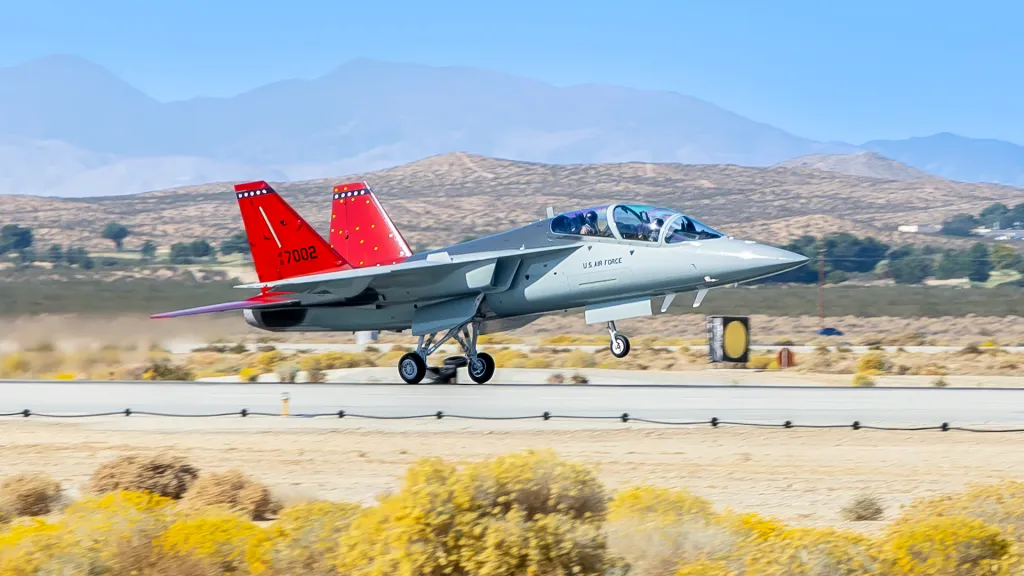
Boeing, Saab, and BAE Systems have teamed up to offer the T-7A Red Hawk advanced jet trainer to the United Kingdom’s Royal Air Force. With a plan to build the jets in the United Kingdom, the partnership aims to deliver a successor to the Royal Air Force’s current fleet of BAE Systems Hawks from 2030. Saab was already deeply involved with the T-7A as an original partner to Boeing.
The three companies announced today that they had signed a letter of intent to work together on the British requirement for a new advanced jet trainer. The proposal puts the T-7A — developed for the U.S. Air Force — at the center of a training system that will employ synthetic training alongside live flying.

Synthetic work is an increasingly important part of flying training, with the latest training systems offering a blend of live, virtual, and constructive (LVC) elements. This approach reduces costs while allowing students to practice tactics and capabilities that would otherwise be impossible using an exclusively live environment, as you can read more about here.
The proposal is pitching the training system to prepare pilots for fourth-, fifth-, and sixth-generation fighters — the Royal Air Force’s Typhoon, F-35, and forthcoming Tempest, respectively.
“The strong partnership between Boeing and Saab developed the T-7 to be the world’s best solution for future pilot training,” said Lars Tossman, head of Saab’s Aeronautics Business Area. “By working with BAE Systems, Saab believes the U.K. can gain a worthy successor to the Hawk that is the right choice for pilots for decades to come.”
If selected for the Royal Air Force requirement, the T-7As will undergo final assembly in the United Kingdom, in an effort led by BAE Systems. This would ensure the company remains involved in the production of jet trainers in the future, after the Hawk production line ended in 2020.

If chosen as the Royal Air Force’s next jet trainer, the T-7A would replace the Hawk T2, which is due to be retired by 2040. It would almost certainly also be the frontrunner to replace the service’s aging Hawk T1s, which continue to serve with the Red Arrows aerobatic display team, and are set to do so until withdrawn around 2030.
The partnership is also looking to use the same approach to “support future international pilot training opportunities,” which could help the T-7A secure export orders that have so far proven elusive.
“Our new collaboration with Boeing and Saab will enable us to present a compelling offer to the U.K. Royal Air Force and our global customers, leveraging the latest tech innovation in training systems and a world-class jet trainer aircraft,” said Simon Barnes, the group managing director of BAE Systems’ Air sector. “We’re committed to ensuring this solution offers the best overall outcome for the nation to support the U.K.’s combat air readiness and deliver economic benefit.”
The requirement for a new advanced jet trainer was set out in the U.K.’s 2025 Strategic Defense Review.

This document stated that the Hawk T1 and Hawk T2 “should be replaced with a cost-effective fast jet trainer. The current flying training arrangements for fast jets must be urgently revised to optimize capacity, building in maximum use of contractors and provision for training overseas students.”
U.K. military flying training is undertaken in three phases. Phase one involves initial recruitment and selection and basic military training, and is carried out within individual service commands. Phase two is known as the Military Flying Training System (MFTS), part of which is overseen by a private contractor, Ascent Flight Training Management. This phase takes pilots from introductory instruction and progresses them into specialized streams, including fast jet and rotary.
Finally, phase three involves pilots training on specific frontline aircraft such as Typhoon or F-35 within an Operational Conversion Unit (OCU).
As part of phase two, the Royal Air Force operates 28 Hawk T2 jets that train both its own and Royal Navy fast-jet pilots at RAF Valley in Wales, before they progress to an OCU.

While the ‘second-generation’ Hawk T2 only entered service in 2009, the Hawk T1, now used exclusively by the Red Arrows, is much older, having first entered service in 1976.
Other contenders to replace the Royal Air Force Hawk include the TF-50, a version of the Korea Aerospace Industries T-50 offered by Lockheed Martin. At the Defense and Security Equipment International (DSEI) exhibition held in London in September of this year, Lockheed Martin displayed a model of the TF-50 in Red Arrows colors.

Competition is also likely to be provided by the Leonardo M-346 and the Turkish Aerospace Hürjet. At one point, BAE Systems had been seen as a possible partner for Leonardo in the British advanced jet trainer bid.
Meanwhile, British aerospace startup Aeralis is offering a clean-sheet modular jet trainer, which it plans to build in Scotland. While Aeralis has yet to win any orders for its products, it has been provided with funding from the Royal Air Force’s Rapid Capabilities Office. The service’s Chief of the Air Staff has also said in the past that the company’s approach was something the RAF was “very interested in.”

That the Hawk T2 needs replacement has been clear for some time now, with the relatively young fleet already suffering from well-documented availability issues, which have had an adverse effect on the training pipeline.
In 2022, a fault was reported within the Hawk T2’s Adour powerplant, reducing the planned design life of each engine from 4,000 to 1,700 hours, leading to an average of just eight serviceable aircraft being made available each day throughout fiscal years 2022 and 2023.
In 2023, the entire Hawk T2 fleet was temporarily grounded after an engine-related incident on the runway.
Among others, these issues have resulted in a need to train British pilots overseas to make up the shortfall, at a considerable cost. This has included buying training slots in Italy, Qatar, and with the Euro-NATO Joint Jet Pilot Training Program (ENJJPT) in the United States.

Meanwhile, an update on the T-7A’s progress was provided by Steve Parker, president and CEO of Boeing Defense, Space and Security, at a pre-show media roundtable ahead of the 2025 Dubai Airshow in the United Arab Emirates that TWZ attended.
Parker identified “really good performance this year” for the T-7A, which should see the first operational example delivered to the U.S. Air Force at Randolph Air Force Base, Texas, next month. Parker added: “We’ve got the first ground-based training simulators already stationed at the base and operational, and the program is doing well in its flight test; we are really seeing some good progress there.”
“We’re about 78 percent through test points at Edwards Air Force Base, so making good progress,” including having started high-angle-of-attack testing, Parker added. “The feedback from the United States Air Force has been great, both the testers as well as folks who’ve flown it from the Air Force […] We think it’s going to be a game-changer. Once we get it into the air with our main user, it’s going to sell itself.”
However, full entry into service is now not expected until 2027, a delay of over four years. Earlier this year, we reported on information that emerged about serious and potentially dangerous deficiencies with the emergency ejection system on the T-7A. This followed environmental testing of the aircraft, which also exposed new problems. More generally, the U.S. Air Force has been working with Boeing to fix or otherwise mitigate a host of issues with the T-7A, which, as well as delays, prompted a shakeup of the overall plans for the program. You can read more about what has been disclosed in the past about T-7A testing in this previous TWZ feature.

When asked about export prospects for the T-7A, Bernd Peters, vice president of business development and strategy for Boeing Defense, Space and Security, confirmed that the current focus is on delivering the 351 jets on order for the U.S. Air Force. However, he noted that “customers around the world are watching and seeing the program and the potential that it has, particularly when you think about the [Middle East] region.”
Peters said that Boeing is “definitely having conversations” with potential T-7A customers in the Middle East and identified what he said was “significant potential” for the trainer with “just about any operator that flies an F-15, an F-16, or an F-35 around the world.”
“We do think that there is a significant opportunity, particularly as we begin to ramp up deliveries to the United States Air Force and some of those other nations begin to think through how they want to recapitalize their trainer fleet and close the gap on pilot shortage,” Peters added.
Other export prospects could lie in a light fighter development of the T-7A, something that we have discussed in detail in the past. Previously, the U.S. Air Force looked at the possibility of an ‘F-7’ light fighter variant or derivative of the Red Hawk as one option to supplant at least a portion of its F-16C/D fleet. Some kind of missionized or light combat aircraft version of the T-7A could fare better when offered for export.
While details of the partnership between Boeing, Saab, and BAE Systems were not provided at the pre-show media roundtable, Peters also said that Europe was earmarked for T-7A sales, especially in the 2030 to 2035 timeframe. “Europe is one where I view that there’s a significant opportunity for us to be able to address not just existing Hawk fleets, but other fleets that might be out there,” Peters said.
As to the question of whether Boeing’s manufacturing capacity will be able to cover aircraft for both the U.S. Air Force and potential export customers, Parker struck an optimistic note.
Pointing to the company’s full-size determinant assembly (FSDA) approach, which reduces build time by moving drilling to the component fabrication process, making it more controlled and efficient, Parker said it would be possible to “scale up to very large volumes” for the T-7A.

“We’re going to go well above, potentially 100 aircraft a year, and we’ll be able to scale that up further if we need to go there,” Parker said. “Right now, we’ve got good capacity that will satisfy the United States Air Force, as well as other customers, right through into the early 2030s without having to put any more capital sort of into the system for that.”
A version of the T-7 is also in the running for the U.S. Navy’s Undergraduate Jet Training System (UJTS) competition, which seeks to replace the aging T-45 Goshawk — a type that was also developed from the BAE Systems Hawk.
Of course, should the United Kingdom choose the T-7A to replace its Hawks, the prospect of an additional final assembly line would allow production to be ramped up even further, to help fulfill more export orders.
For now, however, the U.K. government hasn’t allocated funds for its new advanced jet trainer, but with the Red Arrows’ Hawks requiring a successor by 2030, time for a decision is fast running out.
Contact the author: [email protected]