After 17 months, the WNBA has agreed to terms on a new collective bargaining agreement and players will be paid more than in any other professional American women’s sports league.
It is the latest in a trend of increasing equity for women athletes.
- In 2022, the U.S. women’s soccer team won a $24-million settlement with U.S. Soccer after players disputed making significantly less than the less successful men’s team.
- Then the Professional Women’s Hockey League was born in 2023 following many players defecting from the National Women’s Hockey League to form the Professional Women’s Hockey Players Assn., then merging with the Premier Hockey Federation until a historic bargaining agreement.
- The National Women’s Soccer League announced a new CBA in the summer of 2024 that included giving players agency on where they are traded and abolishing expansion and collegiate drafts.
That momentum put considerable pressure on WNBA negotiations. Could the players set a new benchmark for future contract negotiations across women’s pro sports leagues?

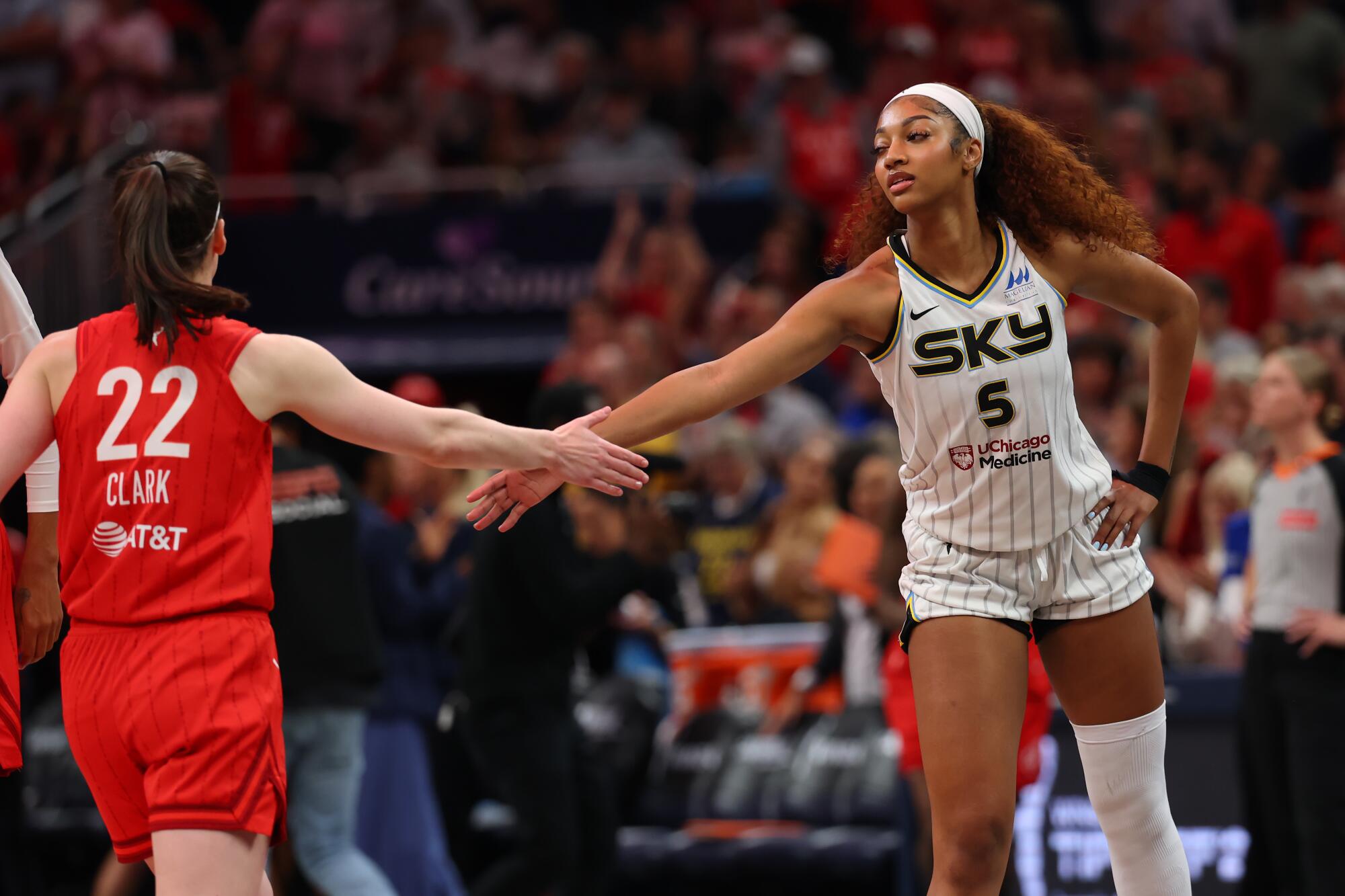
The Sky’s Angel Reese and the Fever’s Caitlin Clark shake hands before a game at Gainbridge Fieldhouse on May 17.
(Gregory Shamus / Getty Images)
The WNBA’s CBA was a flashpoint because of the boom in popularity in supporting women’s sports, with players such as Caitlin Clark and Angel Reese becoming household names. Last season, the WNBA made enough revenue to trigger revenue-sharing for the first time and this season marks the start the league’s new 11-year, $2.2-billion media rights deal.
Unlike in the NBA, where players get around 50% of the league’s revenue before expenses, the WNBA’s first revenue-sharing kicked in only after the league hit a benchmark determined by a formula of revenue targets, which had been difficult to achieve since the start of the deal was the 2020 COVID season played in front of empty stands.
The WNBA broke its single-season attendance record in 2025. As league interest grew, so did the tension between the league and the players’ union.
Many viewed this negotiating cycle as an opportunity to pounce on the increased visibility, and in a lot of ways, the union did. Players are going to be paid significantly more and they got a win in revenue sharing, earning 20% of the league’s revenue before expenses — a big jump from the previous 9% share.
The average player salary before revenue-share payments will be around $584,000.
But was it as much as they should have gotten?
Tamika Tremaglio, former NBPA executive director and advisor to the WNBPA during the 2020 CBA negotiations, said observers were less concerned about the start of training camps looming on April 19 and more focused on whether negotiations would end with a stable deal that would hold for the length of the agreement as market conditions evolve. Increased salaries are always celebrated, but both sides agreeing to a new revenue sharing model was a consequential step forward for players.
“The real story is the revenue share,” Tremaglio said. “At the end of the day, that’s what is going to drive the future.”
The fallout from the new deal will take months or years to fully understand. Free agents will be able to begin signing with teams in April, and since 80% of the players are eligible for free agency, there will be higher figures being floated around than ever.

A’ja Wilson and her Las Vegas Aces teammates celebrate while holding the 2025 WNBA championship trophy.
(Chris Coduto / Getty Images)
That might affect what talent comes to the league, too.
“More European players might come into the league,” a WNBA team consultant not authorized to speak about the league publicly told The Times. “Now that the money is better, that might knock out several college players in the draft.”
There are some WNBA-level players who have stayed in Europe due to restrictive prioritization rules that force players to participate in all WNBA practices and games even if they conflicted with international league obligations. Many WNBA players compete in international leagues during the offseason and prefer the option to keep playing in lucrative foreign leagues if there is an overlap with the WNBA season.
While the new rules for international play in the WNBA CBA are not yet clear, compensation changes could open the door for more players to choose to prioritize the league.
The general consensus among people operating within the WNBA is relief that a deal is in place.
“It’s huge,” one player agent told The Times. “They made big strides. This is important for women’s basketball.

Sparks players Dearica Hamby, Rickea Jackson, Azura Stevens, Kelsey Plum and Julie Allemand talk during a game against the New York Liberty at Crypto.com Arena on Aug. 12.
(Katelyn Mulcahy / Getty Images)
“Anytime both sides don’t get everything they want,” the agent added, “that’s a good deal.”
That agent also noted that this CBA will set the precedent for the next negotiations to continue to raise the revenue-sharing if the league continues to make more money.
Under the new CBA, the 20% revenue-sharing is tied to the league’s gross revenue, a significantly different number than the net revenue, which is calculated after all expenses are taken into account. The players were fighting for a percentage of the gross revenue, even if it is a smaller percentage than the net revenue the league offered because it is guaranteed.
The NBA first reached 53% of gross revenue in their CBA in 1983 and has stayed around that number ever since.
“If it was net, you’d have all these other expenses and you sort of lose control of the actual expenses,” Tremaglio said. “You have no control from the perspective of where the players are. But now, you don’t even have to go look at the minutia of auditing every single expense line item. That’s what makes such a difference.”
More details around the CBA, including player housing, expansion draft format and roster spots, will become clearer as the deal reaches ratification.
For now, even if 20% revenue sharing is less than the 40% the players first proposed, the deal represents a significant, stable increase in player compensation.
“This will impact women’s sport globally, not just the game of basketball,” Tremaglio said. “This will impact everything, soccer, everything.”