revenue

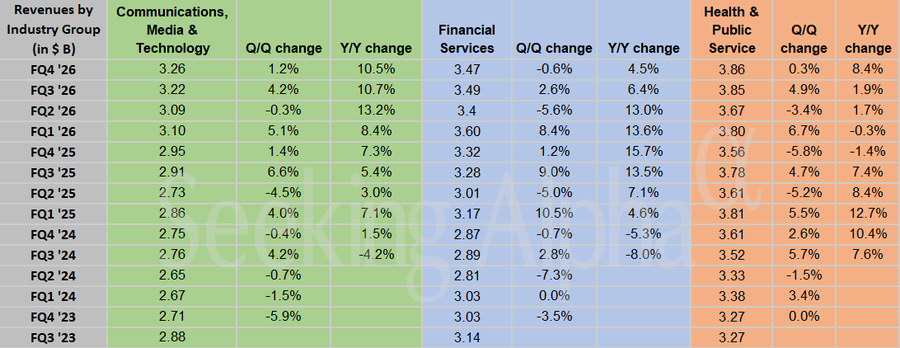
Intuit outlines $21.341B-$21.374B FY2026 revenue as it cuts workforce 17% (NASDAQ:INTU)

Earnings Call Insights: Intuit (INTU) Q3 fiscal 2026

Management View

  • “We delivered strong overall results this quarter with Q3 revenue growing 10% as we made significant progress executing on our AI-driven expert platform strategy.” (CEO, President & Chairman Sasan Goodarzi)

Seeking Alpha’s Disclaimer: This article was automatically generated by an AI tool based on content available on the Seeking Alpha website, and has not been curated or reviewed by humans. Due to inherent limitations in using AI-based tools, the accuracy, completeness, or timeliness of such articles cannot be guaranteed. This article is intended for informational purposes only. Seeking Alpha does not take account of your objectives or your financial situation and does not offer any personalized investment advice. Seeking Alpha is not a licensed securities dealer, broker or US investment adviser or investment bank.

Source link

Agilysys projects $365M-$370M FY2027 revenue with 24% adjusted EBITDA margin while positioning the Marriott PMS rollout as a multiyear driver (NASDAQ:AGYS)

Earnings Call Insights: Agilysys, Inc. (AGYS) Q4 fiscal 2026

Management View

  • “Fiscal 2026 Q4 was an excellent overall business quarter for Agilysys, including with respect to sales, revenue and profitability, each of which set a new quarter record.” (CEO, President & Director Ramesh Srinivasan)

Seeking Alpha’s Disclaimer: This article was automatically generated by an AI tool based on content available on the Seeking Alpha website, and has not been curated or reviewed by humans. Due to inherent limitations in using AI-based tools, the accuracy, completeness, or timeliness of such articles cannot be guaranteed. This article is intended for informational purposes only. Seeking Alpha does not take account of your objectives or your financial situation and does not offer any personalized investment advice. Seeking Alpha is not a licensed securities dealer, broker or US investment adviser or investment bank.

Source link

U.S. Antimony targets $125M 2026 revenue while planning 1,000 tons per month 99.9% hydromet output in 2028 (NYSE:UAMY)

Earnings Call Insights: United States Antimony Corporation (UAMY) Q1 2026

Management View

  • CEO Gary Evans said, “This is no longer just an antimony company” and pointed investors to a portfolio spanning “antimony, cobalt, gold, tungsten, and zeolite,” alongside ramping processing capacity and government-linked demand.

Seeking Alpha’s Disclaimer: This article was automatically generated by an AI tool based on content available on the Seeking Alpha website, and has not been curated or reviewed by humans. Due to inherent limitations in using AI-based tools, the accuracy, completeness, or timeliness of such articles cannot be guaranteed. This article is intended for informational purposes only. Seeking Alpha does not take account of your objectives or your financial situation and does not offer any personalized investment advice. Seeking Alpha is not a licensed securities dealer, broker or US investment adviser or investment bank.

Source link

Newsom offers early peek at rosy budget projections

Hours before Gov. Gavin Newsom is expected to present his budget plan on Thursday, his office released new projections of a $16.5-billion state revenue windfall over three years and offered a rosy outlook on California’s fiscal position during his final year in office and the year after.

Newsom’s office provided few details about his plan to reduce spending or other adjustments that he would need to propose in combination with the increase in revenue to eliminate projected deficits from 2026-27 through 2027-28.

The unusual early look at his budget proposal comes as Newsom begins to wind down his time at the state Capitol and considers a run for president in 2028.

Two weeks ago, the Legislative Analyst’s Office issued an analysis of state spending that said California could not, in the long term, afford to pay for existing services and the new programs that Newsom and Democratic lawmakers have enacted since he took office in 2019. State spending has outpaced California’s strong revenue growth by about 10%, creating a perennial budget shortfall, defined as a structural deficit.

California’s spending problem threatens to define Newsom’s fiscal legacy and could provide ripe fodder for his critics. If projections of the unexpected tax windfall, which analysts attribute to stock market interest in artificial intelligence companies, bear out, the upswing could mark a lucky break for Newsom.

The governor has largely resisted adopting new across-the-board tax increases or sharply curtailing his expensive policy proposals in order to align state spending with revenue.

His budget proposal includes a call to increase taxes on corporations by limiting state tax credits to no more than $5 million, or 50% of a company’s tax liability, beginning in the tax year 2027. No estimates were offered to explain how much revenue the new cap would bring in to support the state budget.

The preview of his budget has several new spending proposals, including providing $300 million to help low-income Californians keep $0 monthly premiums on healthcare coverage through the Affordable Care Act in response to cuts by the federal government, as well as $100 million to help wildfire victims afford construction loans to rebuild their homes. Two days before Mother’s Day, Newsom also introduced a plan to provide 400 free diapers for every California newborn at select hospitals beginning this summer.

Newsom is expected to present his budget in more detail late Thursday morning in Sacramento.

Source link

Shoulder Innovations forecasts $65M-$68M 2026 net revenue as it raises guidance following Q1 growth (NYSE:SI)

Earnings Call Insights: Shoulder Innovations (SI) Q1 2026

Management View

  • “I’m very pleased to report that 2026 is off to a strong start” and the company “deliver[ed] first quarter net revenue of $16.7 million, an increase of 65% year-over-year and 16% sequentially,” with “first quarter gross margin” at “77.7%,” according to (Executive chairman, CEO & president

Seeking Alpha’s Disclaimer: This article was automatically generated by an AI tool based on content available on the Seeking Alpha website, and has not been curated or reviewed by humans. Due to inherent limitations in using AI-based tools, the accuracy, completeness, or timeliness of such articles cannot be guaranteed. This article is intended for informational purposes only. Seeking Alpha does not take account of your objectives or your financial situation and does not offer any personalized investment advice. Seeking Alpha is not a licensed securities dealer, broker or US investment adviser or investment bank.

Source link

QuickLogic outlines 50% to 100% 2026 revenue growth as RADPro dev kits and Intel 18A contracts ramp (NASDAQ:QUIK)

Earnings Call Insights: QuickLogic (QUIK) Q1 2026

Management View

  • CEO Brian C. Faith positioned Q1 as progress toward a 2026 growth target, saying, “we have made significant progress toward our goal of delivering 50% to 100% year-over-year revenue growth in 2026,” and added, “we continue to expect

Seeking Alpha’s Disclaimer: This article was automatically generated by an AI tool based on content available on the Seeking Alpha website, and has not been curated or reviewed by humans. Due to inherent limitations in using AI-based tools, the accuracy, completeness, or timeliness of such articles cannot be guaranteed. This article is intended for informational purposes only. Seeking Alpha does not take account of your objectives or your financial situation and does not offer any personalized investment advice. Seeking Alpha is not a licensed securities dealer, broker or US investment adviser or investment bank.

Source link

Entertainment mogul Byron Allen to acquire Buzzfeed, HuffPost

Digital entertainment company BuzzFeed Inc. is selling its majority stake to Los Angeles entertainment mogul Byron Allen for $120 million.

BuzzFeed announced the sale late Monday, saying Allen Family Digital had agreed to pay $3 a piece for 40 million shares, representing a 52% stake in the company.

Allen will pay $20 million in cash upfront with the remaining $100 million due in five years.

As part of the deal, Allen also will take over HuffPost, another internet pioneer, owned by BuzzFeed.

The sale is expected to close later this month. BuzzFeed founder and current chief Jonah Peretti will transition to a new role as president of BuzzFeed AI.

Allen will become chairman and chief executive.

“This investment in our business and Byron’s management roles will provide liquidity and operational focus to BuzzFeed,” Peretti said in a statement.

Once an internet darling valued at $1.5 billion, the 20-year-old site appealed to consumers with its lists, splashy news articles and quizzes, including “Which ‘Schitt’s Creek’ character are you?”

BuzzFeed has been on the ropes, financially, for a number of years. It bought HuffPost in 2021 to bolster its readership and offerings to advertisers. Three years ago, it pulled the plug on its once ubiquitous BuzzFeed News unit.

BuzzFeed reported a $15 million net loss in the first-quarter of the year. The company generated $31.6 million in revenue, a 12.4% decline compared to the year-ago period. Ad revenue fell nearly 20% year-over-year to $17.1 million. However, content revenue grew more than 50% to $7.5 million.

BuzzFeed soon will make another round of significant cost cuts prior to Allen’s takeover, Peretti said in the statement. He added that BuzzFeed Studios and Tasty will spin off to form a new independent entity.

The deal comes at a busy time for Allen, a former stand-up comedian who is taking over CBS’ late night block later this month, replacing “The Late Show with Stephen Colbert,” which is being canceled by CBS and its owner Paramount Skydance.

Earlier this month, Allen sold television stations in nearly a dozen markets owned by the Allen Media Group to Atlanta-based Gray Media Inc. for about $170 million.

Allen still owns 13 network-affiliate stations in nearly a dozen markets, including the Weather Channel‘s linear and digital outlets, including PETS.TV and COMEDY.TV.

“Our vision is to build on the iconic foundation of BuzzFeed and HuffPost by expanding into free-streaming video, audio and user-generated content,” Allen said. “BuzzFeed is officially chasing YouTube to become another premiere free video streaming service.”

Source link

OmniAb forecasts $28M-$33M 2026 revenue as partner milestones lift outlook (NASDAQ:OABI)

Earnings Call Insights: OmniAb, Inc. (OABI) Q1 2026

Management view

  • “OmniAb delivered a very strong start to the year, largely driven by advancement of our partner programs,” said President, CEO & Director Matthew Foehr, adding, “The progression of these programs gives us a growing line of sight

Seeking Alpha’s Disclaimer: This article was automatically generated by an AI tool based on content available on the Seeking Alpha website, and has not been curated or reviewed by humans. Due to inherent limitations in using AI-based tools, the accuracy, completeness, or timeliness of such articles cannot be guaranteed. This article is intended for informational purposes only. Seeking Alpha does not take account of your objectives or your financial situation and does not offer any personalized investment advice. Seeking Alpha is not a licensed securities dealer, broker or US investment adviser or investment bank.

Source link

Merger costs add up as Warner Bros. Discovery posts $2.9-billion quarterly loss

Warner Bros. Discovery’s impending sale has rattled Hollywood — and the company’s balance sheet as the auction’s high costs increasingly come into focus.

The New York-based media company released its first-quarter earnings Wednesday, which included a $2.9 billion loss. That amount includes $1.3 billion in restructuring expenses, including updated valuations for Warner’s declining linear cable television networks.

Contributing to the net loss was the $2.8 billion termination fee paid to Netflix in late February when the streaming giant bowed out of the bidding for Warner. The auction winner, Paramount Skydance, covered the payment to Netflix but Warner still must carry the obligation on its balance sheet in case the Paramount takeover falls apart. Should that happen, Warner would have to reimburse Paramount.

Warner also spent another $100 million to run the auction and prepare for the upcoming transaction, according to its regulatory filing.

“As we prepare for our next chapter, our focus remains on executing our key strategic priorities: scaling HBO Max globally, returning our Studios to industry leadership, and optimizing our Global Linear Networks,” Warner Bros. Discovery leaders said Wednesday in a letter to shareholders.

Warner generated $8.9 billion in revenue, a 3% decline from the same quarter one year ago, excluding the effect of foreign exchange rate fluctuations.

Its streaming services, including HBO Max, notched milestones in the quarter and 9% revenue growth to $2.9 billion. The company launched HBO Max in Germany, Italy, Britain and Ireland during the quarter.

Advertising revenue for streaming was up 20% compared to the first quarter of 2025.

The streaming unit posted a 17% increase to $438 million in adjusted earnings before interest, taxes, depreciation and amortization (EBITDA).

Warner’s studios, primarily its TV business, had a strong quarter.

Studios revenue rose 31% to $3.1 billion, compared to the prior year quarter.

Television revenue soared 58% (excluding exchange rate fluctuations) due to increased program licensing fees to support the launch of HBO Max in international markets. Those launches also propelled the movie studio, which saw revenue increase 21%.

Video games revenue declined 30% because of lower library revenues.

Adjusted EBITDA for the studios grew $516 million (158%) to $775 million compared to the prior year quarter.

The company’s vast linear television networks saw revenue fall 9% to $4.4 billion compared to the prior year period.

TV distribution revenue tumbled 8% largely due to a 10% decrease in domestic linear pay TV subscribers.

The company also felt the loss of its NBA contract for its TNT channel, which NBC picked up. Advertising revenue fell 12%. “The absence of the NBA negatively impacted the year-over-year growth rate,” Warner said.

As the costs of the merger with Paramount come into clearer focus, the opposition has grown louder.

More than 4,000 artists and entertainment industry workers, including Bryan Cranston, Noah Wyle, Kristen Stewart and Jane Fonda, have signed an open letter warning about the dangers of the merger with Paramount. “This transaction would further consolidate an already concentrated media landscape, reducing competition at a moment when our industries — and the audiences we serve — can least afford it,” according to the letter.

“The result will be fewer opportunities for creators, fewer jobs across the production ecosystem, higher costs, and less choice for audiences in the United States and around the world.”

Adjusted EBITDA for the television networks fell 10% to $1.6 billion, compared to the prior year quarter.

Warner ended the quarter with $3.3 billion in cash on hand and $33.4 billion of gross debt.

Source link

Insulet forecasts 21%-23% 2026 revenue growth as it raises full-year outlook and targets ~100 bps margin expansion (NASDAQ:PODD)

Earnings Call Insights: Insulet (PODD) Q1 2026

Management View

  • “We achieved 30% revenue growth, including 28% in the U.S. and 45% internationally,” and “we are raising our full year 2026 total company revenue growth guidance from 20% to 22% to 21% to 23%.” (CEO, President & Director Ashley McEvoy)

Seeking Alpha’s Disclaimer: This article was automatically generated by an AI tool based on content available on the Seeking Alpha website, and has not been curated or reviewed by humans. Due to inherent limitations in using AI-based tools, the accuracy, completeness, or timeliness of such articles cannot be guaranteed. This article is intended for informational purposes only. Seeking Alpha does not take account of your objectives or your financial situation and does not offer any personalized investment advice. Seeking Alpha is not a licensed securities dealer, broker or US investment adviser or investment bank.

Source link

Lufthansa posts record revenue but warns Iran war fuel costs will hit annual profit

Published on

The surge in jet fuel prices has become a primary concern for the European travel industry, with Lufthansa finding itself at the centre of this crisis.


ADVERTISEMENT


ADVERTISEMENT

According to Lufthansa’s latest earnings report, the airline expects an additional €1.7 billion ($2bn) fuel cost burden in 2026 as soaring jet fuel prices continue to weigh on the industry.

The need to avoid certain airspaces has led to longer flight times, which naturally increases consumption. These adjusted routes also require more staff hours and higher maintenance cycles, adding layers of complexity to an already strained global supply chain.

As reported by Euronews, global airlines have already cancelled approximately 13,000 flights this May, while Lufthansa alone has axed 20,000 short-haul flights through to October in a bid to cut fuel consumption.

This reduction in capacity is a direct response to the unsustainable cost of operating older, less fuel-efficient aircraft during price peaks.

While Lufthansa has managed to stay profitable, the jet fuel price spikes have forced the firm to advise passengers to book their holidays as early as possible to avoid further surcharges.

The company is currently investing heavily in its “fleet modernisation” programme to mitigate these risks in the long term, though the immediate impact of fuel volatility continues to weigh on the balance sheet.

Lufthansa remains committed to its financial targets, but the volatility of the global oil market remains the largest variable in its 2026 outlook.

“We are satisfied with the first quarter […] at the same time, the current situation compels us to rigorously examine every lever available to reduce costs, improve efficiency and mitigate risks in order to maintain our ability to act decisively. Our annual profit will likely be lower than originally anticipated,” CFO Till Streichert stated.

The Lufthansa Group has announced a landmark financial performance, revealing that it generated the highest revenue in its history in 2025. Revenue rose by 5% compared with the previous year to €39.6 billion.

According to the latest figures, the airline group also saw its operating profit grow by 20% compared with 2024, highlighting a robust recovery in passenger demand.

In the first quarter of 2026, year-on-year revenue climbed 8% despite challenges linked to the conflict involving Iran, including €1.7 billion in additional costs caused by volatile jet fuel prices and the suspension of dozens of routes.

The firm kept its capacity broadly stable with slight growth in long-haul traffic compensating for capacity reductions in short and medium-haul segments.

Lufthansa Technik and Lufthansa Cargo also significantly contributed to earnings with demand for maintenance, repair and overhaul services increasing, as well as through the marketing of ITA Airways’ cargo space.

Global demand for air travel remains high and continues to prove resilient even in times of crisis, as Lufthansa Group again expects a strong summer travel season.

“In the first quarter, we significantly improved on the previous year’s financial results […] but the ongoing crisis in the Middle East, combined with rising fuel costs and operational constraints, poses enormous challenges for the world as a whole, for global air travel and for our company as well,” CEO Carsten Spohr stated.

“However, we are resilient in our ability to absorb these impacts. This applies both to our above-average hedging against fuel price fluctuations and to our multi-hub, multi-airline strategy, which provides us with greater flexibility in our route network and fleet development,” Spohr added.

Source link

Disney’s theme parks revenue holds steady, despite national economic concerns

Walt Disney Co.’s theme parks and cruise line business is holding steady despite national concerns about discretionary consumer spending and higher gas prices.

The Burbank media and entertainment giant’s experiences division reported $9.5 billion in revenue in its fiscal second quarter, up 7% compared with the same period a year ago.

The increase was due to higher guest spending at Disney’s domestic parks and experiences, which reported a 6% bump in revenue to $6.9 billion, and more capacity on the company’s cruise line with the introduction of two new ships. The segment saw a 5% increase in operating income to $2.6 billion for the three-month period that ended March 28.

Disney’s theme parks segment was under close scrutiny given the national conversation about rising consumer costs and gas prices due to the U.S.-Iran war. Analysts had wondered whether consumers would tighten their belts and forgo vacations given the higher travel costs.

Disney did see a 1% decline in attendance at its U.S.-based parks compared with the prior year, which the company attributed to “continued softness” in international visitors, but said it was starting to move past those issues. Company executives have previously said Disney pivoted marketing and promotional efforts to attract local visitors.

Last quarter, executives indicated that results in the company’s second fiscal quarter could be affected, in part, by “international visitation headwinds,” a nod to the lower number of foreign visitors now traveling to the U.S.

Though the heightened economic uncertainty around the world could have a “potential impact” on the business, Disney Chief Executive Josh D’Amaro and Chief Financial Officer Hugh Johnston said in a shareholder letter Wednesday that the company was “encouraged by current demand.” The company expected that fiscal third-quarter domestic attendance numbers would improve, they wrote.

The company’s overall earnings were powered by its entertainment business, which posted revenue of $11.7 billion, up 10% compared with the prior year’s quarter.

That growth was driven by big gains for Disney’s streaming services — Disney+ and Hulu — which raked in nearly $5.5 billion in revenue, an increase of 13% compared with 2025, thanks to higher subscription fees from user growth and more advertising revenue. Operating income for the streaming business jumped 88% to $582 million.

Disney’s entertainment segment also had a stronger quarter at the theatrical box office, with standout performances from 20th Century Studios’ “Avatar: Fire and Ash,” the animated sequel “Zootopia 2” and Pixar’s “Hoppers.”

Overall, the company reported $25.2 billion in revenue, a 7% bump from the prior year. Income before income taxes totaled $3.4 billion, an increase of 9% compared with the same period in 2025, while operating income rose 4% to $4.6 billion. Earnings per share, excluding certain items, was $1.57, compared with $1.45 a year earlier.

Disney’s sports segment, which includes ESPN, reported revenue of $4.6 billion, a 2% increase from the same period in 2025. It brought in operating income of $652 million, a 5% slide that the company attributed to higher sports rights costs and the absence of UFC pay-per-view revenue compared with last year.

Disney also alluded to the company’s view of artificial intelligence as a “meaningful long-term opportunity,” saying it could play a role in content creation and production, monetization, workforce productivity, consumer and guest experiences and enterprise operations.

“At the same time, we are committed to implementing AI in a way that keeps human creativity at the center of everything we do and respects creators and the value of our intellectual property,” D’Amaro and Johnston said in the shareholder letter.

After noting OpenAI’s closure of the text-to-video AI tool Sora, which Disney had planned to invest in, D’Amaro and Johnston said the company will “continue to explore” commercial opportunities with OpenAI and other companies.

Source link

Paramount’s Ellison underscores his pledge to make 30 films a year when his company buys Warner Bros.

Paramount Skydance Chairman David Ellison defended his commitment to release 30 movies a year once his media company swallows Warner Bros. Discovery — a goal that some industry observers view as overly ambitious.

During a Monday call with analysts to discuss Paramount’s first-quarter earnings, the tech scion said the target was achievable because his management team would maintain current levels of production. Paramount has doubled its film release capacity to 15 films this year, matching the number of theatrical releases planned by competing Warner Bros.

“The two companies are actually making 30 films to date,” Ellison said. “We really view our pending acquisition of Warner Bros. Discovery as a powerful accelerant to our strategy.”

The company said it was on track to finalize its Warner takeover by the end of September. The $111-billion deal would transform the smaller Paramount into an industry titan with prestigious programming, including Harry Potter, “Game of Thrones,” “Euphoria,” as well as its current slate of Taylor Sheridan-produced franchises, including “Yellowstone” and “Landman.” The combined company also would own dozens of popular TV networks, including CBS, CNN, Comedy Central, Food Network and HGTV.

But the proposed merger would saddle the combined company with $79 billion in debt, stoking fears that Paramount would need to make steep cost cuts to balance such a large debt load. During the quarter, Paramount lined up banks and other institutional investors to provide bridge financing to help pull off the transaction, the company said.

“We’re pleased with the momentum and will continue to take the necessary steps to bring this deal to completion,” Ellison told analysts.

Late last month, Warner Bros. Discovery stockholders overwhelmingly voted in favor of the deal, which will pay $31 a share to Warner investors. The company now must secure regulatory approvals in the U.S. and abroad, and that process is well underway, Paramount said.

Paramount has asked the Federal Communications Commission for permission to exceed a cap on foreign ownership for U.S. media companies. Ellison’s company is expecting $24 billion from three Middle Eastern royal families, who would become part owners of the combined entity. Those total funds will represent about 49% of equity in that new company, exceeding the current foreign ownership cap of 25%.

More than 4,000 filmmakers, actors and industry workers, including Bryan Cranston, Connie Britton, Kristen Stewart, Jonathan Glazer and Jane Fonda, have signed an open letter asking California Atty. Gen. Rob Bonta and other regulators to block the deal, saying it “would reduce the number of major U.S. film studios to just four.”

Late last week, a small group of consumers sued to block Paramount Skydance’s acquisition of Warner Bros. Discovery and unwind Ellison’s Skydance Media’s takeover of Paramount, alleging that both deals reduce marketplace competition.

For the January-March quarter, Paramount’s earnings beat Wall Street’s expectations. Revenue grew 2% to $7.3 billion compared with the first quarter of 2025.

Adjusted earnings before interest, taxes, depreciation and amortization (EBITDA) reached $1.1 billion, helped in part by growth in its streaming services unit. Paramount+ increased its revenue by 17% to nearly $2 billion, compared with the year earlier period when it generated $1.7 billion. The service added 700,000 subscribers, bringing the total to nearly 80 million.

With Warner’s HBO Max streaming platform, the combined service would boast more than 200 million subscribers.

Paramount reported first-quarter net earnings of $168 million, or 15 cents per share, compared with $152 million in 2025, which occurred before Skydance acquired the media company in August.

Executives pointed to “Scream 7,” a late February release that has topped $200 million in global ticket sales, as a success story. Studio revenue grew 11% to $1.28 billion for the quarter.

Television networks revenue declined 6% to $3.7 billion as Paramount’s cable channels continue to contend with the loss of cable cord-cutters, which reduces the company’s collections from pay-TV providers. Nonetheless, Paramount pointed to the strength of Sheridan’s “Landman,” starring Billy Bob Thornton, Ali Larter, Sam Elliott and Demi Moore, and the strength of the CBS television network, which currently has 13 of the broadcast industry’s top 20 prime-time shows, including “60 Minutes,” “Marshals,” and “Tracker.”

The company told analysts it would achieve $30 billion in revenue for the full year and $3.8 billion in adjusted EBITDA. Paramount said it would also make $2.5 billion in cost-cuts by the end of this year and reduce expenses by $3 billion in 2027.

Paramount said it ended the quarter with $1.9 billion in cash and cash equivalents. It also was carrying $15.5 billion in debt. The company had to draw $2.15 billion from its revolving credit facility to pay Netflix a $2.8-billion termination fee that Warner Bros. Discovery had agreed to pay under a previous deal to sell the company to Netflix.

Paramount released its earnings after Monday’s trading day. Its shares closed at $11.13, basically unchanged.

Source link

Taxes, program cuts and Newsom’s legacy on the line in budget negotiations

One of Gavin Newsom’s top goals as he winds down his final year as California governor is to leave the state with a balanced budget.

After years of the state spending more money than it brings in, it’s Newsom’s last opportunity to fix a chronic deficit or dump the problem on the next governor.

How far he goes to solve the state’s structural spending imbalance will define his legacy as a steward of trillions in taxpayer dollars. As a potential candidate for president in 2028, he could also have a political incentive to do as little as possible.

“Any cuts you make are going to cause people to scream,” said Darry Sragow, a veteran Democratic strategist. “Any increases in taxes are going to cause people to scream and in terms of what’s best for a presidential run, it would be nice if people weren’t screaming.”

As California’s 40th governor, Newsom expanded publicly funded healthcare to income-eligible undocumented immigrants, increased state-subsidized child-care slots and provided free meals for schoolchildren among a wishlist of progressive wins since he took office in 2019.

His achievements have helped struggling Californians live in an increasingly unaffordable state and given him bona fides to tout to voters if he launches a bid for the White House.

But the state could never afford to pay for existing services and the new programs that Newsom and Democratic lawmakers enacted, according to an analysis of ongoing state spending since before the pandemic released by the Legislative Analyst’s Office last week.

Spending from the state’s principal operating fund has grown about $100 billion since Newsom’s first full fiscal year in office in 2019-20, mostly due to the growing cost of existing programs that he inherited. State spending has outpaced California’s strong revenue growth by about 10%, creating a perennial budget shortfall — a structural deficit — that Newsom and the Democratic-led Legislature solve with largely temporary fixes each year.

Instead of making across-the-board program cuts or raising taxes to align spending with revenue, Democrats have tapped into reserves designed to preserve social services for the state’s most disadvantaged communities during economic downturns.

While the California economy remains stable and state revenue has increased, Newsom and lawmakers have taken $12.2 billion from the rainy day fund. Democrats have borrowed $28 billion more from other state funds to cover their spending in recent years, according to the LAO.

“Taken together, these trends raise serious concerns about the state’s fiscal sustainability,” Legislative Analyst Gabriel Petek wrote in a review of Newsom’s January budget proposal.

Fiscal watchdogs have warned that the spending trends will leave California in a precarious position if the stock market tanks and tax receipts bottom out.

Personal income taxes are driving higher-than-expected revenue now, which analysts attribute to an artificial intelligence boom on Wall Street, and suggest the state could have no deficit in the upcoming year. In January, the Newsom administration anticipated significant operating deficits in the years ahead: $27 billion in 2027-28, $22 billion in 2028-29 and $23 billion in 2029-30.

The LAO, the Legislature’s nonpartisan fiscal advisor, said the state has already solved $125 billion in budget problems over the last three years with mostly short-term solutions.

“This issue is really whether they’re going to take seriously the structural deficit that is several years in the making now, where the spending has outpaced revenue, and to address that, they’re going to either have to make some fairly deep cuts or raise revenue and or both,” said former state Controller Betty Yee, who worked as a budget aide under Gov. Gray Davis and recently dropped her own campaign for governor. “But they have to be real. I think resorting to these one-time solutions has really exacerbated the problem.”

How Newsom wants to address the state’s financial challenges will be revealed on May 14 when he is expected to present his revised budget plan in Sacramento. His January budget proposal did not include any significant reductions or cuts to programs.

H.D. Palmer, a spokesperson for the California Department of Finance, said the governor is looking to solve the budget problem with more than a temporary fix.

“Although he is still finalizing his proposal that he’ll put forth to the Legislature, as he has said, he wants those solutions to be durable, and he wants them to have an impact beyond a single fiscal year,” Palmer said.

To stabilize California’s budget, Democrats will probably have to raise taxes or fees to generate new revenue and cut programs, according to the LAO. At least 40 cents for every dollar in revenue is dedicated to education under the state Constitution, requiring policymakers to find between $30 billion and $60 billion annually in additional revenue to cover projected shortfalls in 2027-28 and beyond if relying on new taxes alone.

President Trump’s cuts to healthcare are adding to the problem.

HR 1 will add $1.4 billion in state costs to the general fund. Newsom’s January budget proposal did not include a plan to help millions of low-income Californians who are expected to lose access to healthcare under the federal cuts.

To temper those cuts in California, other groups proposed a new tax on billionaires that appears poised to qualify for the November ballot.

Spearheaded by Service Employees International Union-United Healthcare Workers West, the initiative would apply a one-time 5% tax on taxpayers with assets exceeding $1 billion. If approved by voters, the tax would generate roughly $100 billion, which would fund healthcare programs.

The measure has divided unions and Democrats at the state Capitol.

Newsom has criticized the initiative, citing concerns that increasing taxes on the wealthy will have the opposite intended effect and drive the highest earners out of California. Under a progressive tax structure, the state budget is dependent on income taxes paid by the ultra-rich on earnings largely from capital gains.

Larry Page and Sergey Brin, the co-founders of Google, have already purchased residences in Florida, along with others looking to escape the tax if it goes through in November. Billionaires launched their own ballot measure campaign to undercut the tax proposal.

State lawmakers are also considering avenues to raise revenue, which include repealing a “water’s edge” tax break. Under the change, multinational companies would no longer be allowed to shield the income of their foreign subsidiaries from state taxes. California loses about $3 billion in revenue from the tax break each year.

In its budget plan released in April, the state Senate proposed a new fee on the largest corporations in the state to provide $5 billion to $8 billion annually for Medi-Cal.

The upper house said 42% of Medi-Cal enrollees are full-time workers who are not enrolled in their company’s healthcare plan because their wages are low enough to qualify for state-subsidized healthcare. As a result, corporations aren’t paying for healthcare for many of their employees and instead taxpayers are picking up the bill through Medi-Cal.

SEIU California, the powerful state union council representing over 700,000 workers, endorsed the plan. The union said Trump’s tax policy will reduce corporate taxes by $900 billion, while 3 million Californians lose healthcare.

“In this urgent moment, California’s workers need to see our leaders show us what they’re made of,” said Tia Orr, executive director of SEIU California. “The Senate is showing the courage to demand corporations pay their fair share, rather than making working people pay with their lives.”

The change is being described as a more politically palatable “fee” and not a tax.

“We explored multiple revenue options, and this was the one that felt more narrow, it felt more focused, and it also felt like it was directly going for the subsidy that’s being lost because of the Trump HR 1 cuts,” said Senate President Pro Tem Monique Limón (D-Goleta), who leads the upper house of the Legislature.

Limón said her caucus believes it’s important to address potential revenue streams because of the depth of federal healthcare reductions.

“If we don’t address the structural deficit, we are looking at severe cuts,” she said. “You are looking at people without health insurance. You are looking at hospitals closing down. You are looking at medical providers not being able to take more patients. You are looking at our emergency rooms over capacity, with not enough medical providers. I mean, you’re looking at a place that’s really, really, really difficult, and we feel like we have to, at least, look at what are viable options that are conditional on these cuts coming.”

Newsom has not commented publicly on the Senate’s plan. As governor, he’s been reluctant to embrace new taxes and fees.

Newsom could reject all the proposals for new taxes or fees and continue what he’s done before: take advantage of higher-than-expected tax collections, shift funds around, delay program implementation and borrow money to knock the deficit down to zero, or forecast a surplus, for his last budget year that begins July 1.

If he doesn’t take on California’s larger budget imbalance, then the problem would be the next governor’s to solve. A stock market crash, or economic recession, could force his successor to make drastic cuts across the board with limited reserves to support programs.

Kicking the can again would cement Newsom’s fiscal legacy as a governor who championed bold headline-making policies that bolstered the safety net for low-income Californians, but who failed to provide a solution to pay for his agenda.

“Not only has he not come up with a plan, he has pretended we don’t need one,” said Patrick Murphy, a professor of public affairs at the University of San Francisco.

Newsom’s interest in running for president could seemingly discourage him from slashing the budget and raising attention to the state’s financial woes, Sragow said. Newsom is setting himself up as a potential front-runner for his party. He has said he remains undecided about officially launching a 2028 campaign.

As a Democrat from California, his opponents would automatically label him as financially irresponsible and tax-happy. Calling out the massive budget problem on the horizon, raising taxes and making painful cuts will give them ammunition.

“There’s a long list of things that he’s going to be charged with, and this is likely to be one more,” Sragow said. “But I guess the question is, is he going to be charged with a political misdemeanor or a political felony?”

Former state Sen. Steve Glazer said Newsom is standing on political quicksand either way. State budget projections are based on assumptions about the future that often don’t bear out, leaving his choices exposed to criticism that he went too far, didn’t do enough, and everything in between.

“Whatever the governor decides to do in his May revise and in his final budget, it’s fraught with political risks, because it can be manipulated so easily by all sides,” Glazer said.

If Newsom ignores the spending problem, his successor could blame him for California’s financial woes when they take office in January and provide their own outlook of the state’s fiscal future. At the time, Newsom could be trying to convince America to make him the nation’s next president.

Murphy said Newsom has championed major policies and been reluctant to back off them later when revenue doesn’t pencil out.

In terms of spending, he’s governed similarly to the men who led California before him, with the exception of Jerry Brown, who cut programs to reduce a deficit he inherited in his second stint in the governor’s office and left Newsom with a surplus.

“It’s not all that different than most of the governors have done, which is finding it very hard to say no and finding it very hard to take on a tough choice of going to the ballot to ask for more money or raise taxes,” Murphy said.

On taxation, Newsom is perhaps most similar to former Gov. George Deukmejian, who opposed general tax increases for most of his administration.

Deukmejian left a budget disaster for his successor, Gov. Pete Wilson. Deukmejian publicly claimed he passed a balanced budget in his final year and blamed an economic downturn for the problems Wilson encountered.

When Wilson announced a record $13-billion budget deficit early in his first year in office in 1991, he said the Persian Gulf War, an economic downturn and natural disasters added to a structural deficit in the budget.

The Legislature and Deukmejian, Wilson said, had “papered over” the problem.

Source link

Sandisk forecasts Q4 revenue of $7,750M-$8,250M while authorizing a $6B share buyback (NASDAQ:SNDK)

Earnings Call Insights: Sandisk (SNDK) Q3 FY2026

Management View

Seeking Alpha’s Disclaimer: This article was automatically generated by an AI tool based on content available on the Seeking Alpha website, and has not been curated or reviewed by humans. Due to inherent limitations in using AI-based tools, the accuracy, completeness, or timeliness of such articles cannot be guaranteed. This article is intended for informational purposes only. Seeking Alpha does not take account of your objectives or your financial situation and does not offer any personalized investment advice. Seeking Alpha is not a licensed securities dealer, broker or US investment adviser or investment bank.

Source link

Gloo forecasts $190M 2026 revenue while targeting adjusted EBITDA profitability in Q4 2026 following EMD deal (NASDAQ:GLOO)

Earnings Call Insights: Gloo Holdings (GLOO) Q4 fiscal 2025

Management View

  • “Q4 was a strong quarter for Gloo that exceeded our guidance” (CEO Scott Beck), adding “we more than quadrupled our revenue compared to the prior year period” and “we also exited 2025 with a

Seeking Alpha’s Disclaimer: This article was automatically generated by an AI tool based on content available on the Seeking Alpha website, and has not been curated or reviewed by humans. Due to inherent limitations in using AI-based tools, the accuracy, completeness, or timeliness of such articles cannot be guaranteed. This article is intended for informational purposes only. Seeking Alpha does not take account of your objectives or your financial situation and does not offer any personalized investment advice. Seeking Alpha is not a licensed securities dealer, broker or US investment adviser or investment bank.

Source link