revenue

Qualcomm outlines $40B non-handset revenue target by fiscal 2029 while raising automotive exit run rate to $7B (NASDAQ:QCOM)

Earnings Call Insights: QUALCOMM Incorporated (QCOM) Q3 fiscal 2026

Management View

  • CEO Cristiano Amon framed the quarter around diversification and Investor Day targets: “We also updated our fiscal 2029 financial targets, which now include more than $24 billion in revenue across automotive and

Seeking Alpha’s Disclaimer: This article was automatically generated by an AI tool based on content available on the Seeking Alpha website, and has not been curated or reviewed by humans. Due to inherent limitations in using AI-based tools, the accuracy, completeness, or timeliness of such articles cannot be guaranteed. This article is intended for informational purposes only. Seeking Alpha does not take account of your objectives or your financial situation and does not offer any personalized investment advice. Seeking Alpha is not a licensed securities dealer, broker or US investment adviser or investment bank.

Source link

General Dynamics forecasts 2026 revenue of about $55.7B and EPS of $16.80-$16.90 as backlog reaches $136.5B (NYSE:GD)

Earnings Call Insights: General Dynamics (GD) Q2 2026

Management view

  • “Earlier today, we reported earnings of $4.24 per diluted share on revenue of $14.1 billion, operating earnings of $1.460 billion and net earnings of $1.160 billion.” (Chairperson & CEO Phebe Novakovic)

Seeking Alpha’s Disclaimer: This article was automatically generated by an AI tool based on content available on the Seeking Alpha website, and has not been curated or reviewed by humans. Due to inherent limitations in using AI-based tools, the accuracy, completeness, or timeliness of such articles cannot be guaranteed. This article is intended for informational purposes only. Seeking Alpha does not take account of your objectives or your financial situation and does not offer any personalized investment advice. Seeking Alpha is not a licensed securities dealer, broker or US investment adviser or investment bank.

Source link

Seagate expects $4.1B September-quarter revenue and $7.30 non-GAAP EPS as pricing and Mozaic 4 ramp expand margins (NASDAQ:STX)

Earnings Call Insights: Seagate Technology Holdings plc (STX) Q4 fiscal 2026

Management View

  • CEO William Mosley framed the quarter as both an outperformance and a continuation of a multi-quarter margin trend: “Our June quarter results outperformed our expectations for both revenue

Seeking Alpha’s Disclaimer: This article was automatically generated by an AI tool based on content available on the Seeking Alpha website, and has not been curated or reviewed by humans. Due to inherent limitations in using AI-based tools, the accuracy, completeness, or timeliness of such articles cannot be guaranteed. This article is intended for informational purposes only. Seeking Alpha does not take account of your objectives or your financial situation and does not offer any personalized investment advice. Seeking Alpha is not a licensed securities dealer, broker or US investment adviser or investment bank.

Source link

F5 forecasts 9%-10% FY 2026 revenue growth as Q4 EPS guidance targets $4.14-$4.26 (NASDAQ:FFIV)

Earnings Call Insights: F5, Inc. (FFIV) Q3 2026

Management View

  • CEO François Locoh-Donou framed Q3 as demand-led execution across hybrid multi-cloud, security, and AI, saying, “Q3 was another outstanding quarter. We delivered 19% product revenue growth, driving 11% total growth.” He added, “Looking ahead, we see strong demand driven by durable

Seeking Alpha’s Disclaimer: This article was automatically generated by an AI tool based on content available on the Seeking Alpha website, and has not been curated or reviewed by humans. Due to inherent limitations in using AI-based tools, the accuracy, completeness, or timeliness of such articles cannot be guaranteed. This article is intended for informational purposes only. Seeking Alpha does not take account of your objectives or your financial situation and does not offer any personalized investment advice. Seeking Alpha is not a licensed securities dealer, broker or US investment adviser or investment bank.

Source link

Navitas projects $13.5M Q3 revenue while targeting AI infrastructure at more than 1/3 of sales by year-end (NASDAQ:NVTS)

Earnings Call Insights: Navitas Semiconductor (NVTS) Q2 2026

Management View

  • CEO Chris Allexandre framed Q2 as progress in “our strategic transformation to Navitas 2.0,” saying the company “delivered increasing revenue of 22% sequentially, coupled with a stronger third quarter guidance,” and that “high power markets grew more

Seeking Alpha’s Disclaimer: This article was automatically generated by an AI tool based on content available on the Seeking Alpha website, and has not been curated or reviewed by humans. Due to inherent limitations in using AI-based tools, the accuracy, completeness, or timeliness of such articles cannot be guaranteed. This article is intended for informational purposes only. Seeking Alpha does not take account of your objectives or your financial situation and does not offer any personalized investment advice. Seeking Alpha is not a licensed securities dealer, broker or US investment adviser or investment bank.

Source link

Under new owner Byron Allen, BuzzFeed slashes workforce by 35%

BuzzFeed is cutting roughly 35% of its workforce in its first major restructuring since media mogul Byron Allen bought a majority stake in the firm two months ago.

The layoffs, outlined in a Securities and Exchange Commission filing on Monday, will affect about 180 staff and contract positions across BuzzFeed and its sister brands HuffPost and Tasty.

“We’ve been actively managing costs for some time, working through scenarios to save as many jobs as possible,” BuzzFeed’s leadership team said in the memo. “Unfortunately, the elimination of certain roles is still required.”

The company, which maintains a Hollywood office, said the changes are necessary to “put our business on a path to profitable and sustainable growth.”

This restructuring comes after the millennial-focused media company, best known for quirky video content and online quizzes, sold a majority stake to Allen in May in exchange for $20 million in cash and a $100 million promissory note. Allen also became chairman and chief executive of the company.

Through the restructuring, BuzzFeed’s leaders said, the company will aim to grow its audience and bolster its positon in free streaming content.

The BuzzFeed purchase is the latest in a series of business moves Allen has made in recent years to build his entertainment empire. The former stand-up comedian recently purchased a portion of CBS’s late-night block earlier this year, taking over the time slot for the 2026-2027 season. The slot once belonged to “The Late Show with Stephen Colbert,” which was canceled last year and aired its final episode in May.

Allen’s company holds a slate of network-affiliate stations and owns the Weather Channel network. The company bought a 10.7% stake in cable channel Starz for $25 million in March.

Allen could not be reached for a comment on the new layoffs at BuzzFeed.

In its own statement, BuzzFeed said “We are extremely fortunate that Byron has enormous confidence in our management team and moved very quickly to reposition this company and unlock its value.”

BuzzFeed was founded in 2006. The website became known as a pop culture hub, where readers could indulge in the latest celebrity gossip or discover a unique cooking recipe. But over the years, the company has declined and faced mounting financial struggles. BuzzFeed reported a $15-million net loss in the first quarter of the year. The company generated $31.6 million in revenue, a 12.4% decline compared to the year-ago period. Ad revenue fell nearly 20% year-over-year to $17.1 million. However, content revenue grew roughly 69% to $7.5 million. The company is expected to release its second-quarter results Aug. 4.

Times Staff Writers Meg James and Stacy Perman contributed to this report.

Source link

Champions Oncology outlines fiscal 2027 plan with Corellia fully funded as it reports $59.4M revenue and $1.6M adjusted EBITDA (NASDAQ:CSBR)

Earnings Call Insights: Champions Oncology (CSBR) Q4 fiscal 2026

Management View

  • CEO Robert Brainin said the company delivered “record annual revenue” and “met our commitment to full year positive adjusted EBITDA,” including “positive adjusted EBITDA in each of the 4 quarters on its own, the first

Seeking Alpha’s Disclaimer: This article was automatically generated by an AI tool based on content available on the Seeking Alpha website, and has not been curated or reviewed by humans. Due to inherent limitations in using AI-based tools, the accuracy, completeness, or timeliness of such articles cannot be guaranteed. This article is intended for informational purposes only. Seeking Alpha does not take account of your objectives or your financial situation and does not offer any personalized investment advice. Seeking Alpha is not a licensed securities dealer, broker or US investment adviser or investment bank.

Source link

Peacock streaming service finally turns a profit as Comcast moves to spin off NBCUniversal

Peacock, NBCUniversal’s streaming service, reached profitability for the first time, boosted by FIFA World Cup, NBA playoffs and reality dating show “Love Island USA.”

The milestone comes as Comcast Corp. prepares to spin off NBCUniversal entertainment and news media businesses into a separate company. Peacock, which launched in 2020, grew its paid subscribers by 4% to 48 million in the second quarter, compared to the previous quarter. The company said Peacock’s earnings before interest, taxes, depreciation and amortization was $189 million.

“In just six years, we built Peacock into a streaming business with real scale in the U.S.,” said Brian Roberts, chairman and co-CEO of Comcast on Thursday in an earnings call, adding that Peacock has added 2 million paid subscribers in each of the last two quarters.

Co-CEO Mike Cavanagh said that performance “reinforces the value of NBC, Telemundo, Bravo, and Peacock together as one integrated media business with continued opportunity to drive stronger engagement, advertising, and profitability into the future.”

Comcast plans to spin off Peacock, NBC and Telemundo broadcast networks, Bravo, Universal film, television studios and theme parks and British TV service Sky into its own separate company, with a goal of completing the separation in about a year.

Michael J. Wolf, CEO of Activate Consulting, said Peacock’s first profit proves that live sports and premium programming “remain the single most powerful anchors for consumer attention and subscriber growth.”

“As Comcast prepares to spin off NBCUniversal, freeing it from legacy cable, a standalone NBCU is now structurally positioned to compete at the highest level of streaming,” Wolf said in a statement.

Peacock was the last major premium subscription video-on-demand service launched by a legacy studio to reach profitability, said Brandon Katz, director of insights and content strategy at Greenlight Analytics. The streaming service is available only in the U.S. and certain U.S. territories. Its reach is much smaller than other rivals like Netflix, which has about 80 million households in the U.S. and Canada.

“It was a long and arduous process for Peacock to reach profitability, and this is obviously a very important step for their business, but one small step in a much larger journey,” Katz said.

The Peacock news was part of Comcast’s earnings results. Comcast said revenue declined 1% to $29.9 billion in the second quarter, compared to a year ago, hurt by the loss of broadband residential customers.

Net income was $3.5 billion, down 68% from a year ago, when its profit was boosted by a $9.4 billion gain from Comcast’s sale of its share in Hulu.

Content and experiences revenue increased 22.9% to $10.7 billion, thanks to increases in advertising and theatrical revenue from popular movies including “The Super Mario Galaxy Movie,” horror movie “Obsession” and the international distribution of “Michael.”

Comcast’s stock closed Thursday at $21.92 a share, down about 7%.

Source link

Why e-commerce pitches are creeping into TV news

If you feel like your favorite morning news or talk show is frequently trying to sell you something, you’re right.

Shopping segments within the program content of NBC’s “Today,” ABC’s “Good Morning America” and “CBS Mornings” have grown in recent years. Using QR codes on the screen, viewers are taken directly to dedicated e-commerce sites where they can put in their orders, with the program getting 20% or more of the revenue generated.

The segments typically feature a contributor or expert presenting household items, fashion or personal care products, alongside the host viewers know and trust. While hosts typically don’t do the actual pitching, their presence provides a seal of approval that helps drive a purchase.

The segments are also a staple of talk shows and syndicated programs such as “The View,” “The Jennifer Hudson Show,” “Entertainment Tonight” and “Inside Edition” and have spread to local TV stations. Ownership groups have signed deals with companies that match them up with brands looking for exposure that goes far beyond what they get with a 30-second commercial.

“This is the savior for media, if they really focus on it,” said Brian Meehan, co-founder of Knocking, a Connecticut-based company that specializes in embedding e-commerce into TV and digital content.

That may seem bit hyperbolic, but there is little doubt that TV outlets are looking for help as they navigate the upended media industry.

Streaming has pulled viewers away from traditional television, driving down ad revenues. Since 2022, ad spending on broadcast and cable TV has dropped 23%, to $51 billion in 2025. Consumers bypassing or canceling their cable subscriptions are cutting into the fees stations receive from pay TV providers.

As a result, both networks and TV stations have had to make significant cuts in their news operations to maintain profit margins. The daytime syndication business has declined dramatically as well, with NBCUniversal exiting the market and canceling “Access Hollywood” and “The Kelly Clarkson Show.”

Networks and stations don’t reveal how much they earn from the shopping segments, which typically run four minutes, but insiders say it’s well into the eight-figure range.

Bill Hague, executive vice president for the media research firm Magid, said more TV stations are turning to the segments to help fill the additional hours of local news they are programming instead of syndicated talk shows.

“Why invest in syndication when you can have the same audience and more revenue tied to it?” Hague said, adding that the company’s research shows consumers don’t believe the practice diminishes the quality of a newscast.

Jeff Rossen, a former consumer reporter for NBC News, recently pitched online shopping deals for Tegna’s TV local stations. The products he demonstrated sold briskly, likely helped by the credibility and trust he has accrued as a journalist.

That authority matters to viewers. NBC says its research shows that 94% of “Today” viewers trust the product recommendations made on the program.

Morning shows, with their mix of hard news, entertainment segments and lighter fare, have always had more latitude in what they present. But the current dire circumstances of the TV business explain why there is little pushback.

“If helping me buy a better blender also helps pay for an investigative reporter, I’m fine with it,” said Andrew Heyward, a former CBS News president who has consulted for TV station groups.

Heyward said consumers have gotten accustomed to editorial content being a gateway to online shopping. The New York Times gets a cut of sales linked to its Wirecutter product review site.
Book reviews in the Los Angeles Times are linked to Bookshop.org, and the newspaper gets a commission for any sales.

Amazon and other web platforms have made e-commerce account for 21.8% of all U.S. retail purchases, according to the Department of Commerce.

Direct selling on traditional media goes back decades. In 1978, a Clearwater, Fla., radio station accepted 112 electric can openers from an advertiser who could not afford to pay for commercial time. Station owner Bud Paxson had a newscaster auction the inventory over the air and it sold out quickly, leading to a regular show called “Suncoast Bargaineers.”

In 1982, Paxson moved the concept to a local Tampa cable outlet, called it Home Shopping Channel and, after a few years, took it national as Home Shopping Network. HSN soon had celebrities pitching their own product lines, a technique that is now occasionally used by the morning shows.

Candi Carter, whose Cistus Media handles e-commerce for Tegna, said viewers have long been accustomed to seeing products touted inside of programming content, going back to the days of Oprah Winfrey’s “favorite things” segments.

“Brands do it for visibility,” Carter added. “They don’t have to pay a product integration fee and they get revenue from the sales.”

The broadcast networks experimented with direct selling to viewers over the years. NBC even put its name on ShopNBC, a cable channel it co-owned in the 1990s. But the concept was not mastered until NBC’s “Today” introduced “Steals and Deals” in 2010 as an occasional segment that grew over time.

The program now has 30 contributors who present wares in about 350 shopping segments each year. They are available across digital, social, newsletters and mobile platforms after they air on “Today.”

ABC’s “Good Morning America” started its own version in 2011, brazenly calling it “Deals and Steals.” The network now has daily segments on both “GMA” and the afternoon hours “GMA 3” and “The View.” Network contributor Tory Johnson has handled “Deals and Steals” since its launch and has long been one of the most familiar faces on “GMA.” Other contributors, such as former fashion magazine editor Laurie Bergamotto, have been added over the years.

Meehan recalls the biggest hurdle to launching the segments at ABC was the language explaining the arrangement to viewers — making it clear that the network stands to benefit.

“It came down to the attorneys just saying, ‘ABC may receive promotional or financial consideration,’” he said. “It took a long time to go through that process.”

CBS News, historically cautious about any endeavors that could tarnish its legacy as a journalism organization, was the last of the traditional networks to get into e-commerce in 2022 after COVID-19 lockdowns depressed ad revenues. The division was also under pressure to improve its financial performance as Shari Redstone, then-chair of parent Paramount, was intent on improving the company’s balance sheet ahead of a sale.

“Shop CBS” segments, as they’re called, are presented multiple times a week on “CBS Mornings” and “CBS Saturday Morning” and have become key revenue drivers for the struggling news division. Any resistance from producers or on-air talent recedes once they learn how much money e-commerce takes in, according to one veteran at the division not authorized to discuss the matter publicly.

While ABC and NBC broker their e-commerce deals in-house and through some of their contributors, CBS turned to Knocking to develop its segments. The company makes deals with product suppliers looking for in-program exposure, supplies the on-air talent that does the pitching with the network’s hosts and builds the websites that handle the transactions.

While on-air network journalists appear in the segments, they are not asked to do the selling. When CBS News signed on with Knocking, the division insisted the talent and producers involved be able to test the products before putting them on air. When they can react with enthusiasm, it’s a big help.

“When ‘CBS Mornings’ co-host Nate Burleson puts on a massager and he’s like, ‘Ooh, wow, this feels like real human hands,’ — none of that is scripted,” said Meehan.

Still, programs are putting their credibility on the line by selling the products. There is little margin for error or customer dissatisfaction, as disgruntled viewers will tune out.

Meehan said Knocking does its best to mitigate that possibility by accepting returns up to six months after purchase.

“A bad experience will hurt both the product or service being featured, and the broadcaster,” Heyward said. “All the parties have a vested interest in honesty, and in a good user experience.”

Source link

Bush Breaks Campaign Vow, Says New Taxes Are Necessary : Budget: He declares revenue hikes, spending cuts are needed to keep the economy healthy. GOP conservatives are angered.

President Bush, formally abandoning the central pledge of his 1988 presidential campaign, declared Tuesday that preserving a healthy economy will require new taxes.

“It is clear to me that both the size of the deficit problem and the need for a package that can be enacted require” a series of measures including “tax revenue increases” as well as spending cuts, Bush said in a written statement issued after a breakfast meeting with congressional leaders of both parties.

He specifically mentioned the possibility of trimming “entitlement and mandatory” spending programs, a reference to Social Security, Medicare, Medicaid and other benefit programs. He did not specify the type of tax increase he had in mind.

With his statement, Bush abandoned his campaign pledge–”Read my lips, no new taxes”–and opened the door to a “grand compromise” with Congress that could narrow or even close the federal deficit. Richard G. Darman, Bush’s budget director, has been advocating such a compromise almost since the day Bush took office.

At the same time, however, Bush may have sparked a full-scale revolt among conservatives in his party, many of whom believe that higher taxes are far worse for the country than continued deficits. He may also have given up what many Republican strategists see as the party’s most important issue–low taxes.

Rep. Robert K. Dornan (R-Garaden Grove) said the President’s announcement that he would consider raising tax revenues set off a “firestorm” among conservative Republicans.

“I signed a letter today . . . that said, ‘Mr. President, we hope that (tax) rates are untouchable, that they are absolutely radioactive.’ ”

Rep. William E. Dannemeyer (R-Fullerton), one of the most fiscally conservative members of Congress, said, “The Democrat game plan all along in this Congress has been to break George Bush of his promise not to raise taxes and so to lay the foundation of a campaign against him by saying he broke his promise and he can’t be trusted.

“And frankly, I’d disappointed in Mr. Bush. I thought he was smarter than falling for that.”

Democratic leaders, by contrast, welcomed Bush’s new stance, which was prepared, word by word, during the breakfast meeting.

Administration and congressional negotiators, who have been meeting since May 9 to try to craft a deficit-reduction package acceptable to all parties, have discussed a host of potential tax increases.

Some proposals, such as increased “user fees” and hikes in tobacco and alcohol taxes, might be relatively easy for Bush to embrace. The Administration has already proposed roughly $20 billion in new user fees and other minor revenue increases.

But Tuesday’s statement was made necessary because Democratic leaders said that package was unacceptable. And while White House spokesman Marlin Fitzwater said it was up to the negotiators to decide what to do next, he pointedly refused to rule out broader tax increases.

Republicans, however, may find it difficult to accept Democratic demands to increase income taxes for the wealthiest Americans. “I can’t see Democrats agreeing unless there are (income tax) rate changes that ensure that (the final package) is not unfair to the poor and middle class,” said House Ways and Means Committee Chairman Dan Rostenkowski (D-Ill.).

Budget negotiators hope to work out a final package before Congress leaves Washington for its August recess.

Before Tuesday’s developments, said Senate Budget Committee Chairman Jim Sasser (D-Tenn.), the budget talks “were stalemated, going nowhere. The President broke an impasse.”

Bush himself told reporters at the White House Rose Garden Tuesday afternoon: “It is essential that these talks get moving and get moving faster. I want to see this economy grow. I want jobs. I want to see the deficit down.”

Democratic leaders had insisted when the talks began that they would not get involved in specific negotiations unless Bush publicly admitted that a tax increase would be needed.

At the time, the White House insisted that all issues were “on the table” and that Bush would impose “no preconditions” on the talks. But Democrats had insisted on a more explicit statement.

After Bush gave them what they had sought, Democratic leaders appeared solemn and reserved as they struggled to avoid seeming to take political advantage of Bush’s retreat.

“We hope this is not going to be the subject of a political campaign effort,” said House Speaker Thomas S. Foley (D-Wash.) “Someone who wants to complain about taxes being raised will have to complain against both parties.”

When the negotiations began, Democrats feared that Republicans would maneuver them into a corner–forcing them to call for a tax increase and then campaigning against them as “tax-and-spend” liberals.

Many Republican candidates for the Senate this fall already have been doing just that, much as Bush had done in 1988. In that year, Bush’s favorite line–”Read my lips, no new taxes”–formed the centerpiece of his standard stump speech.

Tuesday’s statement not only abandoned that pledge but also gave up on a central tenet of the Republican political philosophy for the past decade–that the deficit is caused by too much spending, not by too little revenue.

Fitzwater, explaining Bush’s decision, said that closing the deficit without new taxes would require spending cuts so large that they “would be unacceptable to all parties.”

The White House estimates that the federal deficit will be roughly $160 billion in fiscal 1991, which begins on Oct. 1. The Gramm-Rudman deficit reduction law would require about $100 billion in across-the-board spending cuts unless the President and Congress agree on a new budget plan.

To mollify conservatives, Bush aides spent much of the day circulating word that the White House was not agreeing to anything beyond the approximately $20 billion in new user fees and related taxes that Bush has already advocated.

“I’m not changing my mind at all” on taxes, Bush insisted during a 45-minute session with 15 Latino reporters from around the country.

Vice President Dan Quayle echoed the theme. “It should not be viewed as a change of policy,” he said in an interview in Los Angeles, where he was raising money for GOP candidates. “This is a deficit reduction summit, not a tax increase summit.”

Asked if he would now admit that Bush was breaking his campaign pledge against new taxes, Fitzwater responded with a laugh: “Are you crazy? . . . Everything we said was true then, and it’s true now. We feel he said the right thing then; he’s saying the right thing now.”

Democratic leaders reacted with some anger to the White House damage control efforts.

“The President’s statement is clear and unambiguous,” said Senate Majority Leader George J. Mitchell (D-Me.). “He said that it is clear to him that tax increases are required. This is a new statement by the President. Any attempt by White House officials or other Republicans to describe the statement otherwise are totally inconsistent with what occurred today.”

Even Fitzwater conceded as much as he listed a series of factors that had forced Bush to change his mind.

The most important was the weakening of the economy since Bush took office. Fitzwater noted that economic statistics continue to show interest rates higher and growth rates lower than the White House had hoped. Bush advisers and most Democratic economists hold deficits at least partly responsible, a point conservatives dispute.

Moreover, the mounting cost of the savings and loan bailout has swelled the deficit, Fitzwater said.

Not all members of Bush’s party, however, were willing to abandon their belief that new taxes are worse than continued deficits.

“Any tax rate increase now threatens recession,” Rep. C. Christopher Cox (R-Newport Beach) said in a statement. “Just the prospect of a tax increase is like a dagger pointed at the jugular vein of the American economy.”

Within hours of Bush’s statement, 90 Republican members of Congress signed a letter to Bush declaring “we were stunned by your announcement that you would be willing to accept tax revenue increases as a part of a budget summit package.”

Rep. Ron Packard (R-Carlsbad), who represents southern Orange County, said he was “a little bit disappointed and a little bit surprised, because I think it was in a way caving in on the issue.”

“A tax increase is unacceptable,” the GOP congressmen wrote. “We will not vote for a budget package that increases tax rates for the American people.”

Sen. Phil Gramm (R-Tex.), one of the authors of the Gramm-Rudman law, said that an agreement may not be worth having if it means a tax increase.

Times staff writers George Ramos and Robert W. Stewart in Washington and Cathleen Decker in Los Angeles contributed to this story.

GEORGE BUSH ON TAXES Oct. 12, 1987: “There are those who say we must balance the budget on the back of the workers–raise taxes again. . . . I am not going to raise taxes again.” Announcement of candidacy in Houston. Jan. 16, 1988: “I want to be the President who finally whips the budget into shape by holding the line on taxes.” Televised debate with five Republican rivals in Manchester, N.H. May 31, 1988: “I’m not going to propose a tax increase.” After meeting with campaign economic advisers at summer home in Kennebunkport, Me. June 14, 1988: “That’s the difference–as plain as day–between us. Tax cuts vs. tax hikes. I will not raise your taxes, period.” At Cincinnati rally, comparing his position with that of Democratic front-runner Michael S. Dukakis. June 24, 1988: “I’ve ruled them all out.” At a Cincinnati news conference, when asked if Bush included excise taxes or other “revenue enhancers” in his rejection of new taxes. July 9, 1988: “If you go to Yosemite Park with your trailer . . . you may have to pay a little more.” At Atlanta news conference, conceding that costs of some programs might rise for users but asserting that voters understood the difference between user fees and tax hikes. Aug. 18, 1988: “My opponent won’t rule out raising taxes, but I will, and the Congress will push me to raise taxes, and I’ll say no, and they’ll push again, and I’ll say to them ‘Read my lips: no new taxes.’ ” Acceptance speech, Republican National Convention, New Orleans. Jan. 31, 1990: “That budget brings federal spending under control. It meets the Gramm-Rudman target. It brings that deficit down further and balances the budget by 1993 with no new taxes.” State of the Union address, discussing budget he proposed to Congress. March 13, 1990: “You know my position and I have no intention of changing that position.” At White House news conference, when asked if he could promise no new taxes this year. May 24, 1990: “Things are complicated out there on this subject. . . . I’d like to do it exactly the way I propose. I’m now enough of a realist to realize that it might not be done exactly that way.” At White House news conference, when asked if he could fulfill his campaign promise. June 26, 1990: “It is clear to me that both the size of the deficit problem and the need for a package that can be enacted require . . . tax revenue increases.” Written statement after meeting with congressional leaders. PROJECTED IMPACT OF VARIOUS TAX INCREASES

Revenue Impac Proposal Next Year Fossil Fuels Tax fuels linked to global $23 warming Social Security Raise tax on benefits to 12 high earners Energy Impose 5% tax on wide range 14 of energy sources Gasoline Raise tax to 21 cents per 12 gallon from 9 cents Stock Market 0.5% tax on stock and bond 8 transactions Cigarettes, Raise 32 cents per pack and 10 Alcohol 25 cents per ounce Income Increase top income tax 4 rate to 33% Acid Rain Tax sources of air 3 pollution Estate Tax capital gains held 2 until death

t (in billions) Proposal Five Years Fossil Fuels $163 Social Security 100 Energy 80 Gasoline 59 Stock Market 58 Cigarettes, 51 Alcohol Income 42 Acid Rain 22 Estate 10

Source: Congressional Budget Office

PERSPECTIVE ON CHANGE–White House feared that Democrats would quit budget talks and blame Bush. A15

OTHER COVERAGE: A14

Source link

Netflix stock plunges to 52-week low following mixed earnings report

Netflix stock plunged 9% on Friday morning to $67.74 a share, after the streamer’s second quarter earnings report renewed concerns among investors and analysts about the streamer’s future growth.

The Los Gatos-based company on Thursday narrowed its 2026 forecast to $51 billion to $51.4 billion from $50.7 billion to $51.7 billion, causing equity analysts to cut their estimates. The stock reached a new 52-week low on Friday and is down 49% from a year ago.

“This outlook likely reinforces investor concerns,” wrote analysts from Guggenheim Securities in a research note on Friday, which has a “buy” rating on the stock.

Netflix did not immediately respond to a request for comment on its declining stock price.

Investors have been skittish about the amount of time people spend on the streaming platform. Netflix’s share of TV viewing time in the U.S. has steadily declined in recent months as YouTube has gained market share, according to Nielsen data.

Investors are concerned that if people spend less time watching Netflix, it could cause people to cancel their subscriptions and make it more challenging for Netflix to raise prices in markets like the U.S.

Netflix said engagement is healthy on its platform and its programs continue to draw large audiences with popular shows like crime drama series “I Will Find You.”

Netflix said subscribers watched more than 97 billion hours on the streaming service in the first half of the year, up 2% from a year ago.

“We are increasingly concerned that younger generations are less interested in long form content as their time migrates to ‘free’ social media platforms,” wrote Jeffrey Wlodarczak, CEO of Pivotal Research Group in a report on Friday, who has a hold recommendation on Netflix stock. “We believe this will result in slower subscriber growth and attempts by the company to offset this via more aggressive price increases and investment in content.”

Netflix executives in a Thursday earnings presentation emphasized that measuring engagement at the company goes beyond hours spent watching the streaming service.

“There is not a linear relationship between view hours and revenue and profit because all hours are not created equal,” said Greg Peters, Netflix co-CEO on an earnings presentation on Thursday. “All hours don’t provide the same kind of value to the business.”

The streamer said it plans to allocate just over 5% of its content spend on live programming this year. Live content has been a key driver for subscriptions, accounting for six of the top 10 new member sign-up days over the last five years, the company said, even though it makes up roughly 1% of overall watch time this year.

The company is also diversifying the content it offers on its platform, adding live sports games and video podcasts, in addition its large library of TV shows and movies.

Netflix revenue rose 13% to $12.6 billion in the second quarter. Net income was $3.4 billion, up 9% from a year ago.

The company said its advertising business is on track to reach $3 billion in revenue this year, double the amount in 2025.

Source link

Netflix reports higher profits as investors worry about growth

Netflix on Thursday reported higher revenues and profit in the second quarter as it sought to assure investors about its growth prospects.

The streaming giant reported revenue of $12.6 billion in the second quarter, up 13% from a year ago. Net income during the period rose 9% to $3.4 billion.

Netflix said it expects revenue to grow 12% in the third quarter, but lowered its 2026 revenue forecast to $51 billion from $51.4 billion.

The results were roughly in line with what analysts had predicted and were driven by recent price increase and growth in advertising revenue. The latter is expected to reach $3 billion this year, the company said.

In a presentation with analysts, Netflix executives touted global expansion plans.

“We’re entertaining an audience approaching a billion people with still lots of room to grow into our addressable market on every measure,” said Spencer Neumann, Netflix’s chief financial officer, in the earnings presentation. “We believe we’ve got lots and lots of runway for solid growth ahead of us.”

Those comments appeared intended to assuage investors who’ve grown concerned that people could be spending less time on the streaming service as rivals like YouTube gain market share.

Netflix’s share of TV viewing time in the U.S. has steadily declined in recent months as rivals have gained market share, according to Nielsen data.

The streamer represented 7.8% of all TV viewing in the U.S. in April — the lowest percentage since May 2025. It was 7.5% in April 2025, Nielsen said.

By comparison, YouTube has seen its share of the streaming audience grow. YouTube’s TV viewing share in April rose to 13.4%, up from 12.4% a year earlier, Nielsen said.

Some investors fear that if viewership is down, subscribers could cancel the service, which would negatively affect the platform’s growing advertising business. It could also undercut Netflix’s ability to raise prices in the U.S. and other countries.

Those worries have caused Netflix’s stock price to plummet 41% in the last year. The stock closed on Thursday at $74.35 a share, up 1%. In after hours trading, the stock fell 8%.

“The engagement elephant continues to rear its head and investors are on edge that an earlier price hike in a seasonally tough period and lighter content slate could have driven more churn than usual,” wrote Morgan Stanley Research analysts in a research note.

On Thursday, Netflix said in a letter to shareholders it has a sophisticated understanding of its consumers and “we know not all hours are equal” and that engagement on its platform is “healthy.”

“The entertainment industry remains dynamic and competitive,” Netflix told shareholders. “We aim to stay ahead by executing against our three areas of focus: delivering more entertainment value, leveraging technology to improve every aspect of our service, and improving monetization.”

The Los Gatos-based company said it plans to allocate more than 5% of its content spend on live programming this year. Live content has been a key driver for subscriptions, accounting for six of the top 10 new member sign-up days over the last five years, the company said.

In the first half of 2026, Netflix said members watched more than 97 billion hours, up 2% from a year ago. Among the most popular shows: the crime thriller “I Will Find You,” which had 87 million views; and the romantic comedy film “Voicemails for Isabelle,” which garnered 71 million views.

Netflix has been adding new types of content to its platform, including video podcasts to help increase engagement with subscribers during the day.

As part of the diversification efforts, the platform has expanded its portfolio of live programming over the years, including adding NFL games and streaming Major League Baseball’s opening day game.

In 2022, Netflix had also faced investor pressure when it reported declining subscribers for the first time in more than a decade. That pushed the company to delve into other areas including advertising, gaming and cracking down on password sharing.

Source link

Phoenix Education projects fiscal 2026 net revenue of $1.02B-$1.025B while outlining OpenAI collaboration (NYSE:PXED)

Earnings Call Insights: Phoenix Education Partners (PXED) Q3 fiscal 2026

Management View

  • “The third quarter reflected continued progress across our strategic priorities. Revenue and enrollment were generally consistent with prior year, supported by continued strength in retention and healthy growth in employer-supported

Seeking Alpha’s Disclaimer: This article was automatically generated by an AI tool based on content available on the Seeking Alpha website, and has not been curated or reviewed by humans. Due to inherent limitations in using AI-based tools, the accuracy, completeness, or timeliness of such articles cannot be guaranteed. This article is intended for informational purposes only. Seeking Alpha does not take account of your objectives or your financial situation and does not offer any personalized investment advice. Seeking Alpha is not a licensed securities dealer, broker or US investment adviser or investment bank.

Source link

Kestra expects $137M FY2027 revenue while targeting 70%+ gross margins in the next few years (NASDAQ:KMTS)

Earnings Call Insights: Kestra Medical Technologies (KMTS) Q4 fiscal 2026

Management View

  • “We concluded fiscal 2026 with another strong quarter” and “Revenue was $28.6 million” alongside “over 6,300 prescriptions written for the ASSURE system,” Brian Webster said (Founder, President, CEO & Director Brian Webster).

Seeking Alpha’s Disclaimer: This article was automatically generated by an AI tool based on content available on the Seeking Alpha website, and has not been curated or reviewed by humans. Due to inherent limitations in using AI-based tools, the accuracy, completeness, or timeliness of such articles cannot be guaranteed. This article is intended for informational purposes only. Seeking Alpha does not take account of your objectives or your financial situation and does not offer any personalized investment advice. Seeking Alpha is not a licensed securities dealer, broker or US investment adviser or investment bank.

Source link

TSMC’s June sales drive revenue surge of 68% ahead of earnings report

Published on

TSMC said on Monday that June revenue rose 67.9% year on year to NT$398.27 billion (€10.8bn), bringing the first-half of the year revenue to NT$2.4 trillion (€65.4bn), a 35.6% increase from the same period in 2025.


ADVERTISEMENT


ADVERTISEMENT

Based on the company’s monthly revenue disclosures, second-quarter revenue amounted to roughly NT$1.27 trillion, ahead of the NT$1.264 trillion (€34.4bn) consensus forecast from 20 analysts surveyed by LSEG.

Monday’s release covers June revenue and cumulative first-half sales only.

TSMC will publish its full second-quarter earnings on Thursday, including net profit, gross margin, operating margin and updated financial guidance.

The road ahead

At its April earnings presentation, TSMC said it expects full-year 2026 revenue to grow by more than 30% in US dollar terms and projected capital expenditure of between $52 billion (€45.5bn) and $56 billion (€49bn) as it expands manufacturing capacity to meet AI-driven demand.

New fabrication plants are under construction or in preparation in Arizona, Japan and Germany, reflecting both the scale of customer demand and government efforts to strengthen domestic semiconductor manufacturing.

Shares in TSMC rose about 1% following Monday’s revenue update.

Investors will now turn their attention to Thursday’s full earnings report for updates on profitability, margins, full-year guidance and the rollout of the company’s two-nanometre manufacturing technology, which is already attracting strong customer interest.

The AI engine

The company sits at the centre of one of the largest investment cycles in the semiconductor industry’s history.

Many of the world’s leading AI processors, including Nvidia’s GPUs and much of the custom AI silicon designed by Amazon, Google and Microsoft, are manufactured by TSMC in Taiwan.

At the company’s April earnings presentation, CEO Che-Chia Wei described AI demand as “extremely robust”, driven by the shift from chatbots that answer questions to agentic AI systems capable of taking actions.

That transition requires significantly greater computing power, increasing demand for the advanced chips TSMC manufactures.

Advanced technologies, defined as chips produced using process technologies of seven nanometres or smaller, accounted for 74% of wafer revenue in the first quarter.

TSMC’s three-nanometre technology alone contributed 25% of wafer revenue.

Reports have indicated that Nvidia has reserved roughly 60% of TSMC’s advanced chip-packaging capacity for 2026, highlighting continued supply constraints across the AI semiconductor market.

Source link

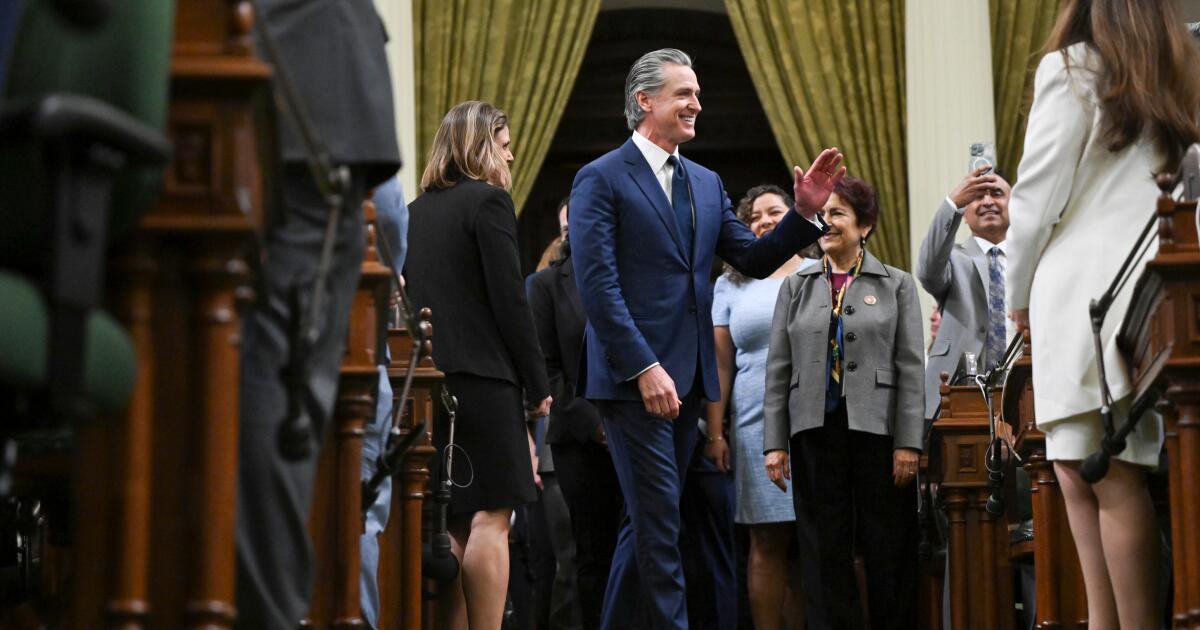
Newsom, California Legislature reach $351.7-billion budget deal

Gov. Gavin Newsom reached an agreement Friday with legislative leaders on a $351.7-billion state budget in his final year as governor, a spending plan that uses a tax windfall to avoid major cuts and lessen California’s chronic deficit in the years ahead.

The deal provides nearly $2 billion in state revenue next year through tax hikes on corporations, new levies on software sales and a revamped tax on managed healthcare organizations. Lawmakers and the governor continue major investments in education, healthcare and agreed to increase spending on subsidized childcare and affordable housing.

“We want to leave the next governor not only a balanced budget, but a budget that is substantially structurally sound, and we’re going to accomplish that,” Newsom said in an interview Friday. “We were very cautious in terms of new spending,”

The agreement ends weeks of lobbying by outside interests and negotiations among lawmakers and the governor at the state Capitol about how to handle a surge of income tax collected on stock market gains related to artificial intelligence.

Early forecasts last June projected a $12.6-billion deficit in 2026-27, according to the California Department of Finance. Updated predictions now suggest the state will end the year with a surplus of $4.5 billion.

Democrats, following Newsom’s lead, are tucking away $6.4 billion for future years, which allows the governor to knock down a deficit previously projected through 2027-28 and assuage criticism about his spending habits.

But economists say the fix and revenue increase is likely only temporary.

Spending in California has generally exceeded revenue growth during Newsom’s tenure in the governor’s office, creating a chronic shortfall. Despite the extra funding, the budget continues a trend of relying on reserves, shifting funds, borrowing and suspending debt payments to balance state spending.

The Legislative Analyst’s Office, the nonpartisan fiscal advisor for lawmakers, has warned of a roughly $10-billion gap between the amount of money the state brings in and spends, which could grow dramatically worse if the stock market turns downward. The LAO has said the existence of any operating deficit during a revenue boom is a red flag and that the state is “ill-prepared” for even a modest decline.

Christopher Thornberg, an economist and founder of the consulting firm Beacon Economics, said it’s business as usual in Sacramento.

“They love increasing spending. But it seems politically impossible to go the other way,” Thornberg said. “We’ve seen this play out over and over again.”

Lawmakers and the governor offered a different take and asserted that their decision to put the $6.4 billion into a short-term reserve, called the Projected Surplus Temporary Holding Account, and ask voters to allow them to store more money in the rainy day fund are examples of prudent budgeting.

“You see us save more and you see try to address the immediate needs of our community, but also the structural budget that potentially awaits us,” said Senate President Pro Tem Monique Limón (D-Goleta) in an interview. “We are forecasting a moment where we will need to address these issues and we want to start now to think about the future as well.”

Under a progressive tax structure, the state budget is dependent on income taxes paid by the ultra-rich on earnings largely from capital gains. The set up leaves California vulnerable to the unpredictable nature of the stock market, dramatic swings in revenue and, in recent years, reliant on poor projections.

Negotiations at the state Capitol included an agreement on a constitutional amendment that seeks to offset the revenue highs and lows.

If approved by voters on the statewide ballot in November, the amendment would raise a cap on mandatory deposits into the rainy day fund from 10% to 20% of general fund revenue. The measure would also allow lawmakers to exempt money they put into the rainy day fund and the temporary holding account from state spending limits.

Under an existing state appropriations restraint, also known as the Gann Limit, lawmakers cannot spend more than an amount determined by a formula that takes annual tax proceeds, changes to the population and cost of living into consideration. Tax revenue above the limit must be divided between schools and refunds to taxpayers.

With few exceptions, the limit applies to most appropriations of tax revenue, including when lawmakers put money away in the rainy day fund and other reserves.

Newsom said the change will leave the state in a much better position to weather the volatility. Though calls for tax reform remain in California, the governor said being able to place more money into the reserves could ultimately solve the state’s budget challenges.

“The one thing missing is the one thing that I think we finally landed, which is the change in the reserves,” Newsom said. “It changes the political dynamic, where now you’re not exchanging general fund priorities.”

Republicans criticized the proposed constitutional amendment, which passed in a budget trailer bill this week, for failing to require that excess revenue pays down the state’s $22 billion in unemployment insurance debt.

State Sen. Tony Strickland (R-Huntington Beach) called it a missed opportunity.

“It does not require debt payment to go to the UI debt,” Strickland said. “It facilitates more spending, exempting reserve deposits from the state spending limit.”

As part of the negotiations, lawmakers agreed to delay some healthcare cuts that would have required monthly premiums for immigrants and eliminated dental care. The deal adopts a Medi-Cal asset test of $21,000 on July 1, 2027, instead of a $2,000.

The budget agreement includes a provision requiring California’s next governor to develop options to reduce taxpayer subsidies for corporations whose employees receive state-sponsored healthcare through Medi-Cal instead of the company’s health plan. The plan is aimed at raising revenue to offset federal cuts that are expected to leave millions of Californians without access to healthcare.

The California Department of Finance said state reserves are expected to total $28.8 billion under the 2026-27 budget.

Source link

FedEx Freight expects $605M-$645M in adjusted operating income on 4%-6% revenue growth through Dec. 31, 2026 (NYSE:FDXF)

Earnings Call Insights: FedEx Freight Holding Company, Inc. (FDXF) Q4 fiscal 2026

Management View

  • “We successfully launched as a stand-alone LTL carrier,” and “on June 1, we proudly rang the opening bell at the New York Stock Exchange, officially marking our debut as a

Seeking Alpha’s Disclaimer: This article was automatically generated by an AI tool based on content available on the Seeking Alpha website, and has not been curated or reviewed by humans. Due to inherent limitations in using AI-based tools, the accuracy, completeness, or timeliness of such articles cannot be guaranteed. This article is intended for informational purposes only. Seeking Alpha does not take account of your objectives or your financial situation and does not offer any personalized investment advice. Seeking Alpha is not a licensed securities dealer, broker or US investment adviser or investment bank.

Source link