
Holiday spending expected to increase 6.7% to reach record high of $275B—Adobe Analytics
Holiday spending expected to increase 6.7% to reach record high of $275B—Adobe Analytics
Source link
Holiday spending expected to increase 6.7% to reach record high of $275B—Adobe Analytics
Source link
Lighter regulation and excess capital are setting up the biggest U.S. banking wave since the 2008 crisis.
The U.S. banking industry is bracing for its most significant wave of consolidation since the 2008 financial crisis, according to a new Bain & Co. analysis.
The firm expects the number of trillion-dollar U.S. banks to grow from the “Big Four” — JPMorgan Chase & Co., Bank of America Corp., Citigroup Inc., and Wells Fargo & Co. — to as many as seven by 2030. Key drivers include lighter regulation, burgeoning tech and 17 global banks holding over $10 billion each in excess capital. That capital cushion, Bain argues, will lead to a spike in M&A activity.
Banco Santander SA’s August acquisition of Webster Financial Corp. serves as an early example of what could be in store for U.S. banking giants. For Joe Lischwe, a partner in Bain’s financial services and customer strategy practice, the deal illustrates how capital-rich banks are leveraging eased regulatory conditions to combine geographic scale with targeted scope. In this scenario, Santander gets Webster’s health savings account franchise.
“We think there’s a window within this current [Trump] administration over the next two to three years where this will continue to be accelerating,” Lischwe told Global Finance on a call. “You will see more consolidation over the next few years.”
Seventeen U.S. banks currently hold more than $10 billion in excess capital — a figure Lischwe said Bain compiled from a mix of public quarterly filings and third-party data sources, including Refinitiv.
Bain also found that total bank M&A deal value rose 19% in 2025 and is up another 7% so far this year.
“There’s been an uptick in the actual deal value that has been occurring,” Lischwe added. “But I think, probably, the biggest tailwind is from a regulatory perspective.”
The Trump administration continues to move on multiple fronts that matter most to M&A-hungry banks, the latest being on Sept. 17 when the Federal Deposit Insurance Corporation’s (FDIC) proposed new guidelines to make bank mergers easier and faster to approve.
Not all acquisitions are created equal, according to Bain’s framework, which sorts bank deals into two categories. “Scale” deals expand a bank’s existing footprint — deposits, branches and geographic reach — and generate value primarily through cost synergies.
“Scope” deals, meanwhile, bring in capabilities the acquirer doesn’t already have. Bain predicts that these blended scale-and-scope deals will emerge as the standouts. Capital One Financial Corp.’s acquisition of Discover, which gave Capital One a payments network it previously lacked, produced outsized total shareholder returns on a two-year basis, Lischwe said.
Fifth Third Bancorp’s purchase of Comerica, by contrast, was a more traditional scale play — consolidating similar deposit and branch businesses — without adding new capabilities.
“In general, we were seeing that blended deals, on average, performed better,” Lischwe said. “That’s not to say that scale deals don’t do well.”
Bain’s advice to bank executives is to first conduct a rigorous self-assessment across six dimensions — financial scale, geographic density, business mix, product capability, technology and liquidity — before approaching an acquisition target.
“The answer is not to buy more fintechs,” Lischwe said. “The answer is to know your gaps, diligence those gaps, and then consider every asset that helps you close those gaps.”
Nowadays, fintechs tend to outpace incumbent banks in artificial intelligence, data, payments, blockchain and digital assets — areas that could tempt banks to leapfrog years of in-house development. But evaluating those targets is harder than buying a similar-sized bank, Lischwe said. A fintech operating in an unfamiliar capability area is more difficult to underwrite than a competitor running the same core business.
That complexity introduces significant execution risk for buyers looking to acquire growth quickly.

Jeff Barrington, Managing Director at tech and payments sell-side advisory firm Windsor Drake, cautions that banks frequently misjudge these acquisitions on several fronts.
“Banks buying fintechs tend to get tripped up in four ways: they pay a growth multiple for revenue that was acquisition cost-fuelled and doesn’t survive inside the bank, they underestimate the cost of bolting a modern stack onto a legacy core, they lose the founders and engineers once the earnout vests, and they misprice the regulatory and partner bank risk that comes attached,” Barrington said. “The recurring error is buying what looks like a growth company and ending up with a bank-owned product that stops growing.”
There’s also the risk of a more concentrated banking landscape: fewer banks means higher fees and diminished access to the kind of relationship-based banking that small towns and entrepreneurs rely on.
Barrington added that while scale can fund improved pricing and technology for users, “consolidation consistently narrows choice, closes branches and thins out relationship lending.
Banks that fail to acquire or build the AI, data and digital capabilities that are currently reshaping the industry risk falling behind competitively.
“Those [banks] that will be successful are those that will be really ruthless about what are our capability gaps, what can we close inorganically, doing the proper diligence and then properly integrating it,” Lischwe added.
Capital One-Discover, Fifth Third-Comerica and Santander-Webster are recent deals that, so far, have held up. Whether pricier, more speculative targets — he cited digital banking upstart Revolut as an example of an asset banks are watching, despite its rich valuation — get bought will depend on whether acquirers can underwrite a clear strategic fit and value-creation case.
As for whether a change in political control in Washington could derail the trend, Lischwe remains skeptical.
“The regulatory tailwind is going to last,” he said, “through this administration and even into the next one.”
Anthony Noto covers corporate finance and private credit. Contact him at anoto@gfmag.com
MAJOR railway lines are closed due to a gas leak leaving commuters stranded in rush hour – with the disruption expected to last all day.
Passengers are urged not to travel between Reading and Swindon as engineers frantically attempt to fix the issue, while other routes are seeing significant delays.


The gas leak close to railway land at Didcot Parkway in South Oxfordshire is expected to cause severe disruption throughout Wednesday.
The Reading-Didcot section of the route is the gateway from Paddington towards Swindon, Bristol, Bath, South Wales, Cheltenham and other parts of the West Country.
Diversions are in place but Great Western Rail is cancelling some services outright because trains can’t get through Reading-Didcot.
A total of 72 services to and from Didcot are cancelled, while 39 have been axed at Oxford and 45 at Reading.
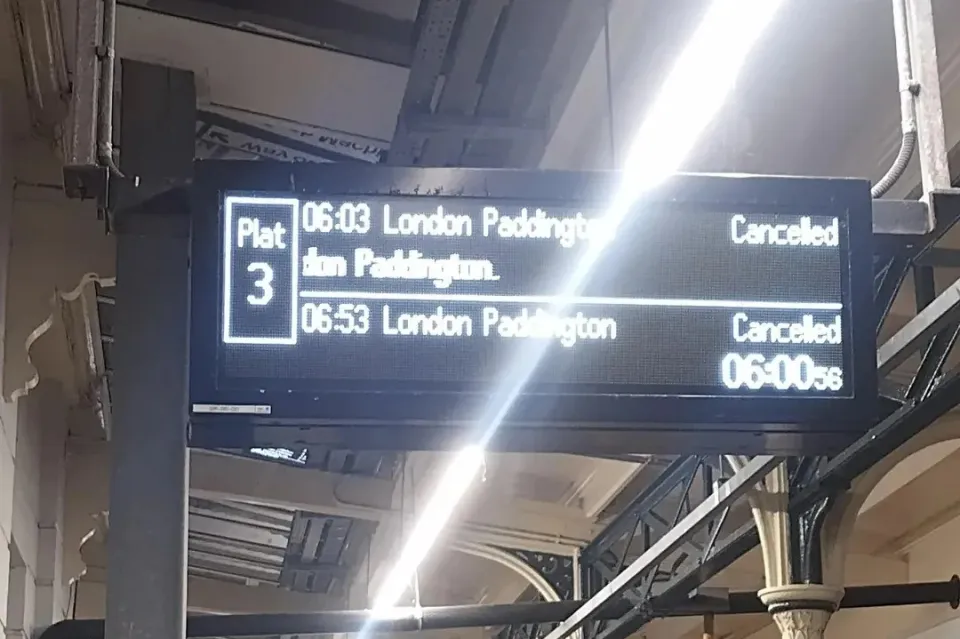
One social media user posted a photo from Swindon showing trains to Paddington cancelled at 6am.
They wrote: “Apparently there’s been a gas leak around Didcot Parkway so they’ve cancelled most of the services, and no replacement bus services running either.
“The staff at Swindon reckon this will last all day and probably tomorrow.”
Another person responded: “Absolutely ridiculous… not good enough.”
GWR is running roughly one train an hour Paddington-Bath/Bristol via a diversionary route – a fraction of the normal capacity.
It has warned only to travel if absolutely necessary.
Replacement buses are running between Swindon, Didcot and Reading but Network Rail says capacity won’t be enough for everyone.
CrossCountry is also telling passengers not to travel between Reading and Oxford – with one person responding to the company’s X post with: “Thanks for ruining my whole day.”
Network Rail said: “Engineers from gas distribution company SGN are on site working to rectify the problem as quickly and safely as possible.
“Network Rail and train operators are working together to manage the impact on passengers, but normal services cannot operate until the leak has been repaired because the railway falls within the safety exclusion zone.
“Severe disruption is expected to long-distance services that would usually travel through Didcot, and passengers are being warned that trains able to run either side of the affected area will be extremely busy.
“GWR will continue to operate as many trains as possible either side of the incident.”
GWR expects to be able to operate services between:

