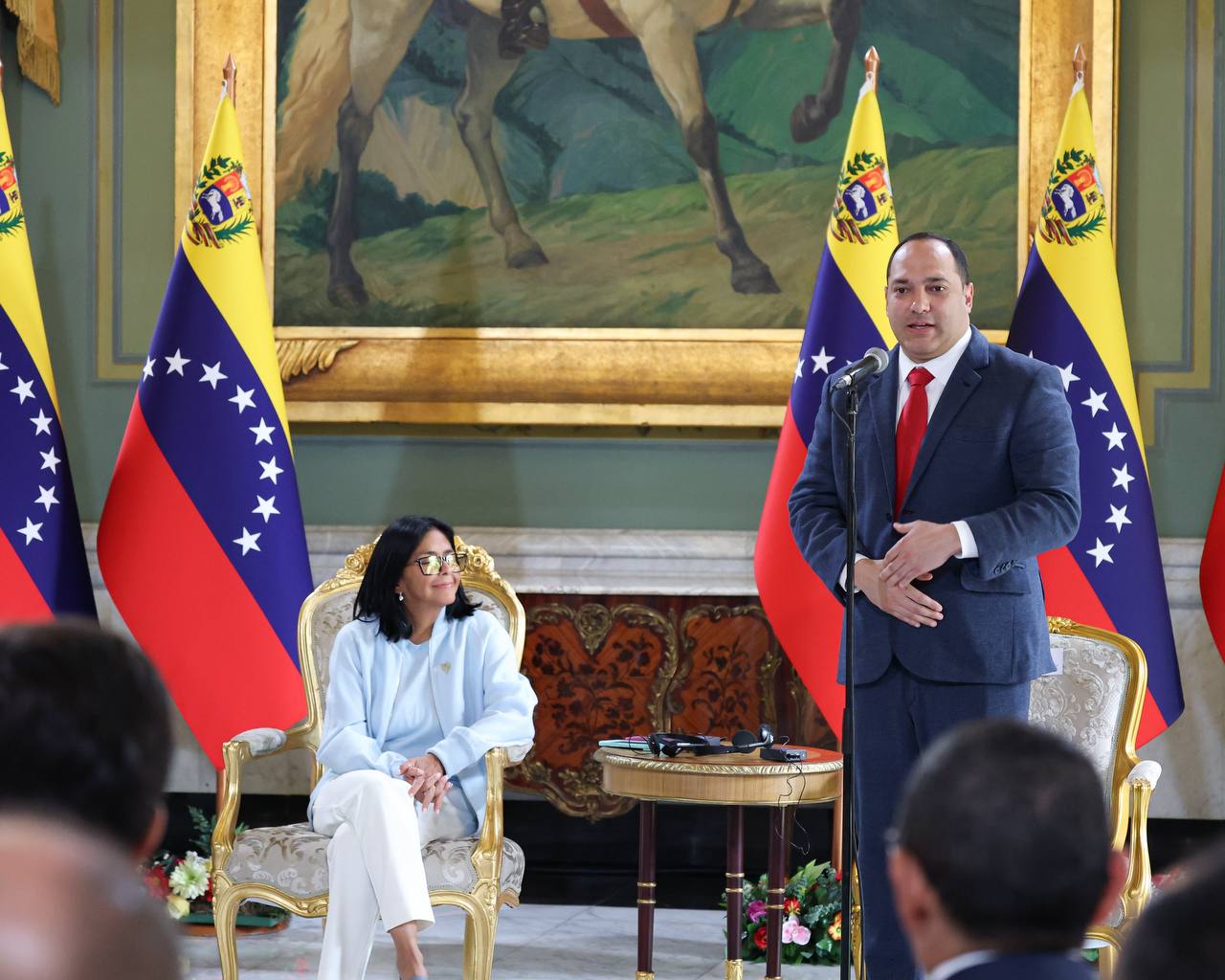
Rodríguez and Obregón have praised the oil agreement with Trump and NABEP. (PDVSA)
Caracas, September 9, 2026 (venezuelanalysis.com) – The president of Venezuelan state oil company PDVSA, Héctor Obregón, backed the recent agreement with the Trump administration as a “win-win relationship” on Monday.
“We signed Productive Participation Contracts where we put forward crude reserves and qualified personnel. What were we missing? Foreign capital,” he said in an interview with Unión Radio.
Productive Participation Contracts (CPP) are concession-type agreements whereby energy projects are turned over to private corporations which run operations and commercialization while paying a negotiated portion of proceeds to the Venezuelan state.
The recent oil deal, hailed by Trump as “the biggest in history,” will see Venezuela transfer 17 prime oilfields, containing 65 billion in proven crude reserves, to private operator NABEP. The projects are split between extra-heavy crude fields in the Orinoco Oil Belt and mature light- and medium-crude ones in the Lake Maracaibo basin.
Obregón insisted on the mutual benefits, explaining that Venezuela will collect taxes and royalties while the US will be able to supply its domestic demand. Regarding the agreement’s timeline, which the White House has claimed to span 100 years, Obregón stated that the concession is for 25 years but may be renewed for similar periods “as many times as necessary.”
After initially vowing that NABEP would invest US $100 billion in the oilfields, a figure repeated by Venezuelan officials, the Trump administration changed the pledge to “more than $10 billion.”
According to a White House “fact sheet” on the deal, the US State Department will be able to secure 20 percent of the NABEP’s output at cost and have a right of first refusal over the remaining 80 percent.
Obregón suggested that Washington could secure additional benefits, indicating that a reference $65 barrel would have a $15 “sales discount.” The oil official likewise estimated capital and operational expenditures at $12-15 and stated that NABEP would never secure a smaller portion of proceeds than the Venezuelan state, with the percentage increasing for greenfield projects.
The $19 revenue estimate offered by Venezuelan officials as the government’s take for a reference $65 barrel is significantly lower than the benchmarks established under the 2001 Hydrocarbon Law approved by former President Hugo Chávez and subsequent reforms. Under the previous framework, only PDVSA or PDVSA-majority joint ventures were allowed to operate oilfields, with the Venezuelan state securing as much as $0.80 for every $1 of oil proceeds in the latter case.
NABEP, owned by Venezuelan oil mogul Alejandro Betancourt, will grant a 35 percent stake at no cost to the Pentagon’s Office of Strategic Capital (OSC). Washington will likewise have veto power over NABEP’s board of directors. Betancourt has faced corruption accusations in Venezuela, with authorities issuing an arrest warrant in 2022 that was later dropped. For its part, the Trump administration has sought to halt money laundering investigations against the Venezuelan businessman both in the US and in Switzerland.
Obregón went on to acknowledge that Venezuelan export revenues are currently deposited in a US Treasury account before US officials decide on the disbursement amounts and timings back to Caracas.
“There is a state-to-state agreement to receive Venezuelan funds in Treasury accounts,” he disclosed, echoing Washington’s assertion that its seizure of Venezuelan export proceeds aims to protect them from potential creditor claims.
“The channeling of revenues through the US Treasury could be considered a protection measure, since there are debt claims against PDVSA and creditors could target our accounts,” he argued.
Neither US nor Venezuelan authorities have disclosed the amount of revenue collected and disbursed back to Caracas. Luigi Pisella, an advisor to Acting President Delcy Rodríguez, claimed that the Trump administration is deducting the costs of its January 3 military operation against Venezuela from the country’s funds.
The costs of goods and services supplied by US-based exporters to Venezuela are also being directly deducted from the funds held in the Treasury accounts.
Apart from controlling export earnings, US officials have publicly participated in a pro-business overhaul of the Caribbean nation’s hydrocarbon law and regulations, including reviewing drafts of the legislation.
The Trump administration has maintained sanctions on the Venezuelan oil industry while issuing licenses for select Western corporations. US Energy Secretary Chris Wright oversaw the signing of agreements with Chevron, Eni, and smaller US-backed energy firms during a visit to Caracas earlier this month.
Edited by Lucas Koerner in Philadelphia, USA.