Venezuelas

Venezuela’s Central Bank Confirms External Audit of US-Controlled Resources

BCV authorities recently met with banking executives and pledged to loosen credit restrictions. (BCV)

Caracas, April 27, 2026 (venezuelanalysis.com) – The Venezuelan Central Bank (BCV) has announced the hiring of outside firms to audit Venezuelan export revenues currently controlled by the Trump administration and disbursed to Caracas.

In a press statement, BCV Acting President Luis Pérez confirmed that both the Venezuelan and US governments had hired auditing companies to “ensure peace of mind and impartiality.”

“The auditing of the country’s resources by external consultants gives us peace of mind,” Pérez stated. “Venezuela can be confident that the resources are being channeled where they have to and getting where they need to.”

According to Reuters and Bitácora Económica, Deloitte is one of the firms selected to inspect the Central Bank’s accounts, though it is not known whether it was chosen by Washington or Caracas.

One of the largest global consulting corporations, Deloitte has close ties to the US political establishment and national security state.  The London-based firm has a well-documented history of hiring former CIA agents and undertaking corporate espionage.

Since the January 3 US military strikes and kidnapping of Venezuelan President Nicolás Maduro, the Trump administration has taken control over Venezuelan oil revenues, mandating that all royalty, tax, and dividend payments be deposited in US Treasury-run accounts before a portion is returned to Caracas at the White House’s discretion.

US officials, including Secretary of State Marco Rubio and Treasury Secretary Scott Bessent, have stated before congressional committees that the Venezuelan government’s allocation of its own resources, once returned by Washington, would be subject to outside audits.

Rubio additionally claimed that Caracas needs to submit “budget requests” before accessing funds. Both US and Venezuelan officials have acknowledged the use of US-managed funds for imports of medicines and medical equipment from US manufacturers.

The sequestered Venezuelan earnings have not been returned directly to the BCV but injected into foreign currency auctions run by banks. US officials have confirmed the transfer of US $500 million of a projected $2 billion initial agreement, though analysts have reported a higher volume of foreign currency made available in recent weeks.

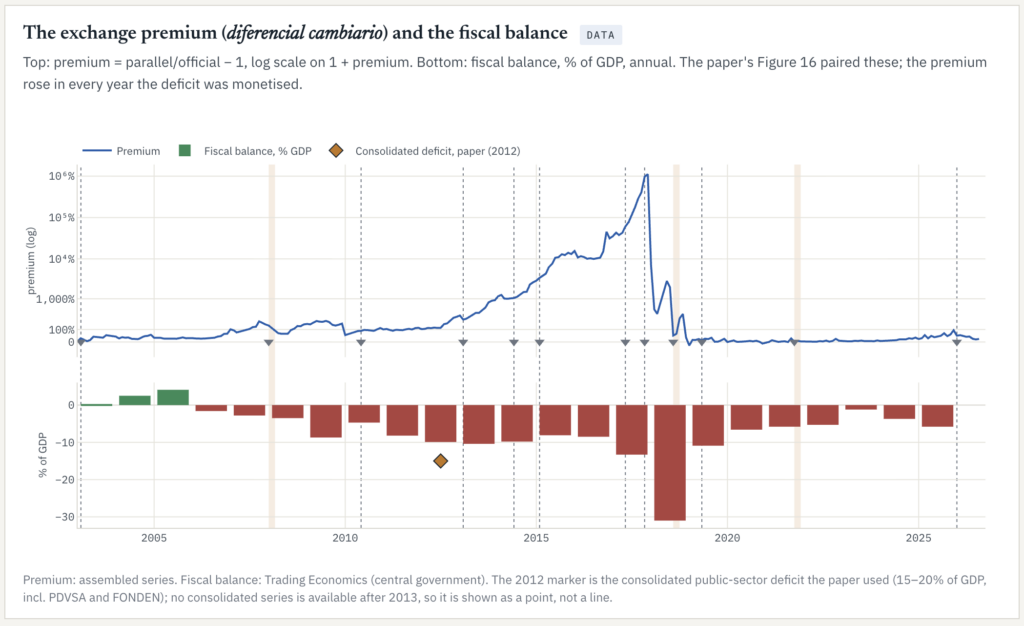
Recently issued US Treasury licenses allowing transactions with the Venezuelan Central Bank are expected to restore some of the institution’s capacity to intervene in the economy. In a recent meeting with banking executives, Acting President Pérez stated that the BCV was prioritizing inflation control and forex market stability. A black market exchange rate has consistently hovered above the official one, with a gap currently at around 30 percent. Critics have blamed the BCV’s lack of oversight for the proliferation of currency speculation.

Pérez likewise pledged to review the Central Bank’s current reserve requirements, a recurring demand from banks in recent months. Banks are presently forced to hold 73 percent of deposits as reserves.

The contraction of credit, alongside reduced public spending and the freezing of wages, were policies adopted by the Maduro government in recent years in an effort to slow down inflation in the sanctions-hit Venezuelan economy.

Pérez was appointed acting president of Venezuela’s financial authority on April 16. He replaced Laura Guerra, who had been in the post since April 2025. Last week, the Venezuelan government’s “rapid response” social media denied reports of negotiations with the US State Department and the far-right opposition to select a new BCV board.

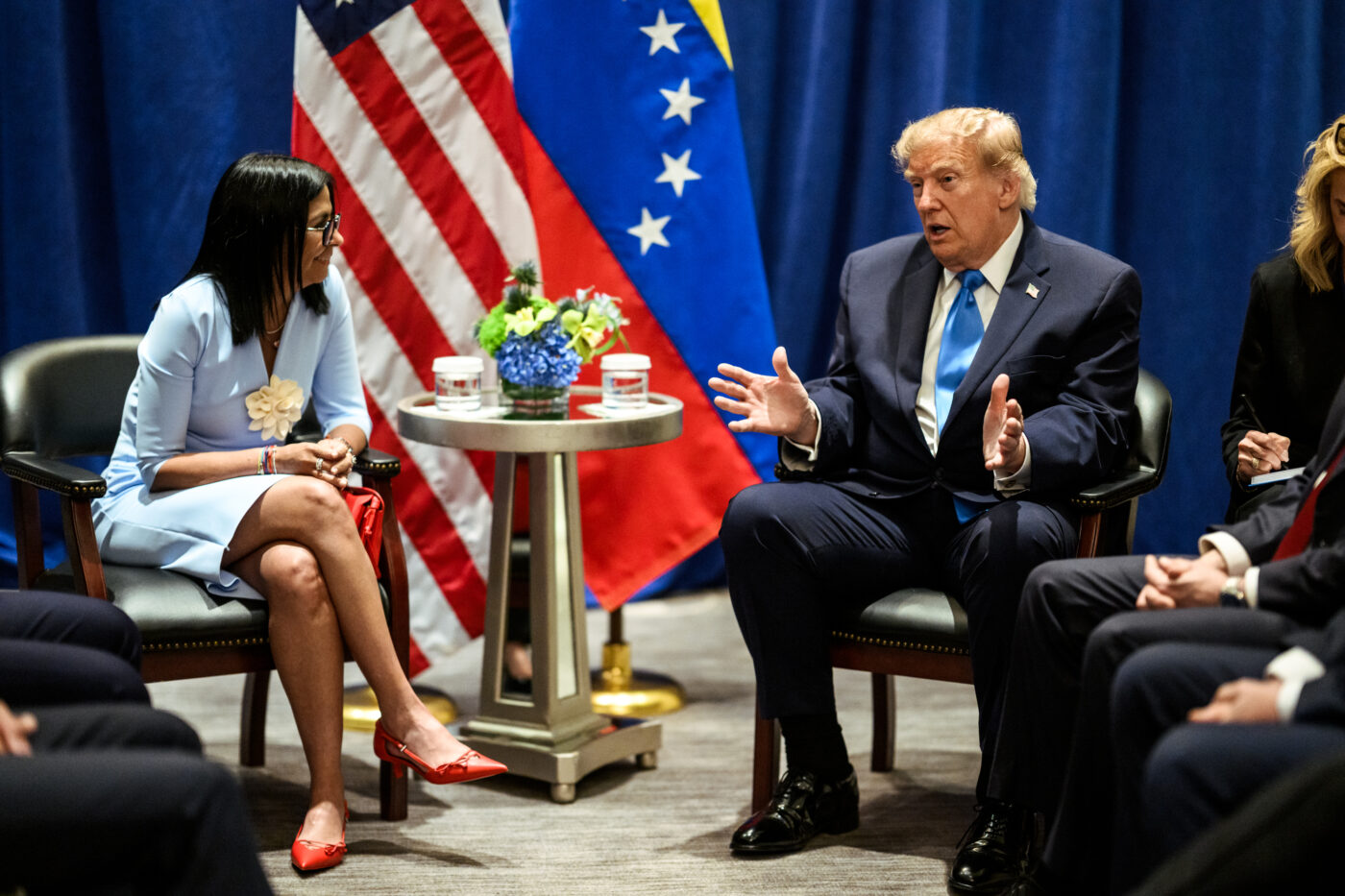
Since January, the Venezuelan government led by Acting President Delcy Rodríguez has fast-tracked a diplomatic rapprochement with the Trump administration.

The White House’s recognition of Rodríguez as Venezuela’s sole leader has paved the way for the resumption of dealings with the International Monetary Fund (IMF), while creditors of Venezuela’s sizable foreign debt anticipate a lucrative restructuring agreement.

The Rodríguez administration has likewise driven a pro-business legislative agenda with the goal of attracting foreign investment. The Caribbean nation’s parliament has approved reforms to the hydrocarbon and mining sectors that grant increased control to foreign conglomerates, alongside reduced fiscal responsibilities and the possibility of taking disputes to international arbitration bodies.

Canadian miner Gold Reserve issued a statement Monday “welcoming” the new mining law, noting that some of its “key recommendations were reflected in the final enacted law,” including the repeal of a 2015 decree establishing majority Venezuelan state control over the sector.

Acting President Rodríguez, as well as National Assembly President Jorge Rodríguez, have both acknowledged receiving “recommendations” and “suggestions” from oil majors in the hydrocarbon industry overhaul.

Edited by Lucas Koerner in Fusagasugá, Colombia.

Source link

Venezuela’s Rodríguez and Colombia’s Petro Hold Talks on Security, Trade, Energy

Petro was the first head of state to visit Caracas since the January 3 US attacks. (Presidential Press)

Caracas, April 24, 2026 (venezuelanalysis.com) – Venezuelan Acting President Delcy Rodríguez hosted Colombian President Gustavo Petro for bilateral talks in Caracas on Friday. 

The meeting marked the first official visit by a head of state since the kidnapping of President Nicolás Maduro during a US military operation on January 3.

Following talks at Miraflores Presidential Palace, Rodríguez said both governments committed to tackling organized crime along their shared border, one of the longest in the region at over 2,200 kilometers.

“We have undertaken a very serious and concrete approach to combating criminal groups and transnational crime,” she said, announcing the development of joint military plans and “immediate” mechanisms for intelligence sharing in a new level of security cooperation.

Petro, for his part, stated that both countries would work toward the “liberation of border communities” through coordinated military, police, and social action.

“Building a fully coordinated common effort to free border populations from mafias engaged in various illegal economies,” he said, accusing irregular groups of human trafficking, drug trafficking, and illegal gold trade activities.

The leaders also agreed on economic initiatives aimed at supporting Venezuelan and Colombian populations in border regions. Petro expressed hope that these efforts would help reintegrate the two territories and boost food security.

The joint action commitments come amid escalating violence in the Catatumbo region of Colombia’s Norte de Santander department, which borders Venezuela’s Táchira state, where clashes between armed groups have displaced thousands in recent weeks.

Armed organizations operating in the area include the National Liberation Army (ELN), the Estado Mayor Central (EMC) and the Segunda Marquetalia, both descendants of the former FARC, and the Clan del Golfo, among others.

Friday’s talks also included the neighboring nations’ trade relations. Rodríguez highlighted discussions on “import substitution” between the two countries.

“It makes no sense for Colombia or Venezuela to look to other regions or hemispheres for what we can produce within our own territories,” she said, noting that bilateral trade currently stands at approximately $1.2 billion per year.

The leaders further addressed electrical interconnection projects for western Venezuela, a region heavily affected by blackouts, as well as reopening a pipeline that would allow Venezuela to export natural gas to Colombia and beyond.

Rodríguez and Petro also discussed the revival of air connectivity to boost tourism, including the development of multi-destination travel initiatives.

Present at the private meeting were Colombia’s foreign minister Rosa Villavicencio and defense minister Pedro Sánchez, alongside Venezuela’s foreign minister Yván Gil and Interior Minister Diosdado Cabello. The presidential summit followed an earlier meeting of the two countries’ Neighborhood and Integration Commission, with bilateral working groups established for a number of areas, including trade, energy and defense. 

A prior meeting scheduled between Rodríguez and Petro on the border in early March was suspended due to security concerns.

Rodríguez hosts new US chargé d’affaires

Venezuelan Acting President Delcy Rodríguez also welcomed the Trump administration’s new chargé d’affaires to Venezuela John Barrett at the presidential palace on Friday.

Alongside Cabello and Gil, Rodríguez held a private meeting that reportedly focused on energy and a “long-term cooperation agenda.” For its part, the US embassy in Caracas stated that Barrett will continue implementing Washington’s “three-phase plan” for the Caribbean nation.

Barrett recently replaced Laura Dogu, who had been on the post since January. A career diplomat, he last served as chargé d’affaires in Guatemala, where he was accused of interference in magistrate elections in March.

Washington and Caracas fast-tracked a diplomatic rapprochement following the January 3 military strikes and kidnapping of Maduro. In March, the White House recognized Rodríguez as Venezuela’s sole leader, while the acting president recently thanked Trump and Secretary of State Marco Rubio for their “good disposition” in establishing “cooperation” between the two countries.

The diplomatic reengagement and US recognition have likewise led to a resumption of ties between Caracas and the International Monetary Fund (IMF).

Edited and with additional reporting by Ricardo Vaz in Caracas.

Source link

The Venezuelanalysis Podcast Episode 44: Venezuela’s Natural Resources, Oil Reform, and Sovereignty

Venezuela’s January 2026 hydrocarbons law reform marks a major shift in the country’s oil sector. It establishes a more flexible fiscal regime in the name of “international competitiveness,” while expanding the private sector role in extraction, operations, and dispute resolution mechanisms.

The reform follows years of US sanctions on Venezuela’s oil industry and coincides with new US licenses allowing Western conglomerates to move into Venezuela’s energy sector.

Join Blas Regnault, energy policy analyst and consultant focused on oil geopolitics, alongside Venezuelanalysis editors Ricardo Vaz and Lucas Koerner, as they break down the reform, its economic and political context, and what it means for control over strategic resources and national sovereignty.

Powered by RedCircle

Source link

Venezuela’s repressive system still active, Amnesty International says

Repression in Venezuela has continued under interim President Delcy Rodriguez, Amnesty International says. File Photo by Henry Chirinos/EPA

April 22 (UPI) — Amnesty International said Venezuela has not dismantled its “repressive apparatus” nearly four months after former President Nicolás Maduro was arrested in a U.S. military operation.

During the presentation of its annual report in Bogotá, the organization said the country’s system of repression remains fully operational under the interim government led by Delcy Rodríguez.

Valentina Ballesta, research director for the Americas at Amnesty International, said Tuesday that Venezuela’s repressive structure continues to operate despite the political transition, according to reports by Infobae.

According to the report, Maduro’s government maintained a policy of systematic repression throughout 2025, with all branches of the state acting in coordination.

Amnesty International said authorities continue to use arbitrary detentions, forced disappearances and torture as tools of social control.

“These are not isolated incidents, but rather a pattern that amounts to crimes against humanity,” the report said.

The organization documented hundreds of cases in which detainees faced judicial proceedings without basic legal guarantees, including ineffective public defenders, the use of special anti-terrorism courts, lack of access to charges and repeated violations of due process rights.

Amnesty International also criticized the implementation of the Amnesty Law approved in February, saying its enforcement has been arbitrary and selective.

Many requests for relief were rejected without explanation, while some people initially granted benefits later had those measures reversed, according to Venezuelan news outlet Efecto Cocuyo.

While the nongovernmental organization Foro Penal and other groups confirmed the release of 673 political prisoners between Maduro’s capture and mid-April, Rodríguez’s government has reported much higher figures as part of what it described as “peace and reconciliation” measures.

In March 2026, government spokespeople said as many as 7,000 people had been granted full release or alternative legal measures. That figure, however, includes common criminals and people already serving conditional release.

Foro Penal said nearly 500 political prisoners remain in detention.

The Amnesty International report said impunity remains the driving force behind Venezuela’s repressive system and warned that the lack of an independent judiciary prevents victims from obtaining justice inside the country.

Analist also pointed to the recent restructuring of the Attorney General’s Office as an example of political control. The move replaced an official close to Maduro with another figure aligned with the Rodríguez political faction, which currently controls both the interim presidency and the National Assembly.

About 7.9 million Venezuelans have fled the country since 2015. Nearly 2 million people depend on international humanitarian aid, while severe shortages in basic services such as water, electricity and food persist, the report said.

Amnesty International further warned about the growing use of new technologies and artificial intelligence for population surveillance, along with continued harassment of journalists and human rights advocates.

Without a genuine dismantling of coercive state structures, Amnesty International said, Venezuela will not be able to restore fundamental freedoms.

Source link

Machado’s Return Is the Real Test of Venezuela’s Political Opening

The real test of Venezuela’s current political moment will not be institutional, but political. It will not lie in the appointment of a new prosecutor, or in any decision taken by a parliament that, by design, reflects the preferences of those in power. It will lie in something far less controllable: the return of María Corina Machado.

For months, there has been talk of normalization, of technocratic adjustment, even of a transition managed from within. It is an appealing idea, but an illusory one. As usual, chavismo does not administer space, it occupies it. The notion that it would suddenly evolve into a system governed by technocratic restraint, even under US pressure, was always more wishful thinking than analysis.

What has changed is not the nature of the system, but our understanding of it. For years, it was assumed that power rested on a rigid internal balance, a kind of tripod between civilian leadership, party machinery, and the military. The uneventful sidelining of Vladimir Padrino López suggests otherwise. Now relegated to an almost theatrical role as Agriculture Minister, he makes appearances at cattle shows in Borsalino hats and Panerai watches. We have long known that chavismo’s superpower is its adaptability. It can reshuffle, absorb shocks, and reallocate power without fracturing, even at its highest levels, and carry on.

That adaptability cuts both ways. It helps explain why Delcy Rodríguez has been able to consolidate authority despite presiding over the country under the tutelage of the “yankee devil”, and despite earlier doubts about her staying power. It also explains why the government has been able to pursue a limited opening without losing control. But it also sets the limits of that opening.

Because the one problem the system has not been able to solve is credibility.

An empty pitch

The effort to attract investment has run into a wall that legal reforms and external signaling cannot easily overcome. Investors are not simply looking for incentives, they are looking for guarantees, that power is legitimate, that rules will be upheld, that today’s opening will not be reversed tomorrow. So far, those guarantees do not exist.

As I have argued before, none of this means that capital will stop flowing into Venezuela altogether. It won’t. There are firms that know how to operate in this environment, firms that have built their business models around political risk rather than in spite of it.

Take Grupo Cisneros, which is moving to secure a $1 billion investment fund aimed at Venezuela’s recovery. Or Chevron, which has doubled down on its presence through a major asset swap with PDVSA, expanding its stake in key projects in the Orinoco Belt.

What is not arriving, at least not yet, is transformational capital, the kind that requires predictability, legal certainty, and a credible political horizon.

These are not naïve entrants. They are actors with long experience navigating the Venezuelan system. Cisneros has remained a player despite fines and suspensions over the years. Chevron, for its part, has effectively become the most important American economic partner of the current government, maintaining operations through multiple political cycles and regulatory frameworks.

But that is precisely the point.

This is not the kind of capital Venezuela needs.

What is arriving, or staying, is adapted capital, capital that knows how to survive volatility, negotiate through informal institutions, and operate without full guarantees. What is not arriving, at least not yet, is transformational capital, the kind that requires predictability, legal certainty, and a credible political horizon.

And that gap cannot be closed through reforms alone. It cannot be legislated into existence, nor negotiated deal by deal. It requires something more fundamental: confidence that power in Venezuela is not entirely discretionary.

The pressure map

The timing of this becomes even more significant in light of Venezuela’s re-engagement with the IMF and the World Bank. After years of isolation, the country is once again being folded back into the international financial system, opening the door to technical assistance, debt restructuring, and eventually, fresh financing. It is the clearest signal yet that normalization, at least at the institutional level, is moving forward.

But this only sharpens the underlying problem.

These institutions can help stabilize accounts, restructure liabilities, and provide liquidity. What they cannot do is manufacture credibility where it does not exist. Their return signals that Venezuela is being treated, once again, as a country with which business can be conducted. It does not guarantee that the rules of that business will hold.

In some ways, Delcy has the easier hand to play. The current arrangement in Venezuela has become useful to Donald Trump in ways that go beyond the country itself. With the Iranian campaign failing to deliver the results he had anticipated, Venezuela has quietly taken on the role of a foreign policy success story, something tangible he can point to, both in terms of energy security and geopolitical leverage.

That utility is not uniform across his coalition. For more isolationist voters in what is often referred to as flyover country, a stable Venezuela that does not require further military involvement, and that contributes to stabilizing US energy prices, is a net positive. 

Detaining Machado, after appearances at CERAWeek and high-level meetings in Europe and Washington, would send a clear and immediate signal to the very actors the government has been trying to court.

Venezuelan crude is already easing pressure on US fuel costs, reinforcing the perception that the current arrangement delivers practical benefits.

But in South Florida, the picture is different. Latino voters, particularly Venezuelans, are already uneasy with the administration’s immigration policies, and are far less inclined to accept stability under a reconfigured chavista leadership as an acceptable endpoint. They are drawn instead to Machado’s message, and increasingly wary of what a prolonged Delcy Rodríguez-led government would mean. For them, the issue is not stability alone, but the absence of a credible electoral horizon.

This creates a tension within Washington’s own political logic. On one hand, there is an incentive to consolidate what appears to be working: restored oil flows, renewed financial channels, and growing international engagement with Caracas. On the other, there remains a constituency that expects something more, a path toward elections, not just normalization.

Machado, in this context, faces a more complex task than it might appear. She is not only trying to pressure the Venezuelan government, she is also trying to persuade a cautious administration that pushing beyond the current equilibrium is worth the risk, that the next step is not to stabilize the system as it is, but to open it further.

And she is doing so with limited institutional backing. Much of the Venezuelan civil society ecosystem aligned with MAGA politics appears more focused on maintaining its own access to the White House than on advancing a coherent strategy for Venezuela itself. That leaves Machado in a familiar position, carrying the burden of political escalation largely on the legs of her own prestige, but now within a much tighter set of constraints.

This is where María Corina Machado reenters the picture, not just as a political actor, but as a structural variable. Her return forces a choice that cannot be deferred. Allow her back into the country, or stop her.

Detaining her, after appearances at CERAWeek and high-level meetings in Europe and Washington, would send a clear and immediate signal to the very actors the government has been trying to court. These are not abstract observers, they are the same executives and investors now being asked to commit capital. Arresting her would not simply be a domestic political decision, it would be read as a statement about the limits of the current opening.

Allowing her to return is not costless either. It risks projecting weakness toward a base that has been conditioned to expect control. It creates space for mobilization, for coordination, for a reactivation of political pressure that the system has worked hard to contain.

But at this stage, that is a more manageable risk.

A constrained confrontation

Chavismo has shown that it can absorb internal contradictions. It can tolerate limited openings while maintaining overall control. What it is less equipped to manage, at least at this point, is a collapse in external credibility at the precise moment it is trying to rebuild it.

This is also not a confrontation between unconstrained actors. Machado is operating within limits of her own. She understands that an uncontrolled escalation could be interpreted in Washington as an attempt to derail a strategy that, for now, tolerates the current arrangement. Her leverage depends not only on mobilization, but on preserving her external legitimacy.

What emerges from this is not a clean confrontation, but a constrained one. Both sides are pushing, but neither is free to push all the way. Machado needs to generate pressure without triggering a rupture that works against her. The government needs to contain that pressure without closing the space in ways that undermine its own economic strategy.

That is what makes her physical presence in the country so consequential. Without it, the reactivation we are beginning to see, student movements regaining traction, party structures reopening, political figures cautiously returning, remains fragmented. With it, that energy has a focal point. 

And that is precisely why her return has become the real test. Not whether the system can produce institutional outcomes aligned with its interests, but whether it can tolerate, and ultimately absorb, the presence of the one actor it does not fully control, without undoing the fragile equilibrium it is trying to build.

Source link

A match made in opposition: Venezuela’s Machado courts Spain’s right wing | News

Madrid, Spain – Venezuela’s opposition leader Maria Corina Machado is aligned with Spain’s main right-wing party on its economic visions, but they are divided by social issues such as abortion, analysts say.

On a visit to Spain this weekend, Machado chose to snub an invitation to meet Socialist Prime Minister Pedro Sanchez and the left-wing coalition government officials.

Recommended Stories

list of 2 itemsend of list

The Nobel Peace Prize winner said she had chosen not to meet Sanchez because he was hosting a summit of left-wing leaders from Latin America in Barcelona.

“What has transpired in the past few hours at the meeting held in Barcelona with various political leaders from different countries is proof that such a meeting was not advisable,” Machado told a meeting in Madrid on Saturday.

Instead, she held a series of meetings with leaders from the opposition conservative People’s Party (PP) and the far-right Vox party.

Machado received a rapturous welcome from Alberto Nunez Feijoo, the PP party leader and Venezuelan emigres in Madrid, on Friday.

On Saturday, the Venezuelan opposition leader met Isabel Diaz Ayuso, the populist conservative Madrid regional leader, one of Sanchez’s fiercest critics and a possible rival to Feijoo.

Ayuso presented Madrid’s gold medal to Machado, while Madrid’s Mayor Jose Luis Martinez-Almeida – also of the PP – handed her the keys to the city before a rally with Venezuelan supporters.

Machado also met Santiago Abascal, the leader of Vox, in the Spanish capital.

Feijoo praised how Machado had championed freedom even at the cost of going into hiding in Venezuela away from her family.

“Spain knows well the value of freedom; it cost us dearly to obtain it. The generations of our parents and grandparents know what it is to live without freedom. That is why we cannot look the other way,” Feijoo said.

What divides Venezuela and Spain’s opposition?

Despite the cordial welcome, there are significant differences between Machado and Feijoo, commentators said.

A liberal conservative, who has said she is an admirer of Margaret Thatcher, Machado has been dubbed Venezuela’s “Iron Lady”.

She moved from the right politically to the centre-ground during the 2024 presidential campaign to attract voters in the middle ground.

As a conservative, Machado heads a Venezuelan opposition that is split and which also contains more liberal factions.

In contrast, Feijoo heads a well-organised conservative political party, which has only recently suffered divisions after the formation of the hard-right Vox party in 2013, analysts said.

Carlos Malamud, an expert on Latin America at the Real Elcano Institute, a think tank in Madrid, said the structure of both opposition groups was different.

“Machado is the leader of a small, disorganised opposition, while Feijoo is the head of the PP, which is a well-organised national political party,” he told Al Jazeera.

Malamud said Machado did not demonstrate the traits of a would-be Venezuelan president by refusing to see Sanchez.

“If Machado wants to be the president of Venezuela next year, she needs to be prepared to meet the head of the Spanish government, whoever that may be,” he explained.

“Perhaps the Venezuelan opposition sees the Spanish Socialist Party as being allied to (former Spanish prime minister) Jose Rodriguez Zapatero.”

Zapatero has played a controversial role in acting as a mediator between Spain and the government of former Venezuelan President Nicolas Maduro, who was abducted by the United States in January.

Maduro faces charges of narcoterrorism, conspiracy to commit narcoterrorism, drug trafficking, money laundering and corruption, which he denies.

Machado ‘more conservative’ on social issues

Malamud said one factor which unites Machado and Feijoo is that they came from political systems which suffered from polarisation.

“Venezuelan politics is the same as Cuban politics, or like Spanish. They all suffer from the same degree of polarisation,” he added.

Ana Ayuso, an investigator in Latin American affairs at the Barcelona Centre for International Affairs, said Machado shared the liberal economic theories of Feijoo, but they differed on social issues.

“She is in favour of freedom of trade and a small state, so she is quite liberal on economic affairs like Feijoo,” Ayuso told Al Jazeera.

“She is also closer to Isabel Diaz Ayuso in terms of economics, in terms of free trade and the participation of the state.”

“However, she is more conservative when it comes to social issues. Machado is against abortion, and religious affairs are important to her. She is close to the [Roman] Catholic Church. Feijoo supports the right to abortion.”

In an interview in 2024 with Spanish newspaper El Pais, Machado said she was against abortion but in favour of changing the law in Venezuela to allow abortion in cases of rape.

At present, the law in Venezuela allows abortion only when there is a risk to the life of the mother or child. Otherwise, it is illegal and can carry a jail sentence of up to two years.

“Machado does not have any similarities with Vox. Venezuela does not have a problem with immigration. Emigration is the problem,” added Ayuso.

She said the Venezuelan opposition leader had initially been a staunch supporter of US President Donald Trump, but he had shunned her in support of Delcy Rodriguez, the acting Venezuelan president.

Machado was now closer to Marco Rubio, the US secretary of state, who supported her cause within the MAGA movement, she added.

Source link

‘No regrets’: Venezuela’s Machado defends giving Nobel medal to Trump | Donald Trump News

Maria Corina Machado gave Trump her Nobel Peace Prize after the US leader captured Nicolas Maduro.

Venezuela’s main opposition leader Maria Corina Machado says she has “no regrets” about giving US President Donald Trump her Nobel Peace Prize medal.

Machado, the 2025 recipient of the prestigious prize, presented the medal that accompanies the prize to Trump when she met him at the White House in January, two weeks after he ordered US special forces to seize Venezuelan President Nicolas Maduro from Caracas.

Recommended Stories

list of 4 itemsend of list

Trump’s military operation to remove Maduro, who is currently detained in the US facing drug trafficking charges, is “something we Venezuelans will never forget”, she was quoted by AFP news agency as saying at a conference in Madrid on Saturday.

“There is a leader in the world, a head of state in the world, who risked the lives of his country’s citizens for Venezuela’s freedom,” she said.

Trump, who has long publicly coveted the Nobel Peace Prize, called Machado’s presentation of the medal at the time a “wonderful gesture of mutual respect”.

The Norwegian Nobel Committee, which honoured Machado for her tireless campaign to restore democratic rights in Venezuela and her struggle to achieve a peaceful transition from authoritarian rule, made clear after the handover that the prize is nontransferable and cannot be revoked, shared or transferred to others.

Machado, who had been living in hiding before leaving Venezuela in December to collect her prize in Oslo, said she was coordinating her return to the country with Washington.

US key to ‘democratic transition’

“I am speaking with the US government, and we are working in coordination, with mutual respect and understanding,” she said, adding that she believed Washington was “key to advancing a democratic transition” in Venezuela.

Trump has, however, publicly questioned Machado’s standing, calling her a “very nice woman” but saying she lacks “respect” within Venezuela. He has instead backed Maduro’s former vice president, Delcy Rodriguez, as the country’s interim leader.

Venezuela’s opposition last week called for presidential elections. Machado, who was banned from running in the disputed 2024 vote that returned Maduro to power, has not yet said whether she would stand in a future poll.

While in Spain, Machado declined a meeting with Prime Minister Pedro Sanchez, citing his hosting of a progressive leaders’ summit in Barcelona as proof the meeting was “not advisable”. Sanchez had said he was willing to meet her at any time.

This snub comes in contrast to her frequent encounters with Sanchez’s right-wing opponents.

Source link

Venezuela’s Rodríguez Signs Chevron Deals Awarding New Oil Drilling Areas, Increased Stakes

Chevron will expand its foothold in the Orinoco Oil Belt, the largest crude deposit in the world. (Archive)

Caracas, April 13, 2026 (venezuelanalysis.com) – Venezuelan Acting President Delcy Rodríguez inked new agreements with Chevron on Monday allowing the US energy giant to expand its presence in the country’s oil industry.

In a televised broadcast, Rodríguez, who was accompanied by officials from Venezuelan state oil company PDVSA and the Hydrocarbon Ministry, praised Chevron’s “commitment” to Venezuela.

“Chevron, with more than a century of presence in Venezuela, is an example of an oil company committed to Venezuela,” she said. “I salute this agreement as an example that there are legal pathways for investment to be assured and prosper.“

The Venezuelan acting president reiterated calls for the lifting of US sanctions against the Caribbean nation. US Chargé d’Affaires to Venezuela Laura Dogu was present at the ceremony and exchanged brief words with Rodríguez. US Assistant Energy Secretary Kyle Haustveit was also in attendance with a delegation from the US Energy Department.

The new contracts grant Petropiar, a joint venture with Chevron participation, the Ayacucho 8 bloc as the Houston-based conglomerate looks to expand its production of extra-heavy crude in the Orinoco Oil Belt. PDVSA completed exploration and appraisal of the 500 square-kilometer bloc but development has been limited.

Chevron owns minority stakes in four joint projects with PDVSA that currently produce about a quarter of Venezuela’s oil output. The agreements with the Venezuelan government will also see Chevron increase its stake in Petroindependencia, another mixed venture with PDVSA, from 36 to 49 percent. In exchange, it will relinquish its stakes in the offshore Loran natural gas field.

For his part, Chevron executive Javier La Rosa, thanked the Venezuelan and US governments for their support and praised the “strengthening” of Chevron’s position in the Orinoco Oil Belt. “Chevron is determined to be a reliable partner and establish win-win relations,” he said.

The exploration of the 7.3 trillion cubic feet (tcf) Loran field, which is part of the Loran-Manatee joint deposit with Trinidad and Tobago, will reportedly be turned over to Shell. The UK-based multinational is also involved in several natural gas projects in Venezuelan waters and similar agreements with the Rodríguez administration are expected in the coming days.

In addition, Shell also closed a deal to take over the Carito and Pirital oilfields from PDVSA’s Punta de Mata division in eastern Monagas state. The projects produce light and medium crudes, as well as natural gas.

The new contracts were signed under the pro-business provisions established by a January overhaul of Venezuela’s Hydrocarbon Law. In a recent interview, National Assembly President Jorge Rodríguez stated that the reform incorporated “suggestions” from Western corporate giants, including Repsol.

The updated legislation grants private corporations expanded control over operations and sales, slashes royalties and income tax, and allows legal disputes to be settled in international arbitration bodies. The reform likewise allows PDVSA to lease out projects to private companies in exchange for a fixed share of the output.

Since the January 3 US bombings and kidnapping of President Nicolás Maduro, the Trump administration has exerted control over the Venezuelan oil industry, granting waivers to boost the involvement of Western conglomerates and mandating that royalty, tax, and dividend payments owed to Venezuela be made to US Treasury-run accounts. 

Financial sanctions against PDVSA, as well as threats of secondary sanctions against firms that do not receive Washington’s green light, remain in place. On Monday, Secretary of State Marco Rubio vowed that the US “would not allow” geopolitical adversaries such as China, Iran, and Russia to have a significant presence in the Venezuelan oil industry.

“We don’t need Venezuela’s oil,” he said in an interview. “What we’re not going to allow is for the oil industry in Venezuela to be controlled by adversaries of the United States.”

Venezuelan crude production increased in March to 988,000 barrels per day (bpd), up from 909,000 bpd in February, according to OPEC secondary sources. The figure is the highest output since the imposition of a US export embargo in January 2019.

For its part, PDVSA reported 1.095 million bpd of production last month, with a 75,000 bpd increase compared to February. The direct and secondary measurements have differed over time due to disagreements over the inclusion of natural gas liquids and condensates. Venezuelan Oil Minister Paula Henao announced a 1.3 million bpd target for the end of 2026.

According to Reuters, Venezuelan oil exports surpassed 1 million bpd in March, driven by several shipments to India’s leading refiner, Reliance Industries, amid the US-Israeli war against Iran and the latter’s closure of the Strait of Hormuz that has disrupted global energy flows and sent crude prices upwards of $90 per barrel

However, Venezuelan authorities have offered no information about the US-controlled oil exports, including details regarding the transfer of proceeds to Caracas. The White House has confirmed the return of US $500 million to Caracas out of an initial deal estimated at $2 billion, while Venezuelan officials have reported the purchase of US-manufactured medicines and equipment using “unblocked” funds.

Edited by Lucas Koerner in Fusagasugá, Colombia.

Source link

The Hidden Figures in Venezuela’s Latest GDP Report

After years of statistical silence, the Venezuelan Central Bank (BC) has now published GDP growth figures. The new series—annual and quarterly, in real terms and using 2007 as the base year—at least allow economic discussion to return to the realm of data. However, the comeback is partial. As has been customary, the BCV released rates of change, but not GDP levels at constant prices, nor values at current prices, nor the sectoral weights needed to understand how the economy is composed.

This omission is not a technical detail. Without weights, growth rates float in a vacuum. They indicate the direction of movement, but not its relevance. A sector may grow by 20% and still remain marginal. Another may expand only slightly and yet dominate the aggregate outcome. Reading GDP solely through growth rates is like looking at a map without a scale.

Based on the sectoral variations published by the BCV, it is possible to conduct an indirect exercise: reconstruct volume indices with base 2007 = 100 and, from them, estimate the implicit sectoral weights within GDP. This is not meant to replace official national accounts, but to extract structural information that is not explicitly presented in the published figures. The result helps answer a key question: what is the Venezuelan economy that has emerged after the recession and the recent rebound actually made of?

Less State production, greater private weight

The first finding is institutional in nature. In 2018, at one of the deepest points of the crisis, the private sector accounted for just 44.8% of GDP, the lowest level observed in the reconstructed series. The public sector, by contrast, exceeded 52%, reflecting both the collapse of private activity and the relative weight of State-led production.

Since then, the relationship has reversed. By 2025, the private sector reaches around 52.1% of GDP, while the public sector declines to 42.4%. The Venezuelan economy emerging from the crisis is, in relative terms, less state-driven than it was at the end of the previous decade.

Oil typically accounted for around 12% of GDP and was often surpassed by manufacturing. Today, the oil sector can be up to four times larger than manufacturing.

This shift should be interpreted with caution. It does not necessarily imply vigorous expansion of the private sector in absolute terms. It rather reflects a sharper and more persistent contraction of the public sector as a direct producer of goods and services. Still, the rebalancing is significant and marks a break from the pattern observed during the most acute years of the crisis.

Oil: renewed centrality with statistical caveats

The second axis of this restructuring is the oil sector. In the new series, its share of GDP stands at around 20.5% in 2020 and rises to approximately 25.9% in 2025. At first glance, these figures suggest an economy once again dominated by oil.

But here a methodological warning is essential. The 2007 base year coincides with a period of high oil prices. This tends to inflate the sector’s relative weight in real terms. In the previous series, based on 1997, oil typically accounted for around 12% of GDP and was often surpassed by manufacturing. Today, the oil sector can be up to four times larger than manufacturing.

This figure should not be dismissed, but it must be interpreted carefully. It reflects both the current structure of the economy and a statistical effect derived from the change in base year. Oil’s centrality remains indisputable, although its exact magnitude depends on the methodological lens.

Sectors gaining ground: information, services, agriculture

Among non-oil activities, the most structural change is observed in information and communications. For more than a decade, between 2007 and 2019, this sector averaged just 5.2% of GDP. From 2020 onward, its share consistently exceeds 10%, consolidating it as one of the main beneficiaries of the recent restructuring.

This increase points to an economy reorganizing around connectivity services, telecommunications, and information flows. It does not necessarily imply high productivity, but it does signal a clear shift in the basket of value-generating activities.

Agriculture follows a different dynamic. While it remains a moderate-scale sector, it now represents about 5% of GDP, compared to an average of 3.3% between 2007 and 2019. The key lies in its relative resilience during the 2014–2020 recession: it declined less than other sectors and, as a result, gained weight within a smaller economy.

Within the services universe, real estate, professional, scientific, technical, administrative, and support activities also stand out. This is a broad and heterogeneous sector, yet it shows a clear pattern over time. Before the crisis, these activities accounted for around 11% of GDP and, like agriculture, displayed relative resilience during the most difficult years of the downturn. In a context of high inflation and exchange-rate volatility, services (particularly professional and technical ones) tend to adjust more flexibly than activities intensive in inventories or physical capital.

Enthusiasm for some growing sectors fades when considering their weights in 2025 GDP: approximately 3.6% for construction, 1.5% for finance, and just 0.8% for mining.

That said, the sector is not without nuance. In 2020 it reached a peak of around 16.7% of GDP, but part of that gain later moderated, settling at about 13% in 2025. This reflects the fact that the aggregate includes very different dynamics: while some professional and technical services expanded, more affected segments, such as real estate activities, continue to operate below historical levels. Even so, as a whole, this block has consolidated itself as the largest non-oil sector in Venezuela’s current economy.

Other sectors, by contrast, show greater structural stability. Trade and vehicle repair, which now account for around 5% of GDP, fell to as low as 3.8% during the most acute years of the crisis (reflecting the collapse in consumption) but have since returned to ranges similar to pre-crisis levels.

A similar pattern is observed in accommodation and food services, which hit a low point during the pandemic (1.3% of GDP in 2020) as a direct consequence of mobility restrictions, closures, and the near paralysis of tourism. It has partially recovered since then, reaching about 1.6% in 2025. Despite the recent attention it has received, its aggregate impact remains moderate and its behavior more stable than popular perception might suggest.

The biggest losers: manufacturing and the producing State

Still within non-oil activities, manufacturing illustrates the scars of the crisis. After exceeding 10% of GDP up to 2013, its share collapsed to a low of around 5.4% in 2019. In subsequent years, a partial recovery is observed, reaching roughly 6.8% in 2025, but still far from historical levels. Rather than reindustrialization, the data point to stabilization at low levels.

The most abrupt adjustment, however, is seen in general government services. After reaching a historic peak of about 22.9% of GDP in 2019, its share drops to just 10.8% in 2025. No other sector loses as much weight in such a short period. The State remains relevant, but its role as a direct producer of value added is now much smaller.

Spectacular growth, limited impact

The highest growth rates in recent years correspond to sectors that remain small. Specifically, between 2023 and 2025, construction recorded cumulative growth of nearly 57%, financial and insurance activities around 40%, and mining close to 27%.

However, the enthusiasm fades when considering their weights in 2025 GDP: approximately 3.6% for construction, 1.5% for finance, and just 0.8% for mining. These are dynamic sectors in percentage terms, but with limited macroeconomic impact due to their size. It is a reminder of why sectoral weights matter as much as growth rates.

What this restructuring tells us, and what it doesn’t

The Venezuelan economy that emerges from this exercise is different from that of fifteen years ago: relatively greater private-sector weight, statistically dominant oil, expanding information services, weakened industry, reduced finance, and a much smaller State as a direct producer.

It is important to stress the limits of the analysis. The weights discussed here are implicit, not official, and depend on the internal consistency of the growth rates published by the BCV. Future revisions could alter some magnitudes.

Even so, the central message is clear. Behind the growth rates that currently capture public attention, there is a silent restructuring of the Venezuelan economy. Understanding it is essential for any serious discussion of economic policy, investment, or productive development. Because in the end, it is not only how much GDP grows that matters, but (perhaps above all) what it is made of.

Source link

Venezuela’s ‘Chavismo’ movement faces a crossroads after US attack | US-Venezuela Tensions News

A new economic partner?

Libertad Velasco, a Chavista who grew up in the 23 de Enero neighbourhood, was only a teenager when Chavez came to power.

She went on to become one of the founding members of the youth wing of Chavez’s party, the United Socialist Party of Venezuela (PSUV). Eventually, she became the head of a government agency to expand access to higher education to members of vulnerable communities.

Still, Velasco described the period after Maduro’s abduction as a sort of awakening.

“It’s like we’re looking at ourselves without makeup,” Velasco said. “Now, everything is laid bare, revealed in its purest state, and we are beginning to recognise ourselves again.”

Since the US attack and Maduro’s removal, Velasco has thought deeply about her “red lines”: the ideals she feels should not be violated under the new government.

Standing up against invasive foreign powers remains one of her top priorities.

“I refuse to be colonised,” Velasco said. “For me, we shouldn’t have relations with Israel, and abandoning anti-imperialism is non-negotiable.”

Yet Velasco does not believe that the Venezuelan government has crossed that line yet. Rather, she is open to the prospect of the US as a trading partner to Venezuela, paying for access to its natural resources.

“It is a customer who should pay market price for the product they need. If Venezuela must act as a market player to lift people out of suffering, I can go along with that,” Velasco said.

Delia Braches in her home in Caricuao, Venezuela
Delia Bracho of Caricuao, Venezuela, says she has grown disillusioned with the Chavismo movement [Catherine Ellis/Al Jazeera]

But it is unclear whether that is happening. Critics point out that the Trump administration has demanded greater control over Venezuela’s natural resources. It has even claimed that Chavez stole Venezuelan oil from US hands.

Already, Venezuela has surrendered nearly 50 million barrels of oil to the US, with the Trump administration splitting the proceeds between the two countries.

Rodriguez, Venezuela’s interim president, has also agreed to submit a monthly budget to the US for approval.

Among Chavistas, there remains debate about whether the relationship with the US is beneficial or exploitative.

But economic recovery is an overwhelming priority for many Venezuelans of all political leanings. Under Maduro, Venezuela entered one of its worst economic crises in history. Inflation is currently at 600 percent, and living standards remain low.

Many Chavista loyalists blame US sanctions for their economic woes. Yet, analysts credit a combination of factors, including declining oil prices, economic mismanagement and pervasive corruption.

Delia Bracho, 68, lives in a district of Caracas called Caricuao, where water is delivered just once a week. Once a committed Chavista, she said her faith in the movement has faded.

Today’s movement, she explained, has been “ruined”, and she no longer wants anything to do with it.

“It’s like when you put on a pair of shoes,” she said. “They break, and you throw them away. Are you going to pick them up again, knowing they are no longer useful?”

Despite her initial fear after the US intervention, Bracho said she now feels cautiously optimistic that Venezuela might change for the better.

“It’s not that everything is fixed, but there is a different atmosphere — one of hope.”

Source link

Venezuela’s Maduro set to appear in US court months after abduction | News

The Venezuelan leader, who is accused of plotting to traffic cocaine, denies all charges as part of an imperialist plot.

Former Venezuelan President Nicolas Maduro is set to return to a New York courtroom as he seeks to have his drug trafficking indictment dismissed.

Thursday marks the first time that Maduro and his wife, Cilia Flores, will be in court since a January arraignment at which he protested his abduction by United States military forces and pleaded not guilty to all charges against him.

Recommended Stories

list of 3 itemsend of list

Maduro, 63, and Flores, 69, remain jailed at a detention centre in Brooklyn. Neither has requested bail.

Judge Alvin Hellerstein has yet to set a trial date, though that could potentially be announced at the hearing.

Maduro, who has led Venezuela since 2013, was abducted in Caracas by US special forces on January 3.

His lawyer contends that Washington is violating the deposed leader’s constitutional rights by blocking Venezuelan government funds from being used to pay his legal costs.

The former president and Flores continue to enjoy some support in Venezuela, with murals and billboards across the capital, Caracas, demanding their return.

However, while Maduro’s ruling party remains in control, he himself has been gradually sidelined within the government led by acting President Delcy Rodriguez.

Rodriguez has removed key figures loyal to Maduro, including his longtime defence minister and attorney general. She has also reshaped state institutions, named new ambassadors, and dismantled core elements of the self-declared socialist project that has governed Venezuela for more than 20 years.

Accusations of helping Colombian rebels

US prosecutors have accused Maduro and several alleged associates of “narco-terrorism” and plotting to traffic cocaine into the United States. If convicted, the charges could carry maximum penalties of life in prison under US law.

Congress created the narcoterrorism statute 20 years ago to target drug traffickers who finance activities the US considers “terrorism”.

Since then, 83 people, including Maduro, have been charged with violating it.

According to the Reuters news agency, the 2006 statute at issue has produced four trial convictions. Two were later overturned over issues stemming from witness credibility.


Maduro is also accused of leading a conspiracy in which officials in his government helped move cocaine through Venezuela in collaboration with traffickers, including the Revolutionary Armed Forces of Colombia (FARC), which Washington labelled a terrorist organisation from 1997 to 2021.

Maduro and his fellow indicted officials have always denied wrongdoing, saying the US charges are part of an imperialist plot to harm Venezuela.

Source link

Venezuela’s Rodríguez Lobbies Foreign Investors, Touts Pro-Business Reforms

Rodríguez connected remotely to the FII Priority conference. (Archive)

Caracas, March 25, 2026 (venezuelanalysis.com) – Venezuelan Acting President Delcy Rodríguez has reiterated calls for foreign investment in the Caribbean nation.

Addressing the FII PRIORITY Miami Summit, Rodríguez showcased Venezuela’s economic growth and lauded the investment opportunities in the country’s vast oil, natural gas, gold, and other mineral resources. The Venezuelan leader highlighted the recent pro-business overhaul of the country’s Hydrocarbon Law and other upcoming reforms as key in generating “flexibility,” “guarantees,” and “security” for investors.

“The new Hydrocarbon Law creates important mechanisms for private sector control over production and commercialization,” Rodríguez said in her video message from Caracas. “It also creates flexible fiscal arrangements and establishes alternative conflict-resolution processes such as international arbitration.”

The acting president added that 64 percent of the price of a barrel is up for “negotiations with investors” in terms of reduced royalties and taxes, as well as dividends. 

Approved in late January by the Venezuelan National Assembly, the new Hydrocarbon Law allows the executive to reduce taxes and royalties at its discretion. The reform also grants expanded control to private corporations, curtailing the state’s sovereignty over the industry established under Hugo Chávez under the 2001 Hydrocarbon Law and subsequent reforms.

In her remarks, Rodríguez urged “de-ideologization,” vowing, “regardless of different [political] views, a favorable climate can be created so that investors have the mechanisms so that their investments foster returns.” She added that she has met with representatives from 120 multinational corporations since January. 

“Our reforms are a call for investors to participate,” Rodríguez stated. She went on to press for greater Latin American economic integration and for an end to unilateral sanctions against Venezuela, though she refrained from mentioning the US by name.

The Future Investment Initiative (FII) Institute is a non-profit run by Saudi Arabia’s Public Investment Fund and holds regular conferences bringing together business executives, analysts, and political leaders.

Rodríguez’s participation in the Saudi initiative came amid unprecedented energy market volatility as a result of the US and Israeli war against Iran. In spite of strong Venezuelan ties with Iran over the past 25 years, the Rodríguez administration has not taken a firm stance on the conflict, having published and later withdrawn a controversial statement. Caracas expressed solidarity with Qatar and the UAE after Iran retaliated against US military assets in the region.

The Venezuelan leader’s Wednesday message to investors in Miami followed a meeting with business executives at Miraflores Presidential Palace on Tuesday. The companies represented were not disclosed, though Houston-based oil giant Exxon Mobil has confirmed it has a team in Caracas “looking to assess the state of the resource that’s there.”

Rodríguez delivered a similar pitch hailing Venezuela’s natural resource potential and the prospects for foreign conglomerates opened by ongoing reforms. She appealed for the full lifting of sanctions, arguing that US Treasury licenses hurt investor confidence.

Since January, the Trump administration has issued a number of sanctions waivers allowing Western entities to engage with the Venezuelan energy and mining sectors. The licenses block transactions with companies from China, Cuba, Iran, North Korea, and Russia.

Additionally, the Treasury exemptions mandate that all royalty, tax, and dividend payments destined for Venezuelan state entities be deposited in US-run accounts. Washington currently controls Venezuelan oil proceeds, having returned a reported US $500 million, out of an initial $2 billion agreement, to Caracas.

On Tuesday, Rodríguez likewise announced the imminent departure of a Venezuelan diplomatic mission to Washington. Félix Plasencia, slated to become the country’s ambassador to the US, will lead the delegation.

“Our delegation will manage this new stage of diplomatic relations and dialogue between our two countries,” she affirmed.

Caracas and Washington fast-tracked a diplomatic rapprochement in the wake of the January 3 US attacks against Venezuela and kidnapping of President Nicolás Maduro and First Lady Cilia Flores. The two governments reestablished diplomatic relations in early March after a seven-year hiatus. The Trump administration went on to recognize Rodríguez as Venezuela’s “sole leader” days later.

Rodríguez, who had served as vice president since 2018, assumed the presidency in an acting capacity on January 5 with the endorsement of the Venezuelan National Assembly and Supreme Court, which declared Maduro’s absence as temporary.

Maduro and Flores pleaded not guilty to charges including drug trafficking conspiracy and will have a court hearing on Thursday. US officials have not presented evidence to sustain reiterated “narcoterrorism” accusations against Venezuelan leaders, while data from specialized agencies has found Venezuela to play a marginal role in global narcotics trafficking.

Edited by Lucas Koerner in Fusagasugá, Colombia.

Source link

Rubio testifies he didn’t know of allegations an ex-lawmaker was lobbying for Venezuela’s Maduro

Secretary of State Marco Rubio testified in court that he had no knowledge that former Florida congressman David Rivera was lobbying on behalf of Venezuela’s government — as prosecutors later alleged — when he met with his longtime friend to discuss U.S. policy toward the South American country several times at the start of the first Trump administration.

“I would’ve been shocked” had I known, Rubio said in almost three hours of testimony Tuesday at Rivera’s federal trial in Miami.

Rivera and an associate were charged in 2022 with money laundering and failing to register as a foreign agent after being awarded a $50-million lobbying contract by Nicolás Maduro’s government.

Prosecutors allege that the goal of the lobbying effort was to persuade the White House to normalize relations with Venezuela, while Rivera’s attorneys argue that the three-month contract, which ended before Rivera met with Rubio, was focused exclusively on luring Exxon Mobil back to Venezuela — commercial work that is generally exempt from the Foreign Agents Registration Act.

As part of his work, Rivera and his co-defendant are accused of trying to arrange meetings for then-Foreign Minister Delcy Rodríguez — now Venezuela’s acting president — in Dallas, New York, Washington and Caracas, Venezuela, with White House officials, members of Congress and the chief executive of Exxon.

Rubio testifies, an unusual move

In sometimes deeply personal testimony Tuesday, Rubio discussed at length friendships that date back to the start of his political career as an aide to Bob Dole’s 1996 presidential campaign and a West Miami council member.

Testifying in a packed courtroom with heightened security, Rubio said he and Rivera became “very close” when they overlapped as members of the Florida Legislature. The two Cuban American Republicans co-owned a house in Tallahassee, celebrated family events together and ardently opposed Venezuela’s socialist government when both went to Washington at the same time — Rubio elected to the Senate, Rivera to the House.

So when Rivera texted Rubio in July 2017 that he needed to see him urgently to discuss Venezuela, they agreed to meet the next day, a Sunday, at a friend’s home in Washington where the then-senator was staying with his family, Rubio said.

At the meeting, Rivera informed Rubio that he was working with Raul Gorrín, a media magnate in Venezuela, on what he described as a plan for Maduro to step aside.

“I was skeptical,” said Rubio, adding that the Maduro government was full of “double dealers” constantly pitching unrealistic plans to unseat Maduro. “But if there was a 1% chance it was real, and I had a role to play alerting the White House, I was open to doing that.”

Rubio said he had no knowledge Rivera was himself working for Maduro, as prosecutors would later allege. Rubio said he doubted Gorrín would betray Maduro even when the former congressman opened his laptop and showed millions of dollars in a Chase bank account that he was told were payments from the businessman to Venezuela’s opposition.

“It was an impressive amount,” Rubio said. “He didn’t tell me whose account it was. He said it was to support the opposition.”

Two days later, borrowing talking points provided by Rivera, Rubio wrote and delivered a speech on the Senate floor signaling the U.S. would not retaliate against Venezuelan insiders who worked to push Maduro from power.

“He provided me with insight into some of the key phrases that regime insiders would’ve wanted to hear to know this was serious,” Rubio testified. “No vengeance, no retribution.”

Rubio also spoke to Trump, alerting the president in his first term that there may be something “brewing” with Venezuela.

‘A total waste of my time’

But the peacemaking effort collapsed almost immediately. At a second meeting at a Washington hotel, Gorrín failed to produce a promised letter from Maduro to Trump that he wanted Rubio to hand-deliver to the president.

“It was a total waste of my time,” Rubio testified.

Shortly afterward, Trump imposed heavy sanctions on Maduro and members of his inner circle for their decision to go forward with what Rubio called a “fake election” to empower a constituent assembly that undercut the opposition-controlled legislature.

By that time, the senator hewed closely to the Trump administration’s hard line. He taped a rare 10-minute address to the Venezuelan people in July 2017, a day after the divisive election, that was broadcast exclusively on Gorrín’s Globovision network.

“For Nicolás Maduro, who I am sure is watching, the current path you are on will not end well for you,” Rubio said in the televised address.

On the stand, Rubio said that had he known Rivera was working with Gorrín on behalf of Maduro, he never would have agreed to deliver the address on the network.

But Rivera said Rubio’s testimony backed his defense that as a lifelong opponent of communism he never worked to strengthen Maduro’s grip on power.

“Marco Rubio made it abundantly clear today that everything we worked on together in 2017 was meant to remove Maduro from power in Venezuela,” he said in a statement.

Throughout his testimony Rubio, a lawyer, spoke calmly and in command of granular details of U.S. policy toward Venezuela over the past decade, even as he struggled to recall the specifics of his text exchanges with Rivera on Venezuela matters.

His testimony was highly unusual. Not since Labor Secretary Raymond Donovan testified at a Mafia trial in 1983 has a sitting member of the president’s Cabinet taken the stand in a criminal trial.

As if to underscore the uniqueness of his appearance in federal court, Rivera’s attorney, Ed Shohat, asked Rubio to sign a copy of his 2012 autobiography, “An American Son,” at the conclusion of his testimony.

Rivera and his co-defendant, political consultant Esther Nuhfer, are among a small number of friends and family Rubio thanks in the acknowledgment section of his memoir.

Goodman writes for the Associated Press.

Source link

Mining Could Help Rebuild Venezuela’s Future

The events that transpired in Caracas on January 3rd drew global attention to the future of Venezuela’s well-known hydrocarbon industry, while another strategic facet of the country´s economy has remained largely unnoticed: mining. 

Historically overshadowed by the sheer scale of Venezuela’s oil-based economy, the country’s mines became an increasingly important source of revenue as sanctions closed the spigot on petrodollars during the Maduro years.

Alongside the vast reserves of hydrocarbons, the country’s privileged geological endowment covers extensive metal and mineral deposits. Concentrated largely in the Guyanese Shield in the southeast of the country, these reserves include some of the region’s largest gold reserves, extensive iron ore deposits, and a range of minerals that have been labelled as critical for the global energy transition by actors like the European Union. 

Despite its vast mineral wealth, Venezuela’s mining sector remains poorly governed. Reforming it will be essential to rebuilding a stable republic.

The harsh reality is that the mining sector in Venezuela is currently a cesspool of some of the most atrocious activities conducted by the regime in the last decade, from human trafficking to international guerrillas like the Colombian Ejército de Liberación Nacional (ELN) controlling illegal mining operations that cause considerable environmental damage and serve to finance terrorist acts abroad. The fact remains that if these actors continue to be a force in the sector, the hopes of establishing a strong and robust Venezuelan economy will be slashed before they even get off the ground. 

All conversations start with the regime’s establishment of the infamous Orinoco Mining Arc in 2016. This Zona de Desarrollo Estratégico Minero Nacional contains an estimated 7,000 tonnes of gold, alongside millions (literally millions) of tonnes of iron ore and bauxite, as well as dozens of other high value resources. In theory, it is managed by the State and the armed forces. In practice, investigations by Human Rights Watch, the Inter-American Commission on Human Rights, the International Crisis Group, and research projects such as SOS Orinoco consistently describe it as a criminal economy dominated by irregular armed groups, through which the Venezuelan regime captures significant revenue from gold extraction and international sales. 

It’s important to mention that three important developments have happened in recent days. The first is that on March 9th 2026, the National Assembly in Venezuela approved the first draft of a new mining reform law. Supported by the Rodríguez-led executive, the bill presents the first significant set of changes to the Venezuelan mining law that has been in full effect since 1999, since the gold reform in 2015. Among the most important aspects of the bill are the extension of concessions from 20 to 30 years, the welcoming of both national and international companies to directly develop projects in Venezuela, and the introduction of an “international arbitration program”.

When the strong control of a mafia-like regime is combined with a lack of true judicial safeguards for foreign investment in the country, most of the reliable foreign investors will be scared away.

This law comes following two key visits from high-ranking Trump administration officials. Secretary of the Interior Doug Burgum had discussed Venezuela’s potential as a reliable source of strategic minerals. And previously, Secretary of Energy Chris Wright said the same about oil. Today came the announcement from Swiss commodity trading giant Trafigura, where they are committing with Minerven to help build a program for the responsible sourcing of Venezuelan gold.

Rebuilding Venezuela’s mining ecosystem will be an uphill battle that will require more than a few high-level visits, a tenuous attempt at legal reform, or a single agreement from a renowned international trader. The shadow mining economy is a key issue in the consolidation of a future Venezuelan republic that aims towards a stable political and economic development. This will in turn place some pressure on Delcy Rodríguez and the regime’s inner circle to address a system that has been successful under their watch. Without a doubt, there’s a big question mark over their willingness to dismantle one of its main cash cows, but this should remain a key issue in discussions over Venezuela’s future.

But just cleansing the system is not nearly enough to revitalize the sector. Because for Venezuela to become a key exporter of gold, iron and critical materials, international standards must be adopted. That is why Venezuela must create a true pathway for foreign investment to become an engine for the sector. One of the main concerns is just how much control the state exerts over the mining system, which can be argued to be even larger than the one seen in the energy industry. Three key State-owned companies “officially” control most of the mining operations in Venezuela: Corporación Venezolana de Minería (CVM), Corporación Venezolana de Guayana (CVG) and Minerven.

The problem is not the fact that State-owned companies operate in the country, but rather that the State that operates them is basically a criminal organization. When the strong control of a mafia-like regime is combined with a lack of true judicial safeguards for foreign investment in the country, most of the reliable foreign investors will be scared away. The ones who can start to create pathways to reintroduce Venezuela into the broader global economy, and transform the country into a crucial source of minerals. 

The main reason why foreign direct investment must drive the growth patterns is due to the fact that international operators can bring much needed expertise and technical know-how to develop stable mining projects across the region. It is important to note that for Venezuela to eventually meet high operational, environmental and safety standards, some time must pass. Many of these international companies have vast experience operating in less than ideal scenarios in countries like Angola or the Democratic Republic of the Congo, and they have managed to meet the minimum benchmarks to sell on Western markets. Thinking that in only a couple of years Venezuela will meet the same standards as minerals sourced from Europe, Canada or Australia is plain wishful thinking. For the industry to take off, production should start, as soon as viable, and as soon as a realistic negotiation and hopefully a government change can happen.

In this vein, the main Western drivers of foreign investment into mining globally, Canada and Australia, have adopted strict technical instruments like the NI 43-101 and JORC following mining scandals like BRE-X in the late 1990s. These frameworks are meant to prove the reliability standards to even invest in mining companies both locally and abroad. These regulations, which are widely accepted interchangeably worldwide, have created considerable scrutiny for the international mining sector, and the ones who can reliably bring these instruments into Venezuela are Western actors who have included them into their internal practices. If international actors bring these in, they can become a major first step in establishing the global standards required for projects in Venezuela. An important facet of this scenario is how retribution for past seizures of assets from companies like Crystallex International and Rusoro Mining will factor into the negotiations into the future of the Venezuelan mining industry.

The Venezuelan armed forces must commit to cooperating with international companies, switch their allegiances, and start a pushback against the criminal structures across the territory.

Thinking that high international standards will be adopted quickly might be too idealistic, but future negotiations in the country should include three key elements. First, territorial control must eventually be regained. Waiting to purge the Arco Minero before starting full production would be unrealistic, as it will require a comprehensive, and time-consuming security strategy. In this case, and considering that international investors will most likely bring in their own private security, there should be a commitment from the high command of the Venezuelan armed forces to cooperate with these companies, switch their allegiances, and start a pushback against the criminal structures across the territory.

Furthermore, international observers should be welcomed into the country with open arms to provide both expertise and external oversight with a true “punitive” capacity to ensure the transparency of the process. While this is happening, the third standard will come naturally, which is the systematic integration of international compliance levels. 

These two steps can eventually lead future governments in the country to invest in the creation of internal independent agencies that oversee the entire process, which will hopefully be embedded into the broader State apparatus that will be revamped in the coming years. 

The reality is that the current situation in Venezuela presents an interesting path towards the reactivation of the mining industry. The sector will be crucial, and the road to restart will be long. As more than a compromise between an unreliable government partner in Delcy Rodríguez and her cadre of officials, and the global hegemon, the industry is in desperate need of foreign investment and a firm commitment from international operators to start implementing the world-class standards. Because eventually, these players will be the ones to push for the creation of viable frameworks during the rebuilding of the Venezuelan Republic.

Source link

Venezuela’s Opposition Cannot Stay on the Sidelines after January 3

Changes in Venezuela are slow and imperfect, but they are happening. The question is not whether chavismo will attempt to produce results that benefit Venezuelans, because it has no alternative. The real question is how it will do so and who is on the playing field trying to shape those outcomes.

The reform of the Hydrocarbons Law, the enactment of the Amnesty Law, and the proposed reform of the Mining Law seem to indicate that the vehicle for implementing the institutional measures demanded by the United States is the National Assembly. A National Assembly that lacks legitimacy and does not represent the majority of the country’s political sectors.

Two weeks ago, Tareck William Saab resigned from his position as chief prosecutor, and Alfredo Ruiz resigned as ombudsman. Both had held those posts since August 2017 and had used the justice system against those who think differently. Following their resignations, the National Assembly confirmed Larry Devoe as acting head of the Public Prosecutor’s Office (Ministerio Público) and appointed Saab himself as acting ombudsman. While Saab’s resignation represented a step forward, appointing Saab as acting ombudsman was a direct violation of the Constitution. These dissonant signals only confirm that the Rodríguez leadership has no political will to move toward a democratic transition.

The process to appoint the heads of the Citizen Power branch has begun with the convening of the Evaluation Committee, and once again the academic world and civil society organizations have decided to participate. The nomination of Dr. Magaly Vásquez for chief prosecutor is a clear example and reflects the same logic that led human rights organizations to participate in the discussions around the Amnesty Law: when civil society comes together, it can take advantage of even minimal conditions to make itself heard and push decision-making toward, at the very least, more “palatable” outcomes.

Will a future democratic government treat the Amnesty Law as illegitimate? Will the hydrocarbon contracts signed by the interim government of Delcy Rodríguez be recognized?

In this process, as in the legislative debates mentioned earlier, there is an absence: the representation of all the country’s political actors. This absence (which includes a large portion of the opposition) is not simply an act of selfishness. On the contrary, their position is rooted in values and principles that prevent them from recognizing any legitimacy in the National Assembly. That stance deserves respect and admiration. However, it is worth asking whether that inflexible position is preventing them from becoming involved in processes that are producing real consequences for real people, inside and outside the country.

We know that these steps are not gestures of democratization. They appear instead to be targeted concessions designed to manage external pressure and preserve power. But achieving the appointment of a credible chief prosecutor or ombudsman could, even if only gradually, begin to rebuild a degree of institutional independence.

This leads me to ask those in the opposition who still remain on the sidelines: if we do not recognize these processes from their origin, what happens to their results when an eventual political change arrives? Will a future democratic government treat the Amnesty Law as illegitimate? Will the hydrocarbon contracts signed by the interim government of Delcy Rodríguez be recognized? Will the institutional reforms that may emerge within the framework of the path outlined by the US be rejected? These questions arise when one notices the absence of the main political figures, or when their presence remains limited to criticism.

These are not rhetorical or ill-intentioned questions. Nor is this about abandoning principles. Rather, it is about recognizing that civil society organizations need backing, especially from political parties and movements. As was demonstrated on July 28, 2024, when society’s desire for change translates into participation and is channeled by political parties, it becomes an overwhelming movement with the potential to materialize that will for change.

At the same time, we must be realistic: the response of opposition leaders cannot be unconditional recognition of the National Assembly. Structurally, it remains an instrument of authoritarian control. What can materialize, however, is support for civil society in the processes in which it is already participating. These expressions of support do not seek to legitimize lawmakers elected under questionable circumstances. Rather, they seek to recognize the work and struggle of the intermediary organizations that are fighting to open spaces for institutional life.

Turning this transition into a Venezuelan process requires Venezuelan actors to claim leadership over the institutional processes now unfolding.

A clear example of support could be the one mentioned earlier. The process to appoint the heads of Poder Ciudadano should not be rejected from the outset. Instead, those who have chosen to submit their candidacies before the National Assembly’s Evaluation Committee—and who possess the necessary technical and civic credentials—should receive public support, while their names are circulated in the public arena. Put more plainly: make noise about it. Doing so would increase the cost for the regime, in the eyes of the Trump administration, of selecting individuals who are the complete opposite: people without technical qualifications or chosen solely for political loyalty.

Choosing to support participation from an external position carries implications that become clearer with every issue appearing on the legislative agenda. The reform of the Mining Law presented this week, for example, cannot follow the path taken by the Hydrocarbons Law, which was approved without consultation, transparency or the participation of those who will bear its costs.

Venezuelan scholars, environmental organizations, and Indigenous communities must be sitting at the table in the discussions on the mining law. And the opposition, if it truly aspires to represent Venezuelans and not simply oppose the regime, could present its own reform proposals to the organizations that decide to participate in the process. In this way, participation would be effectively “outsourced.” The direct actors are not recognized, but the work of leading institutions is acknowledged.

What is at stake is more than a specific law or appointment. January 3 set in motion a process of transition in Venezuela that we hope will reach a safe harbor and conclude with free elections. But we cannot forget that there is also a risk that these changes will become little more than a negotiation between the US and remnants of chavismo. Turning this transition into a Venezuelan process requires Venezuelan actors to claim leadership over the institutional processes now unfolding. On one side, civil society must act as the principal driver. On the other, the opposition must decide whether it will remain on the margins or become an active ally.

Transitions are never perfect, because in most cases the preexisting institutions are not trustworthy. Yet decisions made within those institutions tend to be more durable than the circumstances that gave rise to them. Participating in a flawed process does not mean surrendering one’s principles. Refusing to acknowledge the reality of the moment, by contrast, allows others to shape what will become the legal and institutional architecture of the transition. And possibly, the political landscape of the coming decades.

Source link