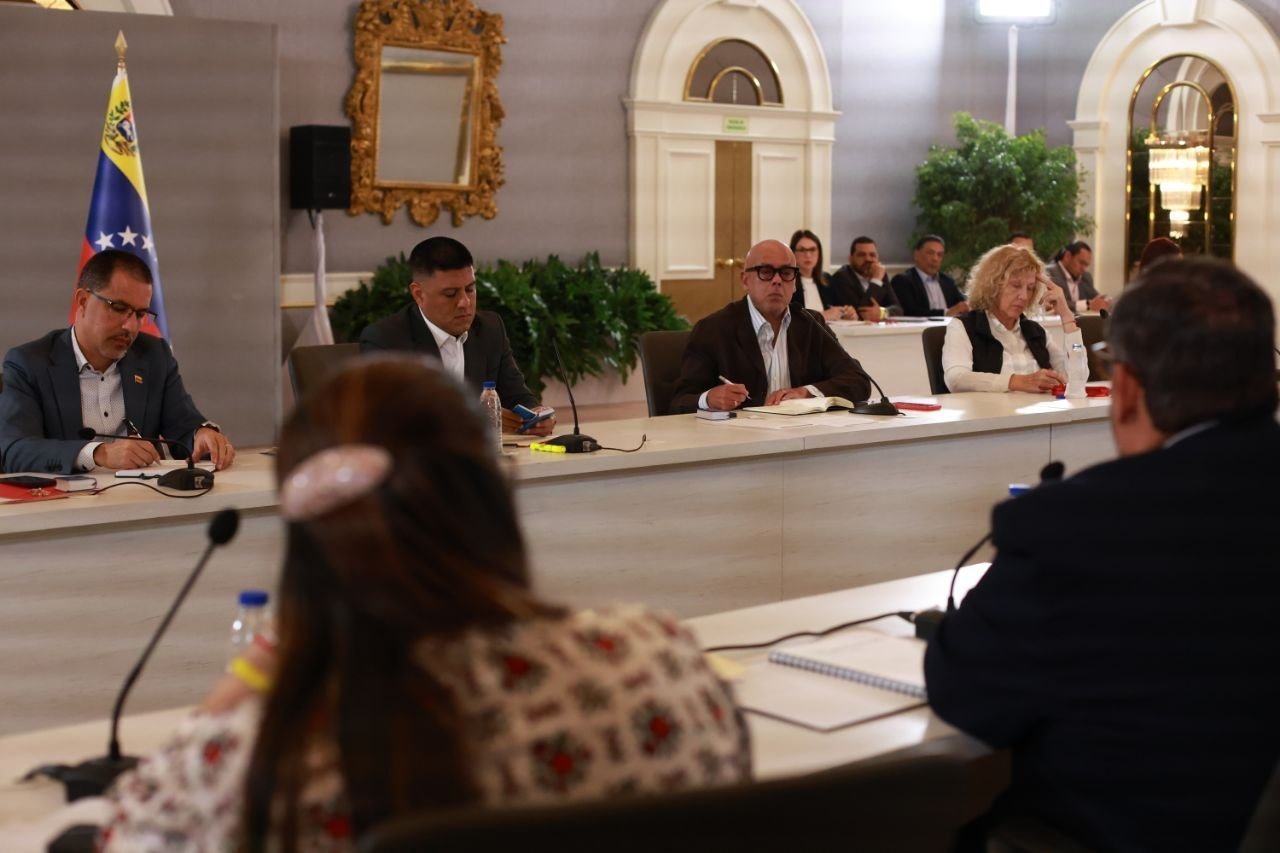
The two sides will hold daily sessions until August 12. (National Assembly)
Caracas, August 7, 2026 (venezuelanalysis.com) – The Venezuelan government and a faction of the opposition formally began a fresh US-backed dialogue initiative on Thursday that is expected to renew the country’s judicial and electoral bodies.
After a plenary session, the two sides announced a methodology for the upcoming talks, and the ratification of the agenda that will guide daily discussions through August 12.
“On that day, the continuation of the plenary will be evaluated, taking into consideration the progress of the work and the results achieved,” stated a joint communiqué issued after the two sides held an in-person meeting at La Carlota Air Base in Caracas.
The government delegation led by National Assembly President Jorge Rodríguez and the opposition faction headed by Dinorah Figuera, head of the defunct 2015 parliament, signed a set of negotiating principles based on good faith and the pursuit of benefits for the country, including political, peaceful, democratic, and constitutional solutions. The principles also include mutual recognition and respect, political equality, and parity between the parties.
The sides further agreed to produce verifiable commitments, the protection of the human and political rights of “all forces,” and to “promptly inform the entire country of the progress achieved in these conversations.”
Neither delegation spoke to the press after the initial talks. The government delegation, apart from Rodríguez, features Higher Education Minister Ana María Sanjuán, National Assembly First Vice President Pedro Infante, and lawmakers América Pérez, Génesis Garvett, and Jorge Arreaza. On the opposition side, accompanying Figuera are former lawmakers Marco Aurelio Quiñones, Ramón López, Jorge Millán, Juan Miguel Matheus, and Sergio Vergara.
Thursday’s meeting followed a preliminary conference call on August 1 between Rodríguez and Figuera, who arrived in Venezuela on Wednesday, having been based in Spain for over eight years.
Upon her arrival, the opposition figure reiterated that the negotiations would lead to the appointment of a new “credible and trustworthy” National Electoral Council (CNE) by November and a “re-institutionalized” Supreme Court (TSJ) before the end of 2026.
The National Assembly had already begun discussions on reforming the TSJ. Lawmakers approved legislation reducing the number of justices on the Full Chamber from 32 to 20. However, a parliamentary process to appoint new justices was subsequently suspended. According to the Venezuelan Constitution, the appointment of electoral and judicial authorities is the exclusive competency of the legislature.
The two negotiating parties held a second session on Friday afternoon at the 5-star Meliá Hotel in Caracas, but offered no public updates.
The Trump administration welcomed the talks, describing them as a “unique opportunity” for reconciliation and “transition” in Venezuela.
“We applaud the efforts to address the urgent needs of those affected by the June 24 earthquakes, expand political freedoms, and advance a more stable and prosperous future for the Venezuelan people,” the State Department affirmed in a statement.
The communiqué added that Washington would remain committed to supporting the “Venezuela-led process,” while emphasizing the White House’s “three-phase plan” which culminates with a “political transition.”
The US-endorsed dialogue comes seven months after a military operation that saw US forces bomb Caracas and kidnap President Nicolás Maduro and First Lady Cilia Flores. In the months since, the Trump administration has wielded considerable influence over Venezuelan affairs, with US officials having input on legislative reforms and the US Treasury Department controlling Venezuelan export revenues.
The negotiations have caused tensions among different opposition factions, with far-right sectors criticizing the exclusion of María Corina Machado.
In a recent interview, Machado stated that she was not involved in the “design, construction, and functioning” of the dialogue, but vowed not to obstruct agreements that represent concrete advances toward a “democratic transition.”
In a statement, the Machado-led Unitary Democratic Platform (PUD) expressed its expectation that the dialogue will yield an “appropriate presidential electoral timetable” and pledged to assess the process based on “concrete achievements,” including the “release of political prisoners” and “electoral guarantees for all actors.”
In contrast, grassroots Chavista organizations have rejected the dialogue and denounced US “interference.” During a demonstration on August 1, the Popular Anti-Imperialist Front warned that the process was intended to place “US puppets” in the justice system and electoral authority, and subsequently organize “unconstitutional” elections.