judicial

Venezuelan Authorities Launch Prison Riot Investigation, Gov’t Pushes Judicial Reforms

Authorities managed to take control of the situation and transfer hundreds of inmates to other detention centers. (Reuters)

Caracas, May 26, 2026 (venezuelanalysis.com) – Venezuelan Attorney General Larry Devoe announced on Monday a formal investigation into recent unrest at the Barinas Judicial Detention Center (INJUBA). 

The prison began to make headlines last week when inmates seized control of the facility to denounce ill-treatment and physical abuse from authorities. The investigation followed the dismissal of prison director Elvis Macuare Guerrero, who had held the post for less than a week before the revolt.

“The Attorney General’s Office announces the launch of a criminal investigation into the events that took place on May 24, 2026, at INJUBA, where inmates staged a protest,” read the official statement. The investigation will focus on accusations of “cruel, inhuman, or degrading treatment” allegedly carried out by security personnel inside the facility.

The probe followed dramatic scenes in which prisoners climbed onto the roof, burned mattresses, and held up banners demanding an end to what they described as a regime of terror. 

According to testimonies gathered by local journalists on the ground, the inmates accused prison authorities of recurring violence and torture, including systematic beatings and forced “ice-cold baths with electric currents.”

The riot was sparked after guards reportedly confiscated belongings and subjected a group of prisoners to violent searches.

In response to the unrest, authorities transferred over 100 female inmates out of the Barinas facility to reduce tensions. On Tuesday, General Giuseppe Cacioppo, head of the Barinas governorship security office, told press that the situation at INJUBA was calm and under control, with a further 818 male prisoners transferred to other penitentiary centers throughout the country.

Rodríguez raises judicial reform priorities

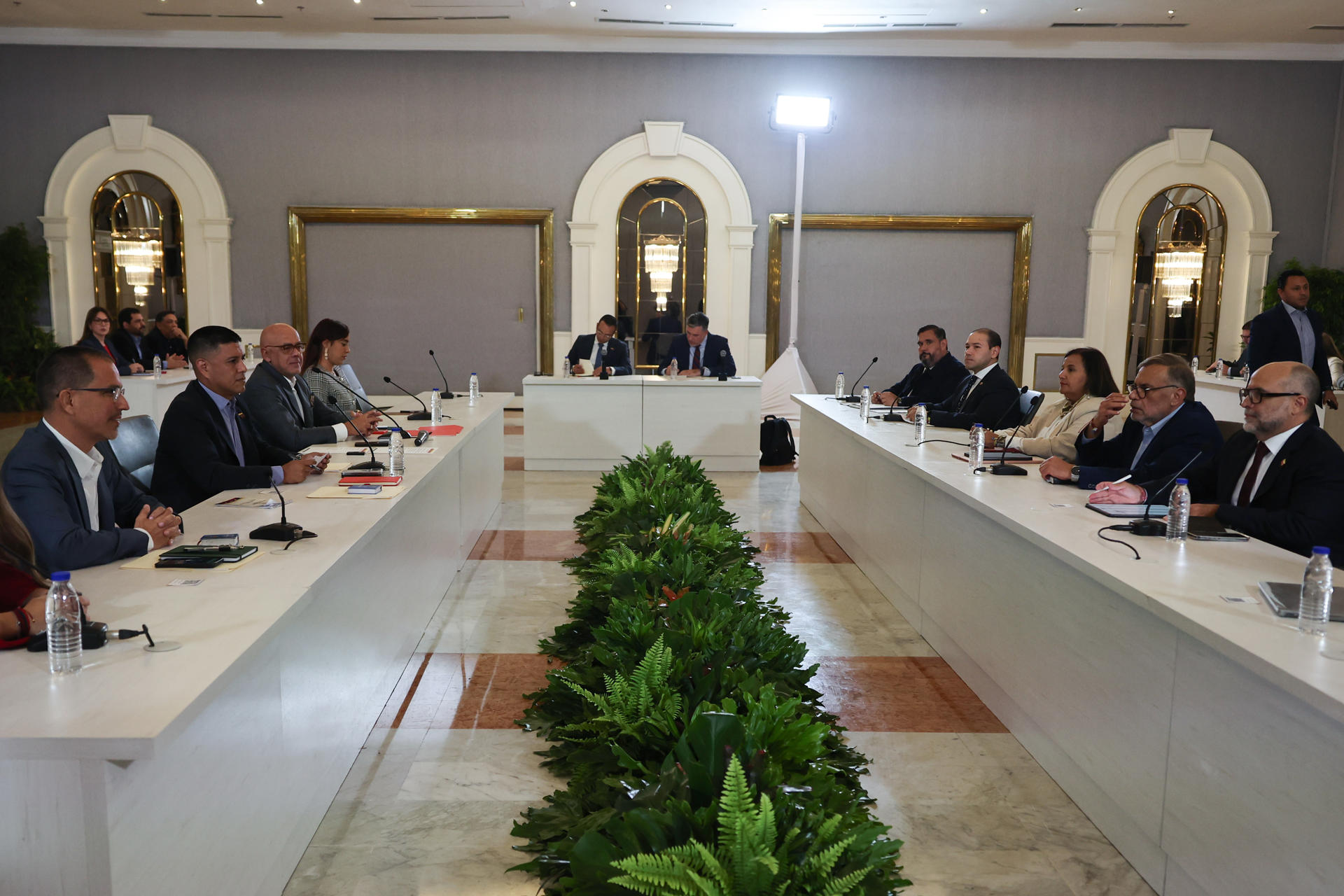
The Barinas inmate unrest coincided with the Venezuelan government announcing the impending release of hundreds of prisoners. On Friday, Acting President Delcy Rodríguez announced that 500 prisoners would be liberated “in the coming hours.” 

Three officers from the former Metropolitan Police were among those already confirmed free. Héctor Rovaín, Erasmo Bolívar, and Luis Molina were serving 30-year sentences for their involvement in the violence leading up to the brief 2002 coup against then-president Hugo Chávez. They had been arrested in 2003 and convicted in 2009.

According to official figures provided by the presidency, since the February approval of the Amnesty Law, a total of 8,740 people have received amnesty. Of these, 8,426 were still facing trial or under probation-type measures and had their cases dropped.

However, the government announcements have also drawn criticism. The Justicia, Encuentro y Perdón (JEP) NGO cautioned that “this type of public pronouncement [announcing more releases] generates enormous expectations,” warning that any failure to comply would represent a “new and cruel affront to human dignity.”

Rodríguez explained that the latest freed individuals had their cases and sentences reviewed through a “different mechanism,” evaluated via the Commission for Judicial Revolution and the Program for Peace and Democratic Coexistence, as opposed to the Amnesty Law.

During a televised working session on Saturday, the acting president framed the ongoing releases and the investigation into the Barinas prison riot as part of a broader transformation of the penal system. She likewise enacted a reform to the Organic Law of the Supreme Court (TSJ), expanding the number of magistrates from 20 to 32.

Rodríguez acknowledged prison overcrowding as one of the main issues plaguing the Venezuelan penitentiary system. She claimed that, according to official statistics, 68% of the incarcerated population in Venezuela comes from the poorest economic strata and vowed to advance judicial reforms that tackle the “criminalization of poverty.”

The Venezuelan leader went on to announce the beginning of the National Consultation for Penal Justice Reform on June 1. The public consultation aims to address what she identified as the “three great challenges” of the current system: procedural delays, judicial corruption, and the criminalization of poverty.

Rodríguez went on to denounce the “partisan and political” manipulation of the justice system.

The commission tasked with the consultation, headed by Attorney General Devoe, will hold meetings with academics, NGOs, judicial system workers, and other relevant actors.

Venezuela’s justice system came under the spotlight recently with the case of Victor Quero, who had an amnesty request denied despite having died in state custody months earlier. Authorities did not inform his mother, Carmen Navas, who continued to visit the prison in search of information. Navas passed away days after her son’s death was publicly acknowledged. The Attorney General opened an investigation into the case.

In recent years, human rights NGOs and prisoner relatives have denounced systematic due process violations and poor incarceration conditions.

Edited by Ricardo Vaz in Caracas.


Source link

Column: Trump’s judicial nominees are fact-challenged and unfit

Who won the 2020 election?

Was the Capitol attacked on Jan. 6, 2021?

Can Donald Trump be elected to a third term as president?

No brainers, right?

The answers are, of course, “Joe Biden,” “yes” and “no.” Any fact- and reality-based American would say so. But that humongous class of people pointedly doesn’t include the president of the United States. And apparently for that reason, his nominees for federal judgeships — the very jobs in which you’d most want fact-based individuals — hem, haw, stammer and ultimately decline to give direct answers when Democratic senators test them with such easy-peasy questions at confirmation hearings.

One after another, month after month, Trump nominees for district and appeals courts across the land say that the answers to the questions are matters of debate, of “significant political dispute.” Well, they’re in dispute only because Trump says they are, as does every ambitious officeholder and office-seeker desperate to remain in the retributive ruler’s good graces — including, alas, would-be judges.

To watch them squirm and then squirt out the same rehearsed reply, the same legalistic word salad, just like the dozens of nominees before them would be hilarious (see below) if it weren’t so ominous for the rule of law in the nation.

Trump nominees for other high-ranking jobs, likewise prepped for Senate Democrats’ questions by their Trump handlers, give the same rote response. But the fact that candidates for lifetime seats on the federal bench, making decisions of life-changing consequences for millions of Americans, would choose to dodge the truth is most sickening.

In their truth-trolling to keep Trump happy, lest he yank their chance at new black robes, these candidates fail the test of judicial independence. As one Democrat, Sen. Richard Blumenthal of Connecticut, told four district judge nominees last week at a Senate Judiciary Committee hearing, their humiliating hedging “on an issue of fact” — Biden won in 2020 — “reflects not only on your honesty but really on your fitness to be a federal judge.”

Indeed. That judicial nominees would curry Trump’s favor bodes ill for future federal jurisprudence in the one branch of government that’s stood up for the rule of law against Trump, repeatedly, when Congress and the Supreme Court have not. To be fair, a number of judges confirmed in Trump’s first term have been among the many who’ve ruled against his and his administration’s second-term abuses of power. Yet just as Trump has populated his Cabinet and executive branch with sycophants, unlike in Trump 1.0, he’s obviously applying new litmus tests to potential judges. One of them, clearly, is playing along with his election lies.

His nominees’ failure to speak truth to Trump’s power should be disqualifying. But they’re not disqualified, because the Senate is run by Republicans who share their fear of him.

That fact is a big reason to hope that Democrats capture the majority in November’s midterm elections and that, under new management, the Senate will finally take seriously its constitutional “advice and consent” responsibility to act as a check on Trump nominees for the final two years of his term — including, perhaps, one for the Supreme Court.

And, yes, this is Trump’s final term, for all of his teasing about “Trump 2028.” The Constitution’s 22nd Amendment says as much in its opening line: “No person shall be elected to the office of the President more than twice.”

Yet the four wannabe district judges at last week’s Senate Judiciary Committee confirmation hearing — Michael J. Hendershot of Ohio; Arthur Roberts Jones and John G.E. Marck, both of Texas; and Jeffrey T. Kuntz of Florida — struggled over that clear language.

All four hesitated when Sen. Chris Coons, a Delaware Democrat, asked them to describe the amendment. He even read its initial words before querying Marck, “Is President Trump eligible to run for president again in 2028?”

Marck paused, then sputtered: “Senator, with ah, without considering all the facts and looking at everything, depending on what the situation is, this to me strikes as more of a hypothetical of something that could be raised.”

“It’s not a hypothetical,” Coons countered, then asked again whether Trump is “eligible to run for a third term under our Constitution.”

“Um, I would have to, to review the, the actual wording of it,” Marck blabbered.

Coons turned to the others: “Anybody else brave enough to say that the Constitution of the United States prevents President Trump from seeking a third term?” Silence.

“Anybody willing to apply the Constitution by its plain language in the 22nd Amendment?” Coons persisted. Crickets.

His Democratic colleague, Blumenthal, inquired of the foursome, “Who won the 2020 election?” All agreed in turn that Biden “was certified” the winner. None would say he “won” because — as we and they know —Trump insists to this day that he won; he’s turned the power of his “Justice” Department to trying to prove that obvious falsehood. Far be it from these future judges to contradict the president who nominated them.

Here’s Hendershot’s gibberish to Blumenthal’s simple query: “Senator, I want to be mindful of the canons here. I know this question has come up many times in these hearings and it’s become an issue of significant political dispute and debate. So, with, with that, I would say that, that President Biden was certified the winner of the 2020 election.”

After the others replied similarly, Blumenthal turned justifiably scathing: “It’s pretty irrefutable that Joe Biden won the election. But you’re unwilling to use that word because you are afraid. You are afraid. Of what? President Trump? That is exactly what we do not need on the federal bench today. We need jurists who are fearless and strong, not weak and pathetic.”

Apparently unshamed, each similarly demurred when he asked if the Capitol had been attacked. “You’ve seen the videos, have you not?” Blumenthal blurted.

No matter, Senator. These would-be triers of fact apparently won’t believe their eyes. Not when their patron, the president, insists on lies.

Bluesky: @jackiecalmes
Threads: @jkcalmes
X: @jackiekcalmes

Source link