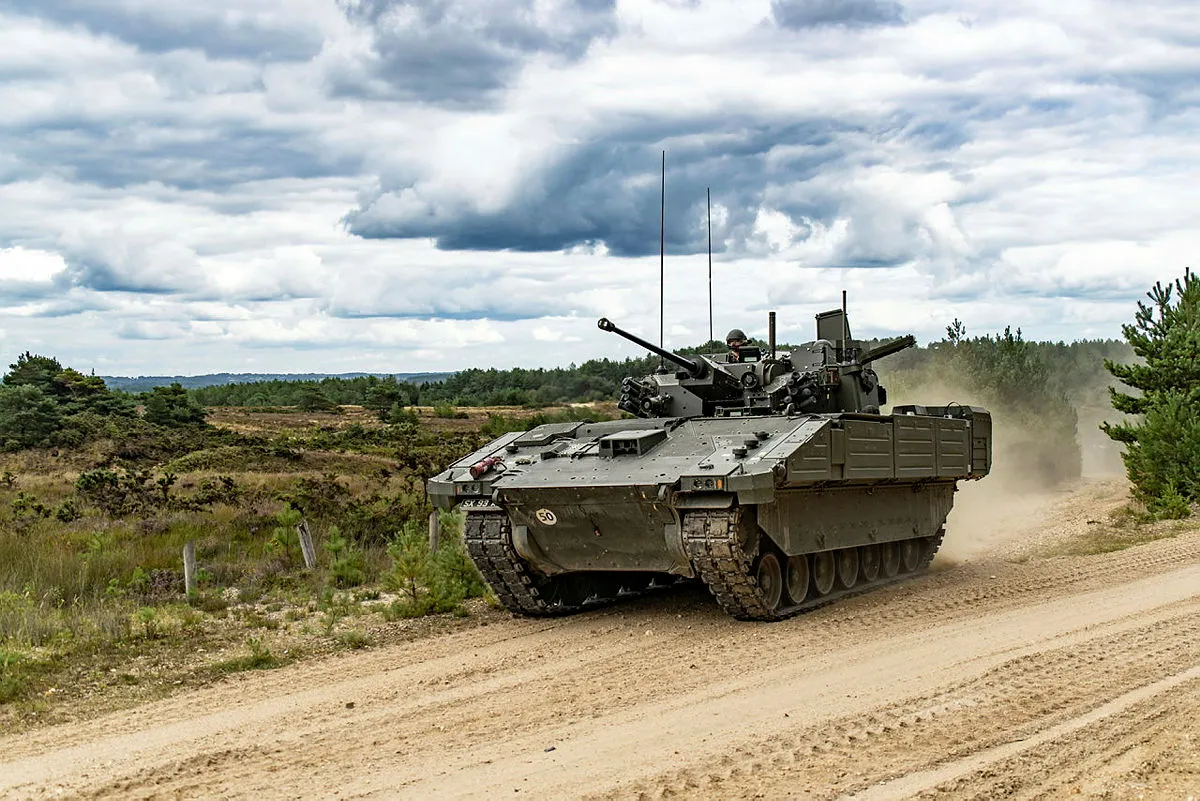
The British Army has suspended the use of its controversial new Ajax armored fighting vehicles after dozens of soldiers became ill after riding in them. The U.K. Ministry of Defense confirmed that “around 30 personnel presented noise and vibration symptoms” following an exercise involving the tracked vehicles.

The Ministry of Defense said that the Army immediately put a two-week pause on using Ajax, following Exercise Iron Fist conducted on Salisbury Plain over the weekend. The ministry added that the “vast majority” of the soldiers affected “have now been medically cleared and are continuing on duty.” Others, however, “continue to receive expert medical care.” The statements were provided to Sky News by a Ministry of Defense spokesperson. Reportedly, the affected soldiers spent between 10 and 15 hours in the vehicles.
The decision was made by Luke Pollard, the defense procurement minister, and will now see a safety investigation carried out on the armored fighting vehicles. In the meantime, the Ministry of Defense said that “a small amount of testing of the vehicle will continue, in order to ensure that any issues can be identified and resolved.”
Perhaps most troubling is the fact that these kinds of issues are by no means new for the vehicle.
In the summer, soldiers were hospitalized after suffering hearing and other injuries caused by loud noise and vibrations inside the vehicles.
Earlier this month, the Ministry of Defense confirmed that a “small number” of soldiers had reported noise and vibration issues after trials that involved three variants of the tracked vehicle.
However, a ministry spokesperson also told Deborah Haynes of Sky News that, following an investigation, “no systemic issues were found.”
Also in November, defense procurement minister Pollard said that “After all the problems [Ajax] may have had in the past, we have put those to bed now.”
Pollard was speaking as the Ministry of Defense announced the initial operating capability (IOC) for Ajax. This milestone required a squadron of 27 vehicles ready to deploy on operations from a pool of 50. By this point, 165 of the vehicles had been delivered from a total of 589 on order, in six different versions (Atlas armored recovery vehicle, Apollo armored repair vehicle, Ares armored personnel carrier, Ajax reconnaissance vehicle, Athena command post vehicle, and Argus engineering vehicle).
The nature of the noise and vibration problem was already well known by that point.
In 2021, the Ministry of Defense published a review that revealed that, for almost two years, senior officers and ministry officials were aware of problems with the vehicles that put troops at risk.
The same review noted that, although the potential for hearing damage had been identified in December 2018, it wasn’t until November 2020 that trials were suspended for the first time. A year later, more than 300 soldiers had been offered hearing tests, and 17 of them were still receiving specialist treatment.

As well as these problems, the Ajax program has seen serious delays.
At one point, IOC was expected in 2017. In June 2021, the Ministry of Defense said that, although IOC had been delayed by another year, it had “90 percent confidence” that it would be declared in September 2021. Ultimately, the Army would have to wait until November 2025 for that milestone.
The summer of 2021 also saw a damning report into Ajax from the Royal United Services Institute (RUSI), a British defense and security think tank.
That report described it as a program in crisis, highlighting the vehicle’s excessive noise and vibration and asking what it said were the two fundamental questions about Ajax: “Whether the vehicle can be fixed, and whether it is worth saving.”

The RUSI report also provided more details on how the noise and vibration issues manifest themselves.
Taking noise first, RUSI reported that the main problem was due to the integration of the Bowman headsets for the crew radios. These headsets picked up the engine noise from what “has long been recognized as a noisy vehicle” and put the sound directly into the crews’ ears. While that problem can clearly be fixed with different headsets, it does raise alarming questions about how these noise tests were carried out.
Second and more worrying is the vibration issue, which is at least partly derived from problems with quality control in the fabrication of the vehicle hulls by General Dynamics Land Systems UK (GDLUK). The vibration not only leads to significant crew discomfort but also has other effects: “Preventing the main armament from stabilizing on the move, damaging the electronic systems that make Ajax a step-change in capability, and leading to a high rate of component failure, with the idler and rear road wheels shearing off with concerning regularity.”
If the future of the Ajax program was questionable in 2021, it is even more precarious now.

What is clear is that the British Army badly needs modern armored fighting vehicles.
The Ajax is the first new tracked armored fighting vehicle for the Army in almost 30 years. Some of the equipment it’s replacing, like the FV432 armored personnel carrier dates back to the 1960s.
Armed with a 40mm main gun, the Ajax is based on the ASCOD 2 armored fighting vehicles used by Spain and Austria and was selected by the United Kingdom in 2010 as the winner of the Future Rapid Effect System contract.
The GDLUK proposal fought off competition from the rival CV90 offered by BAE Systems.
The service’s most modern tracked infantry fighting vehicle, the Warrior, entered service in 1988. In 2021, the Ministry of Defense announced its intention to replace the Warrior with the Boxer, an 8×8 wheeled armored personnel carrier, which would appear to make the introduction of a new tracked IFV all the more urgent.
On the other hand, the decision to give up the Warrior shows that armored infantry is no longer a core capability within the British Army.
As the RUSI report states:
“If grouped within the Heavy Brigade Combat Teams alongside Challenger 3, Ajax cannot deliver infantry to the objective and cannot perform the divisional reconnaissance function. Alternatively, if made part of the Deep Recce Strike Brigade Combat Team, Ajax will struggle to be sustained operating independently. Ajax’s inability to peer-to-peer recover also makes it a poor independent unit, while its weight, complexity, and size make it hard to deploy with lighter forces, despite the British Army seeking to operate further afield with greater frequency.”
With a total program cost of £5.5 billion (around $7.3 billion), this is a huge investment for a vehicle the importance of which within the British Army is somewhat unclear, and which still has unresolved issues that can threaten the health of soldiers. That price tag also doesn’t consider the costs of any future technical fixes to the vehicle.

As it stands, the British Army will use Ajax primarily as a reconnaissance vehicle, a mission that it doesn’t appear immediately suited to, based on its considerable size and weight. The situation would have been different if the Army had planned to retain the Warrior IFV. After all, when Ajax was first drafted, it was expected to work in support of Warrior.
Since the Ajax program was launched, drones have also significantly reshaped the battlefield. Not only do drones offer a cheaper, more survivable, and more flexible way of conducting reconnaissance, including from standoff distances, but the presence of attack drones adds a new dimension of threat to vehicles like Ajax.
Although the Ministry of Defense says that Ajax’s armor is designed to protect against at least some kinds of kamikaze drones, it also admits that the vehicles have yet to be fitted with electronic countermeasures to defeat such threats.
This would seem to be a prerequisite for any kind of operational capability, which makes it all the more puzzling that the Ministry of Defense is already talking about deploying Ajax as part of a future British Army presence in Ukraine, provided there is a ceasefire and an agreement covering such a force.
“When we have the ability to deploy incredibly capable platforms like Ajax and the brilliant men and women trained to use it to its fullest effect,” Pollard told Sky News, “there’s a clear opportunity for us to be able to enhance NATO’s capabilities on the eastern flank and any coalition of the willing deployment potentially in the future.”

Before that happens, the longstanding problems related to vehicle noise and vibration will have to be resolved, and a comprehensive counter-drone system will need to be installed. But with the latest pause on its use, it’s increasingly questionable if the Ajax program will survive long enough for that to happen.
Contact the author: [email protected]