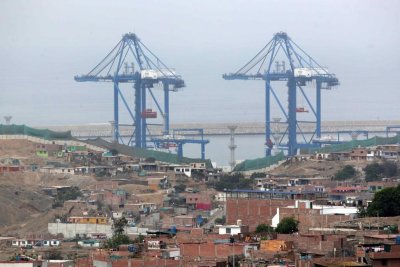

The Chancay megaport opens a door to China on the shores of Lima, Peru, and is a key stop on the new silk route in South America, as well as a hope for Peru’s development. File Photo by Paolo Aguilar
Feb. 12 (UPI) — The U.S. government issued a warning to Peru after a judicial ruling limited that nation’s oversight over the Chancay megaport, one of the country’s main port infrastructures operated by China’s Cosco Shipping.
“We are concerned by recent reports indicating Peru may be unable to oversee Chancay, one of its most important ports, under the jurisdiction of predatory Chinese owners,” the State Department’s Bureau of Western Hemisphere Affairs said in a statement posted on X.
The publication underscored “Peru’s sovereign right to supervise critical infrastructure in its own territory” and questioned the origin of investment in the megaport located north of Lima.
“Let this serve as a warning to the region and the world: cheap Chinese money costs sovereignty,” the U.S. authority said.
In recent years, Beijing has expanded its presence in strategic sectors, such as infrastructure, energy and technology, across Latin America — a trend that has drawn concern among U.S. policymakers.
Chancay, opened in 2024, aims to become a key logistics hub linking South America with Asia. The project has been presented as a milestone for Peruvian trade and part of China’s growing footprint in regional port infrastructure.
The State Department’s statement followed a ruling by a Peruvian court that limited the authority of the Organismo Supervisor de la Inversión en Infraestructura de Transporte de Uso Público, known as Ositran, the national transport infrastructure regulator, over the Chancay terminal, according to local outlet RPP Noticias.
The decision upheld an injunction awarded to Cosco Shipping Ports, the Chinese state-owned majority shareholder in the port. The company argued that Chancay was fully financed with private capital, operates without a state concession contract and functions under an administrative authorization granted by Peru’s National Port Authority.
The ruling ordered Ositran to refrain from regulating, supervising, auditing or sanctioning activities at the port. It said subjecting the terminal to that regulatory framework would violate the claimant company’s constitutional rights to property, free enterprise and legal certainty, according to newspaper La República.
The court also said that public use is a functional characteristic of port services, but does not automatically trigger the legal framework applied to state-concession ports.
In practice, the decision means the regulator cannot intervene directly in terminal operations or impose administrative controls. However, the ruling does not eliminate all state oversight.
Instead, supervisory responsibilities would be redistributed among various Peruvian regulatory bodies, with Ositran excluded from comprehensive regulation except in limited circumstances.
Ositran President Verónica Zambrano said the agency will appeal the ruling, arguing the company may seek to avoid Peruvian regulations.
“They are a public-use company providing services to the public. That condition creates legal consequences, including oversight by Ositran, because we supervise public transport service providers,” Zambrano told news channel Canal N.
She added Peru’s National Port Law defines a port administrator as an operator of public-use transport infrastructure and said this applies to Cosco Shipping.
Separately, Peru’s Cabinet Office issued a statement on X regarding the judicial process involving Cosco Shipping Ports Chancay Peru S.A. Authorities said they will defend private investment while respecting Peru’s regulatory framework.
Ministers added that if conditions outlined in the ruling affect Ositran’s supervisory role, the government will use legal remedies available under existing law.
As part of the National Security Strategy promoted by President Donald Trump’s administration, the U.S. president has called a summit for March 7 in Miami with several Latin American leaders considered strategic allies.
The meeting aims to consolidate a regional bloc aligned with Washington amid growing Chinese investment, trade and diplomatic influence in Latin America, Infobae reported.
Among the invited leaders are Argentine President Javier Milei, El Salvador’s Nayib Bukele, Paraguay’s Santiago Peña, Ecuador’s Daniel Noboa, Bolivia’s Rodrigo Paz and Honduras’ Tito Asfura.
In addition to economic issues, the agenda includes coordination on security matters, particularly the fight against drug trafficking and the management of migration flows.