U.S. President Donald Trump has ordered the Navy to attack any Iranian boats mining the Strait of Hormuz. His decree, issued on Truth Social, also claims the U.S. is currently demining the strategic waterway. His announcement comes hours after the U.S. boarded another Iranian-linked vessel in the Indian Ocean and a day after the Islamic Revolutionary Guard Corp (IRGC) fired on at least three ships and seized two of them in the Strait.
All this activity is taking place as the prospect of peace talks remains unclear two days after Trump announced a ceasefire extension, which we will discuss later in this story.
“I have ordered the United States Navy to shoot and kill any boat, small boats though they may be (Their naval ships are ALL, 159 of them, at the bottom of the sea!), that is putting mines in the waters of the Strait of Hormuz,” Trump proclaimed on his social media site. “There is to be no hesitation. Additionally, our mine ‘sweepers’ are clearing the Strait right now. I am hereby ordering that activity to continue, but at a tripled up level!”
It should be noted that the IRGC has invested heavily in its fleet of small boats for decades as TWZ has explored in the past. In addition to being armed with short-range anti-ship missiles, as well as artillery rockets and other weapons, they can also be used to lay naval mines. While the president claimed that 159 Iranian ships have been destroyed, the IRGC still has a large number of these small vessels.
In a story yesterday, The Washington Post reported that the Pentagon told Congress it could take six months to fully clear the Strait of Hormuz of mines deployed by the Iranian military.
With three carrier strike groups, several destroyers and scores of land-based aircraft in the region, the U.S. is well-postured to take out Iranian boats if needed. Striking Iran’s Navy was a prime mission for Epic Fury, as Trump noted. However, it is not publicly known at the moment what assets are conducting the mine sweeping Trump claimed or what the current level is of that activity that he wants to triple. We’ve reached out to the White House and U.S. Central Command for more details.
While it is possible one or more of these vessels could be in the Strait, doing so would put them at a greater risk of attack from Iran’s remaining cache of land-based weapons like anti-ship missiles and drones, as well as what’s left of its flotilla of small boats and uncrewed surface vessels (USVs).
As we reported on April 13, a pair of Avenger class mine-hunters homeported in Japan were tracked sailing westward out of the Pacific Ocean, however, they are still a distance away from the Strait. USS Chief and USS Pioneer departed Colombo, Sri Lanka, yesterday following a two-day port call, public AIS data on MarineTraffic shows. They stopped transmitting AIS while steaming northwest at 10 knots toward the CENTCOM area of responsibility, although their final destination is unconfirmed.
The U.S. also has a trio of littoral combat ships (LCS) forward-deployed to U.S. 5th Fleet and configured for mine countermeasures missions. However, as we previously reported, those ships were redeployed from Bahrain ahead of the conflict, and two emerged unexpectedly in Southeast Asia last month. It remains unclear why the decision was made to send them to the other side of the globe amid the threat of Iran mining the Strait of Hormuz, but both were recently spotted sailing northbound in the Malacca Strait after weeks in Singapore.
The Santa Barbara left Singapore on April 16 and the Tulsa left on April 2.
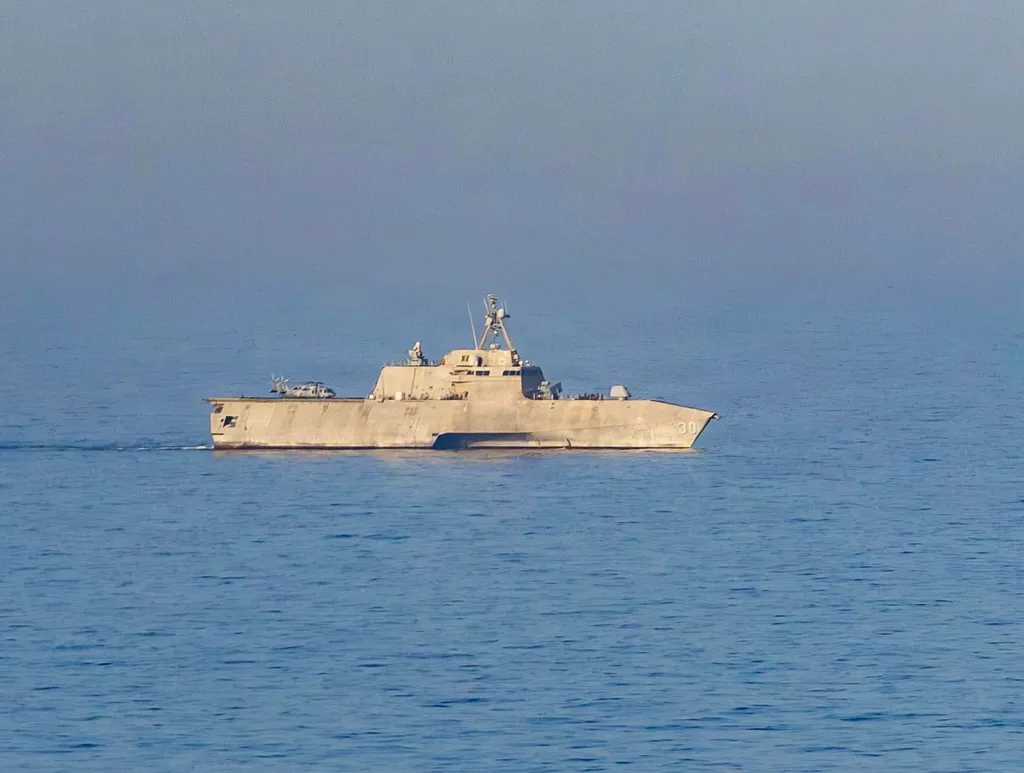
USS Canberra is the only confirmed mine sweeper currently in CENTCOM, according to a post on the Pentagon’s image sharing site that shows the Independence class LCS patrolling in the Arabian Sea.

The arrival of Pioneer and Chief would increase mine sweepers from one to three, tripling the coverage, which aligns with Trump’s order. The other two LCSs, USS Tulsa and USS Santa Barbara, could also be nearby or on station in the Middle East to support the MCM mission.
The transit of the Chief is not without issues. A sailor assigned to the was medically evacuated to his home port after he was scratched by an Asian monkey while ashore in Thailand, Axios reported.
“The Navy reports the incident did not delay the USS Chief‘s mission and that the sailor is OK, but officials say the attack is a reminder that military missions face unexpected troubles and disruptions that are hard to war-game for,” the outlet added.
UPDATES
UPDATE: 6:07 PM EDT –
“U.S. military officials are developing new plans to target Iran’s capabilities in the Strait of Hormuz in the event the current ceasefire with Iran falls apart,” CNN is reporting.
An additional option, according to the cable network, is targeting individual Iranian military leaders and other “obstructionists” U.S. officials believe are actively undermining negotiations.
UPDATE: 5:50 PM EDT-
The U.S. has burned through so many munitions in Iran that some administration officials increasingly assess that America couldn’t fully execute contingency plans to defend Taiwan from a Chinese invasion if it occurred in the near term, The Wall Street Journal reported, citing U.S. officials.
“The U.S. has fired more than 1,000 long-range Tomahawk missiles since the war with Iran began on Feb. 28, as well as 1,500 to 2,000 critical air-defense missiles, including Thaad, Patriot and Standard Missile interceptors, according to U.S. officials,” the publication added.
UPDATE: 5:34 PM EDT –
Trump announced that the ceasefire between Israel and Lebanon will be extended for three weeks.
“The President of the United States, DONALD J. TRUMP, Vice President of the United States, JD Vance, Secretary of State, Marco Rubio, Ambassador to Israel, Mike Huckabee, and Ambassador to Lebanon, Michel Issa, met today with High Ranking Representatives of Israel and Lebanon in the Oval Office,” Trump announced on Truth Social. “The Meeting went very well! The United States is going to work with Lebanon in order to help it protect itself from Hezbollah. The Ceasefire between Israel and Lebanon will be extended by THREE WEEKS. I look forward in the near future to hosting the Prime Minister of Israel, Bibi Netanyahu, and the President of Lebanon, Joseph Aoun. It was a Great Honor to be a participant at this very Historic Meeting!”
UPDATE: 5:15 PM EDT –
Hezbollah reportedly launched about five rockets at northern Israel. The IDF says its forces intercepted all the rockets. There were no reported injuries.
UPDATE: 5:09 PM EDT –
During an afternoon press conference on healthcare, Trump offered additional insight into his ongoing dealings with Iran.
Iran “came to us, and they said ‘we will agree to open the Strait,’ and all my people are happy,” Trump exclaimed. “Everybody was happy—except me. I said, wait a minute. If we open this Strait, that means they’re going to make $500 million a day. I don’t want them to make $500 million a day until they settle this thing, so I’m the one that kept it closed. We have total control of it. And it’ll open when they make a deal or something else happens.”
On the topic of who is in charge in Tehran, Trump said: “Iran wants to make a deal and we’ve been speaking to them, but they don’t even know who’s leading their country. They are in turmoil, so we thought we’d give them a little chance to get some of that resolved.”
As far as the military goals of Epic Fury, Trump said: “We’ve hit 78% of the targets that we’ve wanted to hit. If Iran doesn’t want to make a deal, then I’ll finish it up militarily with the other targets.”
Asked about the timeline of Epic Fury, Trump snapped that: “I don’t want to rush it; I want to take my time. We have plenty of time, and I want to get a great deal. I want to get a deal where our nation and the world are safe from lunatics with nuclear weapons.”
Queried about whether he would use a nuclear weapon against Iran, Trump retorted: “No. Why would a stupid question like that be asked? Why would l use a nuclear weapon when we’ve totally decimated Iran without it? A nuclear weapon should never be allowed to be used by anybody.”
Earlier this morning, the Pentagon announced an overnight “maritime interdiction and right-of-visit boarding of the sanctioned stateless vessel M/T Majestic X transporting oil from Iran, in the Indian Ocean within the INDOPACOM area of responsibility.”
“We will continue global maritime enforcement to disrupt illicit networks and interdict vessels providing material support to Iran, wherever they operate,” the Pentagon said, repeating a refrain it used earlier this week after the interdiction of the M/T Tifani in the Indian Ocean. “International waters cannot be used as a shield by sanctioned actors. The Department of War will continue to deny illicit actors and their vessels freedom of maneuver in the maritime domain.”
Video released by the Pentagon shows troops boarding MH-60S Seahawk helicopters then repelling onto the ship and searching it. As in the case of the boarding of the Tifani, a U.S. Navy Expeditionary Sea Base (ESB) vessel, which you can see in the background, provided support for this operation.
The Pentagon gave the ship’s name as Majestic X but the ship – IMO number 9198317- is also known as Phonix, according to SeaTrade Maritime News. The open-source maritime tracking site MarineTraffic shows that the Guyana-flagged crude oil tanker is located about 200 miles east of Sri Lanka and some 2,000 miles southeast of Iran.


While MarineTraffic data indicates the vessel is currently moving southwest about 8 knots, its current disposition is unclear. The Pentagon declined to offer further information and we have reached out to the White House for additional details.
The fate of the Tifani, boarded on April 21, is now in the hands of the Department of Justice, the Pentagon told us. We reached out to them for more details.

CENTCOM said it has turned away 31 ships so far during the blockade of Iranian ports.
The command also announced that, as anticipated, the Nimitz class aircraft carrier USS George H.W. Bush is now in the Indian Ocean part of its region. That brings the total carrier force to three for now, with the Abraham Lincoln and Gerald R. Ford already on station. However, the Ford, which has set a record for the longest deployment since the Vietnam War and has suffered issues ranging from a fire to leaky plumbing, is likely to depart the area soon.
Two days into the ceasefire extension declared by Trump, efforts to negotiate a peace deal remain murky.
Iranian officials have yet to commit to a new round of talks, which the president blames on schisms in its government between hardliners in the IRGC and more moderate elements.
“Iran is having a very hard time figuring out who their leader is!,” Trump exclaimed on Truth Social. “They just don’t know! The infighting is between the ‘Hardliners,’ who have been losing BADLY on the battlefield, and the ‘Moderates,’ who are not very moderate at all (but gaining respect!), is CRAZY!.”
Iranian officials have pushed back against the notion their government is fractured.
“In Iran, there are no radicals or moderates; we are all ‘Iranian’ and “revolutionary,” and with the iron unity of the nation and government, with complete obedience to the Supreme Leader of the Revolution, we will make the aggressor criminal regret his actions,” Speaker of the Iranian Parliament Mohammad-Bagher Ghalibaf stated on X. “One God, one leader, one nation, and one path; that path being the path to victory for Iran, dearer than life.”
However, at about the time Ghalibaf posted that, Israel’s N12 News outlet reported that Ghalibaf stepped down as a result of interference from the IRGC.
“The reason for the extreme step is his refusal to accept the growing intervention of IRGC generals – including prominent names such as Ahmed and Heidi and Abdullahian,” the outlet claimed in its unsourced story. “According to the information obtained by News 12, the generals penetrate into the decision-making processes and prevent Ghalibaf from providing the maneuver required to manage the negotiations.”
The War Zone cannot independently verify this.
Meanwhile, Israeli Defense Minister Israel Katz said his country “is prepared to resume the war against Iran,” but needs permission from Trump.
“We are awaiting a green light from the United States — first and foremost to complete the elimination of the Khamenei family and to push Iran back into a dark age,” Katz added. “This time, the strike will be different and far more lethal, delivering devastating blows at the most sensitive points — ones that will shake and undermine its very foundations”.
In his Truth Social post about Iranian leadership, Trump added that the U.S. has “total control over the Strait of Hormuz. No ship can enter or leave without the approval of the United States Navy. It is ‘Sealed up Tight, until such time as Iran is able to make a DEAL!!!”
The Iranians, however, have a different take.
“We have control over this Strait,” Hamidreza Hajibabaei, the deputy speaker of Iran’s parliament, said Thursday, according to the semi-official Fars News Agency. Hajibabaei, speaking at a public gathering in the western city of Kuhdasht, added that the first revenues from Iran’s new tolls on shipping in the Strait of Hormuz have been deposited in the Iranian state central bank account.
“If the United States continues on its current course, no vessels will pass through the Strait of Hormuz,” Hajibabaei warned. “We are not engaged in negotiations — rather, we are making demands.”
“The amount collected from each ship depends on its cargo and level of risk they pose,” said Alireza Salimi, another member of the Iranian parliament, according to the IRGC-linked Tasnim News Agency.
“Iran determines how much and how these fees are collected, in other words, we determine the rules,” Salimi said. The War Zone cannot independently verify this claim.
Trump has previously threatened ships that pay tolls to Iran to use the Strait.
Lloyds List reports that the Houthi rebels of Yemen, an Iranian proxy, could institute their own tolls around the Bab al-Mandab region.
“Mechanisms have been discussed at senior leadership levels indicating Houthi ambition to control, and not merely disrupt, maritime traffic,” the outlet reported. “Conversations have been supported by Iranian involvement. But the militia is looking to act on its own terms.”
You can read more about what a Houthi intervention into the conflict would mean in our report about it here.
The maritime security environment across the Arabian Gulf, Gulf of Oman, and Strait of Hormuz “remains CRITICAL, driven by recent attack patterns, continued navigation interference, and persistent operational disruption, including impacts to port activity,” according to the latest update from the Joint Maritime Information Center (JMIC). Despite the April 8 ceasefire, “commercial traffic remains limited, with constrained transits and continued routing uncertainty.”

With the Strait of Hormuz closed, the demand on transiting the Panama Canal has become so intense that one vessel carrying liquefied natural gas (LNG) paid $4 million to skip the line and avoid a wait that can take up to five days, according to AFP, citing an official report.
Oil isn’t the only commodity supply affected by the closure of the Strait of Hormuz. According to the United Nations, one-third of global fertilizers are stalled in that body of water as well.
“With planting seasons already underway, we have no time to lose,” the world organization noted. “This is not a matter of logistics or economics – it’s about saving lives. If we don’t act, a massive food crisis will hit the most vulnerable the hardest.”
Indian crew aboard two of the ships fired upon yesterday in the Strait of Hormuz by IRGC are safe, according to Indian Ministry of External Affairs (MEA) spokesman Randhir Jaiswal.
During the now-extended ceasefire with Iran, the U.S. continues to flow military assets to the Middle East.
Online flight trackers indicate that the first group of aerial refueling tankers supporting F/A-18C Hornets from the VMFA-312 “Checkerboards” are airborne from Lajes.
“The flight plans filed for the tankers indicate the jets are going straight into CENTCOM today,” according to open-source flight tracker DefenceGeek.
Israeli and Lebanese ambassadors are expected to convene again at the State Department on Thursday for a second round of meetings amid the latest conflagration in the Middle East, according to ABC News.
The first direct negotiations between the two states since 1993 “are intended as preparatory meetings to shape future talks on a deal to normalize ties between the countries,” the network noted. “Thursday’s meeting is expected to focus on extending a shaky ceasefire that has halted fighting between Israel and the Iran-backed Hezbollah militia.”
Trump will host the event.
“The ambassador-level talks between Israel and Lebanon will now take place at the White House,” an official tols us. “President Trump will greet the representatives upon their arrival.”
Despite the ongoing ceasefire, Israel is maintaining its positions in southern Lebanon and issued a new warning to residents there.
“We reiterate and warn that, out of concern for your safety and the safety of your family members, and until further notice, you are required not to move south of the line of the villages shown and their surroundings,” IDF spokesman Avichay Adraee stated on X. “Additionally, approaching the Litani River area, Wadi Salhani, and Salouqi is not permitted.”
Heading into a second round of rare direct talks with Israel, Lebanon is urging the Trump administration to pressure Israel to scale back its demands and end its military invasion of the country, Lebanese Prime Minister Nawaf Salam said in an interview with The Washington Post.
Salam said Lebanon could not sign any agreement that does not include a “full withdrawal” of Israeli forces.
“We cannot live with a so-called buffer zone,” he said, “an Israeli presence where Lebanese displaced people are not allowed to return, where destroyed villages and towns cannot be rebuilt.”
Israeli strikes killed one journalist and wounded another in southern Lebanon on Wednesday, The New York Times reported.
“The Lebanese Ministry of Public Health said the Israeli military had targeted the journalists in the town of Tayri, where they took shelter in a nearby house after an airstrike struck a vehicle in front of the car they were traveling in,” the newspaper noted. “About an hour and a half later, a second strike hit the house they were hiding in, according to a statement by a Lebanese newspaper Al-Akhbar, which employed the journalist who was killed.”
Contact the author: howard@thewarzone.com