Israeli air strike kills Palestinian Civil Defence rescue volunteer as he was travelling to help wounded people near Kamal Adwan Hospital in Beit Lahiya, northern Gaza, a medical source says.
Published On 7 Oct 20267 Oct 2026
Israeli attacks have killed at least four Palestinians, including a rescue worker, and wounded several others across Gaza.
The Palestinian Civil Defence rescue volunteer was killed in an air strike as he was travelling to help wounded people near Kamal Adwan Hospital in Beit Lahiya, northern Gaza, a medical source said on Wednesday.
Recommended Stories
list of 3 itemsend of list
The Civil Defence identified the victim as Mohamed Tamous.
Meanwhile, an Israeli drone strike in the southern city of Khan Younis killed Hisham Ibrahim Abu Mustafa, 60, and injured several others, Nasser Hospital said.
The body of a 17-year-old Palestinian was also brought to Nasser Hospital after he was killed in an Israeli drone strike in the Qizan Abu Rashwan area south of Khan Younis, Turkiye’s state news agency Anadolu reported, citing a medical source.
A teenage boy died from wounds sustained last month when Israeli forces opened fire east of Khan Younis, Anadolu reported, citing a medical source.
Also on Wednesday, a girl was injured by Israeli gunfire directed at displaced Palestinians’ tents in the Al-Amal neighbourhood, Anadolu reported.
Additionally, in Khan Younis, the Israeli military carried out two demolitions in the northeastern and eastern parts of the city.
The military also carried out demolitions east of Gaza City’s Tuffah neighbourhood.
Israel has killed more than 74,245 Palestinians since it launched its genocidal war on Gaza in response to the Hamas-led October 7, 2023, attack on Israel.
Gaza’s health toll mounts, with 1,439 dead and 5,052 injured since the ceasefire began in October 2025.
Published On 1 Oct 20261 Oct 2026
An Israeli drone strike has killed a Palestinian man and wounded several others in southern Gaza while settlers shot dead another Palestinian man near Ramallah in the occupied West Bank.
The body of Tamer al-Hamayda, 42, and three wounded people were brought to Nasser Medical Complex on Thursday after the strike hit a tent sheltering displaced Palestinians in the al-Mawasi area, west of Khan Younis on the southern coast of the Gaza Strip.
Recommended Stories
list of 3 itemsend of list
Another Palestinian succumbed to wounds sustained in an earlier Israeli drone strike on Tuesday that targeted a gathering of Palestinians in Jabalia refugee camp in northern Gaza, according to medical personnel in Nasser Medical Complex.
Israeli forces also carried out a large-scale demolition operation targeting buildings east of Gaza City’s al-Tuffah neighbourhood.
The Gaza Health Ministry reported eight new deaths and 26 wounded over the past 24 hours, putting the toll since the “ceasefire” took effect in October 2025 at 1,439 killed and 5,052 wounded, with 834 bodies recovered from the rubble.
Israel’s war on Gaza has killed at least 74,040 Palestinians and wounded 175,168 since October 2023, the ministry said.
Occupied West Bank pogroms
In the occupied West Bank, Israeli settlers shot dead a Palestinian man and wounded another during a raid on the village of Yasuf, north of Ramallah, on Thursday.
51-year-old Mashhour Yassin was shot dead by settler gunfire, the Palestinian Health Ministry said.
Describing the attack, the Palestinian Ministry of Foreign Affairs said Israeli forces had detained an ambulance, seizing its key and throwing it aside, “in a crime that reflects clear coordination between the settlers and occupation forces.”
It said the killing “falls within the framework of a serious and continuous escalation in organised settler crimes,” saying Israel gives free rein to settler “terrorism against our people in the service of settlement, annexation, forced displacement and ethnic cleansing plans.”
Yasuf Mayor Jumaa Abdel Fattah told the AFP news agency that dozens of Israeli settlers armed with sticks and firearms had attacked the village, which lies between four Israeli settlements.
“Yassin was at his doorstep when the settlers attacked the village homes. He went out to defend his house,” Abdel Fattah said, adding that Yassin’s nephew was also wounded in the attack.
Abdel Fattah said the settlers had come from Havat Anton, an illegal Israeli settlement established in July that has previously attacked the village’s residents.
Palestinians in the occupied West Bank have reported a surge in settler pogrom attacks in recent months.
More than 500,000 Israelis live in West Bank settlements considered illegal under international law.
According to the UN, at least 1,112 Palestinians in the occupied West Bank have been killed by Israeli forces or settlers in the territory since October 2023, including at least 37 killed by settlers.
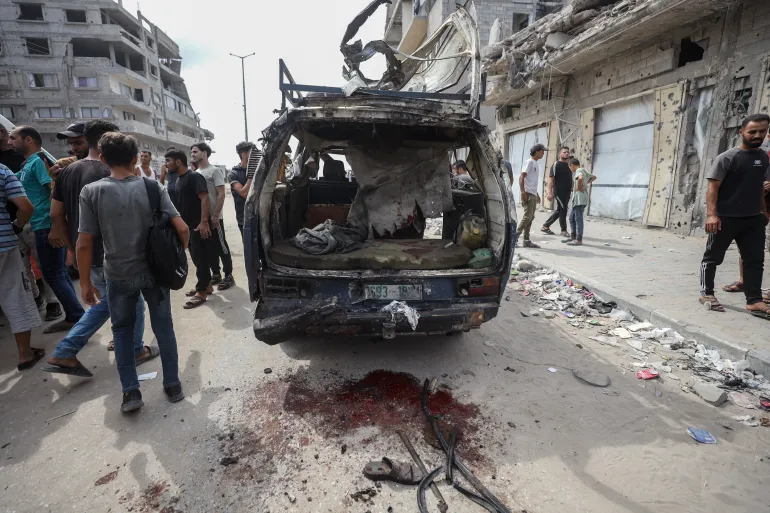
Israeli attacks on residential areas across Gaza killed at least eight civilians and wounded others on Wednesday. In Gaza City, an Israeli strike hit a minibus in the Tel al-Hawa area, killing six people and wounding 15 others, according to Palestinian medical officials.
At least six people killed in drone attack on passenger van and one person killed in strike on residential apartment.
At least seven Palestinians have been killed and more than 10 wounded in Israeli attacks on the Gaza Strip as Israel continues to violate a nearly year-old “ceasefire”.
Six of the victims were killed in an Israeli drone attack on a passenger van in Tal al-Hawa, in southwest Gaza City, on Wednesday, according to witnesses and medical sources.
Recommended Stories
list of 2 itemsend of list
The Palestine Red Crescent Society, a humanitarian group that runs ambulance and emergency services, said its crews took 13 wounded people to al-Quds Hospital.
Medical sources told Al Jazeera the injuries sustained by the victims of the attack are “critical”.
“Doctors say it’s difficult to save the lives of the wounded because the health system is decimated by years of Israeli attacks and the blockade,” said Al Jazeera’s Hind Khoudary, reporting from Gaza City. “The number of dead in the strike could rise in the coming hours.”
Earlier, the official Palestinian Wafa news agency reported that an Israeli attack on a residential apartment near al-Shifa Hospital in Gaza City killed at least one woman.
Elsewhere, four Palestinians, including two children, were wounded when an Israeli drone hit a shelter for displaced people in southern Gaza, according to local sources cited by Wafa.
Two other Palestinians were seriously wounded by Israeli forces southeast of Deir el-Balah in central Gaza, while Israeli tank fire was also reported in southern Khan Younis, in the southern part of the Strip.
The attacks came as the Ministry of Health in Gaza, which compiles casualty figures from hospitals across the territory, said in its latest daily update early on Wednesday that the bodies of at least nine people had arrived at hospitals during the last 24 hours.
While eight people were killed around the reporting period, one woman had died from earlier wounds, bringing the number of people killed since the start of the “ceasefire” between Israel and the Palestinian group Hamas in October last year to at least 1,431.
An Israeli strike targeted a vehicle in Tal al-Hawa, in southwest Gaza City [Khames Alrefi/Anadolu]
At least 5,026 have been wounded over the same period, including 31 in the past 24 hours, the ministry said.
“There is supposed to be a ceasefire in Gaza, but the Israeli army’s violence is endless. Every day, Palestinians are killed, injured, and the humanitarian situation is deteriorating,” said Khoudary, describing “terrifying” conditions for Gaza’s residents.
“Everyone inside the Strip is afraid to go to the supermarket, to take their children to school, and to live their everyday lives,” she added.
Overall, Israel’s genocidal war against Palestinians in Gaza has killed at least 74,032 people since October 2023, with another 175,142 wounded, according to health officials.
In August, an analysis by the United Nations Satellite Centre found that the number of destroyed structures across Gaza has increased by 9 percent since the “ceasefire” took effect.
Overall, about 82 percent of structures in Gaza, roughly 200,000 buildings, have been damaged, and about two-thirds of those have been destroyed since the start of the war, according to the UN.
Ukrainian President Zelenskyy says Moscow launched nearly 4,000 drones, aerial bombs and missiles against his country in past week.
Published On 28 Sep 202628 Sep 2026
A Russian military strike on northeastern Kharkiv, Ukraine’s second-largest city, has injured at least 22 people, including children, less than a day after eight people were killed in attacks nationwide.
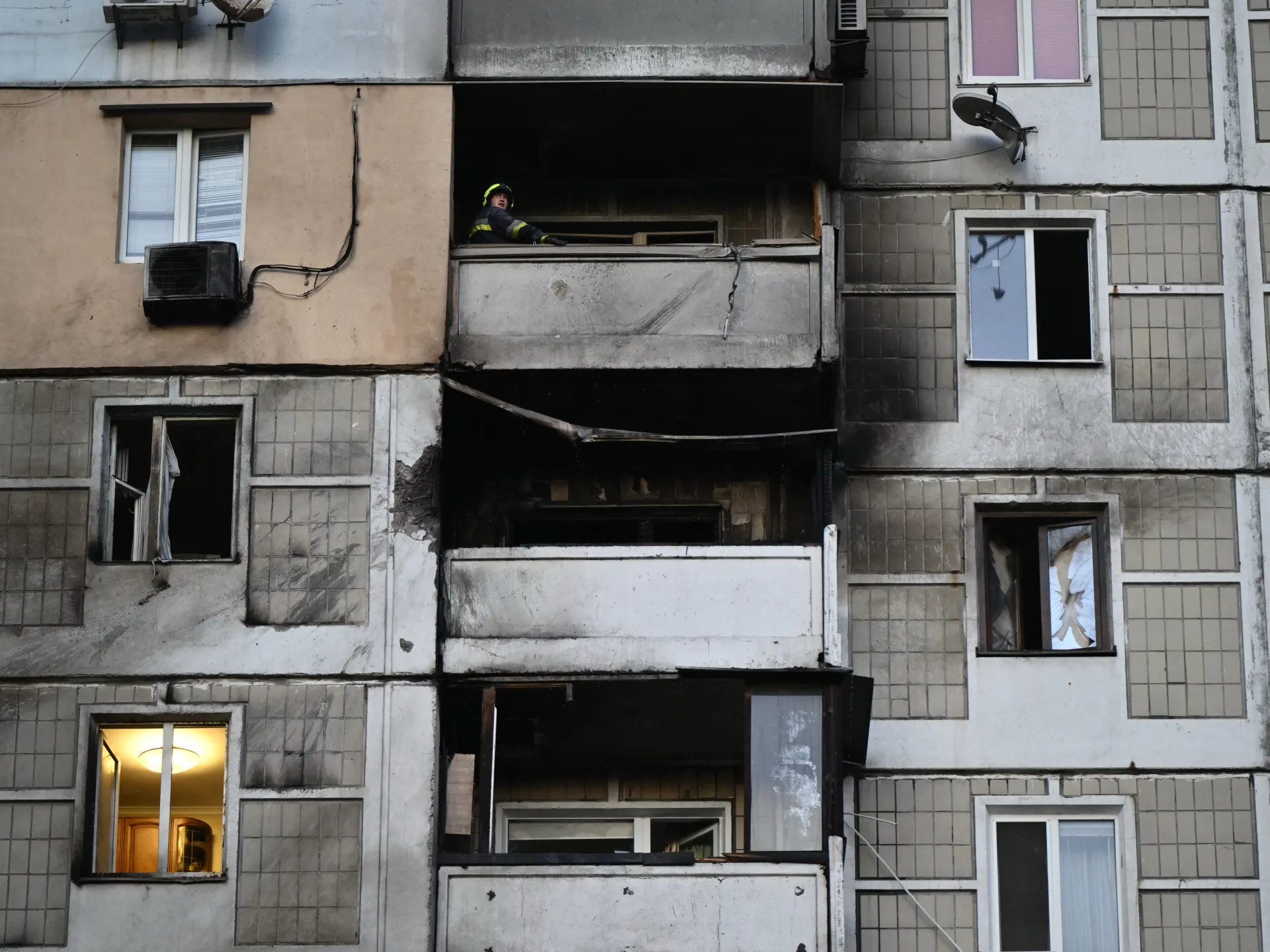
Kharkiv Mayor Ihor Terekov said on his Telegram account that a guided Russian aerial bomb hit an apartment block early on Monday, destroying two floors of the multistorey building.
Recommended Stories
list of 3 itemsend of list
He said six children were among the injured.
Russian attacks were also reported across Ukraine on Sunday.
Ukrainian Minister of Internal Affairs Ivan Vyhivskyi said three people, including a 16-year-old girl, were killed in air strikes that damaged a children’s centre in the northern city of Sumy.
Authorities in the Odesa region, meanwhile, said a “massive strike” on the south of the Black Sea region killed one person and damaged residential buildings, a shop, a hotel, a medical building, and a grain warehouse.
And in the capital, Kyiv, Mayor Vitali Klitschko said a woman and two 16-year-olds were injured and hospitalised.
“The enemy continues to relentlessly attack the Kyiv region with strike drones,” the city’s administration said.
“Sixteen sites have been damaged”, including 12 houses, a warehouse and a production facility, it added.
Ukrainian President Volodymyr Zelenskyy said on Sunday that three people were killed in strikes in the southern Zaporizhia region and that a Russian drone strike had killed one man in Kyiv.
Zelenskyy said in a post on his X account that Russia had launched more than 2,200 attack drones, 1,630 aerial bombs and 38 missiles of various types against Ukraine in the past week.
“If Russia were truly preparing for any real steps towards de-escalation, as it claims, particularly to American negotiators, this wave of Shahed terror would not be happening,” Zelenskyy said in later comments, referring to the Iran-developed drones Moscow has used against Ukraine.
In Moscow, Russia’s Ministry of Defence said it had bombed a Kyivstar data centre in Kyiv and another belonging to the Omega Telecom company. It said that the firms were providing services to the Ukrainian army.
Russian Minister of Foreign Affairs Sergey Lavrov told the United Nations General Assembly in New York on Saturday that Moscow intended to continue its military campaign “to the end”.
Ukrainian drones struck an oil depot in Russia’s Krasnodar region on Monday, according to local reports.
Ukrainian Telegram channel Exilenova+ published footage of a large fire and identified the facility as the Pavlovskaya oil depot.
No injuries have been reported so far.
Ukraine has intensified its targeting of Russian oil infrastructure in recent weeks.
United States-led talks to end the war, which began with Russia’s full-scale invasion of Ukraine in February 2022, have failed to produce a breakthrough, and the UN has highlighted the growing civilian toll.
Israel’s security minister Itamar Ben-Gvir has released a video in which he is seen threatening to kill senior Hamas figure Hassan Salameh. Salameh is serving multiple life sentences for his role in a series of Hamas-orchestrated attacks in 1996, including bus bombings.
Authorities report increasing death toll over three days as rivers rise above danger levels across parts of neighbouring countries.
Published On 27 Sep 202627 Sep 2026
Heavy rainfall has triggered floods and landslides that have killed at least 56 people in the northern Indian state of Uttar Pradesh in recent days while 12 people have been reported dead in neighbouring Nepal.
Hrishikesh Bhaskar Yashod, Uttar Pradesh’s relief commissioner, said on Sunday that India’s most populous state had registered 66.5mm (2.6 inches) of rain from Friday to Sunday morning, compared with a normal 7.6mm (a quarter of an inch) for the period.
Recommended Stories
list of 3 itemsend of list
The deaths, in addition to 46 injuries, were reported during a spell of “exceptionally heavy rain that has affected much of Uttar Pradesh”, according to the commissioner’s office.
More than 1,000 houses were damaged after “a depression over the Bay of Bengal moved inland and intensified rainfall across the region,” it added.
Home to more than 240 million people, Uttar Pradesh is frequently hit by rain and thunderstorms during the annual monsoon season from June to September.
In India’s eastern state of Odisha, more than 70,000 people living in low-lying areas were evacuated after rivers rose due to heavy downpours, the NDTV news network reported. The rains have damaged bridges and culverts, forcing officials to shut down Devkund, a popular tourist spot in the state.
Separately, India’s Central Water Commission said 30 river-monitoring stations across seven states were in a “severe situation”. Major rivers that flow through India, including the Ganga, Gandak, Kosi, Bagmati and Narmada, had risen above danger levels.
People salvage items from sludge on September 26, 2026, next to deluged houses in Nepal’s Nuwakot district in the aftermath of last month’s flash flooding [Prakash Mathema/AFP]
In Nepal, where a devastating flood in late August killed more than 1,400 people and left thousands missing, a new wave of flooding and landslides has killed at least 12 people since Thursday, according to officials, with several others missing.
Authorities warned of possible flash floods in 49 of the country’s 77 districts, with more than half facing high flooding or flash-flooding risks as water levels in major rivers and tributaries continued to rise.
Power supplies have been disrupted in the Manang, Mustang, Myagdi and Baglung districts, with authorities working to restore electricity, officials at the Ministry of Energy, Water Resources and Irrigation said.
Flooding of the Rahuganga River damaged the structure and transmission-line towers of a 40-megawatt hydropower project, Water Resources and Energy Minister Biraj Bhakta Shrestha said.
Shanti Mahat, a spokesperson for the National Disaster Risk Reduction and Management Authority, said Rasuwa and Nuwakot, areas hit by last month’s deadly floods, should remain “alert” but were not currently considered high-risk areas.
Cape Canaveral Space Force Station is getting lasers that can zap drones intruding into its airspace. When installed, the new directed energy defense system will be part of a much larger effort to protect the spaceport against drone incursions, a spokesperson for Space Launch Delta 45 (SLD 45) told us.
The idea is to ensure the safety of launches and to keep prying eyes away from an installation full of secrets about America’s military and commercial space efforts. Companies like SpaceX, United Launch Alliance, Blue Origin and Relativity Space use the installation for space launches. The base defense modernization effort comes as the Cape Canaveral region is inundated with drone incursions. There were hundreds last year.
A SpaceX Falcon 9 rocket launches from Space Launch Complex 40 at Cape Canaveral Space Force Station, Florida, on May 29, 2026. (U.S. Space Force photo by Gwen Kurzen) Gwendolyn Kurzen
“As the world’s premier spaceport continues to support an unprecedented launch tempo for national security and commercial missions, securing critical launch infrastructure from low-altitude aerial threats remains a top operational priority,” the spokesperson explained. “The ongoing security modernization integrates detection, tracking, and defensive capabilities to include directed energy systems. These will provide security forces with real-time situational awareness and the necessary tools to safeguard personnel, launch complexes, and national security payloads.”
The spokesperson did not have a timeline for when the directed energy system will be operational. Florida Today was the first to report that lasers will make up this defensive system.
Col. Brian Chatman, who commands Space Launch Delta 45, told the publication that the facility is “bringing on a directed-energy system that can do a kinetic kill against UASs (Unmanned Aircraft Systems) that are coming into the area that are having nefarious intent.”
“The Air Force Research Laboratory [AFRL]-tested system has been proven to be able to safely bring down a drone,” Florida Today noted. “This directed-energy system uses lasers to shoot down any drone that flies into restricted areas.”
Chatman didn’t name the specific system to Florida Today and the SLD 45 spokesperson declined to say.
The following video shows one such AFRL-tested system that has been used in combat before.
Raytheon laser weapon demo: Drones don’t stand a chance
For the spaceport, being able to use lasers is even more important than it is for other locations needing protection from drones. That’s because the traditional method of jamming radio frequencies to interfere with drone connections to controllers could damage spacecraft.
“If you start blasting a bunch of RF energy you run into potential challenges,” Chatman explained. “You don’t want that.”
There is good reason for Chatman to be concerned about drones. The spaceport has been subjected to many unauthorized incursions, the spokesperson told us. However, there were no statistics immediately available on how many or whether they occurred during launches. There were 500 unauthorized drone flights over the adjacent Port Canaveral in 2025, Port Canaveral CEO Capt. John Murray said.
In addition, on Sept. 18, a Chinese tourist pleaded guilty to a federal misdemeanor charge after flying a drone in restricted airspace above NASA’s Kennedy Space Center (KSC) in late July. KSC is located across the Banana River from the space station.
It is unclear if the new laser system will also protect the skies over KSC. The spokesperson did not immediately know and is checking into it.
Cape Canaveral. (Google Earth)
That tourist, Xiaodong He, flew a drone that videotaped the installation, according to federal documents. The drone got within 1.56 miles of pad 39B, from where the next crewed lunar flight is expected to launch in 2028.
NASA’s Kennedy Space Center pad 39B. (NASA)
Encompassing about 25 square miles, Cape Canaveral Space Force Station is a large, unpopulated, open area with a long Atlantic Ocean shoreline. The station’s physical layout allows many vectors for drone incursions, and what’s housed there makes it a logical target for a nefarious actor.
The systems being prepared for launch and launched at the sprawling facility are extremely valuable and can take many years to build, costing billions. When they are out on the pad or being transported around, the rockets are massive tubes packed with high explosives that would cause a devastating secondary explosion if struck.
Even disrupting launches there due to a successful or even attempted attack could have major national security impacts.
The move to bring directed energy systems to protect the spaceport comes as the military is investing heavily in these systems to counter drones. Late last month, for instance, troops from the Joint Task Force-Southern Border (JTF-SB) employed an Army Multipurpose High Energy Laser (AMP-HEL) system during an operation dubbed Ardent Vanguard. The AMP-HEL was used “to engage and defeat three hostile UAS, determined to be such based on their use in direct support of activities posing a physical threat to U.S. military personnel and CBP [Customs and Border Protection] partners,” according to a media release at the time.
The shootdown was part of the U.S. government’s ongoing effort to counter drones being flown by Mexican drug cartels.
Joint Task Force – Southern Border personnel used the Army Multipurpose High Energy Laser system to engage and defeat a hostile drone. (U.S. Army Photo by Sgt. Daniel Huerta) Operation Ardent Vanguard
The military is seeking to expand its ability to counter drones with directed-energy weapons. In May, the Defense Department and Joint Interagency Task Force 401 selected five installations to participate in a directed-energy counter-unmanned aircraft systems pilot program required by the Fiscal Year 2026 National Defense Authorization Act.
“This initiative will accelerate the fielding and evaluation of advanced directed energy capabilities to protect critical infrastructure, military installations and homeland missions,” the Pentagon explained. “The locations were deliberately selected to support rigorous testing and operational assessments across diverse environments and mission sets.”
The Pentagon selected two “key southern border installations” for this program: Fort Huachuca, Arizona; and Fort Bliss, Texas. It also tabbed Naval Base Kitsap, Washington; Grand Forks Air Force Base, North Dakota; and Whiteman Air Force Base, Missouri.
Though the Pentagon is pressing forward with making directed energy a key part of counter-drone efforts, laser weapons have limitations. These include their short-term magazine depth being limited to how many successive shots they can fire before thermal loads require the system to cool down. Energy supply can also be a limiting factor. Additionally, laser systems don’t function as well in heavy cloud cover and other inclement weather.
You can see the Iron Beam’s first claimed kills in the following video.
A World First — Combat-Proven Laser Defense, Powered by Rafael
For the first time in history, high-power laser systems have been used to intercept aerial threats in combat. This unprecedented breakthrough took place during the Swords of Iron War — with Rafael’s advanced… pic.twitter.com/B3D6UdCJvE
— Rafael Advanced Defense Systems (@RAFAELdefense) May 28, 2025
At the same time, a laser weapon of this kind is very much a point-defense weapon, with its short range meaning that multiple systems will be needed to provide coverage of a significant area. In some situations, even a single, large military base like Cape Canaveral Space Force Station might require more than one to provide full defensive coverage.
In addition, there have been concerns about the safety of the systems and the authorities required to use them in the homeland.
Safety concerns about using directed energy weapons, and especially kinetic ones, to take down drones in the U.S. have been a major factor in why they haven’t been previously used in this role. Almost two years ago, officials at U.S. Northern Command (NORTHCOM), which has coordinating authority for counter-drone efforts in the U.S., said the use of such weapons was not yet on the table. The reason is that they can create dangerous or otherwise serious collateral effects that are less of a concern in a war zone.
That the U.S. Space Force is bringing in a laser system to protect some of the nation’s most important and secret military assets is a strong indication that these concerns are being overcome.
Pakistani security forces report ongoing cross-border fire in latest escalation in fighting between the neighbours.
Published On 25 Sep 202625 Sep 2026
Pakistan has foiled an “attempted Afghan aggression” on the Pakistan-Afghan border.
Pakistani security sources said several Afghan members of the Taliban were killed in an intermittent exchange of fire in the Gulistan area of the border on Friday and that fighting was ongoing.
Recommended Stories
list of 3 itemsend of list
There has been no official confirmation from either country involved.
The Afghan government said on Thursday that it would deliver an “appropriate response” to Pakistani air attacks on 10 locations in Afghanistan earlier in the day.
The strikes were in response to a “deliberate and unlawful incursion into Pakistan by drones” on Wednesday, Pakistani Information Minister Attaullah Tarar said on Thursday.
Tarar said in a post on his X account that Pakistan’s aerial and drone attacks hit “terrorist hideouts and support infrastructure including drone launching and storage sites”.
He also posted a video said to show the military strikes on the Afghan sites.
Afghanistan’s government spokesperson Zabihullah Mujahid said the air strikes targeted Kandahar, Paktia and Khost provinces.
Taliban officials denied that their government launched drones against Pakistan on Wednesday.
The air raids on Thursday were carried out amid growing tensions between the former allies over attacks by armed groups in Pakistan, which triggered their worst fighting in years in February.
Islamabad accuses Kabul of harbouring fighters who stage cross-border attacks, but Afghanistan’s government denies harbouring anti-Pakistani armed groups and says the attacks are Pakistan’s internal problem.
The escalation threatens mediation efforts by China, Turkiye, Qatar and Saudi Arabia to broker a lasting peace between the two neighbours.
Overnight missile and drone attacks hit several Ukrainian regions as world leaders gather in New York for the UN General Assembly.
Published On 22 Sep 202622 Sep 2026
Russian forces have launched widespread attacks targeting industrial sites and critical energy infrastructure across several regions of Ukraine, killing at least three people and knocking out power to nearly 100,000 residents, Ukrainian officials said.
The strikes overnight hit industrial facilities simultaneously in the Dnipropetrovsk region, including Dnipro, Pavlohrad and Kryvyi Rih, the hometown of President Volodymyr Zelenskyy, regional Governor Oleksandr Hanzha said on Telegram on Tuesday.
Recommended Stories
list of 3 itemsend of list
Three people were killed and six others were wounded in Dnipro, where missiles, drones and artillery heavily damaged business and warehouse premises, Hanzha said.
Ukraine’s air force said Moscow’s overnight barrage involved 212 drones, four cruise missiles, and an unspecified number of Oniks antiship and ballistic missiles.
The strikes also damaged energy infrastructure. An attack on a power facility left nearly 100,000 consumers without electricity in the northern region of Chernihiv, while in the Poltava region, Governor Vitalii Diakivnych said a “massive” Russian attack hit an industrial enterprise and a critical infrastructure facility.
The Russian Ministry of Defence confirmed its forces carried out major strikes, stating it hit industrial and military facilities, the fuel and energy sector, port infrastructure and sea vessels operating for the Ukrainian military.
Meanwhile, Ukrainian drones targeted Russia’s Samara region along the Volga River, killing one person and injuring four, according to the local governor. The region hosts critically important facilities, including oil refineries.
The Russian Defence Ministry said its air defence units intercepted and destroyed 297 Ukrainian drones across various regions overnight.
Diplomatic push in New York
The attacks come as Zelenskyy arrived in New York for the United Nations General Assembly (UNGA), where talks on ending the war are set to be high on the agenda as nearly 130 heads of state gather.
The Ukrainian president wrote on X that a “drone deal” was ready to be signed to bolster air defence and secure funding for the war effort.
“Of course, Ukraine’s number one priority is bringing peace closer and protecting the lives of our people,” Zelenskyy posted. “There are concrete security proposals and de-escalation measures that could bring the end of the war closer. We are working to strengthen air defence and ensure sufficient financing for Ukraine.”
He said, “Around 20 meetings are planned, including with the US president, European leaders, US senators and members of the House of Representatives, heads of international organisations, leading American companies and think tanks.”
Zelenskyy met French President Emmanuel Macron on Monday and is likely to meet US President Donald Trump on Tuesday.
Earlier, Macron also met Trump, after which he said the two countries agreed to work together to secure a moratorium on strikes targeting energy networks and civilian infrastructure in Ukraine. Both Zelenskyy and Russian Foreign Minister Sergey Lavrov are set to address the UNGA later this week.
French President Emmanuel Macron, left, with his Ukrainian counterpart, Volodymyr Zelenskyy, on the sidelines of the UNGA in New York, US, September 21, 2026 [Ludovic Marin/AFP]
Within hours of a Feb. 28 missile attack that hit an Iranian school, some Pentagon personnel knew the U.S. was responsible, according to officials involved in an internal investigation of the incident. That probe found what the officials now describe as a cascade of preventable failures.
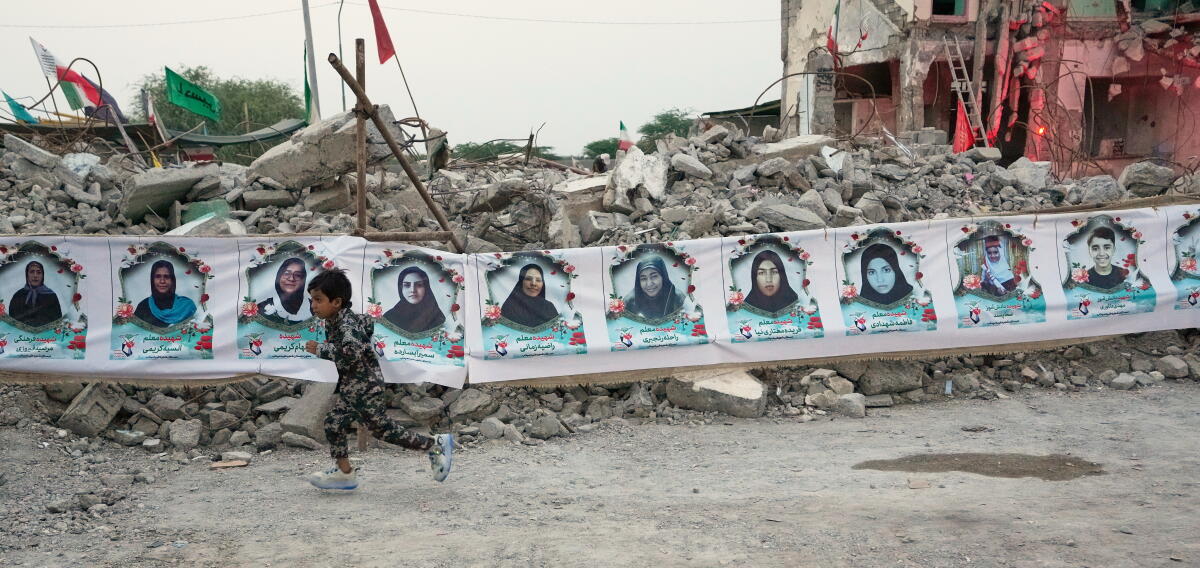
Two Tomahawk missiles struck the building and its grounds that Saturday, killing more than 150 people, including at least 123 children. The strikes devastated the two-story school, which was built on land that was part of a military compound in the southern Iranian town of Minab. In terms of child casualties, it’s the deadliest American military targeting error of the 21st century.
United Nations investigators said Thursday that there were reasonable grounds to conclude that the strike on Minab and another U.S. attack that took place on the same day amounted to war crimes. The U.S. has yet to publicly accept responsibility for the school strike, and President Trump has previously suggested it was Tehran’s fault. As recently as July 14, he told Fox News, “I don’t think anybody’s going to ever be able to say what happened there.”
But in interviews, officials with direct involvement in the Pentagon’s internal investigation have offered some of the first accounts of the probe. The strike didn’t result from a single catastrophic decision but an accumulation of smaller ones, they said, and their review has identified a series of missed opportunities to prevent the disaster. The officials, like more than two dozen others who provided descriptions of targeting procedures or background information for this story, asked not to be named to discuss sensitive matters.
In the final days of February, the Trump administration demanded an overwhelming aerial assault. More than 1,000 Iranian targets were hit within the first 24 hours alone. That order compressed the time frame for finalizing targets, the officials said, instilling an urgency that — combined with gaps in underlying information about the site, cuts in civilian protection personnel and an overreliance on artificial intelligence technology — set the stage for the deadly error.
Full details from the investigation remain tightly held. Officials who described it said they faced constraints on the amount of information they could share. Previous news reports have indicated that by early March, a preliminary internal review determined the U.S. was likely responsible for the Minab strike.
A report on the full Pentagon investigation, which commenced in March, hasn’t been released — though the officials said it has been all but complete for several months.
Adm. Brad Cooper, who heads U.S. Central Command and ordered the investigation, told members of Congress in May that he’s committed to providing transparency. Yet it’s not clear how much detail will be included, nor how much of the report ultimately will be released to the general public.
A child runs past a banner strung across the rubble of Shajarah Tayyebeh Elementary School showing portraits of the children and teachers killed there by a U.S. missile strike.
(Vahid Salemi / Associated Press)
A Pentagon spokesperson said the incident remains under investigation and declined to comment further.
In response to questions, including about when the White House was informed that the strike was a mistake, a senior administration official also cited the ongoing probe and added: “The United States does not target civilians.”
Last week, a report from the United Nations’ Independent International Fact-Finding Mission on Iran said that the U.S. had “failed in its obligation to do everything feasible to verify” that the school was a military target and that the failure “went beyond negligence.” The U.S. Department of Defense has declined to comment on the report.
U.S. officials have said that outdated intelligence was a problem. Although the site in Minab had been identified years earlier as a military compound, there was clear evidence that it had been modified and undergone a change of purpose, the officials said. Physical changes reflecting new construction — visible on satellite imagery — dated back almost a decade, they said, and the site operated openly as a school.
Analysis of commercially available satellite images shows construction of walls and entrances that separate the school site from the military base, work that appears to have been completed by 2017. An image from 2018 shows brightly painted walls alongside a soccer pitch, assembly rows and play markings on the ground.
Some U.S. intelligence analysts took notice, the officials said. Bloomberg reported in June that one analyst detected changes to the site as early as 2019, and logged remarks about the modifications in a system that wasn’t connected to the primary military intelligence database, which informs targeting.
Inside Centcom, which conducted the U.S. attack, some personnel relied too much on the artificial intelligence embedded in Maven Smart System, the officials said. Maven, which is made by Palantir Technologies Inc., allows users to view and coordinate complex military operations — from targeting to command and control — using AI-enabled software that fuses more than 150 different data inputs into a coherent set of information to inform commanders’ decisions.
In the past year, the Defense Department has rapidly made Maven a cornerstone of the U.S. military apparatus. Several former senior U.S. military officials now work for Palantir, including some with high-level security clearances in Centcom’s Tampa headquarters. Their role is to keep the software functioning inside secure military environments.
Some Centcom personnel expected Maven to flag stale information or inconsistencies in the underlying intelligence assembled for potential targets, the officials said. It’s not clear why they had such expectations.
A Palantir spokesperson said that the company “is not responsible for the underlying data nor identifying intelligence deficiencies” and that there’s no evidence that its software was at fault in the Minab strike.
Two people familiar with the firm’s Pentagon contracts said the government retains primary responsibility for the quality of the information that’s fed into Maven. But they said it’s not uncommon for personnel who use tools such as Maven to develop operational understandings that differ from contractual terms.
After the Minab strike, Palantir built new capabilities into Maven that “re-review underlying intelligence to identify factors that would disqualify a target and flag inconsistencies and inaccuracies that human review may have missed,” according to a person familiar with the matter. That work has already caught some anomalies, the person said.
The ‘kill chain’
As Feb. 28 approached, Pentagon officials were tasked with identifying strikes they thought would paralyze Iran’s military before Tehran had a chance to respond, the officials said.
High on Centcom’s list: the naval division of the Islamic Revolutionary Guard Corps, the most powerful force across the country’s military, economy and politics. It’s tasked with defending — and at times, disrupting — the Persian Gulf and the Strait of Hormuz. The Minab school site — with its uncorrected classification as a Revolutionary Guard facility — was fed into Maven along with other potential targets. It ultimately emerged as one of the recommended Day 1 targets, people involved in the investigation said.
As all targets do, the Minab site moved through a multi-stage assessment process known by the military as the “kill chain.” Steps in that process have traditionally involved intelligence analysts, imagery specialists, targeteers, lawyers, operational commanders and launch crews, according to U.S. military doctrine and interviews with current and former Defense officials. Today, Maven sits at the heart of those operations — between the initial intelligence inputs and the latter review stages, officials said.
In past conflicts, preparing lists of proposed targets — work that includes assessing how they align with an operation’s objectives — had taken hours for staffers to complete. Ahead of the U.S. attack on Iran, much of that work was condensed into several minutes via Maven, people involved in the Pentagon’s internal review said.
Officials involved in the investigation pointed to gaps that they said were left after Defense Secretary Pete Hegseth dismantled most of the Pentagon’s civilian harm mitigation, or CHM, units — cutting headcount across a number of teams by roughly 90% to fewer than 20 staff members, people with direct knowledge of the matter said. Centcom’s team was reduced from 10 to 1.
No CHM team member reviewed the Minab site before the strike, according to officials involved in the internal investigation. That was a consequence of the cuts in staffing but also a decision not to involve the group in planning and operations, the officials said. While not mandatory, that sort of review had become routine in recent years, they added. It’s unclear whether such checks, which include mapping the civilian environment, assessing noncombatant presence and developing lower-risk strike options, would have been enough to raise questions about the Minab site.
The Biden administration had built up civilian-harm-prevention capabilities within the Pentagon after an August 2021 drone strike in Kabul killed 10 civilians — based on the misidentification of an aid worker as a threat. Hegseth has characterized his subsequent cuts to those efforts as a shift away from “Biden-era, non-lethal programs.”
“America, regardless of what so-called international institutions say, is unleashing the most lethal and precise air power campaign in history,” Hegseth said at a news conference March 2, days after the Minab attack. “All on our terms with maximum authorities. No stupid rules of engagement, no nation-building quagmire, no democracy-building exercise, no politically correct wars.”
Under Hegseth’s leadership, the U.S. military has prioritized speed of delivery. People involved in the Pentagon probe said a rush to finalize targets shortly ahead of Feb. 28 contributed to the tragedy.
“Haste can lead to errors,” said Laurie Blank, who was appointed a special counsel at the Pentagon’s general counsel during the Biden administration from 2022 to 2024. She drew a distinction between planned targets and those that arise in the heat of battle. “A rush to hit pre-planned targets just isn’t the same thing,” she said, “especially when the operations are launched by choice and not in response to an attack where you are responding without time to plan.”
Why Minab?
A little more than 800 miles south of Tehran, the city of Minab sits on the critical Strait of Hormuz, at the crossroads of centuries-old trade routes and the nation’s modern military might. As the U.S. attack on Iran began, it was deemed a high-value target, according to people involved in the investigation.
As the strait’s significance grew in the 1980s, so did the number of military assets devoted to protecting it and projecting power into the Persian Gulf. The Revolutionary Guard’s missile units, naval facilities and logistics compounds operate alongside neighborhoods where fishermen, teachers and civil servants have lived for generations in the city of 76,000.
Shajarah Tayyebeh Elementary School was built almost a decade ago on land originally occupied by a Revolutionary Guard naval unit. The Pentagon had cataloged the site as a military base several years earlier — a determination that wasn’t updated before the February attack. The New York Times reported in June that targeting officials used satellite imagery that hadn’t been updated in seven years and that did not show a school at the site. Investigators have focused on the Defense Intelligence Agency’s failure to reclassify the location, officials involved in the inquiry said.
On Feb. 28, Minab awoke to clear skies. Shopkeepers unlocked their storefronts. Fishing crews unloaded ice chests along the docks. Children in green-plaid uniforms walked through the gates of the 260-student school, before heading into classrooms.
Firsthand descriptions of the events that took place in and around the school that day have been gathered by a group of human rights advocates, lawyers and digital forensics experts who’ve spent months reconstructing the attack. Members of the informal consortium — including some based in the U.S. and Europe — asked not to be named given the sensitivity of their outreach efforts with victims’ families. Their work and an assessment by the U.K.-based watchdog group Airwars — viewed as a highly reliable source by some Pentagon officials — provides the following account:
After the first reports of attacks on Iran emerged that Saturday morning, teachers called parents and asked them to collect their children, saying the school planned to close early. Shortly after 11 a.m., a first missile hit part of the school, triggering an explosion that reverberated across the neighborhood. Panicked shrieks filled the air. Teachers ushered children from the playground back inside to take cover in a prayer room.
Within minutes, a second missile struck, sending metal fragments across the school. Part of the roof collapsed. Only a few children inside the prayer room survived, buried beneath the rubble.
Rescue vehicles rushed to the scene while passersby helped the wounded. Some injured children were pulled from the rubble while dozens more, deceased, were slowly identified. One rescue crew member stumbled upon a child’s hand, detached and laying on the ground. He wept as colleagues continued to hunt through the debris alongside him.
Some parents were left to identify their dead children by fragments of clothing or belongings — a pencil case, bracelet or shoe — as many faces were no longer distinguishable. The father of Arash Gol-Azin didn’t learn the fate of his 7-year-old son until reaching the morgue. Only then did he spot him by identifying his sock.
Payam Akhavan, a Toronto-based lawyer who has practiced before the International Criminal Court and is an expert on civilian protection, said it’s important for investigators to determine what efforts U.S. officials made to try to ensure they were targeting a military installation.
“The Geneva Convention says you must take all feasible measures to determine that this is, in fact, a military objective,” said Akhavan, who spoke before Thursday’s U.N. report was published. “This does not mean that every mistake is a war crime, because mistakes will be made, even if you take all feasible measures.
“But if all feasible measures were not taken,” he added, “then that raises a question of criminal responsibility.”
At least 1,701 civilians were killed in the opening 39 days of the war, according to data compiled by the U.S.-based group Human Rights Activists in Iran. That’s an average of 43 people a day, and the group — viewed by some in the Pentagon as an authoritative source for Iranian casualty figures — said it’s a low estimate.
“We should be asking how so many civilians were killed amid an unprecedented tempo of strikes over just a matter of weeks,” said Skylar Thompson, the group’s deputy director.
More recently, Iranian officials and a United Nations body said the U.S. was responsible for a Sept. 1 strike on Kuhestak — some 20 miles south of Minab — that hit a residential area where a wedding party was underway and killed at least five people with dozens more injured. The U.S. is investigating the incident, Vice President JD Vance said earlier this month.
Target libraries
For decades, American military planners had maintained extensive target libraries in anticipation of potential conflict with Iran, encompassing everything from limited strikes to maritime war and major air campaigns. The list stretched into the thousands and included air bases, missile factories, nuclear facilities and ports, according to current and former U.S. officials familiar with the plans.
Some potential targets had remained on the books for years, accumulating layers of satellite imagery, intelligence reports and legal reviews.
But these catalogs can age quickly, according to people who’ve dealt with them. Buildings appear and disappear. Headquarters switch locations. Where a military barracks once stood, schools, hospitals and mosques may now exist. So the libraries’ contents require close and continual review well before any particular building or site winds up on a target list.
Maintaining the lists is critical but labor-intensive. Officials involved in the internal investigation of the Minab incident described gaps in vetting — or checking whether the underlying information is accurate, reliable and timely — that came well before the school site was selected.
Some of the most sensitive sites, such as Iran’s nuclear facilities — attacked by Israel in its 12-day war with Tehran in June 2025 — faced relentless attention from U.S. intelligence analysts ahead of the 2026 war, according to officials with direct knowledge of the matter. Less prominent locations, such as Minab, went months without receiving another close look, the officials added.
War planners start to think they’ll have time to revisit the less urgent sites, current and former Pentagon officials said.
That assumption evaporated during the final days of February as diplomatic talks between U.S. and Iranian officials in Geneva faltered and then collapsed on Feb. 26.
Work that had unfolded in previous conflicts over weeks or months — matching sites from the library, such as buildings, airfields or bases — was completed in a matter of days, according to officials involved in the inquiry. More than a thousand potential targets had to be reassessed and approved.
By the time the first Tomahawk missile bound for the Minab site left its launcher on a ship operating in the Arabian Sea, roughly three dozen people were involved along the kill chain, the officials said.
Most sat in secure facilities more than 7,000 miles away in Tampa, Fla., studying maps, imagery and databases in preparation for a war that, until 48 hours before the Minab attack, many officials had believed for decades wouldn’t occur.
Typically, part of their work entails refining a list based on satellite imagery and on-the-ground intelligence that’s used to create a pattern-of-life analysis reflecting human movements on the site and changes over time. In Iran, a bitter U.S. adversary for almost half a century, such intelligence was limited, especially in the south of the country, people involved in the probe said.
Additional steps in the kill chain address other types of issues. Lawyers assess whether each proposed target is a lawful military objective. Specialists estimate potential collateral damage. Weapons experts debate not only which missiles to fire but when.
Every stage leaves a record. Analysts sign off on each piece of the chain. They’re told to report any inconsistencies to superiors.
Then a series of questions is asked by the senior commander: Is the target lawful? Is there sufficient intelligence? And have reasonable precautions been taken to minimize civilian harm? In the early hours of Feb. 28, the answer to each question about the Minab site was yes, according to the officials involved in the probe.
The Pentagon’s internal investigators, who examined the satellite imagery, intelligence databases, targeting materials, operational chat logs and computer records that analysts used, concluded that there was high confidence throughout the kill chain that the Minab site was a Revolutionary Guard facility, according to people involved in the probe.
“Insufficient intel wasn’t really viewed as a concern before the war,” said one Pentagon official involved in the internal probe. “We were confident in our intel. Minab proved you should never be too confident.”
Political pawns
Government researchers and auditors have noted deficiencies in the primary intelligence database that’s used to develop strike targets, and the Pentagon is working to replace it with one that will introduce more automation. And Minab isn’t the first time that flawed intelligence has directed U.S. precision weapons toward the wrong target.
The accidental bombing of the Chinese Embassy in the Serbian capital Belgrade in 1999 killed three people and injured 27 others. A mistaken 2015 airstrike on a Doctors Without Borders hospital in Kunduz in Afghanistan killed 42 people. More recently, soon after the Pentagon’s civilian-harm-mitigation teams were disbanded, a strike on the Ras Ina port in Yemen in April 2025 resulted in at least 80 civilian deaths.
In the months since the attack, the children of Shajarah Tayyebeh Elementary have become symbols. Their faces were plastered on the backs of the seats of Iranian planes ferrying diplomats to Islamabad for talks with the U.S. in April. They adorn memorials on the streets of Minab. Some families have complained that their injured children haven’t received the treatment they need. Critics accuse Iranian officials of leveraging the school attack to their political advantage.
In the U.S., the disaster has become a different sort of political touchstone. Democratic lawmakers, who are seeking to take control of the Congress in the November election, are asking how the attack could have happened.
Sen. Jack Reed of Rhode Island, the ranking member on the Senate Armed Services Committee, accused the Pentagon of deliberately withholding the results of the investigation, and his Republican counterpart, Thom Tillis of North Carolina, called for congressional briefings on what went wrong.
That call is echoed by Sen. Richard Blumenthal, who also sits on the committee, which helps set spending caps for the Pentagon’s roughly $1-trillion annual budget.
“The administration should have been forthcoming within hours or days, and here we are months later and nothing has been provided,” Blumenthal said.
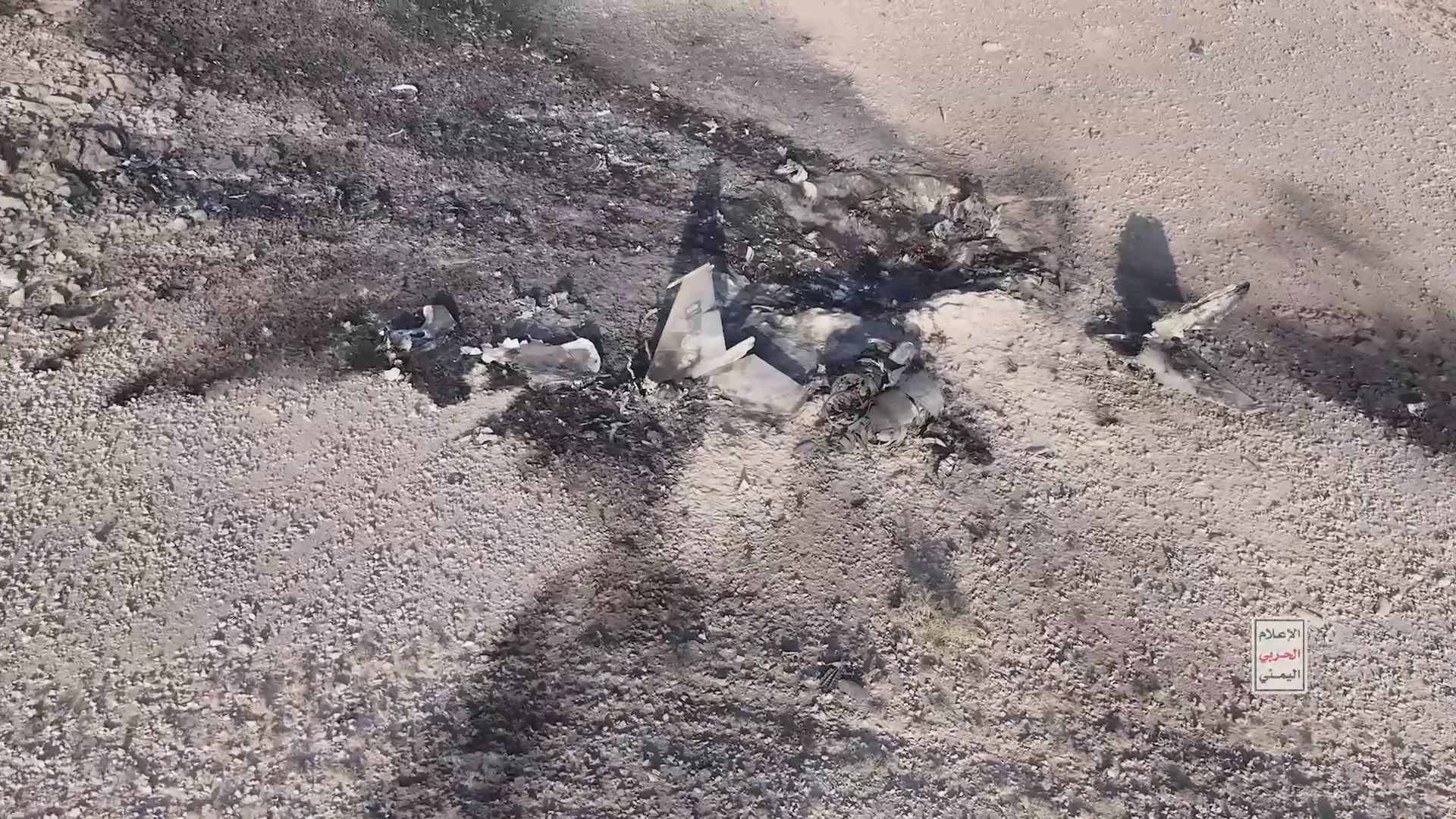
Yemen’s Houthi movement, formally known as Ansar Allah, has released imagery that it says shows the downing of a Royal Saudi Air Force F-15 fighter over Marib governorate. The material includes photos of the wreckage of an F-15 on the ground. At this stage, the fate of the two crew members is unclear. The incident comes amid a major escalation in fighting between Saudi Arabia and the Iran-aligned Houthi movement.
A video of what Ansar Allah says is the successful shootdown of the F-15 shows the typical ground-based forward-looking infrared (FLIR) systems we have seen in use by air defenses in Yemen previously, and, more recently, in Iran.
After a period of relative calm following the 2022 truce, fighting has intensified in recent weeks, with Houthi forces making significant advances against Saudi-backed Yemeni government positions, including around the strategically important coastal areas of Marib and Taiz. The group has also stepped up missile and drone attacks against southern Saudi Arabia, targeting military and energy infrastructure while strangling the kingdom’s ability to move oil through the Red Sea. The Houthis have further declared the Bab el-Mandeb closed to Saudi oil traffic, directly challenging one of Riyadh’s key energy-export routes.
An aerial view of the apparent impact site. Houthi-controlled mediaThe impact site seen from the ground. Houthi-controlled media
Prior to the release of imagery, earlier today the Houthi military spokesman Brig. Gen. Yahya Saree claimed that Houthi forces had shot down a Saudi F-15 while it was conducting operations in support of Saudi-backed forces in Marib. Saree said the aircraft was engaged by a locally manufactured surface-to-air missile, although he did not identify the weapon. Reuters likewise reported that the Houthis had claimed the shootdown but that the claim had not been independently verified.
Saree also claimed that Houthi air defenses subsequently engaged formations of Saudi F-15s and Eurofighter Typhoons that entered the area while attempting to locate the downed aircraft. According to the Houthi account, those aircraft were forced to withdraw. That portion of the claim has likewise not been independently verified.
Saudi Arabia has not, at the time of writing, publicly acknowledged the loss of an F-15. Reutersreported that the Saudi-led campaign had intensified considerably in recent days, with Saudi aircraft striking targets across Yemen while the Houthis have launched missiles and drones toward Saudi territory.
The aircraft appears to be an F-15SA, the most advanced variant of the Eagle operated by the Royal Saudi Air Force. Specifically, it appears to be tail number 5539, assigned to the 55th Squadron based at King Khalid Air Base.
A close-up of one of the tailfins with the apparent tail number 5539. Houthi-controlled mediaAnother view of one of the tailfins. Houthi-controlled media
The Royal Saudi Air Force received 84 of the new-build F-15SA. Meanwhile, the 68-strong fleet of earlier F-15S aircraft has been upgraded locally to a similar standard, also known as F-15SR (for Saudi Retrofit). Aircraft 5539 is understood to be among the latter.
The reported shootdown highlights the continuing threat posed by Houthi air defenses, which have proven considerably more capable and difficult to suppress than their improvised appearance might suggest.
As TWZ has previously detailed, the Houthi air-defense network includes mobile surface-to-air missile systems, repurposed infrared-guided R-73 and R-27 air-to-air missiles, and Iranian-derived systems such as the Saqr/358.
Houthi Thaqib-1 surface-to-air missiles (repurposed R-73s) in front of Thaqib-2s (repurposed R-27). Other Houthi air defense missiles are also seen at the rear. Houthi-controlled media
Of particular concern is the group’s use of passive infrared sensors for detection, tracking, and missile cueing. Unlike conventional fire-control radars, these sensors do not provide an aircraft’s electronic-warfare systems with an early warning that it has been detected or targeted. TWZhas noted that this combination of mobility and passive sensing can create a difficult problem even for highly sophisticated combat aircraft, with the Houthis having previously demonstrated the ability to threaten U.S. crewed and uncrewed aircraft.
That capability does not mean that Houthi air defenses constitute a conventional, integrated air defense network comparable to those operated by major state militaries. However, they can still be effective through a combination of concealment, mobility, passive detection, unconventional employment of missiles, and the difficult operating environment over Yemen.
Previous Saudi aircraft losses attributed to Houthi air defenses during the Yemen war from 2015 to 2022 include several helicopters, fixed-wing aircraft, and drones. Total Saudi losses to all causes in the conflict amount to around a dozen helicopters, five jets, and as many as 30 drones. A Saudi F-15 crashed in the Red Sea at the start of the war in 2015 and Eagles were also reportedly engaged and damaged by Houthi surface-to-air missiles in 2018, although they returned safely.
Video footage that emerged in 2021 shows Saudi troops on the ground watching an F-15 swoop in a relatively low level to knock down a Houthi Qasef-series suicide drone:
Saudi F-15 shooting down a Houthi Qasef-2K
In the past, Houthi forces have come close to engaging U.S. F-35s and have repeatedly demonstrated an ability to bring down MQ-9 Reaper drones. If the Saudi F-15 loss is ultimately confirmed, determining precisely how the aircraft was detected, tracked, engaged, and hit could therefore provide valuable insight into how this unusual air defense architecture is being employed against Saudi and other combat aircraft.
As we discussed at the time, the clear risk posed by Houthi air defenses is likely the main factor behind Saudi employment of a Chinese-made short-range ballistic missile (SRBM) in the current fighting with Yemen.
The timing of the reported shootdown is also notable. It comes amid a sharp escalation in the conflict, with Saudi Arabia conducting air operations against Houthi positions in Yemen and Ansar Allah launching missiles and drones toward targets inside Saudi Arabia. Reutersreported that the Houthis had attacked the Saudi Red Sea port of Yanbu and a southern airbase at Khamis Mushait, while Riyadh has reported intercepting Houthi drones.
The F-15 incident also follows a separate confrontation over an alleged Houthi drone attack near Mecca. Saudi authorities said their air defenses intercepted and destroyed a Houthi drone south of Mecca before it entered the restricted airspace over the city. The Houthis denied targeting the holy city.
Meanwhile, there are reports that U.S. officials met representatives of the Houthis in Oman over the weekend, with the Houthis apparently telling the U.S. officials that they had no intention of attacking American vessels and that they remained committed to the 2025 ceasefire with the United States unless they stepped in on behalf of Saudi Arabia. The Kingdom reportedly requested exactly this in recent weeks but was denied.
For the moment, the most that can be established from the available imagery is that a Saudi F-15 was destroyed, with Ansar Allah claiming responsibility.
This is a developing story and will be updated as additional imagery, official statements, or other independently verifiable information becomes available.
SACRAMENTO — Gov. Gavin Newsom on Friday ordered the formation of a panel to come up with safety regulations for the state’s artificial intelligence companies, including the development of a possible “kill switch” for AI programs that go rogue.
Newsom issued an executive order to convene “a group of world-leading experts” to provide a “guide” for the state to bolster its laws around AI security, according to statement from the governor’s office.
The panel could put consider proposals for independent third parties to write safety plans or for companies to develop an emergency shutoff.
Newsom, who is considering a 2028 run for president, two years ago vetoed a state bill that would have mandated a kill switch.
Some Democratic and Republican leaders around the country are scrambling to come up with safety proposals after employees at AI companies recently warned that the technology could create catastrophe, including ending humanity.
A researcher for AI company Anthropic said he left the company over concerns that AI companies, including OpenAI, are “gambling with our lives” as they race ahead to improve AI that could surpass human intelligence.
The researcher, Jacob Coxon, said in a social media post: “People building AI earnestly believe that it could kill us all by the end of the decade.”
State Sen. Chris Cabaldon (D-West Sacramento), who chairs the state committee overseeing technology issues, told the Times he’ll hold hearings on artificial intelligence this fall. Those meetings were planned before the recent warnings about AI’s dangers, but will be informed by the events of the last few weeks, he said.
He said the state’s rules around AI don’t go far enough.
“We regulate your barber or your sandwich shop more than we regulate [a company] telling us that they may be ending humanity,” he said.
Any new laws could have a disproportionate effect on the global tech industry because many top AI companies are based in California.
A proposed law in 2024 by Sen. Scott Wiener (D-San Francisco) would have required tech firms to be able to turn off the AI models they directly control if things go awry.
Newsom, in his veto message at the time, cited concerns about stifling innovation. He also expressed concern that smaller AI models, which would have been exempt from the law, could also be dangerous.
An artificial intelligence “kill switch” which can be checked by a third-party may need to be mandatory for companies, a co-founder of one of the world’s largest AI firms has said.
Jack Clark, one of seven founders of Anthropic, said a way of shutting off AI software completely if it gets too dangerous was the kind of thing society “might want to eventually pass rules around”.
Clark said “most labs have different ways of being able to pull the plug”, including Anthropic, but said policymakers may need to enforce having one.
The rapid development of AI and fears over the risks that the technology poses to humanity have been thrust into the spotlight by a series of warnings from executives and staff at AI firms.
Some have said publicly there is a chance that the technology could, if unchecked, kill all humans.
Anthropic head Dario Amodei over the weekend called for the pace of AI development to slow and be more closely monitored, as the company has done before, though some have questioned the motivations behind this.
Amodei did not say how exactly how AI development could be slowed down and said any action to reign in AI development should be done “without sacrificing commercial advantage”.
Clark told the BBC that specifics around “kill switch” requirements and verification should be part of “the larger policy conversation” taking place around AI.
“Should you mandate for companies to definitely have a kill switch? Is that kill switch verifiable by a third party?” he asked.
“I think that’s the kind of thing society is going to want to know and might want to eventually pass rules around.”
Anthropic, which was formed in 2021 by a group of former employees of its rival OpenAI, is currently at the centre of a debate around AI safety.
Last week, a post from an artificial intelligence researcher who quit Anthropic over concerns AI could wipe out humanity went viral.
In response, Anthropic scientist Evan Hubinger said he personally thought the possibility of human extinction from AI was “>10% within the next decade”.
Asked what percentage he would put on all humans being killed by AI, Clark said: “I don’t think these statistics are that useful”, but added that allowing AI to continue as a “totally unregulated industry” was a bad idea.
“We are rolling dice with immense risks,” Clark said. “And the point is, we have to change the course of this industry.”
The Ukrainian Navy is claiming one of its uncrewed surface vessels (USV) sank a Russian USV, marking the first time one of these weapons, also known as drone boats, destroyed another. The engagement is the latest iteration in the use of combat drone boats, which Ukraine has employed to devastating effect against Russia’s Black Sea Fleet vessels and facilities, forcing the general evacuation of Russian naval assets from occupied Crimea to bases in Russia proper. The use of weaponized USVs is now proliferating around the globe at an increasing rate.
The incident took place somewhere in the Black Sea, said the Ukrainian Navy, which provided no details about when it happened or exactly where. TWZ cannot independently verify this claim; however, we cannot find any evidence of a drone boat killing another drone boat in the past.
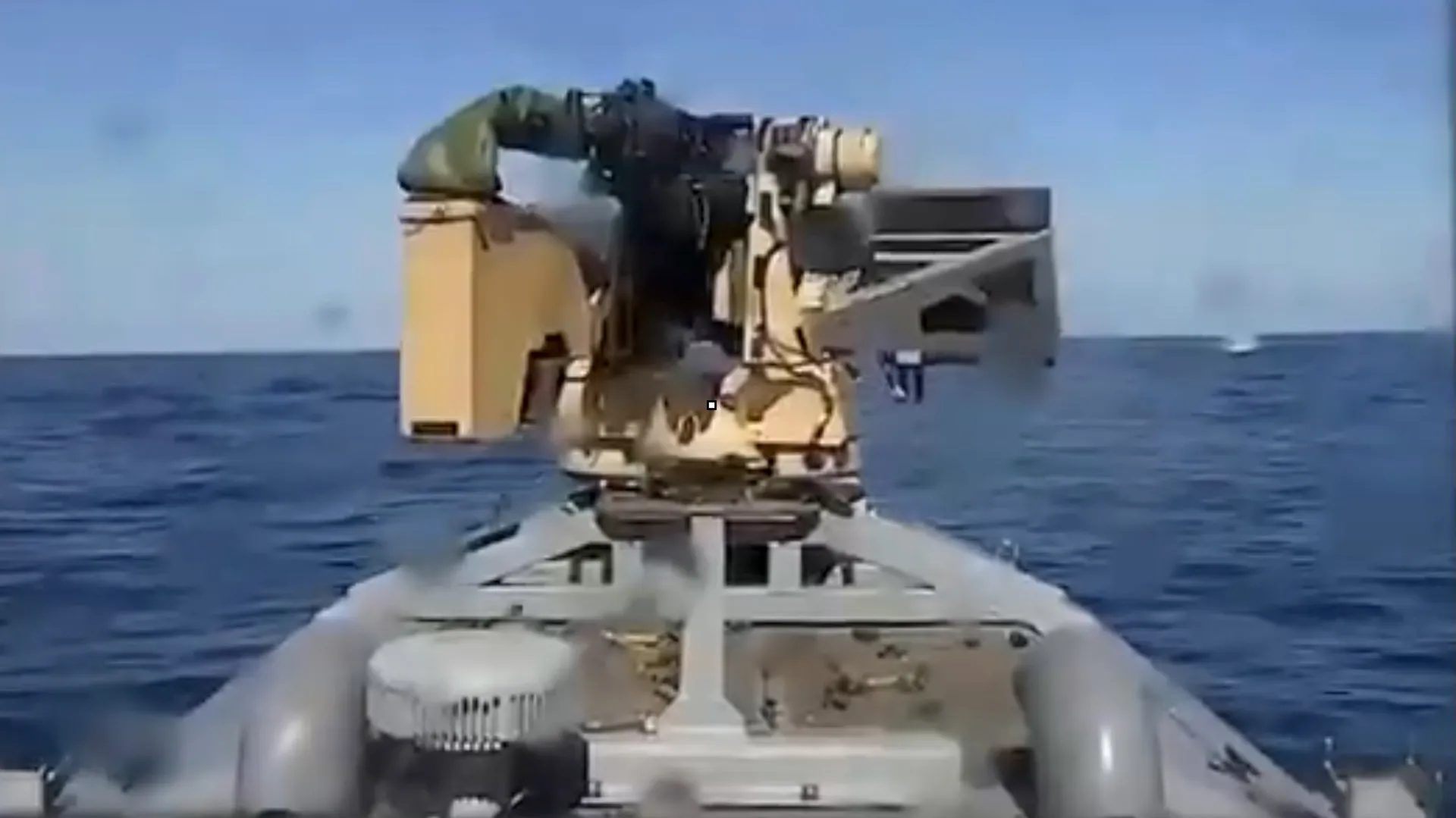
“Units of the Main Intelligence Directorate (GUR) detected the target,” the Ukrainian Navy stated on Telegram. “The Ukrainian Navy’s ‘Sargan 3000’ unmanned boat, equipped with a remotely operated weapon station (RWS) Protector 12.7 mm, successfully destroyed it. This is the first naval battle in history between unmanned boats.”
An 81-second video released by the Ukrainian Navy opens with a view from the Sargan 3000’s onboard camera. It shows the Ukrainian USV acquiring, then engaging the Russian USV with its machine gun. It then cuts to a closer view of the Protector gun system firing at the Russian drone boat. At about the 30-second mark, the view switches to a feed from an aerial platform, though it is unclear if it is piloted or a drone. The video continues with the Sargan 3000 raking the Russian USV with its heavy machine gun until pieces start flying off and it eventually sinks, stern first.
Ukraine’s Navy says a Sargan unmanned surface vessel destroyed a Russian unmanned boat with machine-gun fire in the Black Sea, the first-ever battle between unmanned surface vessels. Ukrainian Navy personnel operated in coordination with HUR. #Ukrainepic.twitter.com/Avg4ecz8m6
The Sargan 3000 (the name means needlefish in Ukrainian) was first introduced by Ukrainian President Volodymyr Zelensky in April as a “multi-purpose platform that has undergone testing and entered service with the Ukrainian Navy. These uncrewed vessels are highly maneuverable and capable of carrying out strike missions.”
“The maritime drone features a specialized low-profile hull with distinctive hydrodynamic lines and is constructed from materials that reduce its radar signature,” the publication explained. “The Sargan-3000 USV is equipped with a waterjet propulsion system (presumably powered by a diesel or hybrid engine to ensure a long operational range).”
AmalNews states that the Sargan 3000 is 6.9 meters (about 22.6 feet) long, 2.2 meters (about 7.2 feet) wide, with an operational radius of up to 1,600 km (about 994 miles) and can carry a payload of 450 kg (about 992 pounds). It travels at an estimated speed range of 40-55 knots.
During operations, the Sargan 3000 connects to Ukraine’s Delta situational awareness system, “enabling the real-time transmission of target data, video feeds, and telemetry to operators,” AmalNews noted. “It features multi-channel control capabilities, including redundant satellite communication terminals (utilizing secure Western commercial networks and NATO military networks).”
It is also equipped with “an autonomous inertial and optical navigation system to ensure operation in the event of GPS jamming, and it incorporates electronic countermeasures (ECM) modules.”
There are several variants of this USV. They include those equipped with machine guns; rockets; FPV drones; an electronic warfare version and one that lays mines, the publication added.
Ukraine’s Sargan-3000 naval drone was presented in an FPV drone carrier variant, additionally fitted with a remote weapon station. The type first appeared in combat conditions in early June, when one washed ashore and detonated in the waters of Romania’s Constanța port. #Ukrainepic.twitter.com/QyKnyJFqUq
The drone boat’s first publicly known combat engagement took place in July, when one “destroyed the Russian Federation’s FSB border guard ship Izumrud,” the Ukrainian Navy stated at the time.
“Ukrainian naval sailors sank the border guard ship of the 2nd rank with the Sargan-3000 maritime unmanned complex near Novorossiysk,” the Ukrainian Navy claimed on Facebook. “Among the crew of the ship are dead and wounded.”
It is unclear whether the USV acted as a kamikaze vessel or a weapons platform, although the former is most likely.
“It was Izumrud that on November 25, 2018, participated in the attack on the ships of the Ukrainian Navy in the Kerch Strait,” the service added. “Revenge is inevitable.”
Ukraine’s Navy has sunk the Russian FSB Border Guard patrol ship Izumrud near Novorossiysk using the Sargan-3000 unmanned maritime system.
The vessel, a Rank 2 patrol ship, reportedly sustained catastrophic damage, with casualties and injuries among its crew.
— SPRAVDI — Stratcom Centre (@StratcomCentre) July 14, 2026
One sea drone killing another is a notable development given the damage these systems can inflict and the challenge of locating and destroying them on open waters. Being able to operate on the water over long distances and timeframes, they can be used to hunt down other drone boats, as what appears to have taken place in this engagement, or serve as a picket line of sorts to protect harbors, vessels and other targets that have been attacked by USVs in the past.
The Russian drone boat, which is not identified, did not appear to be armed.
Ukraine has carried out the world’s first known combat mission in which a sea drone transported and deployed an armed ground robot behind Russian lines on the occupied Kinburn Spit. pic.twitter.com/zyJdFXWxVb
The U.S. used drone boats as kamikaze weapons for the first time in July, during an attack “on a submarine and ship maintenance facility in Iran,” U.S. Central Command (CENTCOM) announced on X at the time.
Yesterday, using multiple one-way attack surface drones, CENTCOM forces successfully struck a submarine and ship maintenance facility in Iran. Three Corsair unmanned surface vessels hit the port at Bandar Abbas Naval Base, marking the first time American forces have employed sea… pic.twitter.com/bOM2kmgRxz
Regardless, it looks like history was made with this incident in the Black Sea. But this involved a sea drone hunting down and destroying another that couldn’t fight back. Given the rapid pace of weapons development by both sides in the Ukraine war, it seems inevitable that a duel between two armed drones boats could soon follow.
Second day of strikes on fuel stations suggest a new campaign focused on civilian areas in the Ukrainian capital.
Published On 11 Sep 202611 Sep 2026
Russian drone attacks on two fuel stations in Kyiv have killed two people and injured others, as Moscow continues to target civilian areas.
They were struck early on Friday within ten minutes of each other in the capital’s Obolonskyi and Dniprovskyi districts, shortly after emergency sirens rang out, Mayor Vitali Klitschko said in a statement.
Recommended Stories
list of 3 itemsend of list
Russia also targeted fuel stations in Kyiv on Thursday, suggesting a new campaign focused on civilian areas in the capital. Ukrainian authorities have warned people to avoid filling up when air raid sirens sound.
One person died at the scene of one of the attacks, Klitschko said, while the other died in hospital. Six people required hospital treatment.
While fuel stations near the eastern and southern battle lines have been hit regularly for months, authorities have long warned that the attacks could extend to the capital as an intimidation strategy.
Russia and Ukraine both deny targeting civilians as the conflict – started with Moscow’s invasion in February 2022 – has developed into a series of daily attacks with missiles and drones.
Other Russian drone strikes overnight hit near a shopping mall in Pavlohrad, leaving five dead and 67 injured, while a mother and son were injured in Zaporizhzhia when a drone hit an apartment building and a mall.
Ukraine’s Minister of Foreign Affairs, Andrii Sybiha, declared Friday a day of mourning.
On Thursday, he condemned Russia for attacking civilian areas in a bid to sow fear.
“Russia is systematically attacking places where it knows people will be spending their time going about their daily lives, seeking to maximise casualties, spread fear and put pressure on Ukrainian society,” he stated.
Ukraine unleashed its own large-scale drone attack through the night, with Russia’s Ministry of Defence reporting that its forces shot down 777 drones in 16 regions.
Two people were killed and three injured in Tula, to the south of Moscow, local authorities reported.
Ukraine launches one of its deepest strikes to date, targeting gas plants in Russia’s Arctic region.
Published On 10 Sep 202610 Sep 2026
Russian forces have launched attacks across Ukraine, killing at least seven people, according to Ukrainian officials, as Kyiv claimed responsibility for a drone attack that set off a fire at a natural gas plant deep in Russia’s Arctic region.
Four people were killed in a Russian attack in Mykolaiv in southern Ukraine overnight on Thursday, while three were killed in a drone attack on a shopping centre in the northeastern city of Sumy, according to Ukrainian authorities.
Recommended Stories
list of 3 itemsend of list
Heorhii Reshetilov, the acting governor of the Mykolaiv region, said the Russian strikes there hit both civilian and industrial infrastructure, killing two men and two women. At least 19 others were wounded, he said on Telegram.
The attack in Sumy left at least 14 people wounded, according to Oleh Hryhorov, head of the Sumy Regional Military Administration. Three of the victims were children, he said on Telegram.
The Russian Ministry of Defence confirmed the attack in Mykolaiv, but said it targeted a drone warehouse. The ministry said it also hit the Ukrainian port of Chornomorsk and two vessels near Odesa on the Black Sea.
The targets of the strikes were being used for military purposes, the ministry claimed.
The attacks came after Russian authorities said Ukrainian forces had launched a drone attack on the country’s Yamal-Nenets region, which is located some 2,800 kilometres (1,700 miles) from the Ukrainian border.
Dmitry Artyukhov, the region’s governor, said the attack targeted an industrial facility in Novy Urengoy. The attack was repelled, but falling debris from the drone caused a fire, he said on Telegram.
“The main thing is that there were no deaths or injuries. The extent and nature of the damage are being determined,” he added.
Artem Zhoga, the Kremlin’s envoy to the Urals, said Wednesday’s strike was the first ever to hit the Arctic part of the region.
Ukraine’s Special Operations Forces (SOF) confirmed the attack in a series of posts on X.
“For the first time! Deepest strike of the war: Ukrainian SOF hit critical russian plants more than 3,000 km away,” it said. “Ukraine’s Special Operations Forces carried out the deepest strike inside russia since the beginning of the full-scale war.”
In the posts, the Ukrainian force claimed it “successfully struck” two gas plants, Novy Urengoy and Purovsky.
“Until today, the area was considered a safe rear zone for the aggressor,” it added.
The Ukrainian force said the facilities play a key role in Russia’s gas industry, processing large volumes of condensate from gas fields across the Yamal region, processing millions of tonnes of condensate per year.
Gazprom used to export gas from Yamal as far as Western Europe until relations broke down following the start of Russia’s war in Ukraine in 2022.
It estimated the region’s gas resources at 26.5 trillion cubic metres as of 2020, enough to cover global demand for more than six years.
Ukraine has escalated its long-range strikes on Russia in recent months, in retaliation for daily Russian bombardment of Ukrainian towns and cities.
Earlier this month, Ukrainian President Volodymyr Zelenskyy said his country’s drones would make Russian airspace “completely unsafe” for the duration of the war.









![France's President Emmanuel Macron meets with Ukraine's President Volodymyr Zelenskyy on the sidelines of the United Nations General Assembly in New York City on September 21, 2026 [Ludovic Marin/AFP]](https://i0.wp.com/www.aljazeera.com/wp-content/uploads/2026/09/AFP__20260922__C8XY4MU__v1__HighRes__UsFranceUkrainePoliticsDiplomacy-1790058813.jpg?w=640&ssl=1)