Welcome back to the Times of Troy newsletter, where I, like many of you, can’t help but wonder: What’s going on with Jayden Maiava?
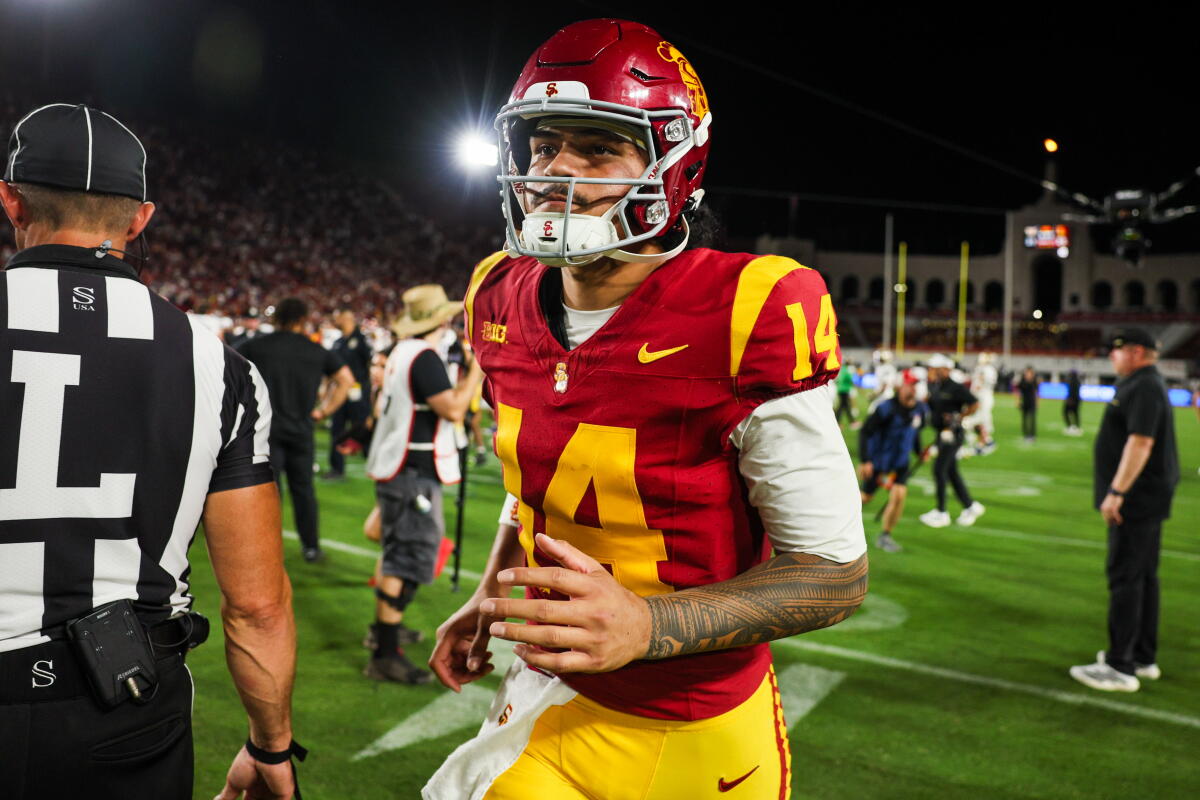
As USC’s quarterback kneeled out the final seconds of an unsatisfying win over Washington on Saturday, he didn’t waste any time celebrating on the field. Maiava spotted an NBC camera trained on him, turned toward the Coliseum tunnel and took off.
The camera followed Maiava and caught USC sports information director Katie Ryan sprinting to reach him. But even after Ryan caught up to the quarterback, Maiava barely broke his stride. He just kept running, the first one up the tunnel, while his Trojan teammates remained on the field.
It was a strange moment, after a game of strange moments for Maiava. And it certainly was not the sort of body language you want to see from your starting quarterback and team leader. Let alone after a win.
It didn’t get much better afterward, when USC trotted him out for the team’s postgame news conference. Maiava was asked about not being able to get into a rhythm. And he proceeded to answer a question that seemingly wasn’t asked.
“Just being able to trust it, fall back on routine plays,” Maiava said.
That’s not new for Maiava, who has often avoided any questions that he doesn’t want to answer by using a non sequitur football cliche. That’s his right. He’s not obligated to play ball with reporters.

USC quarterback Jayden Maiava jogs off the field without pausing for an NBC interview after the Trojans’ win over Washington at the Coliseum on Saturday.
(Ronaldo Bolanos/Los Angeles Times)
But USC has trumpeted Maiava’s progress as a vocal leader for more than a year now. And as the quarterback, he is naturally a representation of the program’s leadership and its larger culture. Which is what makes the body language of the past two weeks, as USC’s season feels on the brink, particularly concerning. Especially in context with what we’ve seen on the field.
The truth is Maiava hasn’t really looked the same since the shutout of Fresno State on Sept. 4, when he appeared to hurt his right shoulder. Maiava was asked about it the following weeks, but he said that he was “great.”
“It’s a physical game,” Maiava said. “It’s what happens.”
No one has mentioned the injury since, but Maiava has been markedly less accurate in the ensuing four games. He’s completing 60% of his passes over that time, after the first two games had him closer to 90%. Maiava’s mechanics have looked far less consistent over that stretch. And then there were the moments Saturday in which Maiava appeared tentative, like he might actually be shying away from running the ball.
During USC’s opening drive, Maiava scrambled away from pressure and had a chance to take off upfield and potentially pick up the first down with his legs. But instead he sprinted wider toward the sideline, in search of receivers who weren’t there in the corner of the end zone. He ended up getting sacked.
A couple possessions later, Maiava launched a prayer down the field off his back foot. It was intercepted and the quarterback threw his hands, fully aware the turnover was his fault.
USC’s problems certainly can’t be laid at Maiava’s feet. The quarterback has been pretty good this season by normal statistical standards. He’s ninth in the nation in passing yards per game (290) and third in total passing touchdowns (15)
But our eyes also don’t deceive us. Maybe he is hurt. Regardless, in order to actually save their season, the Trojans need Maiava to be more than just a passable Big Ten quarterback. They need him to put the team on his back.
Riley said earlier this season that Maiava has come further than any other passer he’s mentored as a college coach. But midway through his third season at USC, it’s this last step in his development that seems to be most troubling Maiava.
Patterson in the press box

USC defensive coordinator Gary Patterson walked onto the field before the Trojans played Oregon at the Coliseum on Sept. 26.
(Ronaldo Bolanos/Los Angeles Times)
With its defense clearly struggling to communicate, USC moved defensive coordinator Gary Patterson from the field to the press box.
The results at least seemed palpable on Saturday. The defense was much more dialed in on third down, holding the Huskies to just a single conversion on 12 attempts. And the secondary seemed to iron out most of its communication problems.
Whether that can be attributed to Patterson being the one in the booth is impossible for me to say. The bigger question, as I see it, is why there was such a disconnect between Patterson, his scheme and the rest of the staff. Riley seemed to suggest that the way Patterson wanted to do things wasn’t clicking with the rest of the operation.
“Going through some of these first few games, seeing the makeup of the staff, it was a conversation that he and I had on Sunday,” Riley said after USC’s win over Washington. “We thought there were some reasons just kind of in our operation that made sense. He knows this defense obviously better than anyone. He was used to having, I think, a staff at TCU — if you look at his staff there, for years and years, they had little to no turnover, right? So when you had guys who had been coaching with you for 15-20 years, like he had in a lot of ways, you might handle that different. He had a heck of a defensive staff, and it’s kind of like players, right? You’re trying to just move the chess pieces to get everyone in the right position to get the best out of them.”
House of Troy ‘Chapter 3: A New Era’ episode drops this week

Ask most people from within the Trojan family when things started to unravel for USC’s football program, and they’ll inevitably point to the Reggie Bush-related NCAA sanctions as an obvious starting place.
Well, what if I told you that the mess that USC would find itself wrapped up in could’ve been so easily avoided?
At least, that’s the opinion of the key former members of New Era Sports & Entertainment, the failed sports agency that said it paid Bush and his family. Bush continues to deny allegations he violated NCAA rules. What could’ve presumably ended with one calm conversation in 2006 ended up snowballing into a yearslong saga that didn’t just upend USC football, it derailed the lives of everyone involved.
You can hear the whole story on Tuesday, at this link and wherever you get your podcasts.
— USC’s pass rush finally played to its potential. The Trojans tallied 25 (!) pressures against Washington and sacked Demond Williams Jr. five times, which was more than its previous three games combined. The most important of those sacks came on the final drive, as Kameryn Crawford dropped Williams on a critical third down, deep in USC’s own territory. Freshman Luke Wafle also got his first college sack, after being close basically 10 other times, and he seemed relieved by that. He wasn’t the only one relieved by the pass rush production. The Trojans’ maligned secondary, in particular, was a major beneficiary.
— Rampant penalties may just be a part of this team’s identity. USC committed nine penalties against Washington and lost 94 yards, but the numbers alone didn’t tell the whole story. Half of those penalties were pretty consequential. An illegal formation call brought back a USC passing touchdown, then a face mask from Wafle kept the ensuing Washington drive moving. The Huskies ended up scoring a go-ahead touchdown. USC has at least eight penalties in three of its past four games.
— Should Desman Stephens II keep his starting job when he returns? Not because of what happened against Oregon, but because of what happened against Washington. I thought his replacement, Ta’Mere Robinson, played the best game of any linebacker at USC this season. Robinson had six defensive stops, twice as many as any other Trojan defender on Saturday. He added a sack and graded quite well in coverage by Pro Football Focus. It’s not like Stephens was playing all that well before his suspension. USC also got a strong showing from reserve linebacker Elijah Newby.
— Alex Graham is clearly essential to USC’s secondary. The Trojans’ Swiss Army knife defensive back returned from injury Saturday and made a marked difference for the whole unit. Graham had four pressures as a blitzer and has looked absolutely lethal in that role. And he played a huge part in taking away Washington’s short-area passing game, which can be dangerous if Williams is able to get loose. There’s no player more valuable on the back end of USC’s defense.
This week … in 2006

USC’s Brian Cushing blocks Sean Douglas’ punt during the Trojans’ win over Washington on Oct. 7, 2006.
(Matt Sayles / Associated Press)
For the second straight week, USC’s defense was backed up deep into its own territory in the final seconds, in danger of losing to a lesser Pac-10 team.
Washington had gotten the ball back with 1:34 remaining, trailing the Trojans, 26-20, when Husky quarterback Isaiah Stanback proceeded to march down the field on USC’s defense. Stanback scrambled to convert a fourth down with 18 seconds remaining, then completed a 19-yard pass to the USC 15.
But with two seconds left, Washington couldn’t get set in time to spike the ball. The clock ran out on their comeback attempt.
The whole experience gave linebacker Brian Cushing flashbacks of USC’s loss to Texas at the Rose Bowl.
“That last minute just got a little nerve-racking,” Cushing said.
Olympic sports spotlight
USC’s men’s water polo team was down 12-11 to California when the Trojans collected the ball with five seconds remaining in their Mountain Pacific Sports Federation opener. Somehow, they managed to win the game from there.
It started with an exclusion. Then a goal with a single tick left on the clock, sending the game to overtime.
It went to a second overtime and USC eventually put away the game 15-14 with a golden goal from Strahinja Krstic. A scintillating start to conference play.
Polling the people
Newsletter editor and poll manager Houston Mitchell is out this week, so we’re extending our poll one more week. If you have not voted, feel free to weigh in now.
Will Lincoln Riley be USC’s coach in 2027?
Yes
No
Click here to vote in our survey.
What I’m watching this week

Sienna Miller and Dominic West star in the new HBO series “War.”
(Justin Downing/ Sky / HBO)
I’ve been yearning for a slow-burn HBO drama since the end of “Industry’s” most recent season, and I’m optimistic that the network appears to have delivered.
“War” has that potential, at least. The first season of what is apparently an anthology series follows a high-stakes divorce case between a tech mogul played by Dominic West and a movie star played by Sienna Miller. And while it doesn’t seem to be breaking any new ground as a legal drama, the writing and acting appears to be on point — as usual with an HBO show of this magnitude.
In case you missed it
Listen now: Podcast ‘House of Troy’ features inside look at highs, lows of USC Athletics
USC silences the ‘Fire Lincoln!’ chants with thrilling comeback win over Washington
Lincoln Riley backs coordinator Gary Patterson amid USC defensive woes
Jahkeem Stewart eases back from injury at critical time for USC defense
‘All options are on the table’: Fallout from Oregon loss puts Lincoln Riley on hot seat
Ultimate SoCal college football sports bar guide: Where to watch your team
Times of Troy: USC gave Lincoln Riley everything. And for what in return?
Until next time …
That concludes today’s newsletter. If you have any feedback, ideas for improvement or things you’d like to see, email me at ryan.kartje@latimes.com, and follow me on X at @Ryan_Kartje. To get this newsletter in your inbox, click here.