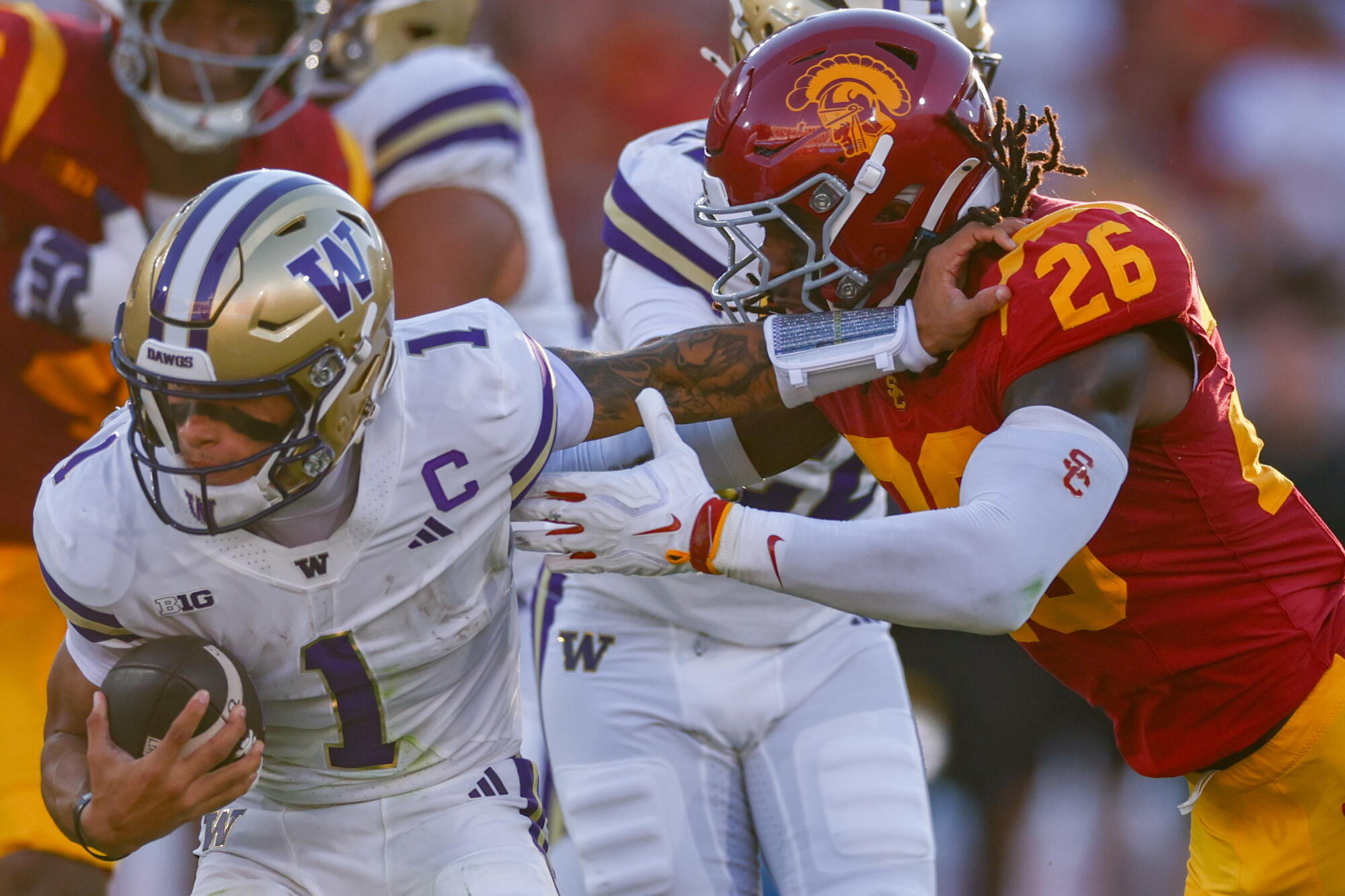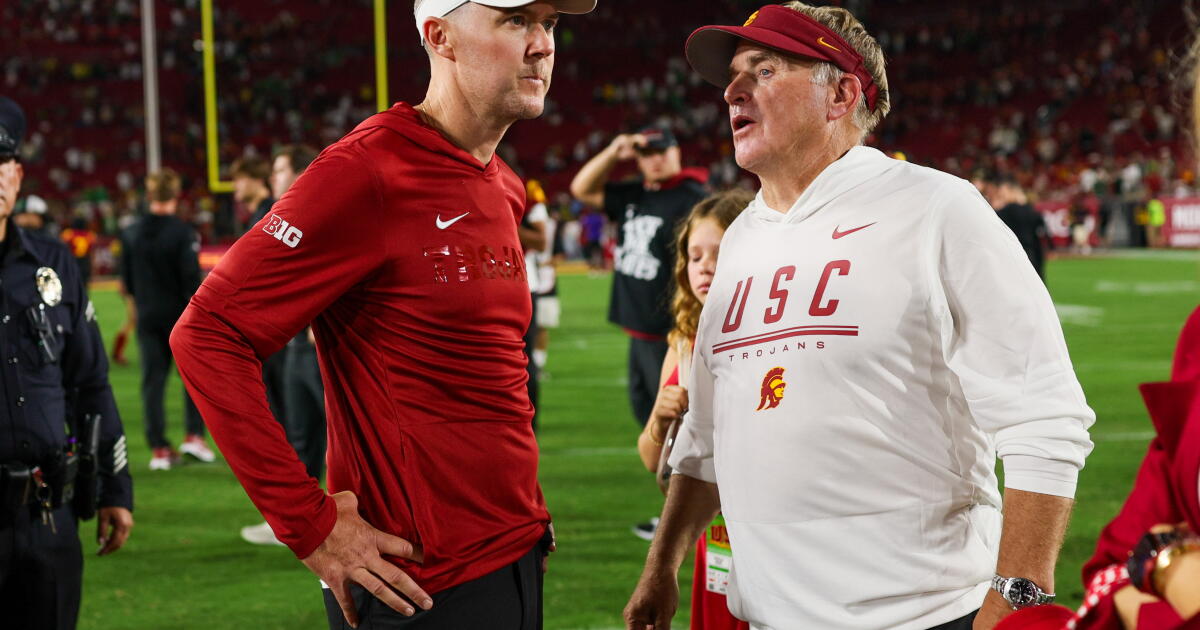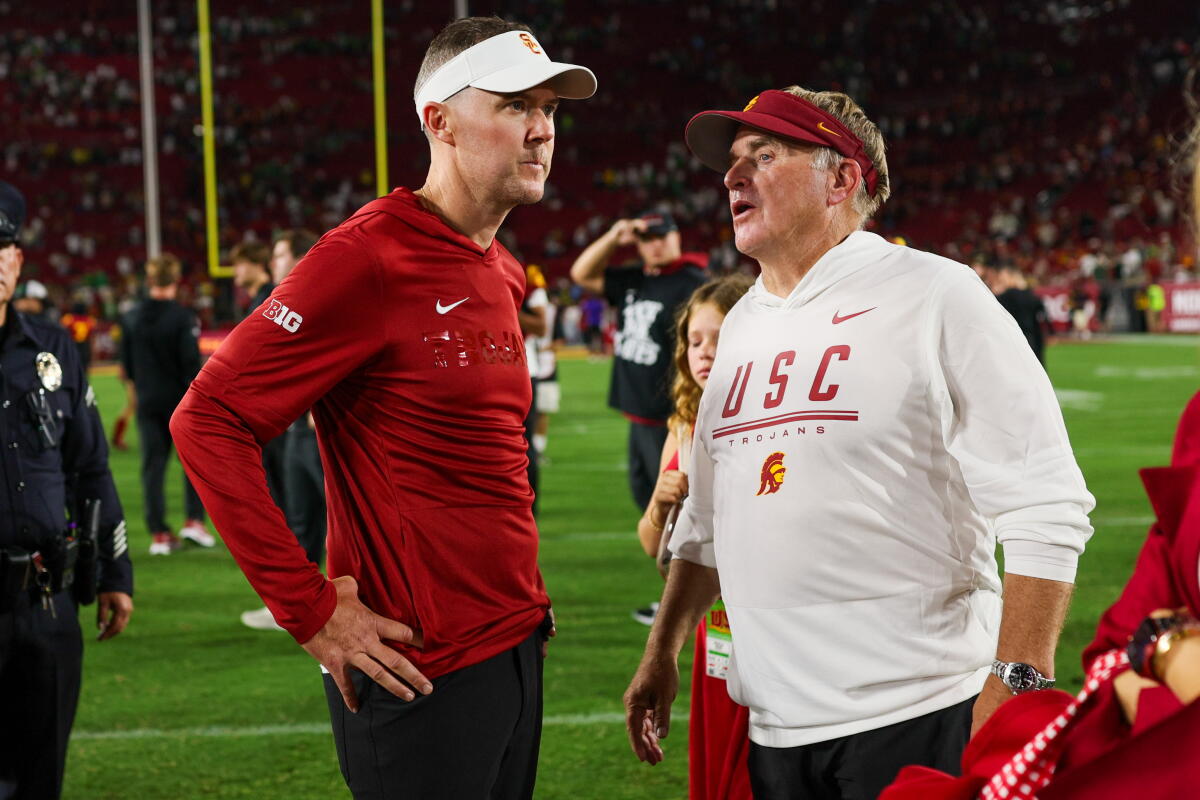
The first serious legal challenge to the House settlement will come courtesy of a USC freshman linebacker.
Talanoa Ili, a top-100 recruit in the Trojans’ vaunted 2026 class, joins Stanford quarterback Charlie Mirer as one of two lead plaintiffs in a class-action lawsuit that takes aim at the system implemented since the settlement ushered in a new era of direct payment from universities to athletes. The suit, which was filed Tuesday, accuses the NCAA, the Power Four conferences and the enforcement arm they created — the College Sports Commission — of participating in a “conspiracy” by creating a system of policies that have “direct anti-competitive effects, including the suppression of [name, image and likeness] compensation below competitive levels.”
Those policies, their attorneys argue, violate state laws in California that prohibit restrictions on NIL rights, as well as federal antitrust statutes. They’re seeking monetary damages, as well as an injunction that would upend the enforcement structure created to determine whether individual NIL deals over $2,500 meet criteria, including whether they have “a valid business purpose” or fall within a reasonable range of market value.
The clearinghouse, NIL Go, was created with the hope of eliminating an influx of booster-funded NIL deals that were basically direct payments from donors to the program. But since its inception, the system has been more restrictive and worked less efficiently than some schools and athletes might have hoped. As of last month, according to Yahoo Sports, more than $125 million worth of NIL compensation that had been promised to athletes had been rejected by the clearinghouse or was still under review.
In Ili’s case, the complaint states that he received a “substantial multi-year offer” from USC’s House of Victory collective in 2024 that led him to commit to the Trojans, only to have the offer disappear after approval of the House settlement.
“Absent the NIL Restrictions on Direct Pay NIL Compensation, Ili would have received more for his NIL rights than he now receives,” the complaint states. “The Agreement has thus injured Ili.”
Mirer, meanwhile, claims that he has received no NIL compensation from Stanford’s collective or revenue-sharing money from the university since 2024 as a result of the settlement.
Stanford quarterback Charlie Mirer during a game last season.
(Godofredo A. Vásquez / Associated Press)
“The [CSC agreement] has suppressed, deterred, and effectively terminated the economic relationships that had produced his prior NIL compensation,” the lawsuit says.
Even the plaintiffs in the House settlement, which created the CSC, are in the process of challenging the current system. On Wednesday, plaintiff attorney Jeffrey Kessler will argue in a hearing that school-affiliated businesses such as multimedia rights holders or corporate sponsors, should not be subject to the CSC’s rigorous criteria for NIL deals. That decision could also open the floodgates, with schools using those entities to circumvent the cap.
Two U.S. senators are hoping to pass legislation they believe would bring more stability to college athletics and thwart legal challenges. Ted Cruz (R-Texas) and Maria Cantwell (D-Texas) spoke with presidents and chancellors from the Big Ten Conference on Tuesday about a bipartisan bill, the Protect College Sports Act, which would codify some of the CSC’s policies into federal law.
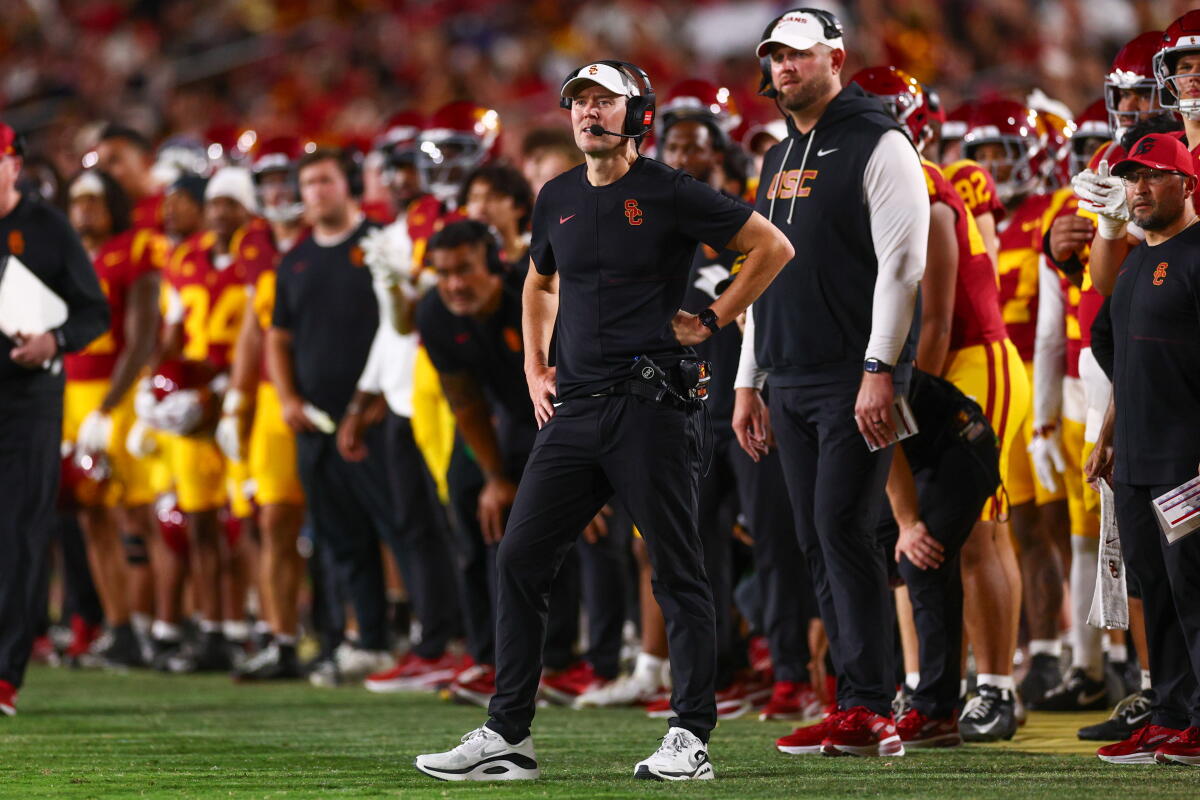
His 7-6 record at USC in 2024 would go down as the worst mark of Lincoln Riley’s career as a head football coach. But in his third and rockiest year at the helm of the Trojans, Riley was still compensated like one of the kings of the sport.
Riley was paid more than $11.8 million in total compensation during the fiscal year 2024, according to USC’s latest federal tax returns, which were obtained by The Times. That total includes a $100,000 bonus and $10.4 million in base pay, believed to be more than all but three college football coaches that season: Georgia’s Kirby Smart, Clemson’s Dabo Swinney and Ohio State’s Ryan Day. All three have won a national title.
For Riley, his pay in 2024 marks just a slight increase from the 2023 season, when USC paid Riley more than $11.5 million in total compensation. The coach’s base pay increased by $145,143 between fiscal years 2023 and 2024, slightly less than it rose following his debut season in 2022 ($168,000).
At least in 2024, USC only had to pay one football coach, after paying Clay Helton a combined $9 million not to coach over the two previous years.
The school would, however, have to pay up a bit to bring in a new men’s basketball coach.
After Andy Enfield left to coach Southern Methodist after the 2023-24 season, USC shelled out more than $6.1 million total in 2024 to lure coach Eric Musselman from Arkansas, according to the university’s latest federal tax records. One million of that was paid to Arkansas to buy out Musselman’s contract.
That puts Musselman at a reported $5.1 million in total pay and benefits from the school in 2024, according to the school’s tax records. That total likely includes additional costs unique to a coaching change. But altogether, it would have ranked Musselman among the highest-paid coaches in the Big Ten for the 2024-25 season.
Musselman didn’t exactly deliver on that investment during the 2024-25 season, as USC bottomed out during its first Big Ten men’s basketball slate. The Trojans finished 17-18 and 7-13 in the Big Ten.
After including her information in tax forms from the previous year, the university did not disclose compensation figures from 2024 for USC athletic director Jennifer Cohen. Federal tax returns filed last May had credited Cohen with more than $3 million in reportable compensation in her first year on the job, $1 million of which was used to buy out Cohen from her Washington contract.
Welcome back to the Times of Troy newsletter, where USC baseball’s charmed season came to a devastating end in the bottom of the ninth of a decisive Super Regional matchup with North Carolina on Sunday. But no matter how brutal it may have been in the moment — with black-stained tears streaming down Trojan cheeks in Chapel Hill — the fact that USC was in position to have its heart broken at all is a testament to what Andy Stankiewicz has built in his four seasons at the helm.
Fight on! Are you a true Trojans fan?
Get our Times of Troy newsletter for USC insights, news and much more.
By continuing, you agree to our Terms of Service, which include arbitration and a class action waiver. You agree that we and our third-party vendors may collect and use your information, including through cookies, pixels and similar technologies, for the purposes set forth in our Privacy Policy such as personalizing your experience and ads.
It was barely a year ago that I sat with Stankiewicz in an unfinished concrete dugout at new Dedeaux Field, discussing the importance of building a foundation for a program that had lacked one for so long. The metaphor wrote itself at the time. His team was on the cusp of clinching its first NCAA berth in a decade, just as its new stadium was finally rounding into form. But as triumphant as that tournament invite would be when it finally happened, Stankiewicz was already thinking bigger.
“We want to build this thing for the long haul,” he said then. “And to build a home, you have to build a strong foundation so it can withstand the weather. The same thing applies here. I want to be here for a long time. This is where I grew up. This is where I’d love to be.”
A year later, the foundation hasn’t just been built. The house is finished. The front door is open. All that’s left is for the Trojans to walk through it.
They had their chance Sunday in Chapel Hill. Andrew Johnson twirled another postseason gem. The Trojan bats, again, delivered in big moments, with clutch solo shots from Kevin Takeuchi and Andrew Lamb. Through 8.2 innings, USC had given up just a single run.
But the bullpen, which had been one of the Trojans’ few weak points all season, couldn’t finish the job. Sax Matson came in for just a single pitch and was pulled. Adam Troy faced three batters, walked one who scored and was pulled in the middle of a 3-0 count for another. Chase Herrell faced four batters after that, walked one and gave up two other hits, including the walk-off winner.
Just two outs stood between the Trojans and a trip to Omaha. At one point, all they had to do was catch a fouled pop fly to send the game to extras.
“That was a tough one,” Stankiewicz said after. “As best we can, we’re gonna move forward. But again, I got some disappointed young men in our dugout. As the head coach, you think, ‘Dang it, what could I have done differently?’”
Surely, the Trojans coach might be thinking all season about how close his team was to reaching that next rung as a program. The truth, though, is it’s a wonder they got here this fast in the first place. USC won 48 games, its most in a quarter century. It had to climb its way back from the loser’s bracket in its regional, then, on the road in Chapel Hill, it took one of the national title favorites to the brink.
Not only that, but USC rose to that level in a still-unfinished stadium, without anything resembling the NIL firepower that other college baseball teams, particularly in the SEC and ACC, are wielding. USC has tried to make up for that by funding more scholarships, but when other teams are handing kids hundreds of thousands more in NIL offers, it makes competing with the Joneses especially difficult.
Stankiewicz has managed to make it work, anyway. And as more talent rolls into Troy, there’s every reason to believe that we’ll look back on this moment, not as a devastating end, but the start of something particularly special for USC baseball.
“We got to the finals of the Regional last year. Now the finals of a Super Regional,” Stankiewicz said. “We’re not going away.”
Calling all questions …
With the summer here and college sports now on hold for the next two months, it’s a perfect time to answer any questions you have about the upcoming year at USC. So please send anything on your mind about Trojan sports to ryan.kartje@latimes.com. When the newsletter returns in a couple of weeks, I’ll answer the best ones in this space.
USC pitcher Andrew Johnson.
(Laura Wolff / For The Times)
—A standing ovation for Johnson, whose pitching performance through the postseason was nothing short of Herculean. Johnson spent most of the season as the Trojans’ forgotten No. 3 option in the rotation, with Mason Edwards and Grant Govel ranking among the best pitchers in the nation. But it was Johnson who came up the biggest in the postseason. Twice he pitched well in relief, only to throw seven-plus innings two days later. This felt like a breakthrough moment for Johnson, who should pair with Govel to give USC an outstanding 1-2 punch on Fridays and Saturdays next season.
—There’s been talk about alternate jerseys at USC over the last several years. The conversation about alternates actually dates back to before Jennifer Cohen took over as athletic director. But as was the case before, the conversation has been tabled for the time being. Athletic departments are always looking for added revenue these days, but the juice just hasn’t been worth the squeeze to date, considering the many fans that would surely be offended by changes to the Trojans’ classic uniforms.
Olympic sports spotlight
After going on a tear to close out the season, USC women’s golf was on the precipice of snagging the school’s second national title this year … before it ran into a buzzsaw in No. 1 Stanford.
But an NCAA runner-up finish is still a great result for a program that hasn’t won an NCAA title since 2013. The Trojans have now finished second six times in their past 38 seasons, which is to say they’ve been the runner-ups basically 15% of the time over the last four decades.
That’s a lot of years being the bridesmaid, not the bride. But there’s no reason to think that Justin Silverstein, the Big Ten’s Coach of the Year in 2026, shouldn’t have this program back in the mix as soon as next season.
What I’m Watching This Week
Matthew Rhys and Stephen Root in “Widow’s Bay.”
(Apple)
If you’re in the mood for something creepy, boy do I have the content for you. “Widow’s Bay” on Apple TV follows Mayor Tom Loftis, played by Matthew Rhys, who’s desperate to revive his struggling island community of Widow’s Bay. But the locals on the island are convinced the town is cursed, and don’t necessarily approve of bringing tourists into the mix.
As you might imagine, the locals appear to be right. And Loftis finds himself in some horrifying situations. Enough to convince me that maybe this isn’t the best show to be watching alone, late at night. But if that’s in your wheelhouse, then this is as good as it gets.
That concludes today’s newsletter. If you have any feedback, ideas for improvement or things you’d like to see, email me at ryan.kartje@latimes.com, and follow me on X at @Ryan_Kartje. To get this newsletter in your inbox, click here.
CHAPEL HILL, N.C. — USC’s 2026 baseball season will be defined by two words — progress and pain.
Just two outs away from reaching the College World Series for the first time since 2001, USC suffered a devastating 4-3 loss in game three of the Chapel Hill Super Regional, as North Carolina rallied for two runs in the bottom of the ninth and snatched the trip to Omaha away from the Trojans on Owen Hull’s walk-off RBI double into the left-center gap.
“I’m proud of our boys,” USC coach Andy Stankiewicz said. “I’m disappointed in the results, but I’m never disappointed in our guys. They did something pretty special this year.”
Andrew Johnson did everything possible and then some to get USC (48-18) across the finish line. After already throwing 3 ⅔ innings of shutout baseball to close Game 1, Johnson went a season-high 7 ⅔ innings with two earned runs surrendered to get the Trojans to the doorstep of victory. He glided through North Carolina’s lineup for most of the day, at one point retiring 15 out of 17 batters.
North Carolina’s Cooper Nicholson celebrates during his team’s ninth-inning rally to beat USC in their super regional finale Sunday in Chapel Hill, N.C.
(Laura Wolff/For The Times)
He ended the super regional with 133 pitches thrown in a little over 48 hours, on top of the 145 pitches he threw across two appearances in the College Station Regional for a total of 278 tosses in 22 ⅓ innings with five earned runs given up in a heroic postseason stretch.
“The goal from the beginning of the season is Omaha,” Johnson said. “We’re definitely not just happy that we made it to supers and moved past the regional, but for it was a great season and we can be proud of what we accomplished.”
A first inning run off a Caden Glauber balk, plus Kevin Takeuchi and Andrew Lamb’s solo home runs accounted for all the offense on a day when the Tar Heels (50-12-1) had their own star pitcher going. Atlantic Coast Conference freshman of the year Caden Glauber held the Trojans at bay for most of the game, striking out a career high 11 batters in 7 ⅓ innings.
USC coach Andy Stankiewicz talks to his players after their season-ending loss to North Carolina.
(Laura Wolff / For The Times)
Glauber’s work was enough to hold his team in the game, but USC still had a 3-2 lead heading to the fateful bottom of the ninth. After closer Adam Troy retired the first batter, a long, loud foul ball seemed to spark North Carolina.
Third baseman Cooper Nicholson crushed a ball more than far enough for a home run, but just foul into the left field corner. But the near-miss seemed to rattle Troy, who walked Nicholson after getting ahead 0-2 in the count and fell behind 3-0 to nine-hole hitter Carter French.
Stankiewicz made a pitching change mid at-bat, going to Chase Herrell. French lined a 3-2 single through the right side, leadoff hitter Jake Schaffner tied the score on a sacrifice fly and Gavin Gallaher drew a walk, bringing Hull to the plate with the series’ winning run at second.
USC appeared to survive at least with extra innings when a Hull foul ball looked ticketed for the third out, but it dropped with three fielders in the area to give him an extra life. Hull pounded his fourth double of the game, prompting mass hysteria from the 3,913 Tar Heel fans and ultimate heartbreak in the other dugout.
Stankiewicz has built his program in stages, finally making the NCAA tournament last year and then going a step further this year.
But he also knows these opportunities are never guaranteed, and it will take a lot of work to return to the super regional stage.
“It’s a step,” he said. “Things take a moment. Sometimes we want things to happen overnight as humans I guess, but sometimes it takes a moment. We’ve been at this thing for awhile now, and we feel like we’re certainly building it and folks are taking notice. Now we just can’t go backwards. This thing’s got to continue moving forward.”
A positive season, but a nightmare ending sure to haunt the Trojans until they finally return to Omaha.
USC baseball lost 4-0 in Game 2 of the NCAA Chapel Hill Super Regional, meaning its season and quest to break a 25-year College World Series drought will come down to a single game on Sunday.
North Carolina (49-12-1) turned to DeCaro with its season on the line, the seventh career NCAA tournament start for the veteran right-hander. DeCaro delivered a complete-game masterpiece, allowing just two hits — singles in the first and fifth innings — with eight strikeouts and one walk on a career-high 117 pitches.
Outside of giving up a solo home run to Colin Hynek in the second inning, Govel had a strong performance. After throwing 153 pitches across two appearances in the NCAA regionals, including 64 pitches in Monday’s clinching win over Texas A&M, he gave up just five hits and struck out three over five innings and 83 pitches to keep the Trojans in the game. His final pitch was a crucial one, inducing an inning-ending double play with runners on the corners to hold the game at 1-0.
But for all of his great work, the day was all about DeCaro’s dominance.
North Carolina found success against the Trojans’ bullpen in the sixth. Erik Paulsen hit a 339-foot home run over the left-field corner wall to double the Tar Heels’ lead, just the second home run given up by USC’s Sax Matson all season. The Tar Heels added two more on sacrifice flies in the sixth and seventh innings, but failed to drive in more with the bases loaded in the seventh and ninth innings.
Game 3 will be Sunday, with time and broadcast information still to be determined.
CHAPEL HILL, N.C. — Dean Carpentier popped up with the biggest swing of his life, and the Trojans won their biggest game in more than two decades.
USC baseball stormed back to defeat No. 5 overall seed North Carolina 9-5 in Game 1 of the Chapel Hill Super Regional, a loud start to the program’s first appearance on this stage since 2005.
Carpentier smoked a go-ahead grand slam off North Carolina (48-12-1) reliever Walker McDuffie in the sixth inning, turning a 5-2 deficit into a 6-5 lead and shutting down a previously charged-up Boshamer Stadium. The swing was Carpentier’s first career grand slam and just his 10th home run in his 132-game collegiate career, the defining moment of the day as USC (48-16) tied its largest comeback victory of the season.
“I was sitting on a slider,” Carpentier said. “He’s a slider guy. I got a good pitch to hit, put a good swing on it and it found a way out of here.”
Ace Mason Edwards struggled through his shortest outing of the season, yielding three earned runs in just three innings with four walks. But the Trojan bullpen picked him up, and kept the game close enough for the offense to rally. Chase Herrell, Ben Cushnie and Andrew Johnson gave up just one run over six innings, with Johnson retiring the first eight batters he faced.
USC’s Adrian Lopez (5) celebrates during Game 1 of an NCAA super regional against North Carolina on Friday in Chapel Hill, N.C.
(Laura Wolff/For The Times)
“He’s done that now a couple of times with the bases loaded where he strikes out the side and gets out of it,” USC coach Andy Stankiewicz said of Edwards’ first inning. “It’s in there. That was huge. It was a big momentum swing to get out of that. Unfortunately it’s taxing though; it made him jump up in his pitch count a little bit.”
His successful but ultimately draining first inning led to UNC scoring four in the next two innings, knocking the Trojans into a huge hole and forcing its bullpen to stem the tide. But eventual winning pitcher Herrell picked up two innings with just one earned run given up. Cushnie retired the only batter he faced and the offense went to work from there.
“The job that Chase Herrell did, the job he did in College Station, it’s two back-to-back outings where he has been tremendous for us,” Stankiewicz said. “It’s always Mason and Grant [Govel] — which is great, they deserve all the recognition — but there’s more guys down there that are doing it.”
With the lead and all of the momentum after Carpentier’s grand slam, Stankiewicz pushed his chips to the middle of the table knowing the importance of winning the opener of a best-of-three series. He brought usual Game 3 starter Johnson in out of the bullpen, and he delivered a sensational performance.
Johnson retired the first eight batters he faced and ended up getting the final 11 outs of the game with just two singles allowed, slamming the door shut for his first save of the season.
“You saw the job that he did over in College Station,” Stankiewicz said of Johnson. “It was a big moment, and we needed that again today. He throws strikes, he’s unafraid, he attacks the strike zone and we felt like he was going to make the pitches.”
Johnson’s dominance meant the go-ahead grand slam would have been enough, but USC added three more runs in the seventh. Isaac Cadena drove one in with an RBI groundout, Jack Basseer plated one on on a fielder’s choice and Andrew Lamb — who started the scoring for USC with a solo home run off Ryan Lynch back in the third inning — tacked on one more with a perfectly executed squeeze bunt.
The Trojans have outscored opponents 64-19 during their five-game NCAA tournament winning streak. And are one win away from advancing to the College World Series for the first time since 2001. Game 2 is set for 11 a.m. PDT Saturday on ESPN.
COLLEGE STATION, Texas — As USC baseball coach Andy Stankiewicz noted the next additions that will be made to USC’s refurbished baseball stadium, he paused Monday night as a train rumbled loudly behind Blue Bell Park.
Stankiewicz, 61, smirked at the fitting metaphor after the Trojans clinched their first NCAA super regional berth in 21 years. He, after all, has rebuilt the USC program over his four seasons as head coach.
“Now we have a beautiful stadium,” he said of Dedeaux Field. “We’re going to have a beautiful clubhouse next year, batting cages and all that.”
As Stankiewicz attempted to utter another sentence, the train’s ear-piercing horn sounded.
USC baseball coach Andy Stankiewicz has guided the Trojans to the NCAA super regionals for the first time in 21 years.
(USC Athletics)
“That’s appropriate because we tell people the train’s moving,” Stankiewicz said. “Now we have a train honking its whistle. The train’s moving. We’re certainly excited to see where we’re going.”
The Trojans are definitely going places these days thanks to many players who believed in Stankiewicz’s vision despite knowing their on-campus stadium would be under construction for at least two seasons.
The Trojans had six players on the College Station Regional’s All-Tournament Team. Three of them — Abbrie Covarrubias, Kevin Takeuchi and Andrew Lamb — are upperclassmen who could have been tempted to transfer after they learned that they would be without a home field for two years. Junior shortstop Dean Carpentier is another upperclassman who believed in Stankiewicz.
“You talk about just kind of cornerstones,” Stankiewicz said. “Abbrie and Takeuchi … and Dean Carpentier and Andrew Lamb, these guys, they could have left. … They got here when we had a field, and they chose to stay.
“That’s something that I’m grateful for. It just tells you the quality of young men that they are. They’re here. They got two feet in and said, ‘I’m not going anywhere. I want to help build this program. Then to see the success that, not just Abbrie, but all of them have had, they’re great leaders. They lead by example.”
While Dedeaux Field was under construction, the Trojans played most of their home games in 2024 and 2025 at Irvine’s Great Park, 47 miles and another county away. They practiced at East L.A. College.
Yet, they still reached a regional final in 2025. They have gone a step further this year by climbing out of the losers’ bracket in the regional to eliminate Texas A&M and reach a super regional for the first time since 2005.
The Trojans didn’t just climb out of the losers’ bracket. They rumbled through like a runaway train, dominating with 55 runs over four losers’-bracket wins. They scored 21 of those runs over two victories against SEC power Texas A&M in the regional final.
The Trojans made themselves at home while playing in one of the SEC’s most hostile environments. It was as though the Trojans have grown accustomed to making themselves at home on the road in recent years.
Although parts of Dedeaux Field are still under construction, the Trojans were 32-1 there for the best home record in school history. USC (47-17) eclipsed the 40-win mark for the first time since 2005.
“Obviously being able to play at home this year has been a blessing,” designated hitter Augie Lopez said after he was named the Most Outstanding Player of the College Station Regional. “But the last couple of years we’ve just kinda showed up every day — whether that was in Irvine or East L.A. Community College for practice — just with the same mentality of we’re going to show up and put our work in and dominate no matter where we are.
“Just showing up every day and punching that time card and going to work and just putting your head down and knowing that no matter where you are (or) what home field you have or you don’t have a home field, we’re going to get it done and play quality baseball.”
USC pitcher Grant Govel throws to home against Texas State during an NCAA regional on May 29.
(Sam Craft / Ap Photo/sam Craft)
The 12-time national champions will face North Carolina at the Chapel Hill Super Regional in hopes of reaching their first College World Series since 2001. No player on the current roster was alive when the Trojans won their last national title in 1998.
Only a few were even born when USC made its last super regional appearance in 2005 at Oregon State.
“With the history that this program has, it’s been an honor to wear the Trojan brand on the front of my chest,” Lopez said. “Honestly just knowing that this team is the team to bring USC back to the super regional it’s incredible.
“Honestly, it hasn’t hit me until right now, but we’re just feeling absolutely grateful. I’m super blessed.”
You don’t need to hear the horn to realize USC’s train is moving in the right direction in Stankiewicz’s fourth season at the helm.
COLLEGE STATION, Texas — As Augie Lopez trotted around the bases late Monday night, the small contingent of USC fans could finally be heard at Blue Bell Park. With one towering blast to right field, the Trojans’ designated hitter silenced Texas A&M’s rowdy 12th Man.
Lopez’s three-run home run helped push the Trojans over Texas A&M 7-1 to reach the NCAA super regional for the first time in 21 years.
Lopez silenced most of the sellout crowd of 7,042, making it easy to hear USC fans serenading him during the College Station Regional Final.
“Augie! Augie! Augie!” USC fans chanted after Lopez returned to the dugout. After the win, he was named the regional’s most outstanding player.
It took a while, but the offense showed up to propel USC (47-16) to the Chapel Hill Super Regional against North Carolina.
Until Lopez’s blast, Texas A&M right-hander Clayton Freshcorn had slowed down a USC offense that had scored 48 runs combined while winning three consecutive games out of the losers’ bracket, including 14 on Sunday night against Texas A&M (41-16), to force the winner-take-all final.
USC right-hander Grant Govel, who had thrown 89 pitches over 5⅔ innings on Friday, retired the first seven Aggies before Bear Harrison hit a solo home run to left-center field in the third.
The Aggies ran out a threat in the fourth. Chris Hacopian drew a leadoff walk. Ben Royo kept the inning alive with a two-out single to left. Jorian Wilson followed with a single to shallow right-center field. Second baseman Abbrie Covarrubias was positioned perfectly to field the ball in the outfield, but his throw to first wasn’t in time.
Fortunately for the Trojans, Adrian Lopez alertly threw home to easily nail Hacopian by several feet to end the inning.
Covarrubias tied the score 1-1 with an RBI single to left-center in the fifth. One out later, Covarrubias stole second. Augie Lopez broke the tie with a single to right-center.
Two innings later, Lopez crushed his three-run blast.
COLLEGE STATION, Texas — Two days after failing to capitalize off numerous scoring opportunities against Texas State, USC battered the Bobcats early and often to remain alive in the College Station Regional.
Third baseman Kevin Takeuchi set the tone with a grand slam in the first inning as USC beat Texas State 15-4 Sunday afternoon before a crowd of 6,885 at Blue Bell Park
With the victory, the Trojans (45-16) advance to the regional final against Texas A&M on Sunday night. The Trojans must beat the Aggies to force a winner-take-all game Monday at a time to be determined.
The Trojans avenged the 5-4 loss they suffered against Texas State on Friday night in the regional opener. In that loss, USC stranded 13 runners, struck out 12 times and left men in scoring position in each of the first seven innings.
The Trojans have been on a tear ever since. They crushed Lamar 19-6 on Saturday and then battered Texas State. The Trojans wasted no time jumping on the Bobcats in the rematch.
Abbrie Covarrubias led off with a single. Texas State sophomore right-hander Cade Smith then hit Adrian Lopez with a pitch and walked Augie Lopez to load the bases. Takeuchi followed with his grand slam to center.
“It just helped me pitch with freedom,” USC freshman starter Diego Velazquez said of the grand slam. “A pitcher always feels good when you’re in the lead, especially with a grand slam. It just keeps everyone positive, so it definitely helped very much.”
Velazquez gave up two runs on three hits and three walks with three strikeouts in 3 1/3 innings. He was relieved by fellow freshman right-hander Gavin Lauridsen, who failed to retire a batter while giving up two runs on two hits and two walks. Freshman left-hander Sax Matson then pitched 3 ⅔ scoreless innings of relief to earn the victory.
Isaac Cadena made it 6-0 in the third with a two-run home run to right field. With one on and two outs in the fourth, Augie Lopez hit an RBI single in the fourth to give the Trojans a 7-0 lead. Reliever Alec Beversdorf then walked Takeuchi and hit Cadena to load the bases. Jack Basseer drew a walk to plate another run to give USC an 8-0 lead, prompting Texas State to make another call to the bullpen.
Texas State countered with four runs in the bottom of the fourth, highlighted by Coy DeFury’s two-run home run.
Lauridsen relieved Velazquez with one out in the fourth, but he couldn’t retire a batter. Brady Boles greeted Lauridsen with a single up the middle. After Jackson Cotton walked, Manny Salas cut USC’s lead to 8-3 with an RBI single through the right side.
Clayton Namken followed with a walk, prompting USC coach Andy Stankiewicz to call on Matson, who took over with the bases loaded.
“I felt good about Diego on the mound here being able to compete and give us quality innings, and he did that,” Stankiewicz said. “I think he’d probably say he wanted to give us a little bit more, but he gave us three quality innings.
“And then Sax Matson came in and did a fantastic job. He came in and made some big, big-time pitches to get us out. It could have been a little dicey there.”
Both teams were retired in order in the fifth, but USC’s offense got back on track with a run in the sixth, two in the seventh and four more in the eighth.
“I think it just shows the type of bond we have all together,” Velazquez said. “We’re all pulling the rope for each other. I think it just shows how strong we are and how we’re able to pull off miracles and stuff.”
COLLEGE STATION, Texas — On a night when the crowd at Blue Bell Park saw some of the most majestic home runs you’ll see in college baseball, USC’s Andrew Johnson showed why pitching is still paramount.
The sophomore right-hander delivered arguably the most important pitching performance of the season for USC on Sunday night, beating Texas A&M 14-3 to propel the Trojans to a winner-take-all College Station Regional Final on Monday.
After needing five pitchers in a rout over Texas State earlier in the day just to reach the regional final out of the losers’ bracket, USC coach Andy Stankiewicz rode Johnson.
Two nights after throwing 21 pitches over 1⅔ innings, Johnson threw 124 pitches over 7⅓ strong innings to beat the host Aggies (41-14) before a crowd of 6,934.
“I’ll say this, I’ve been here [as USC’s head coach] four years,” Stankiewicz said. “That’s the best pitching performance I’ve seen in four years, hands down.
“In a big moment when we needed somebody to step up to take the ball, there hasn’t been a guy that’s done that as well as [he] did … this evening.”
Leading 11-2, Johnson retired the first batter in the top of the eighth inning before Nico Partida singled to right. Jake Duer followed with an RBI triple to right field, prompting a call to right-hander Rohan Kasanagottu.
Johnson (8-2) held the Aggies to three runs on nine hits and two home runs with one walk and four strikeouts. Kasanagottu added 1⅔ perfect innings of relief with two strikeouts.
“It was just basically [Stankiewicz] coming up to me and looking at me, and me just nodding at him,” Johnson said. “And he’s like, ‘All right, let’s go.’
“I don’t know if I’ve thrown 120-whatever before, but I honestly feel pretty good. I’ll pitch tomorrow if it [means] we’re going to win some more.”
USC junior Kevin Takeuchi bats against Texas A&M in the NCAA regionals on Sunday.
(Chris Mora / USC Athletics)
The Trojans (46-16) have scored 48 runs over three wins since falling into the losers’ bracket. They beat Lamar 19-6 on Saturday, and then they beat Texas State 15-4 on Sunday afternoon before pummeling the Aggies (41-15).
Chris Hacopian gave the Aggies a 1-0 lead with a home run in the first. The Trojans countered with four runs in the bottom of the inning with Kevin Takeuchi’s two-run single and Andrew Lamb’s two-run double.
“Yeah, we never want to lose,” Texas A&M coach Michael Earley said. “We never want to get our [butt] kicked. That always sucks, but it is what it is. It’s baseball.
“They beat us, period, from the freaking first pitch. But we got a game tomorrow, and we’re excited to get out there.”
Lamb greeted reliever Cooper Powell with a three-run home run over the right-field bleachers in the third inning. Augie Lopez gave USC a 9-1 lead with a two-run home run in the fourth.
Gavin Grahovac tagged Johnson for a monstrous solo home run to cut USC’s lead to 9-2 in the fifth. Lamb, who singled in the fifth, added another two-run double in the ninth.
“I’m going to flush this thing here in about five minutes,” Earley said. “We’re going to move forward and we’re going to come out tomorrow and get to play in front of our home crowd.
“What more could you want, man? What more could you want?”
That’s the same mentality USC has taken since losing their opener.
“I think we’re seeing the ball really well,” Takeuchi said. “We’re sticking to the middle of the field and kinda just letting the park do its thing. Just trying to put [the] barrel on the ball.
“But when you have pitching like these guys have been, they’ve been lights out. They keep us in every ballgame, so it’s really good for us to just be able to compete for them and kinda just to rack up the hits. I think we’re just seeing the ball really well, and we’re going to continue to do that tomorrow.”
Jennifer Cohen has heard her peers this spring lament the precarious state of college football, with the College Football Playoff format in flux, the College Sports Commission under fire and the current model of college athletics hanging by a proverbial thread. As athletic director at USC, Cohen understands the reasons for their doom and gloom.
There’s little clarity about where things stand in college athletics right now, let alone where they’re going. Plus, it has never cost more to run an athletic department — or a football program, with the price tag of rosters exceeding $40 million this season — in part because of name, image and likeness rights.
“There’s no doubt that this last year’s been frustrating, and that’s because we tried to fly a plane and build a plane at the same time,” Cohen told The Times last week. “So it’s certainly not going swimmingly, right?”
Before discussing all that’s wrong with the current college sports landscape, Cohen wants to remind everyone that it hasn’t all been bad.
“It’s important to talk about what are the positives that came from what’s happened,” Cohen said.” And from my perspective, student athletes have benefited now more than ever, you know?”
At USC, Cohen has managed to steer the athletic department through the chaos. As costs have risen exponentially with the advent of revenue sharing, Cohen says department revenue at USC is up almost 60% over a three-year span, sponsorship values have doubled and USC donors have poured money into the Trojan Athletic Fund, which is up 707% since she started.
Jennifer Cohen, left, and university president Carol Folt, right, flash the “V for Victory” hand sign during a news conference in 2023 introducing Cohen as USC’s new athletic director.
(Ringo Chiu / For The Times)
And later this summer, USC will open a $200-million football facility — a rarity in an age when such spending has more often taken a backseat.
None of that is to say USC is immune to the coming financial crunch in college sports.
“We also have to manage expenses, and we’re trying to do that and still support what we think is part of our DNA, which is [keeping all] 23 programs,” Cohen said. “As you look at the financial benefits that football brings to this place, the more you’re gonna take those revenues from football and put it back into football and to football student athletes versus other programs, you’re gonna feel the pinch. And so we’ve tried to mitigate that with new strategies on revenue generation.”
But what about when football rosters costs balloon to $50 million … or $60 million? What about $100 million?
“Hopefully not,” Cohen said. “We’ve gotta match roster spends with revenues and, and, and, and how we run a business.”
“I don’t think there’s one simple answer to this, and I do think that we are at a point where we’ve got to figure out as an industry, how do we do this in a smart way and not just let our competitiveness get the best of us? But that’s hard when football winning is the only way that you pay your bills.”
The Times sat down with Cohen last week to discuss the state of affairs in college football and USC’s athletic department. The following conversation has been edited for length and clarity.
With college football in such an uncertain place, do you feel like there needs to be some form of outside intervention? Or some major governance change that would help solve these problems?
“I think at some point in time we’re gonna have to find something. I mean, obviously we’re a year in. So I think first we all need to look in the mirror — myself included, as a leader — and say, ‘What did we do in this new system that worked? And what have we done in this new system that doesn’t work? And the question becomes, ‘Can you get everybody across the Power Four [conferences] to do that exercise and be honest enough to find some sort of solutions together? Or do you need to start looking at other solutions? I, for one, fully believe in federal support. I understand why it’s needed. I’m somebody that spent a lot of time on that earlier in my career, and, you know, the patchwork situation of laws is not fair from a competitive standpoint. It’s also very confusing to student athletes and to their families and to our coaches. But I am absolutely not holding my breath for that.
Eric Musselman and athletic director Jennifer Cohen hold a jersey with Musselman’s name during his introductory news conference as the Trojans’ basketball coach in 2024.
(Myung J. Chun / Los Angeles Times)
“The most important place where I’m spending my energy is figuring out how we are going to win in whatever environment that we’re dealt. Because I don’t have as much control in my current role to solve for all of those national issues. I am 24/7 thinking about how USC is going to compete in whatever environment we’re in. And I feel really confident that we will. But as somebody that loves college sports, I also think that we are gonna have to find a different alternative than how we’re operating right now to have a sustainable and durable model.”
USC seems to be in a really strong place with NIL, stronger certainly than when you were hired. How would you say that USC has gotten to that point?
“ When we got here, my mantra was if you’re not ahead, you’re gonna get behind. And so there were a lot of areas that we focused on to just try to improve and get ahead, and NIL was one of them. There’s a natural ability here to be really competitive in NIL — especially in the third-party space with brands. You know, we were just looking at some data the other day just in this new CSC-NIL Go model. Our brand deals are valued 2 1/2 times more than the national average, and I think that really speaks to both USC, the city of L.A., and obviously the quality of the student athletes that we have. And I think it’s just been a strategy of embracing the new era, recognizing that it’s really cool to be able to have student athletes benefit in that new era, and it’s important, and that you have to be competitive in that space.
“And so I think it was just a matter of having intentionality in a plan and getting all of our stakeholders aligned around that plan, and it was an urgent matter to keep trying to get ahead in that space. Because if we weren’t, other people were. That’s how we’ve been tackling it, and so we’re really proud of how robust the program is now. But we’re gonna have to keep getting better at it. We’re gonna have to keep evolving.”
The Big Ten has come out in favor of expanding the College Football Playoff to 24 teams. What are your thoughts on that?
“We’re unified as a league around 24, there’s no doubt about that. And obviously that’s gaining traction in some of the other conferences as well. And so where we’re unified, USC’s gonna support that. I think that there’s merits in the 24 model. I also think there’s plenty of fair questions around that. It has to make sense for everybody. So that’s kind of where we stand on it.
USC athletic direct Jennifer Cohen wears a headset with microphone as she’s interviewed before a football game in 2023.
(Icon Sportswire via Getty Images)
“I think personally speaking, I would have absolutely no problem staying at 12. I think we’ve experienced a lot of change in college sports and in college football. I think we need to understand how that change is impacting not just us, but our fans and others. And so if we end up at 12, I’m confident that we’re gonna find our way in that 12 every single year. And again, uh, that’s where my focus is. I mean, I am nonstop thinking about how USC athletics can compete in whatever model that we’re in, and I feel really good about the plans that we are developing and will continue to develop because we’re gonna have to keep changing to, to make sure that we’re competitive.
Being that it’s now Year 5, is it fair to say that the expectation is that Lincoln [Riley] needs to take USC to the Playoff this year?
“The expectation has always been the same. That’s the thing, that’s the reason why I came here, is that the standard is high. We do expect to make the playoff. We do expect to have a championship run. We do expect to be competing for championships every single year. I think that’s what’s awesome about USC, is that that’s what we all expect of it. And I know that I’m not the only one that expects that. I know our fans expect that. I know that he expects that. And so I really like this team. I really like the kids that we brought in. I love the returners. I love the leadership of this team.
“We’ve got some really outstanding older young men in this program that get it, that have been through a lot and really care about this place and this program. The young guys are awesome. They’re really challenging the older guys. So I feel really good about the talent level of this team, and I feel really good about what Lincoln’s done. I think with this staff, I think we have a highly competitive staff. I think we have a really experienced staff. And then you can’t dismiss what Chad’s accomplished. You know? I think that that’s been the benefit of bringing in not just Chad, but an entire front office staff, taking the pressure off of Lincoln, taking the pressure off of the other coaches so that they can be at their best. I mean, he’s been really energized about that and really focused on taking the strengths that he has. So yeah, the expectation, I mean, we haven’t been shy about that. We expect to win, and I, I feel confident that we’re going to.”
COLLEGE STATION, Texas — USC couldn’t hold on to the lead Adrian Lopez provided with a home run in the bottom of the eighth Friday night.
Texas State’s Chase Mora greeted reliever Adam Troy with a monstrous two-run home run to left field in the top of ninth inning, propelling the Bobcats to a 5-4 upset before a crowd of 6,956 at Blue Bell Park.
The Trojans had plenty of chances, and they wasted most of them in the opening round of the NCAA tournament’s College Station Regional.
Even though the Bobcats’ shaky defense spotted USC two unearned runs, the Trojans will surely lament stranding runners in scoring position in each of the first seven innings.
The Trojans will face Lamar University, which blew a five-run lead in a 7-5 loss against host Texas A&M, on Saturday at 1 p.m. PT.
If coach Andy Stankiewicz’s Trojans return to the Men’s College World Series for the first time since 2001, the 12-time national champions must do it out of the losers bracket.
USC right-hander Grant Govel, an All-Big Ten First Team selection, settled for a no-decision after giving up three runs on four hits with two walks and six strikeouts over 5⅔ innings.
He was relieved by freshman left-hander Sax Matson with one on and two outs in the top of the sixth. Matson escaped unscathed in the sixth, but he was relieved by right-hander Andrew Johnson with one on and two outs in the seventh.
The Trojans (43-16), who reached the Big Ten Tournament semifinals, have lost four of their last five games.
Mora’s sacrifice fly to right field gave the Bobcats a 1-0 lead in the second inning. The Trojans countered to tie the score with a run in the bottom of the second.
With runners on first and second and two outs, Abbrie Covarrubias hit a grounder to first. Texas State first baseman Jaquae Stewart booted the grounder for an error, allowing Isaac Cadena to score. Stewart almost made the situation worse with a wild throw to second, but Dean Carpentier was thrown out trying to reach third on the poor throw to second.
The Trojans benefited from more poor defense in the third. With one out in the inning, Augie Lopez reached on an error by Mora at third. Kevin Takeuchi followed with a double off the center-field wall. Jack Basseer broke the tie with an RBI single through the left side.
Covarrubias hit a solo home run to left in the fourth to put USC ahead 3-1. Texas State sophomore shortstop Brady Boles, who entered the regional with only one home run this season and two in his college career, tied the score 3-3 with a two-run home run to left field in the top of the fifth.
Mason Edwards has first-round hype ahead of July’s 2026 MLB draft for a reason.
USC’s ace takes the mound like a boxer enters the ring, eager to land blow after blow. And as the Trojans (43-15) open the NCAA tournament in College Station, Texas, at 6 p.m. PDT Friday (ESPNU), the southpaw packs a serious punch. He carries a nation-leading 160 strikeouts and the second-best 1.43 ERA.
“They’re getting a competitor,” Edwards said of what people can expect when he pitches. “There have been a lot of situations where I’ve had to battle and fight adversity. So, I think you’ll see a good fight when I toe the rubber. I’m not going to shy away from any type of competition.”
If anything, the competition probably shies away from Edwards.
Named the Big Ten 2026 Pitcher of the Year after stacking a record 113 strikeouts in conference play, Edwards is integral to what has been USC’s best team since the early 2000s.
The junior enters Friday’s regional matchup against Texas State with a perfect 8-0 record through 15 starts and 88 1/3 total innings and has collected nine-plus strikeouts in all but two games during the 2026 season — earning a career-high 16 in a 9-2 home win over Iowa on April 10.
MLB.com ranks Edwards No. 36 in its latest draft prospect rankings. Despite being on his way to becoming a professional baseball player, Edwards remains focused on helping the Trojans pursue their first national title since 1998.
“It’s important to stay present,” Edwards said. “I still play at SC, so I’m still concerned with how USC’s doing and how our team is doing. At the end of the day, that’s what’s important right now. It’s a team sport, it’s not tennis or golf. Got to stay grounded with what’s important. Team winning; going to a regional, winning that; trying to take this team to Omaha. That’s the biggest thing.”
Edwards, 20, is having fun while focusing on the Trojans.
Describing himself as playful, “cool with everyone” and as an “all-around happy” person, Edwards is enjoying his third year at USC, particularly as a teammate everybody can rely on.
Underrecruited during his prep career at Palisades Charter High, Edwards was inconsistent during his first season with the Trojans. He had some promising outings but finished with a 7.88 ERA and 1-3 record through 37 2/3 frames.
Edwards improved as a sophomore, serving as a starter and reliever, finishing with a 3.86 ERA and 3-0 record over 32 2/3 innings. However, he dealt with minor arm injuries and still didn’t have a clear-cut role.
Today, though, Edwards is one of the best pitchers in the country. And his skipper couldn’t be prouder.
“His development’s been really good,” USC coach Andy Stankiewicz said of Edwards. “He’s gotten better. That’s the thing we’re proud of. He’s a guy that’s been in our program for three years. Mason was trying to figure out who he was gonna be. ‘Is he going to be a starter? Is he going to be a reliever? So, he was kind of that spot starter … When he was a youngster, sometimes his misses [were] really big, and they really weren’t competitive pitches. Now, every pitch is pretty competitive.”
Stankiewicz credited Trojans pitching coach Sean Allen for helping Edwards, known for his rising heater, improve his curveball and develop his breaking ball.
The four-year head coach also praised Edwards for being an increasingly confident leader.
“Guys like him,” Stankiewicz said. “Guys enjoy being around him. I enjoy his growth. I enjoy being around him. He’s fun. We can tease each other pretty well and have fun with it. [Edwards was] a typical young man his freshman year, doesn’t say much. And then by the junior, senior year, they just grow up.”
The ace said he appreciates Stankiewicz, noting the coach’s emphasis on making sure players leave the program as “good men.”
Edwards also shouted out Trojans director of player development Josh Goossen-Brown, for being in his corner for years.
“He’s been through it all,” Edwards said of Goossen-Brown. “Been working with him since high school — very early high school — and he works here now. So, very small world, that he was able to get a job here.”
It’s hard not to see how the stars have aligned for Edwards.
While he didn’t consider USC his dream school growing up, Edwards is achieving Trojans royalty status, with loved ones nearby to support his journey in the same threads as great Trojans he idolized such as Randy Johnson and Seth Etherton.
Already named his conference’s best pitcher, Edwards is a semifinalist for both National Pitcher of the Year and for the Golden Spikes Award — given to the best amateur baseball player in America — after becoming the first USC pitcher to surpass 140 strikeouts in a single season since Ian Kennedy in 2005.
Edwards said he has always believed in himself, especially after a particularly rocky freshman campaign when his future appeared far from clear.
“When you’re your own person, you kind of see more than something other people might see,” Edwards said. “But yeah, freshman year, I flashed stuff that I really held onto. It was definitely a roller coaster … but you just hold on to the good things. Really holding on to those positives and trying to take them into the following years has been a big part of why you see that development process.”
And back with Lane Kiffin, the new LSU head coach who now has made Orgeron a member of his staff at three schools following their stint together as USC assistant coaches under Pete Carroll.
LSU announced Wednesday that the 64-year-old Louisiana native is returning to the Tigers as a special assistant for recruiting and defense.
“I’m excited to bring Coach Orgeron back to LSU,” Kiffin said in a statement. “He brings us tremendous value with his ability to recruit elite players nationally, but especially the impact he can have for us recruiting the great state of Louisiana.”
Orgeron played defensive line for four years at Northwestern State, then started his coaching career as a graduate assistant at his alma mater in 1984. After spending the next decade-plus as an assistant on a variety of coaching staffs, including at Miami and Syracuse, Orgeron joined USC coach Paul Hackett’s staff as the defensive line coach.
When Carroll replaced Hackett before the 2001 season, he retained Orgeron on his staff and eventually also made him recruiting coordinator. Also in 2001, Carroll hired Kiffin, who started as tight ends coach and eventually worked his way up to offensive coordinator.
After winning two national championships under Carroll, Orgeron was hired as head coach at Mississippi before the 2005 season. He offered Kiffin a job on his staff as offensive coordinator, but the then-Trojans passing game coordinator turned it down (Kiffin would much later serve as the Rebels head coach from 2020 to 2025).
Orgeron went 10-25 at Mississippi and was fired after the 2007 season. After a year as the New Orleans Saints defensive line coach, Orgeron joined Kiffin’s staff at Tennessee as defensive line coach and recruiting coordinator.
When Kiffin returned to USC as head coach in 2010, Orgeron joined him as defensive coordinator and recruiting coordinator. On Sept. 29, 2013, Kiffin was fired by USC. Orgeron was named interim head coach but left the team at the end of the season after Steve Sarkisian became the permanent head coach.
Orgeron joined LSU as the defensive line coach in 2015. He became interim head coach the following September after Les Miles was fired and got the full-time job at the end of the season.
The undefeated 2019 season, with Heisman Trophy-winning quarterback Joe Burrow, was the peak of Orgeron’s stint with the Tigers. The team’s fortunes dipped after that, with Orgeron and LSU parting ways following the 2021 season. In six seasons with the Tigers, Orgeron went 51-20.
Less than five years later, Orgeron is reunited with the Tigers and his old friend Kiffin.
“Coach O understands my expectations and commitment to being a championship program,” Kiffin said. “I look forward to seeing him with recruits and his intensity working with our defensive players.”
Mulivai Levu helped UCLA remain the comeback kings of college baseball, hitting a walk-off, three-run home run to seal a 7-5 win over rival USC on Saturday and a spot in the Big Ten tournament championship game.
It was No. 1 seed UCLA’s 27th comeback win of the season and the second consecutive game Levu’s hit sealed a victory during the Big Ten tournament played in Omaha, Neb.
On Saturday night, Levu hit a walk-off sacrifice fly to seal UCLA’s comeback 4-3 win over Purdue in the conference tournament quarterfinals.
UCLA improved to 50-6, a record that Levu said gives the team confidence it will find a way to win.
“It’s the power of friendship right there. We’re all well connected,” Levu said during an interview Saturday on the Big Ten Network. “… We just don’t give up. We’re never out of it, we’re never doubting ourselves. We know what kind of lineup we’ve got, we’ve just got to use it.”
USC’s Augie Lopez hit a double and the rest of the Trojans were active early, building a 3-0 lead in the third inning. Levu hit an RBI single in the bottom of the third to cut the deficit. Dominic Cadiz had an RBI single in the fourth before pitchers held both teams scoreless in the fifth and sixth innings.
Dean West hit a two-run home run in the seventh to give UCLA its first lead at 4-3, and both teams were scoreless in the eighth.
In the ninth, Adrian Lopez and Augie Lopez managed to score runs for USC, taking a 5-4 lead. Top Trojans reliever Adam Troy got No. 1 MLB draft prospect Roch Cholowsky to fly out.
Then Levu entered the batter’s box with two outs and hit the home run that sent USC (43-15) back to Los Angeles for a break before the NCAA tournament brackets are revealed Sunday night.
“They’re rivals on the field, but those are our boys off the field,” Levu said of the Trojans. “They’re good guys and they’re good team. We’ll probably see them again later on in the playoff run. Props to them, it was a great game, they made it very interesting. I’m just glad we won.”
Welcome back to the Times of Troy newsletter, where USC and Notre Dame are back at the bargaining table — as you first read in this space last Monday — and also back to bickering about who’s to blame for blowing up their century-old rivalry in the first place. One step closer to order being restored!
Fight on! Are you a true Trojans fan?
Get our Times of Troy newsletter for USC insights, news and much more.
By continuing, you agree to our Terms of Service, which include arbitration and a class action waiver. You agree that we and our third-party vendors may collect and use your information, including through cookies, pixels and similar technologies, for the purposes set forth in our Privacy Policy such as personalizing your experience and ads.
I have less faith in the rest of college football and its leadership, which now appears to be mobilizing around a playoff format that’s almost universally disliked by actual consumers of college football. The 24-team playoff is a great deal for coaches, who want to be able to point to as many playoff berths as possible for job security. It’s probably a good deal for athletic directors, digging through couch cushions for extra NIL dollars. And for the TV networks, it’s especially juicy. Twenty four teams means more than double the number of games, and each of those games is pulling in an average of between 10 million and 20 million viewers. That’s a lot of eyeballs and a lot of advertising dollars. (For everyone but ESPN, which currently has exclusive rights up to 14 teams.)
It’s also a good deal for Notre Dame, whose athletic director Pete Bevacqua came out this week in support of the 24-team playoff in an interview with the Athletic. The Irish would essentially assure themselves of a bid in most years, which, per Bevacqua, would make it easier to clear the way for USC and Notre Dame to play again.
Big Ten commissioner Tony Pettiti has been leading the charge on the 24-team playoff. So while USC athletic director Jennifer Cohen hasn’t said anything about her preference, it would be a surprise to hear her publicly oppose what the rest of the conference has been pushing.
But why do we have to push anywhere? Why do we have to keep fixing the playoff? And if you must keep tinkering with college football, well, there are plenty of ways to fix it that won’t water down the product and devalue the regular season the way playoff expansion does. Plus, who’s to say that after two seasons at 24 teams, the conference commissioners don’t decide they want to expand again? To 28 teams? To 36 teams?
The 12-team playoff already makes a lot of money. But like everything now, it has to make the mostpossible money or be as big as possible. I actually long for the days when college football’s leaders did whatever they could to keep the game from changing.
Now it’s the only thing that feels inevitable these days around college football.
Back to school
Marqise Lee at his graduation ceremony.
(USC)
Marqise Lee stepped to the lectern Friday, in full cap and gown, looked out over a full crowd at Galen Center, and cleared his throat. For so many reasons, the former USC wideout still couldn’t quite believe he was standing there.
Growing up, no part of Lee thought that college would even be available to him. He was brought up in the most difficult of circumstances in Inglewood. Separated at a young age from his sister and his mother, who was deaf. Thrust alone into the foster care system. He ended up living in a motel for three years.
When he did make it to USC, class hadn’t been a priority. Football was his focus from the start, and it would ultimately lead him to the NFL, where he’d never really taken the idea of returning to school that seriously. A counselor would try to convince him on a few occasions and even got him onto campus to set up a schedule.
“But it just never happened,” Lee told me.
Then, his football career ended, and his daughters started getting older. They never got to see him play football. He started thinking about what it would mean to show them what he could accomplish. So Lee decided to go back.
It wasn’t easy at first. He was taking five classes, a full course load. He felt uncomfortable being the oldest student in the class.
“When I first sat in there,” he said, ”I was like, I really don’t need to come back.”
His statistics class, especially, was daunting. He looked for any reason to leave. Then, he thought of his daughters.
“To go back to school and tell my daughters, yeah, I went back, but I wasn’t successful — and expect them to succeed?” Lee said. “Yeah, I can’t.”
But before long, Lee found that he actually liked his classes now. He enjoyed the group projects where he used to only do the bare minimum.
After sloughing off his final semester the first time around at USC, Lee needed at least three B’s and two A’s. No easy feat at USC.
Lee ended up getting A’s across the board. At the end of the semester, the school asked him to be the speaker at its student athlete commencement. Which is what led Lee to that stage, where he delivered a hell of a speech Friday.
“It was just like, this is something that you never ever dreamed about,” Lee said. “You never dreamed about graduating from college. So like to get that done was amazing. And then, I have an opportunity to sit up here and say to these kids and get them prepared for their future, by at least letting them understand where I come from and how hard it is. So they know that we actually can fight through anything that comes our way.”
Next up for Lee?
“I’m about to try and go get my master’s degree after this,” he said.
Cofie’s plans changing?
Jacob Cofie reacts after a layup and a foul during a win over Washington State last season.
(Steve Galluzzo / For The Times)
A month ago, USC basketball announced that Jacob Cofie, one of its starters from last season, planned to return next season. It was a huge coup for Eric Musselman, who had a grand total of two returning players in two seasons as USC’s coach.
Cofie decided to still take part in the G League scouting combine. But in the process, he became one of five players who earned invites to the NBA scouting combine last weekend.
While in Chicago, Cofie was asked if he’d considered keeping his name in the draft. And he didn’t say no. “I’m leaving that up to my agent right now,” he said.
But even with the combine invite, I don’t expect that Cofie could climb any higher than the second round of this NBA draft. And depending on where he would be drafted, if he’s drafted at all, he might actually stand to make more at USC in revenue sharing dollars and NIL.
Cofie has nine days, technically, to make a decision. But I expect we’ll hear sooner than that on his future, and I’d be shocked to hear he’ll be spending next season anywhere but USC.
—USC baseball locked up the fourth seed in the Big Ten tournament. But what about hosting a regional? The Trojans managed to take one of three against Oregon to at least lock up a bye until Friday in the Big Ten tournament. But right now, USC is likely on the outside looking in at hosting its first NCAA regional since 2002. All that could change with a run in the Big Ten tournament. Doing so, though, probably means pulling off an upset of No. 1 UCLA. If USC wins its first tournament matchup against whomever emerges out of Illinois, Iowa, Michigan State and Purdue, then the Bruins will almost certainly be on tap. Win that game, and their hosting fate could change fast.
—Pete Carroll is coming back to teach “The Game of Life” at USC. The former USC coach delivered the commencement address for the Marshall School of Business last Friday, and in the process, announced that he’ll be making his triumphant return as Professor Pete next school year. A spot in Carroll’s class was one of the most coveted on campus in his first go-round — good luck getting off that waitlist the second time!
—Honor Fa’alave Johnson, USC’s top commit in 2027, reaffirmed his plans to sign with USC. That was after a group of USC coaches flew down to the safety’s hometown of San Diego via helicopter. Not a bad way to show you mean business — especially as Texas was doing its best to flip Fa’alave Johnson.
—Some Big Ten championship results from the weekend: The USC men finished fourth in the Big Ten track and field championships, while the USC women finished third. Meanwhile, women’s rowing placed sixth at their Big Ten championships.
What I’m Reading This Week
Patrick Radden Keefe writes for the New Yorker.
(Manuel Balce Ceneta / Associated Press)
It’s a quiet time for new TV, so I took the radical step of picking up a new book this week. (Crazy, I know.) That said, I’m always game for reading something new from New Yorker staff writer Patrick Radden Keefe, who, for my money, is one of our greatest living nonfiction writers. His latest book, “London Falling” follows an American family investigating the death of their 19-year-old son, who they find was living a secret life within London’s criminal underworld mysteriously before he jumped mysteriously from a building into the Thames River in 2019.
Keefe is a tremendous reporter and writer, capable of turning a nonfiction narrative into a roller coaster, page-turning story that reads like a crime novel. This book, like “Say Nothing” and “Empire of Pain” before it, is one I won’t forget any time soon.
Scheduling note
I said I’d be off this week, however the Lee graduation was so nice that waiting to report on it seemed wrong. But the newsletter will be on hiatus the next two weeks.
That concludes today’s newsletter. If you have any feedback, ideas for improvement or things you’d like to see, email me at ryan.kartje@latimes.com, and follow me on X at @Ryan_Kartje. To get this newsletter in your inbox, click here.
Chris Clarke had gone the traditional route, pitching for three years at USC after starring at Newbury Park High, then toiling for six more seasons in the Chicago Cubs’ minor league system after being a fourth-round draft pick in 2019.
But his big-league dream abruptly became a wake-up call last August when the Cubs released him a week before his wife gave birth to their first child. No more paychecks. No more health insurance.
“It was surreal,” Clarke said. “In fact, it was so incredible, I didn’t feel anything. My body went numb. There was a moment in the third inning when everybody was screaming. I couldn’t hear myself talk.”
It was the most people ever crammed into Kyle Field, the nation’s fourth-largest college stadium, trailing only Michigan (107,601), Oregon (106,572) and Ohio State (102,780).
Clarke pitched for the opposing team, the Texas Tailgaters, one of five squads created by Bananas founders Jesse and Emily Cole that serve as touring partners to face the yellow-clad star attraction. All six teams practice at a complex in Savannah, Ga.
The game in College Station attracted the largest crowd in the Bananas’ six-year history, and Clarke shined, striking out five in four innings. He also entertained, as all players in the Banana Ball Championship League are cheerfully required to do.
“The amount of joy it brings to fans and even people online, it’s really something,” Clarke said. “There definitely is a winner and a loser — which holds some weight — but for the most part, fans are there because it’s a really good show.”
Clarke, a 6-foot-7 right-hander, was the third overall pick in the inaugural Banana Ball draft held in November. Tailgater coaches contacted him beforehand to gauge his interest and he told them, “Pick me.”
March 2019 photo of former USC pitcher Chris Clarke during the 2019 Dodger Stadium Classic.
(John McGillen/USC Athletics)
That level of bold fits right in. Banana Ball is fast-paced, hilarious and maximizes fan engagement. It features innovative rules: Fouls caught by fans count as outs, for example, and batters who walk get to run the bases until all nine defensive players have touched the ball. Choreographed dances, acrobatic tricks, a pitcher on stilts and other antics keep the entertainment flowing.
“I like to think of every game as a stepping stone to the next show,” Clarke said. “Whether it goes well or is terrible, we will make it better for next time. Banana Ball is a relaxed culture, so when it comes to the entertainment stuff, there is no fear of failure. We are seeing what works and what doesn’t.”
Guest stars are frequent and on Saturday, the Bananas sent Texas-grown YouTube sensation Tyler Toney, a member of the sports comedy troupe Dude Perfect, to the plate as a pinch-hitter. Clarke struck him out on four pitches: a called strike, a swinging strike, a ball Clarke purposely launched high into the stands for laughs, then strike three swinging on a cut fastball.
It was a rare humbling moment for Toney, who, with fellow Dude Perfect members Cody Jones, Garrett Hilbert, and twins Cory and Coby Cotton, generates more than $20 million annually from YouTube, merchandise and tours.
Clarke had watched Dude Perfect videos religiously when he was at USC and was starstruck to meet them in person.
“Dude Perfect is the reason I failed econ twice,” he said. “I watched every single Dude Perfect video. To meet them and shake their hands was fun. It was the only moment in my life where I was a fanboy.”
He’s also a breadwinner again for his family. The burgeoning popularity of Banana Ball has made the gig more lucrative than playing in the minor leagues.
“I’m making five times as much and playing half the time,” Clarke said. “My contract is also for 12 months of the year. In affiliated baseball, it’s only six months. So, there’s that. I’ve never met anyone in baseball who has had the luxury to spend time with a newborn child. To come to Banana Ball and actually feel like there is respect, a culture and guidelines, that was something I hadn’t experienced.”
It is also giving him notoriety. Twenty-five Banana Ball games this year are being streamed on the ESPN app and Disney+, with select games airing across ESPN networks and ABC. The first Bananas broadcast on ABC will take place at Autzen Stadium in Eugene, Ore., June 27 and 28. The games have been sold out since October.
Highlights from Saturday’s game flooded social media and traditional outlets alike. Family friends and former teammates reached out to Clarke. What was it like pitching in front of 100,000 people? Are you improving your dance moves?
“The entertainment side of it takes pressure off performance,” he said. “Performing well is still very much there, but there is a level of relaxation that makes it easier.”
Clarke admits he thinks back to USC and the 2019 season, when he posted a stellar earned-run average of 1.03. He also occasionally misses the heightened competition and quest to make the major leagues of affiliated baseball.
He pitched two seasons in triple A and is only 27. Would he leave Banana Ball next year if an MLB team offered him an invite to spring training?
“I’m not in a situation to close any doors,” he said. “That’s the mindset that got me here. I wanted to investigate Banana Ball and I told them I’d give them a full year for us both to evaluate it. Either way, I think it’s a win. Just comes down to what’s best for my family.”
Meanwhile, more games in packed stadiums await. In addition to a handful in football stadiums against the Bananas, the Tailgaters will play three games a week against other Banana Ball League teams throughout the summer, mostly in minor league baseball stadiums from Tulsa, Okla., to El Paso, Texas, to Nashville, Tenn., to Charlotte, N.C.
Exponentially larger crowds than those venues are accustomed to are a given.
Alijah Arenas will withdraw his name from the NBA draft and return to USC for his sophomore season, according to a person familiar with the decision not authorized to speak publicly on the matter.
The former five-star prospect, whose father is NBA star Gilbert Arenas, was expected to spend just a single season at USC before declaring for the draft. But nothing went as planned during Arenas’ freshman season.
Arenas was involved in a single-car accident in April 2025 and hospitalized for six days after a Tesla Cybertruck he was driving hit a tree and burst into flames. The week that he returned to practice after the accident, Arenas learned he needed knee surgery. He didn’t debut for the Trojans until late January. And when he finally made it into the lineup, Arenas was thrown into a starring role in the middle of a brutal Big Ten slate and struggled to adjust.
Still, there were glimpses of the player that Compton Magic AAU founder Etop Udo-Ema told The Times had the potential to one day “be the face of the NBA.” Over one stretch in early February, Arenas had 29 points in a win over Indiana, scored 24 and hit a winning shot at Penn State and put up 25 points at Ohio State.
“Just the things he can do, the IQ he has, what he can see, the way that he moves, the length, the size,” Udo-Ema said, “he’s the most talented guy I’ve ever seen.”
But Arenas told The Times in late February that he was unhappy with the results of his freshman campaign to that point.
“I know what I’m capable of. And I’m not there yet,” Arenas said. “Simple as that.”
Arenas had submitted his name as an early entrant in the NBA draft, the deadline for which was Monday. But ultimately, he opted to return to USC as a sophomore, in hopes of starting anew.
Arenas returns to a roster that should be even more talented in the 2026-27 season. Guard Rodney Rice and forward Jacob Cofie also announced earlier this month that they would return, while three top-25 prospects are set to join the roster this summer.
USC also already added a trio of players in the portal, including a 7-footer in Connecticut’s Eric Reibe and an experienced starter in Georgetown’s KJ Lewis.
LA JOLLA — Sinia Plotz scored to begin each half and Anna Reed finished with 10 saves to lead USC to a 10-9 victory over California on Sunday night at the Canyonview Aquatic Center, earning the Trojans a seventh national championship in women’s water polo.
It’s the first championship for Casey Moon in his second season as the Trojans’ head coach. USC last claimed the title in 2021.
Holly Dunn scored on a power play with 23 seconds left in the first quarter to pull Cal even, but Ava Stryker answered with seven seconds remaining and USC took a 3-2 lead.
Emily Ausmus scored for a two-goal lead and Stryker added her second goal to give the Trojans a 6-3 advantage with 3:15 left before halftime. Eszter Varro answered with a goal eight seconds later for the Golden Bears and another one with 2:07 left to cut it to 6-5.
Ausmus found the net with eight seconds left, but Dunn scored on a shot just before the buzzer to get Cal within 7-6 at the break.
Plotz scored to begin the second half and give USC a two-goal lead, but Varro scored for the third time and Cal trailed 8-7.
Meghan McAninch scored on a power play midway through the quarter for a 9-7 lead. Julianne Snyder cut into the deficit with 48.7 seconds left and the Golden Bears had a tying shot by Dunn hit the crossbar. Talia Fonseca had one of her 11 saves on a shot by USC’s Alma Yaacobi at the buzzer and Cal trailed 9-8 heading to the final quarter.
Rachel Gazzaniga scored two minutes in to again give USC a two-goal lead. Despoina Drakotou scored the final goal of the match on a five-meter penalty shot after an exclusion on Reed with 5:23 remaining. Reed had a save on an earlier penalty shot.
The fourth-seeded Golden Bears (16-8), looking for their first championship, knocked out defending champion and top-ranked Stanford 13-11 in the semifinals to advance to their second final in three seasons under coach Coralie Simmons — in her 10th season. UCLA beat Cal 7-4 in the 2024 final and Stanford topped Cal 9-5 for the 2011 championship.
No. 3-seed USC advanced with an 11-10 victory over second-seeded UCLA in the other semifinal.
A legendary NFL coach found linebacker Rod Martin not by scouting him at USC, but almost by accident.
The Oakland Raiders had a throwaway 12th-round pick in the 1977 draft, and then-coach John Madden grew frustrated hearing his personnel executives contemplate using it on a basketball player or track guy. Finally, Madden blurted out that he could find a random kid walking around the USC campus in sandals who could make more of an impact than that.
“Ron Wolf says, ‘All right, smart guy,’” recalled Madden’s son, Mike. “So they were a couple picks away and dad goes, ‘Let me call [USC coach] John Robinson.’”
Robinson had one question: Has Rod Martin been drafted?
Raiders linebacker Rod Martin stands on the field during a game against the Buffalo Bills on Dec. 6, 1987, at the Coliseum.
(Mike Powell / Getty Images)
“Dad goes, ‘What position does he play?’” the younger Madden said. “Robinson tells him Martin is a linebacker, and dad goes, ‘Good. Tough guy we can knock around in training camp. Have him run down on kicks.’ And Robinson says, ‘No, John. Rod Martin will make your team.’”
Martin did a lot more than make the team. He would go on to set a Super Bowl record with three interceptions in one of the most dominant defensive performances in championship history.
Martin, who would play his entire 12-year career with the Oakland then Los Angeles Raiders, is dead at age 72. The Raiders announced his death Monday but did not specify a cause of death.
“The Raiders family is deeply saddened by the passing of Rod Martin, a standout linebacker and key player on two Super Bowl championship teams,” read a team statement.
The franchise called Martin, “a beloved member of the Raiders Family and a favorite of Raiders fans everywhere.”
A two-time Super Bowl winner and a two-time Pro Bowl selection, Martin saved his best game for the biggest stage. In Super Bowl XV at the Louisiana Superdome, he intercepted Philadelphia Eagles quarterback Ron Jaworski three times in a 27-10 Raiders victory.
“What I remember about Rod was his ability to diagnose and react,” Jaworski said by phone Monday. “In the Super Bowl, he makes two phenomenal plays. He has three interceptions, but interceptions one and two — I’d like to say they were bad decisions on my part. They weren’t. I tried to squeeze throws in. He just made a great play. He was a great athlete.”
Three years later, Martin was still a key component to the Raiders’ defense in a Super Bowl victory over Washington. He had a sack of quarterback Joe Theismann, a fumble recovery, and a fourth-and-one stop of John Riggins late in the third quarter of a 38-9 blowout.
Born in Welch, W. Va., the son of a coal miner grew up in Los Angeles and attended Hamilton High before going on to play at Los Angeles City College and USC. The NFL saw him as a tweener, too small for linebacker at 210 pounds and too slow to play safety. Clearly, that was a faulty assessment.
Hall of Fame quarterback Warren Moon was two years behind Martin at Hamilton, and the two remained friends throughout the decades that followed.
“We met when I was a sophomore,” Moon said. “He was a senior — middle linebacker, fullback and center on the basketball team. He was the ultimate athlete. At the time I was there, I looked up to him quite a lot.
“He wasn’t the biggest guy in the world, but he was big enough. He had the strongest hands and the strongest forearms. He could just take a tight end or whoever came to block him, grab his pads, shove him off and go make the play. He was just a real solid player.”
It was those hands that grabbed an opportunity with the Raiders and didn’t let go.
“So dad goes marching into the draft room,” Madden said, “looks at Ron and everybody else and says, ‘We’re going to take Rod Martin, linebacker, USC.’ And they did.”
The “Coachella of books” has arrived. The biggest literary event in the country, the L.A. Times Festival of Books, kicked off at USC this weekend. The 31st annual event features more than 500 authors, including Lionel Richie, Tina Knowles, Larry David, Pat Benatar, Amy Tan, Anne Lamott and more. Several of these talented individuals stopped by the L.A. Times photo studio to have their portraits taken between spirited panel discussions and book signings.
Here are some portrait highlights from the 2026 Festival of Books:
Lisa Rinna author of “You Better Believe I’m Gonna Talk About It.”
Morgan Hutchinson and Brett Hutchinson.
Daniel Humme and Roda Ahmed.
Rachel Renee Russell, Presli Noelle James, Kim James, Nikki Russell and Cori James.
Chet’la Sebree 2026 finalist for the LA Times Book Prize in Poetry for her collection “Blue Opening.”
Tens of thousands of readers of all ages, from toddlers clutching picture books to longtime fans carrying armfuls of paperbacks, fanned out across the USC campus Saturday for the opening day of the 31st Los Angeles Times Festival of Books, packing panels and lining up to see favorite authors and celebrity guests.
It was too early to know how many people attended the first day of the event, billed as the country’s largest literary festival, though organizers said they expect between 150,000 and 155,000 attendees over the weekend. By late morning, the campus was already bustling, with strong turnout expected for appearances by author T.C. Boyle and actors Sarah Jessica Parker and David Duchovny, among others.
Founded in 1996 and spread across eight outdoor stages and 12 indoor venues, the festival has become a fixture on Los Angeles’ cultural calendar, bringing together more than 550 storytellers for panels, author interviews, book signings, performances and screenings spanning a wide range of genres, from children’s story times to cooking demonstrations.
This year’s lineup features a broad mix of writers, performers and public figures, including comedian Larry David, musician Lionel Richie, multihyphenate businesswoman (and Beyoncé’s mother) Tina Knowles, author and social critic Roxane Gay and scholar Reza Aslan.
Under sunny skies, actor and reality TV personality Lisa Rinna brought humor and a bit of bite to a 10:30 a.m. conversation on the festival’s main stage. The “Real Housewives of Beverly Hills” alum released her second memoir, “You Better Believe I’m Gonna Talk About It,” in February, chronicling her time on the show and her recent turn on Season 4 of Peacock’s reality competition series “The Traitors.”
Reflecting on her approach to “Traitors,” Rinna said she wanted to strip away the conflict-driven persona she had cultivated on “Real Housewives” and present a more unfiltered version of herself. “I was like, ‘Self, listen. You’re gonna go in there and just be you. No housewife s—, none of that reactionary stuff.’ ”
In conversation with Times senior television writer Yvonne Villarreal, Rinna also spoke candidly about the loss of her mother, Lois Rinna, in 2021 and how her grief manifested in a feeling of rage while she was filming Season 12 of “Real Housewives.”
“It really took me by surprise,” she said. “And you have to give space for it because you can’t make it go away. … They always say time heals, but time makes everything just a little less intense.”
At a noon panel titled “Fire Escape: Wildfires and the Changing Geography of Southern California,” moderated by Times climate and energy reporter Blanca Begert, author and former wildland firefighter Jordan Thomas said the scale and frequency of California wildfires have shifted dramatically in recent decades.
“The vast majority of the largest wildfires in California’s recorded history have happened just in the past 20 years,” said Thomas, author of last year’s National Book Award finalist “When It All Burns: Fighting Fire in a Transformed World.” “While I was a hotshot, there were three of those fires burning simultaneously, including a million-acre fire — more than used to burn across the entire American West over the course of a decade.”
In the early afternoon, former Georgia Rep. Stacey Abrams spoke with moderator Leigh Haber about artificial intelligence and voter suppression in front of an enthusiastic, packed crowd at USC’s Bovard Auditorium.
Abrams’ latest Avery Keene novel, “Coded Justice,” came out last year and explores the role of artificial intelligence in the healthcare industry. AI has already become enmeshed in everyday life, she said, asking audience members to raise their hands if they had used TSA PreCheck or a streaming service.
“AI is a tool … but it is created by someone, it is programmed by someone, it is controlled by someone,” she said. “Regulation is not about slowing down progress. It is about asking questions and saying that in the absence of answers, we’re going to put on reasonable restraints that we can revisit.”
Abrams also revealed that her next book, the fourth in her Avery Keene thriller series, will focus on prediction markets.
“I write Avery Keene novels to tell stories about social justice, but I put it in a form that’s accessible to people who don’t think that they are social justice people,” Abrams said. “I want to meet people where they are, not where I want them to be.”
She also encouraged audience members to push back against voter suppression and defend democracy by volunteering at polling places — even in reliably blue districts — warning that she believes masked paramilitary groups will be allowed to patrol voting locations and target people of color in the upcoming midterm elections.
The festival kicked off Friday evening with the 46th Los Angeles Times Book Prizes ceremony at Bovard Auditorium, emceed by Times columnist LZ Granderson, recognizing both emerging voices and established writers.
Winners were announced in 13 categories for works published last year. Find a full list of winners here.
Oakland-born novelist Amy Tan, whose work often explores identity and the Chinese American immigrant experience, received the Robert Kirsch Award for lifetime achievement, and the literary nonprofit We Need Diverse Books received the Innovator’s Award for its work promoting diversity in publishing.
Accepting her award, Tan, author of the 1989 bestseller “The Joy Luck Club,” said that as a birthright citizen, she had never questioned her place in the country until recent debates over citizenship and belonging led her to reconsider whether she is, in fact, a “political writer.”
“My birthright and that of millions of others is now being argued before the Supreme Court, and no matter what the outcome is, it’s been a kick in the gut to know that those in the highest echelons of government and those who support them believe that we don’t belong.”
Tan said that as an author, “I imagine the lives of the people I write about,” and that act of compassion “reflects our politics and our beliefs. And so yes, I am a political writer.”
Addressing the attendees, Times Executive Editor Terry Tang pointed to the breadth of the weekend’s programming as an opportunity for connection and discovery. “If you take in just a fraction of these events, it will expand your mind,” she said. “This weekend gives all of us a chance to celebrate a sense of unity, purpose and support.”
The festival runs through Sunday. More information, including a schedule of events, can be found on the festival’s website.