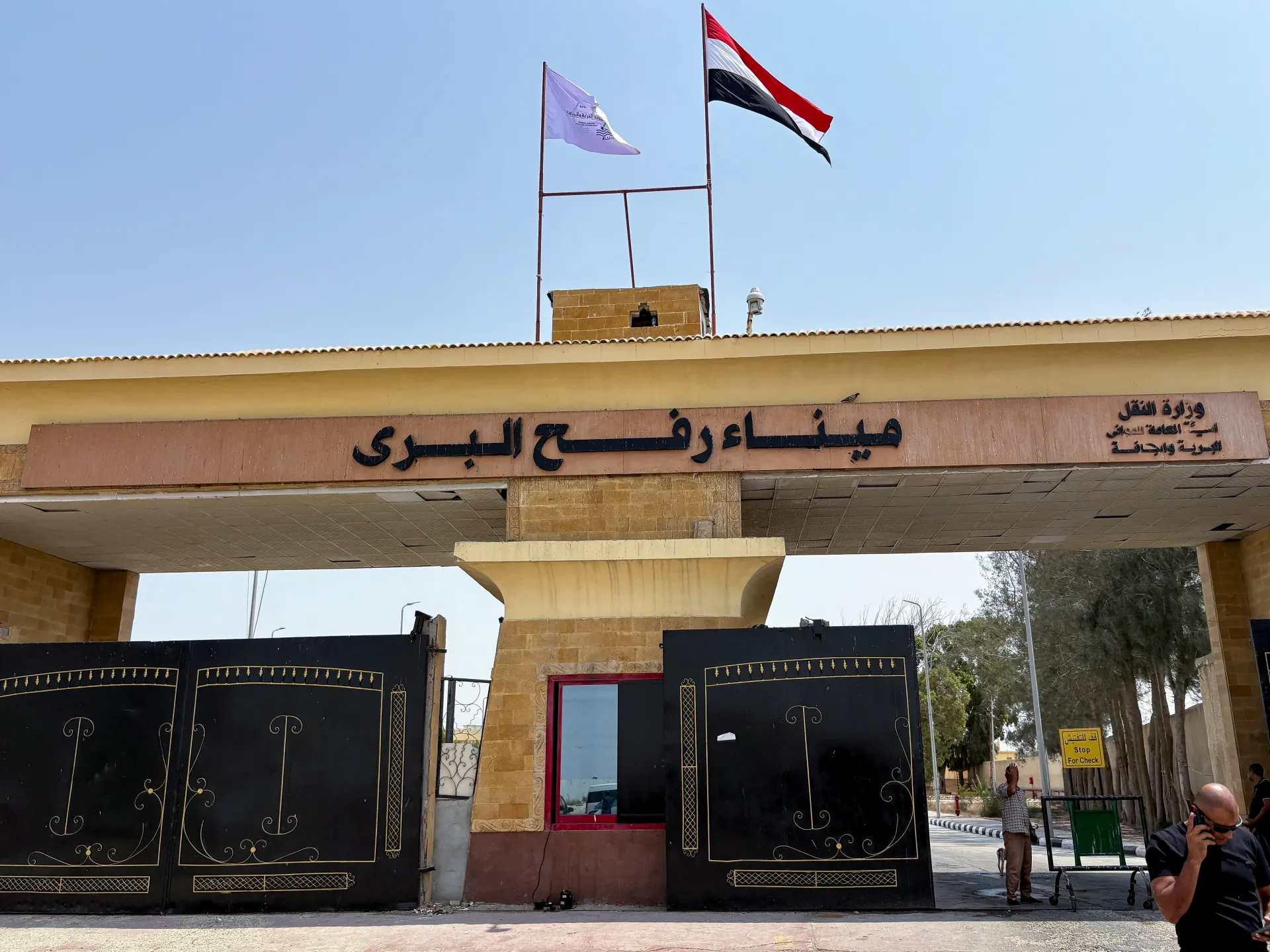
On December 3, Israel announced that the Rafah border crossing with Egypt would reopen “in the coming days”, allowing Palestinians to leave Gaza for the first time in months. The statement was, of course, framed as a humanitarian gesture that would allow those in urgent need to travel for medical care, education or family reunification to leave.
However, Israel’s announcement was met almost immediately with Egypt’s denial, followed by a firm rejection from several Arab and Muslim states.
To the rest of the world, this response may seem cruel. It may seem like Arab states want to forcibly keep in Gaza Palestinians desperate to evacuate to safety. This fits right into the Israeli narrative that neighbouring Arab countries are responsible for Palestinian suffering because they would not “let them in”.
This is a falsehood that has unfortunately made its way into Western media, even though it is easily disproved.
Let us be clear: No, Arab states are not keeping us against our will in Gaza, and neither is Hamas.
They want to make sure that when and if some of us evacuate temporarily, we are able to come back. We want the same – a guarantee of return. Yet, Israel refuses to grant it; it made clear in its December 3 announcement that the Rafah crossing would be open only one way – for Palestinians to leave.
So this was clearly a move meant to jump-start forced displacement of the Palestinian population from their homeland.
For Palestinians, this is not a new reality but part of a long and deliberate pattern. Since its inception, the Israeli state has focused on the dispossession, erasure, and forced displacement of the Palestinians. In 1948, 750,000 Palestinians were expelled from their homes and were not allowed to return. My 88-year-old grandfather was among them. He still keeps the Tabu (land registry document) for the dunams of land he owns in his village of Barqa, 37km (23 miles) north of Gaza, where we are still not allowed to return.
In 1967, when Israel occupied Gaza, it forbade Palestinians who were studying or working abroad from returning to their homes. In the occupied West Bank, where colonisation has not stopped for the past 58 years, Palestinians are regularly expelled from their homes and lands.
In the past two years alone, Israel has seized approximately 55,000 dunams of Palestinian land, displacing more than 2,800 Palestinians. In Jerusalem, Palestinians whose families had lived in the holy city for centuries risk losing their residency there if they cannot prove it is their “centre of life”. In the past 25 years, more than 10,000 Palestinian residencies have been revoked.
Since October 2023, Israel has repeatedly attempted to engineer forced mass displacement in Gaza – dividing the Strip into isolated zones separated by military corridors and “safe” axes and launching successive operations to push residents of the north towards the south. Each wave of mass bombing carried the same underlying objective: to uproot the people of Gaza from their homes and push them towards the border with Egypt. The most recent push occurred just before the latest ceasefire took effect.
According to Diaa Rashwan, chairman of the Egyptian State Information Service, Cairo rejected Israel’s proposal because it was an attempt to shun its commitments outlined in the second phase of the ceasefire. That phase requires Israel to withdraw from Gaza, support the reconstruction process, allow the Strip to be administered by a Palestinian committee, and facilitate the deployment of a security force to stabilise the situation. By announcing Rafah’s reopening, Israel sought to bypass these obligations and redirect the political conversation towards depopulation rather than reconstruction and recovery.
That Israel wants to create the conditions to make our expulsion inevitable is clear from other policies as well. It continues to bombard the Strip, killing hundreds of civilians and terrorising hundreds of thousands.
It continues to prevent adequate amounts of food and medicines from getting in. It is allowing no reconstruction materials or temporary housing. It is doing everything to maximise the suffering of the Palestinian people.
This reality is made even more brutal by the harsh winter. Cold winds tear through overcrowded camps filled with exhausted people who have endured every form of trauma imaginable. Yet despite hunger, exhaustion, and despair, we continue to cling to our land and reject any Israeli efforts to displace and erase us.
We also reject any form of external guardianship or control over our fate. We demand full Palestinian sovereignty over our land, our resources, and our crossings. Our position is clear: the Rafah crossing must be opened in both directions; not as a tool of displacement, but as a right to free movement.
Rafah must be accessible for those who wish to return, and for those who need to leave temporarily: students seeking to continue their education abroad, patients in urgent need of medical treatment unavailable in Gaza, and families who have been separated and long to be reunited. Thousands of critically ill Palestinians have been denied life-saving care due to the siege, while hundreds of students holding offers and scholarships from prestigious universities around the world have been unable to travel to pursue their education.
Rafah should also be open to those who simply need rest after years of trauma – to step outside Gaza briefly and return with dignity. Mobility is not a privilege; it is a basic human right.
What we demand is simple: the right to determine our future, without coercion, without bargaining over our existence, and without being pushed into forced displacement disguised as a humanitarian project.
The views expressed in this article are the author’s own and do not necessarily reflect Al Jazeera’s editorial stance.