war

Oil rises above $106 per barrel as US, Iran deadlocked in Strait of Hormuz | US-Israel war on Iran

Jump in prices comes as Donald Trump says vessels will need permission of US Navy to transit key waterway.

Oil prices have jumped on heightened tensions between the United States and Iran in the Strait of Hormuz following Washington and Tehran’s tit-for-tat captures of commercial vessels.

Brent crude, the international benchmark, topped $106 per barrel early on Friday morning as Washington and Tehran stepped up their confrontation over the key maritime route for transporting the world’s energy.

Recommended Stories

list of 4 itemsend of list

Brent stood at $106.80 as of 01:00 GMT, up nearly 5 percent from its closing price on Wednesday, when it surpassed $100 per barrel for the first time in two weeks.

US stocks fell overnight, with the benchmark S&P 500 index dipping 0.41 percent and the tech-heavy Nasdaq Composite dropping 0.89 percent.

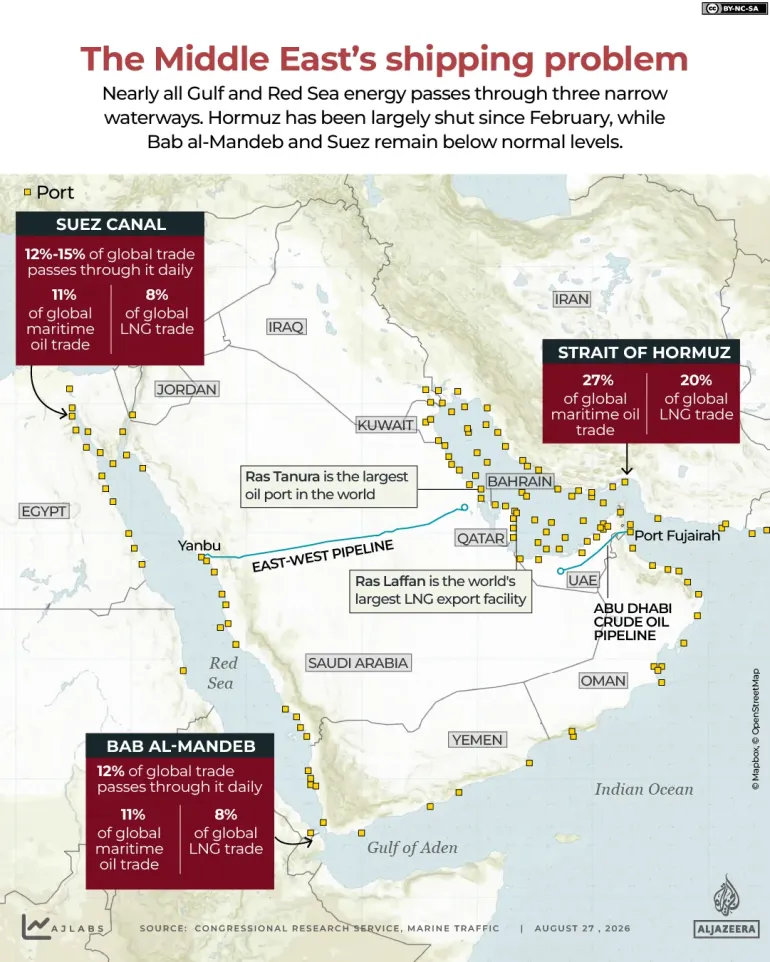
Shipping in the Strait of Hormuz, which normally carries about one-fifth of the world’s supply of oil and natural gas, remains at a standstill as Iran continues to demand the right to decide which vessels may pass and the US blocks Iran’s maritime trade.

US President Donald Trump said in a Truth Social post on Thursday that he had ordered the US Navy to destroy any Iranian boats laying mines in the strait, shortly after the Pentagon announced that it had seized a tanker carrying sanctioned Iranian oil for the second time in less than a week.

Trump also appeared to expand the scope of the US naval blockade beyond Iranian ports, writing on Truth Social that no ship “can enter or leave” the strait without the approval of the US Navy.

“It is ‘Sealed up Tight,’ until such time as Iran is able to make a DEAL!!!” Trump said.

Trump’s threats came a day after Iran’s Islamic Revolutionary Guard Corps announced the capture of two foreign cargo ships in the waterway.

The IRGC said it had seized the Panamanian-flagged MSC Francesca and Greek-owned Epaminondas after the vessels had endangered maritime security “by operating without the necessary permits and tampering with navigation systems”.

The Greek Maritime Affairs and Insular Policy Ministry has denied that the Epaminondas was captured and said the vessel remains under the control of its captain.

Only nine commercial vessels transited the strait on Wednesday, compared with seven on Tuesday and 15 on Monday, according to maritime intelligence platform Windward.

Before the US and Israel launched their war against Iran on February 28, the waterway saw an average of 129 transits each day, according to United Nations Trade and Development.

Source link

U.S. weighs plan to send Afghans who helped with war effort from Qatar to a third country

The Trump administration is in discussions to potentially send more than 1,000 Afghans who assisted America’s war effort and relatives of U.S. service members stuck in Qatar to a third country, the U.S. government and some advocates said. Congo is an option, the advocates said.

Shawn VanDiver, a Navy veteran who heads a coalition that supports Afghan resettlement efforts called #AfghanEvac, said Wednesday that U.S. officials informed him and other groups of discussions between the United States and Congo about taking the Afghan refugees who have been in limbo at a U.S. base in Doha for the last year.

The 1,100 refugees at Camp As-Sayliyah include Afghans who served as interpreters and with Special Operations Forces as well as the immediate families of more than 150 active-duty U.S. military members.

The State Department said Wednesday that it is working to identify options to “voluntarily” resettle the refugees in a third country, but it did not confirm which nations were being discussed.

An alternative provided to the refugees, VanDiver said, is to return to Afghanistan, where they face likely reprisal or even death at the hands of the Taliban for working alongside the U.S. during the two-decade war.

“You cannot call a choice voluntary when the two options are Congo and the Taliban, civil war or an oppressor who wants to kill you,” VanDiver said at a virtual news conference. “That is not a choice. That is a confession extracted under duress.”

The discussions — which were reported earlier by the New York Times — come more than a year after President Trump paused his predecessor’s Afghan resettlement program as part of a series of executive orders cracking down on immigration.

That policy left thousands of refugees who fled war and persecution, and had gone through a sometimes years-long vetting process to start new lives in America, stranded at places worldwide, including the base in Qatar.

From one war-torn country to another

Negotiations between the U.S. and several other countries, including Botswana and Malaysia, started months ago, according to an executive at a refugee resettlement agency who was briefed by U.S. officials. The executive, who spoke on condition of anonymity to share private negotiations, said that Botswana was seen by many refugee advocates as the most promising option but that talks between senior U.S. officials and the country’s leadership fell through. In early April, the executive was briefed that Congo was now the main option being discussed.

A person familiar with the matter who was not authorized to comment publicly and spoke on condition of anonymity said they had heard from State Department personnel that the U.S. was looking at sending the Afghans at the base in Qatar to countries in sub-Saharan Africa. The person said the Afghans were told Wednesday that there was no final deal on where to send them.

The base in Doha “was always intended as a transit platform. It was never designed to hold families for months or years, which is the situation that people are currently in,” said Jon Finer, who was deputy national security advisor to then-President Biden. “What I want to emphasize is that this was intended to honor a wartime commitment.”

Finer and other former U.S. officials and refugee advocates warned of the risk of resettling Afghans in Congo, a country that U.N. officials say is facing “one of the most acute humanitarian emergencies in the world.”

The African country has been battered by decades-long fighting between government forces and Rwanda-backed rebels in its eastern region.

Congolese authorities did not immediately respond to AP’s request for comment on the discussions, which did not come as a surprise to some there. Congo is one of at least eight African nations that were paid millions in controversial deals with the Trump administration to receive migrants deported from the U.S. to countries other than their own.

Like most other African nations involved in the deportation program, Congo is also among the worst-hit by the Trump administration’s policies on aid and trade. At least 70% of the country’s humanitarian aid came from the U.S. before Trump’s second term, and aid workers say American aid cuts have led to avoidable deaths in the conflict-hit region.

Sean Jamshidi — an Afghan American who served in the U.S. military, including a stint in Congo — said he was deeply concerned about his brother possibly being sent from the Doha base to the war-torn country.

“I saw the security situation and what it looked like there. I saw the displacement camps. … I stood in places where the United Nations has counted the dead,” Jamshidi said. “I’m telling you, as someone who has been in uniform, the Democratic Republic of the Congo is not a place you send vetted Afghan allies and their children to live.”

Refugees are in the dark as they await their fate

Negina Khalili, a former prosecutor in Afghanistan who fled during the 2021 U.S. withdrawal, has been waiting to hear about the resettlement status of her father, brother and stepmother since they arrived at the Doha base in January 2025. That was just days before Trump suspended the refugee program soon after he returned to the White House.

Khalili told the Associated Press on Wednesday that she spoke to her family about reports that they could be sent to Congo.

“They are not giving them any information or updates regarding which countries they will go to,” she said. “They were so stressed and worried about it and said that Congo is not a safe place either. They don’t know if it’s a temporary location for them there or a permanent location. They are worried.”

She said U.S. officials at the camp have been suggesting to refugees that they go back to Afghanistan and offering them money to do so.

Amiri, Santana and Asadu write for the Associated Press. Amiri reported from New York and Asadu from Abuja, Nigeria. AP writer Matthew Lee contributed to this report.

Source link

Iran dismisses Trump’s claim of leadership rift, says nation is ‘one soul’ | US-Israel war on Iran News

Several Iranian officials have stressed that their country is united, rejecting United States President Donald Trump’s claims of a rift in the leadership in Tehran.

Iran’s President Masoud Pezeshkian, Foreign Minister Abbas Araghchi and Parliament Speaker Mohammad Bagher Ghalibaf all issued statements rejecting the United States president’s assertion.

Recommended Stories

list of 3 itemsend of list

Pezeshkian and Ghalibaf joined the Supreme National Security Council in posting the same message on X.

“In Iran, there are no radicals or moderates,” it said.

“We are all ‘Iranian’ and ‘revolutionary’, and with the iron unity of the nation and government, with complete obedience to the Supreme Leader of the Revolution, we will make the aggressor criminal regret his actions.”

Mohammad Reza Aref, Iran’s first vice president, also shared the statement, adding another note in English.

“Iran is not a land of rifts, but a stronghold of unity,” Aref said. “Our political diversity is our democracy, yet in times of peril, we are a ‘Single Hand’ under one flag. To protect our soil and dignity, we transcend all labels. We are one soul, one nation.”

Iranian Supreme Leader Mojtaba Khamenei has not made a public appearance since replacing his father, Ali Khamenei, who was killed by US-Israeli strikes on February 28.

US officials have said that the younger Khamenei was wounded and “disfigured” in the strike that killed his father.

The New York Times reported on Thursday, citing unidentified Iranian officials, that Khamenei is gravely wounded but remains “mentally sharp”.

Trump and his aides have been reiterating daily over the past week that there are major disagreements among Iranian leaders.

The US president claimed that Iranians are “having a very hard time figuring out who their leader is”, alleging that there is “crazy” infighting between “moderates” and “hardliners” in Tehran.

Citing the supposed rift by Trump could serve to justify the extension of the ceasefire while also putting the blame on Iran for the stalled diplomacy.

Tehran, however, has stressed over the past days that the talks – previously scheduled to take place in Pakistan – are not happening due to the US blockade on its country’s ports.

On Thursday, Araghchi dismissed allegations that the Iranian military is at odds with the political leadership.

“The failure of Israel’s terrorist killings is reflected in how Iran’s state institutions continue to act with unity, purpose, and discipline,” he wrote on X.

“The battlefield and diplomacy are fully coordinated fronts in the same war. Iranians are all united, more than ever before.”

diplomatic impasse with the US, with Trump suggesting that he is comfortable with the status quo of blockading Iran’s ports to inflict economic pain on the country without resuming the war or rushing towards a conclusive deal.

“Iran’s Navy is lying at the bottom of the Sea, their Air Force is demolished, their Anti-Aircraft and Radar Weaponry is gone, their leaders are no longer with us, the Blockade is airtight and strong and, from there, it only gets worse — Time is not on their side!” Trump said on social media on Thursday.

“A Deal will only be made when it’s appropriate and good for the United States of America, our Allies and, in fact, the rest of the World.”

But the truce under the status quo remains tenuous. Air defences were activated over Tehran earlier on Thursday, but there has been no official confirmation of an attack against the country.

Earlier on Thursday, Trump said the US military will “shoot and kill” Iranian laying mines in the Strait of Hormuz, which could spark a response

And oil prices are once again rising due to the uncertainty and the double blockade in the Gulf – Iran closing down Hormuz and the US naval siege on Iranian ports.

Israel also appears ready to rejoin the war. Defence Minister Israel Katz said on Thursday his country is awaiting the green light from Trump to return Iran to the “age of darkness”.

“Israel is prepared to renew the war against Iran. The [Israeli military] is ready in defence and offence, and the targets are marked,” Katz said, according to the Times of Israel newspaper.

Source link

How Trump’s Iran war is driving military dissent | US-Israel war on Iran News

From protests to quiet resistance, dissent is rising inside the United States military over the US-Israel war on Iran.

As the US expands its war with Iran, opposition is growing – not just among the public, but inside the military itself. Some service members are questioning orders, exploring conscientious objection, and speaking out. What’s driving this shift, and how far could it go?

In this episode: 

  • Mike Prysner (@MikePrysner), Executive Director of the Center on Conscience & War

Episode credits: 

This episode was produced by Marcos Bartolomé, Tamara Khandaker, and Sarí El-Khalili with Spencer Cline, Tuleen Barakat, and our host, Malika Bilal. It was edited by Tamara Khandaker and Noor Wazwaz. 

Our sound designer is Alex Roldan. Our video editors are Hisham Abu Salah and Mohannad al-Melhem. Alexandra Locke is The Take’s executive producer.

Connect with us:

@AJEPodcasts on XInstagramFacebook, and YouTube


Source link

US-Israeli war on Iran will push 30 million back into poverty, UN warns | US-Israel war on Iran News

Disruption to fuel and fertiliser supplies due to the Strait of Hormuz closure will hit crop yields, UNDP chief warns.

The Iran war will push more than 30 million people back into poverty, with the knock-on effects of the conflict likely to increase food insecurity in the coming months, the United Nations has warned.

Disruption to fuel and fertiliser supplies due to the ongoing blocking of cargo vessels through the Strait of Hormuz has already lowered agricultural productivity and will hit crop yields later this year, the UN’s development chief said on Thursday.

Recommended Stories

list of 4 itemsend of list

“Even if the war would stop tomorrow, those effects, you already have them, and they will be pushing back more than 30 million people into poverty,” said Alexander De Croo, administrator of the United Nations Development Programme (UNDP).

He also warned of other fallouts of the United States-Israeli war on Iran, including energy shortages and falling remittances.

Much of the world’s fertiliser is produced in the Middle East, and one-third of global supplies passes through the Strait of Hormuz, where Iran and the US are jostling for control.

The UN’s Food and Agriculture Organization (FAO) last week warned that a prolonged crisis in the strait could lead to a global food “catastrophe”.

India, Bangladesh, Sri Lanka, Somalia, Sudan, Tanzania, Kenya, and Egypt are among the countries most at risk, according to the FAO.

“Food insecurity will be at its peak level in a few months – and there is not much that you can do about it,” De Croo said.

Straining humanitarian efforts

The knock-on effects of the Iran conflict have already wiped out 0.5 percent to 0.8 percent of global gross domestic product (GDP), according to De Croo, who noted, “Things that take decades to build up, it takes eight weeks of war to destroy them.”

De Croo, the former prime minister of Belgium, also warned that the Middle East crisis is straining humanitarian efforts in other parts of the world, with the sector already facing funding cuts.

The US-Israeli attacks on Iran, which began on February 28, have also choked up key humanitarian aid routes, delaying life-saving shipments to some of the world’s worst crises.

“We will have to say to certain people, really sorry, but we can’t help you,” De Croo said. “People who would be surviving on help will not have this, and will be pushed into even greater vulnerability.”

Source link

Ideology, Blood, and War: Rethinking the Origins of Boko Haram

Before he became a fugitive preacher, during which time security officials learned to mutter his name with a foreboding weight, culminating ultimately in his killing,  filmed and circulated across local and international news platforms, Mohammed Yusuf was a boy seated before his father, learning the Qur’an. This is where this story begins.

Not in 2002 or in July 2009, which are often cited as the landmark years. The beginning lay far away from prying eyes, in the ordinary intimacy of religious learning, in a world of fathers and sons, mallams and pupils, recitation and repetition.

Those who knew Yusuf’s early life describe a child shaped in his father’s image. According to one of his sisters, who does not wish to be named, “He learned to recite the Qur’an under Baba. He was our father’s student before he became anyone else’s.” He imbibed that discipline, the rigour and rhythm of recitation, correction, and memorisation. 

He went on to study under Goni Bulama, who was reportedly knowledgeable in fiqh (the human interpretation and application of Sharia law). Later, he travelled to Potiskum in Yobe State to continue learning under his uncle, Goni Madu. He stayed there for two or three years, “then he returned home and continued seeking knowledge in several places” as part of the Almajiranci system, his sister recalled. 

Among the clerics repeatedly named by people who followed that part of his life is Goni Modu in Lamisula, a suburb in Maiduguri. He occasionally took lessons from the late Sheikh Abba Aji, a well-respected Mufassir (Qur’anic exegete)in Maiduguri. “Yusuf did not emerge from the bubble; he was shaped through the interplay of ideologies,” said Kyari Mustafa, a researcher and one of Yusuf’s former students. One of his childhood friends, who is now a moderate cleric in Maiduguri, described Yusuf as a very curious child, adding that he thinks “that was what made him learn faster than all his peers”.

According to many who encountered Yusuf, he was many things, some of them deeply dangerous, but he was not a man who wandered by accident into religious influence. He read, listened, argued, absorbed, and faltered like many clerics before him and after him. He later recast those ideas into a corrosive, doctrinal political weapon, with devastating consequences that plunged more than five countries bordering Lake Chad into violence, killing and maiming tens of thousands, and uprooting millions from their communities.

Long before he created a movement the world would come to know as Boko Haram, he moved through circles of da’awah and doctrinal activism that were themselves products of a wider shift in Muslim politics. At one stage, he was linked to the Muslim Brothers, a movement of mostly students active in the 1980s and 1990s that promoted political Islam and reform. Some accounts also linked him to circles associated with Sheikh Ibrahim El Zakzaky, the Shia cleric and leader of the Islamic Movement in Nigeria. Those familiar with that era said Yusuf pulled away immediately from what he regarded as Shi’a framing by key figures in the movement, since he was inclined toward Sunni religious beliefs. However, Yusuf was not separated from their struggle; instead, he was separated over the terms, over authority, aqeedah, and over who would define the path ahead.

The claim that Yusuf was a disciple of the late Kano-based Salafi scholar Sheikh Ja’afar Mahmud and his circle does not hold under closer scrutiny. However, those who observed the stint at Muhammad Indimi’s mosque in Maiduguri and the eventual split describe a sharper divergence. “Ja’afar argued that Muslims should engage formal schools and institutions, then reform them from within. Yusuf rejected that path, calling for a boycott. He pushed for parallel systems built on Islamic guidance with zero secular influence,” said Mustafa.

From the beginning, there were overlaps between Yusuf and dozens of clerics in broad questions about jihad and Sharia. Still, Yusuf pushed toward establishing a totalitarian Sharia system on terms others did not share, or not yet. Across the Sahel, a broad clerical ecosystem continues to propagate hardline doctrinal interpretations reminiscent of those once advanced by Mohammed Yusuf. Many remain obscure, not for lack of ideological alignment, but because they have not transitioned into open confrontation with the state. Unlike Yusuf, whose influence escalated when he mobilised disaffected youth into armed resistance, these figures operate below the threshold of insurgency and restrict themselves to preaching. 

There was also an organisational history that has been largely buried beneath the violence that came later. “Yusuf was once part of a movement in 1997/1998 identified as ‘Jamatul Tajdid Islami’, which was first created in Kano and headquartered there,” said Malam Mohammad, Yusuf’s former associate now based in Kano. By early 2000, he was back in Maiduguri, beginning or deepening preaching activities across several mosques. He was pushed out from Mohammed Indimi’s Mosque, moved to Al’amin Daggash Mosque, was stopped again, and then continued from his own house, given to him by his father-in-law. He named the sanctuary Ibn Taymiyya Masjid after a 13th-century Islamic scholar. 

This was a precursor phase built on a study circle, not an insurgent cell. At the time, young men in white jalabiyas and their wives in black long jalbabs flooded Maiduguri. They were encouraged to bond tightly, abandon schools, and resign from secular institutions. “They shared food amongst themselves. They sold farm produce at subsidised rates from their large farm in Benisheikh. They provided free medical care through two clinics in Maiduguri. They ran a small revolving loan scheme for indigent members,” said Malam (name withheld), one of the movement’s former clerics currently in Maiduguri.

A fighter still active told HumAngle he dropped out as a sophomore at the University of Maiduguri, leaving his parents’ home to move in with a member of the group. “Between 2006 and 2007, I had no skills or a job. I survived on daily meals and food stamps from the Ibn Taymiyyah mosque. I will never forget that support by Malam Mohammed Yusuf,” said the 42-year-old Boko Haram member.

Ideology and a premeditated war

Boko Haram did not erupt because of the high-handedness of security agents, though that high-handedness was real and consequential. It did not begin because Mohammed Yusuf was extrajudicially killed in July 2009. However, that killing transformed him into a martyr in the eyes of his followers and helped harden the foot soldiers in the war that came thereafter. It did not begin because of one helmet law, one police confrontation, or one week of clashes in Biu, Bauchi, Maiduguri, Damaturu, Potiskum, and elsewhere.

Those events merely accelerated the rupture.

The deeper fuse was ideology, and that ideology did not grow in isolation. It travelled with money, with wars fought elsewhere, with transnational religious currents, and with the afterlife of global politics that Nigeria still refuses to examine closely.

In the 1980s, amid oil-fuelled prosperity and the protracted Cold War contest in Afghanistan, a distinct wave of Salafi thought was actively scaled by a Gulf state. It travelled through well-funded clerical networks, charities, publications, scholarships, and layers of international patronage that gave it both reach and structure.

For external backers, the fine details of ideology did not matter. What mattered was shared strategy. As long as this movement in Afghanistan put pressure on the Soviet Union, its beliefs were rarely questioned and were sometimes quietly supported.

In Afghanistan, jihad evolved from a theological concept into something more kinetic, a pathway, a destination, and, for many, a defining personal transformation. Young men from across the Muslim world answered that call. Nigerians were among them. Many of them were strikingly from the southwest region, but when they returned, they did not find the same fertile conditions in their home environment for a project of violent proselytisation. The idea survived, but it did not easily reproduce itself in that terrain.

In the north, these returnee fighters from Afghanistan did not arrive on stable ground. They met a generation of young men with little education and a grim future, a generation that knew the state only through force, neglect, and theft. They met boys raised on the daily humiliation of poverty and poor investment in education by corrupt officials.

That was the combustible field in which Yusuf picked up most of his ideas in the late 90s and began to nurture them into a movement in the early years of 2000. By the time the July 2009 ma’araka occurred, the insurgency had already been imagined, nurtured, and prepared for years. The movement had passed through the stages of learning, da’awah, withdrawal, factional dispute, internal sorting, and ideological hardening.

“Operation Flush” and the broader security pressure during that period disrupted a longer period of preparation. When the confrontation came, the group had not yet fully built what they intended to build. If they had been left to prepare longer, and if the rupture had come later rather than in July 2009, Nigeria might have faced a movement with greater organisational maturity and strategic capacity.

In the weeks after the confrontation between Boko Haram members and Operation Flush in Maiduguri, triggered by the enforcement of helmet regulations on motorcycle riders, tensions escalated sharply. Security forces shot around 20 sect members, an incident that hardened positions within the group and deepened mistrust of state authority.

Mohammed Yusuf responded with an open declaration, signalling that the group would confront the state if certain demands were not met. Within the cult-like community, preparations began quietly but deliberately. Members started liquidating personal assets. Cars, motorcycles, and even houses were sold. Women parted with jewellery and household items. Contributions came from across the network, each person offering what they could.

This mobilisation unfolded in earnest in the month leading up to July 2009. 

Long before the war, there were also fractures inside the movement that foreshadowed what would come later. One notable example is that of Muhammed Alli, who, after disagreeing with Yusuf, left for Hijra to Kanamma in Yobe State with dozens of youths in 2003. They isolated themselves from normal civil life in a remote location. When the traditional leader in the vicinity noticed a strange group of people in his turf in December 2003, he approached them, and one thing led to another; the group had violent confrontations with the Police that resulted in the loss of lives and properties. 

At the height of Yusuf’s sectarian authority between 2006 and 2009, a fracture was already taking shape within his movement. Beneath the surface, a harder, more impatient current was consolidating around Abubakar Shekau, his top lieutenant. “Yusuf believed in sequencing. Build strength first. Recruit deeply. Arm deliberately. Accumulate resources. Then, confront the state from a position of capacity,” said Mustafa.

Shekau, like Muhammad Ali, who led Kanamma, rejected that procedure. They both pushed for immediacy. Strike now and absorb the consequences later. Death itself, whether inflicted or received, was framed as victory through martyrdom, according to those inclined to Shekau’s hardline views.

Malam Hassan (Gandrova), a staff member of the Nigerian Prison Service, who was radicalised during one of Shekau’s brief remands at the Maiduguri Maximum Security Prison, would eventually join the terror group’s bomb-making unit. On Friday, July 24, 2009, he was assembling an IED with two other individuals at his rented apartment in Umarari, ‘Bayan quarters’ in Maiduguri. “Hassan and the two other bomb-making members of the sect were unskilled at the time, and their explosives blew up everyone in the room,” said a former member currently in one of Nigeria’s deradicalisation programmes set up to reintegrate former fighters back to normal civil life in their communities. 

The following day, Saturday, July 25, Yusuf’s followers were attacked in Bauchi. On the night of Sunday, July 26, Yusuf faced mounting pressure from his own ranks after the bomb incident and the raids in Bauchi, compounded by a sting operation by the police in Maiduguri, “who falsely tipped Yusuf’s men that security forces would launch an assault against them before dawn,” said a senior police officer familiar with the events of July 2009. Shekau’s more radical supporters within the group demanded action.

On the evening of July 26, 2009, hours before they launched an attack on the Borno State Police headquarters, Yusuf condemned the attacks on his men during an interview with this reporter, who worked for Daily Trust at the time. “What I said previously that we are going to be attacked by the authorities has manifested itself in Bauchi, where about 40 of our brothers were doing what Allah said, arm yourself and your religion in the face of an attack and an attack was imminent. This was what Malam Hassan [bomb victim] was doing when he became a martyr,” he said.  

Had Yusuf refused the group’s attack on the Police Force headquarters in Maiduguri, he would not have remained leader after that night, said several senior members of the group interviewed by HumAngle. The movement was already shifting beneath him. At best, he would have been sidelined. At worst, he would have been removed entirely by the very hardline faction he had tried to restrain.

A group of people, some in uniform, stand outside a building engaged in conversation during daylight.
File photo of former Borno State Executive Governor, Ali Modu Sheriff, with the former state Commissioner of Police, Christopher Dega, at the police headquarters in Maiduguri on July 27, 2009. 

Blood ties and the machinery of war

To understand how this story has unfolded, one has to see Yusuf as the centre of a household as well.

He had four wives and a large number of children, between 24 and 26, according to the accounts available. His first wife was Aisha, also known as Ya Bintu or Yaya Bintu. Among the children attributed to her are Yusuf, Habib, Ibrahim, Ahmad, Imam Muslim, Abdullahi (also called Abba), Isa, and Abdulazeez.

His second wife was Fatima, also called Ummu Zara. Children linked to her include Zarah, Alhaji Ba (recalled unclearly in one account), Iya Gana, Ummu Kulthu, Aish, Uma, and Abdulwahab.

His third wife was Hajja Gana, also called Ba’ba. Children associated with her include Zainab (often called Ummi), Maryam, Umar, and Khadija (also known as Ya Dija).

The fourth wife was Ummu Tulaf, or Ummuthulab in some accounts. Muazu is consistently named among her children. This is not a perfect register, but a family history carried through oral memory, insurgent secrecy, death, displacement, and the distortions that come when names are repeated across generations. But the uncertainties do not dilute the central point. Yusuf did not leave behind a disembodied ideology. He left behind a house, and that house has remained part of the machinery of war to date.

One relative of Yusuf, based in Kano, who spoke in detail about the family, put it simply: “All of his children are part of the insurgency. Some are dead now. But they are all part of it with no exceptions.”

The first son, Yusuf, married in Hotoro, Kano State, in 2010. The marriage was brief; he died not long after, leaving no children. His death followed the September 7, 2010, prison break in Bauchi, when Boko Haram freed hundreds of their members. Some of the escapees of that prison break were later traced to a hideout in Hotoro, where Yusuf lived. Security forces moved in. In the exchange that followed, Yusuf, the first son of Mohammed Yusuf, was killed.

Habib, the second son, known as Abu Musab, became the most consequential. Family testimony about his domestic life varies in detail, as such testimony often does in clandestine worlds, but the core is clear. He had multiple wives and many children. Zainab is recalled as one wife, Halima as another, Aisha as another. Their children, depending on who recounts the family tree, include Mus’ab, Humaira, Rumaisa, Muhammad, another Muhammad, Shifa’u, Ramla, Zarah, Rufaidah, Kasim, Abdullahi, and Amir. In one account, there is mention of a concubine or enslaved woman who bore him a daughter. 

After the July 2009 violent outbreak, most of Mohammed Yusuf’s children, except his first son, were moved out of Nigeria. They were first taken to Kusiri in northern Cameroon, then to N’Djamena in Chad, where they continued their religious education under Sudanese and Chadian tutors. This relocation appears to have taken place within months of Yusuf’s death and was aimed at preserving both their safety and their symbolic value within the movement.

In 2012, after Abubakar Shekau left Rijiyan Zaki in Kano and established himself in the Sambisa forest, he ordered Yusuf’s children to be brought back into the insurgent enclave, which the group had begun to frame as its Daula. This move reflected a deliberate effort to consolidate legitimacy by reabsorbing Yusuf’s lineage into the insurgency’s core.

Among those elevated during this period was Abu Musab al-Barnawi. He was progressively assigned roles that combined religious authority and operational relevance, positioning him as a bridge between doctrinal leadership and battlefield command.

From 2015 to 2016, tensions between Shekau and ISIS leadership intensified. The central issue was Shekau’s expansive use of takfir, particularly Takfir al-‘Umum, which justified violence against broad segments of the Muslim population. ISIS leadership, including Abu Muhammad al-Adnani, engaged in repeated efforts to moderate Shekau’s position. These attempts also addressed concerns over targeting practices, the use of female suicide bombers, and command discipline. All efforts failed.

In August 2016, ISIS formally intervened. Through its Al-Naba publication, it announced the removal of Shekau as leader and the appointment of Abu Musab al-Barnawi as Wali of the Islamic State’s West Africa Province (ISWAP). This marked the formal split between Boko Haram and ISWAP. The decision was externally driven by ISIS central and reflected a strategic shift toward a more controlled and population-focused insurgent model under new leadership. 

Abba (aka Abu Umaysa), whose given name is Abdullahi, is also one of Yusuf’s sons. He reportedly had multiple wives and children, including Muhammad, Maryam, Aisha, and at least one other son. Within the insurgent structure, he played a technical and operational role, particularly in communications. Sources indicate he was responsible for managing encrypted messaging platforms that facilitated contact between ISWAP leadership and ISIS-linked actors in the Middle East.

Cluttered desk with a laptop, many phones, and various tech gadgets. A software program is open on the laptop screen.
A file photo of the workstation Abba shared with Baban Hassan during their time as senior members of the ISWAP media unit in the Lake Chad basin.

Despite his communications role, Abba was known to participate directly in combat operations, a pattern that reportedly drew disapproval from senior leadership due to the sensitivity of his liaison responsibilities. Internal disputes led to repeated detentions. Abba was imprisoned on four separate occasions by his brother Abu Musab, including periods of detention alongside that of Mamman Nur, a senior figure associated with Mohammed Yusuf’s lifetime.

In one instance, he escaped custody with other fighters and fled to the Niger Republic, but later returned. According to a source, he was subsequently pardoned and allowed to reintegrate without facing the death penalty typically imposed on members accused of attempting to defect.

A senior ISWAP defector, Malam Ibrahim, stated that during one period of detention linked to internal disagreements, ISIS-linked contacts “declined communication with ISWAP as long as they did not hear his voice. He was released immediately to continue his work.” 

Abba later died in early 2023 during an engagement with the Multinational Joint Task Force in the Kangarwa forest area.

The other sons, Muslim, Abdulazeez, Isa, and Abdulwahab, are described by one source as married and without children at the time of this report. However, Muslim was arrested in Chad when he was trying to defect from the group to live outside of Nigeria. 

Even inside the household of a movement that would later devastate the northeast, family life is still narrated through the intimate vocabulary of births, marriages, hopes, namesakes, and unanswered prayers for children. That is exactly why the story resists easy reduction. The people at the centre of violence remained human in their own domestic worlds. That does not mitigate their responsibility, but it explains how such worlds sustain themselves.

The patriarch’s execution

Yusuf’s rise spiked because of his soft-spoken, unusual, and persuasive verbal skills rather than his scholastic proficiency. He did not need the theatrics many expected from Sahel’s religious authorities. He could name what young men already felt but had not yet organised into doctrine. Corruption. Injustice. Absence. State impunity. The feeling that rulers had abandoned both God and the governed. He took those scattered injuries and gave them a single haunting frame.

Yusuf was carrying a worldview shaped by transnational currents, doctrinal disputes within Nigeria and the broader Sahel Islam, and his own insistence that the Nigerian state was religiously illegitimate.

Then came the extrajudicial killing.

Outside the police headquarters in Maiduguri, Yusuf was captured on camera,  alive in custody, seated and handcuffed. Later, he was dead, his body riddled with bullets. The state said he had been shot while trying to escape. The footage with his hands tied, however, invalidated that claim.

What followed was brutal and systematic. Raids spread across northern states, with Maiduguri at the centre. Security forces targeted hospitals and local pharmacies. They forced staff to identify and lead them to patients treated for gunshot wounds or related injuries. Those patients were taken to the State Police headquarters. Some could barely stand. Some were on crutches. Some were executed at close range in the presence of this reporter, as documented here.

Armed personnel stand near two people on crutches, with more individuals lying on the ground in the background. Trees line the street.
File photo of suspected members of Boko Haram in crutches before they were summarily executed at the entrance of the Borno State Police Command Headquarters by security forces. 

For followers, the image of Yusuf became proof of everything he had preached about state injustice. This was the moment the war entered the family’s bloodstream. His children, who had already grown up under his teachings, now witnessed his extrajudicial death. 

Abu Musab was central to the next phase.

The rise and fall of Abu Musab

Relatives remember him first as a disciplined son who rose through the ranks. He became a Munzir, later Ka’id, fiya, then a Waliy. He read deeply. He gained influence not only because he was Yusuf’s son but because he appeared to embody knowledge and steadiness.

Some accounts describe him as a serious internal voice within the insurgency, especially in doctrinal disputes over takfir and the treatment of ordinary Muslims. At one point, some within the movement argued that any Muslim who refused to migrate to the bush and live under insurgent control was an unbeliever. The practical effect of that doctrine was robbery, extortion, and killing. 

Abu Musab is remembered by those close to him as having resisted that direction. “People had reasons they could not leave,” he said in one of his recorded messages. “Not everyone outside the bush was an apostate.” That detail does not make him humane in any broad sense. He remained a leader in a movement that killed, abducted, raped, extorted, and terrorised civilians. But it does place him more accurately within the insurgency’s internal tapestry. He was part of the crop of leaders who believed Shekau had gone too far.

That split would define the next phase of the war.

After Yusuf’s death, Abubakar Shekau turned what remained of the movement into a machine of spectacle and indiscriminate terror. His fighters razed villages, bombed markets, assassinated Muslim clerics, and turned young women and girls into delivery systems for explosives. Entire communities were punished under expansive accusations of unbelief or collaboration. Shekau did not merely fight the Nigerian state. He fought whole populations, including the Muslims his faction claimed to defend.

Inside the movement, dissent built over time. Some of Yusuf’s old followers, including members of his family, believed Shekau had broken from the founder’s original doctrinal line. They still believed in jihad. They still rejected the Nigerian state. But they did not accept his disregard for restraint and counsel.

When the movement pledged allegiance to the Islamic State, those internal disputes widened. That split changed the insurgency’s logic. Shekau’s faction remained rooted in Sambisa and in a politics of fear, punishment, and theatrical violence. ISWAP, under Abu Musab, moved toward an equally brutal but more organised form of insurgent governance around the Lake Chad Basin. It taxed fishermen, farmers, and traders. It built courts, regulated movement, and sought not merely to kill but to rule.

It was still a terrorist organisation. It still abducted, extorted, murdered, raped and coerced. But its method of domination differed from Boko Haram. Where Shekau often destroyed civilian life outright, ISWAP frequently sought to occupy it, supervise it, and harvest from it. Communities brutalised by both insurgents and the military often did not think in abstract moral categories. They thought in terms of survival. To some, ISWAP looked more predictable than Shekau’s men, less erratic, and more likely to tax than to massacre. In this phase, Yusuf’s family became an infrastructure.

Some sons moved into command, others into ideological work. Some daughters married senior figures, tightening bonds between bloodline and leadership. One of Yusuf’s wives, Hajja Gana, later married Abubakar Shekau. The geography of Lake Chad then amplified everything.

Once a vast inland body of water, the lake has, over the decades, become a shifting geography of reeds, channels, islands, marshes, and seasonal passages where state borders blur, and state authority thins into abstraction. A fighter can move from Nigeria into Niger or Chad with less friction than a trader might face at a conventional checkpoint. Armouries can be hidden on islands. Training camps can be relocated across terrains that conceal unfriendly surveillance. Tax routes can be imposed on fishing channels more effectively than the Nigerian state can regulate ordinary commercial life in some border communities.

Yet dynasties do not move cleanly. They fracture from within.

Abu Musab’s rise inside ISWAP did not end in settled power. Internal struggles sharpened. Rivalries widened within the rank-and-file and the shura. Family accounts describe a period of captivity that placed him in real danger. The Boko Haram faction led by one Bakura Doro wanted him dead. Some within ISWAP opposed his return to influence, reflecting deeper internal fractures shaped by ideology, loyalty, and competition for authority. Yet he retained a critical asset: He was a recognised member of the shura within the broader Islamic State network. That status placed him within a transnational decision-making architecture that extends beyond the Lake Chad Basin, linking local commanders to the central leadership historically based in the Levant and later dispersed across multiple theatres.

According to a high-profile source, “a decision was made to extract him, perhaps toward North Africa or the Middle East.” Such a move would align with patterns seen in the Islamic State’s global operations, where experienced figures are sometimes redeployed across provinces. These decisions are often driven by strategic need, internal distrust, or the desire to preserve individuals with institutional memory and ideological legitimacy within the wider ISIS ecosystem.

That plan never reached its destination.

Instead, he moved through Nigeria under concealment. He spent time with one of his wives and their child. He moved through Kano. He surfaced in Kaduna. The high-profile source said, “Kaduna was the location chosen for him to wait for his travel documents to be processed.” HumAngle gathered that he was in the process of obtaining a Niger Republic international passport. At his Kaduna hideout, between April 21 and May 19, 2023, one of his couriers was tracked and security agents followed the trail to the house.

What remains most striking is that they appear not to have known whom they were closing in on. They suspected criminality, but by available accounts, they did not know they were approaching Abu Musab al-Barnawi himself. 

Abu Musab heard heavy banging at the gate, mixed with men shouting and the rumble of vehicles. He knew immediately it was security forces. HumAngle gathered through extensive interviews that he was calm, almost detached. He told his young wife, who was holding their young child, to open the gate. As she moved toward it, he slipped into the room’s toilet. Moments later, he detonated the explosive vest strapped to his body.

The blast stunned everyone outside, including his wife. The sound cut through the compound without warning. He chose death over arrest, over public disgrace, over the certainty of spending the rest of his life behind bars.

There was no public announcement after the blast that killed Abu Musab, no official triumph, no clear state recognition that one of the most significant insurgent figures in the region had died in that house. The insurgents, too, remained quiet, neither publicly mourning nor confirming the incident. Instead, the kunya Abu Musab continued to circulate, adopted by others as part of the deception and continuity that sophisticated insurgent networks rely on.

So he died in near silence.

A complex conflict

The temptation in telling this story is to simplify it into a mirror, a dreadful, clean reflective script revealing the ugliness and wretchedness of ruthless power mixed with aloof governance. The state is wholly guilty. The insurgents are evil. The civilians are trapped. All of that is true, and none of it is enough.

Yusuf’s movement drew strength from three elements that must be held up together if the story is to make sense.

The first was ideology. A structured creed, nourished by transnational currents, that delegitimised secular authority and imagined an Islamic order justified by violence.

The second was a grievance about corrupt governance, collapsed services, absent justice, police extortion, and growing poverty and unemployment across northern Nigeria.

The third was impunity: lawlessness by the state, extrajudicial killings, collective punishment, detention without process, and the routine treatment of poor people as disposable.

Some of the young men who heard and looked up to Yusuf died in 2009, before the insurgency fully matured. Some fled and returned. Some crossed into Chad, Niger, Cameroon and Sudan. Some started living normal lives. Some became commanders, teachers, recruiters, executioners, or administrators in the insurgent order. Some of his children, like Abu Musab, moved into leadership. Others remained within family or support structures inside the insurgent ecosystem. Some died. Some vanished. Some married deeper into the insurgency. Some had children in forest camps and island settlements. Those children then formed a third generation.

That third generation may be the hardest part of this story.

Across parts of the Lake Chad Basin, children have grown up under insurgent authority or the culture of violence, with no memory of peace. Their parents’ stories are not about school, court, civic life, or public trust. They are about raids, camps, betrayal, martyrdom, command, and survival.

In Borno, Yobe, and across the Lake Chad region, insurgency is not sustained only by ideology at the top. It is sustained by marriages, kinship, cattle routes, fishing economies, clerical contentions, clans, dialects, borderland trade, and the practical calculations of communities trying to stay alive between insurgent taxation and military suspicion. A woman’s marriage can be an alliance, survival, coercion, and entrapment all at once. A boy’s movement from the city to the forest can be due to indoctrination, family obedience, or a lack of alternatives. A trader may pay insurgents not because he supports them but because the state has left him no other safe route.

That is also why the story cuts beyond Nigeria. 

The symmetry is brutal. The state killed the father after capture. The son killed himself to avoid capture. Between those two deaths lies the whole distortion of the northeast conflict. A state too often governed by force rather than law. An insurgency that chose violence over any serious claim to humanity. A population trapped between them, paying in graves, hunger, displacement, and silence.

More than a decade after Yusuf’s death, the conflict he helped set in motion has not collapsed into victory or defeat. Instead, it has settled into a prolonged contest between military containment and insurgent adaptation.

The Nigerian military and the Multinational Joint Task Force have, despite operational limitations, prevented a full territorial takeover by Boko Haram and ISWAP. At multiple points, especially between 2013 and 2015, insurgents controlled significant territory. That phase was rolled back through sustained military pressure.

However, these successes were fundamentally limited. The military has achieved containment, not resolution. This creates a circle where military gains are repeatedly eroded in the absence of credible state presence, turning the conflict into a durable stalemate rather than a solvable war.

The danger now is not only that Nigerians forget Mohammed Yusuf’s actual place in this history. The danger is that the next generation inherits only the myths. On one side, the state myth that terrorism came from nowhere and can be resolved through raids, procurement, press releases, and more force. On the other side, the insurgent myth is that an unbelieving state martyred a “righteous founder” and that his children merely carried forward a sacred duty.

Both myths kill.

The truer version is harder. Yusuf was a product of corrosive ideology, ambition, and grievance. That is why this story still matters.

Nigeria did not invent militant Salafi ideology. It did not write the script of the Afghan jihad. It did not create global takfiri currents. But Nigeria did something unforgivable in its own space. It abandoned millions of citizens to conditions in which men like Mohammed Yusuf could speak with authority. Then, when the blowback came, it answered with the same habits that had already emptied the state of legitimacy in the eyes of many.

There is one final image that remains.

Somewhere in northern Nigeria, perhaps in Lake Chad, perhaps in a displacement camp, perhaps in a community held loosely between one armed authority and another, a child is being taught. The question is not whether that child will learn religion. The question is what will be wrapped around it. 

Source link

For a Republican Win: Work on the Vision Thing : Strategy: With the Cold War over, Bush must design an agenda to calm fears of America’s decline.

Edward J. Rollins was White House political director from 1981-1985 and served as Ronald Reagan’s campaign manager in 1984

Polls show that record numbers of Americans think the country is on the wrong track. Anxious voters find no shortage of corroboration. Seeming proof of national decline is everywhere–the savings-and-loan bailout, an imperial Congress, overpaid executives at the top of underperforming companies, record murder rates in cities, declining school quality, an intractable drug epidemic, spiraling health-care costs and a flat economy riddled with deep pockets of regional recession. We haven’t felt good about ourselves, our country or our future since the Gulf War.

President George Bush’s decline in the polls mirrors this trend. As long as voters were concerned about foreign policy, his high standing compensated for lower ratings on domestic affairs. The Cold War’s end has changed the issue mix of presidential races forever.

The recession is an immediate problem, but that will decline in importance when the growth most economists predict resumes this spring. But the recession masks a deeper fear that our post-Cold War inheritance is a declining standard of living, with high-paying jobs and prosperity flowing overseas. That fear will not recede quickly.

With the recession ending by spring, campaign planners will be tempted to heave sighs of relief and run a status-quo candidacy against the uncertainties of a switch to the Democrats. That would be a serious mistake.

For Bush will never have more fertile ground to lay out a new GOP agenda that addresses the deep fear voters have about the future of America. He can capitalize on the public’s thirst for certainty by laying out a set of ambitious goals–in government, in jobs, in schools and in social progress.

He can start with government. A recent Gallup poll shows 20% blame Bush for the economy’s condition, but 54% blame Congress. Support for term limits and a Trumanesque campaign to fix what’s wrong with Congress will not only pay political dividends, but give him a governing coalition for a second term. Beginning with this week’s State of the Union, Bush should challenge Congress to pass his economic recovery program within 100 days and return it to him for signature. He should also push legislation on health-care reform, education and crime by similarly challenging Congress. To dramatize the push for excellence, he might consider national middle-class merit scholarships for college.

Nor should he give up on trade, despite the Japan trip. Presidential involvement in a few trade confrontations will make his claim to fight for American jobs more credible. Where unfair trading practices are found, executive action on import relief should be swift.

By establishing his vision for the post-Cold War future, contrasting his own activism with Democratic and congressional obstruction, showing that he thinks free trade should benefit us as well as our partners and fighting hard for the middle class–in essence charting a course the country thinks takes us in the right direction and gets us off the wrong track–he’ll win not only reelection but a mandate.

It’s also important to understand this is not the 1984 reelection. Compression of the primary calendar means there are fewer days between the first Iowa caucuses, Feb. 10, and Super Tuesday, March 10, and the Democratic winner-take-all rules could give a front-runner enough momentum to be the apparent nominee by April. There is little prospect for a protracted Democratic primary battle like 1984’s between Gary Hart and Walter F. Mondale.

Because the Democrats won’t be tearing each other apart as long, Bush should engage the Democrats early. But he needs to shore up his own vulnerabilities before he begins to contrast with the Democratic nominee. He needs to sharpen his middle-class message, starting with the economy and people’s fears about the future.

This should be done well before the summer Democratic convention, when the Democratic ticket will have a solid week of national television coverage to engage in Bush-bashing.

It’s also critical to understand this is not 1988. The Democratic nominee will also have learned a lesson from Michael S. Dukakis–define your candidacy before your opponent gets a chance to define it negatively for you. It’s highly unlikely the ’92 Democratic nominee will be kept on the defensive for months as was Dukakis.

This year’s presidential election takes place in politically uncharted territory. It is the first contest of the post-Cold War era, probably the last election with a World War II veteran running for President. World events, from Eastern Europe’s velvet revolutions of 1989 to last summer’s failed Soviet coup, have irrevocably reshaped America’s political landscape.

Foreign policy and defense no longer matter much to voters. Communism’s death also buried anti-communism as an issue. With few external threats, Americans see old relationships through a new prism. They supported the post-war alliance with Japan for mutual security; without the Cold War, that same relationship looks one-sided.

To win reelection, it’s critical to understand what this dramatic shift means. The old rules are gone–now is the time for a new political order in American campaigns. For four decades, we’ve elected presidents against a Cold War backdrop. Now that we’ve won the Cold War, we need a new presidential agenda that’s relevant for the ‘90s.

Source link

Another airline set to raise fares by 20 per cent amid Iran war fuel crisis

ONE of the world’s biggest airlines has said they could soon increase the cost of flights due to ongoing conflict.

United Airlines has warned that fares could go up by as much as 20 per cent because of soaring jet fuel prices.

United Airlines planes on the tarmac with a city skyline in the background.
United Airlines has said it might need to increase flight fares Credit: Reuters

The airline flies mainly to America from a number of UK airports including Edinburgh, Manchester and London Heathrow.

According to Reuters, the airline’s CEO Scott Kirby said on Wednesday that the airline could increase flight prices by between 15 and 20 per cent to offset the surge in fuel costs.

For example, if a flight was £500 before, after the price rise it could be as much as £600.

The airline added that it has already begun raising some prices, as well as higher baggage fees – all to offset increased fuel costs.

Read more on travel inspo

ALL IN

I found the best value all inclusive London hotel… just £55pp with free food & booze


TAKING OFF

I’ve visited 50 countries & this much-loathed budget airline is the world’s best

Kirby added that the airline has not yet seen a drop in demand, despite prices rising.

However, he also accepted that if the airline does introduce higher prices, it may test and put off travellers.

United Airlines has also already confirmed that five per cent of flights would be cancelled – or around 250 flights a month – because of rising fuel cost fears.

This news follows data released by The Transport & Environment (T&E) that disruption to jet fuel supplies has added as much as $100 (£77) per person to the price of long-haul flights from Europe.

As such, for a family of four heading on a long-haul holiday it would cost them an extra £308.

For short-haul flights within Europe, prices have increased by £25.26 per passenger – which would be more than £100 per family heading on holiday.

And a number of airlines have already raised their prices to offset the increasing cost of jet fuel.

For example, on Virgin Atlantic flights economy fares have been increased by £50.

Anyone flying in premium economy will pay an extra £180 and those in business class will pay an extra £360.

What does this mean for your upcoming holiday?

1. How will this affect my holiday?

Getaways should not be seriously impacted immediately as airlines bought fuel far in advance at a fixed rate.

But if the crisis continues into June, operators may start adding a surcharge to holiday prices.

A limited number of flights may be cancelled, but mostly on well-served routes with alternatives.

If supplies start to dry up, cancellations would increase.

2. Am I entitled to a refund?

IF some or all of your holiday is cancelled by the provider, your refund depends on whether you booked your trip as a package holiday, or individually.

Your money tends to be much better protected with a package deal.

3. Is now a bad time to book?

There are some great deals, but book with caution.

You must take out travel insurance as, if your flight is cancelled, you may have protection against the cost of other elements of your holiday, such as accommodation.

Air France and KLM, which are part of the same company, are also increasing round-trip fares by €100 (£87) on most of their long-haul flights.

Some airlines have cancelled flights as well.

For example, Lufthansa has cancelled 20,000 flights up to September, Air New Zealand and Scandinavian Airlines have cancelled around 1,000 flights, KLM has cancelled 160 flights and Cathay Pacific has cancelled two per cent of flights up to June.

In other flight news, a major airline is set to axe 20,000 flights this summer amid soaring fuel costs due to Iran war.

Plus, Brits are being warned that their summer holidays are at risk of being cancelled as jet fuel runs low and thousands of flights are axed.

United Airlines passenger planes parked at gates at Newark Liberty International Airport.
If an increase is introduced, flight fares will rise by between 15 and 20 per cent Credit: Getty

Source link

Senate Republicans again block Democrats’ bid to limit war powers

April 23 (UPI) — Senate Republicans have again blocked the Democrats from curbing President Donald Trump‘s ability to wage war with Iran, as negotiators try to find a diplomatic end to the conflict during the fragile cease-fire.

The Senate voted 51-46 on Wednesday afternoon against Sen. Tammy Baldwin‘s War Powers Resolution, the fifth time since March 4 that the Senate has voted against directing the removal of U.S. Armed Forces from hostilities with Iran until authorized by Congress.

As with previous votes, Wednesday’s was mostly along party lines with Republican Sen. Rand Paul of Kentucky again voting with his Democratic colleagues, and Democratic Sen. John Fetterman of Pennsylvania again voting with the Republicans.

“This entire war has been unnecessary, illegal and unwise. And we need to put a check on this president before it gets even worse,” Baldwin said from the Senate floor on Wednesday.

“Unfortunately, the president has shown us that he did not have a plan after day one. The president said the war would be over in a matter of days; we are coming up on the two-month mark with no real end in sight. And over the course of 50-plus days we have seen nothing short of a disaster.”

Sen. Tammy Duckworth, D-Ill., a veteran, vowed in a statement that the Democrats will continue to do all in their power to end the war.

“It’s infuriating that Senate Republicans keep shirking their oaths and giving Donald Trump the green light to plunge our nation even deeper into his war of choice, further endangering our troops abroad and surging prices at home,” she said.

“This wanna-be dictator keeps breaking every single promise he’s made to the American people who are sick and tired of watching Republicans duck their responsibility to stop this chaos.”

The war began Feb. 28 with the United States and Israel attacking Iran.

Since then, 13 Americans have been killed. At least 3,646 people have been killed in Iran, according to HRANA.

Gas prices have surged as Iran has restricted access to the important Strait of Hormuz energy transportation route, and the United States is enforcing a blockade of Iran’s ports, cutting it off from sea-based trade.

The vote was held as a two-week cease-fire was to end before President Donald Trump announced an indefinite extension amid negotiations. On Wednesday, Iran’s military claimed to have seized two cargo ships in the conflict over the waterway.

Since the war began, Democrats have been seeking to rein in Trump’s war powers, arguing the ongoing war with Iran violates the Constitution, which mandates that only Congress has the power to declare war.

Democrats in the Senate have pledged to use their powers to force weekly debates on the war as well as weekly votes, forcing Republicans to repeatedly and publicly state their position on the conflict.

The vote was held less than a week before the 60-day limit of the war passes. On April 28, the War Powers Act will compel Trump to seek congressional authorization for the war.

Sen. Lisa Murkowski, R-Alaska, has said that Trump should have sought Congress’ authorization, and appears to be leading Republican efforts to draft legislation for the continuation of the use of military force as that deadline comes.

“My focus is on the safety of America’s armed forces and the American civilians who are on the ground in the Middle East,” she said in a statement in early March, just days after the war began.

“At this point, we have little choice but to continue the military operation to degrade and destroy Iran’s capability for nuclear weapons.”

Source link

Democrats up in Virginia, but US voters may pay price for redistricting war | US Midterm Elections 2026 News

Washington, DC – The latest battle in United States congressional redistricting has been decided, with voters in Virginia approving redrawing the state’s electoral map.

The result of Tuesday’s referendum on Virginia redistricting is widely expected to benefit Democrats in their fight to retake control of the slimly Republican-controlled US House of Representatives in the midterm vote in November.

Recommended Stories

list of 4 itemsend of list

While redistricting is typically conducted every 10 years, following the US Census count of the country’s population, the election season has seen an unprecedented flurry of states moving to redraw their legislative maps early, initially spurred by pressure on US President Donald Trump to urge his fellow Republicans in Texas to do the same.

Democrats may be up at the moment, but several scenarios – including a redistricting push in Florida – could soon spoil those gains.

Experts, meanwhile, warn of the long-term implications of the election season’s norm-busting political manoeuvres, which they say could transform how and when electoral maps are drawn for years to come.

“Virginia’s unorthodox redistricting isn’t just a map redraw, it’s a mid-decade power play in a national arms race,” Rina Shah, a political adviser and strategist, told Al Jazeera.

“In a cycle defined by retaliation over reform, this sets a precedent: when one side bends the rules, the other follows, until courts or voters draw the final line.”

Democrats gain – for now

Trump has not been timid about his desire to redraw state congressional maps to benefit his Republican Party.

In July 2025, he confirmed the plan to reporters: “Texas would be the biggest one,” he said. “Just a very simple redrawing, we pick up five seats.”

By August, Texas’s Republican-controlled State House had passed a new map favouring Republicans, setting the party on course to secure five more seats in the US House of Representatives compared to the earlier map.

The move was soon followed by changes in Missouri, whose new maps are expected to net Republicans one additional seat, while redistricting in North Carolina and Ohio is expected to give the party two to three new Republican-dominated districts.

Democrats in several states responded in kind, pushing for redistricting in California and Utah that resulted in about six new Democrat-dominated districts. Virginia’s victory largely neutralised Republican gains, adding between two and four seats for Democrats.

“This could shift Virginia from a 6-5 split to something like 10-1 Democratic,” political adviser Shah said, referring to Virginia’s 11 congressional districts and noting this would result in “delivering up to four net seats and dramatically tightening the fight for House control in the 2026 midterms”.

This comes as Republicans are already expected to face a punishing election season, with wariness over the US-Israeli war in Iran and the stubbornly high cost of living in the US.

Democratic control of either chamber of Congress – or of both – would give the party the ability to largely curtail Trump’s agenda in the final two years of his presidency.

As of Wednesday, Sabato’s Crystal Ball, a midterm predictor published by the University of Virginia’s Center for Politics, rated 217 Congressional districts across the country as leaning towards Democrats, with 205 leaning towards Republicans and 13 rated toss-ups.

Good for Democrats, ‘terrible’ for democracy

In the short term, Democrats are “winning” from the redistricting battle, according to Samuel Wang, a professor of neuroscience at Princeton University who runs the Princeton Gerrymandering Project.

“But from a non-partisan good government standpoint, it’s just a terrible event,” Wang told Al Jazeera.

He explained the “incredible” flurry of redistricting in recent months opens the possibility of a new age of heightened gerrymandering, the process by which congressional boundaries are drawn to benefit one political group.

Prior to this election cycle, there had been just three instances of mid-decade redistricting over the last five decades. Wang described the recent spurt as a “complete busting of norms”.

“It’s bad in the sense of reducing competition. Gerrymandering on both sides, basically, removes voters from the equation everywhere it happens,” he said.

Top Democrats have largely argued their hands were forced in mirroring the Republican strategy, rather than yield to the opposing party ahead of a consequential election.

“We fought back,” Hakeem Jeffries, the top Democrat in the House, told the Associated Press after Virginia’s vote. “When they go low, we hit back hard.”

But some Democrats have echoed concerns over the new precedent being set.

John Fetterman, a Democrat from Pennsylvania who has regularly sided with Republicans, told Newsmax on Wednesday, “Whether it’s a red state or whether it’s a blue state, our democracy is degraded.”

Attention turns to Florida

To be sure, while opportunities for further redistricting are diminishing following the vote in Virginia, the final congressional maps ahead of the midterms may not yet be set.

The Virginia vote now shifts pressure on Republicans in Florida, where Governor Ron DeSantis is set to hold a special legislative session on April 28 to discuss possible redistricting.

A new map could add up to five Republican-dominated congressional districts in the state, but could be scuttled by strict language in Florida’s constitution related to the process.

Democrat Jeffries, in a statement on Wednesday, vowed to surge resources to the state to take down Republican incumbents if the map is redrawn. “Maximum warfare, everywhere, all the time,” he pledged.

Several challenges to Virginia’s redistricting ballot measure are also currently being heard before the state’s Supreme Court, which could hinder the implementation of the new map.

Trump on Wednesday decried the Virginia vote as “rigged”, without providing any evidence to back up the claim.

Meanwhile, a case pending before the US Supreme Court could beckon in another slate of redistricting in the US South.

In Louisiana v Callais, the justices will determine whether the creation of two Black-majority congressional districts is in line with the Voting Rights Act, which seeks to assure minority representation in states with a history of racist election policies.

A ruling could open the door to redrawing maps in several states that would have previously been banned due to so-called “racial gerrymandering”, a process of drawing congressional lines based on racial makeup to dilute the electoral power of a minority group.

A pathway to reform?

A handful of states have created independent commissions to oversee redistricting, in an effort to assure the process remains non-partisan.

But the vast majority rely on their state legislatures to draw the maps, which can lead to outsized influence over the party in control, barring legal challenges. That largely remains true whether redistricting is conducted every decade or, as the current election season could portend, more frequently.

But amid the current cavalcade of congressional map changes, Princeton’s Wang, who is himself running in the Democratic primary for Congress in New Jersey’s 12th district, sees a rare opportunity for federal reform.

That could take the form of Congress creating independent commissions to oversee redistricting.

“Now that mid-decade redistricting is backfiring on Republicans, it creates the possibility that both parties can see clearly that gerrymandering is a zero-sum game,” Wang said.

“It opens a path for possible bipartisan action.”

Source link

Turkiye making efforts to revive Russia-Ukraine talks, says Erdogan | Russia-Ukraine war News

Turkish president meets NATO chief as Kyiv asks Ankara to host a leaders’ level meeting with Russia.

Turkiye is making efforts to revive negotiations between Russia and Ukraine and bring together the leaders of the warring sides, Turkish President Recep Tayyip Erdogan has told NATO Secretary-General Mark Rutte.

Ankara has maintained good ties with both sides since Russia’s full-scale invasion of Ukraine in 2022.

Recommended Stories

list of 4 itemsend of list

Erdogan and Rutte met in the Turkish capital Ankara, the Turkish presidency said on Wednesday.

“Erdogan said we were engaged, as Turkiye, for the Ukraine-Russia war to end with peace, and that we are working to revive negotiations and start talks at leaders’ level,” the presidency said in a readout of the meeting.

The Turkish president also told Rutte that maintaining transatlantic ties was “indispensable”, but that Ankara expected European NATO allies to take more responsibility for transatlantic security, the presidency said.

Separately, Erdogan had a phone call with German Chancellor Frank-Walter Steinmeier on Wednesday, informing him of Ankara’s efforts to achieve a lasting peace through talks in Ukraine, the presidency said.

Erdogan told the German leader that the US-Iran war was “starting to weaken Europe” and that the damage from the conflict would increase if world powers failed to intervene with “peace-oriented approaches”.

“Erdogan said Turkiye was working to end the Ukraine-Russia war through negotiations and reach lasting peace, just as it is trying with regards to Iran,” the presidency said in a statement after the phone call.

Ukraine’s request

Earlier on Wednesday, Kyiv said it had asked Turkiye, a NATO member, to host a leaders’ level meeting with Russia.

“We asked the Turks about it, we asked some other capitals,” Ukraine’s Foreign Minister Andrii Sybiha said in comments to reporters on Tuesday that were cleared for release on Wednesday.

He added that Ukraine would be ready to consider any place other than Belarus or Russia for a meeting with Russian President Vladimir Putin, and that Ukraine’s President Volodymyr Zelenskyy has long sought to try to hasten a resolution of the more than four-year war.

Meanwhile, Russian news agencies quoted Kremlin spokesman Dmitry Peskov as saying that Putin would be ready to meet his counterpart only for the purpose of finalising agreements on the conflict.

“The main thing is the goal of this meeting. Why should they meet? Putin has said he is ready for a meeting in Moscow at any moment,” the TASS news agency quoted Peskov as telling Russian state television.

“The main thing is that there should be a reason to meet, and the main thing is that the meeting should be productive. And it can only be for the purpose of finalising agreements.”

Source link

Trump calls Iran’s leadership ‘fractured’. Is it, and who’s in charge? | US-Israel war on Iran News

United States President Donald Trump has described the Iranian leadership as “seriously fractured” as he announced an extension to a ceasefire.

Trump said on Tuesday that the ceasefire would be extended to allow more time for negotiations and appeared to be suggesting that Iran’s leadership is in disarray.

Recommended Stories

list of 3 itemsend of list

He added that the US naval blockade on the Strait of Hormuz and Iranian ports would remain in place.

Three weeks ago, Trump claimed the US military campaign had succeeded in its goal of forcing a change in Iran’s government and the US was now dealing with “a whole new set of people” in charge of the country.

On April 11, Iran sent a delegation led by parliament Speaker Mohammad Bagher Ghalibaf to Pakistan’s capital, Islamabad, to begin talks with the US.

So is Iran’s government “fractured”? We take a look at the key Iranian stakeholders and power centres in Iran and how their approach to US negotiations may differ.

Who are the key figures in Iran, and are they ‘fractured’ over talks with the US?

Supreme Leader Mojtaba Khamenei

Khamenei is the second son of former Supreme Leader Ali Khamenei, who was killed in US-Israeli air strikes on Tehran on the first day of the war on February 28. Mojtaba Khamenei was selected as Iran’s new supreme leader on March 8, according to state media reports.

The 56-year old has never run for office or been elected but has for decades been a highly influential figure in the inner circle of his father, cultivating deep ties with the the Islamic Revolutionary Guard Corps (IRGC).

Observers said the younger Khamenei’s ascension is a clear sign that more hardline factions in Iran’s establishment have retained power and could indicate that the government has little desire to agree to a deal or negotiations with the US in the short term.

Since his ascension, however, Mojtaba Khamenei has not been seen in public. On March 13, US Secretary of Defense Pete Hegseth claimed Iran’s new supreme leader had been wounded in US-Israeli strikes.

An April 11, a Reuters news agency report that quoted three people close to the supreme leader’s inner circle said Khamenei was still recovering from severe facial and leg injuries suffered in the air strike that killed his father. The sources were quoted as saying he was taking part in meetings with senior officials through audioconferencing.

Al Jazeera could not independently verify these claims.

According to state media reports, Khamenei has been active in making decisions on the war.

In a message read on Iranian state TV on April 18, Khamenei warned that the Iranian navy was ready to inflict “new bitter defeats” on the US and Israel as tensions escalated in the Strait of Hormuz.

Parliamentary Speaker Mohammad Bagher Ghalibaf

Ghalibaf, 64, has served as Iran’s parliamentary speaker since 2020.

He was commander of the IRGC air force from 1997 to 2000. After that, he served as the country’s police chief. From 2005 to 2017, he was the mayor of Tehran.

Ghalibaf stood in elections for president in 2005, 2013, 2017 and 2024. He withdrew his bid for president before the election in 2017 when Hassan Rouhani won a second term.

Last month in the early days of the US-Israel war on Iran, it was suggested that Ghalibaf was the Trump administration’s “pick” to lead the country after the war ended. He has also been the main Iranian official leading negotiations with Washington since they began on April 11 in Pakistan.

In an overnight post on X on Tuesday, Ghalibaf wrote that Iran is “prepared to reveal new cards on the battlefield” after Trump threatened Tehran with “problems like they’ve never seen before” if the two-week ceasefire ended this week without a deal.

Ghalibaf expressed anger at Trump for “imposing a siege and violating the ceasefire”.

“We do not accept negotiations under the shadow of threats, and in the past two weeks, we have prepared to reveal new cards on the battlefield,” he said.

The ceasefire was supposed to have ended on Wednesday, but shortly before its expiration, Trump extended it until Iran “can come up with a unified proposal”.

Within Iran, however, Ghalibaf’s willingness to engage in negotiations with the US has been criticised by some people who have accused him of “betrayal”.

According to a report on Monday by the Iran International TV channel, some critics of Ghalibaf have said on social media platforms in Iran that the parliamentary speaker’s suggestion that peace talks with the US were progressing was “worrying”.

“There is no good in negotiation except harm,” one critic said.

But Ghalibaf has defended undertaking negotiations with the US. In a televised interview on Saturday, he said diplomacy does not mean “a withdrawal from Iran’s demands” but is a way to “consolidate military gains and translate them into political outcomes and lasting peace”.

Islamic Revolutionary Guard Corps

Iran’s military power structure is often described as opaque and complex.

The nation operates parallel armies, multiple intelligence services and layered command structures, all of which answer directly to the supreme leader, who serves as the commander in chief of all the armed forces.

The parallel armies comprise the Artesh, Iran’s regular army, which is responsible for territorial defence, defence of Iran’s airspace and conventional warfare, and the IRGC, whose role goes beyond defence and includes protecting Iran’s political structure.

The IRGC also controls Iran’s airspace and drone arsenal, which has become the backbone of Iran’s deterrence strategy against attacks by Israel and the US.

After the US and Israel struck Iran and killed Ali Khamenei, the IRGC promised revenge and launched what it called “the heaviest offensive operations in the history of the armed forces of the Islamic Republic against occupied lands [a reference to Israel] and the bases of American terrorists”. Since then, it has struck US military assets and infrastructure across the Gulf region.

Some experts said Iranian officials negotiating with the US are more closely aligned with the IRGC than other leaders and groups.

In an interview with Al Jazeera on March 25, Babak Vahdad, a political analyst specialising in Iran, noted that Iran’s appointment of Mohammad Bagher Zolghadr as secretary of Iran’s Supreme National Security Council suggested Iranian negotiations would become more tightly aligned with the IRGC’s priorities. Zolghadr is a former IRGC commander and has been secretary of the advisory Expediency Council since 2023.

But Javad Heiran-Nia, who directs the Persian Gulf Studies Group at the Center for Scientific Research and Middle East Strategic Studies in Iran, said a divide between the IRGC and Iran’s negotiating team was plain to see.

Iran has attacked three cargo ships in the Strait of Hormuz since Trump announced the ceasefire on April 6 and said the US naval blockade will remain.

“The attack on tankers during the ceasefire demonstrates the IRGC’s dominance over the diplomatic team and its disregard for their positions,” he told Al Jazeera.

IRGC
IRGC members attend an exercise in southern Iran on February 16, 2026 [Handout/IRGC via West Asia News Agency and Reuters]

Paydari Front

Heiran-Nia pointed to the role of the Paydari Front (Steadfastness Front), whose members are hardliners within Iran’s political structure who are deeply committed to preserving the original principles of the 1979 Islamic revolution and the absolute power of the supreme leader. This group, he said, has been using the negotiations to cement its position within the power structure and among its support base.

He added that the Paydari Front has also been questioning the negotiations.

“In Iran’s current political climate, various groups are trying to raise their weight, both within the power structure and in public opinion. Of course, the Paydari Front’s efforts are more meaningful in relation to their own support base rather than trying to influence other segments of society because their hardline approach holds no appeal for other social classes,” he said.

The influence this group could have over the progress of talks is debatable, however, he added.

“If a deal is reached, it will likely have a sovereign character. The establishment will impose its own narrative, and the IRGC will accept it. In the meantime, the hardliners will attack the administration of [President] Masoud Pezeshkian and Mohammad Bagher Ghalibaf over the deal. However, it is unlikely that this will spread to the decision-making body of the establishment,” he added.

Source link

What is uranium enrichment and how quickly could Iran build a nuclear bomb? | US-Israel war on Iran News

United States President Donald Trump has claimed that a new nuclear deal being negotiated with Iran will be “far better” than the 2015 Joint Comprehensive Plan of Action (JCPOA), which the US withdrew from in 2018 during his first term.

On Tuesday, Trump extended the two-week ceasefire with Iran a day before it was set to expire, with hopes for a second round of talks in Islamabad, Pakistan.

Key among the US demands is that Iran stop all enrichment of uranium.

Iran has always insisted its nuclear programme is for civilian use only, such as for power generation, which requires uranium enrichment of between 3 percent and 5 percent. To build nuclear weapons, uranium needs to be enriched to 90 percent.

In this explainer, we visualise what uranium is, how it is enriched and how long it could take Iran to make a nuclear weapon.

What is uranium, and which countries have it?

Uranium is a dense metal used as a fuel in nuclear reactors and weapons. It is naturally radioactive and usually found in low concentrations in rocks, soil and even seawater. About 90 percent of the world’s uranium is produced in just five countries: Kazakhstan, Canada, Namibia, Australia and Uzbekistan. Reserves of uranium have also been found in other countries.

Uranium is extracted either by digging it out of the ground or, more commonly, through a chemical process that dissolves uranium from within the rock.

INTERACTIVE - update_Where is uranium found map nuclear-1776865649

Before it can be used as nuclear fuel, uranium is processed through several different forms, including:

  • Yellowcake: Mined ore is crushed and treated with chemicals to form a coarse powder known as yellowcake, which, irrespective of its name, is usually dark green or charcoal in colour, depending on how hot it has been treated.
  • Uranium tetrafluoride: Yellowcake is then treated with hydrogen fluoride gas, which turns it into emerald-green crystals known as uranium tetrafluoride or green salt.
  • Uranium hexafluoride: Green salt is further fluorinated to create a solid white crystal known as uranium hexafluoride. When heated slightly, this crystal turns into a gas, making it ready for enrichment.
  • Uranium dioxide: The gas is spun in a centrifuge machine, which chemically converts it into a fine, black powder.
  • Fuel pellets: The black powder is pressed to form black ceramic pellets, which can then be used in a nuclear reactor.

INTERACTIVE How uranium turns into fuel nuclear reactor-1776853142

How is uranium enriched?

Natural uranium exists in three forms, called isotopes. They are the same element, with the same number of protons but different numbers of neutrons.

Most naturally occurring uranium (99.3 percent) is U-238 – the heaviest and least radioactive – while about 0.7 percent is U-235 and trace amounts (0.005 percent) are U-234.

To generate energy, scientists separate the lighter, more radioactive U-235 from the slightly heavier U-238 in a process called uranium enrichment. U-235 can sustain a nuclear chain reaction while U-238 cannot.

To enrich uranium, it must first be converted into a gas, known as uranium hexafluoride (UF₆). This gas is fed into a series of fast-spinning cylinders called centrifuges. These cylinders spin at extremely high speeds (often more than 1,000 revolutions per second). The spinning force pushes the heavier U-238 to the outer walls, while the lighter U-235 stays in the centre and is collected.

A single centrifuge provides only a tiny amount of separation. To reach higher concentrations – or “enrichment” – the process is repeated through a series of centrifuges, called a cascade, until the desired concentration of U-235 is achieved.

INTERACTIVE - How does uranium enrichment work centrifuge_updated-1776865507

What are the different levels of uranium enrichment?

The higher the U‑235 percentage, the more highly enriched the uranium is.

Small amounts (3-5 percent) are enough to fuel nuclear power reactors, while weapons require much higher enrichment levels (about 90 percent).

The International Atomic Energy Agency (IAEA) considers anything below 20 percent to be low-enriched uranium (LEU), while anything above 20 percent is considered highly-enriched uranium (HEU).

Low enriched – less than 20 percent

  • Commercial grade – 3-5 percent: This is the standard fuel for the vast majority of the world’s nuclear power plants
  • Small modular reactors – 5-19.9 percent: Used in more modern reactors and advanced research reactors

Highly enriched – More than 20 percent

  • Research grade – 20-85 percent: Used in specialised research reactors to produce medical isotopes or to test materials
  • Weapons grade – above 90 percent: This is the level required for most nuclear weapons
  • Naval grade – 93-97 percent: Used in the nuclear reactors that power submarines and aircraft carriers

Depleted uranium, which contains less than 0.3 percent U‑235, is the leftover product after enrichment. It can be used for radiation shielding or as projectiles in armour‑piercing weapons.

How long does it take to enrich uranium?

The effort it takes to enrich uranium is not linear, meaning it is much more difficult to go from 0.7 percent natural uranium to 20 percent LEU than it is to go from 20 percent to 90 percent HEU. Once uranium reaches 60 percent enrichment, it becomes much quicker to reach 90 percent weapons grade.

The effort it takes to enrich uranium is measured in separative work units (SWU).

According to the IAEA, Iran is believed to have about 440kg (970lbs) of uranium enriched to 60 percent – enough to theoretically build 10 or 11 low-technology atomic bombs if refined to 90 percent.

fordo
The then-President Mahmoud Ahmadinejad inspecting the Natanz nuclear plant in central Iran, March 2007 [Handout/Iran President’s Office via EPA]

Ted Postol, professor emeritus of science, technology and international security at the Massachusetts Institute of Technology (MIT), told Al Jazeera that before the US attack on Iran’s nuclear facility at Fordow, the country had at least 10 cascades of 174 IR-6 centrifuges in operation – meaning 1,740 IR-6 centrifuges.

The IR-6 is one of Iran’s most advanced centrifuge models. The country also has tens of thousands of older centrifuges.

Little is known about the conditions of these centrifuges or the stocks of uranium hexafluoride, which are still believed to be buried underground.

Postol has calculated that Iran’s cascade of centrifuges could produce 900 to 1,000 SWUs annually.

“Getting from natural uranium to 60 percent enrichment, which Iran has already achieved, takes roughly five years, and about 5,000 SWUs using Iran’s cascades.”

“If I want to go from 60 to 90 percent, I only need 500 SWUs. So, instead of five years, [by] starting with the 60 percent here, this might take me four or five weeks. Because I am already very enriched,” Postol said.

Using an analogy of a clock, Postol explained: “Let’s say it takes seven minutes to get 33 percent enrichment, and then eight minutes to get to 50 percent enrichment. It only takes me one minute to get to total [90 percent] enrichment.”

INTERACTIVE - How long does it take to enrich uranium_updated-1776865509

How easy would it be for Iran to build a nuclear weapon?

Postol said Iran’s stockpile is held underground, meaning a military strike would not necessarily eliminate the nuclear threat.

A single centrifuge cascade capable of enriching weapons-grade uranium could take up “no more floor space than a studio apartment, making it easily hidden in a small laboratory”, he said, estimating the area at 60sq metres (600sq feet).

“A single Prius Compact Hybrid car can produce enough electric power to run four or more of these cascades at a time,” Postol added, meaning “Iran can covertly convert its 60 percent uranium into weapons-grade uranium metal”.

“What they have done is put themselves in a position where anybody who thinks about attacking them with nuclear weapons has to know that they could be sitting in those tunnels after such an attack, refining [and] enriching the final step they need to build atomic weapons and converting it to metal, and building a nuclear weapon, and that they have the means to deliver it,” Postol said.

“They would have all of the technical equipment they need to build the atomic weapons. And they have the missiles, which are also in the tunnels and can be manufactured in addition to what they already have. And the atomic weapon would not need to be tested, because uranium weapons do not need to be tested before they’re used.”

What does the NPT say about enrichment?

The Treaty on the Non-Proliferation of Nuclear Weapons (NPT), established in 1968, is a landmark international agreement aimed at preventing the spread of nuclear weapons and promoting peaceful uses of nuclear energy. Iran is a signatory to this pact.

The treaty supports the right of all signatories to access nuclear technology and enrich uranium for peaceful purposes, including energy, medical or industrial purposes, with precise safeguards to ensure it is not diverted to make weapons.

Under the NPT, nuclear-weapon states agree not to transfer nuclear weapons or assist non-nuclear-weapon states in developing them. Non-nuclear-weapon states also agree not to seek or acquire nuclear weapons.

Despite this, most nuclear powers are currently modernising their arsenals rather than dismantling them.

Most of the countries are signatories, except five: India, Pakistan, Israel, South Sudan and North Korea.

INTERACTIVE - Nuclear weapons NPT members-1776853134

What agreements has Iran made about its nuclear programme in the past?

In 2015, under the Obama administration, Iran struck a deal with six world powers — China, France, Germany, Russia, the United Kingdom and the US — plus the European Union, known as the JCPOA.

Under the pact, Tehran agreed to scale down its nuclear programme, capping enrichment to 3.67 percent, in exchange for relief from sanctions.

“The Iranians agreed to it, and they were following the treaty. There was no problem with the treaty at all, absolutely no problem,” Postol said.

“They were allowed to have 6,000 centrifuges, which, if they had natural uranium, they could probably build a bomb within a year if they were secretly using these centrifuges, but that was all under inspection. They were just simply going to enrich to 3.67 percent, which is for a power reactor. They’re allowed to do that by the Non-Proliferation Treaty.”

But in 2018, Trump pulled out of the deal, calling it “one-sided” and reimposing sanctions on Iran. Iran responded by eventually resuming enrichment at Fordow.

After the US killed Iran’s General Qassem Soleimani in January 2020, Tehran stated it would no longer follow the set uranium enrichment limits.

Former President Joe Biden made attempts to revive the deal, but it never came to fruition due to disagreements over whether sanctions should be lifted first or Iran should rejoin the JCPOA first.

Trump has repeatedly said Iran should not have the ability to produce nuclear weapons. It has been one of Washington’s red lines during talks with Iranian officials over the past year, and was also the central justification that Washington used when it bombed Iranian nuclear facilities during the 12-day US-Israel war on Iran last year.

In the current negotiations, Iran has said it is willing to “downblend” its 60 percent enriched uranium to about 20 percent – the threshold for low-enriched uranium. The process of downblending involves mixing stocks with depleted uranium to achieve a lower percentage of enriched U-235 overall.

“From the point of view of showing goodwill, I think it’s good, it shows that the Iranians are thinking of ways to address what the Americans claim are their concerns,” Postol said.

INTERACTIVE - TImeline of Iran nuclear programme JCPOA-1776853136

Which countries have nuclear weapons?

Nine countries possessed roughly 12,187 nuclear warheads as of early 2026, according to the Federation of American Scientists. Approximately two-thirds are owned by two nations – Russia (4,400) and the US (3,700), excluding their retired nuclear arsenals.

Some 9,745 of the total existing nuclear weapons are military stockpiles for missiles, submarines and aircraft. The rest have been retired. Of the military stockpile, 3,912 are currently deployed on missiles or at bomber bases, according to the Federation of American Scientists. Of these, some 2,100 are on US, Russian, British and French warheads, ready for use at short notice.

While Russia and the US have dismantled thousands of warheads, several countries are thought to be increasing their stockpiles, notably China.

The only country to have voluntarily relinquished nuclear weapons is South Africa. In 1989, the government halted its nuclear weapons programme and began dismantling its six nuclear weapons the following year.

Israel is believed to possess nuclear weapons, with a stockpile of at least 90. It has consistently neither confirmed nor denied this, and despite numerous treaties, it faces little international pressure for transparency.

INTERACTIVE - which countries have nuclear weapons-1776853140

Source link

Iran’s gunboat fires on container ship off Oman coast | US-Israel war on Iran News

The IRGC says the aggression came in response to what it described as the US seizure of an Iranian commercial vessel.

An Iranian gunboat has fired on a container vessel near the coast of Oman, according to a British maritime monitoring agency, in an incident that occurred hours after United States President Donald Trump said he would extend a ceasefire with Iran.

The United Kingdom Maritime Trade Operations (UKMTO) centre said on Wednesday that the ship’s captain reported that the vessel had been approached by a vessel of Iran’s Islamic Revolutionary Guard Corps (IRGC) before shots were fired.

Recommended Stories

list of 4 itemsend of list

It “has caused heavy damage to the bridge. No fires or environmental impact reported,” the agency added. No casualties were reported, and all crew members were said to be safe.

British maritime security firm Vanguard Tech said the ship was sailing under a Liberian flag and had been informed it had permission to pass through the Strait of Hormuz, one of the world’s most strategically important waterways.

Iranian news agency Tasnim, however, said the vessel had ignored warnings issued by Iran’s armed forces.

The incident followed a warning from the IRGC’s Khatam al-Anbiya Central Headquarters after what it described as the US seizure of an Iranian commercial ship in the Sea of Oman, the IRNA news agency reported.

It accused Washington of violating the ceasefire and carrying out “armed piracy” after allegedly firing on the Iranian vessel and disabling its navigation systems.

Trump extends ceasefire

Trump earlier announced he would delay a planned military attack on Iran after requests from Pakistan’s army chief Asim Munir and Prime Minister Shehbaz Sharif.

Writing on Truth Social, Trump said the decision was made because Iran’s government was “seriously fractured” and needed time to present a unified position.

“We have been asked to hold our Attack on the Country of Iran until such time as their leaders and representatives can come up with a unified proposal,” he wrote.

He added, however, that the US naval blockade of the Strait of Hormuz would remain in place and said the military had been ordered to stay “ready and able”.

The announcement marked a shift from comments made a day earlier, when Trump said it was “highly unlikely” he would extend the truce beyond Tuesday.

‘Positive and negative signals’ from Tehran

Al Jazeera’s Tohid Asadi, reporting from Tehran, said Iranian officials were sending mixed messages over the ceasefire and the prospects for negotiations.

“Tehran is saying they won’t negotiate under imposed terms and conditions … when we compare the initial 10-point and 15-point proposals by the Iranians and Americans, we can understand that the two sides are poles apart,” he said.

“The atmosphere is also clouded by this mistrust in Tehran towards the United States, as well as the simultaneous military rhetoric related to a potential failed negotiation … It is a warning that another round of confrontation may be ahead.”

He said Iran still viewed the Strait of Hormuz as a key source of leverage in any talks.

“It’s trying to exercise authority over the ships and vessels transiting this strategically significant chokepoint,” he said.

Asadi added that Iranian officials framed their regional position as based on mutual security. “Iranians are saying that the basis of their foreign policy behaviour, particularly when it comes to Israel, is security for all versus security for none,” he said.

Source link

UK inflation hits 3.3% as Iran war drives energy costs higher

Published on

The cost of living in the UK accelerated throughout March, propelled by a significant increase in petrol and diesel prices following the outbreak of the Iran war.


ADVERTISEMENT


ADVERTISEMENT

According to the Office for National Statistics, the annual consumer price inflation rate moved to 3.3% from 3% the previous month, a shift that matched the forecasts.

This inflationary pressure is largely attributed to an 8.7% monthly jump in motor fuel costs, which represents the sharpest rise seen since the summer of 2022, following Russia’s full-scale invasion of Ukraine.

Beyond the petrol stations, the fallout from higher energy prices has trickled down into airfares and food supplies, complicating the economic landscape for the government and the Bank of England.

UK Treasury chief Rachel Reeves noted that while the conflict is not a domestic one, it is directly pushing up bills for families and businesses across Britain.

Lindsay James, an investment strategist at Quilter, observed that “this morning’s inflation data showed CPI creeping back up to 3.3%, confirming that price pressures are re-accelerating rather than fading away since the outbreak of the war in Iran.”

While international markets have shown some signs of recovery in equity prices, the physical market for oil delivery into Europe remains under immense strain.

Experts suggest that a swift reopening of the Strait of Hormuz is the only viable path to unwinding the current inflationary trend, yet the situation remains volatile and unpredictable.

The Bank of England’s policy dilemma

The timing of this inflation surge is particularly problematic because it coincides with a period of cooling in the domestic economy.

Recent data from the labour market indicates that payrolled employment is falling and economic inactivity is on the rise, while wage growth has started to ease.

For the average British worker, the combination of rising essential costs and stagnating earnings growth creates a challenging environment for real purchasing power.

As for the Bank of England, this sudden spike in prices has disrupted the projected path of beginning to lower borrowing costs this spring.

Prior to the escalation of the Iran war, there was a growing consensus that the central bank would reduce its main interest rate from 3.75% as inflation appeared to be heading back toward the official 2% target.

However, with inflation now expected to potentially hit 4% in the coming months, the Monetary Policy Committee faces a much more difficult decision during its meeting next week.

There is a growing debate among economists regarding whether traditional interest rate hikes are the correct tool to address this specific crisis.

According to James “a rise in rates risks misdiagnosing the problem. This inflationary pulse is being driven by supply disruption, not excess demand. Higher interest rates will do nothing to increase the flow of oil or other goods from the Middle East.”

This sentiment suggests that the Bank of England may choose to maintain its current stance, keeping rates on hold while monitoring whether these price increases begin to manifest in higher wage demands across the broader economy.

Source link

Iran war: What’s happening on day 54 as Trump extends ceasefire? | US-Israel war on Iran News

President Trump said the US would extend the ceasefire until Iran presents a proposal and talks are concluded, but a naval blockade of its ports continues.

President Donald Trump said the United States is extending the ceasefire until Tehran submits its latest proposal with conditions for ending the war, and until negotiations conclude, keeping diplomacy open while maintaining pressure on Iran.

However, Trump said the US naval blockade on Iran would remain. Iran has insisted that the blockade represents a violation of the ceasefire, and has said it will not negotiate under the “shadow of threats” or while the blockade remains in place, underscoring the fragile and uncertain path to talks.

Meanwhile, violence continues across the region, with Israeli settlers killing two people, including a child, in the occupied West Bank, and Israeli strikes in southern Lebanon wounding civilians and damaging homes despite a 10-day ceasefire.

In Iran

  • The Islamic Revolutionary Guard Corps (IRGC) said oil production across the Middle East could be targeted if attacks were launched from Gulf neighbours’ territory.
  • The US is continuing its naval blockade of Iranian ports despite the truce, a move Iran says undermines the ceasefire.
  • An adviser to Iran’s parliamentary speaker said the ceasefire extension could be a “ploy to buy time” for potential military escalation.
  • Foreign Minister Abbas Araghchi described the US naval blockade as an “act of war” and a violation of the truce.

War diplomacy

  • Tehran open to diplomacy: Reporting from Tehran, Al Jazeera’s Almigdad Alruhaid said there was no official response to Trump’s ceasefire extension, but officials signalled openness to talks. The US blockade of the Strait of Hormuz is seen as a violation of the truce, with commanders saying forces are fully prepared to respond to any escalation.
  • US sanctions widened: The US imposed new sanctions linked to Iran’s weapons programmes, while the European Union is moving to expand its own measures.
  • Talks planned in Washington, DC: The US is set to host ambassador-level negotiations between Israel and Lebanon, as Lebanese Prime Minister Nawaf Salam pushes for a full Israeli withdrawal from the country’s territory as Beirut’s main objective.

INTERACTIVE_LIVETRACKER_IRAN_US_ISRAEL_MIDDLEEAST_ATTACKS_April 21_2026_GMT0830

In the Gulf

  • Trump said a potential currency swap with the United Arab Emirates is “under consideration”, adding Washington would support the Gulf ally if needed, after reports the idea was raised with US officials amid concerns the war could strain the UAE’s economy.

In the US

  • The US president said he was extending a ceasefire with Iran to give more time for negotiations, but would maintain the naval blockade of Iranian ports.
  • Reporting from the White House, Al Jazeera’s Alan Fisher said Trump has shifted between conciliatory and hardline rhetoric, linking the blockade of the Strait of Hormuz to forcing Iran to negotiate, while warning of military action if negotiations fail.
  • The mixed messaging has unsettled markets, but some analysts argue the strategy shows calculated pressure and a willingness to wait for Iran’s response.

In Israel

  • Israeli Prime Minister Benjamin Netanyahu said the country has been strengthened by its campaigns against Iran and its allies, claiming joint efforts with the US weakened Tehran’s capabilities and boosted Israel’s regional position, opening the door to new alliances.

In Lebanon

  • Prime Minister Salam said on Tuesday that Lebanon needed $587m to address the conflict’s ongoing humanitarian fallout amid a fragile ceasefire between Israel and Hezbollah.
  • Tensions remain high as Israel and Hezbollah accuse each other of breaching the truce. Israel said rockets were fired at its troops in southern Lebanon and that it responded with strikes, while Hezbollah said its attacks were retaliation for Israeli shelling and ongoing strikes on Lebanese areas.

Oil and global economy

  • Shipping through the Strait of Hormuz remains severely limited, raising concerns over global oil flows.

Source link

Russian police raid book publisher accused of pushing ‘gay propaganda’ | Russia-Ukraine war News

Raid is part of Moscow’s hardline social conservatism and clampdown on political life.

Russian police have raided the country’s top publishing house on suspicion that it has been disseminating “homosexual propaganda”, local media report.

Police reportedly seized thousands of books on Tuesday and took Yevgeny Kapiev, the chief executive of Eksmo, in for questioning. The raid appears to be part of Moscow’s pivot to hardline social conservatism with repressive laws running alongside a clampdown on political life and aggressive foreign policy.

Recommended Stories

list of 4 itemsend of list

Police targeted Kapiev as part of a “criminal case on extremism” over the publication of books “dealing with LGBT themes”, Eksmo communications director Yekaterina Kozhanova told the AFP news agency.

The firm’s finance director, head of distribution and deputy commercial director were also interrogated, Kozhanova said.

Eksmo is suspected of unofficially marketing books, including novels, that promote “gay propaganda” to Russian youth, the broadcaster Ren-TV reported.

An investigation into Eksmo was opened last year when authorities said “LGBT propaganda” had been “detected” in books published by its Popcorn Books subsidiary and they arrested several members of its staff.

Ultraconservative turn

Books showing approval of same-sex relations have been banned in Russia for more than 10 years.

The law has been tightened recently, requiring publishers to remove publications and destroy entire editions if they depict same-sex relationships.

The persecution of LGBTQ individuals, organisations and communities has intensified in the past decade or so as the Kremlin heralds “traditional values”. That drive has included a crackdown on films, books, art and culture, among other areas of social life.

Cultural producers have faced significant pressure even when they focus on giants of Russian culture. Biographies of Mikhail Bulgakov, author of The Master and Margarita, and the poet, actor and singer Vladimir Vysotsky have to be marked with warning labels because they are seen as promoting drug-taking.

The ultraconservative social turn has accelerated since Russia launched its full-scale invasion of Ukraine in February 2022.

In 2023, Russia’s Supreme Court ruled that LGBTQ activists should be designated as “extremists” and banned activities of the “international LGBTQ movement”.

Courts have issued fines and jail sentences to people displaying LGBTQ “symbols”, such as clothes, jewellery or posters featuring the rainbow flag.

Out of 49 European countries, the Rainbow Europe organisation ranked Russia third from bottom in terms of tolerance of LGBTQ people.

Source link

Rabbi accused of war crimes selected for Israel’s national celebration | Israel-Palestine conflict News

As the sun sets on Israel’s Memorial Day, 12 torches, together symbolising the spirit of the nation, are lit to mark the beginning of Independence Day, the anniversary of the country’s establishment in 1948 – which led to the ethnic cleansing of at least 750,000 Palestinians.

To be selected to light one of the torches over the resting place of Theodor Herzl, the man widely credited with the creation of modern Zionism, is regarded as one of the greatest honours in Israel.

Recommended Stories

list of 4 itemsend of list

This year, among those selected to light the torch on Tuesday evening is Avraham Zarbiv, a rabbi so controversial that even the Israeli military – an organisation that admits to having killed more than 70,000 Palestinians in Gaza – has publicly distanced itself from him. A military spokesperson said last week that Zarbiv “was not selected in coordination” with the military, and was not representing it at the ceremony, despite his being an army reservist.

Obliterate

Zarbiv first came to national prominence in Israel in the early months of 2024, when the 52-year-old rabbi and state rabbinical judge was filmed throwing grenades at Palestinians in Khan Younis during a firefight.

Since then, he has recorded himself gleefully demolishing Palestinian homes – his name even becoming a verb meaning to flatten or obliterate – and has delivered sermons from the ruins of Rafah promising “victory and settlement”. Zarbiv pairs it all with the traditional mannerisms of a religious leader, punctuating his threats and violence with footage of him blowing on a traditional ram’s horn, or shofar, as well as reciting prayers and parts of the Torah.

Zarbiv has also shared footage of himself taking part in the demolition of homes in southern Lebanon, where Israeli forces are accused of deploying the same scorched earth tactics as they did during Gaza’s genocide.


Speaking to Israel’s right-wing Channel 14 in January 2025, Zarbiv boasted of the destruction inflicted on Gaza.

“There are tens of thousands of dead. The dogs and the cats ate them because no one collected them,” he said. “Tens of thousands of families – they have not a piece of paper, no childhood photo, no IDs, they have nothing. No home, there is nothing. They come, they have no idea where their house is. It’s something unbelievable.”

While the army leadership itself might be seeking to distance itself from Zarbiv, the rabbi himself says that he represents his fellow soldiers.

“I am one soldier among many, I am a soldier of the Givati Brigade,” he said in an interview last week.

Illegal settlement

Last week, the Israeli organisation Kerem Navot, which monitors illegal settlement construction in the occupied West Bank, filed a complaint to Israel’s judicial watchdog after confirming that Zarbiv had built his home illegally on private Palestinian land in the Beit El settlement, accusing him of violating the ethics rules for both judges and rabbinic judges.

That had no bearing, however, on Transport Minister Miri Regev’s decision to nominate Zarbiv for the torch-bearing ceremony.

“Rabbi Zarbiv, a father of six, continues to serve in reserve duty and combines in his life in an inspiring way between the book and the sword – between Torah and the army, between study and action, and between spiritual leadership and security responsibility,” the right-wing minister said.

She continued, describing the man now accused of multiple war crimes as representative of a generation “that refuses to part with responsibility, that chooses to bear the burden and continue to build, out of great faith in the future”.

Avraham Zarbiv
Avraham Zarbiv in Gaza, December 2023. ‘The Rabbinical Court of Khan Younis’ is graffitied on the wall behind him [Courtesy of Social Media]

Nevertheless, in January 2025, The Hind Rajab Foundation, the Belgian-based NGO that seeks to prosecute Israeli soldiers on the basis of the video evidence they themselves frequently provide, filed an official complaint against Zarbiv with the International Criminal Court (ICC). According to the foundation’s lawyers, Zarbiv’s gleeful boast of destroying 50 buildings per week in Gaza, participating in the complete destruction of entire neighbourhoods, and having publicly incited violence and hatred through his appearances on Israeli media, were clear enough breaches of the Geneva Convention and Rome Statute to deserve prosecution.

Zarbiv was not a neutral public figure being honoured for civic virtue, Dyab Abou Jahjah, cofounder of The Hind Rajab Foundation, told Al Jazeera. Rather, “he is a notorious perpetrator of grave international crimes”, Abou Jahjah said.

“His selection [for the Independence Day ceremony] is therefore not incidental – it is revealing,” Abou Jahjah added. “When an individual implicated in acts that constitute genocide is elevated in this way, it reflects the underlying logic of a state project historically rooted in the dispossession and ethnic cleansing of Palestinians. From that perspective, his selection is entirely consistent.”

Avraham Zarbiv
Avraham Zarbiv is an Israeli army reservist [Courtesy of Social Media]

B’tselem, the Israeli rights group, is also

among those objecting to Zarbiv’s selection.

“The government’s decision to laud Zarbiv as an ‘exemplary citizen’, after more than two years of genocide in Gaza and amid a reality of unprecedented state and settler violence in the West Bank, represents a state-level endorsement of the complete dehumanization of Palestinians and the systematic destruction of Palestinian life,” B’tselem said in a statement.

“This selection sends a clear message to the citizens of Israel and the entire world: In Israel, genocide, ethnic cleansing, and war crimes are the ‘spirit of the nation’,” the group added.

Source link