US officials indicate Tehran may take days to respond to Trump’s tougher terms on a potential agreement to end the nearly three-month war.
Published On 31 May 202631 May 2026
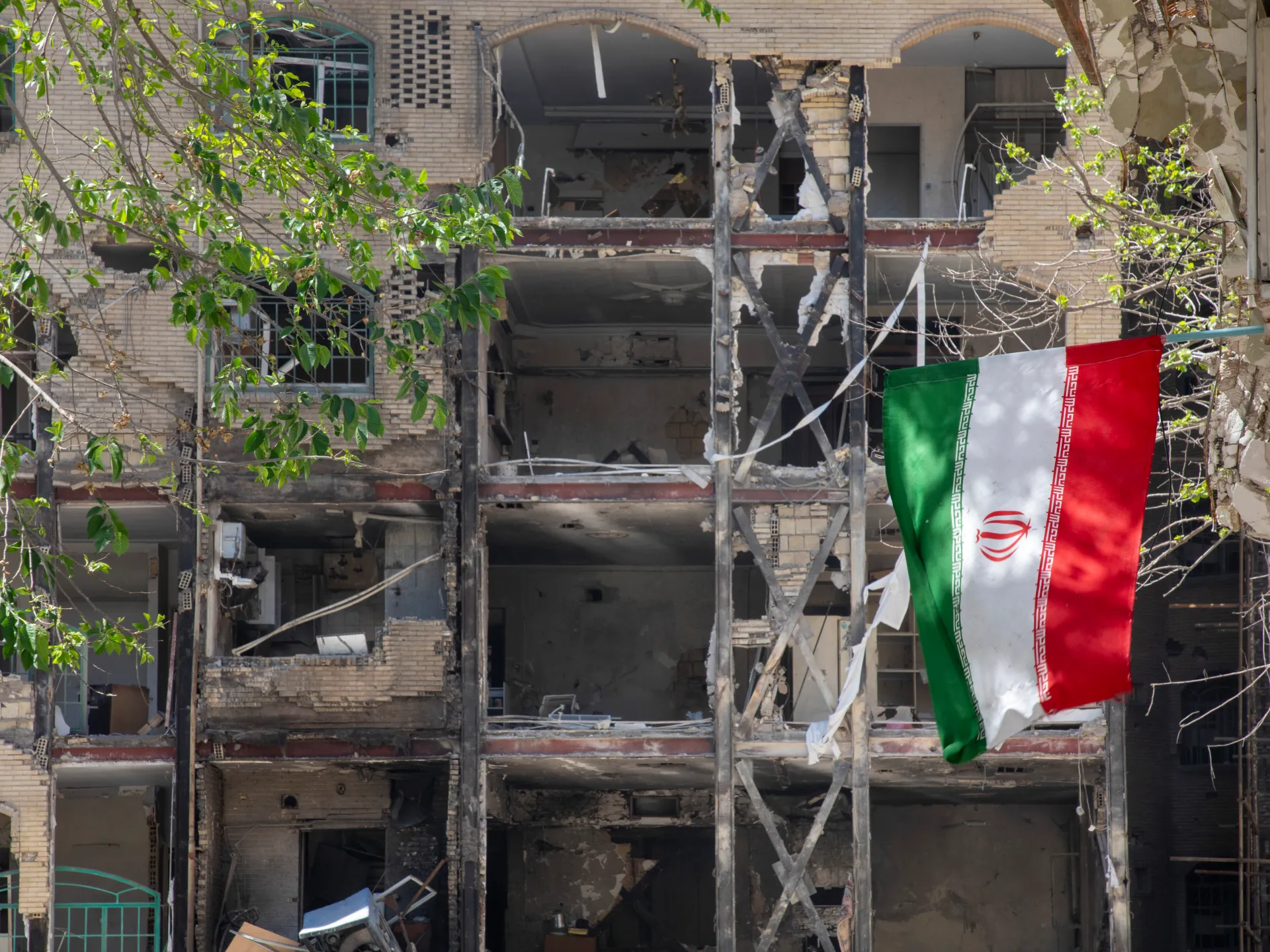
President Donald Trump sought to change several terms of a proposal to end the US-Israel war on Iran, according to media reports in the United States, as a finalised deal remains elusive.
The New York Times reported on Saturday that Trump’s changes involved toughening the deal terms, and the US has sent the new framework back to be considered by Iran, according to officials familiar with the proceedings.
Recommended Stories
list of 3 itemsend of list
The report said it was not immediately clear what the changes entailed. However, Axios reported Trump wanted to reinforce multiple points of the deal that he felt were important, such as what to do with Iran’s nuclear material.
A senior US official told Axios that Trump was informed it could take three days for Iran to respond.
“They’re literally in caves, and they’re not using email,” the official told Axios.
“There will be a deal. The imminence of it, we’ll see. We’re willing to wait so the president gets what he asks for. It could be a week. It could be less. It could be more. At the turn of the week, we hope to have something,” the official added.
The new tweaks could prolong negotiations between the parties for days before a decision is reached on whether the deal would end the war, which began after the US and Israel attacked Iran on February 28.
US sources told the AFP news agency that the proposal had been waiting on Trump’s sign-off, but he made no decision after a White House Situation Room meeting on Friday.
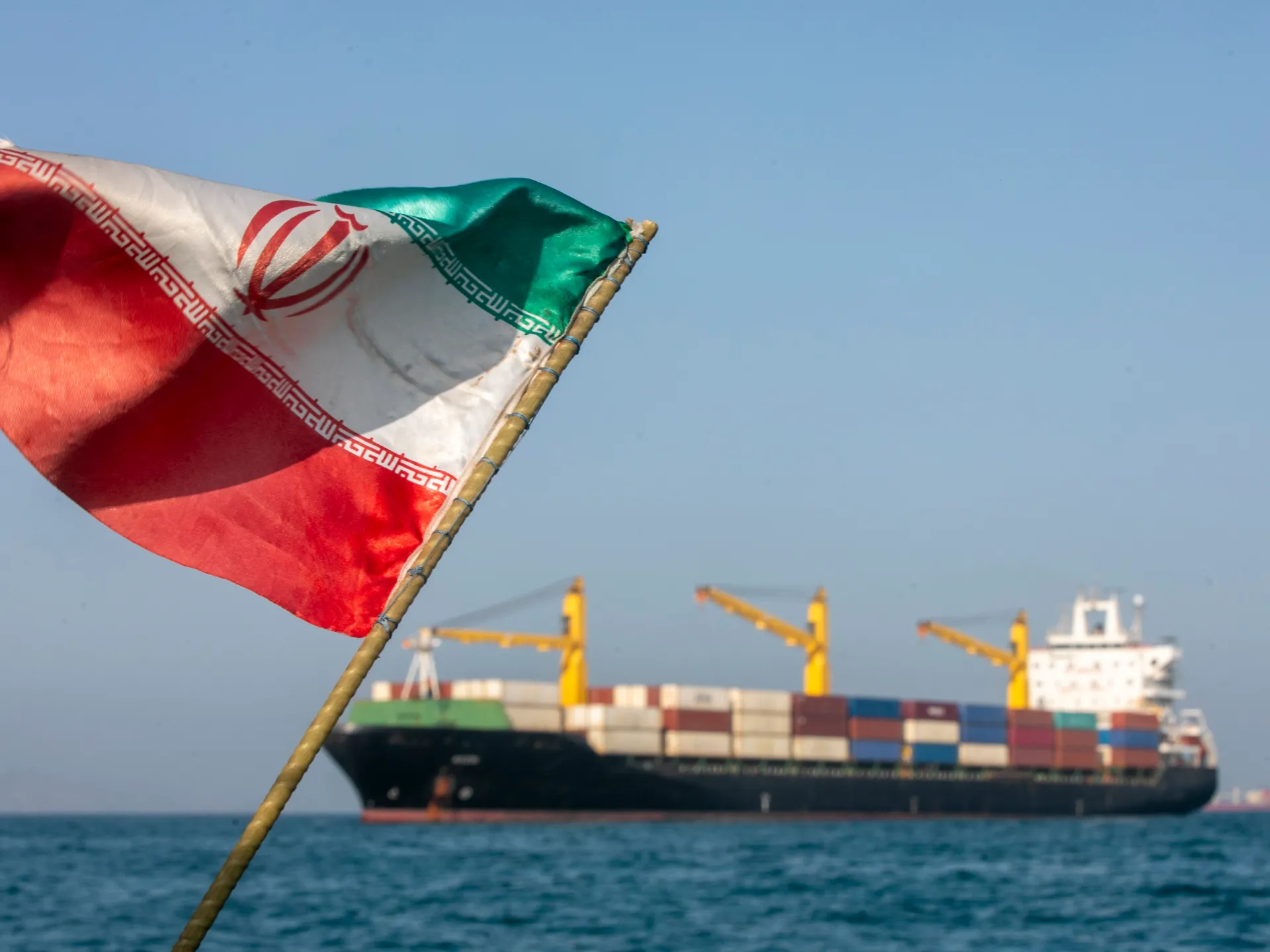
Trump has said his priorities for any deal included Iran agreeing to never develop nuclear weapons and the reopening of the blockaded Strait of Hormuz, through which roughly 20 percent of the world’s oil supply transits.
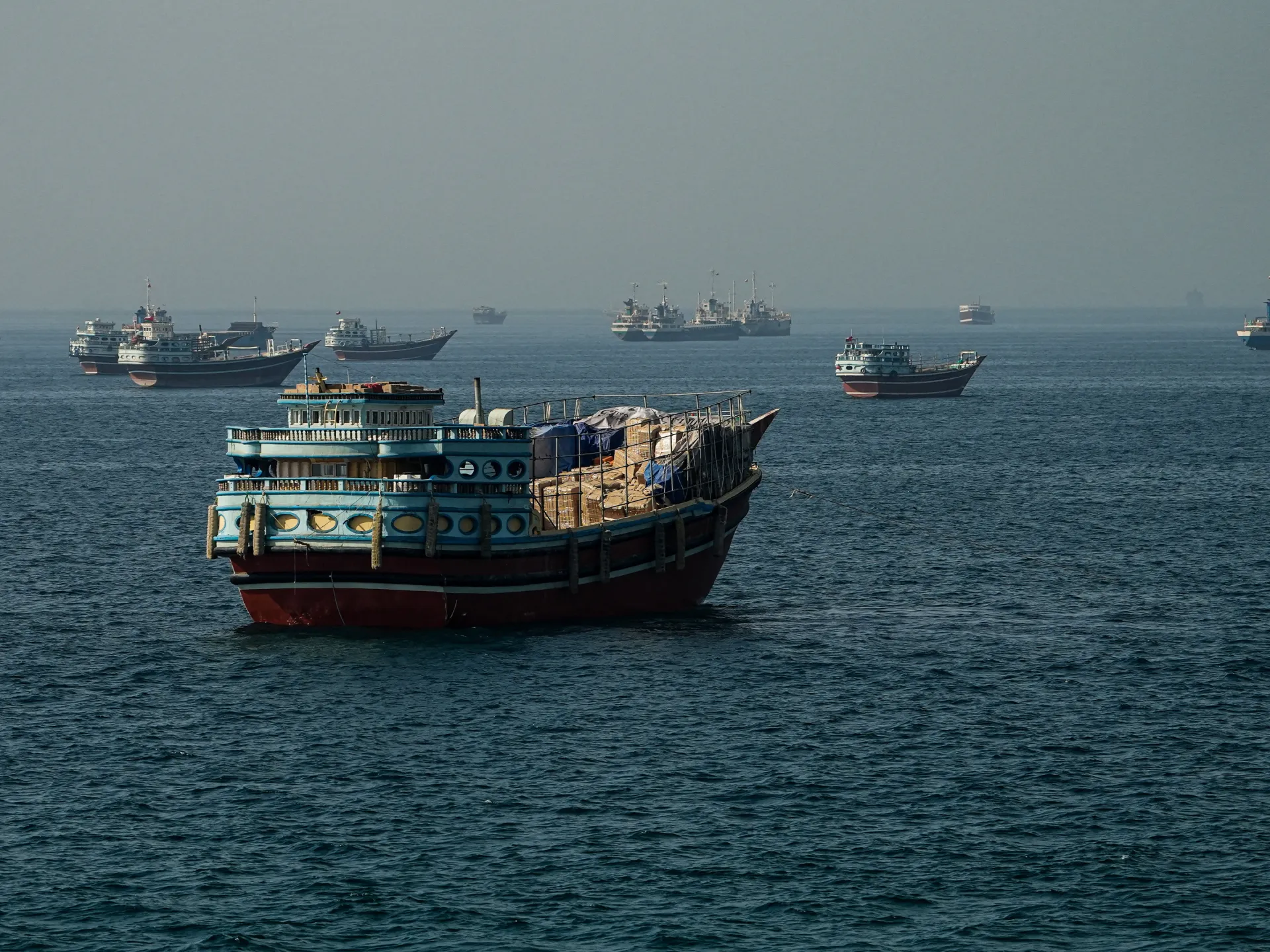
On Saturday, the Iranian military’s Khatam al-Anbiya Central Headquarters reasserted the country’s control over the strait, warning that foreign commercial and military vessels would be targeted if they did not comply with regulations governing passage through the strategic waterway.
Tehran has also said repeatedly that it does not intend to build nuclear weapons. In March 2025, Tulsi Gabbard, the former US director of national intelligence, testified to Congress that Washington “continues to assess that Iran is not building a nuclear weapon”.
Iran has reasserted its control over the Strait of Hormuz, warning that foreign commercial and military vessels will be targeted, if they do not comply with regulations governing passage through the strategic waterway.
The announcement on Saturday came after the United States signalled that President Donald Trump was close to a decision on a potential deal with Iran, but Tehran denied an agreement had been reached.
Recommended Stories
list of 3 itemsend of list
“The management of the Strait of Hormuz is exercised with full authority by the Armed Forces of the Islamic Republic of Iran,” the operational headquarters of Iran’s armed forces, Khatam al-Anbiya Central Headquarters, said in a statement reported by Iranian media on Saturday.
“All ships, commercial vessels, and tankers are only required to travel through the designated routes and obtain permission from the Islamic Revolutionary Guard Corps [IRGC] Navy. Any violation of these regulations will seriously jeopardise the security of their traffic,” it added.
Iran also issued a warning to foreign military forces operating in the area, saying any attempt to interfere with maritime management or shipping movements would trigger a response.
On Friday, Trump met with advisers in the White House Situation Room and said a “final determination” on a possible deal with Iran would soon be made. But no statement followed the meeting.
US sources had told the AFP news agency the deal was waiting on Trump’s sign-off, but he made no decision after Friday’s meeting.
Iran’s Foreign Ministry spokesperson, Esmaeil Baghaei, said on Friday that while messages continue to be exchanged “no final agreement has been reached” on a deal with the US.
US Central Command (CENTCOM) posted on social media that American forces “remain present and vigilant across the region”.
The efforts to reach a deal were thrown into question this week by US strikes on the Iranian port of Bandar Abbas, countered by retaliatory Iranian fire.
Iran’s IRNA state news agency said air defences shot down a drone “belonging to the US-Zionist aggressor enemy” on Saturday, citing a statement from the army.
Trump said his priorities in any deal include Iran agreeing to never develop nuclear weapons, and the reopening of the blockaded Strait of Hormuz.
“President Trump will only make a deal that is good for America and satisfies his red lines,” a White House official told AFP, adding: “Iran can never possess a nuclear weapon.”
Trump ‘betraying diplomacy’
Also on Saturday, Mohsen Rezaei, an adviser to Iran’s Supreme Leader, Mojtaba Khamenei, said in a social media post that Trump was “betraying diplomacy for the third time” by continuing the US naval blockade in the strait, and making what he described as “excessive demands in negotiations”.
In a social media post on Friday, Trump said Tehran would remove mines from the strait and end its closure of the waterway with “no tolls”, while the US would lift its blockade.
Both countries would coordinate on removing and destroying Iran’s enriched uranium, he said, adding that “no money will be exchanged, until further notice”.
Iran’s Fars news agency, however, cited sources as saying Tehran was demanding “the immediate release of $12bn” in frozen assets before moving to the next phase of negotiations.
On the toll-free reopening of Hormuz, the sources said “no such clause appears in the text of the agreement”, while Trump’s comment on destroying Iran’s nuclear material “is fundamentally baseless”.
Iran’s ISNA news agency cited legislator Alireza Salimi as saying a plan “to implement Iran’s management and sovereignty over the Strait of Hormuz will soon be approved by parliament”.
Iran’s Tasnim news agency said the US blockade remains in place, and its ships “are receiving warnings from CENTCOM to stop and not cross the blockade line”.
“Pressure,” the new World War II movie from director Anthony Maras and writer David Haig, is a hyperfocused look at the days leading up to D-day with a special focus on the weather. It’s a one-setting thriller that unspools in the pressure-cooker environment of General Dwight D. Eisenhower’s war room at an English country estate. The movie works backward from a famous 1961 Eisenhower quip to JFK that attributed his success in Normandy, France, to the Allies having “better meteorologists than the Germans.”
If you’re skeptical about how exciting a movie about the weather on D-day might be, “Pressure” takes that as a creative challenge, an argumentative stance from which to start. For the next hour and 40 minutes, Maras and co-writer Haig, who also wrote the 2014 play from which the film is adapted, explain to us exactly how important the meteorologists of D-day were, beginning with the disastrous D-day rehearsal Exercise Tiger.
With the weather app at our fingertips these days, it can be hard to imagine just how difficult it was to forecast the weather in the 1940s, especially in Northern Europe. That was the predicament facing Eisenhower (Brendan Fraser) just 72 hours before the planned D-day launch of June 5, 1944. But we know that D-day happened on June 6, so the arrival at that date is part of the film’s narrative intrigue.
After a devastating glimpse of Exercise Tiger, red blood mixing with blue ocean waves and white sandy beaches, we’re quickly introduced to our protagonist, Group Capt. Chief Meteorologist James Stagg (Andrew Scott), in his cozy home with his pregnant wife before he’s swept into critical war planning.
He’s stern, terse and no-nonsense. Stagg is the kind of person who wants to be correct more than he wants to be liked and he insists on a careful collection of live data, using weather balloons, phone calls and mathematical charting. His foil is Col. Irving Krick (Chris Messina), a charming American meteorologist and Eisenhower’s chosen weather guru, a yes man who relies on selective historical data and a persuasive speaker whose approach rankles the fastidious Stagg. Eisenhower instructs the two men to come to an agreement and “Pressure” follows the ups and downs of their working relationship over the course of several days.
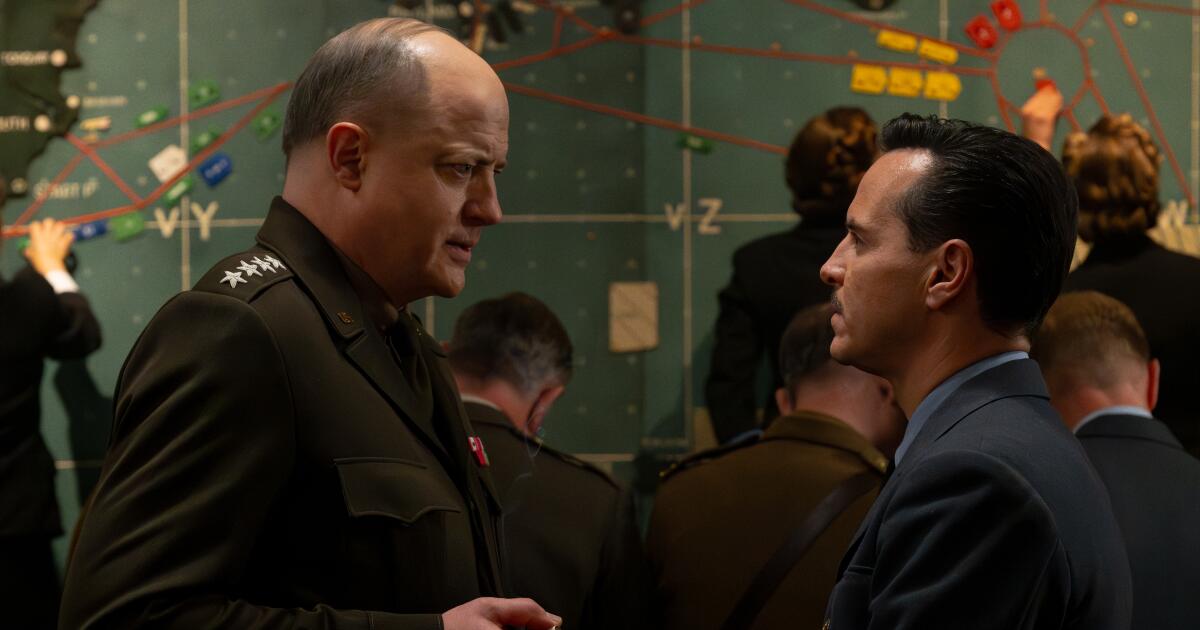
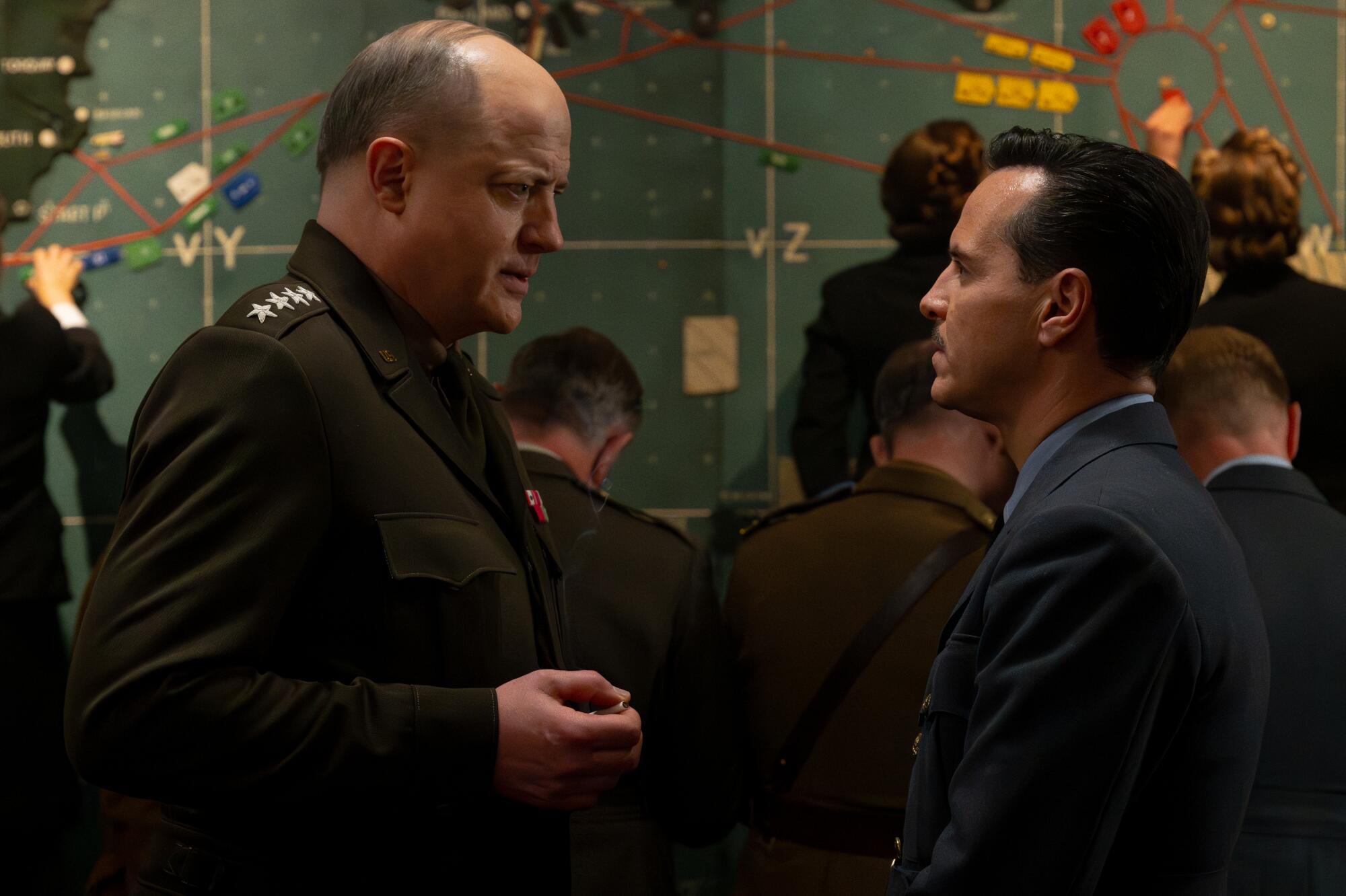
The movie becomes a two-hander between Scott’s Stagg and Fraser’s Eisenhower, the former convinced that a storm on June 5 will make conditions less than ideal, the latter raging at the uncertainty while simultaneously attempting to placate a phalanx of military personnel. The troops are requisitioned, the destroyers in place, the full moon just right, the secrecy of the invasion delicate. Fraser’s explosive performance underlines the immensity of the stakes, balancing every precarious element of this enormous mission.
Maras, who is known for another terrific one-setting thriller based on a true story, 2018’s “Hotel Mumbai,” both directs and edits and his films are put together like precision clockwork: propulsive and relentless, the pace italicized by Volker Bertelmann’s scores. “Pressure” is skillfully directed, sweeping us into this world with a kind of addictive immediacy, and is also beautifully lensed by cinematographer Jamie Ramsay. Maras and Ramsay make the wise choice to shoot the film with richly saturated color instead of the usual grayish, desaturated look often assigned to period pieces set in this era. It’s not gritty and harsh, but rather stunning and lovely — an eerie contrast to the terror and bloodshed of the day itself.
While Fraser delivers an external performance as the tough American general, Scott offers a restrained, mostly tamped-down depiction of the repressed and methodical Stagg. But when he finally bursts with a cathartic eleventh-hour speech about the inaccuracy of Krick’s historical forecast, Eisenhower listens. Scott, as seen in “All of Us Strangers” and “Blue Moon,” is so good at this kind of acting, processing every emotion internally but allowing just enough to show to let the audience into his character’s emotional state. It’s wildly compelling to watch.
In a quiet conversation with Eisenhower’s close confidant and aide, Kay Summersby (Kerry Condon), she jokes that weathermen are boring. Stagg reminds her that the weather itself isn’t. Weather feeds us, it can destroy us — it rules our existence, he says. “People ask, ‘When will the wind stop blowing?’ No one ever asks, ‘Why does the wind blow? What is the wind?,’ ” revealing himself as a sort of philosophical poet of the weather. His forecast was the crucial edge in D-day and the volatility of the weather is increasingly relevant in our lives, especially with our changing climate.
Boring? Never. Thrilling and history-making? Indeed.
Katie Walsh is a Tribune News Service film critic.
‘Pressure’
Rated: PG-13, for war violence, bloody images, some strong language, and smoking
Trump weighs next steps on Iran deal as Tehran insists negotiations are continuing and no final agreement exists.
Published On 30 May 202630 May 2026
Prospects for a US-Iran agreement to end the conflict remained uncertain on Friday, with President Donald Trump saying he would make a “final determination” on a deal, while Iranian officials stressed that no understanding had yet been reached.
Iran’s chief negotiator, Mohammad Bagher Ghalibaf, said Tehran would judge any agreement by actions rather than words, adding that no steps would be taken unless Washington acted first.
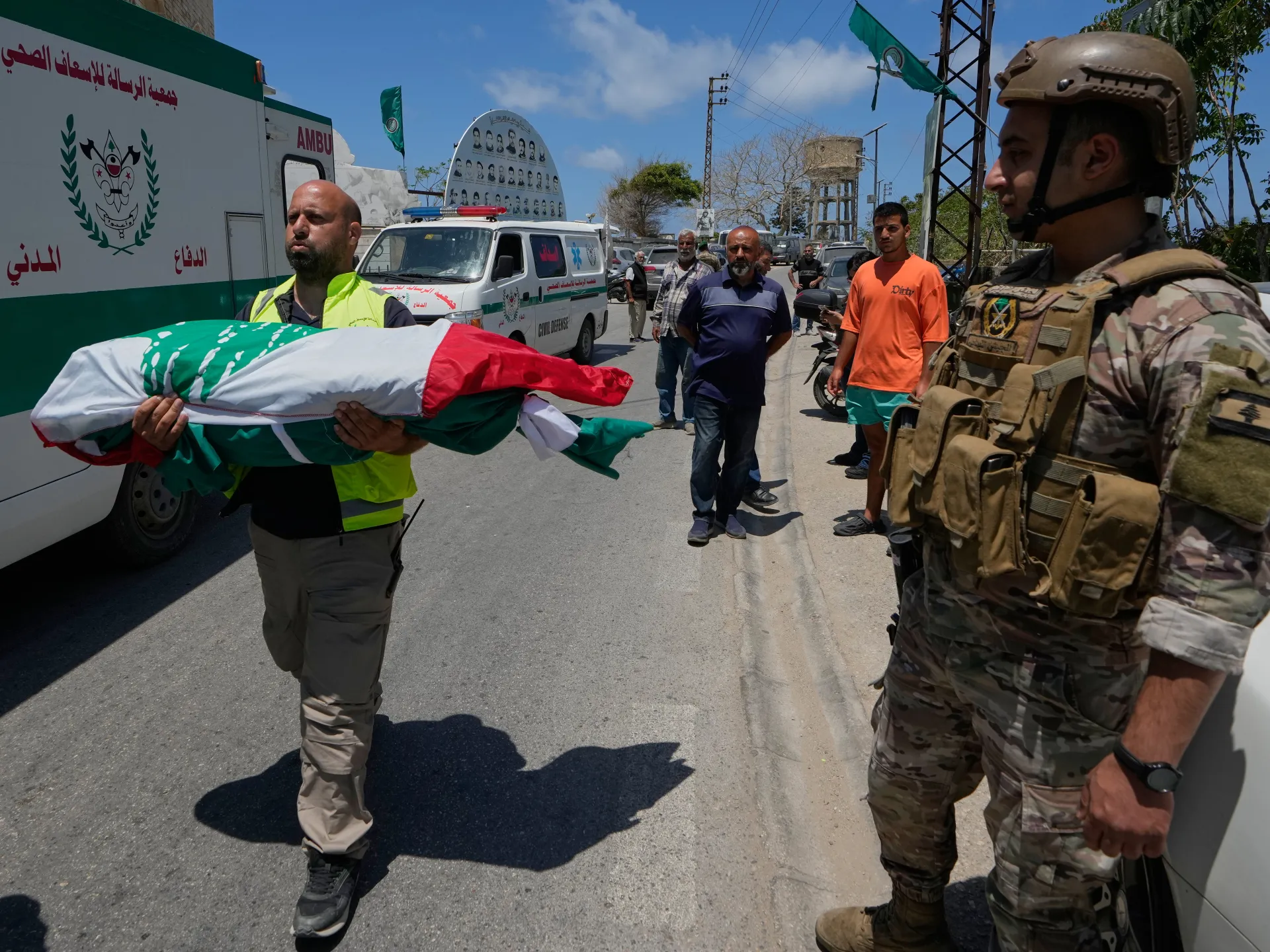
Meanwhile, fighting continued elsewhere in the region. Israeli Prime Minister Benjamin Netanyahu said Israeli forces had advanced beyond Lebanon’s Litani River, as Israeli attacks across Lebanon on Friday left dozens more civilians reportedly killed or wounded.
Here is what we know:
In Iran
Iran says talks continue, but no deal yet: Iranian Foreign Ministry spokesperson Esmaeil Baghaei said exchanges with the United States are continuing but stressed that no final agreement has been reached. He rejected Trump’s demands-based approach and described the US naval blockade as illegal, adding that Tehran would judge any easing of restrictions by actions rather than words.
War diplomacy
CENTCOM highlights ongoing regional patrols: US Central Command (CENTCOM) said its forces remain “present and vigilant” across the region, sharing an image of an F-16 fighter jet conducting a patrol over the Middle East.
US pushes allies to boost defence spending: Speaking at the Shangri-La Dialogue in Singapore, US Defense Secretary Pete Hegseth said Trump plans a $1.5 trillion investment in defence and described it as part of a historic expansion of America’s military-industrial base. Hegseth urged allies to spend at least 3.5 percent of gross domestic product (GDP) on defence, warning that countries that fail to do so could face changes in their relationship with Washington. He also reiterated that the US remains committed to preventing Iran from obtaining a nuclear weapon.
Washington praises Israel-Lebanon security talks: The US Department of Defense described military-to-military talks between Israeli and Lebanese delegations in Washington as “productive”, saying they focused on regional security and stability. The Pentagon also reaffirmed support for Lebanon’s sovereignty and territorial integrity.
In the US
Uncertainty remains after White House talks: Reporting from the White House, Al Jazeera’s Alan Fisher said there was still no clarity after Trump’s Situation Room meeting on whether a final agreement with Iran had been reached. Fisher said any easing of restrictions around the Strait of Hormuz could signal progress, but officials are still waiting for concrete details from the White House.
In Israel
Air raid sirens sound in northern Israel: The Israeli military said it intercepted several projectiles launched from Lebanon, while another landed near Kiryat Shmona in northern Israel. The military reported no casualties and did not specify whether the projectiles were rockets or drones.
In Lebanon
Netanyahu says Israeli troops have crossed the Litani River: Israel’s Netanyahu said Israeli forces have advanced north of the Litani River near Nabatieh, signalling an expansion of operations in southern Lebanon. The move comes amid ongoing Israel-Lebanon talks and could be followed by further strikes on Beirut and the western Bekaa Valley.
“House of the Dragon” Season 3 will see Rhaenyra Targaryen take back King’s Landing — but the war is far from over.
HBO on Friday released the final trailer for the upcoming season of its epic fantasy, which teases brutal battles, many dragons and the Targaryen queen returning to the capital of the Seven Kingdoms to claim the Iron Throne.
“I see you have been merciful,” Alicent Hightower (played by Olivia Cooke) says to her childhood friend (Emma D’Arcy) in the clip. “But the crown is a weight that crushes. You’ll do things that spell death for all involved.”
And if the trailer is any indication, there will be a lot of bloodshed in Season 3.
The second season of “House of the Dragon” left off with Rhaenyra and Alicent plotting for the former to take King’s Landing with minimal resistance in exchange for the latter’s freedom. Unfortunately, Alicent’s promised tribute — her son King Aegon II — has fled his castle so things won’t go exactly as planned.
After a slowburn of a second season, a higher octane Season 3 will kick off with the highly anticipated Battle of the Gullet, a fight at sea that is regarded as one of the bloodiest and most violent clashes in the history of Westeros. “House of the Dragon” showrunner Ryan Condal recently told Entertainment Weekly that the premiere is “arguably the craziest episode of television ever made.”
The new trailer shows that everyone will be reeling in the aftermath. According to the footage, what awaits Rhaenyra during her reign are fearful subjects, conniving enemies, sleepless nights and plenty of anguish.
The success of D-day, a pivotal moment in World War II, partially hinged on the weather forecast. The Allied invasion of Normandy, France, on June 6, 1944, was planned for months as the American and British forces held practice operations in England.
Enormous efforts were made to mislead the Germans about what was coming. The operation was originally scheduled for June 5 but the day before, James Stagg, a meteorologist and group captain in the Royal Air Force, advised the American commander, Dwight D. Eisenhower, to wait for better conditions.
This lesser-known decision is the premise of “Pressure,” a new movie from filmmaker Anthony Maras. It’s an adaptation of David Haig’s play of the same name, in which the playwright himself portrayed Stagg. Haig, who co-wrote the “Pressure” screenplay with Maras, compares it to “The Imitation Game.”
“Some of these heroes who affect history from the sidelines just stay in the sidelines until somebody does research, discovers them lurking and finds they are so quietly heroic that it’s irresistible as a story,” Haig says, speaking via Zoom from London.
Haig began writing a version of the script shortly after the play debuted at the Royal Lyceum Theatre in Edinburgh in May 2014. It moved to the West End in 2018, and opened in North America at Toronto’s Royal Alexandra Theatre in 2023. Maras came onboard after making his 2018 film “Hotel Mumbai,” also based on a true story.
“When I first read the play and the script, I was bowled over by how, with this one decision, so many lives were changed,” Maras says, on a video call from Los Angeles. “Not just the lives of the men on the beach but throughout the Allied world. When you think of a war story, you think of men and now women on the field, but there is so much more to it behind the scenes.”
The film expands Haig’s play and includes additional characters and sequences, including the actual D-day invasion. It stars Andrew Scott as Stagg, Brendan Fraser as Eisenhower, Kerry Condon as Eisenhower’s secretary Kay Summersby, Chris Messina as U.S. Air Force meteorologist Irving P. Krick and Damian Lewis as senior British army officer Bernard Montgomery.
Both Haig and Maras strove to be as historically accurate as possible, even including archival footage from the war. “It is inevitably heightened, as any stage play or film is,” Haig says. “But it is very true.”
“It is absolutely as true as we could get it within the confines of a two-hour runtime,” Maras adds. “We took great lengths to try and be as accurate to the history but also to the deeper story as possible.”
Here’s what is true and what is dramatized in “Pressure.”
The importance of the weather
Brendan Fraser, left, and Andrew Scott in the movie “Pressure.”
(Alex Bailey / Focus Features / StudioCanal)
D-day, secretly known as Operation Overlord, was timed based on several factors, including the weather, the tides and the moonlight. Because the assault was multipronged, with Allied forces coming by sea, land and air, they required good visibility at night and a high tide to ensure less distances between the boats and the defending Germans.
“There were hundreds of meters between low tide and high tide,” Maras says. “So depending on where the boats landed, you either had 50 meters until you made it to the dunes and then the bunkers, or you had to make it 300 meters if it was low tide.”
A clear forecast with low winds and no rain was essential.
“The landing craft were antiquated and flat-bottomed,” Haig says, “and if they had gone on May 5 with the storms that Stagg anticipated coming in with the jet stream, those landing craft would have capsized. The war wouldn’t have been lost, although we do posit that it might have been in the film. In reality, failure would have elongated [the war] and caused countless extra deaths.”
To shoot “Pressure,” the filmmakers used real charts and meteorological instruments. The production design team re-created the famous D-day map from the Allied headquarters in Southwark House. The real one was made in two pieces by separate manufacturers to ensure secrecy.
“When you see that map, it’s a little bit mismatched and our team re-created that,” Maras says. “We got the paper they used to draw the maps from the same mill they used for those maps 80 years ago. A lot of effort was put into the minutiae that adds to the accuracy.”
Exercise Tiger
The film opens with a depiction of an Allied training operation called Exercise Tiger, which took place over several months on England’s Slapton Sands. Because many of the soldiers were young and untested, the Allied leaders wanted to prepare them for the sights and sounds of battle.
“They did a whole series of exercises to try and get together a full-scale dress rehearsal of what D-day would be,” Maras says.
These rehearsals, still widely unknown and spanning from late 1943 through April 1944, involved dangerous friendly fire and suffered from serious coordination errors, resulting in the real-life deaths of at least 700 American and British soldiers.
“That was an absolute disaster and yet we remember D-day as one of the great military triumphs in history,” Haig says.
Maras wanted the film to begin with this moment to emphasize the headspace of the Allied leaders.
“How do you establish what the true consequences of failure are for a story like this?” Maras says. “When we’re in the war room with all of those commanders and officers, they know what the implications of their words mean because they’ve seen it. They’ve lived it. The image of the blood in the water and the young men in that water was to tattoo in the audience’s brain that if these commanders mess up, this could happen again.”
Eisenhower, in particular, felt the magnitude of D-day. “He wrote two letters on the eve of D-day: what happens in success and what happens in failure,” Maras says. “He was sleeping two hours a night. He was a nervous wreck.”
Stagg vs. Krick
In the film, Scott’s Stagg arrives at Southwark House from Dunstable four days before D-day is planned. He is confronted by the American meteorologist Krick, who disagrees with him about the potentially disastrous forecast. Krick believes sun and calm seas are on the horizon thanks to historical analogue charts, but Stagg, using more comprehensive prediction methods, thinks a major storm is coming.
“In actuality, Stagg came onboard in about November 1943 and got to Southwark House a few months earlier,” Maras says. “His transfer came a few months earlier, not a few days earlier. The contours of the relationships between Stagg and Krick and the others are accurate, but they took place in a more compressed timeline.”
Both Stagg and Krick have recounted their version of events in various books, both claiming they were right about the weather. Although Haig and Maras imagine their dialogue and how these conflicts may have played out, the conflicts were real.
“They both adhered to their own meteorological vision,” Haig says, explaining the differences in prediction models from continent to continent. “In the United States, Krick’s system of weather forecasting was viable. If you come to the U.K., you can’t rely on the weather for more than five minutes, so that method doesn’t apply.”
Adds Maras, “They thought, ‘The weather is going to be good. We should hold our nerve and go.’ There was a rhetorically violent disagreement between him and the others.”
In the film, Krick claims that he has never inaccurately predicted the weather ahead of a battle, using his successes in North Africa as evidence. This was technically true.
“He was very good at his job within the context of certain geographical landscapes,” Haig says. “He didn’t make a mistake in North Africa. When Eisenhower challenges Stagg, he says, ‘This man never got it wrong.’ And he didn’t. In the whole of the North African campaign, Krick was spot on.”
After Stagg convinces the leaders to postpone D-day, he is vindicated by a deluge of rain that arrives while everyone is attending church at Southwark House on June 5. There was a church on site, although this moment in the film was dramatized.
“Whether it began raining precisely at that moment I have my doubts,” Haig says. “But it has the framework of truth.”
Ike and Kay
Andrew Scott and Kerry Condon in the movie “Pressure.”
(Alex Bailey / Focus Features / StudioCanal)
Kay Summersby had been an ambulance driver during the Blitz. The film hints at a less-than-professional relationship between Eisenhower and his personal secretary. She was certainly with Eisenhower at Southwark House, although there is less evidence that she had any kind of association with Stagg.
“The biggest fictional thing I did with both the play and the film was to join the third point of the triangle so you’ve got Stagg, Eisenhower and Kay,” Haig says. “The link between Stagg and Kay historically would be tenuous.”
There are differing opinions about Eisenhower and Kay’s relationship. “We know that they were extremely close and they shared a trustful bond,” Maras says. “There are many photos of them together. She was definitely a big force in Ike’s life at that time, and we wanted to pay respect to that.”
“Whatever one’s interpretation of the relationships that she inhabits within the story, her influence was substantial,” Haig adds.
After seeing Peter Jackson’s 2018 World War I documentary “They Shall Not Grow Old,” Maras had the idea to use colorized archival footage in “Pressure.”
“In the D-day sequence at the end, there are various real-life shots of the soldiers landing on the beaches,” Maras says. “We were able to cut between the archival [material] and our footage to increase the scope. And it wasn’t just to get the scale. Yes, we have shots of massive flotillas and ships and trucks, but sometimes it was just for a glance of a soldier where you can see death in his eyes.”
The team ultimately acquired more than 50 hours of archival footage. They hired research editors to go through it and, after a few days, Maras asked if any of the editors could recommend additional crew to help.
Then a man named James Stagg showed up to work. “Stagg’s grandson, 80 years later, walked into our offices and helped edit the archival movie footage that we put in his grandfather’s film,” Maras says.
Stagg’s wife
Andrew Scott in the movie “Pressure.”
(Alex Bailey / Focus Features / StudioCanal)
The play doesn’t include scenes with Stagg’s wife, Elizabeth, but Haig purposefully bookends the film with the couple together. “When he arrives at Southwark House as a terse, brusque, tricky man, you’ve already experienced his level of affection with his wife and that’s really important contextually,” Haig says. “You’re waiting for the end when he goes back to see her and the baby.”
At the time when Stagg went to Southwark House, his wife was pregnant. Stagg was not allowed to make phone calls to her because of the secrecy surrounding D-day. In reality, the hospital where she gave birth was not bombed, as it is in the movie.
“The bombing of the hospital was more reflective of the times that Stagg and his wife had gone through in the lead up to D-day,” Maras says. “That element is to encapsulate that Stagg was fearing for his wife. As he walks down this corridor, he is faced with: Is she alive? Is she dead?”
Truth to power
Ultimately, Stagg tells a room full of military leaders that they have to pause on D-day because of the weather — a truthful inclusion. It was important to Maras to emphasize how he stood up to power.
“Here’s a protagonist who’s not afraid to speak his mind and has the courage to get up in front of a room full of the most powerful military on Earth at that point and tell them something they don’t want to hear,” Maras says.
“When Eisenhower was passing on the baton of leadership at the inauguration for JFK, JFK asked, ‘What gave you the edge on D-day?’ Eisenhower said, ‘We had better meteorologists than the Germans.’ He had the wisdom to trust in the experts. It’s worth heeding that lesson from history.”
Iranian Foreign Ministry Spokesman Esmail Baghaei told state media that a proposed agreement with the US “has not been finalised,” pushing back on US President Donald Trump’s claim that his administration was making a “final determination” on a potential deal with Iran.
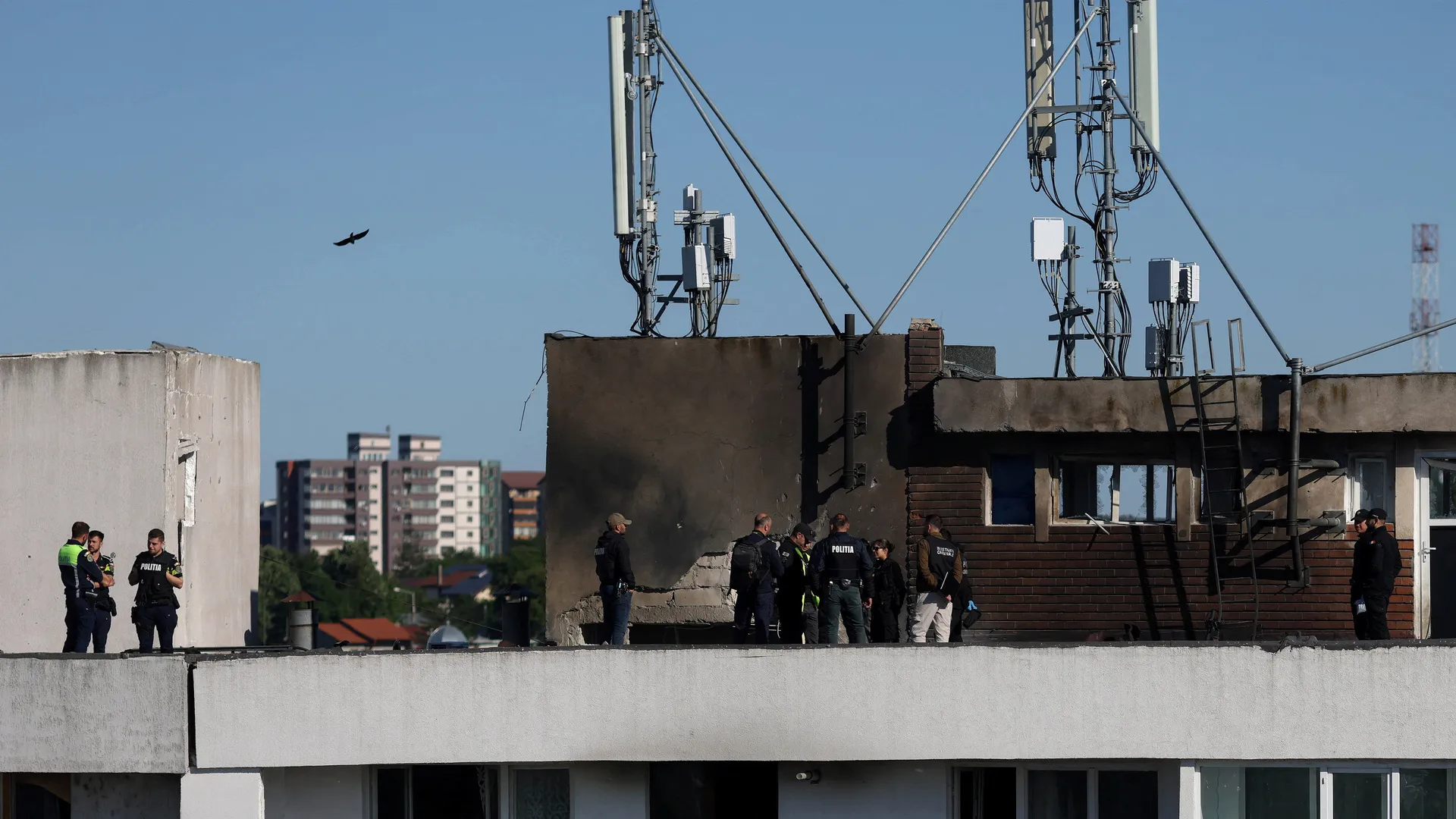
Romanian President Nicusor Dan says that the Russian consul in the southeastern city of Constanta will be expelled and the consulate shut down after a drone intended for Ukraine crashed into an apartment complex in the border town of Galati.
Deep mistrust remains between Washington and Tehran as Iran’s top negotiator urges action, not words.
Published On 29 May 202629 May 2026
United States President Donald Trump says he is meeting in the Situation Room to make a “final determination” on a possible deal with Iran that could extend the ceasefire and reopen the Strait of Hormuz.
However, deep mistrust remains between the two sides. Iran’s top negotiator, Mohammad Bagher Ghalibaf, said earlier on Friday that Tehran would judge any agreement by actions rather than promises as talks continue.
Recommended Stories
list of 3 itemsend of list
In his latest post on the Truth Social platform, Trump on Friday set out numerous conditions for Tehran to accept, including: never having a nuclear weapon or bomb, the Strait of Hormuz being open in both directions and without tolls, the removal of any remaining mines left in the Strait, and the US unearthing and destroying Iran’s enriched uranium that is buried.
“Ships caught in the Strait due to our amazing and unprecedented Naval Blockade, which will now be lifted, may start the process of ‘heading home!’” Trump wrote.
“No money will be exchanged until further notice. Other items, of far less importance, have been agreed to. I will be meeting now, in the Situation Room, to make a final determination,” he added.
Reporting from the White House, Al Jazeera’s Patty Culhane said that in the past, the Trump administration has indicated that a deal has been reached, only to find out it has not.
“If this was in fact a deal, it would be the entire wishlist of what the US was demanding and none of the concessions that Iranian were asking for,” she explained.
Uncertainty about the details of a memorandum of understanding (MOU) has grown over the past week amid ongoing distrust between the two sides as they seek to end the three-month-long war.
On Thursday, White House sources told Al Jazeera that the US and Iran had reached a tentative agreement to extend the ceasefire by 60 days to allow for formal negotiations, but Trump has yet to sign off.
Moreover, earlier on Friday, Iran’s top negotiator Ghalibaf said that Tehran did not trust “guarantees and words, only actions are the criterion”.
“No action will be taken before the other side acts,” he said in a social media post, without elaborating.
“The winner of any agreement is the one who is better prepared for war the day after,” the Iranian official added.
Still, Iranian state news outlet Fars, citing sources, reported on Friday that the agreement with the US was in its final stages of ratification, but no final decision has been made yet.
The sources stressed that there were no provisions about destroying Iran’s nuclear materials in the MOU and added that arrangements for the reopening of the Strait of Hormuz could include the monitoring and inspection of ships.
The eruption of the Middle East war in 2026, which began with strikes led by the US and Israel against Iran under Operation Epic Fury, carries devastating consequences for recovery, development and regional stability. The assassination of senior Iranian figures, most notably Supreme Leader Ayatollah Ali Khamenei, Iran’s closure of the Strait of Hormuz, the involvement of Hezbollah and Houthis in support of Iran, alongside Iranian attacks on neighbouring countries, further escalated the crisis. The war transformed from a military confrontation into a broader regional political, diplomatic and economic crisis.
While global attention focused on military escalation, oil markets and the Strait of Hormuz, far less attention was given to the war’s humanitarian consequences, despite the massive and irreversible impacts. The conflict has triggered new waves of displacement across an already fragile region. However, there were no meaningful strategies to protect or to facilitate aid efforts to sustain the lives of displaced people, further exacerbating the life-threatening risks facing affected populations.
The displaced of the 2026 Middle East war
The Middle East was already carrying one of the world’s largest displacement burdens before this escalation, mainly due to the Syrian, Palestinian, Afghan and Iraqi refugees and internally displaced populations. The recent war has deepened these vulnerabilities by displacing millions more across Iran and Lebanon. The speed and scale of displacement reflect the severity of the humanitarian crisis unfolding in the region, overwhelming already strained humanitarian response efforts.
In Iran, the war intensified existing economic fragility and internal tensions while placing enormous pressure on state institutions not only to govern but also to effectively respond to the displacement crisis, a critical condition to maintain stability and prevent further chaos.
The displacement of over 3.2 million people has posed a serious challenge for the Iranian authorities. It has affected over 20 provinces, while the damage of 82,000 civilian infrastructure sites, disrupted essential services and attacks on healthcare have severely undermined the living conditions of displaced people.
Although figures fail to precisely capture the devastating realities experienced by displaced populations, they reflect the scale of vulnerability facing civilians forced to flee amid insufficient aid efforts and collapse of health, shelter and education systems.
Lebanon presents an even more fragile case, already affected by protracted conflict, sectarianism, the Beirut Port explosion and economic paralysis. While it was already hosting 1.4 million Syrian refugees and around 250,000 Palestinian refugees, the war has now led to the internal displacement of 1.3 million Lebanese civilians—one in five of the total population— with children accounting for a third of those displaced. The large-scale and ongoing displacement in the country has generated enormous needs, detrimentally affecting various areas of civilian life. While over 3,000 have been killed and more than 9,000 injured, around 130,000 people remain displaced in collective shelters, experiencing extremely difficult conditions. The plight of displaced populations in Lebanon is worsened by ongoing attacks on healthcare, lack of services and the destruction of the housing sector, in addition to limited access to education, where hundreds of schools are either closed or used as collective shelters.
Humanitarianism subordinated to hard politics
Efforts have been made to address the needs of displaced communities. These include government-led actions in Iran to, for example, address psychosocial and shelter needs and the work of local organisations and international agencies in Lebanon. Yet such efforts remain far from adequate, mainly due to the absence of serious international political will to prioritise civilian protection and displacement prevention.
Instead, regional and international actors continue to prioritise deterrence, strategic alliances, military positioning and regional influence over humanitarian protection. By the end of April, the Pentagon had reportedly spent $25bn on its war on Iran, with other estimates showing greater costs—ranging between $630bn and $1 trillion—amid US President Donald Trump’s request for an additional $1.5 trillion for defence. This is evident in how the US paused a $14bn arms sale to Taiwan to ensure its military readiness to face Iran. Iran’s resilience against these attacks and the use of drones—costing tens of thousands of euros—have pushed the US to dedicate more resources to the war. The use of financial means from both sides solely for war objectives while overlooking the humanitarian responsibilities exposes the extent to which military objectives have been prioritised over humanitarian response.
Even ongoing diplomatic efforts between Washington and Tehran reveal the extent to which humanitarian concerns remain secondary and completely neglected. The peace negotiations have largely focused on issues related to hard politics. These include Iran’s nuclear programme, the reopening of the Strait of Hormuz and Iran’s frozen assets under US sanctions, with all these elements mainly addressing the security, financial and economic implications of the war.
The absence of the displacement crisis from peace agreements and negotiations reveals the deficiencies posed by the international human rights and humanitarian regimes. They underscore a reality where human lives continue to be shaped not by principles of protection, but by the strategic interests of powerful states.
This transformed the plight of affected populations in Iran and Lebanon from a humanitarian concern into a tolerated byproduct of geopolitical strategy.
Implications for future generations: The way forward
The humanitarian consequences of this war will not end when the war ends. Long-term displacement carries profound risks for future generations in Iran and Lebanon through collapsing health systems, interrupted education, intensifying social fragmentation and deepening poverty and dependency on international aid. Thus, the failure to protect displaced populations today risks producing future instability across the region. Addressing this requires tailored humanitarian interventions, international responsibility—especially from the US and Iran as the primary conflicting states—towards affected populations and the adoption of prevention strategies in future wars.
The international community, conflicting parties and international organisations must take practical yet realistic—acknowledging the centrality of self-interest during wars between states—steps towards addressing this issue. Without international responsibility sharing and collaborative efforts, the already-fragile international humanitarian system fails to continue functioning as the primary response mechanism, especially amid the growing humanitarian funding cuts due to the occurrence of other “national priorities”. Therefore, the US and Iran, alongside the international community, must dedicate resources to lead a comprehensive emergency response to alleviate the impacts of war on affected communities. This has to begin with protection-centred diplomacy, where the plight of displaced populations is prioritised among other key areas in the peace agreements.
Equally important is the stricter implementation of international legal frameworks to protect civilian populations during armed conflicts through accountability measures for violations against civilians. The role of international organisations and UN agencies is decisive in these matters, given their expertise and international positionality—though shrinking—when it comes to humanitarian missions and peacekeeping. Such efforts must revolve around promoting, integrating and imposing the adoption of humanitarian safeguarding standards for civilians in military and political decision-making. If displacement continues to be treated as collateral damage rather than political responsibility, the Middle East will keep producing generations of displaced people, serving the interests of regional and global powers.
The views expressed in this article belong to the author and do not necessarily reflect the editorial policy of Middle East Monitor.
New research from the European Central Bank suggests that the economic impact of the Iran war may be affecting euro zone consumers more deeply and rapidly than previous geopolitical crises, raising concerns about inflation, slowing growth, and long term economic uncertainty across Europe.
According to ECB economists, European consumers appear to be reacting more sensitively to rising prices and economic instability because many households are still psychologically affected by the financial stress caused by the Russia Ukraine war and the energy crisis that followed in 2022.
The latest conflict involving Iran, triggered after United States and Israeli airstrikes earlier this year, caused major disruptions to global energy supplies and reignited fears of another inflation shock throughout Europe.
ECB researchers found that consumers quickly became more attentive to price increases even while inflation remained close to the central bank’s 2 percent target. Economists believe this reaction reflects growing public anxiety over repeated geopolitical and economic disruptions.
Why It Matters
The findings raise serious concerns for Europe’s economic recovery because consumer confidence plays a critical role in spending, investment, and overall growth.
When households become highly sensitive to inflation and uncertainty, they often reduce spending, delay purchases, and increase savings out of caution. This behavior can weaken economic activity and slow recovery across key sectors including retail, manufacturing, housing, and services.
ECB researchers warned that Europe may now face the risk of a more persistent stagflation environment, where inflation remains elevated while economic growth slows simultaneously.
The Iran war also exposed Europe’s continuing vulnerability to global energy shocks. Despite efforts to reduce dependence on Russian energy after the Ukraine conflict, Europe remains heavily exposed to disruptions in global oil and gas markets.
Although oil prices have recently eased amid hopes for diplomacy, they surged sharply earlier this year during the height of the Iran conflict, intensifying inflationary pressure across the euro zone.
Key Stakeholders
Several major stakeholders are directly affected by the growing economic uncertainty surrounding the Iran war and Europe’s inflation outlook.
European Central Bank
The ECB faces increasing pressure to balance inflation control with economic stability. Policymakers are now widely expected to continue raising interest rates in an effort to prevent inflation expectations from becoming entrenched among consumers and businesses.
European Consumers
Households across Europe remain at the center of the crisis. Rising living costs, energy prices, and borrowing expenses continue placing pressure on disposable incomes and consumer confidence.
Businesses and Industries
European businesses, particularly energy intensive industries, face higher operating costs and weaker consumer demand. Continued uncertainty may reduce investment activity and slow hiring across multiple sectors.
Energy Markets
Global oil and gas markets remain highly sensitive to developments in the Middle East. Any renewed escalation involving Iran could rapidly push energy prices higher again, directly affecting inflation and economic stability in Europe.
Governments Across Europe
European governments may face growing political pressure if inflation remains persistent while economic growth weakens. Policymakers could be forced to increase public spending or introduce additional support measures for households and industries.
Future Outlook
The coming months are likely to become a critical period for the euro zone economy as European policymakers attempt to manage the combined effects of geopolitical instability, inflation concerns, and slowing growth.
Much will depend on whether tensions in the Middle East continue easing or whether new disruptions emerge in global energy markets. A stable diplomatic environment could help reduce inflationary pressure and restore consumer confidence gradually.
However, ECB researchers warn that the psychological impact of repeated crises may continue shaping consumer behavior long after energy prices stabilize. Many Europeans who experienced financial stress during the Ukraine war now appear quicker to react to fears of inflation and economic instability.
The ECB is therefore expected to maintain a cautious but firm monetary stance in the near term, with additional interest rate increases remaining highly likely.
If inflation remains elevated while economic growth weakens, Europe could face a prolonged period of economic stagnation combined with reduced consumer spending and higher borrowing costs.
The situation highlights how modern geopolitical conflicts increasingly influence not only energy and security policy but also consumer psychology, market behavior, and long term economic confidence across global economies.
US and Iranian negotiators have reached a memorandum of understanding on a proposed 60-day ceasefire extension, according to US sources, but the deal still requires President Donald Trump’s approval.
The United States has carried out strikes near Bandar Abbas, the second attack in less than a week on Iran’s strategically important port city, escalating tensions around the Strait of Hormuz despite a fragile ceasefire that has been in place between Washington and Tehran since April 8.
Reuters and The Associated Press, quoting unnamed US officials, reported that US forces shot down four Iranian drones and struck a ground control station for drones on Wednesday in Bandar Abbas.
Recommended Stories
list of 4 itemsend of list
The strikes followed explosions in Bandar Abbas on Tuesday. Iran’s Ministry of Foreign Affairs accused Washington of violating the ceasefire through “aggressive acts” in Hormozgan province, where the port city is located.
The semiofficial Iranian news agency Tasnim also reported that Iranian forces had fired on an “American airbase” in the region in response to a US attack near Bandar Abbas.
The escalation came after US President Donald Trump said during a cabinet meeting in Washington, DC, on Wednesday that “nobody’s going to control” the Strait of Hormuz as he spoke about ongoing negotiations between Tehran and Washington.
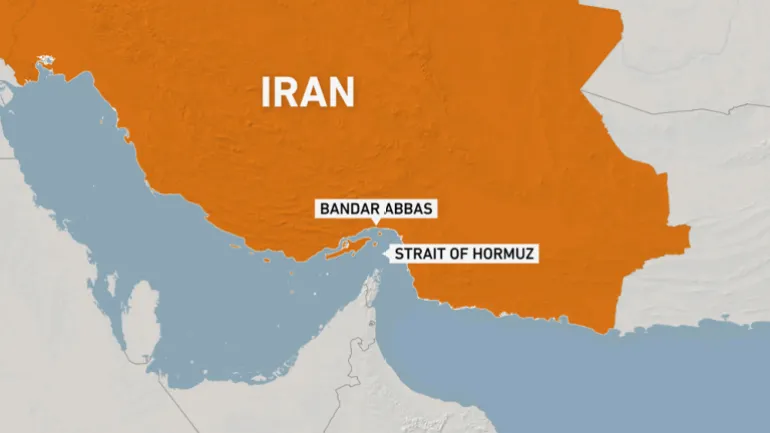
Bandar Abbas, home to key Iranian naval forces, occupies one of the most strategically sensitive positions in the Gulf. Its location on the Strait of Hormuz has made it central to both Iran’s military position and the wider confrontation with the US. Here is what we know:
Where is Bandar Abbas?
Bandar Abbas lies on Iran’s southern coast, on the northern side of the Strait of Hormuz, the narrow waterway linking the Gulf to the Gulf of Oman and Arabian Sea.
The city, which had a population of more than 526,000 people at the time of Iran’s 2016 census, sits roughly 60km to 70km (35 to 45 miles) north of the strait’s narrowest point.
Its position gives Iran oversight of one of the world’s most important shipping lanes. About one-fifth of global oil and gas supplies transit through the Strait of Hormuz during peacetime.
Since the ceasefire was announced on April 8, Iran has continued to control shipping through the Strait of Hormuz while US forces have imposed a blockade on Iranian ports.
What is the military significance of Bandar Abbas?
Bandar Abbas is the headquarters of both Iran’s conventional navy and the naval arm of the Islamic Revolutionary Guard Corps (IRGC).
The conventional navy has used it as its base since 1977 when Iran moved much of its fleet from Khorramshahr at the western edge of Iran’s Gulf coastline, to Bandar Abbas, transforming the city into the country’s main southern naval command centre.
According to the Middle East Institute, the IRGC navy later relocated its headquarters from Tehran to Bandar Abbas to improve operational control along the Strait of Hormuz.
Although Trump and Israeli officials claimed Iran’s naval capabilities have been heavily damaged in their recent attacks, Tehran still maintains a fleet of fast attack boats operated by the IRGC navy.
The vessels are designed for “swarm” tactics and are being used against commercial ships that do not have authorisation from Iran to sail through the narrow Strait of Hormuz. They were used recently against two Indian ships and two foreign container vessels, the Panama-flagged MSC Francesca and the Liberian-flagged Epaminondas, which Iran said had not been given approval to transit the waterway.
(Al Jazeera)
Why is Bandar Abbas important to Iran’s economy?
The Strait of Hormuz is not just a military chokepoint but also an economic lifeline.
Analysts estimated that more than 90 percent of Iranian crude shipments transit through the strait.
That makes Bandar Abbas and nearby Gulf infrastructure critical to government revenues, including the trade networks that help Iran circumvent sanctions, particularly by exporting oil to China.
Why are the US attacks significant?
Samir Puri, a visiting lecturer in war studies at King’s College London, told Al Jazeera the ceasefire has not yet formally collapsed despite these latest exchanges of fire.
He described those incidents as “limited” compared with strikes carried out before April 8. These attacks can be characterised as “tit-for-tat military-to-military engagements rather than attacks on infrastructure or widespread destruction en masse”, he said.
“What the US military is attempting to do is explore whether it can physically deny the IRGC and Iran the ability to control the Strait of Hormuz,” he said.
“Iran, of course, wants to show it cannot be denied that capability.”
What does this mean for peace negotiations?
Diplomatic and military operations are unfolding simultaneously as Iran and the US have exchanged a volley of proposals and counterproposals for peace since the ceasefire began.
“This is unfolding on parallel tracks. There is a military track and a negotiating track all unfolding at the same time,” Puri said. These limited strikes are, therefore, ultimately being launched as part of the negotiations, he said.
“The negotiators can only present the leverage they have from the field of battle. Is the US going to put itself into a position in which it can say to Iranian negotiators that they do not control the Strait of Hormuz? Because if you try to amass forces around Bandar Abbas and launch attacks from that coastal area, we can strike back.
“But Iran will not want to be pushed into that position and will want to say it retains the ability to strike shipping and US bases hosted by Gulf allies and partners. So that’s the duality that’s unfolding right now.”
Puri said both Washington and Tehran still appeared to have incentives to continue mediation but the two sides are approaching negotiations with very different objectives.
“Trump and the US administration want to impose a victor’s peace on Iran. Iran’s reading of the same script that they’re being handed is very different, and Iran probably wants to stretch out these negotiations for as long as possible without conceding.”
“So again, you end up in a situation that wars elsewhere have seen – negotiations without an endpoint or even the promise of an endpoint but still an incentive for both parties to participate, for now.”
Markets betting a deal will reopen the Strait of Hormuz and soothe the deep global economic uncertainty cast by the closure of the vital oil & gas route.
Published On 27 May 202627 May 2026
The United States stock market has been hovering near record highs and oil prices have plunged amid new hope that a ceasefire deal between the US and Iran is close.
The rally came on Wednesday as negotiations continued between Washington and Tehran, with markets betting that a deal would reopen the vital Strait of Hormuz, easing oil and gas supply concerns and soothing the deep uncertainty afflicting the global economy.
Recommended Stories
list of 3 itemsend of list
Oil prices declined sharply after Iran’s state broadcaster said it had obtained a preliminary document outlining a framework for a potential deal.
The price of US crude fell 5.5 percent to settle at $88.68, while Brent crude, the international oil benchmark, decreased to $92 after prices traded above $100 last week.
The report suggested that Iran would allow traffic through the strait at pre-war levels within 30 days. It added that the US would lift its naval blockade on Iranian ports.
Prices remained subdued even after the White House dismissed the report as a “complete fabrication”.
The S&P 500 rose 0.1 percent and added to its all-time high set the day before. The Dow Jones Industrial Average was up 243 points, or 0.5 percent, with an hour remaining in trading, and the Nasdaq composite was 0.1 percent higher.
Wednesday is far from the first time markets have rallied amid reports of a possible end to the war, only to slump once more as negotiations fail to deliver a resolution.
However, the strength of the current surge reflects statements over the past week that suggest the two parties may be closer than ever to reaching a deal.
President Donald Trump said during a cabinet meeting on Wednesday that US officials were not yet satisfied with the agreement, “but we will be”.
“I think they’re starting to give us the things that they have to give us,” he said. “And if they do, that’s great, and if they won’t, then the man on my left will have to finish them off,” he said, pointing at Defense Secretary Pete Hegseth.
Sticking points
It remains unclear whether the two parties have come to an understanding on the major sticking points, including the fate of about 440 kilogrammes (970lbs) of highly enriched uranium; Iran’s nuclear infrastructure, which the US has long insisted it wants to see dismantled in its entirety; Tehran’s ballistic missiles and its support for armed groups in the region.
It is also not clear whether a halt in hostilities in Lebanon would be part of a deal. Iranian officials have repeatedly said that any agreement would have to include that. However, Prime Minister Benjamin Netanyahu this week ordered the Israeli military to step up its attacks against Hezbollah.
There are also questions on whether Washington would agree to lift its sanctions against Iran and release millions in frozen assets.
Eid al-Adha, one of the most important dates in the Islamic calendar, comes at a critical time for Iranians this year.
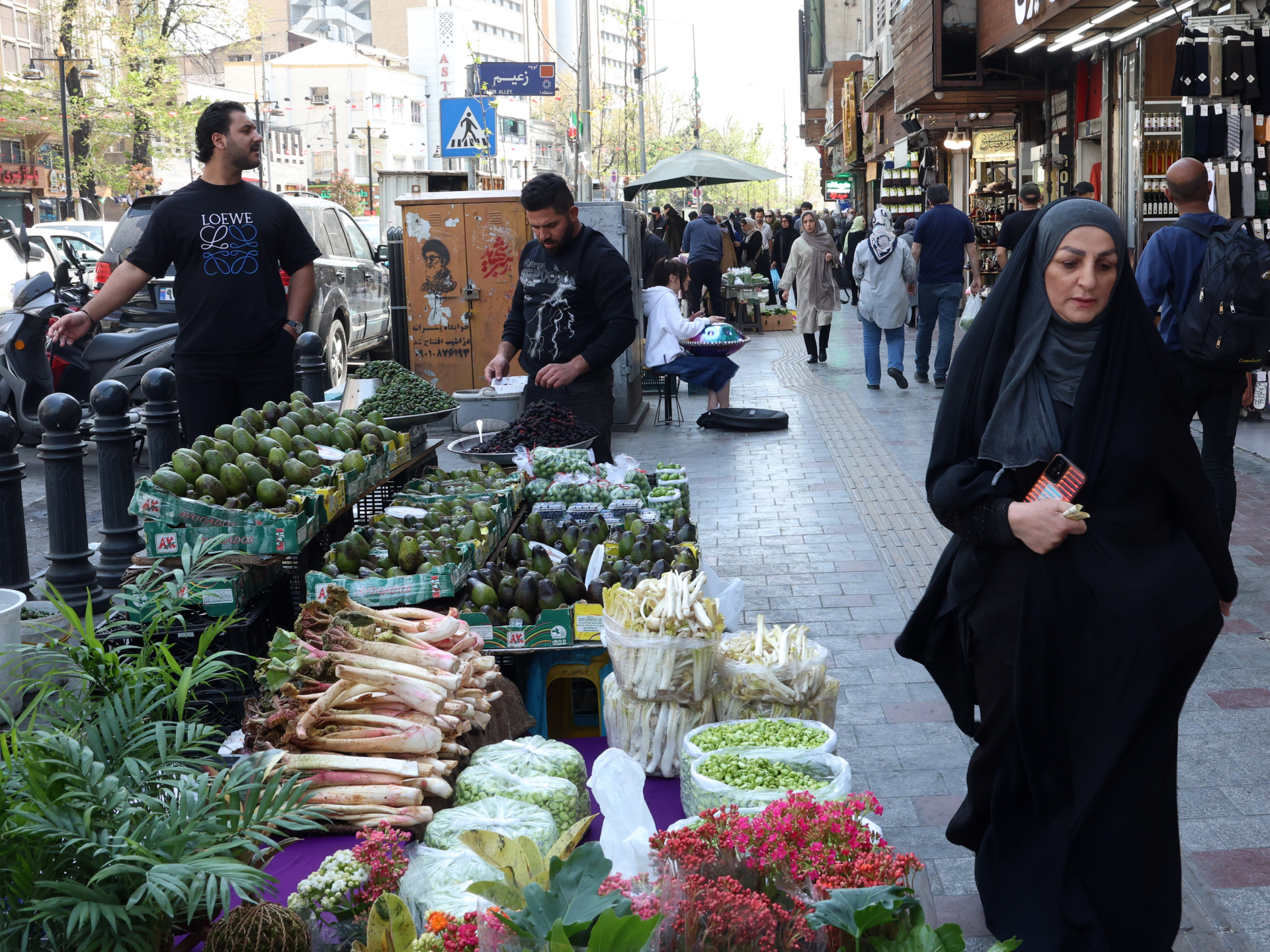
Meat from sacrificed animals is often eaten at Iranian tables, but a blockade on Iranian ports and sanctions by the US has led to escalating costs across the country.
Unlike Nowruz, the Persian New Year, Eid al-Adha is not as widely celebrated in Iran, but mosques and other institutions still observe the ritual of animal sacrifice, known as qurbani, through authorised livestock and slaughter centres.
Here, animals are sacrificed according to Islamic law in a hygienic environment. But another goal of the network is to control runaway inflation by offering meat at lower prices than market rates.
Meat substitutes
A Tehran municipality body announced on Tuesday that each kilogramme of sacrificial meat would be sold at 7.4 million rials ($4.30) at designated shops.
The price for a similar cut on the market can be more than three times that, depending on its quality and the location of the butchers. The minimum wage is currently less than $100 per month in Iran.
“I usually buy meat for a stew or a few dishes around every three weeks; for some families in the neighbourhood, it has become a sort of luxury,” said a middle-aged woman, who lives with her husband and son in Tehran.
She told Al Jazeera that chicken, eggs and legumes have become replacements for red meat, but the costs of these staples have significantly increased, too.
Masoud Rasouli, a meat-packing industry representative, told the state-linked Mehr news agency earlier this week that demand for red meat has decreased by 50 percent compared with last year.
He said some meat was imported to counter any effects of the US blockade, but local demand is currently so low that “existing livestock population is enough for all the needs of the market”.
Data released by the state-linked Iranian Labour News Agency this week showed that the current cheapest government-announced price for one kilogramme of meat during Eid is equal to the price of a 50kg live sheep 10 years ago.
According to the Statistical Center of Iran, year-on-year inflation stood at more than 73 percent in the first month of the Persian calendar year that ended in late April.
Iranian rice was up by 173 percent and chicken by 191 percent in that month compared with a year before, while liquid cooking oil more than quadrupled. Figures for the next month are expected to be worse.
Controlling inflation
Price-control measures – which have been implemented by authorities to fight a decade of rampant inflation – have been unable to adequately compensate for the ever-decreasing purchasing power of Iranian households living under local mismanagement and US sanctions – and now war and a blockade.
A young man working at a butcher shop in southwestern Tehran said they have had to increase prices several times over recent months after suppliers announced hikes.
“Our sales were a bit higher today because of the Eid, but we see even our most frequent customers far less these days. Most of the conversations with the customers are about the prices,” he told Al Jazeera.
Iran and the US have been holding negotiations through regional mediators to potentially end the war. But amid exchanges of fire and inflexibility over demands, no breakthrough has emerged even as both sides say a memorandum of understanding has mostly been negotiated.
Religious messaging
Beyond greetings and congratulatory phone calls with regional peers, Iranian authorities also used the Muslim festival this year to issue political messages.
On Wednesday morning in the capital, the authorities organised a large prayer to mark Eid at the University of Tehran, which was led by ultraconservative Ayatollah Ahmad Khatami.
He said that “submitting to humiliation” is an example of “evil” and the height of vice, at a time when he believes the other side, the US, seeks a surrender from Iran.
“Your enemies, the Iranian nation’s enemies, and this mad enemy sitting in the Black House – which is wrongly referred to as the White House – want your humiliation. But this madman will take that wish to his grave,” he said about US President Donald Trump.
Khatami, a member of the powerful Guardian Council and the clerical Assembly of Experts, also praised the supporters of the government who have taken to the streets every night for almost three months and said this “unprecedented” phenomenon would be repeated on the nights of Eid al-Adha.
President Masoud Pezeshkian had a relatively softer approach, but his comments were still laden with religious symbolism.
“In today’s turbulent world, where the fire of tyranny, occupation, and the arrogance of the hegemonic powers burns bright, Eid al-Adha conveys the message of dignity, liberty, and fearlessness in the face of the pharaohs of our time,” he said.
Foreign Minister Abbas Araghchi said in a message on Wednesday that he hoped for harmony in the Muslim world, amid this difficult time for the region.
“We pray that, by the auspiciousness and blessing of this great Eid, we will witness the deepening and strengthening of Islamic solidarity for cooperation and mutual assistance in confronting war, discrimination and occupation, especially in the West Asia region, and that our world will return to the path of reviving peace and justice,” he said.
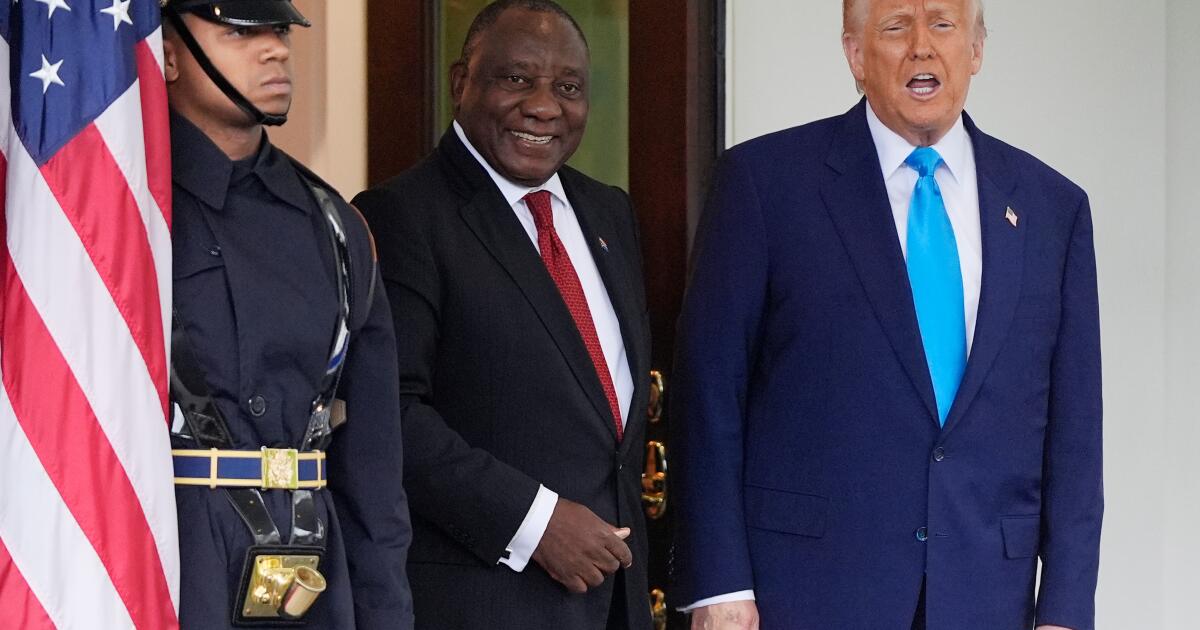
JOHANNESBURG — The government in South Africa and Afrikaner advocacy groups on Wednesday rejected the position of the Trump administration that there’s a humanitarian emergency affecting white people in South Africa.
The argument served as the rationale for raising the U.S. refugee cap, but only for white Afrikaners. The Trump administration said Tuesday that it will admit an additional 10,000 white South Africans into the U.S. as refugees this year, increasing its annual cap, but blocking people from other countries from entering through the program.
President Trump’s announcement on the Federal Register that he was increasing the refugee cap because of “an unforeseen emergency refugee situation.” He blamed the South African government for “recent increases in the incitement of racially motivated violence,” but Trump gave no specific information.
The South African government’s international relations department said Wednesday that accusations of systemic persecution of white Afrikaners are unfounded, pointing out that some beneficiaries of an immigration program have chosen to return to South Africa.
“This reality is further corroborated by the actions of individuals who, despite having availed themselves of this preferential immigration program, have since resolved to return home,” spokesman Chrispin Phiri said.
Afrikaner trade union, Solidariteit, argued that refugee status isn’t a viable solution for Afrikaners, who should thrive in South Africa instead. Spokesman Jaco Kleynhans said that the organization hadn’t discussed any “unforeseen emergency refugee situation” with the Trump administration, but respects the autonomy of U.S. refugee policy toward Afrikaners.
The union “is in no way aware of anything that the Trump administration could be referring to,” Kleynhans said.
AfriForum, a lobbying organization for the country’s white Afrikaner minority with more than 300,000 members, said it “does not have information” regarding the specific assertion that there’s an emergency refugee situation.
The organization’s CEO, Kallie Kriel, said the group’s focus is “fighting to create the circumstances in South Africa where there is no need for Afrikaners to leave.”
Trump suspended the U.S. refugee program on his first day in office and, since then, has turned it into a vehicle to allow Afrikaners — a group of white South Africans descended mainly from Dutch settlers — into the United States. Advocates say the decision to focus a decades-old program on one group has left people around the world fleeing war and strife stranded and with few options.
Refugee groups have questioned why white South Africans are being prioritized ahead of people from countries facing war and natural disasters. Vetting for refugee status in the U.S. often takes years.
The Trump administration’s preference for white Afrikaner refugee admissions, according to Dr. Bryony Fox, a social justice researcher at Stellenbosch University, raises questions about selective humanitarianism, inconsistent refugee protection and favoring privileged groups, while ignoring other refugee populations experiencing severe hardships.
“This risks politicizing refugee protection in a way that may ultimately weaken the legitimacy and universality of the refugee regime itself,” she said.
Iranian and US forces have continued to exchange strikes despite an April ceasefire, fuelling tensions across the Gulf and the Strait of Hormuz, while raising fears the fragile truce could unravel as mediation efforts continue in Doha.
On Monday, the United States Central Command (CENTCOM) said it carried out new strikes on southern Iran, targeting missile sites and boats allegedly attempting to place naval mines. It said the attacks had been carried out in “self-defence” to protect US troops from threats posed by Iranian forces.
Recommended Stories
list of 4 itemsend of list
On Tuesday, the Islamic Revolutionary Guard Corps (IRGC) said it had downed a US drone and fired at a jet and another drone that entered Iranian airspace, according to state media. Iran also said it retained the “legitimate and definite” right to respond to any violations of the ceasefire.
Since a temporary ceasefire was announced on April 8, Iran has continued to control shipping through the Strait of Hormuz, through which one-fifth of the world’s oil and natural gas supplies are shipped in peacetime, while US forces have enforced a corresponding blockade on Iranian ports. Negotiations for a long-term ceasefire are ongoing, but repeated military flare-ups in the meantime underscore the deep mistrust between the two sides, experts say, as Iran and the US jostle for leverage amid a back-and-forth of peace proposals from both sides.
Here is what has happened since the ceasefire:
April 8: Ceasefire announced after 40 days of war
The US and Israel launched strikes on Iran on February 28, as negotiations between Washington and Tehran progressed via mediators, amid claims that Iran was developing nuclear weapons. While the US and Israel provided no evidence to support their allegation, Iran continued to deny. It responded with missiles and drones targeting Israel and US military and infrastructure assets in the Gulf region and the wider Middle East.
On April 8, following mediation by Pakistan, the two sides agreed to a two-week pause in fighting to allow for further negotiations. Delegations from both countries met in Islamabad on April 11 and 12, but failed to reach a broader agreement, with draft proposals exchanged through Pakistani mediators in an attempt to end the conflict. The ceasefire was extended to allow for more proposals to be exchanged.
At least 3,468 people – aged between eight months and 88 years – have been killed in US-Israeli attacks on Iran since February 28, according to its Ministry of Health. They included seven infants, 376 children and 496 women.
At least 26 Israelis have been killed and 7,791 wounded in Iranian attacks, while the US military has confirmed 13 combat-related deaths across the region. Dozens of people were also killed in the Gulf countries. Lebanon remains the worst hit in the region, where, despite a ceasefire, Israel continues to carry out attacks amid its ground invasion. More than 3,200 people have been killed, according to the Lebanese Ministry of Public Health.
April 10: Kuwait accuses Iran of drone attacks
The ceasefire faced near-immediate strain when Kuwait said seven drones entered its airspace on April 10. It accused Iran and allied armed groups of the attacks.
Kuwait’s Ministry of Foreign Affairs condemned what it described as violations of its sovereignty and airspace. Separately, the US Department of State accused Iran-linked armed groups in Iraq of launching attacks from Iraqi territory. However, Iran denied any role in the attacks, saying it had not targeted any Gulf country since the ceasefire began.
April 12: US naval blockade deepens tensions
Four days into the ceasefire – and following the collapse of direct talks in Islamabad – the US announced a naval blockade targeting maritime traffic entering and leaving Iranian ports, after talks mediated by Pakistan collapsed. The US argued that Iran had benefitted from continuing to export oil, while the Strait of Hormuz was closed to nearly all other shipping.
The blockade formally came into effect the following day, although Washington said vessels travelling to non-Iranian ports would be allowed past.
Iran condemned the move as “illegal”, warning that ports in the Gulf region would not be safe if Iranian ports were threatened.
The blockade came after Iran tightened its control over shipping in the Strait of Hormuz, restricting some foreign ships while allowing passage to countries it viewed as friendly.
The International Maritime Organization has said no country has the right to block shipping in international transit straits.
April 18-22: Ship seizures, attacks at sea
On April 18, Iranian forces fired on two Indian ships in the Strait of Hormuz, which it said did not have permission to pass.
Maritime tensions escalated further on April 20, when US forces seized an Iranian container ship near the Gulf in a move Iran described as an “act of piracy“. CENTCOM and US President Donald Trump said the vessel, the Iran-flagged Touska, had ignored orders to withdraw from its route through the Strait of Hormuz.
Days later, on April 22, the IRGC fired on three ships in the strait and seized two foreign container vessels, the Panama-flagged MSC Francesca and the Liberian-flagged Epaminondas, saying they lacked authorisation to transit the waterway.
The incident came the day after Trump extended the ceasefire while maintaining the US naval blockade on Iranian ports.
May 4: UAE refinery fire blamed on Iran
On May 4, the United Arab Emirates accused Iran of launching missiles and drones at the country, triggering a fire at an oil refinery in Fujairah and wounding three Indian nationals.
The UAE said its air defences had intercepted 12 ballistic missiles, three cruise missiles and four drones launched from Iran. Abu Dhabi condemned what it described as “unprovoked Iranian attacks” on civilian infrastructure.
The UAE said the attacks were the first on its territory since the ceasefire had commenced on April 8. The strikes came as Trump launched a new effort to escort stranded oil tankers through the Strait of Hormuz, much of which had remained closed since the war began.
Iran’s military warned commercial vessels against accepting US escorts and threatened to attack if they entered the strait. Trump abandoned the effort after one day.
May 14: Commercial vessels targeted again
On May 14, an Indian cargo ship transporting livestock from Africa to the UAE sank off the coast of Oman, while the United Kingdom Maritime Trade Operations reported that “unauthorised personnel” boarded another vessel near Fujairah and redirected it towards Iran.
India condemned the attack, saying commercial shipping and civilian sailors continued to be targeted despite the ceasefire.
May 17: Drone strike close to UAE’s Barakah nuclear plant
A drone strike has sparked a fire on the perimeter of the Barakah Nuclear Energy Plant in the United Arab Emirates (UAE), raising new concerns over a potential new regional escalation amid a fragile ceasefire between Iran and the United States.
Authorities in Abu Dhabi said the blaze broke out at an electrical generator outside the plant’s inner perimeter in the Al Dhafra region on Sunday. No injuries were reported, and officials said radiation levels remained normal. The UAE did not specifically blame Iran, but said the drones had been launched from the “western border”.
May 17: Drones intercepted in Saudi Arabia
Saudi Arabia also said it intercepted three drones fired from Iraqi airspace. The Saudi defence ministry said it would take “necessary operational measures” in the event of any attempt to violate its sovereignty and security.
Talks continue despite distrust
Diplomatic efforts to secure a broader peace agreement are continuing. Senior officials from Iran travelled to Qatar this week for negotiations aimed at ending the US-Israel war on Iran, with discussions reportedly focused on the release of frozen Iranian assets.
Iran is also seeking sanctions relief for its oil and petrochemical exports during a proposed 60-day period to hold talks about its nuclear programme. A further proposed 30-day timeframe would see the US lift its blockade of Iranian oil ports while Tehran restores commercial shipping through the Strait of Hormuz.
Tehran is also seeking guarantees related to a ceasefire in Lebanon, where Israel continues to strike and occupy towns and villages in the south of the country. Meanwhile, Trump is reportedly attempting to link the negotiations to efforts for Saudi Arabia, Qatar and Pakistan to normalise ties with Israel under the Abraham Accords.
Analysts say any agreement remains politically sensitive, with deep distrust persisting as all sides seek leverage to secure a deal they can present domestically as a victory.
Tehran, Iran – “The fundamental principle is distrust towards America” – this is how senior lawmaker Abbas Moghtadaei described the situation to state television on Tuesday afternoon.
It came after an Iranian delegation, led by Parliament Speaker Mohammad Bagher Ghalibaf, returned to Tehran from Qatar amid efforts to reach an understanding with the United States on ending the nearly three-month-long war on the country.
Hours earlier, the Ministry of Foreign Affairs accused Washington of committing a “blatant violation” of the shaky ceasefire reached on April 8 by attacking the southern province of Hormozgan on Monday night. It added that the strikes validated the “deep suspicion” Iran harboured towards the US.
The Islamic Revolutionary Guard Corps (IRGC) said Iranian armed forces fired back and shot down a US-made RQ-4 drone, using a domestically-made air defence system called Arash-e Kamangir – named after a hero in Persian mythology. State television aired footage of the remains of a downed drone.
The US military said it was hitting missile launch sites and Iranian boats attempting to lay sea mines in a “defensive” move, but IRGC commanders said they have the right to retaliate.
On Tuesday afternoon, a tanker reported an external explosion and fuel leak some 60 nautical miles (about 111 kilometres) east of Oman’s capital city Muscat, according to British maritime intelligence. Iranian officials did not comment on the incident.
The escalation comes as the two sides try to hammer out the final details of a Memorandum of Understanding (MoM) that could potentially facilitate increased transit through the Strait of Hormuz, which has largely frozen since the US and Israel launched a wave of strikes on Iran on February 28.
The deal would also grant Iran access to some of its own overseas funds that have been frozen due to US sanctions and offer a pathway for a future agreement over the country’s nuclear programme.
Nicole Grajewski, an assistant professor at Sciences Po’s Center for International Research, said many in the Iranian leadership appear concerned that an agreement could simply provide operational pause, intelligence access or political cover before the US and Israel launch another round of large-scale attacks on the country.
“For the deal to be politically sellable internally, Tehran likely needs to frame it not as capitulation under military pressure but as a managed stabilisation that preserved core sovereign red lines,” she told Al Jazeera.
“That probably means maintaining some form of enrichment capability for now, avoiding immediate surrender of the stockpile, securing meaningful sanctions or asset relief, and preserving regional deterrence structures, at least formally outside the agreement.”
‘Negotiating with the enemy is pure loss’
From relatively moderate Iranian politicians in the government to the most hardline military-security factions, all have pledged that the Islamic Republic will not accede to a deal that amounts to “surrender”.
President Masoud Pezeshkian told state television earlier this week that he wants to assure the international community “we are not after nuclear weapons, we are not after insecurity in the region”.
But Majid Mousavi, the influential aerospace commander of the IRGC, wrote in a post on X, in reference to former Supreme Leader Ayatollah Ali Khamenei: “As our martyred imam said, negotiating with the enemy is pure loss.”
Mousavi said he would follow the orders of the country’s new supreme leader, Khamenei’s son Mojtaba, who said in a message to mark the Muslim festival of Eid al-Adha on Tuesday, that “nations and territories of the region will no longer be the shield of American bases”. He also predicted that Israel would no longer exist in 15 years’ time, as foreshadowed by his slain father.
Ali Abdollahi, the commander of the Khatam al-Anbiya Central Headquarters and a leading figure in the war, made a first public appearance on Monday to urge the Iranian armed forces to make the “defeat” of the enemy a priority.
“The Americans talk too much and keep changing their story in a moment. We’ve said many times that we will show on the battlefield what we are capable of,” he told state television on the sidelines of a ceremony in Tehran to commemorate Iranian leaders killed during the war.
In his first public message as the secretary of the Supreme National Security Council, released on Monday, Mohammad Bagher Zolghadr, who is also a top IRGC general, pledged, “there will be no retreat”.
IRGC commander Ahmad Vahidi has also expressed readiness to resume military confrontations with the US if necessary.
Alex Vatanka, senior fellow at the Middle East Institute, said decision-makers in Tehran are not just concerned about a ‘bad deal’ but also one that could force Iran to give up key leverage in the event of future disputes.
“Hardliners are especially alarmed by any discussion involving Hormuz, sanctions sequencing or nuclear concessions because they increasingly view coercive leverage, especially maritime pressure, as Iran’s main post-war bargaining asset,” he told Al Jazeera. That is why the debate inside Tehran has shifted from ‘should we negotiate?’ to ‘what exactly are we giving up?” he told Al Jazeera.
For a deal to succeed, the Iranian leadership will need to believe that some sanctions relief will be tangible and fast, he added.
Iran will also seek to preserve enough of a deterrence mechanism and symbolic dignity to avoid looking defeated, and ensure that the agreement prevents another war from breaking out in the future.
But as it stands – and there is scant information on it – Vatanka said the emerging memorandum “looks less like a historic peace settlement and more like a ceasefire-management mechanism designed to buy time, reduce immediate war risks, reopen parts of Hormuz, and defer the hardest nuclear questions into later rounds”. This would mean lingering suspicion and uncertainty would persist.
Concern for assassination
Iranian state media pundits have also claimed that senior Iranian figures would be vulnerable to assassination if military operations resume.
“If the US, at any point during the current agreement talks, gains access to our supreme leader, it will strike without any consideration for its other interests or consideration for intermediaries like Pakistan and Qatar,” Nima Akbarkhani, an IRGC-linked pundit, said on state television on Tuesday.
Ali Samadzadeh, another state-linked analyst, claimed the emerging US-Iranian agreement could even be a “honeypot” scheme to draw out leaders.
According to US media outlets, Khamenei, who has not been seen or heard from in public since the start of the war, except for written messages attributed to him, is hiding in an undisclosed secure location where even many government officials have no access to him. US officials have said this has slowed the process of talks.
Sciences Po’s Grajewski said over the next few days, the key issue for the Islamic Republic will be securing internal approval. Hardline factions will also scrutinise any concessions made to the US, even those made as part of a crisis-management memorandum that leaves more difficult issues to be faced at a later date.
“So, the realistic outcome in the near term is probably an unstable interim arrangement rather than a comprehensive settlement,” she said.
“Whether it evolves into something more durable depends almost entirely on whether the follow-on nuclear negotiations produce concrete mechanisms both sides can live with.”
Israeli strikes kill 31 in Lebanon as attacks intensify and displacement orders spread.
Published On 27 May 202627 May 2026
Israeli attacks across southern Lebanon killed at least 31 people and wounded 40 others on Tuesday, as Israeli forces intensified strikes and issued dozens of displacement orders for towns and villages in the country’s south and east.
Panic spread across southern Lebanon as residents fled the escalating assault, with Israeli ground forces reportedly pushing deeper into Lebanese territory amid fears of a wider offensive.
Meanwhile, Iranian officials condemned what they called “blatant violations” of the ceasefire by the United States after attacks on southern Iran on Monday, saying the strikes had further damaged already fragile diplomatic efforts.
Here is what we know:
In Iran
Iran accuses US of violating ceasefire: Iran said the US violated the ceasefire by carrying out strikes near the Strait of Hormuz, complicating efforts to end the war. Iranian officials described the attacks in Hormozgan province as a “gross violation”, while the US claimed the strikes were defensive and targeted missile sites and vessels attempting to lay mines.
Khamenei warns Gulf states over US bases: In an Eid al-Adha message, Iran’s Supreme Leader Mojtaba Khamenei said the US was losing influence in the Middle East and warned regional countries against hosting military bases that could be used to launch attacks on Iran.
Iran seeks frozen assets release: Iran’s Tasnim news agency said Tehran is pushing for the release of $24bn in frozen assets as part of ongoing negotiations, with half expected to be unlocked after an initial agreement is signed.
Internet partially restored: Meanwhile, internet access has begun gradually returning after what NetBlocks described as Iran’s longest nationwide crackdown on online access.
War diplomacy
US says Iran deal still possible despite strikes: Despite new US attacks, Secretary of State Marco Rubio said a peace agreement with Iran remained within reach. The strikes threatened the fragile ceasefire between Washington and Tehran, as China called on all sides to honour the truce and resolve disputes through diplomacy.
In Israel
Netanyahu warns of ‘more to come’ in Lebanon: Israeli Prime Minister Benjamin Netanyahu said Israeli forces were “deepening” operations inside Lebanon, with troops “seizing and controlling” territory and expanding what he described as a “security zone”. Speaking after Israeli attacks, Netanyahu also said Israel was intensifying efforts against Hezbollah drones and pledged fighting would continue “until ensuring the full security of Israel’s citizens”.
US warplanes remain stationed in Israel: Israel’s Kan broadcaster reported an “unprecedented” deployment of US fighter jets and refuelling aircraft at Israeli airports, saying the military presence at Ben Gurion and Ramon airports is affecting civilian aviation capacity. The aircraft have remained in Israel despite the ceasefire with Iran.
In the US
US senator criticises Trump’s Iran strategy: Democratic Senator Cory Booker said President Donald Trump’s approach to Iran had backfired, arguing the conflict had strengthened Tehran’s position and given it greater leverage over the Strait of Hormuz. Booker said the US was now in a “worse” situation than before the war and accused Trump of leading the country into a costly deadlock.
In Lebanon
Israeli attacks kill 31 in Lebanon: Recent Israeli ground and air operations killed at least 31 people, as Israeli forces intensified strikes and pushed deeper into Lebanese territory. Israel also issued dozens of forced displacement orders across southern Lebanon and the eastern Bekaa Valley.
Hezbollah ‘not losing the war’: Security affairs analyst Ali Rizk told Al Jazeera that Israel’s intensifying military campaign suggests mounting concern over Hezbollah’s resilience on the battlefield, while also reflecting growing political pressure on Israeli Prime Minister Benjamin Netanyahu at home.
‘Illusion of a ceasefire is entirely gone’: Reporting from Tyre in southern Lebanon, Al Jazeera’s Obaida Hitto said the sharp escalation in Israeli attacks shows that diplomatic efforts to contain the conflict have in effect collapsed. Massive strikes hit eastern Lebanon, including areas near the strategic Qaraoun Dam, while displacement orders spread across dozens of towns and villages. Hitto said civilians were once again facing the “devastatingly familiar reality” of widespread destruction, displacement and fear.