If you’re one of the (very rare) people who haven’t seen the first few episodes of the Celebrity Traitors, here’s what happened at the end of the last episode…
(Image: BBC)
The three Traitors – James Acaster, Maya Jama and Hannah Fry – had a big decision to make. They chose to play a fatal game of Hide and Seek with four of the Faithfuls. They were allowed to put themselves amongst the four but chose not to, hoping suspicion might fall on one of their chosen Faithfuls and they can safely slip under the radar…
They chose four stars – Leigh-Anne, Ross, Rob and Romesh – and will ‘kill’ one. However, they don’t know that Leigh-Anne has a special key which protects her from being murdered…
Let’s take you through the critical decisions Roberts made Wednesday night, the ones you second-guessed at home. They all pretty much backfired on him.
Situation: In the third inning, and again in the fifth inning, Tommy Edman comes to bat with Miguel Rojas on first base, none out, and the Dodgers trailing, 1-0. By the end of the fifth, the Dodgers had gone nine consecutive innings without scoring, and with a game plan of getting ahead before the Brewers’ vaunted bullpen could take over. Roberts does not ask Edman, one of the team’s most accomplished bunters, to sacrifice the runner into scoring position.
Roberts: “I just didn’t feel like giving up an out right there. … We could have bunted, but I felt I wanted to give Tommy an opportunity to drive in a run. … We haven’t been getting hits with runners in scoring position (3 for 32 in the postseason). To give up an out, to bank on getting a hit with runners in scoring position, I’d rather just try to maybe slug, hit a double.”
Result: Edman flied out both times. The Dodgers did not score in either inning.
———
Situation: In the sixth inning, with the Dodgers still trailing, 1-0, the Brewers turn to Abner Uribe, who had faced 26 batters and walked two in the postseason. Uribe walks the first two batters, and Roberts deploys his primary left-handed bench threat, Max Muncy. That takes right-handed Andy Pages out of the game; the only Dodgers with more hits than Pages this October are Kyle Tucker and Mookie Betts.
Roberts: “Abner is death on righties. You’re trying to guard against — you want to keep the inning going, and you don’t want a double play ball. Muncy’s not starting, and you want to fire that bullet in a leverage spot. First and second base, nobody out, it gives us the best chance to keep the inning going, in my opinion, and it gets Shohei up, and you have a chance to build an inning.”
Result: Muncy struck out.
———
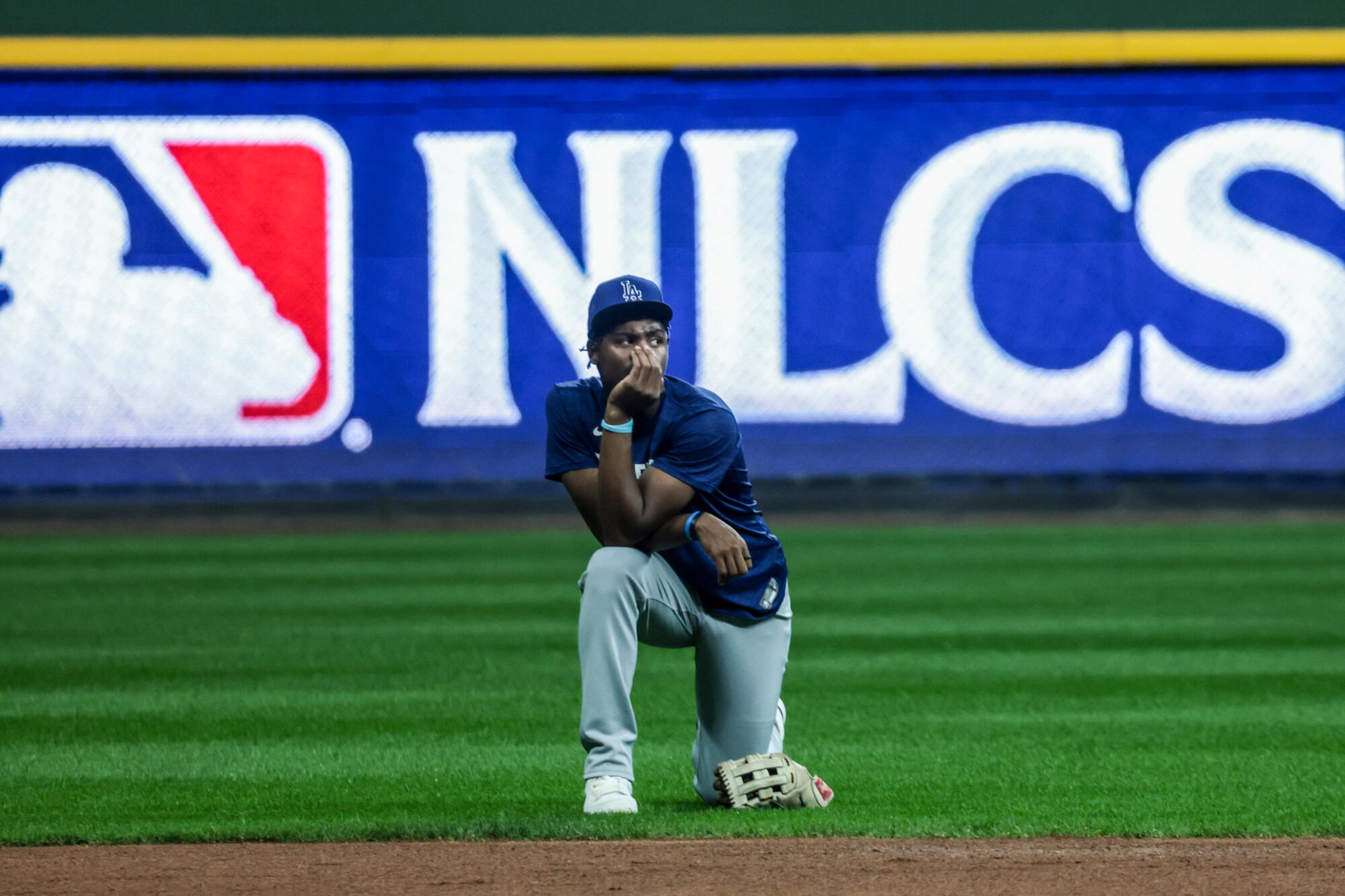
Josue DePaula’s presence was wasted in Game 3.
(Robert Gauthier/Los Angeles Times)
Situation: After Muncy, Ohtani walks to load the bases, and Will Smith follows with a two-run double to give the Dodgers a 2-1 lead. With the right-handed Rojas due up, Roberts opts for the left-handed Josue De Paula as a pinch-hitter. Brewers manager Pat Murphy promptly replaces Uribe with left-hander DL Hall, who had been warming up. Roberts counters with the right-handed Kiké Hernández.
Roberts: “It’s a decision: Do I want Uribe facing Rojas? Then I chose De Paula, and they made the move. At that point in time, I felt we had the matchup advantage with Kiké. … For me, all the experience that Kiké’s had, I feel very confident with Kiké taking a bat with a guy on second and third, infield in.”
Result: Hernandez struck out, and so did Edman. The inning was over, and the Dodgers would not advance another man past first base the rest of the evening. The Dodgers could have used De Paula to bat against right-handed closer Trevor Megill in the ninth inning, but Roberts had already burned him.
Murphy said Uribe was coming out after Smith’s double no matter what — at that point, Uribe had thrown six strikes and 14 balls — so Roberts could have saved De Paula had he waited to see what Murphy would do.
———
Situation: Blake Snell has retired 14 consecutive batters entering the seventh inning, with the Dodgers leading, 2-1. It’s the first time the left-handed Snell has pitched beyond the sixth inning this season, with the right-handed Andrew Vaughn leading off and the left-handed Jake Bauers and Garrett Mitchell to follow. Evan Phillips is warming up in the Dodgers bullpen.
Roberts: “His stuff was really good. I don’t think they were seeing him well. I was trying to get him three more hitters. We had Evan for that fourth hitter.”
Result: Vaughn walks, on six pitches. Bauers homers, on 11 pitches. The Brewers have the lead, 3-2.
Roberts: “Hasn’t given up a homer all year, but it just — it’s baseball. For me, I felt good with where Blake’s stuff was at. You’ve got to give Bauers credit.”
Situation: By that time, Snell is at 99 pitches, two shy of his season high, after the exhausting battles with Vaughn and Bauers. Roberts sticks to his plan: Snell for Mitchell, then Phillips for the right-handed Cooper Pratt.
Result: Mitchell homers, giving the Brewers a 4-2 lead. Hall and Megill combine for 3 1/3 innings of scoreless relief, and the Dodgers are one defeat from winter vacation.
In the Los Angeles mayoral debate Tuesday night, I was reminded of two things.
First, as I’ve said before, it’s no surprise that roughly one-third of likely voters remain undecided with less than three weeks to go until election day.
Second, there is one key difference between the two candidates: We know who Mayor Karen Bass is, but we don’t yet know who Councilmember Nithya Raman is, even though she’s been leading in most polls.
Those two points are connected. I think a majority of voters want a change at City Hall because of the marginal progress on homelessness, the erosion of basic services and the bad decisions before and after the Palisades disaster, among a host of other issues.
But they’re not sure what they’d be getting in Raman.
Why not?
If you haven’t already seen the story a few days ago by The Times’ longtime City Hall reporting ace, Dave Zahniser, you need to check it out right here.
The headline neatly sums it up:
“L.A. mayoral candidate Nithya Raman has strong opinions. But they often change.”
Raman has flip-flopped so many times, it’s as if she’s having a political identity crisis, which is not a great selling point for a candidate.
She endorsed Bass, an ally, for reelection and then abruptly and surprisingly announced that she was running against her.
She rose to power as a darling of the Democratic Socialists of America and vowed to defund the police, only to later support an LAPD budget increase.
She embraced the so-called mansion tax, then said it needed an overhaul.
She supported and helped fund Bass’ signature homelessness initiative, Inside Safe, and now has turned against it.
“That’s the real wild card,” said Sara Sadhwani, assistant professor of politics at Pomona College. “She has flip-flopped so extensively on policy that it’s unclear which version of her values we would get.”
Look, it’s not uncommon for a candidate of the left, or the right, to move toward the center to broaden support. And there’s nothing wrong with learning on the job and evolving. It’s all too rare, in fact.
The problem for Raman is that in somersaulting around on core issues, she’s alienating some of the people she would need as allies in order to be an effective mayor.
They might come around, because in the city’s shared system of power, there are times when the City Council and mayor need to paddle in the same direction in order to get anywhere. But among the 15 City Council members, 13 have endorsed Bass, and that support includes even the DSA wing of the council.
I like the idea of a rebel as L.A. mayor, but the job is hard enough with City Council allies. Without them, Raman could be cooked. And it’s not as if she’d have an easy time winning support for much of anything from the powerful public employee unions and traditional business interests, which are for the most part aligned with Bass, for better and for worse.
Both candidates had their moments in the debate, although I gave the edge to Bass. During The Times’ live chat, I said I think L.A. really needs a leadership change, and I think Raman did not prove that she’s the answer.
It’s probably the second-most important political job in the state, in one of the great cities of the world, and along with the ducking and punching, I wanted more love, more poetry, more unbridled passion and a contagious sense of possibility.
And please, all you Spencer Pratt toadies, don’t send me your whiny little notes about how he was the guy all along. Identifying some of the obvious problems is easy enough. (I do it all the time.) Having a plan is another matter, and that’s why I never ran for mayor, and why Pratt faded out of the picture.
So what next, as the final three weeks of the campaign play out?
If I were Raman, who is 45, I’d go heavy on touting the work she’s done on eviction protections and capping rent hikes, because nailing down younger voters could give her the keys to the throne. On homelessness, she knows the issue better than most, has detailed what’s wrong with the Bass program, has made headway in her own district, and has laid out a plan to speed up progress and efficiency citywide.
But her best argument is that City Hall and the entrenched political establishment need a major shake-up, because the machine is now a jalopy.
“We cannot afford another four years of decline, of mismanagement, of excuses,” Raman said in the debate.
As for Bass, 73, you can’t count her out just yet because she’s a fighter, and she’s better at campaigning than at being mayor. She also is likely to benefit from the fact that older voters — who are most likely to go to the polls — favor her by a huge margin.
“You are not ready for prime time,” Bass told her former ally during the debate, and Bass also hammered Raman for taking “different positions on different days of the week.”
In 2005, Mayor Jim Hahn became the first L.A. mayor to lose a reelection bid in more than three decades, falling to Antonio Villaraigosa. It was a rout, at 58% for Villaraigosa to 41% for Hahn.
I don’t see a rout this time.
The question for Los Angeles is this:
Have you had enough of the mayor you know, and are you ready to roll the dice on someone you don’t?
LONDON — It’s the day after the London premiere of “Sense and Sensibility,” and its stars, Daisy Edgar-Jones and Esmé Creed-Miles, have shed the glamour of the evening before. Both are curled in chairs in an otherwise empty room in an upscale Hyde Park Corner hotel, modestly dressed in jeans, sneakers and casual tops. Each drinks from an enormous glass bottle of water rather than wasting time with a cup.
The spectacle of a blockbuster red carpet is familiar for Edgar-Jones, whose career took off after the 2020 limited series “Normal People” and has since included “Where the Crawdads Sing” and “Twisters.” But last night marked the biggest such occasion so far for Creed-Miles, best known for the Prime series “Hanna.”
“I was a bit nervous with my friends and family all there,” admits Creed-Miles, who plays the more emotional of Jane Austen’s Dashwood sisters, Marianne. “I’m very lucky because Daisy has done it before and she’s so cool about it.”
“Absolutely not,” says Edgar-Jones, who plays the sensible Elinor. She grins sheepishly. “If anything, I think I’m getting more nervous.”
Both actors understood the high stakes of remaking Austen’s 1811 debut novel, most famously adapted in 1995 by screenwriter and star Emma Thompson and director Ang Lee — a movie that became a generational touchstone nominated for seven Oscars. The new version, in theaters Friday, was adapted by Diana Reid and directed by Georgia Oakley, best known for her evocative 2022 feature debut, “Blue Jean.”
Oakley wanted to re-create the emotions of reading the book as a teenager.
“In comparison to other Austen novels, I remember it feeling quite wild,” Oakley says, speaking separately over Zoom. “I also wanted to capture the spirit of the two older sisters as the beating heart of the story. My memory of it was that their story was the main love story of the book.”
Daisy Edgar-Jones, left, as Elinor and Esmé Creed-Miles as Marianne in a new version of “Sense and Sensibility.”
(Focus Features)
Oakley’s “Sense and Sensibility” emphasizes that relationship between Elinor and Marianne. Although they approach the world differently, they find common ground in each other. It was essential to find the right actor for each role, but also to ensure there was both tension and chemistry between them. Edgar-Jones, 28, was cast first without an audition. There was never any question as to which sister she would play.
“I have played a significant Marianne before,” Edgar-Jones says in a nod to affluent, tortured outcast Marianne Sheridan, her role in “Normal People.” “And I love both characters, but I’m moving into my late 20s now. Elinor has a maturity and a wise older soul quality that I really liked and felt I was right to occupy. I have always been attracted to characters who don’t necessarily have the words to express how they feel.”
Oakley appreciated Edgar-Jones’ restraint. “She is able to show so much by seemingly doing very little,” Oakley says. “Elinor has a lot on her shoulders, so I was looking for an actor who could give a sense of that from the very beginning.”
Creed-Miles, 26, faced a more uphill climb to become Marianne. She describes her first audition as awful.
“It was really bad,” she says. “Maybe I was nervous. I can be a bit of a mess. But someone saw something in me, I guess, and they called me back. This time I worked my ass off and spent days preparing the scenes. They liked that audition enough to bring me in for chemistry reads with Daisy and some of the boys.”
“There’s an earthy, undone nature to the world Georgia made,” Edgar-Jones says of director Oakley’s take on Austen.
(Erik Carter / For The Times)
“The first audition didn’t go exactly to plan,” says Oakley, who didn’t expect to see the actor again. “But [the second time] I was so moved by Esmé performance. We have this idea of how we think people are supposed to speak in a period drama, and Esmé seemed to not be affected by any of that.”
Edgar-Jones and Creed-Miles had previously worked together on the 2018 drama “Pond Life,” which was an asset going into “Sense and Sensibility.”
“It’s a summer I have never forgotten,” Edgar-Jones says of the experience, her first film role. “I met Esmé and we fell in love. We watched a lot of ‘Love Island.’ And then COVID happened and we weren’t reunited until our chemistry read.”
Although they hadn’t completely stayed in touch, there was a natural rhythm between them. “We had so much history and nothing was ever overly discussed,” Edgar-Jones adds. “It was instinctual. That level of intimacy takes time to develop and the fact that I already had years with Esmé meant that it felt very lived in.”
“Sense and Sensibility” was filmed entirely on location around England, primarily in the sweeping countrysides and dramatic coasts of Devon and Dorset. Oakley wanted to emphasize nature and to show how the Dashwood women’s emotional landscapes evolved alongside the shifting landscapes around them, both in the countryside at Barton Cottage and in the more confining social landscape of London. There is a naturalistic aesthetic to the film, augmented by the locations, the costumes and the hair and makeup design. The characters wear muted, sweeping gowns, their hair often loose.
“There’s an earthy, undone nature to the world Georgia made,” Edgar-Jones says. “Sometimes there’s distance you can sometimes get from watching a period drama because obviously we no longer wear corsets and bonnets and ride in horse-drawn carriages. But even though this feels very much of the Regency time, it also feels very close.”
“I loved how authentic everything felt,” Creed-Miles adds. “It didn’t feel frilly for the sake of itself. The clothes helped me find a sense of Marianne. I needed the costumes to close that gap.”
“We wore no makeup, even to the point where sometimes I’d put on some lip balm and Georgia would be like, ‘Take it off,’ ” Edgar-Jones recalls.
“The characters started to feel like real people in my life who I knew,” says Creed-Miles. “It was almost like a split personality.”
(Erik Carter / For The Times)
Creed-Miles says the unbuttoned aesthetic felt more true to the time, even if some commenters online have claimed it’s not period accurate.
“We don’t have depictions of women’s internal lives in the way that we do now,” she says. “When you look at a portrait there’s a composure that’s not the same as having a phone picture of someone when they’re getting out of bed in the morning.”
Oakley fills the screen with a palpable yearning. The camera often lingers over the actors’ faces, revealing Elinor’s inner turmoil and Marianne’s dramatic heartbreak. For many scenes, Oakley asked the cast to do silent takes.
“We wanted to tell a story that had space for some quieter moments,” the director says. “The actors were free to speak or make noises, but they couldn’t say the words of the scene.”
“In making this, I realized Elinor isn’t devoid of emotion,” Edgar-Jones says. “She’s full of it, but she’s learned how to govern it. Realizing that she was an extraordinarily passionate person and not a stone was really important for me. By the end, I felt completely marinated in it.”
“The characters started to feel like real people in my life who I knew,” Creed-Miles agrees. “It was almost like a split personality.”
“Circumstances have changed for young women quite drastically over the past 200 years,” director Oakley says. “But the fundamental contradictions around what it means to be a young woman haven’t changed nearly as much as we would like to think.”
(Erik Carter / For The Times)
Oakley’s interpretation of “Sense and Sensibility” has a wistful, almost Brontë-like quality. You can feel each character’s pain and joy and hopefulness. At the premiere, the audience audibly gasped and cheered, even though Austen’s story is well known to many. Oakley didn’t want to make her film overly contemporary, but she feels the story resonates today because Austen is so timeless.
“Circumstances have changed for young women quite drastically over the past 200 years,” Oakley says. “But the fundamental contradictions around what it means to be a young woman haven’t changed nearly as much as we would like to think. There’s this enormous gap between what we tell young women that they can reasonably expect from their lives and what the world is prepared to offer them.”
Creed-Miles admits that she’s recently fought with someone on Instagram about whether Austen was a feminist.“They didn’t have that terminology back then, but she was a rebellious author in that she used these sociocultural structures to explore the trials and tribulations of femininity,” Creed-Miles says. “It was really important to Georgia that we kept that alive. Reading Austin as an adult, I have so much respect and admiration for the themes she was exploring with a really deft hand. It’s never rammed down your throat.”
Edgar-Jones, an Austen fan, agrees that she captured a truth about the human experience. That’s what allows the author’s work to be retold and reimagined over decades.
“The joy of adaptation is that every new person who says these words will bring a piece of themselves and give it new meaning,” Edgar-Jones says. “And every time we explore something again, it will be colored with the context of today. Great art, like this, should be brought to life again and again.”
Mackie, known widely as the King of Camp, who adorned superstars including Diana Ross, Dolly Parton, Beyoncé and Miley Cyrus with fringe and sparkles, died on Sept. 14 in Palm Springs. He was 87. His publicist initially told the Associated Press that the renowned designer died of pneumonia, but a death certificate obtained by Us Weekly paints a different picture.
The certificate lists Mackie’s cause of death as a subarachnoid hemorrhage and blunt head trauma. The Mayo Clinic says a subarachnoid hemorrhage is a type of stroke that involves bleeding in the space between the brain and the tissues that cover the brain.
On Sept. 11, the designer fell at the home of his longtime design director Joseph McFate, according to the outlet, and he died days later at Desert Regional Medical Center in Palm Springs. The designer’s rep further shared that Mackie was staying at McFate’s house at the time of his fall, and that he was battling pneumonia at the time. “A healthcare professional was with him when he fell,” the rep said.
According to the death certificate, Mackie was cremated on Sept. 17, and his ashes were scattered off San Diego.
“Costume designers have long been overlooked for the importance of their work in creating and influencing mainstream contemporary fashion,” fellow fashion designer Tom Ford told The Times in a 2019 email. “Bob Mackie’s work has influenced fashion in a dramatic way, in that many of the body fitting, seemingly transparent and heavily beaded gowns that are worn on red carpets today are derivative of his work for stars like Diana Ross and Cher. The images of his costumes and gowns for these women have become a part of the landscape of fashion from the ’60s, ’70s, and ’80s and in my case become part of my hard-drive of references.
“His famous quote that his clothes are ‘for the woman who is not afraid to be noticed,’ ” Ford added, “is one of my mantras.”
Stars dressed by Mackie posted tributes to the designer after his death. Elton John said he was saddened by the news of Mackie’s death, writing, “Every time I put something on that Bob made, I felt very, very special. His costumes were works of art, and he will go down as one of the most legendary designers ever in Hollywood.”
Cher also weighed in, posting a tribute to Mackie on X that read, “Bob has gone up to heaven. Knowing him, he’s bringing Sequins, Beads, & his sketch pad. Good nite sweet Prince.”
VIC Reeves has stepped out with wife Nancy Sorrell following a health scare that reportedly saw him rushed to hospital after collapsing at a friend’s wedding.
Vic Reeves stepped out at the Sky Arts Awards following his reported health scareCredit: GettyThe comedian posed alongside wife Nancy Sorrell on the pink carpetCredit: Getty
But he was back on his feet as he posed alongside Nancy on the pink carpet at the 2026 Sky Arts Awards at the Roundhouse in London.
Vic, whose real name is Jim Moir, is said to have suffered a medical emergency at a pal’s wedding in Poole over the weekend.
Sign up for the Showbiz newsletter
Thank you!
The comedian had been celebrating at the Hotel du Vin when he allegedly collapsed in front of worried guests.
Speaking to the Daily Mail, a source at the event said: “Vic was telling jokes and entertaining people – and obviously everyone was hitting the bar as the party went on just as you’d expect.
Vic was reportedly taken to hospital after falling ill at a friend’s weddingCredit: GettyThe comedy legend joined stars at London’s Roundhouse for the awards ceremonyCredit: Getty
“But suddenly it appeared to take a bit of a turn for the worse – there was a commotion in the middle of the group and staff were being asked to call for an ambulance which turned out to be for Vic who wasn’t looking at all well.
“It all happened very quickly.
“The next thing he was being wheeled out by paramedics. It all seemed to shift from lots of laughter to serious concern pretty fast.”
Vic has previously revealed he has an inoperable benign tumour that left him completely deaf in one ear.
He previously told Adam Buxton on his podcast how he hates having to have his MRI scans.
“The last time they put me in one I said ‘get me out of here quick’,” he said. “I just couldn’t do it, so I ended up having to pay for it, but they got my head which is all they wanted.”
Acoustic neuromas grow on the nerve used for hearing and balance, which as well as causing hearing loss, can result in unsteadiness and a sensation of moving or spinning.
They tend to affect adults aged 30 to 60 and usually have no obvious cause, although a small number of cases are a result of a genetic condition.
Formula One has signed a 10-year agreement with Rwanda to bring the sport back to Africa for the first time since 1993. The African Grand Prix will be held on a circuit in Bugesera, near the capital Kigali, from the early 2030s.
It has been five years since Michael Che’s last stand-up special. Of course, he has a good excuse, being busy much of the year co-writing and performing “Weekend Update” on “Saturday Night Live,” and he also wrote and starred in two series of his acclaimed sketch comedy show, “That Damn Michael Che.”
But he feels more like himself on the stage, he said in a recent interview. “I really miss stand-up when I’m not doing it because I can really let loose on stage and say all the words I want,” he says.
In his new Netflix hour, with the pointed title, “Michael Che: Shot in Minnesota,” he wastes no time in getting into it, opening with a series of jokes saying a lot of words about Charlie Kirk’s murder: He believes that it happened because “straight white conservative Christian men are being silenced.”
He clearly loves poking at people’s sensitive spots. His favorite joke, he says onstage, is, “Men want anal sex the way women want a sensitive man. It just sounds nice… until you see them crying.”
He talks about race (“I don’t care what color you are — if you’re rich, you’re white”) and goes after President Trump and people who try to police language, but he also talks up how much fun he had at a Pride parade and about growing up poor, with his mother cleaning houses to help make ends meet. In our interview done via Zoom (without a camera on) while he was stuck in traffic on the way to 30 Rockefeller Center and then in an elevator and then in the SNL offices, he discussed it all.
This interview has been edited for length and clarity.
Did anyone in your family shape your humor and your storytelling?
My family has a different kind of humor. It’s a little meaner, if I’m being honest with you.
I’d like to see Thanksgiving at your house.
A lot of people would. It’s kind of crazy.
But the one person was my grandfather who was a pastor. He knew how to hold court and tell a story and he was a funny guy. He could be silly or absurd or dry. So maybe there’s a lot of him in what I do. But he did it week after week with different material.
Speaking of week after week, which is closer to your real self, the “Weekend Update” persona or your stand-up persona?
The stand-up is the most me; “Update” is a job and it’s a character. On stage you get to hear more nuances — on “Weekend Update” it’s a short segment, and I’m splitting time with Colin and guests. There are more needs being met than just mine. I say that respectfully, but there are things we have to touch on that I wouldn’t in my personal work and there are things other people write so it’s never all me.
I can listen, I can build, I can take you on a journey, I can make you think this is a bad joke, but it’s actually a good joke. I can make you think it’s a dirty joke, but it’s a clean joke.
I miss doing stand-up full time, but maybe that’s only because I don’t do it full time. But maybe if I did it full time, I’d miss doing it part time. Getting this hour together for the special, Lorne [Michaels, SNL’s iconic boss] was nice enough to let me go on the road even during show weeks, and he didn’t ask as much of me this past season. He was really kind, and I really appreciate it.
Colin Jost, left, and Michael Che on “Weekend Update” on “Saturday Night Live” on Saturday, March 11, 2023. Che has been doing “Weekend Update” for 12 years, as has Jost.
(Will Heath / NBC)
Your stand-up persona is definitely more thoughtful and open-minded than your “Weekend Update” one. Are you conscious of revealing yourself onstage or just thinking about what’s funny?
They tell you in the criminal world that the longer you talk to the police the more chances there are you’re going to reveal something. And I feel like it’s true for comedy, too. A lot of the stuff that I do is just thoughts that we haven’t said out loud and explored yet. I start with the thought, and if I can get a joke, a one liner out of the thought, that’s then I start to explore it onstage. I only write one line because I can’t write in a vacuum. I need to be able to listen to see what an audience gives me; otherwise, I only know how it makes me feel.
You open this special with that riff on Charlie Kirk’s murder. Your audience is not filled with Turning Point members, but people still may be hesitant to laugh. Are you starting there to challenge yourself or challenge your audience, or is it just because you think it’s funny?
I think all three of those things can be true. Those jokes are funny, but it is hard to laugh at. That’s the sort of feat I seek to pull off, to make people laugh about things that they’re not necessarily expecting to hear without being gross and gratuitous. I did those jokes on Shane Gillis’ show and his audience reacted favorably.
None of this is to make any kind of larger point other than I want you to laugh at the things that horrify you. It’s just horrifying on the surface so people think you can’t make a joke about it. People are afraid of the attempt. And I say, “Well, what about this one?” I do like that.
Then you move on to the R-word and the N-word. Are you simply pushing buttons for laughs or pushing people to think about their own biases and preconceptions about language and their political sensibilities?
I don’t want to let words dictate my next emotions. I want you to put the responsibility of self-control on yourself. People are going to say nasty things literally just to get a rise out of you, and it’s up to you to decide how you’re going to handle that. Also, I’m trying to be consistent. If I start with jokes about Charlie Kirk, but then somebody wants to call me the N-word, I can’t say, “Well, that’s crossing the line.” Right now there ain’t no more lines. We’re in a culture war and bombs are going to fly. So let’s see who’s got the stomach for it.
When you refer to a guy buying you drinks in a bar as “visibly gay,” the audience gets uncomfortably quiet in a way. How do you feel when they hush over a line like that?
With a lot of these jokes it’s like dribbling a football, you just don’t know where it’s going to land. But I like putting people on their heels and being a Black comic of my generation, they expect the joke to go one way because they’ve heard the jokes that come from others so they’re apprehensive. I expect them to be apprehensive and then talk them through it. When the joke lands differently with a punchline they’re not expecting, they’re pleasantly surprised.
The amount of time children in England spend on screens at school could be harming their “physical and developmental health”, a group of more than 150 clinicians has warned.
GPs, paediatricians and other specialists said in an open letter to Education Secretary Lucy Powell and Health Secretary Yvette Cooper that tablets and laptops are being used without a full understanding of their long-term health impacts, including on eye health.
The clinicians said they are prescribing glasses, hearing aids and speech therapy to children “for a problem that is unintentionally being made worse in our schools”.
The government said it was consulting on screen time guidance for children aged five to 18 but that technology could be a powerful learning tool if used properly.
The group of clinicians said nearly one million children are using screens in most lessons, despite studies suggesting a rise in short-sightedness.
They pointed to an analysis of 276 studies covering 5.4 million participants around the world.
That analysis, they claimed, found a rise in short-sightedness among children and adolescents from around 24% in 1990 to almost 36% by 2023, warning the condition is associated with an increased risk of a range of eye health problems.
Many children now spend longer on screens in the classroom than is recommended in a 24-hour period, the letter said, adding: “As a country, we need to wake up to this now, and start rolling back screen use in schools before the damage compounds further.”
One of its signatories was, Dr Becky Foljambe NHS GP and founder of Health Professionals for Safer Screens. She told BBC Radio 4’s Today programme parents had not been given the chance to “opt out” of the “excessive” use of screens in schools, which risks children “just not thriving” in education.
She said an “explosion” in short-sightedness “cannot be put down to genetics alone”.
Foljambe said it was a “lazy argument” to advocate for screen use to prepare children for a digital work, adding: “They also need their sleep, their eyesight, they need rest, they need ability to critically think and appraise.”
“We are conscious that some of this evidence is still surfacing but the direction of travel is consistent across multiple, independent, and in some cases very large, bodies of research,” the letter continued.
It also warned that children with special educational needs are “disproportionately” directed to screen-based learning.
A Department for Education spokesperson said the government was developing new screen-time guidance for children aged five to 18, and will consult on the safety of artificial intelligence and educational technology in schools.
They said: “Used well, technology can be a powerful tool to support learners who need it and free up teachers to deliver the excellent education every child deserves.”
It comes after a ban on smartphones in schools in England came into force in June, making individual schools and trusts legally responsible for being phone-free throughout the day.
The three-peat is slowly, agonizingly having the life squeezed out of it by a collection of hardscrabble Midwesterners with no regard for stardom or status.
Two games into the National League Championship Series, the three-peat was formally placed on life support Monday after the mighty Dodgers lost a second consecutive game to those little giants known as Milwaukee Brewers.
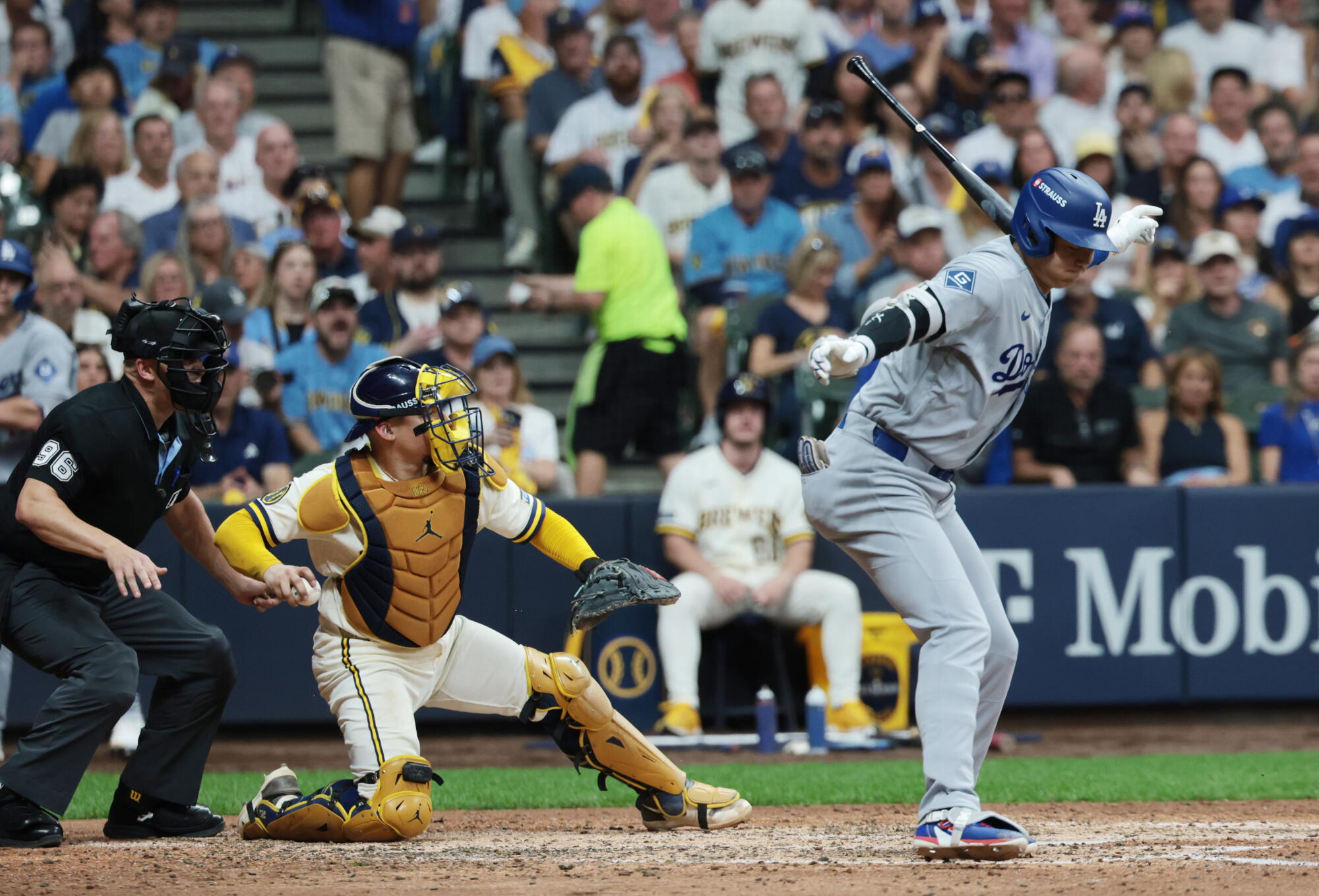
Shohei Ohtani strikes out during the sixth inning
(Robert Gauthier/Los Angeles Times)
This time the score was 7-4 after another devastating night at American Family Field, and now the Dodgers trail two games to none in a best-of-seven series that appears beyond their control.
For a second consecutive game, their ace was knocked out. For a second consecutive game, their powerful offense petered out.
For a second consecutive game, they looked like a weary, aging band of fallen stars that had stumbled into a surprisingly deep pothole and had no idea how to climb out.
For the Dodgers to win this series and continue their journey toward a third consecutive championship, they must beat the Brewers in four of the next five games, the last two of which would be played in Milwaukee.
It doesn’t seem likely. It doesn’t even seem possible.
Not once in in their previous two title seasons did they trail anybody two games to none, and they certainly don’t seem equipped to survive it now.
Look at how they lost Monday. On second thought, don’t look, because what you’ll see bears scant resemblance to the swaggering, self-assured Dodgers of postseasons past.
They pitched their October ace Yoshinobu Yamamoto, and he’s always saved them, right? Not this time. He couldn’t make it out of the third inning, battered by scattered wildness and scathing swings.
They were handed runs on two errors by the Brewers’ shaky rookie starter, Logan Henderson, and they’ve always capitalized, right? Not this time. They couldn’t make the Brewers pay for their clumsiness, managing just three hits, the slumps of their superstars ever deepening, Will Smith and Shohei Ohtani becoming absolute offensive liabilities.
Even with all this, they sent Henderson packing after four innings and took aim at a heavily used Brewers bullpen and surely they could summon the firepower to send at least one of those relievers running, right? Not this time, as four Brewers relievers set a postseason record by pitching five perfect innings.
The last two innings being a sad microcosm of the previous seven.
Entering the eighth inning, the Dodgers trailed only 4-3 and had the top of their order coming up in what still could have been a trademark Dodgers October comeback.
Mookie Betts strikes out in the eighth inning.
(Robert Gauthier/Los Angeles Times)
Not so fast.
Facing Abner Uribe, Mookie Betts struck out. Facing Aaron Ashby, Freddie Freeman struck out and Teoscar Hernández grounded out. Yeah, with perhaps their season on the line, they couldn’t even get the ball out of the infield.
The Brewers, of course, sealed the deal with two runs on three singles in the bottom of the eighth, and the Dodgers went meekly 1-2-3 in the ninth.
It was surely, truly painful for Dodgers fans to witness the final out, a strikeout by … yep, last season’s World Series hero Miguel Rojas.
The three-peat is dying, and it’s almost unbearable to watch.
Having both of their aces beaten in Milwaukee, the Dodgers will come home with Blake Snell and Tyler Glasnow starting in Games 3 and 4, respectively.
In any other scenario, both pitchers are aces as well, and the Dodgers would have a huge advantage. But neither pitcher has looked great in the postseason, and both will be pitching while bearing the weight of a stressed-out Dodgers Nation.
“Yeah, it’s certainly a challenge,” manager Dave Roberts said. “I think that if you look at Game 3, I like where we’re at as far as in a vacuum, who’s pitching, where our bullpen is at, being at home. Then you’ve got to go from there.”
Perhaps the most frustrating thing about Game 2 is that the Dodgers led … then blew the lead … then led … then blew the lead … then led …then blew the lead.
The Brewers’ final tying blow came on William Contreras’ fifth-inning homer against Kris Bubic, who has struggled in this postseason and perhaps shouldn’t have been in the game. The Brewers’ final go-ahead run came in the sixth on Contreras’ bases-loaded single after Brice Turang surprisingly was intentionally walked in front of him.
But neither of those plate appearances was the game’s most important. The key moment that actually didn’t score any runs was Jake Bauers’ 12-pitch walk in the third inning.
That loaded the bases, and Christian Yelich then greeted an exhausted Yamamoto with a two-run single.
“Yeah, it just got to a certain point where it was straight compete mode, a little bit of like blackout, just kind of in the flow a little bit competing,” Bauers said. “It was fun. It was a fun at-bat. I knew that was a moment where the guys needed something, the team needed something.”
Funny, but those are the kind of things Dodgers hitters used to say, back when they were confident and full of life.
But Smith is one for 23, and Ohtani is three for 19, and the Dodgers have just one extra-base hit against the Brewers, and nobody is saying anything about the fun of competing.
In fact, things are so lousy, Roberts appeared to call out Smith for not using the ABS challenge in the early innings against Turang. Both times strikes were called balls, and Turang took advantage of the missed calls to double and walk and score twice.
Yamamoto also seemed annoyed that his catcher could be letting his batting woes affect his work behind the plate.
“Obviously in that spot, Will didn’t feel like it was a strike, but obviously if you look back, that’s a called third strike, he doesn’t double, and that changes the outing,” Roberts said of Turang’s first-inning at-bat.
Roberts still has hope. But he’s not looking past Game 3.
“As far as can we do it, absolutely, but it’s just you want to get that first one,” he said.
Dodger Stadium will be filled with fans in what could be a celebration. Or a wake.
As swiftly as Barry Manilow returned to the stage following a health-related hiatus, he has stepped away.
On Friday, Manilow cut his concert short just two songs after it began. The 83-year-old crooner abruptly told the crowd to talk among themselves as he walked off stage, according to concertgoers who detailed the incident on social media. The curtain dropped, and a few moments later the audience was told the show was a wrap. Manilow’s performance slated for Saturday was subsequently nixed.
The day before, on Thursday, the “Copacabana” singer had returned after a six-week break to perform at the International Theater at the Westgate Las Vegas Resort & Casino, telling the audience, “I’m back!” Manilow appeared to be spry and energetic throughout the show. “God, I feel like I’m a teenage idol again,” he joked when a couple of audience members tossed underwear onto the stage. He picked up a pair of full-coverage briefs and asked if they needed to go to the laundry, then a pink lacy thong and joked, “I’ll keep this pair.”
“After a triumphant welcome-back concert on Thursday, Barry got hit with bronchitis and had to cancel his Friday and Saturday shows,” reps for Manilow told Paste Magazine.
Last year, Manilow revealed that he had been diagnosed with lung cancer and that surgery would require him to postpone several performances. In May, he told The Times that, since he had surgery, he was getting winded just walking down the hallway. “Ninety minutes of screaming in tune, which is what I do for a living — I’m not up for that yet,” he said at the time. “I will be, but it’s taking a long time to get my voice back. They warned me that I’d have to learn to breathe again. So these days, I get up, I go to my piano and I try to be creative. Before I know it, the afternoon’s over.”
The star returned to the stage in June following a six-month hiatus, in support of his latest album, “What a Time,” his first LP loaded with new material in almost 15 years.
But in August, Manilow canceled shows because of vocal and technical problems before telling fans he needed to pause. “We just finished a fantastic summer tour, 29 shows in 68 days,” the singer said. “The shows were fantastic. The audiences were fantastic. And I sounded fantastic. But it seems that we were pushing a little too hard.
“Now we all need to sit down and shut up,” Manilow said.
President Trump has pushed Congress to pass a proof-of-citizenship law, signed an executive order seeking a national voter ID requirement and tried to limit mail voting through U.S. Postal Service changes.
None of those moves succeeded in time to affect this year’s midterm elections. It’s a different matter in the states.
More than three dozen voting laws passed in Republican-controlled states are taking effect for the first time this year, many of them containing elements of Trump’s stalled proposals. They include changes to what IDs are acceptable to register for the first time and requirements to show proof of citizenship, an issue the Republican president has tried but failed to get through Congress.
“Trump’s attacks on our elections are deeply damaging, but they are not happening in isolation,” said Sophia Lin Lakin, director of the American Civil Liberties Union’s Voting Rights Project. ”Across the country, states are also advancing restrictions that make it harder for eligible voters to cast a ballot.”
Republican lawmakers who support the tighter voting laws, especially around voter ID, describe them as common sense changes that help build trust in elections.
Trump and other Republicans have been pushing for more restrictive rules since the president’s false claims of widespread fraud in his 2020 election loss to Democrat Joe Biden. Trump’s false claims have resonated with Republican voters, a majority of whom believe Biden was not legitimately elected despite all evidence to the contrary. Trump lost dozens of court challenges, his own attorney general found no evidence of widespread fraud, and reviews, audits and recounts in the battleground states where he contested his loss all affirmed Biden’s victory.
Among the changes confronting voters as early voting gets underway: Students in New Hampshire can no longer use student IDs; Utah voters returning mail ballots must include more information on the envelope; and some voters in Mississippi might need birth certificates or passports to verify their identities.
Changes to voter ID requirements are challenged
New Hampshire state Rep. Donald McFarlane said he sponsored the bill to eliminate student IDs as acceptable for voting because colleges don’t have the same controls when issuing those cards as government agencies.
“The change removes a special exception and applies the same government-issued ID standard to all voters,” he said, adding that his bill had bipartisan support.
Students, he said, can still get state IDs free of charge.
The new requirements have not gone unchallenged.
In South Dakota, the ACLU has filed a lawsuit seeking to halt a new law that includes requiring voters registering for the first time to present the most common forms of ID — driver’s licenses, Tribal IDs and non-driver state IDs. They must be presented in person at places that accept registration.
“Proof of citizenship in itself is not terrible,” said Kathryn Johnson, president of the League of Women Voters of South Dakota.
Her concern is the requirement to present the IDs in person.
“We’re kind of a remote state, so sometimes it takes a drive, and you have to coordinate, you have to take off work, and all of these kinds of things,” she said.
Some Democrats also have expressed support for voter ID during recent debates. Pennsylvania Gov. Josh Shapiro said he was open to the idea as long as it wasn’t based on “conspiracy theories.” When legislatures change their state’s voting laws, they typically give election offices and voters time to adjust. Trump wanted federal voter ID and proof-of-citizenship legislation to take effect immediately, forcing election officials and voters to comply in the middle of the midterms.
Ohio seeks to scrub voter rolls
Ohio has a proof of citizenship requirement in effect for the first time this year for those registering to vote or updating their voter registration information at a Bureau of Motor Vehicles location. The state also eliminated its four-day grace period for mail ballots, which now must be received at local election offices by Election Day.
Yet the biggest concern for voting rights groups is an ongoing purge of the state’s voter rolls. The databases used to check citizenship against voter registration lists can be outdated, said Freda Levenson, legal director of the ACLU of Ohio, which has sued to overturn the law.
“Vast numbers of perfectly eligible voters are vulnerable to being disenfranchised,” she said.
Republican state Sen. Theresa Gavarone, one of the primary sponsors of the bill, challenged the ACLU’s legal action and said the problem it addresses is a real one.
“In the past two years, hundreds of noncitizens have been removed from Ohio’s voter rolls,” she said in an email. “Every single vote cast by a noncitizen disenfranchises a lawful Ohio voter.”
Voters have mixed views on the changes
Outside an early voting center in Wayne County, Ohio, retired steel worker Dan Walter, an independent voter, said he opposes requiring documentary proof of citizenship to vote.
“It’s to keep people from voting, it sounds to me like,” he said.
His wife, Jody, a retired aerospace executive and a Democrat, said she felt the same way about Ohio’s new requirement for registering to vote.
“A driver’s license doesn’t prove citizenship, and that’s all they ask for now,” she said. “It’s going to be an obstacle for so many people.”
Genia Fortune had a different view. A nurse, the Millersburg resident described herself as an independent and said she voted for President Barack Obama, a Democrat, and later for Trump. She believes Trump’s false claims that the 2020 election was stolen and sees requiring documentary proof of citizenship as a necessary precaution.
“I just feel like you need to be a citizen and show proof of ID,” she said.
Voting and election laws have become a regular target for legislatures
The Trump administration has pushed multiple strategies to influence this year’s midterm elections, most of them stymied by Congress or the courts.
Chris Diaz, director of legislative tracking at the Voting Rights Lab, said the group has seen several versions of the Republican president’s proposals passed by his allies in the states.
A recently released report by the group highlighted some of the key areas drawing Republican lawmakers’ attention, including mail balloting, voter ID and the hunt for noncitizens on voter rolls.
Noncitizen voting has been a focus of the Trump administration despite it being a rare problem. The U.S. Department of Justice recently announced it had brought charges in roughly 90 cases for various types of election misconduct, including 50 against people who are alleged to have voted as noncitizens. The U.S. had 227 million registered voters for the 2024 presidential election.
The Brennan Center for Justice has identified nearly 40 laws in 21 states taking effect this election season that will make it harder for eligible voters to register, stay on the rolls or cast ballots.
The report from the center, part of the New York University School of Law, found that many of the new laws target subsets of voters.
“What I want voters to take away from this is that elections are still run by the states and there are still people in many states who are trying to make it harder for you to vote,” said Sean Morales-Doyle, senior director of the center’s Voting Rights and Elections Program. “But that’s all the more reason to go make a plan to vote and participate.”
Fields and Smyth write for the Associated Press. Fields reported from Washington and Smyth reported from Wooster and Millersburg, Ohio.
CHLOE Ferry has opened up about her plans to start a family with her property developer boyfriend.
The reality star, 31, who has previously revealed she would like 10 children, went Instagram official with Alex Swinney in September last year.
Chloe Ferry has revealed that she’s trying for a baby with her boyfriendCredit: instagram/@chloegshore1She opened up about her plans on InstagramCredit: Instagram
Since then, Chloe has loved sharing an insight into her relationship on Instagram.
And during a recent Q&A on the social media platform, she’s hinted that she’s ready to become a mum.
Sign up for the Showbiz newsletter
Thank you!
One fan asked her: “Are you going to plan to have kids soon?”
Chloe replied: “I have a date in mind when I would love to have babies, but it could happen any time as I’m not anything.”
The couple have been dating for just over a yearCredit: Instagram/@chloegshore1Chloe has spoken about becoming a mum in the past – admitting she wants 10 childrenCredit: Getty
Earlier this year, Chloe gushed over her ‘soulmate’ boyfriend as she opened up about marriage, kids and if he would join the Geordie Shore cast.
Talking to The Sun, Chloe said of Alex: “He is definitely, definitely the person that I want to be with for the rest of my life. I’ve never felt like this ever about someone.
“I thought that I knew what love was before but this is like true love.
“I know it’s a bit cringe to say true love but I just know that this is 100% my person. I’ve planned my full life with this person and I’ve never done that with anyone.”
Chloe added that she is moving in with her beau and would “love” to get married and have children one day.
Times of Troy writer Ryan Kartje is out sick this week, but we didn’t want USC fans to miss extended coverage of the Trojans’ win at Penn State. Times sports editor Iliana Limón Romero is filling until Kartje returns.
USC coach Lincoln Riley lingered at Beaver Stadium on Saturday night, soaking up a hard-fought moment of vindication.
Riley celebrated out-coaching Penn State’s Matt Campbell like he won a national championship, offered gleeful remarks to NBC and reporters at his postgame news conference and shook the hands of USC fans who ventured to Happy Valley to catch the Trojans’ first road win over Penn State.
“It’s one of my favorite wins as a head coach no question, for so many reasons,” Riley said after the Trojans’ 31-23 victory. “Obviously phenomenal atmosphere, as good as it gets there in college football, so give credit to Penn State, their fans, but really proud of our team, man.”
Fight on! Are you a true Trojans fan?
Get our Times of Troy newsletter for USC insights, news and much more — exclusive to L.A. Times subscribers. Free Members receive a partial preview of each edition.
By continuing, you agree to our Terms of Service, which include arbitration and a class action waiver. You agree that we and our third-party vendors may collect and use your information, including through cookies, pixels and similar technologies, for the purposes set forth in our Privacy Policy such as personalizing your experience and ads.
And even Riley’s harshest critics had trouble arguing this wasn’t a meaningful win. A serious test his team passed. The kind of beast Riley and the Trojans have struggled to slay.
Yes, the Nittany Lions now sit 3-3 overall and 0-3 in Big Ten play, but White Out games are their super power. When an announced crowd of 114,419 fans commits to wearing white and roaring in unison, it’s hard for any visiting team to pull off a victory. USC had never won in State College, Pa., and Riley noted seemingly no one outside of his team believed the streak would end Saturday.
How did USC do it?
The Trojans figured out how to overachieve in every area that was considered a weakness entering the matchup.
Maiava lights up Nittany Lions
USC quarterback Jayden Maiava delivers an option pitch under pressure from Penn State’s Caleb Bacon on a play that scored a touchdown Saturday at Beaver Stadium.
With big-play threats Mosley and Tanook Hines on the field, Maiava looked like an elite Big Ten quarterback dealing the ball in locations only his two ace receivers could catch.
Maiava completed 21 of 33 passes for 301 yards, three touchdowns and no turnovers.
Mosley had nine catches for 111 yards and one touchdown. Hines had four catches for 82 yards and another score. The passing attack opened up enough space for King Miller to earn 102 yards and a touchdown in 19 carries.
Of course fans have come to expect big highlight plays from a Riley offense, but Maiava was unquestionably tentative the past few weeks and the offense wasn’t clicking. It hit top gear at Penn State.
USC’s Christian Pierce punches the ball out of the hands of Penn State’s Brett Eskildsen, forcing a fumble in the fourth quarter at Beaver Stadium on Saturday.
(Isaiah Vazquez / Getty Images)
While Riley has caught considerable heat this season, the USC defense directed by Gary Patterson wasn’t far behind.
The Trojans have shown marked improvement with Patterson shifting from the sideline to the press box the last two games.
Patterson had always worked from the sideline, but he also was always surrounded by staff members who knew his system well. Riley said the goal of the move was to speed up communication.
Desman Stephens II returned from his one-game suspension and led USC in tackles with nine. Luke Wafle and Kennedy Urlacher earned sacks. Jahkeem Stewart played after being listed as a game-time decision on the injury report and recorded a quarterback hurry.
Jontez Williams, Prophet Brown and Elijah Newby were credited with breaking up one pass apiece.
Riley can deliver in crunch time
USc coach Lincoln Riley talks with quarterback Jayden Maiava during the Trojans’ win over Penn State Saturday at Beaver Stadium.
And he was well aware few expected USC to win at Penn State, with betting odds favoring a rebuilding Nittany Lions squad by 1 1/2 points.
Riley’s clock management and use of timeouts, along with his play-calling, unquestionably got the best of Penn State’s Campbell and helped seal the USC win.
Opening the second half with an onside kick set the tone that everything was on the table for USC.
When Riley kept his offense on the field on fourth and four at the USC 13 late in the fourth quarter. Campbell said he called timeout with 4:15 remaining to be sure he put his team position to go get the ball.
Riley was delighted Campbell burned his final timeout and sent on his punt team.
After his defense forced a turnover, Riley’s offense burned time off the clock and lined up for fourth down when Penn State jumped offside.
For once, the Trojans didn’t flinch when it mattered most. USC finished with three penalties for a loss of 25 yards, a remarkable improvement for a team that has racked up a lot of ill-timed penalties during Riley’s tenure.
USC was awarded the first down and took a knee to run out the clock on a victory.
USC’s Kameryn Crawford and Luke Wafle celebrate with fans after their win over Penn State Saturday at Beaver Stadium.
(Barry Reeger / Associated Press)
The Trojans celebrated in the rain before starting a bye week.
“I was not surprised at all that we played well,” Riley said. “I felt like we really had one of the best weeks of prep that we’ve had since I’ve been here. I thought team had a great mindset coming in.
”… I’ve only been a head coach at two schools. They’ve both been blue bloods. … Blue bloods are unbelievable. The advantages far, far outweigh the disadvantages, but the disadvantages at blue bloods are the outside noise is always going to be way over the top, no matter what’s happening. And your ability to deal with that as a coach and then your team is critical if you want to have success in these jobs.
“And I thought our team blocked out everything. Our team knows how good of a team we have in that locker room and didn’t flinch.”
House of Troy ‘Chapter 4: Higher Power’ episode drops this week
Lane Kiffin was stunned when he was fired on the tarmac at Los Angeles International Airport at about 3 a.m. on Sept. 29, 2013.
He called his wife, who was equally surprised by the abrupt end to his tenure leading the Trojans.
“And I remember saying, I do not want to wake up tomorrow,” Kiffin recounts in the latest episode. “My life’s over.”
Kiffin helps provide an inside look back at the highs and lows of his USC era during Episode 4 of “House of Troy” available Tuesday morning at latimes.com/sports and everywhere you get your podcasts.
Olympic sports spotlight
The USC women’s volleyball team has been through some big changes, with coach Brad Keller missing matches Oct. 2 and Oct 4 because of an illness. USC announced on Oct. 5 Keller is taking personal leave and assistant Megan Moenoa is the Trojans’ interim head coach.
The Trojans (8-8, 2-4 Big Ten) earned a 26-24, 25-19, 25-22 road win over No. 15 Indiana (10-5, 3-3) in Bloomington on Sunday. It was Moenoa’s first win since stepping in for Keller.
Sophomore Abigail Mullen led USC with 11 kills, four blocks and nine digs. Freshman Milly McGee earned 31 assists, six digs and one kill.
Polling the people
Please note the following poll included voting before USC’s win over Penn State. The results do help illustrate the stress level Riley faced entering the game.
We asked “Will Lincoln Riley be USC’s coach in 2027?”
That concludes today’s newsletter. If you have any feedback, ideas for improvement or things you’d like to see, email Ryan at ryan.kartje@latimes.com, and follow me on X at @Ryan_Kartje. To get this newsletter in your inbox, click here.
QUENTIN Tarantino is swapping the big screen for the stage with his first West End play.
The Popinjay Cavalier is written and directed by the Pulp Fiction filmmaker, with Sacha Baron Cohen taking on the leading role.
The Popinjay Cavalier is written and directed by Quentin TarantinoCredit: GettyThe play opens in London’s West End in February 2027Credit: instagram/@popinjayplay
And theatre fans don’t have long to wait to get their hands on tickets. Here’s everything you need to know.
What time do The Popinjay Cavalier tickets go on sale?
Prices start at £25, while more than 16,000 tickets across the run will cost less than £50.
The show is booking until June 13, 2027.
Demand is likely to be high given Quentin Tarantino’s huge film following and Sacha Baron Cohen’s first major leading role on a West End stage.
Anyone hoping to go should have the official ticket page ready before the sale opens.
When is The Popinjay Cavalier on in London?
The Popinjay Cavalier begins previews at the Phoenix Theatre in London’s West End on February 23, 2027, while its official opening night is on March 18.
At the time of writing, the limited run is booking until June 13, 2027.
What happened to that docile small-town bunch that was once embarrassingly soft? What happened to the team with great stats but none of the swagger, a team that the Dodgers swept last October in a playoff series that wasn’t that close?
The Dodgers entered the National League Championship Series at Milwaukee’s American Family Field on Sunday knowing the Brewers had the best record in baseball, the best batting average in baseball, the best bullpen in baseball, and still…
They had to be convinced this wasn’t the same Brewer team that had famously rolled over one short year ago.
Well, um… duck!
In a first round that portended a lengthy and bloody fight, the Dodgers clutched to a 1-0 lead after three innings with ace Tarik Skubal on the mound and Brewers ace Jacob Misiorowski headed for the showers.
Then they lost it.
They lost to a rare Brewer home run. They lost to a trademark Brewer bunt. They lost to four stifling Brewer relievers.
In the end, they lost the series opener 2-1 to a relentless Brewer effort filled with all the muscle and hustle of their football-toting neighbors up in Green Bay.
This time, when they were knocked down, the Brewers didn’t stay down.
This time, the Brewers swung back and swung harder and eventually landed a stunning blow deep into the Dodgers’ psyche.
This time, it’s clearly going to be different.
This time they tied the game in the fourth inning on a Brice Turang home run, then took the lead an inning later on a perfect example of the manufactured attack that is pure Brewerball.
Garrett Mitchell walked, rookie Cooper Pratt laid down a sacrifice bunt and light-hitting Luis Lara banged the next pitch up the middle to score Mitchell from second for the 2-1 lead.
From there, the league’s best bullpen held the Dodgers to two singles in the last four innings, with the Dodgers stranding two runners on base in two of them. On a night they ended three innings with double plays and have still not focused their postseason hitting efforts, the final inning epitomized the frustration.
With two outs against closer Trevor Megill, Kyle Tucker drew a seven-pitch walk and kid pinch-hitter Josue De Paula drew a walk, and the sort of heroics the Dodgers have displayed for the previous two postseasons were all set up for Mookie Betts.
And he promptly lofted the second pitch to center fielder Mitchell, who made the catch and screamed and flexed with the sort of hearty celebration that usually comes from the Dodgers.
A different day indeed.
Last season in the NLCS, the Dodgers won the opener by this exact same score and the series was never really close. Don’t expect the Brewers to follow the same path, but also don’t expect this to be easy.
Milwaukee’s Brice Turang celebrates with third base coach Matt Erickson after hitting a solo home run in the fourth inning against the Dodgers in Game 1 of the NLCS on Sunday.
(Robert Gauthier / Los Angeles Times)
The Dodgers should get the equalizer in this best-of-seven series Monday afternoon with October superstar Yoshinobu Yamamoto facing relatively untested Logan Henderson.
But who knows? If the Brewers are going to act like this for a week, the Dodgers could be in big trouble.
The two-time defending champs aren’t panicking. But they’re not happy either. And if you listen closely, perhaps you can pick up a scent of worry.
“Yeah, you can’t go into a long series against a team that has the best record in baseball and expect to just win four,” Dodgers manager Dave Roberts said. “It’s going to be a long series. We knew it coming in. We had our chances, but they made plays, pitches when they needed to.”
And the Dodgers, particularly one man in the middle of their order and behind the plate, failed to do the same.
Will Smith grounded into a double play and went hitless in three at-bats and is now one for 19 in the postseason.
“Yeah, he’s not swinging the bat well,” said Roberts, who remains hopeful. “He just has that knack to get a hit, a big hit.”
More of a lost cause is Shohei Ohtani, who banged out a single in three at-bats and is three for 16 in the postseason.
The Brewers seem better able to handle slumps from their stars because they’re all about the business of creating runs from what unselfish soul finds himself in the spotlight.
When asked about the key to this culture, Turang said, “I think the buy-in factor with everyone buying into what we’re trying to accomplish and kind of our style of play. Then not only that, like guys are getting more experience, they’re learning the game — even for me, still learning, getting experience. That’s a big factor in this.”
Milwaukee Brewers pitcher Jacob Misiorowski celebrates after striking out Kyle Tucker in the fourth inning Sunday in Game 1 of the NLCS.
(Robert Gauthier / Los Angeles Times)
Spoken like a guy who believes his team is on the verge of taking the next step. Turang said the key is what happens when they are faced with adversity — like Sunday night.
“Then not giving up when we are behind in the game and knowing that we can do it, we can make up runs,” he said. “This group is really, really good with that.”
As for the Dodgers, they know they’re really, really good at just about everything. But they know that time could be quickly running out on their chance to once again show it.
“We’ve just got to reset,” Roberts said. “We’ve got our guy going tomorrow, who we trust undoubtedly, and we’ve got to win a baseball game.”
This October, against this newly rumpled and roughneck version of the Milwaukee Brewers, that’s apparently going to be easier said than done.
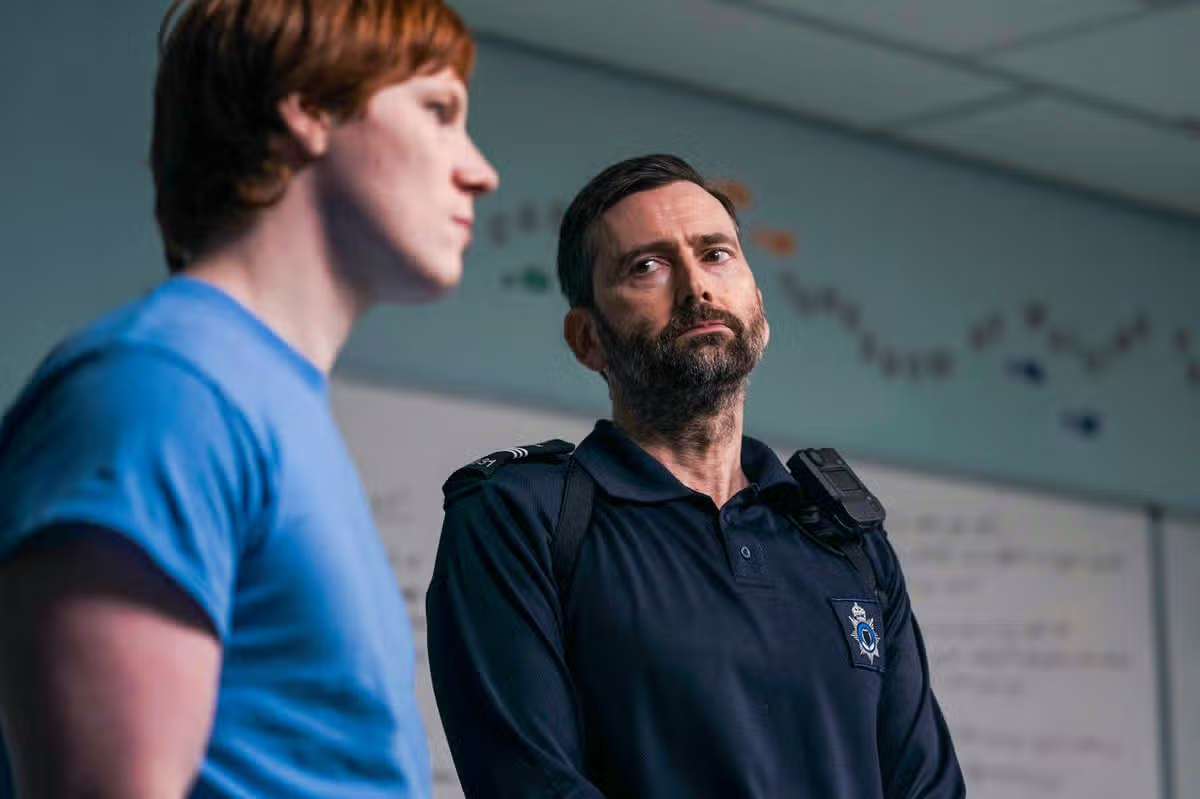
Time returned for a ‘hard-hitting’ third series of the BBC One prison drama starring David Tennant and Siobhan Finneran
BBC One launched a new series of Time starring David Tennant and Louis Shelton(Image: BBC/BBC Studios/Peter Marley)
BBC One viewers were left “shocked” following a violent ending of the new prison drama Time.
Time has returned for a third series, consisting of three episodes, set inside a young offender institution called Alderwick, bringing together David Tennant as officer Bobby Bailey and Siobhan Finneran as prison chaplain Marie-Louise O’Dell.
Written by Jimmy McGovern and co-writer Samuel Bailey and directed by Paul Whittington, Time follows Marie-Louise, who arrives at the institution having lost her faith, where she meets Veteran officer Bailey, a man in the midst of his own crisis.
Away from his day job, Bobby drinks while staring vacantly at the TV as his relationship with his wife, Erica (Vinette Robinson), comes under intense strain.
Back inside the prison, Bobby and Marie-Louise lock horns over how to handle Ushindi, formerly Christopher (Chukwubuikem Molokwu ), a young man with a stammer who has recently reconnected with his birth mother.
Meanwhile, two teenage offenders, Peter (Ollie McNulty) and James (Louis McCartney), struggle through the terrifying first weeks and months of their incarceration, but they are hiding significant secrets.
The most jaw-dropping scene came at the end of episode one, as a mediation meeting between Ushindi and seriously violent offender Patsy Flynn (Louis Shelton) goes horribly wrong, leaving viewers in shock.
Despite the brutal final act of the first episode, Time viewers were left wanting to see what happens next to Patsy and vowed to binge-watch the whole series on BBC iPlayer.
Taking to X, one viewer wrote: “What an ending to EP1, gonna have to binge the lot tonight! #bbciplayer #time”, while a second agreed: “2 more episodes on iPlayer, now #Time.”
“Don’t think I’ve been so traumatised since I saw Scum about 45 years ago #Time”, confessed one viewer.
“#Time.. wow, the best yet. Fantastic writing and acting by all involved. A really shocking watch”, said one impressed viewer of the series.
“What was grim but utterly brilliant! Nobody does hard-hitting drama like the BBC. #Time”, added another.
The next episode of Time airs on BBC One at 9pm on Monday (October 12), while the final episode broadcast on Sunday (October 18) at 9pm.
Time continues on Monday at 9pm on BBC One and iPlayer, with all episodes available now on iPlayer
You’re reading the Essential California newsletter
L.A. Times reporters guide you through the most important news, features and recommendations of the morning.
By continuing, you agree to our Terms of Service, which include arbitration and a class action waiver. You agree that we and our third-party vendors may collect and use your information, including through cookies, pixels and similar technologies, for the purposes set forth in our Privacy Policy such as personalizing your experience and ads.
Sunday morning, Oct. 9, 2022, around 8 a.m., I was about to take a shower when I decided to check my cellphone one more time. Thank God I did: If I hadn’t, I would’ve been half an hour late on assisting in one of the most explosive stories ever to hit L.A. politics.
Via Slack, Times assistant managing editor Steve Clow asked if I could serve as a second set of ears on audio that my colleagues had unearthed involving four of the most powerful L.A. políticos at the time: City Council President Nury Martinez, Councilmembers Gil Cedillo and Kevin de León, and L.A. County Federation of Labor President Ron Herrera. I was still in my birthday suit (sorry for the visual, gentle readers, but I’m sworn to report the facts on this job) when I played the snippet Clow shared: Martinez describing the Black son of then-Councilmember Mike Bonin as “su negrito” — his darky.
I put on my shorts and told my wife I wouldn’t be helping at her restaurant that day.
Clow sent me more clips over the next hour, each crasser than the other — I remember gasping audibly at the part when the four were laughing as Martinez referred to Oaxacans as “ugly.” That morning, my colleagues Benjamin Oreskes, Dakota Smith, Julia Wick and David Zahniser published their first story on the fiasco, which turned out to be a secretly recorded conversation from a year earlier that someone had posted on Reddit just the day before.
The scandal quickly became a national sensation, with even then-President Joe Biden weighing in. L.A. wretched in collective disgust and demanded action, which definitely came: Martinez and Herrera quickly resigned, while Cedillo — who had already lost his reelection bid — would stay on until his bitter end, and De León wouldn’t leave until challenger Ysabel Jurado destroyed him in his 2024 reelection bid. The electoral repercussions of the audio leak can still be felt four years later in this election, as Nithya Raman stages a strong challenge against incumbent Karen Bass — a sentence no one would’ve believed in the fall of 2022, when Bass was on the cusp of winning her first term, and Raman was the lone democratic socialist on the council.
I would’ve figured the anniversary of something as titanic as all of the above would’ve sparked more commemorations than just my columna this week. Nope! L.A. has moved on to the point that Cedillo wasn’t booted from a group photo that included current District 9 council candidate Jose Ugarte, former Assemblymember Wendy Carrillo, former Mayor Antonio Villaraigosa and current Assemblymember Mark Gonzalez — because even Chicanosauruses can survive a political asteroid, I guess?
Having political leaders spew racist, homophobic nonsense now seems like the good ol’ days in an era where infernos destroy or stink up swaths of L.A., immigration agents terrorize immigrants from Westwood to the Eastside, and a spokesperson for a sitting American president denies that the commander in chief suggested Iran bomb the City of Angels, even though he said it during a campaign rally.
I shouldn’t really be surprised, I guess: L.A. infamously loves to forget its own history. But I would urge all you readers to read the great, Pulitzer Prize-winning coverage my colleagues did in the aftermath of the audio leak scandal, because it captured the city at its worst — but also its finest as residents fought back and demanded politicians do better.
Four years later, we can only hope this upcoming election shows more of the same.
The week’s biggest stories
Domenic Hix looks back as a large wave crashes on the shoreline in Laguna Beach on Friday.
(Allen J. Schaben / Los Angeles Times)
Tropical Storm Rachel in SoCal
California real estate
California crime
In memoriam
More news
Editor’s pick
More picks
Things to do
(Illustrations by Lindsey Made This; photograph by Charles Phoenix)
Today’s recipe
(Rebecca Peloquin / For The Times)
This recipe makes apple butter that is less sweet than most; use more sugar if you like, but don’t use less or there won’t be enough to properly preserve the pureed apples.
Have a great day, from the Essential California team
Jack Dolan, investigative reporter Hugo Martín, assistant editor, fast break desk Kevinisha Walker, multiplatform editor Andrew Campa, weekend writer Karim Doumar, head of newsletters
Textile artist Jane Jauregui is expanding the boundaries of what plush figures can be, thinking beyond that pile of mass-produced, branded stuffies huddled atop a twin bed, crammed inside a toy chest, or dangling from a backpack strap.
True, in the nearly two decades that she’s been creating plush figures, she’s produced charmingly minimalistic foxes, cats and buffalo fit for a nursery. However, her latest work has been anything but child’s play.
A plush fried chicken bucket is one of Jane Jauregui’s textile takes on beloved dishes.
She launched her “soft sculpture” company, STFD, in 2024 with the intention of transforming her inner thoughts into plush form — no matter how outside the box those ideas may be. After all, why bring yet another teddy bear into the world when you can dream up a stuffed paintbrush trailing a splash of brightly colored felt “paint,” or a striped bucket filled with faux fried chicken?
In this series, we highlight independent makers and artists, from glassblowers to fiber artists, who are creating original products in and around Los Angeles.
“It stands for Stuff That Feeds Delight,” Jauregui said of the brand’s acronymic name. “The newer things I’m working on are more like display items, but you can absolutely touch them,” she explained. “I just started playing more with the idea of decor, aging it up a little bit more, and playing with the idea of how we can really elevate it.”
Take, for example, a plate of longsilog, the traditional breakfast meal her Filipina grandmother used to make for her. Inside the converted garage of the same Van Nuys house where she was raised, Jauregui whipped up a playful sausage-riceball-fried egg combo using a sewing needle, felt, embroidery floss and sherpa fleece, rather than pots and pans.
Moved by memories of her grandfathers, she created a collection of stuffed felt cigarette butts, complete with simulated ash made by zigzagging stitches.
“My Thai and Filipino grandpas were chain-smokers,” she said. “They passed away, and I just started thinking a lot about what would represent them. Cigarettes immediately came to mind.”
Jane Jauregui’s home studio inside the converted garage of her childhood home.
Though she takes inspiration from her personal experiences, many of her plush figures strike a universal note. Most anyone born in the 20th century would take one look at her plush retro alarm clock radio and instinctively feel the urge to whack its elongated vinyl “snooze” button. The trompe l’oeil wood paneling (which she made by printing a wood-grain design directly onto dark brown fabric) and the red-tinted digital readout screen (the numbers are iron-on transfers) make it a dead ringer for those once-commonplace nightstand devices that predated smartphone alarms.
She first tried her hand at the craft about 18 years ago, after she and her husband, Sergio, couldn’t find the right gift for his newborn niece at famed New York City toy emporium FAO Schwarz.
“Everything was licensed, and I didn’t want any kind of IP [intellectual property],” she recalled. “I went home and said, ‘Well, I’m just going to sew something for her.’ Sergio was like, ‘But you don’t know how to sew, so that’s a little crazy.’ I said, ‘That’s OK, I’ll figure it out!’”
1
2
1.A plush hot dog.2.An ashtray full of plush cigarettes, inspired by Jane Jauregui’s grandparents.
Fortunately, she had a leg up when it came to picking up the new skill. Her father, a retired clothing designer and patternmaker, had introduced her to the inner workings of the garment industry from a young age.
“My dad would have full-time work five days a week, so there wasn’t a lot of time for him to teach me,” she said. “But when he would take freelance work home, I would sit in this garage with him. He had a big table, and I would sit there and watch him sew. It was just really how we spent time together.
“When I decided to start making plush, I remembered little things he would do, like how to walk a pattern — which is making sure the pattern pieces are matching — or how he would move the ruler. I would remember all of those things and put my own spin on it.”
Artist Jane Jauregui eschews watercolors and acrylics, preferring to “paint with plush.”
She started by making simple shapes like a stuffed orange, pear and an eggplant, working her way up to the finalized baby gift: a stuffed whale. By 2009, she’d completed enough plush produce to start selling at local pop-up markets under the business name Janie XY. Sergio, an artist in his own right, even constructed her first booth to resemble a fruit stand. Her first hit item was a baby rattle shaped like a chicken drumstick that was sold wrapped in cellophane, much like a meat-counter purchase. This time, her muse was her own infant niece.
For the record:
11:27 a.m. Oct. 7, 2026An earlier version of this article said Jane Jauregui’s daughter is 4 years old. She is 5.
All the while, she was holding down a full-time job creating window displays for Forever 21. She continued to build her squeezable empire in her off-hours, even as she transferred to corporate jobs at Mattel and Disney (for which she’s now a consumer products design manager), and became a mother. Taking a page from her father, she’s made her at-home workspace accessible to her 5-year-old daughter.
“She’s in here all the time,” she said. “I let her touch everything. What’s fun about the medium is you can’t break it. You can get it dirty, but she knows what to do. She’s really mature about it. She loves to clean the sewing machine — she’ll go in with a pin and pick out all the lint, and she’ll think that was a good day’s work. We want her to feel like part of the work because she is a part of it.”
Jane Jauregui’s sewing machine, which her daughter likes to clean, in her home studio.
That said, Jauregui’s STFD creations aren’t necessarily made with the wee ones in mind. Consider her new pieces celebrating liquor stores, for which she converted items like lottery tickets and frothing beer cans into plush form.
“It’s something that we all take for granted,” she said of the ubiquitous neighborhood corner store. “You tend to turn your nose up at it, but it’s there for you all the time.”
She and her husband also pay homage to these unsung cultural hubs in the latest edition of their fledgling zine, which they’ve dubbed “a gallery you can hold.” Inside, photographs of the stuffed figures fill the pages, accompanied by written musings. (The one-of-a-kind featured items will also be available for purchase.) The series is the couple’s prescribed antidote to the social media doomscrolling they call “internet indigestion.”
Jane Jauregui’s goal for the plush items she makes in her studio? Delight.
She’s also planning to explore plush Thai food in honor of Grandma’s Thai Kitchen, the Van Nuys restaurant her mother owned and operated for years. After treks to downtown L.A.’s Fashion District to find just the right materials, she’ll mock up clever riffs on julienned ginger and cilantro leaves. For her, there’s ample delight in those little details.
“STFD is really about giving myself permission to just do things that make me happy,” she said.
Scarlett Moffatt has shared some adorable photos of her two sons meeting for the first timeCredit: Instagram/@scarlettmoffattThe star beamed in her hospital bed with her partner ScottCredit: Instagram/@scarlettmoffatt
In the new photos, Scarlett is sitting up in her hospital bed surrounded by her expanded little family.
Clark is laying on one of Scarlett’s legs wearing a small cream coloured baby suit, while Jude is sitting between Scarlett’s legs.
Sign up for the Showbiz newsletter
Thank you!
Jude smiles widely at his little brother, who is partly resting on his lap.
Proud dad Scott is beaming by the bedside while the sweet moment unfolds, taking it all in.
Jude appeared happy to be a big brotherCredit: Instagram/@scarlettmoffattScarlett welcomed her little one earlier this weekCredit: Instagram/Scarlett Moffatt
Scarlett gushed in the post’s caption on Instagram: “The moment Jude met Clark.
“Watching the boy who first made me a mammy become a big brother is a moment I’ll treasure forever.
“And judging by the last slide, Clark did very well with his choice of Transformer toy for his big brother.”
Announcing news of the birth on October 9, Scarlett shared online: “Our beautiful boy is here! Clark Xander Dobinson.
“Arriving a little earlier than expected and not quite as straightforward as planned, our little family of four was made complete on Monday.
“Our hearts have never been so full, and I’d do it all again for you, Clark.”
Is there anything more worrisome about today’s tech titans than the fact that they present as abundance-minded optimists but in actuality are gluttonous, scorched-earth pessimists? Documentarian Alex Gibney is no stranger to dissections of corrupting power — from his feature dives into Enron, Elizabeth Holmes and Scientology. He frames his deeply researched four-hour psych eval “Musk” as the reality check we all need when the world’s richest, most cult-powerful human keeps pushing migration to Mars. Musk might need Earth to become uninhabitable to justify the trip.
Musk’s Tesla cars, SpaceX rockets and Starlink satellites have inspired awe while his “dark MAGA” politics, limited knowledge and petty ego have made him plutocrat Enemy No. 1. Other behavior-coded prisms through which to view Musk — an immigrant whom American fascists love — include his oft-stated belief that we’re living in a simulation. He also loves video games. Gibney sporadically complements his archival materials and many interviews with the metaphoric imagery of player-one gaming: toggling between identities, first-person shooter modes. He also shrewdly compares Musk to the protagonist of a 1930s film adapted from an H.G. Wells story, “The Man Who Could Work Miracles,” about an ordinary guy bestowed with world-altering powers by the gods. (It doesn’t go well.)
There’s even a computer-generated Elon, a by-product of Gibney not securing a face-to-face interview with the tycoon himself. Avatar Musk, meant to appear like AI slop and spouting commentary culled from the totality of his recorded interviews, is pretty gimmicky. But its strangeness also seems appropriate, considering the epic oddity of the South African’s ascension from mistrusted Silicon Valley wannabe to ever-confident cheerleader for space dreams and electric vehicles. Musk is savvy at securing investment, whether his shiny pronouncements about the future prove real or not. It’s why Gibney’s surest, most clear-eyed take is that Musk is less a visionary than a self-promoter — selling Autopilot in Teslas when it led to deaths, being recklessly bullish about AI — and the greatest artificial stock-pumper of all time.
Musk’s forthright, crusty dad Errol sounds almost proud that something was bullied out of his son, but the movie avoids filling out that traumatic childhood. More heartbreaking is ex-wife Justine Musk’s well-articulated experience of Musk’s cruel domestic side — especially where trans daughter Jenna was involved. Ashley St. Clair, the right-wing influencer and one of Musk’s many baby mamas, chillingly completes the portrait of someone who sees fatherhood as an NDA arrangement to help facilitate a genetic army. She watched him up close as he cozied up to Donald Trump, grew his online fandom after taking over Twitter and consolidated his data power. St. Clair simply calls him a “nuke,” one that might readily self-detonate at the slightest bruising of his self-image.
With a built-in intermission dividing his rise (SpaceX, Tesla) from his rightward shift (Twitter, Trump), it’s wild how much the documentary’s second half makes you long for the garden variety tech-bro obnoxiousness of the first. The running time seems a lot for one’s tolerance of a supervillain story and not enough, since the story of DOGE, a venal propaganda folly with a human cost, really needs its own separate feature.
Even a four-hour “Musk” can’t keep up with the unelected trillionaire’s financially self-serving governmental meddling, considering the recent news of his involvement in a Department of Defense AI warfare study. Maybe his conning can be curtailed someday, but the thought there’d ever be enough distracting chaos for a similarly lengthy follow-up is almost too much to bear.