For the next five years, the Environmental Protection Agency has indicated it will not require public water utilities to test for microplastics or pharmaceuticals in drinking water, according to a proposed rule published in the Federal Register.
On Friday, the EPA submitted a list of chemicals it plans to test for under the Unregulated Contaminant Monitoring Rule, a mandatory testing program used to collect information about concerning chemicals in drinking water that could be harming human health. It did not include microplastics or pharmaceuticals.
The omissions come after announcements by EPA Administrator Lee Zeldin earlier this year that his agency was designating microplastics and pharmaceuticals priority contaminants for testing.
“This is a direct response to the concern of millions of Americans who have long demanded answers about what they and their families are drinking every day,” he said at an April news conference with Health and Human Secretary Robert F. Kennedy at EPA headquarters.
Zeldin’s announcement was seen at the time as a move to placate the increasingly disgruntled Make America Healthy Again contingent of Trump supporters.
Now the agency says it has no validated or standardized method to test for the plastic particles in drinking water, and wouldn’t be able to develop one before December, when testing is required to begin.
Among the 33 chemicals the EPA will require water utilities to test for are seven PFAS, or forever chemicals, and three pesticide residues.
It will be five years before the EPA proposes another list.
The EPA did not respond to a request for comment.
The agency noted in its proposed rule that it will collaborate with other federal agencies to “evaluate risks and exposures” of microplastics for future monitoring.
Environmentalists reacted with frustration and resignation. They pointed out that the European Union has developed methods to test for the tiny plastic particles, which have been found in people’s blood, brains and lung tissue. California has one in the works.
“The California water board has spent a lot of time and money on how to measure in drinking water,” said Judith Enck, a former EPA regional administrator and president of the anti-plastic environmental group Beyond Plastics “EPA should give them a call.”
California was required by a 2018 state law to establish a protocol for local water utilities to test for the particles in drinking water. The state has not yet begun reporting its results, but protocols were established in 2021. Blair Robertson, a spokesman for the State Water Resources Control Board, said it’s not “a fully validated, end-to-end regulatory method” yet.
At the April meeting, Zeldin announced that he would place microplastics on what is known as the Contaminant Candidate List, which acts as a preliminary “watch list” of unregulated, priority contaminants in drinking water. Like the mandatory monitoring list, it is updated only every five years. The most recent list was published on April 2 — the day he made his announcement.
“Americans have been ignored as they sound the alarm about plastics in their drinking water,” Zeldin said at the April announcement. “That ends today by placing microplastics on the contaminant candidate list for the first time ever. EPA will follow the science, will pursue answers and will hold ourselves to the highest standards to protect the health of Americans.”
There appears to be no clear association between these two lists, although the contaminant list is supposed to inform the monitoring list. Seventy-five chemicals and four chemical groups (microplastics, pharmaceuticals, PFAS chemicals, and disinfection byproducts) were listed on the 2026 contaminant list. Only seven of those chemicals were also on the proposed monitoring list (as well as seven PFAS chemicals).
When Zeldin announced microplastics as “‘a priority contaminant for regulation,’ and called it ‘a historic action on microplastics,’ he made it seem like the administration was going to take microplastics seriously,” said Mary Grant, water policy director for the environmental group Food & Water Watch.
“By not including them, they made it clear they don’t actually have plans to immediately address this crisis by getting the real-world monitoring data that we need right now to really start correcting ourselves,” she said.
Craig Davis, senior director of plastics chemistry at the American Chemistry Council — the nation’s largest trade group for chemical companies — said that while his organization supports microplastic research, it also agrees with the EPA’s decision not to include them in the monitoring list.
“National drinking water monitoring should be based on validated, standardized methods that can produce reliable and comparable data,” said Davis in a statement. He said “limited” national monitoring resources should be focused where data can produce “actionable public health information.”
The public has 60 days to comment once the plan is published in the Federal Register.
WASHINGTON — Holiday gatherings and major life events have come with an empty seat. Certain dates on the calendar meant time at a cemetery, standing before granite stones.
They are a relatively small group of people, scattered across different states, but they share a common bond that stretches decades: Each had a family member die violently in the struggle for voting and civil rights, victims on a long and difficult path marked by blood that ended when the country seemed to mature into the nation of its creed.
But 61 years later, and as the country approaches its 250th anniversary this weekend, those sacrifices are in question. In a series of decisions over the last dozen years, including one in April, the Supreme Court has essentially dismantled the law that their family members died to see enacted, the Voting Rights Act of 1965.
“My mother’s blood is on that bill. We were always proud of that, and now it’s gone,” said Anthony Liuzzo, whose mother, Viola Liuzzo, died on an Alabama highway between Selma and Montgomery while driving marchers in 1965.
Critics of the law contend that times have changed, an argument Chief Justice John G. Roberts Jr. made in a 2013 decision that was the first major step in rolling back the law.
Survivors of lost loved ones disagree, pointing to the speed with which Republican-led state legislatures eliminated majority-Black congressional districts after the court’s April ruling, which severely weakened a section of the law that had protected voting rights for minority communities. They feel anger and sadness that a milestone political victory decades ago has been reversed, but they are committed to keep fighting.
A church bombing and a chunk of concrete
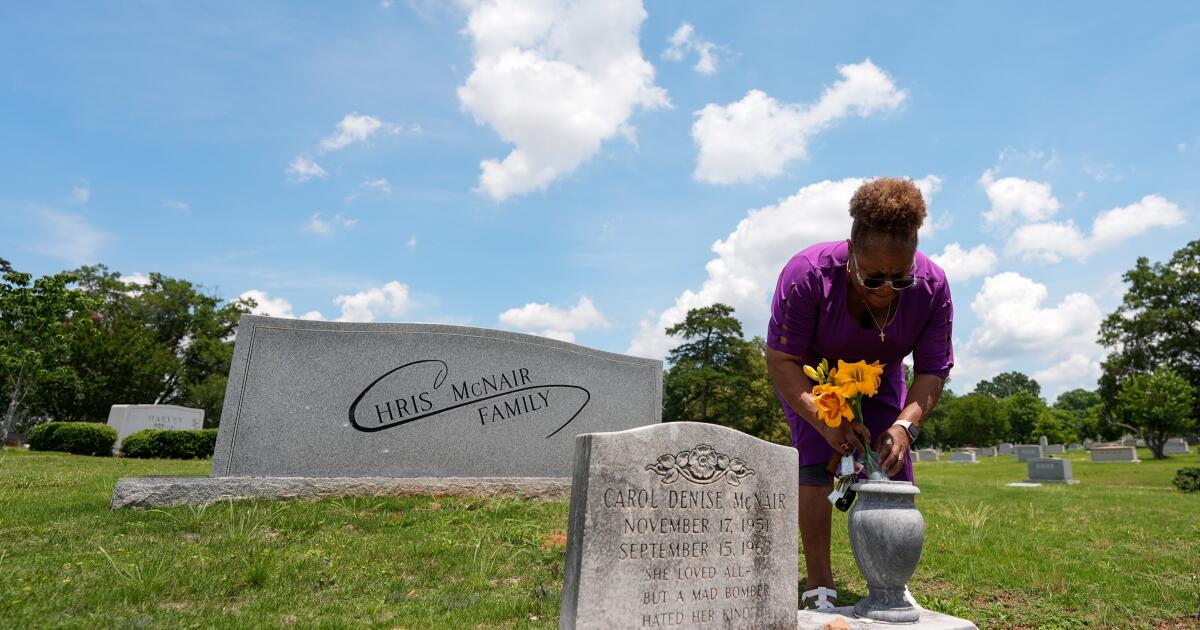
Lisa McNair was born Sept. 19, 1964. Her older sister, Denise, died in the Sept 15, 1963, bombing of the 16th Street Baptist Church in Birmingham, Ala. The church had been a central organizing point for civil rights protest.
The explosion killed Denise McNair, 11, and 14-year-olds Addie Mae Collins, Carole Robertson and Cynthia Morris Wesley. Nearly two dozen others were injured. Three Ku Klux Klansmen were convicted years later.
One of Lisa McNair’s early memories of her sister was of the box that their grandmother kept from the funeral home. It included Denise McNair’s shoes, a purse and a rock-sized piece of concrete that had been embedded in her skull.
The crime brought the civil rights struggle onto the national stage and outraged President Kennedy.
The times were tumultuous, McNair said, but it seemed the nation was heading in the right direction. Most of her life, “I’ve seen advances” on television, in commercials, with interracial marriages, civil rights and voting rights, “a plethora of rights that we got over the greater part of my lifetime.” But that has changed, she said.
McNair, 61, said she is “physically sick” about the Supreme Court decision and subsequent actions by lower courts and legislatures.
“I am constantly working to pray my way through it, so I can get up and go to work in the morning and do what I need to do. But I just want to ask every white person I see, ‘What more do you want?;” she said. “‘Why do you hate us so?’”
They left for Freedom Summer and never came home
Michael Schwerner, known as Mickey, came from a family in which human rights activism and challenging social norms were expected. He was in Mississippi in 1964 as part of Freedom Summer when he, Andrew Goodman and James Chaney vanished one day in June while investigating a bombing at a Black church.
Their bodies were found weeks later, buried in an earthen dam in a rural area of Neshoba County. Schwerner, 24, and Goodman, 20, were white; Chaney, 21, was Black.
Stephen Schwerner, who died earlier this year and was a social activist in his own right, told the Associated Press in a 2023 interview that as soon as the family heard his younger brother and the other men were missing, they knew they were dead.
“Our family was very out front in the media that the only reason there was international attention was two of the young men were white,” said Stephen’s daughter, Cassie Schwerner. “Had all three of those young men been Black, they would have ended up absent from our history and our narrative.”
The executive director of Morningside Center for Teaching Social Responsibility, Cassie Schwerner, said her family has followed voting rights through their ups and downs. That includes the 2013 Supreme Court decision that allowed states and counties with a history of discriminatory voting rules to make changes without prior approval from the Department of Justice.
The court’s April decision, she said, brought rage “and a good deal of sadness — not for me and my family, but for this country.” There is, she said, work to be done on multiple fronts.
Rights paid for in blood turned out to be fragile
Tamara Orange said among her many thoughts when she heard of the Supreme Court decision in this year’s Voting Rights Act case, there was relief — “relief that my dad is not here to see that; that Jimmie Lee Jackson is not here to see it; that Viola Liuzzo is not here to see it,” she said. “I’m relieved for them because to me, it’s as though the sacrifices that were made were done in vain.”
Her father, James Orange, was working with the Southern Christian Leadership Conference to organize voting rights protests in Marion and Perry County, Ala., in 1965. When juveniles joined the effort, he was arrested for contributing to the delinquency of minors. Concern arose that Orange was going to be taken out of the jail and lynched.
A protest to intervene ended with Jackson, a 26-year-old Black church deacon, being shot in the stomach by a state trooper while Jackson tried to shield his mother and grandfather.
His death was the catalyst for what became the Selma-to-Montgomery march and “Bloody Sunday.”
Orange stayed in the movement all his life and died in 2008, Tamara Orange said. But even after the Voting Rights Act passed, “he would say, ‘Be careful or we’re going to lose it.’”
‘We got bad news for you’
Anthony Liuzzo had just turned 10 when his mother, 39, left their middle-class neighborhood in Michigan and headed for Selma. She had cried as she watched scenes from “Bloody Sunday” on television.
Viola Liuzzo participated in a portion of the second march and then helped drive other civil rights protesters around the Black Belt region of the state. On March 25, 1965, she was driving one protester between Selma and Montgomery when a vehicle pulled alongside and fired into the car.
The phone call came around midnight. Anthony Liuzzo remembers the caller asking his dad, “Is your wife Viola? We got bad news for you. She’s been shot.” When his father asked whether she was all right, the caller said, “No, she’s dead,” and then hung up.
An informant for the FBI quickly identified members of the Ku Klux Klan as her killers. The three men charged would escape conviction on state charges but be convicted in federal court.
Anthony Liuzzo and his siblings lived with the lost birthdays and other missed milestones. His comfort was that the voting rights she had died for had become a reality. But the April ruling by the Supreme Court and the subsequent rush by Republican-led legislatures in several Southern states to eliminate congressional districts represented by Black lawmakers left him angry and distraught.
Even so, he said he is still proud his mother had the courage to go to Selma “when others sat in their pretty little houses.”
One morning, the Klan returned
The inscription at the bottom of Vernon Dahmer Sr.’s tombstone reads simply: “If you don’t vote, you don’t count.”
It is a message that embodies his life’s work and the story behind his death.
Even after President Johnson signed the Voting Rights Act, not every state was eager to implement the new law. In Mississippi, it came with a poll tax. The amount was $2, but in a world where a farmworker’s wages might only be $5 a day, that was substantial, said Dahmer’s son, Dennis Dahmer Sr.
The elder Dahmer, 57 at the time of his death, was a successful businessman who owned a store, sawmill and farm near Hattiesburg. He also was a civil rights leader and NAACP president in Ford County. He offered to pay the $2 for Black residents who wanted to register to vote.
He had already been under scrutiny by the local Ku Klux Klan. There was harassment and there were threatening phone calls. The windows were shot out of his store, but no one challenged him directly because his sons were always present and armed.
That seemed to tail off after Johnson signed the law.
“The Klan quit calling,” Dennis Dahmer said. “They quit shooting out the windows, so my family thought that all of this was behind us.”
That changed in the early hours of Jan. 10, 1966, when two carloads of Klansmen showed up. They firebombed the house and adjacent grocery store and began shooting at the house. The elder Dahmer shot back, using his ample arsenal to fight off the attack.
His wife and the three children who were home survived, but he suffered severe injuries from inhaling the smoke and fumes from the flames. He died later that day.
Dennis Dahmer was 12 as he stood next to his dad’s hospital bed. He wondered why some people wanted his father dead just for trying to help Black people vote.
A former Imperial Wizard of the Ku Klux Klan, Sam Bowers, was convicted in 1998 for the attack and sentenced to life in prison.
Like the families of other survivors, Dennis Dahmer’s family has witnessed the methodical dismantling of the Voting Rights Act.
“Finally, they basically turned it into a relic,” he said.
His plan now is activism, to speak out and promote the need for a massive voter turnout. He also wants to remind people of the price that certain families paid for everyone to have the right to vote and be represented by someone of their choosing.
“We’re living in a time when America has a lot of the same characteristics of the 1960s that I grew up in,” he said. “People say, ‘Are we going back?’ Hell, we’re already there.”
“The Pitt” has put “ER” veteran Noah Wyle back where he excels: a fictional emergency room. But this time, Wyle has assumed far more control over the Emmy chaos by producing and directing as well as acting.
2
In 2025, Wyle won the lead drama actor Emmy for playing complicated miracle worker Dr. Michael “Robby” Robinavitch, plus a producing prize for drama series.
5
Wyle was nominated five times (1995-1999) without winning for his supporting performance as Dr. John Carter on “ER,” his first hospital-set collaboration with producer John Wells.
29
Nominations that “ER” actors Wyle, Julianna Margulies, Anthony Edwards, Sherry Stringfield, Eriq La Salle, George Clooney, Laura Innes, Gloria Reuben, CCH Pounder and Maura Tierney amassed in supporting and lead categories.
1
Emmy wins that resulted from those nominations: Margulies’ supporting triumph in 1995.
200%
“The Pitt” doubled that haul in one season, with Wyle’s lead and Katherine LaNasa’s supporting wins. (And added a guest actor Emmy for Shawn Hatosy, who moves up to supporting in Season 2.)
3
Wyle could grab three more nominations this time around, including for his “Pitt” directing debut (Season 2, Episode 6).
8
He also no longer competes against his co-stars, as he did with La Salle, and as at least eight “Pitt” performers (LaNasa, Taylor Dearden, Fiona Dourif, Sepideh Moafi, Isa Briones, Patrick Ball, Gerran Howell and Hatosy) could this year.
Four days after twin quakes left 1,450 dead and nearly 69,000 missing in Venezuela, residents and volunteers say they feel abandoned by the government as they race to save lives from the rubble.
As one of the biggest techno DJs in the world, Charlotte de Witte never has her feet on the ground for long. But she comes back to L.A. as much as she can.
In Sunday Funday, L.A. people give us a play-by-play of their ideal Sunday around town. Find ideas and inspiration on where to go, what to eat and how to enjoy life on the weekends.
“Since I started, L.A. has been one of those very important cities. You really want to hit it as a beginning artist. It’s where everything is centered and everything is happening,” De Witte said during an interview at the Grammy Museum in November. She was here celebrating the release of her self-titled album debut. “L.A. made a difference for me.”
Throughout her years partying and performing in L.A., she’s played clubs such as Sound and Exchange LA. Then she grew to larger spaces like the Shrine and City Market, where she played open-to-close sets.
In the past, when things haven’t been as hectic, De Witte has enjoyed many of L.A.’s unique cultural offerings. Here are a few of her favorite things to do on a Sunday in the city.
9 a.m.: Coffee at Maru downtown
When I’m staying around downtown, I like to go to the Arts District and stop by Maru for a coffee. They also make great matcha and pastries. Whether it’s to-go or you’re just hanging around for a bit, great coffee is the best way to start the day!
11 a.m. Roller skate from Venice to Santa Monica
If we have a little bit more time to enjoy L.A. on tour, we always go to Venice. It’s such a unique place to be, but it’s also a very chill place. You’re in L.A., which is a huge city, but because you’re also next to the ocean it’s more calming for the mind and soul. When I’m on tour, I’m always in big cities, in the middle and the heart of where everything’s happening, and I could miss some peace and quiet, because I live in the countryside at home in Lisbon. Venice is that bright, sweet spot in the middle, where you have the more relaxing presence of the water and the beach, but still connected to Los Angeles.
Noon: Lunch at Gjusta
My manager is a big fan of Gjusta. He goes there all the time, wherever he is staying, so I think it kind of rubbed off on me.
2 p.m.: Facial treatment at Formula Fig in Culver City
A facial treatment is one of my favorite self-care moments when I’m on the road. It helps me relax and keeps me feeling fresh. The area around the Culver City location is also really nice for a walk or to grab a drink or a bite.
4 p.m.: Cruise around L.A. with an old-school Manx Beach Buggy
Manx Beach Buggies are an amazing buzz! I recently had the chance to take one for a spin around the city with my wonderful friends at Race Service, the car culture hub on Venice Boulevard in Mid-City. They had an event at Living Room. People from all over the U.S. drove there with their cars. It was incredibly fun, and it felt very, very L.A.!
6 p.m.: Dinner at Dudley Market
I am kind of into wine, especially natural wines. In Portugal, we are doing a lot with wines. Actually, we are building our own vineyard, so it’s important to us to learn more about natural winemaking. Dudley has amazing food and a great wine selection, and it’s also in Venice, so it’s perfect.
11 p.m.: Night out in a rough and sweaty warehouse like Aurora
As a DJ, I obviously have to end my night on the dance floor. It’s such a primal feeling to go clubbing, to all come together and dance to a beat. To feel this in your chest, it’s an experience that human beings have been doing throughout history. Because of the time that I spent on the dance floor, but also the time that I spent on the other side as a DJ, I would really argue that clubbing is essential in everyone’s life. It’s also self-care. During my last stay in L.A. — the week I released my debut album — I played five shows during a three-day period. I enjoyed all the sets, but to end the day with a deep dive into the night, Aurora Warehouse is a great venue.
A dull yellow light peeks through a brooding sky looming over rolling Southern California hills. The oil painting “Approaching Storm” captures the kind of picturesque scene that would get fine artist Paul Grimm work in early Hollywood. Known for his plein air landscapes and masterful depictions of clouds, he turned to studio work to make money during the Great Depression.
He is one of many artists on display at a new UC Irvine Langson Orange County Museum of Art exhibition about set painters whose work would go uncredited or overlooked.
Share via
“They weren’t making their living selling their paintings, but they were making their living working for the studios,” said museum director Kathryn Kanjo. “The artist would lose their individual credit and recognition, to be at the service of what was needed by the studio.”
Elsewhere in the “Staging California in Early Hollywood” exhibition, hangs an 18-by-25-foot painted backing for “The Sound of Music” (1965), a project led by the then-art director of 20th Century Pictures’ special effects department, Emil J. Kosa Jr. He’d be the only one to get credit at the time, not the five other contributing artists, including celebrated plein air artist Arthur Grover Rider, who are also noted in the museum description.
“In general, at the studios, they systematized the production design, so that it was fast,” Kanjo said, describing the rigid process as militaristic. “Five artists at a time work day after day to get these things done.”
It’s the museum’s first exhibition since UC Irvine acquired the Orange County Museum of Art last September, building a 9,000-piece collection dating back to the 19th century.
The exhibition, with about 50 pieces, is the first since Kanjo’s appointment in December. It’s a love letter to the film industry’s anonymous and little-known artists, whose works were vital to movies.
The exhibition opens with Paul Grimm’s Untitled, 1974, left, and “Approaching Storm,” 1974, right, which capture the essence of the Southern California landscape.
(Allen J. Schaben / Los Angeles Times)
Take two of the most prolific set artists of the mid-20th century: Warren Newcombe and George Gibson. Newcombe was a Massachusetts-born, well-educated artist who started working on sets as early as 1920. He’d eventually join the MGM art department, where he perfected a visual effect technique called “matte painting.” For a time, it was simply referred to as the “Newcombe shot.”
Gibson was also at MGM around the same time. When the studio first hired the Scottish artist, he’d routinely miss shifts to paint plein air in Southern California. He and Newcombe would help craft “The Wizard of Oz” (1939), but when the credits rolled, both their names were missing.
Newcombe and Gibson would go on to be recognized and celebrated for their work. About a decade after “The Wizard of Oz,” Newcombe won two Oscars for special effects, for “Thirty Seconds Over Tokyo” (1944) and “Green Dolphin Street” (1947).
“He was really instrumental in the professionalization of artists at MGM,” assistant curator Michaëla Mohrmann said of Gibson. “His insistence on color saturation is something that really informs his work for ‘The Wizard of Oz,’ and it’s really that movie that cements his reputation as one of the masters of scenic art.”
Meanwhile, artists like Arthur Beaumont hardly got their due. Raised by a military family in England, the California transplant was particularly captivated by naval vessels. By 1933, he had painted maritime art for most of the U.S. Naval fleet. As a result of his work, he was commissioned as a lieutenant in the U.S. Navy and recognized as its fleet’s official artist.
He also began producing promotional materials and storyboards for Paramount Studios’ naval films as early as 1935, first for a movie titled “Mutiny on the Bounty.” In 1942, he would do the same for “Wake Island” in the midst of World War II. His work was later etched into metal plates and used to mass-produce publicity prints.
Museum director Kathryn Kanjo stands between Arthur Grover Rider’s “Ortega Highway” (1974), left, and Emil J. Kosa Jr.’s “How Marvelous Thy Works” (1928).
(Allen J. Schaben / Los Angeles Times)
“They were participating [in the military and war] in different functions and not always credited for that kind of work,” Mohrmann said. “I think there was an act of generosity [during wartime] in general — everyone was really patriotic.”
The exhibition also features a silent film titled “The Life and Death of 9413: a Hollywood Extra,” a 1928 short highlighting the plight of a background actor known as “9413.”
“It’s all like him being shoveled around and underappreciated and not even given a name, right?” Kanjo said. “Everybody thought it was funny because it was kind of meta, but it was pointing out real issues.”
Beyond giving credit where credit’s due, the exhibition aims to uplift background art.
“Back then as well as now, people question the artistic merits of these works because they were made for films that were for profit,” Mohrmann said. “When in reality there was a ton of talent and artistry and critical thinking.”
Appearing as the amoral daughter of Joan Crawford at only age 17, Blyth’s short film career saw her work with many top stars of Hollywood’s classic era.
WHEN it comes to a holiday in Egypt, most Brits head to Hurghada or Sharm el Sheikh.
But there is a lesser-known spot in Egypt that people say feels like going back in time.
Sign up for the Travel newsletter
Thank you!
Siwa Oasis in Egypt is home to a number of salt poolsCredit: Alamy
Siwa Oasisis home to salt pools that are more concentrated than the Dead Sea, clay houses and miles of desert.
You can float in the bright blue waters – just make sure to wash off when you come out with tap water as the salt can irritate your skin.
The pools are surrounded by desert, where you can do a number of other activities including sandboarding and ‘dune bashing’ where you race around in 4x4s.
For another swimming experience, visitors can head to Cleopatra’s Bath – a natural spring with crystal waters.
Local legend has it that Queen Cleopatra used to swim in the circular pool and visitors can do the same today, as long as your shoulders and ankles are covered.
Around the pool there are even a number of cafes serving Siwan mint tea as well as freshly made juices.
And there are natural pools which Cleopatra is rumoured to have usedCredit: Alamy
Near the bath is also the Temple of the Oracle, dating back to the 26th Dynasty.
The temple sits on the top of a hill and is known for being the spot where Alexander the Great was named the son of Amun in 331 BCE.
Even though much of the temple today is ruined, visitors can climb to the highest point where they will get panoramic views with palm groves, salt lakes and desert.
The town of Siwa Oasis itself is home to hundreds of clay buildings, with the Shali Fortress standing in the middle.
The fortress dates back to the 13th century and is made of kershef, which is a blend of salt, mud and clay – all from the local lakes.
Despite heavy rain causing damage to the fortress in 1926, it still stands today with a number of alleyways and sets of stairs to explore.
In the main town, you will find clay buildings including a fortressCredit: Alamy
One person said on TikTok: “The town itself feels like you’re stepping back in time.”
There is a catch, however – to get there, you will have to drive 10 hours from Cairo and pass through several military checks on the way.
You can fly to Cairo from the UK in July from £165 one-way.
With GetYourGuide, you could then head off on a three-day tour from Cairo to Siwa Oasis, staying in a lodge in Siwa Oasis for one night and a Bedouin Camp for the second night.
The tour includes exploring Siwa Oasis as well as the El Alamein Military Museum, Mountain of the Dead with the tombs of Si-Amun, dipping in Cleopatra’s pool and visiting the city of Shali.
Also included in the tour is a dune buggy ride and sandboarding.
To get to Siwa Oasis you’ll need to drive from Cairo which takes around 10 hoursCredit: Alamy
window.itgHolidayConnectHolidayDealsFrames =
window.itgHolidayConnectHolidayDealsFrames || [];
window.itgHolidayConnectHolidayDealsFrames.push({
cid: “99a9d895”,
pid: “8925dc20-49c7-4663-9c7c-547ad29879e4”,
config: {
“poweredBy”:”icelolly”,”intro”:”Best value deals “,”title”:”The Sun Travel Eygpt all-inclusive deals under £600pp”,”destination”:”9546″,”boardBasis”:”AI”,”maxPrice”:”60000″,”maxDepartureDate”:”plus60″,”utm_campaign”:”The Sun Travel Eygpt all-inclusive deals under £600pp”,”layout”:”carousel”,”container”:”false”
},
});
Alternatively, you could head on a three-day tour with Viator heading to Marsa Matrouh, which Viator claims to be “one of the most beautiful cities on the Mediterranean” before reaching Siwa Oasis.
Similar to GetYourGuide, Viator’s tour will also take you to the Mountain of the Dead.
The tour also includes a dune buggy ride, camping in Siwa Oasis, stargazing and meditation, a tour of the Temple of the Oracle and a visit to Darker mountain.
NEW YORK — David Clayton-Thomas, the lead singer of Blood, Sweat & Tears, whose husky, high-strung tenor on “Spinning Wheel,” “And When I Die” and other hits helped make the so-called brass rock band among the most popular acts of the late 1960s, has died at age 84.
Spokesperson Eric Alper said that Clayton-Thomas died peacefully Wednesday at St. Michael’s Hospital in Toronto. Alper did not cite a specific cause of death.
Clayton-Thomas was a onetime street fighter and petty thief from Canada who briefly became a rock superstar, the front man of a nine-member group that sold millions of records and won two Grammys for “Blood, Sweat & Tears,” which beat out the Beatles’ “Abbey Road” for best album of 1969. Calling out amid a jazzy parade of horns, keyboards and percussion, Clayton-Thomas’ urgent shout was a signature voice of the era, preaching love on the Motown cover “You’ve Made Me So Very Happy,” a lasting legacy on Laura Nyro’s “And When I Die” and a cool head on his own “Spinning Wheel.” Meanwhile, Blood, Sweat & Tears helped inspire a wave of horn-led bands, among them Chicago, the Electric Flag and Ten Wheel Drive.
“A lot of the guys [in Blood, Sweat & Tears] would play a Broadway show matinee, then go up to Harlem and play Latin music or R&B and funk at night, or come down to the Village and play pure jazz the next night,” Clayton-Thomas told Bestclassicbands.com in 2023. “I was just a blues player: Give me three chords and I’ve got a song.”
At its peak, Blood, Sweat & Tears’ appeal was so broad it helped lead to the band’s downfall.
Hip enough to perform at the 1969 Woodstock festival, where they were among the highest paid acts, they also were known enough to the establishment to tour Eastern Europe the following year on behalf of the State Department. When Clayton-Thomas and other band members denounced the Communist regimes on the other side of the Cold War, Rolling Stone’s David Felton wrote that “the State Department got its money worth.” Counterculture Yippies would turn up at a 1970 Blood, Sweat & Tears show at Madison Square Garden, carrying obscene banners outside and dumping manure by the front gate.
The band had practical reasons for going along with the government: Clayton-Thomas, who had allegedly wielded a gun at his girlfriend, had been denied a green card and faced deportation. But after topping the charts in 1970 with the album “Blood, Sweat & Tears 3,” their appeal soon faded. A burned-out Clayton-Thomas left the group in 1972, and neither he nor the remaining musicians ever regained their old stature. Blood, Sweat & Tears would continue recording over the next few years, and even briefly reunited with Clayton-Thomas, who went on to release more than a dozen solo albums and tour on his own for decades.
Beginning under a licensing agreement reached in 1984, Clayton-Thomas toured as “Blood, Sweat Tears” for 20 years with a revolving roster of bandmates. A 1994 Times review of a show at the Coach House in San Juan Capistrano reported that “BS&T’s formula has legs, that its music has withstood the test of time. Indeed, in a world full of today’s pop harmonic minimalism, the sound of trumpets, trombones, guitar and sax backing a singer somehow seems fresh, even if it has been around for so long,” and Clayton-Thomas “still has all the enthusiasm and buzz-saw roughness that gave his voice its distinctive quality way back when.”
In 2005, BS&T re-formed (without Clayton-Thomas, who continued his solo career) and has toured since with various lead singers.
Clayton-Thomas was inducted into the Canadian Music Hall of Fame in 1996. “Spinning Wheel,” covered by everyone from James Brown to TV star Barbara Eden, was voted into the Canadian Songwriters Hall of Fame a decade later.
Born David Henry Thomsett on Sept. 13, 1941, in Kingston upon Thames, near London, and raised near Toronto and Ottawa, he was the son of a Canadian World War II veteran and of a pianist-entertainer who helped inspire her son’s interest in music. Thomsett was lucky to have the chance. He fought violently with his father, was living in the streets by his mid-teens and by age 20 was serving time in a reformatory for vagrancy, assault and other crimes.
An old guitar, left behind by a fellow inmate, changed his life. He taught himself to play and began spending extensive time in the early 1960s around Toronto’s Yonge Street music “strip,” where peers included the American rockabilly star Ronnie Hawkins, a mentor to Robbie Robertson and other future members of the Band and a guide for Thomsett early in his career.
Eager to reinvent himself, he changed his last name to Clayton-Thomas while leading his own groups. In the mid-’60s, he released such albums as “Sings Like It Is” and had a hit single with the antiwar rocker “Brainwashed.” He would also befriend a rising star, Joni Mitchell, whose childlike “Circle Game” helped inspire “Spinning Wheel,” and the venerable John Lee Hooker, who would indirectly contribute to Clayton-Thomas’ breakthrough in the U.S.
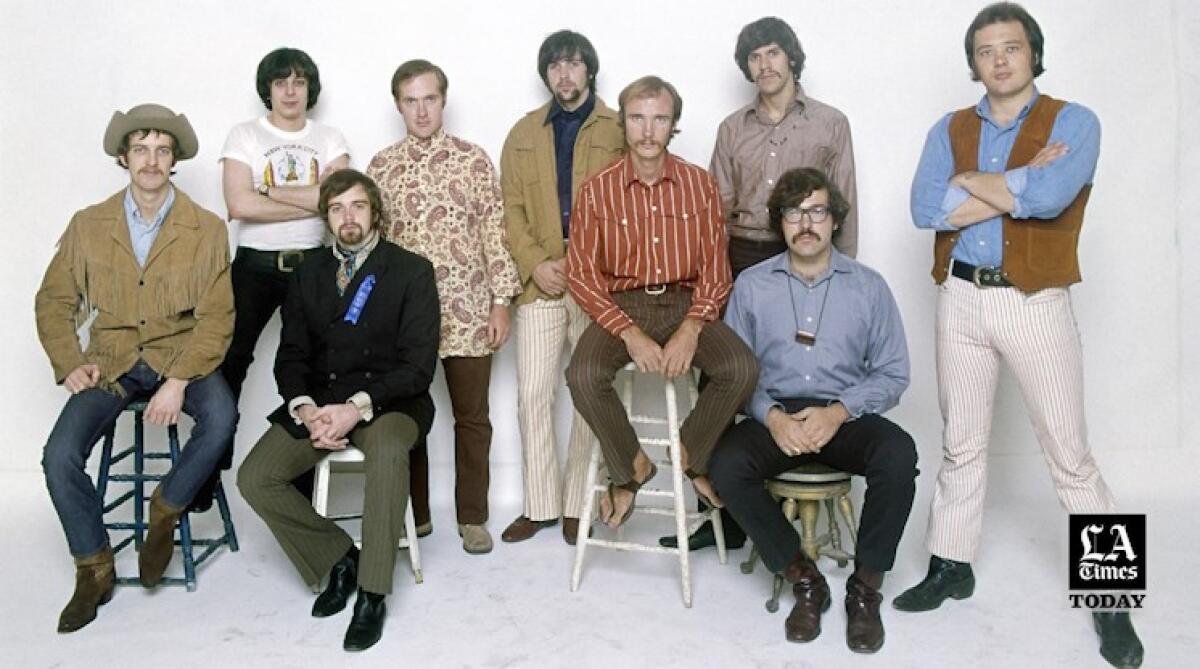
The band Blood, Sweat & Tears, including David Clayton-Thomas, far right, from the documentary “What the Hell Happened to Blood, Sweat & Tears?”
(Sony Music Archives)
Hooker had encouraged Clayton-Thomas to move to New York, where the American bluesman had an engagement at the Cafe Au Go Go in Greenwich Village. When Hooker unexpectedly departed for a tour of Europe, club owner Howard Solomon needed a replacement and recruited Clayton-Thomas.
“So I played him a couple songs on the guitar,” Clayton-Thomas told Bestclassicbands.com. “He said, ‘Do you have a band?’ I said, ‘Sure,’ and went out into Greenwich Village looking for anybody carrying a guitar case or even looking like a musician, and we put together a little band and we opened there that night. We ended up staying there for several months.”
Around the same time, session man-producer Al Kooper was looking to form a jazz-rock group and was joined by such musicians as guitarist Steve Katz, drummer Bobby Colomby and horn players Randy Brecker and Jerry Weiss. They called themselves Blood, Sweat & Tears, releasing the debut album “Child Is Father to the Man” early in 1968. Although praised by Rolling Stone publisher Jann Wenner as “a fine, exemplary group,” members were torn between those allied with Kooper and those who thought his vocals too weak to attract a substantial audience.
By the end of the year, Kooper and others had departed, and the band was seeking a new singer. After Judy Collins saw Clayton-Thomas perform, she recommended him to Colomby.
“I got home and just a couple of days later, Bobby Colomby called me up and said, ‘Hey, Kooper’s gone. We got four guys left out of the nine. And we still got a record contract with Columbia. Do you want to come down and try out for the band?’ ” Clayton-Thomas told Bestclassicbands.com. ”I said, ‘You’re damn right.’ I knew [bassist] Jim Fielder real well and I knew they were superb musicians. So I was on the next plane. We had a rehearsal that afternoon, an audition, and it was instant magic. We just knew right off the bat.”
Clayton-Thomas is survived by his daughters, Ashleigh Clayton-Thomas and Christine Graham.
“This past weekend, after undergoing CT and PET scans, I learned that my ovarian cancer has returned,” Evert, 71, wrote. “I have already undergone surgery as the first step in my treatment and recovery, and will begin chemotherapy in the coming weeks.
“Because of this, I will not be attending Wimbledon this year, and I will step back from my professional commitments over the next few months to focus on my health.”
Evert was first diagnosed with ovarian cancer in December 2021. Two years later, she revealed her cancer had returned.
“Ovarian cancer is relentless, but I will stay optimistic and determined in continuing to fight this battle,” Evert wrote. “I am deeply grateful to my medical team, my family, friends and everyone who has reached out with kindness and encouragement. I look forward to seeing everyone again soon.”
Evert was one of the most dominant women’s tennis players of the 1970s and 1980s, winning a record seven French Open titles to go with six at the U.S. Open, three at Wimbledon and two at the Australian Open. She won at least one Grand Slam for 13 consecutive years (1974-1986) and retired in 1989 with a career record of 1,309-146.
Her on-court rivalry with Czech American tennis great Martina Navratilova during that period is legendary, with Navratilova beating Evert in six of their 10 Grand Slam finals against one another and 43 of their 80 overall matches as opponents. They also won the French Open in 1975 and Wimbledon in 1976 as doubles partners.
A new Netflix documentary, “Chris & Martina: The Final Set,” covers their history together, which also includes a decades-long friendship and support for each other through numerous battles with cancer (Navratilova was diagnosed with early-stage breast cancer in 2010 and stage 1 throat cancer and breast cancer in January 2023; she announced she was cancer-free in June of that year).
Navratilova was one of the first people to comment on Evert’s Instagram post.
“My friend Chrissie is a champion of champions and as such she will slay this monster again,” Navratilova wrote. “We are all pulling for you, and know you will come out on the other side cancer free again- lots of love, m.”
Other former on-court rivals and fellow International Tennis Hall of Fame members also offered their heartfelt support in the comment section of Evert’s post.
“You beat me 18 straight times, therefore you can beat cancer 19 straight if you have to,” wrote Pam Shriver, who lost 19 of her 22 career matches against Evert. “Much love and respect to one of the greatest competitors ever, Pammie”
Billie Jean King, who lost 19 of her 26 matches against Evert, wrote: “You are a champion and a fighter, and you will beat this. Sending love and prayers from both of us for a strong recovery.”
The advertisements all start the same way. It could be a barber, an aunt or a family member in discussion with others about the FIFA World Cup, but in each case, they assume Egypt will be heading home after the group stage.
Then an Egyptian footballer pushes back: “To all the doubters, this time we’re staying longer.”
It’s a line that’s resonating like never before in the nation of 120 million people, as Egyptian football fans wait with bated breath for the final round of group stage matches that could send The Pharaohs, as the national team are known, into uncharted territory: the knockout stages.
Here’s why these commercials have captured the zeitgeist in Egypt:
Egypt’s poor World Cup track record
Egypt was the first African and Arab nation ever to play in a World Cup, back in 1934. It has won the Africa Cup of Nations a record seven times. Football in Egypt isn’t just a sport, it’s a national identity, and The Pharaohs have long been a source of genuine pride and belief.
But the World Cup has always told a different story. Before this tournament, Egypt had qualified just three times — in 1934, 1990 and 2018.
It had never won a single match. Fans still carry the painful memories of a penalty shootout loss to Senegal that kept Egypt out of the Qatar World Cup 2022 entirely.
Egyptian children play football in front of the Giza Pyramids in Giza, on Friday, May 17, 2002 [Amr Nabil/ AP Photo]
What’s different this time?
Everything — at least, so it seems.
After two games at the World Cup, Egypt sits at the top of Group G, above Iran, Belgium and New Zealand.
The 26th ranked Egypt drew 1-1 with Belgium — ranked 10 in the world — in its first match. Then, it beat lower-ranked New Zealand 3-1.
Its four points are the most Egypt has ever earned at a World Cup. Its four goals are the most Egypt has ever scored at a World Cup.
Now, on Friday night in Seattle — early Saturday morning in Egypt — the team faces Iran in their final group game. A win or a draw would guarantee that Egypt’s national team goes into the knockout stages for the first time.
If Egypt loses to Iran, they might still make it to the round of 32, but their fate will depend on what happens in the Belgium-New Zealand match that will be held at the same time, and potentially, on the outcomes of matches in other groups. Eight of the 12 teams places third in their groups will also move into the next round.
So in a nutshell, Egypt is on the cusp of going where it never has before — and only a rare set of permutations can deny it that chance.
Hossam Hassan, now the Egyptian coach, seen here manoeuvring the ball during a friendly international match against Zambia in Cairo January 9, 2001 [Reuters]
But it isn’t just the performances. Part of what makes this year feel different, to many fans, is the identity of the main man standing outside the pitch, next to the Egyptian dugout.
Hossam Hassan is Egypt’s all-time top scorer and one of the most iconic figures in the country’s football history. In 1990, he scored the goal that ended a 56-year wait and sent Egypt to the World Cup in Italy. Now, more than three decades later, he is the national team’s coach, making him the first Egyptian ever to reach the World Cup as both player and manager.
For older fans, his presence carries the memory of a time when Egypt genuinely believed it could make its mark on the world stage.
Mohamed Salah scored during the second half against New Zealand in the 2026 FIFA World Cup in Vancouver on June 21, 2026, as Egypt registered its first-ever win at the tournament [Anne-Marie Sorvin /Reuters]
So what are the advertisements really about?
They aren’t really making fun of the team. They’re making fun of the deeply ingrained expectation that Egypt won’t go very far. And that expectation, many argue, goes beyond football. Years of economic hardship and political uncertainty have made expecting the worst feel like common sense for many Egyptians. They protect themselves from disappointment. They assume it won’t work out before it doesn’t.
That’s what has also made the campaigns somewhat divisive. For some viewers, the humour felt honest — a reflection of a habit fans know they have. It prompted real questions about why low expectations have become so normal. Others argued the advertisements risked making those same low expectations feel permanent, even acceptable.
Either way, they underscore how the 2026 World Cup has reignited faith among Egyptian fans, as they wait for the Iran match. An advertisement campaign challenging doubters has come to reflect the broader hopes, doubts and debates surrounding The Pharaohs.
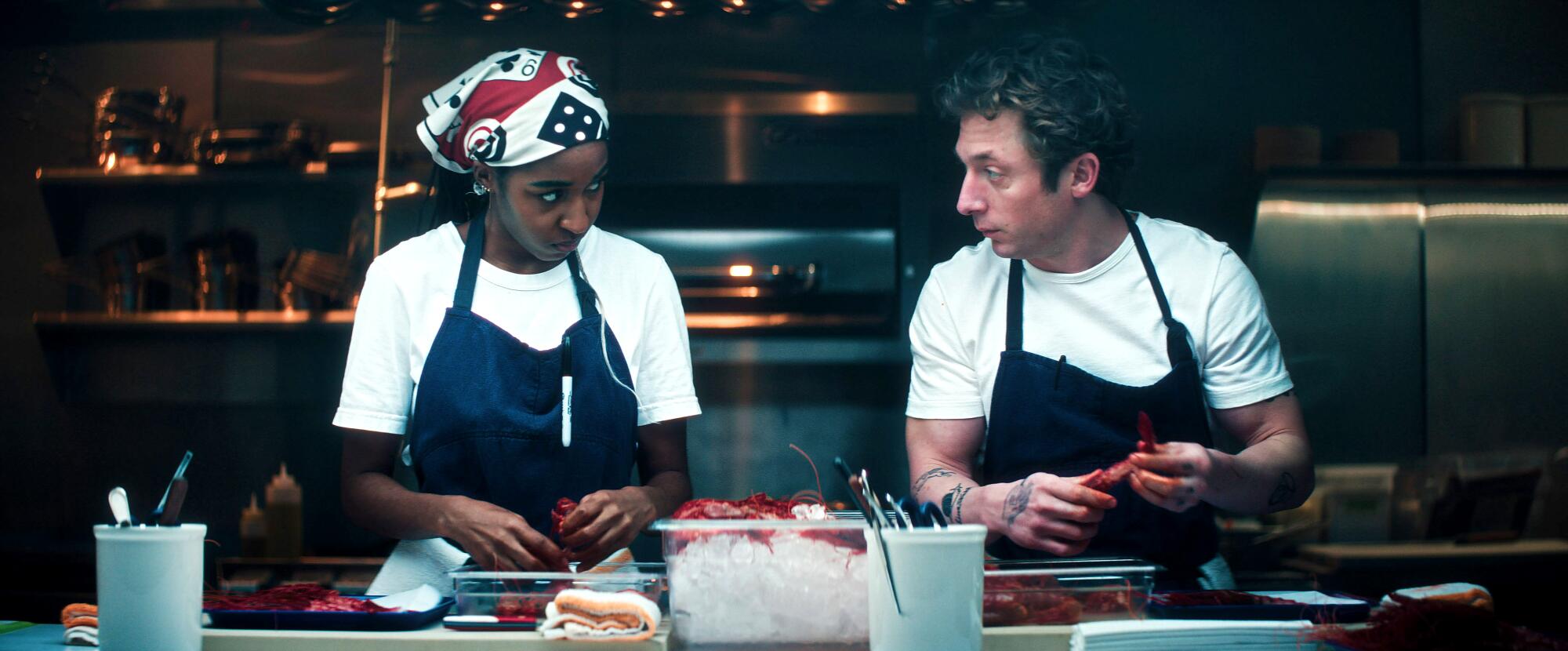
It’s at once a practical and existential question that plagues the two lead chefs in FX’s “The Bear.” He was the emotionally tortured and volatile chef who left behind a rising career in Michelin-starred restaurants to return to Chicago, his hometown, to run his recently deceased brother’s floundering sandwich joint. She was a Culinary Institute of America-trained chef with potential and a steady demeanor seeking mentorship and an opportunity to work with a prodigy. Together, Carmen “Carmy” Berzatto and Sydney “Syd” Adamu — played by Jeremy Allen White and Ayo Edebiri, respectively — transformed the Original Beef of Chicagoland from a hole-in-the-wall into the titular fine-dining establishment.
But now their partnership in the kitchen has come to an end.
Created by Christopher Storer, “The Bear’s” fifth and final season picks up the morning after Syd, Richie (Ebon Moss-Bachrach) and Nat (Abby Elliott) learn Carmy is quitting the food industry and leaving the restaurant in their hands at a make-or-break moment. And the pressure mounts for Syd to decide if she’ll jump ship to pursue another opportunity. The eight-episode season, now streaming in full on Hulu, largely stretches across one day as the restaurant’s debts accumulate, suppliers cut them off and an unrelenting storm floods the kitchen and threatens to upend a night of service the chefs desperately need to have one last shot at survival and one last performance as a team to deliver an improbable turnaround.
In some ways, it’s a journey that mirrors the actors’ own trajectories. Before “The Bear” became a runaway hit, White was best known for his role on Showtime’s long-running dark comedy “Shameless,” while Edebiri primarily worked as a stand-up comedian and writer. Just as their characters have evolved and gained electric momentum in their careers, so have the actors. Both garnered Emmy Awards for their performances on “The Bear,” and they have added a multitude of film and TV credits to their résumés since. Edebiri is currently starring opposite Don Cheadle in the revival of “Proof,” her Broadway debut, while White will be starring this fall as an investigative reporter in Aaron Sorkin’s “The Social Reckoning,” a companion piece to “The Social Network” that chronicles Facebook’s whistleblower scandal.
Over separate video calls from New York, Edebiri and White reflected on “The Bear’s” conclusion and what it means to leave the characters that supercharged their careers behind. Here are edited excerpts from the conversations.
Ayo Edebiri as Sydney Adamu and Jeremy Allen White as Carmen “Carmy” Berzatto in a scene from Season 5 of “The Bear.”
(FX)
After living inside these characters’ skins for so many years, what’s it like to be done playing them?
Edebiri: They keep saying that we’re done, so I guess that really is the thing of it. Obviously I know that it’s over, but even when we were finishing our first seasons, it didn’t matter how much critical acclaim we got because we’re on a show that’s a part of a network that has a deal with the streaming service — there’s all these things that are continually in flux or that you know that you have no control over. As an actor, you’re used to this state of limbo or not totally knowing or being prepared for an ending, so I think I’m not overwhelmed by it, if that makes sense.
White: I don’t know yet. We were very lucky to understand for a long time when the show was going to end and, to a degree, how the show was going to end. It was difficult to see the direction it went — I have strong feelings about Carmy and where he ends up and how his story might continue on. So much of this season, for Carmy, is about a surrender or acceptance of his place in the world and his place in the kitchen, and it’s the first time he’s really been able to get very honest with himself since we’ve met him. And, in doing so, he chooses to leave, and that was hard for me, for Jeremy. Maybe there’s a world in which he tries this and he comes back. I think I had a different understanding for a while of Carmy’s future. I want him to be happy and healed, but it felt like … I don’t know — imagining him outside of a kitchen was hard for me.
I want to unpack that a little bit more. He wants to be happy. But it was interesting to see him wrestle with how his work hinders that — is it the crutch or the salvation? Did you find yourself having an existential moment as Jeremy taking in what Carmy was wrestling with, or have you reckoned with it before?
White: He threw himself into this work, into this world, pretty young in life. And he was really good at it. But a big part of him burying himself has so much to do with his brother, with his family. I was finishing something too. And, yes, of course, I was thinking of goodbyes, and I was thinking of moving on, and new pursuits and all of these things. I was checking in with myself and what it might feel like to just make such a hard turn in life. I thought a lot about what you get back from your work, but I think ultimately, what Carmy and I don’t share is he was causing so much chaos in his work life; it wasn’t just himself that he was punishing at times. It came down to this surrender to an easier way, a softer way, which was to turn it over to Syd, to turn it over to Richie, to turn it over to Tina in the kitchen — that part, I had an easier time understanding.
“The most beautiful thing about their relationship is their true unconditional belief in one another,” says Allen about Sydney and Carmy in “The Bear.”
(David Urbanke / For The Times)
Syd was facing a crossroads: a shiny new job that could take her to the next level or sticking with this seemingly sinking ship that has taken her to the next level, but where she’s felt unappreciated or stifled at times. Ayo, what did you think of the choice she made?
Edebiri: We’re really fortunate to have such amazing writers who thought about her and her journey. [There’s] an awareness of Sydney’s womanhood and Blackness and youth, but I think [they treated] her with the full dignity of just being a human being and getting able to be a complex character in this show and giving her the dignity of being just as flawed as the other characters. [The choice she made] just made sense to me. It made sense in the architecture of the show. It was gratifying to get to build to that with everybody.
The bulk of this final season has the team dealing with this massive storm that’s created a slew of setbacks at a make–or–break moment for the restaurant. It leads to one final symphony in the kitchen together.
White: Those days were beautiful. So much of our show is shot so quickly, but then we really get to slow down with these choreographed pieces of kitchen ballet, and that’s also when we feel really strong as a group of performers, where we’re incredibly reliant on one another, not just for the emotional beats of a scene, but in this very technical aspect as well. I remember going back to Season 1 and filming Episode 7, “The Review,” which was the single-take episode, and just how much camaraderie came from that, and how much respect came from that for everyone — that feeling of real success that we could do this. It’s a really nice thing that happens sometimes on sets, where there is such a nice mirror of what’s going on with the characters and what’s going on with the cast. In this last push, and this team effort, we want these things as the characters, and we want these things as the cast. We want these people to have what they want, what they deserve, so it was really exciting shooting that last episode or two where all those things are coming into place.
Edebiri: That’s Chris’ thing — it’s like a classical piece of music or something; there’s different movements. His own challenge that he puts on himself, and that, in turn, puts on us, is that we’re still in the same piece of music, but everything just has a different feeling. He’d been talking about it since, low-key, Season 3, but definitely started talking about it a little bit more concertedly when we were filming [Season] 4. It was really starting to take shape in his brain. This challenge of having it be in this one day, and how each episode can feel different, was really exciting to him, so in turn, it became exciting to us.
Were you hoping for more runway to chart what the characters were facing?
Edebiri: No, I think it was cool. I was just like, “Yeah, let’s see what it is.” That’s kind of what everything has been with this show. Part of her emotional journey for the last season, what was on a slower track, in a way, there was something also really fun in having the pressure cooker of one day, and everything getting to ramp up and be quite immediate, which I think has been reminiscent of Seasons 1 and 2 in a fun way.
Tina (Liza Colón-Zayas), left, Sydney (Ayo Edebiri), Richie (Ebon Moss-Bachrach) and Carmy (Jeremy Allen White) in “The Bear.” The restaurant faces multiple setbacks, including a storm that causes damage and dwindling supplies.
(FX)
Carmy and Sydney’s dynamic has been so fundamental to the series. These are two people who see something in each other that the other doesn’t. What do you admire about their relationship as friends and as co–workers?
White: The most beautiful thing about their relationship is their true unconditional belief in one another. They see the beautiful things in one another that the other one is not able to witness in themselves. Even though trust has been tested and trust has been broken at times, there is such a loyalty to the best in themselves. They know that they can rely on one another. In a lot of ways, they saved each other. That piece in the opening episode of Season 3, where Carmy gets the call about Mikey and serves the scallop to Syd without ever having met her — there is this invisible tether that was not witnessed by either of them, but it inspired Syd, and whether Carmy knew it or not, this thing was loved and enjoyed by someone that was birthed from this very traumatic moment. There’s just this beautiful, invisible tether that has always existed and will always exist between the two of them.
Edebiri: What I admire about it is the fact that they are able to bring out — through a lot of miscommunication and hard work, but ultimately, I think, with good intentions — the best in each other. They want to see each other be the best versions of themselves.
How is that reflected in your dynamic? Jeremy, who is Ayo as a scene partner and what has she brought out in you as a performer, and vice versa?
White: I was really so lucky to kind of witness Ayo in real time — everybody else had to wait some months to see her on the show. I remember genuinely being struck by her presence, her groundedness. It felt like, if this makes sense, wrong because she was doing it so well. She’s incredibly smart, she’s a wonderful writer, and she’s very skilled improvisationally, and so, in acting with her, there’s something that always makes you feel very in the moment. You can never like relax, in the best way. It’s like you always have to surrender yourself to each moment.
Edebiri: When we first started, I was coming from the comedy world, and he was coming from a much more dramatic world. Our approaches were so different. He has such amazing presence of being and a quiet focus and has such care for the work. He’s a really great leader. There are ideas in society of men in power, and what power held by men has to look like and feel like, and he’s very gentle — especially in the show, which can live so much in the space of chaos and anxiety, having a gentle spirit really helps with filming. He’s so good at making that very clear and helping teach me that as well … I’ve definitely learned from him, without realizing it, ways to protect yourself and protect your peace, and protect also the peace of your co-workers — you get the work done, you be serious about it, but it doesn’t have to be torture.
Edebiri on working with White: “When we first started, I was coming from the comedy world, and he was coming from a much more dramatic world. Our approaches were so different. He has such amazing presence of being and a quiet focus and has such care for the work.”(David Urbanke / For The Times)
What was it like to see them get this thing they’ve been after — not one, but two Michelin stars?
White: Reading that moment —there’s been so much pain and heartache … for years and years and years, and I was just so relieved to see this joyous moment on the page. It felt so, so close to the surface of me already. And we — Jeremy and Ayo — have shared so many insane, joyous moments in our lives since the show. So it felt familiar in the best way. I’m so glad for that moment for both of them — for Carmy and Syd.
Edebiri: We’re shooting it so fast. You always wish you just had more time, and that was one of the last scenes — I think it was the last thing that he and I shot. There’s obviously a bit of a preciousness and emotionality that you’re feeling in that moment, while also tapping into what’s happening to the characters. It’s this thing that, in the brain of myself, we’ve been building to this over five seasons. There’s obviously a somewhat meta reflection of what we’ve gone through — this is just such a crazy journey. But I think at the end of it, especially because of what we know is going to change in their relationship, that in their working proximity, that they are not going to be close, but they know that they were able to do this thing and build this thing together, I think [is] what felt very special, and felt very cool. I hope it’s something that people who have loved the show also feel.
Fans have intense feelings about their relationship, as I’m sure you know. Has it surprised you how strongly people feel about their dynamic?
White: I know that exists. I don’t have too much knowledge on how that all works. It’s funny, I’m very aware of it now because it’s become part of a conversation around the show, but it was nonexistent in our approach to the work. It wasn’t even a thought for either of us. It didn’t occur to us. But I understand it. There is an intimacy, of course, with these two characters. And there is this trust. They lean on each other and they admire each other so much. I’m not like — nobody’s crazy to feel that. There is love there, it’s just not a romantic partnership.
Edebiri: It surprised me the first two [seasons] because I don’t think that that’s what we were doing. Anytime that you say otherwise, I’ve learned [not to]. It’s been hard when doing press, it feels like we get asked specific questions to try to give a specific answer, but the point of art is we make it and we give it. If people are having a response, that’s great, and if I don’t agree with you, I don’t think I’m shutting it down or anything. We made something, then you’re picking something up — that’s the exchange.
White says he knows fans have intense feelings about the relationship between Carmy and Syd. “It’s funny, I’m very aware of it now because it’s become part of a conversation around the show, but it was nonexistent in our approach to the work. It wasn’t even a thought for either of us.”(David Urbanke / For The Times)
Carmy has a few heartfelt conversations this season, but one that really stands out is the one with his mom, played by Jamie Lee Curtis, while revisiting the family home he’s stayed away from for years. He cooks for her. She’s remorseful. Jeremy, what did you think of that moment for Carmy?
White: There’s resistance in it. People like Carmy, you can give them the answer, you can give them the sorry, you can give them the opportunity, and a lot of the times they don’t know what to do with it, or they push it away, or they push it down. What that scene was about, for Carm, was becoming available to even listen. That was the conflict of the scene and the moment. But he was able to eventually get to that acceptance to release some of the resentment, to release some of the anger. Then he is able to show up for her, which was what has been absent. He was able to take it and give her something. It’s been years, if ever, that he’s really been able to do that, to get out of his own way, and be of service in that way to his mother.
Ayo, it was really touching to see Syd naming Tina her chef de cuisine. How did you feel about what that sets up for where Syd and the Bear might be headed with these women as partners in the kitchen?
Edebiri: I loved it. I love getting to work with Liza [Colón-Zayas]. I’ve been so privileged to also be able to direct her — she’s just phenomenal. I think about these two characters, where they started Day 1; Tina was pretending not even to speak English just to stay away from the girl. It was rough from the get-go, but I think both for Liza and I, as two women of color as well, we felt so invested in their relationship and the community they built with each other. There’s something very moving about that to me. Part of the thing for Sydney, she doesn’t know — I think Carmy can see it — that one of her strengths is that they’re different types of leaders. Part of what I think makes Sydney a great leader is that she’s able to delegate and actually remove herself when she knows that she might not be the best in a situation, it might be somebody else.
I haven’t actually seen it. I can’t watch the episodes, but I know when we were filming it, it was both very sweet and very funny. I don’t know if they kept any of the improv from Liza.
You can’t watch because you’re emotional about it or because you just don’t have access?
Edebiri: No, I don’t want to. We were doing all this press and everybody was, “You were so emotional; you wanted to cry, right?” And I’m like, “No, I just don’t want to watch.” I’ll watch it later. The only season that I watched before [it aired], frankly, was 3 and 4 because I had episodes that I made in it. I love the show and I know the show is good. I don’t enjoy watching myself.
I do love that Syd’s ethos in the kitchen is borrowed from “Ratatouille.”
Edebiri: Yes, f—ing rat. It tracks for Sydney.
“I love getting to work with Liza [Colón-Zayas],” says Edebiri about her co-star, whose character is named chef de cuisine. “I’ve been so privileged to also be able to direct her — she’s just phenomenal.”
(FX)
Jeremy, what was your reaction when you read Carmy is in a suit interviewing for an internship at an architectural firm? And what he expresses there?
White: I understand and I’m proud of the courage that it takes [to do a life pivot], but also I tried to play that scene in a way where I didn’t want it to be entirely clear [what happens next]. I wanted the question to be like, “Is this guy still so f— up in the head that he’s trapped regardless of his place in this world, or place of work? Is it a romance that he’s saying goodbye to? Is it a love that he still has, and he’s not quite over yet?” Then I was like, “Do we snap out of that scene and we’re back on the clock?” What is this? I think the goal of the scene is it shouldn’t be all too clear and wrapped up.
What do you think?
White: I could see there’s obviously so much love. There’s love for the people he works with, and there’s love for the paces he’s gone through, but I didn’t know. … I didn’t know if it was a goodbye or an admittance. I think I was trying to find something between him coming clean and being like, you know what, I don’t belong anywhere else or I’m so in love with this thing, but it’s not good for me, and I think it exists somewhere in between that.
Ayo, what was your reaction to Carmy interviewing at the firm?
Edebiri: I was like, “Yeah, that makes sense. This boy’s a noodle.” He’s a fool, he’s ridiculous. It makes sense.
Where do you think he goes from here? Have you thought about it? Do you think he will ever find his way back to the kitchen?
White: I haven’t thought about it too much. I do think there’s something really honest about that direction that Carmy was moving into, but I would hope there’ll always be room for him somewhere in a kitchen.
Edebiri: Syd is like, “You can’t do anything else, brother. Like, what’s the plan?” I don’t know if he takes a break, if he comes back to help her, if he does his own thing.
What do you think happens to the Bear?
Edebiri: I think they do well. It’s not just her; it’s her and Sugar and Richie and Marcus and Tina. She got in it for Carmy, but I think she ended up finding her own voice. I think they keep going, at least for a few more years. I really do.
White: I have to believe that all the pain and suffering and trauma — not only that Carmy has gone through, but that everybody has gone through — is for some greater good. That there is a payoff. My hope is that it would be successful. They’ll have the endurance and the motivation to make it.
At only 24, Samuel Kim Arredondo, better known as Samuel, has lived through nearly every iteration possible in a K-pop idol’s career.
As a child growing up in L.A.’s Koreatown, he attended Wilshire Park Elementary School — but by the fifth grade he had moved to South Korea with his mother, Kyung-ju, with dreams of K-pop stardom. There, he became a trainee under Pledis Entertainment.
Now a subsidiary label of Hybe — parent company of K-pop superstars BTS — Pledis was forming what became one of the most successful “third generation” K-pop groups of all time: Seventeen. Samuel, who was in the running to debut with the group, is even captured in early footage from their “Seventeen TV” variety show.
Though he didn’t make the cut, he remained close with the members and helped write lyrics for their 10-year anniversary album. Just last week, he filmed a dance challenge with singer-MC Mingyu for the reggaeton-infused pop number “Zigi Zigi Zigi” — the lead single off of his new EP, “Samuelito,” which dropped June 8.
After leaving Pledis, Samuel — who is fluent in both English and Korean — signed to a new agency, Brave Entertainment, then formed one half of a short-lived hip-hop duo, 1Punch. (He was Punch, the other kid was One.)
In 2017 he competed on the second season of Produce 101, a globally popular Korean competition franchise, where he made it to the penultimate episode before the debut of the group Wanna One. That same year, he released his first solo album, “Sixteen,” fully showcasing his outstanding dance ability, youthful swagger and velvety tenor.
Yet before he could finally make headway, he suffered a devastating loss.
Samuel’s father, José Arredondo, who came to the U.S. from Michoacán as a child, died tragically in a 2019 case that made national and local headlines. After having spent years apart from his father while living in Korea, Samuel spent quality time with him shortly before his death.
José was a pillar of his community; he rose from washing cars to owning his own car dealership, alongside other businesses in Bakersfield. A precocious young Samuel can still be found showing off his dance and Spanish skills in an old commercial for the dealership. (“Volkswagen me hace bailar,” he says before busting a move.)
The loss of his father was made more harrowing when the news went public, Samuel recalls over a Zoom interview from Seoul, where he is promoting his new album.
“The articles went out first,” he explains. “It was everywhere before I even wanted to talk about it, so I had no choice to keep it private … of course it’s definitely hard for me.”
In the aftermath, Samuel went under the radar — but after a year or two, he started to pave a way forward. After getting out of the contract with his former label, and with the support of his mother, he launched his own company, Samuel Music Group.
“If I kept on staying in the past, I think no one would like it — even my dad wouldn’t like it,” he says. “I learned a lot through that emotion as well. Always be grateful, always be thankful every time, and try to say ‘thank you’ always, especially to parents.”
Composed of three songs and one interlude, “Samuelito” takes its name from the childhood moniker some know him by today. As the follow-up to his 2024 EP, “Now,” it is his second record release since he became independent. It’s also his first record sung predominantly in Spanish — along with the occasional sprinkle of English and Korean. (Take the onomatopoeic “Ddook Ddak,” which is Korean slang for “just like that.”)
Singing in Spanish for the first time, he tells me, to music he created himself, made his “heart race.”
“Samuelito” is not so much an exploration of Mexican musical traditions, but of Latin-influenced rhythms and sounds filtered through his uniquely multicultural lens. In the future, he dreams of working with genre-spanning Latino pop artists who crossed over culturally, like Selena Gomez, Camila Cabello and Rauw Alejandro.
In an Instagram reel from earlier this year he described his efforts as “K-tone” — a Latin and reggaeton fusion, powered by K-pop discipline. The comments below were peppered with encouraging responses from fans in multiple languages.
Wrote Liz Zeledon, from Oceanside: “As a Korean-Nicaraguan who grew up with exposure to both cultures, I love hearing Latin influences in K-pop… Korean Latines are so underrepresented in the Korean music industry.”
Reached by phone, Zeledon is a K-pop fan who has kept tabs on Samuel since his Seventeen trainee days; she is also a child of immigrant parents.”Representation is so important, because existence and visibility are not the same thing,” she says.
In the lead-up to the album’s release, Samuel posted photos and videos of himself as a young child. In one, his dad holds him up as a baby, dressed in all-white with a tam hat. Though Samuel says the EP is not an on-the-nose tribute to the elder Arredondo, his spirit resonates through the lyrics of the poignant downtempo track, “Never Say Goodbye.”
“Gritos que yo sé/Que llegan hasta El Cielo/Gotitas en el suelo/Y se me cae el mundo entero,” he sings. (“Cries that I know/Reach all the way to Heaven/Little drops on the ground/And my whole world comes crashing down.”)
“I used to listen to a lot of Spanish music while I was growing up … I used to eat a lot of Mexican food too,” he says. “While I was in the studio last year, I had [this] big vision: [‘What if] I bring back my roots and just be the true me and call this album “Samuelito?”’ It just felt fresh.”
Samuel started songwriting and producing for himself in the making of “Now.” On his new album, only three writers are credited, including himself — which is somewhat of a rarity these days in K-pop. One of them is Canadian Mexican singer-songwriter Andrea Rocha.
From her new home in L.A., Rocha said the main goal was to seamlessly blend two distinct musical cultures. Although Samuel came to the studio with the structure for his songs already in place, they worked on melodies and writing in Spanish together, since this was his first time penning lyrics in the language.
Rocha says she was taken aback by Samuel’s professionalism. “I’d be like, ‘Oh, what about this melody?’ And then he would sing it perfectly,” she says. “I did ask him about his K-pop training, because it sounds really intense. I think it shows how hard he’s worked in those years because he’s got all the star qualities. Compared to a lot of newer artists that I work with, I’m like, ‘Ooh, they’ve [done] a lot of work to get to that level.’”
These days, Samuel splits his time between Seoul and Los Angeles — once again calling Koreatown his permanent home. He also continues to spend time with his dad’s side of the family in Bakersfield.
“I think the biggest thing that I am happy about is getting back to my roots, where I started,” says Samuel.
The Dodgers won the World Series last year, and the year before that. Their lead is the largest in any division this year. That success, and the money that nourishes it, has battalions of fans beyond Los Angeles all but marching outside ballparks with picket signs reading “SALARY CAP NOW.”
It’s a reasonable thought: The Dodgers can’t possibly keep winning if they can’t keep outspending the competition.
Or can they?
“There are a lot of little things that happen behind the scenes that people don’t see,” pitcher Will Klein said. “I understand where people are coming from. It’s easy to be a fan of a smaller team and get mad at other teams outspending you.
“But I think there’s a level of care here, and wanting to win, that exceeds other groups.”
The obvious disclaimer: Any team would be better with Shohei Ohtani and Freddie Freeman and Mookie Betts and Yoshinobu Yamamoto, at a combined price of $1.6 billion. The counter argument: The Angels had Ohtani and Mike Trout and, well, you know.
It takes a roster. In Klein and pitcher Eric Lauer, the Dodgers have done something they do well besides spend: develop valuable contributors out of players discarded by other teams.
The Dodgers grabbed Lauer last month, desperate to fill a hole in their starting rotation. The Toronto Blue Jays had cut him, and he would be joining his seventh major league organization. The logical thought: The Dodgers had found a healthy arm to eat up some innings until they could find someone better.
That still might happen. But Lauer, who is set to pitch Monday, has put up a 3.22 earned-run average in four starts with the Dodgers. Four starts is a small sample size, but in that time, Lauer is a career league-average pitcher performing 28% above league average.
“They got me immediately,” Lauer said. “They figured me out right away, and they knew exactly what was going to help me.”
For Lauer, the changes affected his delivery, but the specifics were not as important as finding a kindred spirit in Connor McGuiness, the Dodgers’ assistant pitching coach.
“I’ve always had a really hard time explaining myself and what I do, because I think a little differently,” Lauer said.
“When I was with the Brewers, it was running joke that it was ‘the language of Lauer,’ because I would describe things so differently and feel things so differently that, if you weren’t close to me and you didn’t know how I operate, it was very hard to understand what I was trying to do.
“Connor just immediately got it. It was like he’s been speaking it forever.”
At one point in his career, Lauer said, he struggled to explain the sensation of catching his heel on the mound as he completed his delivery toward home plate.
“I would describe it as, ‘I was falling backwards and I would catch myself,’ and it’s a really weird concept to think somebody was falling backwards when it doesn’t look like you’re falling at all,” he said. “It looks like you’re just moving forward.
“So they were like, ‘That’s not what you’re doing’ and I was like, ‘That’s what I’m feeling.’ We have to make the connection between the feel and the real so that we can understand each other.”
“I have a hard time saying anybody has done a better or faster job of helping me than the Dodgers.”
— Eric Lauer, Dodgers pitcher, on his development with the team
Klein, who joined his fourth organization when the Dodgers acquired him in a minor league trade last June, is in his first full major league season. He has a 2.37 ERA, and his 0.7 wins above replacement is better than any Dodgers reliever besides veteran closer Tanner Scott.
Klein said other teams had made suggestions on how to improve his game, and with the Dodgers, he has added a sweeper and dumped a slider. But what he needed to do most was throw more strikes, trusting that his lively fastball and curve were good enough to beat the best players in the world.
In the minors, Klein issued 6.9 walks per nine innings. This season, he has issued 3.6 walks per nine innings.
The credit, he said, should be shared with the Dodgers’ mental skills coaches.
“It’s easy to see the guys in the batter’s box — especially when you come up watching baseball and being fans of these guys, it’s easy to see them being above yourself,” Klein said.
“But you’re on the mound with them, so you have to see that too. There’s a lot on the mental side that’s helped me here.”
Dodgers pitcher Will Klein delivers against the Tampa Bay Rays at Dodger Stadium on June 16.
(Eric Thayer / Los Angeles Times)
The Dodgers did not include Klein on their postseason roster for the first three rounds last year, but he said coaches at all levels — in the majors, at triple-A and at the Arizona training complex — never stopped checking in on him, during the season and throughout October.
“When you’re down there, they don’t forget about you up here,” he said. “That kind of commitment and care was levels above what I had experienced.”
When the Dodgers added him to the World Series roster, Klein saved the season, with four scoreless innings to close out an 18-inning victory in Game 3.
Lauer called the communication in the Dodgers’ organization “miles ahead” of any other organization in which he has played.
“The training room, the weight room, the coaching staff, the players to each other,” he said. “Every form of communication is so seamless. Everybody knows what’s going on all the time. There’s no gray area.
“It’s all: ‘This is the plan, this is what we want to happen, this is how we’re going to make it happen,’ instead of: ‘This is the plan, this is what we want to happen, figure out a way to make it happen.’”
Klein raved about how the Dodgers treat player families, and about a high-tech pitching machine so lifelike that he could see what it would be like to bat against him. Lauer reflected on his experience as a first-round pick turned journeyman who went to South Korea to revive his career.
“I have a hard time saying anybody has done a better or faster job of helping me than the Dodgers,” Lauer said.
What Lauer and Klein say substantially echoes what Dodgers president of baseball operations Andrew Friedman said at last year’s World Series about turning the team into a preferred destination for players, and not just because the team wins and spends.
“Communication, being honest, having a really strong player development group in place at the major-league level, and how you treat families and treat the players,” Friedman said then, “I think matters a lot in that.”
To be clear: There is no indication the players’ union is willing to consider, let alone approve, a salary cap.
But, if that were to happen, Klein believes the Dodgers would be just fine.
“Our owners want to win, so they want to get the best product on the field, so they go and spend money,” he said, “and then everyone is mad that they want to win.
“I think they’ll find ways to win more if they can’t spend as much money. Friedman was with the Rays when they weren’t spending as much money and still had success there.
“I think they’re just better at wanting to win than some other people.”
Veteran broadcast journalist Katie Couric has leveled sharp criticism at CBS’ “60 Minutes,” detailing a culture of systemic sexism and marginalization she says she experienced during her tenure at the prestigious newsmagazine.
On this week’s episode of the “Call Her Daddy” podcast, Couric, 69, described incidents during her time at “60 Minutes” when her story ideas were reassigned to her male counterparts. She described the circumstances as “really tough situations.”
The Emmy-winning journalist said she suspected early on that Jeff Fager, the “60 Minutes” executive producer at the time, didn’t take a liking to her.
“I think maybe because he wasn’t really consulted about bringing me over,” said Couric. “I was sort of seen as somebody from a different network coming in and sort of muddying the waters. I hadn’t come up in the CBS system. So I don’t know, he just didn’t like me.”
Couric started her run at the newsmagazine as a correspondent and as an anchor at CBS News in 2006, after spending 15 years co-hosting NBC’s “Today” show. Her role at CBS made her the first female solo anchor of a national weeknight news broadcast. She stayed with the network for five years before taking on a new role as special correspondent for ABC News.
Fager remained at “60 Minutes” from 2004 to 2018. He also served as the chairman of CBS News. He was eventually fired for allegedly sending a “harsh” message to a CBS reporter. At the time, he was also facing accusations of ignoring inappropriate behavior at “60 Minutes.” He previously denied the claims. CBS could not be reached for comment.
Trouble first came to a head when Couric pitched a profile of the rising pop star Lady Gaga. Fager had initially turned down the idea until he decided to pursue the story a year later, as Gaga had gained more notoriety.
Couric said she had proposed a fresh angle on Gaga’s Catholic school upbringing, but when she arrived for the interview, she discovered her name had been replaced with Anderson Cooper’s. His interview with Gaga aired in February 2011.
“It made me crazy,” Couric said.
A similar situation occurred once again when Couric was set to interview then–Secretary of State Hillary Clinton. The confusion began when the State Department reached out to Couric, wondering why fellow correspondent Scott Pelley’s team was inquiring about Clinton.
“So I go to Jeff Fager, and I say, ‘I thought you wanted me to do Hillary. You told me explicitly that you wanted to assign that story to me,’” Couric said. “And he said, ‘Yeah, we decided to change things up.’”
Couric said she was frustrated with Fager, for repeatedly going “behind [her] back.”
“Like, without even the decency to call me and say, ‘Guess what? We decided to reassign the story, and this is why,’” she said. “Talk about getting gaslit. I mean to me, that is the definition of it.”
Couric isn’t the only former “60 Minutes” to call out sexism at the newsmagazine. Meredith Vieira, who worked as a correspondent in the late 1980s and early 1990s, said in 2018, that she’d experienced sexism at CBS.
In the last few months, “60 Minutes” has undergone a massive upheaval. Under CBS News editor-in-chief, Bari Weiss, several correspondents, including Scott Pelley, and the program’s top producers were fired. Anderson Cooper also recently resigned from his post at the newsmagazine. With the upcoming season slated to begin in September, the program is currently under pressure to replenish its ranks.
WASHINGTON — Senate Republicans who were berated by President Trump over opposition to his war in Iran held a late-night vote Wednesday to try to appease him, rejecting a war powers resolution a day after a similar measure passed.
Trump harangued GOP senators face to face earlier in the day for allowing a vote to block his war in Iran on Tuesday, further escalating a feud that has diverted GOP efforts to focus on election-year affordability issues and brought much of the chamber’s business to a halt. He exchanged particularly harsh words with Louisiana Sen. Bill Cassidy, one of four Republicans who had voted with Democrats on the measure.
Hours later, though, Cassidy was invited to receive a personal briefing on the war at the White House from Vice President JD Vance and envoy Steve Witkoff. Cassidy then returned to the Capitol to vote against a separate but nearly identical war powers resolution.
“I want to thank Vice President Vance and Special Envoy Witkoff for the thorough briefing this afternoon on Iran. I appreciate the quick invitation to the White House to address many of my concerns,” said Cassidy, who lost reelection last month after Trump endorsed his opponent, in a post on X.
Kentucky Sen. Rand Paul, a Republican who has repeatedly voted with Democrats to halt the war, voted present this time “to give the President more space and leverage to negotiate a lasting peace,” he said on X. The measure failed 47-50-1 just before midnight on Wednesday, and the Senate then left town for a two-week recess.
It’s unclear whether the move will be enough to appease Trump, who had called the Republicans “losers” for voting against his war and had called Cassidy a “lunatic” at the lunch after their tense exchange. But the vote was a clear signal to the president from Republican senators who still want to placate him, despite increasing tensions in recent weeks and his decision Wednesday morning to reverse himself and delay signing a housing bill that received overwhelming bipartisan support.
Senate Majority Leader John Thune, R-S.D., and a small group of his Senate GOP colleagues called Trump after the vote. Thune told reporters that the president was “pleased with the outcome.”
Trump later thanked Thune in a social media post and noted that Cassidy and Paul had switched their votes. “This vote puts Iran on notice!” he wrote.
The war powers measure blocked by the Senate on Wednesday was on a separate track from the nearly identical resolution adopted on Tuesday, which had also been passed by the House. Both votes were largely symbolic, and the measures do not carry the full force of law.
Cassidy had sharp words for Trump
Invited by Florida Sen. Rick Scott to speak at a GOP luncheon in the Capitol, Trump had signaled ahead of time that he would use the closed-door meeting to push senators to pass his proof-of-citizenship voting bill. But the conversation was more focused on Tuesday’s vote on war powers.
Most Republicans stayed quiet. But Cassidy stood up and defended his vote.
“I stood and said, ‘You have not told the American people what’s going on,’” Cassidy told reporters after the meeting. “This was supposed to last four weeks, it’s lasted four months. Our original objectives have not been achieved.”
The two men “went back and forth,” Cassidy said, and he “matched his tone and volume.” Cassidy said that he eventually de-escalated, but he did not want to be bullied.
“I am voting for war powers until I get a briefing,” he said afterward.
Trump repeatedly told Cassidy to sit down, according to a person familiar with the private meeting who was not authorized to discuss it. At one point, the president called the senator a “lunatic.”
Publicly, Trump said afterward that they had “a really great meeting.” But he hinted at the discord.
“We like everyone in the room,” Trump told reporters on his way out. “I don’t like a few people, but that’s OK.”
The luncheon capped weeks of friction between Trump and Senate Republicans and added a new layer of frustration as Tuesday’s vote was the first time the Senate had adopted a war powers resolution on the Iran war. Trump made clear he was in no mood to compromise before it even started, calling off a scheduled signing ceremony on a housing bill that passed both chambers overwhelmingly this week and that GOP lawmakers were touting as an election-year achievement.
Trump reverses on housing bill
Republican senators were eager for a conciliatory meeting with the president after escalating tensions in recent weeks. But Trump upended their plans when he declared on social media just beforehand that he wouldn’t sign the legislation until they send him the SAVE America Act, his bill to require proof of citizenship for all voters.
North Carolina Sen. Thom Tillis said he doesn’t know why Trump is holding the housing bill “hostage” for the voting bill that “will never pass in this Congress.”
“It makes no sense to me,” Tillis said as he walked into the luncheon.
Thune said the housing legislation, which aims to lower costs, is “an affordability issue,” and that ”eventually I hope he finds a way to sign it.”
It’s unclear if Trump might veto the legislation or if the late Wednesday night vote will change his outlook. But by rejecting a public bill signing, Republicans worry that Trump is indicating a level of indifference to voters’ affordability concerns heading into November’s midterm elections.
Trump and Senate Republicans have been at odds
Trump’s move on the housing bill is his latest reversal after weeks of being at odds with Senate Republicans.
Trump has blocked the Senate from confirming one of his own nominees, asked them to fund parts of his White House ballroom project despite opposition and forced them to defend the Iran war even as they question the strategy and endgame.
Trump has also helped whittle down his own support in the Senate after endorsing primary challengers to two GOP incumbents who were previously reliable votes for his agenda — Cassidy and Texas Sen. John Cornyn. Both men have become more critical of Trump since losing reelection.
“If we’re going to win the midterm elections, we need to get on the same page,” Cornyn said ahead of the meeting. “We’re not on the same page now, and that I think is dangerous.”
Trump pushes Thune on SAVE America Act
Trump has pressed Republicans for months to kill the Senate filibuster and focus on the proof-of-citizenship voting bill, even though Thune has repeatedly told him that neither has the votes.
While Thune remains popular in his conference and cordial with the president, he has spent much of his time lately telling Trump what he doesn’t want to hear. Thune said Tuesday that while Trump and some in their conference want to see the voting bill pass, “it’s just not realistic.”
Thune devoted weeks of floor time to the voting bill earlier this year and has said he supports it. But he has repeatedly said there aren’t enough votes to scrap the filibuster that triggers a 60-vote threshold to pass most bills in the 53-47 Senate. And Democrats are uniformly opposed to the bill.
“I think people at some point have to come to grips with that,” Thune said.
Jalonick, Sloan, Cappelletti and Mascaro write for the Associated Press. AP writers Josh Boak and Kevin Freking contributed to this report.
Diego Cano-Lasso had been looking for an architectural project when he found two hillside lots with spectacular views for sale in Mt. Washington. With work scarce in 2012, the SCI-Arc graduate persuaded his family to invest in the property, and together they bought the two plots for $95,000.
“We are not developers,” he says, “but sometimes you have to jump.”
He didn’t realize the Mt. Washington project would take 12 years to complete, including a shutdown during the COVID-19 pandemic, or that he, his family and friends would end up doing much of the work themselves.
Diego Cano-Lasso stands in front of the hillside lots in 2012. (Hassan Ismail)The lots today.(Myung J. Chun / Los Angeles Times)
As a fan of Los Angeles’ Midcentury Modern architecture, he imagined designing and building a post-and-beam dream home next-door to a similar home by his aunt Lucia Cano and her husband, José Selgas, of the Madrid architecture firm SelgasCano, stretching over the hillside and connecting to the city below.
“It’s why I moved here,” Cano-Lasso says. “Midcentury design was like a dream to me, because it’s not just an architectural style; it’s a lifestyle.”
But his dream quickly hit a snag when the geotechnical engineer arrived in Mt. Washington to assess the site.
“He said the plots were unbuildable,” Cano-Lasso recalls. “He told me, ‘It is impossible. We cannot even do the soils report, because a big machine can’t fit up here on these narrow streets.’”
Eventually, Cano-Lasso found someone who visited the site and said, “No problem.”
La Canaria House by José Selgas and Lucia Cano features canary yellow aluminum tubes.
Cano-Lasso and his wife, Belén Rodero, in the open kitchen and living area of La Canaria House.
Then the city told him that he didn’t have the right to build on the property. To get permission, Cano-Lasso and his family would need to widen the narrow street, put in a sewer system and add a power pole.
Permits were just as difficult. According to Cano-Lasso, neighbors complained about the project, and the city bureaucracy dragged out the process for three years.
Eventually, he and his crew began digging into the hillside and moved more than 120 truckloads of soil through the steep, narrow streets of Mt. Washington. Without a general contractor, they managed construction themselves and hired different crews for each job.
When COVID-19 hit, construction on the project stopped, and Cano-Lasso returned to Spain. Construction did not restart until 2022, by which time the construction industry had changed and the project felt even more challenging to complete.
“Everything cost more, and there weren’t enough skilled workers,” Cano-Lasso says. As a result, Juan de Santiago, the master builder Cano-Lasso hired and calls “paramount to the project,” was too busy to finish the houses, which had windows and drywall but still needed finishing.
“The only way we could do it was by doing most of the work ourselves and with friends,” Cano-Lasso says.
With help from his brother Alejandro Cano, who is also known as Cato, and his wife, Belén Rodero, they handled everything from carpentry and metal work to lighting, wall finishes, flooring, painting, furniture, custom garage doors and landscaping.
“What I didn’t realize at the time — not even when hundreds of boxes of Moroccan tiles showed up at our door in Madrid — was that I was signing up for both a crash course and a career in tiling,” Cato says of designing murals for three of the Cano Home’s four walls. “I wasn’t expecting to lay a single tile, let alone take on the filing, sanding, rearrangement and all the care and attention required when most tiles come in odd sizes.”
Seven years and plenty of mishaps later, including the time a truck got stuck on the narrow, winding streets of Mt. Washington hauling 42-foot wooden beams, Cano-Lasso finally has a finished home that feels peaceful and warm.
With eye-catching details everywhere, the 2,250-square-foot homes feel relaxed and reflect the style of a Spanish designer inspired by Frank Lloyd Wright and Rudolph Schindler. (Cano-Lasso once lived in Schindler’s Sachs apartment in Silver Lake.) The open floor plan, designed by his father, Spanish architect Diego Cano Pintos, features warm oak floors, inexpensive radiata pine walls and ribbed wood ceilings.
“I am enjoying witnessing the house being lived in,” Cano-Lasso says of renting his house to music producer Jennifer Jimenez and interior designer Hanna Li, pictured right.
The rooms of the Cano House are filled with colorful art, accessories and custom furniture by Andrew Riiska and Cato. “Although we were working toward a deadline on a project that had already been under construction for several years, most pieces of furniture were designed and fabricated on site, with the conviction that we were building something special,” Cato says of setting up a furniture workshop in the garage.
Ceramic rain gutters from Ceramiques Est in Spain have been repurposed as wall-mounted light fixtures for indoor use. Door handles are made from stones found on the beach, and glass light fixtures by Luz Mixtura in Spain echo Robert Irwin’s disc installations. Large boulders from the excavation were brought inside to serve as furniture. Built-ins were made in Spain and shipped to Los Angeles in three containers. Outside, the house is covered in shou sugi ban charred-wood siding, which they installed themselves.
Both homes have similar structures and layouts with four bedrooms and four bathrooms, but La Canaria House features canary yellow powder-coated aluminum tubes inspired by California sunsets, while the Cano House is minimal and warm. “The homes are all about the beams,” Cano-Lasso says, which makes them look like they are floating above the city.
The neutral rooms feel warm and simple, with striking pops of yellow that reflect Southern California’s sunshine and decks that allow a smooth flow from indoors to outdoors.
Li, left, and Jimenez in their music room. The custom DJ workstation, designed by Li, is clad in ceramic tiles designed to look like plywood.
Behind the Cano House, Cano-Lasso created a narrow outdoor space with built-in banquette seating, a raised-bed herb garden and a water fountain. Now the house opens up to the outdoors, making it easy to entertain. “The garden is the coolest feature,” he says. “It really makes the house feel special.”
In some ways, the modern design has revived the midcentury ideal by using post-and-beam construction, an open floor plan, simple materials and easy indoor-outdoor access, all with Cano Lasso’s artistic touch.
But finishing the project also left Cano-Lasso with the large debt he took on — he estimates the project cost about $1 million, although he saved around 40% by acting as his own contractor.
Cano-Lasso and his wife divide their time between La Canaria House and a project in Venice, so he is renting out his dream house to interior designer Hannah Li and music producer Jennifer Jimenez, who grew up together in Pasadena.
Li descends the spiral staircase to the music room on the first floor.
Renting such a personal project might seem overwhelming for the tenants, since the rental included some of Cano-Lasso’s custom furnishings, but the two have made the house their own. They added a striking listening room on the first floor, with a turntable lined with ceramic tiles designed by Li to resemble plywood.
“We’re all artists in this house,” Jimenez says. “We’re always creating here, and other music producers often come over to make music and jam with us. It’s such an inspiring, creative space.”
“It’s a very comfortable house,” adds Li, who enjoys practicing archery on the terrace deck.
The friends’ rental is filled with treasures from their travels, along with pieces Li designed specifically for the home. Li turned one of the first-floor bedrooms into a cozy study by paneling the walls with wood and adding textiles she collected on her trips.
Recently, they hosted a birthday party with art-making stations, candle-making and even goats and they invited their landlord. “Mt. Washington has so many artists, so it’s wonderful to bring everyone together,” Li says.
Cano-Lasso, greets Jimenez, center, and Li on their side-by-side terraces.
When asked if he might consider tackling another hillside project, Cano-Lasso laughs.
“When I finished, I said, ‘I will never do that again,’” he says. “Now I’m starting to think there’s a plot of land for sale nearby. We installed a sewer line, so why not take advantage of it?”
Despite his debt, he isn’t planning to sell the house. “In a way, the project doesn’t finish with construction; I am enjoying witnessing the house being lived in,” he says. Even if he’s not the one living in it.
South Africa’s team has celebrated reaching the World Cup knockout stage for the first time after defeating South Korea 1-0 at Monterrey Stadium in Mexico. A video showed players dancing and chanting in the dressing room.
Kara Zor-El (Milly Alcock) can swill an entire sorority’s supply of booze. As a Kryptonian, her hangovers are instantly cured by a yellow sun. And so director Craig Gillespie’s “Supergirl” follows a trail of empty beer bottles to find Superman’s lonely younger cousin marking her birthday on a solo interstellar bender, pounding shots alongside her dog, Krypto.
Unlike sweet-natured Kal-El (David Corenswet), a.k.a. Clark Kent, who escaped Krypton as a baby, this traumatized 20-something bore witness to their home planet’s long and painful extinction. Playing grief like the sandblasted absence of emotion, Alcock’s Supergirl isn’t in the mood for Metropolis do-gooding. She prefers slumming it at extraterrestrial honky-tonks with suitors who look like armadillo-plated slugs. She’s most visibly depressed when she tries to convince herself she’s having fun.
Who doesn’t want to go on a “Star Wars” cantina crawl? The opening stretch of “Supergirl” is great — Alcock even passes out on a toilet with aplomb. Briefly we hope that Gillespie and screenwriter Ana Nogueira are shaking up the superhero format like a bottle of gas-station champagne. I’d love to see Alcock’s heroine in a grotty, silly “Animal House”-style comedy, out-drinking a galaxy of alien squids. But the limits of Hollywood’s imagination squeeze Supergirl to stop partying and start doing some regular old rescuing. Sigh. Someone’s gotta save franchise movies from themselves.
As usual, there’s a tyke in trouble: 13-year-old Ruthye (Eve Ridley), a fellow orphan with a ramrod disposition and a tidy brunet braid that gives away that her character is modeled on Hailee Steinfeld’s vengeful teenager in “True Grit.” Ruthye wants to hunt and kill the creep who murdered her family. Unlike Supergirl, the child thinks it’s healthier to exorcise — not imbibe — one’s heartache. The duo visit an Epstein-island-like planet of kidnapped breeding women where, in one of the script’s subtler sick horrors, the locals imply that pubescent Ruthye is more valuable than aged 23-year-old Supergirl. (Although some of the caged extras appear to be as ancient as 30.) It’s yet another swiped idea, this one from “Mad Max: Fury Road,” for a minor story beat that’s unnecessary. Still, Alcock reacts with exactly the right note of disdain: “Cool,” she croaks. ‘Nuff said.
They’ve come to this cesspool to find the villainous Krem, an unrecognizably vile Matthias Schoenaerts with a mug that’s been pierced all over like he face-planted into a pile of thumbtacks. His biker-scumbag-times-infinity prosthetic design is fantastic, but what makes it genius is that the makeup team allowed a couple of metal studs to fall off Krem’s forehead before his first close-up. You know, for that lived-in barbarian sex trafficker look.
As Ruthye, Ridley’s crisp British elocution is the cleanest thing in the movie, which is shot by Rob Hardy in shades of mustard smog and latrine brown. Neither Supergirl as a babysitter nor Gillespie as a storyteller let the kid carry her share of the action, but I suspect Ridley has the talent for it. She seizes her small opportunities to impress in the film’s second half. Spitting on a baddie, her righteous loogie stings like a moral disinfectant.
Meanwhile, Jason Momoa swaggers into the fray from the cover of an ’80s hard-rock album with Kiss’ makeup, Manowar’s muscles and Meatloaf’s motorcycle. His character, a blue-skinned bounty hunter, only tangentially slots into the plot. Really, Momoa’s massive presence is here to prove that James Gunn was serious when he announced he was hard-resetting DC Comics’ film canon up to 2023’s “Aquaman and the Lost Kingdom.” Momoa as Aquaman is dead. Long live Momoa as Whoever This Guy Is.
Gillespie likes to champion difficult women, from Tonya Harding in “I, Tonya” to the Dalmatian-skinning Disney villain of “Cruella.” Yet as his budgets have mounted, so has the pressure to make his problematic ladies popular with a mass audience. “Supergirl” feels anxious to entertain. The jokes all have the same sense of snarky humor, no matter what species is cracking them. One scene even has a comic slow clap that, in my theater, didn’t get a reaction. The camera and cutting pace refuse to relax. Major set-piece action shots are impossible to follow. You can’t squint past the distracting lens flares.
Alcock’s wildling Supergirl is the one reason to see the film. As in her too-brief role on the “Game of Thrones” prequel “House of the Dragon” and her rollicking cameo at the end of 2025’s “Superman,” the Australian actor is a striking combination of grounded conviction and otherworldly essence, the ideal one-two for a character who plays anti-gravity fetch with her dog. Floating weightless in the stars, her hair unbrushed and bathrobe-like jacket shrugged on, she makes the impossible look casual. (Supergirl’s iconic red-and-blue minidress is so not her style.)
Alas, Krypto the pup is sidelined early on with a whimper, both from him and us. Maybe he’ll get more screen time when the digital animators figure out how to make him look more realistic. (Between the mutt’s anime eyes and that gawky-phony deer in “Disclosure Day,” are CGI creatures getting worse?)
Grief tethers Supergirl to Ruthye, even though they disagree on how to handle it, and it also seems to repel her from Corenswet’s dopey, innocent Clark Kent. There’s rich irony in the personality contrast between the cousins. Her Kryptonian parents raised her to help humanity; his parents intended their son to rule it. But due to twists of fate, she’s the miserable, maladjusted one. The movie has no time to mine the psychology underneath their clash, let alone summon a sniffle for the other pitiful characters who die during this escapade. Perhaps it’s holding that tension back for a sequel, but I’d rather invest in the characters now.
A flashback to Supergirl’s first touchdown on Earth has the awkwardness of a study-abroad student realizing she doesn’t like her host country at all. Despite our planet seeming to have enforced its monoculture on outer space — an extraterrestrial dive bar band even does “The Girl From Ipanema” — Supergirl appreciates little of it besides some product-placement dog treats and, in a forced touch, the pop music on her headphones as well as crammed into the soundtrack next to Claudia Sarne’s gravelly score. I’ll accept this degenerate Supergirl sporting a retro Blondie shirt, but not her willingly choosing to listen to mopey contemporary Earth jams like Rilo Kiley and a twee cover of Jimmy Eat World over, say, Kryptonian death metal.
Still, the production design has imaginatively askew takes on the mundane: gridded jail cells, plodding space buses, clumsy oxygen suits that shimmy on with a satisfying squeak. When Supergirl makes a pit stop at a celestial convenience store, she samples a snack that I’m forced to call poop-corn. If “Supergirl” sells enough of it, hopefully Alcock can rampage again in a more confident sequel that truly cuts loose.
‘Supergirl’
Rated: PG-13, for sequences of strong violence, action, language, and smoking
Richard Montoya of Culture Clash doesn’t mince words when it comes to politics, current events or the state of mainstream Hollywood. But he does sugarcoat his technological limitations as a 67-year-old comic in the dreaded age of video calls with a punchy Chicano twist.
“I’m a low-tech Aztec,” he writes via email when requesting a Zoom link to our Monday interview.
Culture Clash — which includes members Montoya, Ric Salinas and Herbert Sigüenza — arrived on the scene as a guerrilla sketch theater group from the San Francisco Mission District in 1984. By that time, the Chicano movement had reached its peak, thanks to the United Farm Workers labor movement, as well as student activist organizations like Movimiento Estudiantil Chicano de Aztlán (MEChA), which advocated for Chicano unity, political empowerment and educational access.
Luis Valdez, founder of El Teatro Campesino — who began putting on social justice-oriented plays for the striking Delano farmworkers in 1965 — backed the slapstick satire troupe, considering the trio “the cutting edge of fresh, new Latino comic genius.”
Culture Clash stood out in a time when Chicanos became more vocal and visible — and its members challenged an entertainment industry that has historically lacked Latino representation. Between 1993 and 1996, Culture Clash hosted its own self-titled TV show on the syndicated Fox network. The show, which was filmed at the Mayan Theater in downtown Los Angeles, is widely considered the first Latino sketch comedy to air on American television.
Throughout the last four decades, Culture Clash has parodied nearly every prominent Latino figure in history, including Che Guevara, Frida Kahlo, Ritchie Valens, Rita Moreno, Edward James Olmos and others. Its members have mocked hard-shell cholos and gangsters, often by placing them in funny scenarios. For instance, take this clip, in which the trio take on cholo characters and reimagine what it would be like to surf on the Southern California shore.
But they’ve also taken on more serious topics in their classic “Chavez Ravine” play, which looks into one of the darkest chapters in L.A. history: the forceful removal and displacement of families, mostly Mexican, in the 1950s under eminent domain. Recently Montoya attended a live reading adapted by Somos El Teatro, led by Xolo Maridueña, Mariana da Silva and Angel Villalobos at Elysian Park.
“It gives us so much life that people are finding the issues of swindlers, whether it’s gentrification, the taking over of settlements,” says Montoya. “The generational trauma of losing your home in L.A. has never gone away.”
But not every Culture Clash joke or skit has been safe from criticism. Montoya still remembers how a conservative pundit chastised the group for using light humor to discuss the 1992 riots, when LAPD officers were acquitted for using excessive force in the arrest and beating of Rodney King.
“By looking at it and treating it as dynamite, exploding it and then by bringing some levity and a whole lot of seriousness to the Rodney King matter allows us a moment, a fraction of time to look at the issues a little bit differently,” says Montoya. “That laugh allows us a moment to examine it differently.”
On June 27, Culture Clash will return to Grand Performances, a free summer concert series at California Plaza in downtown L.A., with comedic sketches colored by political and social satire. The show, titled “American Payasos! Culture Clash’s End Times Cabaret” will be co-presented with De Los.
While their 40-year-plus legacy might merit a show reminiscent of old goofball skits — like their early 1989 show “The Mission” that poked fun at the problematic Spanish Franciscan missionary Junipero Serra — this will not be an “oldies but goodies show,” as Montoya put it. “We are highly pissed off about a lot of stuff right now.”
“ We’re thinking a lot about the Mexican American patriarchy, Cesar Chavez, Dolores Huerta and it’s time to address some of these things,” says Montoya. “ We want to look at the service workers of Los Angeles, the people that sell cotton candy in MacArthur Park, the people that sell ice cream in Echo Park and the people working the World Cup.”
For the veteran comic, son of the late Chicano poet Jose Montoya, it is also impossible to ignore the immigration enforcement raids that have rattled Los Angeles communities in recent years.
“This is a very strange moment for satirists,” says Montoya. “We have a responsibility to use those tools to say what’s going on in our city and country and provide these moments where we can do a little bit closer examination because the people in power aren’t telling us what’s going on.”
In the last five years, Montoya has fiddled around with digital media, creating sporadic videos featuring old clips of the troupe, as well as videos of Latino media, to connect with technologically diverse audiences of all ages. (One example is a video calling on people to get out the vote, that features clips of Speedy Gonzales and honors political figures like Huerta.)
Although Montoya believes Culture Clash is nearing the end of its career, there’s a question lingering inside his mind: What does a graceful exit look like for a group like Culture Clash, which has never been fully integrated into mainstream Hollywood and still left such a profound legacy in the world of Latino entertainment?
The answer to that might still be unknown, but like any Culture Clash project, it will likely be wickedly satirical and punchy. Says Montoya: “We’re ready to go out with a huge, loud bang that can say something against the power structure.”
Culture Clash will take center stage on June 27 at Grand Performances, in partnership with De Los. Also performing is the retro cumbia-quebradita musician É Arenas (bassist of Chicano Batman), the cumbia-fusion, luchador-masked cumbia group La Nueva Ola de Cumbia, as well as DJ Dali.
“After a few years of contemplating whether I wanted to continue chasing a dream I had as a little kid, I have decided to go for it,” Ohashi wrote. “I’m taking it one day at a time; one skill, one event, one dream. I don’t have any regrets in my career and I want to be able to continue saying that no matter what happens. So here goes nothing!”
Katelyn Ohashi accepts the trophy for best play during the 2019 ESPY Awards at Microsoft Theater in Los Angeles.
(Kevin Winter / Getty Images)
Ohashi thanks Pacific Reign Gymnastics, a U.S. national training center in Woodinville, Wash., “for taking a chance on me.” Her post also includes a video of herself at the gym performing a couple of floor skills — with her signature broad smile across her face. The clip uses the same audio of a phone buzzing and ringing as the video Serena Williams posted earlier this month to announce her return to competitive tennis.
Also on Tuesday, Pacific Reign posted on Instagram several photos of Ohashi working out at its facility, along with the caption, “Queen Kate trains to reign.” The gym also announced on its Instagram Story that Ohashi would compete Saturday at the American Classic event in Minneapolis.
Little else is known about Ohashi’s comeback plans. The Times reached out to an agency that represents the gymnast but received no immediate response. Pacific Reign referred questions pertaining to Ohashi to the same agency.
Born in Seattle, Ohashi made her senior elite gymnastics debut at the 2013 American Cup, where she outscored U.S. teammate Biles for all-around gold. Later that year, Biles would win the first of her record six world championships in the all-around.
Ohashi became a fan favorite while competing for the Bruins from 2015 to 2018. She earned nine perfect scores on the floor and two on the beam, with video from a January 2019 floor routine reportedly garnering 240 million views across various platforms (including a repost from future Vice President and Democratic presidential candidate Kamala Harris).
The same routine won Ohashi two 2019 ESPY Awards, for best play and best viral moment.
In 2018, Ohashi was the co-national champion in the floor exercise and helped the Bruins win their seventh and most recent NCAA title. The 10-time All-American last competed in the 2019 national championships, where she placed third on the beam and helped UCLA finish third in the team competition.
She’s back!!! Two-time NCAA champion @katelyn_ohashi will be competing in this weekend’s American Classic, marking her return to elite gymnastics after 13 years!
The Owens family curse strikes again — and this time it’s here for the next generation.
In the new trailer for “Practical Magic 2,” released Wednesday, Sally’s (Sandra Bullock) daughter Kylie (Joey King) learns about her family’s legacy and curse after her paramour is involved in an accident.
“It’s true, we’re witches and the curse is real,” Sally tells a tearful Kylie, who along with her sister (Maisie Williams) grew up being told stories where everyone who fell in love died. But the siblings didn’t believe they were actually cursed.
“I will never trust you again,” Kylie responds.
Directed by Susanne Bier, the sequel of 1998’s “Practical Magic” will follow Sally and Gillian (Nicole Kidman) as they chase after Kylie who has set off to “fix the curse,” which will put her on a dark path. Along the way, the sisters encounter a mysterious “scholar of the craft” played by Lee Pace.
The trailer also offers a glimpse into Sally and Gillian’s present lives — with the latter teasing the former’s apparent lack of love life. It seems Sally is uninterested in tempting the fates since for generations those who have fallen in love with members of the Owens family have been cursed to die. Even after things take a turn with the tragic accident, it’s clear that their sisterly bond remains strong. While Sally seems worried about her daughters inheriting her powers, the clip also hints that there might be some happier times ahead.
Also returning for the sequel are Dianne Wiest and Stockard Channing, who play Sally and Gilly’s aunts Jet and Franny Owens. In the original film, Jet and Fran are the witchy, eccentric aunts who took in their nieces after their parents died. The “Practical Magic 2” cast also includes Xolo Maridueña, who plays Kylie’s seemingly ill-fated love interest, and Solly McLeod.
Written by Akiva Goldsman, Georgia Pritchett and Kelly Marcel, “Practical Magic 2” is based on the 2021 novel “The Book of Magic,” the fourth and final installment of author Alice Hoffman’s “Practical Magic” series.