Oh, Strictly. Home of the both the most bizarre and glorious dances known to man. Over the years we’ve seen some incredible routines – ones that brought a tear to the eye, ones that made us double over with laughter, and ones that made our jaws drop.
Many have been watched again and again online. Here are six that broke the internet:
Faye Tozer and Giovanni Pernice’s Charleston
This charleston, choreographed the The Lonely Goatherd, is amongst the most iconic, inventive, and technically brilliant performances the programme has ever witnessed. Bruno hailed it a “theatrical masterpiece” and urged them to “take it to Broadway”. Darcey Bussell emphasised how remarkable it was that a specific movement had been crafted for every single beat of the music.
(Image: BBC)
Lewis Cope and Katya Jones’ Couple’s Choice
Lewis and Katya’s Couple’s Choice to a jazz version of Radiohead’s Creep during Series 23 proved to be one of the defining, standout moments of that series. The performance moved many viewers and judges to tears, with commentators and former professionals hailing it as one of the most unforgettable Couple’s Choice routines in Strictly history.
(Image: BBC)
Danny Mac and Oti Mabuse’s Samba
Who can forget the first samba to earn a 40 on Strictly? Oti crafted professional-level choreography, and Danny delivered fluid hip isolations and relentless energy that matched her step-for-step.
(Image: BBC/Guy Levy)
Rose Ayling-Ellis and Giovanni Pernice’s Couple’s Choice
Their Couple’s Choice routine is widely regarded as one of the most powerful, moving, and culturally significant moments in British television history. Performed in Week 8 to “Symphony” by Clean Bandit ft. Zara Larsson, the contemporary routine was dedicated to the Deaf community.
At the midpoint of the routine, as the music swelled to its peak, the sound cut out entirely, leaving a silence lasting roughly 20 seconds while Rose and Giovanni continued dancing in perfect unison.
(Image: BBC)
Bill Bailey and Oti Mabuse’s Couple’s Choice
Bill, a 55-year-old actor and comedian initially regarded as the “novelty” or wildcard contestant of the series, astonished everyone with his remarkable sense of rhythm, musicality, and dedication. The performance immediately went viral on social media and established Bill as a genuine contender for the series title.
(Image: BBC)
Aston Merrygold and Janette Manrar’s Salsa
The choreography showcased numerous breathtaking overhead lifts and spins, capitalising fully on Janette’s mastery of Latin theatrical work. Their salsa proved hugely popular with audiences and achieved an impressive score, though it later became a focal point of debate within the series, as only three weeks later, Aston and Janette were knocked out.
The late-September postcard from the Monterey County elections office — with all-caps text saying “ACTION REQUIRED — rattled the denizens of quaint Carmel-by-the-Sea.
The notice said all residents needed to update their voter registration. It was sent days before ballots were mailed for the Nov. 3 election.
Carmel-by-the-Sea just got numbered street addresses for the first time in its 110-year history. After decades of debate — and months of nitpicking a draft map released earlier this year — every house, business and government building was assigned its final number in September.
Indeed, each resident will eventually have to update their street address on their voter registration. But not before the upcoming midterm election, which has already been fraught by nationwide confusion and concern over President Trump’s attempt to restrict mail voting that was blocked last month by the Supreme Court.
“We’re at our wit’s end,” Carmel-by-the-Sea Mayor Dale Byrne said of the city’s attempts to clear up confusion wrought by the county mailer, which led some people to think their registration had automatically been canceled. “The city continues to send out notifications to all our residents that you don’t need to re-register right away, that you can still vote.”
After collecting his mail, Hans Lehmann, 91, walks past a bank of post office boxes at the post office in downtown Carmel-By-The-Sea on January 12, 2024.
(Genaro Molina / Los Angeles Times)
Monterey County Registrar Gina Martinez said in an email Thursday that the county began mailing ballots Oct. 1, including to Carmel-by-the-Sea, where there is no at-home delivery and locals pick up their mail — and ballots — from the downtown post office.
Voter registration records are based on a person’s physical residential address, which determines the districts where they can vote. The records can include separate mailing addresses, including post office boxes, where they receive ballots.
The county asked Carmel-by-the-Sea residents to update just their physical addresses.
“They can return their ballot without updating their information,” Martinez said. “If the voter prefers to vote in person and they haven’t yet updated their address, we will assist them with completing an address update form at the polling place.”
Since its founding in 1916, the 1-square-mile town has used directional descriptors — City Hall is on the east side of Monte Verde Street between Ocean and 7th avenues — instead of building numbers. And residents have given their homes whimsical nicknames such as Sea Urchin, Surf Song and A Whistle Away.
The address issue has long been contentious in the woodsy town of 3,200 people on the Monterey Peninsula, where residents once threatened to secede from California if they were forced to number their homes. They argued that the lack of addresses — along with other quirks, such as no streetlights or sidewalks in residential areas, which requires many to walk at night with flashlights — added to the vaunted “village character.”
But complaints about missed packages and mail-order medications, as well as trouble setting up banking accounts and utilities, persisted. And in the aging community — where the median age of 69 is nearly double that of the state — fears have grown that emergency responders may be unable to find people in the midst of a crisis.
The California Fire Code also requires buildings to have and display addresses, meaning the community has long been out of legal compliance.
New addresses, at long last
Last month, residents received city-issued postcards with final assigned building numbers.
While some opposed to street addresses fearing they would lead to at-home delivery and trigger the closure of the post office — where, locals say, serendipitous run-ins with neighbors are an essential part of the small-town charm — that won’t be the case. Residents will retain their post office box numbers and continue picking up parcels downtown.
Locals must now display address numbers visible from the street, at least 4 inches tall and 0.5 inches wide, and in a color that contrasts with their background. Residents who live in the wildland-urban interface, which is more prone to fire, have to post reflective numbers that can be seen in the dark.
“This is probably the most divisive thing in the city’s history,” Byrne said, adding that the rollout has included extensive community outreach and has, for the most part, gone smoothly.
While there are still some holdouts who worry the numbers are chipping away at traditions, the mayor said that “when you’re supporting a tourist economy, which we are, it’s almost punishment to people coming here to do that to them, when they can’t find anything, especially when there’s no parking.”
“‘Old’ is not a strategy,” Byrne said, “and public safety should take precedence over thinking it’s cute to not have addresses.”
In July, Byrne was visiting a friend’s house when the man turned pale and passed out at the table. When Byrne called 911, he spoke to multiple dispatchers, struggling to confirm the home’s location without an address (His friend was fine, just severely dehydrated).
Traditionally, residents locate homes and buildings by giving directional descriptors, such as being on the “west side of San Antonio Street, 3 houses south of 12th Avenue.” When Byrne spoke to the dispatchers, they told him they were accustomed to finding that house by using another cross street and a different direction of travel as a reference.
Due to the lack of addresses in Carmel-By-The-Sea residents post creative names to identify their homes in the seaside town, on January 12, 2024.
(Genaro Molina / Los Angeles Times)
“I’m the mayor, and I know how this works, and I was confused,” said Byrne, who again had to call 911 to urgently describe his location a few months later when his wife broke her arm in the middle of the night.
“They got there within two-and-a-half minutes. But imagine if I were a 92-year-old woman and had dementia and my husband did this. I might not be able to describe where I am,” he said, adding that Carmel-by-the-Sea recently outsourced its ambulance service to the Monterey Fire Department and cannot guarantee every dispatcher is familiar with the quirky local addressing system.
Voter confusion
Brandon Swanson, the acting city administrator, said of the addressing process that “for this big of an institutional change, it’s going pretty smoothly.”
That is, he said, until the county sent its mailer saying voters had to re-register. The notice didn’t include a deadline for updating physical address information, and some local news outlets initially reported it had to be done before the election.
Swanson said the city has been scrambling to reassure voters. It has been sending out digital communications and created a detailed frequently asked questions website about registration that says: “Did you receive a postcard from the Monterey County Elections Office? You are still registered to vote.”
“We’re not happy right now with the county,” Mayor Byrne said.
Martinez, the registrar of voters, said in an email that “overall, voters indicated the information provided is clear and straightforward.” Asked when they need to update their information, she said they are being encouraged to do so “as soon as possible.”
Hans Lehmann, who is 94 and lives in a 1929 redwood cottage nicknamed Pine Gates, said he was surprised by the “giant postcard” from the county and worried he wouldn’t get his ballot in the mail. He tried calling the elections office the day he got the mailer, but it was a weekend and it was closed.
He’s been slightly confused but mostly amused by all the messages.
“We got a card saying, ‘You have to re-register!’ then City Hall said, ‘The mail ballot is fine. Forget all that other stuff!’” he said, laughing.
Lehmann, a longtime mail voter who says he is carefully reading up on the proposed statewide billionaire tax, was relieved to get his ballot at the post office, as always.
Lehmann’s house once was a downtown restaurant called Ella’s Southern Kitchen. In 1941, the whole house was put on rollers, pushed up a steep hill and plopped onto a foundation of beach sand. He recently made a trip to Ace Hardware to mark it with its new designation: a big, fluorescent No. 80.
A man sweeps the sidewalk along San Carlos Street, between 5th & 6th Streets, in downtown Carmel-By-The-Sea on January 10, 2024.
(Genaro Molina / Los Angeles Times)
“Are the addresses popular? Who knows. Ask someone who voted one way, and they’ll change your mind; ask someone who voted the other way, and they’ll change your mind again,” said Lehmann, who loves the convenience of shopping on Amazon.
As long as his electrician and plumber can find the place, he figured, he’s in good shape.
Karyl Hall, an 81-year-old preservationist who grew up in Carmel-by-the-Sea, has long fought addresses, saying they’re part of the push for convenience and modernity that is destroying the artsy soul of the community, where, she said, too many historic cottages are being plowed down and replaced by sleek, boxy new homes.
The addresses, she said, are “representative of the total degradation of all our historic places and maintaining something special versus Everywhere, USA.”
She was baffled by the notice from the elections office. She said she filled out a form with her information, then heard by word of mouth that the county’s message was “a mistake,” and then saw city messaging saying that residents didn’t have to do anything before the November election.
“It’s confusing,” said Hall, who always votes by mail. “We’re dealing with the bureaucracy of not knowing quite how all this should be handled.”
Hall lives in a house called Jollyhase, German for “Jolly Rabbit.” She said she often shops for her 6-pound Pomeranian, Bubbles, at Chewy.com and has never missed a package, even sans address.
She said this week: “I’m one of the rebels that is not going to put a number on her house.”
Mustache. Aviator sunglasses. Bears sweater vest. Though Mike Ditka‘s look may be iconic, his time as a player and coach is what cemented his name in NFL history.
Ditka, the first ever tight end to be inducted into the Pro Football Hall of Fame and coach of the legendary 1985 Chicago Bears, has died. He was 86.. His family announced his death in a statement Friday.
“It is with profound sadness that we announce the passing of our beloved husband, father, grandfather, and friend, Mike Ditka,” The family said. “While the world knew Mike as a Hall of Fame football player, legendary coach, and leader of the Chicago Bears’ Super Bowl XX championship team, we knew him as the heart of our family. Mike will be missed beyond measure and remembered forever.”
With nicknames “Iron Mike,” “Da Coach” and “The Hammer,” Ditka was inducted into the Pro Football Hall of Fame in 1988 after a 12-year playing career that featured five Pro Bowls, 427 receptions, 43 touchdowns and 5,812 receiving yards.
Ditka, who won two Super Bowls as a coach and one as a player, revolutionized the tight end position, transforming it from a primarily blocking-focused role to one that could pose a threat in receiving.
Notorious for his fiery personality, Ditka also took his stardom from field to screen, starring alongside Will Ferrell in “Kicking & Screaming,” in which he played himself. Though instead of coaching the championship-winning Bears, he helps coach a little league soccer team — but his competitive spirit remains the same. He also made several TV appearances, including in “Cheers,” “L.A. Law” and “Entourage.”
Born in Carnegie, Pa., on Oct. 18, 1939, Ditka was a first-round draft pick of the Chicago Bears in 1961. The team at the time was helmed by Bears founder, president and head coach George Halas, who later bestowed Ditka with his first NFL head coaching job in 1982.
Coming from the University of Pittsburgh, where he also played basketball and baseball and received All-America honors in football, Ditka immediately became a mainstay in the Bears lineup, going on to start 84 straight games. He was named rookie of the year with 56 catches for 1,076 yards and 12 touchdowns, becoming the first tight end to reach 1,000 yards receiving in his rookie season.
He also earned All-NFL honors from 1961 to 1964 and made the NFL Pro Bowl five times in his first six seasons. Ditka was enshrined into the College Football Hall of Fame in 1986.
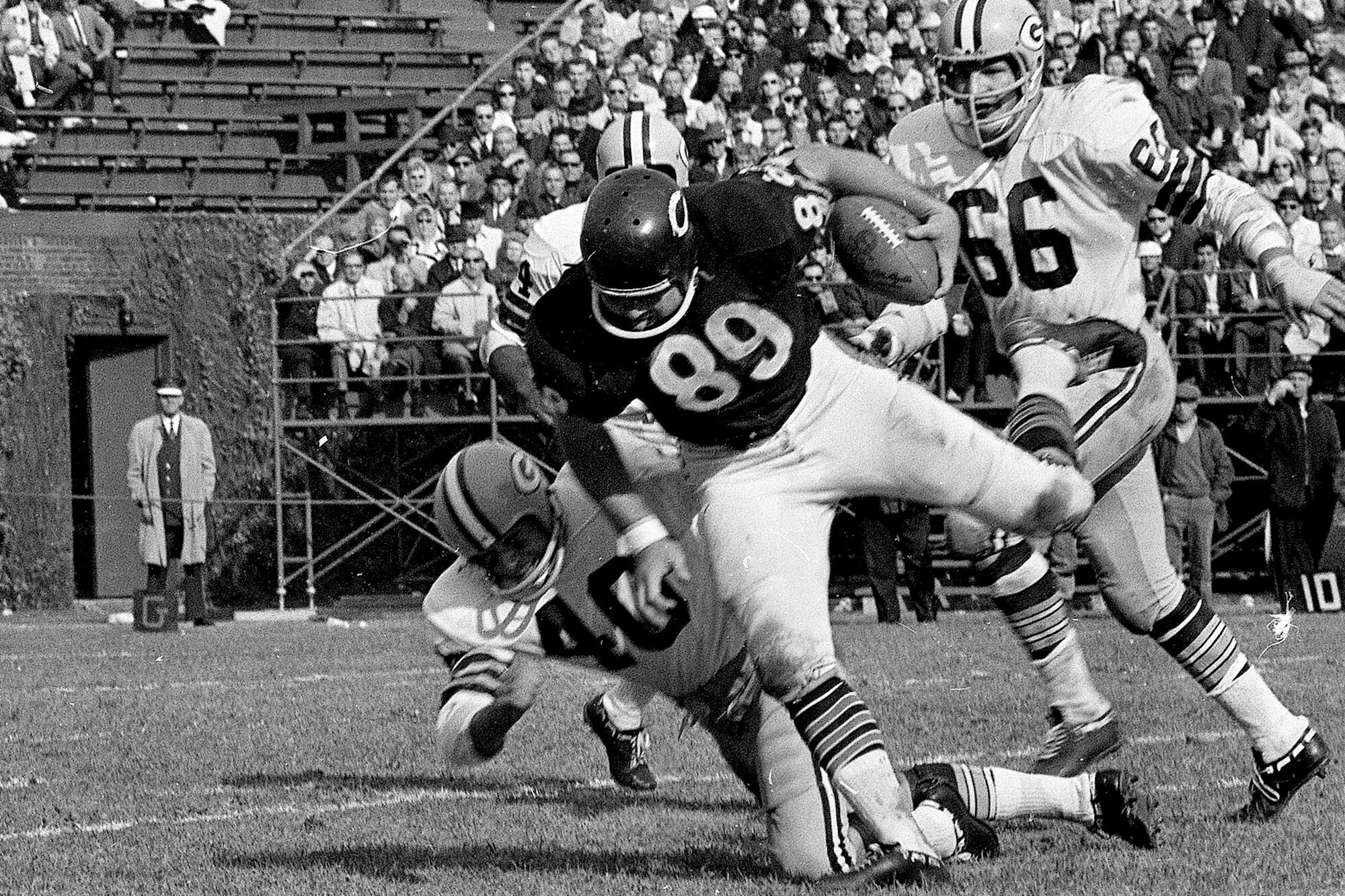
Chicago Bears tight end Mike Ditka is tackled after a pass reception against the Green Bay Packers at Wrigley Field on Oct. 16, 1966.
(Associated Press)
The tight end eventually became a coach, famously leading the 1985 Chicago Bears. The team, one of the best in NFL history, went 15-1 and scored 456 points while only allowing 198. The Bears had plenty of personality that year as well, audaciously recording a rap-styled video called “The Super Bowl Shuffle” that was released during the regular season.
But it was not only a strong season on paper — Ditka is credited with leading the Bears back to relevance and luster after losing records in 1980, 1981 and 1982. He built them back to a team fans adored and competitors feared.
“I think that’s the way Mr. Halas always wanted it,” Ditka told The Times in 1985. “He wanted to have a ballclub with a certain personality, a team made up of, you know, rough, tough guys, a team that didn’t take any crap from anybody and could dish it out.”
Ditka and the team brought triumph to Chicago in Super Bowl XX in New Orleans with a 46-10 win against the New England Patriots.
Winning NFL coach of the year with the ’85 team, Ditka is one of only two who have won a Super Bowl as a player, assistant coach and head coach.
“I believe Mike Ditka represents us, in more ways than one,” then linebacker and captain Mike Singletary told The Times. “We know he’s not coaching the Chicago Bears because he needed a job. The Bears mean something to Mike Ditka. The team is part of him.”
His time in Chicago wasn’t all glitz and glamour, though. Ditka wasn’t immediately welcomed back to the Bears as a coach, with his temper a source of strain between him and the owners. He also had a DUI conviction in 1985 and suffered a heart attack in 1988.
“There was a (magazine) poll of 200 NFL players who said the coaches they would least like to play for were, first, (Tom) Landry and, tied for second, Don Shula and me. I was flattered. What a great compliment,” wrote Mike Ditka in his 1986 autobiography.
Ditka was entrenched in controversy, having been outspoken about Washington not changing its name from the Redskins, also facing backlash for comments he made in 2016 criticizing Colin Kaepernick and social justice protests, later apologizing.
Despite it all, his name is etched in NFL history.
“Ditka was proud and headstrong,” wrote former Times sports columnist Mike Downey. “He was common and condescending. … He did as he pleased. But he restored the reputation of the Chicago Bears, made them winners and made them watchable.”
During his playing career, he made an iconic 63-yard catch-and-run against the Steelers on Nov. 23, 1963, which stands in 69th place on NFL’s 100 Greatest Plays. The highlight helped the Bears to a 17-17 tie after being down 17-14 in the fourth quarter; the team later went on to win the NFL championship.
In 1967, he was traded to the Philadelphia Eagles and then to the Dallas Cowboys in 1969. During his time with the Cowboys, Ditka made it to two Super Bowls, with a loss in 1971 and finally a win the following year in which he scored the final touchdown in a 24-3 win against the Miami Dolphins.
After retiring in 1972, Ditka joined the Cowboys as an assistant coach. He got his hands on the Super Bowl trophy once again in 1977 with the team and stayed on until joining the Chicago Bears.
The Hall of Famer’s ties with Chicago were once again severed, this time with his firing in 1993 following a 5-11 season. But he refused to shed the navy and orange in the years after he went 106-62 and led the Bears to seven playoff appearances in 11 seasons.
“Yeah, I was fired by the Bears, but that’s life,” Ditka said during a visit to Chicago’s practice field in 2013. “There has never been a time I was not a Bears fan. I have a right to be a Bears fan as much as anybody. I played on a championship team and I coached a championship team.”
The Bears retired Ditka’s number, 89, in 2013.
His involvement with the NFL expanded off the green as he explored TV commentating, even earning Sports Emmy nominations for outstanding sports personality in 1994 and 1996.
Ditka did have one more head coaching stint in the NFL from 1997 to 1999 with the New Orleans Saints. After two 6-10 seasons, the Saints traded all of their draft picks — plus a first-round selection in 2000 — to move up and select running back Ricky Williams. But the team went 3-13 in 1999 and Ditka was fired after the season.
He finished his coaching career 121-95 after the 15-33 stint in New Orleans.
“I’ve been to the top of the mountain and I’ve seen it,” Ditka told The Times in 2004. “And I’ve been to the bottom of the mountain and I’ve seen that too. I don’t want to get anywhere between them anymore.”
Professional football would not see the last of him, however, as he went on to do radio and TV broadcasting for programs such as The NFL Today, Monday Night Football and SportsCenter. His passion for football would never fade, apparent in his launch of X Football, women’s tackle football competition league, in 2021.
And his mark on Chicago was not confined to the stadium gates; he was a partner in Ditka’s Restaurant Group which first opened a steakhouse in downtown Chicago in 1997, boasting its signature dish, “Da Pork Chop.” While the original location closed in 2020, there are still locations in Oakbrook, Ill., and Pittsburgh.
After a short stint living in Florida, Ditka and his wife, Diana, replanted roots in Chicago at the end of 2024.
‘‘I was born in Pennsylvania and raised in Pittsburgh, but Chicago is my home . . . and it is my life,” Ditka told the Chicago Sun Times.
The one consensus about Method acting is that it’s controversial. Other than that, everything’s up for debate: What is Method acting, exactly? Do actors and audiences love it or hate it? And, perhaps most importantly, who can afford to practice the technique?
Method acting is a technique in which an actor embodies a character absolutely, usually both on- and off-camera, for months at a time (and sometimes, as in the curious case of Austin Butler’s Elvis accent, beyond the project itself).
Some actors, like those in the list below — including Daniel Day-Lewis, Christian Bale and Robert De Niro — swear by it. But others — like Brian Cox, Toni Collette and Robert Pattinson — eschew the practice. (Collette called it “total bulls—” and “utter wankery,” and Jennifer Lawrence said that working with a Method actor would make her nervous.)
Female actors — like Charlize Theron, Kristen Stewart, Natalie Portman, Anya Taylor-Joy and Ellen Burstyn — have pointed out that it’s a luxury they can’t afford. (“I don’t think that children or partners would be very understanding of, you know, me making everyone call me ‘Jackie Kennedy’ all the time,” Portman said about portraying the first lady.) And Black actors — like Brian Tyree Henry and Omari Hardwick — have said they wouldn’t be able to do it safely. (“I’ve never gone full Method,” Hardwick said. “I don’t want to be pulled over while ‘driving while Method.’ … I’ll get in trouble for that. That’s scarier.”)
Jeremy Strong — who plays Mark Zuckerberg in “The Social Reckoning” — recently defended his commitment to Method acting. Here are some of the most extreme Method acting performances of all time.
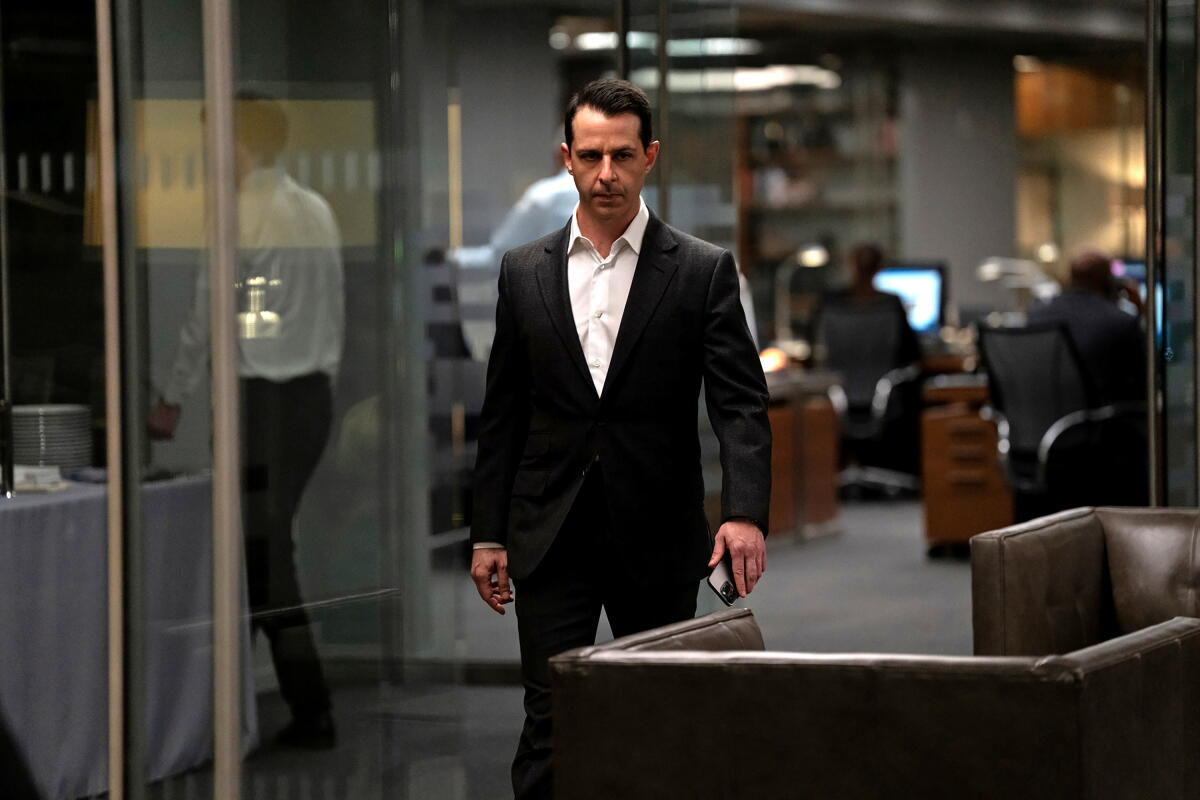
Jeremy Strong as Kendall Roy in “Succession.”
(Macall Polay / HBO)
Jeremy Strong (again)
Strong is known for his unrelenting adherence to Method acting, especially on the set of “Succession.” (“The result that Jeremy gets is always pretty tremendous,” his TV dad Cox told the New Yorker in 2021. “I just worry about what he does to himself. I worry about the crises he puts himself through in order to prepare. … It’s a particularly American disease, I think, this inability to separate yourself off while you’re doing the job.”)
This tendency held true on the set of “The Social Reckoning” too. “He showed up walking like Mark, talking like Mark,” director Aaron Sorkin told Entertainment Weekly. “I heard crew members on set call him Mark. I never heard him use his own voice until after I called ‘cut’ on his last shot.”
“I’ll be honest, I think this isn’t just the way he likes to do it,” Sorkin added. “I think it’s the only way he knows how to do it.”
Andrew Garfield as Father Sebastião Rodrigues in “Silence.”
(Kerry Brown / Paramount Pictures)
Andrew Garfield
Then there are those who argue that the Method is misunderstood — first by actors, and subsequently by public perception.
“I’m kind of bothered by this idea that ‘Method acting is f— bulls—,’” Andrew Garfield said on the “WTF With Marc Maron” podcast in 2022. “No, I don’t think you know what Method acting is if you’re calling it bulls—, or you just worked with someone who claims to be a Method actor who isn’t actually acting the Method at all. It’s also very private. I don’t want people to see the f— pipes of my toilet. I don’t want them to see how I’m making the sausage.”
Garfield employed the Method in Martin Scorsese’s 2016 historical drama “Silence,” in which he played a 17th-century Portuguese Jesuit missionary who goes to Japan. He studied Catholicism with Jesuit priest James Martin, partook in the 31-day Ignatian Spiritual Exercises and denied himself food and sex.
Al Pacino as Tony Montana in “Scarface.”
(Universal Studios / Universal Pictures)
Al Pacino
On that same podcast, Garfield praised two actors known for applying the Method well and seemingly with respect — to the craft and those around them: Al Pacino, especially in “Dog Day Afternoon,” and Robert De Niro, most notably in “The Mission.”
In “Dog Day Afternoon,” Pacino played Sonny Wortzik (based on John Wojtowicz), a first-time crook whose attempt to rob First Brooklyn Savings Bank goes awry and devolves into a hostage situation. Pacino backed out of the role three times before committing (though he later won a BAFTA Award for the performance).
Producer Martin Bregman attributed this hesitancy to Pacino’s Method acting, saying this might have been a world the actor didn’t want to explore, as “no major star had ever played a gay.”
“Scarface” drug kingpin Tony Montana is also considered the pinnacle of Pacino’s Method acting. “I’ve never been that committed to a role,” he said, also on “WTF With Marc Maron.” “I mean, I was there. I said, ‘I am this guy.’”
Robert De Niro as Travis Bickle in “Taxi Driver.”
(Columbia Pictures)
Robert De Niro
In “The Mission,” De Niro stars as Captain Rodrigo Mendoza, a mercenary, slave trader and guest of the Spanish governor of 18th-century Paraguay. Jeremy Irons co-stars as Jesuit priest Father Gabriel, who challenges Mendoza to undergo penance.
De Niro channeled real-life tension with Irons — who he didn’t want cast for the role — into on-screen animosity between the two characters.
And then there’s “Taxi Driver” — for which he got a real New York City cab license and drove 15 hours a day for a month — and “Raging Bull” — when he trained with the boxer he portrays, Jake LaMotta, for over 1,000 rounds — making him a quintessential Method actor.
Lady Gaga as Patrizia Reggiani in “House of Gucci.”
(Metro Goldwyn Mayer)
Lady Gaga
There are also counterexamples of the limitations Method acting often places on women and actors of color. (Theron told The Times in 2020 that, “I can’t do the Method thing. I did it once, for ‘Devil’s Advocate,’ and I was just exhausted. It was really hard to go to those deep, dark places because I was so tired.”)
Lady Gaga, though, lived as Italian socialite Patrizia Reggiani for a year and a half while working on “House of Gucci.” She spoke with a thick Italian accent for nine months, both on- and off-camera.
“I was either in my hotel room, living and speaking as Reggiani, or I was on set, living and speaking as her,” Gaga told British Vogue. “I remember I went out into Italy one day with a hat on to take a walk. I hadn’t taken a walk in about two months and I panicked. I thought I was on a movie set.”
Jared Leto as the Joker in “Suicide Squad.”
(Warner Bros. Pictures)
Jared Leto
Jared Leto also starred in “House of Gucci,” as Paolo Gucci, who aspires to be a designer, despite his apparent lack of talent.
“He works in a very similar fashion,” director Ridley Scott told Vulture. “Once he goes in, it’s like he’s immersed, and he doesn’t come out and breathe for air until he’s finished.”
Leto is infamous for his extreme and controversial approach to the Method. As the Joker in “Suicide Squad,” he sent bizarre “gifts” — a live rat, a dead pig, bullets, anal beads and used condoms — to co-stars Will Smith and Margot Robbie to create a dynamic of “surprise and spontaneity.”
“Leto’s Joker is the latest evidence that the prestige of method acting has dimmed,” essayist Angelica Jade Bastién wrote in the Atlantic, “thanks to the technique’s overuse by those seeking award-season glory or a reputation boost, as well as its history of being shaped by destructive ideas of masculinity.”
Joaquin Phoenix as the Joker in “Joker.”
(Niko Tavernise / Warner Bros. Pictures)
Joaquin Phoenix
The Joker seems to elicit intense psychological commitment like moths to a ghastly green flame. Joaquin Phoenix didn’t quite go Method to play him in “Joker” and “Joker: Folie à Deux,” but he did shed 52 pounds for the role.
“And, as it turns out, that then affects your psychology,” Phoenix told the Daily Beast. “You start to go mad when you lose that amount of weight in that amount of time.” (Heath Ledger walked that same fine line for “The Dark Knight.”)
For his role in “The Master,” as Freddie Quell, a World War II Navy veteran struggling to adjust to a postwar society, Phoenix forced himself to talk out of one side of his mouth by asking the dentistto fasten metal brackets to his teeth.
Jamie Foxx as Ray Charles in “Ray.”
(Nicola Goode / Universal Pictures)
Jamie Foxx
Taylor Hackford, the director of “Ray” — a biopic about Ray Charles — asked Jamie Foxx, who starred as the blind soul musician, to have his eyes glued shut. This was not Foxx’s idea (perhaps a key tenet of the Method), but he agreed to it.
“Imagine having your eyes glued shut for 14 hours a day,” Foxx told the New York Times. “That’s your jail sentence.” For the first two weeks of filming, the actor suffered panic attacks, until he eventually got used to the claustrophobic sensation.
Years later, on the set of “Django Unchained,” Foxx and co-star Leonardo DiCaprio discussed embracing Method acting to help both of them better handle the disturbing material. (DiCaprio plays the ruthless owner of a plantation where Foxx’s character’s wife is enslaved.)
Leonardo DiCaprio as Hugh Glass in “The Revenant.”
(Kimberley French / 20th Century Fox)
Leonardo DiCaprio
The film for which DiCaprio finally won an Oscar (after four previous lead actor nominations, plus one for supporting actor) was also his most Method approach. As fur trapper Hugh Glass in “The Revenant,” DiCaprio crawled inside of a prop horse carcass, ate raw bison liver (despite being a vegetarian) and endured freezing temperatures, his icy breath fogging up the camera lens.
Like Phoenix, DiCaprio might not be a traditional Method actor, but he comes quite close. In 2016, after his “Revenant” nom, director Agnieszka Holland — who directed DiCaprio in “Total Eclipse,” before he filmed “Romeo + Juliet” — reflected on this.
She said he has never been a classic American Method actor, instead relying on personal experience. “But he’s doing some trick which is pretty mysterious to everyone watching — frankly even for the director,” she told the BBC. “Look at him on screen and, for the moment of the shot, he really becomes the character.”
Montgomery Clift as George Eastman and Elizabeth Taylor as Angela Vickers in “A Place in the Sun.”
(Getty Images)
Montgomery Clift
And then there are the true, original Hollywood Method actors. Montgomery Clift, Marlon Brando and James Dean are considered to have christened the technique in the 1950s. Even Clift, though, expressed reservations about the term when asked about it — “Method acting,” as it turns out, is a contentious phrase.
Method acting began with Russian/Soviet theatermaker Konstantin Stanislavski in the 1930s. From there, acting coach and actor Lee Strasberg — who co-founded the Group Theater — largely coined “the Method” in America. Group members Stella Adler and Sanford Meisner eventually left and rejected parts of Strasberg’s technique. All three of them approached the Method slightly differently, and became prominent acting teachers.
Clift was among the first actors invited to study in the Actors Studio with Strasberg and Elia Kazan. His role as George Eastman, the poor nephew of a rich industrialist, in “A Place in the Sun” is considered a landmark Method acting performance.
Marlon Brando as Stanley Kowalski in “A Streetcar Named Desire.”
(Cineclassico / Alamy / Warner Bros. Pictures)
Marlon Brando
Clift and Brando were both contemporaries and, at times, acting rivals. But Brando was so moved by Clift’s performance in “A Place in the Sun” that he voted for him to win the 1952 Academy Award for lead actor — Clift, meanwhile, voted for Brando to win for his role as Stanley Kowalski in “A Streetcar Named Desire” the same year. (Humphrey Bogart ended up victorious for his role as Charlie Allnut in “The African Queen.”)
“A Streetcar Named Desire” — both the original 1947 Broadway production and the 1951 film adaptation — was directed by Actors Studio co-founder Kazan. Brando also starred in both versions, and, though his performance was temperamental, Kazan said: “Marlon was living on stage. … A performance miracle was in the making. What was there to do but be grateful?”
James Dean as Cal Trask and Julie Harris as Abra Bacon in “East of Eden.”
(Warner Bros. Pictures)
James Dean
James Dean only got the chance to star in three films — “East of Eden,” “Rebel Without a Cause” and “Giant” — before he died at 24, and the latter two were released after his death. Prior to all three, though, he also studied at the Actors Studio under Strasberg.
In “East of Eden,” also directed by Kazan, Dean played the wayward young man Cal Trask, who competes against his (favored) twin brother (played by Richard Davalos) for the affection of their pious father. Dean had a turbulent relationship with his own father, and his mother died when he was 9. (The Trask brothers’ mother is ostensibly dead too.)
“One of the things that made [Dean] noticed,” actor Martin Landau told PBS, “was his vulnerability. He understood a mother he didn’t have. … ‘East of Eden’ was like a chance to meet his mother again, if one accepts that.”
Ruth McCabe as Mary and Daniel Day-Lewis as Christy Brown in “My Left Foot.”
(Miramax)
Daniel Day-Lewis
Daniel Day-Lewis is perhaps the closest contemporary follower in Clift, Brando and Dean‘s footsteps. He has won a record three Academy Awards for lead actor, including in 1990 for his iconic performance as Irish writer and painter Christy Brown in “My Left Foot.” (Day-Lewis beat out Tom Cruise in “Born on the Fourth of July,” Morgan Freeman in “Driving Miss Daisy” and Robin Williams in “Dead Poets Society.”)
Brown, who was born with severe cerebral palsy, could not walk or talk, was wheelchair-bound and only had control of his left foot, which he used to paint and write. Day-Lewis refused to stand between takes, remaining in his wheelchair, and made production assistants feed him by hand. He is now renowned for his Method acting, grueling process and devotion to his roles.
Christian Bale as Trevor Reznik in “The Machinist.”
(Paramount Classics)
Christian Bale
Another Method actor who rejects the label, Christian Bale is oft-associated with extreme physical transformations and intense focus onset, including in “American Psycho” as serial killer Patrick Bateman and in “The Machinist” as sleepless industrial worker Trevor Reznik.
Bale lost more than 50 pounds in four months to play the machinist, paranoid and deluded after being unable to sleep for a year. Bale’s daily diet consisted of black coffee, an apple and a tin of tuna.
But in 2011, Bale told the Mirror: “At the end of the day, I’m faking it. Pure imagination. I never took any classes, I just go, ‘I better wing this one and make it up!’ Everybody talks about the process too much. The interesting thing about a movie is the movie.”
Austin Butler as Elvis Presley in “Elvis.”
(Warner Bros. Picture / Warner Bros. Pictures / AP)
Austin Butler
Eight months after “Elvis” hit theaters in June 2022, Austin Butler — who starred as the King of Rock and Roll — said he would finally drop Presley’s deep Southern twang. (That came after fans noticed the Elvis accent creeping in during his Golden Globes acceptance speech, “Saturday Night Live” monologue and “Jimmy Kimmel Live!” guest spot.)
“It’s funny to me because I don’t even think about it,” Butler told The Times after his Oscar nomination for the role. “I guess after three years of doing everything that I could to focus on this one goal of trying to bring life to Elvis in this film, I think that there’s certain muscular habits that must pop up.”
Once again, though, Butler wouldn’t use the term to describe himself. “I never have used the word ‘Method,’” he told the Hollywood Reporter. “I think that word gets thrown around a lot. It’s a very misunderstood thing that isn’t really what I do. … It’s more that I just like to immerse myself.”
Midcentury pop culture expert Charles Phoenix thinks Long Beach gets a bad rap.
“It is very underrated in the grand scheme of all of Southern California, but there is a lot to see and do there,” says the Ontario native, who uses the word “time-honored” repeatedly when describing his favorite attractions in the seaside community. “I often refer to it — under my breath — as the New Jersey of Los Angeles. It doesn’t get much respect, yet it’s loaded with attractions.”
In Sunday Funday, L.A. people give us a play-by-play of their ideal Sunday around town. Find ideas and inspiration on where to go, what to eat and how to enjoy life on the weekends.
When he isn’t gushing over Long Beach, the humorist and author hosts nostalgic slideshows and double-decker open-air bus tours of Midcentury architecture during Modernism Week in Palm Springs. His next event, “LosAngelesland,” is a lively retro slideshow featuring vintage Kodachrome slides taken by Los Angeles locals and tourists in the 1950s and ’60s. The show is scheduled for Oct. 17 during Modernism Week’s October festival in Palm Springs and a Halloween-themed version on Oct. 24 at the Anaheim Fall Festival. Phoenix will also present “Disneyland: Live Retro Slide Show Celebrating the Original Magic Kingdom in the 1950s & ’60s!” at the Hilbert Museum in Orange on Oct. 18.
Phoenix lives in a Midcentury Modern home in Claremont, but he’s always happy to spend a day in Long Beach. His ideal Sunday includes eating clam chowder-topped biscuits at a floating restaurant, shopping for vintage treasures along 4th Street Retro Row, cruising around Naples in an electric Duffy boat and ending the day at a classic diner from 1939.
“There’s more to do in Long Beach,” he says. “I could keep going, but there’s only so much space in this column.”
This interview has been lightly edited and condensed for length and clarity.
8 a.m.: Wake up early and say thanks
When I wake up, I usually have nonfat yogurt, chopped walnuts and one or two types of fresh fruit. Then I walk through my house, and whatever room I walk in first — either the living room or the den and say, “I love you, house.” Those are the first words I speak out loud.
10 a.m.: Drive to the coast for lunch on a floating restaurant
We’re going to start at the only floating restaurant I know of in the Western United States, the Chowder Barge. It stands out on its own, although it’s a bit tricky to find, so it’s a good thing we have GPS or we might never get there. It’s a little bit tiki, a little bit pirate and a little bit seafarer. There’s always an old wizard-like man sitting in the corner with a long beard that reaches the floor. When you’re on the barge and a boat passes by, you can feel it. The best thing there is their fried clams and clam chowder, which you can eat in a bowl or use the chowder as gravy. For breakfast, you could have biscuits topped with clam chowder instead of gravy. It’s the best clam chowder ever. If you want fried clams on top of the biscuits, that’s incredibly delicious. They also have an open-faced hamburger covered with clam chowder and fried clams or just clam chowder.
The place has a deep soul, and everything there is unique and time-honored.
1 p.m.: Go vintage shopping on Retro Row
Next I would go shopping on 4th Street, a.k.a. Retro Row, which is absolutely, in no uncertain terms, the best vintage shopping street in the Western United States — probably the Eastern and Midwestern as well. There are three stores there that I concentrate heavily on. The first is Sneaky Tiki Boutique, which is the destination of all destinations for what I wear all spring and summer and fall — vintage Hawaiian shirts from the ’50s and ’60s. They’re not Hawaiian shirts unless they’re made in Hawaii. Nobody has a better supply than Sneaky Tiki. I mean nobody.
A couple of doors down is another world-class vintage store, Meow. Meow is an institution in the world of vintage clothing, shoes and accessories. And it’s absolutely a spectacular themed environmental extravaganza, as is Sneaky Tiki. There are all kinds of vintage in there. So it is a feast for the senses and your wardrobe and accessory needs.
And then for your Midcentury home decor needs, there’s Xcape Modern. They’ve been there for probably 30 years, and it’s a little mumbo jumbo as far as the way it’s all laid out. It’s a little messy, but they have incredible Midcentury furniture and home decor, including patio items. It’s a spectacular, well-curated collection.
3 p.m.: Explore Rancho Los Alamitos
After that, I’d take a quick late-afternoon scamper around Rancho Los Alamitos. It’s really special, and it’s free, F-R-E-E, free. It’s this gorgeous, time-honored place; basically, you’re walking back into time. The family started building it in 1790 and finished in 1834. I love to look around and walk through the layers of time. The house is beautiful. The barn is beautiful. There are animals there too. It reminds me a little bit of old-timey Knott’s Berry Berry Farm. Chickens walk around, and it just has, again, this deep soul, layers of time, mature garden. And it’s impeccably kept, impeccably groomed. You can spend 20 minutes walking around there or you could spend four hours. And of course, the garden is absolutely out of this world.
It’s its own little world. It doesn’t know the rest of the world exists, which is the kind of place that I really, really love — a place that’s true to itself, time-honored and lost in its own wonderland. You know, it’s just so special to be able to escape to such a rarefied environment.
5 p.m.: Go for a ride on a Duffy Boat in Naples
From there, get ready for my favorite thing to do in Southern California: taking a Duffy Boat ride around Naples. I always rent from Anchors Away. The boats remind me of the Jungle Cruise at Disneyland. Most are white and blue, but a couple of years ago, around the time of the Barbie movie, they added some bright pink ones. You can pay a little extra for the pink boats, but the blue and white ones are just as fun. The boats seat about eight to 10 people, and you rent them for two hours and just cruise around. The canals are much bigger than those in Venice. They give you a map and two hours to enjoy the water. I usually drive the boat while my friends bring drinks, cookies, snacks and whatever they want to drink. I had no experience before my first time, but it’s easy and relaxing. It’s never crowded, the homes are beautiful, and of course, I always wear a captain’s hat.
8 p.m.: Late–night snack at a 1939 diner
After that, even if we’ve already had plenty to eat and drink, we usually end up at one of my favorite diners, Harbor House Cafe, on Pacific Coast Highway in Sunset Beach. It’s been open since 1939. So we drive a couple of miles down PCH, pile into the Harbor House and finish the day with whatever we want — dessert, more dessert, onion rings or a milkshake. It’s our spot to unwind. The onion rings are especially good. It’s an easy, time-honored place, just like everywhere I love to go. I like to soak in the history. After we leave, everyone heads home, and I drive back up the 605 Freeway to Claremont.
Michael Kearns, a trailblazing AIDS activist and author credited as the first out gay actor, has died. He was 76.
Filmmaker and professor Roland Palencia confirmed the actor’s death on social media, writing that Kearns had died Monday evening after feeling unwell and calling the paramedics on Sunday. Palencia said that the actor had been in and out of emergency rooms more than five times in the last few months.
“Michael Kearns was a friend, mentor, neighbor, and my movie buddy,” Palencia wrote. “For the past year, we watched an average of a movie a month. Our favorite theater was the Vista Theater in Los Feliz, with a larger-than-life screen and within walking distance of where we both lived. Our favorite film this year was ‘The History of Sound.’
“It is a strange feeling to know we will not see the living Michael again, who spoke in hyperbolic, superlative tones. For him, nothing in life was small enough; everything had magnified significance. He himself and his legacy are larger than life,” he continued. “I will miss him deeply. Our next movie was going to be ‘La Bola Negra,’ a film based on Federico García Lorca’s first openly gay play, the Spanish playwright [was] killed in 1936 by the fascist Francisco Franco army. Michael was our Los Angeles García Lorca.”
Born Jan. 8, 1950, and raised in St. Louis, Kearns felt odd from an early age.
“I couldn’t throw a ball particularly well. I didn’t excel in sports,” he told talk show host Sheila Kuehl during a 1998 appearance on “Get Used to It.”
“But one day I was put in the school play, and I excelled. Suddenly I realized I could entertain, and from that moment on it was just like this realization, ‘Oh my God, here is something that I can do, I have found it,’ and I was only 8 years old. From that moment on, to this very moment, I’ve never ever veered from that path.”
Kearns realized along the way that his path to stardom wouldn’t be so simple. He had initially been drawn to the theater as a means to escape his home life, and himself, but he ultimately found the craft inspired the opposite: “As I got into my 20s, coinciding with an awakening of other areas of my life — spiritual, sexuality — I found that the theater and being an actor was more of a way to truly connect with who I was as a person,” he told Kuehl.
Around this time, Kearns made his way to Chicago, where he studied acting at the original Goodman School of Drama, which became the Theatre School at DePaul University, and graduated in 1972. It was here that Kearns got his first taste of casting bias, and realized that he was facing a real dilemma: Did he want to be gay or did he want to become a commercially successful actor?
“In spite of the fact that most of the teachers were gay or lesbian, they had that Hollywood philosophy that if they knew you to be a homosexual, you were not as eligible to play heterosexuals,” he continued. “By that point I was out, out, out. I mean, there was no way I was going to alter my offstage behavior to please anyone.”
Kearns acted across film and television from the 1970s through the aughts, including roles in “Body Double,” “Nine Lives,” “Street Asylum” and “Beverly Hills, 90210.” During an era when it could be dangerous to be queer, the actor was out, and in 1991, he made television history when he shared that he was HIV positive on NBC’s “A Closer Look,” and the next day, “Entertainment Tonight.” The following year, he appeared on a segment of ABC’s dramedy series “Life Goes On” and played a character with HIV.
In 1975, Kearns used his acting chops to pull off a literary stunt in which he posed, both in nude photographs and in extensive interviews, as author Grant Tracy Saxon, a pen name for TV writer Thom Racina who penned “The Happy Hustler,” a faux memoir (it was actually fictionalized erotica) about a high-priced male sex worker. Years later, Kearns became an author himself and published five theater books including “T-Cells & Sympathy” and “Acting = Life,” which were nominated for Lambda Literary Awards.
The actor’s first major theater role in Los Angeles was in Tom Eyen’s comedy “The Dirtiest Show in Town” in 1972. Perhaps his most celebrated performance was playing the title role in Charles Ludlam’s “Camille” at Highways Performance Space in 1993. He also acted in James Carroll Pickett’s “Dream Man,” in 1985 and toured with the production internationally.
Kearns, who considered himself “a political creature as well as an actor,” also garnered acclaim for his solo theater works, which were inspired by the AIDS epidemic and his grief surrounding the too-frequent death of his friends. “Intimacies” and “More Intimacies,” in which he played a dozen diverse characters with AIDS, as well as solo pieces “Rock” and “Going In: Once Upon a Time in South Africa,” made Kearns feel that he had found new purpose and depth in his work.
“Somewhere in that time, I became an artist,” Kearns told The Times in 1994. “Whatever that pain, that loss, that tragedy was, I managed to spin it like an alchemist into something passionate. And it’s been increasingly so since.”
In 1992, he married his husband, Philip Juwig, who died the same year. Bereft, Kearns spent three years thinking, “What now?” and kept coming back to the same thing: He wanted to be a dad. In 1995 he adopted a baby girl, Tia Katherine Kearns, whom he named after his grandmother.
In 2017, he interviewed his daughter for the summer issue of Honeysuckle Magazine about her identity as a Black woman, her work as an artist and her unique upbringing. She said that she attended a progressive school and didn’t feel judged, noting, “they doted on my dad because he had a skill set that other dads didn’t; for school fundraisers; he could climb a ladder and decorate with panache.”
Later in the interview, she revealed that she had her dad’s passion for political activism.
“I think my political consciousness was formed early on,” she said. “I think it would have been impossible for me not to have an awareness of the world and political climate with a dad who is an openly gay actor and activist. Your openness and courage forced me to be honest with myself and the world I live in.”
Kearns gushed in a 2015 interview that his dream creative collaboration would be directing a project written by his daughter that explored race.
In the last couple of decades, the social justice crusader worked with Angelenos to develop their own voices through writing workshops. He also served as an artistic associate at the Skylight Theatre in Los Angeles, artist-in-residence at Housing Works, and artistic director of QueerWise, a Spoken Word collective he founded in 2012.
Kearns was widely recognized for his work, including the Robert Chesley Playwrighting Award (2005), honoring lifetime achievement in LGBTQ+ theater, and a COLA Fellowship (2005) from the city of Los Angeles Cultural Affairs Department to fund major new creative works. His acting career was highlighted by a Drama-Logue Award and a Los Angeles Drama Critics Circle Award nomination for his lead role in “Camille.” Additionally, his national advocacy earned him the Victory Award (1999) from the Gay & Lesbian Victory Fund, alongside honors from the ACLU of Southern California (1987).
Anne Carson, the Canadian poet, essayist, professor of classics and translator, has won the 2026 Nobel Prize in literature.
The prize, announced at the Swedish Academy in Stockholm on Thursday, awarded Carson “for her bold and inventive oeuvre that, in playful dialogue with the classical tradition, has created new forms for contemporary literature.” Carson is the 19th woman to win.
Among Carson’s myriad acclaimed works are her novel in verse “Autobiography of Red” and its sequel, “Red Doc>”; her seminal book of literary criticism, “Eros the Bittersweet”; poetry collections such as “Glass, Irony, and God” — which contains “The Glass Essay” — and the T.S. Eliot Prize-winning collection of narrative poetry “The Beauty of the Husband: A Fictional Essay in 29 Tangos”; her haunting accordion-fold elegy, “Nox”; and her widely praised translation of Sappho’s surviving fragments, “If Not, Winter.”
“In 1981, she published her doctoral thesis in classics, and has throughout her entire career, combined poetry writing with translation work and teaching at various universities,” said Anders Olsson, who serves as the chair of the Nobel Committee for Literature at the Swedish Academy, and presented the laureate. “Almost all her literary production has centered upon the intersection between the philologist’s obsession with words and the poet’s desire for new meaning.
“Throughout her entire authorship, Carson, with a light touch, explores the possibilities of writing, a process by which the literary sketch has become of particular value for her. In her collaborations with visual artists and choreographers, and with opera and theater directors, she has crossed over into various artistic fields, which has lent her writing a strongly performative aspect,” Olsson continued. “This demonstrates the freedom with which she relates to literary expectations and rule systems, which in turn lies behind the outstanding importance her work since the 1990s has had for the international art and literature scene.”
Nobel committee member Steve Sem-Sandberg said Carson is “an author for our time,” unique in her skill at connecting contemporary ways of living through antiquity. Sem-Sandberg marveled at Carson’s use of the myths, characters, stories and fables from that time, and the way she puts them into a modern context. “The mixture between those two gives an enormous energy to her writing,” he said. “Nobody writes like her, and nobody would even, I think, dare to do this in this way.”
Carson was sipping tea and eating crackers at her seaside home in Iceland — she also resides in Ann Arbor, Mich., where she teaches — after she got the big news. She said she was thinking of ways to give the 12 million Swedish kronor ($1.2 million) award away. “We have a friend who needs a house, and we always give a lot to Doctors Without Borders,” she said. She also planned to celebrate by taking a walk through the woods and turning off the phone.
Carson’s initial reaction was surprise. “Who would expect it? For heaven’s sake!”
Nimesh Patel’s stock in comedy has been on an upswing lately. From sold-out shows to a skyrocketing social media following and the release of his first Netflix special, “Buy the Dip,” last month, it’s been amazing the difference a year makes. The new hour filmed in Washington, D.C., delivers surgically precise, dryly delivered jokes and personal stories about America falling apart from the heart of our nation’s capital.
Despite the dire circumstances, it’s in our country’s DNA to believe in the power of the rebound. So does Patel, who’s seen one play out with his own career after taking an unexpected hit. Last fall, the comedian faced public backlash for his decision to accept — and then reject — a spot on the controversial Riyadh Comedy Festival, for which he’d been offered $125,000 to perform along with major names like Dave Chappelle, Bill Burr, Sebastian Maniscalco, Whitney Cummings and many more. The rollout of a comedy festival in Saudi Arabia, a nation whose government has been accused of human rights abuses and, according to U.S. intelligence, the brutal murder of journalist Jamal Khashoggi at its consulate in Turkey, lead to a war of words on the internet aimed at the comedians on the lineup. Hearing the scrutiny loud and clear and ultimately deciding the money wasn’t worth it, Patel decided to pull out and tell the world via Instagram that he wasn’t going, opting instead (and somewhat grudgingly) to make up for the lost bag with 40 extra shows added to his nationwide theater tour. The response to his video announcement drew even more ire from comedy fans. Looking back on it now, he admits his delivery at the time, looking tired and somewhat annoyed by his own decision, wasn’t the greatest.
“People read that as sarcasm and like woe is me,” Patel said in a recent conversation with The Times over Zoom. “I can see why they thought that I was a poor actor in the video that I posted. But everyone acts better than the person they see on the screen until it becomes their life and then they’re like, ‘Oh s—, yeah, I probably would have done the same thing.’ So, f— them!”
Despite the roasting he received, Patel stuck to his word and did the shows. Stepping on stage night after night to earn the money he had planned on making last year from one canceled gig in Saudi Arabia gave him the reps he says he needed to perfect the new hour of material. The title “Buy the Dip” is a nod to the remnants of his former career in finance — it’s stock market terminology about buying a failing asset with the hope that it will go up in value again. But it also describes the optimism from which he now makes his decisions as a parent and as someone who still believes that things can get better, even at their lowest.
“I have to be an optimist, I have to believe the world is getting better, because otherwise, what the f— did I do by having a kid?” he said.
In his Netflix debut special, “Buy the Dip,” comedian Nimesh Patel turns personal setbacks and a troubled America into sharply observed jokes grounded in unexpected optimism.
(Courtesy of Netflix)
His belief in positivity followed him to D.C. to record the special, the town where he says he got his first big breaks as a comedian opening for major acts like Maz Jobrani at the Warner Theatre, headlining the Bier Baron and the DC Improv and even the Kennedy Center — “or the now-defunct Trump whatever you’re supposed to call it,” he joked. When it comes to his comedy trajectory, taking the long view is essential to realizing that Patel’s path to this special started over a decade ago when Chris Rock discovered him while on stage in Brooklyn and helped him get writing gigs on “Saturday Night Live” and the 2016 Oscars ceremony, two opportunities that solidified his resolve to go into comedy full-time after he lost his job in finance.
As an Indian American comedian, he knows there is a spotlight of cultural representation on him, which he notes in the special and even makes fun of. That kind of attention isn’t on just him but also on Indian Americans in even higher-profile jobs, such as, say, the first Indian American director of the FBI, the chronically embattled Kash Patel.
“Let me be clear, it’s really difficult to both be proud of Kash and despise him at the same time,” Patel says. On the one hand, there’s the astonishing feat of going from being one of the few Indian kids in Virginia amid post-9/11 racism to becoming head of the nation’s domestic intelligence agency. On the other there’s a career riddled with gaffes and allegedly immoral conduct that makes him an easy punching bag for the writers at “SNL” with the help of his late-night TV doppelganger Aziz Ansari.
“For him to go from that to then be serving the country at this level, that is an incredible achievement, and it’s just so sad that that is who our representative is at the moment,” Patel said. “Just like when an Uber driver says to me, ‘Your last name is Patel? Like Kash?’ I’m like, ‘Yeah, just like that, but not like that at all, you know?’”
Patel revisits the backlash he faced after accepting, then withdrawing from, Saudi Arabia’s Riyadh Comedy Festival, and how dozens of extra tour dates helped shape his new material.
(Courtesy of Netflix)
While trying to distance himself from one person who shares his family name, when it comes to his actual family, Patel has plenty of jokes of being too close to them. Like many millennials, he’s squeezed tight between caring for aging parents and raising a child. At 40, he says in the special that people in his age bracket have become the “Sandwich Generation.” Though, to be fair to his toddler, keeping track of his parents is a much harder task at times.
“They won’t take help. They’re very independent, and I imagine I was the same way when I was growing up,” Patel said. “So it’s that in itself is just like the Progressive commercial that we’re all becoming our parents, but in real life and not driven by a corporate marketing team. It’s just funny to see that play out.”
Whether the obstacles he faces in life are laugh-out-loud funny or career hurdles that threaten to topple him into the abyss, the idea that he can always bounce back is the key to staying unfazed during the highs and the lows of life. And to the extent that anyone can take a lesson from Patel in the art of staying even-keeled, he hopes the special will make people feel a little less bad about the country being on the brink of destruction.
“Everyone knows that we’re not in a good spot right now,” he said. “The dip is here now. I fully believe that we can recover, I hope that we can. It’s going to be a lot of pain. I don’t know if we’re at the bottom just yet, but I’m optimistic, and I have to be. Otherwise, I don’t know what I’m doing.”
The Singapore Grand Prix has been declared a heat-hazard race, the second weekend in a row that the designation has been used in Formula 1 and the fourth time this year.
The definition allows teams to fit cooling devices to their cars that pump liquid through a vest worn by the driver to manage temperatures in the cockpit.
A heat hazard is an official status for an event where it is forecast that temperatures will exceed 31C at some point during the race. It was first introduced in 2025.
Singapore is close to the equator and has long been known as one of the most demanding for drivers – in 2024, George Russell and Lewis Hamilton were treated for heat exhaustion after the race.
Temperatures in the city are always in the 31-33C region across the race weekend, with high humidity and a chance of rain every day.
The race is held at night, but temperatures remain in the region of 30C even after dark.
A cooling kit is not mandatory, but any driver who chooses not to use it has to carry 5kg of ballast in their car to ensure he does not have a competitive advantage.
The system uses a cooling tank and pump, usually situated in the car’s nose, that delivers a cooled liquid, such as glycol, through a system of pipes in a fireproof top worn under their overalls.
Some teams and drivers prefer not to use the system because of two key compromises.
It is difficult to keep the liquid cool enough for long enough so that it lasts for an entire grand prix – a problem exacerbated in Singapore because it is the longest race of the year.
And some drivers find the cooling top uncomfortable in the tight confines of the cockpit.
If the liquid cannot be kept cool, it reverts to car temperature, which is considerably higher than ambient. It is not unusual for temperatures in an F1 cockpit to rise above 40C.
Mercedes are one of the teams who have decided against running the system because they preferred to devote the resource that would have been involved in making it robust enough to last a race into car performance.
Governing body the FIA has granted teams an allowance under the cost cap of $50,000 (£38,000) if they can make a system that keeps the liquid cool for an entire grand prix, and a further $75,000 (£57,000) if they could make the top comfortable.
Mercedes deputy team principal Bradley Lord described the allowance as “small”, adding: “We didn’t believe that allowance was sufficient for us to be able to develop a solution that would be robust enough to last for the entire race.”
Singapore follows the Austrian, Italian and last weekend’s Bahrain Grand Prix in Malaysia in being declared a heat-hazard race this year.
Murphy is a baseball lifer who paid more dues than a union plumber before finally pulling on a big-league uniform for the first time when he was 56. Murphy pitched in the low minors for two organizations and for two independent teams before retiring to become a college coach at Maryville, Claremont-Mudd, Notre Dame and Arizona State. He also managed the Dutch national team to a European championship and a spot in the 1988 Seoul Olympics.
His big break came in 2015, when the Padres promoted him from their triple A team in El Paso to take over for Bud Black as interim manager. A year later Craig Counsell hired him as bench coach for the Brewers, and when Counsell took the Cubs’ managerial job ahead of the 2024 season, Murphy, now 67, was named his replacement.
Two-hundred and 93 regular-season wins and three playoff trips later, the baseball lifer is four wins away from the World Series, which would be the trip of a lifetime.
“I think it was just the relentless pursuit of something,” Murphy told Yahoo Sports of his long journey. “I wanted to be somebody. I wanted to be special.”
Kacey Musgraves is taking another trip to “Uncertain, TX” — this time with a little bit of Tejano flair courtesy of a legendary South Texas band.
On Tuesday, Musgraves released a Spanish version of her critically acclaimed track featuring Tejano group Intocable — a song she originally recorded with country star Willie Nelson, which debuted at No. 50 on Billboard’s Hot Country Songs after the May 1 release of her seventh studio album, “Middle of Nowhere.”
“Having a song with the legends of Intocable is such a thrill for me,” said Musgraves in a press release on Tuesday. “As a Texan, I am proud of the cultural melting pot that makes our state so great and this collaboration is such a fun example of that.”
According to Intocable lead singer and accordionist Ricardo “Ricky” Muñoz, who spoke with The Times via Zoom, Musgraves had first thought of including the great conjunto accordionist Flaco Jiménez, who passed away in August 2025, to join in on the original track with Nelson, a fact that the country gal herself confirmed on the Zane Lowe interview series on Apple Music in May.
“Flaco Jiménez’s son told me that Kacey wanted to do an all-Texas thing where Willie Nelson was in the song and Kacey also invited Flaco to play accordion,” said Muñoz, who heard the original demo. “I believe at the time, Flaco was not good, health-wise, so he wasn’t able to do it.”
Muñoz, who has always been a fan of the “Rainbow” singer, said the song was “orbiting” around him. Three weeks ago, he received a call from Musgraves’ team to help with the Spanish version.
“I was very conservative on the accordion part. I just played little parts here and there,” said Muñoz. “Then they call me back and they go like, ‘No, give me some more of that.’”
This isn’t Musgraves’ first collaboration with a música mexicana artist. In August 2025, the 38-year-old singer-songwriter joined forces with Carin León for the cross-cultural ballad “Lost in Translation.”
Muñoz considered the collaboration a “perfect fit.”
“We’re representing the Tejano community, and I’m proud of that,” said Muñoz, who comes from a long line of Texas-born Mexicans. “ Once we meet in person and we get to play together, it’s even gonna be a better connection to the song.”
On Thursday, the two acts will perform together for the first time for Musgraves’ Middle of Nowhere tour at the Moody Center in Austin, Texas.
The iconic Tejano band formed in the border town of Zapata, Texas, in 1993, and rose to fame thanks to Tejano pop hits like “Fuerte No Soy,” “Soñador Eterno” and “Estás Que Te Pelas.”
In July, the “¿Y Todo Para Qué?” group received its own star on the Hollywood Walk of Fame. At the ceremony, hitmaker and songwriter Edgar Barrera, who grew up in the same borderland area, said that Intocable “showed the world what música mexicana could be.”
But the Grammy-winning band isn’t resting on its laurels. Of the Walk of Fame star, Muñoz said, “that’s just part of the journey. It’s awesome, but I haven’t really paid any more thought than the day I was there.”
Instead, the “Enséñame A Olvidarte” act is looking ahead. The group is preparing for the release of its 16th studio album next year, “Nostalgia Radical,” a project inspired by Muñoz’s mental health journey , which he said has allowed him to show up as his most authentic self.
“I was exploring myself, being vulnerable and asking questions,” said Muñoz. “ To me, going to therapy every Tuesday is like taking out the trash.”
This November, the band — which is currently zigzagging between Mexico and the U.S. for its Cultura Tour — is also up for a Latin Grammy for regional song for their country-fused pro-immigrant anthem “Estamos Todos.”
“We’re all asking all these questions, and we’re not getting the right answers or any answers. We’re just being danced around with the answers,” said Muñoz. “But in the meantime, we’re all together in this.”
The band’s pro-immigrant stance is another thing it has in common with Musgraves, who in May invited invited three teen mariachi brothers previously detained by ICE to open for her sold-out, three-night residency at Gruene Hall in New Braunfels, Texas, the oldest dance hall in the state..
The country singer also asked fans to donate to the Young Center for Immigrant Rights, which helps children whose parents have faced deportations, during the opening night of her tour in Chicago back in August.
“We need more people to talk about this and not stay quiet. Kacey is coming from another community and stepping up, I mean, that’s big, man. That’s huge. I commend her for that,” said Muñoz.
He pounded his chest twice as he left the batter’s box, and all of Dodgers nation rocked to the beat.
Andy Pages did it. He finally did it. He finally broke out of his baffling two-year October slump with a hit so powerful, he didn’t even have to climb over Kiké Hernández to get it.
How powerful? With one smooth swing he broke a tie by scoring two runs while sending two teams packing, the Atlanta Braves trudging home for the winter and the Dodgers charging into the National League Championship Series.
Yeah, it was a blast, both figuratively and literally, Pages’ two-out, two-strike bases-loaded single in the seventh inning Wednesday night silencing the lame tomahawk-chopping fans at Truist Park and giving the Dodgers an eventual clinching 4-1 victory against the Braves in the National League Division Series.
Dodger Andy Pages hits a two-RBI single against the Braves during Game 4 of the NLDS Wednesday in Atlanta.
(Kevin C. Cox / Getty Images)
Certainly, it only gets tougher from here. In winning this best-of-five series three games to one, the Dodgers can now prepare for a best-of-seven showdown task against either the mighty Milwaukee Brewers or blazing San Diego Padres.
Yes, they will need to hit better, they will need Blake Snell to find his focus, they will need Shohei Ohtani to show up.
But… Andy Pages! Seriously! If a guy who was seven for 66 in the last two postseasons and was so helpless last year he was benched for the last three games of the World Series… if that guy can drive in the winning run from the bottom of the order? The once-fallible Dodgers may just be unbeatable.
“There’s no more talented team than the Los Angeles Dodgers,” manager Dave Roberts shouted in the postgame clubhouse. “We’re the best organization in sports, top to bottom. We’re smarter, we’re better, and we’re tougher.”
At that point, someone referenced a recent comment from Padres owner José E. Feliciano insinuating that the Dodgers, baseball’s oldest team, was composed of dinosaurs.
“And we’re dinosaurs!” shouted a voice above the clubhouse din.
If they’re dinosaurs, their first initial is “T” and their last name is ‘Rex.”
It’s OK to start seriously thinking about a three-peat now. They’re now just eight wins away but, given how mediocre the American League playoff teams appear, they could realistically be just four wins away.
Here’s guessing that the NLCS will be the real World Series. And here’s guessing the Dodgers will be ready.
Pages, who won the hearts of Dodger fans last October when he made a leaping game-saving catch over the back of Kiké Hernández, was granted his first big October swing thanks to the Braves largess.
In the seventh inning of a 1-all tie, Teoscar Hernández redeemed himself for another fielding blunder with a single that finally drove dizzying Tyler Mahle from the game.
In came Game 2 rookie sensation Didier Fuentes, only this time, he was all rookie and zero sensation, walking Josue De Paula and Kyle Tucker to load the bases. Considering De Paula is just a kid and Tucker has been struggling, the fact that both showed such patience in such a pressure situation was pretty cool. And moments later, it got even cooler.
In came veteran reliever Robert Suarez, and Pages was ready for him, working the count full before lining the two-run single up the middle.
The Dodgers added a run two innings later on a Max Muncy home run — has there ever been a playoff game when he hasn’t homered? — to finalize the score.
Dodger Max Muncy celebrates after hitting a home run in the ninth inning of Game 4 of the NLDS against the Braves in Atlanta Wednesday.
(Kevin C. Cox / Getty Images)
When the game ended on an Austin Riley fly out to right field, Pages celebrated in center field by taking off his cap, turning his face to the sky and pounding the cap three times into his glove.
It was a series that was worth the emotion, the Dodgers famous starting rotation giving up just four runs in 21 ⅓ innings, the bullpen solid behind a revived Edwin Díaz, and the offense doing just enough to beat Braves aces Chris Sale and Mahle.
In the fifth inning of a tie game, starter Tyler Glasnow issued walks to Riley and Michael Harris II. With two out, in came Alex Vesia. Up stepped slugger Matt Olson. The fans climbed to their feet. This was the Braves’ big chance.
Dodgers closer Edwin Díaz throws the ball against the Braves in the ninth inning Game 4 of the NLDS Wednesday in Atlanta.
(Kevin C. Cox / Getty Images)
But Olson swung at the first pitch and lined it directly to second baseman Kiké Hernández to end the threat and quiet the joint. Díaz threw a hitless ninth for his second save of the series and…who’s going to beat them?
Afterward, Roberts referenced nearly half of his team when talking about his pride. He talked about Pages’ hit, about De Paula’s walk, about reliever Edgardo Henriquez’s 1 ⅔ shutout innings, about Muncy’s bat and Freddie Freeman’s glove.
Share via
“I guess, amazement,” he said. “Our guys just continue to fight, persevere. You never know who the guy’s going to be.”
The only glaring weakness was, once again, the superstar who used to be their strength. Ohtani scored the Dodgers’ first run after drawing a walk but went hitless in three ensuing at-bats. He only got two hits in the four-game series and you have to wonder if his injury-wracked body would be better out of the lineup.
How well are they playing without the full services of their most historic player? On the verge of making history, the Dodgers don’t even miss him.
When Dodgers manager Dave Roberts told Skubal he would start the team’s playoff opener, Skubal responded with a question.
“Why?”
Skubal was honored with the assignment, but he also was worried.
“I was like, ‘Is Yoshi OK?’” Skubal said Tuesday.
He is, as the Atlanta Braves found out the hard way. Yamamoto pitched the Dodgers to within one game of the National League Championship Series, setting a postseason high with 10 strikeouts in a 3-1 victory.
In seven innings, Yamamoto gave up one run on four hits, all of them singles. In only one of those innings did Atlanta advance a runner beyond first base.
“I just have a lot of respect for him and for what he means here in L.A. and what he has accomplished here,” Skubal said. “I know we have a lot of good starting pitching, and I know there is a lot of thought that goes into it, but I just assumed he would be the Game 1 guy.”
You could say Yamamoto rises to the October occasion, but Mookie Betts would not say that, if only because Yamamoto rises to the occasion on just about every occasion.
“I don’t see it any different,” Betts said. “I think he does it all year, too.
“He just has so many weapons. He throws a lot of strikes with a lot of pitches. He’s hard to hit.”
Skubal, a two-time Cy Young winner, is brilliant in October.
In seven postseason appearances, he has a 1.97 earned-run average. He gave up five runs in one inning, and he has given up five runs in the other 44⅔ innings. The Dodgers’ grand prize from the trade deadline was hardly a reckless choice to start Game 1 of the division series.
Yamamoto has a 2.14 ERA in 11 playoff appearances, the fourth-lowest of any pitcher since 1903 to make at least 10 postseason starts. He drains the life out of an opposing crowd as well as anyone in major league history, with a 1.42 ERA in six road playoff outings.
“I’m a fan of this game as much as I am a player,” Skubal said. “So, when I watch guys do really impressive things and do great things, I understand what it takes because I also play the game.
“When he goes out and performs like he does, it’s almost like I expect it. And now, being a teammate of his, it’s not surprising at all why he goes and performs like he does, because the way he prepares is as good as anybody in this game. It’s just a ton of fun to be on the same side of it.”
Yamamoto admitted to feeling nervous, even if you would never sense it from watching him. That’s part of the way he prepares, too.
“During the preparation and before the game, then I do get nervous,” Yamamoto said through an interpreter, “but at that time, I personally think that’s very important.”
And then the game starts, the nerves dissipate, and the opponent is methodically slayed.
“He just has a way to just make pitches, calm his heartbeat,” Roberts said.
Highlights from the Dodgers’ 3-1 win over the Atlanta Braves in Game 3 of the NLDS.
The Dodgers have played seven postseason series with Yamamoto, and they have won them all.
We’ll always cherish last October. In 76 regular-season starts with the Dodgers, he has one complete game. In back-to-back starts last October, he threw a complete game both times.
Of the Dodgers’ four victories in the World Series, Yamamoto earned three — including Game 6 as a starter and Game 7 as a reliever, with no day of rest in between.
“I got goosebumps watching that,” Skubal said. “I didn’t know how he was doing it. That’s what I was thinking: How is this going to work?
“His stuff looked even better than it did in Game 6, which is insane to say. But it did. When I was watching on TV, I was like, ‘Holy … he looks better today than he did yesterday, and he did pretty well the day before.’ It’s incredible.
“Hopefully, we’re not having to do that again to him.”
That is one big reason why the Dodgers acquired Skubal. If Tyler Glasnow wins Wednesday — and the Dodgers won in all six of Glasnow’s postseason appearances last October — they are off to the NLCS.
The Game 1 starter could be Skubal, followed in Game 2 by Yamamoto. That’s a tall order for opposing batters and, so far, a winning order for the Dodgers.
California Republican gubernatorial candidate Steve Hilton dove deep into his housing platform and lobbed a few attacks at his Democratic opponent, Xavier Becerra, during a town hall with Los Angeles news outlets Tuesday.
Hilton also pointed to some disagreements with President Trump, providing daylight between himself and a president who remains deeply unpopular in California, during the event hosted and livestreamed by the Los Angeles Times and LAist.
Democratic Gov. Gavin Newsom’s final term ends in early January, providing California voters the opportunity to select a new governor at a time of conflict between the state and the Trump administration over environmental policies, immigration, healthcare and other pressing issues.
Ballots already have started to arrive in California voters’ mailboxes ahead of the Nov. 3 election.
Here are the top takeaways from the discussion with Hilton:
Walking the tightrope on Trump
Republicans running for statewide office already have an uphill battle because of California’s heavily Democratic electorate. It’s an acute challenge this year, campaign experts say, because many Democratic voters are itching to help their party regain control of Congress and neutralize Trump’s agenda.
Trump endorsed Hilton in April, which helped the former Fox News host pull ahead of his GOP rival, Riverside Sheriff Chad Bianco, and secure the second-place spot in the primary election, behind Becerra.
On the campaign trail, Hilton has remained supportive of Trump and said Democratic policies, not the war in Iran, are to blame for high prices.
The Republican said those differences are rooted in his strong support for states’ rights.
“The broader point I want to make, and you can track this back to the commentary and what I’ve written over the years, is I’m a strong believer in decentralizing power,” he said. “I think there’s far too much involvement of the federal government in our affairs in California, and I’m going to be a very strong advocate for bringing those powers back in all sorts of ways.”
Gas prices, taxes and housing permits
Hilton described California’s cost of living as “a nightmare” and a major contributor to residents and businesses moving out of the state.
He laid out an affordability plan, which he refers to as “Califordable,” that he would prioritize if elected governor. His plan includes:
Ending income taxes for Californians who earn $150,000 or less.
Slashing oil industry regulations and clean energy mandates for utility companies to achieve $3 gas and lower electric bills.
Ushering in a new construction boom of single-family homes, including by developing 10 new cities around the state, and capping government fees on newly constructed houses.
He blames the state’s affordability woes on Democrats, who have controlled the state legislative seats and held every elected statewide office since 2009.
“It’s not just that it’s time for some change in California, it’s time for balance. It’s time to try something different after 16 years of doing it the same way,” he said.
Republican gubernatorial candidate Steve Hilton said he does have some policy differences with President Trump during a town hall at the Los Angeles Times Building on Tuesday in El Segundo.
(Ronaldo Bolanos/Los Angeles Times)
Hilton said he would stop enforcing laws requiring communities to meet housing production goals and instead focus on building in undeveloped areas of the state that want new homes.
“We’ve got this attitude that the only place you can build is inside what’s currently developed, and that’s motivated by a desire to stop traffic and sprawl and all these things. But the consequence of that is that you end up finding [it] almost impossible to build anything” because of permitting battles and lawsuits, he said. “My plan is to open that up so that we build outwards, not just upwards, increasing the amount of space we use for housing.”
How he would pay for it all
Hilton said that Newsom and Democratic lawmakers have gotten accustomed to spending big and that he wants to return California’s state budget to its pre-pandemic size.
Earlier this year Newsom signed a budget just shy of $352 billion. His first budget as governor, in 2019, clocked in at nearly $215 billion.
The growth occurred during a time “when around 2 million people on net have moved out of the state,” Hilton said. “So we’re spending twice as much for a big reduction in population and worse results.”
He said he could offset the tax cuts by ending funding for high-speed rail, trimming state agencies by 5% and cracking down on Medicaid fraud. Together, he estimates those cuts would save about $25 billion annually. He has also promised to end state-funded healthcare for undocumented immigrants and to hollow out agencies that regulate the state’s air quality and coastlines.
Another round of attacks on Becerra
While he largely stayed focused on policy, Hilton criticized Becerra’s record as U.S. Health and Human Services secretary and dinged him for skipping the town hall.
“Looking forward to perhaps one day having another chance to sit down with my competitor in this race, Xavier Becerra. We’ve had one debate. He promised that there would be debates, plural. Not to be today. But hopefully we can have that conversation because Californians deserve a conversation about the future of our state,” he said during his opening remarks.
On Monday, Hilton attacked Becerra for having “pulled out” of the debate, though the Democratic candidate never agreed to attend a debate proposed by The Times and LAist. Becerra’s spokesperson said the campaign declined the invitation because of a full campaign schedule.
In the weeks following the June primary election, Becerra made himself scarce on the campaign trail and attended few public events. In August, he told reporters there would be multiple debates. He and Hilton faced off last week in an hourlong debate on CNN but no other debates have been announced.
Offshore wind projects “grotesque,” Hilton says
At a time when the Trump administration has systematically dismantled climate and environmental policies, Hilton took care to cast himself as an environmentalist who is concerned about climate change.
He criticized many of the policies favored by Democrats, however, as a “very one-dimensional way of thinking” and offered a more business-friendly approach to addressing climate change:
Planting 3 billion trees and restoring wetlands.
Expanding the use of climate-friendly geothermal energy near places such as the Salton Sea and Sonoma and Modoc counties.
Expanding oil production in California, which he said reduces the need to import foreign oil on tanker ships that spew carbon emissions.
“So that’s a way of reducing carbon emissions that doesn’t burden working people and small businesses with the highest energy costs in the country. We’ve got to get the balance right,” Hilton said.
Hilton aligns with Trump’s vehement opposition to offshore wind projects, a potential source of abundant renewable energy. This year, the Trump administration announced deals to pay wind project developers billions to abandon U.S. wind leases off the coasts of California, North Carolina, New York and New Jersey.
“I think offshore wind is an absolute abomination. I mean, you look at beautiful Morro Bay or Humboldt up in the northern part of our state,” Hilton said. “The industrialization of our coastline that offshore wind would create, I think, is just grotesque, and I’m dead against it.”
Working across the aisle
When asked how he would work with a Democratic majority in the state Legislature, Hilton said he has experience doing it — as an advisor to former United Kingdom Prime Minister David Cameron, he shared an office with a member of the opposite party.
“We worked together very well. Didn’t agree on everything,” he said. “That would be my attitude. I’m very open. I’m not tribal. I’m not particularly partisan. I’m a pragmatic, problem-solving kind of person, and I’m looking forward to working with the Legislature.”
He said he would press the Legislature to cut spending and “the endless number of bills that they pass every year. … But I want to work together to reduce costs for Californians.”
Hilton also found alignment with Democrats who ran in the gubernatorial primary, including former Orange County Rep. Katie Porter, San José Mayor Matt Mahan and former Los Angeles Mayor Antonio Villaraigosa.
“Katie Porter in the primary … actually endorsed my tax plan. Matt Mahan and I agree on a lot of things to help” cut costs and speed up housing constriction, he said. “Antonio Villaraigosa, we agreed on a lot of things to do with energy policy. So I think there are Democrats who we’ll be able to work with to get consensus on some of the things that we need to get done.”
Stepping warily into Atlanta’s Truist Park with their five-game division series tied at one game apiece and Braves’ ace Chris Sale waiting for them on the mound Tuesday, the Dodgers marched out three hours later on the verge of another champagne shower.
Yoshinobu Yamamoto was brilliant, showing everyone that they were focusing on the wrong ace.
The Dodger bats were reborn, showing everyone that they still know how to hit in October.
And, yes, the Dodgers finally have a closer, Edwin Díaz entering the ninth and allowing a leadoff double to Ozzie Albies before retiring the next three hitters for the biggest save of his brief Dodgers career.
In all, the Dodgers drowned out that horrible tomahawk chop with some mighty hacks of their own, winning 3-1 while finally displaying some of the desperation that had been missing.
“We’ve gotta treat every game like an elimination game and go out there and play with urgency,” said Freddie Freeman about the lesson learned.
Seemingly moments after staring the Dodgers down with a thrilling Game 2 victory, the Braves have essentially been consigned to their rearview mirror.
Historically, the team that wins Game 3 in a best-of-five series wins that series 72% of the time, but the Dodgers don’t need some fancy stats to tell them what they know.
The Braves can’t beat the Dodgers in two straight games, and they can’t do it with one of those games at Dodger Stadium if necessary, and they can’t do it with Tyler Mahle pitching in one game and the bullpen handling the other game.
The Dodgers have Tyler Glasnow on their mound in Wednesday’s Game 4 and Tarik Skubal waiting for a possible Game 5 and this thing feels over.
Dodgers pitcher Yoshinobu Yamamoto delivers during a 3-1 win over the Braves in Game 3 of the NLDS on Tuesday.
(Mike Stewart / Associated Press)
“I think I was most proud of we played tonight like an elimination game,” said manager Dave Roberts, later adding, “Tonight I think collectively it was probably one of our better performances.”
It started with the Dodgers’ offense against Sale, who shut them out in a 1-0 victory over Yamamoto just last month.
This time they were patient. This time they were smart. This time they worked him for 24 pitches in the first inning, 18 in the second, 20 in the third.
All of this set up the 37-year-old Sale for a fourth-inning beatdown with some familiar Dodger postseason magic.
With Andy Pages on first after a ground-ball single — he’s breaking out of his two-year postseason slump! — Kiké Hernández drove in a hanging changeup 406 feet over the left-field wall for a two-run homer, and where have you heard this before?
Highlights from the Dodgers’ 3-1 win over the Atlanta Braves in Game 3 of the NLDS.
Hernández is arguably the most consistently unlikely postseason hero in Dodger history. During the regular season he struggles. During the postseason he shines.
This was his 17th postseason home run, fourth in Dodger history, and remember the three home runs he hit that night in the 2017 National League Championship Series in Chicago?
He’s been doing that sort of thing ever since, and his Dodger teammates can only stare in amazement.
“I wish there was a recipe for that so we can all take it from him, he’s incredible, he shows up when you need him,” said Freeman, later adding,“He’s a Swiss Army knife and he’s ready to go at all times.”
This time Hernández was followed two batters later by another familiar October bat. It’s safe to say that Freeman has broken out of his slump, as he homered for the second time in two nights after hitting one in the previous 66 games. It was the first time Sale had given up more than two runs in an inning in three years.
That made the score 3-1 and considering Yamamoto was 33-0 with at least three runs of support in his career, this game felt over. And it was indeed over.
In notching a postseason-high 10 strikeouts over eight innings, Yamamoto showed why he — and not Skubal — is the ace of this staff.
Making his first start in 13 days, he gave up just one run on four hits in seven innings in a continuation of his postseason mastery. He now has an 8-0 career postseason record with a 2.14 ERA and that doesn’t begin to illustrate his impact.
“Wow, what a performance,” said Roberts. “He just has a way to just make pitches, calm his heartbeat.”
Yamamoto was held back for this game while Skubal started the opener, but he shouldn’t take a back seat to anyone anymore this postseason. He should pitch early, often, every day if possible, because he is darn near unhittable.
Unhittable in a different sense was struggling Shohei Ohtani, who was moved down from the top of the order to the fifth spot, and it didn’t do him any good.
He failed to get a hit in four plate appearances, reacting so badly to one of Sale’s changeups that he foolishly called for an ABS challenge that he lost.
Ohtani is still lost. But on a turning-point night in Atlanta, the Dodgers found themselves.
The most forgotten hero in Dodger history stepped out of the shadows in 1987 as their instant general manager and created the miraculous monster that came to be in 1988.
The resuscitation of a Dodger brand during what was quite possibly its darkest moment? It all started with Fred Claire, the longtime Dodger executive who died Monday in his Pasadena home on his 91st birthday.
His quiet presence will forever be missed. His audacious impact should never be forgotten.
Claire was an endlessly kind, disarmingly honest and eternally humble sort whose love for the Dodgers was perhaps best illustrated by the story of his most prized souvenir.
After the Dodgers clinched the 1988 World Series championship in a stunning victory over the heavily favored Oakland A’s, catcher Rick Dempsey approached Claire in the champagne-soaked clubhouse. In Dempsey’s back pocket was the game ball used by Orel Hershiser to strike out Tony Phillips for the game’s final out.
Fred Claire talks with Dodgers coach Joe Amalfitano at a batting cage during spring training.
(Kirk McKoy / Los Angeles Times)
Dempsey handed the ball to Claire in gratitude for the belief shown by the general manager in signing Dempsey and several other journeymen who helped lead the team to the title.
Claire quietly accepted the ball, took it home, put it on a shelf, but several years later realized it was needed elsewhere. At the time, the National Baseball Hall of Fame only had two final-out balls. Once again believing that the Dodgers were more important than himself, he donated his jewel to Cooperstown. The shelf remained empty.
“I just played one role in all this,” Claire told me several years ago. “In getting through our difficult times, I always believed in ‘We.’”
Referring to the Dodgers’ 1987 season as a difficult time was an understatement.
In April, longtime general manager Al Campanis was fired for making racist remarks about Black Americans on the TV show, “Nightline.”
Peter O’Malley, the Dodgers’ president at the time, made the sudden and strange choice to replace Campanis with Claire, the team’s public relations boss who had spent the first 11 years of his career as a sportswriter.
There was much criticism. There was overwhelming disbelief. But instead of apologizing for the promotion, Claire ran with it. One day after taking the job he cut popular pitcher Jerry Reuss and signed unemployed Mickey Hatcher and set the stunt man tone.
”I wanted some fire, and Mickey was the guy who could give us that,” Claire told me. “I don’t know if there were people who doubted me, but I never doubted myself. I knew I had the job for today, and I was going to make the most out of that day.”
He slowly turned a stuffy and entitled team into a lean and scrappy one, and by the time he made the brilliant move of signing free agent Kirk Gibson in January of 1988, the stage had been set.
Nine months later, it was only fitting that Gibson’s famous walk-off homer against Dennis Eckersley of the A’s in the World Series opener scored Mike Davis, who was also signed by Claire.
And the most valuable position player in that series? None other than the guy Claire signed first.
“Fred Claire was amazing,” Hatcher told me. “For a guy who was suddenly put into the limelight, he asked all the right questions, listened to everyone, and believed in all of us.’’
It was this great belief in collaboration that burned Claire in 1993 when he traded seemingly frail pitcher Pedro Martínez for second baseman Delino DeShields on the advice of his medical staff.
Martínez, of course, became a Hall of Famer while Claire became saddled with the stain of one of the worst trades in Dodger history. The perception surely irked a man who was just following organizational advice, but Claire never backed down from his role in the deal.
“The facts have to be the facts, and those facts are, I traded Pedro,” Claire told me.
That was Fred Claire personified, honest to the end, refusing to sacrifice his integrity, never surrendering his dignity.
Because he was too modest for acclaim and too quiet for headlines, Claire essentially disappeared from the Dodgers orbit for nearly two decades after his firing, instead focusing on teaching, consulting, and co-writing an autobiography entitled, “Fred Claire: My 30 Years in Dodger Blue.”
During this time he also became a touchstone for all Dodger alumni, as many former players contacted him daily for advice or help or just to remember the good old days. He never failed to answer a call, never turned down a request, seemingly every former Dodger knew his number and leaned on his goodness.
He was finally honored at Dodger Stadium in the summer of 2017 in an emotional ceremony that was long overdue. By then, he was heavily involved in the last great fight of his life, a battle against cancer that led him to become an important advocate and fund raiser for City of Hope.
In one of his final visits there last month, Claire didn’t focus on his illness, but rather his room number. He was quite proud that it was 4217, because Jackie Robinson was 42. Claire was with Robinson shortly before his death and constantly stressed the connection between the icon and his franchise.
In our final correspondence, on the day before he died, Claire texted me and several others with seven photos.
There were images of him with wife Sheryl, with Lasorda, with Dave Roberts, with several champagne-stained Dodgers in a celebratory clubhouse.
There was also a picture that did not contain him but spoke volumes about his character. It was a simple photo of a plaque bearing the number 42 and accompanied by a quote.
“A life is not important except in the impact it has on other lives.”
Democrat Xavier Becerra, the frontrunner to become the state’s next governor, often invokes the story of his parents’ humble beginnings as immigrants from Mexico who, through hard work, built happy and productive lives in California.
“My parents came to California with $12 in their pocket. They lived the California dream,” Becerra said during last week’s gubernatorial debate with Republican rival Steve Hilton, aired nationally on CNN.
Becerra for years has described himself as the “son of immigrants” when talking about his upbringing, but that claim has come under scrutiny by Hilton and other critics who accuse Becerra of embellishing his family history. Becerra’s mother is from Guadalajara, Mexico, but his father was born in Sacramento and raised in Tijuana — making him a U.S. citizen and not a legal immigrant.
“Unlike Xavier Becerra, I am an immigrant. Unlike Xavier Becerra, my father was an immigrant. My stepfather too. My whole family,” Hilton wrote in a post on X.
Hilton is an immigrant from the United Kingdom and is the son of Hungarian immigrants who fled their homeland during a revolution in 1956.
Richard Grenell, a former Trump administration official, accused news outlets of letting a lie “continue for decades” throughout Becerra’s tenure as California attorney general and then as a Cabinet official in the Biden administration.
Becerra has openly discussed the details of his parents’ story, which unfolded on both sides of the border and in many ways reflects Mexican immigrant trajectories during the historical period of the 1920s and 1930s.
During speeches and in interviews Becerra has described how his father, Manuel, was born in Sacramento in 1928 and taken back to Tijuana as a young boy, with few jobs for Americans during the Great Depression, and even fewer jobs for Mexicans working in the U.S. His father traveled between the two countries often, and, as an older child, he would look for work in the U.S.
Becerra on Tuesday accused Hilton of “casting lies” about his family’s background, saying that the Republican failed to understand the struggle that many Mexican immigrants and Mexican Americans faced in this county decades ago. He said his dad would tell of the days when he couldn’t walk into some establishments that had posted signs that read “No dog, Negros or Mexicans allowed.”
“This is what happens when people who don’t understand immigration start to pontificate,” Becerra said Tuesday after a morning rally against Proposition 39, a voter identification measure, at Guelaguetza, a Oaxacan restaurant in Los Angeles’ Pico-Union neighborhood.
“I am very proud of my parents, and I consider them immigrants because even though my dad was born in the U.S. — in a country that wouldn’t treat him the way it would treat other U.S. citizens — my dad was a proud immigrant,” Becerra said. “I am proud that I am their son. I am the son of immigrants.”
G. Cristina Mora, a UC Berkeley professor of sociology studying attitudes toward immigration, said Becerra’s critics misunderstand a common phenomenon at the time, when immigrants moved back and forth across a southern border that was much more porous — very different from the militarized border of today.
Beyond the dwindling jobs and precarious economics of the 1930s serving as a push factor for many Mexican families, a wave of xenophobia also helped send hundreds of thousands back to Mexico. A wave of mass deportations across the Southwest states resulted in more than 1 million Mexicans and their descendants being forced out of their homes and loaded on trains out. More than 60% were U.S. citizens.
Mora, who also serves as co-director of the UC Berkeley’s Institute of Governmental Studies, said “it was a time of very great anti-Mexican fervor.” Many sought to later return. Some were deported multiple times.
“There are many types of immigrants. There’s so much nuance,” Mora said. “To think there’s only one immigrant story would just be to not know California.”
Becerra’s campaign spokesperson Jonathan Underland in a statement accused Hilton of hypocritically attempting to capitalize on an immigrant narrative.
“Steve Hilton doesn’t seem to have a problem with immigrants who look like him — but openly attacks immigrants who look like Xavier Becerra,” Underland said. “Trump ignited a deep anti-immigrant animus among MAGA voters, and Hilton is tapping into that as he scrambles to distract from his bizarre ad campaign that alienated some of his closest allies.” Last week, Hilton’s campaign put out a provocative, sexually suggestive ad that drew criticism from his fellow Republicans.
Becerra, both on Tuesday and throughout his long political career, has often described his parents’ upbringing.
He said his father’s family moved back to Tijuana during the Great Depression. His father, he said, was the eldest child and was forced to leave school after the sixth grade to help support the family. He began working as a preteen, bouncing back and forth between the U.S. and Tijuana. He would tell stories about being a shoe shiner, at times of celebrities and movie stars. He also worked in the farm fields with his dad and sometimes with his uncles.
In the early 1950s he married Becerra’s mother, Maria Teresa, who lived in Guadalajara.
“When they decided to make a go of it outside of Guadalajara, they went to Tijuana. They didn’t have great success, so that’s when they decided to come to the U.S.,” Becerra said on Tuesday. “So when I say my parents came to California with $12 in their pocket, it’s because, Steve Hilton, my parents came to California with $12 in their pocket.”
Becerra’s father later began a construction career that lasted 30 years, while his mother worked as a clerical worker and later purchased rental properties.
Times researcher Cary Schneider contributed to this report.
The newbies have a lot of work to do: The Lakers lost 50.8% of their points, 55.7% of their rebounds and 47% of their assists from last year. As coach JJ Redick acknowledged during his preseason press conference alongside Rob Pelinka, “There’s a lot of minutes … up for grabs.”
All things Lakers, all the time.
Get all the Lakers news you need in Thuc Nhi Nguyen’s weekly newsletter.
By continuing, you agree to our Terms of Service, which include arbitration and a class action waiver. You agree that we and our third-party vendors may collect and use your information, including through cookies, pixels and similar technologies, for the purposes set forth in our Privacy Policy such as personalizing your experience and ads.
We know three of the starters. We start with the biggest question mark in that rotation:
Position battle we’re watching most this preseason
Austin Reaves has tormented the NBA with his crafty finishes in the lane and step-back threes. In many of his new Lakers’ teammates, he has found equally frustrating counterparts, defenders that twist him into knots like he does to them.
It’s the best — and most important — problem for the Lakers to have. The Lakers’ deep group of perimeter defenders have the most to prove and could be the biggest X-factor in the season’s success.
The wing group felt so unsettled late into the offseason that the Lakers were among the final teams willing to wait out the Jonathan Kuminga sweepstakes. The 6-foot-7 forward did not make his decision until Aug. 26, spurning the Lakers for the Minnesota Timberwolves.
The Kings’ Darius Acuff Jr. dribbles under pressure from Laker Ziaire Williams during a preseason game in Sacramento on Monday.
(Thearon W. Henderson / Getty Images)
The only other offseason bandaids the Lakers could acquire were Williams and Thybulle. After signing minimum contracts, they were both in the starting lineup for the Lakers’ preseason opener Monday.
Williams, the 6-foot-9 forward from Sierra Canyon High, is relishing the chance to play for his hometown team. The former top-10 pick is on his third NBA team in six seasons, never finding solid footing with Memphis or Brooklyn. He is coming off a career-high 10.3 points per game for the tanking Nets. The expectations will be drastically different with the Lakers and the Lancaster native is ready to meet them.
“There’s not really anything I’m not comfortable with,” said Williams, who reported he currently weighs 215 pounds, up 30 from his previously listed weight with Brooklyn. “If it’s a smaller guy bringing the ball up, I pick up 94 [feet]. If it’s a bigger wing who likes to play off a live dribble and jab step, being more physical off the ball.”
Thybulle is listed at 6-foot-5, but renowned for a nearly 7-foot wingspan. Not only does he torment opponents with his length, his defensive anticipation is “top-tier,” Reaves gushed.
The Washington alumnus was a two-time second-team all-defensive honoree with the Philadelphia 76ers. The hope has always been that his three-point shot could match that defensive talent.
Thybulle is a 34.9% three-point shooter, averaging only 2.6 attempts per game during his career, although his attempts increased in Portland. Thybulle and Williams (32.2% on threes in his career, four attempts per game) are consistently shooting threes after every practice. Williams made all three of three-point attempts in Monday’s preseason game while Thybulle made two of four.
Lakers forward Sandro Mamukelashvili drives to the basket in front of Kings guard Daeqwon Plowden during a preseason game in Sacramento on Monday.
(Sara Nevis / Ap Photo/sara Nevis)
“For me personally, at this point, [it’s about] having the confidence in my shot to know that when it comes, I’m ready for it, as opposed to just hoping for the best,” Thybulle said. “I think it goes a long way as well.”
Mamukelashvili offers three-point shooting that stretches the floor. Redick described the 6-foot-9 forward as “an offensive connector” who can revive seemingly dead plays with a simple pass or a cut. After shooting 38.9% from three last season (115-of-296) with Toronto, he’s a potential starter at power forward, but the defensive matchups could be different when he and Walker Kessler share the floor compared to one of the other perimeter-oriented wings pairing with Kessler.
Young wing players including Adou Thiero and Cameron Carr have also impressed coaches and teammates with their athleticism and eagerness to learn. Reaves affectionately hailed Thiero, who was Reaves’ primary matchup during offseason pickup games, as a “freak of nature” and “one of the best athletes in the league.” That talent was obvious during his injury-plagued rookie season when Thiero scored his first NBA basket on a high-flying dunk last November.
Redick said Thiero’s development in the summer has been “unbelieveable.” The most critical part has been his health, said Thiero, who battled nagging injuries to both knees last season.
Between the veterans trying to prove themselves and the young players hoping to make an impact, the Lakers could go six or seven deep at the wing, Redick said. Depth is a critical ingredient of this era of the NBA. The Lakers are confident in theirs.
“We got some dogs on this team,” Williams said. “Everyone plays one through four. All the wings are great. There’s no slack; you see four or five wings out there playing hard, everybody else has to pick it up a notch.”
Position we should watch this preseason
Lakers center Kevon Looney drives to the basket under pressure from Kings Dylan Cardwell and Nique Clifford during a preseason game in Sacramento on Monday.
(Thearon W. Henderson / Getty Images)
There is no reason to panic about Kessler’s preseason absence. He jammed his left pinky finger on the backboard in practice last week and Redick said Kessler is “day-to-day.”
But the sight of the star center on the sideline is still an unnerving way to start preseason games, especially after the Lakers invested so much to get Kessler. The 7-foot-2 center, who cost the Lakers four first-round draft picks and a four-year, $130-million contract, is supposed to be a lynchpin of their defense. Without him, the Lakers’ entire plan could fall apart.
The only true center the Lakers have behind Kessler — who only played in five games last year because of a shoulder injury — is Kevon Looney. The former UCLA star started in Kessler’s place Monday, playing 18 minutes with nine rebounds, three assists and two points. Mamukelashvili, a power forward, can also rotate to center.
The Lakers have so much riding on the center position this year. Their backup options don’t feel strong enough to bear the weight of a possible Kessler injury. But Redick said the team’s wing players could shoulder some of that burden.
“Loon, Mamu, those guys, they’re not going to be Kessler,” Redick said. “Mamu is versatile enough that he can do different things, whether that’s a hedge or a switch or a drop, and we’ll figure out what works best for this team with that when we’re in man. Then with Loon, I think he’s smart enough and savvy enough that he can get the job done. But again, none of that matters if we’re not guarding the basketball.”
Looney, 30, is the unexpected veteran on a team of 20-somethings. Redick used the three-time champion’s experience with the Warriors for inspiration on the first day of practice, saying Looney faced plenty of adversity during those years. The Warriors fell behind in multiple series and still clawed back to win, Redick said. The Lakers expect Looney to stablize the team during the inevitable rocky periods of the season.
“What a great vet,” Kessler said. “He’s done it before. He knows what it takes to win a championship on and off the court.”
On tap
Tuesday at Warriors, 7 p.m. PDT
The Lakers open the preseason with a road back-to-back. Expect that while the Lakers have no pressing injury concerns, most of the key players will be on an early load management schedule.
Thursday vs. Kings, 7:30 p.m. PDT
The Lakers’ third game in four days – a workload that should be banned in the preseason – will be the debut of Lakers public address announcer Derrin Horton. The former KTLA broadcaster will take over for franchise legend Lawrence Tanter, who died last week at 76. Tanter retired from his game day role in June after 43 iconic years as the “Voice of the Lakers.”
Favorite thing I ate this week
From Broken Spanish Comedor, the ceviche (left) and the camote, a coal-roasted Japanese sweet potato served with pork rinds.
(Thuc Nhi Nguyen / Los Angeles Times)
I’d been reading great things about Broken Spanish Comedor, and after finally trying the new Culver City restaurant, I’m surprised to report that my favorite dish from a modern Mexican restaurant was a Japanese sweet potato. The camote was an ideal combination of textures thanks to the creamy coal roasted sweet potato and crunchy pork rinds and sweet, smokey and spicey flavors. We also ordered the ceviche, which came with a deserved heat warning, and the chicharron. The server insisted we get the hand-pressed tortillas and who’s saying no?
All things Lakers, all the time.
Get all the Lakers news you need in Thuc Nhi Nguyen’s weekly newsletter.
By continuing, you agree to our Terms of Service, which include arbitration and a class action waiver. You agree that we and our third-party vendors may collect and use your information, including through cookies, pixels and similar technologies, for the purposes set forth in our Privacy Policy such as personalizing your experience and ads.
For My Sister Nicole: Love Shouldn’t Hurt — What to Know About Domestic Violence
By Denise Brown Blackstone Publishing: 240 pages, $30
If you buy books linked on our site, The Times may earn a commission from Bookshop.org, whose fees support independent bookstores.
Nicole Brown Simpson wore a long-sleeved cover-up by the beach, despite the warm weather. “We kept telling her, ‘C’mon, get in the water.’ She wouldn’t,” Denise Brown recalls of a Hawaiian vacation with her sister, Nicole, and the rest of her family, including her brother-in-law, O.J. Simpson. “We didn’t know it then, but he’d beaten the [hell] out of her the night before in the hotel room. We found out later, after she was killed, when we were reading her diaries.”
The incident is one of many chronicled in Brown’s new memoir, “For My Sister Nicole: Love Shouldn’t Hurt.” The book chronicles who Nicole was — from her happy SoCal childhood to meeting beloved celebrity and football star Simpson at the age of 18 (he was 30) to the physical and mental abuse she suffered over seven years of marriage. Brown also reveals the troubling incidents she witnessed behind the scenes, and pairs them with the knowledge she has now of what could have been done to help her sister.
(Blackstone Publishing, Inc.)
Nicole and her friend Ronald L. Goldman were murdered outside her Los Angeles home in Brentwood in June 1994. The brutal homicides set off a media frenzy, and overnight, Brown became the voice for her slain sister.
Images of an angry and sobbing Brown became the media’s hallmark of grief during the criminal trial, particularly when Simpson was acquitted in 1995. He was found guilty in a subsequent civil trial, yet still awarded custody of the divorced couple’s two children.
Now, 69, with sleek silver hair and a voice raspy from the many speaking engagements tied to her advocacy work, Brown has devoted her life to raising awareness about domestic violence. “It’s too late for Nicole,” says the former model who moved from her native Southern California to Florida decades ago. “I want this book to help others avoid what happened to her.”
This interview has been edited for length and clarity.
We’re meeting today in downtown L.A., very close to the courtroom where the trial happened, and to the former LAPD headquarters Parker Center where Simpson was booked after Nicole’s death. Is it difficult being here? Should we have done this somewhere else?
No. This is where it all happened, so it’s OK for me to be here to talk about [the book]. It should start here. And I’m glad it’s with the L.A. Times because Nicole was here in Los Angeles, as was all the chaos. Everything started here.
Denise Brown.
(Ronaldo Bolaños / Los Angeles Times)
It’s been 32 years since your sister’s murder, yet this is the first book you’ve written about what happened.
I had a [previous] book deal, but I wasn’t ready.
It was really hard going back because you think about all the things that should have been, that could have been, that she missed out on, especially with her kids. And everything was so public. It was so out in the open, with everybody looking at you. If you were too happy and laughing, it was, “Oh God, she doesn’t even know how to grieve.” If you’re crying, it’s, “My God, can’t she just get over it?”
I understand why people make these kinds of comments now, because if you’ve never been through something so horrific, you don’t know how to act. You don’t know how you’d respond.
Aside from raising awareness about domestic abuse issues, you haven’t spoken much about your sister’s life or murder until the 2024 Lifetime docuseries, “The Life & Murder of Nicole Brown Simpson.” It was the first production that included interviews and involvement from you and your sisters, which is stunning because there have been so many docs and dramas about the case.
I know. And without asking Nicole’s family, can you really make a good documentary?
A girlfriend of mine who is a producer wanted to [make a documentary] at the 10-year mark, and I just wasn’t ready. Then she asked me at the 20-year mark. I said, “No, this doesn’t feel right yet.” Then on the 30th, I asked my sisters [Tanya, Dominique and Wendy], “Do you guys want to do this?” And it was “Yes, let’s humanize Nicole. Let’s bring her back because she was lost in all of this.” Ron and Nicole were both lost. The trial has been done and saturated. Let’s humanize her, get videos of when we were kids. Stuff like that. So that’s what we did.
In the book you write that the docuseries provided new revelations about Simpson.
What I found out all these decades later shocked me. I learned after Simpson moved down to Florida with the kids, there were 17 calls to 911. There was an FBI raid. I don’t know what it was for, but the police came to the house 17 times?! I was friggin’ livid when I heard that. Where were the advocates? Where were the people protecting those children out there? They would have been protected by my mother and father, by all of us. Coming off that, I thought that it’s time to write a book.
We know so much more about recognizing the signs of domestic violence now than we did in the 1990s. The progress is of course welcome, but it also has to be hard applying that knowledge in hindsight to your sister’s case.
Back then I saw. I was privy to. I was there. I was involved. But I didn’t know it was domestic violence, and that’s what I want people to understand. Don’t read this book like it’s something that I knew about all along because I didn’t. I thought [the fights] were isolated incidents because they didn’t happen every single time I saw Nicole. They were years apart. I learned about domestic violence patterns after the murder.
Can you talk about what was in the diary you found in her home after she was gone?
A couple of months after her murder, my dad was reading her diaries, and I saw him lying on the bed, just broken. He said take a look at these, and it was Nicole’s writing and about the things that were happening. And I sat there like, “Oh my God. We were there.” We were there when this happened, like on a vacation in Hawaii. But we were not in the room with them.
Nicole wrote in her journal of that trip that once they were in their hotel room alone, he beat her and threatened to hang her off the balcony. But the diarywasn’t admissible in court. And maybe it wouldn’t have even made a difference given the lack of awareness about domestic abuse patterns.
Domestic violence, the jurors didn’t really understand it. They thought if you’re not dead after he’s finished strangling you, it’s not domestic violence. Jurors even said, “This is not a domestic violence trial. This is a murder trial.” Well, lo and behold, the ultimate form of domestic violence is murder.
Your passionate statement to a reporter during pretrial hearings marked the first time a member of your family publicly expressed doubt regarding Simpson’s innocence. From then on the press made a point of painting you as the furious, avenging sister.
Why wouldn’t I be angry? My sister was slaughtered, for God’s sake. I became the spokesperson for our family after I went upstairs to the press room [during the hearing] and said to a reporter: “If O.J. so innocent, why is he trying to suppress all the evidence?!” I couldn’t sit there and watch the so-called Dream Team [Simpson’s defense] constantly berating Nicole and belittling her and turning her into something that she wasn’t.
Before testifying in criminal court, you testified before Congress in 1994, urging lawmakers to fully fund programs and shelters supported by the Violence Against Women Act.
It was a bipartisan act from Orrin Hatch and Joe Biden, who were both senators at the time. Bill Clinton signed it into law after Nicole’s murder. I went to Washington and spoke before Congress because the funding was all [tied up ] in state appropriations. I was the first one to speak. I thought I was going to die. But it all worked out [laughs].
How did you deal with such an immense loss in private?
I ran every day for like an hour and a half until I collapsed because there was so much anger in me. My mom said, “Denise, I’m really worried about you because you’re just so angry,” and I said, “Why wouldn’t I be?!” She said, “I know, but you need to be able to deal with it.” So she invited our pastor over to the house who was a friend of the family. He said to me, “Denise, this is not God’s doing. This is the evil of man.” And as soon as he said that, there was something that just came off my shoulders. I could breathe again. You’re right. This is the evil of man. So I was the one who kept saying from the very beginning that I knew who did it: Simpson.
Nicole emerges as a whole person in this book, which after all these years feels long overdue.
Nicole was a wonderful person. Even when he gave her a Ferrari for her birthday, she didn’t give a s— if there was French fries in the gear shelf. Her kids, her friends, her people meant everything to her, and that was taken away from her by a f—ing monster. She was the best wife. All she wanted was her two kids, a white picket fence. The American family. So for her to put up with everything that she went through, it just breaks my heart because she was such a good person. Stubborn as all hell, but that’s OK. You don’t get murdered because you’re stubborn.
And people ask, “Why didn’t you just grab her by the hair and take her out [of that marriage]?” Well, because she was an 18-year-old girl who knew what she wanted, and she wanted him. She was totally in love with him, and she was not going to listen to her sister.
Your sister did eventually leave. She had been divorced for two years before she was killed. During that time, she wrote in her diaries that Simpson stalked her at the gas station, the supermarket, when she ate out, and your family witnessed it.
She did get away — for two years, and he couldn’t handle it. His ego could not handle it. His narcissistic behavior couldn’t handle it.
He was there for every move she made. She’s with a boyfriend having dinner, and he’s there, plopping his ass down at the table and having dinner with them. And at the supermarket?! C’mon, he doesn’t shop.
People [like him], they’re just so obsessed with control. And they’re narcissists. I don’t believe she could have ever gotten out of her situation because [of all the support he had]. He was so loved.
Why do you think she kept the abuse from you?
I asked [a family friend] why they think she hid the abuse. They said she was trying to protect her family and her friends, and to me that made all the sense in the world because that’s exactly what a victim does. The abuser will threaten the family. That’s their MO. I’m going to kill you. Your family. The dog. Our kids. Something you love will get hurt, and you’re the only one that knows about it. You’re the only one who knows how bad and how mean he can actually be.
I don’t have to look over my shoulder. Actually, the funny thing is, I was never afraid. There was never a fear of running into him. But is there a relief that he’s gone? I didn’t even know he was sick, and I hope he suffered the way Nicole did. I wish it would have been longer. You can quote me on that.
Is there ever any closure for you?
You try to move on. You never forget. It’s always there. So to go back, it just ripped my heart out. In 32 years I’ve not told my sister I love her, like we did every single phone call, every single time we left each other. It was always, “I love you. I’ll see you later.” But it was never goodbye. We never said goodbye to each other because that’s so final. It was always, “I’ll see you later.”
What impact do you hope this book has on readers?
I just really want your readers to know, if it can happen to Nicole, it can happen to you. It can happen to anybody: rich, poor, Black, white, gay, Democrat or Republican.
At the end of the book, I say that I think Nicole was put on this earth to be the person that shines the light on domestic violence. The 24-hour national domestic violence hotline didn’t exist before Nicole. The Violence Against Women Act didn’t exist before Nicole. There weren’t a lot of shelters. There wasn’t a lot of education. There weren’t PSAs. She changed that.
A TRAIN station is set to return to the centre of a tiny UK village after more than 100 years.
Work has started on bringing the station back following a “major breakthrough” on issues that delayed the scheme.
An artist’s impression of how the new station in the village of Cheadle will lookCredit: PELL FRISCHMANNAn aerial view of the new station, which will serve Manchester city centreCredit: PELL FRISCHMANN
Villagers in Cheadle, Stockport, last had the use of a train station in 1917, when it was located near to the high street.
Since then, residents have been forced to use public transport and cars when travelling to nearby areas, including Manchester city centre.
Sign up for the Travel newsletter
Thank you!
Stockport Metropolitan Borough Council said concerns that other trains on the rail network might be delayed had stalled progress of the scheme.
However, in what has been described as a “hugely significant” move, council officials said work had now started on bringing back the station, which will be built near The Alexandra Hospital.
Funding for the station was approved in 2022, with planning permission granted in 2023, but concerns over timetabling led to delays.
In a statement, Cllr Mark Roberts, leader of Stockport Council, said: “This is a hugely significant moment for Cheadle and for Stockport.
“For years we’ve fought for this station because we know the difference it will make to residents, businesses and the future prosperity of the area.
“Cheadle Station has always been about improving connections, creating opportunities and making it easier for people to travel for work, education and leisure and I am delighted that the highways work can now start on site later this month thanks to the persistence and partnership of all involved.”
Services are expected to run from Cheadle into Stockport town, Manchester Piccadilly and Chester.
It remains unclear when the station will open to the public.
Karoline Leavitt, the tenacious former Trump White House press secretary, is joining Fox News as a contributor.
The network announced Monday that Leavitt, 29, known for her rapid-fire defense of Trump’s policies in the White House briefing room, will be delivering commentary and analysis across Fox News programs starting Nov. 1.
Leavitt joins a long line of former White House secretaries who have made the jump to TV news punditry. Her predecessor Kayleigh McEnany is a co-host on the daytime Fox News chat show “Outnumbered” and hosts her own Saturday program.
Leavitt joins Fox News at a time when President Donald Trump has been irritable over negative press coverage as his favorability ratings with the public are at an all-time low. He briefly banned CNN, MS NOW and Politico from the White House until a federal judge stepped in.
Trump has complained about Fox News coverage as well, although the opinion hosts on the conservative-leaning network have continued to defend him. Leavitt will likely give the president another robust advocate on the channel he often watches.
Trump has hired Fox News personalities for his cabinet as well, naming former weekend host Pete Hegseth as his defense secretary and Jeanine Pirro, a one-time co-host of “The Five,” as U.S. Attorney for the District of Columbia.
“Karoline’s first hand experience in the White House and on the presidential campaign trail gives her a distinct understanding of today’s political landscape,” Fox News Media Chief Executive Suzanne Scott said in a statement.
Leavitt served in Trump’s second administration from Jan. 2025 until Aug. 2026. She was the youngest person in American history to hold the White House press secretary position. She departed her role after returning from maternity leave, saying she would continue to promote the Republican party and the issues important to Trump’s MAGA followers.
Prior to joining the White House, Leavitt served as national press secretary for Trump’s 2024 presidential campaign. She ran for Congress in her home state of New Hampshire in 2022 and served as communications director for then-House Republican Conference Chair Rep. Elise Stefanik (R-NY).
Leavitt also served as an assistant White House press secretary during Trump’s first term.
In her time as press secretary, Leavitt created a “new media” briefing room seat, often filled by conservative commentators and pro-Trump social media influencers.
Welcome back to the Times of Troy newsletter, where I, like many of you, can’t help but wonder: What’s going on with Jayden Maiava?
As USC’s quarterback kneeled out the final seconds of an unsatisfying win over Washington on Saturday, he didn’t waste any time celebrating on the field. Maiava spotted an NBC camera trained on him, turned toward the Coliseum tunnel and took off.
The camera followed Maiava and caught USC sports information director Katie Ryan sprinting to reach him. But even after Ryan caught up to the quarterback, Maiava barely broke his stride. He just kept running, the first one up the tunnel, while his Trojan teammates remained on the field.
Fight on! Are you a true Trojans fan?
Get our Times of Troy newsletter for USC insights, news and much more — exclusive to L.A. Times subscribers. Free Members receive a partial preview of each edition.
By continuing, you agree to our Terms of Service, which include arbitration and a class action waiver. You agree that we and our third-party vendors may collect and use your information, including through cookies, pixels and similar technologies, for the purposes set forth in our Privacy Policy such as personalizing your experience and ads.
It was a strange moment, after a game of strange moments for Maiava. And it certainly was not the sort of body language you want to see from your starting quarterback and team leader. Let alone after a win.
It didn’t get much better afterward, when USC trotted him out for the team’s postgame news conference. Maiava was asked about not being able to get into a rhythm. And he proceeded to answer a question that seemingly wasn’t asked.
“Just being able to trust it, fall back on routine plays,” Maiava said.
That’s not new for Maiava, who has often avoided any questions that he doesn’t want to answer by using a non sequitur football cliche. That’s his right. He’s not obligated to play ball with reporters.
USC quarterback Jayden Maiava jogs off the field without pausing for an NBC interview after the Trojans’ win over Washington at the Coliseum on Saturday.
(Ronaldo Bolanos/Los Angeles Times)
But USC has trumpeted Maiava’s progress as a vocal leader for more than a year now. And as the quarterback, he is naturally a representation of the program’s leadership and its larger culture. Which is what makes the body language of the past two weeks, as USC’s season feels on the brink, particularly concerning. Especially in context with what we’ve seen on the field.
The truth is Maiava hasn’t really looked the same since the shutout of Fresno State on Sept. 4, when he appeared to hurt his right shoulder. Maiava was asked about it the following weeks, but he said that he was “great.”
“It’s a physical game,” Maiava said. “It’s what happens.”
No one has mentioned the injury since, but Maiava has been markedly less accurate in the ensuing four games. He’s completing 60% of his passes over that time, after the first two games had him closer to 90%. Maiava’s mechanics have looked far less consistent over that stretch. And then there were the moments Saturday in which Maiava appeared tentative, like he might actually be shying away from running the ball.
During USC’s opening drive, Maiava scrambled away from pressure and had a chance to take off upfield and potentially pick up the first down with his legs. But instead he sprinted wider toward the sideline, in search of receivers who weren’t there in the corner of the end zone. He ended up getting sacked.
A couple possessions later, Maiava launched a prayer down the field off his back foot. It was intercepted and the quarterback threw his hands, fully aware the turnover was his fault.
USC’s problems certainly can’t be laid at Maiava’s feet. The quarterback has been pretty good this season by normal statistical standards. He’s ninth in the nation in passing yards per game (290) and third in total passing touchdowns (15)
But our eyes also don’t deceive us. Maybe he is hurt. Regardless, in order to actually save their season, the Trojans need Maiava to be more than just a passable Big Ten quarterback. They need him to put the team on his back.
Riley said earlier this season that Maiava has come further than any other passer he’s mentored as a college coach. But midway through his third season at USC, it’s this last step in his development that seems to be most troubling Maiava.
Patterson in the press box
USC defensive coordinator Gary Patterson walked onto the field before the Trojans played Oregon at the Coliseum on Sept. 26.
The results at least seemed palpable on Saturday. The defense was much more dialed in on third down, holding the Huskies to just a single conversion on 12 attempts. And the secondary seemed to iron out most of its communication problems.
Whether that can be attributed to Patterson being the one in the booth is impossible for me to say. The bigger question, as I see it, is why there was such a disconnect between Patterson, his scheme and the rest of the staff. Riley seemed to suggest that the way Patterson wanted to do things wasn’t clicking with the rest of the operation.
“Going through some of these first few games, seeing the makeup of the staff, it was a conversation that he and I had on Sunday,” Riley said after USC’s win over Washington. “We thought there were some reasons just kind of in our operation that made sense. He knows this defense obviously better than anyone. He was used to having, I think, a staff at TCU — if you look at his staff there, for years and years, they had little to no turnover, right? So when you had guys who had been coaching with you for 15-20 years, like he had in a lot of ways, you might handle that different. He had a heck of a defensive staff, and it’s kind of like players, right? You’re trying to just move the chess pieces to get everyone in the right position to get the best out of them.”
House of Troy ‘Chapter 3: A New Era’ episode drops this week
Ask most people from within the Trojan family when things started to unravel for USC’s football program, and they’ll inevitably point to the Reggie Bush-related NCAA sanctions as an obvious starting place.
Well, what if I told you that the mess that USC would find itself wrapped up in could’ve been so easily avoided?
At least, that’s the opinion of the key former members of New Era Sports & Entertainment, the failed sports agency that said it paid Bush and his family. Bush continues to deny allegations he violated NCAA rules. What could’ve presumably ended with one calm conversation in 2006 ended up snowballing into a yearslong saga that didn’t just upend USC football, it derailed the lives of everyone involved.
— USC’s pass rush finally played to its potential. The Trojans tallied 25 (!) pressures against Washington and sacked Demond Williams Jr. five times, which was more than its previous three games combined. The most important of those sacks came on the final drive, as Kameryn Crawford dropped Williams on a critical third down, deep in USC’s own territory. Freshman Luke Wafle also got his first college sack, after being close basically 10 other times, and he seemed relieved by that. He wasn’t the only one relieved by the pass rush production. The Trojans’ maligned secondary, in particular, was a major beneficiary.
— Rampant penalties may just be a part of this team’s identity. USC committed nine penalties against Washington and lost 94 yards, but the numbers alone didn’t tell the whole story. Half of those penalties were pretty consequential. An illegal formation call brought back a USC passing touchdown, then a face mask from Wafle kept the ensuing Washington drive moving. The Huskies ended up scoring a go-ahead touchdown. USC has at least eight penalties in three of its past four games.
— Should Desman Stephens II keep his starting job when he returns? Not because of what happened against Oregon, but because of what happened against Washington. I thought his replacement, Ta’Mere Robinson, played the best game of any linebacker at USC this season. Robinson had six defensive stops, twice as many as any other Trojan defender on Saturday. He added a sack and graded quite well in coverage by Pro Football Focus. It’s not like Stephens was playing all that well before his suspension. USC also got a strong showing from reserve linebacker Elijah Newby.
— Alex Graham is clearly essential to USC’s secondary. The Trojans’ Swiss Army knife defensive back returned from injury Saturday and made a marked difference for the whole unit. Graham had four pressures as a blitzer and has looked absolutely lethal in that role. And he played a huge part in taking away Washington’s short-area passing game, which can be dangerous if Williams is able to get loose. There’s no player more valuable on the back end of USC’s defense.
This week … in 2006
USC’s Brian Cushing blocks Sean Douglas’ punt during the Trojans’ win over Washington on Oct. 7, 2006.
(Matt Sayles / Associated Press)
For the second straight week, USC’s defense was backed up deep into its own territory in the final seconds, in danger of losing to a lesser Pac-10 team.
Washington had gotten the ball back with 1:34 remaining, trailing the Trojans, 26-20, when Husky quarterback Isaiah Stanback proceeded to march down the field on USC’s defense. Stanback scrambled to convert a fourth down with 18 seconds remaining, then completed a 19-yard pass to the USC 15.
But with two seconds left, Washington couldn’t get set in time to spike the ball. The clock ran out on their comeback attempt.
The whole experience gave linebacker Brian Cushing flashbacks of USC’s loss to Texas at the Rose Bowl.
“That last minute just got a little nerve-racking,” Cushing said.
Olympic sports spotlight
USC’s men’s water polo team was down 12-11 to California when the Trojans collected the ball with five seconds remaining in their Mountain Pacific Sports Federation opener. Somehow, they managed to win the game from there.
It started with an exclusion. Then a goal with a single tick left on the clock, sending the game to overtime.
It went to a second overtime and USC eventually put away the game 15-14 with a golden goal from Strahinja Krstic. A scintillating start to conference play.
Polling the people
Newsletter editor and poll manager Houston Mitchell is out this week, so we’re extending our poll one more week. If you have not voted, feel free to weigh in now.
Sienna Miller and Dominic West star in the new HBO series “War.”
(Justin Downing/ Sky / HBO)
I’ve been yearning for a slow-burn HBO drama since the end of “Industry’s” most recent season, and I’m optimistic that the network appears to have delivered.
“War” has that potential, at least. The first season of what is apparently an anthology series follows a high-stakes divorce case between a tech mogul played by Dominic West and a movie star played by Sienna Miller. And while it doesn’t seem to be breaking any new ground as a legal drama, the writing and acting appears to be on point — as usual with an HBO show of this magnitude.
That concludes today’s newsletter. If you have any feedback, ideas for improvement or things you’d like to see, email me at ryan.kartje@latimes.com, and follow me on X at @Ryan_Kartje. To get this newsletter in your inbox, click here.