Yemen’s Houthis say they have targeted oil facilities in Saudi Arabia owned by Aramco, in the latest escalation between the two sides. Saudi authorities say they intercepted the missile and drone attacks. Yousef Mowry has more details from Sanaa.
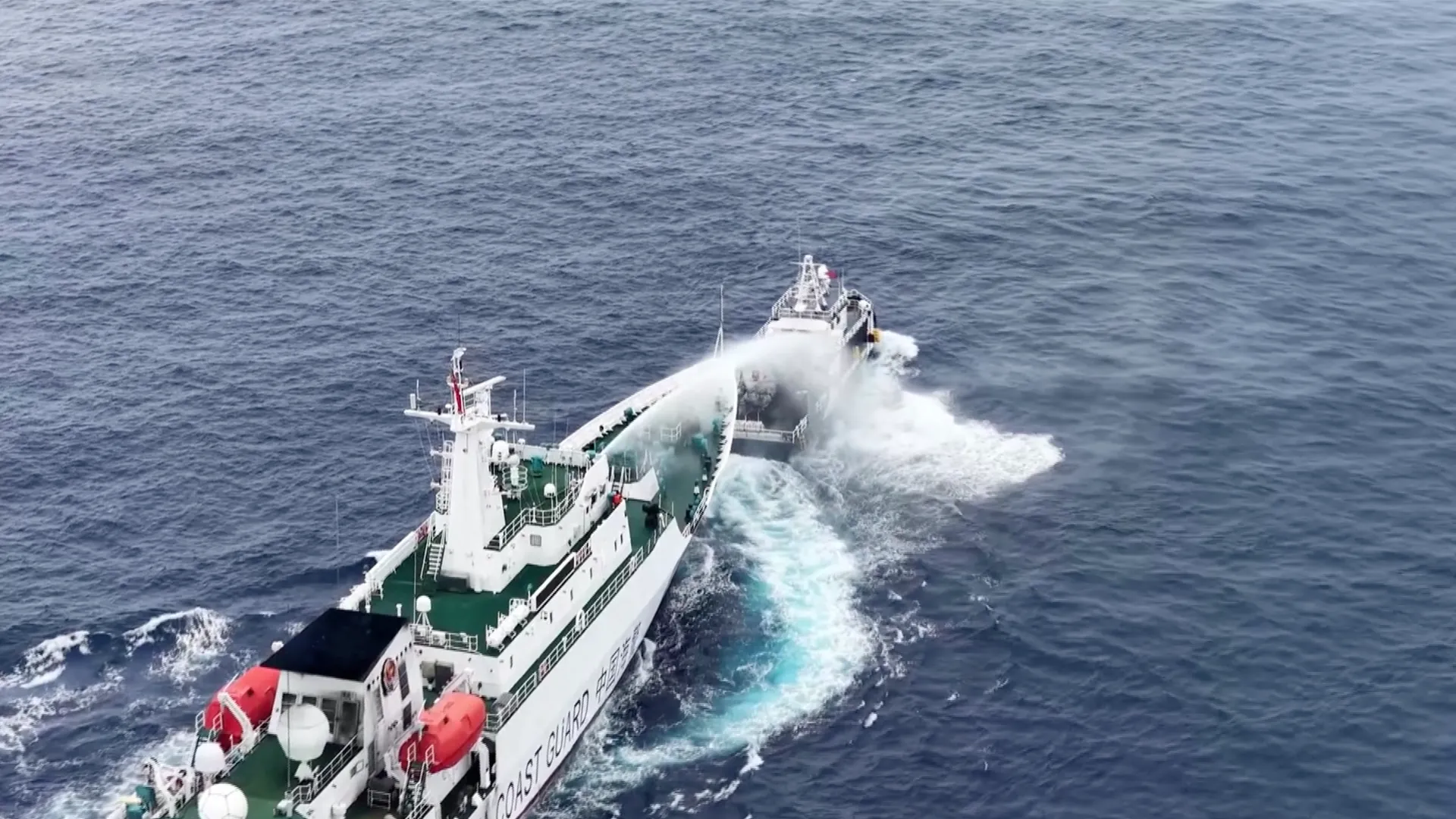
A China Coast Guard vessel has fired its water cannon at Philippine government boats near Scarborough Shoal, the latest in a series of confrontations in the disputed South China Sea.
Japan has identified a high concentration of valuable heavy rare earth elements in deep sea mud recovered from waters near the remote Pacific island of Minamitori, marking another step in its efforts to reduce dependence on Chinese critical mineral supplies.
The Japanese government said on Friday that analysis of rare earth rich mud collected earlier this year showed medium and heavy rare earth elements accounted for about 54% of the total rare earth content. However, officials did not disclose the overall size of the deposits, saying the limited scope and duration of sampling meant the available data was insufficient to estimate total reserves.
The samples were collected during a month long expedition in February by Japan’s scientific drilling vessel Chikyu near Minamitori Island, approximately 1,900 kilometres southeast of Tokyo. The mission marked the world’s first successful continuous recovery of rare earth bearing seabed mud from depths of around six kilometres beneath the ocean surface.
Strategic Push for Mineral Security
The project forms part of Japan’s broader strategy to strengthen supply chain security for critical minerals following tighter Chinese export restrictions on heavy rare earth elements and magnets, which are widely used in defence systems, electric vehicles, semiconductors and other advanced technologies.
Stay ahead of the geopolitical week.
MD Briefing delivers expert analysis across five global fronts — the Indo-Pacific, energy, geoeconomics, European security, and the Middle East — every Monday morning. Free.
Researchers recovered approximately 50 metric tons of seabed mud during the expedition.
Analysis identified several strategically important rare earth elements, including yttrium, used in aerospace, semiconductor and energy technologies; gadolinium, widely used in medical imaging and other high technology applications; and dysprosium, a key component in high performance permanent magnets used in electric vehicle motors.
Commercial Mining Trial Planned
Japan plans to conduct a month long large scale mining trial in the same waters beginning in February 2027.
The trial aims to recover approximately 350 tons of seabed mud each day. The material will first be dewatered on Minamitori Island before being transported to mainland Japan for separation, refining and smelting tests.
The project will evaluate whether domestic deep sea rare earth production can become commercially viable. A comprehensive assessment of industrial scale production is expected by March 2028, according to Kazushige Kikuchi, project manager at the Japan Agency for Marine Earth Science and Technology, which operates the Chikyu research vessel.
China Remains Dominant Supplier
Japan’s exploration efforts come amid growing concern over China’s control of global rare earth supplies.
Beijing introduced export controls on several heavy rare earth elements and related magnets in April 2025 and later tightened restrictions on exports to Japan in January, followed by two additional rounds of measures the following month targeting major Japanese companies.
Rare earth elements are essential components in advanced manufacturing, including electric vehicles, renewable energy systems, military equipment, consumer electronics and semiconductor production.
Analysis
Japan’s latest findings highlight the growing strategic importance of securing independent supplies of critical minerals as geopolitical competition increasingly shapes global supply chains. Although the newly analysed deposits have yet to be proven commercially viable, the discovery strengthens Japan’s long term effort to reduce reliance on Chinese exports. If future mining trials demonstrate economic feasibility, deep sea resources could become an important pillar of Japan’s critical minerals strategy while encouraging other resource poor countries to accelerate investment in seabed mining technologies despite ongoing environmental concerns.
Houthi blockade for now is shaping who moves Saudi crude, not whether it moves, analysts say, even as oil prices soar.
As oil prices hit $100 a barrel on Thursday, experts say they are watching to see which vessels Yemen’s Houthis allow to pass through in the Red Sea as that will indicate how the crude market trends.
Brent futures rose $6.58 or 6.96 percent, to $100.65 a barrel, exceeding $100 for the first time since late May.
Recommended Stories
list of 4 itemsend of list
That was on the back of the Iran-aligned Houthis saying they were cutting off the passage Riyadh had been using to ship parts of its crude oil once Iran closed the Strait of Hormuz to retaliate against United States and Israel attacks.
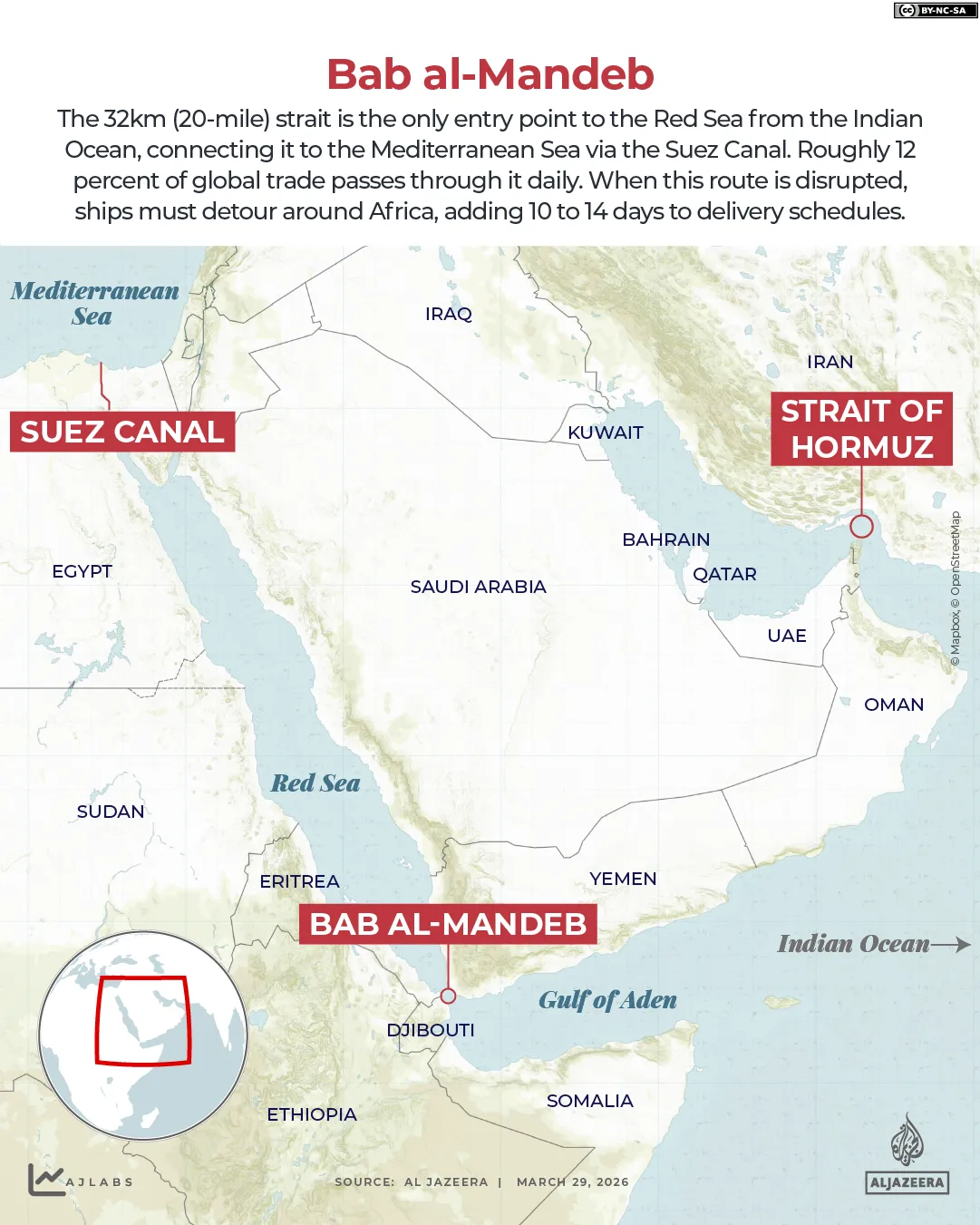
On Monday, the Yemeni group declared a naval blockade on shipments from Saudi Arabia and said they would target Saudi, Israeli, and United States-linked tankers in the Bab el-Mandeb, which links the Red sea to the Indian Ocean.
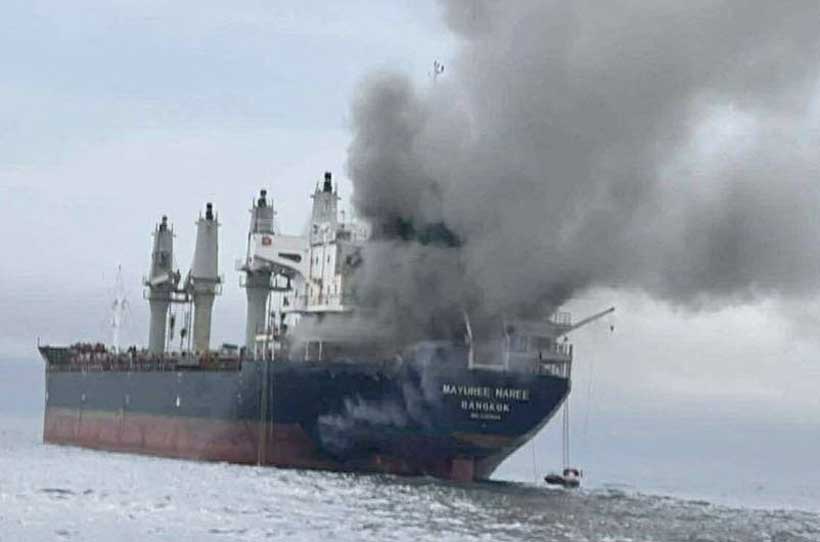
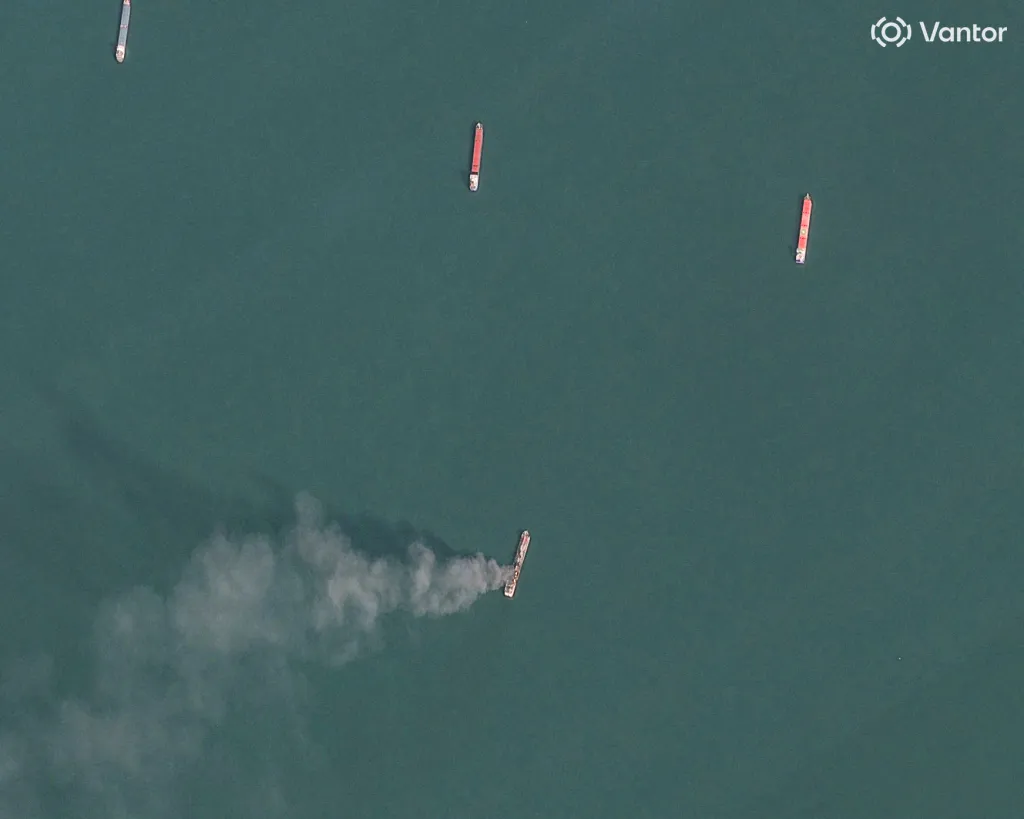
On Thursday, the Houthis attacked two Saudi Arabian oil tankers, the group said, with a Saudi news agency later confirming that one of the two vessels was set ablaze.
It is not clear if the second one was also hit, according to marine analysis firm, Windward.
“The Houthis are quite mercurial and there is no complete clarity on what the blockade means,” said Michelle Bockmann, a senior maritime intelligence analyst at Windward.
“We’re watching now the ability of Chinese-owned tankers at [Saudi port] Yanbu if they are allowed to go through Bab el-Mandeb. Two have gone through but those had been loaded before the blockade was announced.”
The Houthis have previously relied on China for help, including for drone components, and “the Chinese have previously had a free pass”, said Bockmann, including between 2023 and 2025 when the Houthis attacked cargo ships aligned with Israel and the US in the Red Sea in the wake of the war on Gaza.
Windward tracking shows the cargo that moved through the Bab el-Mandeb chokepoint on July 20 was Saudi in origin but Chinese in crew and destination, and it drew no interdiction. The two vessels passed through the same corridor that Western- and Saudi-linked operators were being warned to avoid.
The enforcement is calibrated to affiliation rather than cargo and the blockade is shaping who moves Saudi crude, not whether it moves, Windward said.
“No one has ever been able to predict their actions… but they know you don’t have to do a lot to get the oil markets to react,” said Bockmann referring to the rise in benchmark oil prices on Thursday.
Rachel Ziemba, adjunct senior fellow at the Center for a New American Security, underscored that the standoff in Bab el-Mandeb is happening while crude buffers have nor been replenished after the peak of the Hormuz crisis earlier this year.
“The multiple chokepoints are new and an example of littoral states looking to use their leverage,” Ziemba said.
Diesel also impacted
For now, both the Houthi threats and the continued closure of the Strait of Hormuz through which nearly one-fifth of the world’s oil transited before the US-Israel war on Iran, has sent prices soaring, including at the pump in the US reaching the national average of $4.09 per gallon (3.4 liter).
“Today’s rise in oil prices could cause $0.10 to $0.20 rise over the next week or two per gallon average price in US,” said Patrick De Haan, head of petroleum analysis at GasBuddy.
But De Haan is looking beyond the two straits and says he’s watching the availability of diesel as price per gallon averages $5.34.
“Diesel prices are being impacted more significantly,” he told Al Jazeera.
One reason behind that is that Ukrainian drone attacks have taken offline some of Russia’s oil refineries. The shortages are being felt domestically leading to Russia banning diesel exports, De Haan said.
“Oil exports are one story, but supplies of diesel gasoline, jet fuel is another story,” he said.
Another unknown in the mix is the role of China which, historically has been a major importer but slashed those imports in the past few months, helping stabilise global prices as some pressure on demand eased.
“It’s been one of the reasons that oil prices haven’t gone up dramatically – that china slashed its imports, and no one predicted that,” De Haan said. “For now, we don’t know if china is using its own strategic reserves or if it will start import again.”
Between those geopolitical plays and the upcoming hurricane season in the US, there is “another wildcard ahead for global refining capacity” and prices, De Haan said.
The U.S. war with Iran escalated again Thursday as Iran-backed Houthis in Yemen attacked two Saudi Araian oil tankers in the Red Sea, causing global oil prices to surge amid fears of yet another vital energy corridor being choked off by the conflict.
The attacks came after the Trump administration threatened additional strikes on Iran’s nuclear infrastructure while pushing a new deal to help Saudi Arabia develop a nuclear energy program of its own. Also Thursday, four Republicans in the U.S. House joined Democrats in a vote to halt the American military campaign absent congressional approval. Senate Republicans blocked a similar measure.
The price of oil hit $100 a barrel for the first time since May, increasing the financial pressure on Americans at the gas pump and the political pressure on President Trump to end a war he promised would last weeks but has persisted for months. At least 18 U.S. service members have died in the war.
The Houthis, who control the populous northwest of Yemen, receive arms and training from Tehran but had remained largely on the sidelines since the U.S. and Israel launched the war. Their latest strikes complicate already fraught negotiations between the U.S. and Iran after the collapse of a ceasefire this month amid renewed hostilities in the Strait of Hormuz, the other major energy passageway choked by the conflict.
The Houthis had this week announced a naval blockade of Saudi ships in the Red Sea, which stretches along Saudi Arabia’s western flank. That blockade centered on the Bab al Mandeb strait, the only southbound route for Saudi tankers headed to Asian markets.
Tanker traffic has already been heavily diminished in the Persian Gulf along Saudi Arabia’s northeast flank and between it and Iran, because of Iran’s threats to vessels traveling through the Strait of Hormuz. Saudi Arabia had diverted its oil exports to its Red Sea ports and out the Bab al Mandeb, dispatching some 4.5 million barrels via that route per day.
In a social media post Thursday, Trump said that if the Houthis continue attacking ships in the Red Sea, the U.S. “will hold Iran responsible” because the Houthis are an Iranian proxy, and inflict “major military punishment” on the Houthis and Iran.
He said he was “very disappointed” in the Houthis, “in that they have, until now, acted very professionally and smart” amid the Iran war.
At a later event Thursday, Trump said the U.S. is “doing extremely well” against Iran, which he accused of having “evil intentions.”
Democrats in the House and Senate cited the war’s spread to the Red Sea as yet another reason that Congress should act to pass a war powers measure to halt the president’s military campaign. Sen. Chris Van Hollen (D-Md.), who led the unsuccessful effort in the Senate, cited the expansion while recalling how Trump had claimed victory in Iran as far back as March.
“If we won back in March, why are more Americans getting killed in July? If we won back in March, why is the Strait of Hormuz closed? If we won back in March, why is the war expanding as Houthis attack ships transiting the Bab al Mandeb strait in the Red Sea? If we won back in March, why are oil and gas prices and diesel prices shooting through the roof again, imposing costs on every American family?” Van Hollen said. “Is that their definition of winning?”
The Houthis’ military spokesman, Yahya al-Sarea, said the group’s forces conducted “a qualitative military operation” targeting two Saudi oil tankers with missiles and drones for what he said were violations of the Houthis’ blockade on the Red Sea.
The Houthis have accused Saudi Arabia of imposing a blockade on airports and seaports in northwestern Yemen, where most of the country’s population lives and which the Houthis otherwise control. They also blamed Saudi Arabia for an attack this month on Sanaa’s airport to prevent the landing of a plane carrying a Houthi delegation returning from the funeral of Iranian Supreme Leader Ali Khamenei, who was killed at the start of the war.
Al-Sarea said that in addition to striking the two tankers, the Houthis forced 10 other ships to turn back from their passage, will “continue their naval operations against the Saudi enemy” and will “continue imposing the equation of blockade against blockade.”
The escalation of the war — and the shock wave it sent through global energy markets — added to regional uncertainty already being stoked by the Trump administration’s announcement Wednesday that it had agreed to work with Saudi Arabia to develop a civilian nuclear program.
That announcement, after years of U.S. attempts to block nuclear proliferation in the Middle East, sparked widespread concern in Washington, where lawmakers will vote on the deal, and in Israel, which has long feared a nuclear arms race in the region.
Trump administration officials said the deal would “uphold the highest standards of nuclear safety and nonproliferation,” with American firms developing the program. But they provided few details, and questions immediately arose about the absence of clear inspection protocols or any requirement that Saudi Arabia first normalize diplomatic relations with Israel.
On Thursday, Trump said the deal would be conditioned on Saudi Arabia joining the Abraham Accords and establishing diplomatic ties with Israel. White House Press Secretary Karoline Leavitt later said that Trump had not talked to Saudi leaders since making that condition public, but that they would have to agree to it or “the deal is off.”
Leavitt said that Trump had raised the matter with Saudi leaders in the past, and that it is something Trump “feels very strongly about.”
Asked whether Israel pressured the president to impose the condition, Leavitt said, “Not to my knowledge.”
Earlier this week, Defense Secretary Pete Hegseth told Congress that the Iran war has already cost the U.S. $37.5 billion. House Republicans on Wednesday pushed through a $1.15-trillion defense policy bill to fund the war moving forward. Most Democrats voted against the measure in protest of the war, and it faces stiff opposition in the Senate.
Trump in recent days has tried to deny polls showing plummeting support for the war among Americans. On Wednesday, before attending the dignified transfer of the bodies of U.S. service members killed in the war to Dover Air Force Base in Delaware, Trump claimed Americans don’t want high gas prices but “aren’t against the war.”
On Tuesday, Trump posted statistics showing that more U.S. service members died in past wars, which Democrats denounced as disrespectful to those killed in the current conflict.
The Houthis seized control of the Yemeni capital in 2014, along with much of Yemen’s populous northwest. Their advance triggered a devastating Saudi-led campaign to dislodge them. Since 2022, the two sides have been in a stalemate, though tensions have been rising again in recent months.
Mohammed al-Basha, founder of the Basha Report, a U.S. risk advisory firm focused on the Middle East and Africa, said the Houthis’ latest escalation comes as their influence is growing because of the increased importance of Bab al Mandeb while the Strait of Hormuz is choked off by Iran.
“This is their moment, because with everything happening in the Strait of Hormuz, Bab al Mandeb quadrupled in importance. By exerting maximum pressure in this period, they can maximize the effect of any kinetic action they’re trying to do,” Al-Basha said.
“Their narrative is very aggressive. They want war. And they feel that because they want war and sense that the U.S. and Saudi Arabia don’t, that they will submit to their demands.”
A giant mountain swing is sending visitors soaring more than 2,000 metres above the Swiss Alps as ski resorts look for new ways to attract visitors beyond the winter season
The Balanc’Air swing opened earlier this month(Image: AFP via Getty Images)
Thrill-seekers can now soar over the Swiss Alps on a giant mountain swing that launches riders over the edge of a cliff.
Visitors to the Villars ski resort can now brave the BalancAIR swing, a 12-metre-high attraction perched 2,110 metres above sea level that sends up to three people at a time soaring out above a dramatic Alpine drop. Riders are strapped into saddle-style seats fixed to a structure resembling an Alpine Ibex before being hauled backwards to a 90-degree angle and released high above the valley below.
Alexandra Henchoz, 37, admitted she was nervous before testing the attraction with her husband and 10-year-old daughter. She said she: “I had a bit of a pit in [her] stomach” before she was strapped in to the harness.
“But once it is happening, it is just incredible. You feel like a bird flying,” Alexandra added.
The swing, which opened earlier this month, forms part of the resort’s efforts to attract more visitors outside the traditional ski season as Alpine destinations adapt to the effects of climate change. Martin Deburaux, head of the Villars-Gryons-Diableret ski area, said: “We are really trying to diversify our offering.”
The 12-metre swing “provides us with a source of attraction that can function independently of snow conditions”, he said. Although the resort has enjoyed record winter visitor numbers over the past two seasons, Martin said warmer conditions meant planning for the future was essential.
He added: “But we know we are facing climate change. We are looking for substitutes to conserve jobs, the dynamism and the tourist economy built up around our ski lift facilities.”
The resort currently welcomes more than 700,000 visitors during winter but around 100,000 over the summer, now busses hope the new attraction will help draw more visitors outside the ski season in a bid to boost off-season tourism.
Among those giving it a go was Marc Truffer, 70, who admitted the experience left him both frightened and amazed. He said: “It was so scary… I didn’t even scream.
“It took my breath away going down, but then the view was magnificent.”
An armed student rallies in support of the Houthi-imposed naval embargo against Saudi Arabia in Sanaa, Yemen, Wednesday. Hundreds of students gathered at Sanaa University to support the move. Photo by Yahya Arhab/EPA
July 23 (UPI) — The Houthis in Yemen claimed responsibility for two attacks on Saudi oil tankers in the Red Sea with missiles and drones.
The Iran-backed Houthis, who have been fighting for control of Yemen, claimed on Wednesday that they had hit the Encelia and the Layla oil tankers, which they said were violating their blockade of Saudi ships. They had announced the blockade on Monday.
Saudi Arabia’s transportation authority confirmed the attack on the Encelia in a statement. It said there was a fire on board but the crew were all safe. It didn’t mention the Layla.
Houthi military spokesperson Yahya Saree said the group promised to continue naval operations and would continue “enforcing the ‘siege for a siege’ equation,” the BBC reported.
The Houthis claimed they had also forced “10 ships to retreat and return.” That claim could not be independently verified, The Times said, but at least six vessels reversed course in the Red Sea on Monday and Tuesday after the Houthis warned shipping companies to avoid Saudi ports, according to Kpler, a maritime data company. It was not clear if those ships were part of the Houthis’ claims.
The Saudis and the Houthis have been in an effective cease-fire since 2022. But last week, tensions flared when the Houthis accused the Saudis of striking the airport in Yemen’s capital Sanaa. The spat came from a dispute when an Iranian plane had tried to land at the airport.
The Houthis then attacked the Abha airport in Saudi Arabia.
When the Houthis announced the “maritime embargo,” they didn’t give many details. But a media official said they would close the Bab al-Mandab Strait. That strait is on the other side of the Arabian Peninsula from the Strait of Hormuz. It’s the gateway between the Arabian Sea and the Red Sea, and blockades of both straits would cut off Saudi Arabia ships entirely.
The United States and Iran continued to trade attacks for the 12th consecutive night after the cease-fire between the two countries ended.
Astronaut Buzz Aldrin walks on the surface of the Moon during the Apollo 11 mission on July 20, 1969. Photo by NASA/UPI | License Photo
1 of 3 | Philippine President Ferdinand Marcos Jr., right, meets Wednesday with U.S. Secretary of State Marco Rubio, second from right, during a courtesy visit inside Malakanang Presidential Palace in Manila. Rubio was in Manila to attend meetings of the Association of Southeast Asia Nations. Photo courtesy U.S. State Department | License Photo
July 22 (UPI) — U.S. Secretary of State Marco Rubio, in Manila on Wednesday for a meeting of the Association of Southeast Asia Nations, met with Philippines President Ferdinand Marcos Jr. and his counterpart in China, Foreign Minister Wang Yi.
Meanwhile, police clashed with protesters outside who criticized the United States’ involvement in area conflicts and blamed the Trump administration for fueling tension in the region. Some protestors held up signs that said, “U.S. out of everywhere!” and “War criminals not welcome! Ban Rubio! Ban Trump!”
The two men confirmed that “there is no legal basis for China’s expansive maritime claims in the South China Sea” and discussed other matters, Pigott said.
Tensions between the Philippines and China have been high lately over the disputed South China Sea. On Monday, the Philippine military accused Chinese coast guard personnel of striking and injuring a Philippine sailor. China said the Philippine officers instigated the conflict.
China claims most of the South China Sea, including areas that hold the exclusive economic zones of other countries including the Philippines.
In person at the ASEAN conference, Rubio behaved politely toward his Chinese counterpart, saying he appreciated China withholding support for Iran and opposing a toll in the Strait of Hormuz. He also said the countries were taking steps to establish boards of investment and trade.
He did not mention recent claims by U.S. President Donald Trump that China interfered in the 2020 U.S. presidential election.
“Look, these are the two most powerful countries in the world,” Rubio told reporters Wednesday. “It would frankly be reckless and irresponsible for the U.S. and China not to have a relationship.”
Chinese President Xi Jinping is expected to visit the United States in September.
In contrast to his remarks Wednesday, Rubio’s words in an opinion column that the U.S. State Department placed in Philippine newspapers this week were somewhat less measured when it came to the conflict over the South China Sea.
“If those waters fall under the control of a power willing to use commerce as a geopolitical weapon, both the United States and the ASEAN states would face dire new threats to their sovereignty, security and economic futures,” he wrote.
“The Yemeni armed forces have carried out a significant military operation targeting two Saudi oil tankers that violated the ban imposed by the armed forces in the Red Sea,” the Houthis claimed on Telegram. “The operation involved a number of ballistic and cruise missiles, as well as drones. Thanks to God’s help, the strikes were accurate and caused a large fire on both vessels.”
بيان القوات المسلحة اليمنية بشأن استهداف سفينتين نفطيتين سعوديتين خالفتا قرار الحظر في البحر الأحمر ما أدى إلى نشوب حريق كبير فيهما، واجبار 10 سفن على التراجع والعودة – 22 يوليو 2026م pic.twitter.com/S5ijNZYaV7
TWZ cannot independently verify the Houthi claim. However, in a post on X, UKMTO stated that a master of an oil tanker “reports being struck by an unknown projectile which has caused a fire onboard that the crew are currently fighting.”
The incident took place 70NM southwest of Al Shuqaiq, Saudi Arabia, the organization added. “There are no reported casualties and no environmental impact. Authorities are investigating. Vessels are advised to transit with caution and report any suspicious activity to UKMTO.”
The increasing tensions on the BAM come as U.S. President Donald Trump threatened to destroy Iranian bridges and power plants each time Iran hits a ship transiting the Strait of Hormuz, which has been a major flashpoint of tit-for-tat exchanges of fire. Trump also threatened that he will retaliate for the deaths of three U.S. Army soldiers during a July 17 attack on Muwaffaq Salti Air Base (MSAB) in Jordan. He made those statements at a dignified transfer ceremony for the soldiers, plus one killed in Iraq, at Dover Air Force Base in Delaware today.
The incident in the Red Sea took place a day after the U.S. Navy warned that the Houthis had moved weapons near the BAM.
“Recent Houthi statements indicated a readiness to target shipping (specifically Saudi-affiliated) if directed,” the Navy’s Joint Maritime Information Center (JMIC) warned on Tuesday. “According to regional reporting, Iran has instructed the Houthis to stand ready to close the Red Sea oil route should the United States strike Iranian power infrastructure.”
“Sources close to the group stated that the Houthis have completed preparations to attack shipping, including the deployment of missiles and drones positioned near Bab al-Mandeb.”
The Houthis have also “told shipping companies not to load or discharge cargo at Saudi Arabian ports or they may be targeted, according to an email the group sent to companies,” Reuters reported.
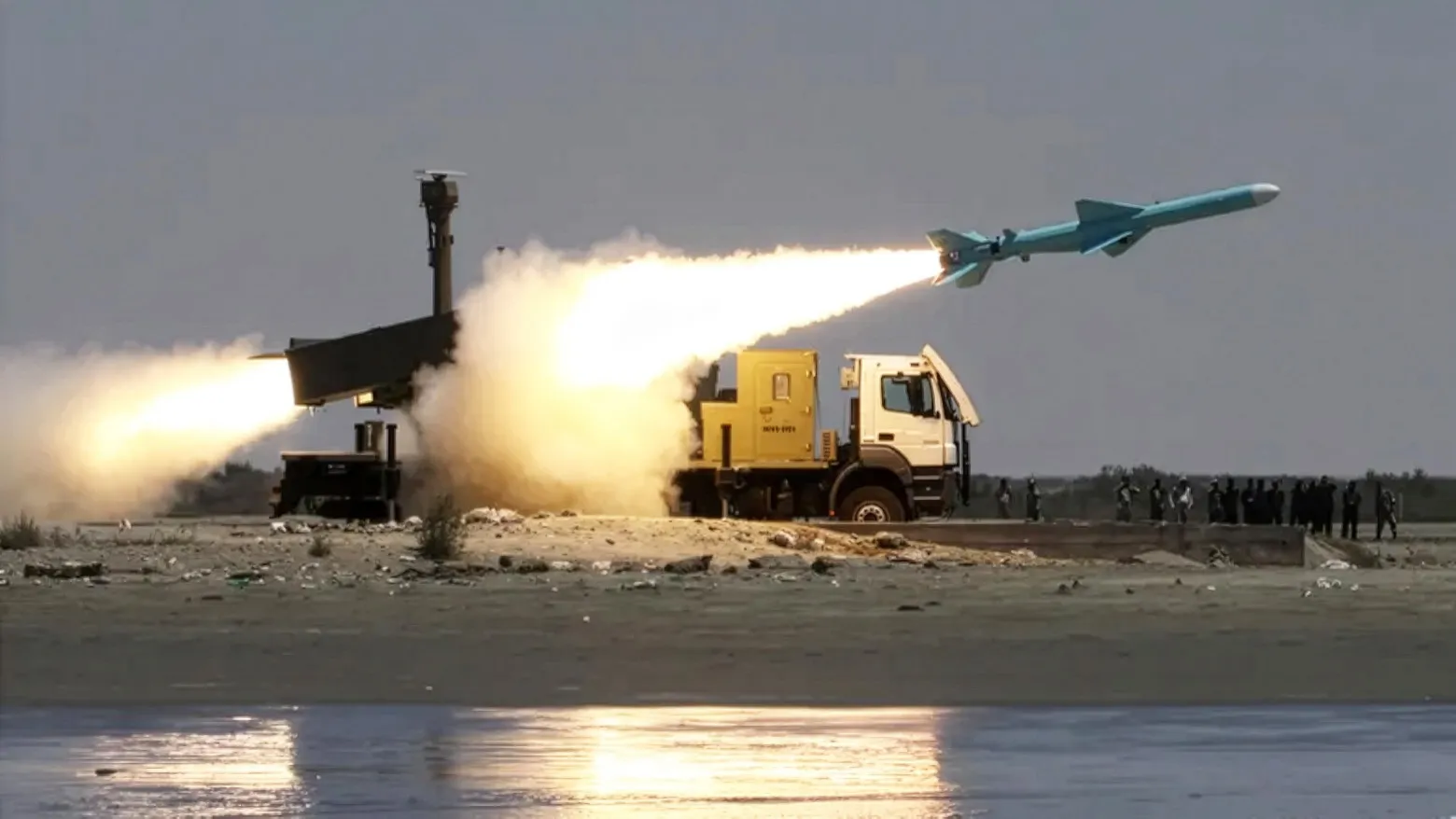
The Houthis are gearing up for potential anti ship missile launches, releasing footage that appears to show their Asef anti-ship ballistic missile (ASBM) as they continue to threaten commercial shipping linked to Saudi Arabia.
As we have frequently detailed, a Houthi blockade of the BAM threatens to add further pressure on oil exports from the Middle East, already drastically affected by the Iranian closure of the Strait of Hormuz and the resumption of the U.S. blockade on Iranian ports. Saudi Arabia has diverted millions of barrels of oil per day through pipelines to its Yanbu port on the Red Sea in an effort to minimize the energy shortages due to the hostilities in the Persian Gulf. This also raised the specter of the U.S. having to get as involved as it did during the previous Houthi campaign against shipping that ended last September, which could pull resources away from Iranian-focused operations.
Before the attack claim, global trade intelligence firm Kpler pointed out on X that while traffic continues through both straits, “operational confidence remains under pressure.”
“Traffic declined sharply across both chokepoints on 21 July, with Strait of Hormuz crossings down 31% day-on-day to nine vessels and Bab al-Mandeb down 34% to 29 amid a worsening security backdrop,” Kpler added. “Four confirmed vessel U-turns near the Gulf of Aden suggest operators are becoming more cautious following Houthi threats against Saudi-linked shipping. At the same time, confirmed maritime attacks continue around the Strait of Hormuz, reinforcing concerns that uncertainty across both regional chokepoints could reshape routing decisions, increase freight costs and sustain higher geopolitical risk premiums for energy markets.”
Dual chokepoint risks deepen
Shipping continues through both the Strait of Hormuz and Bab el Mandeb, but operational confidence remains under pressure. Traffic declined sharply across both chokepoints on 21 July, with Strait of Hormuz crossings down 31% day-on-day to nine… pic.twitter.com/D7dmCRffcv
As noted earlier in this piece, Trump visited Dover Air Force Base to take part in the dignified transfer ceremony honoring Lt. Tyler James Feehan, 25, of Hawaii, Pvt. Isabella Gonzales, 19, of Texas, Sgt. Angel Rampersad, 28, of New York and Sgt. Michael Emmanuel Swinton, 30, of North Carolina.
Today, we honor four American heroes who made the ultimate sacrifice in service to our nation.
May God hold them in His eternal embrace and comfort their grieving families, and may God forever… pic.twitter.com/P5NA59ltAU
— Rapid Response 47 (@RapidResponse47) July 22, 2026
Feehan, Gonzales and Rampersad were killed during the July 17 Iranian barrage of MSAB. U.S. Central Command (CENTCOM) previously announced Rampersad as missing, but her status was updated to a Duty Status–Whereabouts Unknown and she is believed to be deceased.
Swinton was killed during a controlled detonation of a downed One-Way Unmanned Aerial System on July 19, 2026, at Erbil Air Base, Iraq.
— Rapid Response 47 (@RapidResponse47) July 22, 2026
Speaking to reporters, Trump said his administration would share the results of the investigation into the MSAB attack and vowed that Iran would “pay a big price.”
Those comments followed an earlier statement the president posted on Truth Social vowing to target key infrastructure sites each time Iran strikes a ship transiting the Strait of Hormuz.
“From this point forward, any time the Islamic Republic of Iran shoots at a ship in the Strait of Hormuz, whether it be by Missile, Rocket, Drone, or any other device or weapon, the United States will bomb and destroy ONE BRIDGE OR POWER PLANT, including those located next to, or in, the Capital City of Tehran,” Trump proclaimed.
Not surprisingly, Iranian officials reacted to Trump’s comments by issuing their own threats in response.
“Iran will retaliate against regional infrastructure and energy facilities with American interests if the United States strikes any Iranian bridge or power plant, responding directly to a new threat from US President Donald Trump,” the Islamic Revolutionary Guard Corps (IRGC)-connected Tasnim news agency stated on X.
A military source said Iran will retaliate against regional infrastructure and energy facilities with American interests if the United States struck any Iranian bridge or power plant, responding directly to a new threat from US President Donald Trump. pic.twitter.com/a8MIFqxktx
Earlier on Wednesday, Jordanian officials said the country was once again targeted by Iran.
“An official military source at the General Command of the Jordanian Armed Forces—Arab Army stated that air defense systems detected six missiles coming from Iranian territory targeting the Kingdom’s territory today, and engaged them immediately upon their entry into Jordanian airspace,” the Jordanian military stated on X. “Air defenses intercepted and shot down four missiles, while the other two fell in two remote, uninhabited areas, without causing any casualties or material damage.”
“The Kingdom’s airspace is under continuous operational monitoring, and the Armed Forces will deal with any aerial threat targeting Jordanian territory according to the applicable rules of engagement, in a manner that ensures the protection of the Kingdom’s sovereignty and the safety of its citizens,” officials added.
The situation in Jordan is so intense that the U.S. Embassy in Amman issued a security alert.
“President Trump, Secretary of State Rubio, and the Department of State have no higher priority than the safety and security of American citizens,” the embassy cautioned on X. “We remind U.S. citizens that Iran has attacked civilian and critical infrastructure across the Middle East, including hotels, airports, diplomatic facilities, and other civilian locations.”
Security Alert: U.S. Embassy Jordan July 22
President Trump, Secretary of State Rubio, and the Department of State have no higher priority than the safety and security of American citizens. We remind U.S. citizens that Iran has attacked civilian and critical infrastructure… pic.twitter.com/UOihlptEwp
— U.S. Embassy Amman (@USEmbassyJordan) July 22, 2026
Over the course of the past 12 days, Iran has lobbed missiles and drones at several Arab nations, taking particular aim at U.S. military installations.
Satellite imagery continues to emerge on social media purporting to show damage at these bases. The images below claim to show a 117-FPS radar at Al-Jaber Air Base in Kuwait destroyed by an Iranian barrage. While the image clearly shows what appears to be a radome destroyed, TWZ cannot independently verify the date, location or provenance of the imagery. CENTCOM, which does not talk about battle damage, declined comment.
Imagery has also emerged purporting to show that U.S. Air Force aerial refueling tankers and other aircraft have evacuated Al Udeid Air Base in Qatar, the largest American base in the region. Again, we cannot confirm the details and CENTCOM, which also does not typically talk about the movements of assets, declined comment.
However, Axios reported last week that the Trump administration “notified Israel it is sending dozens more refueling planes to the country ahead of a potential expansion of military operations against Iran.”
“Israeli officials say the U.S. wants to send several dozen more refueling planes in the coming days, bringing the number of planes to the same level it had at the beginning of the war,” Axios added. “Israeli officials say the U.S. military prefers operating the refueling planes from Ben Gurion Airport, because other air bases in the region are more exposed to Iranian attacks and less safe for U.S. planes. At the moment, the Iranians are still deterred from launching attacks on Israel, because it will likely trigger a massive retaliation.”
The U.S. still sits ready to conduct long-range bomber strikes from bases in the U.S. and the U.K.
There were recent unconfirmed claims by open-source trackers that B-1B Lancer bombers out of RAF Fairford in England took part in yesterday’s attacks on Iran. Again, we cannot verify that and CENTCOM declined comment.
Overnight, B-1B “Lancer” bombers flying from RAF Fairford (EGVA) conducted strikes in Iran as the US ramps up operations again. Although 2 bombers launched, it appears it was pre-planned that only 1 of them would… pic.twitter.com/Q7Ic3Ahqk3
However, Israel’s KAN news outlet claimed that “Israel has been informed by the United States that it intends to escalate attacks on Iran in the coming days and to carry out attacks using heavy bombers for the first time in the current escalation.”
In addition, other U.S. Air Force assets – including EA-37B Compass Call electronic warfare jets – appear headed to the region, according to online flight trackers. While we don’t know for sure these jets will actually head to the Middle East, it could be another sign of the U.S. bolstering assets ahead of an increase in intensity of attacks, which have been largely focused over the past 12 days on Iranian coastal targets.
Amid these rising tensions with Iran, the Houthis have now apparently raised the stakes and it will be absolutely critical to keep the BAM open as the world already sits on the razor’s edge of a full-on energy crisis.
UPDATE: 7:17 PM EDT –
CENTCOM announced a new round of attacks on Iran.
“At 5:30 p.m. ET today, U.S. forces began launching more strikes against Iranian military targets at the Commander in Chief’s direction,” the command stated on X. “The mission will continue to further degrade Iran’s ability to threaten civilian mariners and commercial vessels transiting regional waters.”
At 5:30 p.m. ET today, U.S. forces began launching more strikes against Iranian military targets at the Commander in Chief’s direction. The mission will continue to further degrade Iran’s ability to threaten civilian mariners and commercial vessels transiting regional waters.
U.S. wheat futures closed above $7 per bushel Wednesday for the first time since late 2023, driven by surging tensions in the Black Sea and hot weather in crop-growing areas around the world, including the U.S. Plains and Western Europe.
United States Secretary of State Marco Rubio has met his Chinese counterpart Wang Yi at a gathering of southeast Asian foreign ministers, to discuss how to manage bilateral tensions ahead of a planned summit between US President Donald Trump and China’s Xi Jinping.
The meeting on the sidelines of the Association of Southeast Asian Nations (ASEAN) gathering of foreign ministers in Manila on Wednesday came amid tensions over China’s conduct in the disputed South China Sea and the US war against Iran. ASEAN countries have expressed concerns about both issues at the meeting.
Recommended Stories
list of 3 itemsend of list
Relations between Washington and Beijing have also been complicated by Trump’s accusations that China meddled in US elections, allegations Beijing has dismissed as “pure fabrication”.
Rubio said the US and China have “great differences” that are likely to persist “for the foreseeable future”, but that he and Wang discussed the need to manage those disagreements to ensure Xi has a “very positive visit” to the US. Xi is expected to visit in September.
Wang said the US must “respect China’s core interests … effectively manage differences and disagreements, and address China’s legitimate concerns”, according to an official Chinese summary of their meeting. It described the talks as “pragmatic, positive and constructive”.
The two sides agreed to “make sound preparations for the next stage of high-level exchanges,” China’s Ministry of Foreign Affairs said in a statement.
‘Commerce as geopolitical weapon’
Wednesday’s meeting came two days after a confrontation between Chinese and Philippine vessels in the South China Sea left a Philippine sailor injured, leading both countries to summon each other’s ambassador.
The incident this week took place on Monday at the disputed Second Thomas Shoal. The Philippines said Chinese coastguard struck one of the Philippine navy staff on the head with a wooden baton, while China said the Philippine personnel were the first to attack and accused Philippine vessels of ramming a Chinese patrol boat.
Rubio said the altercation benefited nobody, adding that Washington had reiterated in all its meetings that it was bound by a defence treaty to stand up for Manila.
“We intend to live up to our treaty obligations, and I think we’ve done so, and will continue to do so,” he said.
Rubio’s remarks echo an opinion piece he published in Philippine media on Tuesday about Beijing’s conduct in the South China Sea. Rubio warned of “dire new threats” if those waters were to “fall under the control of a power willing to use commerce as a geopolitical weapon”.
Beijing claims sovereignty over almost the entire South China Sea via a line on its maps that cuts into the exclusive economic zones of Brunei, Indonesia, Malaysia, the Philippines and Vietnam, and is at the centre of long-running disputes over a multitude of islands.
Disputes between the Philippines and China have increased in recent years as Manila takes a bolder stance while pursuing closer defence ties with the US, Australia and Japan.
The US has increased military financing for the Philippines to $100mn for the 2026 fiscal year and is providing an additional $9mn to expand a coastguard pier on the island of Palawan “to enhance Philippine maritime law enforcement presence and sustain operations in the South China Sea”, the State Department said in a fact sheet.
Discussing the US relationship with ASEAN member states, Rubio said the security and prosperity of the US and southeast Asia were closely interconnected.
“I believe very much that the future and the story of the 21st century will be written in this region and by how events unfold here,” he said.
US Secretary of State Marco Rubio attends a meeting with Japan and South Korea on the sidelines of the ASEAN foreign ministers’ meeting in Manila, Philippines, July 22 [Brendan Smialowski/Pool via AP Photo]
Iran ‘not serious about talks’, says Rubio
Rubio also addressed the situation with Iran in a meeting with ASEAN foreign ministers, claiming that Tehran was responsible for the latest escalation.
“The problem we’re having right now is that they’re not serious about talks,” Rubio said. “If they’re serious, we’re serious. If they’re not, then we will do what’s necessary to protect our interests, and also the interests of our allies.”
The US has carried out strikes on Iran for eleven consecutive nights, including targeting roads, bridges and power plants in recent attacks, all but shattering an interim peace deal agreed by the two sides last month.
Rubio stressed that Iran could not be allowed to control the Strait of Hormuz, as it could set a dangerous precedent for other parts of the world.
The top US diplomat also confirmed he would meet on Thursday with his Russian counterpart Sergei Lavrov to discuss the Ukraine war, saying that Washington remained open to playing a constructive role in ending the conflict.
This shipping disaster has lived on through the decades, with remnants of the past still washing ashore now.
This corner of the UK has become a famous spot for treasure hunting(Image: Rob Maynard via Getty Images)
Along this stunning UK coastline, you will see crashing waves, white sand and towering cliffs. But if you are wandering along the beach and cast your eyes downward, you might spot something else.
Hidden in the sands of Cornwall’s coastline is a reminder of an ecological disaster that occurred 29 years ago. On February 13, 1997, a German container ship was sailing off the coast of Land’s End in Cornwall when it was hit by an enormous rogue wave.
The wave caused the vessel to lurch, and 62 containers plunged into the ocean.
One of these containers contained 4.8 million Lego pieces. Ironically, the majority of them had an ocean theme.
These scattered pieces then floated in ocean currents for years before eventually washing up on coastlines across the UK, Ireland and the Netherlands. Some even reached as far as Australia.
Environmental impact
Since the pieces are manufactured from the hardy acrylonitrile butadiene styrene (ABS) plastic, they resist degradation and chemical breakdown, and a 2020 study suggested the bricks could last in the ocean and on beaches for 1,300 years.
Even as they begin to degrade, they will shed microplastics which are consumed by sea life and marine birds.
In response to the spill, Lego company officials released a finders keepers statement telling people they were free to keep any pieces they discovered, though they should give them a thorough wash first.
The firm also set up a hotline so people could report where they collected them and the company could offer assistance with any clean-up efforts.
The Cornish coast is referred to as ‘Lego Beach’ by those familiar with it, and people devote hours to hunting for the miniature plastic toys.
What was on board?
Content cannot be displayed without consent
The Lego pieces that washed overboard are now sought after by beachcombers, with enthusiasts on the hunt for the ultimate prize from the disaster — the octopus piece.
Other items such as flippers, scuba tanks and swords are spotted more frequently, but the octopuses are highly coveted given that only 4,200 of them were on board the stricken vessel, making them considerably harder to come across.
According to the BBC, there were several different kinds of Lego on board. These range from the most common through to ones that are so rare they have never been found on the beach.
Lego pieces you might find
Flippers: one of the most common, with over 352,000 pairs in black, blue and red
Life jackets: 26,000 bright yellow life jacket figurines were scattered
Scuba tanks, flowers and brooms: also a common find
Octopus: one of the hardest to find and most prized Lego figures — only 4,200 on board
Green dragons: there were 33,427 black dragons inside the shipping container but only 514 green dragons
Weekly insights and analysis on the latest developments in military technology, strategy, and foreign policy.
As renewed hostilities between Iran and the U.S. and its allies enter a 10th day, the Houthi rebels of Yemen say they are imposing an embargo on Saudi oil shipments passing through the Bab el-Mandeb (BAM) Strait. The move threatens to add further pressure on oil exports from the Middle East, already drastically affected by the Iranian closure of the Strait of Hormuz and the resumption of the U.S. blockade on Iranian ports. Saudi Arabia has diverted millions of barrels of oil per day through pipelines to its Yanbu port on the Red Sea in an effort to minimize the energy shortages due to the hostilities in the Persian Gulf. This also raises the specter of the U.S. having to get as involved as it did during the previous Houthi campaign against shipping that ended last September, which could pull resources away from Iranian-focused operations.
BREAKING: Houthis of Yemen announce a a “maritime embargo” against Saudi Arabia, “effective immediately.”
Saudi Arabia has until now exported ~4.5m b/d from Yanbu in the Red Sea, most of it heading South throughout the Bab al-Mandab Strait between Yemen and Djibouti-Eritrea pic.twitter.com/c96Apzh9As
On Monday, Kuwait said it came under Iranian fire again.
“Kuwaiti air defenses are currently engaging hostile missile and drone attacks following the heinous Iranian aggression,” the Kuwaiti Defense Ministry stated on X. “The General Staff of the Army notes that any sounds of explosions heard are a result of air defense systems intercepting hostile attacks. Everyone is urged to adhere to the security and safety instructions issued by the relevant authorities.”
Hours earlier, Bahrain said it too had come under a new wave of Iranian attacks.
“The General Command of the Bahrain Defense Force (BDF) announces that Iran is continuing its systematic hostility approach through its sinister attacks targeting civilians in the Kingdom of Bahrain,” BDF posted on X. “The General Command clarifies that, with strong will and high combat readiness, the air defense systems attacked, intercepted and destroyed a number of treacherous Iranian air strikes today, Monday, July 20, 2026.”
The extent of the damage in either Kuwait or Bahrain is unclear at the moment. These most recent attacks came after U.S. Central Command on Sunday night said it wrapped up a ninth straight day of strikes on Iranian assets, targeting “military command centers, air defense and coastal surveillance sites, maritime capabilities, missile and drone launch sites, and communications networks to further diminish Iran’s ability to attack commercial vessels and civilian mariners transiting the Strait of Hormuz,” the command stated on X.
Amid this kinetic activity, as we noted earlier in this story, the Iranian-backed Houthis say they will no longer permit Saudi Arabian ships passage through from the Red Sea into the Bab el-Mandeb Strait.
“The Yemeni Armed Forces declare a maritime embargo against the criminal Saudi enemy, based on the equation of an ‘eye for an eye,’ effective immediately upon the issuance of this statement,” the Houthis stated on Monday, according to the official Houthi SABA media outlet. The move follows increased tensions between the Houthis and Saudi Arabia as well as a request by Iran “to stand ready to close the Red Sea oil route if the United States strikes Iranian power infrastructure,” Reuters reported last week. “The idea has been discussed within the Islamic Republic’s leadership, and the message has been conveyed to Iran’s Houthi allies.”
⚡️BREAKING: Yemen’s Houthis have announced a Naval Blockade on Saudi Arabia from the Red Sea
This move essentially Cuts OFF Saudi oil exports through the Bab al-Mandeb Strait pic.twitter.com/gqV8E5hfq1
Houthi forces on Monday reportedly began issuing warnings on open maritime frequencies near Yemen that the BAM is closed to Saudi shipping and its vessels are subject to attack.
Houthi forces are reportedly issuing warnings on open maritime frequencies near Yemen that the Bab al-Mandab Strait is closed to Saudi shipping. pic.twitter.com/MD0KhmTmJ5
A Houthi shut down of the Bab el-Mandeb (BAM) Strait, a narrow stretch of water between Yemen and Djibouti, would choke off the flow of oil exports from Saudi Arabia, exacerbating the above-mentioned impingement on the flow of oil from the closed Strait of Hormuz.
Having both straits closed at once is something of a ‘sum of all fears’ scenario for the global energy marketplace.
“The full closure of the BAM would cut global oil supply by 7% as it would leave most Saudi oil exports unable to leave the region,” Reuters noted on Monday. “The disruption would add to the massive cut to global oil flows from the war in the Gulf, which has already reduced shipments by 10% of global supply.”
You can read more about the effects of both straits being closed at once in our story about that here.
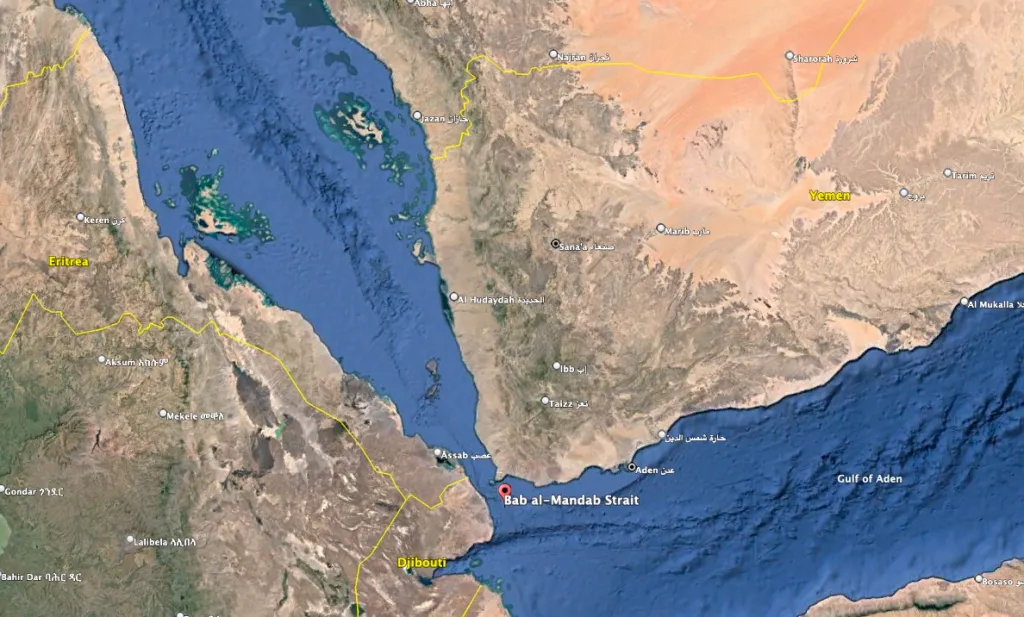
The Bab el-Mandeb Strait is a strategic chokepoint where the Houthis declared they have imposed an embargo on Saudi shipping. (Google Earth) The Bab al-Mandab Strait between Yemen and Djibouti has become a dangerous chokepoint of Houthi attacks. (Google Earth image)
Beyond affecting the flow of oil, a Houthi blockade on the BAM threatens to open a new front in this conflict.
The Houthis carried out a campaign against shipping in November 2023 in solidarity with Palestinians over the latest war between Israel and Gaza. However, while it was ostensibly aimed at only Israeli connected ships, numerous commercial vessels with no clear Israeli ties were attacked as were several U.S. and allied warships. The campaign stretched into the summer of 2025, forcing some vessels to avoid the Suez Canal for a far longer route around Africa, boosting shipping costs by nearly $200 billion at the time.
The Houthi attacks also forced the U.S. and allies to deploy many warships, including the Eisenhower and Truman Carrier Strike Groups (CSG) to both defend against Houthi attacks and strike targets in Yemen. These operations resulted in a large expenditure of air defense and strike munitions.
You can see video of some of those encounters below.
WATCH: CENTCOM releases footage as US HAMMERS Iran
The possibility exists that a new wave of Houthi attacks — especially if non-Saudi ships are targeted — could drag in U.S. forces already in heavy use in the Persian Gulf region battling the Iranians. This sets up a major showdown as Saudi oil is a lifeline to Asian supplies hobbled by conflict in the Persian Gulf. We reached out to CENTCOM for comment and will update this story with any pertinent details shared.
Earlier on Monday, the head of the European-led task force providing maritime security in the Red Sea region told us the Houthis remain a threat to navigation despite not having attacked any merchant vessels since September 2025.
“The security situation in the Bab el-Mandeb remains fragile and is highly sensitive to regional escalation,” Rear Admiral Vasileios Gryparis, Commander of EUNAVFOR ASPIDES, told TWZ. “On the rhetorical level, the Houthis’ leadership reiterated several times their alignment with the broader Axis of Resistance.”
Gryparis’s comments, in response to a query from last week about Iran’s outreach to the Houthis, came before the Yemeni group’s embargo declaration.
“From an operational standpoint, we assess that the Houthis pose a threat and are capable of rapidly escalating,” the ASPIDES commander told us. “We maintain a frequent presence at sea, monitor the situation, and adjust our actions when needed. In the event of a resumption of Houthi attacks on merchant vessels, which remains a possibility, we are present and ready to implement our mandate, within our means and capabilities. ASPIDES remains ready, within its defensive mandate, to adapt to evolving operational requirements.”
A French destroyer operating under EUNAVFOR ASPIDES provided support to a commercial vessel transiting the Red Sea region. (ASPIDES)
Being drawn into defending against a new Houthi campaign on shipping in the Red Sea region would exacerbate the strain on U.S. forces already under tremendous pressure from Iran. In addition to defending against ongoing barrages, the U.S. has committed about 20 U.S. warships, along with hundreds of aircraft dispersed across various bases, vessels, and forward arming and refueling points in the Middle East, to maintaining the newly reimposed blockade on Iranian ports. Moving these assets to another prologned shooting match in the Red Sea would degrade those capabilities and the ability to support a war effort should it fully erupt. It’s a capacity issue.
Expanding the fight against Iran is already in discussion by the Trump administration.
“The U.S. is planning for a wider war,” a U.S. official familiar with internal administration discussions told The Washington Post.
But the official cautioned that “the expansion of U.S. operations will be limited by dwindling stockpiles of air defense and long-range munitions and constraints on the ability to surge more troops and aircraft into the area because of battle damage,” the newspaper continued.
“We do not have enough to safely sustain operations, and I don’t think the White House is aware of that,” the Post said the official added.
One notable detail from The Washington Post’s reporting: even as the Pentagon prepares for the possibility of a broader conflict with Iran, one U.S. official warned that the campaign could be constrained by dwindling stocks of air defense interceptors and long-range munitions,… https://t.co/Xo9A6yNFnppic.twitter.com/dKEN3IGNUr
All this comes as there are increasing signs of damage at U.S. facilities in the Middle East from Iranian barrages. Though largely spared in the initial phases of Epic Fury due to robust air defenses, the airfield at Muwaffaq Salti Air Base in Jordan has taken the brunt of recent attacks, while several other installations have been hit as well.
The air base has long been a major regional hub for U.S. operations, and is being very actively utilized in the current conflict. It hosts the greatest concentration of U.S. tactical aircraft in the region, and thus is an extremely important target, where, as we pointed out, even one ballistic missile landing on an apron could destroy multiple prized aircraft and take the lives of U.S. service members or cause injuries.
Satellite imagery has emerged on social media purporting to show the extent of the damage at MSAB. The following shows what is claimed to be before and after views of strikes on aircraft hangars and containerized housing units. The imagery is provided by Iran and, because U.S. satellite firms do not collect over American facilities, we cannot independently confirm what is being depicted.
Before-and-after imagery shows at least two dozen containerized living units housing U.S. troops completely destroyed by Iranian strikes at 31°49′57″N, 36°47′47″E.
Two U.S. service members were killed at this site, while a third remains missing. pic.twitter.com/sqPOxhGTLr
Beyond damage, the number of troops killed and injured in Iranian attacks is rising. On Monday, the Pentagon identified two soldiers killed in action.
“1st Lt. Tyler James Feehan, 25, of Ewa Beach, Hawaii, was killed in action on July 18, 2026, and Pvt. Isabella Gonzales, 19, of Carrollton, Texas, was killed in action on July 17, 2026, during an enemy attack on July 17, 2026, at Muwaffaq Salti Air Base, Jordan,” the Pentagon said in a statement. “The incident is under investigation.”
Both soldiers worked for air defense units. Feehan was assigned to 2nd Battalion, 55th Air Defense Artillery Regiment, 32nd Army Air Missile Defense Command, Fort Bragg, North Carolina. Gonzales was assigned to 1st Battalion, 57th Air Defense Artillery Regiment, 52nd Air Defense Artillery Brigade, 10th Army Air Missile Defense Command, Ansbach, Germany.
BREAKING: The Pentagon has identified the soldiers killed in action from Iranian attacks in Jordan as 19-year-old Pvt. Isabella Gonzales and 25-year-old 1st Lt. Tyler James Feehan.
1st Lt. Feehan was assigned to 2nd Battalion, 55th Air Defense Artillery Regiment, 32nd Army Air… pic.twitter.com/3PFpnMcOVZ
Today’s identifications came after CENTCOM on Saturday reported that two U.S. service members in Jordan were killed in action on July 17. Additionally, the command said one service member was currently missing, but later said unidentified remains were found.
CENTCOM also reported on Sunday that “a U.S. service member in northern Iraq was killed in action July 18 during a controlled detonation of unexploded ordnance from a downed Iranian one-way attack drone. A second service member was wounded and continues to receive medical treatment for a minor injury.”
We have asked CENTCOM and the Army to confirm that Feehan was the soldier killed in Iraq during the controlled detonation or if he was killed in another incident.
It should be noted that in announcing the identities of Feehan and Gonzales, the Pentagon said they died in support of Operation Inherent Resolve (OIR), which is the fight against ISIS in Iraq and Syria. We asked the Pentagon for clarity and they deferred us to CENTCOM, which has yet to respond.
“In the week leading up to the Iranian attack on Friday that killed two U.S. soldiers and left one service member missing in Jordan, Iran carried out three other strikes against U.S. forces in the country,” the paper explained. “Those attacks injured dozens of U.S. service members and damaged several helicopters, according to several U.S. officials, who spoke on the condition of anonymity to discuss operational matters. But the Pentagon did not disclose the earlier strikes, nor the casualties and damage they inflicted.”
The episode “is the latest example during the Iran conflict of the tension between what the Pentagon says is the need for operational security and the government’s obligation to inform the public about the conduct of the war,” the Times proffered.
The Pentagon pushed back on that claim, rejecting it as “baseless and malicious.”
The Department of War rejects these baseless and malicious accusations of hiding injury numbers as outright lies from partisan hacks at the New York Times who are desperate to smear America’s military and its leadership.
Still, despite the increasing violence, both the U.S. and Iran have suggested that further diplomacy to end the fighting is possible. This is even as both sides declared the ceasefire over and Iranians last week said they would no longer negotiate a Memorandum of Understanding on a possible peace deal.
“You can’t have an MOU that’s alive if they’re violating the terms,” U.S. Secretary of State Marco Rubio told reporters. “The U.S. always remains open to a diplomatic solution. We’ve tried multiple times with Iran and we’ll continue to try… but their behavior is what we’re responding to — and their behavior is they’re launching missiles and drones against ships.”
.@SecRubio: “You can’t have an MOU that’s alive if they’re violating the terms… The U.S. always remains open to a diplomatic solution. We’ve tried multiple times with Iran and we’ll continue to try… but their behavior is what we’re responding to — and their behavior is… https://t.co/SIYaJOeAHKpic.twitter.com/qv4THvFqRg
— Rapid Response 47 (@RapidResponse47) July 20, 2026
“Proposals were put forward by the mediators, we were informed of them, and we received them,” Iran’s Foreign Ministry spokesman Esmail Baghaei said during a press conference. “However, let me not go into details right now. The gist of the matter is that the diplomatic mission has been actively working these days, and some ideas from a number of mediators have reached us—yes, this is confirmed.”
FM Spox: Peace is not a luxury item stored away in the vault of int’l relations, waiting to be handed over. Rather, it is something that must be fought for. Peace comes at an exceptionally high price particularly in our region, where war is being normalized and forced upon us. pic.twitter.com/Ulpt2hPfl4
Still, Trump threatened to continue striking Iran should more U.S. forces be killed.
“Every time Iran kills an American Soldier they will pay for that killing many times over!” the president proclaimed on Truth Social. “This directive has been passed on to Secretary of War, Pete Hegseth, Chairman of the Joint Chiefs of Staff, Daniel Caine, and every Leader in the Military.”
There are no new peace talks scheduled and it remains unclear if they will be. Meanwhile, the new Houthi blockade could deeply complicate an already highly-precarious situation in the Middle East.
UPDATE: 4:50 PM EDT –
CENTCOM announced the start of the 10th consecutive day of strikes on Iranian targets.
“Today at 4 p.m. ET, U.S. forces began a new round of strikes against Iran at the Commander in Chief’s direction,” the command stated on X. “The strikes are designed to further degrade Iranian military capabilities used to attack commercial shipping in the Strait of Hormuz.”
Today at 4 p.m. ET, U.S. forces began a new round of strikes against Iran at the Commander in Chief’s direction. The strikes are designed to further degrade Iranian military capabilities used to attack commercial shipping in the Strait of Hormuz.
“U.S. forces struck Iranian military command centers, maritime capabilities, missile and drone launch sites, and air defense systems to degrade Iran’s ability to continue attacking commercial vessels flowing through the Strait of Hormuz,” the command stated on X. “Commercial vessel transits through the vital international maritime corridor continue. Since early May, CENTCOM forces have helped facilitate the transit of approximately 900 commercial vessels and 450 million barrels of crude oil.”
U.S. Central Command (CENTCOM) announced it concluded another round of strikes against Iran at 9:00 p.m. ET on July 20, targeting military command centers, maritime capabilities, missile and drone launch sites, and air defense systems for the tenth consecutive night intending to… https://t.co/e6VYmo3vt6pic.twitter.com/A6b0lMqn4B
On July 14 the crews of the Mombasa and the Al Bahiyah found out. Two UAE-flagged tankers were hit by Iranian cruise missiles in the southern lane, inside Omani territorial waters, according to the Emirati defense ministry. An Indian sailor was killed and eight others were hurt, six Indians and two Ukrainians, and India summoned Iran’s deputy ambassador the same day. The Revolutionary Guard said the ships had run dark and ignored repeated warnings on a mined route. They had been following the other government’s instructions.
This is what a diplomatic technique looks like when it fails in public.
The technique has a name, and for fifty years the profession has been proud of it. Constructive ambiguity, Henry Kissinger’s phrase, is the art of writing a sentence that lets two enemies sign the same page while believing opposite things. Resolution 242 called for Israeli withdrawal from “territories” occupied in 1967, and the missing definite article has been argued over for fifty-nine years. The Good Friday Agreement left the sovereignty question deliberately unfinished. Ambiguity is not a drafting failure. It is often the only reason a war stops on the day it stops.
The Islamabad Memorandum, signed on June 17 by Donald Trump and Masoud Pezeshkian and brokered by Pakistan, used the same tool. Read Paragraph 5 and you can watch it happen. Iran undertakes to use “best efforts” for the safe passage of commercial vessels “with no charge, for 60 days only,” and to open a dialogue with Oman on the strait’s future administration “in line with the applicable international law and the sovereign rights of coastal states. ” Tehran reads that as recognition that Iran determines safe passage and will price it when the clock runs out. Washington and the Gulf states read best efforts as an obligation to facilitate passage and nothing more. Fourteen points. One waterway. Two meanings, both sincere.
Stay ahead of the geopolitical week.
MD Briefing delivers expert analysis across five global fronts — the Indo-Pacific, energy, geoeconomics, European security, and the Middle East — every Monday morning. Free.
Here is what the drafters missed, and it is the reason the strikes came back and the market is repricing this week. Constructive ambiguity works on questions that can sit still. A border can stay contested for six decades because a border does nothing in the meantime. Sovereignty over Northern Ireland is not exercised on Tuesday at 4 p.m. by a specific person who has to make a call.
A strait is not like that. Before the war, roughly 130 vessels crossed Hormuz every day. That is one ship approaching the disputed sentence about every eleven minutes, each one requiring somebody to physically wave it through or turn it back. Paragraph 5 does not get to be undecided. It gets decided, hundreds of times a day, by a coastal battery commander at Bandar Abbas and a watch officer on a destroyer, neither of whom has the luxury of interpretation.
The memorandum deferred two questions to a second phase. One of them, Iran’s nuclear program, can wait, because centrifuges do not require a daily ruling. The other cannot wait an afternoon. The drafters treated them as the same kind of problem, and only one of them is shooting. JD Vance, who runs the American side of the file, conceded the point on a podcast Wednesday without appearing to notice he had made it: the nuclear negotiations he leads have stalled over the strait.
Everything since follows from that. Six consecutive nights of American strikes. A naval blockade of Iranian ports has been back in force since Wednesday, with a Curacao-flagged tanker disabled by Hellfire missiles fired into its smokestack near Kharg Island. Iran’s ambassador filed a letter at the U.N. listing 42 American violations of a text Trump declared dead on July 8 and Tehran stopped complying with on the 13th, which tells you the memorandum has become useless as a truce and indispensable as a claim. Both capitals still cite Paragraph 5. Neither will be governed by it. They are both telling the truth about a sentence that says two things.
Trump’s week makes more sense in this light than in any other. On Monday he declared the United States “guardian” of the strait and announced a 20% charge on cargo passing through it. By Tuesday the fee was gone, swapped for promises of Gulf investment, after the International Maritime Organization said there is no legal basis for mandatory tolls simply to transit a strait and shipowners refused to play. On Thursday, IRNA reported that Tehran is preparing environmental compensation fees on transiting ships. Both governments have now tried to invoice the same water in the same week, and neither can collect. That is not a strategy, and it is not a neoconservative plot. That is what happens when the document you signed does not contain the authority you thought you had bought.
He said on Tuesday that next week come the bridges. The bridges came Friday. American strikes hit six of them around Bandar Khamir and a railway junction outside Bandar Abbas, cutting Iran’s main port off from the roads inland, and collapsed the control tower at Chabahar. Iran’s health ministry counts 38 dead and more than 400 wounded since the strikes resumed. Even Trump’s own deadlines are now being decided faster than he sets them.
The market is the only participant being paid to read Paragraph 5 honestly, and its verdict is arriving. Brent touched $86 on Tuesday, a one-month high, and held above $85 through a week in which the peace was formally alive. Traffic tells it better than price. Eleven ships crossed on the day Iran declared the strait closed. Seven crossed on Wednesday. Three crossed Thursday, the fewest since May, against 130 a day before the war. One ship every eleven minutes has become one ship every eight hours.
Rory Johnston of Commodity Context makes the harder point, and it deserves more attention than it has received. The stock cushion that absorbed the spring’s supply shock has been drawn down, which means the next shock will not be padded the way the last one was. The price is not high because the war is bad. It is high because the peace is unreadable.
Americans are paying in a currency the ceasefire never touched. Thirteen of the fourteen U.S. service members killed in this war died in March, before any truce existed. What has climbed through every pause is the wounded count, now 414, most of them with traumatic brain injuries. Truces here have reliably stopped the funerals and never stopped the concussions.
The mediators still working the phones in Islamabad, Doha, and Cairo do not need a grand bargain by August 16, when the memorandum’s sixty-day clock runs out and Iran has promised to start charging. They need something duller and much harder. They need to convert one sentence into a procedure: who physically waves the ship through, on whose radio frequency, under whose flag, and with what recourse when someone gets it wrong. Not sovereignty over the strait. Traffic control of it. The nuclear file can keep. The lane cannot.
Iran released an American detainee on Wednesday, which some in Washington read as a hand reaching for a rail. Nobody has set a date for the conversation that would matter. If none is set, the war will not restart in August. It will simply stop pretending to have paused, and a ship’s master off Oman will keep making a sovereign decision on behalf of two governments that refuse to make it for him.
Constructive ambiguity is a loan against the future. Most disputes let you pay it back slowly. Hormuz charges interest by the hour.
The diplomatic spat is rooted in the ongoing dispute between China and the Philippines over sovereignty in the South China Sea.
Published On 18 Jul 202618 Jul 2026
The Philippines has lodged a diplomatic protest with China over what it called the “racist depiction” of Filipinos in a series of videos published by state-backed newspaper China Daily.
The videos, which depicted Filipinos as monkeys, went “beyond political debate” and resorted to “demeaning, dehumanizing, and racist depictions of Filipinos,” the Department of Foreign Affairs said in a statement on Friday.
Recommended Stories
list of 3 itemsend of list
Foreign Affairs Undersecretary Maria Theresa Lazaro raised the issue directly with China’s ambassador to the country, while the department also lodged a formal diplomatic protest condemning the videos.
Its embassy in Beijing separately published an open letter addressed to the editor of China Daily, flagging the outlet for “breach of editorial norms and principles”, and urging the publication to “uphold dignity, respect, and truth” in public discourse.
China Daily describes itself as China’s most-read English-language newspaper. It claims a combined audience of more than 470 million people. It has more than 110 million followers on Facebook, where the videos were shared.
The videos were published as part of a series marking the 10th anniversary of the 2016 South China Sea arbitral award, in which an international tribunal ruled overwhelmingly in favour of the Philippines and found that China’s sweeping claims in the South China Sea had no legal basis under international law.
Beijing has rejected the ruling and continues to assert sovereignty over most of the South China Sea, where tensions have remained high.
The dispute centres on features including the Spratly Islands and Scarborough Shoal, both of which are claimed by China and the Philippines.
The South China Sea is estimated to have 11 billion barrels of untapped oil and 190 trillion cubic feet of natural gas.
The dispute has led to repeated confrontations between Chinese coastguard vessels and Philippine ships, including collisions and the use of water cannon that Manila says have endangered its personnel and fishermen.
The Philippines has received diplomatic backing from the United States and other allies including Germany, Japan and the United Kingdom, which have repeatedly called for respect for the 2016 arbitral ruling.
In a joint statement released this month, the countries reaffirmed their support for what they described as the tribunal’s “legally binding” and “definitive” findings and warned against “unilateral actions including by force or coercion that threaten peace and stability in the region”.
China’s Ministry of Foreign Affairs and China Daily had not publicly responded to the Philippine protest at the time of publication.
At least three people have been killed and three others wounded in Russian strikes on Odesa, the city’s military administrator says.
Published On 15 Jul 202615 Jul 2026
Several people have been killed in Russian attacks on port infrastructure in Odesa and Mykolaiv, and Ukraine said it launched drone strikes on 20 Russian vessels as the warring sides escalated their battle over the Black Sea and key trade routes.
Odesa region Governor Oleh Kiper said on Wednesday that a “massive” Russian drone and missile attack on the southern region continued for a fifth day, with civilian, industrial and port infrastructure coming under attack.
Recommended Stories
list of 3 itemsend of list
At least three people were killed and three others wounded in the Russian strikes on Odesa, the city’s military administrator Serhiy Lysak said on Wednesday.
Russia’s Ministry of Defence confirmed the strikes on the Odesa and Chernomorsk ports, saying Russian forces targeted infrastructure facilities that it claims are used to store fuel and assemble drones.
Russia in recent days has stepped up attacks on Ukraine’s Black Sea ports in the Greater Odesa area, which handle much of the country’s grain and other cargo and are vital to its wartime economy.
Meanwhile, Ukraine has escalated its campaign to disrupt logistics for Russia’s forces in areas Moscow occupies in southern Ukraine and to isolate Crimea, which Russia has occupied since 2014.
Kyiv’s drone force commander Robert Brovdi said Ukraine hit 17 Russian oil tankers, two gas tankers and one tugboat in the Black Sea.
He claimed earlier this week that 116 Russian vessels had been “hunted down” over a nine-day period.
Moscow said on Tuesday that it was preparing to redirect exports following waves of attacks on Russian shipping in the Sea of Azov, while Foreign Minister Sergey Lavrov called the Ukrainian attacks on shipping “terrorism”.
The attacks come as European Commission President Ursula von der Leyen arrived in Kyiv and said she would announce steps to deepen Ukraine-European Union defence integration.
“I will announce new initiatives to integrate our defence industries. So we can produce more, and faster,” she wrote on X, posting footage of her arrival in the Ukrainian capital.
Ukraine says drones hit 11 Russian vessels in the Azov Sea, targeting tankers, dry cargo ships, and a tugboat overnight.
Published On 14 Jul 202614 Jul 2026
Russia says it is working to reroute grain shipments from the Sea of Azov after its vessels came under Ukrainian attacks in the sea, as Kyiv claimed it hit 11 more Russian vessels in overnight strikes.
Russia was preparing to use “alternative shipping routes” and may redirect cargo “to other modes of transport”, Russia’s Ministry of Agriculture said in a statement on Tuesday.
Recommended Stories
list of 3 itemsend of list
The ministry added that “the situation in the Azov Sea will not affect the domestic market’s food supply or our country’s export capabilities.”
Ukrainian military commander Robert Brovdi said on Telegram on Tuesday that drone attacks hit 11 Russian vessels in the Azov Sea overnight. The targets included five tankers, five dry cargo vessels and a tugboat, bringing the total number of vessels struck in the past nine days to 116, he said.
Russia’s Foreign Minister Sergei Lavrov accused Ukraine of carrying out “acts of terrorism”.
“What the Ukrainian regime is doing goes beyond even piracy. Pirates, at least, plunder and keep the spoils for themselves. But here, it benefits neither them nor anyone else – the goal is simply to cause damage and intimidate. It is terrorism, pure and simple,” Lavrov said.
The attacks come as Ukraine steps up long-range strikes on Russian oil refineries and other energy infrastructure, triggering a fuel crisis in Russia.
Russia’s Ministry of Defence said its air defences intercepted 288 Ukrainian drones across the country overnight. Russian authorities said falling debris from a drone attack injured one person and damaged houses in several villages.
One attack sparked a fire at the Afipsky oil refinery, authorities in Russia’s Krasnodar region reported.
Ukraine also struck another oil refinery in the republic of Bashkortostan, which had been hit twice in September 2025. Governor Radiy Khabirov said on Telegram that the attack hit an industrial area in the city of Salavat.
Ukrainian strikes on Russian oil refineries have contributed to a fuel crisis, leading Moscow to ban some fuel exports amid a global surge in energy prices.
Russia’s Defence Ministry also said it hit targets in Kyiv, port infrastructure in Ukraine’s Odesa region, and fuel storage facilities for Ukrainian forces in the port of Yuzhny.
Ukrainian navy spokesman Dmytro Pletenchuk said Russian forces struck a civilian vessel near Ukraine’s Black Sea port of Odesa. Pletenchuk reported no casualties in the attack.
Meanwhile, Ukrainian military officials said their forces shot down seven missiles and 108 drones across the country.
Ukrainian rescuers work to extinguish a fire at a damaged residential building following a Russian drone strike late night in Zaporizhzhia on July 12, 2026, amid the Russian invasion of Ukraine [File: Darya Nazarova/AFP]
Weekly insights and analysis on the latest developments in military technology, strategy, and foreign policy.
Ukraine claims that 28 Russian vessels were hit by aerial drones in the Sea of Azov on Saturday. The strikes are the latest in a campaign that Ukrainian authorities assert has resulted in nearly 80 Russian vessels, mostly so-called shadow fleet oil tankers, being attacked in that body of water on a daily basis since July 6.
As a result of these attacks, “Russia temporarily stopped shipping through the Don-Azov Channel, a navigable waterway linking the Don River with the Sea of Azov,” Reuters reported, citing three grain export industry sources.
The move came after 13 Russian vessels, including 10 tankers, were attacked in this body of water on Friday. Market analysts noted to Reuters that about 25% of wheat exports from Russia, the world’s largest exporter of the grain, pass through the Sea of Azov.
Russia has suspended new applications for vessel transit through the Kerch Strait and halted navigation on the Don-Azov Canal, Reuters reported. The move follows Ukrainian drone attacks on Russian vessels in the Sea of Azov. Euronext wheat futures rose 4%. #Ukrainepic.twitter.com/5pETqKD75K
“Overnight on 11 July, the Birds of the Unmanned Systems Forces hit 21 tankers, 4 tugs, 2 cargo vessels, and 1 special-purpose vessel in the Sea of Azov,” Ukraine’s 414th Separate Unmanned Strike Aviation System Brigade, known as “Magyar’s Birds,” stated on X. The cutting-edge unit is named for Ukraine’s drone force commander Robert Brovdi, also known as Magyar.
In addition to striking the ships, Magyar’s Birds claimed to also have hit “53 legitimate military targets were engaged deep inside the enemy’s rear in Crimea and the southern part of the temporarily occupied territories, including fleet assets and energy infrastructure. Operation ‘Crimean Switch Off’ has no end date.”
The shadow tanker fleet was engaged by drone pilots from a wide array of units, the brigade added.
“The technological humiliation of the empire continues,” Magyar’s Birds proclaimed. “It will fall because of Crimea.”
TWZ cannot independently verify the claims; however, many videos have emerged on social media purporting to show the results of these attacks. Magyar’s Birds has released six compilations of them.
Magyar’s update: Another bad day to be a tanker.
28 shadow de-fleet vessels of the rf hunted down overnight on 11 July in the Sea of Azov by the Birds of the Unmanned Systems Forces.
A total of 76 vessels were struck over six days (06–11.07.26). The Molochka is doing its job.… pic.twitter.com/nhM9Di3DRg
— 414 Magyar’s Birds (@414magyarbirds) July 11, 2026
The brigade began releasing videos of these strikes on July 6. This first one shows two ships being hit in a compilation of videos showing strikes on targets mostly on Crimea. The targets included S-400 air defense systems, radars and an oil depot.
⚡️ Don’t joke about fuel shipments to Crimea. We warned you.
Two fuel tankers carrying gasoline from Taganrog to Crimea were hunted down in the Sea of Azov; on land – two S-400 “Triumf” air defense systems, an oil depot burning in Kerch, and a Nebo-U radar.
— 414 Magyar’s Birds (@414magyarbirds) July 6, 2026
The next day, July 7, Magyar’s Birds released a video that opened with a wide view of almost two dozen tankers lined up in the Sea of Azov. The video then cuts to show several of those vessels being struck and burning. The unit claimed eight tankers, a cargo ship and a ferry were hit.
Holy shit.
Madyar’s Birds took out 8 Russian tankers, 1 cargo ship, and 1 ferry from the shadow fleet in a single night (!).
At this point, Ukraine is effectively seizing control not only of the northern Black Sea, but of the entire Sea of Azov as well. pic.twitter.com/7Hj1DUVbu3
— Illia Ponomarenko 🇺🇦 (@IAPonomarenko) July 7, 2026
On July 8, Magyar’s Birds claimed nine more Russian tankers were attacked.
Magyar’s update: the tanker hunt continues.
🔥 The USF Birds struck 9 more russian shadow fleet tankers during the night of July 8 in the Sea of Azov.
🌶️ 21 vessels were hit over the past 72 hours: 19 shadow fleet tankers, 1 cargo ship, and 1 ferry in Kerch.
— 414 Magyar’s Birds (@414magyarbirds) July 8, 2026
Magyar’s Birds released another video on July 9 claiming 14 Russian ships were hit overnight.
Magyar: Shadow fleet massacre continues.
🔥 14 vessels hit overnight on July 9 in the Sea of Azov by the Birds of the Unmanned Systems Forces.
The worms’ shadow fleet keeps shrinking: 35 tankers, cargo ships, and auxiliary vessels hit within the past 96 hours. (Full timeline… pic.twitter.com/PNwRY7cg0F
— 414 Magyar’s Birds (@414magyarbirds) July 9, 2026
Friday, July 10, Magyar’s Birds claimed strikes on 10 tankers, a cargo vessel, a ferry and a sea tug.
Magyar’s update on new Chornobaivka in Azov Sea:
The Azov branch of Chornobaivka already 48: +13 shadow fleet vessels hunted down on the approaches to Crimea overnight on 10 July.
🔥 Birds of the Unmanned Systems Forces struck 48 vessels within 120 hours – the fleet is becoming… pic.twitter.com/S0wmmi5Y71
— 414 Magyar’s Birds (@414magyarbirds) July 10, 2026
In addition to the videos released by the unit, others emerged on social media showing the aftermath of these attacks.
❗️Consequences of the 🇺🇦Ukrainian drone strike on the 🇷🇺Russian dry cargo ship FAVORI (Volgo-Don type, Project 1565A) in the Sea of Azov pic.twitter.com/MCfwC5fmPa
— 🪖MilitaryNewsUA🇺🇦 (@front_ukrainian) July 10, 2026
Footage shows Ukrainian Armed Forces drones attacking tankers belonging to the Russian shadow fleet in the Sea of Azov. In the last four days alone, the Ukrainians have damaged or destroyed 49 Russian vessels. pic.twitter.com/Ejv7aPv9JS
— Jürgen Nauditt 🇩🇪🇺🇦 (@jurgen_nauditt) July 10, 2026
Magyar’s Birds doesn’t name the types of drones being used, but the video displays show they are from Fire Point, which makes several kamikaze drones as well as the FP-5 Flamingo cruise missile.
Roy Gardiner, a former Canadian military officer who is part of the Defense Tech For Ukraine collective and is an expert on Ukrainian drone warfare, surmised that the attacks are by the FP-2 drone.
FP-1 and FP-2 – Drones that inflict pain on the Russian rear! | Weapons with @StarskyUA
“It’s the only UAV available in large numbers and with the range to carry that much explosive, other than the long-range AN-196 Liutyi, which is a lot more expensive and illogical to use for this mission,” Gardiner, who uses the @GrandpaRoy2 handle on X, told us.
Ukrainian UAVs have struck about 175,000 tons of shipping in the Sea of Azov over the last few days — these are World War II numbers. https://t.co/P4IEJb77M0
Fire Point co-owner Denis Shtilerman recently told the TSN media outlet that the company has increased the warhead of its FP-2 strike drones to 200 kilograms. A change in the wing design enabled the drone to achieve a flight range of up to 370 kilometers with those warheads, he claimed.
УКРАЇНСЬКІ ДРОНИ СТАЛИ НОСІЯМИ РАКЕТ! Деталі від українських розробників / ТСН.Тиждень
That range gives Ukrainian forces fire control over virtually all of the Sea of Azov, a body of water north of the Black Sea. The videos indicate this is made possible by high-speed satellite data links allowing for man-in-the-loop operations at great distances. This has enabled Ukraine’s sea drones since their arrival but the miniaturization of the technology has now allowed for large-scale use on one-way attack munitions.
Sea of Azov (Google Earth)
In addition to the aerial drones striking these tankers, Ukraine’s SBU state security bureau used Sea Baby sea drones to attack a Russian tanker in the Black Sea on June 8. As we have frequently reported, Ukraine’s naval campaign has focused overwhelmingly on the Russian Black Sea Fleet. Many successful attacks have been recorded against Black Sea Fleet vessels and facilities, forcing the general evacuation of Russian naval assets from occupied Crimea and to bases in Russia proper.
The Sea of Azov campaign has some Russian milbloggers chiding Moscow for not doing enough to protect these tankers.
“The ‘Military Informant’ Telegram channel complained that the defenseless manner in which the tankers had travelled had become in effect a shooting gallery for Ukrainian drone operators, with no cover from a Black Sea Fleet, which could nowadays barely defend itself,” the BBC recently noted.
The Kremlin is certainly paying attention to Ukraine’s targeting of refineries, oil depots, ports, ships and other energy infrastructure.
Russian nationalist and Z-blogger Vitaly Voronov is disgusted that Ukrainian drones have reached Omsk, well to the east of the Urals in Siberia.
Russian President Vladimir Putin “is concerned enough to address the fuel shortage publicly on state TV, insisting the Ukrainian attacks are ‘obviously creating problems’ but insisting ‘it’s not critical,’” BBC explained.
There’s good reason for Putin to be concerned.
“Russian gasoline output fell to a level equivalent to only around 65% of the seasonal average consumption after Ukrainian drone attacks led to stoppages at large oil refineries,” Reuters reported on Friday, citing “two industry sources and Reuters calculations.”
As a result of the Ukrainian attacks, Russia – long a major oil exporter – is now turning to imports to cover the gap and meet the demands.
“Supplies of gasoline and diesel from Belarus to Russia hit a monthly record in June, while industry sources said last week that Russia had started seaborne from India,” Reuters added. “Traders said that up to 6,000 tons of gasoline per day are delivered from neighboring Belarus to Russia. Stockpiles are also being tapped.”
Russia is also taking the drastic step of considering bans on exports of diesel, gasoline and jet fuel.
All this comes as both Ukraine and Russia are jockeying for territory and influence amid a slow-churning, on-again, off-again effort by President Donald Trump to end the conflict.
Ukraine’s success in targeting Russia’s energy infrastructure and isolating Crimea has likely had an effect on Trump, who has repeatedly changed his stance on which side he favors.
As we recently reported, Trump and Ukrainian President Volodymyr Zelensky had a remarkably warm bilateral meeting at the NATO Summit in Ankara, Turkey, earlier this week. So much so that the American leader promised his counterpart licenses to manufacture Patriot air defense system interceptors, something Zelensky has sought for years without success.
Ukraine continues to struggle badly to fend off Russian ballistic missile barrages and remains overmatched in terms of troops and equipment on the battlefield, where fighting has ground to a virtual standstill. Despite that, Kyiv is proving that asymmetric efforts like the Sea of Azov campaign are helping to offset Moscow’s advantages.
Weekly insights and analysis on the latest developments in military technology, strategy, and foreign policy.
The U.S. Navy’s Nimitz class aircraft carrier USS Abraham Lincoln has been underway for 210 straight days – well over half a year – in support of Operation Epic Fury and the subsequent blockade of Iran. This looks to be a record-setting milestone. Lincoln, the flagship of Carrier Strike Group 3 (CSG-3), is currently operating in Middle Eastern waters.
Aircraft attached to Carrier Air Wing 9 fly over the flight deck of USS Abraham Lincoln, June 28, 2026. U.S. Navy photo U.S. Central Command Public Affa
Abraham Lincoln, the fifth Nimitz class supercarrier and self-styled “most capable CSG in the fleet,” departed Naval Base Guam on December 12, 2025, after a quick one-day port call. Port calls, or temporary visits to friendly countries, allow the crew to disembark for “liberty” – to step on solid ground – and break up the grueling, nonstop schedule experienced during deployments. However, the stop in Guam, a strategic U.S. territory in the Western Pacific, was so brief that much of the crew likely never went ashore.
USS Abraham Lincoln pulls into Naval Base Guam for a scheduled port visit, Dec. 11, 2025. U.S. Navy photo by Valerie Maigue Valerie Lynn Maigue
Lincoln and CSG-3, made up of more than 5,000 Sailors and Marines, quietly left Naval Base San Diego three weeks earlier on November 21, 2025. At the time, the U.S. military buildup in the Caribbean was the focus of public attention, and Lincoln was expected to conduct a routine Pacific patrol. An Iran contingency was on the table following Operation Midnight Hammer, when B-2 bombers struck nuclear targets deep inside Iran, and Lincoln’s Composite Training Unit Exercise (COMPTUEX) included preparing for a fight in the Middle East. COMPTUEXs are weeks-long capstone training events for carrier strike groups that come right before they deploy.
Abraham Lincoln pulls out of San Diego on November 21, 2025. U.S. Navy photo by Mass Communication Specialist 3rd Class Mario Castro Gamez Petty Officer 3rd Class Mario Castro Gamez
After leaving Guam, Lincoln conducted operations in the South China Sea before entering the Indian Ocean and arriving in the northern Arabian Sea in late January. Aircraft from Carrier Air Wing (CVW) 9 launched sorties in the opening salvo of Operation Epic Fury, and the CSG was instrumental in enforcing the naval blockade that followed. Since the Memorandum of Understanding (MOU) was signed on June 17, Lincoln has remained in the northern Arabian Sea, launching retaliatory strikes during the recent skirmishes.
F-35C Lightning II, attached to Marine Fighter Attack Squadron (VMFA) 314, staged for flight operations on the flight deck of USS Abraham Lincoln in support of Operation Epic Fury, Mar. 3, 2026. U.S. Navy photo U.S. Central Command Public Affa
The CSG has been deployed for more than seven months now and would likely be among the first naval assets to rotate out of the theater if an agreement is reached between the U.S. and Iran. The details and scale of the drawdown of forces in the U.S. Central Command (CENTCOM) AOR, as per the MOU agreed to by American and Iranian officials last month, are to be determined within 30 days if a final deal is reached before the deadline in mid-August. A new spate of tit-for-tat strikes just this week has created serious uncertainty around future talks between Washington and Tehran. More than 20 U.S. Navy surface combatants are still operating in the region.
“We’ve officially claimed the title for most consecutive days at sea for any modern aircraft carrier,” Lt. Commander Alexis Travis, an officer currently serving aboard Lincoln, wrote on Instagram on June 16.
We have reached out to the Navy to confirm whether this is indeed a record-breaking period at sea. However, we have not received a response as of the time of publication.
In June 2020, the U.S. Navy did announce that the Nimitz class carrier USS Dwight D. Eisenhower and the Ticonderoga class cruiser USS San Jacinto had set a new record after spending 161 days consecutively operating at sea. Eisenhower did not make a stop in port until the next month, having been at sea for 206 consecutive days in the end. This was, in part, due to the COVID-19 pandemic, when port access was severely limited due to quarantine restrictions. The carrier had left Norfolk in January 2020 for a deployment to the Middle East and launched combat sorties during Operation Freedom’s Sentinel in Afghanistan, returning home nearly seven months later without a single stop. Prior to that, USS Theodore Roosevelt held the record in 2002, supporting the post-9/11 response. Roosevelt left Norfolk in September 2001 to participate in Operation Enduring Freedom and spent 160 days at sea before anchoring in Bahrain for a reprieve in February the following year.
USS Dwight D. Eisenhower transits the Arabian Sea on June 12, 2020, during a record-setting deployment. U.S. Navy photo by Mass Communication Specialist 1st Class Aaron Bewkes
In April, USS Gerald R. Ford, the newest American carrier and largest in the world, logged the longest deployment on record at 326 days. Ford, while deployed for nearly eleven months, was operating primarily in the U.S. European Command-6th Fleet area of responsibility (AOR) and U.S. Southern Command-4th Fleet AOR, which is relatively friendly territory, and made at least nine port calls in Marseille, Oslo, Palma de Mallorca, Split, St. Thomas Island, and Souda Bay. Between port calls and stops to refuel and make emergent repairs, Ford averaged a visit to port every 36 days.
USS Gerald R. Ford arrives at the NATO Marathi Pier Complex in Souda Bay, Crete, Greece, during a scheduled port visit on Feb. 23, 2026. U.S. Navy photo by Mass Communication Specialist 3rd Class Hannah Donahue Petty Officer 3rd Class Hannah Donahue
The Lincoln CSG, which also includes guided-missile destroyers from Destroyer Squadron (DESRON) 21, served as the tip of the spear in Operation Epic Fury. DESRON 21 fired dozens of Tomahawk Land Attack Missiles (TLAMs) against Iran, and provided defensive measures for the CSG, using Standard Missiles and other armaments to intercept incoming threats. The embarked “air wing of the future,” CVW 9, launched thousands of sorties and pressured Iran’s southern axis during the 40-day war, successfully escorted commercial ships through the contested Strait of Hormuz, and hunted and disabled Iranian-affiliated vessels attempting to run the blockade. The carrier’s air wing notably includes F-35C Joint Strike Fighters assigned to Marine Fighter Attack Squadron 314 (VMFA 314), giving it better penetrating capabilities. The CSG has proven its ability to blend and interoperate high, medium, and low-end naval and joint capabilities, for offensive and defensive purposes, as well as integrate across platforms, including manned and unmanned systems, conventional and unconventional, surface and subsurface, overt and covert, and more, during nonstop combat operations.
USS Abraham Lincoln, USS Michael Murphy, USS Frank E. Petersen Jr., USNS Henry J. Kaiser, USNS Carl Brashear, USCGC Robert Goldman, and USCGC Clarence Sutphin. Jr. sail in formation in the Arabian Sea, Feb. 6, 2026. U.S. Navy photo by Mass Communication Specialist 1st Class Jesse Monford
The destroyers escorting Lincoln were able to make port calls before the war began, but some have been at sea for over four months. USS Frank E. Petersen Jr., the Integrated Air and Missile Defense (IAMD) Commander, moored at Navy Terminal in the Port of Duqm, Oman, for two days in mid-February. USS Michael Murphy, the last destroyer to leave the Persian Gulf before the first shots were fired, docked in Dubai, UAE, from February 25-27, and left the day before the city was targeted in the initial waves of Iran’s counterattack. Satellite imagery reviewed by TWZ at the time showed Murphy’s precise location the day prior was targeted. USS Spruance, the only San Diego-based destroyer operating with CSG-3, deployed on the same day as Lincoln, and has been at sea for just as long, with one port call in December in Guam. Spruance was spotted firing a black TLAM on the first day of Epic Fury.
Arleigh Burke-class guided-missile destroyer USS Spruance fires a Tomahawk Land Attack Missile (TLAM) in support of Operation Epic Fury, Feb. 28, 2026. U.S. Navy photo NAVCENT Public Affairs
“Literally no one signed up for this,” Lt. Commander Travis also wrote on Instagram. “And yet here we are, still doing it safely and successfully. Just a strong group doing tough stuff, breaking records and then waking up and doing it again.”
When the crew serving tirelessly aboard Lincoln will next set foot on land is unknown, and with the fate of the U.S.-Iran MOU similarly uncertain, it may be some time.
Contact the author: ian.ellis-jones@teamrecurrent.io
Weekly insights and analysis on the latest developments in military technology, strategy, and foreign policy.
In the future, the iconic image of the commander-in-chief strolling through the grass of the White House South Lawn onto the Marine One helicopter will be a faded memory. President Donald Trump today said he had ordered a granite helipad be built on the South Lawn to protect it from the intense exhaust heat and rotor wash generated by the new VH-92A Patriot helicopter that will shuttle him, the vice president, their families, and their closest advisors, around, both at home and abroad. Based on imagery of the White House from satellite and far close to the ground, the helipad is already deeply under construction.
The helipad, he added, will be paid for by Sikorsky, the Lockheed Martin subsidiary that makes the VH-92A. The Wall Street Journal was the first to report that the White House building a helipad on the South Lawn.
Construction at the future site of a helipad on the South Lawn of the White House on Tuesday, June 30, 2026 in Washington, D.C. (Photo by Al Drago/For The Washington Post via Getty Images) The Washington Post
“For 50 years we’ve been landing helicopters on grass,” Trump told reporters at the White House today. “The grass is wet, soggy, and our other Marine Ones are about 40 years old.”
Aging VH-3Ds currently used for the mission are set to be retired completely sometime this year. However, the Marines expect to keep flying their VH-60Ns through at least 2030 because of their particular ability to operate in hot and/or high-altitude environments.
The VH-92As “are about two and a half times more powerful than the old ones,” the American leader explained. “And when you land on the grass, it’s not that the grass gets discolored, it gets ripped out.”
Marine Helicopter Squadron One (HMX-1) runs test flights of the new VH-92A over the South Lawn of the White House on Sept. 22, 2018, Washington, D.C. (U.S. Marine Corps photo by Sgt. Hunter Helis) Sgt. Hunter Helis
The problem, as we reported on for years, led to a delays in the operational deployment of the VH-92A.
“This was a little bit of a planning mistake,” Trump explained. “So they landed the helicopter, and half of the grass was sitting in front of the Oval Office front door. The rest, it was scattered all over.”
The grass was also singed, Trump added.
“Everybody said, ‘well, we’ll keep using the old helicopters when we have to land at the White House, and for everything else we use the new helicopters.’ That’s a pretty expensive deal, you wouldn’t do that for your company.”
Trump proffered that Sikorsky, who makes the new VH-92, is going to pick up estimated $5 million to $6 million construction costs.
“You know why?” Trump exclaimed, answering his own question. “Because they didn’t tell us how powerful these helicopters were, and they felt a little bit guilty.”
Reporter: Are you building a helipad?
Trump: Yeah. For 50 years, we’ve been landing helicopters on grass. The grass is wet, soggy. Sikorsky is paying for it. You know why? Because they didn’t tell us how powerful these helicopters were. This one is a beauty. It’s got the seal of… pic.twitter.com/TL6lgW1yge
It isn’t clear how the same issue will impact how the VH-92s will be used when flying abroad, as using large fields as landing zones is not uncommon for such trips.
Trump didn’t offer a timeline for this project or name the company doing the construction work. Lockheed confirmed the contribution range shared by Trump.
“This specific contribution was made to the Trust for the National Mall, the National Park Service’s non-profit organization,” a Lockheed Martin spokesperson said in a statement.
“Our engagement with the federal government is guided by rigorous ethics and compliance standards and conducted in full accordance with all applicable laws and regulations.”
The “VH‑92A Patriot is a recognizable patriotic asset known around the globe for safety, security and reliability,” a Sikorsky spokesperson said. “It brings increased capabilities for the no‑fail mission supporting the Commander‑in‑Chief around the world. The helicopter delivers increased performance and reduced maintenance costs and time over the current fleet of presidential helicopters.”
Marine Helicopter Squadron One (HMX-1) runs test flights of the new VH-92A over the south lawn of the White House on Sept. 22, 2018, Washington, D.C. (U.S. Marine Corps photo by Sgt. Hunter Helis) Sgt. Hunter Helis
Upon learning that Sikorsky was footing the bill, Trump said he decided to go for granite.
“Let’s do a beauty, let’s not just do a piece of concrete and paint it white,” he proclaimed. “This one is a beauty. It’s got the seal of the White House, it’s beautiful, the eagle, and it’s carved out of granite stone by some of the most talented people you’ll ever meet. And you’re landing on granite, which is the strongest stone that we can like.”
Trump suggested that when the helipad isn’t being used for Marine One, it can be used for events or even press conferences. The president also stated that once the helipad is finished, “we’ll be able to finally retire 45-year-old helicopters.”
A U.S. Marine stands at ease next to a VH-60N Whitehawk executive transport helicopter as Air Force One lands at Buckley Air Force Base, Colo., April 24, 2012. (Photo by Tech. Sgt. Wolfram Stumpf) Master Sgt. Wolfram Stumpf
The destruction of the White House lawn wasn’t the only issue delaying the use of the VH-92A as the only presidential helicopter. Communications systems problems were one of the hurdles these helicopters had overcome on its long road to reaching operational service, which was supposed to occur years ago.
Sikorsky, which won a $1.24 billion contract, delivered the 23rd and final VH-92A Patriot to the Marines on Aug. 19, 2024. That same day, then-President Joe Biden took the first presidential trip on one of those aircraft.
U.S. President Joe Biden and First Lady Jill Biden step off of Marine One, the new model Sikorsky VH-92A, upon arrival at Soldier Field Landing zone in Chicago, Illinois, on August 19, 2024. (Photo by Brendan SMIALOWSKI / AFP) BRENDAN SMIALOWSKI
The U.S. Marine Corps achieved Initial Operational Capability (IOC) for the VH-92A in December 2021, and HMX-1 commenced operational missions with the new aircraft in 2022.
U.S. Marine Corps VH-92A flying over Washington, D.C. (Photo by Nicolas Economou/NurPhoto via Getty Images) NurPhoto
Trump’s helipad declaration comes as he is already turning the former East Wing into a new ballroom/military center. It should be noted that while Trump initially said the project would cost $400 million and be paid for by private donors, the administration wound up seeking a billion dollars in new fundingfrom Congress for the U.S. Secret Service. Of that money, $220 million would go toward the facility, while the rest would go to other efforts to enhance security around the complex. The spending plan is now caught up in a legal battle.
In our story about that project, we raised the question about whether Trump would use the roof of that building as a new helipad.
From that story: “Not long after the East Wing was torn down, we inquired with the White House if the ballroom’s roof would work as a helipad for Marine One. This inquiry was spurred by thechronic landing area issues with the new VH-92A Marine One helicopters. We never got a response,but the news hit this weekthat the White House is now looking to build a helicopter landing pad due to this issue. It isn’t perfectly clear if the ballroom could serve in this role or at least be used as an alternative landing site.”
U.S. President Donald Trump speaks to the media alongside posters of his proposed White House ballroom amid construction at the White House on May 19, 2026 in Washington, D.C. (Photo by Chip Somodevilla/Getty Images) Chip Somodevilla
It’s also worth noting that the manicured grass where the helipad is going was already damaged by the temporarily set up for UFC fight on Trump’s 80th birthday, so the timing for the helipad install does make sense.
Guests, including members of the U.S. military, attend the Ultimate Fighting Championship (UFC) Freedom 250 mixed martial arts event under the open-air “Claw” on the South Lawn of the White House on June 14, 2026 in Washington, DC. (Photo by Chip Somodevilla/Getty Images) Chip Somodevilla
We don’t know exactly when the new granite helipad will come online, but it will likely be this summer. And while it is yet be another way Trump has put his mark on the White House grounds, above all else, it will finally usher in the VH-92 as the primary Marine One helicopter and will allow the long-serving VH-3D Sea Kings to fly off into retirement once and for all.
U.S. Navy airmen prepare an MH-60S Seahawk helicopter for flight as part of recovery operations for NASA’s Orion Capsule prior to splashdown after a successful uncrewed Artemis I Moon Mission off the coast of Baja California, Mexico, on Dec. 11, 2022. A Navy aircrewman remains missing after a MH-60S Seahawk he was aboard crash landed in the Arabian Sea on Wednesday. File Pool Photo by Mario Tama/UPI | License Photo
July 5 (UPI) — The U.S. military suspended its search Sunday for a missing Naval aircrewman who went missing Wednesday following an emergency landing in the Arabian Sea.
U.S. Naval Forces Central Command announced the suspension of the search in a statement on social media after more than 102 hours.
“The efforts concluded following an extensive search by the U.S. Navy and U.S. Air Force in the U.S. Central Command area of responsibility,” U.S. Naval Forces Central Command said in a statement. “The Sailor’s name is benign withheld until at least 24 hours after next-of-kin notification is complete in accordance with Navy policy.”
The search spanned more than 14,000 square miles. The military utilized multiple helicopters and other U.S. Air Force aircraft, aircraft carriers and guided-missile to canvas the region.
The missing crewman was aboard a MH-60S Sea Hawk helicopter when it crash landed at about 3:30 a.m. EDT on Wednesday. There were four people in the helicopter. The other three crewmembers were recovered and listed in stable condition.
The helicopter was on a routine patrol when it went down.
U.S. officials said the helicopter’s crash landing was not the result of hostile fire.