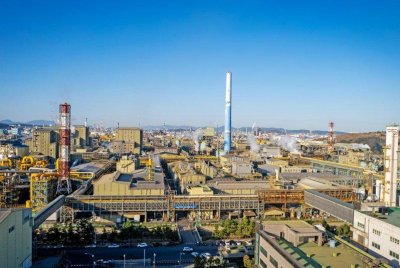

1 of 2 | A smelter of Korea Zinc in Ulsan. The company has increased the annual production capacity of semiconductor-grade sulfuric acid by more than 14%. Photo by Korea Zinc
SEOUL, Sept. 2 (UPI) — Korea Zinc said Wednesday that its production capacity for semiconductor-grade sulfuric acid has increased by more than 14% as the country’s two leading chipmakers boost production to meet rising demand.
The world’s largest non-ferrous metals manufacturer noted that it recently built two additional production lines for ultra-high-purity sulfuric acid at its Onsan Smelter in Ulsan, roughly 190 miles southeast of Seoul.
With the two new lines now in full-scale operation, Korea Zinc’s annual production capacity has risen from 280,000 tons to 320,000 tons.
Eventually, Korea Zinc aims to raise its domestic production capacity to 500,000 tons a year. It is also considering installing semiconductor-grade sulfuric acid lines at its planned integrated smelter in the United States.
In cooperation with the U.S. government, Korea Zinc is set to construct the smelter for strategic materials on a 160-acre site in Clarksville, Tenn. Under the $7.4 billion Project Crucible, the facility is expected to start production in 2029.
Korea Zinc said that it supplies more than 60% of South Korea’s demand for semiconductor-grade sulfuric acid. The Asian nation is home to the world’s two largest memory chipmakers, Samsung Electronics and SK hynix.
The corporation said that its product has a purity of more than 99.9999 percent, known as “six nines,” or 6N, purity.
“Through this capacity expansion, we will respond in a timely manner to the operation and ramp-up of key domestic clients’ new manufacturing facilities,” Korea Zinc said in a statement.
“Moving forward, we will phase in additional domestic production capacity in alignment with our clients’ demand and investment timelines. At the same time, we plan to establish a supply base in global markets, including the United States,” it added.
The share price of Korea Zinc fell 3.92% on the Seoul bourse on Wednesday, while the benchmark KOSPI declined 3.99%.