Weekly insights and analysis on the latest developments in military technology, strategy, and foreign policy.
The U.K. Royal Navy has launched a kamikaze drone, the Nyan one-way effector, from a ship at sea, marking a significant step toward the U.K.’s ambition of a so-called ‘hybrid’ naval force. This is just one element of a much broader push toward increased reliance on uncrewed platforms, something that was underscored in the long-awaited Defense Investment Plan, unveiled earlier this week.
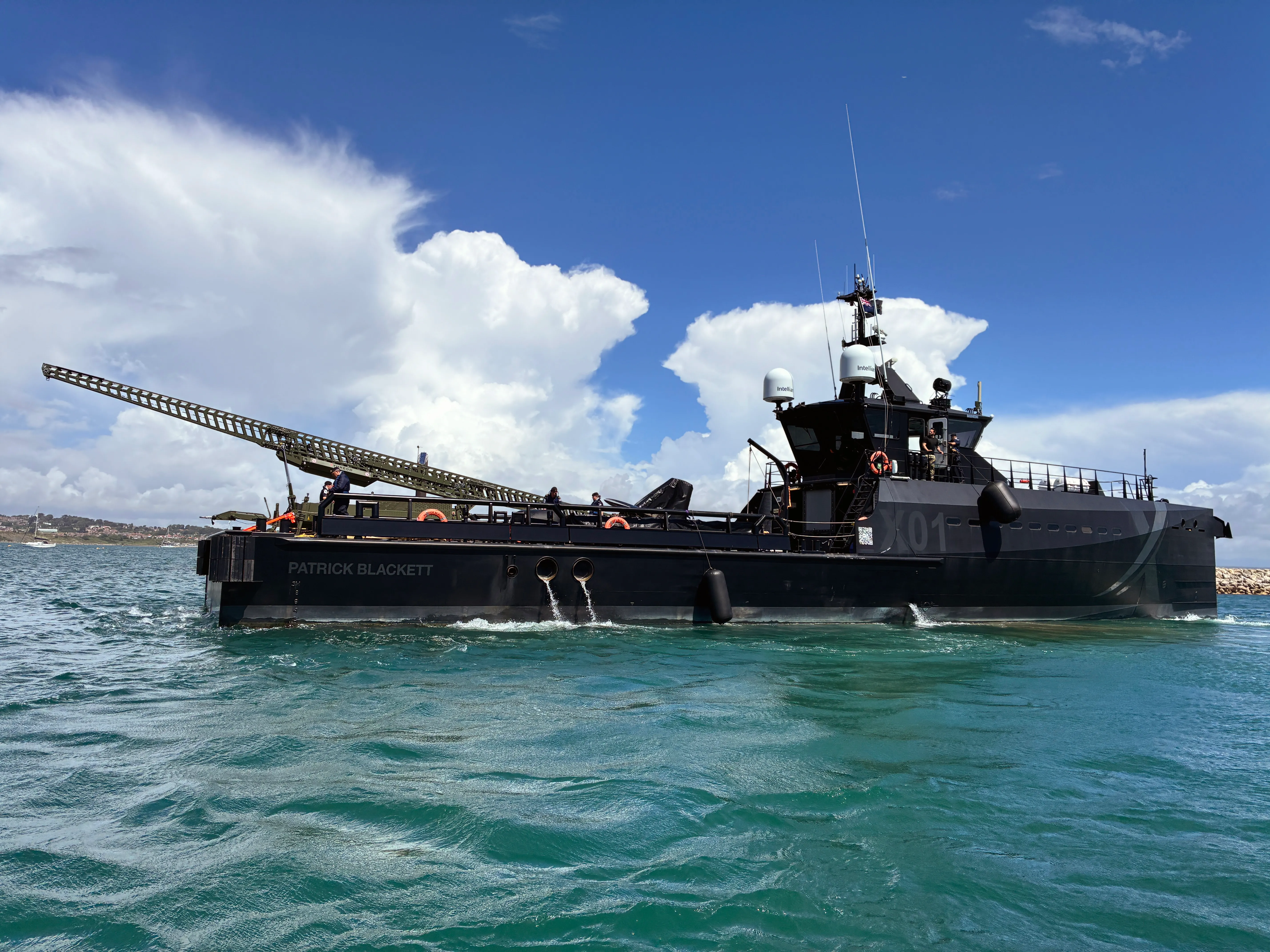
During recent trials off the south coast of England, the Nyan one-way effector drone was launched from the experimentation ship XV Patrick Blackett, a platform used by the Royal Navy as a testbed for new technologies.
The trial, known as Exercise Neptune Reach, involved personnel from the Royal Navy’s 744 Naval Air Squadron, 26 Royal Artillery of the British Army, and the Royal Air Force.
In a statement, Luke Pollard MP, Minister for Defense Readiness and Industry, said: “Britain is serious about the transition to a Hybrid Navy with new, powerful drones at the heart of the Royal Navy. By bringing together Army and Navy expertise to field strike drones from a ship at sea, we are accelerating the capabilities our forces need to stay ahead of our adversaries.”
The experimentation ship XV Patrick Blackett with the launcher for the Nyan drone installed. Crown Copyright Royal Navy
The catapult launcher for the Nyan was installed on the ship’s deck. Operators then programmed the drone to fly to a specific target, which it flew to autonomously, while the ship was underway.
Developed starting in 2022, specifically for precision strike, the Nyan was designed and built by Callen-Lenz, a subsidiary of BAE Systems. It is intended to be a low-cost strike platform, with a unit cost of less than £100,000 ($132,000), according to the manufacturer.
The drone has a wingspan of around 9.5 feet and a reported range of more than 93 miles (150 kilometers) — meaning it can hit targets at a greater distance than the Harpoon anti-ship missile. Built mainly of carbon fiber, the Nyan is powered by a small turbojet engine. The design of the drone and its construction include reference to low observability, including a stealthy exhaust nozzle, making it harder for hostile air defenses to detect and destroy.
Royal Navy and British Army personnel prepare a Nyan for launch on experimentation ship XV Patrick Blackett. Crown Copyright Royal Navy
The Nyan drone and launcher have already been tested extensively during land exercises. During Exercise Spring Storm in Estonia this year, the British Army used the system in support of NATO allies on maneuvers. Thereafter, the British Army’s Royal Artillery adopted the Nyan for operational service.
In the maritime context, the Exercise Neptune Reach trials from the Patrick Blackett were part of the wider, tri-service Project Vantage. This is focused on rapidly testing and delivering one-way effectors for the Royal Navy.
“This trial makes a significant step forward in delivering maritime one-way effectors at pace,” explained Lt. Cmdr. David Burton, Maritime One-Way Effectors Capability Sponsor with the Royal Navy. “Under Project Vantage, we are planning to integrate these capabilities into the Hybrid Navy, combining crewed platforms with uncrewed systems to expand reach, increase tempo and enhance lethality.”
A palletized Nyan drone is lowered onto its catapult launcher installed on the ship’s deck. Crown Copyright Royal Navy
The Nyan is already in quantity production, with more than 1,000 units manufactured so far, according to Matt Foster, CEO of Callen-Lenz.
The Royal Navy has said that the recent at-sea trials pave the way for further experimentation and also potential future deployment of the Nyan across the fleet.
Beyond the strike mission that the Nyan is currently equipped for, Callen-Lenz has said that the Nyan could be adapted to carry other payloads, or potentially be scaled up for increased range or endurance.
Interestingly, BAE Systems has also outlined the potential for further trials of the Nyan aboard the aircraft carrier HMS Queen Elizabeth.
In its last Strategic Defense Review, published last year, the U.K. Ministry of Defense described how plans for a hybrid naval force would also affect the two carriers and their air wings:
“The Royal Navy must continue to move towards a more powerful but cheaper and simpler fleet, developing a ‘high-low’ mix of equipment and weapons that exploits autonomy and digital integration,” the review stated. “Carrier strike is already at the cutting edge of NATO capability, but much more rapid progress is needed in its evolution into hybrid carrier air wings, whereby crewed combat aircraft (F-35B) are complemented by autonomous collaborative platforms in the air, and expendable, single-use drones. Plans for the hybrid carrier air wings should also include long-range precision missiles capable of being fired from the carrier deck.”
Already tested extensively during land exercises, the autonomous drone was taken to sea to explore how it could be operated from a ship. Crown Copyright Royal Navy
Earlier this week, the Defense Investment Plan noted that the development effort for the hybrid carrier air wing will include trials of jet-powered drones from the carrier. Previous drone trials aboard the British carriers have involved the QinetiQ Banshee Jet 80+, an adapted target drone, launched from HMS Prince of Wales in 2021. Subsequently, the General Atomics Mojave short takeoff and landing (STOL) drone was operated from the same carrier in 2023, as you can read about here. The Mojave’s impressive STOL capabilities meant that no launch and recovery systems were required for these tests.
A Mojave STOL drone landing on HMS Prince of Wales. GA-ASI
Beyond catapult-launched drones like the Nyan, the Royal Navy has a longer-term ambition for ‘cat and trap’ drone operations aboard its carriers, under an effort named Project Ark Royal.
If successful, Project Ark Royal will see the two carriers start to operate drones that can undertake a variety of missions and then increasingly heavier, complex, and higher-performance ones. In the past, General Atomics has pitched to the Royal Navy a carrier-capable fifth member of its Gambit drone family, intended to fit into a future air wing aboard the U.K. carriers.
A rendering featuring a catapult-equipped HMS Prince of Wales with a Gambit-series drone ready to launch. GA-ASI
Later on, full catapult-assisted takeoff but arrested recovery (CATOBAR) capability could even add fixed-wing crewed aircraft, as we have explored in the past.
Of course, the United Kingdom is not alone in these aspirations, with China and Turkey, most notably, also increasingly exploring using drones aboard big-deck amphibious warfare vessels and other non-conventional-takeoff-and-landing aircraft carriers.
For the time being, the Nyan represents a fairly modest strike capability. Based on its range, what is likely a relatively small warhead, and subsonic performance, it is best understood as a low-cost tactical precision weapon. It lacks the reach and payload of the kinds of long-range precision-fires capabilities that the U.K. Armed Forces are increasingly looking to develop. However, it is an affordable means of engaging targets at relatively short distances and could be particularly effective if launched in large numbers and from a variety of platforms. As we have explored in the past, quantity has its own advantages in this context, and launching swarms of these at enemy ships or shore targets would make them very hard to defend against.
At the same time, experience with the Nyan in a maritime environment will help pave the way for introducing more capable drones.
An experimental Banshee Jet 80 target drone on the flight deck of HMS Prince of Wales during an earlier test of uncrewed technology on the aircraft carrier. Crown Copyright LPhot Ben Corbett
As such, the successful at-sea launch of the Nyan drone marks an important milestone in the Royal Navy’s transition toward a hybrid naval force.
More generally, by demonstrating the ability to deploy low-cost, autonomous strike drones from a moving ship, the trial highlights the U.K.’s commitment to expanding precision strike capabilities and expanding its use on uncrewed platforms.
As the Royal Navy continues to experiment with ship-based drone operations, including air wings featuring uncrewed systems, these kinds of assets are set to play an increasingly important role, complementing traditional platforms and enhancing the fleet’s overall combat effectiveness.
Weekly insights and analysis on the latest developments in military technology, strategy, and foreign policy.
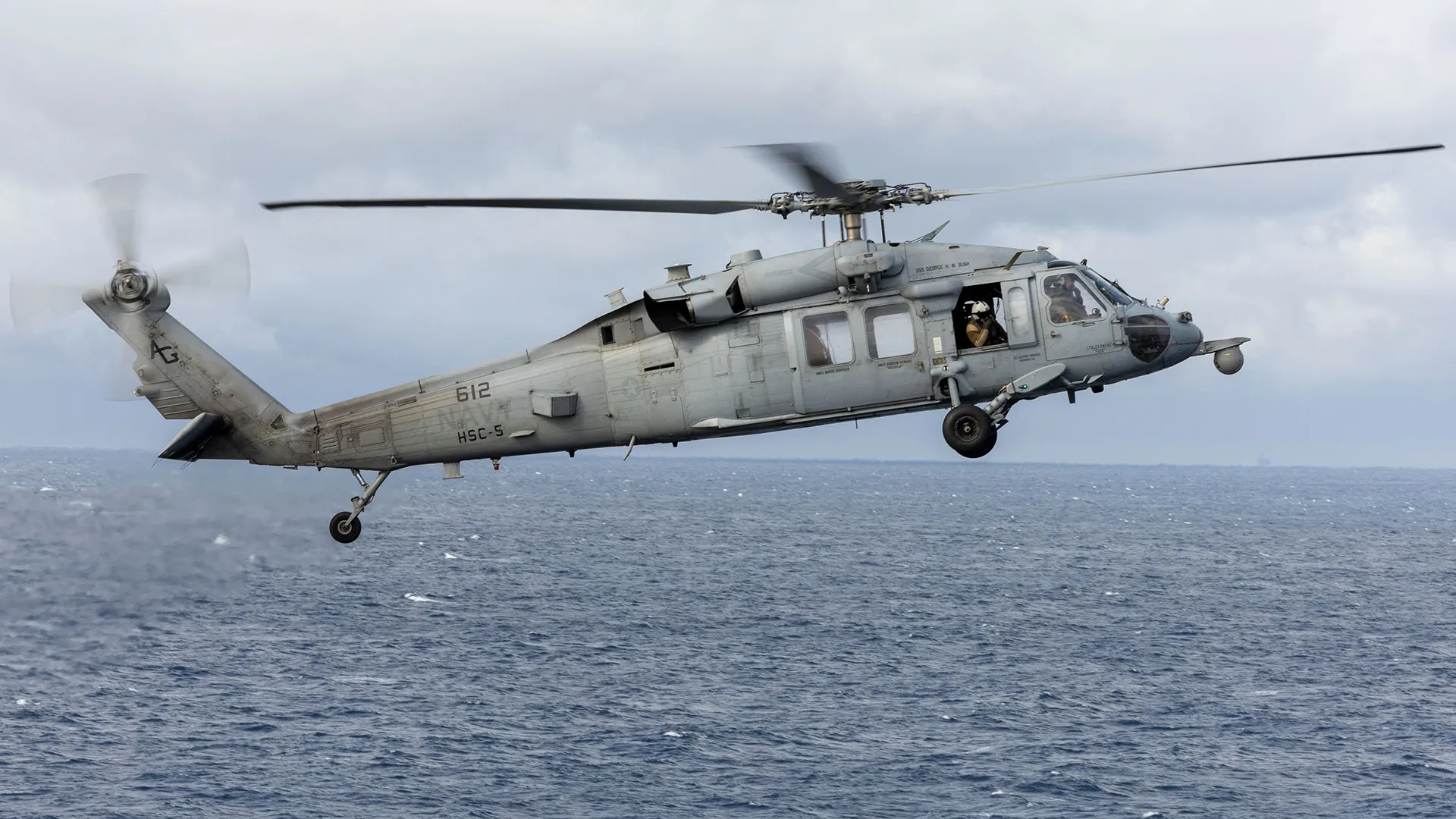
A search is underway for a missing aircrewmember after a U.S. Navy MH-60S Seahawk helicopter assigned to the aircraft carrier USS George H.W. Bush (CVN 77) “conducted an emergency water landing in the Arabian Sea,” the U.S. Navy’s 5th Fleet stated in a post on X. “There is no indication the emergency was caused by hostile action.”
“Three of the helicopter’s four crew members have been recovered and are in stable condition aboard George H. W. Bush,” 5th Fleet added. “U.S. Navy assets in the region are currently searching for other aircrewmen still missing. The cause of the incident is under investigation.”
The incident took place at 3:30 a.m. EDT, 5th Fleet stated.
On July 1 at 3:30 a.m. ET, the aircrew of an MH-60S Sea Hawk helicopter assigned to USS George H.W. Bush (CVN 77) conducted an emergency water landing in the Arabian Sea. There is no indication the emergency was caused by hostile action. Three of the helicopter’s four crew…
— U.S. Naval Forces Central Command/U.S. 5th Fleet (@US5thFleet) July 1, 2026
The mishap occurred amid tense ongoing negotiations between the U.S. and Iran to end the war. This marks the second time in the past few weeks that a U.S. military helicopter aircrew had to be rescued after a crash in the region.
The crew of a U.S. Army AH-64 Apache were rescued from the Gulf of Oman overnight June 9 by a Corsair drone boat. President Donald Trump said Iranian forces downed the attack helicopter.
A U.S. Navy MH-60 helicopter, like the one seen here, made a water landing in the Arabian Sea on Wednesday. A search has been launched for one aircrewman aboard the helicopter was has since reported missing. File Photo by Keizo Mori/UPI | License Photo
July 2 (UPI) — A search is ongoing for an aircrewman who went missing after the Navy helicopter they were aboard performed an emergency landing in the Arabian Sea, the U.S. military said.
U.S. Naval Forces Central Command said in a brief statement that the MH-60S Sea Hawk helicopter with four people on board made the emergency landing at 3:30 a.m. EDT Wednesday.
Three of the helicopter’s crew were recovered and were listed in stable condition, while the fourth member remained missing.
U.S. Navy assets in the region are searching for the missing aircrewman, it said.
Little information about the incident has been made public. U.S. Naval Forces Central Command said there was no indication that hostile activity prompted the emergency landing.
“The cause of the incident is under investigation,” it said.
The helicopter was assigned to the aircraft carrier USS George H.W. Bush, which departed Norfolk, Va., on March 31, according to U.S. Fleet Forces Command. The aircraft carrier has been in the Arabian Sea since at least May 3, according to a statement from U.S. Central Command, which said it was deployed to the U.S. 5th Fleet area of operations to support maritime security and stability in the Middle East.
The United States has been at war with Iran since Feb. 28. The two sides are negotiating an end to the war amid a cease-fire.
The best weapon in the “Jackass’” arsenal isn’t the taser, the beehive or the booby-trapped latrine. It’s the explosion of relief when a prank ends, often in humiliation, always with hoots and claps. The first film, 2002’s “Jackass: The Movie” was slow to discover that carnage without camaraderie is painful; several injuries limped off-screen in horrified silence. Laughter heals, except for the brain hemorrhage that Johnny Knoxville suffered in 2022’s “Jackass Forever” when, dissatisfied by the clobbering he took from a bull, requested a second ramming that knocked him out cold.
Hence “Jackass: Best and Last,” the goon squad’s alleged final film, is underwhelmingly tame. Shot quickly by stalwart director Jeff Tremaine this spring, half of it is a clip reel of past hits, like the time fan favorite Steve-O slingshotted into the sky in a port-a-potty. The rest is scraps of hastily assembled chaos, the most elaborate of which is a puppet show in which veterans Ehren McGhehey, Dave England and Jason “Wee Man” Acuña dangle helplessly from strings, trying to recite cue cards while being pummeled by tropical fruit. “A pineapple!” Wee Man moans.
I’m no sadist. They’ve suffered plenty for our amusement. Still, it’s a shame that for the first time in two and a half decades of cringe comedy, the guffaws feel forced.
Acknowledging the Jackasses’ age, if not maturity, are a couple skits about prostate and rectal checkups. (The gnarliest involves clear pants, colonoscopy prep liquid and a game of Twister.) Modern technology enters the arena with a nimble-fingered robot. If the team had invested any actual energy into brainstorming this entry, they’d have played paintball with a sniper drone. At least for the sake of torch-passing, someone should have thought of something for the newish members introduced in “Jackass Forever” to do besides stand around and applaud.
These fresher faces — Jasper Dolphin, Rachel Wolfson, Zach Holmes — prove brave and resilient when allowed to participate. Only one of them, Sean “Poopies” McInerney, a surf bro so gullible that I’m not sure he’s capable of informed legal consent, fits into “Best and Last” like a well-worn punching bag. (When Poopies yelps that “my mind is getting to me” while wearing a shock collar around a sensitive area, people snort because, as sweet as he seems, the only thing rattling inside his cranium is a moth.) Early on, Poopies gets swollen lip injections that, someone claims, will last the whole movie. You expect his trophy wife pout to be a running sight gag. But his disfigurement never even gets another closeup.
“Jackass” started with a bang. In January of 1998, Knoxville, then a 26-year-old aspiring actor, strapped on a cheap bulletproof vest padded with a stack of “Hustler” magazines and fired a gun point-blank into his chest. His dumb derring-do went viral on VHS tapes, earning him an MTV show and five feature films. Watching that Rosetta Stone-cold stupid footage here, you’re struck not only by his audacity, but by the scene’s excruciating comic pacing. As there’s only one bullet in the pistol, empty chambers click multiple times before the bullet finally fires. Logically, you know Knoxville will live long enough for his hair to turn fright-wig white. Yet the lizard brain making you gawk is shrieking.
Do not attempt any of the stunts you’re about to see, the prefatory caution blares. Absolutely. The thing is, no one else could. “Best and Last’s” flashbacks are a walloping reminder that Knoxville is inimitable: a telegenic and extroverted entertainer with a charisma he wields like a skunk aims its stink. Upset him at your own risk. Like Buster Keaton before him, Knoxville has an uncanny awareness of how his death-defying escapades appear on camera. Even in that near-suicidal early segment, note how Knoxville stays on his feet, enduring agony with a magician’s “Ta-da!” He might have given himself a bruise the size of a baseball but he’s focused on the audience’s delight.
Over the years, the visuals dramatically improve, from snuff film aesthetics to confidently silly splendor. “Jackass Number Two,” released in 2006, expended major energy on a musical homage to Old Hollywood that nodded to Keaton and bathing beauty Esther Williams who, in MGM’s “Million Dollar Mermaid,” plunged 50 feet into a pool and broke her neck. By 2010’s “Jackass 3D,” which riffed on classic cartoons with Knoxville strapping himself onto an Acme-style red rocket, one could admit they went to see a Jackass movie for the cinematography with even more sincerity than if Knoxville claimed he bought “Hustler” for its life-saving properties.
The new movie doesn’t have any artistic ambition. The charitable excuse for its reliance on old material is that the gang wanted one more film that summed up their entire legacy — from the impact of seeing them age to the opportunity to include departed colleagues Ryan Dunn, who died in 2011, and Bam Margera, fired in 2020. The other explanation is it’s a cash grab made for pennies. Still, Steve-O strives for memorable moments, gathering the gang in a generic office building corridor to watch him take off his pants and pop out a ping-pong ball. There’s a lot of nudity but the setting feels half-assed.
“Best and Last’s” intro splat-tacular, typically a highlight of each film, hinges on the posse standing still on a moving floor. But the monochrome staging — white walls, white ground — looks almost like CGI, the antithesis of their appeal, and it takes us a minute to understand what’s actually going on. Worst, it lacks both suspense and surprise, that no-they-aren’t–oh-god-they-are drama that once elevated the franchise to the peak of pure cinema.
There is — and I mean this — existentialism in witnessing a person embrace shame and terror. Actors have won Oscars without achieving the transcendence of, say, misery glutton McGhehey in “Jackass Forever,” bound to a chair and coated in salmon and honey, realizing that his friends have released a bear into the room. Meryl Streep could never do that (and wouldn’t have to). McGhehey’s sole path to stardom is that he did.
Not everything in a “Jackass” movie needs to be that sublime. One of my few genuine howls in “Best and Last” came in a three-second rehash of someone stepping on a rake; another was the percussion Chris Pontius makes with his swinging nethers before attempting a naked Fosbury flop. There’s a great accidental gag in a cut bit from the original MTV pilot when a deputy pulls up to arrest Knoxville and forgets to put her car in park. Yet the snippet I keep thinking about is a throwaway beat in a new skit when McGhehey willingly gets into the wrong chair again and, once freed, attacks Knoxville who coolly knees him in the nuts. Everyone chuckles.
Once, in anthropology class, my professor lectured on an insular island tribe that cackled whenever someone got hurt. Schadenfreude was the community’s way to vent tension. I thought of that village throughout “Best and Last,” especially during Knoxville’s nonchalant disarmament of his pal. Team Jackass has stayed united even while at each other’s throats. In bad times, they’ve borne each other’s struggles with sobriety and mental health. In good, they’ve seen the inequality of success that’s left Knoxville in a better financial position to retire than the rest.
While “Best and Last” is a whiff, I can forgive this band of bozos’ urge to make it. No one seems happy to still be zapping themselves with electrodes. They just want to rally together for the final time to choke out one last laugh.
‘Jackass: Best and Last’
Rated: R, for extremely dangerous stunts and crude material throughout, graphic nudity, pervasive language and sexual material
TechnipFMC (FTI) said post-market Thursday it was awarded a “large” contract from Norway operator Vaar Energi (VARRY) for subsea work on the Ofelia and Gjoa Nord developments in the Norwegian North Sea; TechnipFMC considers a “large” contract in the $500M-$1B range.
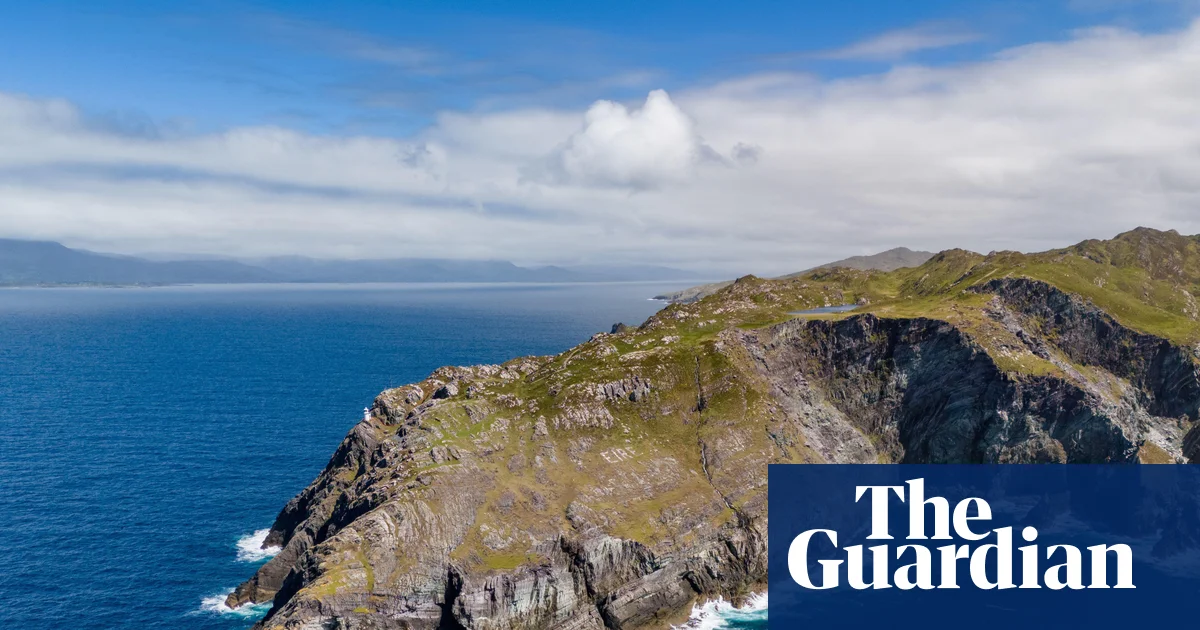
The Sheep’s Head peninsula is clearly a good place to be a skylark. They seem to warble overhead at every turn, singing their little hearts out – and who could blame them? The hills here are high and heathery, the sea breeze is warmed by the Gulf Stream and the edge-of-the-world scenery is a realm of wild green slopes and endless blue Atlantic. If you had to choose a sky to lark in, the one that crowns this County Cork headland is a bona fide wing-quiverer.
The peninsula wows hikers, too. I’ve come to one of the south-westernmost points on the Irish mainland to trek the Sheep’s Head Way, a long-distance trail opened by the local community 30 years ago this summer. It took serious work to complete – more of which later – but it’s a delight. I’m walking the original 55-mile (88km) loop around the peninsula, although a longer, 63-mile option is now considered the official route.The way attracts a fraction of the numbers drawn to the Kerry Way and Dingle Peninsula trail further north, and thanks to its untrammelled paths and rampant, cliff-edged scenery, the rewards are grand, in every sense.
“Ah, you’ll love it,” enthuses Thérése Linehan of Doire Liath B&B in Bantry, having fuelled me with poached eggs and soda bread for breakfast. “People do.” This colour-splashed harbour town, at the landward end of the peninsula, is the route’s start and end point. I’m setting off on a Friday and the waterside square is busy with market stalls: fresh seafood, local artworks, turbo-strength flat whites. A statue of 18th-century revolutionary Wolfe Tone stares out to sea. I dawdle a while in the chilly May sunshine, then walk west.
The early miles wind up into the range of rounded drumlins that form the spine of the peninsula. Wildflowers speckle the gorse verges; boggy paths squelch underfoot. Soon, the views open up. Bantry Bay to the north, Dunmanus Bay to the south and a belt of shaggy-grassed peaks stretching out ahead. Swallows are cavorting in the wind. I turn and see nothing but hills, ridges and sea. Where is everyone?
The harbour town of Bantry, seen from the Abbey Graveyard. Photograph: Radnor Images/Alamy
Despite being almost at the westernmost limits of the European map, the region is no historical hinterland. Folklore holds that Bantry Bay was the place where feet were first planted on Irish soil, in 2680BC. Millennia later, in 1796, the same bay witnessed an attempted landing by a vast French fleet looking to help local resistance forces against English rule, only to be thwarted by storms. I’m luckier with the weather. Today the bay is sun-stippled and marble smooth.
The themes of this first day – near-empty trails, unbridled scenery, spring birdlife and heady history – set the tone for those that follow. The loop walk is traditionally split into five or six days – I’m doing it in five. For the first two, with crags and coastal meadows cascading around me, I pass only sheep. Cuckoos sound from woodland patches, stonechats flit between rocks, squadrons of hooded crows glide overhead. High, lonely stiles come in their dozens; abandoned 1840s stone homesteads stand sentry above the sea.
At one point the trail ascends to a 345m (1,130ft) viewpoint known as Finn McCool’s Seat, where the legendary giant is said to have sat and rested. I do the same, gazing at the peninsulas further north. I don’t know whether, like me, McCool was sapped enough to wolf down two packets of Taytos while he lingered.
There are few settlements on the first half of the anticlockwise route, so prearranged road transfers take me to and from Bantry to the trail on the first two days. The town has the advantage of myriad pubs and restaurants. Ma Murphys bar, 185 years old, does a fine drop of Murphy’s – which often outsells Guinness in these parts – and sets things up nicely for what is arguably the scenic climax (and far and away the busiest part) of the walk, a roller-coaster trek on Day 3 out to the lighthouse on the promontory’s furthest cliffs.
Roancarrigmore Lighthouse, Bantry Bay. Photograph: Richard Cummins/Alamy
I reach it in early afternoon. The sea is huge and aglitter. Gannets patrol the waves. To the south, across Dunmanus Bay, is Mizen Head, traditionally the last finger of Irish land seen by people sailing to North America. The Sheep’s Head path now spins on its heel and heads east, past a wayside shrine and a tea-and-toasties cafe. Within half an hour the trail is deserted again, its yellow markers leading back into the tussocky green of the hills.
The trail is so well signed that it’s easy to overlook the complexity of shaping a hike around an entire peninsula. The Sheep’s Head Way has an office in the village of Kilcrohane, my base for that night, where I meet local farmer James O’Mahony. Now 82, he was one of the original mid-1990s founders of the trail, along with the late Tom Whitty, a Philadelphian who fell in love with the region. They envisaged a hike that would promote the peninsula’s charms to the full, benefiting not just walkers but local communities. Setting it up, however, required effort.
“There’s no crown land in Ireland, it’s all freehold,” explains James, speaking softly in a thick Cork accent. “We had 265 different landowners to speak to, all on the route. Some of the farmers couldn’t believe their land might appeal to hikers. They’d say, ‘Why would anyone want to walk my old hill?’” He chuckles. “One of the aims was also to keep our old pathways alive. Lots of them were funeral paths, mass paths, church paths. That was very important.”
Yellow waymarkers show the way on the main ridge of the Sheep’s Head Way, Ireland Photograph: Ben Lerwill
The trail took 18 months to complete.While never overcrowded, it has won wide recognition, including a European Destination of Excellence Award in 2009 for “respecting its protected environment while meeting the needs of local residents and visitors”. All landowners on the route still receive an upkeep payment from the government’s rural affairs department, a committee of volunteers oversees the trail and a small, grant-funded team of workers is tasked with maintaining it.
The next day, I’m back on the trail. The 11-mile stretch from Kilcrohane to Durrus, my last staging post before a final day’s walk back to Bantry,is as all-enfolding as all that’s come before. There are historical gems – including a bronze age stone circle and the ruins of a bardic school that, by some local accounts, can claim to be one of Europe’s oldest universities – and more of those coastal views.
There’s a feeling you get when you complete a long-distance trail, a sweet fatigue that holds a sense of the miles walked. This is a special corner of a special county, and the trail that snakes its way around the peninsula – soggy in places, steep in others, but rarely less than spectacular – is one to be celebrated.
The trip was provided by Tourism Ireland and Ireland Walk Bike Hike, which offers seven-day Sheep’s Head Way sel-guided packages, with five days of hiking, B&B accommodation, transfers and luggage transfers from €885. Five-day packages also available. For more information on the Sheep’s Head Way, visit thesheepsheadway.com
Mona Khalil watches small sea turtles crawling on the sandy beach of al-Mansouri, south of Beirut, in 2003. Khalil, a protector of sea turtle hatching sites, died Saturday after sustaining injuries in an Israeli attack on Lebanon on June 5. File Photo by Nabil Mounzer/EPA
June 20 (UPI) — A Lebanese conservationist and protector of sea turtles died from injuries she suffered when her home was hit by an Israeli strike.
Mona Khalil, 76, died after suffering injuries from an Israeli attack on her home at al-Mounsouri Beach on Lebanon‘s southern coast on June 5. Her assistant was also injured in the attack, according to Green Southerners, a local nonprofit.
The Israeli military told CNN that Khalil “was not a target” of the Israel Defense Forces. “There is no known IDF strike in which she was injured,” the military said in a statement Saturday. “However, strikes were conducted in the area after the IDF issued evacuation warnings.”
Khalil was born in Lagos, Nigeria, and moved to her parents’ homeland Lebanon at age 7. In her 20s, she fled to the Netherlands to escape the Lebanese civil war and became a porcelain restorer. She attained British citizenship because she was born in a British colony.
She returned to Tyre, Lebanon, when she inherited property from her grandmother. There, she spent the rest of her life protecting the nests of loggerhead and green sea turtles.
Both species of turtles are threatened by coastal development, plastic pollution, fishing nets and light pollution. They are at risk of extinction in the eastern Mediterranean.
Khalil helped create the Orange House, an eco-tourism project at al-Mansouri beach. She painted her house orange to symbolize the safety the Netherlands had given her.
“She is a deeply committed environmental defender,” Hisham Younes, founder and president of Green Southerners, told the BBC. “She used to talk about the beach like it was a person. Her bond to the sunset, her bond to the water and the turtles … she was really into conservation, and into the soul, the spirit of conservation.”
In 2006, CNN profiled her, and she said she refused to leave her sea turtles even among fighting between Israel and Hezbollah.
“Me and my animals were all traumatized, and I lost a bit of my hearing. But otherwise I’m still alive and kicking,” Khalil told CNN at the time. “I live every day to the fullest and don’t worry about tomorrow.”
Bruce Springsteen performs at the grand opening for the Obama Presidential Center, in the center’s John Lewis Plaza in Chicago on June 18, 2026. The grounds open to the public on Juneteenth, June 19th. Photo by Tannen Maury/UPI | License Photo
ARCADES, ice cream parlours, chippies and tourist attractions galore – there’s one town that has everything you’d look for in a seaside trip, but the catch is, it’s not on the coast.
Matlock Bath in the Derbyshire Dales has attracted visitors for centuries and is renowned for its coastal feel, even though it’s miles from the sea.
Sign up for the Travel newsletter
Thank you!
Matlock Bath in the Derbyshire Dales has a coastal feel despite not being anywhere near the coastCredit: AlamyThe banks of the River Derwent are ideal for being beside the waterCredit: The Sun – Catherine Lofthouse
It may not have a beach, but the banks of the River Derwent are a great alternative for being beside the water.
And there are so many chippies on one half-mile stretch between the Fishpond Inn and the Midland pub, that I think this little gem could easily give Scarborough a run for its money to claim the title of the chip shop capital of the country.
The Yorkshire resort has 93 takeaways, which equals 85.4 for every 100,000 people, while I counted 10 along Matlock Bath’s North and South Parade.
With a population of just 670, that means there’s one chippie per 67 residents.
All these fish bars are needed, though, to feed the hungry hordes that flock to the area, especially in warm weather.
It’s a mecca for motorcyclists, as well as offering family-friendly attractions like theme park Gulliver’s Kingdom and the Heights of Abraham.
The town has lots of family attractions including Gulliver’s KingdomCredit: The Sun – Catherine Lofthouse
The town also boasts the oldest pleasure park in the UK, which has been wooing wanderers for almost 300 years.
I took a meander around Lovers’ Walk, which is accessed via a bridge over the river, and felt like I’d happened upon a wilderness, miles away from civilisation.
You climb up the steep wooded slopes to the edge of the treeline to get incredible views out over the rolling countryside.
Further along, you can spot the rides and attractions over at Gulliver’s Kingdom on the opposite side of the valley.
It’s no wonder that visitors have been strolling here since at least 1742 and why it was a favourite for courting couples seeking privacy from prying eyes, hence the name.
I’ve been visiting this area since I was little and never been up to this secluded spot, so it just goes to show how much there is on offer, as every time I come, I find something new to do.
Adults should head to the lido at New Bath Hotel which is fed by a natural springCredit: The Sun – Catherine Lofthouse
If you’re visiting without kids, I would thoroughly recommend taking a swim at the lido at the New Bath Hotel, which is fed by a natural geothermal spring that has a temperature of around 20C.
The pool is for over-18s only and costs £10 for a 50-minute swim if you’re not a guest at the hotel.
For families, you really can’t go wrong with a trip on the cable cars up to the Heights of Abraham, where you can explore the caverns through the cliffs and enjoy the playgrounds and walks with views out over the town and river below.
Blue Peter badge holders can get in free and it’s a fantastic day out, unlike anywhere else I’ve visited at home or abroad.
You’d be mad to miss this unique place if you’re in the area, as it really does have something to appeal to all ages, including a display paying homage to the Wombles this summer.
Even Queen Victoria gave it her seal of approval when she came here and trekked up to the vantage point on a donkey – I’m sure she would have given the alpine cable cars installed in 1984 her royal assent as the perfect way to make the ascent if they had been around at the time.
And there are even cable cars to head up to the Heights of AbrahamCredit: AlamyAt the Heights of Abraham, you can explore the caverns through the cliffs and enjoy the playgroundsCredit: The Sun – Catherine Lofthouse
If you’re looking for a bit of a break, you should check out the accommodation on offer at Gulliver’s Kingdom, which is great for a day out or an overnight stay.
It’s got plenty of rides that are perfect for primary aged children and lots of its rooms are themed around Wind in the Willows, as well as some for little princesses and wannabe wizards.
It’s even got an indoor glamping option, with bell tents set up in one big room that also houses a camp kitchen.
One of my favourite days out in Matlock Bath was bringing my youngest son to see the illuminations, which take place on weekends in early autumn.
The boat parade is a fun activity to watch in the autumn tooCredit: Alamy
This is certainly a spectacle to behold, with themed boats lit up in the darkness as they parade up and down the Derwent.
Some evenings also have fireworks and there’s entertainment and fairground rides on the riverside.
The boat parade makes perfect use of its setting and you can see why it’s still going strong after more than a century.
If you love discovering quirky spots with something different around every corner, you could do a lot worse than heading to the Derbyshire Dales and checking out Britain’s only inland seaside town.
NEWLYWEDS Dua Lipa and Callum Turner were spotted kissing in the sea as he squeezed her bum while on their honeymoon in Italy.
The pop star, 30,and heractorhusband Callum, 36, have been enjoying married life at the luxury San Domenico Palace hotel in Taormina near Catania.
Sign up for the Showbiz newsletter
Thank you!
Dua Lipa and Callum Turner were spotted kissing in the sea as he squeezed her bumCredit: BackGridThe newlyweds are enjoying a luxury honeymoon in ItalyCredit: BackGrid
The couple arrived at the hotel on Monday after they drove from Palermo where they had a huge wedding bash that was attended by several A-listers.
In new photos, the pair looked every inch the loved-up couple, as they soaked up the sunshine in Sicily.
They were pictured in the sea on a float with their hands all over each other.
In one snap, Dua was seen on top her new husband as they enjoyed a kiss, while he couldn’t resist but give her bum a squeeze.
The pair looked loved-up with their hands all over each otherCredit: BackGridThe happy couple were seen enjoying a string of kisses in the waterCredit: BackGridThe One Kiss hitmaker was seen soaking up the sunshine in an inflatable floatCredit: BackGridThe actor and the pop star have been making the most of married lifeCredit: BackGrid
Dua showed off her toned figure in a silver thong bikini and matching top.
They were also seen with their eyes firmly locked on each other as they gazed into each other’s eyes, with Dua placing her hands on his face.
The duo looked smitten as Callum wrapped his arms around Dua’s waist.
The One Kiss hitmaker animatedly pulled an excitable expression with her hands up in the air.
Dua was then seen relaxing on the inflatable float, while Callum held onto the side.
Dua showed off her incredible figure in a silver thong bikiniCredit: BackGridThe singer looked in her element as she soaked up the sunshine in the metallic two-pieceCredit: BackGridThey were seen gazing into each other’s eyesCredit: BackGrid
She showed off her sunkissed glow in the two-piece swimwear and wore a black and white bandana on her head.
The couple are staying at a lavish £4k-a-night Italian hotel.
Earlier this week, they were seen walking through the town of Taormina hand-in-hand as they explored.
The hotel where the pair are residing for their honeymoon might be recognisable to some, this is because it was made famous in the HBO series The White Lotus.
Dua partied with A-listers including Donatella Versace at her wedding in Italy last weekendCredit: ReutersDua and Callum first married at Old Marylebone Town Hall in London on May 31Credit: Madison Phipps
Known for its stunning clifftop setting and jaw dropping view of the volcano Mount Etna, the resort is more than fit for the A-listers.
The hotel is The Four Seasons Hotel San Domenico Palace, and it was the main location for the second season of the hit HBO series.
The pair tied the knot last weekend prior with a string of famous faces in attendance.
Elton John, 79, who flew in by private jet for the ceremony, and Dua are close friends after they collaborated on the track Cold Heart in 2021.
Italian fashion designer Donatella Versace, 71, was also at the wedding, held in the grounds of the 18th-century Villa Valguarnera in Bagheria, and is believed to have designed Dua’s dress.
Other A-list guests at their Sicily bash included Brit actor Joe Alwyn, American actress Grace Gummer and her husband DJ Mark Ronson, and pop star Charli XCX and her husband George Daniel, the drummer with The 1975.
Some guests were understood to have signed non-disclosure agreements to protect the privacy of the star-studded three-day celebrations, which kicked off on Friday.
The villa where the lavish wedding bash happened, which also featured in HBO drama The White Lotus 2, is widely considered one of the most historically and culturally significant villas in Sicily.
Amid the vow renewal, following their London ceremony, music legend Elton John serenaded the couple with a rendition of his smash hit ‘Your Song’ in an incredibly emotional and touching moment.
The ceremony kicked off at 5pm and lasted for around an hour with guests arriving from 3:30pm in a whopping 60 minivans.
The bride and groom turned up in a luxury Mercedes Maybach Class V at 3pm prompt to greet their guests ahead of the nuptials.
Serving breakfast and lunch, you can get all the classic of a Full English or avocado on toast, as well as burgers and fish and chips.
They also serve alcohol including cocktails and grazing boards.
Live music evenings will also return this summer, including Jazz Cafe nights and 5 Nights of Sumer with “sunset dining, European sharing platters and cocktails by the sea” along with music.
Otherwise the cafe is only open in the day, from 9am to 5pm, (or 3pm in the week).
Guests can book in for sunset music sessions in the evening tooCredit: Instagram/southseacafeThe outdoor terrace has direct views of the seaCredit: Solent
The cafe’s general manager Elisa Standley told local media: “I think this place has completely reformed the beachfront – it’s taken a modern twist of what we used to do, and it’s expanded what we do in a better way.
Weekly insights and analysis on the latest developments in military technology, strategy, and foreign policy.
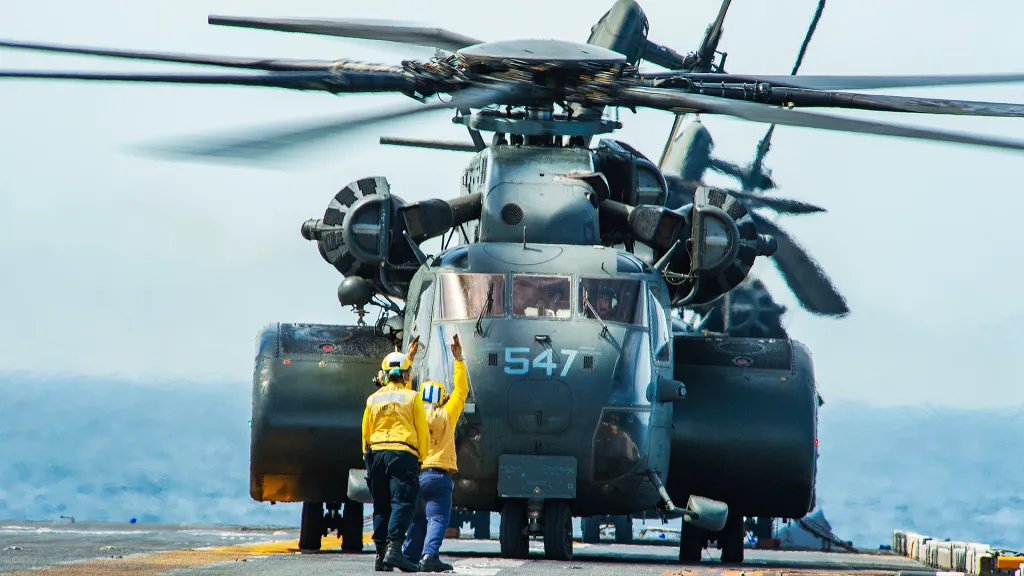
For decades, the massive MH-53E Sea Dragon helicopter has served as the Navy’s primary airborne mine countermeasure platform, dragging massive mine hunting sleds through waters all around the globe. However, the Sea Dragon’s days are now numbered, with the last 11 aircraft scheduled to sunset sometime next year. With the MH-53E’s demise on the horizon, we reached out to one of its former pilots, Steve Jones — a man who came to know this monster intimately during the Global War On Terror. He had plenty of stories to tell and provided us with a new understanding of the often misunderstood counter-mine mission.
The MH-53E’s mission is also, of course, extremely topical right now thanks to ongoing tensions with Iran. Secretary of State Marco Rubio recently told senators that the Islamic Republic mined “large segments” of the Strait of Hormuz, endangering shipping in the region.
As it currently stands, the mighty Sea Dragons, which are considered one of the military’s most dangerous to fly due to numerous fatal mishaps, are being phased out in favor of the smaller MH-60S Seahawk paired with a suite of new aerial mine countermeasures systems, as well as other new technologies, like uncrewed underwater and surface vessels. The Navy’s overall mine hunting force is going through a transition that is controversial, to say the least, with many questioning if the Pentagon is investing enough resources in this critical missions set.
Petty Officer 1st Class Rawad Madanat
With all these issues in play, in an exclusive, wide-ranging, two-hour interview, Steve Jones offered in-depth insights about the Navy’s airborne counter-mine mission, the Sea Dragon’s capabilities and dangers, current mine sweeping operations, as well as everything from what it was like to narrowly avoid getting entangled with a surfacing sub to his experiences ferrying celebrities like Robin Williams and Tom Jones around a war zone.
So, with the stage being set, let’s get into this incredible exchange.
Some of the questions and answers have been lightly edited for clarity.
Then-Navy Lt. Steve Jones in an MH-53E Sea Dragon. (Courtesy Steve Jones)
A: During the time that I selected, you could choose SH-60 Seahawks, you could choose CH-46E Sea Knights and the MH-53 Echo. You could choose SH-3 Sea Kings, but they were kind of winding down the H-3s, which is the same as the presidential helicopter Marine One that they fly now, but they were flying out of Norfolk and Puerto Rico, primarily for VIP transport.
So, I looked at the 53 for a lot of reasons. One, I liked the instructors that came from that community in the advanced helicopter training. And two, I just thought the helicopter just really looked awesome, and it was big, and so that’s why I chose it, and I just thought it would be a good personality fit, work fit for me, and it ended up being that way.
An MH-53E Sea Dragon, assigned to the “Blackhawks” of Helicopter Mines Countermeasures Squadron 15 (HM-15), takes off from the flight deck of the amphibious assault ship USS Wasp (LHD 1) during flight operations on the ship’s flight deck, April 5, 2025. (U.S. Navy photo by Mass Communication Specialist Seaman Soren V.P. Quinata) Petty Officer 3rd Class Soren Quinata
Q: What are the main differences between the Navy’s MH-53E and the Marines’ CH-53E Super Stallion?
A: It’s primarily the same aircraft. Except our aircraft has larger fuel sponsons, so we could carry more gas. The reason for that is ideally we’d want to be able to fly an hour to where the mission objective was, be able to stay on station for about an hour, and be able to fly back. That requires at least three and a half, four hours of gas and extra fuel in those side sponsors. And that allowed us to do that. So instead of a small sponson with two tanks, we had one big sponson with four fuel tanks that were inside each of the sponsons on either side of the aircraft.
Q: So how much gas would that larger sponson hold?
A: About 22,000 pounds of gas.
U.S. Navy Aviation Boatswain’s Mates (Fueling) prepare to refuel an MH-53E Sea Dragon helicopter, attached to Helicopter Mine Countermeasures Squadron (HM) 15, on the flight deck of the Nimitz-class aircraft carrier USS Abraham Lincoln (CVN 72). (Official U.S. Navy photo) Courtesy Asset
Q: Talk about the training and some of the biggest challenges of flying that huge aircraft.
A: Typical Navy training is two years of flight school, and then after flight school, we went to our Replacement Air Group, which we call the RAG, that was in Norfolk, Virginia. You spend about a year, or up to 10 months, in Norfolk, Virginia, learning primarily how to fly the helicopter, how to land the helicopter, and we do that in the combination with the Airborne Mine Countermeasure Squadron. We used aircraft from Helicopter Mine Countermeasures Squadron (HM) 14 to learn how to fly the different mission sets and learn aircraft familiarization. And then from there you either get assigned to HM-14, which was in Norfolk, Virginia, or HM-15, which was in Corpus Christi, Texas. HM-15 has now moved to Norfolk, Virginia. [Editor’s note: HM-14 sunsetted in 2022.]
Sailors assigned to the “Vanguard” of Helicopter Mine Countermeasures Squadron 14 (HM-14) posed for a photo in front of an MH-53 “Sea Dragon” helicopter prior to the squadron’s last flights Dec. 8, 2022. (U.S. Navy photo by Mass Communication Specialist 2nd Class Malachi Lakey) Mass Communication Specialist 2nd Class Malachi Lakey
The training takes about 10 months. Mine was a little bit longer because when I actually joined that community, the aircraft were down because of a crash off the coast of Corpus Christi, Texas. There was a problem called ‘thermal runaway,’ where the bearings in the main rotor head would fail, and they would seize together and get hot, and we lost a few sailors from HM-15. And until they figured out why and how to prevent it, it took about a year for those aircraft to come back up, so I was in Norfolk for maybe about a year and a half, almost two years, before I got to Corpus because of that bearing issue.
Q: What was it like when you finally got out there and learned how to fly while pulling a mine countermeasure sled?
A: There’s different types of equipment that you use and it takes a special kind of person to be able to maintain the situational awareness – both flying the aircraft and what’s happening in the back – because there’s dangers in the back. You have a very confined area, lots of equipment, and under lots of tension, and so the very first couple of times, the instructor is kind of handling everything, and you’re just kind of riding along.
An MH-53 Sea Dragon helicopter from the “Vanguards” of Helicopter Mine Countermeasures Squadron Fourteen pulling a Mark 105 Magnetic Influence Minesweeping System (SLED). (Photo by BOB HOULIHAN / NAVY VISUAL NEWS / AFP) BOB HOULIHAN
Then eventually you start to do more tasks, physical tasks, in terms of flying and maintaining a stable platform for the men and women that are working in the back, and then over time those skills translate into a larger situational awareness, where you’re now a mission commander – where you’re flying the aircraft, but also, conducting the mission in the back is your primary responsibility. The positions are second pilot or co-pilot, and then you become a Helicopter Aircraft Commander (HAC), which is like the captain, and then you become an Airborne Mine Countermeasures Mission Commander (AMCM MC), meaning you’re flying the aircraft, you’re the commander of the aircraft, but you’re also commanding the mission.
Lt. Cmdr. Jeff Spencer and Lt. Cmdr. Nik Bochette, assigned to the Vanguards of Helicopter Mine Countermeasures Squadron (HM) 14, perform a pre-flight check on an MH-53 helicopter. (U.S. Navy photo by Mass Communication Specialist Seaman Jessica L. Dowell/Released) Petty Officer 2nd Class Casey Hopkins
Q: Did you become a mission commander?
A: I did. So I was fully qualified in the MH-53 Echo in my squadron, so I was a mission commander. I worked the maintenance side, so I was the maintenance check pilot and functional check pilot. It takes a lot of maintenance, and then post maintenance, and you have to do post maintenance flights to be able to make sure the aircraft is safe for anyone else to fly. So I spend most of my time in those areas in that squadron.
A U.S. Navy Sailor with Helicopter Mine Countermeasures Squadron 14 guides an MH-53 helicopter from a vehicle carrier ship at Marine Corps Air Station Iwakuni, Japan, Sept. 14, 2022, after completion of aircraft maintenance. (U.S. Marine Corps photo by Cpl. Darien Wright) Cpl. Darien Wright
Q: What are the MH-53’s unique quirks and advantages?
A: One of the advantages was pure brute strength. You had three GE engines, so you could handle lots of torque, and the way that we hunted and swept for mines was pulling sleds in the water, which causes thousands and thousands of pounds of stress, so it’s really like a forceful instrument in the water. The operation requires the coordination of not only meteorologists and Operations Specialists, which are like intel specialists in mine warfare, but then you have the maintainer, you had two pilots and a crew chief, plus it could be up to four people in the back, depending on the type of gear you’re stowing in the back, so it really takes coordination from the front.
An explosive ordnance disposal technician, assigned to Explosive Ordnance Disposal Mobile Unit 5 Platoon 502, operates a communications system aboard an MH-53 helicopter belonging to Helicopter Mine Countermeasures Squadron (HM) 14. (U.S. Navy Combat Camera photo by Mass Communication Specialist 2nd Class Alfred A. Coffield) Petty Officer 1st Class Alfred Coffield
The disadvantage is that it’s a very expensive aircraft to operate. Every hour of flight, required 24 hours of maintenance, and if a squadron had 10 helicopters, which we did at one point in time, you’re looking at the largest deployable squadrons in the Navy, like 600-plus people to operate these aircraft.
With everybody working together, we advertise that we could be anywhere in the world in 72 hours, where there’s a mine threat. We could break down the helicopters, put them in a C-5 and then reassemble them anywhere in the world in 72 hours. After 9/11, for Operation Iraqi Freedom, we did deploy by C-5. We took half the helicopters to Sicily and the other half went to Bahrain and took 11 C-5s in order to move a squadron that size into those two locations, so big footprints, lots of money, lots of parts.
An MH-53E Sea Dragon assigned to the “Blackhawks” of Helicopter Mine Counter Measures Squadron 15 is offloaded from a U.S. Air Force C-5 Galaxy, March 14, 2003, at the U.S. naval base at Sigonella, Sicily. (Photo by Damon J. Moritz/U.S. Navy/Getty Images) U.S. Navy
Q: How fast could the Sea Dragons fly?
A: The 53 is a fast helicopter. One of the fastest out there. We were limited to 150 knots for airframe preservation. Under towing conditions, we typically flew between 18 and 25 knots, depending on the device in the water. Each vehicle had different performance parameters to properly deploy the device. Under rapidly changing conditions we always had to maintain proper speed and altitude control.
Q: The Sea Dragon has experienced a notoriously high rate of mishaps. Did that ever concern you? What do you think contributed to this record?
A: It did. If you’ve ever seen one or been on one, been close to one, or heard one, you’ve got 100-foot long machine with millions of moving parts, right?
Our maintenance crews were very good, I always felt safe flying. I think you have to if you choose to fly that particular weapon system, but there were a lot of accidents. And I knew folks that were killed in MH-53 accidents who I went to flight school with, and buddies.
Maintaining MH-53E’s
It’s a very complicated machine that did a very important mission, and accidents do happen, both mechanically, but also because of pilot error. In combination, you end up losing a lot of airframes. Besides the United States, there is only one other nation that flew that airframe, and that was the Japanese for their mine sweeping operation. It’s a very complicated, expensive machine, and that’s why not very many people flew it.
An MH-53E helicopter belonging to the Japanese Maritime Self-Defense Forces takes off during Marine Corps Air Station (MCAS) Iwakuni Friendship Day, May 5, 2004, at MCAS in Iwakuni, Japan. (Photo by Koichi Kamoshida/Getty Images) Koichi Kamoshida
Q: Did the danger concern you?
A: You know, you’re in your 20s, right? So you feel a little bit invincible. I’ll tell you a story. When I switched from 53s and started flying C-130s, after the Haitian earthquake, I flew into Guantanamo Bay, and my old squadron was there on the same ramp as we were. So I walked over to see who I still knew there, and they had a 53 turning on the deck there, and I was just going, ‘wow, I couldn’t believe I used to do that,’ and not thinking about how many things have to go right in order to have a good day. And I just kind of said to myself, ‘it’s really a young person’s game,’ because you gotta kind of hit the ‘I believe’ button on a lot of things, because there’s just a lot of opportunity for negativity to come in. Weather, environment, and then the mechanics of things.
MH-53 pilot Lt. Steve Jones in Bahrain, circa 2002. (Courtesy Steve Jones) Picasa 2.7
Q: What were the biggest factors contributing to the Sea Dragon mishaps?
A: With any aircraft system, the largest factor that contributes to any accident is the human factor. Yes, engines will fail, components will fail, but a lot of times it was human error that caused the ultimate catastrophe because when an emergency happens, you have three criteria in order to gauge when you should land.
The two critical ones are ‘land immediately,’ meaning if you do not ditch in the water or put the aircraft down, it is going to come apart in flight. The other critical criteria is ‘land as soon as possible,’ meaning as soon as you have a safe place to land, then you land as soon as possible. Then you have another condition where you can continue to fly, but flying is not recommended. And so that decision factor between land immediately and land as soon as possible, it’s a bit of a gray area, right? You have a set of skills you can fly, but you can never time when the aircraft is going to come apart.
Navy ‘Sea Dragon’ Helicopter Unsafe For Flight | NBC Nightly News
For example, in the Corpus Christi crash, they knew that they had a problem. I’m not second-guessing the pilot, but it was in that gray area between land immediately and land as soon as possible.
The aircraft commander chose to try to bring the aircraft closer to the beach, so you could survive a ditch, because putting a helicopter in the water – nothing is guaranteed, right? Then you have no control. However, bring it closer to the beach means you’re flying that much longer. So land immediately, there could have been more survivors.
Not to ‘Monday morning quarterback’ anything. I probably would have made the same call. And then with the new equipment that was put on the aircraft, there are lights now placed in a monitoring system that kind of took the gray area out of those decisions when it came to thermal runaway with the main rotor head. So now the decision is clear. Land immediately if certain indications happen, and land as soon as possible if certain indications happen. Prior to 2000, we didn’t have that.
Q: The Sea Dragon community has been well-documented for being neglected by the Navy. What was your experience when you were flying it? Why do you think that was?
A: It’s a unique mission set. It kind of came online during the Vietnam War and Haiphong Harbor, and clearing those mines, and then again in Desert Storm, when the USS Tripoli was hit by a mine.
Mining sea straits is a very cheap way to stop a huge navy, such as the one that we have in the United States. However, the Navy, in my opinion, didn’t necessarily see the value in that mission. There are very limited resources. There’s only so much money to go around, and large strike groups and ships just took priority. We were always probably a little bit underfunded, in my opinion, for a mission that’s important, which you can see today with the Strait of Hormuz. But it was definitely a huge problem that many people did not talk about during the first two Gulf Wars.
An Iranian mine-laying boat. (Iranian state media) (Iran State Media)
Q: Why was it a huge problem?
A: Well, when you try to move a carrier strike group into a small area like the Persian Gulf, by putting mines in the water, you create doubt in a captain’s head. The captain is responsible for thousands and thousands of lives, and the battle group commander is responsible for thousands and thousands of more lives, plus the strategic reason of why they’re there. If a mine is discovered, then everything has to pause. You can’t land Marines on the beach, you can’t move the strike group closer to the shore. The ability for you to project power ashore, all that kind of comes to an end.
Q: How does the MH-53E go about this unique mission set? Can you walk us through what a mission would look like from start to finish?
A: Depending on the intel, you’ll have a threat and the threat could be you suspect that there’s mines in the water, or that you know that there’s mines in the water. So, typically it’s ‘you suspect,’ right? And we used the AN/AQS-14, or “Q-14.” There’s about three different versions of the Q-14. It’s a side-looking sonar, which you drag in the water – we call it the fish. We would fly the fish at certain depths based on the terrain and what was in the water. That was called mine hunting.
MH-53 crew members and the AN/AQS-14 side-looking sonar. (Courtesy Steve Jones)
So initially you would always kind of begin with a hunting mission, where we could, or the OS operator, or the console operator would mark what they view as a mine-like contact. You’re really kind of looking at the sonar and distinguishing between man-made objects and natural objects. If you believe it’s a man-made object, and then you would mark a tape. You could also, real time, send that image back to the ship, but that capability came a little bit later.
We also had devices that allow you to sweep. A mine can be triggered by different mechanisms. Sometimes they’re triggered by contact.
Some mines are acoustically triggered, meaning you can set that mine to blow up for a certain type of ship acoustics. For instance, a destroyer has a different set of acoustics from an amphibious ship, from an aircraft carrier. If you want to let 1,000 destroyers pass you or a submarine and then wait for the aircraft carrier, you can tune it to that way. So we had devices that could mimic the sound signatures of different ships, and you could tow that in the water, you could tow it really fast. One of the reasons why we were successful is that we could do large areas of the ocean relatively quickly.
An MH-53E Sea Dragon from Helicopter Mine Countermeasure Squadron (HM) 15, aboard the multipurpose amphibious assault ship USS Wasp (LHD 1), performs Mine Countermeasure training using the MK-105 sled. (U.S. Navy photo/Lt. Cmdr. John L. Kline) U.S. Naval Forces Central Comman
The last piece for sweeping is the magnetic variation. Each ship is a metal hull, and as a ship is moving through the water, it has a magnetic signature, and then we have gear, which you could tune to mimic certain types of ships in the water, in order to have them explode behind the gear that we’re towing in the water.
So you hunt, that means you’re searching, and then you sweep, and then that means you’re clearing. Sometimes you can clear using other technology, such as sometimes the Avenger class ships would go in and sweep, and not us. Sometimes you would use dolphins to work with EOD teams in order to sweep mines. It just depends upon the threat, on what the second tool is used after you hunt.
Navy Dolphins Practice In Key West How To Find Mines In The Ocean
The most time that I spent was in the hunting phase of the mission set. In Bahrain, every week, a couple days a week, we would hunt. We would do the Strait of Hormuz. We would do the approaches into Saudi Arabia for the tankers. We would do the approaches into the Suez Canal, just to be sure that there are still no mines in that area.
That is for what we call change detection, meaning you map the ocean floor, and then over time, because of consistency, you’ll be able to tell if something changed. If something changed, then you went in to investigate further. It’s constant because the ocean floor is constantly moving, and then somebody could easily place a very cheap object that could be devastating.
An MH-53 Sea Dragon, Helicopter Mine Countermeasures Squadron 14 attached to USS Anchorage (LPD 23), controls an Mk-105 magnetic mine sweeping sled. (U.S. Navy Photo by Ensign Lindsay Lewis/Released) Ensi Lindsay Lewis
Q: Walk me through how a mission would take place.
A: The intel can be good sometimes, sometimes the intel is lacking. The weather has to be at a certain sea state in order for it to be successful, and you can’t do it at night, right? You have to do it during a daytime in littoral situation, so you’re pretty close to shore and you are susceptible to threats that are on the beach. That is the mission set and if you don’t know where the mines are, that’s why you begin with hunting. The Q-14 is a relatively quick device to deploy. You can pull it in the water relatively fast. Then you can real-time send images back, or you can collect tapes to study for that change detection.
When you’re going out for a mission, you’ll have your standard aircraft brief, where the crews get together and talk about the state of the aircraft, the conditions, the environmental conditions of today. And then you’ll get into the mission brief on where the ship is, or where the shore is, and where actually the square, or the box, or the rectangle is, where we’re going to conduct a mission. We talk about the distances from that point that we’re going to deploy the gear, because it takes time to be able to do that, and then we’ll enter what we suspect is a minefield or an area of interest from which we want to be able to tow in.
Minesweeper Exercise
Then we fly what we call tracks. It’s almost like rows on a field, like cornrows, and we go up, down, up, down, and you have to stay within track by feet, okay? If you, if you stray as little as 20 feet off track, then you have to redo that track, because you want to have a continuous picture of the ground. And so it may take two or three sorties to cover an entire minefield.
And then times where the device may have strayed off track. It takes time, but we can do it quicker than a ship doing it on its own, like the Avenger class ship, and so between the aircraft brief and the mission brief, and executing, it’s like a six, seven hour day in the heat or in the cold, depending on where you are.
This is the Navy’s Largest Helicopter | MH-53 Sea Dragon
There’s no air condition on that helicopter. So everybody’s working in those conditions based on the information that we bring back. Then the tactics folks that are supplied to us by COMINEWARCOM (Commander, Mine Warfare Command), which was our bosses, those intel folks will say what needs to happen next, meaning there’s nothing that needs to happen now, or we need to investigate this further. And then they pick the next tool for us to be able to deploy, or they go with the EOD and dive teams to go take a closer look.
Lt. Sean Johnson, left, and Cmdr. Derek Brady, commanding officer of Helicopter Mine Countermeasures Squadron (HM) 14, right, pilots a MH-53E Sea Dragon out to amphibious dock landing ship USS Pearl Harbor. (U.S. Navy photo Lt. Cmdr. Jeremy Braun/Released) Seaman Molly Evans
Q: How fast are you flying, and how high are you flying? How deep do the sleds go?
A: The helicopters are anywhere between 25 and 75 feet over the water, depending on the gear, because the speed in which we pull through the water is extremely important. You could go as fast as 25 knots in some cases, which is about the top speed, or you’d have to go as slow as 12 knots.
Mine Countermeasures Unit Drops a Slocum Glider from a MH-53E Sea Dragon
Q: How deep do the sleds go?
A: The depth of some of the gear is classified, or at least it was at my time. I’m not sure now, but you could go relatively deep. It’s under lots and lots and lots of tension, and the reason why you had to go very deep is that some gear has to be able to get to the sea floor at certain distances, because there’s also the subsurface fleet that is operating down there, and mines will affect them as well.
Q: What’s the tension like when you’re dragging a sled?
A: You’re looking at around 15,000 to 20,000 pounds of tension. The aircraft will kind of buckle. You look at the side of a 53, it has a crease from the tension that goes on it.
If there is a swell in the sea state, sometimes the Doppler radar – which would kind of track how fast you’re going forward, backwards, or sideways – it’ll go from forward to negative, meaning we’re actually getting pulled backwards by the sea state. And the engines would automatically just start – the torque would come in as the blade did a bigger bite out of the air. And the aircraft will kind of turn, because of the torque. It’ll kind of turn and whine, and you’re just flying an out of balance flight, nose down.
A US MH-53E military helicopter drags a MK 106 Combination escorted by two military Zodiak boats during an operation off the USS Ponce to clear mines from Khor Abdullah at the entrance to Umm Qasr port in the western Gulf, 29 March 2003. (Photo by RABIH MOGHRABI/AFP via Getty Images) RABIH MOGHRABI
Q: Did you ever have the sled get tangled up behind you?
A: Yes. It can get caught on things in the water, and the tension will spike. If the tension spikes too high, or the gear gets fouled in something, you always have the option to guillotine or cut the gear.
Q: Did the aircraft have other devices that helped in the mine hunting mission?
A: Yes. In addition to the Q-14, we had the Mk 104 acoustic device, mine chain cutting devices and the Mk 105, a huge gas generator, which produces electrical charges in the water for those magnetic-seeking mines that change the magnetic variation.
HM-15 Sailors Recover Mk 104
There’s at least six devices that I know of that are used for hunting mines, including something as simple as what we call a MOP, which is stands for Magnetic Orange Pipe, which is what they used in Vietnam.
Essentially you have this pipe, it looks like a telephone pole, which is about the size of a telephone pole or larger, and it’s orange. It has a positive charge on one end and negative on the other end. It’s just a magnetic pipe that we would tow in the water. It’s probably the easiest thing that you can tow, and the simplest, but it’s looking for those magnetic variations. The problem with the magnetic orange pipe is you can’t change it, so it’s set for a certain amount of tactics. You can see how that could become obsolete in today’s environment.
A US MH-53E military helicopter using a cable drags an MK 106 sled sent out from the USS Ponce as mine clearance takes place in Khor Abdullah at the entrance to Umm Qasr port in the western Gulf March 29, 2003. (Photo by RABIH MOGHRABI / AFP) RABIH MOGHRABI
Q: How does the Sea Dragon integrate with other mine hunting capabilities, like the Avenger class ships or other assets?
A: We worked as a team, but obviously we’re a tool in that larger mine warfare strategy. We were the speed aspect of that, meaning we could have left holes, but if you’re trying to move at the speed of war, then sometimes we were the tool that was required. And if you have 72 hours to be somewhere, speed is required. We could do that to be sure that the fleet can continue to do what it needs to do, but if you’ve got time, then you could sail a ship or move one of those slower small boats into that environment, that makes sense.
Q: Did you ever work together with Avenger class ships?
A: Maybe in the same AOR, but other than an exercise where you would see an Avenger class ship working the tow area, and then we will be working our tow area. It was under controlled condition. When I was doing change detection, and during work conditions, we were operating concentrated on our mission set, they’re probably concentrating on their mission set, and between the two pictures, they came together in the operation center to have a very clear picture.
A stock picture of the US Navy’s Avenger class mine-hunter USS Pioneer. USN
Q: When was the Sea Dragon actually used for this mission operationally? How did it perform?
A: It was used throughout Iraqi Freedom, from Shock and Awe to the pull-out to the drawdown. If not every day, every week there was change detection in mine operations, because it’s always a threat. It’s a very cheap weapon that non-state actors can get off the black market. One mistake or one mishap causes devastating consequences for the individuals on that ship, but also the mission, so it’s a constant threat, and still is a threat.
During my time, actively hunting for mines to be sure that those straits and those approaches remain clear, dominated my entire career in the community. From the time I started and then I towed to my last days in the squadron, which was in 2005.
A U.S. Navy sailor directs an MH-53E Sea Dragon helicopter launching March 28, 2003 at the port of Umm Qasr, Iraq. The helicopter was part of a mine clearing unit that cleared the way for the British Navy ship, Sir Galahad, that delivered the first wave of humanitarian aid in support of the U.S.-led Operation Iraqi Freedom. (Photo by Bob Houlihan/U.S. Navy/Getty Images) U.S. Navy
Q: How did the Sea Dragon perform?
A: I would say, since there was not a mishap, it performed as designed. It doesn’t mean that the mines were not there. During Iraqi Freedom, mines were put in the water, but we didn’t have the mishaps like we had before that I can recall. So I would say it was a success.
In this U.S. Navy handout mines are seen which were found on four Iraqi vessels that were intercepted in the Khor Abd Allah waterway by U.S.-led coalition forces March 26, 2003 in the Arabian Gulf. (Photo by Joseph Krypel/U.S. Navy/Getty Images) U.S. Navy
Q: Any close calls during any of your sled-towing flights?
A: I got disoriented one time with vertigo. Like I mentioned earlier, you’re on an out-of-balanced flight, so your ears are doing one thing, your eyes are doing another thing, and sometimes there’s low fog over the water early in the morning. Under tow there was a time where I got vertigo and put the aircraft in an undesired state, but there’s two pilots. I recognized it and told the aircraft commander ‘I’ve got vertigo.’ He took the control and saved it. Being that close to the ground, getting vertigo could have devastating effects, right? We just ended up releasing the gear that day.
Q: How do the big rearview mirrors help with towing?
A: Mirrors are super important for situational awareness when lowering the equipment into the water and for ensuring the tow cable is staying on track. The co-pilot is crucial while under tow because they are responsible for making sure the aircraft remains clear of obstacles and threats. The pilot flying will be head-down monitoring performance of the helicopter and the gear deployed. The pilot flying will maintain navigation in the minefield and overall safety. When flying, looking out of the windows was a brief luxury.
Q: Tell me about the time you encountered a surfacing sub while dragging your sled.
A: It was sometime in 2003 or 2004. We were flying over the Strait of Hormuz, towing a side-looking sonar to do bottom mapping. I’ve got a very loud helicopter in the air and a sonar that’s pinging on the bottom, so it probably was not a surprise where we were to the submarine, but their location was a surprise to us.
It’s a bright sunny day. The water looked beautiful, and we’re just doing a random tow. And all of a sudden, this big black submarine surfaced right in front of us. Just popped out of the water, and right in line with our track.
I think I was maybe 50 feet over the water and the gear is behind me. Now I have to turn like a semi truck, having to turn myself and the gear all at the same time to maneuver around the submarine. I said something like ‘holy shit’ and I remember I banked to the right because I think it was the easiest thing to do. There’s more space.
We ended up able to clear the sub, but it had a startling effect. So either they were in the wrong spot or we were in the wrong spot, I couldn’t tell you. But no one came and knocked on the door, saying that I did something wrong. So I’m gonna leave it as if they were in the wrong spot.
During his time flying Sea Dragons, Steve Jones saw a submarine – like the guided-missile submarine USS Georgia pictured here transiting the Strait of Hormuz – surface right in front of him as he was towing a mine sweeping sled. (U.S. Navy photo by Mass Communication Specialist 2nd Class Indra Beaufort/Release) Petty Officer 1st Class Indra Beaufort
Q: What was it like aerial refueling such a monstrous helicopter and did you use it operationally often?
A: Very intimidating at first. However, it is all about training. Yes, you are very close to the other airplane, but that is not your focus. Your focus is on check points. Align your check points and the aircraft will plug. Once you connect and position the aircraft above the wing and propeller wash, the ride is smooth. When I switched over the flying C-130s, it would have been nice to go full circle, but never got the chance to give fuel.
We almost did aerial refueling during a possible mission scenario, but the plan was scaled back and we ended ship hopping. I only used the boom in training. I’m sure it happened, but didn’t know anyone who did it. They were there for a reason, and we trained for it.
Pilot’s view of an MH-53E during aerial refueling.(Steve Jones)
Q: What’s the operational situation regarding Iran at the time you were flying?
A: Annoying. They have a lot of islands that are in the Persian Gulf that are their territory, and sometimes during operations, when you’re either delivering cargo or going to field a tow, it puts you in close proximity with those islands. At the same time, if it’s necessary, you could have your own boat team in the water as well. It was post-Cole [a reference to the October 12, 2000 attack on the USS Cole just a few years earlier by explosive-laden suicide boats at the port of Aden in Yemen. The blast ripped a 40-foot-wide hole near the destroyer’s waterline, killing 17 U.S. sailors and injuring nearly 40 other crew members.]
A Suicide Boat Attack Leaves the USS Cole Reeling from the Damage | Combat Ships | Smithsonian
So you have fishing boats in the water, and you don’t know who’s on that boat that is getting close to your ship. But when you got close to Iranian territory, they will speak up on the radio, and tell you to turn around, that you’re approaching their territory,. Even though you know exactly where you are, and you know exactly where this island is, they’re still going tell you are in violation of their airspace.
Then it’s always a constant threat, right? So, if I were to have to ditch a helicopter or airplane in the water, they’ve got boats in the water. You wouldn’t want to get captured by them, where they could say you are in violation of their sovereign territory by mistake, and then it becomes an issue.
We were flying helicopters without GPS, so you’re using visual navigation maps and whatnot. I’m sure there’s a GPS on those birds now, but at the time, I had a handheld GPS from Academy Sport, where I marked the islands myself, so I knew exactly where I was, or at least the best that I could manage with the equipment, to be sure that was in the right position.
Q: Did they ever directly threaten you while you were on those missions?
A: No. They talked about violating their airspace, but they never intercepted or anything like that. I think that would be a huge mistake. It would not be a good day for them.
Q: Tell us about other locales where Sea Dragons operated.
A: We had detachments in South Korea for the North Korean threat from underwater mines. We did exercises in the Pacific. We did exercises with Japan because there’s a threat of mine in those straits, like the Strait of Malacca.
There’s obviously a threat in the Pacific theater. But because of the situation with Operations Enduring Freedom and Iraqi Freedom, I spent most of my time in the Middle East.
An Mh-53E Sea Dragon from Helicopter Mine Countermeasures Squadron 14 deploys the Mk-105 sled from the USS Anchorage (LPD 23) well deck, part of air mine countermeasure operations during Rim of the Pacific (RIMPAC) exercise 2014. (U.S. Navy Photo by Ensign Lindsay Lewis/Released) Ensine Lindsay Lewis
Q: Were there any difference between operating in the Persian Gulf area and the Pacific, or Europe?
A: A lot of the effectiveness of what we do is dependent upon water. The salinity of the water, the sea state, the amount of garbage and trash that’s in the water. So those environmental threats change the tactics. That’s why you need to practice out there.
In terms of the purpose of the mission, that does not change, but how you go about it does change. If you’re closer to a near-peer actor, it’s going to require better intelligence, different types of equipment in order to counteract the threat. I would say the Iraqi Navy was not near-peer in terms of mine tactics, but the Chinese could probably be very different in terms of mine tactics. They would be a more sophisticated enemy in this case, which would heighten everything.
Chinese mine-laying AJX002 unmanned underwater vehicles seen during the military parade marking the 80th anniversary of victory over Japan and the end of World War II, in Beijing’s Tiananmen Square on September 3, 2025. (Photo by Greg Baker / AFP) GREG BAKER
Q: Did the Iraqi Navy or the Iraqis present a threat to your aircraft? Did they harass you, fire at you?
A: No, not during my time. I think maybe possibly during the first Gulf War. The threat was that there, it was always a threat when you’re operating close. So yes, something could have happened. They’ve got boats, they’ve got men in the water.
Q: What are your thoughts about the current MCM missions taking place now in the Middle East? Just how hard is it to clear an area of mines like the Strait of Hormuz?
A: I would say that it is difficult. All mine clearing operations are difficult because you’re talking about the needle in the haystack. Like literally, and you know they’re deploying something that can be hoisted by one person and thrown overboard into the water or by a machine, and you can deploy a lot of mines in a very short time in a concentrated, tactical way, or randomly. It really doesn’t matter, it’s still a threat.
I would say it is difficult because people talk about how narrow and small the Strait of Hormuz is, but you have to remember the earth is large, and there is just a sheer volume of water, and square miles or square kilometers on which something can happen.
It is a very daunting task, and so having more MH-53E helicopters probably wasn’t the solution for the future.
From reading, and then from hearing from my peers that are still in, the tactics are different, but also the equipment that they use to detect this threat is also different. It is faster. It is unmanned. You can deploy more assets quicker because you’re not relying upon one machine or two machines at one time being deployed.
What kind of sea mines is Iran using in Strait of Hormuz?
Q: What equipment are they using now? What are the differences?
A: I retired in 2017 and it has changed dramatically. For one, it is more integrated into the fleet, so you’ll have multi-mission capabilities, meaning an MH-60Ss can be used for different sets of missions, from delivering cargo, to deploying different sensor arrays. You have AI for detection assistance. You have side-looking sonar, which instead of being towed are now on underwater unmanned vehicles. So I think more of what you’re looking at now is a mission package of sensors that can be deployed.
When you have sensor sets, it’s integrated into the larger Navy strategic picture better. I think that that was lacking in the past in a way, because you have to cover such a large volume of area, you need more sensors and eyes to be able to do that, and I think that’s the strategy today.
A Sailor assigned to Explosive Ordnance Disposal Mobile Unit 5, describes the capabilities of the MK 18 Mod 2 Kingfish unmanned underwater vehicle and a remotely operated vehicle (ROV) to Japan Maritime Self-Defense Force Rear Adm. Yatsutaka Ebata, commander, Escort Flotilla 2, and Rear Adm. Tom Shultz, commander, Task Force (CTF) 76. (U.S. Navy photo by Mass Communication Specialist 1st Class W. Chase Stephens) Petty Officer 1st Class Chase Stephens
Q: Do you talk to any of the current pilots/crews of the last squadron flying them? What do they say about the current status of the fleet? Are they involved in the mine clearing operation in the Strait?
A: So I talked with folks, there’s still some folks that are still active duty. Some of them have transitioned out of the 53 pilot-wise and have transitioned into the MH-60S community and so they are deploying those tactics and new systems.
I would say it is probably still a neglected community in their opinion. Everybody’s fighting for resources, but I think when you’re talking about the current situation with Iran in the straight, there’s always a time where mine countermeasures become a very hot topic, because people do forget about it.
Q: Are the MH-53Es still performing airborne counter-mine missions?
A: I’m not sure.
Q: What other missions does the MH-53 community perform? Can you talk about your experience with those and what they entail?
A: When you have that much capability, you move a lot of things. And so we did a lot of moving cargo. I could move an F-14 Tomcat engine with the afterburner completely attached. I could move it at 150 knots from shore to ship internally, so I didn’t have to sling it underneath the aircraft in a pod. I can have the engine assembled together and be able to move it. So we moved things that the C-2 Greyhound couldn’t.
The primary mission was mines, the secondary cargo and people. We would do people movement, if a better ride wasn’t available to move an admiral or someone for an important meeting, then we would do so. Obviously, you know, it’s a very dirty ride.
Aviation Warfare Systems Operator 2nd Class Gavin Chatham prepares to push cargo out of an MH-53 Sea Dragon helicopter from Helicopter Mine Countermeasures Squadron 14 (HM-14). (U.S. Navy Photo by Mass Communication Specialist 2nd Class Michael Chen/Released) Petty Officer 2nd Class Adam Craft
Q: What admirals did you move?
A: I can’t remember the admirals, because they kind of all blend together, but we did move fun people. We did Tiger Woods for all the USO engagements. Blink 182. We did Tom Jones, Robin Williams, a number of NASCAR folks and other celebrities. We did a lot of that.
Q: What was Robin Williams like?
A: Funny. He was on from the time that we picked him up in Bahrain, and then giving him the brief. He liked talking with sailors and making jokes. Tom Jones was memorable because he’s got the hair right, and he didn’t want to wear a cranial or helmet on his head to mess up his hair before he did the show, and so that became a thing. But you know, the hair won out. The hair was not going to get covered by the helmet.
Robin Williams with MH-53E crew members, from left to right, LCDR Chuck Miller, Lt. Ray Jimenez and Lt. Kyle Leslie. (Steve Jones photo)
Q: What will the Navy miss when that last squadron is finally retired next year and there are no more Sea Dragons flying? Can the MH-60S handle the job?
A: With the Greyhounds going away, I think even with the CMV-22, which is a very capable aircraft, a very fast aircraft, but in terms of lift capacity internally, there’s something to that. If it’s outsized or weirdly shaped or is on wheels, the MH-53E is your catch-all aircraft. The Navy will miss that and the large numbers of people that we can move.
During the start Operation Iraqi Freedom, when I was in Sigonella we spent four days offloading the Marine Corps battalion landing team from the Iwo Jima on to Souda Bay for them to be flown into the northern part of Iraq. With those two helicopters and in one helicopter with Helicopter Detachment 4, we moved hundreds and hundreds of Marines from a ship to the shore for them to be staged in order to be moved into Iraq in a matter of days. I don’t think that same amount of capability in terms of volume of moving at that speed can be done with what’s available today. So I think they’re going to miss the kind of the ad hoc nature of having a big aircraft to move odd things. It’s good to be a generalist sometimes.
Sailors assigned to operations department aboard the aircraft carrier, USS Gerald R. Ford (CVN 78) transfer passengers to an MH-53E Sea Dragon, attached to the “Blackhawks” of Helicopter Mine Countermeasures Squadron (HM) 15. (U.S. Navy photo by Mass Communication Specialist 2nd Class Maxwell Orlosky) Petty Officer 2nd Class Maxwell Orlosky
Q: What about the mine countermeasures mission? Is there anything that the Navy will miss from the capabilities of the 53 from that standpoint?
A: I can’t speak on it with the new equipment, because I’ve never operated it, but I think what the Navy won’t miss is the price tag, and maybe the lack of full mission capability. We operated a lot of times in that partial mission capability, because of the complexity of the equipment and the machine, and then you have to get the equipment and the machine to work together, the machine being the helicopter. I don’t think the Navy will miss that part of it.
Q: Can the MH-60 do the job?
A: They can do the job, but they don’t conduct it the same way we did. They can’t pull big sleds like we did for underwater sonars because of power and tension. And you can’t send as many crew members in the back in order to make that mission successful. But the 60 is a very capable platform in order to conduct the mission the way they do it now.
Naval Aircrewman 1st Class Patrick Miller, assigned to the Dragon Whales of Helicopter Sea Combat Squadron (HSC) 28, operates the common console, used for both Airborne Laser Mine Detection System (ALMDS) (pictured) and the Airborne Mine Neutralization System (AMNS), aboard a MH-60S Sea Hawk helicopter. (U.S. Navy photo by Chief Mass Communication Specialist Shannon E. Renfroe (Released) Chief Petty Officer Shannon Renfroe
Q: What’s the difference between what they do and what you did?
A: They’re deploying sensor arrays and underwater vehicles from the thing, so they have standoff distance. They’re capable of not putting the helicopter in the same proximity to danger. They can’t put a Mk 105 in the water, but they don’t need to, because they have other types of technology to do it.
An MH-60S Sea Hawk helicopter, from the “Screamin’ Indians” of Helicopter Sea Combat Squadron (HSC) 6, lifts off the flight deck of the aircraft carrier USS Nimitz (CVN 68). (U.S. Navy photo by Mass Communication Seaman Bryant Lang) An MH-60S from Helicopter Sea Combat Squadron 6 lifts off the flight deck of the aircraft carrier USS Nimitz. U.S. Navy photo by Mass Communication Seaman Bryant Lang
Q: What was your most fear-inducing flight in the Sea Dragon?
A: For me, I was on the sea wall in Corpus Christi, Texas, about to do a towing training mission off the coast of Texas. In the 53 you have three engines, and then you have an auxiliary power unit – another gas turbine that’s above the cockpit.
The purpose of the auxiliary power unit is to run the hydraulics and various components and accessories when the engines and the rotor head aren’t turning. The idea is, once you get the engines going and the main rotor is turning, there is a shaft that goes from the main gear box into that auxiliary power unit, where all your generators and hydraulic systems are run. So we had the engines running, we were on the sea wall – we had a hanger, and then we had an apron, and right there was the Corpus Christi Bay.
(DoW courtesy photo)
I was taxiing out to take off from the helipad, and you’re over the water as soon as you take off from the sea wall. Well, that shaft sheared while I was taxiing up. I have to push the cyclic (the stick) forward in order to tip the rotor head forward to pull me along the ground. If you lose hydraulics in a 53 there is no amount of strength that you or the other copilot has to help to change the path of that helicopter.
When the shaft broke, it meant whatever condition that rotor head was in, it was not going to move, and that rotor head was in position for me to be able to take off, but I did not have enough power in order for me to lift off. Even if I lifted off, I probably would have just careened into the water.
So we were going in a situation where I heard it pop, and then all of a sudden the controls froze, and I told the co-pilot, Ty Jurica, that I was so concentrated at that point because I could not control the aircraft. I said ‘I don’t have control, I cannot move the controls.’ But Ty’s quick thinking noted that he could get the hydraulic power unit started again, which it takes time to spool up, but he was able to hit the start on the APU, and we managed to spool up to get hydraulics back, and as soon as the pressure came on at 3000 psi, I was able to move the controls again.
We stopped the aircraft where we were, and we shut it down at that particular time, but in a few seconds, maybe, we probably just would have taxiied off over the sea wall, and into a very bad situation.
(U.S. Navy Photo by Mass Communication Specialist 3rd Class Samuel Bacon/Released)
Q: What was your best memory of a mission you flew, or a moment during one of your missions in your time in the Sea Dragons? Put us in your shoes of what that was like.
A: Oh man, my best day there? There were a lot of good days. A lot of times, we would fly in formation – two ships going out to whether it was an aircraft carrier or whatever – and we would take off before sunrise. When you’re flying in formation low over the water, and the sun is coming up over the Persian Gulf, those are those are great days. Because everything is working. You have two planes actually going to conduct the mission and not training. I don’t care who you are, it’s always a lot of fun.
You’re going relatively fast. I mean, we’re not Hornets or whatever, but we were low and fast at that time for us, and we thought we were pretty cool.
You couldn’t touch us on those days.
(U.S. Air National Guard photo by Master Sgt. Matt Hecht/Released)
Author’s note: we added three additional sets of questions and answers to this story. We asked Jones about how fast the Sea Dragons could fly, how helpful the big rearview mirrors were when pulling a sled and what it was like conducting aerial refueling in the giant helicopter.