The next stage in this legal dispute will be a behind-closed-doors hearing over whether the police can still retain material seized from Mountbatten-Windsor’s homes under alternative powers designed for situations like this.
The error that has led to Thames Valley Police accepting the search warrants were unlawful relates to the particular power the judge permitted the force to use when its officers raided the properties.
Strict legal safeguards on searches bar the police from automatically seizing sensitive material without thinking through in advance the need to take it.
Examples of that material include advice from a suspect’s lawyer or material which does not really belong to them, such as copies of confidential work-related papers from an employer.
In practice, if the police find such material during a search, they should return it rather than use it in their investigation.
The category of search warrant that was granted by the court in this instance did not take into account the possibility of such protected material being seized.
However, the law says police can in fact seize that kind of material – or potentially retain it in the event of an error – providing they pass some extra tests.
Thames Valley Police must now convince a judge that the material is likely to be of “substantial value” to their investigation into Mountbatten-Windsor and, ultimately, potential evidence to present to a court.
So while the force has conceded the search warrant was unlawful, a judge will have to decide whether this alternative search power, with its extra safeguards, justifies them keeping and using the material after all.
The vote in London’s Holborn and St Pancras parliamentary seat tests whether Burnham can restore faith in Labour.
Published On 8 Oct 20268 Oct 2026
Londoners are voting in a special by-election in the electoral district of Holborn and St Pancras, where the Green Party is posing a threat to Prime Minister Andy Burnham’s Labour Party.
Zack Polanski, leader of Britain’s left-wing Greens, was among candidates bidding on Thursday to win the parliamentary seat vacated by the resignation of former Prime Minister Keir Starmer.
Recommended Stories
list of 3 itemsend of list
Labour has held the seat continuously since its creation in 1983. Thursday’s vote is widely considered a two-horse race with the Greens, with thousands of activists from both parties out canvassing in recent weeks.
The vote is seen as a first test of whether Burnham can restore voters’ faith in Labour, which saw its popularity among left-wing voters plunge over the war in Gaza.
The by-election also offers him a chance to rob the Greens of the momentum they have built up under Polanski, the 43-year-old self-styled “eco-populist” who became party leader in September last year.
Green gains in areas of London contributed to Labour’s dismal local election results in May, which helped set in train a process that culminated on July 20 with Starmer’s resignation and his replacement by Burnham.
He has since adopted a tougher position on Israel and seeks to blunt the Greens’ rise by laying out a more left-wing vision for the UK.
Polanski, as the Greens’ candidate, faces Labour’s Sagal Abdi-Wali, a local council leader who arrived in Britain as a child refugee from Somalia in the 1990s and is expected to be declared the winner.
Polls are scheduled to close at 10pm local time (21:00 GMT) and the result is expected to be announced in the early hours of Friday.
The other candidates are: Barmy Brunch of the Official Monster Raving Loony Party; Ewan Cameron, Conservative Party; independent candidate Tom Darwood; Clare Fischer of the Climate Party; George Galloway, Workers Party; Tyler Johnson, Restore Britain; Briony Anne Lonbay Kapoor of Rejoin EU; Peter Newman of Reform UK; Ketankumar Pipaliya, UK VOICE; Jonathan Silberman of the Communist League; Helen Spiby-Vann, Christian Peoples Alliance; Patrick Thomas Stillman, Liberal Democrats; Ben Walker, UKIP.
The new US charge adds to the existing drug trafficking case against Venezuela’s former president and first lady.
Published On 8 Oct 20268 Oct 2026
Former Venezuelan President Nicolas Maduro and his wife, Cilia Flores, were charged in the US state of New York with conspiring to commit torture in connection with allegations that they tortured political opponents to maintain their power.
The charge announced on Thursday in a Manhattan federal court adds one count of conspiracy to commit torture to the drug trafficking charges the couple already faced.
Maduro and Flores pleaded not guilty to the drug charges and have been held at Brooklyn’s Metropolitan Detention Center since their capture. Their trial is scheduled for June 1.
The charges pile on an ongoing criminal case against Maduro and Flores. A superseding indictment accuses Maduro of working with cartel groups to move cocaine through Venezuela toward the United States.
After blowing past a self-imposed August deadline, the U.S. Navy has finally announced Boeing as the winner of its F/A-XX next-generation carrier-based fighter competition. F/A-XX has become one of the most hotly anticipated U.S. defense procurement decisions in recent memory after the Pentagon tried to shelve the program indefinitely last year.
Boeing had been competing against Northrop Grumman for the F/A-XX contract. An earlier down-select reportedly eliminated Lockheed Martin back in March 2025.
TWZ has now published an initial analysis of Boeing’s winning F/A-XX design based on what can be seen in the new rendering, which you can find here.
As mentioned, the Pentagon had moved to freeze the F/A-XX program in June 2025. Three months earlier, Boeing had won a separate U.S. Air Force competition to produce what is now called the F-47. U.S. military officials had argued that the U.S. industrial base lacked the capacity to support work on two next-generation fighters simultaneously.
A rendering of Boeing’s F-47 for the US Air Force. USAF
Congress subsequently intervened to keep the F/A-XX program running, but its future had remained very murky until earlier this year. In April, Chief of Naval Operations (CNO) Adm. Daryl Caudle said that a winner of the competition would finally be announced in August. Secretary Pete Hegseth and Acting Secretary of the Navy Hung Cao both publicly committed to that same timeline later that month. There had been concerns that the program might have slipped back into limbo after that deadline came and went. Adm. Caudle told Aviation Week‘s Brian Everstine that he himself was no longer aware of when this decision might come on the sidelines of the Tailhook Association’s annual convention last month.
Just two weeks ago, Air Force Gen. Dale White, the service’s Direct Reporting Portfolio Manager for Critical Major Weapon Systems, reiterated concerns about industrial capacity in response to a question about potential challenges in building F/A-XXs at the same time as F-47s. White also acknowledged that these concerns were “not unique” to F/A-XX and F-47.
In this context, Boeing’s win today is perhaps unsurprising. The company will be able to leverage design work it has already been doing in relation to the F-47 program, as well as relevant production experience and supply chains. TWZ had previously highlighted similarities between what was seen in a rendering the company released of its F/A-XX proposal and official renders of what it is building for the Air Force. We still have yet to learn just how closely related the two designs are.
Boeing’s previously released F/A-XX rendering. Boeing
It is also worth noting here that Boeing previously pushed back publicly on the assertion that it was not ready to meet Air Force and Navy needs at the same time.
Regardless of any industrial base considerations, top Navy officials have been consistently vocal about the need for F/A-XX, even after the Pentagon’s move to put the program on ice last year. The service has presented the next-generation fighters as essential for staying ahead of top global competitors like China and Russia, as well as smaller adversaries, such as Iran.
“I know these things are expensive, and I know the defense industrial base is compressed, but we have got to figure out how to walk and chew gum here with aircraft,” CNO Caudle said in January, just weeks before the start of major combat operations against Iran. “The folks that used to be not in [the] headspace that I needed a stealth aircraft of this level to fly a mission into their country, will gain capability that the F-18 [F/A-18E/F Super Hornet] will not match against.”
A US Navy F/A-18E Super Hornet seen being launched from a carrier. USN
“This is an ever-evolving theme, and when you’ve got partnerships … well coupled with each other across China and Russia and Iran and North Korea, and terrorist groups that are getting that kit from all of those through back-channel ways, our ability to fly with impunity with our existing airframes is fleeting,” he added at that time. “So, if I don’t start building that [F/A-XX] immediately, you’re not going to get it for some time.”
The Pentagon has now issued a full press release for the F/A-XX contract award to Boeing, which is valued at approximately $20 billion. The deal covers the “full-scale development phase” and includes the procurement of “multiple test aircraft for ground, airworthiness, systems, and weapons integration testing.”
“The F/A-XX is a critical pillar in our commitment to maintaining peace through strength. F/A-XX will dominate contested airspace, extend operational reach, and deliver a decisive combat advantage for the warfighter,” Michael P. Duffey, Under Secretary of War for Acquisition and Sustainment, has said in a statement. “The F/A-XX platform represents a crucial, non-negotiable investment in America’s national security and long-term air combat capabilities. We are joining forces with Boeing to field these capabilities rapidly, ensuring our warfighters possess the lethal and highly networked systems required to deter aggression, project undisputed power, and secure absolute air superiority.”
“This achievement marks a new era for the U.S. Navy,” Acting Secretary of the Navy Hung Cao also said in a statement. “The Sixth-Generation fighter is a generational leap in air superiority and will provide the world’s best aviators with unparalleled capabilities to fight, win, and come home safe. We are excited to partner with Boeing, and for our warfighters to continue to dominate the skies and defeat our nation’s enemies.”
“The F/A-XX will provide advanced carrier-based power projection that extends the range of the most agile and survivable airfields: U.S. Navy carriers. In addition, F/A-XX will be interoperable with manned and unmanned platforms such as Collaborative Combat Aircraft (CCA) and increase the capability of every CCA it teams with,” the press release adds. “Following this contact award announcement, Boeing will deliver the platform to augment and eventually replace legacy F/A-18E/F Super Hornets and EA-18G Growlers beginning in the 2030s, and operate alongside the F-35C.”
The Navy has not yet announced a formal designation for the F/A-XX aircraft. If Boeing’s base design does share significant DNA with the F-47, it is possible that the designation for the new sixth-generation carrier-based fighter could reflect that.
It is also worth noting how muted the F/A-XX announcement has been across the board given how hotly anticipated it was. The contrast with the F-47 contract announcement, which was a live-broadcast event headed up by President Donald Trump from White House, is particularly striking.
Update: 6:14 PM ET –
Boeing has now put out its own press release regarding the F/A-XX contract award, which notes that “technical and programmatic details” about the aircraft “remain classified under U.S. national security and export laws.”
“It’s an honor to be selected to produce the Navy’s first sixth–generation platform,” Steve Parker, President and CEO of Boeing Defense, Space & Security, said in a statement. “Backed by decades of work, bolstered by game-changing innovations and solidified by the investments we’ve made in new facilities uniquely suited to build multiple products with next generation capabilities, our dedicated and talented team is ready to execute this critical program.”
6th-gen edge.
Thank you, @USNavy, for continuing our partnership to design, build and deliver your F/A-XX aircraft. We’re honored to produce the 6th-generation fighter that will revolutionize advancements in naval aviation to maintain U.S. carrier air superiority.
“Delivering two advanced fighters in parallel was always our plan, and we invested accordingly,” Parker added. “We are ready and able to build multiple concurrent future combat aircraft franchise programs.”
Boeing’s release explicitly highlights a major ongoing expansion of its production and other facilities in St. Louis, Missouri. That work is also widely understood to be supporting the F-47 program, asTWZ reported separately just earlier today.
“Investment in facilities is just one part of the story,” Boeing’s Parker also said. “We’re also investing in technology and people so that we can deliver for our customers.”
As an aside, Boeing also received a separate contract today from the Navy, valued at $16,667,607, to support the final shutdown of the production line for the F/A-18E/F Super Hornet fighter and EA-18G Growler electronic warfare jet.
Great timing. The same afternoon Boeing gets F/A-XX, the Navy gives them a new contract for shutting down the F/A-18, EA-18 line
Boom times are coming for STL though: F-47, F/A-XX, F-15EX increase, T-7 ramping up, MQ-25. pic.twitter.com/9TnMBC7jMb
French Prime Minister Sebastien Lecornu has promised to address student concerns as growing protests force hundreds of schools to close. Students are demanding better school conditions and more teachers, while criticism grows over how police are handling the demonstrations.
Stanford University has released a video showing US scientist Karl Deisseroth breaking the news to his son and two daughters that he won the Nobel Prize in Medicine. His children were seen erupting in joy, jumping and hugging him.
During his time as the lead propulsion engineer for SR-71 Blackbirds at NASA’s Dryden Flight Research Center, Tim Conners looked into how to push the iconic recon plane to fly faster than it had ever flown before. The world record for any crewed jet-powered aircraft is officially Mach 3.3, or 2,193 mph. It was set by a Blackbird in 1976 “on a straight-line course over Edwards Air Force Base in California.” In a recent interview with TWZ, Conners said he investigated whether there were ways to get Blackbird to approach Mach 4, equivalent to roughly a whopping 2,660 mph at altitude. Fast forward to today, with the possibility that NASA could be returning the SR-71 in some configuration to its test fleet, as well as its potential missions, the question of just how fast could the airframe go has become far more relevant than just a hypothetical exercise.
Conners spoke to us about his knowledge of plans to restore SR-71 #844, which had mysteriously disappeared from NASA’s Armstrong Flight Research Center, as well as its potential uses, in a deep-dive interview here. Prior to the revelations about the missing Blackbird, speculation about NASA’s renewed interest in the type was sparked last month, when NASA Administrator Jared Isaacman showed the silhouette of an aircraft that immediately drew comparisons to SR-71 during a speech at the annual All-In Summit in Los Angeles, California. Isaacman pushed back on a direct link to the SR-71 but said his agency is working hard to get “back in the business of flying high and fast again.”
NASA Administrator Jared Isaacman talks at the All-In Summit about new high- and fast-flying X-planes with the eye-catching aircraft silhouette in the background. All-In Summit/YouTube screencap
Given that, we wanted to know what limited the SR-71’s speed in its original configuration and how fast Conners thought it could go with modifications.
“The study that I did at Dryden was purely conceptual,” Conners explained of his work on the topic there in the early 1990s. “I asked questions of the Lockheed folks and the Pratt folks regarding limitations on speed. So stagnation temperature. What can we get to at altitude?”
The Blackbird, he said, “flew a trajectory that was usually operationally limited to 450 knots equivalent airspeed. If you look at the flight envelope, that defines the right edge of the envelope.”
SR-71 Blackbird. (Courtesy photo via USAF)
“The engines, however, were optimized to fly at about 500 knots equivalent airspeed, 475 to 500, and for whatever reason, there was a mismatch between what the engines were designed to do and what the airframe was ultimately optimized for, which was flight at around 450 knots,” the engineer added. “And you end up with that limitation now, the equivalent airspeed curve hooks up and to the right as you go up in altitude, so it sweeps out Mach number, and as you sweep out Mach number, the stagnation temperature is going up on you.”
“So you do reach a point, even at 500 KEAS [knots equivalent airspeed], where you end up with a constant value up at altitude once you’re in the stratosphere,” Conners said. “The Blackbird was trimmed or limited at that speed on the right side of the envelope, and that equated to a certain stagnation temperature. That limitation was driven primarily by the material strength of the engine front frame, from what it was described to me, and that’s what drove the analysis we did at NASA.”
SR-71 tail number 844 during its service with NASA. (NASA)
To even consider pushing the aircraft past the world record speed, Conners said something had to be done to mitigate the tremendous effects of the extreme heat on the air entering the engines.
“We weren’t looking at active cooling of the frame by pumping coolant through it,” Conners recalled. “What we looked at was spray cooling of the incoming airflow to lower the bulk temperature, so it would only be used when you were accelerating beyond about Mach 3.4. You would only very briefly do Mach excursions to a higher Mach number, and then come back. That was the conops for that system.”
“This is a way to [get to a higher Mach range] briefly,” the engineer postulated. “You could probably get to a higher Mach number. The problem is that if you clog or freeze the system, if it fails while you’re at higher speed, you have to decelerate in a hurry to protect the assets.”
Among other impediments to breaking the speed record, the Blackbird’s existing power plant was not up to the job, according to Conners.
“So that weak link was the J58,” he explained. “It had the performance, but not the material strength. If we’re looking at alternate engines designed to handle the higher Mach capability, then that could put the limiter on the airframe at that point, which we were told at NASA was somewhere like up near Mach 4 for brief excursions.”
The Pratt & Whitney J58 – The Engine of the SR-71 Blackbird
Aviation expert Paul F. Crickmore, who’s written several books about the Blackbird, told us that the aircraft was designed around a sustained cruise speed of Mach 3.2, with the primary critical limitation being aforementioned compressor inlet temperature (CIT).
Above 427 degrees Celsius (about 800 degrees Fahrenheit), the engines would be damaged, Crickmore noted. But if outside air temperature was colder, the aircraft could go faster before hitting that limit (in practice, Mach 3.3).
Temperature was just one factor in limiting how fast the SR-71 could travel, Crickmore explained. The shock waves from traveling so fast would also tamp down the Blackbird’s ultimate speed potential.
Paul Crickmore’s latest book on the SR-71, Lockheed Blackbird: Beyond the Secret Missions. The Missing Chapters. (Osprey Publishing)
“On the SR, you have to think three-dimensionally,” Crickmore explained. “But looking in just two dimensions, you would have an oblique shock wave on the nose, the first shock wave, and it would be at 90 degrees on either side. As the airplane got faster, that cone became more sharp until you got down to about 32 degrees. Now, at that speed, you’re at [Mach] 3.2. That oblique shock wave was still outside the envelope of the airplane – you don’t want to get that shockwave going anywhere near the flight controls. The faster you go, the narrower that cone, and the closer it gets to the wingtips, which is not good. This is the thing: People say, ‘Oh yeah, we can go maybe Mach 6.’ Well, right. But it’s not just about that. It’s about a lot of other things.”
The limiting factors imposed by the CIT value and the shockwave effect are also recalled by the late SR-71 pilot David Peters, recounted on the Habubrats SR-71 account on X.
“A little clarification on the speed. The issue is that I have been limited to less than Mach 3 on a few occasions because the outside air temperature was entirely above standard, and 427C came up at about [Mach] 2.95. On other occasions, like the Murmansk deal I got above 3.4 (3.49 on one occasion) and wasn’t close to 427C. The actual limiting airspeed is around 3.55; that is where the spike, being at full retraction loses the intercept on the shock wave and can no longer position it correctly in the inlet. Also, the overflow of the shock starts to go over the wing and interfere with the flight controls. So the limiting speed as configured would be about 3.55 so long as you don’t exceed 427C.”
Dare to Dream: A SR-71 Pilot’s Tale
For his part, Conners said that “shock effects at the inlet can be accommodated through rescheduling the inlet spike movement and perhaps making changes to the bypass schedules. None of that would necessarily be simple, and any changes would require careful envelope expansion. But it would not be impossible.”
Regardless of any other factors, Conners, the Blackbird engineer, remembered that his effort in boosting the jet’s speed never took off.
“It never got beyond me just sizing tank volume, considering different fluids that might work as a coolant, and then just gauging the relative appetite of NASA hierarchy for something like that,” Conners stated. “They weren’t interested in the risk. Nobody was asking for that Mach range.”
But that may be changing. It seems clear that one of the biggest challenges of getting the Blackbird back in the air will be its engines. They have sat for a long time, and getting them into a flyable condition could be the limiting issue. Beyond that, equipping the SR-71 with new engines also may represent the biggest opportunity for NASA getting a return on investment from its revived Blackbird.
(NASA)
In our interview, Conners told us that the feedback he heard about the remaining Blackbird J58 engines was “discouraging” because “the engines are indeed unserviceable.”
“I don’t believe that is based on an actual attempt to run them,” he explained. “It is based on inspection. Probably no surprise. They’ve sat idle, you know, for 27 years. That is what led to questions going back and forth regarding how the airframe would be powered. And that’s what led into, if you connect the dots, that’s where the airframe would be used as an engine test bed.”
Different engines “would have to be high-Mach bypass systems,” he noted. “We can speculate on which engine company might be developing those systems, but yeah, I don’t want to give it too much away because I don’t want us to lose the inside information that we got.”
Pratt & Whitney J58 engine. (National Air and Space Museum)
Also, the flight regime approaching Mach 4 would likely be one of the areas NASA is most interested in. It’s here where a combined cycle engine capable of hypersonic flight, one that contains both turbojet and ramjet or scramjet functions, would ‘hand-off’ propulsion from the turbojet to the other that is optimized for extreme speed. This is the same concept behind Lockheed’s SR-72 concept. Having an aircraft, and especially one that is not mired in deep classification and hidden from view, that can actually test this transitional flight regime could be of extreme value in unlocking a future where hypersonic flight is more accessible.
“Yeah, that could very well be what we’re looking at here,” Conners told us when we asked whether Blackbird’s open classification level is a driving factor in using it as a test bed for this research. “I’ve had friends ask that question this week. We were talking about the SR-72. Where is that at? I don’t know. I know people who went to work on it years ago. I’ve never heard anything since. So it could be that that’s so deep black that there’s no way that platform could be used as a test asset. So I think it’s precisely what you said. The Blackbird’s no longer classified, and that it’s possible that the engines that might be used in Blackbird wouldn’t be classified either.”
Lockheed’s ‘SR-72’ hypersonic plane concept. (Lockheed Martin Skunk Works)
So, reengining the SR-71 may solve two birds with one stone — providing a modern powerplant that won’t require the J58s to be revived and taking care of the inlet temperature issues discussed above that would allow the SR-71 airframe’s full potential to be exploited in testing. The fact that the jet can carry a massive payload on its back could allow it to provide critical testing of the handoff for dual cycle engine concepts.
This is just one use, of course. With the explosion in high-speed flight for defense purposes over the last decade, there are many other reasons to push a Blackbird to higher Mach numbers.
So with all this in mind, if we get the Blackbird back at all, maybe it will roll out with some major modifications that could indeed push it to new velocities.
His October track record suggested he was an unlikely hero. He entered Wednesday with a .123 playoff batting average. He was benched in Game 5 of the World Series last year. He’d even started this postseason hitless in the first two games of the National League Division Series against the Atlanta Braves, and was given the red light on ABS challenges.
He didn’t carry any of that up to the plate with him in the seventh inning, with the score tied, the bases loaded and hard-throwing Braves reliever Robert Suarez entering the game to face him.
“I like being in those at-bats,” Pages said in Spanish after the Dodgers’ 4-1 win in Game 4 of the NLDS. “There are times the result comes, sometimes not, but I prepare to be in those spots. And today I was able to get the result.”
He was patient, working a full count as he fouled off and then foul-tipped a pair of fastballs in the zone.
The next one, he sent through the middle of the infield for a two-run single to finally give the Dodgers the lead in the deciding moment of the series.
The Dodgers are headed to the NL Championship Series for the ninth time in 14 seasons. They will play the Milwaukee Brewers, who finished off the San Diego Padres in four games, starting Sunday. And they came one step closer to their goal of winning a third straight World Series.
Get the latest on L.A.’s teams in the daily Sports Report newsletter.
By continuing, you agree to our Terms of Service, which include arbitration and a class action waiver. You agree that we and our third-party vendors may collect and use your information, including through cookies, pixels and similar technologies, for the purposes set forth in our Privacy Policy such as personalizing your experience and ads.
When asked about his quarterback Tuesday, Trojans coach Lincoln Riley quickly replied that Maiava is not injured.
“Jayden has been pretty healthy,” Riley said. “They’ve kept him upright all season long.”
Maiava has adapted to shifting receiving options, calling it a learning experience as he connects with new pass catchers. USC freshman Trent Mosley was an early breakout star, but Maiava has had to look to others with Mosley out the past two games because of injury.
From Thuc Nhi Nguyen: The five Buss siblings who voted to sell the family’s shares of the Lakers filed their formal opposition to team governor Jeanie Buss’ attempts to block the sale on Wednesday, calling Jeanie’s petition “legally and factually baseless” in a statement provided to The Times.
“While discussions among the siblings continue, their focus remains on facilitating the proposed transaction and the Trust’s participation in it, while ensuring that all beneficiaries, including Jeanie, are treated equally,” Jimmy, Johnny, Janie, Joey and Jesse Buss said in the statement.
“Today’s filing is a necessary step to protect those interests and ensure the transaction proceeds on schedule.”
Evan Bouchard had two goals and an assist to become the second defenseman in NHL history with at least six goals through the first four games of a season, and the Edmonton Oilers used a five-goal second period to beat the Ducks 5-2 on Wednesday night.
Bouchard has a league-leading six goals through four games. Harry Cameron had eight goals in four games for the Toronto Arenas during the NHL’s inaugural season in 1917-18.
Leon Draisaitl had four assists, Connor McDavid had a goal and two assists, Kasperi Kapanen and Vasily Podkolzin also scored, and the Oilers overcame a sluggish start to win their third straight game. Devon Levi made 28 saves.
No. 2 Dodgers vs. No. 3 Atlanta at Dodgers 5, Atlanta 3 (box score) Atlanta 3, at Dodgers 2 (box score) Dodgers 3, at Atlanta 1 (box score) Dodgers 4, at Atlanta 1 (box score)
No. 1 Milwaukee vs. No. 4 San Diego at Milwaukee 3, San Diego 2 (box score) at Milwaukee 4, San Diego 3 (box score) at San Diego 4, Milwaukee 3 (box score) Milwaukee 3, at San Diego 1 (box score)
American League
No. 1 Tampa Bay vs. No. 4 New York at Tampa Bay 1, New York Yankees 0 (box score) at Tampa Bay 5, New York Yankees 2 (box score) Tampa Bay 4, at New York Yankees 3 (box score)
No. 2 Cleveland vs. No. 6 Chicago White Sox Chicago White Sox 3, at Cleveland 0 (box score) Chicago White Sox 4, at Cleveland 3 (box score) Cleveland 9, at Chicago 3 (box score) Thursday at Chicago, 2 p.m., TBS/truTV/UniMas/HBO Max *Saturday at Cleveland, 2 p.m., TBS/truTV/UniMas/HBO Max
NLCS
No. 1 Milwaukee vs. No. 2 Dodgers Sunday at Milwaukee, TBD, FOX/FS1/FOX Deportes/FOX One Monday at Milwaukee, TBD, FOX/FS1/FOX Deportes/FOX One Wednesday at Dodgers, TBD, FOX/FS1/FOX Deportes/FOX One Thursday at Dodgers, TBD, FOX/FS1/FOX Deportes/FOX One *Friday, Oct. 16 at Dodgers, TBD, FOX/FS1/FOX Deportes/FOX One *Sunday, Oct. 18 at Milwaukee, TBD, FOX/FS1/FOX Deportes/FOX One *Monday, Oct. 19 at Milwaukee, TBD, FOX/FS1/FOX Deportes/FOX One
ALCS
No. 1 Tampa Bay vs. Cleveland/Chicago winner Monday, at Tampa Bay, TBD, TBS/truTV/UniMas/HBO Max Tuesday at Tampa Bay, TBD, TBS/truTV/UniMas/HBO Max Thursday at Chi/Cle, TBD, TBS/truTV/UniMas/HBO Max Friday, Oct. 16 at Chi/Cle, TBD, TBS/truTV/UniMas/HBO Max *Sat., Oct. 17 at Chi/Cle, TBD, TBS/truTV/UniMas/HBO Max *Monday, Oct. 19 at Tampa Bay, TBD, TBS/truTV/UniMas/HBO Max *Tuesday, Oct. 20 at Tampa Bay, TBD, TBS/truTV/UniMas/HBO Max
* if necessary
World Series starts Friday, Oct. 23
This day in sports history
1933 — Cliff Battles of the Boston Redskins becomes the first NFL player to gain more than 200 yards rushing with 215 yards in a 21-20 win over the New York Giants.
1949 — Walt Pastuszak has five of Brown’s 11 interceptions in a 46-0 rout of Rhode Island.
1950 — Bill Grimes of the Green Bay Packers gains 167 yards in 10 carries in a 44-31 loss to the New York Yankees.
1966 — Jerry DePoyster of Wyoming becomes the first player in college football to make three field goals of 50 yards or more in a game. DePoyster connects on two 54-yard tries and a 52-yarder in the Cowboys’ 40-7 rout of Utah.
1961 — Paul Hornung scores 33 points, with four touchdowns, six extra points and a field goal, to lead the Green Bay Packers to a 45-7 romp over the Baltimore Colts.
1977 — No. 7 Alabama beats No. 1 USC 21-20 in Los Angeles. USC fullback Lynn Cain scores with 38 seconds remaining but the 2-point attempt fails.
1992 — Doug Smail scores two goals and the expansion Ottawa Senators rock the Montreal Canadiens 5-3 — the first regular-season NHL game by an Ottawa franchise in 58 years.
1993 — The Anaheim Mighty Ducks, before 17,174 at the Arrowhead Pond, lose 7-2 to the Detroit Red Wings in their first NHL game.
1995 — Dolphin’s Dan Marino breaks Fran Tarkenton’s NFL career completions record.
1997 — Adam Oates reaches 1,000 points with three goals and two assists as the Washington Capitals post a 6-3 victory over the New York Islanders.
2005 — Baylor wins a Big 12 road game for the first time in the league’s 10-year history, beating Iowa State 23-13. The Bears had been 0-37 on the road in the Big 12 Conference.
2006 — Randy Moss’ 22-yard TD catch between two defenders 51 seconds before halftime is the Oakland receiver’s 100th touchdown reception. He’s becomes the seventh receiver in NFL history with 100 TD catches.
2011 — Howard scores all its points in the fourth quarter, including 16 in the final 1:27 to beat 29-28 Florida A&M. Parker Munoz caps the improbable comeback by hitting a 21-yard field goal with 4 seconds left following FAMU’s Damien Fleming fumble on the 28-yard line.
2015 — Tampa Bay’s Jason Garrison scores his second goal of the game at 2:17 of the extra period to lead the Lightning past the Philadelphia Flyers in the first 3-on-3 overtime game in NHL history.
2016 — Will Worth and Navy stuns No. 6 Houston, romping to a 46-40 victory. Worth runs for 115 yards and throws two scoring passes for the Midshipmen. Navy hadn’t beaten a top 10 team since 1984, when it topped then-No. 2 South Carolina in Annapolis.
2017 — Aaron Rodgers throws a 12-yard touchdown pass to Davante Adams with 11 seconds remaining, lifting Green Bay over the Dallas Cowboys 35-31 in another thriller nine months after the Packers’ divisional playoff victory on the same field.
2018 — Drew Brees’ 62-yard touchdown pass to rookie Tre’Quan Smith makes him the NFL’s all-time leader in yards passing and sends the New Orleans Saints well on their way to a 43-19 victory over the Washington Redskins. Brees enters the game needing 201 yards to eclipse Peyton Manning’s previous mark of 71,940 yards. He finishes 26 of 29 for 363 yards and three touchdowns.
Compiled by the Associated Press
This day in baseball history
1956 — Don Larsen of the New York Yankees pitches the only perfect game in World Series history, a 2-0 triumph over Brooklyn.
2018 — Red Sox utility player Brock Holt becomes the first MLB player to hit for the cycle in a postseason game.
Compiled by the Associated Press
Until next time…
That concludes today’s newsletter. If you have any feedback, ideas for improvement or things you’d like to see, email me at houston.mitchell@latimes.com. To get this newsletter in your inbox, click here.
Italy’s parliament is voting on Thursday on a new electoral law that would make it easier for election winners to form a majority government.
The law, proposed by Prime Minister Giorgia Meloni, would award extra seats to any party or coalition that obtains more than 42 percent of seats in both parliamentary chambers, ensuring it holds a majority.
Recommended Stories
list of 3 itemsend of list
Meloni has framed the legislation as a route to greater stability in Italy’s political system, which has often been run by fragile coalition governments. Her critics, however, say the move is actually aimed at boosting her own chances in elections next year.
Here’s what we know about the electoral law and what it means for Italian politics:
What is Italy’s current electoral system?
Italy currently has a mixed electoral system for its 600-seat parliament, with about 36 percent of members of parliament elected directly in constituencies where the candidate with the most votes wins, and the rest decided through proportional representation.
The system, called “Rosatellum”, has been in place since 2017. It encourages coalition-building but can produce fractured results that make a governing majority hard to forge.
What would the new law change?
The new legislation would replace the mixed electoral system with a fully proportional one, as well as awarding extra seats to the party or coalition that wins the most seats if it secures at least 42 percent in both chambers.
The bonus would be as many as 70 seats in the 400-member Chamber of Deputies, the lower house, and up to 35 seats in the Senate, which has 200 elected members.
That means if a party or coalition meets the 42 percent share threshold in both chambers, it would have stronger power to govern. If no party or coalition meets the threshold, representation would be decided proportionally.
The new law would also force coalitions to announce their candidates for prime minister before the elections. Rado Fonda, head of research at Italian pollster SWG, told the Reuters news agency this provision could “prove problematic for the centre-left, potentially forcing an early leadership contest and exposing divisions that could weaken the bloc”.
Meloni, who currently leads the country’s longest-serving government since World War II, has said the reform will help stabilise the country rather than serve any one political group. “Whoever wins the elections will have the numbers to govern,” she said.
What stage is the legislation at?
The proposed law has already been approved by the Senate and must now undergo a final secret-ballot vote in the Chamber of Deputies.
Giovanni Orsina, a political scientist at Rome’s Luiss Guido Carli University, predicted that the law is “extremely likely” to pass.
If it fails, Meloni has said she will resign.
Italian Prime Minister Giorgia Meloni speaks during the MED9 Summit, in Split, Croatia, October 7 [Antonio Bronic/Reuters]
Why is the legislation controversial?
Opponents say the law is undemocratic because it could potentially grant a winning coalition a disproportionate level of power in parliament.
They also say that the legislation is intended to favour Meloni, whose Brothers of Italy party (Fdl) is bracing for a tough election battle next year.
Riccardo Magi, head of the liberal More Europe party, who is on a hunger strike to protest the proposed reform, has called it an “anti-democratic law” that risks giving a minority bloc a huge majority in parliament.
Senator Matteo Renzi, who leads the Italia Viva party, has accused Italy’s governing coalition of pushing the electoral reform due to a fear of losing power.
Other critics have pointed out that the law would do little to stabilise the political system if no party or coalition reaches the 42 percent threshold in both chambers – a relatively high bar.
“This could produce a hung parliament, making post-electoral negotiations necessary to form a government,” Vincenzo Emanuele, a political science professor at Luiss Guido Carli University in Rome and a member of the Italian Center for Electoral Studies (CISE), told Al Jazeera. “Even relatively small changes in coalition composition could make the difference between a clear parliamentary majority and a situation of political deadlock.”
When are Italy’s next elections, and what do the polls show?
Italy’s next general election must be held by December 22, 2027, although the government can call elections earlier if it wishes.
Currently, Meloni’s Fdl is polling ahead of all other parties, with 27 percent support, according to Politico’s polling aggregator. Her coalition partners, Lega and Forza Italia, have a combined 12 percent support, according to Politico, bringing the coalition share to 39 percent.
Fdl’s polling has been dented by support for a new far-right group, Futuro Nazionale (National Future), Reuters reported. It currently has 7.8 percent support, according to Italian polling institute SWG.
In opposition, the Democratic Party (PD) has 21 percent support, the Five Star Movement (M5S) has 12 percent and the Alliance of Greens and Left (AVS) has 6 percent, according to Politico. The Italy Viva (IV) and More Europe parties have 2 percent support each.
Emanuele said the current landscape means the proposed electoral law would not necessarily favour Meloni and could even benefit the opposition.
He said recent simulations by the CISE have shown that a centre-left coalition including the PD and M5S could potentially reach 44 percent of the vote, securing a “comfortable parliamentary majority”, though that could change if Meloni allies with National Future.
“The reform does not inherently favour the incumbent government: Its effects will depend crucially on how the competing coalitions are formed,” said Emanuele.
Ukraine says it has received proposals from India, Turkiye, Egypt and the United States to broker talks with Russia. The offers come as the two adversaries escalate attacks on each other’s energy and port infrastructure with their war now in its fifth year.
Ukrainian Foreign Minister Andrii Sybiha revealed the four proposals at a briefing in Kyiv on Friday and singled out New Delhi’s. “The most comprehensive is India’s proposal,” he said, adding that India had signalled a willingness to play a role for the first time.
Recommended Stories
list of 3 itemsend of list
None of the proposals aims to end the war. Each seeks a narrower truce, covering energy facilities, ports or commercial shipping in the Black Sea.
Here’s what we know:
What is India proposing?
India has not made its plan public. Quoting unnamed sources, however, Indian media have reported it has three parts. According to the Hindustan Times, it would aim to protect infrastructure, keep grain and energy supplies moving through Black Sea ports, and ensure the safety of commercial shipping.
The first part – mutually halting strikes on energy facilities and ports – matches what Kyiv has been demanding. Sybiha said any deal must be a complete energy truce that covers port infrastructure as well.
The second part builds on the Black Sea Grain Initiative, which Turkiye and the United Nations mediated in 2022 but Russia abandoned in 2023.
The third part, protecting merchant ships and their crews, is particularly important to India because Indian sailors have been killed or harmed on Black Sea routes.
The sources were quoted as saying India’s plan goes further than the other three proposals because it covers infrastructure and shipping together. A Ukrainian official told the Kyiv Independent that it incorporates elements of the Turkish, Egyptian and US initiatives. The Kyiv Post reported that Sybiha also described the plan as addressing a possible ceasefire along the front lines, although other accounts said he gave no specifics.
The proposal likely took shape during Indian External Affairs Minister Subrahmanyam Jaishankar’s first visit to Ukraine last month and in a later meeting with Sybiha at the UN General Assembly in New York, also in September. Jaishankar said New Delhi was “trying to be helpful, starting with the Black Sea safety of shipping issue”.
What do we know about the Turkish and Egyptian proposals?
Very little. Neither Ankara nor Cairo has published details. Both reportedly focus on keeping Black Sea grain supplies moving by suspending attacks on commercial shipping. Some reports said the two countries proposed a grain truce jointly while others described two separate plans.
Turkiye has done this before. With the UN, it steered the 2022 grain deal, one of the few narrow truces of the war to hold for any length of time. Ankara and the UN are now organising new Black Sea talks with a round planned for October.
Beyond its Black Sea focus, almost nothing is known about Egypt’s proposal. Its interest, however, is clear: Egypt relies on Ukraine for nearly one-third of its grain supplies.
What is the US pitching?
According to Ukrainian President Volodymyr Zelenskyy, Washington has proposed three steps: a mutual halt to energy strikes, a reopening of the grain corridor and a trilateral meeting with Ukraine and Russia, possibly in Abu Dhabi.
The latest effort began in early September when US President Donald Trump’s envoys visited Kyiv and Moscow and secured an agreement in principle for a trilateral meeting. Steve Witkoff and Jared Kushner met Russian President Vladimir Putin in Moscow on September 5 while Kremlin envoy Kirill Dmitriev visited the US twice in September.
The trilateral meeting has since been pushed back. It had been expected to take place in the United Arab Emirates in early October. Washington now wants it in late October, and people close to the talks blamed the delay on Russia.
Washington has also invited Putin to the Group of 20 summit in Miami, Florida, in December. “We hope that’s an invitation he’ll accept,” US Secretary of State Marco Rubio said. The Kremlin said no decision has been made.
At the same time, the US is applying pressure to try to end the war. Trump recently signed a law giving him sweeping powers to sanction buyers of Russian energy.
He has also called on Ukraine to stop targeting Russian diesel facilities amid a diesel prices crisis in the US, where Trump faces tricky midterm elections next month. “Mr Zelenskyy has to do one thing,” he said on September 13. “He has to stop knocking out diesel fuel in Russia.” This drew much criticism that Trump instead should focus his comments on Russia, which began the war with its invasion of Ukraine in February 2022.
He is reportedly sceptical about his own government’s latest diplomatic initiative. People familiar with his thinking have told US media that he doubted Putin would agree to an energy truce before winter.
(Al Jazeera)
How have Russia and Ukraine responded?
Sybiha said Ukraine would agree to a truce but with conditions. It would accept an energy and Black Sea shipping ceasefire, but only as a combined package, he said.
He added that Kyiv is also open to an unconditional ceasefire along the current front lines. Zelenskyy backs the US-proposed meeting but stressed it needs “not only Ukraine but also the Russian side” to support it.
Moscow has been warm in tone but has committed to nothing. Kremlin spokesperson Dmitry Peskov said Russia would welcome India’s peace efforts while Putin said Modi has “very good ideas aimed at finding mutually acceptable solutions”, but he did not elaborate.
In private, Moscow appears to have said no. A Ukrainian official told the Kyiv Independent that Russia has rejected India’s proposal although this has not been confirmed publicly. Ukraine’s agriculture minister said Russia had rejected every Black Sea ceasefire option the mediators have presented.
Why are Global South countries becoming more involved?
Food supplies, the lives of their citizens and fuel prices are all at stake.
“I think it’s clear to many countries that this war is not a localised war, but it’s a war that has these global consequences,” Fredrik Wesslau, a senior policy fellow at the European Council on Foreign Relations, told Al Jazeera.
Russia and Ukraine account for more than a quarter of global wheat shipments, and their attacks on each other’s ports helped push wheat futures to a three-year high in August.
Sailors from countries with no links to the war are being killed. At least five Indian seafarers have died in strikes on Black Sea shipping in recent months along with seven Azerbaijani crew members since June. On Saturday, a Russian strike on a Liberian-flagged ship in a port in the Odesa region killed a crew member. Ukraine, for its part, has targeted tankers it links to Russia’s shadow fleet since July.
The energy war is also being felt in global markets. Ukraine reported more than 194 drone attacks on Russian refineries this year, hitting all 11 of the largest. Bloomberg News estimated that Russia’s fuel output has fallen by more than 30 percent. With Middle East supply already down as a result of the US-Israel war on Iran, global diesel markets are more exposed to the loss of Russian supplies.
Maximilian Hess, a nonresident senior fellow in the Eurasia Program at the Foreign Policy Research Institute, said energy is at least as important as grain in driving the diplomatic efforts. He pointed to a “clear frustration” among many countries over high oil prices, which reflect both the Russia-Ukraine war and the crisis in the Middle East.
“Of course, Ukrainian grain is important for them, but the oil-price factor is important there as well,” he told Al Jazeera. “I think it is those commodity-shock concerns that are pushing them to re-embrace this rhetoric, rather than anything else.”
What are the challenges ahead?
Every previous attempt at diplomacy has failed to end the Russia-Ukraine war. A US-brokered, 30-day energy truce in early 2025 collapsed amid accusations of violations on both sides. At talks in Istanbul in May 2025, Zelenskyy complained that Russia had sent a junior delegation with no authority to sign a ceasefire.
In August 2025, a meeting between Trump and Putin in Alaska yielded no results despite Trump claiming to be close to a deal ahead of it.
Wesslau said Washington’s efforts have faltered partly because Trump – who had boasted he would end the war within 24 hours of taking office in January 2025 – has appeared unwilling to put real pressure on Moscow. “The Russians see this, and they conclude that they can continue this war,” he said.
Deep distrust remains. Oleksandr Merezhko, head of the Ukrainian parliament’s foreign affairs committee, said: “Putin never keeps agreements.”
Moscow’s actions on the ground suggest it is in no hurry, Wesslau said “They’re trying to strangle Ukraine, strangle the economy, and make it unliveable ahead of the winter,” he said. He added that Moscow’s occasionally softer rhetoric was aimed mainly at the Trump administration and “has always proved to be a bluff”.
Russia’s terms are another obstacle. Hess said Moscow’s demands have not softened at any point since it launched the war and at times have grown. Putin has demanded all of Ukraine’s Donetsk, Luhansk, Kherson and Zaporizhia regions, including territory Russian forces have never controlled, as well as a buffer zone in northern Ukraine. Moscow is also seeking sanctions relief and military concessions for any Black Sea deal.
“I don’t think it’s a question of who actually mediates. I think it’s really a question of the calculation in Moscow,” Wesslau said. “Fundamentally, the problem is that Putin doesn’t want a ceasefire or a peace agreement. He wants to continue the war. He believes that he can win.”
Analysts said only greater economic pressure is likely to change that calculation.
Wesslau said if Europe can close down Russia’s shadow fleet of oil tankers, “this would be a massive blow to Russia’s war economy.” Hess said the country best placed to shift things quickly is China, rather than the US, by cutting its purchases of Russian oil. However, he added: “I don’t think Beijing is interested in doing so.”
Hess said that unless there is an outside shock, the war “is much more likely to last another four years than another four months”.
Dozens of people have been injured in the protests, including students, teachers, and police officers.
Published On 8 Oct 20268 Oct 2026
Protests have resumed at schools across France as high school students press on with demands for more education funding and better conditions, the day after the country’s prime minister ordered ministers to provide an action plan.
Reporting from Paris, Al Jazeera’s Natacha Butler said university students and more trade unions have joined the nationwide protests and that a large rally is expected in the capital on Thursday.
Recommended Stories
list of 4 itemsend of list
“They are moving around, trying to block off the streets,” Butler said from outside one school, where university students were barricading a large area.
“They are out, they say, in solidarity with high school students because they say it’s important that as many young people join in the protests as possible,” she added.
The wave of protests began in a high school in a deprived area of Paris on September 21 . Tens of thousands of students across the country have since marched with a range of demands, from renovated school buildings to fewer classroom hours.
Police response under scrutiny
Rights groups have accused security officials of using disproportionate force against protesters.
Several demonstrators have been injured, including one teenager who lost a hand and another whose jaw was shattered by an exploding stun grenade. They have since been banned at marches.
Police officers and teachers have also been injured, authorities say, accusing students of committing violent acts. At least 6,600 arrests – mostly of minors – have been made so far, according to the Interior Ministry.
Authorities said 375 schools were either fully or partially closed on Thursday, and that two dozen had been burned or destroyed.
The demonstrations are increasing pressure on the cash-strapped outgoing government of Emmanuel Macron ahead of April elections.
Prime Minister Sebastien Lecornu condemned the violence in a TV address on Wednesday. He faulted “political leaders who use this anger to conduct their electoral battles”, after opposition leader Jean-Luc Mélenchon called for protesters to keep marching.
Lecornu has ordered ministers to provide an action plan responding to students’ demands by the end of the month, but protesters remain unconvinced.
“As far as they are concerned, the government only talks about solutions but never actually comes up with concrete actions, so they say they are going to keep coming out onto the streets until their demands are met,” Butler said.
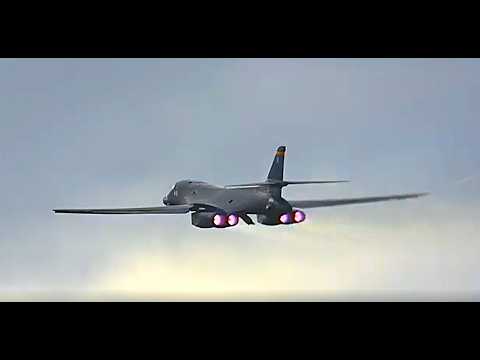
Before the hasty and unexpected departure of the bombers on Sunday, B-1s had been deployed to RAF Fairford continuously since March, initially in support of Operation Epic Fury against Iran. A contingent of B-52s had also conducted strikes on Iran from Fairford, but left back in July. The base is a major operational hub for the U.S. military in the United Kingdom, and regularly hosts strategic aircraft, including bombers and U-2 spy planes.
B-1s first mission to Iran out of RAF Fairford UK
Dan Rivers, U.S. correspondent for ITV News in the United Kingdom, was among the first to report on Monday that the B-1’s quick departure had been prompted by concerns about a potential Spiderweb-like drone attack ordered by Iran, citing an unnamed source. Other outlets have subsequently reported similar details, all sourced to anonymous U.S. and British officials.
“They didn’t fly out by accident,” U.S. President Donald Trump told reporters during a gaggle at the White House on Monday when asked about why the B-1s had left Fairford. “There were some threats.”
“I can’t tell you that, but if they did, they’ll suffer greatly,” Trump added in response to a separate question about whether Iran might have managed to get weaponized drones into the United Kingdom.
“What you saw there was the Secretary of War [Pete Hegseth], out of an abundance of caution, trying to protect our guys,” U.S. Vice President J.D. Vance said during a separate press engagement on Monday. “We do feel, with some confidence, that the Iranians are – they’re trying to do what the Iranian state has done for 49 years, which is engage in acts of terrorism against the United States, and a lot of other people, as well. So, we are being extremely cautious.”
Another satellite image offering an overall view of RAF Fairford. Google Earth
“We’ve documented what happened [near Fairford] last week. I wouldn’t just directly tie that to the move that was made,” U.S. Secretary of State and National Security Advisor Marco Rubio also told members of the press on Monday. “The only reason why you guys are focused on how many planes are at Fairford is because of the threat that happened last week.”
“We have confidence in the security of all of our bases, because all of our bases are [sic] theoretically could be threatened at any moment,” he added.
LIVE: UK police gives update on explosive-related arrests near air base used by US
Rubio’s comments notwithstanding, the remarks from Trump and Vance make clear that there was some recent threat intelligence that contributed to the decision to pull the bombers from Fairford. There are still many questions about the exact nature of the potential attacks, and how imminent, or not, the danger may have been.
Regardless, as mentioned, the prospect of a near-field drone attack on a base like Fairford carried out by actors in close proximity is extremely plausible, and the barrier to entry to such an operation is relatively low. Spiderweb may have thrust this reality into the public consciousness in dramatic fashion, but the danger well predates that operation, and even the start of Russia’s all-out invasion of Ukraine in 2022.
TWZ has been highlighting exactly these kinds of threats in the course of a decade or so now of regular reporting on drone incursions over U.S. and foreign military facilities and critical infrastructure, as well as American naval vessels operating offshore. Langley Air Force Base in Virginia and Barksdale Air Force Base in Louisiana, some of America’s most strategic airbases domestically, are among the facilities that have had to grapple with this in the past. After the Langley incident, in particular, it had become clear to the larger public what we had been reporting for many years, that the United States does not control the airspace over even its most critical military installations.
New footage of yet another act of Russian terrorism on EU soil, showing the drone loaded with explosives on the tarmac at Leipzig/Halle Airport, just meters from a Ukrainian Antonov An-124 cargo aircraft.
— SPRAVDI — Stratcom Centre (@StratcomCentre) August 5, 2026
A drone attack on Fairford would also not necessarily have had to come from somewhere very close by. Longer-range one-way attack drones are steadily proliferating, and can be launched using a variety of methods from positions on the ground, as well as vessels at sea. TWZ explored the very real threat of sea-based drone attacks, including ones conducted covertly, and Iran’s specific ability to carry them out globally, following the leak of an FBI alert back in March.
The proliferation of lower-end one-way-attack drones has ‘democratized’ precision-guided attacks, even for non-state actors. The fielding of automated targeting capabilities, driven by developments in artificial intelligence and machine learning, is also becoming more and more widespread. That technology will soon enable these weapons to find and strike even moving targets on their own. Even without anyone at the controls and without the drone putting out any detectable radio emissions, very effective precision attacks can still be launched at static targets, like known parking areas for aircraft at airbases, just by using basic map coordinates or Google Earth. It’s also worth pointing out here that the definition of a stand-off attack is becoming increasingly blurry, with even quadcopter-type drones capable of flying miles away to conduct a kamikaze attack on a target based on a set of GPS coordinates.
Ukrainian Saker UAV with AI capabilities. The video shows the process of target recognition. It has reportedly already been put to use several times against Russian targets. pic.twitter.com/NVNJyxUjGP
Overall, it is an indisputable fact that aircraft sitting exposed on a flightline are particularly vulnerable to drone attacks, as well as other threats. This is something U.S. military officials have acknowledged themselves. Fairford, where B-1s and other bombers have no option but to park out in the open in well-established areas that are plainly visible from outside the base’s immediate perimeter, is indicative of how American military aircraft are generally positioned on the ground abroad and at home.
As we wrote all the way back in 2017:
“Similar swarming strikes could be unleashed behind the front lines as well, with hugely expensive and low density/high demand combat aircraft being especially vulnerable to this sort of tactic—something General James Holmes alluded to inadvertently while speaking to the Air Force Association, stating:
‘Imagine a world where somebody flies a couple hundred of those and flies one down the intake of my F-22s with just a small weapon on it.’
Actually, it would be even easier to just strike the jets as they sit idle and vulnerable on the flight line. One swarm could see a whole squadron of tightly packed fighters destroyed without even having a chance to fight back.“
This picture of a B-1 at Fairford on March 7 shows how bombers and other aircraft are typically parked at the base. The line of photographers along the fence line also underscores how close those parking spots are to the base’s immediate perimeter. JUSTIN TALLIS / AFP via Getty Images
“I’m not a big fan of hardening infrastructure,” Gen. Kenneth Wilsbach said at a roundtable at the Air and Space Forces Association’s main annual symposium in 2023, offering a prime example of this viewpoint. “The reason is because of the advent of precision-guided weapons … you saw what we did to the Iraqi Air Force and their hardened aircraft shelters. They’re not so hard when you put a 2,000-pound bomb right through the roof.”
Wilsbach was commander of Pacific Air Forces (PACAF) at the time. He subsequently became head of ACC and is now Chief of Staff of the Air Force, the service’s top officer.
“I think that I don’t want to spend a lot of money on hardening shelters. Unless you’re going to send something 100 feet or more underground, we can blow it up, and so can they,” Wilsbach said in an interview with Breaking Defense in July of this year when asked explicitly if his position changed. “So, the economics of building a shelter that is impervious to a strike doesn’t work.”
U.S. Air Force Chief of Staff Gen. Ken Wilsbach speaks during an all-call with personnel at RAF Mildenhall, another base in the United Kingdom, on July 13, 2026. USAF
“I think the economics favor defending your airspace, defending your ground space with systems that can defeat the incoming rounds, versus building a shelter,” he added. “Some people would argue, well, you should do both. Well, that’s even more expensive. And the other thing is, the shelter doesn’t go anywhere.”
It is fair to point out that typical above-ground hardened aircraft shelters are not invulnerable, especially to attacks involving ballistic, cruise, and certain air-launched threats. There are also substantial cost and other factors to consider when it comes to any major military construction effort.
That being said, having more hardened infrastructure also imposes costs and complexities on opponents, who have to dedicate more advanced and costly munitions and other resources to ensure targets are neutralized. Shelters have the knock-on benefit of complicating the targeting process for an enemy by obscuring where aircraft are or are not positioned, to begin with. An opponent has to treat shelters like they are full even if they are empty.
When thinking about hardened aircraft shelters, stereotypical Cold War-era reinforced concrete structures typically come to mind. However, they do not all have to be built to a one-size-fits-all standard with the same degree of hardening across the board to be useful. Shorter-range drone attacks are typically carried out by platforms carrying small explosive charges or that are designed to drop small bomblets. Even longer-range one-way-attack drones generally have smaller warheads than traditional missiles, they also hit with less kinetic energy.
A US Air Force F-16 fighter sits inside a traditional hardened aircraft shelter. USAF
A structure that shields against smaller blasts and shrapnel, also including from cluster munitions that can be readily scattered across wide areas, is one that then has to be addressed by more capable weapons. This could even include mobile or otherwise temporary shelters that offer sufficient concealment and protection.
This picture shows what the Air Force described as a “prototype portable camouflage, concealment, and deception hangar” in use during Exercise Hoodoo Sea in 2023. Air National Guard The prototype portable hangar intended to support camouflage, concealment, and deception efforts in use during an Air National Guard-led exercise in 2023. Air National Guard
Eliminating, or at least substantially mitigating, the lowest rung of threats creates a dilemma for opponents, who then have to decide whether it is even worthwhile to attempt certain types of attacks. There is clear value in narrowing the available options for the enemy and pushing them toward having to expend higher-end, more expensive munitions, that are available in smaller quantities, and that traditional active defenses may be better optimized to handle. As an example, it may be more viable to shoot down a small barrage of incoming cruise missiles than a swarm of dozens of drones.
There are magazine and stockpile depth issues at play here, too. This is something that has also been brought front and center by the conflict with Iran, which has fueled already long-standing concerns about the sufficiency of stockpiles of air defense interceptors, other critical munitions, and the capacity to replenish them quickly. This is something the British government, among others, is also grappling with, as you can read more about in our separate reporting here.
Furthermore, losses of aircraft on the ground are not without their own costs, which are even more lopsided if an opponent can simply use lower-cost weaponized drones. U.S. bombers are particularly expensive and prized assets that are in short supply compared to the level of demand, as seen during the height of combat operations earlier this year against Iran. When it comes to B-1s, specifically, there are only 45 of them left in service today. A dozen of them being knocked out in one go would have major repercussions strategically. Losing even one would also be a propaganda coup for whoever might be responsible.
How many shelters can we build for the upgrade cost of one Zumwalt class DDG that will probably be parted out in 10 years anyway?
On top of all this, the U.S. military simply will not always have the luxury of being able to rapidly relocate aircraft in response to threats. Moving a dozen bombers on short notice takes massive resources. It is not just aircraft that have to be repositioned, but supporting personnel and assets, as well as weapons and fuel. Having to shift to alternate locations could easily have negative impacts on tempo and other aspects of operations, especially in the midst of actual conflict. RAF Fairford is one of only a few bases globally that can support bomber operations for a prolonged period.
“There is value in some light protection against small, unmanned threats,” Gen. Wilsbach also told Breaking Defense in July. “Some of them — just nets that are up that keep a small, few-$100 drone from getting next to a $2 billion aircraft. That actually works, [and is] really cheap.”
A graphic included a contracting notice put out by authorities at Langley Air Force Base in 2024 showing how sunshade-type shelters at the base might be equipped with anti-drone nets. USAF
“It’s not either or,” Wilsbach said in a separate interview with Air & Space Forces Magazine in July. “The net keeps the small UAS [uncrewed aerial system] from getting close to an aircraft that you’re trying to protect… That’s a very inexpensive way to give you some modicum of protection without killing your checkbook on really exquisite defensive systems.”
In spite of these institutional developments, action to implement such recommendations on a broad basis has continued to lag. There still does not appear to be any major department-wide push to build new hardened aircraft shelters or other fortified structures at facilities globally. The U.S. Air Force does have a certain number of hardened aircraft shelters at bases now, especially in the Pacific and Europe.
This is all despite a very visible trend in the construction of new aircraft shelters and other hardened infrastructure elsewhere around the globe, including in China, Russia, North Korea, and Iran. Even before Operation Spiderweb, Russia had already initiated a large-scale effort to build new hardened shelters at various bases, especially on the occupied Crimean Peninsula, in the face of expanding Ukrainian drone and missile attacks. This effort has now extended to building the huge hardened shelters for the country’s bomber force, something the country has never done before.
“It is inappropriate to discuss matters of intelligence, and we will not discuss specific force protection measures,” a U.S. Air Force spokesperson told TWZ yesterday when asked about the reports that Iranian drone threats prompted the recent removal of the B-1s from Fairford. “The Department will continue to assess the threat environment surrounding our installations and take appropriate actions to protect our people, our platforms and the bases where our forces operate from.”
We still do not know exactly how serious or imminent any recent threat to the B-1s at Fairford was that contributed to their hasty departure. Regardless, the reports of concerns about potential drone attacks remain very plausible. The reality here is that a dozen bombers were yanked from a forward operating location in Europe without an adversary ever having to fire a shot. This is a problem set that is only growing, especially as lessons and expertise on low-end weaponized drones from the war in Ukraine are spreading around the globe.
A B-1 bomber seen parked out in the open at RAF Fairford on March 15, 2026. Matthew Horwood/Getty Images
Erecting new aircraft shelters and other hardened infrastructure would not be a full solution to those threats by themselves. At the same time, they would be a valuable added layer of defense, and a passive one that would have a huge logistical footprint to operate once the initial investment is made. The lack of movement to better fortify American airbases globally is only becoming more and more glaring, and it remains to be seen if real action will not occur until lessons are learned in a most unfortunate way.
Matt Baker and his family will be back on screens very soon and fans are thrilled about it
Matt Baker and Nicola Baker (Image: Channel 4)
Countryfile star Matt Baker has shared some “big news” with his followers.
Matt Baker has thrilled his Instagram followers by sharing that he will be back on screens very soon with a brand new series. The Countryfile star confirmed he will be back next week with a new series called Our Farm In The Dales.
Alongside a picture of his family, Matt wrote, “Hi all, got some big news for all of you who enjoyed ‘Our Farm In The Dales’ (the series based on our family farm). We’re back with a new series, but with quite the twist. We’re calling it ‘Our Barn In The Dales’ as Nicola and I are converting the barn, stable, and granary at the end of the courtyard into a cottage…
“We’re deep in an epic adventure which will be spanned across 2 series, the first starting in a couple of weeks, is all the building and conversion stuff, and another series next year will be the interior bits and bobs. Hopefully full of all the things you loved in previous series with the animals, Mum Dad and of not forgetting his classic car – spoiler we finally finish it!”
Content cannot be displayed without consent
He concluded the post, “A massive thanks to all our friends and new builder mates who are making our dream happen. See you in a couple weeks on More4 starting Tuesday 13 October 9pm!”
Matt’s followers were delighted by the announcement and took to the comment section to share their thoughts. One wrote, “We can’t wait for you to see it!”
“Ahhhh, great. We love seeing you all together,” another said while a third added, “That’s brilliant, I can’t wait to watch it. When will it be on TV?”
Someone else added, “Yay!!! Ah this is great news @mattbakerofficial. Lush family viewing. My son, in particular, loves you and wants to be a farmer. He’s in Butsfield YFC! You inspire him so much.”
“Great news! Looking forward to watching the new series,” one fan commented. This isn’t the only TV role Matt has announced recently, as he is returning to the BBC with his first solo series, Matt Baker: Life With Dogs.
The series, produced by his own company Big Circus Media, will explore the diverse roles dogs play in human lives – from working farm dogs to therapy dogs and assistance dogs for those with disabilities.
Matt told The Mirror: “Dogs have been a lifelong passion of mine, and I’m so excited to be making this series about the bond between humans and dogs. The show comes after the 48-year-old recently lost his beloved border collie Bob, leaving him heartbroken. He described Bob as “the ultimate companion through some of the greatest chapters of my life”.
The series will examine how dogs can be trained for medical detection, warning owners of oncoming seizures, as well as their roles in therapy and police work.
Our Barn in the Dales airs on October 13 on More4.
French high school students have been protesting for more than two weeks over conditions in schools, including overcrowded classrooms and staff shortages, and they show no sign of stopping.
The unrest began on September 21 when pupils blockaded a school in the Paris suburb of Creteil, and within a week, their protest had spread across the country with students and police clashing violently.
On September 29, the demonstrations coincided with a nationwide public sector strike, in which teachers joined other state workers against a proposed pay freeze. More than 6,100 people have since been arrested.
With the government under pressure to rein in spending as its debt rises, Al Jazeera looks at how much France invests in education, how it compares with the rest of Europe and how it measures up against what the country spends on healthcare and defence.
How much does France spend on schooling?
According to the latest data from Eurostat, the European Union’s statistics agency, France’s public spending on education amounts to 5.1 percent of its gross domestic product (GDP). That figure does not include private spending, such as school fees paid by families.
The French Ministry of National Education uses a broader measure, known as domestic expenditure on education, which counts all the money that goes into education, whether from the state, local authorities, businesses or households. As well as teaching, it covers adult and continuing training and related costs such as school meals, boarding and transport.
By this measure, France spent 199.2 billion euros ($223bn) on education in 2025, equivalent to 6.7 percent of its GDP and 2.4 billion euros more than in 2024, according to provisional ministry figures.
(Al Jazeera)
Spending has more than doubled since 1980, even after accounting for inflation. But the economy has grown too, so education spending’s share of GDP is lower today than it was in the mid-1990s.
Secondary education accounted for the largest share of spending at 73.7 billion euros (37 percent), followed by primary education at 60 billion euros (30 percent), higher education at 45.6 billion euros (23 percent) and adult and continuing education at 19.7 billion euros (10 percent), according to the National Education Ministry.
How much do other European countries spend on education?
Among European countries, Sweden spends the largest share of its GDP on education at 7.3 percent in 2024, followed by Iceland (7 percent) and Belgium, Estonia and Finland (6.3 percent each), according to Eurostat.
The lowest spenders are Ireland (2.7 percent), Greece (3.9 percent), Romania and Italy (4 percent each), and the United Kingdom and Spain (4.1 percent each).
At 5.1 percent, France is joint 13th, level with the Netherlands and Slovakia, and above the EU average of 4.8 percent.
But above-average spending has not shielded France from a problem affecting much of the developed world. Teacher shortages are growing across countries in the Organisation for Economic Co-operation and Development, according to the OECD’s latest Education at a Glance report.
Rather than leaving posts empty, many countries are filling them with teachers who lack full qualifications. In the 2024-2025 school year, 9 percent of primary and secondary teachers across the OECD were not fully qualified.
In France, the strain is most visible in secondary schools. About 11 percent of secondary teachers are not fully qualified, compared with less than 3 percent in primary schools. Furthermore, lower secondary classes average 26 pupils, compared with 23 across the OECD.
That echoes what pupils have been saying during the latest protests: Classes are large, and absent teachers are not being replaced. Some also described dilapidated buildings, a shortage of tables and chairs and, in some schools, rodent infestations. The intense heatwaves that hit France this year exacerbated existing problems in neglected buildings, many of which have no air conditioning, students said.
Teachers also feel undervalued. Only 4 percent said their profession is valued in society, the lowest share of any country surveyed and far below the OECD average of 22 percent.
How much has spending changed?
Historical UNESCO data showed France’s education spending slipped from 5.5 percent of GDP in 2017 to 5.3 percent in 2022 although it remained the ninth-highest among 29 European countries with data. A brief rise to 5.7 percent in 2020 reflected the pandemic shrinking the economy, not extra spending.
France was one of 14 countries where the share fell. Norway and Denmark saw the steepest drops while Slovakia, Slovenia, Lithuania and the Czech Republic recorded the biggest rises.
What else are these nations spending on?
The protests have coincided with nationwide public sector strikes over the government’s proposed 2027 budget, which seeks 54 billion euros ($61.3bn) in savings as French President Emmanuel Macron’s government tries to rein in a large public deficit.
Unions and public sector workers object in particular to a plan to freeze state employees’ salaries, which is expected to save about 2 billion euros ($2.27bn).
Across Europe, most governments spend more on education than on defence, but healthcare takes the largest share of national income of the three, according to 2022 data from the World Bank and UNESCO.
France spent 11.9 percent of its GDP on healthcare in 2022, one of the highest shares in Europe.
Police say the incident is not connected to ongoing investigations at the RAF Fairford airbase.
Published On 8 Oct 20268 Oct 2026
Police in the United Kingdom say they have arrested and charged a member of the Royal Navy accused of working with an unnamed foreign power after an investigation by counterterrorism police.
Teddy Young, 24, was charged with two offences under the National Security Act for allegedly obtaining protected information and preparing to transfer it for the benefit of a foreign power.
Recommended Stories
list of 4 itemsend of list
In a statement, authorities alleged that between November 2024 and May 2025, Young “obtained, copied, recorded or retained protected information, intending the conduct to benefit a foreign power… contrary to section 1 of the National Security Act 2023″.
Young is due to appear at London’s Westminster Magistrates’ Court later on Thursday.
“These are very serious charges against a serving member of the armed forces,” Commander Helen Flanagan, Head of Counter Terrorism Policing London, said in a statement.
“We have worked extremely closely with relevant operational colleagues within the Ministry of Defence as our investigation has progressed to ensure appropriate measures could be taken to mitigate any potential risks linked to this matter,” she added.
UK media reported that the officer was arrested at his home in Bedfordshire on Tuesday before he was taken into custody in London.
The police clarified that the case is not related to the ongoing investigation into an incident at the RAF Fairford airbase.
Last month, director general Matt Brittin said the BBC’s financial situation and changing audience habits “may well mean” some channels and radio stations have to close so resources can be invested in on-demand services.
Brittin told BBC One’s Sunday With Laura Kuenssberg that “we wouldn’t guarantee any programme or any channel will exist forever”.
In June, the BBC announced 550 job cuts in news, nations and TV and radio content as part of its first stage in its plan to save £500m across the corporation over the next two years.
Staff were told of proposals including ending Radio 4’s The World Tonight, and reducing the number of permanent presenters on Today from five to four, with a single anchor on Saturdays.
It was revealed that BBC One’s Breakfast would no longer be shown on Sunday mornings, and that the production teams making Sunday with Laura Kuenssberg and Newsnight would merge.
It followed April’s announcement that the BBC would cut between 1,800 and 2,000 jobs – or almost one in 10 – in an attempt to tackle “significant financial pressures”.
Last week, an influential group of MPs said the BBC licence fee should be extended to cover services other than TV, and that the corporation’s charter review should be scrapped and made permanent.
In its recommendations, the DCMS committee also said that political appointments to the BBC board should end, to improve public trust.
‘I have the utmost respect for what you’ve accomplished with Argentina,’ Ronaldo writes in response to Messi’s post.
Published On 8 Oct 20268 Oct 2026
Cristiano Ronaldo has hailed his longtime adversary Lionel Messi in a tribute to the Argentinian icon, who bid a grand farewell to international football.
The Portuguese forward wrote the message in response to Messi’s social media post on Wednesday, a day after Argentina’s friendly match against Benin in Buenos Aires, where the local idol and global icon bid an emotional goodbye.
Recommended Stories
list of 4 itemsend of list
“Leo, after so many years of defending your country, you’ve made history that will last forever,” Ronaldo said in his reply to Messi’s Instagram post in which the Argentinian poured out his emotions after hanging up his boots for his country.
“I have the utmost respect for what you’ve accomplished with Argentina,” Ronaldo added, ending the message with: “A hug”.
Ronaldo and Messi in action during a match between Real Madrid and Barcelona in 2017 [File: Sergio Perez/Reuters]
The careers of Messi and Ronaldo followed a similar trajectory and crossed paths for many years in club and international football.
It resulted in a hotly contested rivalry, mostly between the two players’ supporters over the past two decades.
The pair dominated the sport for more than 15 years, winning the prestigious Ballon d’Or award 13 times between them.
Their rivalry grew over the nine years in which they faced off against each other in Spain, with Messi starring for Barcelona and Ronaldo for Real Madrid.
Fans display a banner that reads ‘Ronaldo is Cristiano [Christian], but Messi is God’ during Argentina’s friendly match against Benin at the Monumental Stadium in Buenos Aires [File: Rodrigo Valle/Reuters]
Messi, 39, announced his retirement from international football after leading his country to the World Cup final in July in the United States, where the 2022 champions were runners-up behind Spain.
“Yesterday was my last game, and I already miss wearing the blue and white. I know I’m making the right decision,” Messi said in a lengthy message a day after his final match in the famous number 10 blue and white shirt. “It’s been an incredible journey, full of joy and also some sadness, but I know for sure that every step I took was worth it.”
“I don’t want to forget Diego [Maradona], who put our country where it deserved to be and who, as I always say, I know helped us both by being here with us and also from heaven, with every step we took,” he said.
“Thank you to the clubs where I played, for always respecting my feelings and allowing me to dedicate myself to my country whenever it was time to put on the national team jersey.”
An artist adds final touches to a painting featuring Messi and Ronaldo in Amritsar, India [File: Narinder Nanu/AFP]
Messi scored Argentina’s final goal in a 3-0 win and provided assists for the other two as the Albiceleste played in front of 85,000 fans at the Monumental Stadium.
Messi captained Argentina to the 2022 World Cup title and Copa America triumphs in 2021 and 2024, while also helping them win the 2022 Finalissima.
“I am grateful. I love you all very much; I’m going to miss you, and I will always thank you for having been by our side, by my side,” the Inter Miami playmaker added.
Messi and Ronaldo have vied for recognition as the greatest player of their generation throughout their illustrious careers.
The 41-year-old Portuguese forward was among the hundreds of thousands who responded to Messi’s post.
Messi’s final game came the same day Ronaldo apologised for his controversial departure from the Portuguese national team’s camp after a fallout with coach Jorge Jesus. It remains unclear whether Ronaldo will play for his country again, despite his apology for walking out, which leaves the door open to a return.
Messi and Ronaldo last met on the pitch in an exhibition match in Saudi Arabia in January 2023, when they took fans back in time to the heyday of their storied rivalry, as both forwards got on the scoresheet.
Ronaldo, who plays for Saudi Pro League champions Al Nassr, was part of a Riyadh Season Team that took on Messi’s then-club Paris Saint-Germain (PSG).
Sanaa, Yemen – The Yemeni government’s new military offensive against the Houthis is testing more than the balance of forces in the country – it is also testing whether the government can persuade powerful tribes in Houthi-controlled areas that the balance of power is beginning to shift.
For years, many of the tribes hostile or wary of the Iran-backed Houthis have stopped short of openly confronting the movement, deterred by their military strength and by previous failed uprisings. Those same tribes are now looking to the internationally recognised government’s newly-activated frontlines – on the Red Sea coast, Marib and al-Jawf primarily – to see if the limited advances made since the Dawn of Yemen military operation launch this week can turn into sustained gains.
Recommended Stories
list of 3 itemsend of list
The offensive by the Saudi Arabia-backed government forces follows major Houthi gains in September, when the armed group also known as Ansar Allah (Arabic for Supporters of God) swept across the country’s Red Sea coast. The Houthis captured vital trade corridors, including the port city of Mocha and territory around the Bab al-Mandeb Strait, one of the world’s most important shipping routes.
While airstrikes have inflicted losses on Houthi forces over the past few days, pushing towards Houthi strongholds where the group has been entrenched since the war started in 2014, including Sanaa, Saada, and Amran, remains a formidable challenge.
With the government declaring an all-out war on the Houthis, pledging to recapture Sanaa, tribal distrust of the government may diminish, prompting tribes to shift positions at the right time, experts say. The role of the tribes could therefore prove critical to the government’s ability to advance deeper into Houthi-controlled territories.
On Monday, Marib governorate – the government’s stronghold in the north – saw a large tribal rally attended by tribal sheikhs and local anti-Houthi fighters from tribes such as the Jadan from Marib, Nihm from Sanaa and other allied tribes.
The rally announced a general mobilisation to support the armed forces in the battle to “restore the state and topple the Houthi coup”.
“If this tribal support translates into actual mobilisation and sustained participation in the battle, tribes will help government troops advance toward Houthi-controlled areas and the Houthi heartland, including Sanaa,” said Adel Dashela, a researcher at the Sana’a Center for Strategic Studies.
Over the past decade of war in Yemen, tribes have repeatedly mobilised against the Houthis at a local level, but deep divisions and a lack of sustained outside backing have prevented the emergence of a unified tribal front. Nevertheless, tribes can potentially be a key source of manpower and influence for the government.
“Tribal fighters remain indispensable to any future campaign against the Houthis. But to be effective, their military engagement must occur through formalised state and coalition command structures, rather than as an independent vanguard,” Dashela said.
‘Wait for the right time’
Tribes in Yemen do not want to risk confronting Houthi forces without support, and they “wait for the right time” to act, Abdulsalam Mohammed, chairman of the Yemeni Abaad Studies and Research Center, said.
“The tribes seek a powerful state, and once they find the state reliable, they can side with it,” Mohammed said.
He added that tribes do not want to repeat mistakes made by tribes that had rebelled against the Houthis, and then not received enough support from the government.
“Those tribes revolted against the Houthis, and they were crushed amid the absence of the government’s effective role,” Mohammed said.
In January 2019, fighting broke out between the Houthis and the Hajoor tribe in northwest Yemen’s Hajjah, lasting several weeks. The Houthis eventually captured the Hajoor areas in March of the same year.
At the time, Saudi Arabia dropped food, medical supplies and weapons to besieged Hajoor fighters, but this did not prevent the tribe’s defeat by the Houthis.
Mohammed said that even in areas where the Houthis have local support, some tribes could gradually shift their allegiance towards the government, if they saw it as serving their interest.
“Not all tribes fighting for the Houthis are staunch supporters. Their motivations range from pragmatism to ideological loyalty and material necessity,” Mohammed said.
‘A friend of the tribe’
Over the past decade, the Houthis have weakened traditional tribal power structures in areas under their control, co-opting some leaders and replacing others with loyalists. They have defeated tribal challenges, and have withstood not only conflict with the Yemeni government and Saudi Arabia, but also bombing by the United States, the United Kingdom and Israel. All of that has reinforced a perception among tribes that the Houthi military capability had become “invincible”.
A tribal sheikh in northern Yemen, who asked not to be named for security reasons, told Al Jazeera that the Houthi military “supremacy” in the country over a decade-long war has “dwarfed the political and military role of the tribe”.
“Before the Houthi takeover of power, the government was like a friend of the tribe,” he said. “Today, the tribe is subordinate to the Houthis.”
The Houthis, according to him, used three tactics to tighten their grip on territories under their control: military force, financial incentives and their public identification with the Palestinian cause.
“The Houthis used military force if negotiations or financial incentives failed to win the tribes’ backing. Moreover, the Houthi military support for Palestine has earned the group additional popular and tribal support,” said the tribal figure.
As the Houthis built up enormous military and financial power over the past few years, the tribal sheikh said tribes acting alone could not match the group’s power. He also said that the government’s reported gains on some frontlines could not by themselves be taken as a sign that the Houthis were collapsing.
“A concrete government advance on the battlefields would reassure some Yemeni tribes that the Houthis have lost ground,” the tribal sheikh said. “Once this materialises, anti-Houthi and neutral tribes can feel confident and begin confronting the group.”
In the past three years, following the October 7 attacks and the start of Israel’s genocidal war on Gaza, the wider region has been marked by conflict, economic turmoil, and a shattering of the balance of power.
The network of alliances maintained by Iran, long central to its regional power, has been hit hard and severely weakened. Yemen’s Houthi rebels remain one notable exception.
Recommended Stories
list of 4 itemsend of list
Israel has made gains. Many of the leaders of the Lebanese group Hezbollah and the Palestinian group Hamas have been killed, while Iranian Supreme Leader Ayatollah Ali Khamenei was also assassinated in February. Israel occupies most of Gaza, where it has also killed more than 74,000 Palestinians and reduced much of the enclave to rubble.
Its military aggression has come at a cost, isolating it from its traditional allies and making it globally unpopular, including in the United States. The potential for more normalisation deals with Arab countries seems unlikely, at least in the short term.
Instead, Israel continues to launch attacks across the region, crossing previously held red lines – such as the 2025 attack on Doha, Qatar – and making many governments around the world view it as the primary source of unrest in the Middle East.
US not a protector
“Before October 7, the US’s entire policy in the Middle East rested on normalising Israel’s presence in the region through its so-called Abraham Accords,” HA Hellyer of the Royal United Services Institute said, referring to the normalisation deals with several Arab states, including the United Arab Emirates. “Israel’s response to the October 7 attack ended that.”
Instead, rather than a stable Middle East with Israel at its centre, the US entered into a war with Iran this year, and has since looked on as Tehran targeted US allies across the Gulf, shattering the perceived security of the US security umbrella.
Drones and missiles hit Qatar’s Ras Laffan gas hub and started fires near Dubai airport and at Fujairah’s oil zone. In September, the Houthis surged down Yemen’s Red Sea coast, taking the port of Mocha and nearby islands. Their gains tightened their grip on the Bab al-Mandeb strait, threatening a key route for global trade and energy supplies that had become even more important amid disruption in the Strait of Hormuz.
“There’s been a loss of faith in the US as a singularly sufficient security guarantor,” Hellyer continued.
“This is why you’re seeing many in the region talk to other external actors, in addition to continuing, and in some cases deepening their US ties, as well as initiatives such as the Mecca security pact as states in the region look elsewhere for ways to safeguard their security,” he said, referring to the defence agreement between Saudi Arabia, Turkiye and Pakistan, signed in August, agreeing that an attack on one was to be regarded as an attack on all.
Iranians walk near an anti-Trump billboard in Tehran, Iran, August 19, 2026 [Abedin Taherkenareh/EPA]
Alliances
Alongside the loss of confidence in the US as a security guarantor has come a dramatic reordering of alliances and rivalries. Much of Iran’s network – most notably Hezbollah, whose reputation had long served as a deterrent against Israeli attack – appeared to buckle under Israeli pressure.
“The Middle East has always been multi-aligned. However, now it’s even more so,” Sanam Vakil, the director of the Middle East and North Africa Programme at Chatham House, said of the increased leverage given to external actors, such as Turkiye in Syria and China’s involvement in negotiations over the end to war on Iran, as Beijing finds its own energy supplies under threat.
“It’s ironic, since October 7, it’s Israel that has emerged as the revisionist power and Iran almost as the status quo power,” she said of the apparent reversal in status of the two belligerents, with Tehran seemingly more focused on regaining the ground it has lost in the last three years rather than advancing beyond them.
However, none of this was to overstate Israeli influence, or liken it to a regional superpower, Vakil cautioned. “Israel may currently be the preponderant military power in the Middle East, but real power is typically classed as being able to project stability, which Israel hasn’t shown itself able or willing to do,” she said.
Clogged arteries
While Israel and the US hoped February’s attacks would swiftly topple Iran’s government, they have instead opened a new front. Tehran now wields economic leverage over Israel, the US and their partners through the Strait of Hormuz, which borders Iran and typically carries about a fifth of the world’s oil and gas, and through Bab al-Mandeb, which is now threatened by its Houthi allies.
Whatever Tehran’s intentions, the economic pain has been uneven. The West, cushioned by emergency reserves, record US oil production and supplies from countries such as Norway, has so far avoided the turmoil of the 1970s oil shocks, when US drivers queued for petrol, even though the current disruption is on a greater scale. In April, the International Monetary Fund trimmed its 2026 global growth forecast only slightly, to 3.1 percent from 3.3 percent.
Gulf exporters, in contrast, have fared far worse. The same assessment cut its forecast for Saudi Arabia from 4.5 to 3.1 percent, and turned Qatar’s from growth of 6.1 percent into a contraction of 8.6 percent.
“It’s curious, in many ways the West’s reduced need for Gulf oil has increased the degree to which Israel has become a liability for the US,” Israeli political economist Shir Hever told Al Jazeera, referring to a diplomatic alliance between the two states long underpinned by Israel’s strategic position in an oil-rich region central to US interests.
“There’s a train of thought in Israel that the current crises may push the Gulf states into allying with it,” he said, while noting the irony that Israel had been the main aggressor in the conflicts that followed October 7. “Though that seems fairly unlikely.”
Thursday marks 30 days since Israel’s foreign minister ordered the closure of the UK consulate in occupied East Jerusalem.
Published On 8 Oct 20268 Oct 2026
Workers at the UK consulate in occupied East Jerusalem have removed its signage as the Israeli shutdown deadline arrives, further damaging strained ties between allies.
Journalists from the Reuters news agency saw workers remove a plaque reading “British Consulate General” from the building on Thursday, as well as another sign for its consular section. The UK flag was still flying over the building.
Recommended Stories
list of 3 itemsend of list
Thursday marks 30 days since Israeli Foreign Minister Gideon Saar ordered the closure of the consulate in occupied East Jerusalem. The move was in response to the UK’s wave of sanctions on illegal Israeli settlements, including a ban on importing goods made there.
The United Nations and most countries consider the settlements illegal under international law. Israel disputes this.
The United Kingdom threatened to expel 27 Israeli diplomats if Israel proceeded to close the consulate in occupied East Jerusalem, according to unverified Israeli media reports.
The consulate has not responded to an immediate request for comment.
Israel has been adamant the consulate will close even as the UK has sought to keep it open, including sending the country’s top national security adviser to Israel last week for talks.
The UK’s presence in the city dates back almost 200 years, long before the state of Israel was established in 1948. The closure order does not affect the UK’s embassy in Tel Aviv, which handles diplomatic relations with Israel’s government.
The consulate, in the Sheikh Jarrah neighbourhood of occupied East Jerusalem, handles the UK’s relations with Palestinians in Jerusalem, as well as in the occupied West Bank and Gaza. It also provides consular services to Palestinians.
The UK Foreign Office on Wednesday declined to comment when asked whether the consulate was still operating or if diplomats working there had returned to the UK.
Despite the current strains, the UK and Israel are close economic, security and intelligence partners.
Hundreds took to the streets of Bogota to protest the ongoing genocide in Gaza.
Published On 8 Oct 20268 Oct 2026
Protesters have rallied in Colombia’s capital opposing the new far-right government’s policy towards Israel.
Hundreds took to the streets of Bogota on Wednesday to protest against the ongoing genocide in Gaza and the Colombian government’s decision to restore diplomatic and economic relations with Israel.
Recommended Stories
list of 3 itemsend of list
The protesters, who began their rally in front of the Israeli embassy in Bogota, criticised President Abelardo de la Espriella’s decision to open a new Colombian embassy in Jerusalem.
The rally marked three years since the Hamas-led attacks of October 7, 2023, which were followed by Israel launching a genocidal war on Gaza.
“When diplomatic relations with Israel were broken off, the message was that we would not be a nation complicit in their atrocities,” Nicolas Isaza, who took part in the protest, told Al Jazeera.
“Today our government is no longer drawing a line against the atrocities being committed in Palestine,” he added.
De la Espriella, who was sworn in as president in August, promised close relations with the US and Israel during his election campaign as a way to combat armed groups in his country.
Colombia’s government has since restored relations with Israel after former President Gustavo Petro, who criticised Israel’s genocidal war on Gaza, severed diplomatic relations and halted Israeli arms imports.
The Colombian government also recognised Israel’s claim of sovereignty over the occupied Syrian Golan Heights, just days after the new president took power.
Burnham is set to be greeted with military honours at the German capital’s Chancellery ahead of his first face-to-face meeting with the chancellor.
On Thursday, the two leaders will formally ratify the 2025 Kensington Treaty, a partnership committing both countries to tackle hostile activity through deeper cooperation on science, technology, defence, security and growth.
Speaking ahead of the visit, Burnham said the UK and Germany were “joining forces to find, expose and disrupt” threats.
He continued: “Attacks on our infrastructure, our businesses and our democracies are not a distant threat.
“They reach into people’s homes and workplaces, and they are designed to make us weaker and more divided.”
European leaders have warned the threat of hybrid attacks against Europe by Russia has intensified in recent weeks.
Hybrid warfare or hybrid attacks are loose terms which tend to describe non-military methods designed to exert pressure and destabilise an adversary – for example cyber attacks, sabotage or misinformation.
Last month, a senior Russian diplomat was summoned by the British government over an “egregious and reckless attack” on Leipzig airport.
It is a major international freight hub used for providing support to Ukraine. Moscow has denied any involvement in the incident.
Meanwhile, questions have also been raised this week about Germany’s reliability as an intelligence partner, following the bombshell arrest of a former spy chief on suspicion of espionage.
August Hanning has been accused of espionage, treason and obtaining classified information for a foreign power, the German Federal Prosecutor’s Office says.
He ran the Federal Intelligence Service (BND) from 1998 to 2005 and has since been working as a private consultant.
The talks also come during a period in which Merz’s own political future has come under intense scrutiny.
Burnham replaced Prime Minister Sir Keir Starmer in July after the former leader was forced out by his own MPs just two years after winning a landslide election victory.
Similarly, Merz has faced persistent rumours he could be replaced by his party due to his poor approval ratings and following setbacks in regional elections.
Although the chancellor appears to have overcome an immediate crisis in his leadership, questions remain over his future.