Talks will focus on the €1 billion daily deficit and rare earth export restrictions.
Published On 7 Oct 20267 Oct 2026
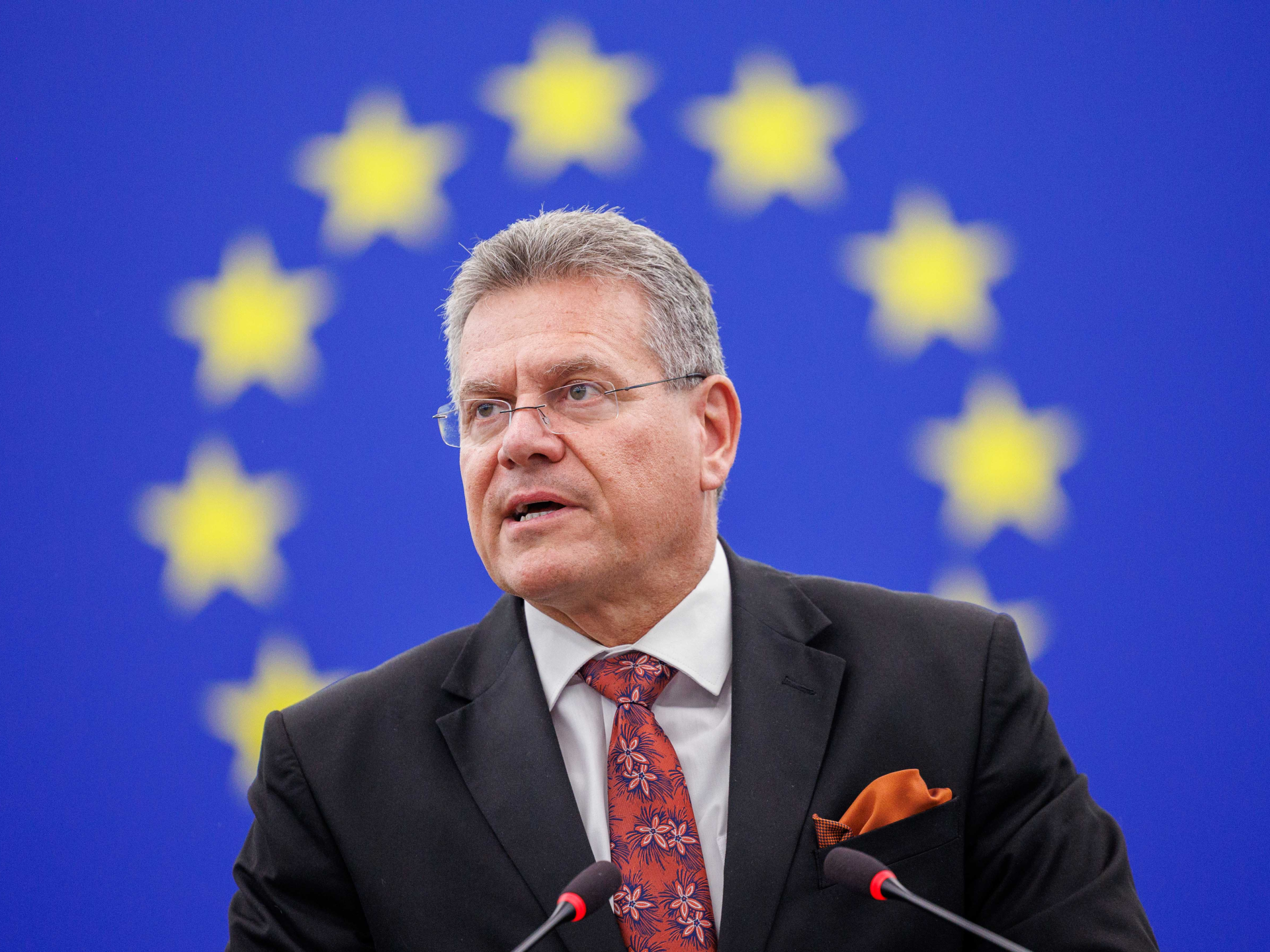
European Trade Commissioner Maros Sefcovic has arrived in Beijing for talks on the European Union’s (EU) growing trade deficit with China.
Sefcovic will meet Chinese Commerce Minister Wang Wentao on Thursday and Friday after months of discussions over the EU’s trade deficit of more than €1bn ($1.12bn) daily, as well as Chinese curbs on exports of rare earths and other critical minerals.
Recommended Stories
list of 3 itemsend of list
Meanwhile, Chinese companies are increasingly challenging Europe’s top car brands. China rejected the EU request for voluntary curbs on Chinese hybrid car exports as the two sides enter negotiations, the Financial Times reported on Wednesday. The European Commission now hopes to get Beijing to accept a unilateral EU measure to cap hybrid imports instead, the outlet said, citing two diplomats briefed on the plan.
The two days of discussions come just as a majority of EU lawmakers called for a more assertive trade policy towards Beijing in a non-binding resolution on Wednesday. China vowed a “resolute response” to safeguard its industries if the European Union goes ahead with restrictions against Chinese companies or products, according to its commerce ministry.
Germany and France propose rapid EU measure
French President Emmanuel Macron and German Chancellor Friedrich Merz, leaders of the bloc’s two biggest powers, on Tuesday urged the EU to prepare a “credible instrument” that could be quickly activated to strike back against countries that harm the bloc economically.
The new measure would not target any specific country. German officials said the EU needed a tool as powerful as the Section 301 tariffs imposed by the United States or China’s restrictions on critical-mineral exports.
The proposed weapon – to be discussed at an EU leaders’ summit next week – would give the European Commission the power to respond to a trade aggression within days.
China responded to the letter by urging Paris and Berlin to steer clear of “protectionist” measures.
“We hope that France and Germany, as major economies in the world, will uphold openness, cooperation and free trade,” the commerce ministry said in a statement.
“They should avoid going down the wrong path in the wrong way, only to ultimately suffer the consequences themselves.”
G20 finance leaders, except China’s, agreed in September to act against “non-market” distortions that exacerbate imbalances. Beijing says that hyping up issues such as economic imbalances and overcapacity is a form of protectionism designed to exert pressure on and restrict China.
Ongoing trade talks
EU and Chinese officials have been discussing trade imbalances since June. Sefcovic said he wanted “tangible results by October” as well as some form of commitment that can be put to EU leaders meeting in Brussels.
Trade relations with China top the summit’s agenda next week, as ballooning debt has prompted auditors to warn about the next seven-year EU budget and has spurred protests in France.
European Commission President Ursula von der Leyen told the European Parliament last month that the trade imbalance had reached a tipping point and that Europe would use every tool at its disposal to rebalance the relationship.
The United Nations Interim Force in Lebanon said there were no casualties after small arms fire targeted a border post.
Published On 7 Oct 20267 Oct 2026
The United Nations Interim Force in Lebanon (UNIFIL) says one of its posts on the Lebanon-Israel border was targeted by small arms fire, with no casualties reported.
The UN force said the incident occurred on Wednesday morning with several rounds of small arms fire targeting a UNIFIL position near Kfar Shouba along the UN-drawn border with Israel, known as the Blue Line.
Recommended Stories
list of 3 itemsend of list
“Such deliberate attacks gravely endanger the lives of peacekeepers,” UNIFIL said in a statement, adding that it was investigating the incident.
Under pressure from the United States and Israel, the UN Security Council decided earlier this year to set December 31 as the end of the mandate for the UN peacekeeping force in Lebanon.
UNIFIL was initially created to oversee the withdrawal of Israeli troops from southern Lebanon after Israel’s 1978 invasion, and its mandate has been renewed annually since then.
The mission was expanded after the 2006 war between Israel and Hezbollah. Proponents say it remains important to maintaining a demilitarised buffer between the two sides along the volatile Israeli and Lebanese border.
Israel has long accused UNIFIL of failing to prevent threats posed by Hezbollah and has increasingly pushed for the end of its mission since cross-border fighting escalated in the wake of the October 7, 2023, Hamas-led attacks on Israel and the start of Israel’s war on Gaza.
UNIFIL currently has 7,500 peacekeepers from around 50 countries operating in Southern Lebanon.
Last month, Lebanon’s Prime Minister Nawaf Salam pressed the UN on the need to “avert the vacuum” that would be caused by withdrawing the mission from the country’s south without a viable replacement.
Violence has decreased since a ceasefire following a June memorandum of understanding in the US-Iran war. Lebanon and Israel concluded a US-sponsored framework agreement later that month.
The Israel-Lebanon deal involves the disarmament of Hezbollah, a gradual withdrawal of Israeli forces from Lebanon’s south and the deployment of the Lebanese army to the region, starting in test areas known as “pilot zones”.
Thousands of people have taken to the streets of Rio de Janeiro in a student-led protest against presidential candidate Flavio Bolsonaro and the growing influence of Brazil’s far right.
The march happened on Wednesday, just days after far-right Senator Flavio Bolsonaro, the son of former President Jair Bolsonaro, earned the most votes in the first round of the country’s presidential race.
Bolsonaro won 47 percent, ahead of his closest rival, incumbent left-wing President Luiz Inacio Lula da Silva, who gained 45 percent support.
Since neither candidate surpassed the 50 percent threshold, they will face each other in a run-off on October 25.
The results have triggered fears that Brazil could become the latest Latin American country to see its presidency switch from left to right.
Protesters marched through downtown Rio carrying signs reading “Never again Bolsonaro” and “No to the father, no to the son”. Others held banners reading “Dictatorship never again” and “Get out Bolsonaro”.
“I’m here because I believe in democracy. Because I’m scared,” said Alice Carneiro, 25, an administrator in maritime shipping who participated in the protests. She explained that, under a far-right government, she feared a backlash against her wife, who is transgender.
Jair Bolsonaro, the former president, led the country from 2019 to 2023. But his single-term tenure was marked by a series of controversies related to his far-right policies.
He voiced support for Brazil’s past military dictatorship, which was responsible for the disappearance and murder of hundreds of perceived dissidents. He also spread unfounded claims about the accuracy of Brazil’s election system, leading to a court ruling that barred him from holding office for eight years.
Currently, the former president is serving a 27-year sentence after being convicted of plotting to overturn his 2022 election defeat. After Lula’s inauguration in 2023, Bolsonaro’s supporters stormed government buildings in the capital, reportedly hoping to trigger a military uprising.
Critics have framed Jair Bolsonaro’s actions as a threat to Brazil’s democracy.
But Senator Flavio Bolsonaro has received his father’s endorsement, and he has backed amnesty for his father, a prospect that has raised concerns among protesters.
“I find this rise of the far right and the rise of Bolsonarism in Brazil very, very sad,” said Emmanuel Araujo, 19, who is preparing for university entrance exams.
“Lula might not be my preferred candidate,” Araujo added, “but amid this barbarism, we have to choose between someone we can keep criticising and someone who might take away our right to speak.”
Australia play their first Test in South Africa since the 2018 ball-tampering scandal when they start a three-match series in Durban on Friday, with the visitors unlikely to face more than a few heckles over the incident that rocked the sport eight years ago.
The tourists’ efforts to roughen up the ball using sandpaper to aid reverse swing in Cape Town in March 2018 were caught on camera and led to a major reckoning for the game in Australia, with captain Steve Smith among those banned for their role in the subterfuge.
Recommended Stories
list of 4 itemsend of list
Al Jazeera Sport takes a closer look at the first Test battle in South Africa since the infamous series.
What is the context for the first return of series since ‘Sandpapergate’
South Africa have played Tests in Australia since ‘Sandpapergate’, and Australia have toured South Africa in the interim for limited-overs internationals.
The scandal has attracted little media focus in South Africa over recent weeks in comparison to the attention devoted to the incident in the Australian press.
After dethroning Australia last year in a thrilling World Test Championship (WTC) final at Lord’s to win a first major title, South Africa are focused on improving their chances of a return to the final at the end of the 2025–27 WTC cycle.
What shape are South Africa in for the visit of Australia?
The pitch at Kingsmead often proves a fickle track but should offer the spinners a chance to play a leading role in a change from South Africa’s usually seamer-friendly surfaces.
It is unusual for South Africa’s chances to be largely entrusted to their spin attack, but Simon Harmer and Keshav Maharaj wreaked havoc in India last November when they triumphed in their last two Test outings.
Spin was also a key factor for the home side as they beat Australia in the recent One-Day International series.
South Africa may therefore opt to rest frontline attack bowler Kagiso Rabada from the Test as he continues his comeback from a hamstring injury.
South Africa also have a choice to make over their number three batsman, with coach Shukri Conrad having several options including a potential first cap for 30-year-old Marques Ackerman.
How are Australia poised for their South Africa return?
Australia are also in need of a boost after a surprise home Test defeat by Bangladesh in August in their drawn series, and with an Ashes tour to England starting next June.
Injury to Australia all-rounder Cameron Green opens up a chance at number five for Cooper Connolly, or a fairytale return for 34-year-old Nic Maddinson after recovering from cancer.
Head hits back at former Australia players in defence of Test team
Australia opener Travis Head has taken to task former Test players turned critics whom he accused on Wednesday of “putting a bullet” through the current team.
Head did not single out any pundit directly, but his strong remarks at a news conference came the day after Matthew Hayden, one-time holder of the record for the most runs in a Test innings, accused selectors of “promoting the greatest pile of mediocrity that we’ve seen in a generation of cricket”.
The reference, made in a podcast, was about the recall of Maddinson, who has been out of Test cricket for nearly 10 years, but who joined the squad in South Africa after Josh Inglis fractured his finger and Cameron Green suffered a stomach injury.
“I think it’s unfairly judged a fair bit from a group of past players, pretty much that put the bullet through a lot of players, which I think is unfair,” Head said.
“But that’s what they’re paid to do. Some of them need a job, so they go after us, and that’s totally fine.
“This group is strong enough to deal with those sorts of things. That’s how it is. It’s unfortunate sometimes to have some of that feedback from a generation of players that we have huge respect for, but that’s the caper.”
Why have Australia selectors been accused of disrespecting cricket?
Hayden accused the selectors of “disrespecting first-class cricket”, asserting that batsmen should have an average of 45 runs or more before being considered for Test selection.
Head, however, praised Maddinson’s abilities and the benefits of choosing experienced players for Test cricket despite the 34-year-old replacement having a first-class average of 37.11.
“We need mature guys that know what they need to be doing,” Head said. “That revolves back to why we’ve been so good over a period of time, and why Australian cricket was so good back then in that era, because you’d bring in the Mike Husseys of the world, who are 30, who are tried and tested and know what they need to do.”
Former Australia captain Allan Border suggested that the 32-year-old Head would face his toughest test as an opener against the South African bowling attack and would perhaps be better batting at number five.
“I have laughed at a fair bit of it because if a traditional opening batter had pushed out the same sort of numbers in his first 20 innings, I think he’d be pretty safe and not talked about in the way that it has been talked about,” Head said. “It’s a lot of headline stuff.”
South African fans hold up a banner with reference to the sandpaper scandal during the fourth Test against Australia in 2018 [File: Gavin Barker/EPA]
Smith still traumatised by Sandpapergate
In the build-up to the series, Smith has admitted he is still traumatised by “Sandpapergate” – the series he oversaw as captain.
The prolific batter was sent home in disgrace, banned for a year and sacked as captain for his role in the ball-tampering scandal during the third Test in Cape Town eight years ago.
David Warner, considered the ringleader, was suspended for 12 months and stripped of all leadership roles, while Cameron Bancroft was slapped with a nine-month ban.
Smith said he still suffers flashbacks to a traumatic period of his life, haunted by memories of leaving Johannesburg airport, with cameras clicking furiously around him, and a harrowing Sydney news conference on his return when he broke down in tears.
“I’m not a big fan of cameras … I get anxious around cameras to be honest,” he told News Corp.
“That was a traumatic experience in my life, and when I hear the flash of a camera it makes me revisit that in a way.
“The 24-48 hours of being told by James Sutherland [then Cricket Australia chief executive] that I was getting banned for a year. That and going through the airport in Johannesburg getting absolutely mobbed, and then flying back and doing that press conference.
“I still have little flashbacks here and there of it.”
Smith bore the brunt of the scandal that is considered one of Australian sport’s darkest moments, but bounced back emphatically.
He smashed a superb century against England on his return and has gone from strength to strength, with 10,920 Test runs so far at an average of 56.
“It was certainly a difficult period, particularly the initial period a few days after,” he said.
“The mental state I was in was not great. That’s somewhere I’d like not to get to again, but I certainly learned from that and have been able to move forward with my life.
“I’ve tried to kind of erase a lot of 2018 and what happened,” he added.
“I can’t remember a lot about the series. I’ve tried to block most of it out of my memory bank.”
Smith has been back to South Africa for a white-ball series since 2018, but not for a Test, and he is bracing for hostile crowds.
But the 37-year-old is unperturbed, having negotiated multiple Ashes tours to England since 2018, where the Barmy Army abused him relentlessly.
“It’s something I’m kind of used to. I’ve copped a lot at times away from home at different venues across my career and it’s something that I take in my own stride,” he said.
“I use it as motivation to try and go out and do well and try and take a positive from it.”
A Gallup survey highlights a deep – and historic – partisan divide over confidence in the country’s elections.
Published On 7 Oct 20267 Oct 2026
With less than a month to go before the United States’ pivotal midterms, a new survey found that most independent voters and supporters of President Donald Trump’s Republican Party do not believe the elections will be honest.
Polling from Gallup, released on Wednesday, found 37 percent of Republicans and 35 percent of independents have confidence in the country’s electoral system, significantly lower than US Democrats (63 percent).
Recommended Stories
list of 3 itemsend of list
Overall, 49 percent of Americans said they were confident in the honesty of elections, while 51 percent said they were not. Those figures are unchanged from the country’s last midterm election in 2022.
This “marks a change from 2025, the first year of Trump’s second term, when confidence was nominally higher among approvers (51 percent) than disapprovers (45 percent)”, Gallup wrote in a statement highlighting the results of the survey.
The numbers highlight a deep, historic partisan divide over confidence in US elections.
“Since 2025 and Trump’s return to the White House, the relationship between leadership approval and confidence in elections has disappeared,” Gallup wrote.
Gallup said that the US is the only country out of more than 100 polled annually over the past 15 years to show this pattern – trust in US election integrity is markedly higher among those who disapprove of the country’s leadership under Trump (52 percent) than those who approve (41 percent).
In more than 100 countries where the polling organisation tracks views of national leadership and confidence in elections, people who approve of their governments have generally been more likely to trust their country’s elections.
In 2025, 70 percent of people globally who approved of their national leadership expressed confidence in the honesty of their elections, compared with 30 percent among those who disapproved.
“The current US pattern is highly unusual compared with the rest of the world,” Gallup wrote.
Under former US President Joe Biden, 81 percent of Americans who approved of the government expressed confidence in elections, compared with just 30 percent of those who disapproved, according to Gallup.
Gallup said the unusual divide could have implications for the November elections, raising questions about whether some voters will view the results as legitimate.
The White House did not respond to a request for comment.
Rahul Gandhi has been arrested several times at protests demanding the resignation of poll body chief.
Published On 7 Oct 20267 Oct 2026
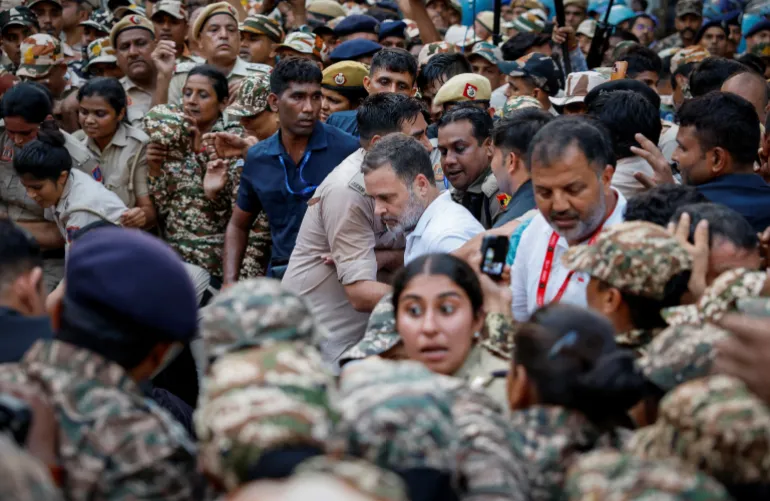
Indian opposition leader Rahul Gandhi has been detained for the third time in two days during a protest demanding the resignation of the election chief over a controversial revision of voter lists.
Gandhi and other opposition lawmakers were apprehended by police on Wednesday as they marched towards Jantar Mantar, a designated protest site in India’s capital, New Delhi.
Recommended Stories
list of 3 itemsend of list
A live feed on the YouTube channel of Gandhi’s Congress Party showed police taking him into a vehicle and driving away. Authorities also detained several other opposition lawmakers and protesters.
Opposition parties, their student units and the “Cockroach” youth movement have been demanding the resignation of Chief Election Commissioner Gyanesh Kumar, accusing the poll body he heads of benefiting Prime Minister Narendra Modi’s ruling Bharatiya Janata Party.
India’s Election Commission has so far removed more than 130 million names from the voter lists, with millions appealing the removals. About 969 million people were eligible to vote in the 2024 election.
Protesters allege the changes disproportionately removed voters who support opposition parties while preserving or adding voters more likely to back Modi’s party.
Police detain Indian opposition leader Rahul Gandhi during a protest organised by opposition parties in New Delhi [Adnan Abidi/Reuters]
The commission and government deny the allegations. They say the revision has no political motive but is aimed at removing duplicate and ineligible entries while ensuring eligible voters remain registered.
Opposition lawmakers led by Gandhi protested on Tuesday as well, before police broke up their gathering and briefly detained them.
Speaking before his detention on Wednesday, Gandhi said protesters showed up unannounced after Delhi police “stopped” their gathering the day before.
“We will go to the designated protest site, sit there, and tell the country that, for us, Gyanesh Kumar is not the legitimate commissioner,” he told reporters, referring to Jantar Mantar.
“The people who have done this [vote theft] are traitors … Gyanesh Kumar will have to resign,” he added.
There was no immediate comment from the police on the detentions.
The demonstrations present a new political challenge to Modi midway into his third term, just months after similar protests led by the Cockroach Janta Party youth movement forced the resignation of his education minister over exam paper leaks.
The “Cockroach” protests, one of the most visible signs of public dissent against Modi’s government in recent years, reflected growing anger over job scarcity, corruption and a lack of government accountability.
Eritrea dismisses allegation as Ethiopia’s pretext for more war.
Published On 7 Oct 20267 Oct 2026
Eritrean soldiers have been seen driving through a northern town inside Ethiopia, witnesses tell the Reuters news agency, days after the neighbouring countries severed ties.
At least two witnesses told Reuters they saw “dozens” of Eritrean soldiers drive through Adigrat in two trucks on Wednesday. The town is located 25km (15 miles) south of the border with Eritrea.
The witnesses said they could identify the soldiers as Eritrean by their off-white camouflage uniforms.
Another Adigrat resident who was not in town at the time said family members had told him they had also seen Eritrean troops, according to Reuters, which could not independently verify their accounts.
“The Eritrean army has entered Tigray in uniform, equipped with heavy weaponry,” said Gebreigziabher Beyene, commander of the Tigray Peace Force, a pro-government militia that has fought alongside the federal army.
“This force is being struck by drones,” he said, adding Eritrea was “deliberately deploying its forces so that the fighting takes place inside Tigray rather than spilling into Eritrea”.
Last week, the chief administrator in Ethiopia’s northeastern Afar region said Eritrean troops were fighting in the area, but Reuters was unable to confirm the claim.
In a statement on X, Eritrea’s Information Minister Yemane Meskel did not deny that troops had crossed the border, but said Ethiopia’s government was creating “a fallacious narrative of ‘self-defense’ to rationalise and camouflage its war of aggression”.
If confirmed, it would mark the first time Eritrean forces have been seen inside Ethiopia since the renewal of fighting between Ethiopian forces and a seven-group armed alliance, including the Tigray People’s Liberation Front (TPLF), on September 23.
Ethiopia has accused Eritrea, as well as Egypt and Sudan of backing the armed alliance which is fighting to remove the government. All three countries have denied involvement.
Eritrea announced it was severing ties with Ethiopia on Thursday after Addis Ababa announced it would close its embassy in Asmara and expel 10 Eritrean diplomats.
In a statement, Eritrea’s Ministry of Foreign Affairs said Ethiopia’s actions had left it with “no option but to reciprocate in kind and sever all diplomatic ties with Ethiopia”.
Members of the Ethiopian pro-government Tigray Peace Force (TPF) give a thumbs up to residents after Ethiopian federal and allied forces entered the Tigray capital of Mekelle on October 4, 2026 [AFP]
On Monday, Ethiopian forces captured Tigray’s regional capital Mekelle, days after the TPLF confirmed that it had withdrawn from the city and moved its regional administration “temporarily” to another location.
It happened as Ethiopia’s Prime Minister Abiy Ahmed was sworn in for another five-year term, during which he insisted that his landlocked country must have access to the Red Sea.
On the same day, Eritrea joined Somalia, Sudan and Egypt in issuing a joint declaration calling for a political and peaceful solution to the war in Ethiopia.
The declaration appeared to push back against several policies pursued by Ethiopia in recent years, highlighting widening rifts between Addis Ababa and its neighbours.
Comments by one of Israel’s most senior ultra-Orthodox rabbis postulating that Jews may have been better off without a state have prompted controversy in the country.
In footage broadcast by Channel 12 on Monday, the 96-year-old Rabbi Dov Lando, the spiritual leader of the Degel HaTorah party, also said that soldiers adhering to “Religious Zionism” killed in Israel’s wars were dying because of what their rabbis had taught them. The remarks, made at a closed meeting at his home in Bnei Brak, have set off a political storm three weeks before Israel’s October 27 parliamentary election.
Recommended Stories
list of 3 itemsend of list
“They are killed because their rabbis teach them a distorted Torah,” Lando said, adding that many military operations are carried out “not for saving lives, but for the honour of the state”.
Lando’s comment came in response to a question about admiration among some ultra-Orthodox Jewish men – who have traditionally refused the military draft – for religious Zionists who combine Torah study with military service.
His comments aren’t new – they were first published in February 2025. However, their reemergence this week comes amid an election campaign in which ultra-Orthodox military service has become one of the sharpest fault lines in Israeli politics.
The Israeli Supreme Court ruled in 2024 that there was no legal basis for ultra-Orthodox seminary students to have exemptions from military service, and the government has since not been able to pass legislation restoring the exemptions. The issue has led to large protests on both sides of the divide.
“The question is not what he said, but why this discourse has been placed at the heart of the Israeli debate three weeks before the election,” Ehab Jabareen, a researcher on Israeli affairs, told Al Jazeera.
Better ‘without a state’
Lando’s party is one of the two factions of the United Torah Judaism (UTJ) alliance, which won seven seats during the last election in 2022, and had been part of Israeli Prime Minister Benjamin Netanyahu’s government before its ministers resigned last year.
The bloc did continue to intermittently support the coalition government, however, and Netanyahu has been wary of removing the military exemption – despite widespread opposition to it from many in Israel – out of fear that the UTJ and similar parties would remove their support completely.
Along with his role within Degel HaTorah, Lando is also one of the spiritual leaders of Israel’s Lithuanian ultra-Orthodox community, which makes up roughly a third of the country’s estimated 1.45 million ultra-Orthodox Jews, also known as Haredim.
In the footage, he goes further. “It is possible to live well with the Arabs without a state,” he says, adding that international or Palestinian rule would have been “the best situation”.
Zionism, he argues, “caused the Arabs to hate us” and brought physical as well as spiritual disaster on the Jewish people. He describes secular Israelis as having built “a state of apostasy and heresy”.
The comments reflect non-Zionist and anti-Zionist positions that used to be dominant within ultra-Orthodox Judaism, but take on an overt reference to the possibility of living within a non-Zionist state, something that is even more controversial in Israel.
Ibrahim Khatib, a conflict studies scholar at the Doha Institute for Graduate Studies, said Lando’s remarks drew a line between Zionism and Judaism “from inside the Jewish community itself”, at a time when the official Israeli establishment “tries to bind them together”.
They also put to the test the narrative that Jewish communities in Arab societies were in danger and threatened, and that the Zionist movement came to “save them” at the formation of the state of Israel in 1948, he told Al Jazeera. However, Khatib cautioned that the ultra-Orthodox polity in Israel “is right-wing, its leaders hold right-wing positions, and some of them have made clearly offensive statements about Arabs and Palestinians”.
Political ammunition
Israeli opposition leaders moved quickly after the footage of Lando emerged this week, taking it as an opportunity to attack a figure from a party within Netanyahu’s electoral bloc.
Former Prime Minister Naftali Bennett – one of Netanyahu’s main challengers in the upcoming elections – called the remarks “anti-Semitic, anti-Zionist and anti-[Israeli military]”, but aimed his fire at Netanyahu and Finance Minister Bezalel Smotrich, who he said “back [Lando] and funnel tens of billions of shekels to him and his friends”.
Gadi Eisenkot, another opposition leader whose Yashar party has campaigned on enforcing the military draft, urged every Zionist party to pledge not to sit with Lando’s party.
Netanyahu, who publicly rejected Lando’s remarks in July when the rabbi accused the Religious Zionism movement of “incitement to murder” for its support of the drafting of religious seminary students to the military, has not yet commented.
Yair Golan, leader of the Democrats, put it bluntly: “Netanyahu is silent because without Rabbi Lando and his emissaries, he has no government.”
Jabareen sees Netanyahu’s silence as “calculated”.
“If Netanyahu attacks Lando forcefully, he pays a price with the Haredim he needs to form a government,” he said. “If he stays silent, he hands his rivals material to tell right-wing voters that the man who speaks of Zionism and security depends on a religious leadership that doubts Zionism itself.”
Who fights and who dies
The military draft of the ultra-Orthodox, Jabareen added, has turned “from an old dispute over religion and state into a question about the Israeli [social] contract itself: Who fights? Who dies? And who gets the exemptions, the budgets and the political influence in return?”
Mohammad Abu Rumman, an academic adviser at the Politics and Society Institute in Amman, said the significance of Lando’s remarks lay in the question that prompted them. The example of a young religious man who combines Torah study with military service, he said, “raises a question inside the ultra-Orthodox world itself: Why don’t we do the same?”
“When Lando describes their teaching as a distorted Torah, he is trying to close the door on emulating them,” Abu Rumman told Al Jazeera. “His words are aimed at his own audience as much as at his opponents.”
But Jabareen argued that the row exposes a rift more dangerous for Netanyahu than the familiar clash between secular and religious Israelis, because it runs through the right itself. Religious Zionists have paid a heavy human price in the war, while the ultra-Orthodox leadership still rejects conscription. Caught between those who pay the price of war and those who refuse to, Netanyahu needs both, and cannot satisfy them at once.
Whether the outrage over Lando’s comments translates into votes is less clear. Abu Rumman expects the remarks to “reinforce existing positions more than change voters’ choices”. The space where they could matter, he said, lies among right-wing voters who serve in the army and resent Netanyahu’s protection of ultra-Orthodox demands.
“If Netanyahu needs these parties to build a majority, that need will not disappear because of a rabbi’s remarks, however shocking,” Abu Rumman said. Netanyahu is also not the UTJ’s only suitor: Channel 12 reported that, frustrated by his failure to secure a law exempting ultra-Orthodox men from military service, the party would not rule out or oppose a government led by Eisenkot.
“The Israeli right has managed to bring under one political roof two currents with almost contradictory visions of the Jewish state,” Jabareen said. “One sanctifies the state and the expansion of its sovereignty. In the other, one of its most important rabbis can say it might have been better had the state never been founded.”
Far-right and far-left parties gain ground in local elections as Merz’s approval rating sinks.
Published On 7 Oct 20267 Oct 2026
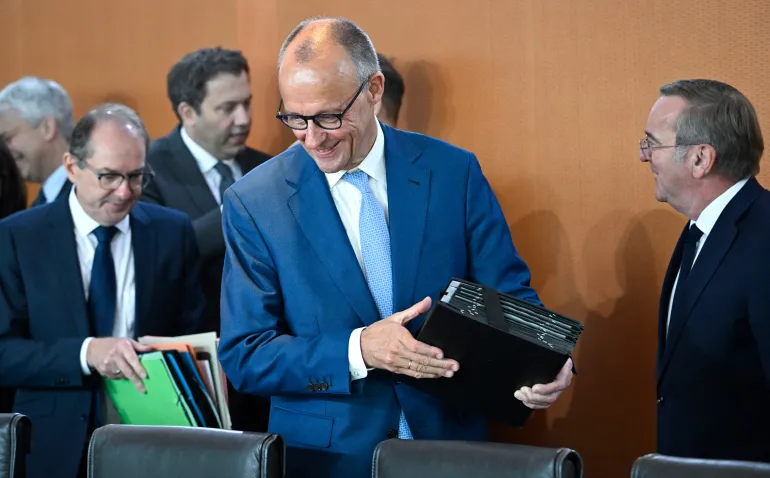
Chancellor Friedrich Merz has hit out at what he called political “extremism” in Germany after recent stinging defeats in local elections to far-right and far-left parties.
“This is a task for our society as a whole, and it is one I intend to play my part in,” he said on Wednesday at an event in Berlin.
Recommended Stories
list of 3 itemsend of list
Merz said “extremism” was forcefully making its way into the country’s parliaments, a day after a member of the far-right Alternative for Germany (AfD) was elected president of the state parliament in Saxony-Anhalt and the Left Party won out in Berlin’s state election last month.
“Anyone who casts their vote for the AfD is playing the extremists’ game and undermining credibility,” Merz said. “In any case, this is incompatible with the values of my party, the CDU [Christian Democratic Union of Germany].”
Despite winning the vote in the September 6 election in Saxony-Anhalt, the AfD fell three seats short of the absolute majority it had had sought. AfD lawmaker Tobias Rausch won the presidency of the parliament in the eastern German state Tuesday, backed by the left-populists in a secret ballot.
Founded in 2013 as a Eurosceptic movement, the AfD won over voters with an increasingly hardline opposition to immigration after about a million people fled to Germany in 2015, many of them from war-torn Syria.
The party has since become a dominant political force in much of eastern Germany, especially among voters disillusioned with mainstream parties, though most traditional parties have pledged not to enter coalitions with the AfD.
German Chancellor Friedrich Merz arrives for the weekly cabinet meeting in Berlin on October 7, 2026 [Tobias Schwarz/AFP]
Berlin election
Merz’s comments followed the far-left Left Party’s victory in the Berlin state election on September 20, in another defeat for the chancellor’s ruling Christian Democrats.
Lead candidate Elif Eralp campaigned on the soaring cost of housing in the German capital and immediately promised to follow through with a pledge to nationalise private housing associations that account for a large share of the city’s housing stock.
The result, which roughly doubled the party’s previous score, could see her become the first mayor of Berlin from the Left Party, which grew out of the former East German communist party following the reunification of the country 36 years ago.
Eralp, the 45-year-old daughter of left-wing Turkish parents who fled a coup in 1980, said the increasingly difficult rental situation was the biggest social problem in the capital.
She promised to proceed with nationalising the housing associations she said drove property speculation, in accordance with a referendum from 2021 in which 58 percent of voters backed a proposal to promulgate the move.
While the AfD has attracted most attention, the Left Party has also benefitted from a general turn against the mainstream centre-left and centre-right parties.
Meanwhile, Merz has received a record low approval rating. Earlier this month, a survey by Germany’s public broadcaster ARD found that only one in 10 respondents were satisfied or very satisfied with his performance, the lowest figure for any chancellor since the survey began in 1997.
Another major election test will come in North Rhine-Westphalia, Germany’s most populous state, where voters are set to elect a new parliament in April.
Rising borrowing costs have pushed mortgage applications to lowest level since February 2025.
Published On 7 Oct 20267 Oct 2026
Mortgage rates in the United States have hit their highest level in nearly three years, as cost-of-living concerns weigh on Americans less than a month before the midterm elections.
The average cost for a 30-year fixed-rate mortgage jumped 19 basis points to 7.49 percent for the week ending October 2 , according to the Mortgage Bankers Association’s weekly report released on Wednesday.
Recommended Stories
list of 4 itemsend of list
Meanwhile, applications for mortgages tumbled 4.2 percent from the previous week, according to the report. Applications are at their lowest level since February 2025 and have fallen by almost half since the beginning of the year.
“Very few homeowners have an incentive to refinance at these rates, and the jump in borrowing costs has caused many potential borrowers to step back from the purchase market,” Joel Kan, vice president and deputy chief economist at the Mortgage Bankers Association, said in a press release.
Mortgage rates are closely tied to US 10-year Treasury notes. Earlier this week, those hit a 24-year high of 5.3 percent amid surging oil prices tied to ongoing tensions with Iran.
Meanwhile, the yield on 30-year Treasury bonds rose to its highest level since 2002, at 5.7 percent on Wednesday.
Mortgage rates have jumped since late February, when the US and Israel first struck Iran. Since the strikes, mortgage rates have climbed 1.4 percent. Inflation, which has risen by 3.4 percent from a year ago, is also putting pressure on mortgage rates.
It comes as the cost of living is top of mind for voters as they approach the congressional midterm elections that could decide the balance of power in Washington, DC. According to a Reuters/Ipsos poll in late August, 47 percent of voters said that the cost of living was the single most important issue ahead of the midterms.
In a separate Reuters/Ipsos poll in September, 17 percent of voters said they approved of US President Donald Trump’s handling of cost of living-related issues.
Protesting students demand accessible education in French-speaking areas of the country.
Published On 7 Oct 20267 Oct 2026
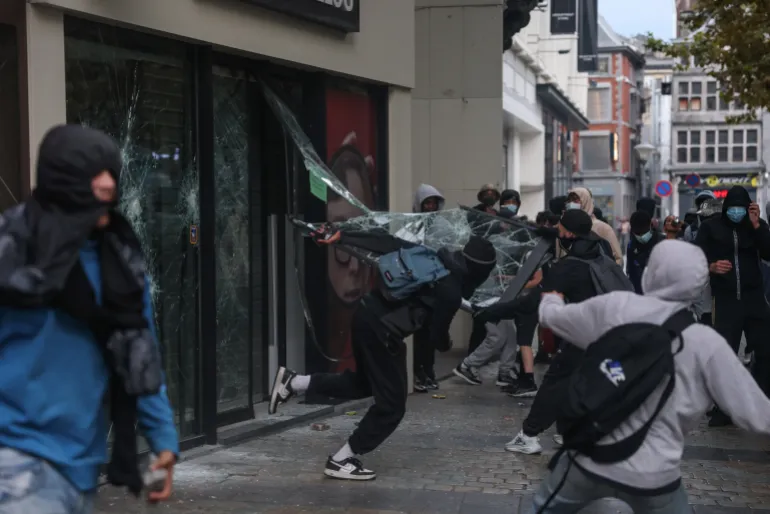
Police in Belgium have detained more than 100 people after demonstrations in the city of Liege against the rising cost of education turned violent in some places, as similar protests grip neighbouring France.
Students rallied in the city on Tuesday and Wednesday against overcrowded classrooms and difficulty accessing resources in Belgium’s French-language education system.
Eighty people were detained during the protests, and 27 were formally arrested, the Belga news agency reported, citing the Liege police.
Some protesters damaged property and set fires, the police added.
Attendees insisted that shortcomings in the education system gave them no choice but to take to the streets.
“When we saw nothing was changing without protests, we decided we would start,” said Amelia Di Salve, a 19-year-old studying to become a teacher, who added that protests in “France did influence us a little”.
“We support each other because we’re facing pretty much the same issues,” Alfred, another 19-year-old student, told the Reuters news agency.
‘Peaceful way’
Authorities were attempting to defuse tensions and head off further unrest.
“Dialogue can be established,” Willy Demeyer, the mayor of the city of Liege, told Belgian broadcaster RTBF, adding that he hoped “young people can express their grievances in a peaceful way and if possible have those concerns heard”.
Demonstrators smash a shop window during a protest by high school students against education reforms and increased student fees in Liege, Belgium, on October 7, 2026 [Stephanie Lecocq/Reuters]
In Belgium, education is managed independently by the country’s linguistic communities, and there is no single national curriculum.
Instead, the Flemish population regulates education in Belgium’s Dutch-speaking Flanders region while French-speaking Wallonia oversees its own curriculum.
Parents can decide where to enrol children in the bilingual capital Brussels.
The protests in Liege follow sporadic violent demonstrations over the summer in Brussels against an increase in tuition fees for students in French-speaking areas from 835 euros ($930) to 1,194 euros ($1,340).
Belgium’s education budget has been under pressure as a result of a cost-of-living crisis and the spiralling cost of energy, issues that are helping fuel student protests in France as well.
Acting President Rodríguez has prioritized the reengagement with Western multilateral institutions. (Presidential Press)
Mérida, October 6, 2026 (venezuelanalysis.com) – The Venezuelan acting government is resorting to a Qatar-led financing agreement in order to regain access to multilateral loans from the Inter-American Development Bank (IDB).
According to specialized outlet Bitácora Económica, Qatar is preparing to establish a specialized rescue fund to settle Venezuela’s estimated US $2.5 billion debt with the IDB.
Under the proposed mechanism, the Qatari fund would immediately clear Venezuela’s overdue principal and interest payments, while issuing a new, long-term loan with favorable interest rates for the South American nation.
Venezuelan economist José Guerra claimed that Qatar will be joined by the United Arab Emirates and that the Gulf countries will back the financing initiative with their sovereign wealth funds.
The Qatari-backed initiative would reportedly allow Venezuela to address short-term liquidity constraints and access a new IDB credit line worth as much as $8 billion. The financing would be used for public infrastructure projects, including the national road network, water distribution systems, and stabilizing the national electric grid, as well as providing additional funding for state budgets.
The proposed Gulf-backed debt arrangement comes amid a broader, deliberate push by Caracas to re-establish formal relations with major US-led multilateral financial institutions.
Over recent months, high-level Venezuelan delegations have held technical and institutional meetings with representatives from the International Monetary Fund (IMF), the World Bank, and the Development Bank of Latin America and the Caribbean (CAF).
In September, Acting President Delcy Rodríguez met in New York with IMF Director Kristalina Georgieva, as well as senior World Bank and IDB officials.
Caracas’ rapprochement with Western multilateral institutions has coincided with a geopolitical shift in its foreign policy since the January 3 US military strikes and kidnapping of Venezuelan President Nicolás Maduro. The Venezuelan government, headed by Acting President Delcy Rodríguez, reestablished ties with Washington while also strengthening relations with US allies such as Qatar and the UAE.
Doha initially provided intermediation for US control over Venezuelan oil export revenues, with funds deposited in Qatari bank accounts. The scheme was later transferred directly to the US Treasury Department. Energy firms from Qatar and the UAE were recently announced as stakeholders in a Venezuelan offshore natural gas project as well.
Venezuela’s reengagement with Washington-based financial institutions saw the IDB officially reopen its country office in Caracas on October 2, seven years after halting operations in the Caribbean nation.
The IDB had suspended all active credit lines and disbursements to Venezuela in May 2018 following payment arrears. The relaunched local office follows the formal reinstatement of Venezuela’s voting rights in June, when the IDB Board accepted Calixto Ortega as the country’s governor at the IDB.
During an expanded session of the National Economic Council in Caracas on October 2 with IDB officials, Acting President Rodríguez emphasized the importance of access to international multilateral credit for both the public and private sectors.
“This agenda that we have been developing with the multilateral financial system is for development, for investment and financing in infrastructure and services,” she stated during the televised session. “In Venezuela, there is a very important installed industrial capacity to develop, and a boost in financing will bring us to full capacity.”
Rodríguez added that the renewed engagement aims to ensure that private companies, communal production units, and small businesses can access international loan programs to expand local production.
While direct sovereign lending to the Venezuelan government remains contingent on fully clearing arrears, the multilateral’s private-sector arm, IDB Invest, has already initiated direct financial assistance to key Venezuelan corporations and commercial banks.
Under recently approved financing structures, IDB Invest is reportedly delivering commercial-rate loans and capital support to food processing conglomerate Empresas Polar, as well as private commercial banks Banco Mercantil and Banesco.
The allocations for Banco Mercantil and Banesco are designed to strengthen liquidity and capitalization within the national banking system, while also boosting local credit lines for businesses.
Meanwhile, the funds directed to Empresas Polar are earmarked for agricultural development projects and supply-chain expansion, particularly targeting grain production in Portuguesa state, according to reports.
Unlike traditional development loans, the IDB Invest credits are extended at market interest rates, focusing directly on private-sector growth and sustainability.
The Venezuelan government’s current strategy marks a departure from the former President Hugo Chávez’s stance toward multilateral lending institutions.
In November 2008, at a Bolivarian Alliance for the Peoples of Our America (ALBA) summit, Chávez criticized the IDB, labeling it an “instrument of political pressure” used by Washington to impose orthodox economic policies on sovereign nations.
At the time, Chávez called on Latin American governments to withdraw from both the IDB and the IMF, which he labeled as a “weapon of US imperialism,” advocating instead for regional alternatives such as the Bank of the South to replace traditional multilateral lenders.
London, United Kingdom – Claire, 52, lives in the Scottish countryside, not far from Edinburgh.
She describes her work as “low-level administration” and does not use social media. She lives a quiet life with her dog, reading and baking in her spare time. Until three years ago, she did not consider herself political.
Recommended Stories
list of 4 itemsend of list
Now, she faces 14 years in prison for her suspected show of support for Palestine Action.
Claire, who requested Al Jazeera withhold her surname, is one of the many people in the United Kingdom who, until three years ago, did not consider themselves activists.
But as the genocide in Gaza was livestreamed, many have rallied around the cause of Palestinian solidarity.
Organisations like Defend Our Juries, Artists for Free Palestine, Workers for Free Palestine, and virtually every other insert-profession-here for Palestine have cropped up across the UK.
In the summer of 2023, Claire read I Shall Not Hate by Dr Izzeldin Abuelaish, a Palestinian physician in Gaza who lost his three daughters to Israeli tank fire. Not long after finishing the book, Claire watched the aftermath of October 7 unfold online.
“For me, there wasn’t a delay between ‘Israel has a right to defend itself’ and then lies,” she told Al Jazeera.
She went to a pro-Palestine rally on Armistice Day, calling for a ceasefire, and “was horrified” by then Home Secretary Suella Braverman, who called the protests “hate marches”.
“I was determined not to ignore [Palestine],” she says.
A protester wears eyewear in the colours of the Palestinian flag and holds a fan featuring a watermelon design during a rally organised by Defend Our Juries in Parliament Square, London, Britain, August 9, 2025 [Jaimi Joy/Reuters]
She continued to march, writing letters to lawmakers and fundraising for various Palestinian aid programmes.
In August 2025, she began publicly protesting against the proscription of Palestine Action with Defend Our Juries, the group behind a campaign of civil disobedience aimed at lifting the ban. To date, more than 3,000 people have been arrested for showing support for the pressure group that was banned in 2025.
Earlier this year, police arrived at her door to arrest Claire under Sections 11 and 12 of the Terrorism Act: “Being a member of a proscribed organisation and encouraging others to join a proscribed organisation.”
“I’ve never been in trouble before,” she says. “I’m not backing down.”
A police officer holds a pro-Palestinian protester during a demonstration outside the Parliament, organised by campaign groups including Palestine Solidarity Campaign, Avaaz and Parents for Palestine, calling for sanctions on Israel over ongoing hunger among Gaza’s war-struck population, in London, Britain, June 4, 2025 [Isabel Infantes/Reuters]
Marji, 70, lives in Colchester and had a similar feeling after hearing Braverman’s words.
“I had never been to a protest in my life,” she says, until she carried a “Ceasefire Now” sign at an Armistice Day march in 2023.
“I knew it wasn’t a ‘hate march’.”
Marji’s father served in the British Army, and her father-in-law was in the Royal Air Force and taken as a prisoner-of-war in Japan during World War II.
“Our parents’ generation fought fascism,” she says. “Now Britain is breaking British law.”
Marji, who also requested to be identified only by her first name, had a successful career in financial services, while her husband held an executive-level role.
They are now retired grandparents.
In July, they were arrested in Westminster under Section 12 of the Terrorism Act and are now waiting to see if charges will be laid.
“We’ve had to decide … is it safe to have grandchildren here? When the police could come to the door?”
Her children remain supportive.
“I think they’re proud of us, even if there’s been fear on their part.”
People protest on Vauxhall Bridge during a march in solidarity with Palestinians in Gaza in London, Britain, November 11, 2023 [Kevin Coombs/Reuters]
Across sectors, from the arts to railways, financial services and administration, Britons have risked professional and legal repercussions for the sake of Palestinian solidarity.
Hundreds of thousands have taken to the streets to protest against Israel’s genocidal campaign in Gaza and what they see as the UK’s role in the conflict. They have urged the UK government to cease all arms sales to Israel and cut diplomatic and trade ties as the genocide goes on in Gaza and violence escalates in the occupied West Bank.
This week, tensions have flared again as the Metropolitan Police warned pro-Palestine protesters against rallying on the three-year anniversary of October 7. The force said on Wednesday that five people were arrested outside the Board of Deputies of British Jews in north London for “inciting racial hatred, involving allegedly shouting or chanting slogans calling for Intifada”.
Israel’s latest war on the Gaza Strip – it has waged several since 1948 – began after Hamas, the group that governs Gaza, attacked southern Israel. About 1,200 people were killed that day, while more than 240 were taken captive, including Israeli soldiers, citizens and some foreign nationals.
Since October 7, 2023, Israel’s relentless bombardment has killed more than 74,000 people and devastated Gaza, making life for survivors nearly impossible. The small territory is now home to the largest group of child amputees in modern history.
“The narrative that we had grown up with was wrong – that the people who were there and living peacefully have been cast as ‘terrorists’, when they have suffered terrorism,” Marji says.
A demonstrator argues with the police as students take part in an inter-university march organised by the University of London Coalition in support of Palestinians, on the third anniversary of October 7, 2023 in London, Britain [Carlos Jasso/Reuters]
“The government participation, complicity, and their lies. Their gaslighting makes people more determined,” says Claire.
As the legal dangers and rhetorical backlash mount against pro-Palestine protesters, Marji, whose maternal grandmother was Jewish, is only more resolved: “We knew that saying ‘stop the genocide’ doesn’t mean you’re an anti-Semite. We’re not stupid, we can differentiate between Jewish people and people who support illegal occupation.”
Workers for Free Palestine, which includes a range of trade unions, formed in late 2023 and soon began holding protests.
“Many people oppose how their labour is used to prop up an apartheid state, but have been told there is nothing they can do as individuals,” a spokesperson told Al Jazeera.
Many workers are nervous to speak out against their workplace’s role in producing weapons, their investments in Israel, or other ways of enabling Israel’s war.
“Many are unfamiliar with their rights as workers and are afraid of the repercussions of speaking up – and these repercussions can be very real,” the spokesperson said.
Still, for some, there is not just resolve but optimism.
“Doing nothing makes us feel sick, angry and powerless,” says Marji. “I hope people will wake up and see how our own civil liberties … are being eroded to protect the interests of Israel.”
Paramount Skydance has completed its takeover of Warner Bros Discovery, bringing CNN and CBS News under the same corporate ownership, in a deal that has raised concerns about editorial independence and freedom of speech.
The acquisition, worth about $110bn including debt, combines two of Hollywood’s biggest studios after months of legal challenges lodged by state attorneys general and unions.
Recommended Stories
list of 4 itemsend of list
The new company, Skydance Corporation, brings together HBO, CBS, Nickelodeon, Showtime, Comedy Central, DC Studios and Food Network, alongside streaming services Paramount plus and HBO Max.
But its control of two major US news organisations has drawn particular scrutiny. David Ellison, Skydance’s chairman and chief executive, has promised to preserve their editorial independence, but his father, Oracle cofounder Larry Ellison is a major financial backer of the deal, and has previously donated funds to US President Donald Trump and Israel.
Asked about the takeover on Tuesday, Trump welcomed it. “They’re terrific people, and it’s going to be a great company,” he said.
Why was the merger challenged?
The takeover faced initial opposition from Hollywood workers, politicians and state prosecutors concerned about the mounting concentration of power in an industry already dominated by a handful of companies.
Netflix initially reached an agreement to buy part of Warner Bros Discovery. Paramount then launched a competing bid, prompting a bidding war before Netflix walked away.
A California-led coalition of 12 state attorneys general sued to block the deal, saying that it would reduce competition and raise prices. The Writers Guild of America brought a separate challenge.
Both cases were settled in September when Paramount agreed to commitments relating to film production, support for displaced workers and protections for the news networks, including the creation of a new editorial independence board.
But the settlement did not end opposition to the deal. “This merger will stifle creativity, weaken free speech and cost people their jobs,” actor and activist Mark Ruffalo has said.
Democratic Senator Elizabeth Warren linked the takeover to Trump’s efforts to restrict media access. “As Trump tries to ban CNN from the White House, it would be a massive mistake to cave on the Paramount merger,” she said, referring to the US president’s so-far thwarted attempt last month to bar reporters from several news organisations, including CNN, from accessing the White House.
Can an editorial independence board protect CNN and CBS?
One condition of the settlement requires Skydance to establish a “News Editorial Independence Board” within 180 days of completing the takeover.
The five-member body is to include active or retired journalists with at least 10 years of experience. It is intended to establish editorial principles and address disputes involving the news networks and corporate management.
However, its members will be appointed by, and will report to, Skydance’s board of directors, which Ellison chairs. Two members can belong to the same political party, and there is no requirement to publish its findings.
The condition has left critics with a multitude of questions, including: How can a member of an independent editorial board be a member of a political party? How can there be scrutiny if its findings are not public? How can it be independent if it is appointed by a board of directors, themselves appointed by the CEO of the company?
Seth Stern, chief of advocacy at the Freedom of the Press Foundation, said, “A Paramount-appointed editorial independence board for CNN and CBS is worthless. The fish rots from the head, and this particular fish is headed by a compromised oligarch with a history of throwing journalists under the bus to advance his business interests.”
Stern also questioned whether government enforcement of the settlement could itself threaten press freedom. “The editorial board creates the same First Amendment problems it’s supposed to solve – the government meddling in the news.”
The First Amendment provides constitutional protection for freedom of speech and the press.
Ellison argues that the two networks will continue to operate independently. “We’re going to make sure that CNN and CBS News are completely editorially independent,” he said on Tuesday.
On Monday, Skydance announced that Mark Thompson would remain CNN’s chairman and editor-in-chief, while Bari Weiss will continue as CBS News’s editor-in-chief, easing previous fears that Weiss would immediately take charge of both networks.
Why are there fears for editorial independence?
The takeover gives the Ellison family control of CNN less than a month before the November 3 US midterm elections, and follows Trump’s repeated attacks on the network as it seeks to hold the US president to account.
Shortly after Paramount launched its bid in December, Trump accused CNN of spreading “poison and lies” and said it was “imperative” that it be sold, while the Trump administration has moved to bar CNN from reporting in certain areas of the White House.
Ellison donated roughly $45m to a political nonprofit group supporting Trump’s election efforts in 2024, while he donated $16.6m to Friends of the Israel Defense Forces, a charity supporting Israeli soldiers – its largest single donation at the time.
Earlier this year, the White House criticised CNN’s coverage of the US-Israeli war on Iran, while Defence Secretary Pete Hegseth told reporters that “the sooner David Ellison takes over that network, the better.”
Sovereign wealth funds from Saudi Arabia, Qatar and the United Arab Emirates also hold indirect financial interests in the combined company. They have no voting stakes, although their involvement adds another layer of scrutiny over its funding.
Concerns about the future for editorial integrity, however, intensified after Skydance acquired Paramount in 2025, and layoffs followed, alongside the closure of CBS News Radio and changes to CBS News flagship investigative programme 60 Minutes.
High-profile firings enacted under CBS News Editor-in-Chief Bari Weiss and Skydance Media CEO David Ellison included correspondents Sharyn Alfonsi and Cecilia Vega, as well as 60 Minutes executive producer Tanya Simon.
The programme’s September season premiere attracted about 21 percent fewer viewers than a year earlier.
In 2025, Paramount also agreed to pay Trump $16m to settle a lawsuit over the editing of a 60 Minutes interview with then-presidential candidate Kamala Harris.
In a June 2 letter, nine advocacy groups, including Reporters Without Borders, the Freedom of the Press Foundation and the Committee for the First Amendment, warned that CNN could face similar upheaval and firings.
“Bari Weiss’ shameless actions fulfil the Ellisons’ commitment to President Trump to remake CBS to his liking,” they alleged, referring to the firings and changes at 60 Minutes.
“Larry Ellison has reportedly promised to do the same at CNN if allowed to take control through the pending Paramount-Warner Bros. Discovery merger. Not because it makes any business sense, but because they seek to control the public discourse.”
The groups described the proposed takeover as an “existential threat to the free press, independent media, and free speech in this country and beyond”.
Islamabad, Pakistan – More than 9.5 million people have received subsidised petrol under a special fuel relief scheme launched by Pakistan’s prime minister, Federal Minister Shaza Fatima Khawaja told Al Jazeera on Wednesday.
The initiative, aimed at lower-income citizens, comes as the government attempts to help households deal with fuel price increases tied to the war on Iran.
Recommended Stories
list of 4 itemsend of list
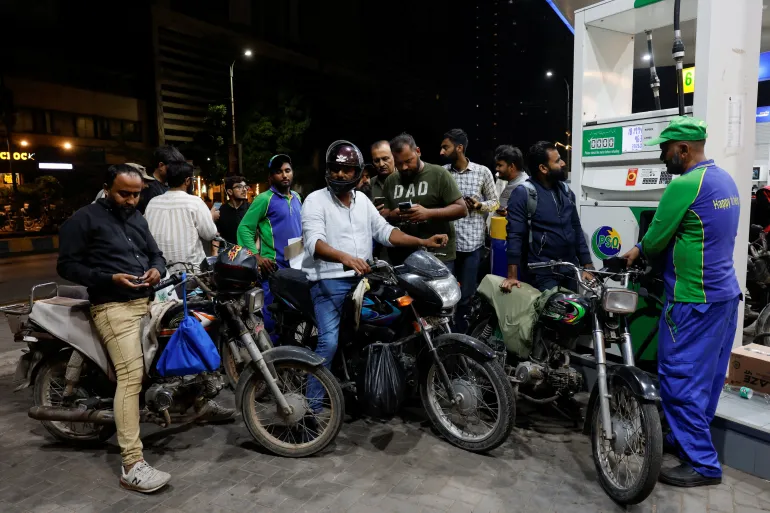
The scheme, launched in September, offers 100 rupees ($0.36) off every litre of petrol to owners of motorcycles, rickshaws and small cars, through a text-message system.
Petrol prices have risen by nearly 50 percent since the war began on February 28, adding to Pakistan’s economic hardship and putting further pressure on consumers already grappling with rising inflation.
How the scheme works
Explaining the process, Khawaja, the minister for information technology and telecommunications, said applicants text their national ID number, vehicle registration, and province to 9771. A second message, sent before each visit to a pump, generates a token redeemable anywhere in the country.
Two- and three-wheelers get 500 rupees ($1.80) a week, capped at four tokens a month. Cars with engines of up to 800cc get 1,000 rupees ($3.60) every 10 days, for three tokens monthly.
After complaints, registration, once a paid service, was made free, and a five-litre minimum purchase was scrapped for the same reason.
Khawaja told Al Jazeera the system had been redesigned based on experiences of users on the ground.
Riders no longer need the vehicle to be registered in their own name, as long as they can supply the exact registration date shown on the documents.
“Even in my own house, there’s a bike registered in our name that our cook uses for daily errands,” Khawaja said, explaining why the ownership requirement for two- and three-wheelers was dropped on September 20.
An earlier cash-transfer scheme in April had reached just over a million bike owners, she said, largely because disbursement required a bank account most riders did not have.
‘The relief is decent’
Government officials say that the scheme has been expanded to include wider sections of society, especially those who depend on their vehicles to generate income.
“There’s a benefit; it’s not like there’s nothing,” Shakeel Ahmed, 45, an electrician in Islamabad, told Al Jazeera. “The relief is decent for people who use it normally, for local trips. But for people like us, who put in 1,000 to 1,500 rupees [$3.60-$5.40] of petrol a day, it’s not enough.”
Safiya Aftab, an economist, told Al Jazeera the scheme has reached the people it was meant to.
“The scheme has indeed reached low-income segments of society, people who typically use two-wheelers and 800cc cars. So yes, it’s a good thing that they are subsidising the poor,” she said.
Aftab, however, also pointed to a levy – 114 rupees ($0.41) for every litre – that the government charges. This, she said, was helping the government raise revenue. She said the government is now earning more than 100 billion rupees ($361m) a month from the levy, which is fuelling inflation.
“The levy was originally meant as a sort of environmental tax, to discourage the use of petrol. Now it has become a full revenue earner for the government, one that helps keep the fiscal deficit down,” the economist said.
What it costs and for how long
The Pakistani government has approved 75 billion rupees ($271m) for the scheme’s first three months, through November.
Petroleum Minister Ali Pervaiz Malik put the running cost at 25-30 billion rupees ($90m-$108m) a month at launch. By late September, he said, it had risen to 35-40 billion rupees ($126m-$144m).
Malik has said the government is prepared to run the scheme for up to 10 months, or “until the end of the war”, if needed.
Pakistan is currently under a $7bn International Monetary Fund programme, and an IMF team is in Islamabad this week for talks with the government as it seeks to keep its fiscal commitments on track while responding to the fuel shock.
Officials familiar with the government’s talks with the IMF say the Fund wants relief capped at three months and routed instead through the Benazir Income Support Programme, the country’s main cash-transfer scheme.
Khawaja said the IMF’s position from the outset was that relief had to be targeted, not universal, which was why the scheme was built around actual token use rather than a blanket price cut.
Who it leaves out
But there are claims that the relief is not reaching all. Cars with engines larger than 800cc, diesel vehicles and public transport are excluded entirely, leading some experts to suggest that the subsidy scheme risks missing the most vulnerable sections of Pakistani society.
“A poor household that uses public transport, walks to work, or relies on diesel-powered transport may receive nothing while still facing higher food and transport costs,” Khaqan Najeeb, a former adviser in Pakistan’s Ministry of Finance, told Al Jazeera.
More than 8.1 million tokens had gone to two- and three-wheelers by late September, compared with fewer than 380,000 for cars, Malik said. A November 2024 Gallup Pakistan survey found that 79 percent of respondents, in rural and urban areas alike, said they use public transport such as buses or wagons.
People wait to refuel their motorcycles at a petrol station following the rollout of a fuel relief scheme, which provides a fuel subsidy for eligible motorcycles, rickshaws and vehicles with engines of up to 800cc, in Karachi, Pakistan, September 17, 2026 [Akhtar Soomro/Reuters]
Does the relief go far enough?
At 100 rupees a litre, the maximum monthly saving is 2,000 rupees ($7.20) for a motorcycle user and 3,000 rupees ($10.80) for an eligible car owner, Najeeb said, calling it “useful household relief, but not enough to offset the broader cost-of-living shock”.
Petrol has climbed from 266 rupees ($0.96) a litre before the war to nearly 395 rupees ($1.42), despite a partial rollback in April. Inflation rose to 10.3 percent in September from 7 percent in February, Najeeb said.
Sajid Amin Javed, a senior economist at the Sustainable Development Policy Institute in Islamabad, said the relief was “minimal”, but added that this was understandable given the IMF constraints on Pakistan.
“The relief is minimal, and that is understandable as we are in an IMF programme,” Javed told Al Jazeera, arguing that cutting the petroleum development levy, which still adds 114 rupees to every litre, would deliver broader relief than a capped subsidy.
“The government is using the petroleum development levy to fill its revenue gap, but that comes at a significant cost in terms of inflation, growth and household welfare,” Javed said.
Najeeb, however, argued the scheme should not become a permanent fixture of Pakistan’s energy policy – and should be used only to make oil price shocks “less damaging”.
Scientists honoured for solving mystery of asymmetric ‘mirror image’ molecules that has helped in manufacture of pharmaceuticals.
Published On 7 Oct 20267 Oct 2026
Scientists Henri Kagan and Kenso Soai have won the 2026 Nobel Prize in Chemistry for solving a longstanding riddle of asymmetric “mirror image” molecules, a discovery hugely important for pharmaceutical manufacturing.
The Royal Swedish Academy of Sciences said on Wednesday the pair – Kagan, 95, from France; and Soai, 76, from Japan – were honoured “for the discovery of nonlinear effects and autocatalysis in asymmetric organic synthesis”.
Recommended Stories
list of 2 itemsend of list
Their findings showed how chemical reactions can be driven to favour a single molecular mirror image, work that has been key for chemists who design reactions for the manufacture of pharmaceuticals.
Many of the molecules essential to life exist in two forms that are mirror images of each other, like left and right hands. Yet living organisms almost exclusively use only one version, a phenomenon known as “homochirality” – from the Greek word for hand – that has puzzled chemists for more than a century.
“The left-handed version of the drug can have one effect, and the right-handed version can have another effect, and then we need methods for selectively preparing them,” said Peter Somfai, a member of the Nobel Committee for Chemistry.
“In developing such methods, the findings of this year’s laureates are important. They provided powerful tools for that,” he said.
Heiner Linke, chair of the committee, said the two scientists provided “a solution to a chemical mystery that is over a century old: how homochirality can emerge spontaneously”, calling the chemical reactions they developed “spectacular”.
‘Most exciting day’
Soai, speaking by phone to the Nobel Prize news conference, said he had been out shopping when he received the news.
“This is the most exciting day in my life, I am very glad to share this prize with Professor Henri Kagan,” he added.
Last year’s chemistry award went to scientists Susumu Kitagawa, Richard Robson and Omar Yaghi for the development of so-called metal-organic frameworks, molecular constructions that can help tackle challenges such as climate change and lack of freshwater.
The chemistry Nobel is always the third prize to be awarded during Nobel week, following those for medicine and physics.
The literature laureate will be revealed on Thursday, while the keenly anticipated peace prize is due on Friday.
Established in the will of Swedish inventor and businessman Alfred Nobel, the prizes for achievements in science, literature and peace have been awarded since 1901, with a few interruptions mostly due to the world wars.
Nobel, a chemist by trade, amassed huge wealth in the 19th century from inventions primarily tied to warfare, most notably dynamite. The economics prize is a later addition funded by the Swedish central bank.
South Korea’s government has signalled that the current military service exemption reserved for gold-medal winning athletes could be abolished, after controversial comments made by winners at the Asian games caused public backlash.
The first-ever F-16 Block 72 has taken to the air, marking a major milestone for the program and for Morocco’s long-running effort to field what Lockheed Martin describes as the most advanced version of the Viper.
The first of the jets for the Royal Moroccan Air Force (RMAF), a two-seat F-16D, completed its maiden flight at Lockheed Martin’s facility in Greenville, South Carolina, the company announced today. The aircraft will now proceed through flight testing ahead of its delivery to Morocco.
Morocco’s first @LockheedMartin F-16 Block 72 aircraft has taken flight in Greenville, South Carolina. The milestone marks another step toward delivering the most advanced F-16 configuration to the Royal Moroccan Air Force.
Interestingly, one of the photos of the jet published by Lockheed Martin shows the pilot in the front cockpit wearing a Digital Joint Helmet Mounted Cueing Systems (D-JHMCS). This advanced helmet is not often seen worn by F-16 pilots and it is not clear if it has been ordered by Morocco.
Regardless, Morocco was the first customer to select the Block 72 configuration when the U.S. government approved its purchase in March 2019.
At that time, the Defense Security Cooperation Agency said Morocco was seeking 25 F-16C/D Block 72 aircraft in a package estimated at $3.787 billion. The proposed aircraft were to be equipped with the AN/APG-83 Scalable Agile Beam Radar (SABR), an active electronically scanned array type, new mission computers, Link 16 Multifunctional Information Distribution Systems, modernized navigation systems, helmet-mounted cueing systems, and a range of air-to-air and air-to-ground weapons.
A Royal Moroccan Air Force F-16C/D Block 52+ with a pair of AGM-88 High-speed Anti-Radiation Missiles (HARM) under the wings. U.S. Air Force photo by Staff Sgt. Ceaira Tinsley
The distinction between the Block 70 and Block 72 is the engine. The Block 70 uses General Electric’s F110-GE-129, while the Block 72 uses Pratt & Whitney’s F100-PW-229, providing fractionally more power. The two configurations otherwise share the same major avionics and systems modernization package.
The F-16 began life as a Pratt & Whitney-powered fighter, with the F100 selected to power the original F-16A/B. But reliability and maintainability problems with early F100s prompted the U.S. Air Force to launch its Alternate Fighter Engine competition in the 1980s, leading General Electric to develop the F110 as an alternative. The resulting “Great Engine War” established two competing F-16 engine families, with Pratt & Whitney’s F100 and GE’s F110 ultimately becoming the principal powerplants for later F-16C/Ds. Although U.S. procurement eventually became heavily concentrated on the GE-powered F-16, Pratt & Whitney continued to supply F100-powered aircraft to international customers.
Airmen conduct a test run on a Pratt & Whitney F100 turbofan engine in the hush house at Holloman Air Force Base, New Mexico. U.S. Air photo by Airman 1st Class Isaiah Pedrazzini
For Morocco, the choice of the Block 72 is based on ensuring as much fleet commonality as possible. The RMAF already operates F-16C/D Block 52+ aircraft powered by F100 engines, making the new aircraft a natural fit within its existing support infrastructure.
Morocco is also upgrading its existing F-16 fleet to the F-16V configuration, which is broadly similar to the new-build Block 70/72 standard.
That will eventually provide the RMAF with a larger fleet centered around a common, substantially modernized F-16 standard.
A separate notification in March 2019 covered the upgrade of Morocco’s existing 23 F-16C/D Block 52+ aircraft to the F-16V standard.
Morocco’s new and upgraded F-16s could also provide a significant boost to combined operations with its other international partners. In recent years, Moroccan F-16s participated in the campaign against ISIS, while the country has also deployed the aircraft on missions against Houthi rebels as part of the Saudi Arabia-led coalition in Yemen. In 2015, a Moroccan F-16 crashed in Yemen. Although the Houthis claimed they had shot down the aircraft, Moroccan authorities attributed the loss to a technical malfunction.
Outside of combat operations, the RMAF also frequently takes part in exercises with its allies, including the African Lion series, the largest annual, multinational joint military exercise led by U.S. Africa Command (USAFRICOM) and partner nations.
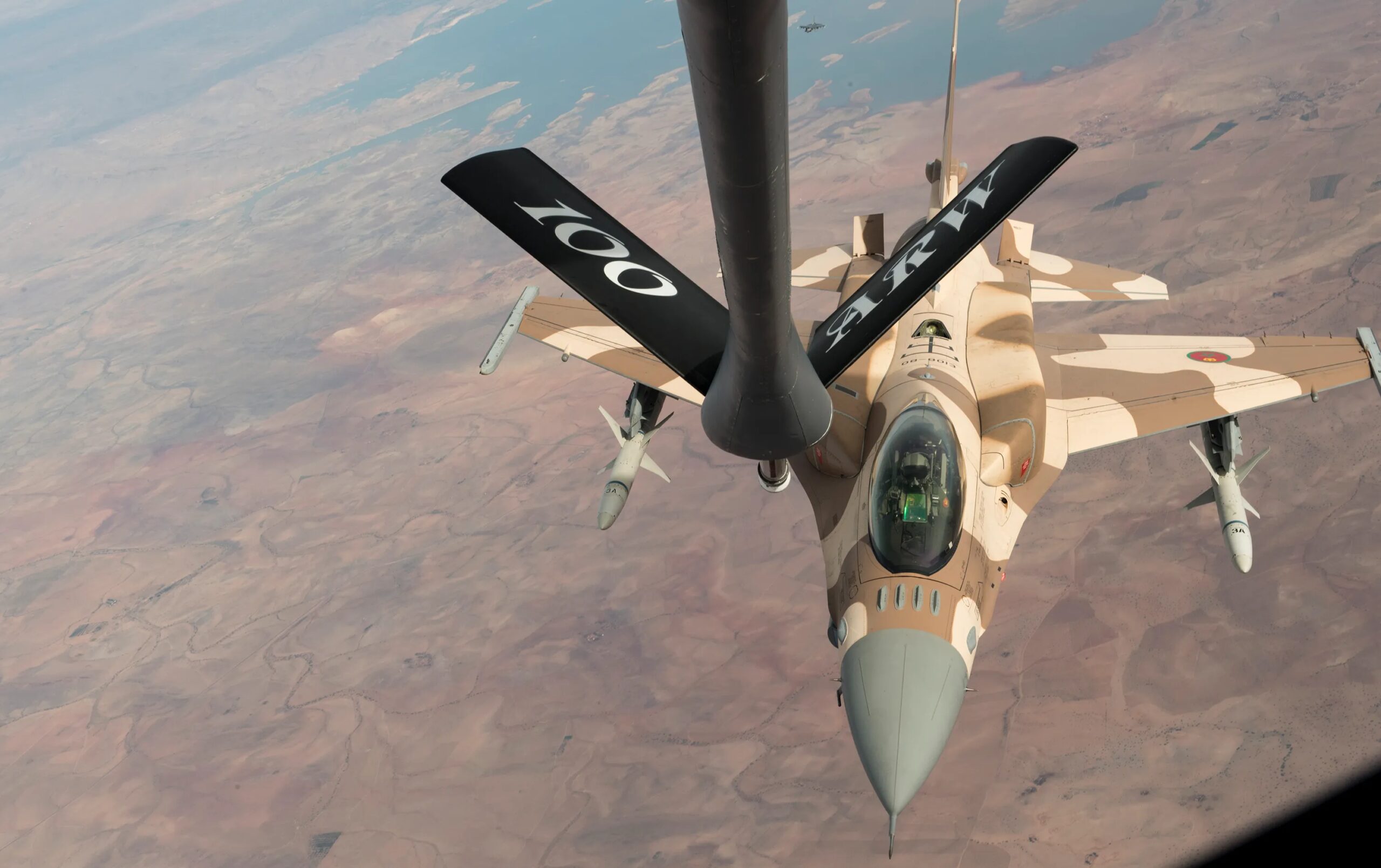
A Utah Air National Guard KC-135 Stratotanker refuels a Royal Moroccan Air Force F-16 over central Morocco as part of Exercise African Lion 2019. U.S. Air Force/Courtesy Photo
Meanwhile, the new-build Moroccan aircraft also arrives at an interesting point in the F-16 program.
The Block 70/72 has attracted customers across Europe, the Middle East, Asia, and elsewhere, with Bahrain, Bulgaria, Jordan, Peru, the Philippines, Slovakia, Taiwan, and Turkey also having selected the latest-generation Viper configuration. So far, only Block 70s have been ordered, although tbe Block 72 has been offered to some customers and potential customers. There is also apparent U.S. Air Force interest in a version of the Block 70 tailored for its specific needs and referred to by the manufacturer as the F-16G.
An F-16D Block 70 aircraft for the Royal Bahraini Air Force prior to delivery. U.S. Air Force
Morocco’s position as the Block 72 launch customer means the aircraft now flying is effectively the prototype-standard production aircraft for an export configuration that other countries can now buy.
The Moroccan F-16 program is also increasingly tied to a broader effort to develop the country’s military-industrial and sustainment infrastructure.
Lockheed Martin says it is working with Moroccan industry, including Maintenance Aero Maroc, on an upcoming MRO facility at Benslimane. The more than 86,000-square-foot facility is intended initially to support heavy maintenance and modernization of C-130 Hercules aircraft, with plans to expand into additional platforms, including the F-16.
A Royal Moroccan Air Force C-130 Hercules taxis down the runway at the 3rd Royal Moroccan Air Force Base in Kenitra, Morocco. U.S. Air Force photo by Tech. Sgt. Devin Nothstine
That could eventually give Morocco a greater role in sustaining its own expanding fleet and potentially supporting other aircraft in the region.
The F-16 program itself is part of a much broader U.S.-Moroccan defense relationship that dates back more than five decades. The Royal Moroccan Armed Forces now operate a range of U.S.-supplied systems, while Morocco is also set to receive HIMARS and has expanded its rotary-wing capabilities with AH-64E Apache attack helicopters.
For the RMAF, however, the F-16 remains central to its combat-aircraft modernization and, once it arrives, it will be the spearhead of the country’s fighter fleet.
From Maddie Lee: The Dodgers’ first few innings Tuesday night were riddled with strikeouts and missed opportunities. But the work they did racking up Atlanta Braves ace Chris Sale‘s pitch count culminated in Kiké Hernández’s big fourth-inning moment in Game 3 of the National League Division Series.
“I felt hitting at the bottom of the lineup, my responsibility was to not chase him around, not give in to what he was trying to get me to do, which was roll over and hit into a double play,” Hernández said after the Dodgers’ 3-1 win against the Braves. “So my mentality was to grind out the at-bat, try to get a good pitch to hit. If not, just be patient so I could turn the lineup over to Mookie [Betts] at the top.”
Hernández let Sale’s first pitch, a changeup in and off the plate, go for a ball. Then, he recognized the pitch again, heading toward the inner third of the plate. And Hernández demolished it, taking three slow steps out of the batter’s box before dropping the bat.
Go beyond the scoreboard
Get the latest on L.A.’s teams in the daily Sports Report newsletter.
By continuing, you agree to our Terms of Service, which include arbitration and a class action waiver. You agree that we and our third-party vendors may collect and use your information, including through cookies, pixels and similar technologies, for the purposes set forth in our Privacy Policy such as personalizing your experience and ads.
Hernández has too many big postseason moments — a three-homer game against the Cubs in Game 5 of the 2017 NL Championship Series, for example — for a single homer in a non-elimination game to rank at the top. It was his 17th career postseason home run, which accounts for 11% of his home runs over 13 years in the majors, putting him in a category of his own.
It was, however, the biggest offensive moment of the Dodgers’ postseason so far. As the series teetered, in a matchup of rotation aces, all tied up and in Atlanta for the first time, he got his first at-bats of the 2026 postseason and immediately delivered.
“We played tonight like an elimination game,” manager Dave Roberts said. “Collectively it was probably one of our better performances, certainly with the [opposing] starter, as far as 1 through 9.”
Kiké Hernández celebrates after hitting a two-run home run in the fourth inning of the Dodgers’ 3-1 win over the Atlanta Braves in Game 3 of the NLDS at Truist Park on Tuesday.
Stepping warily into Atlanta’s Truist Park with their five-game division series tied at one game apiece and Braves’ ace Chris Sale waiting for them on the mound Tuesday, the Dodgers marched out three hours later on the verge of another champagne shower.
Yoshinobu Yamamoto was brilliant, showing everyone that they were focusing on the wrong ace.
The Dodger bats were reborn, showing everyone that they still know how to hit in October.
And, yes, the Dodgers finally have a closer, Edwin Díaz entering the ninth and allowing a leadoff double to Ozzie Albies before retiring the next three hitters for the biggest save of his brief Dodgers career.
The most forgotten hero in Dodger history stepped out of the shadows in 1987 as their instant general manager and created the miraculous monster that came to be in 1988.
The resuscitation of a Dodger brand during what was quite possibly its darkest moment? It all started with Fred Claire, the longtime Dodger executive who died Monday in his Pasadena home on his 91st birthday.
That is what UCLAcoach Bob Chesney told his team when he showed them their Associated Press Top 25 ranking during Sunday’s team meeting, reminding the Bruins what their priorities are as they come off their bye week and prepare for a showdown in Eugene, Ore., against the No. 13 Ducks.
“If you pay attention to this number it will go away,” Chesney said. “If you pay attention to what you did to get that number, and only focus on that and improve that, maybe the number even gets better. Who knows as time goes on, but that can’t be anything we talk about or worry about, and that’s why I wanted to bring it up one time and that was the end of it.”
The commitment to the process remains Chesney’s top priority as his team stares down its biggest test of the season to date.
Kings goaltender Darcy Kuemper makes a glove save during the first period against the Florida Panthers on Tuesday.
(Mark J. Terrill / Associated Press)
From Kevin Baxter: Before the first home game of their upcoming 60th anniversary year Tuesday, the Kings honored their past by unveiling a modest Hall of Fame on the concourse of Crypto.com Arena.
An hour later, this season’s Kings took the ice and made some history of their own, though not the kind they had hoped for, falling to the Florida Panthers 2-1 to open a season with three consecutive losses for the first time since 2020.
For Peter Laviolette, the history was even more unwanted since the team’s 0-2-1 start makes him the first Kings coach to go winless in his first three games since Robbie Ftorek in 1987.
Laviolette was a 23-year-old defenseman with the U.S. national team then. He would go on to win 934 NHL games as a coach, the most ever for an American, but he has yet to add to that total with the Kings. It didn’t help that two of the first three games with his new franchise came against Colorado and Florida, popular picks to finish the season in the Stanley Cup Final.
Lakers forward Adou Thiero looks to pass around Golden State forward Yaxel Lendeborg during the Lakers’ 124-98 preseason loss Tuesday.
(Ezra Shaw / Getty Images)
From Thuc Nhi Nguyen: This was never going to be a game for the Lakers to remember. But with nearly half of the roster sidelined because of injuries or resting, Adou Thiero at least tried to inject some life into a sleepy preseason back-to-back.
Thiero’s towering one-handed dunk over two Golden State defenders provided a highlight in the Lakers’ otherwise forgettable 124-98 preseason loss to the Warriors at Chase Center on Tuesday. The Lakers leaned on their depth to get through their second short-handed preseason game in as many nights.
Guard Quentin Grimes, the only player starting a second consecutive game for the Lakers, had 12 points and three assists. Forward Sandro Mamukelashvili started at center and had 15 points and a trio of three-pointers. Thiero, getting a rare starting moment, scored seven points and grabbed four rebounds while Bronny James had four points and five assists in a starting role.
No. 2 Dodgers vs. No. 3 Atlanta at Dodgers 5, Atlanta 3 (box score) Atlanta 3, at Dodgers 2 (box score) Dodgers 3, at Atlanta 1 (box score) Wednesday at Atlanta, 3 p.m., FOX/FS1/FOX Deportes/FOX One *Friday at Dodgers, 5 p.m., FOX/FS1/FOX Deportes/FOX One
No. 1 Milwaukee vs. No. 4 San Diego at Milwaukee 3, San Diego 2 (box score) at Milwaukee 4, San Diego 3 (box score) at San Diego 4, Milwaukee 3 (box score) Wednesday at San Diego, 7 p.m., FOX/FS1/FOX Deportes/FOX One *Friday at Milwaukee, 1:30 p.m., FOX/FS1/FOX Deportes/FOX One
American League
No. 1 Tampa Bay vs. No. 4 New York at Tampa Bay 1, New York Yankees 0 (box score) at Tampa Bay 5, New York Yankees 2 (box score) Wednesday at New York, 5 p.m., TBS/truTV/UniMas/HBO Max *Thursday at New York, 5 p.m., TBS/truTV/UniMas/HBO Max *Saturday, Oct. 10 at Tampa Bay, 5 p.m., TBS/truTV/UniMas/HBO Max
No. 2 Cleveland vs. No. 6 Chicago White Sox
Chicago White Sox 3, at Cleveland 0 (box score) Chicago White Sox 4, at Cleveland 3 (box score) Wednesday at Chicago, 1 p.m., TBS/truTV/UniMas/HBO Max *Thursday at Chicago, 2 p.m., TBS/truTV/UniMas/HBO Max *Saturday, Oct. 10 at Cleveland, 2 p.m., TBS/truTV/UniMas/HBO Max
* if necessary
NLCS starts Sunday, Oct. 11 ALCS starts Monday, Oct. 12 World Series starts Friday, Oct. 23
This Day in Sports History
1904 — Jack Chesbro registers his 41st victory of the season as New York defeats Boston 3-2.
1916 — Georgia Tech, coached by John Heisman, beats Cumberland 222-0 in the most lopsided college football game in history.
1933 — Baseball World Series: NY Giants beat Washington Senators, 4-3 at Griffith Stadium to clinch 4 games to 1 series victory.
1935 — Baseball World Series: Detroit Tigers beat Chicago Cubs, 4-3 at Navin Field for 4 games to 2 series win; Tigers win first championship in 5 WS appearances.
1945 — The Green Bay Packers score 41 points in the first quarter in a 57-21 win against the Detroit Lions.
1950 — Baseball World Series: New York Yankees beat Philadelphia Phillies, 5-2 at Yankee Stadium to sweep series, 4-0 for 13th WS title in team history; MVP: NY 2B Jerry Coleman.
1952 — Baseball World Series: NY Yankees beat Brooklyn Dodgers, 4-2 at Ebbets Field in Game 7 to tie own record 4th straight WS; MVP: NY 1B Johnny Mize.
1962 — Judy Kimball wins the LPGA championship with a four-stroke victory over Shirley Spork.
1967 — Tulsa wide receivers Ricky Eber and Harry Wood have the best day by a receiving duo in college football history. Eber has 20 receptions for 322 yards and three touchdowns, while Wood grabs 13 passes for 318 yards and three scores in Tulsa’s 58-0 win over Idaho State.
1970 — Willie Shoemaker wins his 6,033rd race to pass Johnny Longden as the winningest jockey. His first race was won on April 20, 1949.
1984 — Walter Payton breaks Jim Brown’s career rushing mark of 12,312 yards and Brown’s career mark of 58 100-yard rushing games in a 20-7 victory over New Orleans. Payton breaks the record on Chicago’s second play from scrimmage in the second half.
1985 — Lynette Woodard, captain of the women’s basketball team that won the gold medal at the 1984 Olympics, is chosen to be the first woman to play for the Harlem Globetrotters.
1995 — Coach Eddie Robinson gets his 400th victory as Grambling beats Mississippi Valley State 42-6.
2000 — Zamir Amin of Menlo College sets an NCAA all-divisions record, passing for 731 yards in the Division III school’s 37-32 loss to Cal Lutheran. Amin, 39-of-66 with four TDs and three interceptions, breaks the mark of 716 set by David Klingler of Division I-A Houston against Arizona State on Dec. 2, 1990.
2001 — San Diego’s Rickey Henderson becomes the 25th player with 3,000 hits with a bloop double in a 14-5 loss to Colorado.
2001 — Barry Bonds wraps up his record-breaking season with his 73rd homer and shatters the slugging percentage record that Babe Ruth had owned for 81 years. He finishes with a slugging percentage of .863, easily surpassing the mark of .847 that Ruth set in 1920.
2006 — Denis Hopovac’s fifth field goal of the game, in an NCAA record-tying seventh overtime, gives North Texas a 25-22 victory over Florida International. The other two seven-overtime games involved Arkansas — against Mississippi in 2001 and Kentucky in 2003.
2011 — Minnesota Lynx beat the Atlanta Dream 73-67 to complete a three-game sweep of the WNBA championship series.
2012 — Drew Brees finishes 29 for 45 for 370 yards with four TD passes and an interception in New Orleans’ 31-24 win over San Diego. Brees breaks the NFL record by throwing a touchdown pass in his 48th straight game. His 40-yard pass to Devery Henderson eclipses the mark of 47 consecutive games set by Johnny Unitas from 1956-60.
2017 — Jarvion Franklin runs in from the 12 to give Western Michigan a 71-68 victory over Buffalo in a record-tying seven overtimes with a record-breaking 139 total points.
2017 — Backup Khalil Tate rushes for 327 yards, an FBS record for a quarterback, and accounts for five touchdowns to help Arizona hold off Colorado 45-42.
2017 — Alex Ovechkin scores four goals to become the first player in 100 years with back-to-back hat tricks to open a season, and the Washington Capitals beat the Montreal Canadiens 6-1.
Compiled by the Associated Press
Until next time…
That concludes today’s newsletter. If you have any feedback, ideas for improvement or things you’d like to see, email me at houston.mitchell@latimes.com. To get this newsletter in your inbox, click here.
Israeli air strike kills Palestinian Civil Defence rescue volunteer as he was travelling to help wounded people near Kamal Adwan Hospital in Beit Lahiya, northern Gaza, a medical source says.
Published On 7 Oct 20267 Oct 2026
Israeli attacks have killed at least four Palestinians, including a rescue worker, and wounded several others across Gaza.
The Palestinian Civil Defence rescue volunteer was killed in an air strike as he was travelling to help wounded people near Kamal Adwan Hospital in Beit Lahiya, northern Gaza, a medical source said on Wednesday.
Recommended Stories
list of 3 itemsend of list
The Civil Defence identified the victim as Mohamed Tamous.
Meanwhile, an Israeli drone strike in the southern city of Khan Younis killed Hisham Ibrahim Abu Mustafa, 60, and injured several others, Nasser Hospital said.
The body of a 17-year-old Palestinian was also brought to Nasser Hospital after he was killed in an Israeli drone strike in the Qizan Abu Rashwan area south of Khan Younis, Turkiye’s state news agency Anadolu reported, citing a medical source.
A teenage boy died from wounds sustained last month when Israeli forces opened fire east of Khan Younis, Anadolu reported, citing a medical source.
Also on Wednesday, a girl was injured by Israeli gunfire directed at displaced Palestinians’ tents in the Al-Amal neighbourhood, Anadolu reported.
Additionally, in Khan Younis, the Israeli military carried out two demolitions in the northeastern and eastern parts of the city.
The military also carried out demolitions east of Gaza City’s Tuffah neighbourhood.
Israel has killed more than 74,245 Palestinians since it launched its genocidal war on Gaza in response to the Hamas-led October 7, 2023, attack on Israel.
Rescuers halt operation off the coast with no survivors found, following a Black Sea attack that also damaged a second vessel.
Published On 7 Oct 20267 Oct 2026
Bulgarian authorities have ended search operations after confirming no survivors were found following a drone strike that sank a ship off the country’s coast.
“There is no trace of the sailors,” Rumen Nikolov, the head of the country’s Maritime Search and Rescue Coordination Centre, told reporters on Wednesday.
The search stopped late on Tuesday and would not continue, he added.
Eighteen Turkish and Indian crew members were rescued from the ship that caught fire, but the crew members from the vessel that sank remain missing.
Authorities have not said how many people are missing, but according to the Maritime.bg specialised website, 10 people were on board the ship.
Nikolov said the incident occurred in a so-called “responsible search and rescue zone” and not in the country’s territorial waters, which extend to 12 nautical miles off the coast.
“What was found from the sunken ship was one overturned boat, three life rafts and debris from the ship’s equipment that was floating on the surface of the sea,” he said.
Asked whether any debris from the drones had been recovered, Nikolov said: “I have no information about drone debris.”
Prime Minister Rumen Radev has described the attack as “absolutely unacceptable”.
European Union chief Ursula von der Leyen has also condemned the incident.
Bulgarian authorities have said they are not yet able to determine the origin of the drones.
A distress beacon signal from the ship that sank was received at 2:54am on Tuesday (23:54 GMT on Monday), while the distress signal from the other ship was received at 3:23am (00:23 GMT), Nikolov said.
Both commercial ships were managed by Turkiye-based companies, according to the Equasis merchant shipping database.
They were hit about 80 nautical miles (150km) east of the Bulgarian coastal town of Byala.
The strikes came a day after another ship caught fire and sank off the Romanian coast on Monday, killing two people. Ukraine blamed Russia for the drone attack.