For half a century, Deidre Hall has taken on every kind of disaster in the drama-packed town of Salem, Ill., as a star of “Days of Our Lives.”
There was the time — actually, it happened twice — when her character, Dr. Marlena Evans, was famously possessed by the devil and even levitated.
In Sunday Funday, L.A. people give us a play-by-play of their ideal Sunday around town. Find ideas and inspiration on where to go, what to eat and how to enjoy life on the weekends.
Or the time a serial killer, who was actually Marlena under hypnosis, seemed to kill several beloved characters. The long-running show’s storylines have become legendary, and in March, while promoting “Hail Mary,” actor Ryan Gosling even gave Hall a shout-out, admitting he was a fan, praising the hard work of soap opera actors and calling her an “OG acting inspiration.”
But Hall’s real life in Santa Monica is much quieter than her character’s, and she likes it that way.
“When I bought my house in Santa Monica, I didn’t realize how great it would be to live near Montana Avenue,” says Hall, 78, about the popular shopping spot. Every day, she walks to the main street with her golden retriever, Riley, and enjoys Pilates, art and good food along the way. “The owners of the Farms Market even keep dog biscuits, so guess where the dog wants to go every time we walk — the Farms, of course,” she says, laughing.
When she isn’t filming the daily soap opera, which airs on Peacock, Hall enjoys raising monarch butterflies, exploring the shops and restaurants on Montana, and hosting movie nights at home with her two sons.
Here’s what a perfect day in L.A. looks like for her.
This interview has been lightly edited and condensed for length and clarity.
7 a.m.: Breakfast and dog walk
I usually kick off my day with a protein shake, feed our golden retriever and take her out for a walk. She’s a phenomenal girl. When we adopted her, her name was Riley, but I did think about naming her after Mrs. Hughes from “Downton Abbey.”
10 a.m.: Church and garden time
After I walk the dog and go to church, I like to spend some time in my yard. I’m not a natural gardener, but I really enjoy it. I started raising monarch butterflies because my identical twin sister, who played my twin on the show, planted a butterfly garden. Monarchs are amazing because they are transitional. Every year, they travel from Mexico to southern New England, but it’s getting harder for them. Their numbers have dropped by about 80%. To help, I plant milkweed, which is what they need to survive. I buy my milkweed from the Staghorn Garden on Wilshire Boulevard in Santa Monica. Julie, who owns the nursery, is delightful and has a wide variety of milkweed. The monarchs always seem to find my garden. Julie was raising some caterpillars too, and she cared a lot about them. We talked about how important it is to help the butterflies. That’s why I do this. Sometimes I get milkweed with eggs already on it, and Julie knows her butterflies are going to a good home.
1 p.m.: Walk to Montana Avenue for some lunch
I live near Montana and love taking long walks, going to Pilates and trying out the great restaurants nearby, like R+D Kitchen and La La Land. I’m a big fan of the waffles at the Courtyard Kitchen. Just a few days ago, I had a chicken salad on raisin bread with an Arnold Palmer, and it was delicious. It is right on Montana and has a nice outdoor seating area. It’s one of my favorite spots. La La Land always has a long line in the morning, which is perfect if you want coffee. They serve coffee, doughnuts, croissants and avocado toast. There’s plenty of outdoor seating, and you can even bring your dog.
2 p.m.: Peek inside a clock shop
There’s a small clock shop on Montana Avenue that’s closed on Sundays, but if you walk by, you’ll see all kinds of clocks — standing, table and wall clocks. The owner is great at fixing them. Once, I bought a wall clock from MacKenzie-Childs, but it didn’t work. And I was really upset because it matched everything else on my countertop. I brought it to the owner and said, “I love this, but I can’t make it work.” He fixed it right away. His name is John, but I call him Geppetto. And we all know why. He really does have a magic touch.
2:30 p.m.: Visit a neighborhood art gallery
Ten Women Gallery is run by 10 artists, all of whom show their work there. I was drawn to some watercolors there, bought a few cards and spoke with one of the artists. She told me, “You seem to love watercolors,” and mentioned that the artist who painted them, Pamela Harnois, lives in Los Angeles and teaches nearby. I got Pamela’s name and found out she taught at the Brentwood Art School. I was so inspired by her gift that I started taking private lessons with her on Saturdays. That gallery is where I discovered my love for watercolor painting.
3 p.m.: Grab some ice cream at Rori’s
The other day, my longtime girlfriend wanted to get ice cream and told me, “We are walking to Rori’s Artisanal Creamery.” It’s a small shop on Montana near Lincoln. They make everything themselves, using local ingredients from grass-fed cows with no added hormones. The place is family-owned and probably has the healthiest ice cream you’ll find. They switch up their flavors often, but my favorite is the salted caramel.
6 p.m.: Family dinner and movie night at home
R+D Kitchen is always packed, so my sons, who are 31 and 33, do the cooking. They come over, and together we make salads and cook dinner. There’s a neighborhood grocery store called the Farms, off Montana, a small family-run place that has everything we need. Everyone knows each other there, and people bring their dogs. We try to have movie night every Sunday. Sometimes the day changes, but we always make sure to have one night a week where we cook a meal and sit down as a family. Keeping that tradition has become really important to us. My sons are great cooks, which is funny because they definitely didn’t get that from me. [Laughs]
9 p.m.: Take Riley for one last walk and visit neighbors
After dinner, I take my dog for a walk. It’s a great way to meet neighbors. We always go around the same block. We’ve met so many people, and since she’s a golden retriever, she loves meeting everyone.
10 p.m.: News, knitting and bedtime
I am a news junkie, so I usually watch whatever is on the news before I go to bed. I have a long-standing passion for knitting. Lately, though, the news would make me drop a stitch.
The builder got up every morning long before dawn, left home to pick up his construction crew and then headed out to work on yet another house somewhere across the sprawl of Houston.
Fourteen hours later, Lorenzo Salgado Araujo would return to the wife he’d met as a teenager in Mexico and the modest house he’d built for his family on the city’s east side.
It’s what he’d done for decades, according to Ronaldo Salgado, his oldest son. He said his father built hundreds of houses over 35 years, creating a life for his family and watching as his three sons headed off to college.
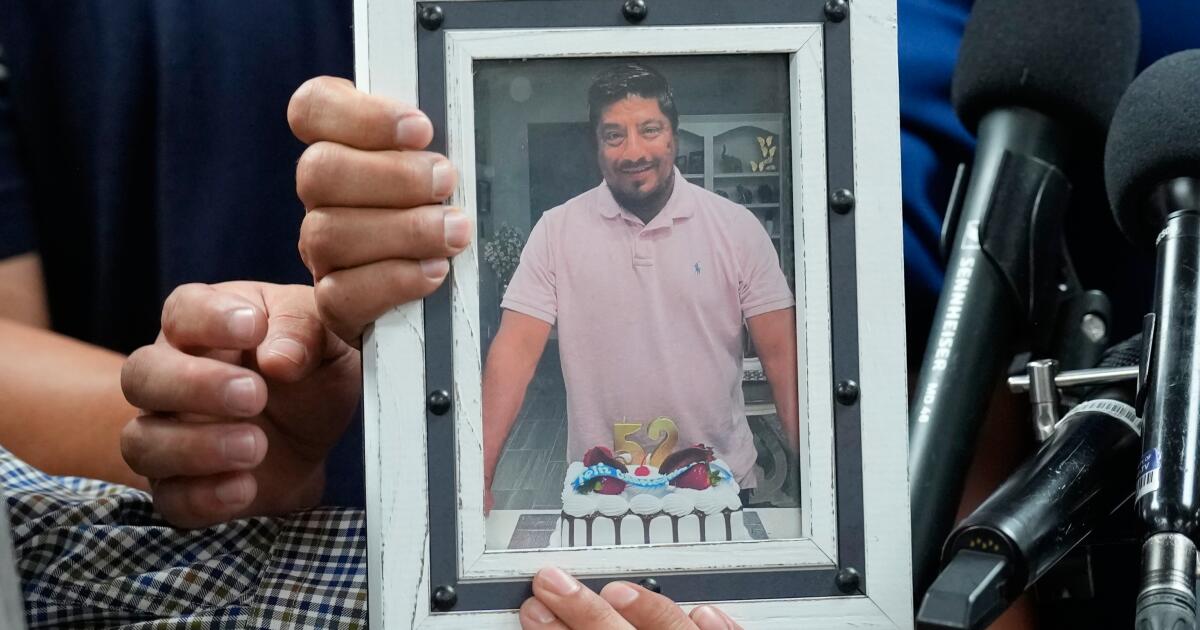
On Tuesday, a U.S. Immigration and Customs Enforcement officer fatally shot Salgado Araujo, 52, after he was pursued by federal agents driving unmarked vehicles while he was taking his crew to their latest job site. The shooting has outraged Houston leaders and renewed public scrutiny over ICE and Trump’s immigration crackdown.
Four Democratic members of Congress who represent the Houston area said at a vigil Saturday that they would push for an independent investigation into the shooting.
“We are never going to forget that his blood is on Donald Trump’s hands,” Rep. Christian Menefee said. “We are not at war. Lorenzo Salgado Araujo was not a casualty. He was a human being who was murdered by our government.”
ICE was looking for someone else
Federal agents were looking for someone else when they tried to stop Salgado Araujo’s white van, Garcia said, citing a briefing she received from ICE’s acting director. The Department of Homeland Security has said an ICE officer fired at the van in self-defense after Salgado Araujo, whom officials described as an “illegal alien,” rammed an ICE vehicle. They have provided no evidence.
After some previous shootings by federal immigration agents, Homeland Security authorities have given accounts that were contradicted by video evidence. No video showing the moment of the shooting this time has emerged, and the agents at the scene were not wearing body cameras.
The three men that Salgado Araujo was driving said he was shot through a passenger window and that the ICE officer who fired was not in front of the van or even in danger, a lawyer who has spoken with them said Friday.
His family has also disputed the account from ICE. They said lawyers, who were helping him apply for a work permit, had explained how he should behave if immigration agents stopped him. Salgado Araujo was close to obtaining legal status when he was killed, they said.
“He knew what to do,” Ronaldo Salgado told reporters this week. “He knew not to sign anything. He knew that the first phone call he should make should be either to myself or to my mom. So that way we can get the process started of getting him out.”
He believes his father may have been scared that he was being followed by unmarked vehicles, worried someone was planning to steal his van or his tools.
The shooting in the largely Latino neighborhood is at least the eighth death connected to the Trump administration’s immigration enforcement campaign.
A kind, present husband and father
Salgado Araujo entered the U.S. more than 30 years ago, settling in Houston with his wife where they raised their three children.
Education was a constant focus in the house, said Ronaldo Salgado, who is now a teacher. One of his brothers is an engineer. The other is in college studying engineering.
Several childhood friends of Salgado recalled that his father was kind and soft-spoken, always inquiring after a long workday about his wife’s day and how his sons’ friends were doing.
“We didn’t really see him until the end of the day when he came home to have dinner, but that just shows how much of a hard worker he was,” said neighbor Jessica Alanis Magdaleno. “Everything they have now is thanks to the dedication to that.”
Josué Flores, a friend of Ronaldo Salgado since their freshman year of high school, said he first saw Lorenzo Salgado Araujo at his son’s football game.
“I think it speaks volumes of the kind of person that he was,” Flores said, recalling how Salgado Araujo showed up for his son even after an arduous day of work.
Salgado Araujo’s wife, a relative said, is “inconsolable.”
“She is very upset … angry, sad, disoriented,” Jose Torres Ramon, a nephew who lives in Mexico, told the Associated Press in a Facebook message.
Ronald Salgado, his oldest son, said at the Saturday vigil that he hoped he was making his father proud.
“I’ll keep fighting for him,” he said.
His brother Lorenzo Salgado Jr. said the shooting of his father was “a hard moment to be an American.”
“Even though my government, my federal government took away my father, we the people will bring justice,” he said. “We the people are America.”
After coming home in the evening, Salgado Araujo liked to listen to music on the porch and pet the family dog. His family has described him as a simple man of routine.
“He did not deserve to die,” Ronaldo Salgado said. “He dedicated his life in the United States to giving his family the American dream.”
Sullivan writes for the Associated Press. AP reporters Jack Brook in New Orleans, Valerie Gonzalez in McAllen, Texas, and Scott Bauer in Madison, Wis., contributed to this report.
Kranti Gaud takes five wickets and makes history, before Smriti Mandhana frustrates England with an unbeaten 69 as India close on 154-1, giving them a lead of 269, with the tourists in complete control of the one-off Test at stumps on day two at Lord’s.
Jane Austen’s most famous novels have been adapted numerous times, but one film adaptation is widely praised as one of the best.
Kelly Reilly stars in the iconic film(Image: UNIVERSAL PICTURES)
Period drama fans need to clear their diaries this weekend for a Jane Austen classic.
Devotees of period dramas and Jane Austen classics are being urged to set aside time as a “simply excellent” Austen reimagining is being broadcast free-to-air. Pride & Prejudice stands as one of Austen’s most celebrated novels and the 1813 masterpiece has been brought to screen on countless occasions.
The narrative charts the tempestuous relationship between Elizabeth Bennet and Mr Darcy and the ramifications of rash judgements.
In 2005, a period romance film featuring Keira Knightley and Matthew Macfadyen in the principal roles was released and it garnered widespread critical acclaim from audiences at home. The 2005 Pride & Prejudice film is being shown on BBC Two this Sunday, July 12, having recently departed Netflix.
Screenwriter Deborah Moggach dedicated more than two years to crafting the script, creating approximately 10 different drafts.
Actress Knightley also disclosed on The Graham Norton Show that she hadn’t been an obvious contender for the leading role, as director Joe Wright believed she was “too pretty”.
Despite considerable uncertainties surrounding the film and some criticism from reviewers, Austen devotees have proclaimed it among the finest adaptations to date.
In July 2025, the film appeared in the Readers’ Choice edition of The New York Times’ list of The 100 Best Movies of the 21st Century.
Enthusiasts turned to IMDb reviews to voice their opinions, with one declaring it an “emotional masterpiece”, stating: “Pride and Prejudice was the best movie I’ve seen in a very long time, if not the best I’ve ever seen.
“It captured the very essence of Jane Austen’s brilliant novel. In fact, I enjoyed the movie more than the book itself. Everything about the movie was perfect.
“This movie is a work of art, an emotional masterpiece. Watching this movie was actually a life-changing experience.”
Another viewer described it as “absolutely perfect”, sharing: “This Pride and Prejudice adaptation perfectly captured the wit, the intelligence, the passion and the romance of Jane Austen’s classic.
“The 1995 mini is fabulous, and I have watched it many times, but I have always been frustrated that while it got so much of the dialogue and the detail right, it somehow fell flat on some of the more subtle dynamics of the novel. But this movie adaptation has captured what has before been missing!”.
A final fan labelled it “simply excellent”, sharing: “Loved this movie. It’s simplicity that empowered every possibility for imagination. The music, the natural scenes, the arts, and every honest soul in the movie made this film alive.”
Pride & Prejudice is being broadcast on BBC Two this Sunday, July 12, at 4.25pm.
COMEDIAN Jim Davidson admitted “I found out what legless means” after collapsing outside a pub and being helped up by drinking buddies.
The star downed two bottles of wine, tequila, vodka, six pints of Guinness and two whiskies on an all-day session, saying: “I think it must have been that last scotch that did it.”
Jim Davidson admitted ‘I found out what legless means’ after collapsing outside a pub and being helped up by drinking buddiesJim downed two bottles of wine, tequila, vodka, six pints of Guinness and two whiskies on an all-day session, saying: ‘I think it must have been that last scotch that did it’Credit: News Group Newspapers Ltd
Ex-Big Break and Generation Game host Jim, 72, had sailed to the Isle of Wight on his £350,000 yacht Lady Natasha — named after his fiancée.
The pair dined at The Hut in Colwell Bay before Natasha, 49, called it a night and Jim carried on drinking with some yachtsmen.
Sign up for the Showbiz newsletter
Thank you!
He said: “It was boys stuff. I found out what the term legless means.
“We had a smashing meal at The Hut, which is the best restaurant in the country, then I decided to go on the p***.
“It was a bit of a harmless fun, no one died.”
Jim, who has five ex-wives, detailed his mammoth booze-up, which ended with him collapsing outside Salty’s pub in Yarmouth.
He said: “Most people leave Salty’s like that. First I had a couple of bottles of wine that made me a bit dizzy.
Jim, who has five ex-wives, detailed his mammoth booze-up, which ended with him collapsing outside Salty’s pub in YarmouthCredit: AlamyJim admitted being a binge drinker and said: ‘I can do that when I’m not working. I can’t when I’m working’Credit: AFP
“I thought I better have some tequila to sober me up. After the tequilas made me feel worse, I thought vodka will kill the tequila.
“And after that six pints of Guinness. I thought well I need a wee, I’ll go into this pub and use their toilet and while I’m here I’ll have a couple of scotches.
“I think it must have been that last scotch that did it.”
Jim admitted being a binge drinker and said: “I can do that when I’m not working. I can’t when I’m working.
“Today I’ve got to drive five hours to Blackpool, do a show in the club and then five hours back tomorrow. This is the reality of showbiz. Then back to the studio to film my weekly satire show.
“When you’ve got a picture of me coming off stage in a theatre like that, then I’m in trouble.”
PROVO, Utah — Lawyers for the man accused of killing conservative activist Charlie Kirk planned to call a final witness Friday as they try to raise doubts about the prosecution’s case before it can go to trial.
A Utah judge is deciding whether prosecutors have enough evidence to put Tyler Robinson on trial on a charge of aggravated murder. Kirk, 31, was killed as he spoke to a crowd of thousands at Utah Valley University on Sept. 10.
One of Robinson’s attorneys, Michael Burt, tried to inject uncertainty into the case Thursday by challenging the reliability of ballistics tests on a bullet fragment recovered from Kirk’s body.
Authorities sought to tie the fragment to the suspected murder weapon, but the results were inconclusive.
“Saying anything but inconclusive was inappropriate,” said Samantha Karner with the Bureau of Alcohol, Tobacco, Firearms and Explosives.
Earlier in the week, Robinson’s team questioned the reliability of DNA evidence that investigators said linked Robinson to the scene. Experts say the science behind DNA testing is sound.
Robinson has not entered a plea. He turned himself in a day after the fatal shooting of Kirk, a close ally of President Trump credited with helping galvanize young voters for the Republican in the 2024 election.
At the request of Kirk’s family, State District Judge Tony Graf said he would allow to be shown inside the courtroom an altered version of campus surveillance video that prosecutors said shows Robinson crawling out to a rooftop “sniper’s perch” before shooting Kirk.
The unaltered video was previously shown. The altered version includes footage that zooms in on a figure that prosecutors said was Robinson and red marks that were added to the video.
The weeklong preliminary hearing ends Friday, but a decision won’t come until after Sept. 1, when Graf scheduled oral arguments in the matter.
Prosecutors on Thursday aired portions of a recorded interview with Robinson’s roommate, Lance Twiggs. The day after Kirk was shot in the neck, Robinson allegedly told Twiggs “he wishes he hadn’t done it,” a recording played in court revealed.
Later that same day — and only about an hour before turning himself in — Robinson posted “it was me at UVU yesterday,” in a chat room on the Discord social media platform, according to investigators and messages shown by prosecutors.
Defense attorneys unsuccessfully fought the public release of the statements from Twiggs and the chat room messages. They argued prosecutors would characterize the material as a confession, undermining Robinson’s right to a fair trial.
Prosecutors contend the shooting endangered others at Kirk’s campus event — an aggravating circumstance that could make the crime punishable by death under Utah law. Robinson also faces possible sentence enhancements based on claims by prosecutors that he targeted Kirk because of his political views.
Twiggs said in the April interview with prosecutors and investigators that Robinson sometimes talked about politics, including Trump. But Twiggs said he never heard Robinson talk about Kirk before the shooting. The defendant also did not talk much about gender issues or LGBTQ rights, Twiggs said.
The weeklong preliminary hearing has attracted intense media coverage and spectators who have angled for one of the 14 seats in the courtroom that are reserved for the public.
People have lined up early — sometimes sleeping there overnight — in hopes of getting in.
Schoenbaum and Brown write for the Associated Press. Brown reported from Billings, Montana.
1 of 8 | Photograph shows William Jennings Bryan (seated, left, with fan) and Clarence Darrow (standing, center, with arms folded) at an outdoor courtroom during the Scopes Trial (Tennessee v. Scopes) in Dayton, Tenn., in July 1925. UPI File Photo
July 10 (UPI) — On this date in history:
In 1925, the so-called Monkey Trial, in which John Scopes was accused of teaching evolution in school, a violation of state law, began in Dayton, Tenn., featuring a classic confrontation between William Jennings Bryan, the three-time presidential candidate and fundamentalist hero, and legendary defense attorney Clarence Darrow.
In 1962, the United States launched the first telecommunications satellite, Telstar, into orbit, which relayed TV pictures between the United States and Europe.
In 1985, Coca-Cola, besieged by consumers dissatisfied with the new Coke introduced in April, dusted off the old formula and dubbed it “Coca-Cola Classic.”
File Photo by Stephen Shaver/UPI
In 1989, Mel Blanc, the voice of Bugs Bunny, Daffy Duck and countless other Warner Bros. cartoon characters and radio and TV comic creations, died from complications of heart disease. He was 81.
In 1991, Boris Yeltsin was inaugurated as the first freely elected president of the Russian republic.
In 2009, General Motors completed its race through bankruptcy with the signing of a contract with the U.S. government, which got 61 percent of the company. The recovery plan included considerable shrinkage, including the closing of factories and layoffs of 21,000 union workers.
Then-General Motors CEO Fritz Henderson attends a press conference in New York City on June 1, 2009. File Photo by John Angelillo/UPI
In 2011, media mogul Rupert Murdoch’s News of the World, Britain’s best-selling weekly newspaper, abruptly ceased publication amid allegations that its reporters and investigators had hacked into telephones of royalty, politicians, celebrities, homicide victims, families of fallen soldiers and others to illegally gain material for stories.
In 2012, an Israeli court acquitted former Prime Minister Ehud Olmert of corruption but found him guilty of breach of trust. The charges stemmed from a period before he was PM.
In 2018, divers rescued the last of the 12 boys and their soccer coach from a flooded cave in Thailand, where they’d been trapped for more than two weeks.
In 2024, the original Hermes Birkin bag — designed by Jean-Louis Dumas specifically for actor and singer Jane Birkin in 1985 — sold for $10 million at auction in Paris. A Japanese business executive, Shinsuke Sakimoto, won the bidding, making it the most expensive handbag ever sold.
A TEACHER flew to France for lunch and says it was cheaper than a typical day out in the UK.
Claire Howard flew to Beauvais, France for a day of sightseeing and sunshine – while still being home before midnight, and spending less than £80 all in.
Claire Howard spent just over £70 on an entire day trip to France
The 48-year-old spotted return Ryanair flights for just £27, which left Birmingham at 7:30am and returning at 11pm.
She managed to skip the expensive airport taxis, with her husband dropping her off at the airport before a £1.80 bus.
Sign up for the Travel newsletter
Thank you!
Claire says the whole excursion including flights, buses food and drink cost around £70.
“I’ve been to Paris a few times and didn’t want to travel in from Beauvais as Paris is really pricey and busy,” Claire told creatorzine.com.
“I just wanted to see what was actually in Beauvais itself for a relaxing day of wandering, eating and drinking.
“It’s exciting to go to a different country just for lunch or to explore for a day.
“It’s just a different feeling abroad – it makes it feel much more like an adventure than just going somewhere at home.”
She added that it was much cheaper than a day trip in the UK, where a trip to the cinema and lunch out can easily be £50 alone, before factoring in travel.
The English teacher spent the morning at the city’s weekly Saturday market while enjoying coffee and a pain au chocolat that set her back £4.
Then she relaxed with a drink in the town square while listening to live music before taking a £10 Uber to Plan d’Eau du Canada, a popular lakeside spot.
She has already been to a number of cities in Europe on a day tripOther day trips she has been on include PortoCredit: Alamy
Lunch was an £8 French picnic of supermarket baguette, cheese and a small bottle of wine while reading and sunbathing by the water.
Her itinerary also included visits to Beauvais Cathedral and the nearby Musée de l’Oise, both of which offered free entry.
The day ended with a Pad Thai dinner at a local Thai restaurant costing around £10 before she headed back to the airport for her evening flight home.
She also bagged an £8 bracelet to help her to remember the day.
Claire says she has become hooked on cheap day trips abroad after discovering bargain flights from Birmingham Airport – and flies to a different city nearly once a month.
Just this year, she’s visited Bergamo, in Italy, Malaga, in Spain, Valetta, in Malta, Poznan, in Poland, and Porto, in Portugal.
And she’s already bagged return flights to Poland and Berlin in August for £70.
Claire said: “I’m just led by what is possible and affordable.
“I can’t take time off at all in term time but I have Tuesdays off so I do like to make use of them.
“I just love the way you can do and see so much in the same time that you might waste a day at home just watching Netflix and doomscrolling.
“I usually find the best prices four to six weeks in advance.”
Turkish actress Ece Irtem, 35, died from ethyl alcohol poisoning after her 35th birthday partyCredit: NewsflashExperts concluded the exceptionally high alcohol level mixing with prescribed antidepressant and anti-anxiety medication killed the starCredit: Newsflash
She died at her home in Istanbul, Turkey, after collapsing in front of her devastated mother.
Initial findings suggested Ece had died of a heart attack, but The Institute of Forensic Medicine ruled that the star died from alcohol poisoning after an extensive investigation.
Sign up for the Showbiz newsletter
Thank you!
395 milligrams of alcohol per decilitre (mg/dl) of blood was found in her system, nearly eight times Turkey’s legal drink-driving limit.
This blood alcohol level is deemed medically critical and can be fatal.
Experts concluded the exceptionally high blood alcohol level mixing with prescribed antidepressant and anti-anxiety medication caused the actress’ death.
The findings put to bed widespread rumours that Ece had died from an illness contracted from a monkey bite.
She had been bitten by a monkey on May 27, during a trip to Thailand, Ece’s lawyer Uğur Gökkoyun confirmed.
Macaques in Thailand can carry infectious diseases including rabies and herpes.
Ece died at her home in Istanbul, Turkey, after collapsing in front of her devastated motherCredit: NewsflashShe had been bitten by a monkey on a recent trip to Thailand, but the bite was not fatalCredit: Newsflash
But Uğur explained that she had taken a 21-day course of preventative medication before safely stopping it after 11 days.
And the autopsy found no evidence suggesting that the monkey bite was at all linked to her death.
Ece had posted on social media just a day before her death thanking fans for their sweet birthday wishes.
Heartbreaking tributes have poured in for the young actress, saying she was full of love and happiness.
Caglar Kuru, her friend from university, wrote: “I cannot find the words. She was a person whose heart was full of love, energy and happiness.
“Living through this pain is truly very sad.”
Ece studied at Yasar University’s Opera and Vocal Studies Department before going on to train as an actress.
The soap star kicked off her television career in 2014 before going on to appear in series including Runaway Brides, That’s My Life and New Bride.
She also starred in shows including Payitaht Abdulhamid and Mr Wrong.
Ece was buried at Yenikoy Cemetery in Kusadasi, on Turkey’s Aegean coast.
But the funeral sparked a furious row after several people were spotted filming and taking photos of the coffin.
Footage of the moment went viral on social media and the fans were slammed for their disrespect towards the grieving family.
When it comes to fear of heights, Maddi Haferling was born with the opposite gene — loving heights.
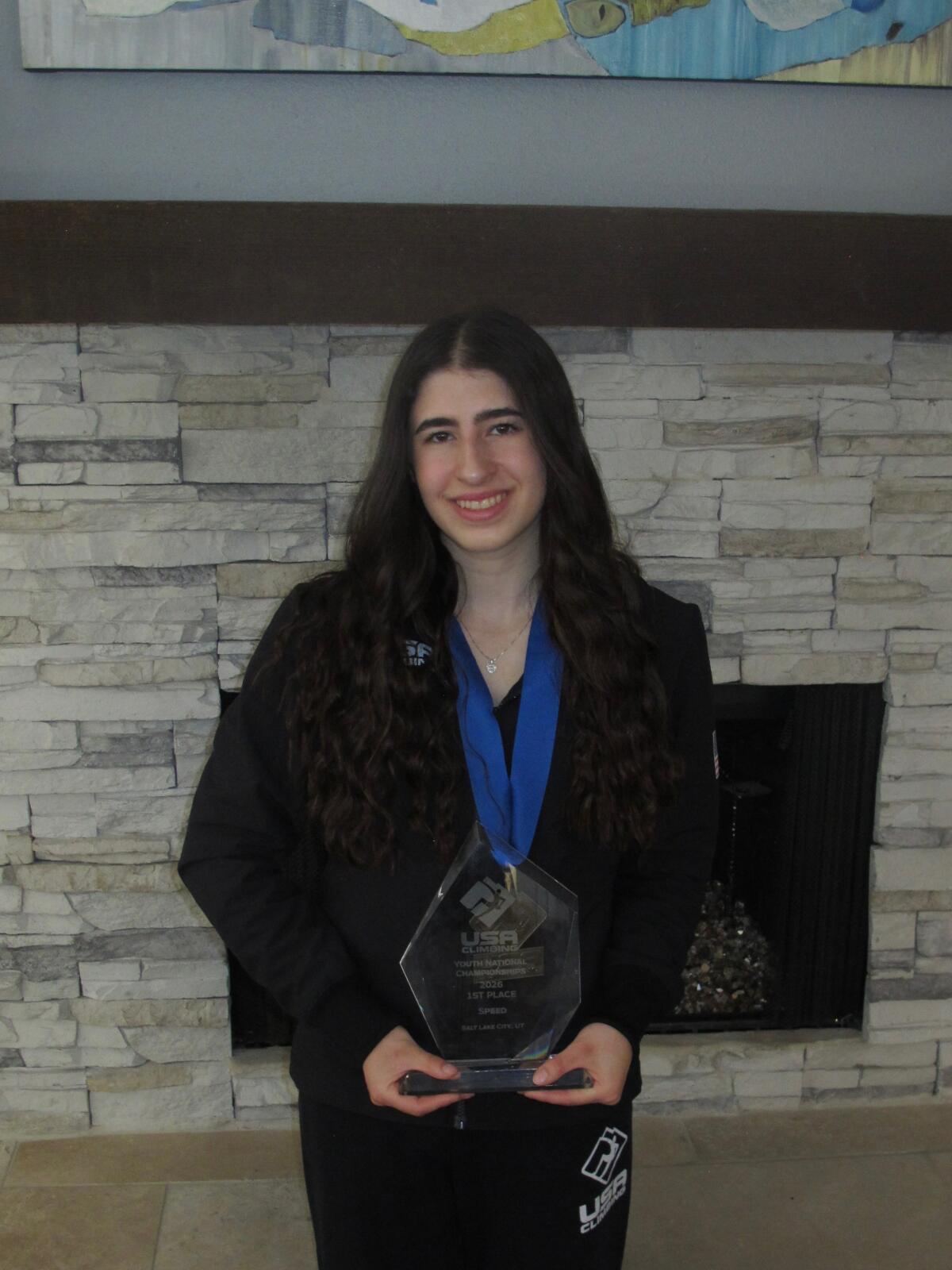
The Woodbridge High senior started climbing a door at home at age 4 trying to reach a pull-up bar. By 10, she was signed up for a climbing academy. At 17, she won a gold medal in speed climbing last week at the USU19 National Championship in Salt Lake City.
On Thursday, she leaves for Arco, Italy, to compete at the Youth World Championships.
“It’s pretty cool,” she said.
At 5 feet tall, her challenge is climbing a standardized 15-meter wall course and finishing with the fastest time going against an opponent climbing an identical course. She’s attached to a safety rope in case there’s a fall.
Maddi Haferling of Woodbridge won a gold medal in speed climbing.
(Haferling family)
Being a climber, I have a lot of strength that oust don’t have,” Haferling said. “I can do 25 pull-ups that can impress you.”
So what happens if a Woodbridge football player challenges her to a pull-up contest?
“I think they know they’d lose,” she said.
She trains five days a week, three hours a day at a Santa Ana climbing facility lifting weights and practicing speed climbing techniques with other team members.
“It’s nice I can push myself in a sport and commit to something,” she said. “Being on a team is amazing.”
Booming Hans Zimmer-style cinematic music reaches a crescendo, shaking my bones. Two turquoise macaws swoop within an inch of my hair and join a sky filled with nearly 250 birds. Hawks, kites, pelicans, and an owl soar and swoop around a pagan-looking wooden circle. Peacocks fuss at the makeshift river below, coaxed by two actors telling the story of humans’ relationship with nature. Grey clouds roll in, dark with rain. After all, we are risking an open-air performance in north-east England. I’m at a preview of Kynren: the Storied Lands, the latest gloriously unrestrained project in the market town of Bishop Auckland, 12 miles south of Durham.
I grew up near Bishop Auckland, which was once an important coal-mining and railway town. Last time I was here, its centre was dominated by discount stores. If, in 2003, you’d told teenage me that the high street would become an ode to art, history and culture, I would have laughed. Well, I would have grunted and turned up the Nu metal on my MP3 player.
The Spanish Gallery inside Auckland Palace features work by El Greco and Velázquez. Photograph: The Auckland Project
This madcap renaissance is down to one couple. In 2012, investment banker Jonathan Ruffer rescued Francisco de Zurbarán’s celebrated series Jacob and His Twelve Sonsfrom the sale of Auckland Palace. Needing somewhere to house the paintings, he ended up buying Auckland Palace too. He and his wife Jane Ruffer could have followed centuries of previous owners, closed the doors and kept the paintings to themselves. Instead, they set up a charity and opened up the palace and its beautiful gardens to the public. Thus began the complete renovation of Bishop Auckland.
The palace itself is a vision of grand, gothic architecture dating from the late 12th century. In St Peter’s chapel, the stone archways and a painted wooden ceiling make you feel as if you have stepped into the middle ages. The lifesized Zurbarán paintings remain on the dining room walls as a stream of visitors peruse the preserved stately rooms, guided by volunteer attendants.
“We employ 201 staff,” says Harry Sinclair, public relations officer at the Ruffers’ Auckland Project, as he guides us through the estate. “Around 80% come from a 10-mile radius, so we’re very much leading the circular economy. It’s about regenerating the town through its culture and heritage.”
After procuring the palace, the project grew arms and legs, becoming the Auckland Project, a regeneration charity dedicated to remodelling Bishop Auckland. As well as running the palace and gardens, the initiative built two art galleries and a lookout tower, and preserved a local heritage railway and Roman fort.
The galleries – one dedicated to mining art from County Durham, the other to the golden age of Spanish art – are not the ramshackle, fossil-packed local museums of my childhood school trips, but sleek galleries with ink-black walls and , boasting works by El Greco and Velázquez. Back outside, the drizzle clinging to my skin brings me back to Earth, but the striking viewing tower dominating the centre like the skeleton of a cathedral is another sight I never thought I’d see in Bishop Auckland. “Altogether we call it a slightly bonkers day out,” says Sinclair.
The setting for the new show is picturesque. Photograph: Will Walker/North News and Pictures
He tells me about the 59-bedroom hotel the project is building on the market place. He says it should increase footfall and dwell time in the town centre, with 1.5 million visitors expected each year from 2029. The hotel could create up to 95 jobs. There are already self-catering cottages in a neat line outside Auckland Palace and boutique accommodation at the Park Head Hotel.
But most ambitious of all is the jaw-dropping Kynren project. In 2013, the Ruffers bought Flatts Farm – about 100 hectares (250 acres) outside Bishop Auckland – and every summer since 2016, have hosted a glorious night show telling 2,000 years of English history to audiences of up to 8,000 people. More than 1,000 local volunteers work to create an extravaganza with horseback cavalry, sword fighting, working steam locomotives and boats gliding across a human-made lake, culminating in a dazzling firework display.
And next week, Kynren: the Storied Lands is opening during the day, too, as a live-show theme park for the first time. The arena, where my sneak peek at the new Lost Feather show takes place, is impressive. Huge wooden branches are stacked haphazardly into a circular nest so convincing I expect an eagle chick the size of a bus to emerge. During the show, birds pop out of hidden doors above the audience and swoop overhead, coaxed by handlers in medieval-style tunics.
It doesn’t always go to plan. One kestrel flies off into the nearby forest, and a tawny owl refuses to perform; its wide yellow eyes staring out at an audience delighted by its misbehaviour. Each mishap only adds to the joy of the experience. “That’s the beauty of live performance,” Anna Warnecke, CEO of Kynren, says. “There’s an electric sense of adrenaline that you don’t get from watching the same thing on a screen.” She’s right. By the end of the show, we’re holding a collective breath and there’s heartfelt applause and laughter when the kestrel returns from the distant woodland to the gloved arm of its handler.
The Auckland Tower in the heart of town. Photograph: travelibUK/Alamy
The Lost Feather is one of six live shows running throughout the day until mid-September. The other five performances are in equally elaborate auditoriums. The Legend of the Wear (a re-telling of the local Lambton Worm myth) features live action water stunts on a lakeside stage. At Land of the Vikings you walk through a working village, interacting with actors to the sound of clanging metal from the forge before distant drumming signals the start of the show in the boat-like arena. Expect big beards, the clash of shields and axes, fire, and a lot of Viking roaring.
“We wanted to create a visitor destination,” Anna says. “People aren’t going to travel that far for a single 90-minute show like Kynren. So the daytime performances give people a reason to spend all day here.” There’s certainly plenty to stay for at Bishop Auckland these days. Apart from epic bird shows and recreated Viking raids, a fascinating palace, Spanish masterworks, a Roman fort, deer park and heritage railway line, the original Kynren spectacular still runs on Fridays and Saturdays between July and September.
This is not just a “slightly bonkers day out”; it’s a testament to unbridled ambition. I think even my sulking 16-year-old self would be secretly in awe of what Bishop Auckland has achieved.
The trip was provided by Visit County Durham. Kynren: the Storied Lands day show runs from 18 July until 12 September (£30 adult, £20 child, kynren.com). Auckland Palace (£20, children under 4 free, aucklandproject.org) is open 10.30am-4pm, Wednesday to Sunday and bank holiday Mondays
America’s semiquincentennial came and went, and the Disneyland Resort marked the occasion with a transformation of its now-classic Soarin’ ride. Gone, for now, is Soarin’ Over California and Soarin’ Around the World. In their place is Soarin’ Across America, a lightly patriotic-themed journey from coast to coast.
There are flyovers of nationalistic symbols such as the Statue of Liberty, Mount Rushmore National Monument and the Washington Monument, but the majority of its dozen locations are national parks, making Soarin’ Across America a love letter to America’s natural and diverse beauty. And it felt like a four-and-a-half-minute celebration.
You’re reading Mr. Todd’s Wild Ride newsletter
Todd Martens’ newsletter delivers news and commentary on the past, present and future of theme parks, right from the theme park capital of the world — Southern California.
By continuing, you agree to our Terms of Service, which include arbitration and a class action waiver. You agree that we and our third-party vendors may collect and use your information, including through cookies, pixels and similar technologies, for the purposes set forth in our Privacy Policy such as personalizing your experience and ads.
Soarin’ Across America has the strongest scene of any of the three attraction films, which envelop riders as they ascend in the sky on a hang glider simulator. That’s its opening, a shot of a rocket launch at Florida’s Kennedy Space Center. We start level with the spacecraft, and then follow its journey into the clouds. Being this close to a liftoff, and feeling the sensation of rising with it, creates an inspiring, rousing moment. As in any Soarin’ film, we are promised the great outdoors, but here we get magnificent ingenuity.
Is it the best Soarin’? I’d still rank Soarin’ Over California as No. 1, as it has a sort of goofball charm, such as tumbling skiers or a golf ball flying toward the audience. But Soarin’ Across America is a worthy successor. It takes a more patient approach, as the ride now seems to linger longer over certain locales, allowing us to take in the majesty of the Grand Canyon West or vibrancy of the Louisiana bayou without distraction. I appreciated the tonal shift, which makes it stand on its own and doesn’t try to force itself to capture the original’s whimsy.
A coastal scene from Soarin’ Across America.
(Disney Parks)
I also enjoyed the new smells. When hovering near the Hawaii coast, for instance, the tropical fragrances that wafted over guests seemed to reflect the gummy fruitiness of a mai tai. (No, that wasn’t just me longing for an afternoon break at Trader Sam’s.)
I went in with a bit of skepticism, and I’m relieved to say my fears weren’t realized. Well, fully realized. This is a divisive time in American history, and cultural works are increasingly viewed through a political lens. When announcing the attraction, Disney did so with symbolism of the American flag, a bald eagle and the Statue of Liberty, art that was admittedly bright and welcoming, but also could be read as giving it an uncomfortable, chauvinistic sheen.
Share via
Not everyone in 2026 may be excited with a flight simulator that serves as a cheerleader for America. And I still question the inclusion of Mount Rushmore, which has a long, controversial history, and has been a fascination of President Trump’s. But aside from that scene, and some odd red, white and blue sparkler-like fireworks visible in the New York Harbor, which curiously distract from a view of the Statue of Liberty, Soarin’ Across America doesn’t lay on the jingoism. At least until the final moments, when we see an American flag in the sky above Disneyland’s Sleeping Beauty Castle.
I’ll take it. The vibe throughout is one of restraint. When we glide near a Maine lighthouse, the film seems to pause, allowing the rocky coast and long-standing structure to be the stars. A dip across the American plains takes us above a herd of bison, but by and large movement is kept to a minimum (here the scent is of grassy freshness, which I’m betting is not what a bison smells like). A train in the Ozarks, for instance, comes to us rather than the film rushing to trace its path.
Filmed primarily with helicopters and drone shots, Soarin’ Across America utilizes CGI, courtesy of Industrial Light & Magic, less than Soarin’ Around the World, and primarily on scene transitions when we appear to fly next to a bird. This is an attraction that leans more National Geographic, that is it is unobtrusive and unstaged, than past iterations of Soarin’. While some may miss more active visuals, I appreciate that each Soarin’ film takes a different approach. Long term, it will allow Soarin’ Across America to serve as a snapshot in time, of an America at a certain point in history.
Soarin’ Across America shows aerial vistas across the United States, and it’s arriving at a divisive moment in our nation’s political history.
(Disney Parks)
And that’s already true. For when the film takes us down in front of the Washington Monument, we can off in the distance ever-so-slightly glance at the Lincoln Memorial Reflecting Pool, caught before its current Trump adminstration remodeling. Depending on your point of view, it can be unintentionally uncomfortable or amusing to see a locale before it became a political lightning rod. But that’s sort of the appeal of the Soarin’ films. They’re glimpses of not just a moment in time, but of a constantly changing world.
In that sense, there’s something relatively quaint about Soarin’, especially for our fast-paced, thrill-focused world. Soarin’ was groundbreaking when it debuted in 2001, but today we have venues like Las Vegas’ Sphere and Inglewood’s Cosm, whose spherical screens are higher definition and can even create the illusion of movement. Soarin’ Across America charms — all four of my rides last week ended in audience applause — by simply being a calming, relaxed journey that stokes our sense of adventure.
This week in SoCal theme parks
Disneyland Park has now welcomed more than 1 billion guests.
(Christian Thompson / Disneyland Resort)
Disneyland: More than 1 billion served. The Disneyland Resort over the weekend welcomed its 1 billionth guest. The distinction went to 8-year-old Andres Robles, who with his family was treated to a VIP tour of the park. Disneyland has updated its population sign atop the Disneyland Railroad’s Main Street Station. To help put into context how unfathomably large 1 billion is, it’s worth noting that it took Disneyland, which in recent years has been drawing around 17 million attendees, nearly 71 years to reach that number.
The Cenobites are coming to Universal Studios Hollywood. The latest addition to this year’s Halloween Horror Nights has been revealed, and it’s a haunted house based on the “Hellraiser” franchise. Pinhead actor Doug Bradley will reprise his role for the walkthrough attraction by voicing the character’s representation in the house. Halloween Horror Nights is set to launch Sept. 3.
Don’t miss this look into Disney history. PBS SoCal will on Friday, July 17, show the documentary, “Bob Gurr: Living by Design.” It’s a revealing look into the life of a key early Disneyland designer, as Gurr created the look and feel of the Haunted Mansion “Doombuggies,” the original Autopia cars, the bobsleds of the Matterhorn and, of course, the first Disneyland Monorail. Before you watch, get to know the colorful, outspoken Disney legend.
A Disneyland deal for Anaheim residents. Good news for those who live near the Disneyland Resort. For a limited time from July 20 through Aug. 8, Anaheim residents will have access to a locals-only deal. Adult one-day tickets will start at $71, while child tickets will be $50. Park-hoppers for adults will sell for $104 while child tickets will remain $50. It’s a significant savings and a great way to see the start of the park’s Halloween season. The tickets go on sale July 16.
The best thing I ate at the parks
The al pastor pork chop at Lamplight Lounge.
(Todd Martens / Los Angeles Times)
One of Disneyland’s best dishes is currently available at Disney California Adventure’s Lamplight Lounge, its Pixar-decorated pub-like outpost. It’s a sliced al pastor pork chop served with cheese polenta, pineapple relish and a spicy red chili butter sauce ($32). The pork is soft, the polenta creamy and it carries just enough heat to give it a bit of an edge. While filling, it’s surprisingly not too heavy, and Lamplight is always a lively spot to take a break from the parks. I only wish the place had a non-hazy IPA.
Your questions answered
Disneyland’s Sleeping Beauty Castle on a crowded 2019 day.
(Jay L. Clendenin / Los Angeles Times)
Hi Todd, we went to the park [Sunday] and it was empty: walk on to Cars, walk on to Indy. Thirty minutes for Guardians. Everything else was down to about 5 [minutes] besides Tiki Room because it’s a 15 min show. Are they struggling this summer? I haven’t seen a day like that at Disney since I was a kid. — Jake from Riverside
Disneyland has been unseasonably comfortable this summer (read: less people). And the Fourth of July holiday week was kind of a breeze, with low wait times at most attractions at both parks.
But I wouldn’t says struggling, as I have seen busy days in recent weeks and Sunday was particularly unique. Mexico and England were playing a much-buzzed-about World Cup match, which no doubt kept crowds at bay. But it’s true that Disneyland this summer has, on a whole, been more pleasant, crowd-wise, than in year’s past.
Ultimately, I attribute the potentially lighter attendance to a combination of factors. One, the park has likely hit the peak price it can currently offer guests (fingers crossed this is true, as I don’t think most Disneyland fans can absorb another yearly price hike right now). Two, the aforementioned World Cup is drawing away potential attendees. And three, everything is more expensive today, forcing families to choose between, say, an afternoon at Dodger Stadium or a day at Disneyland. It’s increasingly untenable to do both.
And people are hungry for different, approachable ticket options. Last week, for instance, Disneyland unveiled a new evening ticket deal for all guests. The $59 offer allows attendees to enter either Disney California Adventure at 5 p.m. or Disneyland at 7 p.m. Available Sundays to Wednesdays through Aug. 5, all dates sold out in six days, unless Disneyland allots more tickets for the deal.
Tell us your stories. Ask us your questions.
Have a theme park tale to share? Whether it was a good day or less-than-perfect day, I would love to hear about it. Have a question? A tip? A fun photo from the parks to share? Email me at todd.martens@latimes.com. I may feature your note in an upcoming newsletter.
Ride on,
Todd Martens
P.S.
Universal Studios Hollywood first began exploring a high-speed coaster more than a decade ago.
(Todd Martens / Los Angeles Times)
Universal Studios Hollywood’s new Fast & Furious: Hollywood Drift is set to open soon, and while many are excited, I’m curious to hear from those who live near the theme park. Universal has emphasized how it has instituted a number of noise-mitigating factors, from placing pea gravel in the tracks to building sound walls and creating shields designed to capture rider screams.
Theme park rides, however, can still be loud. If you’re in one of the neighborhoods surrounding the park, drop a line at todd.martens@latimes.com and let me know if Universal’s efforts have been enough, or if the coaster is a disruptive presence.
John Slattery was jet-lagged in Budapest late one night after a day of shooting the 2025 drama “Nuremberg” when his old “Mad Men” co-star and friend Jon Hamm texted him with the kind of pitch that would send many actors sprinting in the opposite direction.
Would he be willing to play an out-of-work version of himself who hadn’t had a gig in a decade and was shamelessly coasting on his “Mad Men” fame?
Reading the script for “Gail Daughtry and the Celebrity Sex Pass” through the haze of fatigue, Slattery fixated on that one detail: “Hasn’t worked in 10 years, huh?” he recalls by phone from his home in New York. “I had to go: Wait a second. Let me IMDb myself.”
As it happens, the 63-year-old Slattery — best known for his four-time Emmy-nominated turn as the silver-haired ad executive Roger Sterling on “Mad Men” — has racked up some 30 film and TV credits since that show ended in 2015. Still, he says he was happy to detonate his cool, unflappable persona in the latest comedy from “Wet Hot American Summer” and “Role Models” filmmaker David Wain.
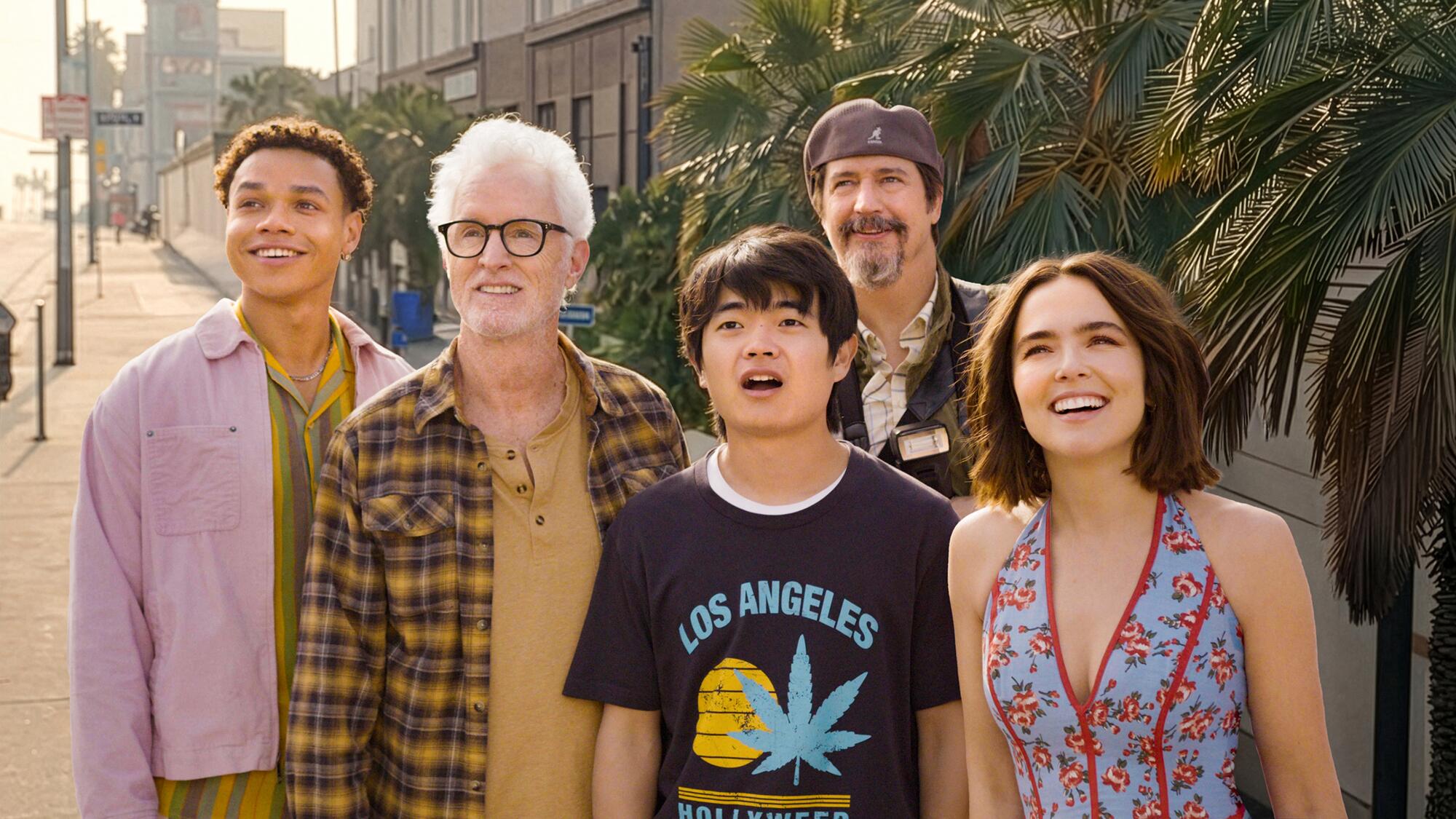
The gleefully unhinged “Gail Daughtry,” which premiered earlier this year at Sundance and opens Friday, casts Slattery as a washed-up version of himself who is enlisted by a Midwestern woman (Zoey Deutch) who flies to Los Angeles determined to cash in on a celebrity sex pass with Hamm after discovering her fiancé cheated on her with Jennifer Aniston.
For Slattery, what begins as an exercise in comic self-demolition gradually becomes the movie’s biggest surprise, with the actor turning a desperate, delusional version of himself into its most unexpectedly lovable character.
From left, Miles Gutierrez-Riley, John Slattery, Ben Wang, Ken Marino and Zoey Deutch in the movie “Gail Daughtry and the Celebrity Sex Pass.”
(Sundance Institute)
Speaking with The Times, Slattery reflected on cheerfully becoming the butt of the joke, why broad comedy is anything but easy and what it’s like navigating Hollywood at a moment when fading away feels a little less far-fetched than it once did.
Actors spend years building a certain cool image, but within seconds of appearing onscreen in this movie, you’re whining, farting and generally making an ass of yourself. What appealed to you about that?
I never considered it risky. Not that it was foolproof, but it was just such a silly idea and I was a fan of David Wain and those guys anyway. These kinds of comedies take skill and experience. I mean, you have to be really smart to make a movie this stupid.
You’re always looking for something that’s different and this was such a funny way to depart from myself — ironically, by playing myself. It seems like the wildest character I’ve played in a while, and it’s me. I thought: What kind of research am I supposed to do? Am I supposed to watch myself and imitate myself? But there was really nothing to do. You just learn the lines and show up.
Was there ever a moment where you thought: This is either going to be really funny or the end of my career?
I didn’t have that feeling on this. There’s nothing funnier to me than a confident moron. My favorite thing in the world to watch or try to do is somebody who has full confidence in their idiocy.
I’m not somebody who dives into the deep end right away. First I want to know I can trust the people in charge of what I’m about to deliver to them. If I do all this, whose hands am I leaving it in? With David, that wasn’t even a consideration. He’s just so good at what he does, and that gives you permission to just go all in.
Have you always been able to laugh at yourself or is that something that’s gotten easier as you’ve gotten older?
I come from a large family of piss-takers. They’re all really good at ball-breaking and really funny. My mother had six kids, and all her brothers had five or six kids. I had a million cousins, and they will shred you. Somebody would always knock your feet out from under you if you took yourself too seriously.
John Slattery and Jon Hamm in a scene from the AMC drama “Mad Men.”
(Frank Ockenfels / AMC)
Every successful actor probably has a nightmare that one day the phone stops ringing and you’re coasting on fading glory. Did you ever have that feeling after “Mad Men” ended?
After going through COVID and the strike and directing an independent movie [2023’s black comedy “Maggie Moore(s)”], which doesn’t pay very well, I hadn’t acted in a while. I was like: Oh, I wonder if this is going to continue. I don’t know.
The business has contracted. It seems like there’s an endless list of titles on every streaming menu, and yet they’re making less and people are struggling. So I’m glad to be working. I’ve had a pretty lucky run of late and I’m not taking it for granted.
At this point in your career, what makes you say yes to something?
Money. [laughs] No, it’s really the same as it’s always been. You always want a big, fat, juicy part, but sometimes it’s just a functioning part in a really good story.
You kind of roll with the punches. You do something, you have some success with it and then you get a lot of offers for things that are a lot like that. If that’s all that comes in, you pick the best one and keep going. People say, “Well, it’s not ‘Mad Men.’” And you go, “Well, what do I need to do that again for? I did that.”
This is a perfect example of something that’s every bit as interesting and fun in a completely different way. If they could all be like this one, I could die tomorrow. You want them all to be this fun, because they’re not. Sometimes you’re stuck in a courtroom all day and it’s pretty dry. This was anything but that.
Hollywood feels like a deeply anxious place right now. You’ve worked through a lot of different eras of this business. How does this moment compare?
I have a job coming up, so that’s always hopeful. Having just come off something, and knowing you’re about to do something else, gives you a sense of security. But there’s definitely a palpable anxiety. You hear it when people get jobs: “Thank God.” Or, “It’s about time.” Or, “I don’t care what it is, I’m going to do it.”
I was listening to Taylor Sheridan recently talking about how people who don’t tell stories are governing the telling of stories. That’s more than disconcerting. And now AI is the overlord of all that. It’s very strange.
It’s always been a youth-oriented business. There are definitely more movies about people who are 27 than people who are 63. Maybe it all kind of shakes out. I don’t know. Sometimes I wish it were 1943 and I was in a suit playing a detective.
I would watch that movie. Meanwhile, Hollywood doesn’t make many broad theatrical comedies like this anymore. Why do you think that is?
I don’t know why the studios have given up on comedies in movie theaters. They used to be the thing, right? Those big Will Ferrell movies were huge moneymakers.
Maybe this will turn the tide. When you think about the condition of the country right now, and how pissed off and divided everybody is, you roll out this silly, smart-but-stupid comedy, and it seems like the perfect amelioration of everybody’s anxiety. Go get some popcorn and laugh your ass off. You’ll feel better.
1 of 3 | Philippine Congresswoman Gerville Luistro (L), a member of the prosecution panel, delivers an opening statement during proceedings for the impeachment trial of Philippine Vice President Sara Duterte at the Philippine Senate in Pasay City, Metro Manila on Monday. Photo by Rolex Dela Pena/EPA
July 6 (UPI) — Prosecutors in the Philippines called for accountability Monday on the first day of an impeachment trial for Vice President Sara Duterte, whose lawyers said the case was politically motivated.
Sara Duterte, who is the daughter of former President Rodrigo Duterte, faces allegations of misusing public funds. The House of Representatives voted overwhelmingly to impeach her in May, with 257 of 290 lawmakers voting in favor.
The allegations center on the wealth she gained after becoming mayor of Davao in 2019 along with her use of funds as vice president.
In opening arguments, Gerville Luistro, a House representative from Batangas, questioned, “does accountability still matter in our country?”
“If a small village treasurer can’t explain missing funds, he is investigated. If a school principal squanders public funds, even just 5,000 pesos, she is punished. If ordinary people are held to account, why not the most powerful government official,” Luistro questioned, as reported by the BBC.
Sara Duterte’s lawyer, meanwhile, said lawmakers are targeting her politically because she received more votes in the 2022 presidential election — 32.2 million — than President Bongbong Marcos did in his race — 31.6 million.
“It is clear that the objective is to oust her,” lawyer Sheila Sison said.
“Whatever one’s political persuasion is, the reality is that the prosecution now comes for this court to remove a vice president chosen by an overwhelming number of the electorate,” she added, as reported by the Philippine Star reported.
After opening statements, Sen. Chiz Escudero, the presiding officer in the trial, ordered the return of Sara Duterte’s tax records to the Bureau of Internal Revenue.
Sara Duterte was not present in the courtroom as the trial got underway.
She issued a statement saying her decision not to attend the proceedings and not to testify are a “legal strategy.” She also criticized Marcos for speaking against that decision.
“The burden remains on the prosecution to prove its case,” Sara Duterte wrote in her statement on Facebook. “Choosing to appear through counsel rather than testify personally does not diminish accountability or imply a lack of transparency. The integrity of an impeachment trial depends on adherence to the rule of law — not on whether the respondent personally takes the stand.”
Marcos, who was on a trip to Canada, told reporters in Vancouver that he would appear in person in court if he were facing an impeachment trial.
While this is Sara Duterte’s first impeachment trial, it’s her second impeachment as vice president. In 2024, she claimed to have arranged for Marcus to be killed if she were killed. The House of Representatives voted to impeach her for the comments, but the country’s Supreme Courtblocked the effort.
Troops in landing craft approach Omaha Beach on D-Day in Normandy, France, on June 6, 1944. D-Day was the largest seaborne invasion in history and turned the tide of World War II. Photo by UPI | License Photo
KATIE Price showed off her painful looking toe as she headed on a ‘pamper day’ with son Harvey.
Taking to Snapchat, the 48-year-old’s posts showed Katie enjoying a day out with her eldest son.
Sign up for the Showbiz newsletter
Thank you!
Katie Price shows off painful-looking toe while she and Harvey enjoyed a pamper dayCredit: Katie Price/Snapchat/BackgridKatie Price shows off painful-looking toe as she and Harvey enjoy a pamper dayCredit: Katie Price/Snapchat/Backgrid
Media personality and model Katie treated herself to a pedicure while Harvey, 24, got a manicure.
As Katie showcased her long toenail extensions, she also wasn’t shy about showing off a bruised, sore-looking toe.
Following their treatments, the mother and son duo then headed on to attend a baby shower.
The day out saw Harvey treated to a manicureCredit: Katie Price/Snapchat/BackgridKatie welcomed Harvey in 2002 and her is her eldest childCredit: Getty
She is also mother to son Junior and daughter Princess (with Peter Andre), as well as Jett and Bunny Hayler (with Kieran Hayler).
Venezuela has marked its 215th Independence Day as citizens continue to grapple with grief following a pair of deadly earthquakes on June 24.
On Sunday, interim President Delcy Rodriguez sought to project strength during a military service in honour of the annual holiday.
Recommended Stories
list of 3 itemsend of list
“There will be no social unrest here,” Rodriguez said. “What we have here is deep social solidarity.”
But Rodriguez’s government has faced backlash since the twin earthquakes struck, hitting Venezuela with magnitudes of 7.2 and 7.5, respectively.
On Sunday, Venezuela’s Ministry of Communication and Information announced that it had recorded 3,342 deaths as a result of the earthquakes, with more expected. Thousands of people remain missing.
In addition, some 16,470 people are injured, while 17,345 have been left without homes.
The powerful seismic activity levelled buildings along Venezuela’s northern coastline, damaging regions like La Guaira and the Caracas metropolitan area.
Critics have accused the United Socialist Party of Venezuela, which has led the country since 2007, of chronic mismanagement and corruption.
That, they say, has left Venezuela incapable of handling a crisis of the current scale. The June 24 earthquakes are the deadliest in a century for the country, and they represent the most catastrophic natural disaster Venezuela has weathered since the flash floods of 1999.
After the earthquakes, residents reported that government aid was slow to reach the most affected areas. Some accused the government of impeding the flow of foreign assistance.
In Sunday’s remarks, Rodriguez accused critics of seeking to stir “hatred” against the state.
“Attempts are being made today to attack Venezuelan institutions,” Rodriguez said. “There can be no room for any kind of conspiracy, internal or external, from whatever source it may come.”
The earthquakes are the first major disaster the Rodriguez government has had to contend with.
Rodriguez was sworn in as acting president in January, after serving as vice president under then-President Nicolas Maduro.
But on January 3, the United States launched a military operation to abduct and imprison Maduro on drug- and weapons-related charges. He is currently facing trial in New York.
Since taking power, Rodriguez has sought to work within the demands of US President Donald Trump. Her government has overseen reforms, for example, to its nationalised mining and fuel industries allowing more foreign investment.
The Trump administration, meanwhile, has stood by Rodriguez, even amid the outpouring of criticism following the earthquakes.
Media reports have emerged that the US has repeatedly rejected requests from Venezuela’s main opposition leader, Maria Corina Machado, to help her return to the country.
Machado had been living in hiding under Maduro for fear she would be arrested for her politics. In December, shortly before Maduro’s abduction, she secretly left Venezuela to collect a Nobel Peace Prize for promoting democracy.
But Machado has yet to return, though she has said she wants to be in the country to help with disaster relief efforts.
Her political coalition, Vente Venezuela, has been organising its own volunteer effort to collect donations and distribute supplies.
In a message to mark Venezuela’s Independence Day, Machado sought to draw a parallel between the US and her country.
“Yesterday, the people of the United States celebrated the 250th anniversary of their Declaration of Independence. Mere hours separate these commemorations, reflecting far more than a coincidence of history,” she wrote.
“They remind us that our nations are bound by the same republican ideals and by a shared commitment to the defense of the free world.”
In January, Machado presented Trump with her Nobel Peace Prize medal, in what was widely seen as an attempt to curry favour with the US president.
She has repeatedly pushed for new elections in Venezuela, claiming that her party has had a mandate to lead since the 2024 presidential race.
That election saw Maduro claim a third term as president, despite published vote tallies indicating he lost the race to the opposition candidate, Edmundo Gonzalez, an ally of Machado.
“We have built an unshakable democratic legitimacy, we have defeated the regime’s lies with the truth, and we have peacefully mobilized an entire nation that today is outraged and desperate for change,” Machado wrote in her Independence Day message.
“Enduring alliances are built on truth and trust. Now is the time to move forward with determination and to carry out, with unwavering resolve, the decisive chapter of our shared strategy.”
STACEY Solomon made it a real, er, family affair on Sunday as she headed to Silverstone for the British Grand Prix with her husband Joe Swash and her ex, Dean Cox.
Stacey Solomon has revealed she brought her ex-boyfriend along for a ‘date day’ with husband Joe SwashCredit: instagram/@staceysolomonStacey and Joe headed to Silverstone together on Sunday
Before heading to the F1 event, Stacey told fans she was going on a ‘special date day’ with husband Joe.
And when they arrived to Silverstone, the star filmed herself walking in as she explained that the couple had also brought along her dad – a big racing fan – for the fun.
“It’s not a date day without bringing your dad,” laughed Stacey as she dubbed Joe a ‘third wheel’.
She then revealed that it wasn’t just her dad who was there, but her ex Dean, too.
Dean’s wife was also there with the coupleCredit: instagram/@staceysolomonWhile Stacey brought her dad along tooCredit: instagram/@staceysolomonStacey shares eldest son Zach with DeanCredit: Instagram / @staceysolomonDean has a close co-parenting relationship with Stacey and even appeared on her show, Stacey & JoeCredit: BBC
“Do you know who is really important to bring on a date day with your husband? Your last baby daddy and his wife,” said Stacey as she filmed herself with Dean.
Laughing, she panned the camera through the group and said: “Zach’s dad, Zach’s stepmum, my dad are all on this date with us.”
“Gooseberry,” said Joe as he interjected while laughing.
The teenager has moved stateside to take part in Camp America, with his famous mum admitting it ‘hurt her heart’ to drop him off at the airport.
She said in an Instagram post: “It hurt my heart to drop you off this morning but I know you’re going to have the best time ever, and that camp is so lucky to have our Zachary in their lives for the summer.
“Good luck my darling boy. To the moon and stars and back again.
“Please tell me why I really wanted him to do this experience & I am so happy for him but also so my gut is in knots??”
I HAVE normally necked far too much Ouzo the night before to rise with the sun during a holiday in gorgeous Greece.
But my eyes are being opened, literally, to a much more wholesome and healthy way to start the day here on the island of Crete.
Sign up for the Travel newsletter
Thank you!
This Crete resort right on the beach has lagoon pools and island day trips, pictured Old Venetian HarbourCredit: GettySteve Corbett takes to the blue MedCredit: Supplied
While my downward dog should arguably be put down, as my balance has gone walkies, the sound of the Cretan Sea gently lapping at the shore does make a sunrise yoga session surprisingly satisfying.
Never mind sinking sambuca shots, this is how holidays should be — relaxing, restful and geared towards recuperation.
I’m staying at Giannoulis Santa Marina Plaza, a 4* adults-only hotel tailored to a quieter and more authentic Cretan vacation.
Superbly serene, with a calming, child-free environment, it’s right on the golden, sandy, Blue Flag-rated Agia Marina beach.
My double room is small but comfortably formed, with an ensuite bathroom, TV and compact balcony to enjoy the sunrise over Kri-Kri island (more on that later).
With just 51 rooms and suites at this boutique hotel, even at full occupancy you’ll always get a sun bed.
The food is as good as you’d expect in Greece — super souvlaki, terrific tzatziki, outstanding olive oil — but the jewel in the crown is the hospitality.
From reception staff to the waiters and cleaners, this family-run resort is full of welcoming faces, attentive and always ready with a friendly “kalimera” (good morning) or “kalispera” (good evening).
The majority of guests are couples, over 50, enjoying the easy-going vibe.
By day, the only activity is people rising from a sun lounger for a refreshing dip in the pool or sea.
By night, it’s all about a game of cards on your balcony or a casual al fresco dinner by candlelight.
Crucially, this tranquil base is only 20 minutes — by bus, right outside the hotel, or taxi — from Chania, Crete’s charming old town, where ancient architecture meets a more modern city.
It’s an easy-on-the-eye cultural hub, with shops carved into honey-coloured stone walls, restaurants, cute cafes and churches.
After a few relaxed hours searching for souvenirs down its narrow, cobbled streets and snapping away at the beautiful Venetian harbour and 16th-century lighthouse, it’s time for a change of location, as I head west along the coast to Giannoulis’s sister hotel, Cavo Spada.
A much larger complex, with 150 deluxe rooms and suites, this sporty 5* leisure and spa resort is more suited to active holidaymakers. With tennis and padel courts, an assault course, a running track and indoor and outdoor gyms kitted out with top-quality equipment, its facilities are so good that the Swedish Olympic team use it for their training camps.
You can take part in a calendar of events ranging from spinning to body combat.
Sprawling pool is great for relaxing eveningsCredit: SuppliedCavo Spada offers excellent dining facilitiesCredit: Supplied
But that’s not my idea of a holiday.
Instead, I take advantage of the all-inclusive board to sample the decent cocktail menu at the bar overlooking the huge lagoon pool at the heart of the resort.
After over-exerting my right arm with the repeated lifting of a pina colada from table to mouth, I head to the on-site spa for a full-body massage, followed by a sauna and steam room.
Clearly a gem of a resort for keep-fit couples, it’s also a good option for families, with a kids’ outdoor playground and indoor play room.
And it’s just a short taxi ride from Kolymbari port, where I clamber aboard a catamaran for a half-day at sea. Destination — Kri-Kri island.
Our deckhand tells us of the ancient Greek mythology that Kri-Kri — AKA Thodorou island — was created when a massive sea monster and its child were turned to stone by Crete’s protector Poseidon, God of the Sea.
Now it’s a breeding ground for the protected Kri-Kri wild goat.
And while anchoring up for some paddleboard play and a snorkel in clear azure water, it’s fun to see if you can spot any of the cliff-climbing goats.
Having worked up an appetite thanks to all that, well, relaxing, back at the hotel’s Azzuro restaurant I really get stuck into a sensational a-la-carte option with Michelin star-worthy food.
After another cocktail workout (my right arm really is doing the heavy lifting on this break), I educate myself with two mainstays of Greek culture.
A complimentary olive-oil tasting session (FYI: trust the Cretan chef and store your olive oil in the fridge) is followed by wine-tasting with the hotel’s maitre d’.
I could quite easily finish a bottle of the white — an indigenous Vidiano.
But like I have done since arriving in Crete, I’m taking it easy — I’ve got another yoga session at sunrise.
Relax in style at Cavo Spada spaCredit: Supplied
GO: Crete
GETTING/STAYING THERE: Seven nights’ half-board at Giannoulis Santa Marina Plaza is from £913pp, including flights from Birmingham on October 20, transfers and 20kg hold luggage.
Seven nights’ half-board at Giannoulis Cavo Spada Sports & Leisure Resort is from £782pp including flights from Bournemouth on October 9, transfers and 20kg hold luggage.