Earnings Call Insights: Fifth Third Bancorp (FITB) Q2 2026
Management View
“Today, we reported earnings per share of $0.83 or $1.02, excluding certain items outlined on Page 2 of the release.” (Chairman, CEO & President Timothy Spence)
“Tangible book value
Seeking Alpha’s Disclaimer:This article was automatically generated by an AI tool based on content available on the Seeking Alpha website, and has not been curated or reviewed by humans. Due to inherent limitations in using AI-based tools, the accuracy, completeness, or timeliness of such articles cannot be guaranteed. This article is intended for informational purposes only. Seeking Alpha does not take account of your objectives or your financial situation and does not offer any personalized investment advice. Seeking Alpha is not a licensed securities dealer, broker or US investment adviser or investment bank.
When Journalism enters the Del Mar Racetrack starting gate shortly after 5:30 p.m. Saturday, 363 days will have passed since he last won a race.
Anyone who watched the colt win six of eight starts — including the Santa Anita Derby, Preakness Stakes and Haskell Stakes — during the eight months leading up to July 19, 2025, might find that unthinkable.
Imagine being his primary owner.
“Yeah, it’s pretty hard to believe that a horse like him hasn’t won a race in a year,” said Aron Wellman, managing director of Eclipse Thoroughbred Partners, which co-owns the 4-year-old son of Curlin. “Frustrating for sure.”
It’s not like Journalism has been disgraced during his four-race winless streak. Two of the races came when he was a 3-year-old facing older horses. His speed figures have ranked among the highest of his career. And five of the seven horses who finished ahead of him have won Breeders’ Cup races while a sixth captured two legs of the Triple Crown.
“You can understand how he might have found it hard to make his way into the winner’s circle,” Wellman said. “But it’s not for lack of ambition or lack of trying, or I don’t think any deterioration in his form, really. It’s just been a matter of circumstance, and hopefully he can get back in the win column on Saturday.”
Journalism, with jockey Umberto Rispoli, crosses the finish line to win the 150th Preakness Stakes in 2025.
(Rob Carr / Getty Images)
There’s no guarantee Journalism, the even-money favorite on the morning line, will win the $300,000, Grade 2 San Diego Handicap. But even with another past Breeders’ Cup winner (Full Serrano) among his five opponents in the 1 1/16-mile race, it’s unarguably the weakest field he will have faced since winning the Haskell last July at Monmouth Park.
In the last year he finished second behind Fierceness in the Pacific Classic; fourth behind Forever Young, Sierra Leone and Fierceness in the Breeders’ Cup Classic; third behind White Abarrio and Sovereignty in the Oaklawn Handicap, and third behind Nysos and Knightsbridge in the Met Mile.
Even with those defeats, as well as his runner-up showings last year behind Sovereignty in the Kentucky Derby and Belmont Stakes, he has six wins, three seconds and three thirds in 13 starts, with earnings of nearly $4.6 million. Nothing to apologize for, but there’s also no question Journalism’s star has dimmed. He no longer is ranked among the top 10 older horses in the National Thoroughbred Racing Assn. weekly poll.
Wellman, though, believes Journalism is not done writing his story. A good performance Saturday, one in which he shows what the owner calls “the explosivity that we’ve seen in the past,” surely would make him one of the favorites for next month’s Pacific Classic. And his connections would like to give him another chance to win the Breeders’ Cup Classic, scheduled for Oct. 31 at Keeneland, before he goes off to stud next year.
“We haven’t lost any faith in him,” Wellman said. “I mean, he’s a horse that’s inspired confidence from Day 1, and put together a campaign last year for the ages. You don’t see many modern-day horses string together the type of races that he did, travel back and forth across the country multiple times, take on all comers and maintain elite performance, race in and race out.
“So, are we frustrated by the fact that he hasn’t won in some time? Absolutely. But when you compete at this level, you can’t play scared. You’ve got to continue to take on the best of the best, and no matter how much any horse or human has accomplished in this game, or in any sport, I think the best and the most driven athletes, equine or otherwise, feel as though you’ve constantly got to prove yourself.”
Perhaps reuniting with the jockey who was aboard Journalism during a streak of eight straight wins or runner-up finishes will provide a boost. Umberto Rispoli was replaced by Jose Ortiz before the Breeders’ Cup Classic, but the 37-year-old Italian is returning to the saddle Saturday. Rispoli, the leading jockey at last fall’s Del Mar meeting, has had his own rough stretch, missing five months of action after breaking his right ankle and leg in a January spill at Gulfstream Park.
“It was a difficult, difficult situation,” Wellman said, “considering the success that Umberto had on Journalism. It was hard on everybody for a lot of reasons. But the relationship speaks for itself between (trainer) Michael (McCarthy), our group, and Umberto.
“Obviously, Umberto holds Journalism himself in the highest regard and maintains an incredible rapport with the horse. It’s great to see Umberto coming back so strong off a serious injury, and we’re delighted to give him the opportunity to get back on Journalism. Hopefully they can find that magic again with the camaraderie that they share for one another.”
Del Mar underway
Del Mar’s annual eight-week summer meeting opened Friday, with racing normally held Thursday through Sunday. Post time is at 2 p.m. every day except closing weekend, Sept. 5-7, when it shifts to 1:30. Daily coverage is available on FanDuel TV.
Dodgers pitching coach Mark Prior was worried. But how worried? He couldn’t say at first.
The team had taken major steps to address Shohei Ohtani’s lingering left knee condition, presenting him with a plan to skip his last start before the All-Star break and have his knee drained that Sunday. And he’d co-signed it.
The swelling in Ohtani’s knee, however, had been more persistent than the team expected. And pitching seemed to irritate it.
“I would say, moderately concerned,” Prior eventually said in a conversation with The Times last weekend. “But no more concerned than I probably am with anybody else who’s had to deal with aches and pains. Hopefully, this break and this rest will get it to calm down a little bit, and then we’ll see where we’re at next weekend.”
Coming out of the All-Star break, the Dodgers face the most pressing question for their second half: Will they be able to manage Ohtani’s knee condition?
Of course, plenty of other questions loom: What approach will the Dodgers take at the trade deadline? Will the pitchers coming off the injured list in the second half provide enough depth? Can they maintain the best record in the majors?
But naturally, Ohtani’s health is tangled up in all those answers.
The Dodgers have enough star power and enough of a lead in the division to still make the playoffs without Ohtani replicating his first half on the mound (8-2, 1.79 ERA). And they showed last year that they can win a World Series even if their postseason path begins with a wild-card series.
They’d prefer, however, to take a different route, with a strong second half that ensures home-field advantage all the way through the postseason.
“At the end of the day, it’s just trying to expect the best of your ballclub,” manager Dave Roberts said before the break. “And with the talent that we have, we expect to have the best record in baseball, and so that’s our standard. And so, what falls out of it is X, Y and Z. So that’s what we’re playing for.”
That’s also what they need a healthy Ohtani for.
Workload is part of the equation, and an aspect that’s garnered plenty of attention in Ohtani’s first full season balancing two-way duties since 2023.
“I’ve been much more open and watching … his workload, and not just taking for granted that he can be a two-way player, take every at-bat, pitch like a normal pitcher,” Roberts said. “I think that would be unfair. So for me, if anything, it’s just, keep having those conversations with him, bringing them to him, and saying, ‘Hey, this is what we see. This might be a different option, a better option for your best interest and our best interest.’ And I think that with that, he’s responded really well.”
That approach will continue in the second half. But refining Ohtani’s mechanics also will be vital to keeping his knee from becoming an issue again.
Ohtani said it himself, through interpreter Will Ireton, last week: “I have to kind of find a way to adjust my mechanics so that my knee doesn’t get affected.”
He’s been trying to do so since the swelling in his knee first cropped up.
“I think we’ve identified the issue,” Prior said. “Sometimes the fix isn’t always the easiest, especially with a guy who doesn’t spend probably the same amount of time on the mechanics of it.”
As a two-way player, Ohtani doesn’t have the “physical bandwidth,” as Prior put it, for things like multiple bullpen sessions between starts, even if they are a week apart. He has to keep the long, grueling season in mind when he’s also in the lineup every day.
“He fixed it, and then I’m wondering if it got aggravated just in-game,” Prior said. “These guys are extreme compensators, and in the moment they don’t necessarily know what they’re doing, but they’re finding other ways to pitch, and then afterwards you find out that things are a little sore.”
Ohtani had a dominant first half, but, whether because of the knee condition or mechanics or some combination of the two, he wasn’t quite as sharp in his last four starts (4.38 ERA).
“If he can fix the delivery, then he can fix a little bit more of the execution,” Prior said.
But will the delivery adjustment, All-Star break intervention and attention to workload fix Ohtani’s knee at least through the postseason? The Dodgers’ second-half trajectory will be tied up in the answer.
Mary Steenburgen moved to California to work with Jack Nicholson.
It was 1977, and Steenburgen — an Arkansas native — had been waiting tables in New York at night while studying acting with Sandy Meisner at the Neighborhood Playhouse during the day. She’d been pounding the pavement for about seven years, she says, when her “overnight moment came” and she was called in to read for a film Nicholson was both directing and starring in called “Goin’ South.”
In Sunday Funday, L.A. people give us a play-by-play of their ideal Sunday around town. Find ideas and inspiration on where to go, what to eat and how to enjoy life on the weekends.
Getting the role, Steenburgen says, changed her life in every way. “I flew out [to film] and had an amazing introduction to the town,” she explains. “I lived at the Chateau Marmont and went to Paramount Studios every day, where [Nicholson] would screen movies for me and then come in at the end to give me a little film-slash-acting lecture about each one. It really helped me get ready to dive into the big leagues.”
Though she spent some years in an old Ojai farmhouse in the 1980s raising her kids with former husband Malcolm McDowell, she’s always had a base of operations here in L.A. She shares her L.A. abode now with husband Ted Danson, whom she married in 1995 and with whom she’s starred in numerous projects, including the Netflix series “A Man on the Inside.” L.A. is also where she filmed her latest movie, “The Dink,” an Apple TV comedy centered on one of her favorite pastimes: pickleball.
Here’s how Steenburgen would spend her perfect, pickleball-filled Sunday in Los Angeles.
This interview has been edited for length and clarity.
5:30 a.m.: Early morning meditation and mental exercise
We always wake up early. After so many years of going to work at 5 in the morning, we always wake up between 5 and 6 now.
We’re morning meditators, or we try to be since our dog [Blue] just sits on our laps and stares at us until he’s been fed. Then we have to do all the New York Times games, and then I’ll try and find a pickleball game. We love Spelling Bee. We have to get to Genius, at least. Occasionally we’ll get to Queen Bee, but if we don’t get to at least Genius, then my day is ruined.
If my husband and I are working that week, whoever’s not working will have to run lines with the one who is. So we’ll generally spend a few hours doing that in the morning, too.
8:30 a.m.: Light gardening
I love my garden. A lot of it was hand-planted by me. Not the big trees — someone else planted those — but everything else, like the ground cover and smaller plants, I did. So I’ll spend a little time out there, too.
I like to go to Armstrong Garden Centers. They hire very knowledgeable people there. When I first started planting my garden — I live on a hill and it was all dirt back there and not everything grows well that way so I was looking for ground cover that would grow quickly but also didn’t mind a hillside. The people at Armstrong knew the answer, and they were great.
10 a.m.: Pickleball-palooza
I try to play pickleball for at least two hours a day, if I can. I try to find a game with friends, or I’ll go and play in different parks.
This morning, I played at a friend’s house. She has a beautiful tennis court and they put tape down on it so we can use it for pickleball, too. I played with her daughter and her friend.
I also have a pickleball coach and sometimes we’ll go play at this place called Pickle Pop that’s on the Third Street Promenade. Other times, I’ll play at the Santa Monica Pickleball Center.
My son just brought eight members over from [one of] London’s biggest pickleball club[s], Lemon Pickleball, and they all stayed with me. We played all over the place and we had so much fun. They loved Southern California, and seeing it through their eyes made me love it even more.
On their last night here, I called a wonderful family I know that cooks fantastic Mexican food, because I knew [the Brits] hadn’t ever really experienced great Mexican food. I met them because they’re set up every weekend in the parking lot at Rustic Coffee [in Santa Monica]. They’re lovely folks. So they came over and cooked, and we had a wonderful night for the Brits, putting up all kinds of lights and decorations too.
12:30 p.m.: Magical brunch with the grandkids
We go to Kreation a lot for lunch, just because it’s nice and it’s very healthy. I was just there yesterday with my granddaughters, after we all played Pickleball.
Actually, this weekend we all went to the Magic Castle together, too. I hadn’t been for decades and two of my five grandkids were here, and they’d never been either. Mostly it’s no kids at the Magic Castle but on weekends they do a brunch where kids can come so we went to that. The last magician in the show even called my granddaughter up on stage to be a sort of assistant, and it was very cute.
3 p.m.: Hiking with the dog
Because we work a lot and our days often belong to someone else from early in the morning until pretty late at night, weekends are more laid back.
We like to go on hikes and walks around Santa Monica. We have this big Australian Shepherd and we take him for long, slow walks. They’re slow because he has to say hello to every dog and person along the way — especially babies, who are his absolute favorite.
There’s something magical about my dog, I think. People will say, “Oh, my dog hates all dogs” and then my dog pulls me over and the dog that hates all dogs just melts. It’s like he calms other dogs. He even calms people that think they don’t like dogs. I know I’m very prejudiced, but I’m also very proud.
6 p.m.: Breakfast (or Goop) for dinner
We’re big on breakfast for dinner, so maybe we’d have some poached eggs on toast or poached eggs on creamed spinach.
If we order in, we might get food from Goop Kitchen. They have so many healthy, fantastic choices. Even their pizzas are pretty healthy.
8:30 p.m.: TV in bed
Sometimes I read a book at night, but we also have a show we absolutely love to go to sleep to, even if you’re not supposed to do that. It’s this British game show called “Would I Lie to You?” and unfailingly it makes me laugh. I’ve seen every single episode — some of them twice — and I like to go to sleep laughing.
I also just said to Ted that I think we’re going to have to start “Cheers” again soon. We just lost our friend Jimmy Burrows, who was a magnificent human and so important to Ted’s whole career, and one of the great things about watching “Cheers” is, if you know Jimmy’s laugh, you can actually pick it out multiple times during each episode.
It’s been a long time since we’ve watched “Cheers,” and it honestly never gets old. I first watched it in Ojai when I was married and had young children. We would watch it with our best friends on Thursday nights, like everybody would go down to their house in their pajamas and we’d watch “Cheers” and then I’d come home to put the kids to bed. Then, when I was going through my divorce I would watch it at 10 o’clock at night because I was very lonely and it was the thing that cheered me up at the end of the day during a hard time in my life. Little did I know that one day I’d be sleeping with Sam Malone.
The MV Kestrel has been taking boat tours out from Enniskillen on Lower Lough Erne for as long I can remember. We were brought out as primary schoolchildren on a geography field trip and I was recently a passenger for a civilised stag party. It’s popular for a reason: the tour (adults £15, under-12s £11) passes the old alma mater of Oscar Wilde and Samuel Beckett (Portora Royal School), and stops at the sixth-century monastic settlement on Devenish island. The silence out here has to be heard (or rather not heard) to be believed. The lough is beautiful regardless of the weather – and with this being Fermanagh, if you don’t like the weather just give it 10 minutes. Tom
A fun-packed day on Glasgow’s riverside
The Riverside Museum was designed by Zaha Hadid Architects. Photograph: Joseph King/Alamy
My family loves a day trip to Glasgow’s Riverside Museum (free entry) on the north bank of the Clyde, quite near the Kelvingrove art gallery. It’s a great place for all generations to explore, and we love that it has interactive displays for children and a wealth of detail on Glasgow’s technological and industrial past for adults. Quite often there will be pop-up events, and the museum regularly runs holiday activities and workshops for families. It also has a purpose-built skateboarding spot outside and just over the Govan footbridge, there is the Maple Leaf, a newly opened artisan bakery that produces Scotland’s best croissants. Katie
Bowled over by Bolsover in Derbyshire
Bolsover Castle. Photograph: Eye35/Alamy
I’ve lived 30 minutes from Bolsover Castle (adults from £15.38, children from £7.65, free for English Heritage members) for more than three years, but only decided to visit when trying to entertain my visiting parents and nephews (aged from two to 75). It was brilliant. The site has gardens and ruins to explore, a wall you can walk on and a castle to climb, but we also loved the interactive activities. In the basement, my nephew was wide-eyed at how his voice echoed through the chambers. Sarah Rose
Profile
Readers’ tips: send a tip for a chance to win a £200 voucher for a Coolstays break
Show
Guardian Travel readers’ tips
Every week we ask our readers for recommendations from their travels. A selection of tips will be featured online and may appear in print. To enter the latest competition visit the readers’ tips homepage
–
A wetland wonder in London
Walthamstow Wetlands. Photograph: Abs/Alamy
Not many Londoners know that there is a real treasure of a nature reserve just 20 minutes from the city centre by tube, perfect for a free family day out. The Walthamstow Wetlands is a protected area in the Lee valley, easily reached via Tottenham Hale station. I often spend a day there with my kids in spring and summer. We make up a picnic together, take a bird guide, a flask of tea and a pair of binoculars each. That, and a sense of curiosity and appreciation, is all you need for a great family day out. My teenagers especially enjoy the circular bird walk, viewing platforms and hides to enjoy unusual wildlife. There are also guided walks and talks about the wildlife. Nigel
Hidcote’s gardens. Photograph: Nick Hatton/Alamy
Inspired by a family reading of Laurie Lee’s As I Walked Out One Midsummer Morning, we decided to follow his footsteps and have a walking day in the Cotswolds. It was brilliant. The sweet rolling hills stretching from Broadway to Bourton-on-the-Water are easy on the feet and easy on the eye for youngsters, parents and grandparents alike. The paths are well signposted and straying into little villages like the Slaughters – with their honey-coloured houses, village greens, pubs and tea rooms – is a joy. And don’t miss the National Trust’s Hidcote and Upton House for heavenly buildings, gardens and views over the Cotswolds. Nicoletta
Be inspired by Isaac Newton in Lincolnshire
The apple tree at Isaac Newton’s home is still alive. Photograph: Martin Bache/Alamy
The National Trust’s Woolsthorpe Manor (adults from £15, children from £7.50), with its mix of history, science and a great picnic spot, has everything for a brilliant outing. It’s where Isaac Newton grew up and sheltered from the plague, and the house tells this story in a fascinating, family-friendly way. The gardens are a beautiful and peaceful spot to enjoy an ice-cream – next to the famous apple tree, of course. The discovery centre’s activities and experiments are brilliant for budding scientists of all ages. It’s our favourite stop off the A1 – a lovely day out which packs a punch for its small size. Laura K
A green man figure at the Forbidden Corner. Photograph: John Morrison/Alamy
The Forbidden Corner (adults from £16.99, children from £14.99, pre-booked tickets only) on the Tupgill Park estate on the eastern edge of the Yorkshire Dales offers a day of mysteries and surprises. We loved exploring its maze of tunnels, secret doors, strange statues and hidden passages. It’s wonderfully quirky and just as entertaining for adults as for children. We also walked round the estate, discovering the herb garden and Fish Temple. We enjoyed a picnic, but you could eat in the cafe or restaurant. Susanna B
A magical woodland in Gloucestershire
Photograph: Image Professionals/Alamy
Puzzlewood (adults from £9.90, children from £8.50) is one of our favourite hidden gems in the UK. Within the ancient Forest of Dean, this magical woodland feels as if you’ve stepped into a fairytale. Our children loved winding through the twisting paths, clambering over mossy rocks and discovering hidden corners, while we enjoyed the peaceful atmosphere and spotting TV and film locations. There’s also a small farm, picnic areas and a cafe, making it easy to spend the whole day here. If your family enjoys outdoor adventures with a touch of magic, I can’t recommend Puzzlewood highly enough. Susanna Callaghan
A country park in Bedfordshire
Photograph: Andrew Greaves/Alamy
Rushmere country park in Bedfordshire is our favourite summer day out. Our boys love the woodland play areas and den-building, while the walking trails through the trees are perfect even on hot days because there is plenty of shade. We usually take a picnic and stay the whole day there without spending very much at all. There are wildlife trails, cycling routes and lots of open space for football or games. It feels miles away from everyday life, and is perfect for families wanting an affordable summer adventure. Nicola Hart
Fruit-picking in Surrey
Fruit grown at Crockford Bridge farm is used in gelato on sale in its barn
When my family needs an easy summer day out, we head to Crockford Bridge farm in Surrey to fill our baskets with juicy strawberries, raspberries and rhubarb before rewarding ourselves with homemade gelato from local favourites Gelateria Danieli, served in the Wilding Barn. There are up to 24 flavours – some made using fruit grown on the farm – plus excellent vegan sorbets. Afterwards, the children can burn off any remaining energy in the playground. We leave with sticky fingers, punnets of fruit and the feeling we’ve made the most of a summer afternoon. Carrie
July 16 (UPI) — U.S. retail spending was weaker than expected while tourists from around the world came to the country for the World Cup.
Retail sales rose 0.2% in June from a revised 1% in May, and up 6.7% from June 2025, the U.S. Census Bureau said Thursday. Expectations from the data firm FactSet were at 0.3%.
The World Cup and Amazon‘s Prime Day helped boost spending, but lower gas prices slowed the rise. Excluding gas sales, June spending rose 0.7% after 0.9% in May.
A measure of retail spending that removes sales of building materials and gasoline rose 0.5% in June, which is down from 0.8% in May, but slightly higher than the expected 0.4% increase, CNN reported. It shows consumer demand continued steadily in June.
Strong economic growth along with rising inflation means that the Federal Reserve is less likely to lower interest rates. For the Fed to cut rates, inflation would need to slow to toward the 2% annual target or signs of a slowing economy, CNN said.
“Despite challenges, consumers are still spending and the labor market shows no signs of cracking,” Ellen Zentner, chief economic strategist at Morgan Stanley Wealth Management, wrote Thursday.
“This type of data won’t move the Fed’s needle either way, but it underscores the ongoing resilience of the U.S. economy.”
Another economist said the second half of the year’s economy could slow even more.
“A renewed slowdown in spending, however, beckons over the second half of this year,” Oliver Allen, senior economist at Pantheon Macroeconomics, wrote in an analyst note Thursday.
“The lift to cashflow from tax refunds now has faded, leaving consumers far more exposed to the real income shock from the jump in gas prices.”
Weekly insights and analysis on the latest developments in military technology, strategy, and foreign policy.
U.S. Central Command (CENTCOM) on Wednesday unleashed a new wave of strikes on Iranian targets. The attacks, on Iran’s Greater Tunb Island, came as the newly restored blockade on Iranian ports entered its first full day and the command began ordering ships headed to Iran to turn around. Meanwhile, Iran claims it damaged several U.S. military facilities in new rounds of missile and drone attacks in the region.
“CENTCOM launched precision munitions against coastal defense systems and cruise missile storage and launch sites on Greater Tunb Island during the 90-minute wave,” the command stated on X. “The strikes further degraded Iran’s ability to attack commercial shipping in the Strait of Hormuz.” The island, located at the western mouth of the Strait, sits about 30 miles south of the Iranian coast and about 50 miles northwest of the United Arab Emirates (UAE), which also lays claim to it, along with the Abu Musa and Lesser Tunb islands that Iran seized in 1971.
US Central Command carried out a 90-minute wave of strikes against coastal defense systems and cruise missile storage and launch sites on Greater Tunb Island on Wednesday, further degrading Iran’s ability to attack commercial shipping in the Strait of Hormuz, CENTCOM said. pic.twitter.com/8GpPtZKAIW
— Iran International English (@IranIntl_En) July 15, 2026
Greater Tunb Island was a frequent target during Operation Epic Fury. A little more than two miles across at its widest point, it hosts a “vast network of underground bunkers,” created by the Islamic Revolutionary Guard Corps (IRGC), according to the Israeli Alma Research and Education Center think tank. “These underground facilities are believed to be storing anti-ship missiles and other weapons threatening freedom of navigation and commerce through the Strait of Hormuz.”
Greater Tunb Island. (Google Earth)
In a subsequent X post, CENTCOM stated that since “restarting the naval blockade against Iranian ports 17 hours ago, U.S. forces have redirected 2 commercial vessels attempting to run the blockade. The U.S. military remains vigilant and prepared to ensure full compliance.”
Since restarting the naval blockade against Iranian ports 17 hours ago, U.S. forces have redirected 2 commercial vessels attempting to run the blockade. The U.S. military remains vigilant and prepared to ensure full compliance. pic.twitter.com/E00JAlmBua
In its announcement on Tuesday that the blockade had been reimposed, CENTCOM stated that there are “currently more than 20 U.S. Navy warships and hundreds of military aircraft operating across the Middle East. American forces remain vigilant, lethal, and ready.”
U.S. forces resumed the naval blockade against vessels transiting to and from Iranian ports and coastal areas today at 4 p.m. ET.
There are currently more than 20 U.S. Navy warships and hundreds of military aircraft operating across the Middle East. American forces remain… pic.twitter.com/ATRJHlLQNo
Control over the Strait has been at the center of most of the flare-ups of violence that have taken place after a shaky ceasefire was agreed to by the U.S. and Iran on April 8. They’ve often involved Iranian attacks on commercial shipping in the Strait followed by U.S. kinetic responses. However, these kinetic encounters have been intensifying over the past five days, leading President Donald Trump to order the resumption of the naval blockade on Iranian ports. It went into effect at 11:30 PM local time on Tuesday.
President Trump on the blockade on the Hormuz Strait: “I don’t think anybody should be able to charge a fee for the Strait or for any other Strait-relationship in terms of other sections of the world… but we were doing it as a reimbursement.” pic.twitter.com/ZNAdSa7wSl
As we have frequently noted, the blockade was lifted on June 17 when the U.S. and Iran signed a 14-point Memorandum of Understanding (MoU). The MoU provided a 60-day extension of the ceasefire to iron out an agreement to end fighting throughout the region, including Lebanon, prevent Iran from seeking nuclear weapons, end U.S. sanctions and resume the flow of traffic through the Strait of Hormuz, among other points.
Iran, as we noted earlier in this story, said it carried out a number of retaliatory strikes on Kuwait, Bahrain and Jordan as it has over the past five days. All three nations host an array of U.S. military facilities.
The Iranian Army’s public relations office said it “launched a seventh wave of drone strikes on U.S. bases in the region on Wednesday, targeting F-18 facilities and support infrastructure at al-Azraq in Jordan,” Iran’s official Mehr news outlet stated on Wednesday. The strikes “were part of ‘Operation Thunderbolt’ and followed six earlier waves of drone attacks on U.S. positions since the American violation of the ceasefire and the start of ‘brutal attacks’ on Iranian territory.”
The Iranian army launched a seventh wave of drone strikes on U.S. bases in the region on Wednesday, targeting F-18 facilities and support infrastructure at al-Azraq in Jordan.https://t.co/hpqsv0WImA
TWZ cannot independently confirm Iran’s claims and CENTCOM declined comment.
“Jordan’s military intercepted three Iranian missiles,” The New York Times reported, citing a statement carried by the official Petra news agency. “The Kuwait Army said earlier that its air defenses were intercepting hostile targets, while Bahrain’s interior ministry said warning sirens had been activated. None of the countries have reported damage or casualties from strikes on Wednesday.”
However, images and videos have emerged online purporting to show damage at several installations in the wake of Iranian attacks over the past several days.
The following post on X uses satellite imagery from Iranian state media to claim damage to an anti-drone radar system at Prince Hassan Air Base in Jordan; however, its low resolution makes it hard to confirm that claim.
Video shared on social media and verified by The New York Timesshowed an Iranian drone hitting the area surrounding an already burning warehouse in Kuwait late on Tuesday night local time.
“The IRGC claimed that the warehouse in Mina Abdulla was a logistics and supply hub for U.S. forces in the region,” the publication noted.
Iranian officials also claimed that “seven members of the 388th Iranshahr Brigade, including permanent personnel and conscripts, were killed during a U.S. strike on one of the Iranian Army Ground Force bases in Bampur early on Wednesday,” according to the IRGC-connected Tasnim news outlet.
Located in southern Iran, Bampur is about 120 miles north of the Gulf of Oman. TWZ cannot verify these claims either.
Seven personnel of Iran’s Army Ground Force were martyred after the US military launched a missile attack on an Army base in Bampur, in the southeastern province of Sistan and Baluchestan, the Army said, vowing a decisive response to the “heinous crime.”https://t.co/v8v7DwAps3pic.twitter.com/kED98QGljV
This latest wave of strikes came after Trump on Tuesday warned that the U.S. would strike bridges and power plants in Iran “next week” unless Tehran returns to the negotiating table.
“We’re going to hit them very hard tomorrow night,” Trump proclaimed in an interview with Fox News. “We’re going to hit them very hard the night after, and then next week it gets really bad for them, because next week comes the power plants. Next week comes the bridges. We’re going to knock out all their power plants. We’re going to knock out all their bridges unless they get to the table and negotiate.”
PRESIDENT TRUMP: “Ultimately, we’ll hit energy targets in Iran. Next week comes the bridges. We’re going to knock out all of their power plants. We’ll knock out all of their bridges unless they get to the table and negotiate” pic.twitter.com/CwbiDxHcwx
The U.S. leader also rescinded his threat to impose a 20% toll on Strait of Hormuz transits.
“I was called by different people, different countries, kings and emirs,” Trump said Tuesday, shortly after announcing the fee reversal. “And they’ve said, ‘We’d love to do it a different way. We’d love to invest in the United States with billions and billions of dollars. I like that actually because I don’t think anybody should be able to charge a fee for the Strait or for any other strait.”
President Trump said Tuesday he changed his mind on charging 20% Strait of Hormuz cargo fees after many countries called him.
“I was called by different people, different countries, kings and emirs,” Trump said shortly after announcing the fee reversal. “And they’ve said, ‘We’d… pic.twitter.com/8IaHfltzKT
Pickaxe Mountain is Iran’s hardest-to-reach facility and Trump saying he may take a “shot right in the front door” wasn’t likely just small talk.https://t.co/SsDnvtAGXZ
Iranian officials on Wednesday reacted to Trump’s statement about attacks on bridges and power plants, saying that: “Wherever the Americans strike, our Armed Forces will respond in the same manner.”
In addition, the Islamic Republic has no intention of returning to the bargaining table, Foreign Ministry spokesperson Esmaeil Baghaei told Iranian media on Wednesday.
“We currently have no plans for negotiations and remain focused on defending the country,” Baghaei told reporters.
⚡️BREAKING
Iran’s Deputy Foreign Minister on the U.S. striking Power Plants and Bridges:
“Wherever the Americans strike, our Armed Forces will Respond in the same Manner
While Trump and Iran are ramping up the rhetoric, there is also tremendous global and domestic pressure on the American leader to refrain from expanding the fighting. In just one example of that playing out, the per barrel price of Brent crude jumped from a recent low of just over $75 a barrel on July 13 to more than $84 a barrel this morning as the attacks are intensifying.
Meanwhile, the MarineTraffic maritime tracking organization reported a slight uptick in Strait of Hormuz transits yesterday. However, the outlook for future traffic is grim given the unfolding security situation, including the renewed blockade, the organization posited.
Strait of Hormuz risks deepen despite slight rise in crossings
Vessel activity through the Strait of Hormuz increased slightly on 14 July, with 21 confirmed crossings recorded, according to #MarineTraffic data. Commercial traffic accounted for most movements, including vessels… pic.twitter.com/oIkrtu2kGl
Trump also faces domestic headwinds, with the November mid-term elections fast approaching and the conflict is unpopular among American voters.
Still, the fighting rages on, and the fact that the U.S. Navy is once again forcing ships away from Iran is a significant step back up the escalation ladder given that the now tattered MoU called for the blockade to end. We will continue to monitor this situation and provide updates when warranted.
UPDATE: 3:22 PM EDT –
CENTCOM announced new strikes against Iranian targets.
“At 3 p.m. ET, U.S. forces launched operations for a second wave of strikes today against Iran,” the command stated on X. “The strikes are targeting Iranian military capabilities used to threaten vessels freely transiting through the Strait of Hormuz, an international waterway vital to global commerce. The U.S. military is holding Iran accountable at the Commander in Chief’s direction.”
At 3 p.m. ET, U.S. forces launched operations for a second wave of strikes today against Iran. The strikes are targeting Iranian military capabilities used to threaten vessels freely transiting through the Strait of Hormuz, an international waterway vital to global commerce. The…
For the first time since resuming the blockade, U.S. forces today fired on a ship trying to run it, CENTCOM stated on X. The Curacao-flagged M/T Belma, an unladen oil tanker, was transiting international waters, headed toward Iran’s Kharg Island terminal, when it “ignored multiple warnings as it attempted to violate the U.S. blockade,” according to the command. “A U.S. aircraft disabled the vessel after firing Hellfire missiles into the ship’s smokestack. The ship is no longer transiting to Iran.”
U.S. Central Command says it disabled the Curaçao-flagged tanker M/T Belma as it sailed toward Iran’s Kharg Island earlier today.
CENTCOM said the unladen vessel ignored repeated warnings before a U.S. aircraft fired Hellfire missiles into its smokestack, stopping it from… pic.twitter.com/zLFHGAOsn7
“U.S. forces struck Iranian command centers, air defense sites, missile and drone capabilities, and coastal surveillance facilities to further degrade Iran’s ability to threaten innocent mariners crewing commercial vessels transiting the Strait of Hormuz,” CENTCOM explained, adding that its forces “used precision munitions to hit targets in multiple locations including Bandar Abbas.”
U.S. military:
“U.S. Central Command (CENTCOM) ended an evening wave of strikes against Iran at 9 p.m. ET on July 15.
U.S. forces struck Iranian command centers, air defense sites, missile and drone capabilities, and coastal surveillance facilities to further degrade Iran’s… pic.twitter.com/6Bx5YZtAoP
1 of 2 | An Iranian woman on Wednesday walks next to a huge anti-U.S. billboard featuring U.S. President Donald Trump in a coffin, accompanied by a sentence in Persian that reads, “We kill Trump.” It is displayed at the Enghelab Square in Tehran, Iran. Photo by Abedin Taherkennareh/EPA
July 15 (UPI) — The United States attacked Iran on Wednesday, and Iran struck U.S. assets across the region into Thursday morning, marking the fifth straight day of strikes between the two nations as they fight over the Strait of Hormuz.
U.S. Central Command launched two waves of attacks seeking to degrade Iran’s ability to threaten vessels transiting the vital chokepoint between Iran and Oman.
“Once again, we remind the honorable people of Kuwait that the United States is committing these crimes against Muslim Iran from your soil,” the elite military unit responsible for protecting Iran’s Islamic regime said in a statement.
The IRGC-aligned Fars News Agency reported early Thursday that U.S. bases and facilities in Bahrain, as well as in Kuwait, were being struck. It separately said it was attacking U.S. assets at the Al-Azraq Base in Jordan.
The extent of potential damage could not be independently verified. However, the Kuwait Army said its air defenses were confronting drone attacks, and the Jordanian Armed Forces said they downed eight Iranian missiles early Thursday. Bahrain’s Ministry of Interior urged residents to find shelter as sirens blared, suggesting an incoming attack.
CENTCOM said in a statement that its second wave ended at 9 p.m. EDT, hitting command centers, air defense sites, coastal surveillance facilities and missile ad drone capabilities.
In announcing the strikes hours earlier, CENTCOM had said they were “targeting Iranian military capabilities used to threaten vessels freely transiting through the Strait of Hormuz.”
“The U.S. military is holding Iran accountable at the commander in chief’s direction,” the post said.
The U.S. attacks followed earlier strikes on Greater Tunb Island in the Strait of Hormuz, a key site for Iran’s coastal defenses and missile storage, during a 90-minute wave. The U.S. military also said it fired on the Curacao-flagged Belma vessel transiting international waters toward Iran.
CENTCOM accused it of violating a military blockade of Iran’s coast that Trump reimposed Tuesday afternoon to deny Iran maritime trade.
The IRGC said Ahvaz, a southwestern Iranian city, had come under U.S. attack, with missiles reportedly hitting near Baghaei Hospital, which treats children with cancer, requiring all but the most ill patients to be transferred to another medical facility.
Iran’s Parliament Speaker Bagher Ghalibaf told state media that Iran had “no reason” to abide by any deal with the United States if it did not benefit from it, but he left the door open for possible diplomacy, stating: “We must utilize diplomacy and negotiation to achieve and stabilize our national interests.”
While the war began in late February with President Donald Trump seeking to dismantle Iran’s nuclear and conventional weapons programs while encouraging regime change, the current chapter of the war is over the Strait of Hormuz. U.S. President Donald Trump is fighting to restore freedom of navigation through the waterway, down which about one-fifth of global energy supplies flow. Tehran is fighting to preserve its ability to restrict passage through the chokepoint as leverage and has previously suggested it could charge vessels that transit it.
The U.S. attacks came as Trump told reporters that Iran’s leaders “better behave” on Wednesday, one day after he threatened that the United States would strike bridges and power plants if Iran did not return to the negotiating table.
“They want to settle so badly,” Trump said later Wednesday at a defense summit in Pennsylvania. “They don’t like what we’re doing, and they do want to settle. We’ll find out whether or not we settle with them or we just finish it off.”
Seven years after gaining fame as UCLA’s “perfect 10 gymnast” and 13 years since last competing at an elite level, Katelyn Ohashi has returned to gymnastics with new goals and the same outlook.
“I want to have fun with it,” Ohashi said on a video conference Thursday, less than two weeks after making her return to competitive gymnastics at the American Classic. “I want to see how far I can go with it, and how far I can push myself.”
Still only two competitive routines into her comeback, Ohashi said the idea of competing in a home Olympics at the 2028 Los Angeles Games is “a beautiful thing to think about.”
She is plotting her own path. The 29-year-old’s first elite meet since 2013 was on June 27, when she tied for third on beam and performed a floor routine with light tumbling passes. She will compete at the U.S. Classic on July 18 with hopes of qualifying for the U.S. championships, which determines the national team roster.
Katelyn Ohashi performs during the “Gold Over America Tour” at Crypto.com Arena on Sept. 25, 2021.
(Katharine Lotze / Getty Images)
Competing on only beam and floor, Ohashi needs to reach 26.80 points in her routines to qualify for the national championships. The meet in August would be her first U.S. championship as a senior gymnast. Gymnasts typically make senior debuts at 16 years old. More than a decade older than some of her competitors, Ohashi can’t help but giggle at how circuitous her path has been.
“It’s really funny, also,” Ohashi said through laughter, “because, like, I’m pretty much a senior citizen.”
The deadline for a female gymnast’s Olympic dreams used to be 16 years old, Ohashi was told. But watching Simone Biles, Suni Lee, Jade Carey and Jordan Chiles win team gold at the Paris Olympics inspired Ohashi. The team, which also included 16-year-old Hezly Rivera, was the oldest U.S. women’s gymnastics team in the Olympics since 1952. Every gymnast who competed in the team final was in her 20s.
In 2024, the then-27-year-old Biles was the oldest U.S. female gymnast to qualify for the Olympics since 1952. When Ohashi recently called her longtime friend about her plan to return to elite gymnastics after a 13-year retirement, Biles “thought I was crazy,” Ohashi said.
“Which,” Ohashi continued, “most people, I think, might.”
Ohashi has nothing left to prove. In her first senior international competition at 15, she beat Biles for the 2013 American Cup all-around crown — the last time Biles lost an all-around title. After injuries derailed her promising elite career and the sport’s abusive culture robbed her of her joy, Ohashi reached superstar status while rediscovering her love of the sport with UCLA. She won a team NCAA title and the floor individual title in 2018. As a senior, her perfect 10 floor routine garnered 500 million views, landed her in Rolling Stone magazine and drew sold-out crowds to almost all of UCLA’s meets.
Since her final college routine in 2019, Ohashi was loving her retired athlete life. She did speaking appearances, traveled and published a book of her poetry. She enjoyed all the time and freedom she had.
She still missed the gym.
“I have not been able to replicate the feeling or the joy, sensations, adrenaline that gymnastics or competing brings,” Ohashi said.
Staying connected in the sport by participating in Biles’ “Gold Over America Tour” in 2021 and 2024, Ohashi would often joke of a comeback. Calculating her age and looking toward an Olympics in the city that helped her fall in love with gymnastics again, Ohashi knew that if the joke was ever going to become real, it had to be soon.
So Ohashi started working with a personal trainer, lifting weights for three hours a day for four days a week. In January, she moved back to her hometown of Seattle, in part to be closer to her family, and started training with Cale Robinson at Pacific Reign Gymnastics in Woodinville, Wash.
Most skills came back seamlessly, even ones she hadn’t executed in competition since she was 16. The first month felt great. Then fatigue started setting in. Ohashi loved that challenge.
Former UCLA star gymnast Katelyn Ohashi performs during the “Gold Over America Tour” at Crypto.com Arena on Sept. 25, 2021.
(Katharine Lotze / Getty Images)
Because Ohashi, who suffered a back fracture and injuries to both shoulders during her elite career, can’t do as many reps as she did as a teenager, she makes each one count more now. Between training her upgraded skills, she focuses on conditioning and religiously attends physical therapy sessions.
Still early in her comeback, Ohashi said she’s “physically getting there.” She is mentally stronger than ever.
“There are still those hard days, but it’s a lot easier when I know that I’m doing it for me, and me only,” Ohashi said. “And only I can push myself on those days.”
Ohashi wants to push past the baseline she set at the American Classic, where her two-event total was 24.65 points. The meet, which was staged in a gym with one set of bleachers and fans sitting on mats, was an intimate warm up for the arena stage Ohashi will take at the U.S. Classic in Hartford, Conn.
Ohashi walked into her first elite meet in 13 years next to Carey, who, at 26, is trying for her third Olympics. Entering the gym, Ohashi giggled that so many of the judges from a decade ago were still there. She recognized so many coaches. She was greeting everyone and waving. Carey looked at her in shock and asked what she was doing.
US President Donald Trump is shown Tuesday in the Oval Office of the White House in Washington, D.C. The United States military struck Iran for the fifth straight day Wednesday, with Trump saying Iran’s leaders “better behave.” Photo by Graeme Sloan/UPI | License Photo
July 15 (UPI) — The United States struck Iranian targets again Wednesday evening, marking the fifth straight day of strikes and the second wave that day, as President Donald Trump said Iran’s leaders “better behave.”
U.S. Central Command said in a social media post that the later strikes “are targeting Iranian military capabilities used to threaten vessels freely transiting through the Strait of Hormuz.”
“The U.S. military is holding Iran accountable at the Commander in Chief’s direction,” the post said.
The U.S. attacks followed early strikes on Greater Tunb Island in the Strait of Hormuz, a key site for Iran’s coastal defenses and missile storage, CNN reported. The United States military also said it fired on a ship that tried to violate its blockade of Iran’s ports and “redirected” two other commercial vessels.
Iranian media reported explosions in several areas, including Bandar Abbas and the city of Ahvaz. The state-run Islamic Republic of Iran Broadcasting said Shahid Baghaei Hospital, which is in Ahvaz and treats children with cancer, evacuated families after a U.S. projectile landed nearby, CNN reported.
Meanwhile, Iran said it struck U.S. military targets in Kuwait, Jordan and Bahrain. Iranian negotiator Bagher Ghalibaf told state media that Iran’s leaders had “no reason” to abide by any deal with the United States if the country did not benefit from it, but he left the door open for possible diplomacy. An Iranian Foreign Ministry spokesperson, however, said Iran has no plans for negotiations.
Trump said Wednesday that Iran’s leaders “better behave” as he spoke with reporters, one day after he threatened that the United States would strike bridges and power plants if Iran would not negotiate again.
“They want to settle so badly,” Trump said later Wednesday at a defense summit. “They don’t like what we’re doing. We’ll find out whether we want to settle with them or if we just finish it off.”
Actor Sam Neill expressed a simple wish for his legacy nearly a year before he died at age 78.
The New Zealand star beloved for his leading role in the “Jurassic Park” films said in an August 2025 interview with The Telegraph, published Wednesday, that he wanted to be remembered for his kindness. Neill, reminiscing on mortality, said this wish was inspired by a painting he owned by Helena Bonham Carter’s mother, Elena Propper de Callejón.
“It is a very sweet watercolor of a funny old thing in a flowery dress and bonnet,” Neill said of the artwork. “At the bottom of the painting is an inscription: ‘But she was kind…’ When I am no longer about, I hope someone will be able to say that about me.”
Neill died suddenly Monday in Sydney, his family confirmed on Instagram.
The actor announced in April that he was in remission after five years of living with cancer due to a new cancer therapy. He battled Stage 3 angioimmunoblastic T-cell lymphoma, a rare and aggressive type of non-Hodgkin lymphoma. Neill was in remission at the time of his conversation with The Telegraph.
After news of Neill’s death spread, his collaborators remembered him for his talent and his kindness — just as he had hoped. Laura Dern, who played Dr. Ellie Sattler opposite Neill’s Dr. Alan Grant in Steven Spielberg’s “Jurassic Park,” wrote, Neill “showed me the depths of loyalty, protectiveness and love always with the driest of wit.”
She continued: “He was a true and noble gentleman, wrapped up in my dream leading man. I will love you forever, Dr. Alan Grant.”
His “Peaky Blinders” co-star Cillian Murphy remembered Neill as “one of the kindest, funniest and gentlest people, and one of the finest actors,” while Nicole Kidman celebrated Neill as “one of the greats.”
Neill appeared in about 150 film and TV productions throughout his career. His notable credits include films “The Hunt for Red October,” “The Piano” and “Evil Angels” and shows “The Tudors” and “Apples Never Fall.”
For The Telegraph, Neill also discussed his humble upbringing, how he felt his acting career had been a “complete fluke” and his perspective on life amid his cancer battle.
“I have had the odd brush with cancer, so every day is a bonus these days,” he explained. “Life lesson: never take a single day for granted.”
Dodgers left-hander Justin Wrobleski could have been content with his performance the first couple of months this season. After all, he’d come into the year fighting for a rotation spot, and he’d shown in that time that he was ready to be a full-time major-league starter.
That wasn’t enough.
While still holding on to his identity as a pitcher who goes right at hitters, Wrobleski tallied 20 strikeouts over his last two starts of the first half.
“We’re just doing a good job with the plan,” Wrobleski said last week, days before he was named a first-time All-Star. “I feel like I’m continuing to get better at knowing where to go with two strikes, knowing where to go versus a certain hitter with two strikes and just kind of reading the game.”
Wrobleski is the only Dodgers pitcher set to appear in Tuesday’s All-Star Game in Philadelphia. Yoshinobu Yamamoto and Shohei Ohtani pitched too close to the game, and Ohtani eventually pulled out of All-Star activities altogether in order to have his left knee drained on Sunday.
The story of how Wrobleski got there, in his first full season in the rotation after debuting two years ago, includes plenty of twists and turns.
“It’s a chronicle story in his young career, the down to up, but at the end of the day, he’s been a rock for us these first three months,” Dodgers pitching coach Mark Prior said in a conversation with The Times. “Was hoping he got in on the first set of announcements, but at the end of the day, he’s an All-Star, and he’s earned every bit of it.”
When Wrobleski wasn’t included on the initial National League All-Star roster, the Dodgers coaching staff went to work lobbying for him to be a replacement player. Manager Dave Roberts publicly made the case for Wrobleski and closer Tanner Scott whenever he had the chance.
Then, a week later, Wrobleski (10-2, 2.69 ERA) got the call after Cincinnati Reds right-hander Chase Burns bowed out because of tightness in his groin.
“He’s done so many intangible things that I think get lost in the shuffle of numbers and metrics,” Prior said of Wrobleski. “But he’s eaten innings, he’s provided length for us when we needed length. He went toe-to-toe with [Phillies three-time All-Star Zack] Wheeler. He went toe-to-toe with [José] Soriano when he was dealing with the Angels, kept us in ballgames.”
Admittedly, a year and a half ago, Prior wouldn’t have imagined Wrobleski would be an obvious All-Star pick this quickly.
The tipping point came when Wrobleski surrendered eight runs to the Washington Nationals in his first start last season. And it didn’t help that his last start of the previous season was a 10-run slog against the Arizona Diamondbacks.
“It was a long, raw, emotional sit-down with him,” Prior said. He said after the conversation with Roberts, assistant pitching coach Connor McGuiness and the rest of the staff, “we left with like, ‘Which way is this going to go?’”
But persistence has been a hallmark of Wrobleski’s career, dating to his college years, when he infamously bounced back from a car hitting him on a scooter and a baseball breaking his jaw. He also underwent Tommy John surgery two months before the Dodgers selected him in the 11th round of the 2021 MLB draft.
So, committing to a delivery change last season wasn’t all that intimidating.
Wrobleski returned to the majors in mostly a bullpen role. And his steadiness in those shorter outings culminated in a strong postseason run that included four scoreless appearances in the World Series.
“We talk about, who can you depend on to not let the moment get too big?” Prior said. “And I think Wrobo had proved that all the way through September, but clearly proved that the moment is not too big for him to continue to make pitches. And that was exciting to see too as a staff.”
Still, Wrobleski wasn’t guaranteed a rotation role this season. And Prior was frank about that over the offseason.
Wrobleski’s first outing of the season was in relief, but the Dodgers had earmarked him as their sixth starter for the second turn in the rotation.
In his first five starts, Wrobleski posted an eye-popping 0.56 earned-run average.
His swing-and-miss rate and strikeouts were down, but pitching to soft contact was getting him positive results. The most glaring example came against the St. Louis Cardinals in early May, when he threw six shutout innings without recording a punchout.
Dodgers left-hander Justin Wrobleski recorded 20 strikeouts in his last two starts before the All-Star Game.
(Eric Thayer / Los Angeles Times)
Wrobleski wasn’t going to coast on that early success, however. He kept fine-tuning his delivery and adjusting his pitch mix, right through a rough patch in late May and into a consistent June.
“He went from paring down his arsenal to kind of two pitches, to regrow his arsenal while he’s learning how to pitch at this level,” Prior said. “I think the big thing is now these guys have different looks.”
Wrobleski’s four-seam fastball and slider have done the heavy lifting. The rest of his secondary pitch mix has been a moving target.
He and the pitching coaches have talked through the most effective use of his curveball. He started integrating his sinker more consistently in late April, especially against left-handed hitters. He’s tinkered with different grips for his change-up, a pitch he started using more in mid-May. Three weeks ago, he introduced a sweeper. And in his last two starts, he threw that pitch 19 times.
“At the heart of it, though, is he never lets off the gas pedal,” Prior said. “He just gets the ball, he’s on the rubber, he puts the hitter on defense from the get-go before they’ve even seen a pitch. And that’s something that not everybody can do.”
So, despite the journey, when Wrobleski looks back at the pitcher he was a year and a half ago, he doesn’t see a complete overhaul.
“Same guy but different, I guess,” he said. “It’s crazy. I’ve had to go through a lot of small tweaks and changes. And it’s just all been about just having belief that I could continue to do it. And I knew that there were a lot of things that I could do just to get better, and I wasn’t as far away as maybe it seemed on the outside — or, as people thought it was.
“I felt like I was close that whole time, even though the results weren’t really there. It’s been cool to see the results come.”
PHILADELPHIA — For years, as stars such as Shohei Ohtani and Bryce Harper pleaded for the chance to play in the Los Angeles Olympics, and for Major League Baseball to back up its talk of growing the game internationally by participating in the world’s greatest sporting festival, the league was reluctant: Would the owners truly benefit from shutting down the season for a week and lending their best players to an event beyond their control?
Now that MLB is on board, the league wants the players to make an extraordinary commitment to back up their talk: If you’re selected to play in the Olympics, you must play. Or else.
The “or else” is not rhetorical. If a player is not on the injured list and is selected for the Olympics but declines to participate, the player would be subject to fine and/or suspension. In addition, the players would be ineligible to play for the first 14 days when the season resumes after the Olympics, according to a proposal from the commissioner’s office to the players’ union and obtained by The Times.
Under a tentative MLB plan, the first half of the 2028 season would end on July 9, with the All-Star Game on July 11. The Olympic baseball competition would start on July 13, with the second half of the season starting on July 21.
So as to discourage placement on the injured list as a way to avoid playing in the Games, a player selected for the Olympics but on the injured list as of July 9 would be excused, but he could not be reinstated to his team’s major league roster until Aug. 4, even if he had recovered from the injury before then.
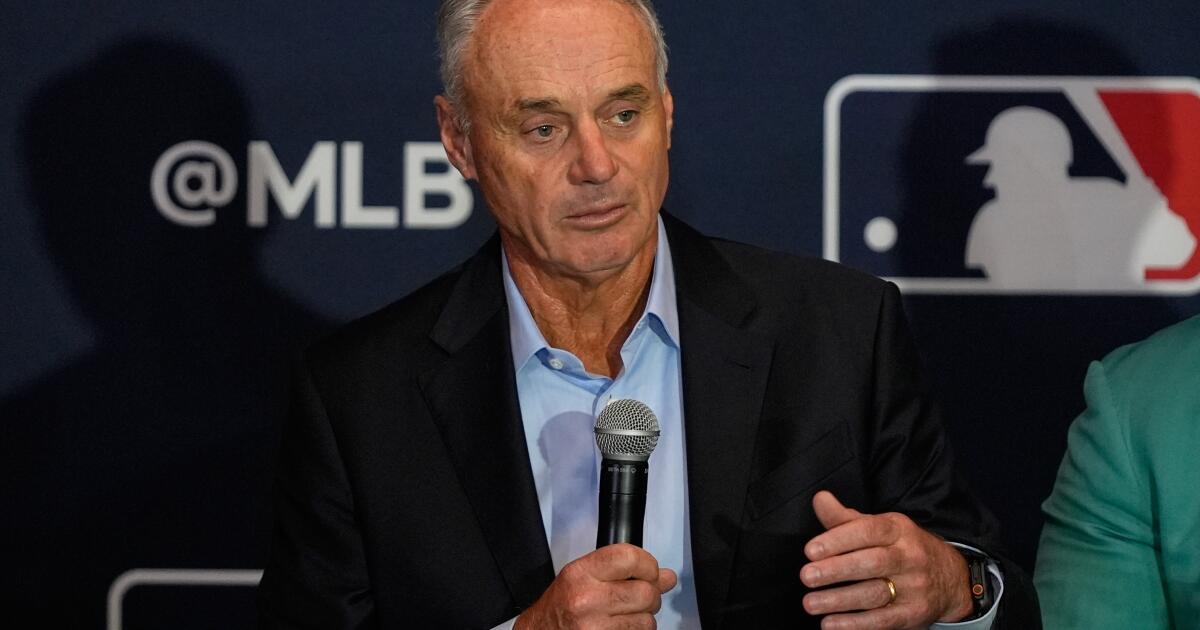
“We went down the road on LA 2028 because we saw it as a unique opportunity to market the sport with our very, very best players,” Commissioner Rob Manfred said Tuesday in a meeting with the Baseball Writers Assn. of America.
“It is a disruptive undertaking for us … If we’re disrupting an entire season and we’re going to undertake that effort, we want our very best out there, so that people see how great our game really is.”
The league also does not want to undermine its All-Star Game, and it is reasonably foreseeable that some players might wish to skip the All-Star Game for a two-day summer break if they are going to play the next week at the Olympics.
In that scenario, under its proposal, the league would have the right to declare the player ineligible for the Olympics, and the player would be subject to fine and/or suspension as well as ineligibility for the first 14 days of the second half.
Bruce Meyer, the executive director of the players’ union, said the MLBPA plans a counterproposal.
“They want to make it mandatory for players who are selected to appear at the All-Star Game and the Olympics,” Meyer said Tuesday. “The proposals that they made in terms of what the discipline would be, the ramifications if a player doesn’t want to do that, in our view, are extreme.”
To use a Dodgers example, Yoshinobu Yamamoto was selected for this year’s All-Star Game, but Dodgers manager Dave Roberts said last week that he would not pitch.
Given that situation in 2028, if Yamamoto wished to pitch for Japan, he would have to be available for the All-Star Game. If not, Japan could lose him for the Olympics, and the Dodgers could lose him for his first two starts of the second half.
Meyer said the union is in “a very early stage of discussions” with the league. It is unclear how much time might be needed to resolve the issue, as well as what Meyer called “travel and accommodation” issues, which involve LA28.
It also is uncertain how long MLB would be willing to wait before committing to an All-Star site and date, although the league moved the 2021 game from Atlanta to Denver three months before the game date. San Francisco is expected to host the 2028 game, in large part because Los Angeles is a short flight away for an Olympic competition that would start two days later.
It is clear, however, that the league is getting tired of not always securing participation from marquee players in marquee events. The “you can’t pitch in the All-Star Game if you pitched on the previous Sunday” rule was intended to protect pitchers.
“It’s clear to me that teams are managing their pitching in a way to take advantage of the Sunday pitcher rule,” Manfred said. “I do think it’s really important that we always re-evaluate our approach to the All-Star Game in order to get the very, very best players that can participate in that game.”
The World Baseball Classic was a smashing success this year, even as the United States started a rookie pitcher in the championship game. Do we really need to mandate player participation in the Olympics, especially since so many great players already have said they want to be there?
“The WBC takes place at a point in time that the players are just beginning to ramp up for the season,” Manfred said. “There’s a whole host of reasons why, at that point in the calendar, players might not be ready to play.
“In contrast, the schedule for the Olympics is going to cover days that players otherwise would be playing in major league games — if they’re not on an injured list, they’d be out there playing. That is a huge difference.”
In another column, we could argue the merits of moving the final round of the WBC — the semifinals and championship game — to July, when players “otherwise would be playing in major league games.” That would grow the game, too.
But that is for another day. It would be absurd for MLB to miss out on the global marketing platform that is the Olympics. The issues MLB raises are legitimate; the solutions need not be so draconian.
The opening ceremonies in Los Angeles take place two years from Tuesday. The Olympics have taught us this about boycotts: No matter how worthy the cause, no one pays attention once the Games start. The Soviet Union boycotted the L.A. Games in 1984, and we had a grand time without the Russians.
No one cares if you’re not there. In MLB, a star-studded core wants to be there. Seize the moment.
Folarin Balogun insists that the red card controversy surrounding him during the World Cup was not the reason the U.S. lost 4-1 to Belgium in the round of 16.
But, the breakout American star said Tuesday on NBC’s “Today” show, “it didn’t help.”
“As an athlete, you go into a game that’s already difficult enough with everything that goes on, the pressure,” Balogun said. “So to have more pressure, not just internally [but also] from almost the whole footballing world, was difficult. But it’s not an excuse. We were disappointed with the way it ended, but there’s still a lot to be proud of.”
Balogun, a birthright U.S. citizen whose Nigerian parents live in England, scored his third goal in four World Cup games during a 2-0 win over Bosnia and Herzegovina on July 1 in Santa Clara. But he also received a straight red card for stomping on the ankle of Bosnian center back Tarik Muharemović, meaning the top-scoring American player would have to miss the next game.
It was a controversial call, with some feeling the red card was unwarranted since Balogun’s action didn’t seem intentional.
The only other time a red-card suspension was overruled during a World Cup was in 1962, when Brazilian attacker Garrincha was allowed to play in the final after Brazil’s prime minister lobbied on his behalf.
“My initial reaction was, I was happy to be back in the team,” Balogun said Tuesday on “CBS Mornings.” “But when I kind of started to reflect, I knew it was going to cause a lot of controversy.”
He was correct about that. Although Infantino insisted that the FIFA Disciplinary Committee makes its decisions independently, the reversal caused outrage among many in the soccer world. Belgium submitted an appeal, but it was rejected hours before the game.
Amid all that, the U.S. had to prepare for Belgium — first without and then with Balogun in the mix. He told CBS the situation was “confusing” for all involved.
“I could almost see within my teammates a bit of nerves, because it’s something that is so unique,” Balogun said. “But the closer we got to the game, I tried to just focus as best as I could, but it was difficult. A lot of outside noise, and that’s hard to avoid.”
He added, though, that he and his teammates were “able to separate the emotion from the job at hand,” and the distractions didn’t contribute to the disappointing loss.
“We’re all professionals, so it’s not something I think was too difficult to be separate once we kind of got over the initial announcement that I’d be back in the team,” Balogun said. “I think you saw definitely it was a difficult game against Belgium, and that can kind of overshadow whether we were focused or not. … I know we had full concentration going into the game.”
NEW YORK — The sudden death of Sen. Lindsey Graham, a top ally of President Trump and one of Washington’s best-known politicians, is renewing focus on the country’s aging lawmakers.
Graham, a South Carolina Republican who had turned 71 just two days before dying on Saturday, was far younger than many of his Senate colleagues and appeared to have been in good health. He suffered a tear in his aorta, according to a preliminary report from the medical examiner.
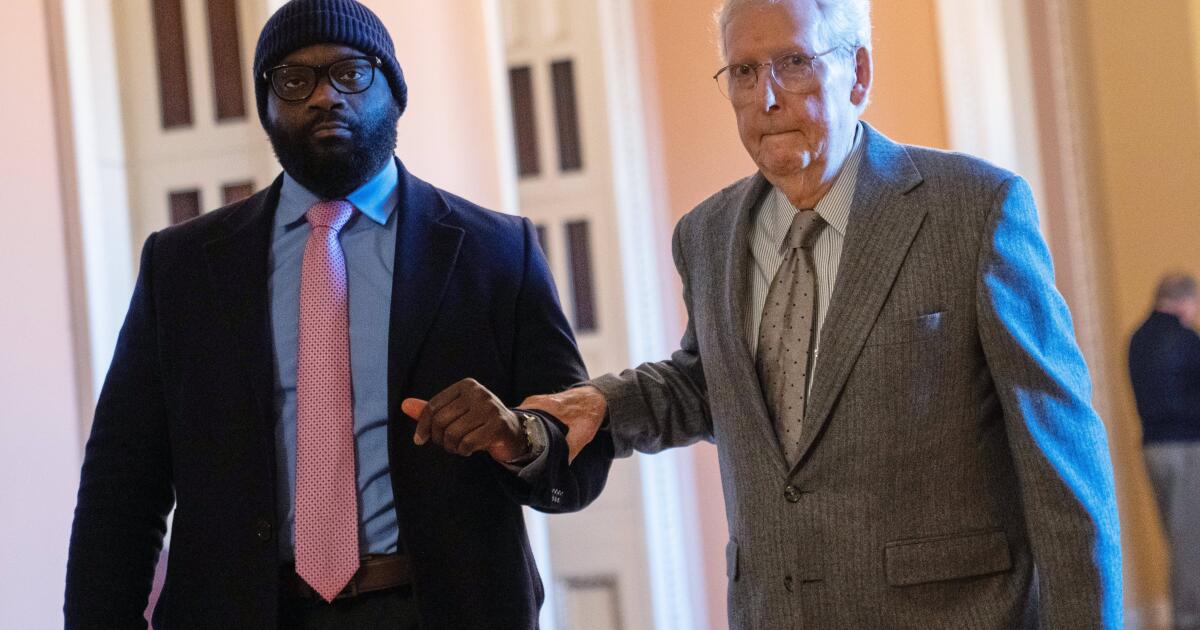
It was the second time in less than a month that emergency personnel were dispatched to the home of a U.S. senator. In early June, Mitch McConnell of Kentucky, the former Republican Senate leader, was hospitalized for undisclosed reasons.
After weeks of increasingly dire speculation about his health, he finally revealed on Sunday that he had fallen and suffered from mild pneumonia. He released a photo, complete with a copy of the day’s newspaper.
Graham’s death and McConnell’s hospitalization have come amid an ongoing reckoning about the nation’s aging leaders, two years after the disastrous presidential debate that sparked widespread panic among Democrats about then-81-year-old President Biden’s capacities and accusations of a cover-up.
Some politicians have continued to obscure details about their health challenges, asking for privacy despite their public positions, and fueling conspiracy theories.
“I think we need some transparency,” Sen. John Cornyn (R-Texas) said Monday. “I wish Sen. McConnell and his team would have done that earlier. I think it would have resolved a lot of questions.”
McConnell is admitted to a hospital
McConnell, who at 84 is only the third-oldest member of the Senate, was admitted to the hospital on June 14 with barely any explanation. Aides said he was “receiving excellent care” but offered no details about his condition.
The dearth of information fueled a wave of speculation about his prognosis, with Laura Loomer, a Trump ally and conspiracy theorist, claiming on social media that a “high level source close to the White House” had told her he was “officially brain dead.”
But McConnell, who will retire from Congress at the end of January after serving as the longest-ever Senate leader, said in a statement that he is on the mend. He said a fall had led to his hospitalization and that he was “briefly unconscious” and treated for mild pneumonia.
“You all know how folks of my generation often hesitate to share the vulnerability that comes with growing older,” he said. “Even in the public eye, I feel that same instinct — I can’t help it.”
That wasn’t enough to put speculation to rest. On social media, many refused to believe the veracity of a photo his office released that included the front page of the sports section of the Washington Post.
Conspiracy theories about McConnell’s health are “a symptom of our times,” said Sen. Rand Paul, a Republican who is also from McConnell’s home state of Kentucky. Paul said people should “give him a break.”
“People think they have a right to know everyone’s medical problems,” he said, “but I don’t know, where does it begin and where does it end?”
Trump’s medical reports offer limited details
The oldest person ever elected president, at age 78, has long offered only the rosiest picture of his health.
“Everything checked out PERFECTLY,” he boasted after his last physical in May, adding that he took yet another cognitive test aimed at detecting early dementia and has “aced them all.”
His past medical reports have been criticized for offering limited detail and including statistics that some health professionals have viewed with skepticism.
When he first ran for president in 2016, Trump declined to release his health records, breaking with longtime precedent. He instead offered a four-paragraph note from his doctor declaring that he would be “the healthiest individual ever elected to the presidency.” Rep. Ronny Jackson (R-Texas), White House doctor during Trump’s first term, later drew headlines when he extolled the president’s “incredibly good genes.”
When he was infected with COVID-19 in the midst of his 2020 reelection campaign, Trump’s doctors and aides withheld key details of his treatment and tried to downplay the severity of his illness.
And after an attempted assassination at a Pennsylvania rally, Trump aides kept the public in the dark for days, declining to discuss the extent of his injuries or release medical records after assuring he was “fine.”
Kean Jr. goes absent for months
The obfuscation extends beyond the septuagenarian and octogenarian set. New Jersey Republican Rep. Tom Kean Jr. spent four months missing without explanation before he finally disclosed late last month that he had been in treatment for depression.
He said in a brief floor speech after his return that he had remained silent about his condition because he is a “private person by nature.”
He won an uncontested primary during his absence, despite missing more than 100 votes in the House, and is running for reelection.
The approach stood in contrast to Sen. John Fetterman, a Pennsylvania Democrat, who disclosed his hospitalization for clinical depression the day after he was admitted to Walter Reed National Military Medical Center for treatment. He also suffered a stroke while running for office.
Biden’s stumbles doom his reelection effort
Biden’s halting gait, frail appearance and frequent verbal stumbles eventually doomed his 2024 reelection campaign. After a debate in which he frequently lost his train of thought, he chose to withdraw from the race, sparking an unprecedented swap at the top of the Democratic ticket that ultimately paved the way for Trump’s return to office.
Many others have refused to retire. California Sen. Dianne Feinstein, a Democrat, died in office in 2023 at the age of 90, after years of declining health, including a bout of shingles. Though she returned to the Senate after her illness, she appeared frail and confused at times. It was later revealed that her office had failed to disclose in real time that she had contracted encephalitis while recovering.
Longtime Republican Rep. Kay Granger of Texas spent the final months of her more than two decades in Congress, when she was in her early 80s, suffering from what her office called “unforeseen health challenges” that made travel to Washington difficult.
Eleanor Holmes Norton, 89, the longtime House delegate for the District of Columbia, announced earlier this year that she would not run for reelection amid questions about her competency.
Colvin writes for the Associated Press. AP writers Mary Clare Jalonick and Lisa Mascaro in Washington contributed to this report.
Todd Martens’ newsletter delivers news and commentary on the past, present and future of theme parks, right from the theme park capital of the world — Southern California.
By continuing, you agree to our Terms of Service, which include arbitration and a class action waiver. You agree that we and our third-party vendors may collect and use your information, including through cookies, pixels and similar technologies, for the purposes set forth in our Privacy Policy such as personalizing your experience and ads.
So when I had the opportunity to talk to Chris Mortensen, one of the Disneyland Resort’s longest-tenured vacation planners, I wanted to know his.
Mortensen recently celebrated his 40th year with the company, and has spent more than 20 of them in his current role as director of West Coast Travel Operations. That means a significant part of his job is talking on the phone with those who want advice on how to plan their Disneyland days.
He comes from a Disney family. His wife has spent about 30 years with the resort, and one of their children is also a cast member. If anyone should know how to plan a special day at Disneyland, it’s Mortensen.
One of his key pieces of advice: Decide what’s most important to you as a guest. “Is it a thrill ride? Is it entertainment? Is it food?” Mortensen asks. “One of the things that I like to tell people is that you’re going to have a really busy day, but take time for yourself.”
Here are some of Mortensen’s other favorite park tips. We steered the conversation to Southern California locals, and those who may want a little glimpse of what makes Disneyland so special.
Get around the park by train
Here’s one hint, off the bat, that Mortensen says he gives most everyone: “Use the Disneyland Railroad as a form of transportation. Yes, it’s a great little attraction. Seeing the dinosaurs is one of my favorites. But it’s also a great way to get from one place to another. If you’re on Main Street and don’t want to walk all the way back to see ‘Bluey,’ jump on the railway. It’s a great way to get a little rest, and experience the park.”
Decompress at Disneyland’s most tranquil spot
Disneyland’s Snow White Grotto is a tranquil spot overlooked by many guests.
(Todd Martens / Los Angeles Times)
Mortensen notes that it’s impossible to see all Disneyland has to offer in a single day, but rather than stressing about rushing from attraction to attraction, prioritize those that are important to you, and then take a breather at some overlooked park elements, especially those that add to its beauty and tranquility. I couldn’t agree more, and was pleased when Mortensen singled out one of my favorite places in the park: the Snow White Grotto, which is on a path on the eastern side of Sleeping Beauty Castle.
Sculpted by Leonida Parma from Carrara marble, the initial figures have, according to Disney’s fan club D23, been since replaced by fiberglass ones built from the original molds. The eight figures are still a sight, and Disney legendary designer John Hench constructed the fountain that holds them in 1960. The character figures, in the midst of a collection of jutting rocks and log bridges surrounding a peaceful waterfall, are all the same height, so Hench used forced perspective illusions to make it seem like Snow White was towering over the dwarf sculpts.
“The Snow White wishing well — you won’t find that anywhere [else],” Mortensen says. “Bring a quarter and toss it in, experience that.”
Take time for the Sleeping Beauty Castle Walkthrough, a lesser-known attraction
Don’t sleep on the Sleeping Beauty Castle Walkthrough at Disneyland.
(Todd Martens / Los Angeles Times)
“People don’t know about it,” Mortensen says of the self-guided mini-tour that tells the tale of Princess Aurora.
Indeed, I had the Sleeping Beauty Castle Walkthrough to myself one late Sunday morning. The attraction, best experienced with patience in mind, is largely inspired by the artwork of Eyvind Earle. Earle’s approach, after all, is designed to transport us, to place us in lush, fairy-tale-like environments that contain an ever-so-slightly foreboding atmosphere.
Think of this as a mini-art gallery where illuminated dioramas spring to life and transform before us. The walk-through was updated with new effects and artwork in 2008 but dates to 1957.
It’s Disneyland. Order the iconic turkey leg.
Mortensen and I clearly have different palates. If I’m recommending a must-try Disney snack, it’s not the churro. It’s the corn dog. Mortensen, however, is voting for the turkey leg. A brave choice, I believe, as it’s a hefty item and, well, a lot of tough meat. Mortensen, however, made his case.
“It’s unique,” he says. “Yes, you can get a churro, but where else can you walk around and just literally bite out of a turkey leg? It’s about trying to create memories. Every time we have conversations with someone, it’s about, ‘What’s going to make a memory for you?’ You’re always going to remember walking around Disneyland as a 5- or 6-year-old little boy or girl with a turkey leg.”
Turn It’s a Small World into a scavenger hunt
Cinderella is one of the many Disney characters that was added to It’s a Small World in the late 2000s.
(Todd Martens / Los Angeles Times)
Mortensen had my attention when he declared It’s a Small World a must-do attraction at the park. After all, the Mary Blair-styled boat excursion is my favorite Disneyland ride.
Mortensen highlights a once controversial but now beloved late 2000s renovation that added more than two dozen Disney and Pixar characters to the attraction. When riding It’s a Small World, he says, try to spot as many as possible. Disneyland even recently placed Miguel from “Coco” in the ride. Focusing on the scavenger hunt, says Mortensen, helps turn a familiar attraction into one that feels fresh.
“There’s more to it than just riding the attraction,” he says.
Spot details in the windows of Main Street
Enjoying a horse-drawn trip around Main Street, U.S.A., is a relaxing start to a Disneyland day.
(Todd Martens / Los Angeles Times)
Disneyland’s introductory land is a joy. Often, I start my day with a ride on one of Disneyland’s horse-drawn carriages, which venture from the foot of Main Street, U.S.A., to the Sleeping Beauty Castle and back. It’s a relaxing way to settle into the theme park and take a look at the exquisite designs of the Main Street buildings, which many guests rush past on their way to one of the park’s many rides.
Mortensen wanted to call specific attention to Main Street’s windows, which celebrate those who were integral to the development of the park. Many are nods to famed Disneyland designers. Most recently, the park awarded a window to the just-retired Kim Irvine and her mother, Leota Toombs. Irvine and Toombs were longtime creatives with Walt Disney Imagineering vital to the development of the park.
“I love to point out the windows on Main Street,” Mortensen says. “If you and I were walking in, that’s what I would do. I’d grab a box of popcorn, and just point out two or three of the names. Some people you may recognize. Some people you may not.”
And I certainly won’t argue with popcorn for breakfast.
This week in SoCal theme parks
Disney legend Don Iwerks died last week at 96.
(Lori Shepler / Los Angeles Times)
A legend was lost. Don Iwerks, whose inventiveness helped transform Disney’s theme parks, died July 9 at the age of 96, reported the Walt Disney Co. For Disney and his own studio, Iwerks Entertainment, Iwerks helped develop technologies and techniques like Circle-Vision, the 360-degree camera behind “America the Beautiful” and other early Disney attractions, and the 3D effects used in attractions like Captain EO and Star Tours. He also had major contributions to the world of cinema, instrumental, particularly, in the effects sequences of “Mary Poppins.” Read more about Iwerks in The Times’ obituary by Corinne Purtill.
Fiesta Village is no more. The Inland Empire amusement park, which stood for more than 50 years, closed for good last weekend. A center for mini golf, roller skating and go-karting, Fiesta Village announced the closure last week, citing rising operation costs and declining attendance.
Montezooma’s Revenge is back. The reimagined coaster, now known as Montezooma: The Forbidden Fortress, is set to return to Knott’s Berry Farm on Monday. Shuttered for the last four years, the ride has essentially been rebuilt, now featuring enhanced Aztec theming, new trains and a modern launch system. Look for a report on the remade coaster next week.
It’s almost Halloween season. Disneyland in mid-August will launch its Oogie Boogie Bash, Universal will follow in early September with Halloween Horror Nights and Knott’s Berry Farm isn’t far behind with its Knott’s Scary Farm. The latter is the longest-running Halloween event in the Southland, and defined the maze-focused haunt formula. Tickets are now on sale for all three happenings.
Happy 71st anniversary, Disneyland! On Friday, Disneyland will turn 71. While the occasion won’t be as grand as the 70th anniversary, which has been celebrated for the past year and will essentially continue up until the start of the park’s Halloween activities, the Anaheim theme park typically recognizes the birthday with some light festivities for guests. Think, perhaps, a character cavalcade or some specialty treats.
Tell us your stories. Ask us your questions.
Have a theme park tale to share? Whether it was a good day or less-than-perfect day, I would love to hear about it. Have a question? A tip? A fun photo from the parks to share? Email me at todd.martens@latimes.com. I may feature your note in an upcoming newsletter.
Ride on,
Todd Martens
P.S.
The initial news for those who purchased Disneyland’s specially priced $59 nighttime ticket is good. While now sold-out, Disneyland launched the promotional evenings this past Sunday, and the park didn’t appear flooded with twilight guests. Attendance was continuing a summer trend of being relatively light, and though wait times increased in the evening, nothing was headache-inducing.
At times, even showcase attraction Star Wars: Rise of the Resistance stood at about 40 minutes, with Space Mountain often showing a similar wait time. Most rides, however, were even more approachable, topping off at around 25 minutes throughout the night. Since the evening ticket only gives guests a taste of Disneyland — five hours worth — it’s a positive sign that the event’s opening night kept things manageable, providing those who bought in at a budget price a prime experience.
They came to this country without papers as teenagers. Lack of legal status didn’t stop them from building beautiful lives — a wife, a home, a loving dog. A blue-collar job that paid the bills, weekend carne asadas with friends and family, children who followed their father’s example of hard work.
The Lorenzos enjoyed the fruits of their labor in their adopted land, even as they battled to become American citizens while politicians demonized immigrants as invaders and worse.
Lorenzo Arellano arrived in the United States in 1968 and didn’t get his citizenship until nearly 30 years later. Back then, the path to naturalization was far easier.
Lorenzo Salgado Araujo arrived in the early 1990s, when those opportunities were becoming severely limited.
Lorenzo Salgado Araujo, 52, who ran his own construction crew, was on his way to a job with his brother and two other men when an Immigration and Customs Enforcement agent shot him dead on July 7 in Houston.
When I see a photo of Salgado Araujo beaming in front of a cake with the number 52 on it at the well-kept home he built with his own hands, I’m reminded that we’ll be celebrating my father’s 75th birthday next month. When I see video of Salgado Araujo’s feet twitching on the ground with two ICE agents next to him as he bleeds out and moans for help, I weep.
Only geography, age and Donald Trump separated the Lorenzos. Even their children — he had three boys, while my father had two boys and two girls — are similar. The Salgado Araujos, like the Arellanos, are college-educated. The eldest son, Ronaldo, is a teacher like my sisters. He wears glasses like me and is now telling the story of his father to the nation, as I have for decades.
I write about my Papi as the puckish personification of immigrant America.
Ronaldo is eulogizing his dad way too soon.
“He wanted nothing else in life but to provide for his wife and see his sons become great people,” Ronaldo said proudly at a news conference the day after his father’s death — words I’ve always said about my Papi. “He did not deserve to be reduced to a headline of ‘Mexican man shot and killed by ICE’” — words I hope to never utter but can sadly see as a possibility given la migra’s unapologetic shoot-first approach and indiscriminate targeting of anyone brown.
Salgado Araujo’s killing came as part of the Trump administration’s newest deportation surge — the New York Times reported that the feds have arrested nearly 2,000 people a day since the end of June. The rate is higher than ICE’s campaign of terror last summer, yet it hasn’t drawn the same attention, fulfilling the promise of newish Homeland Security Secretary Markwayne Mullin that la migra would operate far more quietly and efficiently than under his reckless predecessor, Kristi Noem.
Those quiet times are over.
Ronaldo Salgado, son of Lorenzo Salgado Araujo, dries his tears while talking at a news conference on July 8 in Houston. His father was shot and killed by ICE agents the day before.
(David J. Phillip / Associated Press)
Vigils are popping up across the country in Salgado Araujo’s name. Stories about his life and death have replaced those about Mexico’s World Cup run on my social media timelines. They are heartbreaking, infuriating and a baleful reminder for Mexican Americans that these last five weeks of soccer, as joyful as they were, didn’t change our precarious status in this country under President Trump.
“He deserved to live a quiet life as a husband, a father and a job creator for dozens of men who also wanted the American dream,” Ronaldo said at the news conference through tears as his younger brother, Lorenzo Jr., comforted him. That their father never will — that the Department of Homeland Security is now smearing his name by claiming he “weaponized” his van by trying to run over an agent, even though video evidence proves no such thing — is the latest indictment against the Trump administration’s cruelty toward the undocumented.
Salgado Araujo wasn’t even the target of ICE’s operation. His family said he had applied for a work permit and was on his way toward finally obtaining legal status.
We should heed Ronaldo’s words about his father. As people protest and seek justice, we should also hail the life of Lorenzo Salgado Araujo the way we one day will hail the life of Lorenzo Arellano — as Mexicans who made it, challenges be damned. And we should continue to fight for immigrants who remain in legal limbo, afraid for their lives more than ever.
I called my father to ask how he felt about a tocayo — someone with the same first name — losing his life to la migra.
“I put myself in his place and lament that ese [that] Lorenzo couldn’t get the citizenship that I could,” Papi said in Spanish.
He remembered how immigration agents “did it with respect” when they caught him living in this country illegally in the 1970s and 1980s.
“They asked you for your papers, and if you didn’t have them, they put handcuffs on you, you got deported and that was that. None of these beatings or shootings that are happening now under Trump,” he said. The worst it ever got was when he said he was going to Los Angeles, and an agent snapped that he was going to L.A. but now had to return to Mexico.
Papi asked me what justification ICE has offered for killing Salgado Araujo.
“I hope they put those people who killed him in prison for many years,” he said with disgust. “Will they?”
I replied that probably wasn’t going to happen. ICE has shot and killed 11 people during Trump’s second term, both citizens and noncitizens, and scores more have died in immigration detention. No agents have faced charges for any of these deaths. The agents involved in Salgado Araujo’s killing didn’t even have dashboard cameras or body cameras, a convenient oversight that a Department of Homeland Security spokesperson blamed on “multiple government shutdowns.”
“Pues, Dios sabe que todo se paga en la vida,” my dad responded. Well, God knows you reap what you sow.
Ronaldo Salgado and Lorenzo Jr., sons of Lorenzo Salgado Araujo, hold a photograph of their father during a news conference July 8 in Houston.
(David J. Phillip / Associated Press)
Nothing can bring Lorenzo Salgado Araujo back to his loved ones. But I hope they find solace in his namesake, St. Lawrence. Tradition has it that Roman authorities roasted the Spanish deacon to death after Emperor Valerian demanded that he turn over the treasures of the Church. Instead, Lawrence presented the emperor with the city’s poor and maligned, insisting that he confront the oppression he had forced on them.
May we remember Lorenzo Salgado Araujo as a modern-day martyr, killed because our government refused to give him and so many others a chance at living in this country without fear.
May his name resonate through the ages as embodying the promise and tragedy of the American dream.
The White House visit will be on a day off in the middle of a nine-game East Coast trip.
“I’m sure a lot of guys are going to participate and be there, and this is an individual choice,” Roberts said. “But I do expect a lot of our guys to be there.”
Scheduling conflicts when the Dodgers played the Nationals in Washington on April 3-5 pushed back the trip.
“This took a long time to get both sides together, and, honestly, like I’ve always said, my company line, my personal line is I hope that we get this invitation every year,” Dodgers manager Roberts said. “Because that’s the goal: to win a championship, to get this invitation to the White House. And I’m not a politician, and I’m doing something that teams have done for decades. And so that’s where I stand, really. I’m a baseball coach. That’s what I do.”
Back in 2019, Roberts suggested that he might not accept an invitation to the White House with Trump in office. But he did attend last year when the Dodgers celebrated their 2024 title.
Roberts said the Dodgers found out earlier this week that the White House visit had been scheduled.
“There was a lot of unknown,” Roberts said. “It’s an off day, and then how could we work this out logistically?”
That set off “a lot of phone calls, texts, and communication internally.”
Hernández’s injury rehab has moved along more quickly than Roberts initially expected. He landed on the injury list in late May after playing in just two games following offseason surgery on his left elbow.
“He looks normal,” Roberts said last weekend. “I’m not saying miraculous, but I’m really in disbelief how well he responded, given the injury.”
And if you didn’t hear your name called, well, you’re feeling like you’re out there on the street behind the police barricade, hot and sweaty, wondering what happened to your dragons and how in this underwhelming Emmy season things could go so wrong.
Share via
With Emmy submissions still down this year, there aren’t as many slots available to salute all the worthy work, leading to some sad omissions — which, for the sake of alliteration and search engine optimization, we’ll call “snubs.” There were also some surprises, some worthy, some about as welcome as the aftermath of a hot dog-eating contest on the Fourth of July.
Now that I’ve whetted your appetite, grab a donut (or a footlong) while I run down the morning’s notables.
SURPRISE: “The Bear” (comedy series)
OK, not that huge a surprise when a series nominated for its first three seasons, and winning for its first, snags another nod. But given the number of people complaining about the show’s pokey plotting, it was fair to wonder if “The Bear” would again make the cut for Season 4. The show dropped its final season three days after nominations voting ended and because things actually happened during this crowd-pleasing conclusion, it’s possible we might be seeing it again here next year too.
SNUB: Jeremy Allen White, “The Bear” (comedy lead actor)
While “The Bear” made the cut for series, the only cast member to join the party was Ayo Edebiri. Past winners White, Liza Colon-Zayas and Ebon Moss-Bacharach were left out, though all will have a shot at returning next year. Whether they will is open to question. Voters seem to have had their fill of the show.
Jeremy Allen White and Ayo Edebiri in “The Bear.”
(FX)
SURPRISE: “Your Friends and Neighbors” (drama series)
The Jon Hamm-led Apple crime drama failed to land any nominations for its first season outside a nod for main title music. Now moved from limited series to drama, it inexplicably landed a single nomination for its enjoyable-enough follow-up season — for the big prize, drama series. No other noms. Nothing for Emmy favorite Hamm. It’s almost as confusing as some of the plotting in the show.
SNUB: “Half Man” (limited series)
Richard Gadd’s limited series was provocative with its brutally violent look at male rage and unresolved trauma. But some voters I talked with found it so off-putting that they never made it past the first episode. Could be we’ve had our fill of toxic male behavior in the news without having to endure it on our down time too.
SURPRISE: Riz Ahmed, “Bait” (limited series / TV movie lead actor)
Ahmed created, wrote and produced this limited series about a struggling actor whose life is upended when rumors circulate he might be the next James Bond. His sharp comic timing and affecting vulnerability landed with voters.
SNUB: Cailee Spaeny, “Beef” (limited series / TV movie supporting actress)
OK, you didn’t like her character and you’re still afraid to drink orange juice after watching the show. But to nominate everyone else from the series and omit Spaeny? That feels like a case of Millennials and Boomers taking out their grievances on Gen Z.
Cailee Spaeny, left, with Carey Mulligan and Charles Melton in “Beef.”
(Netflix)
SURPRISE: Richard Jenkins and Joy Sunday (limited series / TV movie supporting actor and actress)
The weird and unpredictable “DTF St. Louis” had one last surprise for us, as voters indicated their enthusiasm for it by nominating not just David Harbour, Jason Bateman and Linda Cardellini, but also Richard Jenkins and Joy Sunday, who were terrific as the mismatched law enforcement partners. “DTF,” not “Beef,” might now be the limited series to beat at the Emmys.
SNUB: “Stranger Things” (drama series)
Nostalgia, it would seem, has its limits.
SURPRISE: Rufus Sewell, “The Diplomat” (drama lead actor)
He’s overly involved on the show, so why not at the Emmys, too?
SNUB: Kathy Bates, “Matlock” (drama lead actress)
Dirty birdies.
Chase Infiniti in “The Testaments.”
(Disney)
SURPRISE: Chase Infiniti, “The Testaments” (drama lead actress)
Infiniti was overlooked at the Oscars for her lead turn in “One Battle After Another,” but Emmy voters did right by her, nominating her formidable work in the sequel to “The Handmaid’s Tale.”
SNUB: Adam Brody and Kristen Bell, “Nobody Wants This” (comedy lead actor and actress)
Though Netflix’s rom-com nabbed a comedy series nomination, voters took the title to heart regarding its two leads, both of whom were nominated for its first season.
SURPRISE: Yahya Abdul-Mateen II, “Wonder Man” (comedy lead actor)
A show about a struggling actor navigating the indignities of auditions? No doubt voters found it relatable and Abdul-Mateen II made his anxieties and aspirations vivid.
SNUB: Jenna Ortega, “Wednesday” (comedy lead actress)
Wednesday’s child is full of woe.
Megan Stalter, left, with Robby Hoffman and Paul W. Downs in “Hacks.”
Stalter’s loud, boundary-pushing nepo baby Kayla on “Hacks” was divisive, but she coasted to her first nomination on the wave of goodwill surrounding the show’s final season. Cringe comedy enthusiasts are celebrating. Now we await a reprise of her jeans and white T-shirt red carpet look from last year.
SNUB: “Saturday Night Live” cast members (comedy supporting actor and actress)
Admittedly it’s a low bar, but “Saturday Night Live” was better this year, not that voters seem to have noticed. Bowen Yang failed to earn a nomination for his farewell season, ending a four-year streak. And breakout cast member Ashley Padilla was overlooked too, her comic timing apparently too absurd for voters’ tastes.
Hopes were high for “Widow’s Bay,” television’s best new comedy, which arrived late in the Emmy season — so late that its last three episodes weren’t eligible for consideration. But that didn’t stop voters from embracing it, giving the show 19 nominations, including one for Dickey’s turn as the gruff town hall worker who is the Spielberg of overhead projector presentations.
SURPRISE: Connor Storrie (comedy series guest actor)
HBO Max’s hockey romance drama “Heated Rivalry” wasn’t eligible for the Emmys because it’s a production of the Canadian TV network Crave, and the television academy requires the U.S.A. be part of a show’s funding to make the ballot. But star Storrie still received an Emmy invite thanks to his impressive comic turn hosting “Saturday Night Live” in February. The guest actor trophies are handed out during the Creative Arts Emmys, a week before the primetime show, but we’ll likely see Storrie and “Heated Rivalry” co-star Hudson Williams show up to present something during the main telecast. They do want people to watch, right?
In the final innings of her international career, Tammy Beaumont is bowled first ball by India’s Kranti Gaud at Lord’s on day three of the one-off Test, with England needing 457 to win.
Lauren Bell bowls Jemimah Rodrigues with a brilliant delivery to give England a small glimmer of hope on the morning of day three against India, with the tourists falling to 177-3, their lead just short of 300 in the off-one Test at Lord’s.
Bo Lowrance models his game after Freddie Freeman. So, it’s fitting that the Dodgers selected the 6-foot-5, 200-pound high school infielder — ranked the No. 21 overall prospect by MLB.com — with the 40th pick in the MLB amateur draft on Saturday.
“He’s obviously a first baseman, and I’m on the left side, so defensively a little different,” Lowrance said of Freeman during a conference call with media. “But he’s still unbelievably athletic, and a big thing that I’ve watched for years is his approach and how he uses the whole field. … [Freeman is] somebody that I’m always trying to emulate.”
Lowrance hit .435 with 12 home runs last season at Christ Church Episcopal School in Greenville, S.C.
A left-handed batter and right-handed thrower like Freeman, Lowrance is expected to develop as a shortstop — noting former Dodger Corey Seager has a “super smooth” defense at 6-4 he hopes to replicate — with a potential role at third, depending on how the prep star grows into his frame.
“Yeah, definitely want to be a shortstop,” Lowrance said. “I believe I’m capable of it. I think I have the glove skills and the athleticism. I think it’s just going to turn into who I want to become at the plate in terms of my overall size and frame. Like, if I ultimately put on a bunch of weight and kind of grow out of the shortstop position, then maybe that’s where that’ll change.”
Lowrance hit it off with the Dodgers’ front office in June at the draft combine in Phoenix.
And even though the Dodgers didn’t exactly see the Freeman comparison Lowrance mentioned, they would be thrilled if he turned out anything like the 10-time All-Star.
“Bo was definitely our main target coming into the day,” Dodgers amateur scouting director Zach Fitzpatrick said. “Probably would have said there’s a pretty low chance we were able to acquire him, had you asked me in the morning. So as the picks start coming off the board and realizing there’s a little bit more opportunity to get him, our excitement level climbed. And then to actually be able to call his name was a home run for us.”
“I’ve been in communication with them for a while,” Lowrance added. “I’ve loved their scouting staff. I have a great relationship with them.”
The Dodgers entered the draft with the smallest bonus pool at $3,951,900; the White Sox had the most cash to work with, boasting $20,489,500.
Fitzpatrick, though, said the Dodgers’ strategy centered around taking the best player available.
The approach carried over into the Dodgers’ second and final pick on the day — Florida right-handed pitcher Russell Sandefer at No. 132.
Sandefer posted a 3-2 record as a junior in 2026 with a 4.42 ERA over 19 games and 12 starts. The Dodgers were intrigued by his repertoire and heat.
“As we dove into Russell throughout the spring, kind of all departments — from scouting and what we saw at the park to our player development group and our analytics group — kind of flagged Russell as very intriguing and then having a lot of upside left,” Fitzpatrick said.
“A starter at Florida, threw a lot of strikes; there’s obviously velocity, there’s a deep mix, and he performed and had some pretty stellar outings along the way that helped us believe in his upside and different ways we can help him access it more consistently.”
Lowrance was happy to be part of the Dodgers’ draft class.
“Just a whole wave of emotions,” he said. “I’m extremely grateful, first off, and couldn’t be more excited. I mean, yeah, I’ve said it already: It’s the best team in baseball, and nobody else that I want to be a part of.