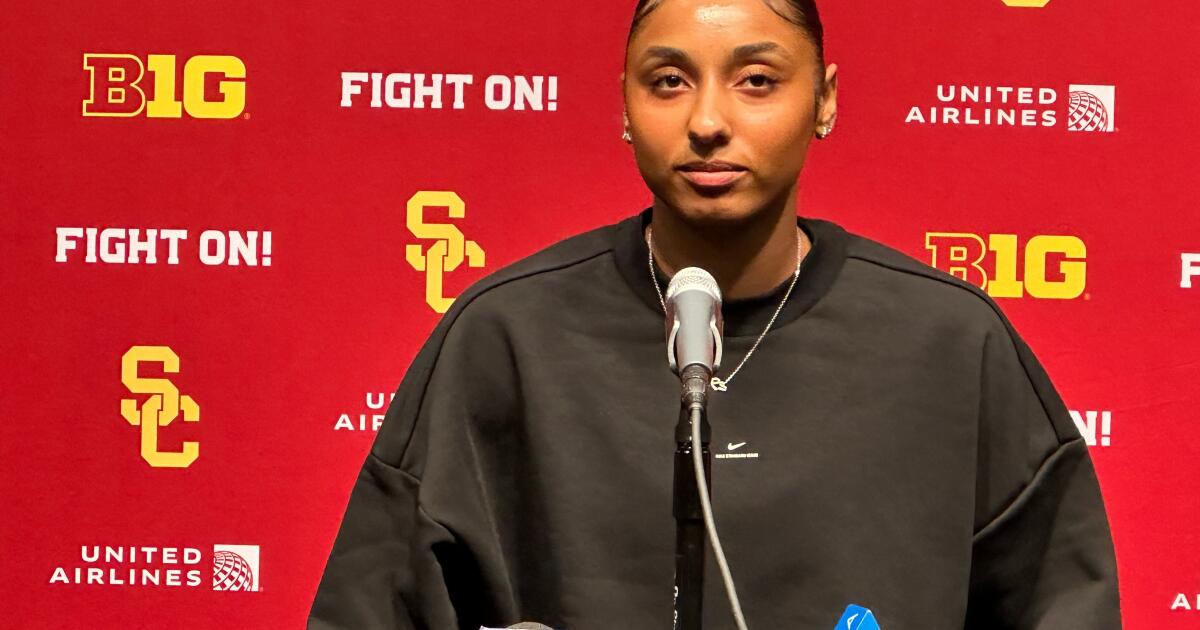
From Ryan Kartje: She’d been out for more than a year, her long, arduous recovery from a season-ending knee injury kept almost completely under wraps. But as JuJu Watkins took her place in front of a microphone for the first time since returning to practice this summer, the USC superstar barely could contain her gratitude.
Asked Monday what the best part about being back has been so far, a big smile crept across Watkins’ face.
“Honestly everything,” Watkins said. “Like I don’t even know, the smallest stuff just gets me excited.”
Watkins’ return is a momentous mile marker for a Trojans team that has serious national title aspirations this season. Her status remains uncertain, and reporters in attendance Monday were told not to inquire further about Watkins’ recovery timeline. But she did say she’s already been able to scrimmage during USC’s summer practice and that she’s “feeling back like myself.”
“It’s just been a long time coming,” Watkins said. “I’ve just been working out and grinding every day so that I could be in position, so to see all of that hard work pay off right now, it’s really fulfilling.”
Continue reading here
Get the latest on L.A.’s teams in the daily Sports Report newsletter.
By continuing, you agree to our Terms of Service, which include arbitration and a class action waiver. You agree that we and our third-party vendors may collect and use your information, including through cookies, pixels and similar technologies, for the purposes set forth in our Privacy Policy such as personalizing your experience and ads.
Monday’s World Cup results
Round of 32
Brazil 2, Japan 1
Paraguay 1, Germany 1 (Paraguay wins on PK’s, 4-3)
Morocco 1, Netherlands 1 (Morocco wins on PK’s, 3-2)
Today’s World Cup TV schedule
All times Pacific
10 a.m., Ivory Coast vs. Norway, Fox, Telemundo
2 p.m., France vs. Sweden, Fox, Telemundo
6 p.m., Mexico vs. Ecuador, Fox, Telemundo
World Cup round of 32 schedule, results
Canada 1, South Africa 0
Brazil 2, Japan 1
Paraguay 1, Germany 1 (Paraguay wins on PK’s, 4-3)
Morocco 1, Netherlands 1 (Morocco wins on PK’s, 3-2)
All times Pacific
Tuesday
Ivory Coast vs. Norway, 10 a.m., Fox, Telemundo
France vs. Sweden, 2 p.m., Fox, Telemundo
Mexico vs. Ecuador, 6 p.m., Fox, Telemundo
Wednesday
England vs. Congo DR, 9 a.m., Fox, Telemundo
Belgium vs. Senegal, 1 p.m., FS1, Telemundo
U.S. vs. Bosnia-Herzegovina, 5 p.m., Fox, Telemundo
Thursday
Spain vs. Austria, noon, Fox, Telemundo
Portugal vs. Croatia, 4 p.m., Fox, Telemundo
Switzerland vs. Algeria, 8 p.m., FS1, Telemundo
Friday
Australia vs. Egypt, 11 a.m., Fox, Telemundo
Argentina vs. Cape Verde, 3 p.m., Fox, Telemundo
Colombia vs. Ghana, 6:30 p.m., Fox, Telemundo
Round of 16 schedule
Saturday
Canada vs. Morocco, 10 a.m., Fox, Telemundo
Paraguay vs. France or Sweden, 2 p.m., Fox, Telemundo
Sunday
Brazil vs. Norway or Ivory Coast, 1 p.m., Fox, Telemundo
Dodgers defeat the Athletics
From Bill Shaikin: Teoscar Hernández was back from a hamstring injury, and a little bit humble. He was about to play his first game in a month for the Dodgers.
“I don’t think they really need me in the lineup,” he said, with a hint of a smile.
Hernández hit 58 home runs over his first two seasons with the Dodgers, each of which ended in a World Series championship, so of course they need him. But, in his absence, the Dodgers had more than doubled their National League West lead.
Hernández is back, but Will Smith and Kiké Hernández still are out. So are Tyler Glasnow, Blake Snell and Edwin Díaz.
No matter: The Dodgers boosted their division lead to 11 games Monday with a 9-4 victory over the Athletics. Shohei Ohtani, Max Muncy and Andy Pages homered to highlight a 17-hit attack.
Continue reading here
Dodgers box score
MLB standings
Angels lose to Mariners
Cole Young hit two home runs to back eight strong innings from George Kirby as the Seattle Mariners came from behind to beat the Angels 6-2 on Monday night.
Dominic Canzone also went deep to help Seattle (43-43) get back to .500 and stay a half-game behind the first-place Texas Rangers in the American League West.
Zach Neto doubled to center field leading off the game against Kirby (7-7), and Denzer Guzman singled two pitches later for a 1-0 lead. Neto hit his 18th home run in the third — a two-out shot that made it 2-0.
Continue reading here
Angels box score
MLB standings
Who is coming back to the Lakers?
From Broderick Turner: As LeBron James dominated the news cycle regarding his future on the eve of NBA free agency, another member of the Lakers’ starting lineup returned.
Deandre Ayton is picking up his contract option for $8.1 million, according to people not authorized to publicly discuss the decision.
The 7-foot Ayton averaged career lows in points (12.5), rebounds (8.2) and minutes per game (27.2) in his first season with the Lakers, but played a career-high 72 games and shot a career-best 67.1% from the field. He averaged 10 points and 9.6 rebounds in the playoffs.
Lakers guard Marcus Smart declined his option of $5.9 million and will become an unrestricted free agent, according to people not authorized to publicly discuss the decision.
Smart is expected to have several teams pursue him in free agency, with the Houston Rockets reportedly among them.
He was the Lakers’ best defender and averaged 9.3 points and 3.0 assists last season, also his first with the team.
As for James, he’s an unrestricted free agent who earned $52.6 million last season. Lakers president of basketball operations Rob Pelinka said during his season-ending news conference in May that they would give James time with his family to decide his future.
Continue reading here
Former Lakers Malik Beasley and Ed Davis accused of illegal gambling, wire fraud and money laundering
This day in sports history
1909 — Jack Johnson fights Tony Ross to a no decision in 6 rounds at Duquesne Gardens, Pittsburgh, Pennsylvania to retain his heavyweight boxing title.
1916 — Amateur Chick Evans Jr. wins the U.S. Open with a record 286 total.
1929 — Bobby Jones beats Al Espinosa by 23 strokes in a 36-hole playoff to win the U.S. Open.
1962 — Murle Lindstrom wins the U.S. Women’s Open by two strokes over Jo Anne Prentice and Ruth Jessen.
1965 — The NFL grants Atlanta a franchise. Rankin Smith Sr., an Executive Vice President of Life Insurance Company of Georgia, pays $8.5 million for the franchise. It’s the highest price paid in league history at the time.
1975 — Muhammad Ali retains world heavyweight boxing crown by beating Englishman Joe Bugner by unanimous points decision in a re-match in Kuala Lumpur, Malaysia.
1991 — Wimbledon breaks 114 years of tradition by playing on the middle Sunday of the tournament, a move forced by a huge backlog of matches caused by rain earlier in the week.
1991 — Meg Mallon sinks a 10-foot birdie putt on the final hole to break a tie with Pat Bradley and Ayako Okamoto and win the LPGA Championship.
1993 — NBA Draft: Michigan center Chris Webber first pick by Orlando Magic (traded to Golden State).
1994 — Diego Maradona is kicked out of the World Cup by FIFA for failing a drug test after Argentina’s June 25 victory over Nigeria in Foxboro, Mass.
1994 — Tonya Harding is stripped of her national title and banned for life from the U.S. Figure Skating Assn. because of her role in an attack on Nancy Kerrigan.
1996 — UEFA European Championship Final, Wembley Stadium, London, England: Oliver Bierhoff scores his second goal in extra time as Germany beat Czech Republic, 2-1.
1999 — NBA Draft: Duke power forward Elton Brand first pick by Chicago Bulls.
2002 — Ronaldo scores both goals to lead Brazil to a 2-0 victory over Germany for the team’s record fifth World Cup title.
2012 — Yaroslava Shvedova of Kazakhstan becomes the first player in a Grand Slam tournament to win every point of a set on her way to beating French Open runner-up Sara Errani 6-0, 6-4 in the third round of Wimbledon.
2013 — Inbee Park wins the U.S. Women’s Open for her third straight major this year. Babe Zaharias is the last player to win three straight majors on the calendar, but that was in 1950 when that’s all there were.
2013 — NHL Draft: Halifax Mooseheads (QMJHL) center Nathan MacKinnon #1 pick by Colorado Avalanche.
2015 — The United States defeat Germany 2-0 in semifinals at Women’s World Cup. Carli Lloyd converts a penalty kick for Team USA and a 1-0 lead. Substitute Kelley O’Hara scores in the 84th minute off a Lloyd cross to seal the U.S. team’s 2-0 victory.
2018 — FIFA World Cup: Kylian Mbappé (19) becomes only 2nd teenager (Pelé 1st 1958) to score twice in a World Cup match as France eliminate Argentina 4-3 in Kazan.
2020 — FC Barcelona’ Argentine soccer player Lionel Messi scores his 700th career goal in a 2-2 draw with Atletico Madrid.
Compiled by the Associated Press
This day in baseball history
1908 — Cy Young of the Boston Red Sox pitched the third no-hitter of his career at age 41, an 8-0 win over the New York Highlanders.
1948 — Cleveland’s Bob Lemon pitched a 2-0 no-hitter against the Detroit Tigers for the first American League no-hitter at night.
1962 — Sandy Koufax of the Dodgers struck out 13 New York Mets en route to the first of four career no-hitters, a 5-0 victory at Dodger Stadium.
1970 — Riverfront Stadium in Cincinnati was dedicated, but Henry Aaron spoiled the show for the crowd of 51,050 with a first-inning homer off Jim McGlothlin to send Atlanta past the Reds 8-2.
1978 — Willie McCovey became the 12th player in major league history to hit 500 home runs. His shot off Atlanta’s Jamie Easterly wasn’t enough, with the Braves beating the visiting San Francisco Giants 10-5 in the second game of a doubleheader.
1986 — 1985 Heisman Trophy winner Bo Jackson makes his pro baseball debut with the Memphis Chicks of the double-A Southern League and goes 1 for 4 with two strikeouts.
1995 — Eddie Murray of the Cleveland Indians became the second switch-hitter and the 20th player in baseball history to reach 3,000 hits when he singled against the Minnesota Twins. Murray joined Pete Rose, the career hits leader with 4,256, as the only switch-hitters to get 3,000.
1997 — Bobby Witt of Texas hit the first home run by an American League pitcher in a regular-season game in almost 25 years, connecting off Ismael Valdes in the Rangers’ 3-2 interleague victory over the Dodgers.
1998 — Sammy Sosa hit his 20th home run in June, extending his major league record for most homers in a month with an eighth-inning shot for the Cubs against Arizona.
2005 — Chad Cordero earned his 15th save in June in the Washington Nationals’ 7-5 victory over the Pittsburgh Pirates. He tied a major league record set by Lee Smith in 1993 and matched by John Wetteland in 1996.
2006 — Adam Dunn hit a grand slam with two out in the bottom of the ninth inning off closer Bob Wickman to lead Cincinnati to a 9-8 victory over Cleveland.
2008 — Nick Swisher homered from both sides of the plate, hitting his second grand slam in four games and adding a solo shot to lead the Chicago White Sox past Cleveland, 9-7.
2009 — Nick Markakis hit a two-run double off Boston closer Jonathan Papelbon to complete the biggest comeback in Baltimore Orioles history for an 11-10 win. Baltimore trailed 10-1 before scoring five runs in the seventh inning and five more in the eighth.
2016 — Coastal Carolina capitalized on two errors on the same play for four unearned runs in the sixth inning, and the Chanticleers won their first national championship in any sport with a 4-3 victory over Arizona in Game 3 of the College World Series finals. The Chanticleers became the first school since Minnesota in 1956 to win the title in its first CWS appearance.
2020 — Minor League Baseball officially announces the cancellation of its season as Major League Baseball will keep a “taxi squad” of eligible players that can be added to the roster if needed.
2021 — Washington Nationals shortstop Trea Turner ties the major league record by hitting for the cycle for the third time in his career in a 15-6 victory over the Tampa Bay Rays.
Compiled by the Associated Press
Until next time…
That concludes today’s newsletter. If you have any feedback, ideas for improvement or things you’d like to see, email me at houston.mitchell@latimes.com. To get this newsletter in your inbox, click here.