court

Canada’s Supreme Court must strike down Quebec’s Bill 21 | Human Rights

Under the guise of preserving secularism, this law allows the exclusion of people based on their religious identity.

On Monday, the Supreme Court of Canada will begin a four-day hearing for one of the most consequential constitutional cases in the country’s recent history. At issue is Quebec’s so-called “secularism law”, known as Bill 21 – a law enacted in 2019 that prohibits certain public sector workers from wearing visible religious symbols at work.

It bars many public sector employees, including teachers, prosecutors, police officers, and judges, from wearing religious symbols such as hijabs, turbans, kippahs, and other visible expressions of faith while at work.

There is much at stake in this case that raises fundamental questions about religious freedom, equality, and the limits of state power in a constitutional democracy. In addition, another significant issue is that to get the bill passed, Quebec’s government had used the “notwithstanding clause”, a unique provision in Canadian law that allows it to override fundamental rights and freedoms. No other constitutional democracy in the world has a similar blanket override of fundamental rights and freedoms.

The Quebec government claims that the law is necessary to preserve the religious neutrality of the state. Yet Bill 21 does the opposite: by forcing some individuals to choose between their profession and their religious identity, the Quebec government is not remaining neutral – it is effectively excluding people of faith from public sector employment.

The use of this extraordinary, and until recently rarely used, constitutional mechanism has turned the spotlight on Bill 21 beyond the borders of Quebec and the debate over secularism and religious freedoms. It has become a test of how far a democratic government can go in limiting fundamental rights and freedoms.

Evidence before the courts shows that Bill 21 affects religious people of many faiths, including Jewish men who wear kippahs and Sikh men and women who wear turbans; but its impact falls particularly heavily on Muslim women who wear the hijab. For many Muslim women who wear headscarves, teaching and other public service careers have effectively been closed off.

The message of exclusion that this law sends to young people is especially troubling. Generations of young people in Quebec are being told that their full participation in public life requires abandoning visible aspects of their identity.

This is why the National Council of Canadian Muslims and the Canadian Civil Liberties Association launched the constitutional challenge against Bill 21. The Supreme Court of Canada must consider the implications, and possible limitations, of allowing governments to sidestep rights protections through pre-emptive use of constitutional override powers. The court’s decision will help determine whether constitutional rights in Canada remain meaningful constraints on government power, or whether they can be suspended whenever politically convenient.

These questions extend far beyond Canada. Across Europe and elsewhere, debates about secularism have increasingly centred on restrictions targeting religious expression, often impacting Muslim women in particular.

Canada often prides itself on being a model of multicultural democracy, one that accommodates diversity. Bill 21 challenges that reputation by testing whether neutrality can coexist with policies that effectively exclude people of visible faith from public service.

True secularism does not demand the erasure of religious identity. A neutral state does not require citizens to shed visible expressions of belief in order to participate fully in public life.

The Supreme Court of Canada now has the opportunity to reaffirm these principles and clarify that constitutional rights cannot be easily set aside. At a time when countries around the world are grappling with questions of belonging, pluralism, and the rights of minorities, the Canadian court’s ruling will send an important signal about whether liberal democracies are willing to uphold their commitments to freedom and equality.

We say this is not an abstract idea, but an imperative to demonstrate that commitments to freedom and equality are more than mere words.

The views expressed in this article are the author’s own and do not necessarily reflect Al Jazeera’s editorial stance.

Source link

Court rules for N.Y. Times, orders Pentagon credentials restored

March 21 (UPI) — A federal judge struck down the Department of Defense’s policy that led to the ouster of most journalists from the Pentagon last fall and replaced them with those who agreed to the department’s new rules.

Judge Paul Friedman of the U.S. District Court for the District of Columbia ruled in favor of The New York Times, which sued the Department of Defense over the policy. Friedman ruled that the policy is unconstitutional and ordered the department to give back the credentials of the seven Times journalists who cover the Pentagon.

Though he didn’t order the restoration of other reporters’ credentials, he voided the policy that they refused to sign, allowing them to get credentialed again.

Pentagon spokesperson Sean Parnell wrote on X: “We disagree with the decision and are pursuing an immediate appeal.”

In October, the Defense Department required that all credentialed journalists sign the policy. Signing it gave the Pentagon the ability to label the journalists “security risks” and revoke their credentials if the department decided they had endangered national security. They had to pledge to only publish approved information.

Most news outlets refused to sign, losing their press passes and desks inside the Pentagon. They were replaced with news outlets and people friendly to the administration. The Times then sued the department over its First Amendment rights.

“A primary purpose of the First Amendment is to enable the press to publish what it will and the public to read what it chooses, free of any official proscription,” Friedman wrote in his opinion.

“Those who drafted the First Amendment believed that the nation’s security requires a free press and an informed people and that such security is endangered by governmental suppression of political speech,” Friedman added. “That principle has preserved the nation’s security for almost 250 years. It must not be abandoned now.”

First Amendment attorney Theodore Boutrous, who is representing The Times in the suit, told CNN: “The district court’s decision is a powerful rejection of the Pentagon’s effort to impede freedom of the press and the reporting of vital information to the American people during a time of war.”

“The district court’s opinion is not just a win for The Times, [Times reporter] Mr. [Julian E.] Barnes, and other journalists, but most importantly, for the American people who benefit from their coverage of the Pentagon,” Boutrous said.

Friedman also agreed with the Times that the policy violated its due process rights because it was vague and could be accidentally violated by reporters. Part of the policy prevented reporters from asking certain questions.

“A primary way in which journalists obtain information is by asking questions,” he wrote. “Under the policy’s terms, then, essential journalistic practices that the plaintiffs and others engage in every day — such as asking questions of department employees — could trigger a determination by the department that a journalist poses a security or safety risk.”

First Amendment advocates said they support the decision.

“The court affirmed that our security and liberty rely on the press’s freedom to publish and the public’s ability to access news about government affairs free from state control,” said Gabe Rottman, vice president of policy at the Reporters Committee for Freedom of the Press, in a statement.

Seth Stern, chief of advocacy at Freedom of the Press Foundation, said the ruling is especially important right now.

“It’s unfortunate that it took this long for the Pentagon’s ridiculous policy to be thrown in the trash. Especially now that we are spending money and blood on yet another war based on constantly shifting pretexts, journalists should double down on their commitment to finding out what the Pentagon does not want the public to know rather than parroting ‘authorized’ narratives,” Stern said in a statement.

Source link

Supreme Court sides with street preacher free speech lawsuit

March 20 (UPI) — The U.S. Supreme Court on Friday ruled in favor of allowing a so-called street preacher in Mississippi to challenge a law prohibiting where he can protest.

The high court said Gabriel Olivier can file a civil suit in response to a law in Brandon, Miss., that prevents public protests outside of designated areas. He said the law violates the 1st Amendment’s free speech protection.

Police in Brandon, Miss., arrested Olivier in 2021 as he and a group of protesters shouted slurs and insults at concertgoers as they entered an amphitheater. Some members of the group also held up graphic signs showing aborted fetuses.

He was convicted of violating the city’s laws banning protesters from coming within about 265 feet away of the amphitheater and from using loudspeakers that can be heard from more than 100 feet away, CNN reported.

Olivier pleaded no contest to the charges and was ordered to pay a fine and serve a year of unsupervised probation. Following his sentence, he sued the city, saying its law violated his free speech rights.

A 1994 Supreme Court ruling — Heck v. Humphrey — though says that a defendant convicted of a crime can’t then sue over the legality of their conviction. Otherwise, he and other defendants could be cleared of their convictions outside of the normal criminal appeals process, The Washington Post reported.

Olivier’s lawyers said his case should be allowed to proceed because success wouldn’t affect the result of his conviction, for which he wasn’t imprisoned. The Supreme Court agreed with a unanimous vote.

The ruling did not pass judgment on the constitutionality of the city of Brandon’s laws, only that Olivier is allowed to challenge them.

President Donald Trump presents the Commander in Chief’s Trophy to the Navy Midshipmen football team during a ceremony in the East Room of the White House on Friday. The award is presented annually to the winner of the football competition between the Navy, Air Force and Army. Navy has won the trophy back to back years and 13 times over the last 23 years. Photo by Bonnie Cash/UPI | License Photo

Source link

U.S. court sentences Bolivian ex anti-drug chief to 25 years

March 20 (UPI) — A U.S. district court has sentenced former Bolivian anti-drug chief Maximiliano Dávila to 25 years in prison for conspiring to import large quantities of cocaine into the United States.

Dávila, 54, was convicted of coordinating cocaine shipments and using heavy weapons to protect drug trafficking operations while serving in senior law enforcement roles in Bolivia under former President Evo Morales.

The sentence, imposed Thursday by U.S. District Judge Denise L. Cote in a Manhattan court, concludes a legal process that began with his arrest near Bolivia’s border with Argentina in 2022 and his extradition in December 2024, Bolivian newspaper La Razón reported.

Dávila served as head of Bolivia’s Special Force to Fight Drug Trafficking, the country’s main anti-narcotics agency, until November 2019. His tenure placed him among the most influential figures in Bolivia’s efforts to combat drug trafficking.

However, his career was marked by allegations of ties to criminal networks, which later led to international investigations, according to local outlet Red Uno.

Prosecutors in New York said Dávila used his position to facilitate drug trafficking operations rather than combat them, turning his office into a logistical hub for organized crime.

They said he ensured safe passage for aircraft carrying cocaine from Bolivian airstrips to intermediate destinations in Central America and the Caribbean, with the drugs ultimately bound for the United States.

According to the investigation, Dávila provided armed protection for cocaine shipments, Bolivian newspaper El Deber reported.

In 2022, the U.S. State Department offered a $5 million reward for information leading to his conviction, underscoring his alleged role in regional drug trafficking networks.

In addition to the 25-year prison sentence, Dávila will face five years of supervised release. His defense has indicated it may appeal, though legal experts say the strength of the evidence makes a reduced sentence unlikely.

Source link

Luka Doncic (40 points) and LeBron James (30) lead Lakers to win over Rockets

The combination of Luka Doncic and LeBron James was overpowering and enthralling for all to see during the Lakers’ dynamic 124-116 win over the Houston Rockets at Toyota Center on Wednesday.

Doncic was masterful with his near triple-double of 40 points, 10 assists and nine rebounds.

“I thought he definitely put on a clinic down the stretch,” Lakers coach JJ Redick said. “Whether it was in isolation, versus fires in isolations, versus the shock with (Alperen) Segun, he just got us good offense whether for himself or for his teammates every single time down the floor….We moved the basketball, so that kind of got us going and then when Luka came back in he was just fantastic.”

James was a force with 30 points, five rebounds and two assists.

He was super efficient, missing just one of his 14 shots and making both of his three-pointers.

“Look, he was awesome tonight and I think two, part of the evolution of him on this team has been, particularly in this stretch, it’s just been his patience,” Redick said. “His patience, knowing he’s going to get the ball and he’s going to have transition opportunities and he’s going to have plays called for him and he’s going to play off-ball and get a corner three…He was great.”

The tremendous play of Doncic and James is why the Lakers extended their winning streak to seven straight games and helped them take the three-game series over the Rockets, 2-1, winning both games here, one on Monday night.

And because Doncic and James were clutch down the stretch when the Lakers leaned on them to be clutch, they are the third-place team in the rugged Western Conference, holding a 1-½ lead over the Minnesota Timberwolves.

“You know, when you win, everything is easier,” Doncic said. “Winning is fun. So, just the way we play, I think it’s a lot of fun. And that’s what we just do, we win, have a good time.”

Doncic had 10 points and three assists in the fourth quarter.

But the beauty of the night was when Doncic threw a no-look lob pass to James for a dunk and then when Doncic drilled a three-pointer with 58.4 seconds left for a 120-111 Lakers lead.

Doncic yelled at the crowd and ran down court shaking his head. When the Rockets called a time out, the Lakers bench all ran over to Doncic, hugging him, slapping him and James nudging him for a job very well done.

Doncic was asked what the fan said to set him off.

“I don’t know, some guy. Some guy was talking crazy,” Doncic said. “Showed me his… I don’t know. Nevermind.”

Doncic speaks several languages, including English and his native Slovenian.

He was asked what language he spoke when talking to the fan.

“Off the camera, it was in English,” he said. “I made sure he understand.”

Luka Doncic celebrates after making a three-pointer against the Houston Rockets in the first half.

Luka Doncic celebrates after making a three-pointer against the Houston Rockets in the first half.

(David J. Phillip / Associated Press)

James had a steal in the first quarter and then threw down a dunk with Alperen Segen chasing him, leading to James to stare at Segun as he ran back down court, drawing cheers from the fans in awe at witnessing the 23-year veteran still making highlight plays at 41.

Early in the second quarter, James gave the fans even more to cheer about, catching a high lob pass from Marcus Smart and throwing down a one-handed dunk to oohs and aahs.

James wasn’t done, taking a pass from Jake LaRavia and throwing down another dunk later in the second quarter that brought the crowd out of its seats. That play gave the Lakers a 13-point lead.

James was at it again with a tip dunk off a Deandre Ayton missed shot late in the second quarter.

By the end of the first half, James had made all eight of his shots and scored 18 points in carrying the Lakers to a 12-point lead after the first 24 minutes of the game.

“Right now, I feel like….” James said after the game. ‘’Right now. But in the game I felt pretty good. Before the game I didn’t feel that great. I mean, I was yawning and tired and telling myself I was literally, just like talking to myself like, ‘Come on, here we go. Let’s figure it out. Let’s get through it.’ But I felt pretty good in the game and like I said I’m happy to make a few plays to help our team win.”

In many ways, it was easy to understand why he felt that way. He had just played in his 1,610th career NBA game, leaving him one shy of the all-time record held by Robert Parish (1,611).

So, James was asked, where did he find the energy to play 34 minutes and six seconds in such a high-level and intense game.

“I mean, if I’m in uniform I got to try to see what I can give,” James said. “And that’s where it stems from.”

Source link

Trump administration defends Anthropic blacklisting in US court | Science and Technology News

The US defence secretary designated the AI company a ‘supply chain risk’ after it refused to remove guardrails on its technology.

The administration of United States President Donald Trump has said in a court filing that the Pentagon’s blacklisting of Anthropic was justified and lawful, opposing the artificial intelligence company’s high-stakes lawsuit challenging the decision.

The administration made its comments in a court filing on Tuesday.

Recommended Stories

list of 3 itemsend of list

Defense Secretary Pete Hegseth designated Anthropic, the maker of popular AI assistant Claude, a national security supply chain risk on March 3 after the company refused to remove guardrails against its technology being used for autonomous weapons and domestic surveillance.

The Trump administration’s filing says Anthropic is unlikely to succeed in its claims that the US government’s action violated speech protections under the US Constitution’s First Amendment, asserting that the dispute stems from contract negotiations and national security concerns, not retaliation.

“It was only when Anthropic refused to release the restrictions on the use of its products — which refusal is conduct, not protected speech — that the President directed all federal agencies to terminate their business relationships with Anthropic,” the administration’s legal filing said. The filing, from the US Justice Department, said that “no one has purported to restrict Anthropic’s expressive activity”.

Anthropic’s lawsuit in California federal court asks a judge to block the Pentagon’s decision while the case plays out. Some legal experts say the company appears to have a strong case that the government overreached.

In a statement, Anthropic said it was reviewing the government’s filing. The company said that “seeking judicial review does not change our longstanding commitment to harnessing AI to protect our national security, but this is a necessary step to protect our business, our customers, and our partners.”

The White House did not immediately respond to a request for comment.

Supply chain risk

Trump has backed Hegseth’s move, which excludes Anthropic from a limited set of military contracts. But it could damage the company’s reputation and cause billions of dollars in losses this year, according to its executives.

The designation came after months of negotiations between the Pentagon and Anthropic reached an impasse, prompting Trump and Hegseth to denounce the company and accuse it of endangering American lives with its use restrictions.

Anthropic has disputed those claims and said AI is not yet safe enough to be used in autonomous weapons. The company said it opposes domestic surveillance as a matter of principle.

In its March 9 lawsuit, Anthropic said that the “unprecedented and unlawful” designation violated its free speech and due process rights, while running afoul of a law requiring federal agencies to follow specific procedures when making decisions.

The Pentagon separately designated Anthropic a supply chain risk under a different law that could expand the order to the entire government.

Anthropic is challenging that move in a second lawsuit in a Washington, DC, appeals court.

Source link

Supreme Court will rule on Trump’s plan to end temporary protection for Haitians, Syrians

The Supreme Court agreed Monday to rule on whether the Trump administration may end the temporary protection that had been extended in the past to migrants who live and work in the United States.

At issue are legal protections for about 6,000 Syrians and up to 350,000 Haitians.

The court’s announcement signals the justices want to resolve this issue in a written opinion rather through emergency appeals.

Twice last year, the court’s conservatives set aside decisions from judges in San Francisco who said President Trump’s Homeland Security secretary had overstepped her authority.

Those cases involved the temporary protection status extended to about 600,000 Venezuelans.

But those decisions did not set clear precedents, and in recent weeks, judges in New York and Washington, D.C., blocked the administration’s plan to end the special protections for Haitians and Syrians.

Frustrated by what he labeled “indefensible” decisions, Trump’s Solicitor Gen. D. John Sauer advised the court to hear arguments and issue a written ruling on the issue.

The justices on Monday agreed to just that. Arguments will be heard in April, and a decision will be handed down by July.

Immigrant-rights advocates argued the repeal of the special protection would be cruel and unjust to migrants who have established lives and careers in this country.

In 1990, Congress authorized giving temporary shelter to non-citizens from countries experiencing armed conflict, natural disaster or “extraordinary and temporary conditions” that prevent them from returning there.

In 2012, the Homeland Security secretary extended this protection to Syrians in response to a “brutal crackdown” engineered by its then-President Bashar al-Assad.

Last year, citing Assad’s fall from power, Trump’s Secretary Kristi Noem proposed to cancel the temporary protection for Syrians. Lawyers for the Syrians questioned how this could be seen as an emergency requiring an immediate ruling.

They said about 6,100 Syrians who have lived here lawfully for years.

They are “highly sought-after doctors and medical professionals, reporters, students, teachers, business owners, caretakers, and others who have been repeatedly vetted and by definition have virtually no criminal history. The government apparently needs urgent authority to send them to a country in the middle of an active war,” the lawyers said.

In 2010, the Obama administration extended the protection to Haiti after an earthquake caused death and damage in Port-au-Prince, the capital.

Judges in New York and Washington blocked those repeals and said the high court had given “no explanation” for its decision upholding the repeal for Venezuelans.

Those judges said the Supreme Court’s earlier orders orders “involved a TPS designation of a different country, with different factual circumstances, and different grounds for resolution by the district court.”

Sauer pointed to a provision in the 1990 law that says judges have no authority to second-guess the government’s decision to end it.

“There is no judicial review of any determination of the [Secretary] with respect to the designation, or termination or extension of a designation, of a foreign state under this subsection,” the law says.

In the three weeks since Trump’s attorney filed his emergency appeal, there have been two significant changes since then.

Trump fired Homeland Security Secretary Kristi Noem. And his war launched against Iran threatens countries throughout the Mideast, including Syria.

In agreeing to hear the pair of cases, the justices did not disturb the lower court rulings that blocked the repeals for now.

Source link

BBC asks U.S. court to dismiss Trump’s $10 billion defamation lawsuit

The BBC filed a motion Monday asking a U.S. court to dismiss President Trump’s $10 billion lawsuit against it.

The British national broadcaster said that the Florida court where the case is expected to be heard does not have jurisdiction over it. It also argued that Trump could not show that it intended to misrepresent him.

Trump filed a lawsuit in December over the way a BBC documentary edited a speech he gave on Jan. 6, 2021. The claim seeks $5 billion in damages for defamation and a further $5 billion for unfair trade practices.

Last month a judge at the federal court for the Southern District of Florida provisionally set a trial date for February 2027.

The BBC argued that the case should be thrown out because the documentary was never aired in Florida or the U.S.

“We have therefore challenged jurisdiction of the Florida court and filed a motion to dismiss the president’s claim,” the corporation said in a statement.

In a 34-page document, the BBC also argued that Trump failed to “plausibly allege facts showing that defendants knowingly intended to create a false impression.”

Trump’s case “falls well short of the high bar of actual malice,” it added.

The documentary — titled “Trump: A Second Chance?” — was aired days before the 2024 U.S. presidential election.

The program spliced together three quotes from two sections of a speech Trump made on Jan. 6, 2021, into what appeared to be one quote, in which Trump appeared to explicitly encourage his supporters to storm the Capitol building.

Among the parts cut out was a section where Trump said he wanted supporters to demonstrate peacefully.

The broadcaster’s chairman has apologized to Trump over the edit of the speech, admitting that it gave “the impression of a direct call for violent action.” But the BBC rejects claims it defamed him. The furor triggered the resignations of the BBC’s top executive and its head of news last year.

Source link

Sparks’ Rickea Jackson asks court for protection from James Pearce Jr.

Stating that she fears for her life, Sparks forward Rickea Jackson has filed a petition for protection against her ex-boyfriend, Atlanta Falcons edge rusher James Pearce Jr.

Miami-Dade (Fla.) County Judge Heloiza Correa granted Jackson’s initial request for protection Feb. 9, and a permanent injunction hearing is set for April 21. Pearce is under order not to have contact with Jackson or come within 500 feet of her home or place of employment.

“James has threatened to kill me, James has threatened to harm me, James has threatened to injure me, James has threatened to place a bag over my head, and James has verbally and physically abused me on more than one occasion,” Jackson wrote in her statement to the court.

Jackson, 24, also filed notice with the court that she is willing to testify against Pearce. Her original petition for injunction for protection against dating violence — essentially a restraining order — was filed two days after Pearce’s arrest Feb. 7 for allegedly ramming his Lamborghini SUV into her car more than once, and doing the same to a police car in Doral, Fla.

Pearce, 22, faces felony charges of aggravated battery with a deadly weapon, aggravated stalking, aggravated battery and fleeing from a police officer. He also faces a misdemeanor charge of resisting an officer and nine traffic violations.

“Mr. Pearce maintains his innocence and urges the public to understand that while allegations have the power to shape a narrative, that it is hardly the full, complete story,” Pearce’s attorney, Jacob Nunez, told AP shortly after the arrest. “We look forward to vigorously defending our client.”

In a court filing, Jackson said that she broke up with Pearce weeks before the incident that led to his arrest. She said Pearce offered her $200,000 to remain in a relationship with him and that his behavior toward her became increasingly alarming. According to ESPN, at least seven other 911 calls to police ⁠in the months before the Feb. 7 incident reported Pearce to be stalking or harassing an unnamed girlfriend.

A police report says the relationship between Jackson and Pearce began three years ago when both were star athletes at Tennessee.

Pearce was taken by the Falcons in the first round of the 2025 draft with a pick acquired from the Rams. The 6-foot-5, 243-pound edge rusher finished third for AP Defensive Rookie of the Year after recording 10.5 sacks.

Jackson was a first-round pick of the Sparks in 2024. The 6-2 forward emerged as a star in her second season, picking up MVP votes after averaging 14.7 points, 3.2 rebounds and 1.7 assists.

“She’s a smooth person, smooth athlete, smooth basketball player,” Sparks coach Lynne Roberts said in 2025. “She makes hard things look really easy … she makes things look effortless, and I know they’re not.”

The relationship between Jackson and Pearce became volatile in January when the Falcons star admitted in a police report obtained by ESPN that he thought Jackson was cheating on him.

The Feb. 7 incident was described in Jackson’s court filing and a police report. Jackson was attempting to get away from Pearce, who followed her in his car, tried to open her car door at a stop and slammed into her car more than once while she tried to enter the Doral Police Department parking lot “because I knew James was going to hurt me,” Jackson said.

An officer pulled a gun on Pearce and ordered him to get on the ground. However, Pearce jumped back into his car. The officer attempted to open the door, but Pearce shut it and drove away, his car clipping an officer’s left knee.

Police gave chase and Pearce crashed at an intersection before fleeing on foot. Officers said that they caught up with him and he resisted arrest. He was released after posting a $20,500 bond.

Source link

UK court rejects bid to reinstate ‘terrorism’ charge against Kneecap rapper | Courts News

Irish rapper Liam O’Hanna welcomes ruling in case he says was ‘never about any threat to the public, never about terrorism’.

British prosecutors have lost an appeal seeking to reinstate a “terrorism” charge against a member of Irish rap group Kneecap accused of waving a Hezbollah flag during a gig in London.

London’s High Court on Wednesday rejected prosecutors’ attempts to challenge a lower court’s decision to throw out the case against Liam O’Hanna in September due to a technical error.

Recommended Stories

list of 3 itemsend of list

The decision means the case will not proceed. In a statement, the Crown Prosecution Service said the High Court had “clarified how the law applies” to such cases and that it accepted “the judgement and will update our processes accordingly”.

O’Hanna – also known as Liam Og O hAnnaid (his name in Gaeilge, the Irish language) and by the stage name Mo Chara (“My Friend”) – was charged in May of last year with displaying a Hezbollah flag during a November 2024 concert in London, in violation of the United Kingdom’s 2000 Terrorism Act.

Kneecap’s members –  who rap in Gaeilge and English and have been outspoken in their condemnation of Israel’s genocide against Palestinians in the Gaza Strip – have called the attempted prosecution a “British state witch-hunt”.

BELFAST, NORTHERN IRELAND - MARCH 11: Liam Óg Ó hAnnaidh, aka Mo Chara, of the band Kneecap speaks during a press conference following a High Court ruling which upheld the decision to drop the terrorism case against him on March 11, 2026 in Belfast, Northern Ireland. Irish language hip-hop group Kneecap called on supporters to attend the press conference in Belfast on Wednesday as the High Court in London ruled on the Crown Prosecution Service's (CPS) appeal on an earlier decision to throw out terror charges against rapper Liam Óg Ó hAnnaidh. Ó hAnnaidh, who performs with Kneecap under the stage name Mo Chara, was charged with a terror offence after allegedly displaying a flag in support of Hezbollah at a gig at the O2 Forum in Kentish Town in November 2024. The charge was dropped on a technicality in September 2025, which the CPS has appealed. (Photo by Charles McQuillan/Getty Images)
Liam O’Hanna (Liam Og O hAnnaid) welcomed the ruling during a news conference in Belfast, Northern Ireland [Charles McQuillan/Getty Images]

O’Hanna welcomed the ruling on Wednesday, saying during a news conference in Belfast that the case was “never about me, never about any threat to the public and never about terrorism”.

“It was always about Palestine, about what happens if you dare to speak up, about what happens if you can reach large groups of people and expose their hypocrisy, about the lengths Britain will go to cover up Israeli and US war crimes,” he said.

Cheered by supporters at the event, O’Hanna was joined by Kneecap bandmates JJ O Dochartaigh and Naoise O Caireallain – better known by their respective stage names, DJ Provai and Moglai Bap.

“Your own High Court ruled against you,” O’Hanna added, addressing the UK government.

“The pathetic thing about this whole process is that you falsely tried to label me a terrorist when it is the British government ministers that are arming and assisting a genocide in Gaza, the destruction of Lebanon, and the senseless slaughter of schoolkids in Iran.”

Source link

Jessica Pegula commitment to hard work turned her into an leader

Jessica Pegula never needed tennis.

She simply kept showing up for it anyway, through the long and often anonymous slog of the professional tour.

Now 32 and the oldest player in the top 10, Pegula is having her best season start yet.

The fifth-ranked American reached the Australian Open semifinals for the first time in January, falling to eventual champion Elena Rybakina. She followed that by capturing the Dubai 1000-level tournament, just a rung below the majors.

She is 15-2 so far in 2026, tied with Victoria Mboko in match wins and second only to Ukraine’s Elina Svitolina (17-3), who she defeated 6-2, 6-4 in the Dubai final.

Pegula is guaranteed to emerge from this week’s BNP Paribas Open in Indian Wells as the top-ranked American, overtaking No. 4 Coco Gauff, if she reaches the final.

Jessica Pegula kisses the Dubai trophy after defeating Elina Svitolina in the finals on Feb. 21.

Jessica Pegula kisses the Dubai trophy after defeating Elina Svitolina in the finals on Feb. 21.

(Altaf Qadri / Associated Press)

First, she will have to get past No. 12-seed Belinda Bencic of Switzerland, her fourth-round opponent on Wednesday. Bencic has not dropped a set in four previous meetings with Pegula.

“That will be a challenge for me,” said the characteristically even-keeled Pegula after defeating former French Open champion Jelena Ostapenko in the third round on Monday.

A late bloomer, Pegula has taken the long road.

She failed to qualify for Grand Slam main draws in 12 of 14 attempts from 2011 to 2018, and didn’t reach the third round at a major until the 2020 U.S. Open at age 26. All three of her Grand Slam semifinal runs — along with her 2024 U.S. Open final — have come after she turned 30.

Pegula said this week that her patience and persistence stem from “always being a little more mature for my age even when I was younger.”

“I think as I’ve gotten older, your perspective changes as well,” she added.

Pegula, whose parents are principal owners of the NFL’s Buffalo Bills and the NHL’s Buffalo Sabres, acknowledges that her wealthy family background can cut two ways.

Financial security offers freedom to push through the sport’s early years on tour, when results are uncertain and the grind is relentless. That same cushion might make it easier to walk away if the climb becomes too frustrating.

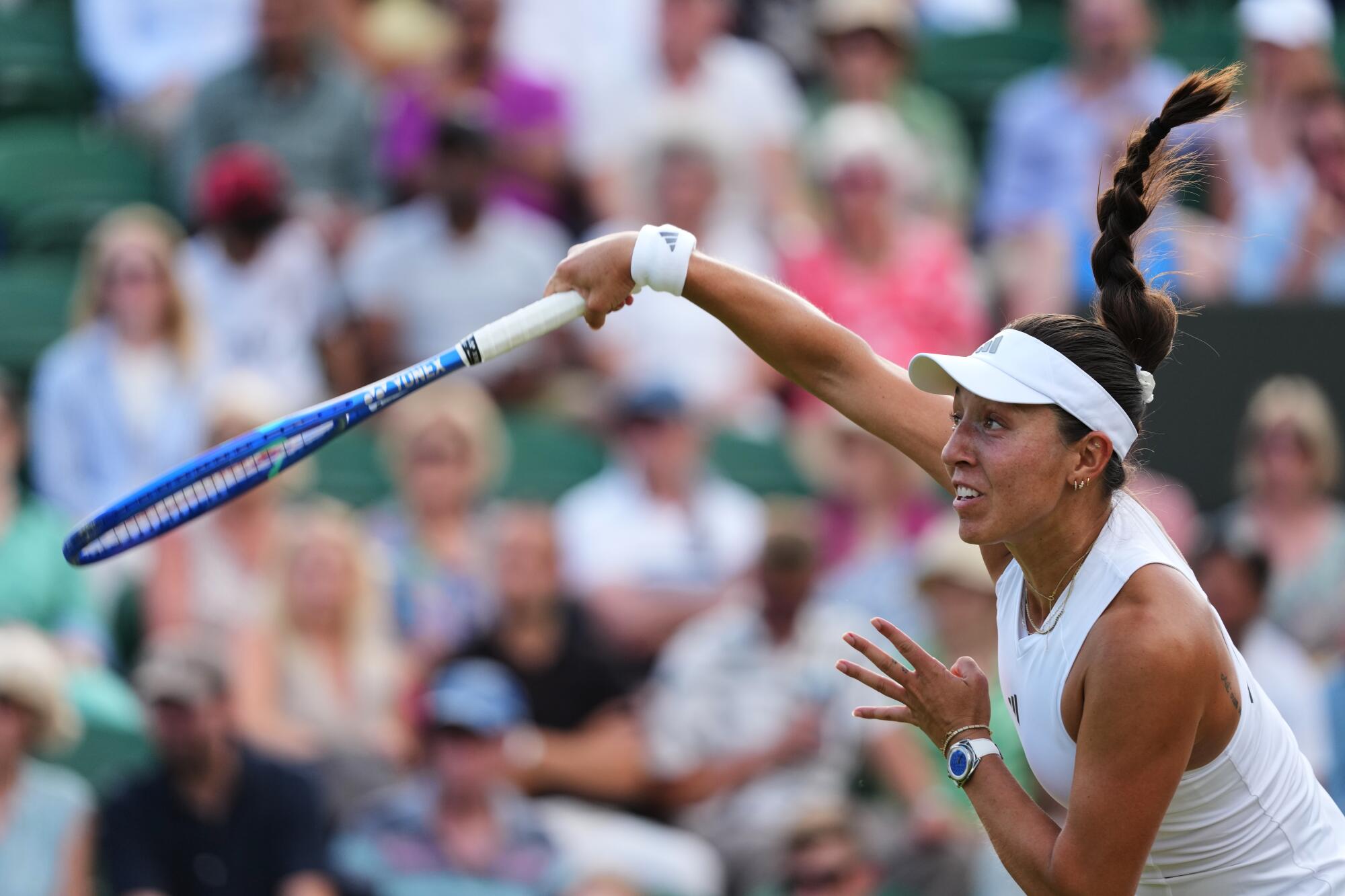
Jessica Pegula plays a backhand against Donna Vekic during their match at the BNP Paribas Open at Indian Wells.

Jessica Pegula plays a backhand against Donna Vekic during their match at the BNP Paribas Open at Indian Wells.

(Clive Brunskill / Getty Images)

Pegula says her motivation to pursue tennis came well before her family’s fortune grew.

“I’ve been wanting to be a professional tennis player and No. 1 in the world since I was like 7,” she said in a small interview room after beating Ostapenko this week.

“It’s a privilege, but at the same time I don’t want to do myself a disservice of not taking the opportunity as well,” she explained. “I’ve always looked at it that way.”

In the last few seasons, that maturity on the court has dovetailed with a growing leadership role off it.

Pegula has served for years on the WTA Player Council and was recently tapped to chair the tour’s new Tour Architecture Council, a working group tasked with examining the increasingly demanding schedule and structural pressures players say have intensified in recent seasons. The panel is expected to explore changes that could reshape the calendar and player workload in coming years.

Pegula said she hadn’t put up her hand to be involved but agreed after several players approached her to take the lead role — though she declined to say who they were.

“I think maybe as you mature … you realize how important it is to give back to the sport,” she said last week.

Life has also provided grounding and a wider lens.

Pegula’s mother, Kim, suffered a serious cardiac arrest in 2022, a situation she discussed in detail in a moving 2023 essay for “The Players’ Tribune.”

The Buffalo native and Florida resident also married businessman Taylor Gahagen in 2021. Gahagen helps “holds down the fort” at home with the couple’s dogs and travels with her when possible. He is with her in Indian Wells.

“I have an amazing support system,” Pegula says.

Despite winning 10 WTA singles titles, achieving a career singles high of No. 3 in 2022 and the No. 1 doubles ranking, Pegula’s low-key demeanor means she flies a bit under the radar.

She’s not one for fashion statements, outlandish antics or attention-seeking initiatives, her joint podcast with close friend Madison Keys notwithstanding.

Instead, Pegula tends to go about her business quietly, relying on a calm temperament and a methodical style that wears opponents down over time.

She gets the job done — the Tim Duncan of the women’s tour.

“She’s just all about lacing them up and competing between the lines, and then trying to be as big an asset as she can to her peers off the court,” says Mark Knowles, the former doubles standout who has shared coaching duties with Mark Merklein since early 2024.

“I think one of her great attributes is she’s very level-headed,” Knowles adds. “She doesn’t get too high, doesn’t get too low.”

Her tennis identity echoes her steadiness.

Instead of bludgeoning opponents with power, the 5-foot-7 Pegula beats them with savvy, steadiness and tactical variety. A careful student of the game, she studies matchups and patrols the court with a composed efficiency that incrementally drains big hitters and outmaneuvers most rivals long before the final score confirms it.

Keys calls that consistency her “superpower.”

“She doesn’t lose matches that she shouldn’t lose,” the 2025 Australian Open champion said this week.

Because of injuries in the early part of her career, Knowles says Pegula might have less wear-and-tear than other players her age. And he and her team have prioritized rest and recovery, which included the decision to skip the tournament in Doha last month following her tiring Australian Open run.

On brand, there was no panic in Pegula after dropping the first set in her two matches so far at Indian Wells. As she’s done all season, she steadied herself to earn three-set wins.

Bucket-list goals remain, however. Chiefly, capturing a Grand Slam title.

Jessica Pegula returns a shot to Jelena Ostapenko during the BNP Paribas Open in Indian Wells on Monday.

Jessica Pegula returns a shot to Jelena Ostapenko during the BNP Paribas Open in Indian Wells on Monday.

(Matthew Stockman / Getty Images)

Pegula jokes that she briefly interrupted a run of American female success when she fell in the 2024 U.S. Open final to No. 1 Aryna Sabalenka. But seeing close friend and teenage phenom Keys capture her major in Melbourne last year — after many wondered if her window had passed — hit closer to home.

“I think Madison winning Australia just motivated me even more,” Pegula says.

Although Pegula believes she is among the best hardcourt players in women’s tennis, that confidence hasn’t translated into success in the California desert. She has reached the quarterfinals just once in 10 previous appearances in Indian Wells.

“Why not try and add that one to the resume?” says Knowles, noting that she had never won the title in Dubai until last month. “She’s playing still at a very high level.”

Pegula says the key to keeping things fresh is maintaining her love of the game by continuing to improve and experiment with new ideas, a process that keeps her engaged mentally and eager to compete.

“I’m not afraid to kind of take that risk of changing and working on different things,” she says, “which just keeps my mind working and problem solving.”

For a player who never needed tennis, she remains determined to see how much more it can give her.

Source link