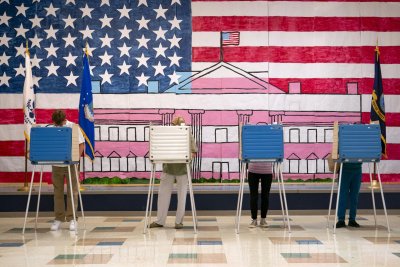
WASHINGTON — The Trump administration urged the Supreme Court on Monday to lift a judge’s order and clear the way for state-by-state lists of citizens who are eligible to vote by mail.
Solicitor Gen. D. John Sauer filed an emergency appeal and said judges in Boston had wrongly intervened too soon.
In March, Trump ordered the U.S. Postal Service to direct states to compile a list of citizens who are eligible to vote. This list would limit who may receive a mail ballot.
He also ordered the Department of Homeland Security to “compile and transmit state-specific lists of individuals who are citizens and will be 18 years of age or older at the time of an upcoming election,” Sauer said.
Lawyers for California and 22 other Democratic-led states sued, arguing the states, not the federal government, have the constitutional authority to set the rules for voting and elections.
In June, they won before a federal judge in Boston who blocked Trump’s order from going forward, at least in the 23 states which had sued. Her decision was upheld over the weekend by the 1st Circuit Court of Appeals.
In his appeal, Trump’s solicitor general focused on a procedural question, not the issue of whether the president has the legal authority to impose national rules on state-run elections.
Sauer said the U.S. Postal Service and the Department of Homeland Security had not issued final specific plans to comply with Trump’s directive.
“Courts cannot enjoin implementation of Executive Orders that leave open material issues that still need to be resolved by agencies,” he wrote.
He asked the court to lift or stay the “premature injunctions.”
Time is running short, he said.
“Absent a stay … there will not be sufficient time to obtain appellate relief before the November election,” Sauer said. “That is especially true because implementation efforts for any USPS rule or DHS policy will need to begin well before November … particularly given that absentee and mail-in voting begin (in some States) several weeks prior to Election Day.”
The justices asked for a response from the 23 Democratic states by Aug. 3.
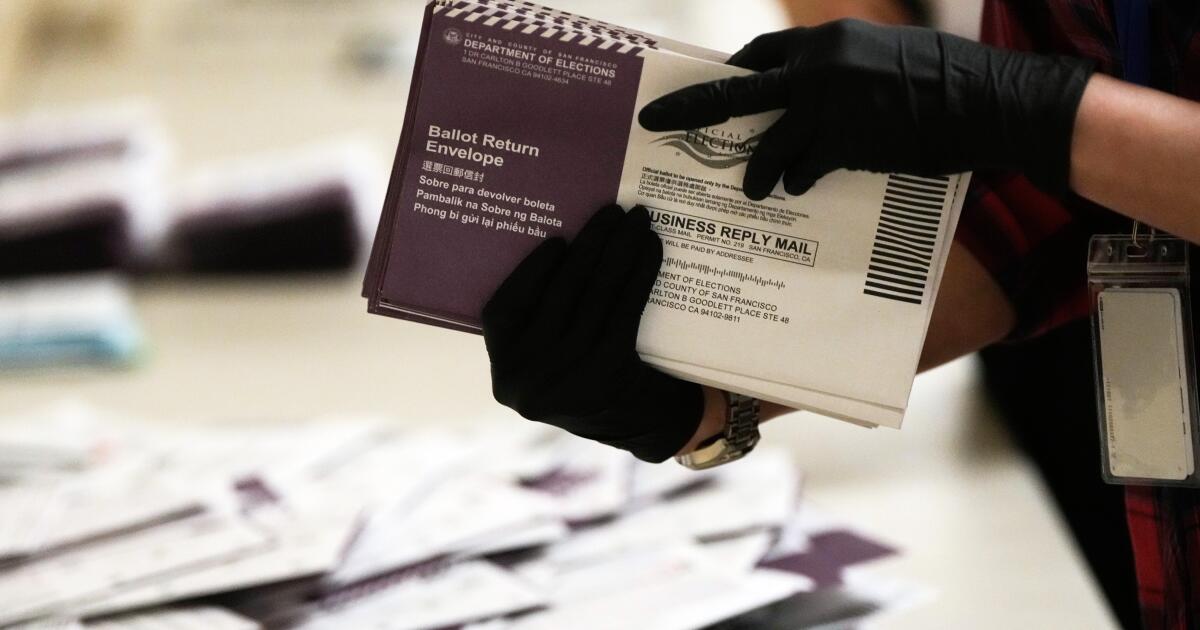
A federal appeals court has upheld a ruling that in nearly half of U.S. states halted President Trump’s executive order to create a federal list of eligible voters and limit delivery of mail ballots only to people on that list.
The ruling Saturday by judges of the 1st U.S. Circuit Court of Appeals rejected the Trump administration’s effort to move forward with the mail-in voting restrictions in 23 U.S. states that sued ahead of November’s midterm elections.
Trump issued an executive order in March for the director of U.S. Citizenship and Immigration Services and the commissioner of the Social Security Administration to create a “state citizenship list” of eligible voters. It also ordered the U.S. Postal Service to deliver mail ballots only to people on that list.
Trump has claimed the proposed changes are necessary safeguards to keep non-U.S. citizens from voting, but state election officials argued they were ripe for abuse and could cause chaos.
Democratic officials in 23 states and the District of Columbia challenged Trump’s order in a lawsuit filed in U.S. District Court in Boston. They argued that Trump’s order was unconstitutional because the states and Congress, not the president, have the authority to set election rules.
U.S. District Court Judge Indira Talwani agreed and halted Trump’s order from being implemented for the Nov. 3 elections, but only in the states that have sued.
Trump’s executive order is part of his ongoing campaign to restrict voting access and raise doubts about the integrity of the election system before the November midterms.
The White House and the Justice Department did not immediately return an email seeking comment Sunday about the court ruling.
WASHINGTON — Justice Anthony M. Kennedy, the Supreme Court’s most influential member prior to his retirement, has watched quietly for eight years as a new conservative majority took charge.
Though he believed abortion was a moral wrong, he cast the crucial vote in 1992 to uphold Roe vs. Wade and the principle that a woman, not the government, had the right to decide on ending an early pregnancy.
Four years ago, that decision was overturned on a 5-4 vote.
While Kennedy has refrained from commenting on the current court or President Trump, he has written a memoir that tells his life story and explains the reasoning behind the major decisions of his era.
It has become common for the justices to write books, but they steer clear of writing about the work of the court. Kennedy’s book, “Life, Law & Liberty,” is, like the justice, the exception to that rule.
An Irish Catholic from Sacramento and a Reagan Republican, Kennedy had a generally conservative voting record over 30 years on the high court. But he had a distinct view of liberty and justice.
“The nature of injustice is that we may not always see it in our own times,” he wrote in 2015.
Kennedy rejected the “rigid” view that the Constitution’s promises of liberty and equal protection of the law, as well as the protection against cruel and unusual punishment, were limited to their “original” meaning in the Bill of Rights of 1791 or the 14th Amendment of 1868.
After all, slavery and segregation were legal for much of American history, and women were not protected from discrimination by the promise of “equal protection” in the 14th Amendment.
Kennedy remained open to new rights and liberties. The goal, he wrote, was “a decent society in which the Constitution and the rule of law treat all with dignity and equality.”
He was the justice who made the difference in several areas of law, none more significant than in LGBTQ+ rights.
He wrote the court’s four major rulings rejecting discrimination based on sexual orientation. In 2015, he spoke for the 5-4 majority to uphold same-sex marriages nationwide.
“No union is more profound than marriage, for it embodies the highest ideals of love, fidelity, devotion, sacrifice, and family,” he wrote. “Many same-sex couples provide loving and nurturing homes to their children, whether biological or adopted. And hundreds of thousands of children are presently being raised by such couples.”
They “ask for equal dignity in the eyes of the law. The Constitution grants them that right,” he concluded in Obergefell vs. Hodges.
He also believed that teenagers who commit crimes are not as culpable as adults. He wrote a court opinion in 2005 ending executions for murderers who were under age 18 at the time of their crime.
Five years later, he wrote the court’s opinion holding it was cruel and unusual punishment for judges to impose a sentence of life in prison with no chance for parole for a teenager’s crime that did not involve homicide. In the case before the court, a Florida teen was given a life term for committing an armed robbery and a home burglary prior to his 18th birthday.
Kennedy marked his 90th birthday on Thursday and says his favorite topic of conversation is not the nine justices but his nine grandchildren. He still goes to the court some days and says he is worried by the tone in Washington and around the country.
“It is too partisan and confrontational,” he said in a recent interview with The Times. “I’m concerned that the divisiveness may be reflected at the court.”
Democracy requires “reasoned and respectful debate,” he said, not personal attacks and name calling.
Kennedy may be the last justice of his kind, said Washington University law professor Daniel Epps, a former Kennedy clerk.
“I don’t think we’ll see another justice who is so ideologically unpredictable and who votes against his party of appointment in some of the hugest cases in our lifetimes,” he said. Kennedy emerged from “an appointments process that was less polarized, where there were conservative Democrats and liberal Republicans and a Senate filibuster, which all made it possible for moderates to be appointed.”
While Kennedy describes himself at times as a small-town lawyer from Sacramento, he knew the two California governors, both Republicans, who reshaped the Supreme Court.
Kennedy’s father was a friend of Gov. Earl Warren, and young Tony played with Warren’s children. He also worked as a young page in the state Capitol when Warren was governor.
He was a high school senior in 1954 when Warren, the new chief justice, spoke for a unanimous court to strike down racial segregation in the case of Brown vs. Board of Education.
He and his father agreed the ruling was long overdue. It also provided an early lesson in how justices can uphold the fundamental principles of the Constitution despite intense opposition in much of the nation.
He said he later learned a second lesson. The Brown decision was “a historic step forward” but it “just a beginning” in the fight against entrenched racial injustice.
In writing the same-sex marriage case, Kennedy cited Warren’s opinion in the 1967 case of Loving vs. Virginia which struck down the bans on interracial marriages in 16 states.
As as young lawyer, Kennedy worked on special projects for Gov. Ronald Reagan and admired him greatly. He was just 38 years old when, at Reagan’s behest, he was appointed to the U.S. 9th Circuit Court of Appeals.
As president a decade later, Reagan had appointed Justices Sandra Day O’Connor and Antonin Scalia to the Supreme Court and elevated William Rehnquist to be the chief justice. But his third nominee — Judge Robert Bork — was voted down as too conservative by the Senate.
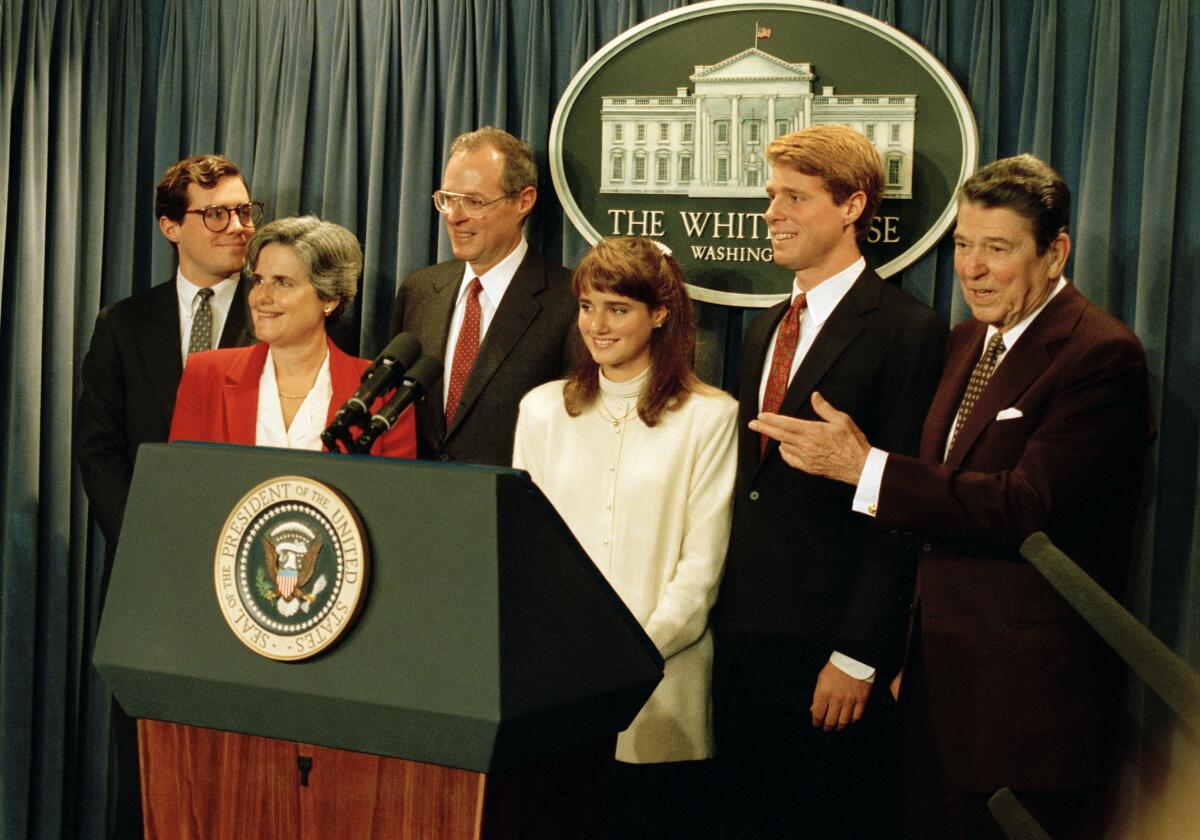
Reagan invited Kennedy to the White House and offered him the nomination. Kennedy recalled telling Reagan that he and his wife Mary were happy in Sacramento where all their friends and family lived. We don’t know anyone in Washington, he said.
President Reagan gestures toward Judge Anthony M. Kennedy’s family after nominating Kennedy to the Supreme Court in 1987.
(Dennis Cook / Associated Press)
In his best imitation of Reagan’s voice, he recounted the president’s response: “You know me. And you know Nancy.”
Kennedy accepted the nomination and was confirmed in February 1988 by a 97-0 vote, the last justice to win unanimous approval from the Senate.
His three decades on the court were shaped in part by his relationship with Scalia.
Kennedy and his wife bought a house in the same northern Virginia neighborhood where Scalia lived. In their early years on the court, they appeared to be friends and allies.
They broadly supported freedom of speech. To the surprise of many, they cast the deciding votes in 1989 to rule that the 1st Amendment protects the right to burn an American flag in protest.
A year later, Kennedy and Scalia dissented vehemently when the court ruled the Michigan Chamber of Commerce and its corporate supporters could be barred from advertising their support for state candidates.
The decision triggered a decades-long dispute that ended with the Citizens United ruling in 2010. Kennedy spoke for a 5-4 conservative majority to rule that corporations, unions and other groups were free to spend money independently to oppose or support candidates.
But when the court was closely split in major cases, Kennedy was likely to be in majority while Scalia wrote scathing and increasingly personal dissents.
“I would hide my head in a bag,” Scalia wrote in dissent in the same-sex marriage case, rather than join an opinion “couched in a style that is as pretentious as its content is egotistic.”
Kennedy was put off by a different jab. Scalia said the justices do not represent the full country. For example, the court lacks a “genuine Westerner (California does not count),” he wrote.
Since Scalia’s death, his influence has grown especially with the younger generation of conservatives.
Two of Trump’s appointees — Justices Neil M. Gorsuch and Brett M. Kavanaugh — were clerks for Kennedy in 1993, but they are far more likely to cite Scalia and his views on interpreting laws or the Constitution. Justice Amy Coney Barrett, Trump’s third appointee, was a clerk for Scalia.
While Kennedy did not respond to Scalia’s harsh dissents, they hung over their last year together on the court.
One day in early February of 2016, Scalia stopped by Kennedy’s office to talk.
“Nino said he had come to regret deeply the tone of his Obergefell dissent and its personal references. He apologized for being intemperate,” Kennedy wrote. “Neither of us is big on hugging, but we hugged, both of us smiling.”
They agreed to get together for dinner with their wives when he returned from a hunting trip to Texas.
A week later, Scalia’s wife Maureen called to tell them of his death.
“Nino and I spent 28 years on the court together,” Kennedy wrote. “We sometimes agreed and sometimes disagreed, but I respected him and miss him very much.”
July 25 (UPI) — A federal appeals court ruled that the Trump administration cannot implement tighter rules for mail-in voting in the mid-term elections this November.
The ruling, handed down by the First U.S. Circuit of Appeals on Saturday, will prevent his administration from creating a list of eligible voters and from requiring the U.S. Postal Service to refuse to deliver ballots to people who are not on the list, The Hill and Bloomberg News reported.
The three-judge panel rejected the administration’s appeal of lower court rulings in late June and early July that an executive order issued in April to expand the federal government’s role in managing elections could not be put into effect.
The April 1 executive order was condemned by critics at the time as an attempt by President Donald Trump and the administration to interfere with the mid-term elections, and led to 23 states and the District of Columbia to file suit to stop it.
The appeals court said in its ruling that the federal government failed to make its case for lifting the federal government’s injunction, which was partially based on the lower court preventing the executive order from going into effect.
“To be sure, the injunction prevents the federal Defendants from enforcing the EO in the Plaintiff states’ upcoming primary and general federal elections in September and November,” the judges wrote.
Trump, who continues to falsely claim that he won the 2020 election, signed the order under the guise of election integrity based on his also false claims of widespread voter fraud.
The fraud allegations center on ineligible people casting mail-in ballots, of which Trump and his administration have not shown happened in significant numbers during the 2020 election.
The order directs the Department of Homeland Security to build a state citizenship list based on federal date, to send the lists to state elections officials to verify mail-in ballots go to eligible voters and for the USPS not to send out absentee or mail-in ballots to people who do not appear on the lists.
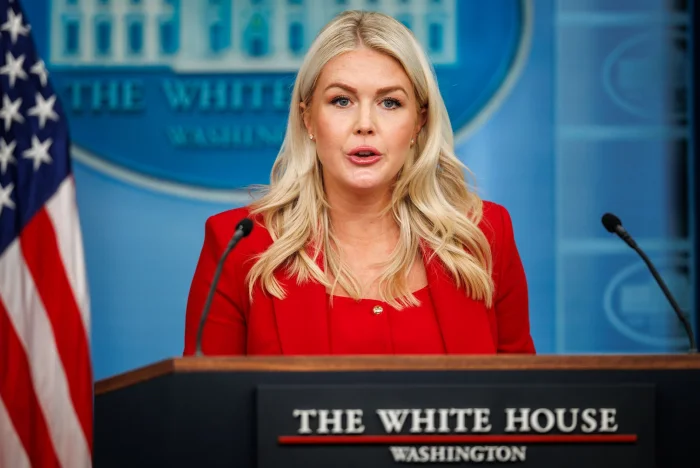
White House Press Secretary Karoline Leavitt speaks during a press briefing in the James S. Brady Press Briefing Room at the White House on Thursday. Photo by Samuel Corum/UPI | License Photo
The delay, filed in court on Friday, can cost Paramount $1.7bn in fees if the deal is not closed by next June.
Published On 24 Jul 202624 Jul 2026
Paramount Skydance has agreed to pause its $110bn acquisition of Warner Bros Discovery until after a federal judge rules on states’ challenge to the deal, according to court papers.
The delay, filed in court on Friday, could cost Paramount Skydance about $7m a day in fees it agreed to pay Warner Bros shareholders if the merger does not close by September 30.
Recommended Stories
list of 4 itemsend of list
“We look forward to proving our case at trial,” Paramount’s spokesperson said.
Twelve states, led by California, sued on July 13, arguing the deal would “extinguish competition” in Hollywood and lead to fewer choices for consumers, particularly moviegoers and cable customers. Paramount has called the states’ claims meritless and pledged to “vigorously defend” its merger.
“Halting this merger while our case proceeds is a critical victory in our efforts to uphold the law and protect the film and television industries,” said New York Attorney General Letitia James, who is suing to block the deal.
Friday’s move arrives just days after US District Judge Araceli Martinez-Olguin granted a temporary restraining order requested by the states to freeze the transaction for several weeks.
The companies agreed to pause the deal until five days after the judge rules on the merits of the case, or June 1, 2027, whichever comes first. Paramount could owe as much as $1.7bn in ticking fees to Warner Bros shareholders if the deal is delayed until then.
Similar merger challenges have taken an average of eight months for a judge to rule, a review of recent cases by the Reuters news agency has found.
There have also been concerns over a media stranglehold as the merger would have brought CNN, currently owned by Warner Bros, under the umbrella of Paramount. The latter already owns CBS, which has seen a fair amount of turmoil amid allegations of bias in favour of US President Donald Trump under the leadership of CEO David Ellison, whose father, tech billionaire Larry Ellison, is a Trump ally.
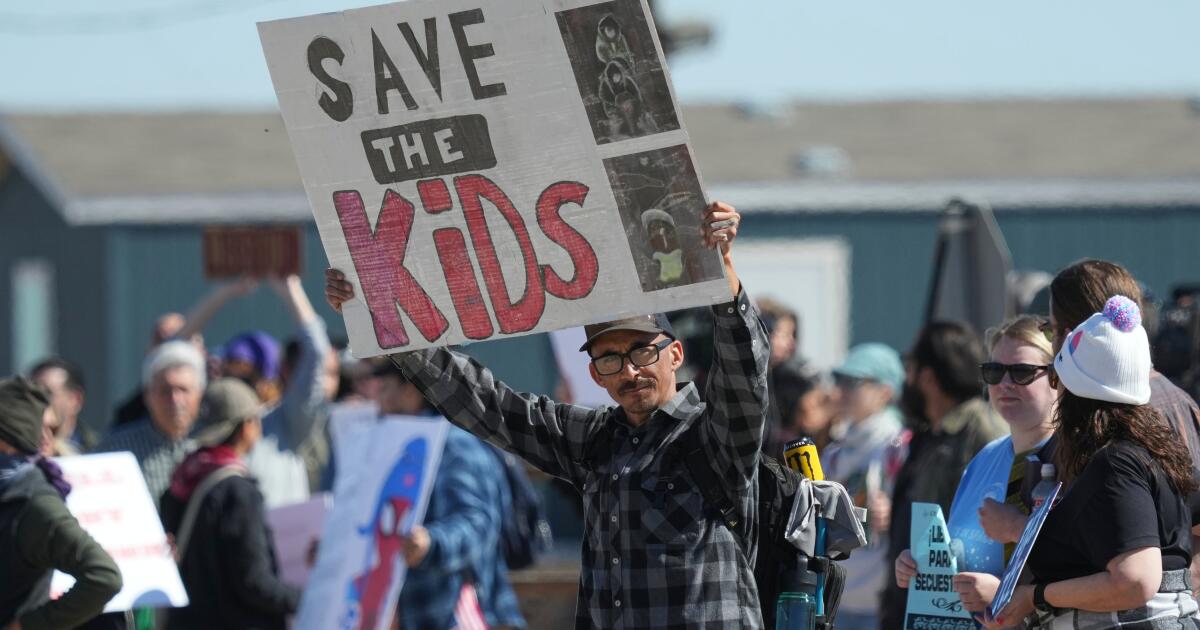
For more than a quarter-century, a lawsuit settlement from a case brought in Los Angeles federal court has dictated conditions for children held in immigration detention.
But now, the long-standing settlement — which set minimum standards for housing, education and medical care for migrant kids in federal custody, while strictly limiting how long they can remain there — hangs in the balance in the 9th Circuit Court of Appeals after a challenge by the Trump administration.
At the same time, the federal judge in L.A. who presides over the agreement appears poised to appoint a powerful new enforcer to uphold it.
President Trump has long sought to scrap the Flores settlement, which dates back to the Clinton era. In recent months, the Trump administration has waged a legal battle to cancel the agreement, while also pleading with the district court not to order an independent monitor to boost its compliance.
“[Flores] is the only thing standing between them and indefinite detention of families,” said Leecia Welch, chief legal director at Children’s Rights, a plaintiff in the case.
Last month, Assistant Atty. Gen. Brett A. Shumate pressed the 9th Circuit court to give the administration “the thumbs-up or thumbs-down” on its bid to tear up the settlement and end what he called “judicial micromanagement” of federal immigration policy.
“The Flores consent decree is an agreement which goes well above the constitutional floor,” Shumate told the court during oral arguments in June. “We’re asking that [the Department of Homeland Security’s] compliance with the law be assessed based on the law, not a 30-year-old settlement agreement.”
The three-judge panel sharply questioned the Justice Department’s legal claims, saying little had changed since the government last petitioned the court to have the agreement dissolved in 2020 — a request that was rejected.
The judges also pressed Trump administration lawyers to respond to evidence from scores of declarations filed in district court since last summer, in which detainees describe struggling to sleep in freezing, brightly lit rooms, vomiting from eating spoiled food, and begging for diapers, baby formula and asthma inhalers.
“You’ve said a lot of the reason you’re doing this is to discourage families from coming in the first place, so you’re basically punishing children because their parents brought them here,” Judge Marsha S. Berzon said.
Berzon, a Clinton appointee who issued a fiery dissent last year in a case that challenged the administration’s use of armed troops in immigration enforcement operations, asked: “You’re saying there’s no constitutional problem there?”
“I understand the detention of children at the border is a controversial policy issue, but that’s a policy decision,” Shumate said.
Just a day earlier, Chief U.S. District Judge Dolly M. Gee scolded a pair of government attorneys from her bench in Los Angeles, signaling she would probably appoint a new special master to force compliance with the settlement agreement.
“We’re talking about 11 years of this,” Gee said during the June 1 status conference. “None of these issues are new to me. These are all issues on which I have issued orders. I am very displeased about the fact that my orders are being disregarded and are not being complied with, not in good faith.”
“Both sides seem to be operating in different planes of reality,” Gee said.
The disputed settlement emerged from a 1985 lawsuit over the fate of 15-year-old Jenny Flores, a Salvadoran refugee who was picked up by federal immigration enforcement and left to languish in detention in Pasadena. At the time, there was little awareness that children were among the tens of thousands of migrants fleeing civil war and state collapse in Central America — with virtually no U.S. government infrastructure to protect them.
“It was a surprise,” said Benjamin Roth, a professor at the University of South Carolina College of Social Work and an expert on the agreement. “There was no thought then that there were kids in this mix.”
The current court fight centers on an immigration detention center in Dilley, Texas, run by the private prison company CoreCivic, where the vast majority of children and families in immigration custody are held.
In court filings earlier this month, U.S. Immigration and Customs Enforcement said it has “maintained core Flores-related services” at Dilley and argued its length-of-stay numbers were skewed by a small number of families it was forced to keep because they are considered “national security risks.” U.S. Customs and Border Protection likewise boasted its July 1 report “shows our highest level of compliance to date.”
Immigrant rights advocates called those claims “a fiction.”
“We see the same sorts of problems and concerns and misery that we’ve been seeing for the last 15 months,” said Welch, the Children’s Rights attorney.
In dozens of declarations collected as part of the court record, detainees recounted broccoli full of worms, diapers doled out one at a time, and staff tearing up children’s drawings.
One mother said medical staff laughed off her 8-year-old’s broken arm. Another said she was denied treatment for hepatitis B, even after doctors told her she could develop liver cancer and pass the infection on to her unborn daughter.
Still others described unexplained rashes, outbreaks of diarrhea and infestations of lice, among a host of other maladies for which many said they were offered only Tylenol or allergy medication. Even Christmas brought misery in the form of an ICE agent dressed up as Santa, who shoved away children trying to hug him, according to the detainee declarations submitted to the court.
“What happened on Christmas Day can only be described as an atrocity,” one mother recalled. Children “dropped everything, ran up to him, begged for candy and wanted to take pictures. Some children even cried and begged him for their freedom. Santa himself acted very indifferent.”
The Department of Justice argued that immigrant kids could still sue over poor conditions if the Flores settlement is unwound. But experts say existing protections would collapse without the legal architecture of the consent decree to support them.
“[Under the settlement], the federal government has built out a very efficient system to provide temporary care for kids,” Roth said. “If Flores is dissolved, it’s not going to be easy to stand up this same set of programs.”
If the Trump administration loses before the 9th Circuit, the fight over Flores could soon escalate to the Supreme Court.
“I’d be shocked if the 9th Circuit rules for the government, and I’d be shocked if the Trump administration doesn’t appeal,” said Eric J. Segall, a law professor at Georgia State University and an expert on the high court.
But consent decrees are legally and politically complicated, and the treatment of migrant children further tangles the situation. Given the legal and political complexity, the Supreme Court could rule to keep the settlement in place, or decline to take the case at all, experts said.
“It’s more likely than not the court would stay away from this,” Segall said.
For now, both the district judge and the 9th Circuit panel appear fed up.
“I think my patience has come to an end,” Gee said during the recent hearing in her Los Angeles courtroom.
The ‘Farmgate’ scandal nearly cost President Cyril Ramaphosa the leadership of his African National Congress in 2022.
Published On 24 Jul 202624 Jul 2026
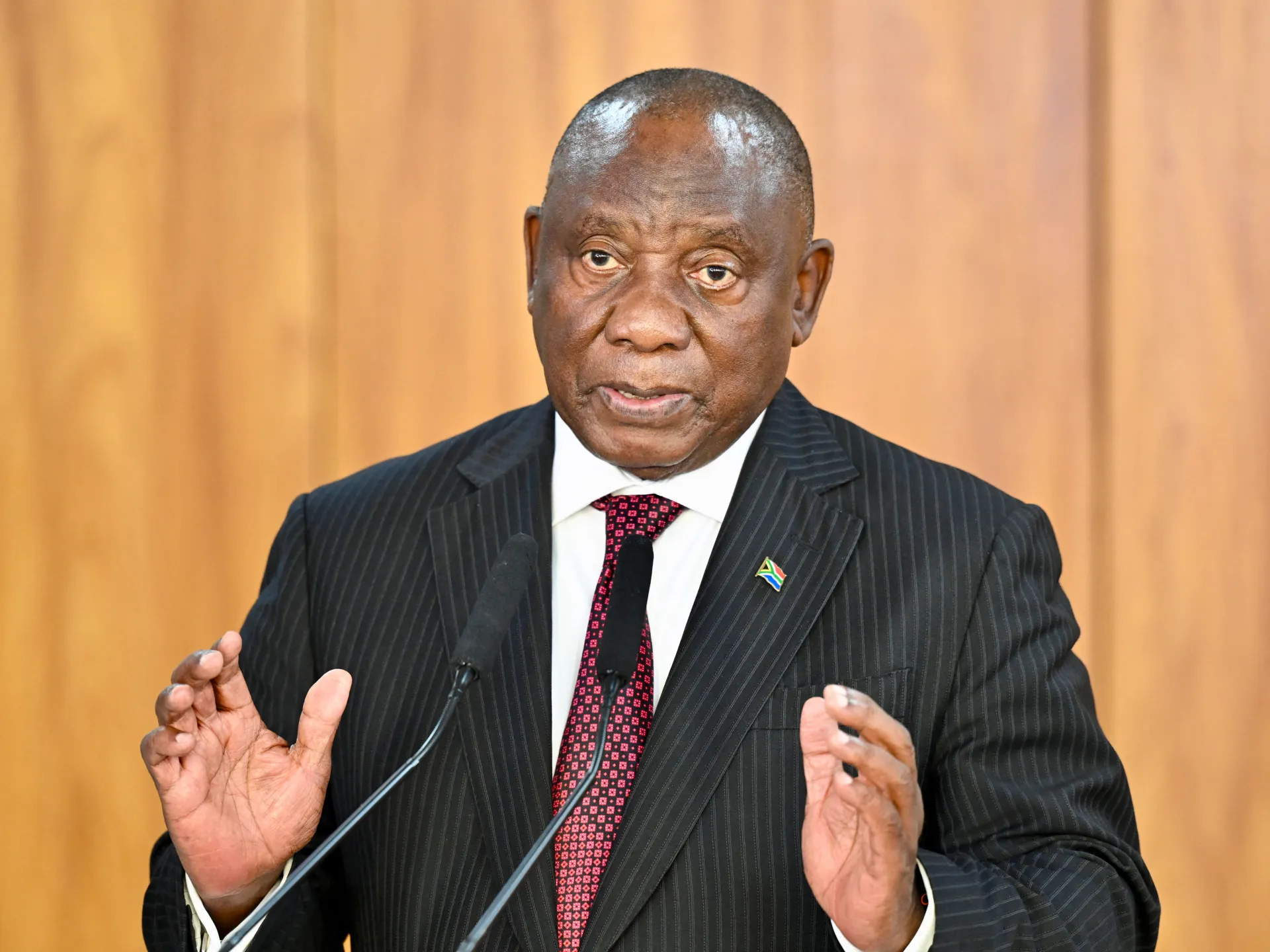
South African President Cyril Ramaphosa has won a court challenge temporarily halting a parliamentary impeachment process over misconduct allegations linked to the “Farmgate” scandal.
The Western Cape High Court granted Ramaphosa an “interim interdict” that temporarily prevents the impeachment committee from proceeding with public hearings while the president challenges the legality of a 2022 report that found he “may have committed” serious violations and misconduct.
Recommended Stories
list of 3 itemsend of list
“Pending the determination by this court of the applicant’s review … respondents are interdicted from proceeding with a public impeachment hearing,” Judge Andre le Grange announced on Friday.
“Farmgate”, a scandal involving half a million dollars stashed in a sofa at Ramaphosa’s ranch, nearly cost the president the leadership of his African National Congress (ANC) in late 2022. Meanwhile, allegations of corruption within the party contributed to the ANC losing its majority in an election in May 2024, the most closely contested vote in South Africa‘s democracy.
Ramaphosa has always denied any wrongdoing and ruled out resigning over the incident since the allegedly undeclared stash of foreign currency came to light after it was reported stolen in 2020.
The president said the $580,000 that was hidden at his luxury Phala Phala farmhouse in the northern Limpopo province was proceeds from the sale of buffaloes. But the episode has been a major embarrassment, raising questions about why he had so much money stuffed in furniture.
Friday’s ruling is a boost for Ramaphosa as he also awaits the outcome of a separate court case challenging an independent panel’s findings that he may have a case to answer over the scandal.
Ramaphosa’s spokesperson Vincent Magwenya said the president respects the ruling.
“[He] reaffirms his respect of judicial independence and separation of powers enshrined in our Constitution,” Magwenya said in a statement. “The president will continue to cooperate with and abide by processes of accountability.”
Political analysts expect Ramaphosa to remain in power, even if the impeachment process does get off the ground and ultimately leads to a vote on whether he should be removed from office.
Ramaphosa still enjoys the backing of his ANC party, the country’s biggest, which leads a coalition government. The ANC holds about 40 percent of seats in the National Assembly. It is not clear how all the ANC’s coalition partners would vote in the impeachment process.
July 24 (UPI) — A federal court has allowed Tennessee to use a new congressional map that eliminates the state’s only majority-Black district in November’s midterm elections, rejecting a challenge from civil and voting rights advocates.
The three-judge panel on Thursday denied a motion filed by Black Memphis voters for a preliminary injunction against implementing the map, ruling they lacked evidence of racial motivation for the map’s unorthodox mid-decade redistricting, which could be explained by a political motivation.
“The road to a reliably 9-0 map runs through Memphis. Thus, political motivations readily explain the map’s dilutive effects,” the panel, which consisted of two Trump appointees and one Obama appointee, wrote in its decision.
With the ruling, Tennessee may use the map in next month’s primaries.
November’s midterms have been of increasing concern for President Donald Trump, who has repeatedly voiced worries about impeachment proceedings and investigations if Republicans lose the House to Democrats, and has pushed GOP-led states to redraw their congressional maps to create additional Republican-favored districts.
Texas was the first last summer to agree to Trump’s request, sparking a gerrymandering arms race, with at least 10 states have redrawn their maps. All but Democrat-led California and North Carolina, which has a Democratic governor, are Republican-led.
Tennessee’s GOP-majority legislature passed its redistricting map to eliminate the one Democrat-held seat in May, a week after the Supreme Court issued a controversial decision that weakened a key part of the Voting Rights Act, by greatly limiting the use of race in drawing electoral districts.
The three Black Memphis voters, along with the Black Clergy Collaborative of Memphis, the Memphis A. Philip Randolph Institute and the Equity Alliance sued days later, alleging that the new map unlawfully discriminates against Black Memphis voters by dismantling a district where they had long been able to meaningfully participate in the political process.
In its ruling Thursday, the court said that the plaintiffs had to show that the map redraw was racially motivated, which they failed to do.
“The map’s effects — breaking Black Memphians into three separate congressional districts — are readily explainable by political motivations,” the court said.
“It’s no secret (supported by Plaintiffs’ own statements) that city voters prefer Democratic candidates and that rural voters prefer Republican candidates. So, it makes sense that Tennessee’s legislature would split Memphis into thirds when attempting to create a map that favors Republican candidates. And it’s no surprise that the resulting map would also split the Black population of Memphis into thirds.”
Amber Sherman, a plaintiff in the case, said the court’s decision further disenfranchises Black voters in Memphis.
“It’s painful to know we’ll head into another election under a map that was designed to weaken the Black voters in Memphis,” she said in a statement.
“We deserve the same opportunity to shape our future as anyone else.”
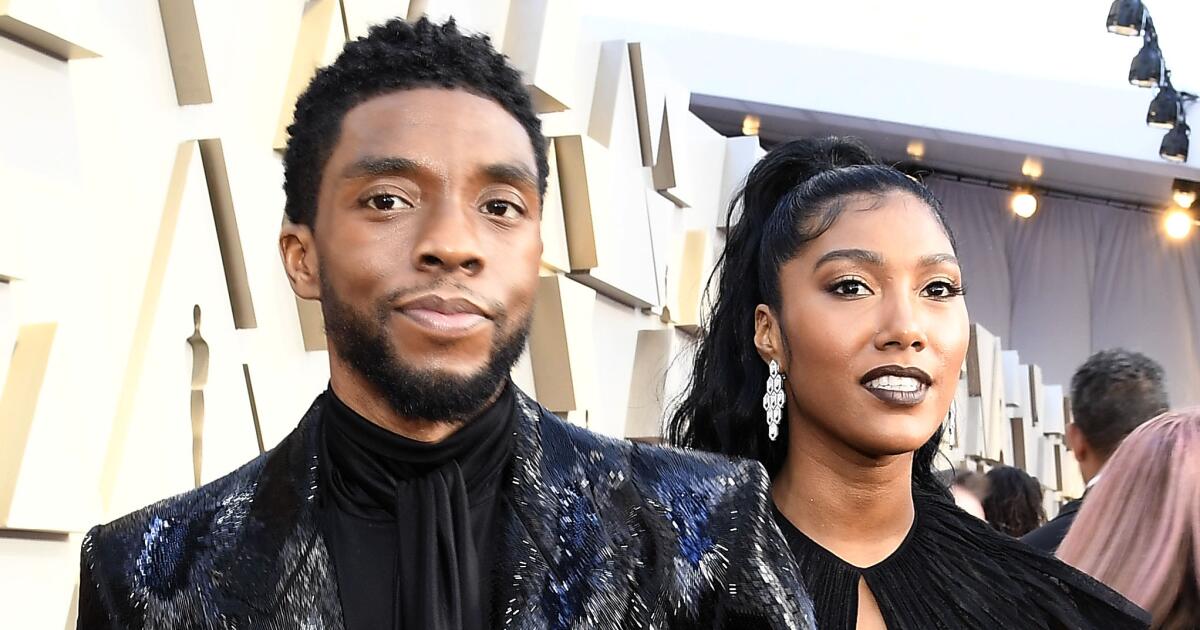
Chadwick Boseman’s brothers, Derrick Boseman and Kevin Boseman, are taking the actor’s widow to court over her handling of his multimillion-dollar estate.
The pair filed a petition with a Los Angeles court to remove control of the “Black Panther” actor’s estate from his widow, Taylor Simone Ledward. They claim Ledward has mishandled distribution of the funds and “cannot be trusted with the continued administration of the estate.”
According to court documents reviewed by The Times, the brothers filed the petition last week on behalf of their parents, Leroy and Carolyn Boseman, whom they say each inherited 25% of their son’s “sizeable” estate while Ledward inherited 50%. The petition states that the estate included residuals and royalties, rights to his image and intellectual property, investments, insurance policies, personal property and multiple bank accounts. Because the actor did not leave a will, the estate was passed to his parents and Ledward.
Ledward, the petition claims, “was also appointed as administrator” but never “fully distributed [Boseman’s] estate. … Instead, she continues to exercise complete control over his estate without input from Leroy and Carolyn.” The filing asks the court to have Ledward distribute the remaining estate assets, make a case for why she shouldn’t be “held in contempt for disobeying the court’s order,” and provide a “full accounting with receipts for her time as administrator.” It also asks that the court remove her as administrator.
The brothers asked the court to pass Ledward’s role as administrator to a private fiduciary and forensic accountant, who they claim will be essential in investigating Ledward’s alleged “mismanagement of the estate and marshaling any unaccounted-for assets.”
Reps for Ledward did not immediately respond to The Times’ request for comment.
The actor’s brothers allege that, because of their lack of access to Boseman’s estate, they are “blocked from pursuing lucrative business opportunities” that might benefit their “elderly parents.”
“For years, our parents have sought clarity regarding matters connected to the estate of our brother, Chadwick Boseman, including his intellectual property and legacy,” the brothers said in an emailed statement shared by their representative. “On behalf of our parents, we are committed to ensuring that transparency, accountability, and respect guide the resolution of these matters. Our hope is that this process brings clarity, honors the Court’s orders, and ensures the responsible stewardship of Chadwick’s legacy.
“We love our brother, and we remain committed to preserving his legacy with dignity, integrity, and respect.”
The Oscar nominee died in 2020 at 43 years old after privately battling colon cancer for four years. He was diagnosed with Stage 3 colon cancer in 2016, the same year he made his debut as comics superhero T’Challa, a.k.a. the Black Panther, in “Captain America: Civil War.” The acclaimed actor also portrayed real-life icons Jackie Robinson in “42,” James Brown in “Get on Up” and Thurgood Marshall in “Marshall.”
Boseman and Ledward, an R&B artist who uses the stage name sahn, started dating in 2015 and quietly wed in 2020 before the actor’s death. In a December 2020 interview with “CBS Sunday Morning,” Boseman’s friend and the producer of the Netflix movie “Ma Rainey’s Black Bottom,” Denzel Washington, said that while on the set of the film he watched Ledward care for the actor in the midst of his cancer battle and told him to “put a ring on that finger.”
In recent years, Ledward has advocated for colon cancer awareness and spoken at multiple events. In 2024, she spoke at the Dana-Farber Cancer Institute, saying, “Colorectal cancer is killing young people across the country, and most are vastly underestimating their risk. I’ve seen how this disease moves, and I know now how treatable it is when it’s detected early,” she said, per NBC Boston.
“My personal advocacy stems from this understanding, and from the disappointment I feel in the lack of awareness in my community,” she said. “We who have this knowledge have an obligation to inform our fellow man. Spreading awareness will save lives.”
Brad Pitt and Angelina Jolie‘s youngest daughter, Vivienne, is seeking to drop “Pitt” from her name, according to People.
The 18-year-old filed a petition in Los Angeles County Superior Court to remove her father’s surname from her legal name, Vivienne Marcheline Jolie-Pitt. The reason for her request was listed as “personal.”
The request is a common theme among the Jolie-Pitt siblings since the couple’s marriage was formally dissolved in 2019 and divorce became finalized in 2024 after a long legal battle.
In August 2024, the court granted Shiloh’s request to drop the surname. Zahara and Maddox have both asked for the same, but their petitions are pending hearings.
Before her request, Vivienne had already informally dropped the last name. In May 2024, the youngest of six was credited as “Vivienne Jolie” on the Playbill for “The Outsiders,” a play she co-produced with her mom.
The couple wed on Aug. 14, 2014, nine years after they met while filming their movie “Mr. and Mrs. Smith.” Jolie filed for divorce in September 2016 after the couple allegedly had a physical altercation aboard a private plane, which also involved several of their children.
The Los Angeles County’s Department of Children and Family Services and the FBI investigated the alleged physical altercation between Pitt and his son Maddox. No charges were filed against Pitt.
The court has scheduled a hearing for Vivienne’s request for Nov. 2.
President Maduro and former minister Saab were among those targeted by the civil lawsuit. (AP)
Caracas, July 20, 2026 (venezuelanalysis.com) – A US federal judge has issued a default ruling against Venezuelan President Nicolás Maduro and several current and former state officials. US $314 million in damages was awarded to three US citizens who spent time imprisoned in Venezuela.
Venezuelan authorities have yet to comment on the case. Legal proceedings against Acting President Delcy Rodríguez continue. However, on Monday, the Trump administration sent a letter to the court arguing that, as a sitting head of state recognized by Washington, Rodríguez should be “entitled to immunity.”
Judge Darrin P. Gayles from the District Court for the Southern District of Florida published the verdict on July 14. US nationals Jerrel Kenemore, Jason Saad, and Edgar José Marval brought a civil lawsuit in August 2025 under Florida’s Anti-Terrorism Act (ATA) and the federal RICO statute against organized crime.
The three US citizens were released from Venezuela in December 2023 as part of a prisoner swap agreement with the Biden administration that saw former Venezuelan government envoy Alex Saab returned to the South American country.
The plaintiffs sought damages after claiming to have suffered “physical and psychological torture” while imprisoned in Venezuela and to have been used as part of “hostage diplomacy” to secure Saab’s release. The judge claimed that Maduro and other officials were a “criminal enterprise” that acted against US interests.
“The Maduro Criminal Enterprise committed myriad predicate offenses through its drug trafficking and kidnapping actions in and against the United States and its citizens,” he wrote in the verdict. The court estimated compensation for “kidnapping and torture” and “solatium, pain and suffering” under ATA that totaled $312.5 million and added $1.5 million in RICO damages.
Gayles entered the default ruling against Maduro after he failed to enter a defense or plea before the court. The court clerk entered similar defaults against Interior Minister Diosdado Cabello, former Defense and current Agriculture Minister Vladimir Padrino López, former Interior Minister Néstor Reverol, former Attorney General Tarek William Saab, former Supreme Court President Maikel Moreno, and former Industry Minister Alex Saab.
Maduro and First Lady Cilia Flores were kidnapped by US forces on January 3 and are facing charges including “narcoterrorism” and drug trafficking conspiracy. Both have pleaded not guilty, with the next hearing scheduled for July 22.
The Florida judge also included the so-called Cartel de los Soles, an alleged drug trafficking outfit run by high-ranking Venezuelan officials, as a defaulting defendant. Crime researchers have cast doubt on the existence of the cartel, while the US Justice Department dropped all references to it in the formal indictment against Maduro and Flores.
Similarly, Gayles claimed that “for at least twenty years, Maduro intentionally inundated the United States with tons of cocaine.” However, US officials have never presented evidence tying Maduro to narcotics activities, while reports from the DEA have consistently found that a very small percentage of US-bound drugs flow through Venezuela.
The US Justice Department has since 2020 introduced $25 million and $15 million bounties, respectively, for the arrest of Cabello and Padrino in connection with alleged “narcoterrorism.”
According to the Associated Press, Saab’s legal representatives declined to comment on the case. The acting Rodríguez government turned over the Colombian-born businessman, who served as industry minister after his 2023 release, to US authorities in May. He is being held at the Federal Detention Center in Miami while facing trial on renewed money laundering charges.
In contrast to Maduro, Cabello, and others, Acting President Rodríguez responded to the lawsuit in April, with lawyers contending that, as Venezuelan head of state, she should be immune from civil action. Rodríguez received the backing of the Trump administration via a July 20 letter “suggesting” to the court that the acting president should enjoy immunity,
“The United States respectfully submits to the Court that President Delcy Rodríguez is immune in this action and all claims against her should be dismissed without prejudice,” the letter concluded. The US State Department also intervened in June, requesting that the Justice Department communicate Rodríguez’s immunity to the Florida district court in order to secure a “prompt dismissal of the proceedings.”
Rodríguez’s brother, National Assembly President Jorge Rodríguez, filed a similar motion to set aside the lawsuit via a different legal team. The plaintiffs opposed the moves in another motion at the end of April.
The civil lawsuit likewise targeted state-owned companies Petróleos de Venezuela, SA (PDVSA) and Corporación Venezolana de Petróleo (CVP). The two firms have claimed immunity from civil litigation under the Foreign Sovereign Immunities Act.
The plaintiffs have not disclosed any strategy to collect the awarded damages. None of the defaulting defendants has any publicly known assets under US jurisdiction.
Edited by Lucas Koerner in Caracas.
[Updated on July 21 to include the Trump administration and State Department letters to the court endorsing immunity for Venezuelan Acting President Delcy Rodríguez.]
On Monday, a federal judge temporarily blocked Paramount Skydance’s efforts to complete its purchase of Warner Bros. Discovery, ruling that the proposed $111-billion merger “raises serious questions” about whether the combination violates U.S. antitrust law.
District Judge Araceli Martínez-Olguín, based in Oakland, granted a request for a temporary restraining order from a coalition of 12 state attorneys general, led by California Atty. Gen. Rob Bonta, to freeze the deal while the court delves more closely into its impact on markets.
The order pauses the deal for 14 days. Martínez-Olguín’s ruling sets up a showdown for Aug. 3, when she considers a motion for a preliminary injunction — which, if granted, could tie up the deal for months in advance of a trial.
“This is a critical first win in our case to ensure this megamerger never sees the light of day,” Bonta said in a statement. “History tells the tale of what happens when a few people have great power over markets that are central to Americans’ lives: fewer opportunities for more people, worse products and services for all people.”
Two century-old film studios — with rights to Harry Potter, Batman, Scooby-Doo, “Top Gun,” “Ted Lasso” and “Game of Thrones” — would be combined, and HBO, CNN and HGTV would come under new ownership.
“The judge basically said, ‘Look, let’s not race to the finish line here,’” Eric Talley, a Columbia Law School professor, said in an interview. “At the end of the day, maybe this thing gets signed off on, but I think the AGs are going to be given a fair chance to bring their claims forward.”
The ruling dealt a blow to tech scion David Ellison’s efforts to quickly finalize his massive merger, which has the support of President Trump. Ellison wants to complete the deal by September to avoid a higher payout to Warner Bros. Discovery shareholders.
Paramount, in a statement, said the restraining order simply preserves the status quo, which Paramount had already pledged to do in court papers last week that offered to hold off on finalizing the transaction.
“We are confident the evidence will demonstrate that the State AGs’ antitrust arguments are without merit as their alleged markets and claims of anticompetitive effects are without any basis in modern market realities,” Paramount said in the statement.
Larry Ellison, co-founder of software giant Oracle, is bankrolling his son’s ambitions to acquire a second major entertainment company in less than a year. The Ellison family acquired the smaller Paramount in August.
The Democratic state attorneys general, including from New York, New Mexico, Nevada, Oregon and Washington, filed their lawsuit a week ago.
The 37-page lawsuit alleges that Paramount’s proposed takeover — the largest Hollywood deal in decades — would violate the U.S. Clayton Antitrust Act, a century-old law to prevent mergers that weaken competition and raise costs for consumers.
The lawsuit represents the stiffest challenge to a deal that had been swiftly clearing its various regulatory hurdles. Nearly two dozen regulators from around the globe, including Australia, Austria and Saudi Arabia, have already signed off.
The U.S. Justice Department last month approved the merger, saying the combination would probably bolster competition — not harm it. That decision wasn’t a surprise because Trump has been rooting for a CNN shakeup. The president told the network’s Jake Tapper earlier this month: “We’re trying to have CNN go on a normal path.”
“This merger is lawful, pro-competitive, and will benefit consumers, creators, workers, and the entertainment industry,” Paramount said. “We will continue to vigorously defend the transaction and will look forward to the hearings on the substance of the State AGs’ action.”
Paramount shares slid 2% to $8.57 on Monday. Warner shares tumbled nearly 4% to $25.86 — the stock’s lowest mark this year.
Martínez-Olguín’s order came after a hearing in Oakland on Friday that represented an opening salvo between the two sides in the fight over a merger that would dramatically reshape the entertainment industry.
“In many ways this case is a poster child for a much larger set of questions — some of which are specific to the entertainment industry but many are more specific to our regulatory state in general,” Talley said.
Because of the case’s expedited status, the judge said she looked closely at only one of the three markets where the plaintiff states allege the merger could bring anticompetitive harms — wide-release Hollywood films.
“Plaintiffs present compelling evidence that the combined firm resulting from the transaction will possess substantial market share in the wide-release theatrical distribution market,” Martínez-Olguín wrote in her 10-page order.
If allowed to merge, Paramount-Warner Bros. would control about 27% of the market of films that are initially released into more than 3,000 theaters.
“On this combined firm market share alone, the Court is persuaded that it can presume the proposed merger is likely to violate antitrust laws,” the judge wrote.
The ruling doesn’t signal that the states will win but, Talley said: “This is an important mark in the road that suggests that, in the eyes of the judge, at least one of their allegations has the seeds of a valid case.”
Paramount and Warner Bros. Discovery are “temporarily enjoined and restrained from closing or consummating the transaction or taking any steps, directly or indirectly, to integrate or consolidate their operations pursuant to the transaction,” the judge wrote.
The order extends to all officers, attorneys, and “other persons who are in active concert or participation with Defendants,” Martínez-Olguín wrote.
The merger is far from dead, Emarketer senior analyst Ross Benes said in a statement after the ruling.
“The order is likely to be a speed bump,” Benes wrote. “Thanks to the company’s symbiotic relationship with Trump, most challenges ahead that could stop the deal will be steamrolled.”
WASHINGTON — The Trump administration has filed a first-ever petition to a secretive and dormant court created 30 years ago to consider government requests to deport “alien terrorists” from the United States.
The Alien Terrorist Removal Court was established in 1996 but had never received a petition until Wednesday, when the Justice Department filed an application seeking the removal of an individual whose name is withheld from the single-page document posted on the court’s website.
The chief judge of the five-member court, Joan Ericksen, said in a written response to the petition that a hearing was held Thursday during which the court had “questions about the nexus that the government alleges between the actions of the respondent and the specific sections and subsections it invokes with respect to those actions.”
“The answers persuaded the Court that the Government could benefit from the opportunity for more thoughtful consideration,” wrote Ericksen, a federal judge in Minnesota.
She directed the Justice Department to provide more information by Wednesday.
The court’s authorities emerged from the Antiterrorism and Effective Death Penalty Act of 1996, which permits the attorney general to file under seal applications for the deportation of a suspected “alien terrorist.” If an application is granted, the court must hold a public hearing at which the government has the burden to prove that the individual satisfies that definition. Applications must be approved by the attorney general or deputy attorney general.
Federal law says that an individual could qualify as an “alien terrorist” by, among other factors, having “engaged in a terrorist activity,” endorsing or espousing terrorist activities and by belonging to a political or social group that encourages terrorist activity.
The court has been dormant since its creation, having received — until last week — no applications and conducting no hearings, according to a summary posted on the Federal Judicial Center website. It comprises five judges selected by Chief Justice John G. Roberts Jr.
The Trump administration has moved aggressively over the last year to carry out deportations, including invoking a 1798 wartime law, the Alien Enemies Act, to remove Venezuelan migrants who officials accuse of being part of a terrorist gang. During a hearing in that case last year, the Washington judge presiding over it, James Boasberg, indicated that the Alien Terrorist Removal Court would be the natural forum to consider a request for deportation on national security grounds.
“In fact, Congress has an answer for us, doesn’t it? Because they created the Alien Terrorist Removal Court,” he said. “So if there’s a national security concern with having these hearings … you can always go to the ATRC, which would be a first, but that’s what it’s there for, right?”
The petition was first reported by Court Watch, an independent news site.
Former Brazilian President Jair Bolsonaro, who is serving a 27-year sentence for a coup attempt, was placed under further restrictions on Friday for breaching conditions of his house arrest. File Photo by Andre Borger/EPA-EFE
July 18 (UPI) — Brazil’s top court on Saturday denied a request from former President Jair Bolsonaro to be visited by Argentinian President Javier Milei while under house arrest.
The attempted visit by Milei, a political ally of the far-right Bolsonaro, was part of a campaign to drum up political support for the son of the former president, who is running against leftist President Luiz Inacio Lula da Silva.
He was already barred from participating in national politics as part of his sentence.
But Bolsonaro was placed under further restrictions on Friday for breaching conditions of his house arrest, after he wrote a political letter supporting his son’s candidature for president.
The son, right-wing state Sen. Flavio Bolsonaro, then showed the endorsement letter during a live stream on social media.
Supreme Court Justice Alexandre de Moraes barred Bolsonaro from receiving any visits of a “political-electoral” nature until after Brazil’s general elections in October.
Bolsonaro’s defense lawyers argued in court he was unaware that his son would divulge his writing on social media, though the former president titled the text “letter to the Brazilian people.”
“The letter — written and personally signed by Jair Messias Bolsonaro — was addressed ‘to the Brazilian people,’ demonstrating that it was not of a private nature but rather intended for political and electoral purposes, with dissemination to the general public, using Flavio Nantes Bolsonaro as an intermediary, or in his own words, as his ‘spokesperson,'” Moraes wrote in his decision, G1 reported.
“The text of the ‘Letter to the Brazilian People,’ therefore, clearly shows that Jair Messias Bolsonaro intended to communicate with his political supporters through his son’s social media accounts,” the justice added.
Bolsonaro is now barred from receiving visits for 30 days, except by his medical and legal teams.
He is also not allowed to be visited by his son for 90 days.
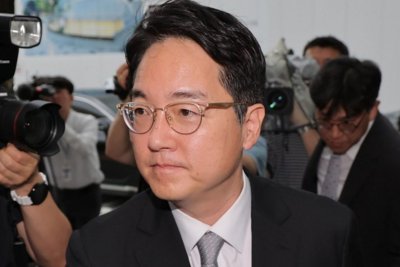
Former Prosecutor General Shim Woo-jung appears at the office of special counsel Kwon Chang-young’s team in Gwacheon, South Korea, 10 July 2026. He is being questioned as a suspect on allegations of abuse of power for ordering his subordinates not to indict former President Yoon Suk Yeol’s wife, Kim Keon Hee, over corruption allegations she faced while her husband was in office. Photo by YONHAP / EPA
July 17 (Asia Today) — A South Korean court Thursday rejected an arrest warrant for former Prosecutor General Shim Woo-jung over allegations that he participated in former President Yoon Suk Yeol’s failed declaration of martial law.
The Seoul Central District Court said prosecutors had not sufficiently demonstrated that Shim was likely to destroy evidence.
The court also said the progress of the investigation and related court proceedings made it difficult to conclude that he posed a flight risk.
The court separately rejected an arrest warrant for Jeon Moo-gon, a former head of the policy planning division at the Supreme Prosecutors’ Office.
The court said Jeon’s arguments, the progress of the investigation and the evidence collected did not indicate that he was likely to flee or destroy evidence.
Shim and Jeon are accused of reviewing plans to dispatch prosecutors to a joint martial law investigation headquarters under instructions from then-Justice Minister Park Sung-jae on Dec. 3, 2024.
Investigators also suspect they discussed how to handle crimes that would fall under military court jurisdiction after the martial law declaration.
They are further accused of participating in the preparation of a document concerning court jurisdiction under martial law.
The second special counsel team led by Kwon Chang-young requested arrest warrants for Shim and Jeon on Tuesday on allegations of participating in an insurrection and abusing their authority to obstruct the exercise of rights.
The special counsel team’s failure to secure their detention could complicate its investigation into allegations that senior prosecution officials participated in the martial law attempt.
Paramount Skydance’s top antitrust attorney told a judge Friday that David Ellison’s company would voluntarily delay its proposed $111-billion takeover of Warner Bros. Discovery at least until mid-August amid a legal challenge brought by 12 state attorneys general.
The states, led by California Atty. Gen. Rob Bonta, have asked a judge to issue a temporary restraining order that would prevent Paramount from finalizing its deal as the court battle ramps up. Paramount made the pledge in hopes of avoiding such a ruling that would tie its hands — and give the states an early win in the litigation.
Federal District Judge Araceli Martínez-Olguín said she would decide by Wednesday whether to issue a restraining order.
Tech scion David Ellison has been a regular in Washington D.C. this year as he races to consolidate Warner Bros. Discovery — less than a year after his family bought Paramount.
(Anna Moneymaker / Getty Images)
Friday’s hearing in Oakland opened the first chapter in the fight over the blockbuster deal that both sides agree would dramatically reshape Hollywood. Two century-old film studios — with rights to Harry Potter, Batman, “Top Gun,” “The Big Bang Theory” and “Game of Thrones” — would be combined, and HBO and CNN would come under new ownership.
Antitrust attorney James H. Weingarten, of the Washington law firm Milbank, represents California and the other states. He told the judge it would be impossible to untangle the two companies if they are allowed to combine.
“If this merger is allowed to close … the harms begin,” Weingarten said. “The job losses, the synergies — that’s the fancy word for ‘we’re going to save money and there might be job cuts.’ All of that process starts rolling.”
Bonta filed the suit Monday, alleging the proposed merger — the largest in Hollywood in decades — would violate the U.S. Clayton Antitrust Act, a 112-year-old law to prevent mergers that weaken competition and raise costs for consumers.
The lawsuit alleges antitrust violations in three markets where the two companies currently compete: wide-release films, potential blockbuster movies and cable television, where the combined entity would own more than 50 cable channels.
Paramount shares fell 4.3% to $8.75 on Friday. Warner stock slipped 1.5% to $26.87 — below Paramount’s offer of $31 a share.
More than two dozen lawyers attended Friday’s hearing, including from Colorado, Oregon, Washington and New York who came to support California, which is leading the case.
Paramount, represented by antitrust lawyer Jeffrey L. Kessler, argued a temporary restraining order was not necessary. The two sides should instead focus on the next big step — whether the judge issues a preliminary injunction, he said. Such a ruling could delay the deal for months.
Kessler said Paramount should be allowed a hearing to defend against a preliminary injunction by the end of August. The company wants to wrap up the litigation by late September to avoid a higher payout to Warner Bros. Discovery shareholders.
In a show of confidence earlier this year, Paramount offered Warner Bros. Discovery shareholders a “ticking fee” of 25 cents for every quarter after Sept. 30 — until the deal was done. Such payments would cost Paramount more than $7 million a day, which Kessler called a “massive injury.”
California Atty Gen. Rob Bonta is leading a coalition of 12 state attorneys general to try to halt Hollywood’s biggest merger in decades.
(Genaro Molina/Los Angeles Times)
Paramount would also have to pay Warner a $7-billion breakup fee should the deal fall apart.
Kessler argued the states had not made a sufficient case that competition would be harmed. “We don’t think they’ve come close to jumping through that hurdle,” Kessler said.
Earlier this year, Kessler represented the state attorney generals in their winning case against Live Nation Entertainment. A jury found that Live Nation, which owns Ticketmaster, operated as a monopoly. This time, Kessler is representing corporate interests.
Prominent Los Angeles litigator Daniel Petrocelli is representing Warner Bros. Discovery.
Paramount hired attorney Jeffrey Kessler to lead its antitrust defense.
(Noah Berger / Associated Press)
The case was assigned to Martínez-Olguín Wednesday after Paramount requested an earlier judge be removed because he formerly worked as a labor attorney.
Martínez-Olguín said she inherited the case because she was already overseeing another lawsuit dealing with the merger — not because Paramount had agitated for a change.
SEATTLE — President Trump fired the new top U.S. prosecutor in Seattle on Wednesday less than an hour after the attorney was unanimously appointed by the federal judges in the district, highlighting tensions between the courts and the president over the powerful positions.
Roger Rogoff, a former judge and veteran state and federal prosecutor, was sworn in as U.S. attorney before 8 a.m. at the U.S. courthouse in downtown Seattle. In a phone interview, he said he then went to the U.S. Attorney’s Office and asked to meet with Charles Neil Floyd, whose 120-day interim term in the position ended in February.
As he waited in a lobby, Rogoff said, he received an email from the Trump administration informing him he’d been removed. He is consulting with other lawyers about suing over his firing, he said.
Presidents normally appoint U.S. attorneys, the top federal prosecutor in each judicial district. The positions require Senate confirmation, except in temporary appointments. When temporary appointments expire before a nominee is confirmed, the judges in a judicial district can name a U.S. attorney.
But under Trump, the Justice Department has sought to leave unconfirmed prosecutors in their positions indefinitely, often through novel personnel maneuvers.
“District court judges can appoint a temporary U.S. Attorney, and POTUS can fire them,” Acting U.S. Atty. Gen. Todd Blanche said in a social media post Wednesday. He added that the judges who appointed Rogoff “abandoned the time-honored process of consultation with the administration so that the selected U.S. Attorney is qualified to serve in the administration.”
Trump named Floyd, who previously served as an immigration judge, interim U.S. attorney last October but never forwarded his nomination to the Senate. When Floyd’s time as interim U.S. attorney expired, Trump simply shifted his title, a tactic the administration has also tried in other federal judicial districts: It named him first assistant U.S. attorney, while leaving the top post empty.
In May, a U.S. appeals court panel expressed skepticism that the maneuver was legal. The federal judges in the city decided to take applications for the position, and it appointed a bipartisan panel to review the applications.
On Wednesday morning the court — comprising 17 active and senior judges appointed by five presidents — issued its unanimous order naming Rogoff the U.S. attorney for western Washington.
Democratic Washington U.S. Sen. Patty Murray, who had opposed Floyd for the U.S. attorney job, blasted Rogoff’s quick firing.
“Throughout his career, he has demonstrated an outstanding commitment to public service, and he was appointed legally by the federal judges in the Western District of Washington,” the senator said in a written statement. “This administration doesn’t want to deal with advice and consent—they just want to install cronies to carry out a corrupt political agenda.”
In December, Alina Habbaresigned as the top federal prosecutor for New Jersey after an appeals court said she had been serving in the post unlawfully.
Lindsey Halligan, who pursued indictments against a pair of Trump’s adversaries, left her position as an acting U.S. attorney in Virginia after a judge concluded her appointment was unlawful and that indictments she brought against James and former FBI Director James Comey must be dismissed.
The judges there named James Hundley, who had handled criminal and civil cases for more than 30 years, but the administration fired him. It also fired a court-appointed U.S. attorney in northern New York.
Rogoff, who spent 20 years as a state prosecutor and six as a federal prosecutor before becoming a state judge, said he knew the administration might fire him immediately. But he said he had no qualms about the potential conflict he was walking into. Being U.S. attorney is “the best job there is” for a prosecutor, he said.
“I’m really proud of my career,” Rogoff said. “The fact that the judges of this district — most of whom I’ve spent my career appearing in front of, or trying cases against, or working with — believed that I was the right person to do this work is just really humbling and amazing.”
Only a few days ago, Paramount Skydance’s planned $111-billion takeover of Warner Bros. Discovery appeared to be on the glide path to completion.
The deal, which would be the largest merger in Hollywood history, had won approval from several foreign governments and, on June 12, Justice Department antitrust regulators.
The Justice Department’s assent looked to be a major step toward fulfilling the ambitions of David Ellison, the son of multibillionaire tech tycoon Larry Ellison, to bring together Paramount and Warners, which owns CNN and CBS among other properties, under one roof.
‘I will not let Warner Bros. and Paramount merge without a fight.’
— Rob Bonta, California attorney general
The Justice Department’s action ignited suspicions that the Ellisons had profited from their support of President Trump. But it has turned out not to be the last word on the deal. The very next day, California and 11 other states filed a motion to block the merger, stepping in where the Justice Department chose not to tread.
“I will not let Warner Bros. and Paramount merge without a fight,” California Atty. Gen. Rob Bonta said in announcing the states’ action. A hearing on the motion is scheduled for Friday in San Francisco federal court.
Get the latest from Michael Hiltzik
Commentary on economics and more from a Pulitzer Prize winner.
By continuing, you agree to our Terms of Service, which include arbitration and a class action waiver. You agree that we and our third-party vendors may collect and use your information, including through cookies, pixels and similar technologies, for the purposes set forth in our Privacy Policy such as personalizing your experience and ads.
There’s more to this development than an effort to block Ellison’s attempt to repave the entertainment landscape for his own benefit, even though, as my colleague Meg James reports, the states’ motion “poses a major headache” for Ellison. It’s also a pointer toward a major restructuring of antitrust enforcement in the United States.
Customarily, state regulators have piggybacked on antitrust cases brought and managed by the federal government. The feds generally have greater resources than most individual states to conduct the investigations that can lead to antitrust lawsuits. States often have relied on the government to craft consistent and coherent theories of antitrust law to undergird their lawsuits.
But the Trump administration’s apparent pullback from aggressive legal pursuit of allegedly anti-competitive mergers has left a vacuum that states have moved to fill. That’s what’s driving their motion to block the Paramount-Warner Bros. deal.
Dating back to the first Trump term, California and other states have enacted new laws resembling federal statutes requiring merger proponents to provide detailed information about planned deals.
States also have filed their own lawsuits to challenge anticompetitive conduct by pharmacy benefit managers and algorithmic pricing that has driven up housing rents via alleged collusion.
States may have an advantage over the federal government in that their regulators can move faster on complex cases than the feds. That’s what happened in the fight against the proposed 2023 merger of supermarket companies Kroger and Albertsons, something that was widely feared to presage higher prices at the shelf.
Although the Federal Trade Commission moved to block the merger, so too did Oregon, Washington and nine other states in court. The companies called off the merger after a state court in Washington and a federal court in Oregon, ruling on that state’s lawsuit, simultaneously enjoined the merger on Dec. 10, 2024. One day later, Albertsons dropped the proposal.
Some supporters of effective antitrust enforcement suggest that the states’ involvement in these cases could be an effective counterweight to the mercurial approach taken toward enforcement under Trump, which seems to be driven by personal pique, as Paul Glastris, editor of the Washington Monthly, has written.
In 2017, Trump’s Justice Department sued to block AT&T’s acquisition of Time Warner, driven by Trump’s irritation over the coverage he received from CNN, which was owned by Time Warner. (I described the lawsuit as Trump’s doing the right thing for the wrong reason.) The merger eventually went through.
The best example of the states’ willingness to supplant the feds as antitrust enforcers in chief is the antitrust case against Live Nation Entertainment. The federal government and 30 states originally filed the case in 2024 in federal court in Manhattan. The lawsuit sought to break up Live Nation, which has controlled scores of top concert venues, in part by forcing it to divest Ticketmaster, the leading entertainment ticketing firm.
A few days after the trial began this spring, the Justice Department reached a settlement with Live Nation. The settlement led to accusations that the White House interfered in the Justice Department’s work on the case, including that Trump himself personally pushed for a settlement and that the deal was reached without the participation or even the knowledge of the Justice Department lawyers handling the case or of the state attorneys general who were participating. The White House referred my request for comment on these accusations to the Justice Department, which didn’t respond.
The states, asserting that the settlement wouldn’t cure Live Nation’s alleged violations of antitrust law, took over the lawsuit — and won. In mid-April, a federal jury found that Live Nation had maintained a monopoly over the live events business, exposing the company to the states’ claims of as much as $700 million in damages and a possible order that it sell Ticketmaster. The company says it will appeal.
The history of antitrust enforcement in the U.S. generally resembles the complaisant stance taken under Trump. Since the enactment of America’s first antitrust statute, the 1890 Sherman Act, industry has generally benefited from lax enforcement, in part because antitrust theory has been ever-changing. During the New Deal, President Franklin Roosevelt suspended antitrust enforcement so his National Recovery Administration could pursue its mandate to suppress industrial competition, which was thought to drive up prices and thereby foster the Great Depression.
The Supreme Court overturned the National Recovery Administration in 1935, though it had already lost credibility. Roosevelt responded in 1938 by appointing Thurman Arnold, a critic of existing antitrust theory, as the Justice Department’s antitrust chief. In his writings, Arnold implied that antitrust law as then interpreted was a fraud aimed at acclimating consumers to ever-larger business combinations through the pretense that “unfair” or “immoral” deals would be barred.
Arnold’s appointment marked what may have been the most productive period in antitrust enforcement. By the time he departed for a federal judgeship in 1943, he had brought more than 50% of all the cases brought under the Sherman Act in its half-century of existence. He broke the auto industry’s stranglehold on consumer auto lending, and started a case that concluded with the Hollywood studios’ forced divestment of their theater chains.
Since then, there have been a few notable antitrust successes, including the 1982 breakup of AT&T. That resulted from a Justice Department antitrust lawsuit launched in 1974. But the consolidation of major industries into fewer and fewer participants, especially in entertainment, has continued with very few roadblocks.
Khan’s published academic work had taken aim at what she called the lax antitrust treatment of companies such as Amazon. Her argument was that antitrust enforcers’ focus on whether a monopolizing company brought consumers lower prices overlooked the longer-term consequences of giving companies the unfettered right to build market share at the expense of competitors and the free market.
Amazon “has evaded government scrutiny in part through fervently devoting its business strategy and rhetoric to reducing prices for consumers,” Khan wrote in a key article. Once it reached a critical mass, she argued, nothing would stop Amazon from extracting monopoly rents from consumers.
Khan’s aggressive stance on antitrust law earned her the enmity of targets such as Amazon and Facebook, which tried to force her to recuse herself from FTC cases against them. She refused, but due to corporate distaste for her policies, Trump replaced her as FTC chairman on his inauguration day last year.
The Paramount-Warner Bros. deal could be a key test of states’ authority and willingness to take over antitrust enforcement from the federal government. That’s because they’ll be fighting not only resistance from the merger partners, but the government’s conclusion that the deal poses no threat to consumers.
On the other hand, their case at least will be free of the suspicion that the government’s approval owed more to Trump’s friendship with the Ellison family than to sober, painstaking analysis of how reducing the number of big entertainment companies from five to four would be good for the rest of us.
A federal judge has halted California’s groundbreaking “Truth in Recycling” law, which aims to reduce consumer confusion about which packaging can be recycled.
California’s recyclable packaging law prohibits manufacturers from using a “chasing arrows” recycling symbol on products or materials unless they are actually being recycled in a meaningful way, which the law quantifies. The bill was signed by Gov. Gavin Newsom in 2021 and was to go into effect on Oct. 4.
A coalition of farming, forestry, restaurant and packaging organizations sued the state in March, arguing the law violates their right to free speech. They argued that Senate Bill 343 operates as “government-imposed censorship.”
Judge William Hayes agreed that their challenge has merit, and on Tuesday ordered California Atty. Gen. Rob Bonta, the defendant in the case, to pause enforcement of the law “until further order of the Court.”
The industry trade groups, which include the Dairy Institute of California, the Flexible Packaging Assn. and the Western Growers Assn., applauded the decision.
The coalition “will continue to press the case that California can strengthen recycling without censoring truthful information on packaging and without adding unnecessary and significant costs for California families and businesses,” Californians for Affordable Packaging said in a statement.
The “ruling is a significant win, not just for our members, but for every business that wants to give consumers accurate information about the products they buy,” said Julie Landry, vice president of government affairs at the American Forest & Paper Assn. “The Court recognized what we’ve said from the beginning: California cannot fix consumer confusion by restricting truthful speech.”
Advocates of reducing the use of plastic disagreed.
“The court got it wrong, and I’m confident that the state will ultimately prevail,” said Nick Lapis, director of advocacy for Californians Against Waste. “SB 343 does not violate the First Amendment; it requires companies to tell the truth when they make recyclability claims. Suggesting that the First Amendment protects misleading environmental marketing is inconsistent with the basic principles of consumer protection that states like California have implemented for decades.”
In January, CalRecycle, the state’s waste agency, issued a report showing that less than 10% of most single-use plastic materials in the state were being recycled.
Even yogurt containers and margarine tubs — made of ubiquitous polypropylene, or #5 plastic — are being recycled at a rate of only 2% in the state, the report said. Only 5% of colored shampoo and detergent bottles, made from polyethylene, or #1 plastic, are getting recycled.
Plastic materials that can’t be recycled are typically sent to landfills or sometimes illegally shipped overseas, where they are burned or end up in landfills, rivers and waterways.
A report by the Natural Resources Defense Council shows that nationwide, taxpayers, governments and businesses are spending between $9.8 billion and $13.3 billion per year cleaning up plastic litter, and almost $3 billion is spent by local governments on landfilling plastic.
According to one state analysis, 2.9 million tons of single-use plastic and 171.4 billion single-use plastic components were sold, offered for sale or distributed in California in 2023.
“It is a terrible decision which denies consumers basic information needed to make informed choices,” said Judith Enck, former Environmental Protection Agency regional administrator and president of the nonprofit Beyond Plastics. “Given the long history of the plastics industry deceiving the public about plastics recycling, this is an especially bad outcome. It is a reminder that the plastics industry has enough money to fight even the most modest policy designed to protect people and the planet.”
Roh Kyung-pil, new head of the National Court Administration, speaks during a ceremony at the Supreme Court in Seoul, South Korea, 14 July 2026, to mark his inauguration to the position. Photo by YONHAP / EPA
July 14 (Asia Today) — South Korea’s new court administration chief warned Tuesday that growing outside pressure is making it more difficult for judges and other court employees to perform their duties independently.
Supreme Court Justice Roh Kyung-pil, 62, made the remarks during his inauguration as minister of the National Court Administration at the Supreme Court in Seoul.
“External pressure and burdens that make it difficult for judges to conduct independent trials and for court members to perform their duties in a stable manner are increasing,” Roh said.
He said the National Court Administration would serve as a protective barrier so judges and other employees could carry out their responsibilities according to the law and their professional judgment.
“The National Court Administration will provide firm support so that all members of the judiciary can confidently perform their duties in accordance with laws and principles,” Roh said.
He also pledged to strengthen personnel and material resources for judges and court employees working in difficult positions.
“The more demanding the position, the more we must reduce the burden, even slightly, so they can concentrate on their work,” he said. “We will expand the necessary personnel and physical foundations and develop effective support measures.”
Roh’s appointment filled a position that had remained vacant for about four months.
Former court administration chief Park Young-jae resigned in February after the ruling bloc pushed three controversial judiciary bills through the National Assembly.
The measures included the creation of a criminal offense for intentionally distorting the law, a system allowing constitutional challenges to court judgments and an expansion of the number of Supreme Court justices.
Park stepped down in protest against the legislation.
Roh was born in Haenam County in South Jeolla Province. He graduated from Gwangju High School and Seoul National University’s College of Law.
He was appointed as a judge in 1997 and later served as a Supreme Court research judge, a Seoul High Court judge and a presiding judge at the Gwangju and Suwon high courts.
Roh was appointed to the Supreme Court in August 2024.
The head of the National Court Administration oversees judicial administration under the direction of the chief justice and supervises court administrative operations and personnel.
The position does not involve directing judges’ decisions in individual trials but carries significant responsibility for the judiciary’s budget, staffing and administrative policies.
EMINEM’S ex-wife Kim Mathers has been rushed to hospital after months of personal troubles.
The 51-year-old was pictured strapped to a gurney as paramedics wheeled her out of her home in Chesterfield, Michigan, per TMZ.
Kim Mathers lives a low key life out of the spotlight near Detroit with her teenage sonKim Mathers with her famous ex-husband, EminemCredit: GettyThe mom-of-four is seen looking tired with puffy eyes in a recent mugshotCredit: Macomb County Prosecutor’s OfficeKim Mathers appears to fall asleep in her car on a shopping spree in July 2014Credit: News Enterprises Inc.
The 911 call came in around 8 pm on Tuesday for a person who was unconscious or fainting, according to a Chesterfield Fire/EMS report.
Sign up for the Showbiz newsletter
Thank you!
It lists the incident as “Hemorrhage/Laceration,” and says emergency workers responded along with the Chesterfield Police Department.
No further details have been released since the incident.
The health scare comes after two warrants were issued for her arrest last month.
She was due in court for three hearings across two separate drunken driving cases — including a sentencing and bond violation hearing over a February hit-and-run crash, and a probable cause conference for a May OWI (operating while under the influence) arrest.
However, she failed to appear or contact the court, leading to the warrants being issued. The issue was later resolved.
Kim crashed her white Range Rover into a parked Dodge Ram pickup truck on February 16 near her home.
Most read in Entertainment
The impact was so severe it launched the truck 50 feet from where it was parked.
Officers who found her noted her slurred speech, glossy eyes, and a strong smell of alcohol.
Police also found empty and open alcohol containers in her vehicle.
In May, she pleaded no contest to operating while impaired and failure to stop after a collision.
Just two days later, Kim was arrested again after crashing into another parked car in Chesterfield Township.
Police body camera footage published by TMZ showed her slurring her speech heavily.
After claiming an oncoming vehicle’s high beams blinded her, she underwent field sobriety tests and blew a 0.20 per cent BAC on a breathalyzer — nearly three times the legal limit.
Kim’s recent hospital run also comes after her famous ex made a rare appearance on stage this week during one of Jay-Z’s concerts in New York.
The former couple, who are said to be on good terms after a messy past, have a daughter, Hailie Jade, 30, along with an adopted daughter, Alaina, 33.
Alaina’s mother, Dawn, is also Kim’s sister, who died of a drug overdose in 2016.
Kim is mom to Stevie Laine, 24, whose biological dad died, and was also raised by the rapper, 53.
The rapper’s ex also has a teenage son, Parker, from a more recent relationship but she is believed to be single.
Eminem, whose real name is Marshall Mathers, first married Kim in 1999, but the couple divorced just two years later.
The pair later reconciled and walked down the aisle for a second time in 2006, but their marriage once again ended in divorce.
Kim has spoken publicly about her struggles with substance abuse over the years and was believed to have maintained her sobriety following a stint in rehab in 2023.
Her turbulent relationship with Eminem, which was frequently referenced in his music — including graphic lyrics about their relationship — contributed to some of her darkest moments.
She has also battled depression and addiction throughout her adult life.
In more recent years, the former couple have appeared to be on better terms and have become grandparents, although they are not believed to have a close or regular relationship.