california

Instead of uniting the left, California’s billionaire tax measure has split Democratic allies

For all the media attention California’s proposed billionaire tax has generated nationally — with some blasting it as a foolish Left Coast assault on American enterprise — the November ballot item has actually triggered a rift among progressive labor unions and Democrats, groups critical to the measure’s success.

Championed by California’s largest health workers union, Proposition 40 would levy a one-time, 5% tax on California’s roughly 200 billionaires. The measure aims to backfill Medicaid cuts signed into law last year by President Donald Trump, and would raise an estimated $100 billion.

Dave Regan, the measure’s architect and president of Service Employees International Union-United Healthcare Workers West, said the tax was intended to prevent “the imminent collapse of California’s health care system because of the Trump cuts in the ‘One Big Beautiful Bill.’”

Regan, who has become well-known for using ballot measures as leverage in negotiations with state lawmakers and the healthcare industry, seemed poised to channel public anxiety over economic affordability, access to medical care and anti-Trump sentiment when the initiative was announced last fall.

Today however, the initiative not only faces heavy and well-funded opposition from those it aims to tax, but also divided support among groups who traditionally favor taxes on the wealthy — labor unions. Both the powerful California Teachers Association and the State Building and Construction Trades Council of California have come out against Prop. 40, while Teamsters California and AFSCME California support it. Others unions have yet to weigh in, including the California Federation of Labor Unions and SEIU California, a parent organization for Regan’s healthcare worker union.

Establishment Democrats are also divided. Gov. Gavin Newsom aggressively opposed the measure and sought to negotiate with Regan to remove it from the ballot beginning last year. Days before a state deadline to withdraw ballot measures in late June, Regan publicly offered to trim the wealth tax to 2% over two years, an offer Newsom quickly rejected.

To some close observers, the offer signaled that Regan may have been looking for a way out of an expensive ballot fight.

“I found it unusual that he did that because he’s usually not that kind of negotiating type — he’s no nonsense,” said Democratic political consultant Steven Maviglio. “I don’t know if he felt it was a hot potato or what.”

Regan’s union spent $31 million to gather 1.6 million voter signatures to put the tax on the ballot.

“At the outset, this may have looked like the replay of a strategy he’s employed successfully many times in the past, but he ended up painting himself into a corner, and so now he’s stuck with an initiative that he knows he probably can’t pass,” said Dan Schnur, a politics and communications professor at Pepperdine, USC and UC Berkeley.

A March poll by UC Berkeley’s Institute of Governmental Studies showed 52% of registered voters support the billionaire tax while 33% opposed it and 15% were undecided. However, campaign experts say its position remains precarious, due in part to the deep pockets of its opponents.

Several billionaires, including Google co-founder Sergey Brin, have so far pumped a combined $118 million into a campaign committee that gathered enough signatures to place two other measures on the ballot aimed at undercutting the billionaire tax.

Groups that might otherwise support more revenue for healthcare have also come out against Prop. 40, including Planned Parenthood Affiliates of California and the California Medical Assn.

“The dangerous wealth tax directly threatens vital funding for education and schools, healthcare and clinics, public safety, and infrastructure projects by making California’s revenue even more volatile,” leaders of the California Medical Association, California Primary Care Association and California School Boards Association wrote in a joint statement.

Regan and fellow supporters insist that, without approval of the tax measure, Trump’s “Big Beautiful Bill” will gut the state’s healthcare resources.

“This will take between $20 and $25 billion annually out of our healthcare system, meaning three and a half million people are going to lose insurance, 150,000 health care workers will be laid off and over 20 million consumers are already paying more in premiums, deductibles and copays,” he said.

While prominent progressives such as Sen. Bernie Sanders (I-Vt.) and Rep. Ro Khanna (D-Fremont) have voiced support for the measure, some progressive opponents say its near exclusive focus on healthcare is a problem. (Only a small portion of tax revenues would go toward education and food security.)

The CTA said after reviewing the measure, its council of delegates “determined that this policy will not provide the sustainable and long-lasting funding that our schools and communities deserve.” Leaders of the state’s largest teachers union plan to focus their efforts on passing Proposition 3, which would make permanent an existing tax on certain high earners to fund schools and community colleges.

Labor unions have typically aligned in support of tax-raising ballot measures, including earlier temporary versions of this year’s Prop. 3 and an unsuccessful 2020 proposal to revamp commercial property taxes.

But the billionaire tax “doesn’t benefit everybody. It benefits workers in the healthcare sector primarily, and I think that’s why not everybody’s on board. It’s not a ‘rising tide lifts all boats’ kind of proposal,” Maviglio said.

In the 15 years he has led SEIU-UHW, Regan has become known for using expensive ballot measures — or the threat of them — to bring lawmakers and industry opponents to the negotiating table.

In a landmark 2023 deal, Regan secured a statewide $25 wage floor for healthcare workers after qualifying initiatives to raise industry wages in Los Angeles and other cities. The deal included a 10-year moratorium on minimum wage propositions. He also pushed ballot measure regulations on kidney dialysis clinics for three subsequent election cycles. Though none of them passed, the dialysis industry spent hundreds of millions between 2018 and 2022 to defeat them.

“Everybody knows that he is wielding ballot measures as a weapon to leverage his unionization or political demands. It’s not a secret. He’s admitted it,” said Brandon Castillo, a ballot measure strategist who often finds himself opposite Regan in ballot fights including the dialysis clinic propositions.

The measure retroactively applies a tax on billionaires who were residing in California as of Jan. 1. Newsom and other opponents say the initiative would drive the ultra-wealthy out of the state and their departure would blow a hole in the state budget.

California’s budget is dependent on income taxes the rich pay on stock market profits. The Legislative Analyst’s Office said the measure would “likely” result in an “ongoing decrease in state income tax revenues of hundreds of millions of dollars or more per year.”

“You may not be able to pick up and move to Texas or Florida to shelter your income from taxation, but I promise you that billionaires can, and do,” Newsom wrote in a post on Substack in late June. “Wealth is movable, and it shops for the state with the lowest taxes.”

After the talks ultimately failed to result in a deal, Newsom endorsed the idea of a national wealth tax instead.

“It’s easy to see how they may have believed that Newsom’s strongest incentive was simply to stay out,” Schnur said. “There’s a huge potential downside for a Democratic governor [to weigh in] on either side of this initiative. If you oppose it, you’re alienating your base. If you support it, you’re putting your state in dire fiscal peril.”

Focusing on raising taxes at the federal level allows the governor to support a popular idea nationally, which he can campaign on if he runs for president. His opposition to the measure in California could still leave him vulnerable to criticism from progressives in a national Democratic primary.

Times staff writer Taryn Luna contributed to this report.

Source link

DHS buys two California immigrant detention centers for $1.5 billion

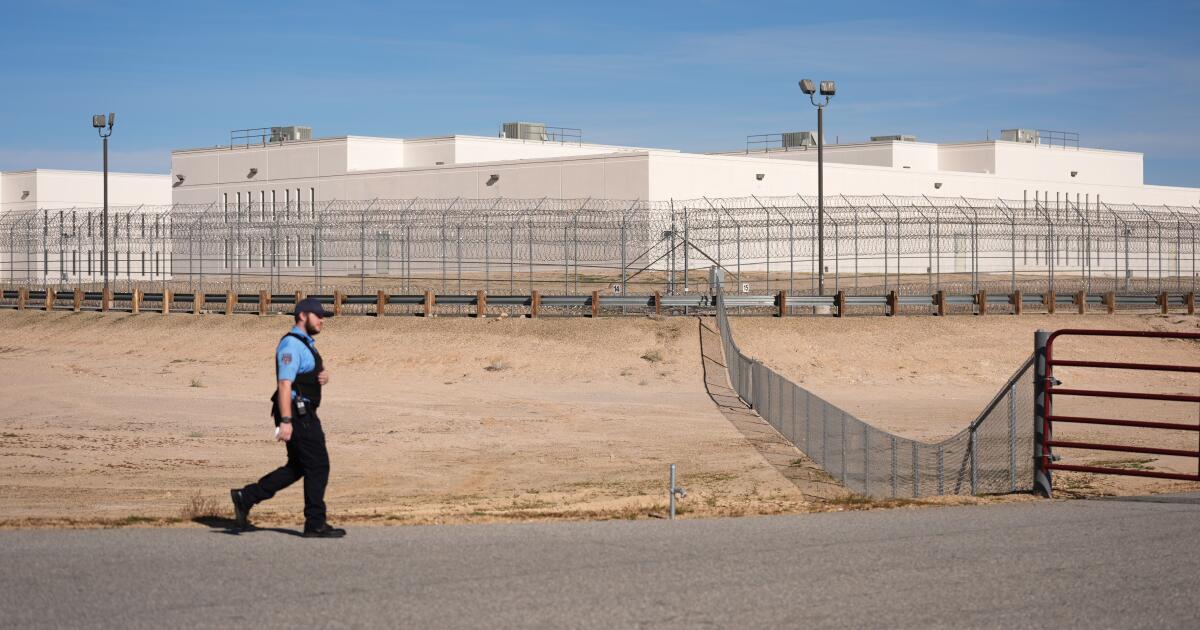
The Department of Homeland Security bought two of the largest immigrant detention facilities in California for $1.5 billion, according to the private prison company that sold them.

The purchase comes as the department — flush with cash after Trump’s One Big Beautiful Bill Act infused the agency with $170 billion — has moved to scale up its capacity to detain immigrants without relying as heavily on private prison corporations.

In announcement Monday, the Tennessee-based CoreCivic said the sale of the 2,560-bed California City Detention Facility and the 1,994-bed Otay Mesa Detention Center in San Diego closed on July 2.

The company said it expects net proceeds of about $1.1 billion after income taxes and transaction expenses.

Ryan Gustin, public affairs director for CoreCivic, said such sales are not uncommon and that “the process was marked with rigor and integrity.” He added that the valuations were established through the federal government’s required appraisal process, using independent appraisers, who determined objective fair market value.

The sale doesn’t immediately change anything at the facilities — CoreCivic expects to continue managing them under existing contracts with U.S. Immigration and Customs Enforcement, according to the company and a filing with the Securities and Exchange Commission.

But the terms of those contracts could be modified given the change in ownership, the filing states. The California City facility contract expires in August 2027 and the Otay Mesa facility contract expires in December 2029, with the option to extend for another five years.

“We are pleased with the sales of these two mission-critical facilities for the Company’s government partner, which demonstrates the value of the Company’s underlying real estate portfolio, while reflecting our role as a long-term, flexible solutions provider to government,” CoreCivic CEO Patrick Swindle said in the announcement.

The Department of Homeland Security did not immediately respond to a request for comment.

During a quarterly earnings call in May, George Zoley, CEO of the GEO Group, another major private prison corporation, said that the company had been in discussions with ICE “regarding the potential sale of multiple facilities.”

Critics of the purchases of detention facilities say the Trump administration is simply looking to avoid state and local oversight by bringing them under federal ownership. That issue was raised during the GEO Group earnings call when a participant later asked why the federal government wants to own the facilities instead of contracting with third parties.

If the facilities are federally owned, Zoley replied, there are “more protections from unwarranted litigation that infringes upon the activities of the ICE processing centers.”

Zoley said federal ownership would bolster the legal defense of the facilities and the argument that “states can only have very limited involvement.”

“There’s been litigation regarding overseeing medical services, food services, general cleanliness, etc.,” Zoley continued. “It’s really unprecedented and I believe it’s fundamentally unconstitutional. As some blue states are considering more active involvement in oversight of facilities, I think the logical solution to much of that is federal ownership of the facilities.”

California tried to kick private detention operators out of the state, but the 2020 law was overturned in the Ninth Circuit Court of Appeals. Since then, state leaders have established oversight mechanisms through laws that allow for monitoring and investigation of detention centers by the California Department of Justice and local health authorities.

Asked to comment about the sale, Sen. Alex Padilla (D-Calif.) said his congressional oversight visits to facilities operated by CoreCivic have shown that immigrants who pose no public safety threat are being held in “unacceptable conditions.”

“Whether these facilities are operated by a private contractor or owned by the federal government, my expectations remain the same,” he said. “I will continue demanding transparency, accountability, and humane conditions that respect the dignity and rights of every person in immigration detention.”

Eight ICE detention facilities now operate in California, with a combined capacity to hold nearly 9,000 people.

The California City and Otay Mesa facilities have both been the subject of lawsuits by detainees alleging detainee mistreatment. CoreCivic calls such allegations unfounded and says it complies with all regulations concerning the treatment of detainees.

In its announcement on Monday, CoreCivic said the company is in discussions with ICE about potentially selling additional detention facilities, though it said those talks are in various stages and it’s unclear whether the sales will go through.

Source link

2026 California propositions voter guide: Billionaire’s tax, voter ID, homebuyers’ money, tax hike limits

California voters will decide 14 statewide propositions in the Nov. 3 election, measures placed on the ballot mostly by either powerful interest groups or lawmakers that will affect the lives of millions of Californians.

While a proposed tax on state billionaires has dominated headlines, voters will also have a chance to weigh in on a number of consequential issues, from healthcare to voter identification requirements and more.

Californians are accustomed to legislating by the ballot and often face a list of propositions. But even by the standards of the state’s direct democracy process, the 2026 election stands out. The campaigns supporting and opposing the ballot measures have already collected more than $100 million in contributions, and are expected to use their money to inundate the television airwaves, livestreams and social media feeds and to flood mailboxes with glossy campaign mailers over the coming months.

Here are the measures on the Nov. 3 ballot:

Proposition 1: The Veterans and Affordable Housing Bond Act of 2026

Icon illustration of a house with a military medal on it.

Spurred by the state’s affordable housing shortage, state lawmakers are asking voters to approve an $11.25-billion bond to boost affordable housing construction around the state.

Advocates say the funds would help build more than 40,000 shovel-ready affordable homes that are unable to move forward because of a financing gap and help preserve thousands of other existing units.

Proposition 1 includes specific funding for high-need groups, including $1.25 billion for a veterans’ home loan program, $1.15 billion for supportive housing for homeless people, $350 million for student housing at state universities, $450 million for farmworker housing and $200 million for Native American tribes.

“In California, we don’t turn away from the needs of our people — we meet them head-on,” said Gov. Gavin Newsom in a statement about the measure. “We are giving voters the power to help shape the future of housing in our state. This bond is about building communities, expanding access and affordability in California, where every family has a fair shot at a place to call home.”

Some Republicans took issue with the measure’s title — “The Veterans and Affordable Housing Bond Act of 2026” — arguing that it included veterans to have broader appeal while doing little to actually help homeless veterans.

“It’s a sad thing to say that you have to use the veterans as bait to get the people of the state of California to approve an $11-billion bond, and I just think that’s shameful,” said Sen. Shannon Grove (R-Bakersfield), an Army veteran. “Call it what it is. It’s a homeless bond, and it does include some veterans’ benefits, but it is not a veterans bond.”

Proposition 2: Save for California’s Future Act

Icon illustration of California in a crystal ball.

This measure would give California lawmakers more flexibility over state spending and allow them to save money that could otherwise go back to taxpayers.

The measure, supported by Newsom, seeks to exempt deposits into state savings accounts from a spending limit that voters adopted through a series of ballot measures dating back to the late 1970s, and to increase the share of tax revenue that can be put into the rainy day fund.

Under an existing state appropriations restraint, also known as the Gann Limit, lawmakers cannot spend more than an amount determined by a formula that takes annual tax proceeds, changes to the population and cost of living into consideration. Tax revenue above the limit must be divided between schools and refunds to taxpayers.

The measure could incentivize lawmakers to save more money because funds tucked away in the rainy day fund would no longer be considered expenditures counted toward the spending limit. By allowing lawmakers to set aside more money that is not subjected to state spending limits, it could also allow them to hold onto money that otherwise would be returned to taxpayers under current law.

This proposed constitutional amendment was placed on the ballot by state lawmakers.

Proposition 3: Fund schools and healthcare

Icon illustration of books, an apple, a hospital and stacks of coins.

If passed, this proposition would make permanent an existing tax on high-income Californians.

The existing tax, passed by voters in 2012 and extended in 2016, is set to expire in 2031. It applies to people who earn more than $360,000 for single filers, $721,000 for joint filers, and $490,000 for heads of household. It adds between 1% to 3% to these high earners’ personal income tax rates.

According to the initiative text, the funds are largely earmarked for local school districts and community colleges, with some portion of the money going to California’s rainy day reserves — which the state uses to prevent cuts to healthcare and other services when revenues decline. The measure says revenues cannot be spent on state bureaucracy or administrative costs.

The state’s nonpartisan Legislative Analyst’s Office expects the measure to bring in between $5 billion and $15 billion annually, depending on how the stock market is performing, with the amount expected to grow over time.

Proposition 4: Public financing of campaigns

Icon illustration of money inserted into a ballot box.

This measure would allow the state and local governments to offer public campaign financing to candidates running for elected office. Candidates receiving the funding must abide by expenditure limits and adhere to the criteria set by statute, ordinance or charter to demonstrate broad support, such as demonstrate a large number of small dollar contributions.

None of the public campaign financing can come from funds designated for education, transportation or public safety. The financing cannot discriminate based on party or whether a candidate is a challenger or an incumbent. The public funds cannot be used for legal costs, fines or to pay back personal loans to a campaign.

This measure was placed on the ballot by the California Legislature and governor.

Proposition 5: Recall elections

Icon illustration of a ballot box being yanked offstage by a large hook.

This measure would change the way recall elections are conducted in California. Under this proposed constitutional amendment, during a recall election, voters would decide solely whether a politician should be removed from their elected position. If the recall is successful, that office would remain vacant until it is filled in accordance with existing law — either by a separate election or by appointment.

Under current law, voters make two separate decisions during a recall election: Whether to remove the subject of the recall from office and, if they are booted, which candidate running to replace them should fill the position. The candidate who receives the most votes wins, even if they receive far less than 50% of the vote.

The proposed constitutional amendment would also allow the recalled politician to run in the next election to fill the vacancy, though they cannot be appointed to their former post. Under the current system, office holders targeted in a recall are barred from being a candidate to replace themselves in that same election.

The proposal comes in the wake of the unsuccessful, Republican-led recall campaign against Gov. Gavin Newsom in 2021, which in part tested voter sentiment about his response to the COVID-19 pandemic. One of the sponsors of the recall-reform measure was Sen. Josh Newman (D-Fullerton), who was recalled from office in 2018 after he voted to increase gas taxes for road repairs, legislation pushed by then-Gov. Jerry Brown. Newman won back his seat in 2020.

This proposed constitutional amendment was placed on the ballot by the California Legislature.

Proposition 37: Homeownership loan program

Icon illustration of a home with magnifying glass, pen and contract.

Proposition 37 would create a down payment assistance program to help middle-class Californians buy a new home.

The measure, spearheaded by former state Senate Majority Leader Bob Hertzberg, would allow middle-class California residents — defined as anyone who makes less than 200% of an area’s median income — borrow most of their down payment for a new home that they plan to live in. It is designed to boost construction of single-family homes.

A down payment is traditionally about 20% of the purchase price of a home. If passed, the measure would create a state-administered loan program that offers qualified homebuyers a second mortgage of up to 17% of a home’s sale price.

The proposition would allow the California Housing Finance Agency to issue up to $25 billion in revenue bonds to administer the program.

The Legislative Analyst’s Office does not anticipate the measure to result in direct state or local costs because the costs are meant to be covered by homeowners’ mortgage payments.

Proposition 38: Immunology research bond

Icon illustration of several viruses and bacteria.

Proposition 38 asks voters to approve an $8.4-billion bond to support research in the burgeoning fields of immunology and immunotherapy, which study the human immune system and how it can be used to prevent, treat and cure diseases.

If approved, half of the funding would go toward the creation of a new immunology and immunotherapy research institute affiliated with the University of California. The other half would fund research grants for other California-based universities and nonprofit medical research institutions to study potential treatments for cancer, Alzheimer’s disease and heart disease.

The measure has a built-in discount program for Californians — it requires that any technology or drugs developed from bond-funded research be sold to California patients for a price at least 20% below the national average.

Backers of the proposal include the Alzheimer’s Assn., National Multiple Sclerosis Society and other healthcare groups. Supporters argue the funding would facilitate research that could save lives and save patients “billions of dollars in health care costs by preventing and curing a range of debilitating diseases and illnesses,” according to the initiative text.

Proposition 39: Voter identification

Icon illustration of a California driver's license, photo and Real ID.

Proposition 39 would require Californians to show government-issued identification every time they vote at the polls.

Currently, Californians must affirm under penalty of perjury that they are U.S. citizens and provide information to verify their identity, such as their birth date, driver’s license or Social Security number, when registering to vote, but they don’t have to present identification when they cast their ballot.

Under this measure, voters would also need to present government-issued ID each time they vote in-person at the polls or, if voting by mail, provide the last four digits of a “unique identifying number from government-issued identification” that matches the one they provided when they registered to vote. California would be required to provide free voter ID cards on request, and state and county election officials would be required to verify registered voters are U.S. citizens by using government data.

The voter ID measure has support from Assemblymember Carl DeMaio (R-San Diego), who has framed it as necessary to prevent voter fraud and restore trust. It comes as President Trump is pushing for stricter voter identification requirements and severe limits on voting by mail.

Democrats and voting rights groups, including the American Civil Liberties Union, oppose the measure, saying California’s elections are already secure — voter impersonation and noncitizen voting cases are rare — and that it would make voting harder for many eligible voters, including people who have changed names, move frequently or face housing instability.

According to the Legislative Analyst’s Office, the measure would make election administration more expensive, costing state and local governments anywhere from tens of millions to low hundreds of millions of dollars annually, plus tens of millions in upfront implementation costs.

Proposition 40: Billionaire tax

Icon illustration of a hand with cufflinks pinching a money coin.

This proposition, supported by a healthcare worker union, would impose a one-time tax of 5% on taxpayers and trusts with assets valued at more than $1 billion.

According to a state-prepared summary of the measure, 90% of the tax revenues would be spent on healthcare and 10% would fund food assistance or education-related programs. California’s richest residents would be able to spread the payments over five years.

The Legislative Analyst’s Office estimates it would generate “tens of billions of dollars” spread over several years, but would lead to an annual decrease in state income tax revenues of “hundreds of millions of dollars or more.”

Newsom has publicly opposed the tax, arguing it would lead wealthy residents to leave the state and lead to future budget problems. Other opponents include Planned Parenthood, the California School Boards Assn. and a nonprofit called Building a Better California that is backed by tech execs and venture capitalists.

Some billionaires have already proactively moved themselves or their businesses out of the state because of the proposal, which as written would retroactively apply to residents of the state as of Jan. 1.

Proposition 41: Requires limits and audits on new state special taxes

Icon illustration of scissors cutting a document in half with stacks of coins nearby.

This is one of two ballot measures crafted by opponents of the proposed initiative to impose a new tax on California billionaires, and it would in effect undercut or curtail that wealth tax.

This proposed ballot measure would also prohibit any new state taxes from being excluded from the state’s current voter-approved spending limit. The proposed billionaire tax would have such an exclusion. If the billionaire tax proposal is approved by voters but this proposal receives more votes, the billionaire tax measure would be voided.

The measure would require the state auditor to conduct a financial and performance audit of proposed ballot initiatives and of the programs they fund. The measure would require audits of any program that would receive funding from the special tax in the proposed initiative to assess the efficiency of the program and recommend who ought to reduce its annual costs by 10%. If the measure passes, the costs of the audits would be paid via the revenues generated by the special tax.

This ballot initiative is one of two so-called poison pills to sink the billionaire tax that is being bankrolled by Building a Better California, which has raised well over $100 million from the state’s most affluent. The largest donor is Sergey Brin, a co-founder of Google, who has reportedly moved out of California because of the tax proposal. He donated at least $82 million to the group as of late June.

Proposition 42: Ban on new state personal property taxes

Icon illustration of scissors cutting a document in half with a house symbol. Stacks of coins nearby.

This is one of two ballot measures created by opponents of the proposed initiative to impose a tax on California billionaires, and it would in effect void that wealth tax.

This proposed ballot measure would prohibit new taxes on personal property, intellectual property, retirement accounts and other assets and would limit situations in which a ballot measure or state lawmakers can impose or raise taxes retroactively — both of which are essential parts of the billionaire tax initiative.

If the billionaire tax proposal is approved by voters but this proposal receives more votes, the billionaire tax ballot measure would be voided.

This ballot initiative is one of two so-called poison pills to sink the billionaire tax that is being bankrolled by Building a Better California, which has raised well over $100 million from the state’s most affluent. The largest donor is Sergey Brin, a co-founder of Google, who has reportedly moved out of California because of the tax proposal. He donated at least $82 million to the group as of late June.

Proposition 43: Voting thresholds for special taxes

Icon illustration of two dollar bills with checkmarks and one dollar bill with a red X.

The measure would prohibit local governments from imposing new special taxes unless the proposed tax receives approval from two-thirds of voters. The restriction also applies to citizen initiatives, which currently only need a simple majority vote to be approved.

It would also limit cities’ ability to impose taxes on property sales. In charter cities, the measure would prevent voters from approving any real estate transfer taxes beyond the state’s existing rate of 0.11% of a property’s sale price. It would also cancel some existing property-related taxes.

The Howard Jarvis Taxpayers Assn. supports Proposition 43. The advocacy group has characterized the measure as an effort to “save” 1978’s Proposition 13, the landmark initiative that capped California property tax increases and required a super-majority of votes to approve most future tax increases.

Assemblymember Buffy Wicks (D-Oakland), who authored the legislation that became Proposition 43 — ACA 22 — opposes the measure and has urged Californians to vote against it. She said the only reason she crafted the bill was because it was a necessary bargaining chip to torpedo another ballot measure backed by the Howard Jarvis Taxpayers Assn. that would have devastated revenues for local governments and retroactively rescinded some local tax increases.

“I authored ACA 22 not because I wanted it to become law — but because it was the only path left to get the more dangerous initiative off the ballot before time ran out,” Wicks posted on social media.

Proposition 44: Regulate health clinic spending

Icon illustration of a stethoscope encircling stacks of coins.

If passed, Proposition 44 would require federally qualified health centers to spend 90% of their revenue on “program services advancing their charitable purpose” rather than management and overhead. Community clinics that fail to comply would be penalized, with fines placed in a state-managed fund to be spent on clinic workforce programs.

Advocates say clinics spend too much on executive pay and other administrative costs and not enough on patient care. The measure, which would dictate how clinics spend money, is designed to fix that. The measure is backed by the Service Employees International Union-United Healthcare Workers West, an influential healthcare workers union, which argues it will help hold clinics accountable.

In May, the California Primary Care Assn., which represents more than 2,300 community health clinics, sued to block the ballot measure. The state’s powerful doctors’ lobby, the California Medical Assn., also opposes the measure, arguing it would ban clinics from keeping funding in reserves and hamper their ability to upgrade equipment or expand to new locations.

The Legislative Analyst’s Office estimates that enforcing the measure would cost the government up to the low tens of millions annually, and that much of the cost would be paid for through penalties and fees charged to affected clinics. The office says the measure has “uncertain” impacts and could lead to clinic closures.

Proposition 45: CEQA reform

Icon illustration of half of the Earth and half of a mechanical gear.

This proposition would amend the California Environmental Quality Act, or CEQA, and speed up the process for projects deemed “essential,” including certain housing, water, health, public safety, energy and transportation projects.

Jails, detention facilities and oil or natural gas production facilities would not be considered “essential” projects, according to the measure text.

If passed, the measure would set deadlines for public agencies to complete environmental review, allow expedited review of a project’s environmental impacts — currently, public agencies are required to consider a range of feasible alternatives to reduce environmental impacts — and establish deadlines for filing and resolving lawsuits.

CEQA lawsuits have often been used to block construction of housing in the state. For instance, in Berkeley, neighbors used CEQA — citing potential noise impact from partying students — to delay, for years, UC Berkeley’s construction of student dorms on People’s Park.

The Legislative Analyst’s Office estimates that the state and local government implementation will cost in the tens of millions of dollars for the first several years. It notes the legislation would probably result in net savings in the long term due to reduced administrative and legal workload.

Times staff writers Seema Mehta and Phil Willon contributed to this report.

Source link

Humans, machines or nothing: Future of court transcripts hangs on case

The California Supreme Court is poised to rule in a lawsuit that has pitted the state’s court reporters — the workers who create transcripts of court proceedings — against victims of domestic violence and other vulnerable litigants.

The case will determine whether to end a long-standing prohibition on the electronic recording of most civil court proceedings, enabling the use of modern technology to create a “verbatim record,” which is crucial to appeals and other legal challenges.

Advocates say a decision in favor of electronic recording could end a years-long judicial crisis virtually overnight, producing legal records and preserving the right to appeal in tens of thousands of cases in civil, family and probate hearings where court reporters are rarely provided. Participants in the civil proceedings can hire private stenographers to maintain a record of what’s said, but their services can run thousands of dollars a day.

“In many, many courtrooms throughout the state today, there is nobody there, and there’s not going to be anybody there,” attorney Sonya Winner told the high court during oral arguments in Los Angeles last month. “The court reporters the court has on staff are off doing felony trials,” making electronic recording the only alternative for most civil litigants.

Everyone agrees the lack of court reporters is a crisis. Lawyers on both sides have urged the high court to establish a clear right to a verbatim record in civil hearings.

The divergence is over whether the worker shortage is improving slowly or still getting worse, and what the Supreme Court should do about it.

California’s largest public sector union and the court reporters it represents warn the decision could allow the state’s court systems to stop hiring stenographers.

Court reporters say their duty to maintain an accurate record is a profound public trust that can only be performed by a human being, who can intervene to ensure everyone is heard and who bears responsibility if a transcript is missing or incomplete.

Despite California’s sluggish job market, hiring for court reporters remains brisk, bolstered by tens of millions in funding from Sacramento, a recent change in state law and aggressive recruitment by some of the country’s largest court systems, including Los Angeles, Orange and San Diego counties.

Lila Scott, a TV writer, is among those seeking to join the profession. Like a lot of Hollywood talent, she had been struggling to find steady work in recent years.

The “Unicorn Academy” writer was trolling government job sites when she stumbled across a listing for court reporters in Los Angeles — and then another, and another.

“I thought, ‘What the heck is this?’” Scott recalled as she set up for a class at Downey Adult School.

Scott is now in training to become a “voice writer,” a form of note-taking that relies on a device called a stenomask — something like a cross between a podcast mic and a nebulizer — to produce a transcript. Voice writers repeat every word spoken in court along with a sequence of formatting commands to voice recognition software.

“You use your mom voice when you’re dictating,” said another Downey student, 40-year-old Wanda Port. “That stern mom voice, that’s the one you use.”

Traditionally, court reporters have used 22-key steno machines to rapidly take down every word said by lawyers, judges and anyone else who speaks on the record during an official proceeding. The licensing process for these stenographers is significantly longer and more difficult than what voice writers undergo.

A change in state law in 2024 allowed voice writers to become licensed as “certified shorthand reporters,” opening a new pipeline for court staff.

About half of the court reporters hired in California since 2024 have been voice writers, data show.

“Of the 300-plus students we have, it’s about 50/50,” said Jennifer Shenbaum, who directs the Downey program.

The current hiring blitz follows more than a decade of decline, after California’s court systems shed about a third of their reporters amid a protracted budget crisis in 2012. Labor leaders say new licenses have jumped ninefold in recent years, and court reporting classrooms across the state are full.

Diana Van Dyke, a Los Angeles County Superior Court reporter and a shop steward in Service Employees International Union Local 721, credits much of that growth to the expansion of paid internships, signing bonuses and other aggressive recruitment tactics funded by the Legislature and promoted by the union.

Students sit in a classroom setting.

Students training to become court reporters practice on stenotypes and stenomasks during a speed-building class at Downey Adult School.

(Kayla Bartkowski / Los Angeles Times)

At Orange County’s Cypress College, which offers court reporter training, job fliers boasting six-figure salaries paper the walls. A pamphlet from the Central District of California that touted “front-page Federal cases” hung in the window of a court reporting classroom, where students practiced typing 200 words per minute.

“By the end of the third test I can’t feel my fingers — but it’s worth it!” said Asia Mendez, a trainee-stenographer.

While advocates for court reporters say humans can still do the job better than machines, the fact that many hearings occur without any official transcript at all has drawn concern from top state officials.

Atty. Gen. Rob Bonta has called the situation “untenable.”

“This is the rare case in which the current application of a statute violates procedural due process,” Bonta’s office said in a brief urging the state’s high court to allow recordings.

Such a ruling would be especially important for survivors of domestic violence, who often find the family court system weaponized against them, said Jennafer Dorfman Wagner, director of programs at the Family Violence Appellate Project, which brought the suit that is now before the California Supreme Court.

“People who want to exert power and control over an ex-partner will find whatever foothold they can and use it,” Wagner said.

Without a record of their proceedings, litigants can’t prove what happened in the courtroom, or appeal if a judge denies a restraining order or approves a custody arrangement that leaves them vulnerable to further violence.

California’s court systems have also thrown their weight behind the plaintiffs in the case.

“California has long led in areas of access to justice and technology, but in this area, it lags far behind the rest of the country, and behind the federal courts that are in this state,” said Mark Yohalem, an attorney representing the state’s superior courts.

The justices, too, seemed eager to embrace electronic recording in cases where no court reporter is available and litigants cannot afford to pay for one on their own, repeatedly pressing lawyers on exactly how such a ruling might be written.

Although the decision would not affect criminal proceedings, the high court judges have expressed concern that court systems may use their ruling to roll back the broader recruitment push as a cost-cutting measure — a worry labor leaders share.

“Electronic recording is cheaper,” said Justice Joshua P. Groban. “It allows any court to just say, for example, that no more court reporters are needed.”

When advocates for the Family Violence Appellate Project told Groban and the other justices hearing the case that such a move by the courts would amount to “bad faith” and should not weigh on their decision, the judge appeared skeptical.

“Either bad faith or fiscal responsibility, depending on the budget that year,” Groban said.

Source link

California bill aims to help discharged transgender troops

U.S. Navy sailor Chase Humes is moving back to his dad’s house in Texas.

Last month, the 25-year-old was notified that his “voluntary separation” from the Navy, which he’d applied for in May 2025, had been approved — he would be released from service. He and his wife must be out of their military housing in San Diego by mid-July.
Humes, a transgender man who’s been taking testosterone for seven years, was among at least 1,000 service members who chose to leave on their own terms rather than face involuntary separation following the military’s February 2025 ban on transgender service members. By choosing a voluntary separation, he’s been approved for an “honorable discharge,” which preserves access to benefits like Veterans Affairs healthcare that others worry they might not have access to.
Humes is one of about 4,200 transgender service members the Department of Defense estimates have been diagnosed with gender dysphoria and could be subject to the policy. Advocates say the transgender service member population could exceed 15,000, according to a UCLA study from 2014.
A new California bill, Assembly Bill 1775, is intended to assist people who don’t have the certainty of Humes’s honorable discharge and worry about their future prospects if they were forced out of the military. Proponents say the bill, by San Diego Democratic Assemblymember Chris Ward, could help people who are given less than honorable discharge for hiding their transgender identity by helping them restore access to services.

In the meantime, service members like Humes are scouting their next move. The sailor and his wife have been searching for jobs near his dad’s house outside Houston. They can’t afford to start their life in San Diego, despite having fallen in love with the city’s accepting atmosphere.
“The whole reason I joined was for a better future for myself and my family, and it just got torn away,” Humes said of the separation.

Over a year in limbo

Among the flurry of executive orders President Trump issued at the start of his second term was the Prioritizing Military Excellence and Readiness order.

It rescinded President Biden’s policy permitting transgender people to openly serve in the forces, and asserted that gender dysphoria and using pronouns different than one’s biological sex at birth were inconsistent with the country’s “high standards for troop readiness, lethality, cohesion, honesty, humility, uniformity, and integrity.”

What followed the Jan. 27, 2025 order was a series of legal challenges, some of which are still ongoing. Last month, a federal appeals court ruled that Trump’s ban on transgender people in the military was likely unconstitutional, allowing a group of 28 plaintiffs from across the country to continue serving while their case proceeds.
Transgender troops were faced last spring with the choice of either voluntarily leaving the military, and in some cases receiving separation pay, or saying nothing and hoping they were not found out and “involuntarily separated” from the forces.

A close-up of a wedding ring on a left ring finger

Humes is choosing to voluntarily leave the Navy after the Trump administration announced a policy banning transgender troops.

(Adriana Heldiz / CalMatters)

Kat Koehlmoos, who was in active duty for eight years and is now in an inactive Army Reserve status, said the military chain of command does not know she is transgender.
“Anyone could use my testimony today to report me to the Army Reserves here, and they would be required to take action to involuntarily discharge me from the U.S. military,” she told lawmakers during a hearing on the legislation last month.
Koehlmoos is a board member for SPARTA Pride, which advocates for transgender service members and co-sponsored the legislation. She said the bill came about in part because supporters are concerned the federal government might replicate the actions it took during its “don’t ask, don’t tell” policy, which allowed gay, lesbian and bisexual troops to serve if they concealed their sexual orientation. Some 2,000 troops were given less than honorable discharges in connection to the policy, and were shut out of some veterans’ benefits, according to a class-action lawsuit that was settled in 2025.

Koehlmoos said the group anticipates some people who are “involuntarily separated” under the 2025 transgender ban will be punished by the Department of Defense for not complying with the law.

“They may pursue other charges: accusing them of falsifying records or lying on federal documents, and attempt to get them a less than honorable discharge because of that,” she said, although SPARTA Pride does not know of any such cases so far.
If that happened in California, Ward’s bill would help those people qualify for expedited professional licensing in civilian careers like contracting and nursing and prioritize them for discharge upgrades as well as housing and support services.

Ward said he believes the benefits of all service members should be secured, whether they leave voluntarily or involuntarily.

“They have served honorably, and this was a separation that was involuntary, and they would deserve the full benefits that they otherwise would have been due had they been cisgender,” he said.

Unknown number affected

It’s unclear how many people could be affected by the legislation. Ward has repeatedly told fellow lawmakers that 2,900 of the federal government’s estimated 4,200 transgender troops — 69% — are either from California or are currently stationed in California. In an emailed statement in response to a question from CalMatters, Ward said the figures were mistakenly adopted after conversations with veterans’ advocates, and he would no longer use them to describe the number of affected California service members.
The bill would also require the state’s Department of Veterans Affairs to create a new housing and supportive services grant for veterans, which Ward said would fill a gap in existing housing support for veterans experiencing imminent homelessness. But the budget Gov. Gavin Newsom signed Monday does not include funding for that program.
Instead, it directs $2 million toward the state’s existing Veteran’s Military Discharge Upgrade Grant Program, which provides legal assistance for veterans fighting for a discharge upgrade.
As Humes prepares to leave San Diego, Ward’s bill is still pending in Sacramento. The legislation has cleared policy committees in both houses and awaits a hearing in the Senate appropriations committee.
Koehlmoos said the moment is stressful for most transgender troops — those being removed voluntarily, who have few options; the people who haven’t notified the chain of command, who may be living in fear; and the service members who will delay their transition, or never transition, because of the federal government’s ban on transgender troops.

“For me that’s heartbreaking, because that really is putting your life on hold,” she said.

Kate Wolffe writes for CalMatters.

Source link

Nancy Pelosi’s husband likely to face hit-and-run charge after California crash

Paul Pelosi, left, husband of former House Speaker Nancy Pelosi, was allegedly hit a parked car and kept driving in Napa Valley, Calif., on Saturday, later telling police that he knew he hit something but kept driving until his car was no longer operable. File Photo by Christine Chew/UPI | License Photo

July 4 (UPI) — Paul Pelosi, former House Speaker Nancy Pelosi‘s husband, is expected to face charges after he hit a parked car in Napa County, Calif., on Saturday.

Pelosi allegedly hit an unoccupied, parked car, with Napa County Sheriff’s Office deputies later finding his brown convertible parked behind a California Highway Patrol Vehicle and partially blocking a road, KCRA and NBC News reported.

Pelosi has previously been found guilty for driving under the influence, but the sheriff’s office said that an alcohol test did not find alcohol in his system.

“The witness provided deputies with the direction the suspect vehicle was last seen traveling,” police said.

“A short time later, deputies observed a vehicle parked behind a brown convertible car,” which had “significant damage” and was “consistent with the recent crash,” police said.

Because DUI is not suspected, Pelosi, 86, was not arrested after the crash, which the sheriff’s office said is common for a misdemeanor accident.

“Pelosi admitted to hitting something, but said he did not know what he had hit, so he kept driving,” police said.

“He drove until his car became disabled and was no longer able to continue driving,” they said.

Pelosi apologized to the owner of the parked car and said that he would take responsibility for the damage to the vehicle, a family spokesperson said.

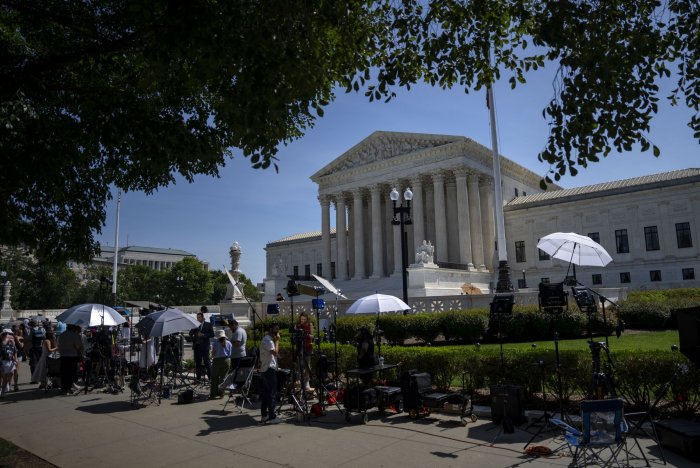
News anchors are seen outside the Supreme Court of the United States as the court releases their final opinions before summer recess on Tuesday. The court upheld birthright citizenship and also state laws banning transgender women and girls from playing on school athletic teams. Photo by Bonnie Cash/UPI | License Photo

Source link

New Jersey is set to charge companies with workers on Medicaid. Other states may follow

New Jersey is launching a new fee on companies whose workers have Medicaid health coverage instead of being covered by their employers. Other states are considering it, too.

Democratic lawmakers and governors see it as a way to help pay for the joint federal and state insurance program that covers low-income residents as federal policy changes are expected to make the program more expensive for states and may lead to a reduction in the number of people with coverage.

Proponents also say it’s about fairness because employers benefit from having some lower-income workers with taxpayer-funded health coverage.

Business groups object. So do some liberal policy organizations.

New Jersey is putting the fee in place

New Jersey Gov. Mikie Sherrill signed a measure Tuesday night to charge employers that have at least 50 workers covered by Medicaid, and the state budget she approved earlier in the week counts on raising $145 million this year from the program.

Under the plan, companies will be billed for each employee and employees’ dependent receiving Medicaid, the joint state-federal insurance program.

The fees per person would start at $325 a year for companies with 50 to 249 Medicaid beneficiaries and top out at $725 annually for employers with at least 500 recipients.

A bill passed this week in California doesn’t impose a charge now, but it does direct the state administration to present lawmakers options for doing so next year.

Finishing the job would fall to the successor of Gov. Gavin Newsom, a Democrat who is leaving office in January. Democratic gubernatorial candidate Xavier Becerra has made an employer charge part of his election platform.

State Sen. John Laird, a Democrat who sponsored the California proposal, said the big tax and policy law President Trump signed a year ago was a major factor in the need for action because it could prompt the state to spend more on Medicaid to plug holes left by federal changes.

The nonpartisan Congressional Budget Office expects more than 10 million people will be uninsured because of the law by 2034. It requires some beneficiaries to work, be in school or volunteer — and requires even more to document whether they meet the requirements.

Most employees at the bigger companies would not be at risk of losing Medicaid coverage as long as they’re working at least 20 hours a week.

Laird also said there’s an equity issue involved.

“If you’re a small business person in California, you are quite likely paying for health insurance for your employees. And through your taxes, you’re paying for health insurance for some of the biggest employers in California,” he said. “And that’s not fair.”

Legislation with similar intents passed one legislative chamber in both Colorado and Oregon this year, but neither made it to law. A measure was also introduced in Washington.

Connecticut Gov. Ned Lamont, a Democrat who is seeking a third term in November’s election, has called for the same move there with the idea of making it a part of the state budget that would kick in two years from now.

Opposition comes from business and some liberal groups

It’s no surprise that business organizations have criticized the approach, which would add to their expenses.

“The fact remains that many job-creators are still going to be penalized for something they have no control over,” Christopher Emigholz, the chief government affairs officer at the New Jersey Business and Industry Assn., said in a statement. “If an employee declines an employer-provided health plan because they’d rather be on Medicaid, it is unfair to penalize the employer for that employee’s decision.”

Some left-leaning policy organizations also oppose the charges.

Gideon Lukens, who analyzes health policy at the left-leaning Center on Budget and Policy Priorities, said that while the idea may be well-intentioned, it could lead companies to employ fewer people from low-income household or single parents. He said companies could also consider the policy in decisions about whom to hire or lay off — and also on where to locate or how many workers to employ.

And, he said, it could make employees — or potential employees — less likely to enroll in Medicaid knowing it would make them less attractive to employers.

“Usually, when I see a tax on something it’s going to discourage whatever being taxed,” he said in an interview.

New Jersey’s legislation tries to address some of the concerns. It would exempt temporary, seasonal and part-time employees. It would also bar employment decisions based on a workers’ Medicaid status.

Charging companies whose workers are covered by Medicaid isn’t a new idea. At least two states have previously enacted it, and it’s been proposed in Congress.

Massachusetts lawmakers in 2017 adopted a charge on employers up to $750 per nondisabled worker who was covered through Medicaid or a state-subsidized health exchange plan. The program began in 2018 was not renewed when it expired the next year.

An even earlier policy in Maryland, in 2006, immediately affected only Walmart. An industry group challenged it in court and won, stopping the fees.

The latest generation of proposals may avoid that legal pitfall by not referencing those health plans in the legislation.

Mulvihill writes for the Associated Press.

Source link

California designates Bruce Lee Day, in first for a Chinese American

Cut to a seedy alley behind a Chinese restaurant in Rome: A dozen mobsters menace a slight young man who suddenly pulls out a pair of nunchucks. He swings the traditional stick-and-chain weapons and makes quick work of his enemies, who fall one by one, groaning in pain.

The comedic, legendary action scene is from the 1972 film “The Way of the Dragon,” written, directed and starring Bruce Lee. The martial arts star was a trailblazer, allowing Asian Americans to see themselves represented in a strong, positive light on-screen.

And now he has secured a place in California history, becoming the first Chinese American in state history to have a day designated in his honor.

Lee was born in 1940 in San Francisco. His mother was of European descent and his father was a Cantonese opera star who was on tour in the city, affording his son birthright citizenship.

Lee grew up in Hong Kong, where he followed his father’s path as a performer, acting in more than a dozen films as a child and studying the close-quarters southern Chinese martial art Wing Chun.

On May 17, 1959, an 18-year-old Lee returned to San Francisco and eventually made his way to Hollywood. He went on to influence an industry that was at the time bereft of Asian American talent, and helped to popularize the genre of martial arts films and ignite Western interest in Hong Kong action cinema.

In recognition of his contributions, state Assemblymember Matt Haney (D-San Francisco) introduced a bill designating May 17 as “Bruce Lee Day” in California. The bill, signed into law Tuesday by Gov. Gavin Newsom, encourages schools and communities to honor Lee’s life and cultural impact.

Haney has described Lee as a “symbol of pride, resilience and possibility for generations who rarely saw themselves reflected with strength and dignity.”

Lee, who saw himself not only as an actor but also as a poet and philosopher, encountered repeated barriers. Up for the main role in the 1970s television series “Kung Fu,” for example, he was rejected in favor of white actor David Carradine.

In 2020, filmmaker Bao Nguyen sought to show how Lee dispelled anti-Asian sentiment and long-held stereotypes of emasculated Asian men in his ESPN documentary “Be Water.”

“The Asian male was the face of the enemy to many Americans,” Nguyen told The Times in 2020. “It was this vicious cycle of society reflecting media and culture, and media and culture reflecting society. There had to be some kind of intervention there and Bruce, in a way, was that intervention. He was the hero that we hadn’t seen before.”

Lee learned much about the systemic oppression that Black Americans faced from his first student, Jesse Glover, who had been a victim of police brutality.

And scholars have pointed out that, although his films had far-from-perfect politics, they touched on themes of fighting oppression. The 1971 movie “The Big Boss” showed Lee battling alongside laborers. “Fist of Fury” saw him opposing Japanese colonialism and discrimination.

Lee died young in 1973, at age 32 — before he was able to witness the full extent of his stardom. He died just one month before the release of “Enter the Dragon,” which was a box-office sensation and is considered a masterpiece of martial arts filmmaking.

Source link

Where to camp last minute near Los Angeles for Fourth of July weekend

Like many outdoors lovers, I love a last-minute camping trip.

There’s a special kind of magic when the stars align, you snag a reservation and realize you’ll soon be sleeping under the stars in a place you’ve never been.

But given the popularity of California’s campgrounds, is it really possible to book a campsite on short notice? In this edition of The Wild, our weekly outdoors newsletter, I will explain not only how you can but also where you will be more likely to find open spots (even, if lucky, on a holiday weekend).

You are reading The Wild newsletter

Sign up to get expert tips on the best of Southern California’s beaches, trails, parks, deserts, forests and mountains in your inbox every Thursday

L.A. sits within a quick drive to both the San Gabriel and Santa Monica mountains, two expansive ranges that offer multiple opportunities.

But first, I want to share what I learned in my conversation with Mike Lee, owner of Campsite Tonight, a website and app that monitors campgrounds throughout California for cancellations so its users can book sites.

Large boulders and rocks in a high desert like environment with mountain peaks in the distance.

One of the expansive views of the San Gabriel Mountains that can be found at Chilao Campground.

(Jaclyn Cosgrove / Los Angeles Times)

I’ve long been a skeptic of using private websites to book a campsite on public lands. But given Lee is an avid camper, dad and Californian running the site on his own, I wanted to hear him out.

Lee was motivated to take over Campsite Tonight a few years ago after finding himself frequently frustrated with how challenging it was to book campsites at state and national parks in California at times when his busy family could take a vacation.

Campsite Tonight frequently scans several websites throughout California and several other states (including Utah for those dreaming of a trip to Zion National Park). His site checks the popular campgrounds every 12 seconds for cancellations while less popular campgrounds are scanned often but less frequently.

He also offers data for popular campsites too, so users can learn more about when to look. For example, at Yosemite’s Upper Pines Campground, Lee includes that 11 a.m. Pacific is the peak hour when cancellations appear (and about 31% of reservations there are booked within seven days of arrival).

An orange tent among dense trees.

A tent in the evening light at Upper Pines Campground in Yosemite National Park.

(William Hale Irwin / For The Times)

Lee’s app offers limited-but-still-useful features to free users, including some ability to search for open sites, and is $29.99 a month or $59.99 a year for advanced features, including the option to more rapidly book a campsite at a national park by essentially linking your Campsite account with your Recreation.gov account.

Running the website has “taught me, as I’ve looked at the data more and more, that last-minute camping is actually pretty achievable,” Lee said while sitting inside a tent in a campground near Yosemite. “The biggest thing is being flexible. Before, if I didn’t book it in advance or if I didn’t get [a site when I wanted], I would never look again. Now I look more.”

Lee said he’s noticed fewer cancellations on long weekends, although there will still be families that can’t make their trips. After we initially spoke, Lee built a page specifically to scan for campsites available over Fourth of July weekend. I was surprised by just how much remained open.

Grass in the foreground with a coastline in the distance with short cliffs and a stretch of sandy beach.

Leo Carrillo State Beach.

(Mike Cilantro / For The Times)

Scanning the page on Tuesday, I noticed a spot at Leo Carrillo State Park. Although it was for Wednesday night, I was tempted. Multiple campsites remained open in Los Padres National Forest, even over the weekend. A random campground in Sequoia National Forest made me look at just how far of a drive it would be from my apartment. And I noticed there was even a spot free at a Big Sur campground on Sunday evening. “No, you can’t, er, you shouldn’t drive that far for one night of camping,” I told myself. (Should I, though?)

That said, there are several first-come, first-served campgrounds near L.A., especially in Angeles National Forest, for those who’d like to stay closer to home or can’t find something online.

Here is a quick guide to what I recommend trying to snag. Given it’s a holiday weekend, it will still be more challenging, but if you can leave early Friday, I don’t think it’ll be impossible to camp at one of these spots.

For those looking for simple car camping (beginner)

A circular campfire ring with wooden benches around it on sandy soil with tall pine trees nearby

A campsite at Chilao Campground with a large campfire ring.

(Jaclyn Cosgrove / Los Angeles Times)

Each of these campgrounds are in Angeles National Forest, offer piped water and vault toilets, and have sites with picnic tables, parking spots and campfire rings.

  • Chilao Campground: A large campground with 84 sites spread over two loops, Little Pines and Manzanita. Its landscape features large boulders, sweeping views and pine trees (especially the eponymous loop). Piped water is available, although it is at times turned off, so please check the campground website before heading out. The Chilao Visitor Center, open on the weekends, is nearby.
A campsite in Chilao Campground shaded by several pine trees.

A campsite in Chilao Campground shaded by several pine trees.

(Jaclyn Cosgrove / Los Angeles Times)

  • Crystal Lake: A 120-site campground north of Azusa. It sits at 5,539-feet elevation and features great views of nearby peaks, including Mt. Islip and Windy Gap. Visitors can fish in Crystal Lake when it’s deep enough and find a hot meal at Crystal Lake Cafe and General Store.
  • Monte Cristo: A campground with 19 individual drive-in sites, including some with large shady sycamore trees. A small seasonal creek runs through the middle of the campground and has small pools in spring and early summer. (Note: Because of its proximity to L.A., this one can fill up quickly.)

For adventurers willing to plan just a bit, even last minute (intermediate)

Oak trees offer shade in a grassy meadow.

Oak Flat Campground.

(Jaclyn Cosgrove / Los Angeles Times)

These sites offer their own escape, but because they lack potable water (unless otherwise noted) and are farther away from L.A., they require more planning than those on the “beginner” list. Each site has picnic tables and campfire rings. The campgrounds below are in Angeles National Forest unless otherwise noted.

  • Horse Flats: A shaded 26-site campground that offers easy access to nearby trails, including Mt. Hillyer and the Silver Moccasin Trail.
  • Oak Flat: A campground north of Castaic just off the 5 Freeway with 20 sites situated around a nice small meadow shaded by several oak trees.
  • Musch Trail Camp: This small-but-charming backpacking campground in Topanga State Park features flush toilets and sinks and requires only a one-mile hike in, a trek that’s on the easier end of moderate.
  • Sawmill: A rustic eight-site campground whose main challenge, outside of its lack of water, is just reaching it, as campers must take a steep gravel road off Pine Canyon Road (see website for information on road closure).

For experienced trekkers looking for quick escapes (expert)

Valley Forge Trail Camp in Angeles National Forest.

One of a handful of sites at the Valley Forge Trail Camp in Angeles National Forest.

(Jaclyn Cosgrove / Los Angeles Times)

These backpacking sites offer backcountry adventures for those with the time and the right gear.

  • Glenn Camp: A 10-site forested haven next to the West Fork of the San Gabriel River that’s reached via a seven-mile paved road that can be hiked or biked; no restrooms available, so campers will need to follow Leave No Trace principles.
  • Valley Forge: Reachable via 2.4-mile hike along the Gabrielino Trail from Red Box Picnic Area, this six(ish)-site campground has picnic tables, campfire rings, vault toilets and is a sylvan refuge of mighty pines next to the pristine West Fork of the San Gabriel River.
  • Cooper Canyon: A backcountry campground shaded by towering old pine trees with about five sites, offering vault toilets, campfire rings, klamath stoves, large picnic tables and bear-proof boxes. Because of the Angeles Crest Highway closure, you will need to reach the site either by walking the closed road or Pacific Crest Trail.

Regardless of where and when you go, I hope you have a wonderful time enjoying our public lands. Please remember to practice the Leave No Trace principles and, in short, leave it cleaner than you found it!

A wiggly line break

3 things to do

A person holds a hose spraying water onto several containers of little green plants.

A volunteer waters plants in the nursery at North East Trees in Ascot Hills Park in El Sereno.

(William Hallstrom)

1. Restore native plants in Ascot Hills
North East Trees, a climate resiliency nonprofit, needs volunteers from 9 a.m. to noon Saturday at its native plant nursery in Ascot Hills Park (4371 Multnomah St.). Participants will get hands-on experience working with native plants as they help water and restore habitat. Learn more at the group’s Instagram page.

2. Sketch plankton in Playa del Rey
Nature Nexus Institute, an environmental equity nonprofit, will host two beach ecology sketching events: an online option Tuesday from 6:30 to 8 p.m. and then an in-person event on July 12 in Playa del Rey. Learn more at the group’s Instagram page.

3. Check out the birds in Calabasas
Two National Park Service volunteers will host an easy bird walk from 8:30 to 10 a.m. Saturday at King Gillette Ranch in Calabasas. Participants will walk less than a mile at an easy pace, stopping often to observe the birds. Children are welcome. Register at eventbrite.com.

A wiggly line break

The must-read

A person walks along a rope bridge high in the air among thick old trees.

A visitor walks on the Redwood Canopy Trail at Trees of Mystery in Klamath.

(Andrew Cullen / For The Times)

If you’re sitting there, daydreaming over your next adventure, consider this California wildlife factoid: Our state is home to 139,000 acres of protected public lands where nearly half of the world’s remaining old-growth redwood forests live. The allure of walking beneath these giants is what drew writer Edwin Goei to head to Humboldt County. Goei maps out a guide for The Times of how an Angeleno can make the long-but-worthy trip there (including how to snag an $80 round-trip flight). “I learned that Humboldt County — including the cities of Eureka, Arcata and Ferndale — is full of treasures beyond its abundance of the Earth’s tallest trees,” Goei wrote.

Excuse me while I go research flights there.

Happy adventuring,

Jaclyn Cosgrove's signature

P.S.

You have until Monday to snag a free California State Parks Historian Passport. In honor of both Juneteenth and the 250th anniversary of the signing of the Declaration of Independence, the state is offering the pass — which typically costs $50 — to anyone who registers for it through ReserveCalifornia.com, but just for a few more days. The pass will be good through the rest of 2026 and will allow unlimited entry for up to four people to state historic parks and museums that charge a per-person admission fee or a vehicle day-use fee. I was amazed that it took less than 10 seconds once I was logged into my ReserveCalifornia account to secure my pass. Enjoy!

For more insider tips on Southern California’s beaches, trails and parks, check out past editions of The Wild. And to view this newsletter in your browser, click here.


Source link

Why it took so long for feds to allow masks for crews fighting fires

Last week, the U.S. Forest Service and Department of the Interior expanded the situations in which their firefighters are allowed to wear N95 masks.

Starting in September, the federal government began allowing firefighters to wear the masks, but not when they were working on the fire line, only at times such as in camp and sitting in vehicles. Now they’ll be allowed to wear them during some work battling wildfires, including patrolling for areas where the blaze has jumped past fire lines and putting out smoldering remains after a fire is contained.

Masks are still prohibited during firefighters’ most grueling tasks — digging lines to stop fires and directly attacking flames. And the masks they’re using, N95s, do not protect against all of the toxic substances in wildfire smoke.

Nonetheless, health experts applauded the move as a step in the right direction.

Here’s why it took so long to get here:

You’re reading Boiling Point

The L.A. Times climate team gets you up to speed on climate change, energy and the environment. Sign up to get it in your inbox every week.

Research has linked wildfire smoke to a range of long-term health issues, including respiratory problems, cardiovascular diseases and cancers.

“The fire service knows that,” said Rachael Jones, professor and chair of environmental health sciences at UCLA’s Fielding School of Public Health. “They all have stories” of lung damage or cancer, either their own or their coworkers’.

But this wasn’t always common knowledge.

“The verbiage was that wildland smoke was benign,” one firefighter told Jones’ colleagues for a recent study on firefighters’ thoughts on mask use. “It was like sitting around a campfire.”

Even as scientists and fire officials came to terms with the very real long-term health risks, some firefighters still had concerns that masks could muffle communication, make it hard to breathe and interfere with other equipment. That slowed adoption.

Missing crucial orders because a voice is muffled, or struggling to pull out an emergency fire shelter because a mask is in the way, could be the difference between life and death.

“These are not trivial things when the fact is that they reflect life safety outcome,” Jones said.

Deciding on the right type of mask or respirator has slowed adoption too. There are no commercially available respirators that protect against all of the dangerous pollutants in wildfire smoke.

Scientists have not even fully determined which pollutants pose the greatest risks to firefighters, further complicating a choice.

N95s filter for solid particles in the air but not dangerous gases. Heavy smoke or sweat can cause them to clog.

Half-face respirators — often gray rubber with pink canisters — offer different filters for different gases, but none can filter all of the concerning gases in wildfire smoke. The masks and backup canisters are also much bulkier to carry around than N95s.

Respirators that can filter out all of the “literally hundreds” of concerning compounds in smoke “just simply don’t exist,” said Matt Rahn, research director for the Wildfire Conservancy, a nonprofit dedicated to protecting firefighters.

The result: “In our pursuit for perfection in finding the best respiratory devices for firefighters, we’ve basically fallen into a decision paralysis of doing nothing,” Rahn said. “It’s been that way for years.”

The federal government acknowledges the limitations of N95s in its educational material for firefighters. In a statement to The Times, the Forest Service said it will begin studying different respirators in a small pilot program to “determine if their use will be suitable for the wildland fire environment.”

The Forest Service said that N95s are already “readily available” to its firefighters and that it has more than 30,000 of them.

More recent wildfire news

Many in the western United States will have to celebrate the country’s 250th birthday with fewer fireworks due to heightened wildfire risk. Utah’s governor restricted fireworks statewide through July 5 as multiple wildfires raged in the state and the National Weather Service issued a rare “Particularly Dangerous Situation” warning, Kathy McCormack reports for the Associated Press. California officials, meanwhile, warned of zero tolerance for illegal fireworks, with some local governments recently increasing fines, Kassia Bonesteel reports for CBS News.

Three federal wildland firefighters were killed and two were injured by the fast-moving Knowles fire in Colorado on Saturday. As a ground crew began some of the first attacks on the fire, an order came over the radio to “get out of there now,” CNN reported. Within minutes, the crew was forced to deploy their emergency shelters, a desperate last line of defense when escape is impossible. Firefighters lined the streets of Grand Junction, Colo., on Sunday in a procession for their fallen colleagues.

Much of the western U.S. is facing above normal fire potential after one of the hottest and driest winters in recent years. Coastal Southern California, conversely, is facing average wildfire potential, fire weather analysts say, thanks to monsoon breezes bringing damp air from the tropics.

A few last things in climate news

A pair of hazardous chemical crises in Greater Los Angeles — at an aerospace facility in Garden Grove and a warehouse in Boyle Heights — have left Californians questioning why environmental and public health agencies such as the South Coast Air Quality Management District and the state’s Division of Occupational Safety and Health failed to address known risks, a team from CalMatters and the LA Local reports.

The Boyle Heights warehouse fire coincided with a spike in emergency room visits for smoke inhalation and throat pain, my colleague Hayley Smith found. Meanwhile, the water used to fight the toxic blaze ended up in the Los Angeles River, The Times’ Mack Baysinger reports. Local organizers collected water samples for testing as L.A. County public works deployed floating barriers to contain the runoff.

The headwaters of the Colorado River, a vital source of water for 35 million people and 5 million acres of farmland, is drier than anyone can remember, my colleague Ian James reports. As seven U.S. states and Mexico remain gridlocked in complex debates over use of the river, it’s a stark reminder that the climate of the 21st century will leave less for everyone.

Europe is facing its second major heat wave of the year, with France recording its hottest day ever, Lauren Dalban reports for Inside Climate News. As residents struggled to handle the extreme heat, worsened by climate change, so did climate infrastructure championed to combat it. Trains were halted as the heat risked buckling tracks and nuclear reactors were slowed or powered off as the cooling water they discharged became too hot, the New York Times’ Chico Harlan reported.

This is the latest edition of Boiling Point, a newsletter about climate change and the environment in the American West. Sign up here to get it in your inbox. And listen to our Boiling Point podcast here.

For more wildfire news, follow @nohaggerty on X and @nohaggerty.bsky.social on Bluesky.

Source link

California puts more money toward speeding its election count

Chances are, right about now, you’re considering how you’d like to spend this upcoming Fourth of July weekend. At the beach, maybe, at a barbecue or whatever place sets fireworks pinwheeling through your holiday-happy mind.

Which makes it a perfectly excellent time to talk about elections and vote counting.

Every two years, in the spring and fall, California holds an election. Every two years the state faces an outraged chorus, voices raised nationwide, decrying the length of time it takes to tally the millions of ballots cast and, in a handful of races, determine the winner.

  • Share via

Then, just as suddenly, the din fades away, the focus shifts and the election process is forgotten until the next round of howling protest.

Just that word, process, can throttle and snuff the life out of the subject.

You’re reading the L.A. Times Politics newsletter

George Skelton and other analysts cover the insights, legislation, players and politics you need to know. In your inbox Monday and Thursday mornings.

So it’s good news that lawmakers in Sacramento have used this inattentive time to address the biennial hullabaloo and perhaps shut some people up.

The budget that Gov. Gavin Newsom signed into law Monday includes an additional $40 million aimed at speeding up California’s vote count, and even if the sum is less than half the $90 million sought by reform-minded advocates, it’s something.

Most of the money will go toward staffing, technology and equipment upgrades. Another $10 million will pay for voter education and outreach. A further $750,000 will be used to combat election misinformation. (A $3.50 roll of duct tape would be a far more economical way to address the latter were it applied to the inciteful mouth of America’s election-denier-in-chief. More about him in a moment.)

“While the amount budgeted is less than we had recommended, it still represents a sizable investment that prioritizes timely election results,” said Kim Alexander, head of the nonpartisan California Voter Foundation, which has been at the forefront of election reform efforts in the state.

A surprise Supreme Court decision

As it happens, the budgetary infusion came the same day the U.S. Supreme Court upheld the right of states to count mail ballots that are postmarked by election day, even if they arrive days afterward. In California, where most voters mail their ballots, that lag time can be up to a week.

It was a surprise decision from this most Trump-obeisant court, a setback for the petulant president and a ruling that will have very little effect on California’s prolonged vote counting.

That’s because those late-arriving ballots have very little to do with the time it takes to complete the count. My colleague Kevin Rector reported that in 2024 California tallied more than 406,000 late-arriving mail ballots — which represents only about 2.5% of the more than 16 million ballots cast. The long count is a result of the huge number of ballots placed in drop boxes or arriving at processing facilities on or just before election day — and, really, is it such a bad thing for voters to watch for late developments before letting go of their ballot?

(Does the name Eric Swalwell ring any bells?)

Lawmakers in California made a purposeful decision that voting should be convenient and not a chore, as a way to to encourage the greatest turnout possible. That’s a good thing if you believe in our system of representative democracy. The voice of the people, and all that.

There wasn’t much hue or cry — especially about mail balloting, which has exploded in popularity and introduces all sorts of time-consuming steps, such as signature verification — until Trump cried fraud and made other specious claims. That’s what happens when you have a sore, whiny loser astride the bully pulpit; Trump is perfectly willing to torch people of good faith and burn working systems to the ground if it salves his eggshell ego.

An election, not a soccer match

Many political commentators are complicit in Trump’s arson.

Awaiting California’s election results, they act like pouty birthday children forced to leave their presents unopened until all the kids have had their cake. They speak of voters losing faith in the election process without explaining the commendable reason for the delay — seeking maximum voter participation — or acknowledging how their impatience contributes to the sense that something wrong is afoot.

At bottom, the push for instant results, and instant gratification, is much more about sating the curiosity of pundits and political junkies than some widespread agita among voters glued to the ballot-counting as if it were a World Cup match.

Is there a soul out there who feels there’s insufficient time between June 8, when the Associated Press called the Los Angeles mayoral race, and June 9, when the call came in the gubernatorial contest, for candidates to present their cases and voters — who haven’t already decided — to make up their minds?

Hang out with family and friends. Enjoy some barbecue. Watch fireworks paint the night sky. There’s plenty of time for speechifying, TV ads and campaign mailers to blitz the state between now and the election on Nov. 3.

Frankly, most Californians welcome the break.

What else you should be reading

The must-read: What you should know about the $351.7 billion state budget Newsom just signed
The deep dive: Costs of Iran war will linger despite conflict’s end, experts say
The L.A. Times Special: This California bill is so bad it has me agreeing with a Trump Republican

Until next time,
mzb

Was this newsletter forwarded to you? Sign up here to get it in your inbox.

Source link

Ban on sex offenders running for office fails at California senate

California Democratic senators failed to advance a proposal Tuesday that would have barred registered sex offenders from running for office.

State Sen. Scott Wiener (D-San Francisco) voted against Assembly Bill 2753, while fellow Sens. Tom Umberg (D-Santa Ana) and Ben Allen (D-Santa Monica) abstained from a vote that ultimately failed 2-1-2 in the Senate Elections and Constitutional Committee.

The committee’s lone Republican, Steve Choi (R-Irvine), and Sen. Sabrina Cervantes (D-Riverside) voted in favor of the bill, which is likely dead because it failed to get support from a majority of the five-member panel.

AB 2753 could be reviewed in a floor session Thursday, but staff from the office of Assemblywoman Esmeralda Soria (D-Fresno), who authored the bill, are conceding that’s unlikely.

The defeat comes on the heels of unanimous support, including a 60-0 vote in favor on the Assembly Floor on May 7.

“I am deeply disappointed and disheartened after the Senate Elections Committee has failed to advance AB 2753, a bill that would have prohibited any registered sex offender in the State of California from running for local or state public office,” Soria said in a statement.

The bill’s wording said the legislation would “prohibit a person from being a candidate for, or elected to, any state or local elective office if the person has ever been required to register as a sex offender.”

Inquiries to the offices of Sens. Wiener, Umberg and Allen were not immediately returned.

Sex offenses in California are broken up into three tiers. First-tier offenses call for a minimum of 10 years placement on the sex offender registry. Second-tier offenses call for a minimum of 20 years and third tier crimes could result in a lifetime on the registry.

The types of offenses for each tier vary. Tier 1 offenses range from indecent exposure to misdemeanor child pornography and sexual battery. Tier 2 includes incest and penetration with a foreign object, and Tier 3 includes felony possession of child pornography, rape and pimping and pandering of a minor.

Wiener asked for amendments to the bill during the bill’s review and in the committee meeting, including that the lifetime ban only be applied to Tier 3 members.

He pointed to committee analysis of the bill that could affect so-called “Romeo and Juliet” couples — those close in age, for instance with one partner being 19 and the other being 17. If the younger partner sent sexually explicit digital content to the older partner (a misdemeanor), this law could ban the older partner from public office for life.

There were also concerns listed in the analysis that the registry, which dates back to 1947, could include LGBTQ+ offenders from decades ago who were convicted of offenses that are no longer crimes.

Wiener mentioned in the committee meeting civil rights strategist and fighter Bayard Rustin being placed on the California sex offender’s registry list after being arrested by Pasadena Police for having consensual sex with another man in 1953.

“Without the amendment contained in the analysis, I will be voting ‘no’ on this bill and recommending that the committee vote ‘no,’” Wiener said at the committee hearing.

He added that the sex offender list was “not punishment,” but instead “a tool for law enforcement to monitor who may potentially cause a risk.”

While Soria agreed to one bill amendment, she did not accept other provisions, including the elimination of lifetime bans on Tier 1 or 2 offenses.

“The bottom line is this: I was not willing to make additional amendments to this bill,” she said. “I made a promise to my community that I would do everything in my power to ensure they would never have to go through something like this again. Accepting additional amendments to this bill would have jeopardized that promise.”

Some of the impetus behind her bill revolved around the June 2 Fresno City Council election. Registered sex offender Rene Campos fell short of the necessary votes in his bid to run for Central Valley Council.

He was charged with possession of child pornography in 2018 and hosted his campaign kickoff in front of an elementary school.

Nelson Esparza, Fresno City Council President, spoke at the Senate Elections and Constitutional Committee meeting in favor of AB 2753.

“My office received dozens of calls from our residents asking how this could be allowed,” Esparza said of Campos’ candidacy. “AB 2753 closes this loophole.”

It’s unclear if this bill will be reintroduced next year at least at the Assembly level, as Soria is running for the state senate in November.

Source link

Trump administration sues California over ‘Glock ban’ law

California’s effort to restrict sales of handguns that can be converted into fully-automatic machine guns drew an immediate federal challenge Wednesday, with the Trump administration suing the state over its new “Glock ban” law just hours after it took effect.

The U.S. Department of Justice is seeking a court order to block the controversial state law that limits where most Glock and Glock-style pistols can be sold. The lawsuit, filed in U.S. District Court for the Central District of California, also aims to invalidate key parts of the state’s handgun roster — a list that dictates the types of firearms that Californians may legally purchase. In a statement Wednesday, acting Atty. Gen. Todd Blanche said that both policies “trample” the rights of law-abiding Californians.

“The Second Amendment is a sacred right belonging to all Americans, even those in California,” Blanche said. “California cannot ban the most popular type of handgun in America.”

California’s Assembly Bill 1127 does not explicitly name the Glock brand, but instead targets any handgun with a specific mechanism that can easily be converted by a black market device. These simple “Glock switches” convert semiautomatic handguns into a weapon capable of firing 20 rounds per second with a single squeeze of the trigger.

Advances in 3D printing have made the conversion devices widely available and cheap to produce. Federal authorities reported recovering 11,088 of them from crime scenes between 2019 and 2023. Switches have been used in several mass shootings, including one in Sacramento that resulted in six deaths and 12 injuries in 2022.

The new law does not prohibit the possession of affected handguns already owned by Californians, and includes exemptions for gun dealers, as well as law enforcement and military agencies.

Gov. Gavin Newsom signed the bill in October, and has maintained that firearm laws are responsible for California’s declining crime rates and gun deaths.

“The Trump administration is once again trying to dismantle California’s commonsense gun safety laws,” Diana Crofts-Pelayo, a spokesperson for the governor, said in a statement. “Our response is simple — these laws save lives.”

The federal government argues in its complaint that California can’t ban legal semiautomatic handguns simply because they could be illegally altered, adding that state and federal law already prohibit such pistol converters. The U.S. compared California’s approach to banning ordinary shotguns because they can be illegally shortened.

The lawsuit also challenges California’s decades-old handgun roster, which requires new handgun models to pass certain safety tests before they can be approved for retail sale. A federal judge tentatively blocked portions of the roster requirements in a separate 2023 case, which is being appealed before the 9th Circuit. That lawsuit was filed by the California Rifle & Pistol Assn. and other gun rights supporters following a landmark 2022 decision by the U.S. Supreme Court that set new standards for evaluating firearm restrictions.

Under those new guidelines, the Trump administration wants a judge to find that California’s gun restrictions violate the 2nd Amendment, and is seeking an order to bar the state from enforcing them.

The Trump administration is relying on a federal civil rights law typically used against police departments accused of repeated constitutional violations, arguing that California Atty. Gen. Rob Bonta and state Justice Department agents qualify as peace officers and therefore violate gun owners’ rights whenever they enforce handgun restrictions.

Bonta, who is named in the suit, has a winning court record over the Trump administration, and has secured at least 12 final court rulings and more than 35 preliminary injunctions or emergency orders.

“We won’t be intimidated by another politically motivated lawsuit,” said Crofts-Pelayo, Newsom’s spokesperson. “We’ll continue defending the laws that protect Californians and keep dangerous weapons off our streets.”

Source link

California immigrant detainees boycott over high commissary prices

Immigrants detained at two federal facilities in California have launched a boycott in protest of increasing and, in their view, burdensome prices at the facilities’ commissaries for items including tampons, coffee and soup.

The Times reviewed a grievance letter and spoke with three detainees who are involved in the boycott at the California City Detention Facility, about 80 miles east of Bakersfield, and at the Golden State Annex in McFarland.

More than 300 detainees are estimated to have signed grievance letters sent recently to facility administrators, according to advocates with the California Collaborative for Immigrant Justice.

Both facilities are operated by private prison corporations — the California City facility by Tennessee-based CoreCivic and the Golden State Annex by Florida-based GEO Group.

The Times has reached out to the Department of Homeland Security, GEO Group and CoreCivic for comment.

Detainees are provided certain essentials, such as food and soap, free of charge, but many also purchase items at commissary stores that are of better quality or otherwise unavailable. Detainees said shampoo and other hygiene items sometimes run out for days and that meals are small or exacerbate diabetes and other health issues.

“The three daily meals that CoreCivic provides at California City Detention Facility are the bare minimum to keep a person alive,” they wrote. “Because of this, charging inflated prices on necessities is considered price gouging and profiteering against vulnerable incarcerated population who have no ability to refuse or shop elsewhere.”

The detainees said an 8 oz. jar of Folgers instant coffee costs $18 at the California City facility, a single instant ramen soup is 75 cents and a box of 40 tampons costs nearly $21.

At Walmart, the same Folgers coffee costs $8.97, Maruchan chicken ramen soup is 50 cents and 40 Tampax tampons are $12.19.

U.S. Immigration and Customs Enforcement detains immigrants for civil purposes. Detention is meant to facilitate removal proceedings but is not meant to be punitive.

Detainees are paid $1 per day under a voluntary work program for cleaning or cooking. Many detainees rely on money from family and friends.

In their grievance letter, the detainees called the markups an unacceptable business practice with no apparent limit. They said they view the situation as an example of captive market exploitation and economic coercion.

The detainees requested a review of commissary pricing by facility leaders, a comparison of prices with prison industry standards, an immediate reduction in prices of essential items and the implementation of reasonable price caps. They also requested an increase in the portions of daily meals, including for meals meeting religious requirements, which they said are particularly small.

In May, the California State Senate passed a bill that would prohibit the excessive markup of products sold at private detention centers, limiting prices to 35% above the vendor cost. Existing California law already limits such markups in state prisons. The bill is now in the Assembly.

Priya Patel, an attorney at the California Collaborative for Immigrant Justice, represents people who have been detained at both facilities. She said that during legal service consultations, commissary pricing frequently comes up.

“The higher the prices get, the higher of an impact the conditions have on people and the more difficult it becomes to fight their cases,” Patel said.

The collaborative is one of the organizations that brought a lawsuit last year alleging inadequate medical care, as well as insufficient clothing, food, water and outdoor recreation time at the California City facility, which can hold more than 2,500 people. The lawsuit remains ongoing; in March, a U.S. district judge in San Francisco appointed an external monitor to ensure the facility provides “constitutionally adequate health care.”

The lawsuit describes multiple commissary-related issues. For example, it says the facility doesn’t provide headphones for tablets, making private phone calls — including privileged calls with attorneys — impossible unless the detainee can afford to purchase headphones from the commissary.

“One detained person has difficulty walking and standing for extended periods of time without shoes that provide arch support,” the complaint says. “He arrived at California City with appropriate shoes to accommodate his mobility disability, which were approved as an accommodation at a prior ICE facility. California City staff confiscated those shoes and instead provided him with plastic, orange sandals.”

“Several weeks after staff confiscated his shoes, he had an appointment with a doctor at California City,” it continues. “The doctor told the him … to buy different shoes from commissary to accommodate his foot condition.”

A contract between CoreCivic and ICE for the California City facility, dated April 1, 2025, says the contractor must provide notice of any price increases and that “any revenues earned in excess of what is required for commissary operations shall be used solely to benefit aliens at the facility.”

Alfredo Parada Calderon, 52, has been detained at the California City facility since September. He said commissary prices were already high before they increased around mid-June.

Parada Calderon said he asked an ICE officer why the prices had increased so much. The officer said he wasn’t aware of the change but that the vendor is Keefe Group, which supplies commissaries at prisons and immigrant detention centers across the country.

Detainees in his dormitory submitted a grievance about commissary prices, Parada Calderon said. The answer was vague.

“They’re blaming it on inflation,” he said.

Parada Calderon said his family sends him about $100 per month to spend on commissary items, which he spends on packets of crackers, coffee, soups, soap, shampoo, deodorant and chips.

“Enough is enough,” he said. “It’s a horrible enough place to be in and you guys are making it even more horrible, not just for me but for my family. The detainees want to be heard and this is the only option we actually have — a peaceful protest.”

Tommaso Bardelli, a researcher at New York University who studies mass incarceration, said the families of most people in prison are working class and may sacrifice their electricity bill or credit card payment to send money to their incarcerated relatives. The money they send no longer pays for small luxuries, he said, because prisons have over the years reduced how much they spend per person on necessities such as food.

Bardelli published a research article in 2022 about inequality within prison commissary stores. Commissary is often now the difference between starving and a semi-normal diet, he said.

Source link

Newsom signs off on 100% California tax for money from Trump’s $1.8-billion ‘slush fund’

Gov. Gavin Newsom has signed off on a 100% state tax on money any Californians receive from Trump’s $1.8-billion “anti-weaponization” fund for his political allies.

Newsom unveiled his proposal in May, after Trump’s Justice Department said it would create a fund to compensate Trump’s allies who claim they have “suffered weaponization and lawfare” under Biden’s Justice Department.

The settlement fund was criticized by politicians on both sides of the aisle, including Sen. Mitch McConnell (R-Ky.), who described it as a “slush fund to pay people who assault cops.”

The fund remains in legal limbo. Earlier this month, a federal judge in Virginia extended a court-ordered block on the plan, which critics warned could be used to pay pardoned Jan. 6 rioters.

Fast-tracked into law as part of Senate Bill 122, Newsom’s plan imposes “a tax on any settlement fund payment from the federal Anti-Weaponization Fund, or any subsequent fund, settlement, or agreement, as provided, at a rate of 100%,” according to the bill text. The tax applies to all tax years between 2026 and 2030.

Newsom signed the bill Tuesday. In a statement, his office said the tax is meant to ensure that, should Trump’s fund proceed, California recipients won’t “receive favorable state treatment on those payments.”

“We believe democracy is worth defending, the rule of law matters, and public dollars should support victims—not those who attacked the very institutions that protect our freedoms,” Newsom said in the statement.

University of Southern California law professor Ariel Jurow Kleiman, an expert on tax law and policy, said that while Newsom’s tax is a “novel legal strategy,” she believes there is “no categorical legal restriction” preventing California from implementing it.

States have a “wide degree of discretion” to design their tax systems — including how they define income — so long as they do not violate their constitutions, Jurow Kleiman said.

If a California resident wanted to challenge the tax in court, they would need to show they were harmed by it to have standing to sue, according to Jurow Kleiman. That would mean receiving a payment from Trump’s settlement fund and then paying the 100% California tax. Unless the settlement fund is established and distributes payments, that scenario is unlikely.

While there have been proposals to levy a 100% tax on income above certain thresholds — Sen. Bernie Sanders (I-Vt.) in 2023 said he supports a 100% tax on income exceeding $1 billion — Jurow Kleiman said she is not aware of any governments that have adopted such a policy.

Source link

Supreme Court will decide a gun-rights challenge to blue-state bans on assault weapons

The Supreme Court announced Tuesday that it will hear a 2nd Amendment challenge to the gun laws in Connecticut and Cook County, Ill., that ban most semiautomatic assault weapons.

Before leaving for the summer recess, the justices issued orders on new cases that will be heard in the fall. The new 2nd Amendment case figures to be a major test of what kinds of firearms and ammunition are off-limits to state or federal regulation.

The outcome will affect California and all the states led by Democrats that strictly regulate or prohibit semiautomatic rifles, such as the AR-15.

Gun-rights advocates say these are among the most common and popular weapons in the country, and they should not banned in some states.

In response, Connecticut state attorneys said only about 2% of Americans own assault weapons, and they rarely use them for self-defense.

Since 1989, California has prohibited the sale and possession of most semiautomatic rifles and pistols that can fire more than 10 shots before reloading. Nine other states led by Democrats have similar laws.

State lawmakers said these rapid-fire guns are not needed for self-defense but can be a weapon of mass murder. All of the blue-state bans could be struck down next year if the court’s conservatives rule in favor of the 2nd Amendment claim.

Gun-rights advocates say firearms in “common use” by law-abiding owners cannot be prohibited by the government.

Four of the court’s conservatives have said in past dissents they believe the state bans on assault weapons run afoul of the 2nd Amendment. They are Justices Clarence Thomas, Samuel A. Alito, Neil M. Gorsuch and Brett M. Kavanaugh.

That suggests the fate of those state laws depends on Chief Justice John G. Roberts and Justice Amy Coney Barrett.

Joining in support of the gun-rights challenge were the state attorneys for Montana, Idaho and 25 other Republican-led states.

They urged the court to prevent liberal judges and states led by Democrats from “rewriting the 2nd Amendment … to allow hostile jurisdictions to continue infringing on their citizens’ core constitutional right to keep and bear arms.”

In 2016, California’s voters approved a ballot measure that makes possession of large-capacity magazines illegal. At least 10 states have similar laws, but they apply only to the manufacture and sale of large-capacity magazines.

Gun-rights advocates sued in San Diego, leading to nearly a decade of back-and-forth litigation. A federal judge struck down these restrictions under the 2nd Amendment, but the state appealed. They were eventually upheld by the 9th Circuit Court in an en banc ruling.

Meanwhile, the 7th Circuit Court in Chicago has upheld an Illinois law and the Cook County ordinance prohibiting semiautomatic rifles and pistols. Its opinion said rapid-fire guns do not differ significantly “from machine guns and military-grade weaponry,” which can be banned under the 2nd Amendment.

Before Tuesday, the justices had repeatedly refused to weigh in on whether the 2nd Amendment’s right to “keep and bear arms” includes the right to semiautomatic “assault weapons” and large-capacity magazines.

Since 2015, the court has turned down gun-rights appeals from blue states like Illinois and Maryland over their bans on “assault weapons,” despite dissents from Justices Thomas, Alito and Gorsuch.

As an appeals court judge in Washington, D.C., Kavanaugh voted to strike down the city’s ban on assault weapons.

Three years after John Roberts became chief justice, the court ruled for the first time in 2008 that the 2nd Amendment protected individual gun rights, not just state militias. But the 5-4 decision simply struck down a city’s ban on having a hand gun at home for self-defense.

Justice Antonin Scalia’s opinion in District of Columbia vs. Heller said the Constitution gives law-abiding persons a right to have weapons in “common use” for self-defense, but not “dangerous and unusual weapons.”

Ever since, advocates for gun rights and gun control have been arguing over whether semiautomatic guns with large-capacity magazines can be regulated because they are uniquely dangerous or are protected because they are very common.

In the past two years, the Supreme Court has a mixed record on gun regulation.

Last year, the justices in a 6-3 decision struck down a federal regulation that banned “bump stocks,” which allow rapid-fire shooting with a semiautomatic rifle.

That regulation was adopted in the first Trump administration in response to the mass shooting at an outdoor concert in Las Vegas where a lone gunman fired as many as 1,000 shots from a hotel window.

The conservative majority ruled the bump stock devices did not fit the definition of a prohibited machine gun.

Earlier this year, however, the court in a 7-2 decision upheld a regulation prohibiting unregistered “ghost guns” that were made by parts kits.

Source link

What you should know about the $351.7 billion state budget Newsom just signed

Gov. Gavin Newsom on Monday signed his final state budget as governor, a $351.7-billion spending plan that seeks to uplift the poorest Californians through a tax system reliant on the stock market gains of the wealthy.

In a video message, Newsom extolled free school meals, universal transitional kindergarten, 130,000 subsidized childcare slots and other accomplishments in his tenure at the state Capitol, a period in state history marked by a dramatic expansion of state government and over $100 billion in increased spending.

“Over the past eight years, we built great things for the people of California — some of the boldest actions any government in this country has taken in a generation,” Newsom said. “And we did this without breaking the bank. We did this by design.”

The agreement ends weeks of lobbying by outside interests and negotiations among lawmakers and the governor at the state Capitol about how to handle a surge of income tax collected on stock market gains related to artificial intelligence.

Economists have warned that the revenue bump is potentially temporary and analysts say the growth in state spending could leave California in a challenging position if the economy declines.

Assemblymember David Tangipa (R-Fresno) agreed with Democrats that the budget is “compassionate.”

“My fear is that it’s not too much of a competent budget, and the budget continues a pattern that Californians know all too well: Spend now, justify it later, and hope somebody else pays the bill,” he said during a floor debate Monday.

Here’s what you need to know about the spending plan, which takes effect July 1.

Who decides the state budget?

The simplest answer is: Democrats. California voters have elected Democrats to represent 30 of the 40 seats in the Senate and 60 seats of the 80 seats in the Assembly. The budget was passed through a majority vote in each house of the Legislature and signed by Gov. Gavin Newsom, also a Democrat.

A more complex answer is that the budget is a product of dozens of legislative hearings, millions of dollars spent on lobbying by outside interests, talks among lawmakers and the governor and ultimately subject to the same political dynamics that rule the Democratic party.

Senate President Pro Tem Monique Limón (D-Goleta) and Assembly Speaker Robert Rivas (D-Hollister), in consultation with the chairs of the budget committees, represent their Democratic caucuses and reach a final agreement on the details of the spending plan with Newsom. In reality, staff members for the three parties handle most, if not all, of the back of forth negotiations to get there.

Union leaders seeking better pay, working conditions, benefits for workers and opportunities to expand their ranks are often brought in to consult or hammer out thorny deals as business groups try to fight off more regulations, taxes and costs, and support policies that increase their financial performance.

Democrats are spending more than ever before. How is that possible?

The Legislative Analyst’s Office, the nonpartisan fiscal advisor for lawmakers, recently examined the increase in state spending since 2019-20, Newsom’s first full year in office.

Between the budget approved that year and the spending proposal Newsom unveiled in January, spending from the state’s main operating fund had grown by over $100 billion, or 70%. That was largely by a 60% increase in revenue during that time. California typically operates with a spending deficit because Democrats spend more money than the state brings in.

The LAO found that the increase in spending stemmed from the growing cost of sustaining programs and services that were already in place when Newsom took office. About 30% of the remaining spending growth was categorized as new, either by newly created programs or the expansion of existing services.

Among the report’s conclusions: California could not afford the programs that predated Newsom and the ones he and the Legislature adopted.

To balance the budget over the last few years, Newsom and lawmakers have dipped into the state’s reserves at a time when California is experiencing strong revenue growth, which the LAO has cautioned against. Democrats have also increased taxes on businesses, paid for programs out of other funds and suspended reserve deposits among other solutions.

This year, the state budget places $6.4 billion in higher than expected revenue into a temporary holding account to knock down a deficit and balance the budget through 2027-28.

Democrats are pursuing a change to the state constitution on the November ballot that would allow them to set aside more money in years of good revenue growth to prevent cuts in future downturns.

Where is the money going?

Education and Medi-Cal are the two largest costs for the state.

Medi-Cal is the state’s version of subsidized health insurance for low-income Californians and provides medical, dental and vision care for an estimated 14.5 million people, or about one-third of the state population.

The federal government pays for more than half of the cost of the program. California is expected to spend about $50 billion from the general fund next year out of a total estimated at more than $220 billion in costs shared between the state and federal government, according to the LAO. State taxes and fees on providers also help fund Medi-Cal.

Overall, Medi-Cal costs more than any other state program and takes up about 40% of total spending, including federal funds the state receives, according to the LAO.

Spending on Medi-Cal has more than doubled over the last 10 years, which the LAO attributes to an increase in costs per enrollee, more enrollees and a greater share of seniors seeking care, among other factors.

Under Newsom, California has expanded Medi-Cal, including offering coverage to include all immigrants regardless of their immigration status, which the governor said has dropped the state’s uninsured rate down to 5.9%

The cost of Medi-Cal has grown beyond what Democrats expected and resulted in Newsom suggesting spending cuts.

The final budget agreement rejects a call by Newsom to lower the asset limit to $2,000 now and instead lowers it to $21,000 in 2027-28 to be eligible for Medi-Cal. The Legislature also delayed the governor’s proposal to reduce dental coverage and shift asylum seekers and other immigrants to restricted scope Medi-Cal, according to Jason Sisney, the lead budget advisor for the Assembly who posts about the budget on Substack.

The budget includes Newsom’s proposal to shift enrollees with unsatisfactory immigration status, a term that includes undocumented immigrants and others, from managed care to fee-for-service to save costs.

Under Proposition 98, approved by voters in 1988, California has a minimum funding guarantee for schools and community colleges and dedicates roughly 40% of general fund revenue to education.

Sisney said the budget increases the Local Control Funding Formula by $2.2 billion and provides historic general fund per pupil spending of $21,148. Support for special education also grew by $1.8 billion.

The California Community Schools Partnership Program received a $1-billion boost and Democrats directed $2.8 million in additional funding to the program that provides free meals for school children.

The budget also establishes 22,770 new slots for free or reduced childcare, which Newsom had proposed decreasing.

Source link

California leaders cheer Supreme Court ballot ruling while eyeing other ways to speed count

California officials cheered a U.S. Supreme Court ruling Monday that allows states to continue counting mail ballots postmarked by election day but received in the days after — calling it a win for voter participation and access, including in the upcoming November midterm.

They also acknowledged delays in recent vote counting have spurred frustration, and promised to speed the process through other solutions — including by investing millions into new election infrastructure and vote processing capabilities.

Gov. Gavin Newsom — who called the court ruling a “win for voters, plain and simple” — has previously said the state should be able to count ballots faster, and his latest budget includes $29 million for “increased staffing, technology and equipment upgrades and purchases for counties,” $10 million for voter education and outreach at the state and county levels and $750,000 for combating election misinformation.

The court decision, a loss for President Trump and other critics who contend such policies contribute to unacceptable delays in vote counting, specifically upheld a Mississippi policy to accept mail ballots received within five business days of an election.

But it also lets stand similar policies in other states — including California, which counts ballots postmarked by and received within seven days of an election.

California Secretary of State Shirley Weber, who has long prioritized voter participation over a speedy count, called the high court’s ruling a “win for voters, for the rule of law, and for the future of our democracy.”

She said that she will “keep working to ensure every eligible Californian has the opportunity to be heard, because our democracy is strongest when every voice and vote count.”

Dean Logan, head of the Los Angeles County registrar-recorder/county clerk’s office, said in a statement to The Times that the ruling “affirms what Los Angeles County voters deserve: the assurance that a ballot cast by Election Day will be counted if received within the legal timeframe established in State Law.”

“Our office will continue to provide voter education, multilingual outreach, and leverage available resources to ensure voting access for our 5.8 million registered voters,” Logan said.

Many voting rights experts agree California’s vote counting should and could be faster, but disagree with the Trump administration’s efforts to step in with policies such as election day deadlines.

In 2024, California counted more than 406,000 late-arriving mail ballots, but they represented only about 2.5% of the statewide total. Experts say California’s delayed results have far more to do with the massive influx of mail ballots that are placed in ballot drop boxes or arrive at processing facilities on or just before election day.

Rick Hasen, an election law expert and director of the Safeguarding Democracy Project at UCLA Law, said the court’s decision was a “symbolic loss” for Trump, in that the court rejected his preferred policy on mail ballots, but “doesn’t appreciably change how long it takes to count ballots” because late-arriving ballots were never the problem.

In a report published Thursday, the California Voter Foundation recommended statewide adoption of “sign, scan, and go” programs that allow elections officials to immediately process mail ballots that voters submit in person at polling centers or drop boxes.

The foundation recommended ballot curing programs that speed up the process by utilizing a secure text platform when double checking whether a ballot is legitimate when a voter’s signature doesn’t match state records.

It also urged the state to invest $35 million in a voter education campaign to encourage early ballot returns, and more than $55 million in improving counting capacity and efficiency in county elections facilities.

Trump and other conservatives had called for an end to state policies allowing late-arriving mail ballots to be counted as an overdue fix to a voting system that often can’t produce election results in close races for days after polls close, as was the case in California’s recent primary races for governor and L.A. mayor.

Trump has pointed to California’s time-consuming count as proof of widespread fraud to undermine Republican candidates, though he has never produced evidence to support that claim and Democrats have fiercely denied it.

On Monday, Trump called the high court’s decision to uphold such state policies a “tremendous loss,” and more reason to pass the Save America Act — a bill he has backed that would enforce new voter ID and proof of citizenship requirements and ban mail ballots except for military personnel, individuals suffering from illness, disability, and in other rare circumstances.

He said politicians have “no excuse” other than “CHEATING!” to oppose such measures, especially at “a time when there is a powerful Communist Movement taking place in our Country, one more dangerous than World War I, World War II, Pearl Harbor, or September 11th.”

But California leaders rejected that — saying the criticisms of mail ballots are baseless and an attempt by Trump and his allies to undermine elections in which they are poised to lose, particularly in big blue states such as California, by attempting to wrest control over voting processes that have always been the purview of states, not the federal government.

California Atty. Gen. Rob Bonta said Monday that states have been “primarily responsible for regulating elections” since the nation’s founding, and his office was “pleased that the U.S. Supreme Court has respected that authority.”

“Today’s decision recognizes a basic reality: Mail delays happen. When people vote by election day, their ballots should not be discarded because of those delays,” he said.

Sen. Alex Padilla (D-Calif.), the ranking Democrat on the Senate Rules and Administration Committee, which has oversight over federal elections, praised the high court Monday for acknowledging that nothing in federal law precludes states from counting mail ballots in the days after an election.

“Today’s decision is a victory for voting rights and a rejection of Trump’s attacks on mail and absentee voters,” Padilla said.

Liberal groups and many voting rights experts also hailed the ruling as a win for voters.

Moving up deadlines for mail ballots is just one effort in a much broader political war over voting and the rules that govern it. The U.S. Constitution generally gives states the authority to run their own elections, but the Trump administration has been trying to assert greater federal control — especially around mail ballots.

Earlier this year, Trump signed an executive order directing the U.S. Postal Service to assert control over mail balloting by designing new envelopes with special bar codes that would allow the federal government to ensure ballots only go to and get returned by eligible voters. The order prompted the Postal Service to propose new rules requiring states to hand over their voter mailing lists so it could implement Trump’s directive.

In a letter to U.S. Postmaster ‌General David Steiner on Wednesday, Democratic senators denounced the proposed rule as an “unconstitutional and illegal attempt to transform [USPS] into an election administration agency controlled by the White House and President Trump.”

In a Senate hearing the same day, Steiner said that under the new rule, the USPS would not mail the ballots of a state that refused to turn over its voter lists, but also that his agency would adhere to any court orders curtailing its implementation.

On Thursday, just such an order came down in a federal case in which California and other Democrat-led states challenged Trump’s executive order. U.S. District Judge Indira Talwani ruled that the Constitution does not grant the president “any specific powers over elections,” and blocked his order as unlawful.

Nevada Secretary of State Cisco Aguilar, who is chair of the Democratic Assn. of Secretaries of State, said states such as California were right to focus on increasing investment in their own election infrastructure rather than accepting the Trump administration’s “bad policy ideas” for speeding things up.

Newsom’s office on Monday said that is exactly what California has been doing. It pointed to laws passed by the state Legislature last year that allow election officials to begin processing mail ballots earlier and require them to finish counting ballots sooner.

Source link

Anthropic partners with California to expand AI use by government workers

Anthropic teamed up with California to get more state workers to use its artificial intelligence assistant Claude as part of an effort to leverage technology to make the government more efficient.

Gov. Gavin Newsom, who announced the partnership on Monday, said state agencies will be able to access Claude at a 50% discount. Free training and other assistance will also be available to the workers. California’s local governments will also get the same discount under the agreement.

Government workers can use Claude to draft and summarize documents, analyze information and do other tasks.

Anthropic, an AI company based in San Francisco, has a version of its AI assistant for government clients that provides more security than what it provides other consumers.

The new partnership shows how AI is playing a bigger role at work as tech companies market their tools as ways to complete tasks more quickly. Last year, San Francisco made Microsoft 365 Copilot Chat, which is powered by OpenAI’s model, available to nearly 30,000 city employees.

Still, the rise of automation at work has heightened concerns that people will lose their jobs. There are also worries that there are not yet adequate guardrails in place to mitigate data privacy and security risks.

Anthropic and the governor said that they’re focused on the responsible use of AI.

“AI should not replace the human work of government; it should help our workers move faster, solve problems more effectively, and deliver better results for Californians,” Newsom said in a statement.

The remarks didn’t appear to comfort union leaders.

“Wow. Look local government, the Gov is giving you a 50% off coupon to give up your residents’ private data, outsource your jobs to big tech. Isn’t that cool? Because California basically invented AI slop!” said Lorena Gonzalez Fletcher, president of the California Federation of Labor Unions, AFL-CIO, in a post on X.

Anthropic has faced political hurdles as it pushes to get more companies and government agencies to use its products.

Most notable, it’s sparred publicly with the Trump administration, which ordered the company to cut off foreign access to its most powerful AI systems this month.

The Trump administration cited potential national security risks, but Anthropic disagreed with the findings. Last week, tensions decreased after the U.S. government gave Anthropic permission to restore access to its AI model Mythos to certain clients.

Valued at nearly $1 trillion, Anthropic has also signaled it plans to become a publicly traded company.

California has already started using Claude more in state government to develop tools to get the public to engage more in AI policy discussions and assist state workers, the governor’s office said in its news release.

State agencies, including the Department of Motor Vehicles, are also using AI to reduce wait times and improve customer service.

“As state employees, our goal is to provide our fellow Californians with the best possible service,” Government Operations Agency Secretary Nick Maduros said in a statement. “To do that, we need to make sure our teams have access to the best modern tools, including Claude and other emerging technologies.”

Source link

Supreme Court allows late-arriving mail ballots, leaving California’s system unaffected

The Supreme Court on Monday upheld state laws that allow for counting mail ballots that are postmarked by election day but arrive later.

The 5-4 decision rejects a Republican challenge to laws in California and 13 other mostly Democratic states which permit the counting of these late-arriving ballots.

Justice Amy Coney Barrett and Chief Justice John G. Roberts Jr. joined with the three liberals to form the majority.

The decision is a mild surprise and should bolster Democrats in the fall election.

While California’s seven-day grace period for mail ballots has contributed to slow tabulations, it has not been shown to trigger fraud or unreliable vote counts.

Election law experts blame slow tallies on the surge in voting by mail combined with the need to carefully match signatures on these ballots.

The court said federal law since 1845 has set election day nationwide as the Tuesday after the first Monday in November and voters were required to cast their ballots that day.

Citing that fact, the Republican National Committee and the Trump administration joined a challenge to a Mississippi law adopted during the COVID-19 pandemic that allowed counting ballots that were up to five days late.

Trump’s lawyers said federal law preempted or overrode the state law.

“From the dawn of America, election day has meant the day the ballot box closes — and when election officials must be in receipt of all ballots,” wrote Solicitor Gen. D. John Sauer.

Democrats said the Constitution says the “time, place and manner of holding elections” for Congress “shall be prescribed in each state” by its legislature. However, Congress was given the power to override those state rules and set its own regulations for federal elections.

Barrett said the federal election day requires only that the voter must decide by then.

“The election-day statutes require the electorate’s choice to be made on election day. That occurs so long as election day is the deadline for individuals to vote — as it is in Mississippi,” she wrote. “But the election-day statutes do not set a deadline for ballot receipt, so they do not prevent Mississippi from counting ballots postmarked before election day yet received afterward.”

While Congress could have prohibited the counting of late-arriving ballots, it had not done so. That may be because states wanted to count ballots from members of the military stationed overseas even if they arrived late.

Last year, however, the 5th Circuit Court of Appeals in New Orleans struck down Mississippi’s law that allowed for counting ballots that were cast by election day but arrived up to five days later.

The opinion by three judges, all Trump appointees, concluded that the election day set by Congress “is the day by which ballots must be both cast by voters and received by state officials.”

In its appeal, Mississippi stuck with a states’ rights view and argued that the federal election-day statutes mean that ballots must be cast — not received — by election day.

“This is a victory for voters and for an election system that meets the needs of the people it serves,” said Common Cause President Virginia Kase Solomón. “Eligible Americans shouldn’t lose their voice because of mail delays outside their control.”

Source link

Column: California pushes for affordable housing while Trump plays games

President Trump was handed a golden opportunity to upstage Gov. Gavin Newsom in Newsom’s own state on an issue of critical importance to Americans everywhere. But Trump naturally blew it.

The governor and the Democratic-led state Legislature shined.

Trump was victimized by his own self-centered obstinance and inhumanity. And Republican congressional leaders were left looking embarrassed and wimpy.

The issue was housing affordability — the lack of it that is stifling the American dream of homeownership everywhere, not just in California.

In Sacramento, the Legislature lopsidedly passed an $11.25-billion bond proposal aimed primarily at providing government subsidies for building affordable housing. Newsom immediately signed the measure last week, just beating the deadline for getting it on the Nov. 3 election ballot.

“In California, we don’t turn away from the needs of our people,” Newsom boasted in a prepared statement, taking a veiled shot at Trump, his favorite political target.

This came just after both houses of Congress, with members working collaboratively in a rare bipartisan manner, overwhelmingly passed a landmark bill aimed at boosting housing supply. The measure removed regulatory barriers, upgraded federal programs and incentivized new home building.

A Trump “promise kept,” the White House proclaimed.

Whoops! The president then suddenly flip-flopped. He canceled a planned bill-signing ceremony, torpedoing the legislation, an opportunity to gain sorely-needed points for the GOP heading into the fall elections and a chance to outboast Newsom, arguably his most annoying political antagonist.

Trump said he wouldn’t sign the housing bill unless Congress approved his unrelated voter ID legislation, which has practically no chance of passage. The least of his concerns seemed to be struggling homebuyers and renters.

As of this writing, it wasn’t clear what Trump would ultimately do. Nothing ever is certain with him. Shocked and confused GOP congressional leaders even held back sending the president the bill, then ducked out on holiday recess.

At the California state Capitol, by contrast, the governor and legislative leaders were united, working off the same page and successfully negotiating a final agreement on housing help.

You’re reading the L.A. Times Politics newsletter

George Skelton and Michael Wilner cover the insights, legislation, players and politics you need to know. In your inbox Monday and Thursday mornings.

As icing on the cake for voters, $1.25 billion was added for the popular CalVet loan program for military veterans. Their home loans are repaid through mortgages, costing the state nothing.

But the remaining $10 billion would need to be paid off by taxpayers over 30 years — at an estimated $580 million annually, bringing the total bond cost to about $17.4 billion, including interest.

Putting this in perspective, the Legislature just passed a $352-billion state budget for the fiscal year starting July 1. Of that, $7.5 billion will go for retiring debt on $73 billion in bonds. And the state has voter authorization to sell $38 billion more in bonds.

During legislative floor debates, some Republicans objected to the additional borrowing.

“We’ve got record revenue, why do we need to borrow money?” asked Assemblyman David Tangipa (R-Fresno).

That was answered during the Senate debate by Sen. Christopher Cabaldon (D-West Sacramento), one of the measure’s principal jockeys.

Building affordable housing “simply is impossible, it can’t be done without this bond” to finance government subsidies, Cabaldon told colleagues.

Developers are subsidized so they can build at a cost that will result in affordable consumer prices, mainly rents in this case.

Some Republicans also objected to inserting the CalVet money for voter appeal. Assemblyman Carl DeMaio called it “window dressing.”

CalVet funds normally are acquired through very small, separate bond measures.

But in the end, only a few Republicans voted against the big bond, which was officially authored by the Assembly Speaker and the Senate leader to display political muscle.

To their credit, the Legislature and governor in recent years have been whittling away at regulatory obstacles to home building. But many cities still balk at rezoning residential neighborhoods to make room for new multifamily dwellings.

The bond proposal is mainly designed to generate affordable rentals for poor people. More money was added at the end for affordable student and farmworker housing.

There’ll be a separate bond proposal on the November ballot that goes in a different direction but doesn’t conflict. It would help middle class homebuyers. And that measure wouldn’t cost taxpayers a cent.

“Housing supply is not just about poor people. It’s not just about homelessness,” says the middle class initiative’s originator, former legislative leader Bob Hertzberg, a Los Angeles County Democrat.

His proposal would authorize $25 billion in revenue bonds. Like the CalVet program, those bonds would be repaid by homebuyers through mortgages — not costing the state anything.

Under the plan, a homebuyer could borrow most of the money needed for a down payment on a newly constructed single-family home or condo. Typically, a 20% down payment is required. Under Hertzberg’s proposal, 17% could be borrowed. Regular lending institutions would arrange the second mortgage.

To be eligible, a homebuyer’s income could not exceed 200% of the area’s median income. In L.A. County, that would be around $213,000 for a family of four, Hertzberg figures. The home would need to be the owner’s primary residence.

The November ballot will be bursting with state propositions — 14 in all, mostly very complex, running the gamut. Besides housing, there’ll be proposals for a billionaires tax, voter ID requirement, local tax limitations and fast-tracking of public works.

Voters could just throw up their hands and reject everything.

“At some point, voters are just gonna say, ‘I don’t know about all this stuff. There’s a lot of stuff,’” says Dan Dunmoyer, who heads the California Building Industry Assn.

California’s housing affordability crunch won’t be solved by just two bond packages. But they’d help.

We and all of America could also use some help from our seemingly unconcerned president, who enjoys free public housing.

What else you should be reading

The must-read: Newsom, California Legislature reach $351.7-billion budget deal
Money (That’s what I want): Controversial billionaire tax proposal will appear on November ballot
The L.A. Times Special: Here’s a clue about these mystery books: ‘Papa’ may be California’s next governor

Until next week,
George Skelton


Was this newsletter forwarded to you? Sign up here to get it in your inbox.

Source link

California Reverts to Its Scapegoating Ways : Immigration: Throughout its history, when economic times got tough, blame was passed on to migrant groups. Mexico is the latest target.

Kevin Starr, professor of planning and development and faculty master of Embassy Residential College at USC, is the author of “The Dream Endures: California Through the Great Depression,” to be published by Oxford University Press.

The California dream, according to the latest Times’ poll: National Guardsmen patrol the border with Mexico, bayonets at the ready. Every resident, citizen and non-citizen alike, carries a tamper-proof identi ty card (You can’t leave home without it). Countless times a day, the card is shown to bureaucrat or police officer to prove citizenship. The 14th Amendment, guaranteeing citizenship to the U.S.-born, is abrogated. Truant officers, lists in hand, enter classrooms and pull undocumented children from behind their desks, trundling them into vans for shipment to relocation centers. At hospitals nearby, emergency-room doctorsturn away the sick or injured who do not possess the identity card.

Every now and then, the people of California surrender themselves to a recurrent paranoid delusion that is virtually a badge of Californian identity. Now is such a time. And the combination of a paranoid-delusional populace and demagogic politicians has engendered among Californians a mean-spiritedness, a detachment from reality–and worse, a fear of freedom itself.

It happened in Los Angeles on Oct. 24, 1871, when a mob, which included some of the city’s best citizens, tortured and hanged 17 Chinese men from downtown lampposts, among them a teen-age boy, then looted the Chinese quarter.

It happened in the 1930s, in the midst of the mother of all Depressions, to Dust Bowl migrants. In February, 1936, the city of Los Angeles declared both the federal and state constitutions null and void, dispatched 126 police officers to seal off all California’s land borders from entry by migrants–all American citizens–who could not prove their net worth.

It happened most sweepingly in 1942, when American citizens of Japanese descent were shipped off to what were euphemistically called relocation centers.

It happened in June, 1943, when thousands of young servicemen wandered the streets of Los Angeles, beating up young Mexican males, stripping them of their zoot suits, blaming them, implicitly and explicitly, for the fact that they, the Anglos, had to go off to war while the Mexican youths were able to stay home and jitterbug.

As Yogi Berra would say, “It’s deja vu all over again.” Just as Californians once believed that the Chinese, the Japanese, the Dust Bowlers, or Mexican youths in zoot suits were the cause of their ills, they now believe, with the full force of mass psychosis, that illegal immigrants–read: illegal Mexicans–constitute the gravest threat to our way of life, in a close third to the economy and crime, to which illegal immigration is intimately linked.

Think of it! Mexican illegals responsible for bloated bureaucracy. Mexican illegals responsible for special-interest-dominated politicians. Mexican illegals responsible for a soaring divorce rate, the breakdown of the family, AIDS, venereal disease, declining standards in culture and education, anti-female violence in rap music, drugs, child abuse, spousal batterings, the loss of religion and personal morality, deferred maintenance of the infrastructure, teen-aged pregnancies, the Inquisition of political correctness, slovenliness in personal dress–or whatever other symptom one might choose to signify the decline of California as a culture.

To say all this is not to deny that California faces a terrible array of problems, including illegal immigrants. As Delmore Schwartz once pointed out, even paranoids have enemies. Illegal immigrants are a drain on the public sector. The underground economy–with its exploitative wages, lack of benefits, forged and perjured documents–corrupts employer and employee alike.

Furthermore, in an economy partly dependent upon illegal immigration, citizenship is devalued. What previous generations struggled for across a lifetime–the chance to live and work in America–is stolen by means of false papers. The ghetto existence of illegal immigrants reinforces an unfortunate tendency in the legal immigrant community not to learn English, not to assimilate, on some level, the language, legal and institutional structures, heritage and historical identities of the United States of America.

As bad as these problems are, however, they are not the whole picture. The state’s current malaise cannot be blamed on the young busboy, far from home, washing dishes late into the night in an upscale restaurant on the Westside. Indeed, in the vast majority of instances, Mexican illegals are doing the work that others–even those on welfare–will not do, yet needs to be done.

How did we lose faith in the premise of America and California, which is freedom and an open society, personal liberty, courage, fairness and, whenever possible, generosity to others who also wish something better for themselves? Why are we talking about bayonets on the border when, every day, there are tens of thousands of legal crossings between Mexico and California crucial to the survival of our economy? Why are we scapegoating obliquely, perhaps, yet with loathsome effectiveness, the fact of Mexican immigration to America, an immigration that was absolutely necessary for the creation of modern California?

Mexican labor built the interurban electrics that made possible modern Los Angeles and its hinterlands. Mexican labor played the major role in the creation of the agricultural economy that still remains the leading component of California’s domestic product.

Californians had it easy in that long arc of prosperity extending from World War II through the ‘80s? When it was taken away–when California began to suffer like the Rust Belt or rural New England or Appalachia–they turned around and blamed the weakest, especially an underclass approaching non-personhood.

Paranoia is intrinsically self-destructive. Paranoids not only blame others; they do damage to themselves. And so it is not surprising that the current paranoid-delusional mind-set, not content with soldiers on the border and identity cards, with kids yanked from classrooms and the sick denied treatment, now seeks to sink the North American Free Trade Agreement. True, the treaty requires some amending, but to kill the entire idea of economic cooperation with Mexico on the ground that Mexico will hijack our economy is to betray in an instant how far our self-esteem has sunk, how far we have devolved into paranoia. We want it both ways: to see the Mexicans as, on the one hand, illegals enervating our social system; and, on the other, to see them back on their own turf, capable of stealing our industrial base.

What a horrible hypocrisy for California to simultaneously exploit and berate those who come only for a better life.

Source link