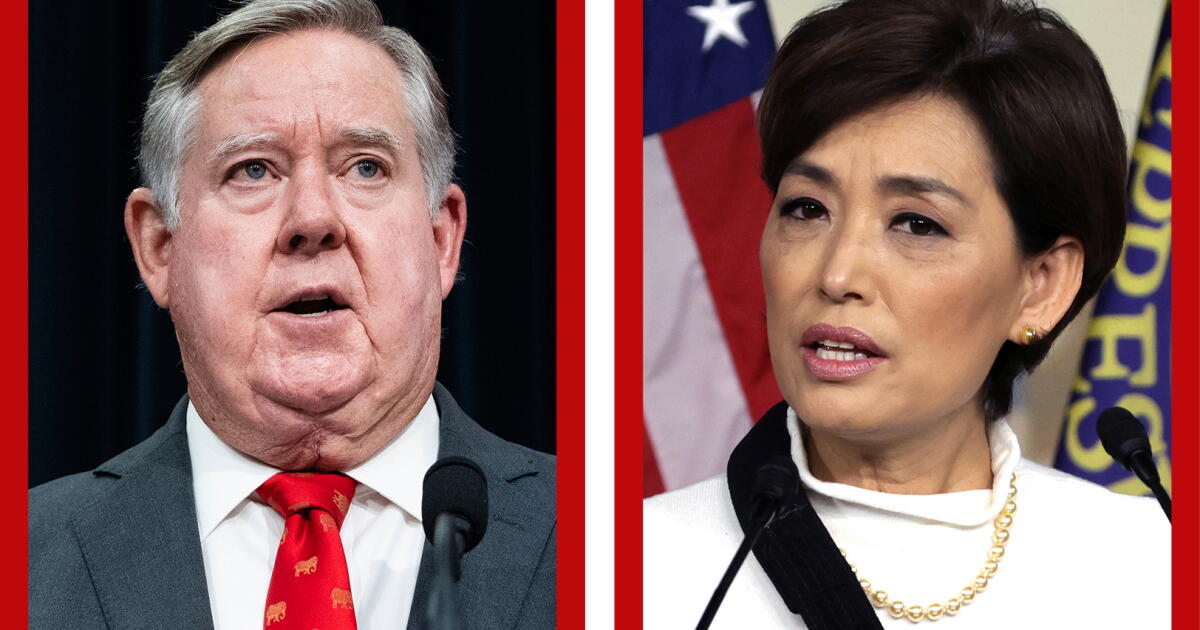
Last year, Kim was one of the sponsors of the Community Investment and Prosperity Act, a proposed law that later was encompassed in another piece of legislation that expanded banks’ ability to invest in communities in a way that promotes economic development and the public good. The law allows national and state member banks to invest up to 20% of their capital and surplus in affordable housing, small business lending and community revitalization.
“Families across California have felt the effects of rising costs for years. From delivering meaningful tax relief to supporting commonsense housing and energy reforms, I remain committed to fighting for opportunity and economic security that put Californians first,” Kim said in a press release issued by Americans for Prosperity in May.
Calvert sees affordability as the biggest challenge facing families and blames Sacramento for the rising costs and “driving businesses out of the state.” He points to his vote in support of the One Big Beautiful Bill Act, which maintained many of the tax cuts in the Tax Cuts and Jobs Act of 2017 and raised the State And Local Tax (SALT) deduction cap.
“My priority is fighting to lower everyday costs, help families keep more of what they earn and supporting policies that fuel economic growth, which in turn provides higher wages and more opportunities for California families and workers,” he said.
The largest chunk of this money — $7.2 billion — would be doled out as loans to builders who agree to rent some of the homes to low-income families; in Los Angeles County, a family of four earning about $133,000 a year qualifies as low-income.
Researchers recently found that the construction of nearly 40,000 low-income homes was in limbo because of a lack of funding.
The second-largest portion of these funds — $1.25 billion — would be set aside for housing for veterans, in the form of homeownership loans. Voters last approved this type of statewide bond for veteran home loans in 2018.
According to the Legislative Analyst’s Office, the remaining dollars would be spread across several other initiatives and could subsidize up to 40,000 rental apartments, 2,500 homes for farmworkers and 1,200 beds for university students:
$1.1 billion to help low- and middle-income families buy homes through direct loans and funds to nonprofits
$500 million for infrastructure related to new housing, such as road and water repairs
$450 million in loans or grants to build or upkeep affordable housing for farmworkers
$350 million to build affordable housing for students, split evenly among the University of California and California State University
$200 million available for tribal members to use to build or repair housing
$200 million available to city and county governments and other entities hoping to pilot programs to build low-cost housing
SACRAMENTO — Supporters of a high-profile Nov. 3 ballot measure that would require Californians to show identification when they vote accused state Democratic leaders of falsely stating that President Trump has endorsed the initiative.
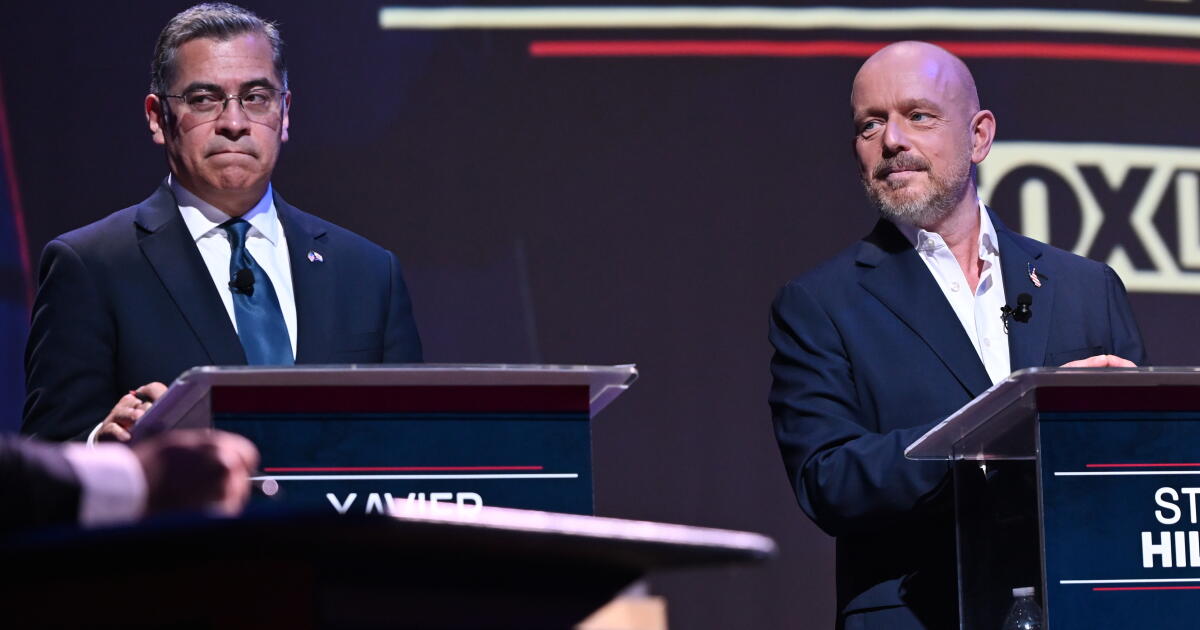
Republican Assemblymember Carl DeMaio of San Diego, one of the measure’s authors, on Thursday called Democratic gubernatorial candidate Xavier Becerra a “bald-face liar” over comments he made during Wednesday’s gubernatorial debate hosted by CNN.
Becerra said during the debate with Republican Steve Hilton that Trump was instrumental in the voter ID measure, Proposition 39, qualifying for California’s November ballot. Trump for years has tried to cast doubt about American elections, and unsuccessfully pushed Congress to pass a strict voter ID and proof of citizenship measure known as the SAVE America Act.
“Prop. 39 is an initiative that is backed by Donald Trump,” Becerra said during the hourlong debate. “He couldn’t get his SAVE Act out of Congress, which tries to interfere in elections. So he’s gone around the country and put initiatives on the ballot. In California, it’s Prop. 39.”
Though Proposition 39’s provisions are less restrictive than those in the SAVE America Act, its proponents echo Trump’s unsubstantiated claims that voter fraud and noncitizen voting are widespread in California and therefore stricter ID measures are needed.
DeMaio said the ballot measure qualified for the ballot because of strong support from California voters, including many Democrats and independents. Supporters collected more than 1 million petition signatures in support of the measure, surpassing the 874,641 needed to qualify.
“It was not put on the ballot by Donald Trump,” said DeMaio, who also founded the conservative advocacy group Reform California.
Becerra is “showing that he’s not willing to be truthful with California voters,” DeMaio said.
Meredith Shields, press secretary for the Yes on Prop. 39 committee, reiterated that Trump hasn’t taken a position on the initiative.
“The opposition will do anything to advance their cause and protect their power,” Shields said. “It will come as a surprise to no one that career politicians don’t always tell the truth, and they certainly aren’t telling the truth here.”
The White House didn’t immediately respond to a request for comment about Trump’s position on Proposition 39.
The measure would require anyone voting in person in California to present a government-issued ID, and those voting by mail ballot to include the last four digits of the ID number provided when they registered to vote. State and county election officials would be required to verify the U.S. citizenship of registered voters using government data and publicly report the findings.
The ballot measure is backed by DeMaio and several deep-pocketed Trump supporters. Julie Luckey, director of the group Californians for Voter ID, is the mother of billionaire tech entrepreneur Palmer Luckey, a major Trump fundraiser and Republican donor. Richard Uihlein, chief executive of the shipping and packing supplies company Uline, has given the campaign $17 million.
Representatives for Becerra and the No on Prop. 39 campaign on Thursday argued that Trump pushed for voter ID in California before Proposition 39 officially qualified for the ballot, pointing to a March 11, 2025 news release on Reform California’s website acknowledging Trump’s support.
In January 2025, Trump endorsed “CA Voter ID” as a “condition” for continued federal funding to the state, according to the release, which was updated this year with an editor’s note to clarify that Proposition 39 hasn’t been endorsed by Trump.
“Carl DeMaio knows Prop. 39 is central to Trump’s voter suppression playbook, and he’s doing everything he can to hide that from voters,” said Jonathan Underland, spokesperson for Becerra’s campaign.
The No on Prop. 39 campaign repeatedly has sought to link Trump to the measure, which has not been a surprise given that the Republican president remains extremely unpopular among a majority of Californians.
“The fact that Donald Trump has endorsed it tells you everything you need to know,” Assembly Speaker Robert Rivas (D-Hollister) and Senate pro Tempore Monique Limón (D-Santa Barbara) said in a statement released by the “No” campaign this year.
U.S. Sen. Alex Padilla (D-California) suggested to reporters at a rally organized by the “No” campaign last month that Trump is behind Proposition 39.
“Carl DeMaio has been the face of this in California, but don’t be fooled into thinking this has nothing to do with Donald Trump and the MAGA agenda nationally,” Padilla said.
Separately, DeMaio on Thursday accused Secretary of State Shirley Weber, another Democrat, of falsely stating that Proposition 39 would end California’s vote-by-mail system. The vast majority of Californians use mail-in ballots.
Weber, in a television interview that aired this week on KCRA in Sacramento, said the state already requires ID for those who register to vote.
“But if you tell me everybody has to take their ID to the poll, Californians should be concerned because 90% of them don’t want to do that,” she said. “They want to vote by mail, and you would effectively eliminate vote by mail.”
DeMaio questioned whether Weber understood what Proposition 39 proposes.
“If she truly is concerned about trust and confidence in our elections, she should start with her own behavior by refraining from spreading misinformation about Prop. 39 and our election,” he said.
Weber, when asked about her statement this week, said in an email to The Times that Proposition 39 would “cause disruption” in the state’s mail-in voting system because it would require voters “to write private personal information on the ballots.”
A Weber campaign spokesperson followed up with another response Thursday.
“What Dr. Weber actually said was that, if passed, this very poorly drafted proposition could cause people to decide not to vote by mail because it creates unnecessary and burdensome steps,” the spokesperson said.
SACRAMENTO — Days after signing a package of bills to rebuff aspects of federal immigration enforcement in California, Gov. Gavin Newsom vetoed two bills from Los Angeles lawmakers that targeted public employment for federal agents.
One of the bills, backed by Speaker Robert Rivas (D-Hollister), would have blocked agents and contractors who worked to enforce federal immigration laws from state and local jobs in California, including for law enforcement agencies. It was called the “Get the Feds Out” or “GTFO” Act.
Newsom said the bill goes “a step too far.”
“It is a mistake to discourage empathetic and qualified Americans from working in the federal government, or choosing to leave long-standing employment with the federal government because they find the current administration’s policies and tactics reprehensible,” the governor wrote in a veto letter to the Legislature made public on Wednesday.
The governor added that hiring for public employment already includes personal conduct evaluations. He emphasized the “horrific tactics” used by immigration agents during President Trump’s second term but said it is the responsibility of Congress to hold the administration and individual agents accountable.
Newsom signed a similar bill that prevents federal agents from becoming police in California if their federal badge was revoked for misconduct.
While he expressed disappointment in the veto, Assemblymember Mark Gonzalez (D-Los Angeles), the author of Assembly Bill 1896, applauded Newsom for signing “a strong package of legislation that will protect Californians and stand up for our immigrant communities.”
“From the beginning, the GTFO Act was about a simple principle: We should never use public dollars to reward conduct that has caused fear, terror, and pain in our communities. I am proud to have stood alongside my brother, Speaker Rivas, in this fight and this fight is not over,” Gonzalez said in a statement to The Times.
A spokesperson for Rivas said while the proposal did not become law, “Californians know Trump’s immigration agenda is failing and doesn’t keep anyone safe. That’s why Assembly Democrats are leading the nation in holding ICE accountable. The Speaker thanks his colleagues for delivering real results this year.”
The outgoing governor also vetoed a proposal from Assemblymember Isaac Bryan (D-Culver City), Assembly Bill 1537, that would have prevented sworn law enforcement officers from taking secondary employment or contract jobs for immigration enforcement.
Newsom took issue with the prospect of prohibiting “secondary employment law enforcement officers choose to do in their free time.”
“State and local peace officers already must abide by specific standards and rules, including ones that apply to their personal conduct,” Newsom wrote in the veto letter. “Any officers who violate those standards are held accountable through investigations that may culminate in their peace officer status being suspended or revoked entirely.”
Bryan, through a spokesperson, declined to comment on the veto.
Earlier this week, Newsom signed 21 bills aimed at federal immigration enforcement, including bans on electric shock gloves and face coverings for law enforcement. Other laws impose a 25% tax on companies that operate private detention centers, along with additional oversight of the facilities.
“No tax will stop ICE from deporting criminal illegal aliens to make California safe again,” a spokesperson for the Department of Homeland Security said in an email. “While California sanctuary politicians continue to release pedophiles, rapists, gang members, and murderers onto their streets, our brave law enforcement will continue to risk their lives to arrest these heinous criminals and make California safe again.”
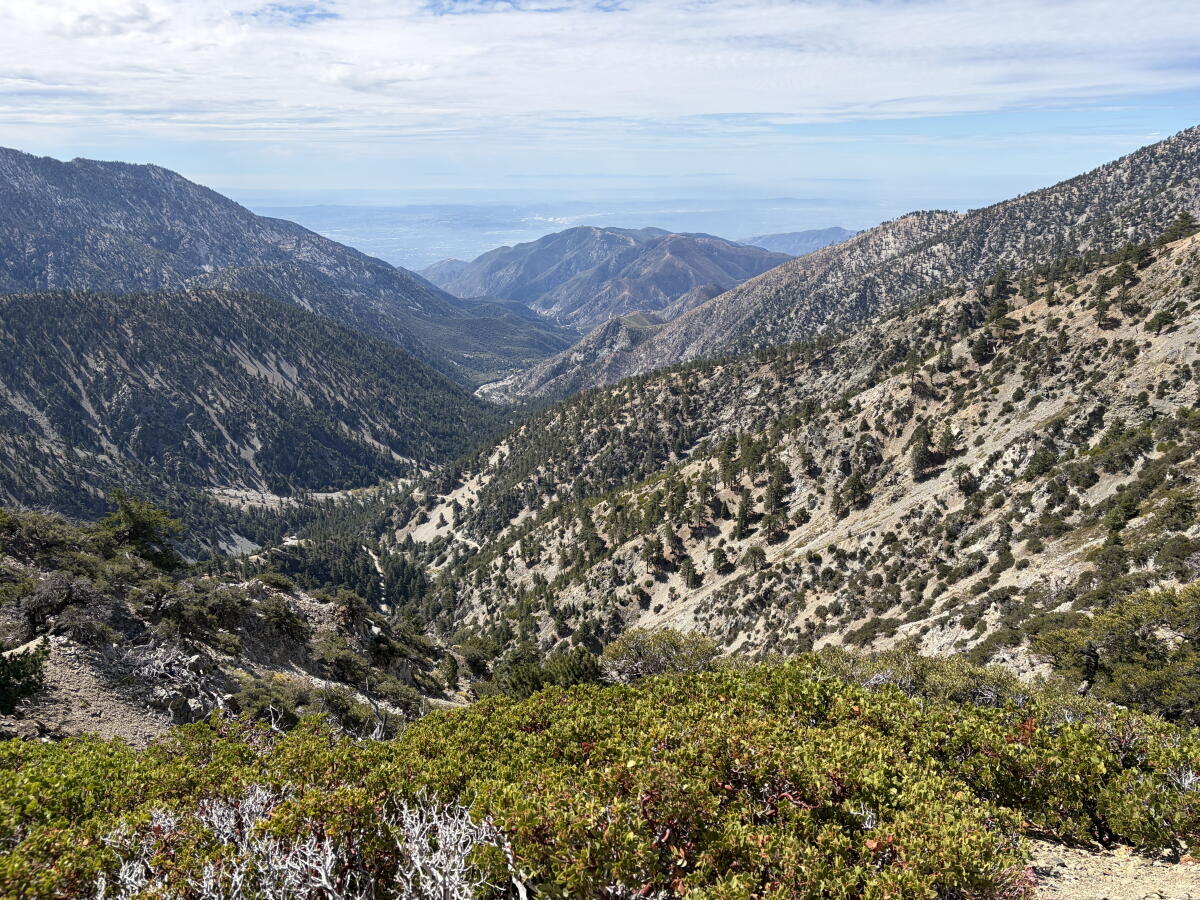
This summer, Southern California hiker Mark Orr spotted a hazard he struggled to stop thinking about: a crumbling, narrowing section of the Devil’s Backbone Trail near Mt. Baldy.
Orr wanted to help.
In early August, he trekked about 5.6 miles from the trailhead near Manker Flat campground to the site, hauling 85 pounds of gear with him over two trips. Orr first spent two hours digging out a wider route and then built what he dubbed an “anti-erosion fence” by installing 30-inch rebar stakes, stainless steel wire, clamps, aluminum flashing and zip ties. A few weeks later, Orr posted a video documenting his work to his YouTube channel, where he’d previously shared about hiking and other DIY projects. In the video, which Orr has since made private, he said he’d never performed trail work.
A view from Baldy Road leading up the Mt. Baldy Notch in the San Gabriel Mountains.
(Jaclyn Cosgrove / Los Angeles Times)
The people of the internet were initially grateful. “I can’t imagine doing this in my backyard let alone at 9,350 ft. You are THE MAN,” one YouTube user wrote. “I’ve hiked the backbone dozens of times and will remember you with gratitude every time I come across this section,” another person said. One person said his son was one of the three people who died while hiking the Backbone Trail in late December, and he wanted to connect with Orr.
But, as the video’s view count ticked up, concern over Orr’s work mounted into rage.
Two camps developed: Those who lauded Orr’s efforts and those who felt he should be held accountable for what they argued was damage to the trail. “I give this guy an A+ on his intentions and effort,” a Reddit user wrote on a post about Orr’s video. “If a section is dangerous, it should ‘look’ dangerous. To make it look safe, creates a bigger hazard as people will come to rely/trust in what is actually a DIY retaining wall. What happens when that eventually gives way? What if someone is hurt/killed as a direct result of this DIY project?”
You are reading The Wild newsletter
Sign up to get expert tips on the best of Southern California’s beaches, trails, parks, deserts, forests and mountains in your inbox every Thursday.
By continuing, you agree to our Terms of Service, which include arbitration and a class action waiver. You agree that we and our third-party vendors may collect and use your information, including through cookies, pixels and similar technologies, for the purposes set forth in our Privacy Policy such as personalizing your experience and ads.
In this edition of The Wild, our weekly outdoors newsletter, I will report out the current status of the trail where Orr completed his work. I will discuss how we got here — where an individual, not the U.S. Forest Service, tackled a trail repair — and where we go from here, including how you can do your part without upsetting half the outdoors corner of the internet and violating federal policy.
First, let’s talk about Mt. Baldy and how people usually get there.
A segment of the Devil’s Backbone Trail that hikers take to the Mt. Baldy summit.
(Jaclyn Cosgrove / Los Angeles Times)
Mt. San Antonio, commonly referred to as Mt. Baldy for its appearance, is a 10,064-foot peak in the San Gabriel Mountains and is the highest point in Los Angeles County.
Outside of winter, when much of the trail can become covered in snow and ice, most hikers reach Mt. Baldy via two routes. They start near the Manker Flat campground and walk Falls and Baldy roads until they either turn north-ish onto the Baldy Bowl Trail, often referred to as the “Ski Hut” route because hikers pass the Sierra Club’s green building, or hikers continue on Baldy Road until they reach the Mt. Baldy Notch. From here, hikers start the Devil’s Backbone Trail first by trekking up a fire road and then taking on a grueling, narrow 1.9(ish)-mile jaunt that gains about 1,500 feet and always makes me question my life choices about halfway through.
The Devil’s Backbone is named as such because of its shape, including segments where hikers walk a narrow stretch with steep drop-offs on both sides. This steepness is part of what makes it susceptible to erosion — and why only serious, well-equipped mountaineers should traverse it during the winter.
The Devil’s Backbone Trail, per the U.S. Forest Service, is 3.24 miles long, starting at Baldy Notch and ends at Mt. Baldy Summit.
(Jaclyn Cosgrove / Los Angeles Times)
On Sunday, I headed up Baldy Road to see how Orr’s repairs were holding. I am active in the r/socalhiking Reddit community, where I first learned of the story, and had already seen images showing a hole developing at the start of Orr’s repairs.
But no one had pinpointed exactly where they were.
Once I reached the Devil’s Backbone, a hiker warned me about a particularly steep and narrow section he’d just traversed.
“Is this the part with the repairs?” I asked.
“No, that part is way up, and it is already breaking down,” he told me.
I then chatted with two high schoolers coming back from summiting Baldy, one of whom hopes to attend a University of California school to study environmental science. “A little bit of rain,” and it’s gone, he said of Orr’s repairs.
A segment of a repair performed by a local hiker that has started to fail.
(Jaclyn Cosgrove / Los Angeles Times)
Just over a mile into the Devil’s Backbone, I spotted the shiny aluminum of Orr’s anti-erosion fence. And I spotted the hole where fill dirt has fallen through. Before Orr started his work, the trail was narrow — his work did widen the route, but how long will it hold?
Alan Coles, a trail crew leader with the San Gabriel Mountains Trailbuilders, which maintains routes in the backcountry and Baldy area, told me the answer is probably not long, especially given the rain and snow we could get this winter from El Niño.
A segment of the Devil’s Backbone Trail where a hiker attempted to widen and repair the crumbly trail.
(Jaclyn Cosgrove / Los Angeles Times)
“Taking another look at the video, the problem with the trail may be due to a buildup of material washing down from above,” said Coles, who has 35 years of trail maintenance experience. “Often the best solution is to dig it out and lower the trail to the original alignment, which will also widen it. The problem with the repair is that the hardware he installed would make that difficult. In time, the material he used will come apart, and those stakes will get more exposed, leading to problems with people tripping on them, especially if there is snow.”
Coles said to begin work in Angeles National Forest, he must submit a list of trails that his organization wants to work on to the U.S. Forest Service. The agency’s archaeologist, biologist and other technical experts will review his list. If there are any issues with a particular trail that Coles has identified needs repairs — like if an endangered species is known to live in a creek next to the trail — the Forest Service could deny his request, thus leaving the trail unmaintained.
A hiker walks near the hole created by unauthorized repairs performed in early August.
(Jaclyn Cosgrove / Los Angeles Times)
Coles said the Devil’s Backbone Trail is a “very difficult repair” for a lot of reasons, including its high altitude and the need for a crew to get permission to use the fire roads to shorten the distance they have to haul their gear. Coles said hikers often ask him when his crew will work on the Three T’s Trail, as the route has several downed trees and other issues, and his crew faces similar access issues.
Coles said he sympathizes with Orr’s reasoning for repairing the trail: People died in that area.
“His heart’s in the right place, but it really needs to be done with someone who says, ‘OK, here’s how you properly do a repair like that,’” Coles said.
It’s impossible when thinking about Orr’s repairs not to think about the old adage of, “The road to hell is paved with good intentions,” and the brutal irony is that, once you reach the Devil’s Backbone, you’re going to need more than that.
Two hikers navigate down the Devil’s Backbone Trail after summiting Mt. Baldy, the highest point in L.A. County.
(Jaclyn Cosgrove / Los Angeles Times)
When I spoke to Orr after my hike, he said he hopes that he can join the trail crew to remove what he did and repair the trail properly.
“The first thing is, it was nothing but well intentions by somebody who loves the mountain and wants it to be safer for everybody,” Orr said. “I totally get that my first crack at this, I didn’t do everything right, and I’m actively working with the San Gabriel Mountains Trailbuilders to get it right before this winter.”
The final challenge, though, will be getting officials at the U.S. Forest Service to approve the work plan. A spokesperson at Angeles National Forest did not respond to my request for a comment or an interview for this story.
Orr’s trail repairs come at a time when outdoors lovers are feeling particularly protective of public lands. The Trump administration has continued its efforts to peel back layers of environmental protections, like the Roadless Rule, raising the alarm of park advocates who fear not even Yosemite is safe from development.
The sunset as viewed Sunday on a trail often referred to as the “Ski Hut” route.
(Jaclyn Cosgrove / Los Angeles Times)
At the same time, the U.S. Forest Service and National Park Service have both seen massive staffing cuts during Trump’s second term, and this comes after decades of underfunded trail construction and repair.
In the early 1980s, “each of the five Angeles Forest districts had a full-time, paid trail crew of eight to 10 members. Now there are only summertime crews with three to four members. Forest Service officials and the agency’s critics agree that if it were not for the volunteer corps of 700 trail builders, the mountain paths would not be repaired for years,” according to a 1993 Times story.
Those crews, Coles said, were one of the casualties from a swath of federal budget cuts in the 1980s. A 1986 Times story noted that, in just four years, “the amount of federal money allocated for trail maintenance nationwide and in Southern California … dropped about 50%.”
“For the most part, without the volunteers, you wouldn’t have a trail system today,” Angeles National Forest official Don Gilliland told The Times in 1993.
The sun goes down, casting orange and pink hues through the clouds above the San Gabriel Mountains near Mt. Baldy Village.
(Jaclyn Cosgrove / Los Angeles Times)
The agency continues to rely heavily on volunteers. The U.S. Forest Service estimates that it has about $10.8 billion in deferred maintenance, including $241 million in deferred trail maintenance and almost $70 million in trail-bridge deferred maintenance, according to a recent budget document.
In an analysis of that backlog of work, officials with the U.S. Government Accountability Office heard from one regional official who told them that the trail maintenance program “is held together by Band-Aids and baling wire.”
If you’d like to be part of that baling wire, you can join Orr in joining a local trail crew. There are several who service the San Gabriel Mountains and their foothills.
It is easy to read about Orr’s efforts and point out the obvious mistakes he made. It’s another thing to take action, whether that’s donating to local trail crews or volunteering on their work days. I’ll see you out there, focusing on the latter.
3 things to do
A coyote drinks water puddling near the golf course at Griffith Park.
(Mel Melcon / Los Angeles Times)
1. Document dicots and deer in L.A. The Los Angeles Public Library, along with other city agencies, will launch this year’s L.A. Nature Quest at 9 a.m. Saturday at the Griffith Park Visitor Center. The L.A. Nature Quest is an annual monthlong effort to document as much of L.A.’s flora and fauna as possible using iNaturalist, a citizen science app. Attendees will be guided by rangers and other experts in a morning of outdoor exploration and nature journaling. Downloading iNaturalist beforehand is recommended. Register at eventbrite.com.
2. Sit down and spy birds in Pasadena The Pasadena Audubon Society will host a seated birding experience at 8 a.m. Saturday on the Gamble House lawn (4 Westmoreland Place in Pasadena). Guests should bring water, sunscreen, a lawn chair or blanket, and a hat. Participants can bring their own binoculars, but there will be some to loan out for those without. Register at eventbrite.com.
3. Marvel at mushrooms in Monrovia Monrovia’s Canyon Park Nature Center will host the opening reception for the Mushrooms of the San Gabriel Mountains at 10 a.m. Sunday. Mycologist Aaron Tupac will share with guests about how and why they photographed the specimens shown in the exhibit, along with sharing information about our local fungi populations. Learn more at Tupac’s Instagram page.
The must-read
Biologists collect olive ridley sea turtle eggs from nests on Southern California beaches.
(Huntington Beach Police Dept.)
In mid-September, two heart-shaped olive ridley sea turtles made history when they dug nests on Seal and Huntington beaches, marking the first documented natural sea turtle nests on the U.S. West Coast. Times staff writer Corinne Purtill wrote that biologists and cheloniophiles barely had time to celebrate before realizing that these nests were at risk of being destroyed by incoming storm surges and high tides. Biologists recovered just over 200 eggs. “We had to make some quick decisions,” said biologist Jonathan Snyder of the U.S. Fish and Wildlife Service at the Aquarium of the Pacific in Long Beach on Friday. “This is the decision that we made, and I think it’s the best one for species recovery.”
Happy adventuring,
P.S.
Montrose Search and Rescue recently highlighted the perils of taking the wrong route to hike Strawberry Peak. Strawberry Peak, visible from several L.A. hikes, is the highest point in the front range of the San Gabriel Mountains. Montrose Search and Rescue recently rescued hikers, though, who’ve ended up on the mountaineering route. Their video highlights how crucial it is to know your route before you go — and to ensure you have a physical map with you in case you get lost. Stay safe out there, folks! (And don’t hike Strawberry Peak right now — it’s too hot.)
For more insider tips on Southern California’s beaches, trails and parks, check out past editions of The Wild. And to view this newsletter in your browser, click here.
When Brandon Hurst first decided to sell his plants on TikTok Live in 2023, the 32-year-old Sylmar resident didn’t know what to expect. He said he thought he could sell at least 30 plants, but instead sold 250.
Now, three years later, the internet creator, who goes by Brandon the Plant Guy, sells up to 5,000 plants a week, works out of a 3,000-square-foot greenhouse in Sylmar and has a staff of 13. He credits much of this success to the exposure he’s received on TikTok.
“I’d be out of business if it wasn’t for TikTok,” said Hurst. “I would have ended the business and gone back to working the desk job that I was working prior. I was already on that path, that was where we were headed. And then TikTok really did turn that around.”
Hurst is one of the 920,000 California-based businesses using the social media platform to reach new customers and grow their brands, according to new data from consulting firm PF Global.
In 2025, TikTok helped generate $12 billion in advertising and merchandise sales for those businesses and supported 52,000 jobs in the state, said the PF Global report, which was commissioned by TikTok.
Nationwide, economic activity on TikTok last year helped contribute $81 billion to some 8.5 million U.S. businesses, the report said.
The surge in activity reflects a growing trend toward online commerce, as more small businesses and consumers turn to social media platforms like TikTok to buy and sell goods.
“We enable American culture, American creators, American businesses, to reach an audience around the world,” said Nicole Mason, TikTok’s head of U.S. public policy, said during a presentation on Wednesday morning.
The new report comes as TikTok is increasingly eager to tout its economic impact as a newly formed U.S. joint venture. In January, the company was taken over by three managing investors: Silver Lake, Oracle and Emirati investment firm MGX, each holding 15%, with ByteDance retaining 19.9% of investments. This transition came after TikTok’s Chinese parent company, ByteDance, was under pressure to divest its ownership in the app’s U.S. operations or face a nationwide ban, due to security concerns.
TikTok, which operates its U.S. headquarters in Culver City, where it employs several hundred workers, is mostly known for its viral, short-form vertical videos. But, over the years, the platform has become a hub of curated viral content and a central part of many businesses’ marketing strategies.
The app also has features like TikTok Live, where businesses can host live shopping events, and TikTok Shop, which serves as a direct-to-consumer online marketplace.
For its study, PF Global surveyed more than 11,000 adults in the U.S. and 5,000 businesses. The firm also conducted five case studies with U.S. small businesses and TikTok creators and interviewed over 600 people around the country. The data set combined that survey data with government statistics, industry research and TikTok’s own internal data.
PF Global recently published a similar economic report for the U.K. and is working on reports for 10 other European countries with TikTok.
Neil Ross, a partner at PF Global, said a common global theme is that TikTok users are more likely to see something on the platform and go out and do it.
“People around the world are using it as a kind of digital front door to work out where to go, what to shop, what experiences to have,” Ross said.
The U.S. report states that 27 million Americans “visited an independent shop, cafe or restaurant for the first time after seeing it on the platform.”
The app’s roots date to 2014, when an app called Musical.ly was launched in Shanghai. In 2016, Chinese tech company ByteDance launched a similar platform in China called Douyin.
As the apps grew in popularity, ByteDance picked up on their potential. It purchased Musical.ly in 2017 and combined all these platforms into one, named TikTok. Over the next few years, the app began its rapid ascent, hooking in users with a curated algorithm and viral trends. Today, 200 million Americans use TikTok every month, according to PF Global.
“On a daily basis, TikTok powers real economic impact across the United States, helping entrepreneurs grow their businesses, reach new customers, and create jobs across the country,” said Adam Presser, TikTok’s chief executive in a statement.
Min said Trump’s attacks on voting by mail and his attempts to get the U.S. Postal Service to refuse to deliver mail-in ballots, combined with his attempts in 2020 to overturn the election, “should worry every American who cares about our country, our Constitution, and the values of our nation.”
In 2024, Min authored a bill which passed that prohibits local governments from forcing voters to present identification before they cast a ballot at a polling place.
“I will continue to do all I can to stand up against these anti-democratic and un-American attacks on the sanctity of our elections,” Min said.
Le Roux told The Times she supports the Safeguard American Voter Eligibility or SAVE America Act, which would require voters to provide documents proving their citizenship at the time of registration and a photo ID at the time they vote.
In California, people are required to provide a driver’s license number or a portion of their social security number when they register to vote.
“Millions of ballots are mailed out in California with very few safeguards and at significant cost, leading to weeks of uncertainty as the rest of the country laughs and mocks us for our incompetence,” she said.
Le Roux also supports Proposition 39, which will appear on the November ballot in California, and would require voters to show government issued identification at the polls. Voters who submit mail-in ballots would need to provide the last four digits of a government ID to vote.
The California I grew up in had its pluses and minuses, just like the state I’m living in now.
But consider this:
In 1974, I wrote a check for a semester of college.
The fee was $98.
That was the cost of registration, by the way. Tuition for in-state residents was free at San José State University and other public universities in California. The state’s leaders believed subsidized higher education would serve the greater good and seed economic growth.
Two years after graduating, I was working as a sportswriter for a small Bay Area newspaper. My spouse was a drug store clerk. Together we made less than $20,000 a year.
And we bought a brand-new house, 45 minutes east of Oakland, for just under $50,000.
In a thousand ways, we’re living in a different California today. Tuition and fees for a semester on a Cal State campus now run about $4,500, and the average mid-tier home costs about $775,000 in some places and far more in others, which is out of reach for nearly 80% of working people.
So as I watched the gubernatorial debate Wednesday night between the two men who want to lead us into the future, I was wondering which California is better in terms of hope, opportunity and livability?
The one I was born in during the postwar boom, or the one we’re living in now?
There’s no easy answer. The California of my youth was more affordable, but it was no utopian dreamscape. Housing discrimination and segregation were deep-seated, and the Los Angeles sky was the color of swamp water.
In the last half of the 20th century, California went on to become a global leader in technology, aerospace, the arts and healthcare, and its investment in public education helped build an economic superpower. Even the air got cleaned up, to a degree.
But for all of California’s riches and unrivaled natural beauty, it’s fair to say things are out of whack at the moment. How is it that the world’s fourth-largest economy also has the nation’s highest poverty rate?
There’s a flotilla of yachts, but millions of have-nots, and enough homeless people to fill stadiums. If we’re so progressive, and swimming in more venture capital than the rest of the nation combined, why are the masses crippled by a housing shortage and the high cost of living, and why did we build a soaring higher education model while letting our once exalted K-12 system sink in national rankings?
If California weren’t so lopsidedly blue, Republican candidate Steve Hilton might get a little more traction with a campaign built around the idea that there’s an easy explanation for the state’s misery of problems: Democrats have been in charge for years, they’ve mucked things up, and Xavier Becerra is yet another textbook California liberal who will stay the course.
“It’s impossible for regular working people to live in this state anymore,” Hilton charged during the debate, calling out over-regulation, the high cost of living, the housing shortage and a homelessness problem that “shames” our state. “And all you’re offering,” Hilton continued, “is more of the same, backed by the same corrupt machine in Sacramento.”
Becerra, meanwhile, kept handcuffing Hilton to President Trump, a good move, given that the president has helped launch an idiotic war, gummed up the economy, and seen his favorability plummet.
Hilton is not entirely off base, although there’s no evidence he has plausible solutions.
What he doesn’t tell you is that other states have their own problems, many of which have more to do with global economic forces — and President Trump’s war-mongering and tariff tirades — than with public policy decisions at the state level.
When I was a lad, my father drove a milk truck, and then a bread truck, and then he sold candy and tobacco for a wholesale distributor based in Oakland, near the Coliseum, where he’d take me to A’s games but save a few bucks by parking next to the railroad tracks a half-mile away from the parking lot.
His jobs were mostly unionized. Unions were plentiful in the private sector back then. My family saved up for a house while we lived in an apartment, and then I paid next to nothing for a college degree.
The boldness of that idea — a free education at an elite university, with a lofty if unfulfilled goal of equal access for all — is still a testament to California’s long-ago grand ambition, even if Gov. Ronald Reagan eventually ended free tuition.
In her new book, “California Dreams: The Making and Remaking of the University of California,” Miriam Pawel references a quote from UC Berkeley alum Joan Didion, who called the system “the most coherent expression of the California possibility.”
The staircase I climbed was the essence of what USC professor Natalia Molina called “the infrastructure” of upward mobility. In her immigrant family, her grandmother established an Echo Park restaurant that Molina wrote a book about — “A Place at the Nayarit” — and her mother ran the bar there after attending bartending school.
Molina went to UCLA, and is now both a MacArthur Foundation fellow (the “genius” grant) and a Guggenheim fellow.
“There’s not that same path for upward mobility,” Molina said. “But there sure seems to be a path for downward mobility.”
That brings me back to the economy, and lessons I learned in 2018, when I spent several weeks in and around Telfair Elementary School in Pacoima, looking into why nearly a quarter of the students were homeless.
The answer? Several once-bustling manufacturing and aerospace companies in the area had shut down. The new economy was fast food and big box stores. Pay dropped; housing prices spiked. It was a snapshot of a changing world — one we haven’t yet adapted to.
Modern politics is not built to foster long-term thinking about such challenges, said longtime political strategist Darry Sragow.
“What are the dreams, what are the aspirations, where do you want to go?” said Sragow, who doesn’t know the answers but would like to at least hear the questions. “I keep looking for somebody who will do that.”
Agoura Hills resident and attorney Dan Douglass, 80, who detests President Trump and isn’t a fan of Hilton, told me that as a moderate Republican, he feels like “a man without a party.” But he is not without an answer to California’s housing problem.
“They’ve made it too complicated to build anything,” Douglass said. “Too many permits. Too much time to build.”
“California must reduce regulatory costs that fall disproportionately on low- and middle-income residents,” Trachtman wrote in a recent four-part analysis.
“The state has “long led the nation in regulations promoting safety, sustainability, and quality,” he went on. “These policies can produce strong benefits. But they can also drive up the cost of essentials — costs that hit the poor hardest. This amounts to regressively funded progressivism.”
California was, and is, a work in progress, richly endowed and deeply flawed. Fixing complicated problems isn’t easy, but what I’d like to see from the next governor is more of the striving, imagination and sense of collective purpose that made California great.
There’s no way and no reason to go back to the state of my youth, but Trachtman had a thought about where to go next.
“In some ways we can use the past as a model,” he told me. “But in other ways we need to be more innovative and think about charting a path forward.”
Toward the most coherent expression of the California possibility.
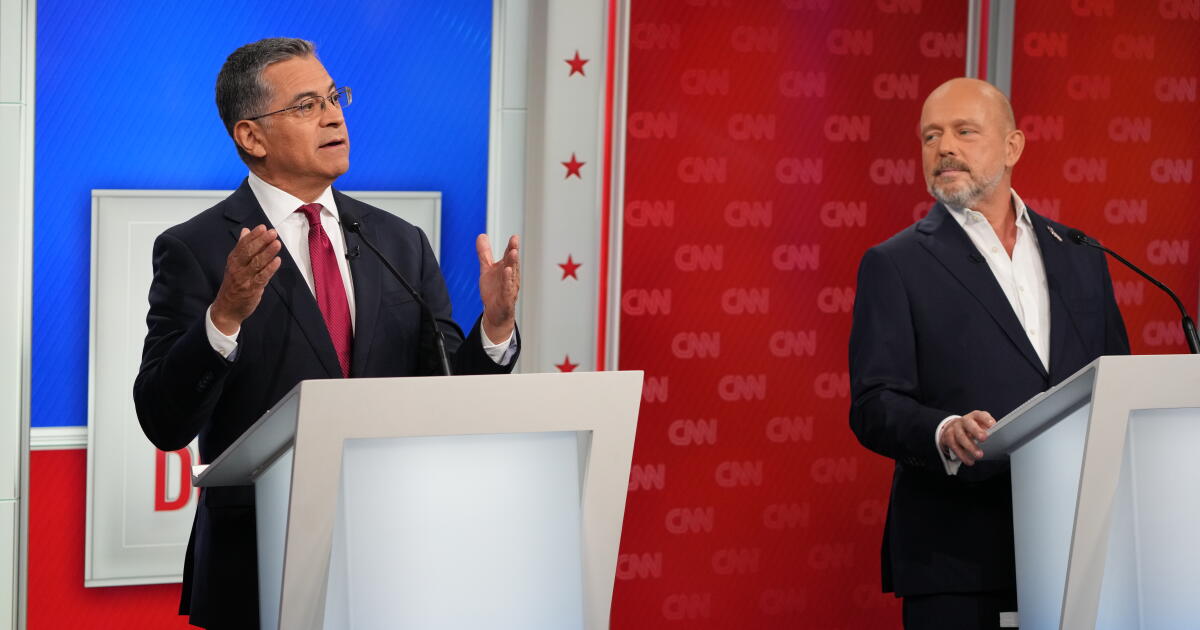
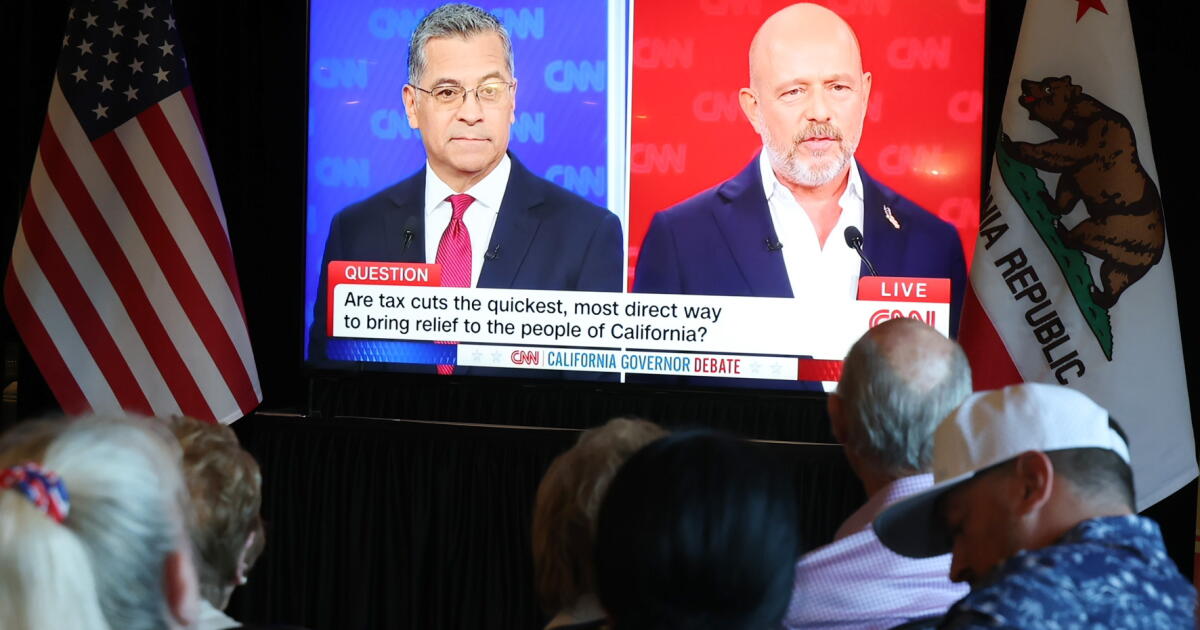
The two candidates to become California’s next governor painted vastly different portraits of the state they want to lead during a televised CNN debate Wednesday night — though they both agreed the state faces tremendous challenges.
Democrat Xavier Becerra, leading in polls, cast the state as an economic engine and a critical bulwark against the disastrous economic policies and creeping authoritarianism of the Trump administration, but also a victim of Trump policies, including tariffs and the war in Iran, that have made life less affordable and the nation less safe.
Becerra said he would work hard to help struggling Californians — including by cutting red tape on housing and regulating AI to ensure it doesn’t destroy jobs — while his challenger, Republican Steve Hilton, would harm them further by backing President Trump’s agenda at every turn.
Hilton, endorsed by Trump, blamed the state’s most entrenched ills on years of Democratic governance, awash in unnecessary state bureaucracy and regulation that have made it wildly unaffordable, and wrongly obsessed with fighting the president instead of bringing down costs and fixing related local issues like homelessness.
Hilton said he would help struggling Californians by cutting taxes, cutting the cost of building new housing, eliminating fraud and bringing common sense back to state policy-making.
Both candidates came out of the gate on offense, and at times it got intensely personal, particularly on immigration — with Becerra accusing Hilton of welcoming white immigrants into the country while rejecting Latino immigrants, and Hilton accusing Becerra of handing migrant children over to sex and labor traffickers during his time as U.S. Health and Human Services secretary.
With ballots soon arriving in voters’ mailboxes and the Nov. 3 midterm election rapidly approaching, the hour-long debate — moderated by CNN anchors Jake Tapper and Dana Bash in Burbank and aired live by the national news network — provided the public with its latest look at two candidates vastly different both in politics and campaign style.
Becerra, a former Congress member from Los Angeles, California attorney general and Health secretary under President Biden, surged past a slate of other Democrats to win the June primary after onetime front runner Rep. Eric Swalwell dropped out of the race amid sexual assault allegations. Hilton placed second after Republican voters and others coalesced behind his message to shake up Sacramento — earning him the right to face off against Becerra in November.
Hilton, a former British political aide, former Fox News host and Silicon Valley entrepreneur, has been crisscrossing the state looking for votes anywhere he can find them — an uphill battle given registered Democrats outnumber Republicans by a nearly 2-to-1 margin, and opposition to Trump is widespread in the state and growing even among Republican voters.
A poll this month by the UC Berkeley Institute of Governmental Studies and co-sponsored by the Los Angeles Times found 58% of likely voters surveyed said they support Becerra, compared with 33% who back Hilton — a slight increase to Becerra’s lead compared with an August IGS poll. California voters identified the high cost of living as their top concern, but that was followed closely by opposition to the Trump administration.
Becerra has taken a less visible approach to campaigning, with critics accusing him of intentionally keeping a low profile in an effort to cruise to victory in a state that hasn’t elected a Republican to statewide office in two decades.
“I just want to say thank you to CNN for bringing Xavier out of hiding,” Hilton said at the beginning of Wednesday’s face-off. “He’s barely been seen in public since the primary four months ago; it’s very important we have this debate.”
During the debate, both candidates seemed prepared to focus on the lack of affordability — namely by blaming the other’s political party for it. But they also discussed artificial intelligence and data centers, immigration policy and, of course, Trump.
Tackling gas prices, high cost of living
California has some of the highest housing and energy costs in the nation, and affordability tops the list of concerns for likely voters. It also was the first issue the candidates debated.
Hilton has made the cost of living a central theme of his campaign, with a plan he calls “Califordable” to cut gas prices and end income taxes on earnings up to $150,000. He blamed California’s high costs on Democrats, who have controlled the Legislature and statewide offices for more than 15 years. Hilton says he can lower costs by slashing onerous state regulations on businesses.
Hilton said the “quickest way to get more money in people’s pockets is for the government to take less out” and to reduce regulations to allow more housing to be built — including in “10 new cities” he said he would help build in the state.
Becerra has blamed higher prices on Trump’s tariffs and the war against Iran. In response to attacks from the U.S. and Israel, Iran has for months choked off a major oil trade route, sending global gas prices soaring — to a national average of $4.48 per gallon this month.
Becerra said Hilton’s plan to end income taxes would amount to a massive tax cut for “billionaires and millionaires” that would take money from schools, healthcare and other critical services. “The math doesn’t add up to what he’s talking about. He’s going to have to take it out of somewhere. It will come out of our schools,” Becerra said.
Becerra said he would bring down costs for people by cutting red tape, including on housing, and fighting the Trump administration — which he said is the real driver of cost increases. He also said he has helped create millions of jobs during his career.
Agree but disagree on AI and data centers
Hilton and Becerra both support regulations for data centers and artificial intelligence companies, a sign of growing bipartisan pushback seen across the country.
Hilton said he wants California to take a leading role in regulating AI, given much of the industry is located in the state, and expressed concern about losing AI jobs to other states such as Texas and Arizona. Hilton questioned whether Becerra would have the political courage to rein in the industry, saying his campaign has received funding from it.
When Bash asked Hilton if those companies should be able to “self-police,” as Trump has suggested, Hilton said, “We’ll have to see.” He also said he appreciates the effort by Trump to get assurances from AI companies on safety during a recent summit, and he would work to make sure that those promises are upheld.
Becerra derided Trump’s deal as a meaningless “pinky promise” that does not guarantee a safe path forward. He said he would lead efforts to reach real and meaningful regulations but also work directly with local communities on what they want.
“If someone wants to come in and build a data center that creates more jobs in the community, adds more energy to our grid, and it actually protects and adds more water capacity, then let’s talk,” he said. “But it has to be good for the community.”
Sharp attacks on immigration
Becerra has faced bipartisan criticism of how Health and Human Services cared for the influx of unaccompanied immigrant children during the pandemic.
Hilton has hammered Becerra on it, and at the debate accused him of sending “thousands of young children directly into the clutches of child sex and labor traffickers.”
Becerra was attacked by Democratic rivals in the gubernatorial primary in the aftermath of a Pulitzer Prize-winning series in the New York Times, including an article that said thousands of migrant children who entered the United States between 2021 and 2023 worked in slaughterhouses, factories and other dangerous jobs that violated child labor laws. The investigation also alleged that tens of thousands of the children Becerra’s agency released couldn’t be found because he relaxed screening of relatives and sponsors.
Becerra repeatedly has said that despite a lack of congressional funding for licensed-care facilities dismantled by the Trump administration, his staff worked hard to vet the people who the children would be placed with.
At the debate, he called Hilton’s claims “Trump talking points.” He also said more needs to be done to ensure children aren’t separated from their immigrant parents.
Becerra also has slammed the Trump administration for its mass deportation program and immigration crackdown, which has sent immigration enforcement agents into cities across the country, including Los Angeles.
Hilton said he would work to “lower the temperature” in the immigration debate and “prioritize the removal of dangerous criminals,” which he said is not occurring in California because Democrats are playing “politics” with the Trump administration.
Becerra, the son of immigrants, said California welcomed Hilton as an immigrant, and Hilton “welcomed ICE mercenaries” into California in return. He also accused Hilton of welcoming immigrants that look like Hilton, who is white, while working to remove immigrants who look like Becerra, who is Latino.
“I have fought all my life to make life better for immigrants, to represent them well, to defend them, to let them grow and build like my parents. But here’s the problem I have with your policies: You seem to welcome immigrants who look like you, but deport immigrants who look like me,” Becerra said.
Hilton called that “disgraceful.”
Trump, Trump and more Trump
Hilton repeatedly has praised Trump and his policies and consolidated support among California Republicans after Trump endorsed him before the June primary. But Trump’s endorsement could be an albatross in the Nov. 3 election, given his low approval ratings — particularly in California.
Becerra repeatedly hammered Hilton as a Trump acolyte, so much so that Hilton said that it was Becerra’s only attack line, and that Becerra “takes no responsibility” for Democratic policies that have harmed California for years.
“All you ever say is Trump, Trump, Trump, and that’s nothing but an insult to every Californian who is desperate for something to change in this state, and all you’re offering is more of the same,” Hilton said.
Becerra countered that Hilton embraced Trump during the primary.
“Your words, Trump, Trump, Trump. Because he is your supporter,” Becerra said. “You chased his endorsement.”
Where they stand on billionaire’s tax, schools and other quick hits
Proposition 40, the billionaires tax: Both Becerra and Hilton oppose the controversial wealth tax proposal on the ballot that would enact a one-time 5% levy on billionaires’ assets to largely replace $100 billion in federal healthcare funding cuts to California.
Proposition 39, voter ID: Hilton expressed support for the ballot measure, which would require voters to present ID at the polls or write a special pin on their mail-in ballot. Becerra, who opposes the measure, claimed the initiative is part of an effort by Trump and his supporters to interfere in elections.
Improving schools: Fewer than half of third-grade students read at grade level. Hilton said it’s a “catastrophe” that exemplifies Democratic failure in the state. Becerra conceded that the school system is not “well coordinated” but supports transitional kindergarten, a new pre-K grade created by Gov. Gavin Newsom.
Democrat Xavier Becerra and Republican Steve Hilton debated for 60 minutes Wednesday night on a soundstage in Burbank. Times columnists Gustavo Arellano, Anita Chabria and Mark Z. Barabak watched the gubernatorial match-up and weigh in.
Arellano: Steve Hilton came in with next to no chance of becoming the next California governor, but maybe if he focused on touting the feel-good messages he’s been spouting since launching his campaign in front of the Huntington Beach Pier earlier this year — Make California Gold Again! Califordable! I’m a Legal Immigrant with a British Accent! — he might’ve convinced at least a few voters to go with him.
Instead, Hilton debated like someone already preparing to launch a podcast or beg for his old Fox News job back after he gets walloped. When your solution for solving California’s housing crisis is building 10 new cities, you’re not running for California governor — you’re angling for an influencer job with the Irvine Co.
He whined and grumbled and grinned and quoted someone calling Becerra a “bitch ass,” which would’ve been a funny dig if he wasn’t running to run the greatest state on Earth. Hilton is charming in person, in the way all British people inevitably, initially come off as to Americans, and he has traveled to every California county — and especially to Latino-majority cities. He should’ve shared some of the many stories of hardship that I’m assuming he’s heard over the last year.
Nope! Instead, Hilton attacked Becerra again and again — why? California is a super-blue state, Latino Trump supporters notwithstanding, so Hilton should’ve tried to at least offer a reason for voters to choose him instead of saying — not completely inaccurately — that the problems Californians deal with are the fault of Democrats.
But blaming the other side only gets you so far — just ask Democrats how it worked out with them in 2024.
“We’ve got to try something different,” Hilton said in his concluding remarks. Californians agree — and his name is Xavier Becerra, who last I heard isn’t Gavin Newsom, no matter how much the California GOP is trying to convince people otherwise.
Becerra, meanwhile, didn’t offer much in terms of vision, mostly because he played defense most of the evening. But he didn’t have a major flub, except maybe raising a CNN coffee cup a few too many times. Why, Becerra sometimes even smiled — proof that he’s not some Chicano automaton. He hasn’t agreed to any more debates with Hilton — but after this blowout, Becerra should take the both of them on the road to make Hilton the next John Cox.
Chabria: Becerra came out as more of a fighter than we’ve seen before, even in the earlier Democratic debates. He held his own against Hilton, who is a skilled orator and attacker with a pointed wit and slick accent. But please, for the love of God, Hilton, button that shirt. This is not a casino.
Becerra was the clear winner, and to be honest, Hilton — usually a nimble pugilist — came across flat too much of the time. Maybe he’s already signed his Fox contract, as Gustavo suggests.
But Becerra also failed to lay out any kind of vision for the future of California. He did a good job of fending off Hilton’s attacks, but never told us what a vote for him will bring to the average Californian. There was some talk about housing, about protecting health insurance, but no big picture of what the California Dream of the future is and how we deliver it for the next generation.
I walked away from this debate certain that Hilton hadn’t gained a single voter, and equally certain Becerra hadn’t lost one. But also certain that Californians are rightfully disenchanted with this political moment because it offers little for the people who are voting. Becerra is going to ghost-coast into leading the most powerful state in the nation, and none of us will know what that will mean or why we should care one way or another.
Yes, there is a strong Legislature that will certainly keep the next governor focused on Democratic priorities. But what Becerra stands for remains a mystery that only the next four years will reveal. Let’s hope it has to do with our collective well-being.
Becerra exited the stage a little over an hour later, still the overwhelming favorite to become California’s next governor.
As the Democratic nominee in a state where Democrats enjoy big numerical, structural and political advantages — and have for decades — Becerra needed only to show up at CNN’s Burbank studio, field some questions alongside Hilton and avoid a Bidenesque disaster. (Even that might not have mattered.)
It was an exceedingly low bar, and one Becerra easily surmounted.
He was authoritative, crisp and kept on the offense most of the night, which raises the question of why his campaign handlers have been sheltering him up to now. Yes, it did get a bit repetitive when the Democrat’s response to so many questions amounted to: Trump, Trump, Trump! But that’s hardly surprising in a state where the president is about as popular as $6-a-gallon gas and $10-a-pound hamburger.
What was surprising was Hilton’s failure to do more to unshackle himself from the ball-and-chain sitting in the White House.
He allowed a smidgen of daylight here and there, but not enough to doff the MAGA mantle Becerra has draped around him. If anything, Hilton yoked himself even closer to Trump, sounding at times like his wacky Health secretary, Robert F. Kennedy Jr,. as he talked about vaccines — Hilton said he was for them, but also favored more parental discretion — and re-litigated masking and other pandemic policies from the Biden administration.
Hilton’s most effective moments came when he asked why unhappy California voters should expect anything different if they keep electing Democrats. Not an unreasonable question. Trump Lite, however, doesn’t seem like the remedy most are looking for.
Little to nothing seems likely to change as a result of Wednesday night’s encounter. Still, it was important to give California voters an opportunity to take the measure of the two gubernatorial hopefuls side by side and hear — in something more than a 30-second commercial — how they would lead the state.
It’s far more probable than not Becerra will be the candidate voters choose on Nov. 3. But for those who don’t like Becerra’s vision, his record, Democratic affiliation or, heck, his glasses or salt-and-pepper hair, Hilton offered an alternative — albeit more of a grouchy one than the happy warrior who’s appeared on the campaign trail.
Hilton gave it his best shot. Becerra ably deflected him.
California voters will decide whether to establish a $7.5-billion state scientific research arm — similar to the National Institutes of Health — after Gov. Gavin Newsom signed a bill that will put the proposal on the March 2028 ballot.
The new state fund would aim to blunt federal research cuts by the Trump administration and ensure state and private institutions — including the University of California and California State University — can continue to produce scientific breakthroughs.
If voters approve the measure, $7.5 billion in bonds would fund California scientific and medical research into diseases such as cancer, Parkinson’s and ALS. Other research areas include reducing wildfire risk and fighting pandemics and climate change.
“This is a research and science bond that does the opposite of what Donald Trump is doing that will allow us to double down on what makes this state great — what makes America great,” Newsom said Wednesday during a bill signing atop the Golden Gate Bridge. “We are the tentpole of the U.S. economy because we invest in the future so that we can all do well there.”
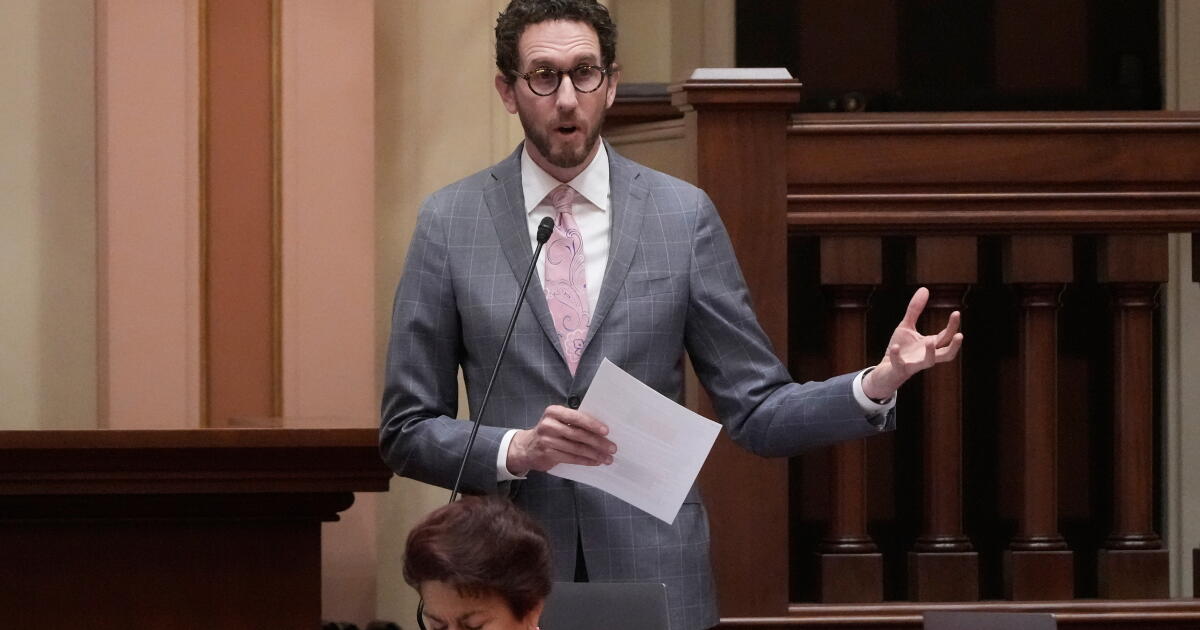
The legislation to establish the bond measure, state Senate Bill 895, was authored by Sen. Scott Wiener (D-San Francisco), who in a statement called it a “bold step to protect science, improve lives, and continue California’s global leadership on innovation for many years to come.”
The bill was sponsored by the Union of American Physicians and the University of California, as well as the United Auto Workers Local 4811, which represents some 60,000 UC academic workers.
The bond measure represents a pullback from what Wiener and supporters first proposed.
Originally conceived as a $23-billion bond measure that the Legislature would approve to go before voters in November, it was whittled down to $12 billion. But lawmakers then did not approve it in time for the November ballot.
Wiener said legislative leaders and the governor’s office then worked out a compromise, deciding on a $7.5-billion bond measure for 2028.
The measure also calls for the new state fund to establish regulations that would allow it to recoup part of its investments while not damaging innovation.
“This is a major achievement, made possible by an extraordinary coalition of people who understand the importance of investing in scientific research,” UC President James B. Milliken said in a statement.
But don’t worry, Golden State voters — Times columnists Gustavo Arellano, Mark Z. Barabak and Anita Chabria are watching every minute, every second, really, to bring you the zingers, gaffes and hopefully maybe even some insights.
*
Chabria: Let me start things off by saying my hope is that Hilton will push Becerra into specifics around issues including affordability, what we’re going to do about the coming Medicaid cliff, housing and education. California has been focused on raising up our most vulnerable and struggling residents for years — which is important.
But the middle class is suffering now, too, in all those areas. Hilton is right that the status quo isn’t working. That’s going to be a challenge for Becerra when he gets into office (and honestly, he could vacation in Hawaii until November and still get elected), so I’ll be looking for answers on how he plans to lift all boats.
Barabak: There will be much critiquing to come, so let me start by paying both gentleman a compliment.
Hilton has been campaigning hard, as though he has more than the merest speck of a chance of pulling an epic upset and somehow prevailing. Good for him!
And Becerra, who’s made himself exceedingly scarce, is stepping up and debating, as he should. And he’s not being cute about it, insisting on, say, a midnight appearance on local cable TV in Alturas. So props for that.
Arellano: I’m hoping that Becerra will once again channel his inner cholo, as I urged him to during the primary.
The Tío Xavier persona that Becerra supporters have trotted out — a kind, chuckling sage — isn’t what California needs right now. Becerra knows that the most loved uncles in Latino households aren’t the safe, boring ones but the ones who risked it all: the ones who came into this country without papers, who pulled themselves up by their bootstraps so that their kids could drive hybrids, and who proudly warble “El Rey” during the mariachi portion of the latest family wedding instead of sit quietly at the table.
We need the loco uncle, Xavier, not the fresa — uppity — one.
And I’m hoping Hilton will rebuke Donald Trump. I know, I know: there’s a better chance of England winning the FIFA World Cup than that ever happening.
But if there’s an iota of hope for the British expat to beat Becerra, it can only happen by him showing Californians that he’s willing to stand up to the loathed president instead of cozying up to him.
Otherwise, as a famous Brit once sang backed by sinuous xylophones, “Baby, baby, baby, you’re out of time.”
Insights
L.A. Times Insights delivers AI-generated analysis on Voices content to offer all points of view. Insights does not appear on any news articles.
The following AI-generated content is powered by Perplexity. The Los Angeles Times editorial staff does not create or edit the content.
Ideas expressed in the piece
Chabria argues that the debate should press Becerra for concrete plans on affordability, the coming Medicaid funding cliff, housing and education. In particular, the piece says California’s middle class is struggling and that the status quo is not working, leaving Becerra with a challenge if elected.
Barabak welcomes both candidates’ participation: Hilton, for campaigning energetically despite his long odds, and Becerra, for agreeing to a televised debate rather than avoiding the encounter.
Arellano contends that Becerra should project a more forceful, less cautious persona, drawing on the immigrant and working-class experience of Latino families. The column also argues that Hilton would need to show independence from President Trump to make a stronger case to California voters.
Different views on the topic
A contrasting case for Hilton’s candidacy is that California needs a sharp break from current policies. Hilton has proposed eliminating state income taxes on the first $150,000 of earnings and says he would offset the lost revenue with budget cuts; he has also blamed climate policies and regulations for high fuel costs.[3][1]
Becerra’s record of public proposals complicates the article’s portrayal of a candidate who has made a campaign out of saying little: his platform calls for expanding housing construction, streamlining approvals and addressing utility and insurance costs. At the same time, his healthcare proposals have been described as broad rather than detailed, lending weight to calls for greater specificity.[4][2][3]
The candidates also offer different approaches to affordability. Hilton has promised to unwind policies he blames for high costs, while Becerra says the state should maintain environmental standards as it works to lower costs and stabilize fuel supply.[3][1]
Gov. Gavin Newsom signed a landmark bill that would give a financial boost to California’s struggling newsrooms.
Assembly Bill 2222 will create refundable tax credits for California local news organizations based on the number of journalists they employ. It passed through both houses. It marks an innovative yet controversial attempt to slow the decline of local journalism.
The bill, called the Community Newsroom Employment and Workforce Sustainability Act, works by assigning a “job retention credit” of $20,000 per journalist for up to five positions, and after that $15,000 for every additional journalist. Part-time positions will be awarded half-credits. It also stacks an additional $15,000 credit for each new hire, to incentivize expanding journalist head counts.
Before signing the bill Wednesday morning, Newsom spoke about what he called the “assault on the free press and the First Amendment..coming from Washington D.C. and Donald Trump.”
“It’s journalists that need to report those stories and local journalists that need to uncover and sort of peel back the facade if democracy is going to survive, let alone thrive,” Newsom said.
The bill was supported by the California News Publishers Assn., of which the Los Angeles Times is a member and a wide range of other community news boosters. Backers said it could be a lifeline to local news organizations, many of which have struggled to maintain staffing levels over the past two decades.
California has lost more than 12,000 of its local journalists since 2002, according to nonprofit advocacy group Rebuild Local News. And almost 40% of all local U.S. newspapers have vanished, according to an annual report on the state of local news put out by Northwestern University’s Medill journalism school.
To pay for the credits, the bill would amend California’s tax code to align with a little-discussed component of President Trump’s “Big Beautiful” tax bill that expanded taxes on some companies by eliminating a deduction for executive salaries of over $1 million annually.
It is common practice for the state to consider aligning its tax code with the federal structure to make filing taxes easier and administering them more cheaply. But California has not yet sought to adopt this federal tax change, a move which would increase tax revenues to the state.
The California Taxpayers Assn. and groups representing business interests such as the California Chamber of Commerce oppose the bill because it raises taxes on employers that they argue already face billions of dollars in new taxes.
They contend that the higher costs will be passed along to consumers.
The governor’s finance office issued an analysis opposing the bill for not including a cap on the tax credits, thus creating “unlimited fiscal liability to the state,” and argued the bill mainly subsidizes existing activity rather than encouraging the creation of new jobs.
While speaking with reporters on Wednesday, Newsom acknowledged some of the concerns that have been raised about those who will receive benefits from the bill’s funds, specifically hedge funds and billionaire owners and outlets who he says spread propaganda.
“It does subsidize those that don’t need to be subsidized,” he said. “We have hedge funds in this space. We have billionaires in this space. We have people that are profiteering in this space by gutting the newsrooms and extracting value out of the space that also are the beneficiaries.”
Newsom said he chose not to veto the bill because he believes its benefits outweigh the liabilities. He added that he hopes the legislature and next governor can work to narrow down who benefits most from the legislation.
“We should not be subsidizing hedge funds,” he said. “We should be focused on where the need is the greatest, in my humble opinion, and I do think when you have no cap, the limitlessness of this…to some of the most well-heeled organizations, where now they simply could pull from this bill the benefits that they didn’t even ask for or need, is self-evident.”
Assemblymember Chris Ward (D-San Diego), who authored the bill, said the governor’s signature shows California’s commitment to the free press at a time when newsrooms are shrinking and misinformation is rampant.
“Local journalism is the backbone of an informed democracy, and today California made clear that the people doing this essential work are worth investing in,” Ward said in a statement. “This historic investment will help keep reporters in our communities, strengthen nonprofit and public media, and ensure Californians continue to have access to trusted, fact-based local news.”
In signing the bill, Newsom emphasized the role of journalism in uncovering scandal and wrongdoing.
“The L.A. Times to their credit did a big investigative piece on Bell, and people getting paid a million dollars in some cases, local government officials, a million damn dollars a year. No one would have known had it not been for local journalism. How many more Bells are out there, not just in this state, but all across the country?”
With gas prices topping $6 a gallon and an unpopular war continuing in Iran, President Trump’s approval has slipped with California Republicans — a falloff that could diminish the party’s chances in the state’s few competitive congressional races.
A new poll by the UC Berkeley Institute of Governmental Studies, co-sponsored by The Times, found that 76% of Republican voters in the state approve of the president’s performance, down from 83% last year.
The president’s approval has softened even among those who still support his performance. Only 44% of Republicans in California said they strongly support Trump’s performance, down from 57% who said the same in August 2025.
That could translate into lower Republican turnout in the state’s few competitive races, said the poll’s director, Mark DiCamillo.
“Republicans are losing some of their enthusiasm in terms of being motivated to vote,” he said.
In addition, the more Trump tries to make the midterm elections about himself — such as the pro-Trump ads recently sponsored and paid for by the government — the more Democrats might be inclined to show up, said G. Cristina Mora, the UC Berkeley institute’s co-director.
“That might actually have a galvanizing effect on voters,” she said.
The congressional map in the state was already challenging for Republicans after voters last year approved a referendum championed by Gov. Gavin Newsom to redraw districts to be more favorable for Democrats — a response to similar efforts by Republicans in Texas and other states.
In the new map, only four of the state’s 52 districts are currently considered safe Republican districts, while three additional districts are seen as competitive, according to the Cook Political Report, a nonpartisan political handicapper.
The remaining 45 districts are seen as either likely or solidly Democratic in a state where Democrats hold a roughly 20% advantage in party registration.
Only one race is considered by Cook to be a true toss-up — California’s 22nd Congressional District in the Central Valley, which is held by Republican Rep. David Valadao.
“We’re looking at the best case scenario for Democrats at this point,” said Erin Covey, Cook’s U.S. House editor.
Valadao, one of only 10 Republicans to vote for Trump’s impeachment in the wake of the Jan. 6, 2021, insurrection, faces progressive Democrat Randy Villegas, a political science professor who has the backing of Bernie Sanders. The Vermont senator is joining Villegas this weekend for a rally in Bakersfield.
Valadao first won a seat in Congress in 2012, but was ousted from office during the Democrats’ “blue wave” election in 2018, in which the party gained 40 seats in the House in the first election after Trump took office in 2016. Valadao was able to win back his seat in 2020 and has held it since.
There has been scant public polling in the race, but a poll conducted in June by a political committee backing Villegas showed the Democrat holding a 4-point lead over Valadao.
Two other congressional districts in the state are listed by Cook as leaning Democratic:
California’s 48th Congressional District in Riverside and San Diego counties, now held by Republican Rep. Darrell Issa, who opted to retire rather than seek reelection in the redrawn district.
California’s 13th Congressional District in the San Joaquin Valley, where Democratic Rep. Adam Gray is trying to fend off a challenge from Republican Kevin Lincoln, the former mayor of Stockton.
Trump’s approval also dipped among Black and Latino voters in the poll. Both groups were part of Trump’s winning coalition in the 2024 presidential election.
The poll also found broad disapproval of two signature Trump administration policies.
It found that 70% of California voters disapprove of Trump’s decision to go to war in Iran, including 1 in 5 Republicans.
Also, 70% of California voters believe that the president’s immigration policies are hurting California’s economy and local businesses, including 1 in 5 Republicans.
The poll was conducted online in English and Spanish between Sept. 15 and Sept. 20 and included the opinions of 6,989 registered California voters. The margin of error is plus or minus 1.5 percentage points.
California is set to bring back a program aimed at reducing conflict between wild animals and people, as the state’s rebounding wolf population continues to cause concern among ranchers.
Newsom signed a bill restoring the program Tuesday ahead of a “fireside chat” focused on biodiversity and natural resources, during which he described growing up with a father who was dedicated to protecting mountain lions, condors and other wildlife.
Protecting nature is “a moral issue,” Newsom said, describing a “relationship we have to what’s above us, and … how that connects us to our Creator.”
The California Department of Fish and Wildlife once employed 13 specialists dedicated to resolving human-wildlife conflicts, but it let all but one of them go after funding ran dry in 2024. The loss came as such clashes are increasing, with climate change and urban sprawl bringing people closer to bears, mountain lions and other animals.
State Sen. Catherine Blakespear, author of Senate Bill 1135, said she’s seen it play out with sea lions around La Jolla Cove. This year, someone kicked one of the marine mammals, she said, and in general there have been no government staffers “to provide the guardrails.”
When the program ended, “we weren’t doing the education, and we didn’t have staff at the state that could help intervene or provide guidance,” Blakespear (D-Encinitas) told The Times. “It was a clear lack.”
The legislation also codifies a program to compensate ranchers when they lose livestock to wolves or suffer indirect harm. The program also provides money for nonlethal equipment to deter wolves, such as electric fences with bright flags.
Part of the law is rebranding, adding “coexistence” to both programs’ names.
The California Cattlemen’s Assn. and the California Farm Bureau shifted from opposing the bill to an “enthusiastic neutral,” said Kirk Wilbur, vice president of government affairs for the former trade group, noting his colleague coined the term.
Wilbur’s group was initially concerned about parts of the bill focused on livestock compensation, but he said they were amended in a way to avoid impeding how the program operates. However, the changes “didn’t quite get us to a support position because we didn’t necessarily view it as a significant improvement over the status quo.”
His group is in favor of the bill’s requirement to relaunch the Wildlife Coexistence Program, as it’s now called, saying it “does provide resources, for instance, for my members that are contending with mountain lion depredations of their livestock.”
The bill signing comes as California’s gray wolves had at least 42 pups this year — a record. The apex predators were extirpated in the state in the 1920s, beginning to naturally recolonize their native digs only 15 years ago.
“It’s a great sign for the conservation of the species that the population continues to reproduce, and that the number of individuals continues to reproduce,” said Axel Hunnicutt, gray wolf coordinator for the Department of Fish and Wildlife.
The animals’ success has delighted conservationists but frustrated some cattle ranchers, whose livelihood can become dinner for the endangered canids.
Hunnicutt spoke to The Times from Siskiyou County, where he was trying to get more GPS collars on wolves in the Whaleback pack, linked to 41 confirmed or probable livestock attacks this year, according to a recent report. That’s by far the most of any pack in the state.
Hunnicutt’s team consists of him and two other employees, along with temporary staffers. Collaring wolves in a pack that doesn’t already have the devices is challenging, he said. It involves setting up cameras, howling throughout the night to try to get the animals to respond and sometimes driving hundreds of miles looking for tracks.
Some members of the Whaleback pack are collared, providing a good starting point. While on the phone, he said he could see the tracks of two wolves on the road where he was walking.
Proponents of SB 1135 say it could lead to the expansion of Hunnicutt’s team or more resources for efforts such as collaring, which wildlife officials say helps reduce conflicts by enabling ranchers to know where wolves are.
However, the legislation does not guarantee funding for the programs it establishes.
Pamela Flick, California program director for Defenders of Wildlife, a co-sponsor of the bill, said advocates asked state leaders for $18 million in one-time funding for the human-wildlife coexistence program, followed by $15 million annually. They also asked for around $30 million for wolf compensation and management.
What they got this year is $6 million, with $2.5 million earmarked for compensation, according to Flick.
“It’s really a drop in the bucket when we’re talking about statewide human-wildlife conflicts,” she said. “So we will be advocating for additional funds in out years for sure.”
House Speaker Mike Johnson plans to visit California on Wednesday to stump and fundraise for Republican candidates in a state that could determine control of the U.S. House of Representatives during President Trump’s final two years in office.
Johnson (R-La.) plans to visit the Central Valley and the Inland Empire, a sign of the importance of California congressional contests in the November midterm election.
David Wasserman, a congressional forecaster for the nonpartisan Cook Political Report, said that Johnson is attempting to mitigate the aftermath of Proposition 50, the redrawing of California’s congressional districts that voters approved in November in response to Trump’s efforts to tilt districts in his favor elsewhere in the nation, notably Texas.
“If it weren’t for Republican efforts to redraw Texas, Proposition 50 wouldn’t have seen the light of day,” said Wasserman, who predicts Democrats will win control of the House, and said that Republicans would have a better chance at holding more seats if they hadn’t prompted the redistricting fight.
Redrawing congressional districts typically happens once a decade after the U.S. Census, and in California, voters in 2010 decided to hand the power of crafting the state’s districts to an independent commission. After Trump pushed Texas to redraw its congressional boundaries to increase GOP representation in Congress last year, California Democrats responded by persuading voters to reshape its districts to favor Democrats, who already dominate the state’s 52-member congressional delegation.
“California Republicans are on the verge of extinction because of the White House action,” Wasserman said.
In Chowchilla, Johnson is scheduled to hold a fundraiser and a rally in support of former Stockton Mayor Kevin Lincoln, who is trying to topple Rep. Adam Gray (D-Merced) in one of the most competitive congressional races in the nation. He is expected to be joined by Republican National Committee chairman Joe Gruters, California Republican Party Chair Corrin Rankin and Congress members from Texas and Michigan.
He is also holding a get-out-the-vote event in support of Rep. David Valadao (R-Hanford), a longtime Democratic target given the voter makeup of his Central Valley district. Johnson is also holding an evening fundraiser in Riverside for Jim Desmond, a member of the San Diego County Board of Supervisors who is running in the district being vacated by longtime Rep. Darrell Issa (R-Vista).
Issa decided to retire after his congressional district was redrawn because of Proposition 50. He has endorsed Desmond to represent the new district, which spans San Diego and Riverside counties.
The California trip is part of Johnson’s plans to campaign in 22 states in an effort to help Republicans retain control of the House before the Nov. 3 election.
Despite California’s sapphire tilt — registered Democratic voters outnumber Republicans nearly two-to-one — the state’s residents are often the largest donors to politicians on both sides of the aisle. Democrats headed here in coming days include gubernatorial candidates Amy Acton of Ohio, Deb Haaland of New Mexico and Gina Hinojosa of Texas.
Trump sent followers a fundraising appeal Tuesday focused on Democrats’ ability to win control of Congress, which would upend his agenda during his final two years in office.
“I’ve never asked for sympathy. I’ve never asked this country to feel sorry for me. I’ve never asked for anything,” he said in the email. “That changes today. With less than 45 days until midterm elections, the left is ready to put the final nail in my coffin.”
Christian Martinez, a spokesman for the National Republican Congressional Committee, pointed to the pivotal role California will play in determining control of Congress.
“California’s House races will decide whether working families keep fighters like David Valadao, James Gallagher, Kevin Lincoln, and Jim Desmond or get more of the same from Democrats who raised costs, left the border wide open, and made communities less safe,” Martinez said. “Californians are done paying more, waiting longer, and living with less safety so corrupt Sacramento and Washington Democrats can protect their socialist agenda.”
Anna Elsasser, a spokesperson for the Democratic Congressional Campaign Committee, shot back that the policies and beliefs of Desmond, Lincoln and Valadao have deeply harmed California families, including high gas prices and the cost of living.
“That’s why Mike Johnson is swooping in to try and save their fledgling campaigns. Voters won’t forget who sold them out to hand massive tax breaks to billionaires and wealthy corporations by gutting health care and food assistance, championing chaotic tariffs, and refusing to rein in a costly war that has sent gas prices soaring,” she said. “Californians are ready for change, not another two years of Mike Johnson and DC Republicans’ status quo.”
Gov. Gavin Newsom signed a raft of bills designed to push back on the Trump administration’s immigration enforcement in California, including bans on electric shock gloves and a revamped ban on law enforcement face coverings after a previous law was blocked by a federal judge.
The more than 20 bills approved by the governor Tuesday were crafted to thwart tactics used by Immigration and Customs Enforcement agents, including the use of facial coverings and making arrests outside immigration hearings. Other bills are meant to boost state oversight of federal detention centers in the state.
“Trump has put his political interests above the health, safety and livelihood of American families. California is taking action to strengthen transparency, accountability, and oversight around immigration enforcement in our state,” Newsom said in a statement. “This is about stepping up where the federal government has failed our communities. We will continue protecting our people, upholding the rule of law, and making clear that if the federal government operates in California, we will hold them accountable.”
The governor signed legislation to ban the use of electric shock gloves by any law enforcement in the state, which was hastily written and passed after reports that the Department of Homeland Security planned to spend $20 million to outfit agents with the gloves.
One bill, dubbed the “No Kings Act,” makes it easier for residents to sue federal agents for alleged civil rights violations, such as racial profiling, unlawful searches or interfering with the right to free speech.
Its author, Sen. Scott Wiener (D-San Francisco) said the law already applies to state and local officials and that his bill, SB 747, closes a loophole that exempts federal officials.
Newsom signed another bill by Wiener that bans ICE agents and other law enforcement from wearing face coverings or masks while on duty. After a federal judge blocked his prior bill, which applied to federal agents but not state police, Wiener passed legislation that applies to both.
Many of the bills Newsom signed Tuesday aim to improve state oversight at immigration detention centers within the state and slowroll the development of new facilities.
Among them is AB 1801, which requires municipalities to wait at least 180 days and hold public hearings before approving any plans to build or convert facilities into immigration detention centers.
Newsom signed a 25% tax on companies that operate immigration detention centers in the state. Most of the detention centers in California are run by the private prison companies GEO Group and CoreCivic, under contracts with the federal government. AB 1633 by Assemblymember Matt Haney (D-San Francisco) would raise an estimated $177 million, according to a fiscal analysis of the bill.
Another new law requires local agencies to disclose 911 calls made from immigration detention centers. It stems from a CalMatters investigation which found alleged sexual assaults at Otay Mesa, a detention center in San Diego, were being investigated by CoreCivic, the company that operates the facility, rather than local law enforcement.
“Our communities deserve safety, and no person in detention should have to resort to throwing notes over the walls of a detention facility to have their needs met and their voice heard,” Sen. Lena Gonzalez (D-Long Beach), chair of the Legislative Latino Caucus and the bill’s author, said in a statement after lawmakers passed her legislation.
Activists and Democratic lawmakers have raised alarms about the rising number of in-custody deaths and poor conditions inside ICE detention facilities. The federal government has reported 57 in-custody deaths during Trump’s second term, up from the 26 deaths reported during the previous four years.
During reviews of detention centers around the state last year, Atty. Gen. Rob Bonta’s office found substandard conditions including overcrowding, delays in medical care and poor quality food and drinking water. At one center, detainees were not given clothing warm enough to protect against extremely low temperatures in the facility, Justice Department staff reported.
Newsom signed legislation indefinitely extending the attorney general’s duty to review private detention centers, which had been set to expire next year.
For Dylan Feierabend, there are few things more life-affirming than fishing for redtail surfperch and smelt at Centerville Beach in rural Humboldt County.
His favorite spot, where the Eel River meets the Pacific Ocean, is a few miles from the main road — too far to walk with fishing poles and an ice chest in tow. He instead gets there by driving a side-by-side, a small off-road vehicle, right onto the sand.
He might not be able to do so much longer.
If the California Coastal Commission has its way, vehicular access will soon be nixed at Centerville Beach County Park outside Ferndale — one of just a handful of beaches along the state’s 840-mile coastline where driving is allowed.
This month, the Coastal Commission approved a request from Humboldt County for a coastal development permit to rebuild a 0.17-mile segment of a storm-battered road adjacent to the fast-eroding beach — but only if the county stops people from driving on the sand.
Coastal Commission staff, in a 78-page report, said motorized vehicles threaten both sensitive vegetation and critical habitat for the federally threatened western snowy plover, a small, white-bellied shorebird.
“California’s dune habitats are particularly rare and important, so where driving could damage these sensitive areas, the Coastal Act requires that we protect them,” commission spokesman Joshua Smith said in a statement to The Times.
However, he said, the agency does not “have a one-size-fits-all policy on driving on the beach.”
But Humboldt County residents and officials decry the move as just the latest example of overregulation and government overreach in liberal California — and of the disconnect between its rural and urban places.
“What you see in Southern California isn’t what we see up here,” resident Joey Sancho told the Coastal Commission during its meeting in Eureka this month. “The beaches aren’t overly populated. They’re not being torn up by ATVs and so forth. But yet, [it’s] just one more thing just to take away from us up here in the North Coast.”
Humboldt County wants to make improvements to Centerville Road.
(Google street view)
Feierabend, a 36-year-old loan officer, told The Times: “It’s about slowly choking out the individuals that utilize the beach and gaining control under the ruse, or the guise, of conservation.”
Amid this wider debate, beach driving has emerged as an unexpected flashpoint.
Last month, Republican gubernatorial candidate Steve Hilton called coastal commissioners “idiots” for their years-long effort to end off-road driving at Oceano Dunes State Vehicular Recreation Area, the only state park that allows recreational driving on the beach.
Cars, bikes and pedestrians share the sand at Oceano Dunes State Vehicular Recreation Area near Pismo Beach in February 2021.
(Myung J. Chun / Los Angeles Times)
Oceano Dunes, near Pismo Beach in San Luis Obispo County, temporarily closed to off-roaders this spring amid long-running legal battles between recreation advocates and environmentalists who say all-terrain vehicles are tearing through western snowy plover habitat and sending clouds of unhealthy dust into nearby neighborhoods.
“Surprise, the Coastal Commission are trying to shut it down because they’re joyless bureaucrats who don’t want anyone to have fun,” Hilton said in a social media video as he leaned on a bright yellow dune buggy on the sand. “And it’s not just about fun. This is a real economic engine for this community.”
If elected, he said, he would create a state “Office of Fun and Freedom.” Its first task? Protecting off-roading at Oceano Dunes.
The campaign for Xavier Becerra, the Democratic gubernatorial candidate, did not return requests for comment.
In Humboldt County, residents have stressed that rural Centerville Beach is nothing like Oceano Dunes, where thousands of pickup trucks, ATVs and dirt bikes may carve through the sand on a given day.
Centerville Beach’s nearest town, Ferndale, the childhood home of celebrity chef Guy Fieri, has a population of just 1,500. Residents say the beach typically sees a handful of four-wheelers and side-by-sides — with most heading out to fish, not joy-riding.
“Centerville is not a beach anyone can just drive on — you’ve got to know what you’re doing,” said Shawn Griggs, a painter who surfs there most mornings. “It’s a very volatile beach with coarse sand. It’s steep right off the shore; the sand bars are transient.”
A view of Centerville Beach, near where Humboldt County is looking to repair a stretch of Centerville Road.
(Beau Sanders / For The Times)
Griggs, 57, described himself as “an environmentalist at heart” who appreciates efforts to protect threatened species. But he doubts vehicles are doing much harm at Centerville.
“With the amount of sand that is pushed off that beach every year and moved around, it’s hard for me to imagine that beach would be a super stable beach for the snowy plover,” he said.
The Coastal Commission staff report says the area is “moderately suitable for plovers,” but that “heavy human use” has degraded the habitat.
In Humboldt County, driving is allowed on a handful of county-maintained beaches, as well as portions of the Samoa Dunes Recreation Area, which is managed by the federal Bureau of Land Management.
Feierabend, who grew up next to Centerville Beach, said vehicles are not destroying the beach — the ocean is.
“No one’s going too fast,” he told the Coastal Commission. “No one’s driving through dunes. In fact, there are no dunes.”
Centerville Beach, home to some of the state’s fastest-eroding cliffs, has been shrinking for decades. The rising and warming sea has accelerated that process in recent years, and powerful El Niño-charged storms this fall and winter could wreak further havoc on the coastline.
A beach parking lot that once accommodated up to 100 vehicles has already washed away. And Centerville Road — a narrow county thoroughfare that provides access to the beach, a few rural homes and the federally managed Lost Coast Headlands — is so regularly slammed by powerful storm waves that it is often covered with sand and made impassable.
The road is what initially brought Centerville Beach to the Coastal Commission’s attention.
The Humboldt County Department of Public Works applied for a required coastal development permit to repair a short stretch of storm-damaged roadway, a project for which it had already secured federal and state funding.
The county has proposed elevating the road 10 feet and adding a new parking area. It also is looking to build a revetment — a sloping layer of rocks on the sand meant to protect the road from waves, at least for a few decades.
Humboldt County initially pushed to move the roadway farther inland, but faced resistance from private landowners.
According to the Coastal Commission staff report, beach erosion puts Centerville Road at “severe risk of being destroyed” within the next five years.
Given the urgency of the needed repairs, the decision to tie the development permit to beach driving felt like “a backroom deal stuck into the project,” Humboldt County Planning Commissioner Iver Skavdal said at the Coastal Commission meeting.
The commission is “holding the project, the residents and the county hostage,” said Skavdal, noting that seven generations of his family had enjoyed the beach.
Though the commission approved the permit on the condition beach driving will be stopped, it added an amendment after locals pushed back — giving Humboldt County an opportunity to write a plan to allow restricted driving, provided it would not harm sensitive habitats. That plan would have to come back to the commission for approval.
The Humboldt County Board of Supervisors still must decide whether to accept the stipulations of the coastal development permit before any construction begins.
The potential loss of driving on Centerville Beach — a unique attraction in California’s sparsely populated, economically depressed northwest corner — struck a chord with residents, about two dozen of whom sat through several hours of a Coastal Commission meeting on a Wednesday morning to speak about it.
“Families here don’t have a lot to do,” Sue Long, former mayor of the nearby city of Fortuna, told the commission. “There’s not a lot of the kind of entertainment you guys have, with waterslides and Disneyland and all of those things. … We count on nature.”
Mike Astry, who runs a small off-road recovery business pulling out vehicles stuck in sand or mud throughout the region, told the commission most people towed off Centerville Beach are out-of-town tourists who traveled just to drive on the beach.
Stopping vehicular access is “a big deal to a lot of people,” Astry, 49, said in an interview. “People driving from out of town that want to come drive on that beach are not going to come to our town and spend money on hotels and food.”
Astry, who also is an automotive maintenance supervisor for Humboldt County, started the towing business with his souped-up Jeep during the COVID-19 pandemic, when people flocked to outdoor spaces during lockdowns. Now, he typically gets one or two calls a week.
At Centerville Beach, he said, “I’ve had some pretty gnarly tows,” including some “little old ladies who thought, ‘Oh, I thought my Prius could go here,’ and it can’t.”
A few years ago, he yanked a Tesla out of the ocean. Powerful waves ripped off its bumper. The driver was from the Bay Area.
“People are just sick of California, their mandates, and this is just one more thing to add to it,” he said of the coastal commission decision. “It’s just a power trip. We pay our frickin taxes.”
Jennifer Savage — California policy associate director for the Surfrider Foundation, a coastal protection nonprofit — was one of the few speakers at the Coastal Commission meeting who focused on a different aspect of the county’s Centerville Beach proposal: the rock revetment next to the old, crumbling road.
Revetments and sea walls, which generally are not allowed for developments built after the Coastal Act took effect in 1977, “make a beach erode significantly faster,” she told The Times.
Erosion has been a known problem for a long time, she said, and “the failure to prepare doesn’t justify sacrificing the public beach.”
A proposal to tax California’s billionaires has fractured Democratic politics, repelled some of the state’s richest residents and exploded into a costly battle that’s overshadowing even the gubernatorial election.
Known as Proposition 40, the ballot measure is also dividing the very industry it’s supposed to help. The healthcare workers union behind the initiative, which would authorize a wealth tax on billionaires, says the levy would raise sorely needed funds to shore up health coverage.
By contrast, leading California hospital and doctor groups are opposing the measure ahead of the November vote. They say the one-time 5% levy on the state’s wealthiest is a risky gambit with an uncertain path to victory — as well as a distraction from other proposals to shore up healthcare.
“This is an experiment on a taxation scheme that’s not been done before, and it puts healthcare in a more vulnerable position as a result,” California Medical Assn. Chief Executive Dustin Corcoran said at a recent briefing in Sacramento. “It’s not a healthcare ballot measure.”
Less than six weeks before election day, polls show a divided electorate. But whatever the outcome, the fight is exposing a broader problem confronting California: how to preserve one of the nation’s largest expansions of publicly funded healthcare as a big chunk of the money that helped pay for it disappears.
Over the last decade, California increased access to publicly funded healthcare by broadening eligibility for Medi-Cal, the state’s Medicaid program, and other types of insurance, allowing millions more residents to gain coverage. The number of people without insurance fell to 2.4 million in 2024 from about 6.5 million in 2011.
Now, that trend is expected to reverse. According to the Congressional Budget Office, President Trump’s budget bill last year will lead to $1 trillion in healthcare-related cuts over a decade. Earlier this week, the Trump administration said it recently removed 760,000 people from Obamacare plans across the nation, alleging that some were enrolled improperly and others don’t exist.
Combined with strict work requirements, more frequent eligibility checks and a pullback in state spending pushed by Democratic Gov. Gavin Newsom, the changes are projected to push California’s uninsured population under the age of 65 to 4.6 million by 2030, according to the UC Berkeley Labor Center.
“Without trying to be melodramatic, when millions of people lose coverage, it is entirely predictable that thousands will die unnecessarily because of foregone treatment,” said Dave Regan, president of SEIU-UHW, the healthcare-workers union pushing the billionaire tax.
“There is an absolute consensus on what the problem is, and there’s a consensus that there’s no other solution on the table,” he said in an interview at Bloomberg’s San Francisco offices.
Even before the budget cuts start to bite, financial strains are mounting at institutions such as Martin Luther King Jr. Community Hospital in South Los Angeles.
MLKCH’s waiting room is now mostly used for treating patients, with 16 wooden cubicles functioning as care rooms. Sick or injured people are also cared for in the hospital’s front hallways and in what used to be the meditation chapel and the gift shop.
The hospital opened in 2015 with an emergency department built for 25,000 visits annually. In 2024, it handled 130,000. Dr. Elaine Batchlor, its CEO, said further funding reductions “would threaten the sustainability of the hospital.”
Batchlor isn’t taking a position on Proposition 40 and has been looking for other sources of revenue. SEIU-UHW’s Regan argues there’s no other way to raise the money needed to fill the massive gap.
The California Budget & Policy Center estimates the state stands to lose roughly $30 billion in federal Medi-Cal funding each year. Asking California lawmakers for that amount is a “fool’s errand,” Regan said. “And on top of that, the only people the legislature will tax are ordinary people.”
The union estimates the levy would raise $100 billion over five years, with 90% earmarked to shore up health coverage amid impending budget cuts.
Critics dispute the projection. The state’s nonpartisan Legislative Analyst’s Office says the tax would probably raise tens of billions of dollars, but potentially reduce income-tax revenue in the long run, as some ultrawealthy residents depart the state.
Recent polls show an increasingly contested path for Proposition 40. A recent UC Berkeley-Politico poll found 45% of likely voters in favor, but opposition has increased since early this year and now stands at 43%. A separate Public Policy Institute of California survey put support at 52% and opposition at 46%.
Led by Sergey Brin, wealthy opponents have poured almost $230 million into funding Building a Better California, according to a filing late Thursday. That’s helping them flood the airwaves with anti tax advertising. There are also two competing ballot measures designed to torpedo Proposition 40 if they pass.
Billionaires aren’t the only detractors. Critics have also assailed Proposition 40 for carving out an exception to California’s constitutional funding rules to steer most proceeds to healthcare. While the state generally earmarks at least 40% of General Fund revenue to public schools and community colleges, the billionaire-tax proposal excludes the new levy from that calculation.
Corcoran, the medical association chief, argues that even if Proposition 40 passes in November, legal challenges would potentially delay its implementation for years.
“There’s a lot that we can do looking ahead to 2028 when these cuts start taking greater effect that frankly would provide more immediate relief than Proposition 40 would,” he said. His group and others are pushing instead for large corporations to help cover the cost of public insurance for their workers.
Regan called that proposal “the worst public policy on planet Earth,” saying costs will be passed on to consumers and that it essentially acts as a payroll tax on low-wage workers.
He also disputed the notion the billionaire tax would lead the ultrawealthy to leave the state, pointing to Nvidia Corp. CEO Jensen Huang, who earlier this year said he would be “perfectly fine” with the levy. As for legal challenges to the billionaire tax, Regan said he believes they can be resolved in 12 months.
The uncertain funding picture has many hospitals bracing for cuts.
James Suver, CEO of Ridgecrest Regional Hospital, about 150 miles north of Los Angeles, said he’s not betting on proceeds from the billionaire tax. He’s weighing options that include pausing maternity care again, cutting physician recruitment and reducing emergency-room service.
“Our future under the most likely scenario is not looking very good,” Suver said. “We’re beyond doing minor nips and tucks to be able to offset some of the changes that I suspect may be happening in the future.”
Clanton writes for Bloomberg. Kara Wetzel of Bloomberg contributed.
WASHINGTON — California is sometimes described as the ATM of Democratic politics.
That’s certainly been the case in the most divisive Democratic races this year.
Donors from California have given more to far-left candidates and their moderate opponents in congressional races and U.S. Senate contests than donors from any other state — more than $17 million combined, according to a Times analysis of the most recently available campaign finance filings.
More of that money — nearly $11 million — went to more progressive candidates. That giving came from more than 95,000 individual donors, which was more than double the number of California donors who gave to their more moderate opponents. That includes 18,000 donors who gave to both progressive and moderate candidates.
There was a geographic divide in giving by Californians. The largest share of cash to progressive candidates came from donors in the Bay Area, while the largest share of financial backing to moderate candidates came from donors in the Los Angeles area.
The Times looked at competitive races outside California in which one of the candidates had been endorsed by either the Justice Democrats or the Democratic Socialists of America, or DSA, as well as key Senate races in Michigan, Minnesota, Florida and Maine that featured a stark ideological divide between top Democratic contenders.
Although these races represent a small fraction of the electoral contests across the country, they were the races in which the future ideological direction of the Democratic Party was most fiercely contested.
Progressive candidates fared better in the majority of these contests.
California donors helped fund the Senate primary victories of progressives Abdul El-Sayed in Michigan and Peggy Flanagan in Minnesota — second only to in-state donors in providing cash to each of those candidates.
Progressive House candidates such as Melat Kiros in Colorado and Darializa Avila Chevalier in New York were able to defeat more moderate incumbents with heavy support from California donors.
Their efforts weren’t always successful, however.
Former Rep. Cori Bush raked in more cash from California donors than in-state supporters in her bid to unseat incumbent Rep. Wesley Bell in Missouri’s 1st Congressional District, the seat she had held previously. But Bell easily cruised to victory in this year’s primary.
And then there was Graham Platner.
California donors gave nearly $2.5 million to his Senate campaign in Maine before he withdrew after he was accused of sexual assault by a former girlfriend. He has denied the accusation.
The Times analysis looked at direct contributions to campaigns, which are capped at $7,000 per election cycle. It did not include contributions to party committees or independent committees that could also be spending in these races. The analysis included both bigger contributions required to be disclosed by campaigns as well as small-dollar contributions through the Democratic fundraising platform ActBlue.
Flipping the script
Progressive donors said they were motivated to give to candidates who would shake up the Democratic Party’s status quo.
“The Democratic Party has to understand that they can’t keep doing the same thing,” said Rehan Alvi, a real estate investor in El Dorado Hills.
He gave the maximum allowable to support the campaigns of El-Sayed and Bush, and also supported Junaid Ahmed’s failed primary bid in the Illinois 8th Congressional District, as well as Platner’s campaign.
Harry Saddler, a retired designer who lives in San Francisco, said that the state of the party is “enraging.”
“That leads me to think about people who can actually flip the script,” he said.
Joshua Saltman, shown in his Los Angeles home, is one of many Democratic donors from California who have given in divisive Democratic races across the country.
(Genaro Molina / Los Angeles Times)
Saddler has written checks to a number of more progressive candidates, including Flanagan, Chevalier, Ahmed and Nida Allam, who lost her primary bid to unseat incumbent Rep. Valerie Foushee in North Carolina’s 4th Congressional District, though he has also supported some moderate candidates in other races he sees as crucial to Democrats chances at retaking control of one or both chambers of Congress.
That pragmatic approach is part of the reason Joshua Saltman said he has supported a number of moderate candidates.
“The reality of the map is that if Democrats are going to retake the House, it’s not just winning super blue districts,” said Saltman, a former entertainment industry lawyer who now runs a Broadway music festival.
Saltman said that he considers himself to be a more moderate Democrat and is also inclined to give to moderate candidates who he believes “get a little less love” from other donors, particularly in California.
He has written checks to Rep. Haley Stevens, who lost to El-Sayed in Michigan; Rep. Angie Craig, who lost to Flanagan in Minnesota; Bell in Missouri and Gov. Janet Mills in Maine, who was Platner’s main competition in the Democratic primary before dropping out of the race.
Alan Burye, a retired accountant who lives just outside San Diego, said he prefers more moderate candidates because he thinks they are more productive politicians.
“The ones who are out on the edges, like Bernie Sanders, really don’t get much done,” Burye said.
He cut checks to Craig in Minnesota and Stevens in Michigan.
Israel’s impact
American support for Israel — in the wake of wars in Gaza and Iran — has been a major point of division among more progressive and moderate candidates and is a key fault line among many donors.
Progressive candidates have been increasingly critical of the actions and influence of the Israeli government as the public, broadly, has adopted a more negative view of the Israeli government.
Politicians who have drawn support in the past from the American Israel Public Affairs Committee, or AIPAC, have been a particular target of progressive challengers.
“The problem with the Democratic Party is that they’re all just beholden to AIPAC and to corporate interests,” said Alvi, the real estate investor in El Dorado Hills. “I want a candidate who has the courage to speak.”
In Michigan, El-Sayed described AIPAC’s support of Stevens, his moderate opponent, as “legalized bribery.”
El-Sayed has made no secret of his criticism of American foreign aid for Israel and said that he “doesn’t believe in ethno-states” in response to a question in the summer about whether he supports the right of Israel to exist.
El-Sayed’s comments and similar sentiments expressed by other more progressive candidates are part of the reason some donors have given to moderate candidates.
“I feel that people who fundamentally aren’t big fans of Israel aren’t necessarily people I want to give money to,” said Saltman, who gave to Stevens.
Saltman, who was born in Michigan, said that he would still vote for El-Sayed if he lived in the state.
Other donors said they were inspired to give to moderate candidates because of concern that anti-Israel rhetoric could veer into attacks on Jews more broadly.
Los Angeles investor Steve Emerson said his motivation in writing checks to moderate Democrats such as Stevens is “to fight antisemitism.”
El-Sayed, for his part, said in the summer that his criticism of Israel is about foreign policy, not Jewish people.
“Judaism and the Jewish people are a light onto the world,” he said.