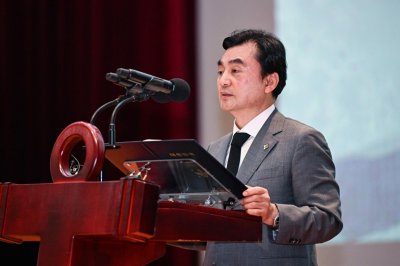

Defense Minister Ahn Gyu-back speaks during a ceremony at the Navy’s 2nd Fleet Command in Pyeongtaek, South Korea, 29 June 2026, to mark the 24th anniversary of an inter-Korean naval battle on the seas off South Korea’s northern Yeonpyeong Island. Six South Korean seamen were killed and 19 others injured in the 2002 skirmish, called the Second Battle of Yeonpyeong, which broke out as two North Korean patrol boats violated the inter-Korean maritime border in the Yellow Sea. Photo by YONHAP / EPA
July 1 (Asia Today) — South Korean Defense Minister Ahn Gyu-back urged senior commanders Wednesday to complete a key military capability review and work toward proposing a target year for the transfer of wartime operational control by the end of 2026.
“A military that cannot make its own decisions cannot become a strong military,” Ahn said while presiding over a meeting of senior commanders from across the armed forces at the Defense Ministry in Seoul.
Ahn called on the military to make every effort to present what officials have described as an “X-year” for the command transfer at this year’s South Korea-U.S. Security Consultative Meeting.
“Regaining wartime operational control is a path toward building a stronger Republic of Korea and advancing the South Korea-U.S. alliance to a new level,” Ahn said.
He said the transfer would allow the South Korean military to take the lead in wartime planning, operational preparations and the execution of military operations.
Ahn made similar remarks earlier Wednesday while chairing a quarterly meeting reviewing progress on the command transfer.
“This year, we face the critical task of completing the Full Operational Capability verification and determining the timing of the OPCON transition,” Ahn said. “Let us fulfill the historic mission of regaining wartime operational control.”
The Defense Ministry aims to complete verification of the future Combined Forces Command’s Full Operational Capability at the annual Security Consultative Meeting, or SCM, scheduled for November in Washington.
The ministry then plans to recommend a target year for the transfer to the presidents of South Korea and the United States.
South Korea regained peacetime operational control of its armed forces in 1994. During wartime, designated South Korean and U.S. forces remain under the operational control of the South Korea-U.S. Combined Forces Command, which is led by a U.S. general.
The allies have agreed that wartime command will be transferred after mutually established conditions are met rather than on a predetermined timetable.
The assessment of South Korea’s ability to lead the combined defense is divided into three stages: Initial Operational Capability, Full Operational Capability and Full Mission Capability.
The ministry said the Full Operational Capability assessment has been completed and that finishing its verification would allow the allies to begin specifying a transfer timetable.
U.S. and South Korean defense officials have repeatedly said the transition must be carried out in a stable and systematic manner under their jointly approved conditions-based plan.
Ahn also emphasized cooperation among the Army, Navy and Air Force.
He said each service must maintain its professional expertise but warned that service-specific interests should not create barriers to joint operations.
“Each service should ask itself how much time it allocates to joint training during the year,” Ahn said.
“Jointness must become part of military culture through the process of learning, training and thinking together beginning at the service academies and then be refined and developed in the field.”
The remarks came amid concern that the ministry’s plans to reform and potentially integrate elements of the military academy system could weaken the specialized education provided by each service.
Senior commanders also discussed developing a military based on artificial intelligence and advanced technology and restructuring South Korea’s armed forces by 2040.
They reviewed lessons from Russia’s war in Ukraine and recent fighting in the Middle East, including the growing battlefield use of artificial intelligence, drones and robots as relatively inexpensive and efficient weapons.
The ministry said it would begin pilot programs using newly developed artificial intelligence models during the second half of the year.
It also plans to provide private companies with a catalog of military data that could support defense technology development.
The military will expand the number of units assigned to test commercially developed drones from one to nine to support South Korea’s domestic drone industry, the ministry said.
— Reported by Asia Today; translated by UPI
© Asia Today. Unauthorized reproduction or redistribution prohibited.
Original Korean report: https://www.asiatoday.co.kr/kn/view.php?key=20260701010000411