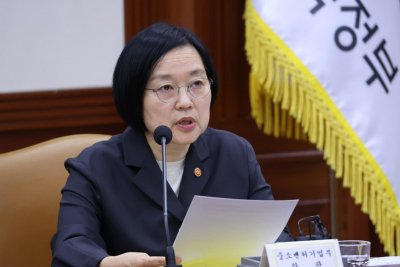

SMEs and Startups Minister Han Seong-sook attends a meeting of the emergency economic headquarters at the government complex in Seoul, South Korea, 22 May 2026. Photo by YONHAP / EPA
June 26 (Asia Today) — South Korea plans to create an investment and procurement system aimed at producing homegrown security technology companies comparable to U.S. data analytics company Palantir Technologies, the government said Friday.
The Ministry of SMEs and Startups announced the strategy with the Defense Ministry and Korea AeroSpace Administration during a meeting on future security innovation companies at the Blue House.
The plan seeks to accelerate the transfer of advanced civilian technology into national defense and security.
The government aims to develop five security technology companies valued at more than 1 trillion won ($651 million) and 50 companies with annual sales exceeding 100 billion won ($65.1 million) by 2030.
It will designate five strategic sectors covering drones and robotics, defense artificial intelligence and semiconductors, advanced sensors and materials, aerospace technology and cybersecurity and quantum communications.
Officials described the initiative as an effort to cultivate a “Korean Palantir,” referring to the U.S. company known for software that integrates and analyzes large volumes of defense and intelligence data.
The phrase is a policy description rather than the name of a company the government plans to establish.
Investment vehicle modeled on In-Q-Tel
The ministry plans to establish a government-backed investment organization modeled on In-Q-Tel, the nonprofit strategic investor created to support technologies relevant to U.S. intelligence agencies.
The proposed organization would make direct investments in early-stage security technology companies to address funding shortages.
The government also plans to support the establishment of a technology-focused asset management company tentatively called Korea Strategic Technology Partners.
Through government and private investment vehicles, officials aim to create as much as 10 trillion won ($6.5 billion) in strategic technology financing over the next five years.
The money would provide growth capital to startups and smaller companies developing technologies with potential defense, intelligence, aerospace or cybersecurity applications.
Faster research and procurement
South Korea also plans to introduce a special research and development program modeled on the U.S. Other Transaction Authority system.
The system would connect research, testing and government purchasing under a faster contracting process intended for rapidly changing technologies.
Selected companies could receive as much as 10 billion won ($6.5 million) each over five years.
The Defense Ministry and Korea AeroSpace Administration plan to create procurement systems capable of placing some advanced weapons or technologies into initial service within one year.
The government also plans to expand access to defense data through a catalog showing what information may be available to approved companies.
Aerospace authorities will support the development of core technology for a national space data center and platforms that allow businesses to use satellite information.
The strategy reflects the government’s view that traditional defense procurement moves too slowly for technologies such as artificial intelligence, drones, robotics and cybersecurity software.
Support for smaller technology companies
Minister of SMEs and Startups Han Seongsook said the global security industry is shifting rapidly from traditional hardware toward software, data and artificial intelligence.
“The government will provide bold and rapid support so startups and small venture companies with flexible and creative technologies can become leaders in security innovation,” Han said.
The government also plans to protect companies’ intellectual property rights and allow technologies developed through public programs to be adapted for civilian markets.
Officials said the strategy would help smaller companies enter a defense industry that has traditionally been dominated by large manufacturers and hardware-centered weapons programs.
The ministries plan to form an interagency committee, pursue special legislation and revise contracting rules to support the initiative.
— Reported by Asia Today; translated by UPI
© Asia Today. Unauthorized reproduction or redistribution prohibited.
Original Korean report: https://www.asiatoday.co.kr/kn/view.php?key=20260626010009467