The White House is expanding its campaign against international workers, targeting elite study and work visa holders with restrictions and a new investigation.
On Thursday, the Trump administration announced a probe into whether Stanford, Caltech, UC Davis and other universities across the country have been abusing a special visa used by international scholars and students to do research and work in the U.S. It is also suspending Microsoft, Adobe and six other tech companies from how they sponsor employees who are in the country under a highly skilled worker visa program.
The White House’s concern is that schools and companies are too quick to bring in people from outside the U.S. The moves rattled Silicon Valley executives and California educators who see easy access to the smartest, hardest-working people in the world as one of America’s greatest competitive advantages.
Vice President JD Vance said the universities being investigated are overusing J-1 visas to bring in students and researchers from abroad. The international scholars then take jobs and grants that could go to Americans.
“They are using these visas way too much,” he said. “They are using them to undercut the wages of American grad students and American researchers, and it simply has to stop.”
Harvard, Yale, Brown, the University of Pittsburgh, Arizona State and MIT will also be investigated.
Labor Department Inspector General Anthony D’Esposito said subpoenas have been served and “nobody will be getting a free pass because their name is carved into an expensive building.” Many universities have buildings named for foreign donors.
While most of the companies targeted for the tech visa restriction were Indian, Vance called out Microsoft.
“There’s been no company, unfortunately, in the United States that has abused this system more than Microsoft,” Vance told reporters at a White House news conference.
Vance said the company has abused the permanent labor certification program, which he argued has enabled Microsoft to hire international talent that is then paid less to replace American workers.
The new development suspends Microsoft from applying for green cards for workers who come to the U.S. on H-1B visas and later apply to become permanent residents.
American technology giants have relied on the H-1B visa program for decades to bring in thousands of skilled foreign workers they cannot find locally. Critics have accused the program of being riddled with fraud and abuse.
The administration’s power move came the same day President Trump awarded the National Medal of Technology and Innovation to two prime examples of international talent who came to the U.S. on student and work visas: Microsoft Chief Executive Satya Nadella and Tesla’s Elon Musk.
Cognizant, Infosys, Tata Consultancy Services, Wipro, HCL and Capgemini were also on the list of companies that will no longer be able to apply for permanent residence status for their H-1B employees.
Microsoft defended the use of H-1B and said in a statement that it looked forward to sharing additional information with the administration. In a post, it said that of the thousands of H-1B visa applications it submitted in the last fiscal year, 80% were to extend or change the status of existing Microsoft employees.
“They equal only 1% of our U.S. workforce. They are not new arrivals to our country,” the company said. “Microsoft only files H-1B petitions for those who meet the rigorous standards of this visa category.”
There’s a limit of 85,000 H-1B visas issued in a fiscal year, and they are selected through a lottery system. Last year, Microsoft was the third-largest beneficiary of the program, with 6,258 H-1B visas, according to data from U.S. Citizenship and Immigration Services. Amazon led the list, employing more than 13,000 H-1 B visa holders; Adobe had 777 approved applications.
The Thursday announcement has sparked confusion among technology workers and companies. Immigration lawyers point out that the action is not a blanket suspension of green card applications for all employers, but a targeted enforcement freeze on the Permanent Labor Certification program for the eight named corporations.
Proponents of H-1B note that Silicon Valley’s biggest tech companies are founded or run by immigrants, and the efforts to thwart H-1B have already started stifling talent flow and startup creation.
“It’s only going to probably hurt some companies and hurt the best and the brightest that are coming here,” said Devashish Mitra, professor of economics at Syracuse University. “It’s like throwing the baby with the bathwater.”
The J-1 investigations follow other actions, making it more difficult for international students to come to U.S. campuses. This year, the Department of Homeland Security said it wanted to end a “duration of status” visa policy that lets students stay in the U.S. through the completion of their programs and limit stays to four years. A federal judge blocked the change, and the government is appealing.
The Trump administration has also proposed charging colleges $70,000 per student for Optional Practical Training, which lets international students work in their fields of study for a limited number of years after graduation. Students now pay about $500.
In a statement, a Stanford spokesperson said the campus “complies with all applicable visa laws, including those relating to J-1 visas. We will cooperate with the investigation.”
A UC Davis spokesperson said the university “carefully complies with all federal laws and regulations for visas and looks forward to working with our federal partners to confirm compliance.”
A Caltech spokesperson did not respond to a request for comment.
About 275,000 people started J-1 programs in 2025, down from 301,694 in 2024, according to State Department data. Trainees and temporary summer workers, such as au pairs and summer camp counselors, also use the visa to enter the U.S.
Most were not at universities, with a majority working summer jobs.
The Trump administration’s crackdown has started to dissuade students from coming to the U.S., with experts expecting a drop in their registration when data for 2025 are released next month.
New research scholars fell 27% from 2024 to 17,622, about half the 2015 total. Most new research scholars in 2025 came from China, followed by South Korea and India.
California drew the most research scholars, 3,211. It ranked second behind New York for all new J-1s in 2025, with 23,167.
The State Department vets applicants and approves sponsors. Research scholars can stay up to five years
Sarah Spreitzer, vice president and chief of staff for government relations at the American Council on Education, said she had found little information about what the new probes would cover. But she said the federal government already has tools “to identify fraud, both in the granting of the visa and then also tracking the person through the Department of Homeland Security.”
“I think that all of these things are focused on bringing fewer international students into the United States, and we have been seeing that impact,” she said, expecting “a huge drop in our international enrollment this year, given everything going on.”
As Olivia Rodrigo kicked off the Unraveled Tour in support of her third album, “You Seem Pretty Sad for a Girl So in Love,” the internet had plenty to talk about—from her dissolving dress and flower-covered stage design to her custom-made, pink heart-shaped guitar.
The guitar was built by Luis Muñoz, a Mexican American guitar technician and luthier who operates out of a tiny repair shop in East L.A.
Originally from El Paso, Muñoz moved to Los Angeles in 2009 and took guitar repair classes in Hollywood, hoping to find his way into the music industry.
Music was always around Muñoz. He remembers discovering Slash after his family got cable television. Mesmerized by the Guns N’ Roses guitarist, who stole the spotlight with his top hat and searing guitar solos in videos for “Welcome to the Jungle” and “Sweet Child O’ Mine” on MTV’s Hot 100 music video countdown, Muñoz knew that was what he wanted to do.
He picked up his father’s old guitar and began learning to play, experimenting with the strings and teaching himself along the way.
His first opportunity came with singer-songwriter LP as a guitar technician. Muñoz admits he exaggerated his skill set to get his foot in the door, but he was determined to make the opportunity count.
“Once you’re in, you’re in,” he said.
Share via
Over the years, Muñoz has toured with artists including Smashing Pumpkins, Deftones, Bush, Anthrax, Fall Out Boy and his most recent touring job was with Rodrigo, after his wife, the pop star’s former bassist, told him she was looking for a new guitar tech.
Rodrigo’s heart-shaped guitar was another opportunity to put his craftsmanship on display.
“I’m sure Olivia has every guitar company in the world in her DMs, and she still trusted a small shop in East L.A.,” Muñoz wrote on Instagram, alongside photos of Rodrigo with the guitar.
“Five prototypes before I got the body right. It had to look cool, play easy, feel comfortable, and most of all, sound good. Built completely by hand, late nights after shop hours.”
Muñoz recalled the moment Rodrigo’s team reached out to request a custom-made guitar. He knew he had one shot to get it right: “In the back of my mind, I’m like, I only got one shot and it has to be made with love.”
The guitar took several months to complete and was built entirely by hand. He later hinted that it is currently one-of-one for now. After Rodrigo shared the guitar with her fans, Muñoz’s one-of-a-kind creation quickly became part of the visual identity of the tour — but for him, the significance went beyond the instrument itself.
Now retired from touring to spend more time with his family, including his 18-month-old daughter, Rosie, Muñoz says moments like seeing young fans in the crowd are what stay with him.
“One of my favorite things being on tour was seeing all the little girls lose their minds. The power of seeing that. Immediately in their head it’s like, ‘I can do that too.’ Imagine if I’m playing a tiny little role in that, yeah … all day.”
US President Donald Trump and leading tech companies have signed a voluntary agreement to regulate AI that includes internal reviews and joint monitoring, but falls short of introducing concrete ‘guardrails’.
Gunnison Copper (GCUMF) has appointed finance veteran Jennifer Hays as CFO, effective October 12, 2026. Fabio Rocha, who served as Interim CFO, will transition to Senior Director of Accounting and Reporting.
Hays brings roughly two decades of corporate finance, strategic investment, and
Open AI’s CEO has called for international coordination to address potential risks posed by artificial intelligence (AI). Sam Altman’s remarks come as Australia’s government reveals OpenAI’s AI agents hacked the country’s healthcare data tracking website.
What happened to the future we were promised? The vision that grew out of the 1990s techno-utopianism, when the internet was still a place of freedom and experimentation. Where are the infinite possibilities the early years of the millennium afforded, when social media meant AOL Instant Messenger and GeoCities, when our cellphones were not yet smart, and when personal tech evoked whimsy and excitement rather than anxiety and dread?
On a recent night in L.A., that digital optimism still existed. Here, at a clothing store on La Brea Avenue in the Fairfax District, something that felt lost was rediscovered. People were huddling around to play 1999’s “Crazy Taxi” on a Sega Dreamcast, or 2005’s “Tekken 5” on a PlayStation 2. They were surfing a perfectly re-created Y2K-era internet, and navigating an early version of Apple’s Photo Booth to snap selfies with a first-generation iSight webcam.
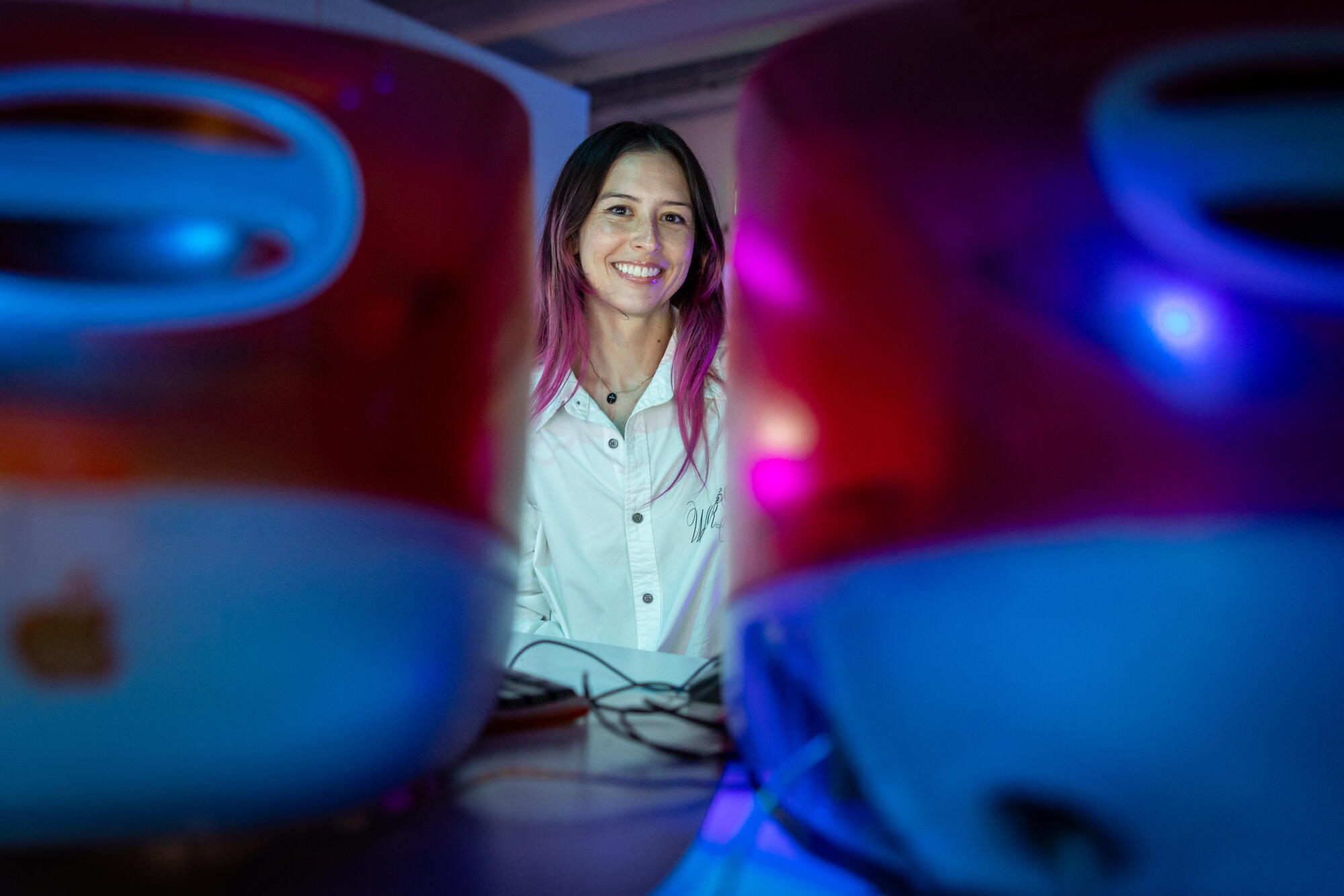
Paizley Lee created Dead Internet Theory to bring guests back to an era when tech evoked excitement rather than dread.
(Jason Armond / Los Angeles Times)
Yes, almost everyone was staring at screens, but almost no one was looking at their phone. Instead, the room felt alive and buzzing with energy. Technology was creating human connection rather than isolation.
Welcome to Dead Internet Theory, an event hosted by game designer Paizley Lee that’s both a celebration of vintage tech and a place to build community. The name is a tongue-in-cheek reference to the theory that the internet today is mostly bots, AI slop and corporate algorithms, while the human element is quickly disappearing from the web.
Lee started the event earlier this year after seeing how her friends reveled in hacking old hardware but had nowhere to show off their reimagined contraptions. She said Dead Internet Theory is a space to highlight “artists who don’t see the light of day,” a cyberpunk show-and-tell of sorts. “There’s a world of knowledge that comes from that person that can share and collaborate with another artist, and that’s really the future that we were promised, right then and there,” Lee said. “It’s the ‘Hey, look at what I made, look at what I’m interested in, and let’s share that.’ ”
Benjamin Palmer shows his project called Pan and Scan.
(Jason Armond / Los Angeles Times)
One of those artists sharing his work was Dan Ruth. Atop a low credenza, he displayed a black, leather suitcase that housed inside of it an old laptop attached to an external zip drive. On the laptop’s screen was a menu of various banned books — the Unabomber’s manifesto and “The Anarchist Cookbook” among them. Ruth had recently bought the trademark rights to the digital storage systems iOmega, Zip and Jaz. “They were what we all used in the ‘90s to transfer larger files,” he explained of the era before online storage and transfer infrastructure like Google Drive.
With his setup at the event, participants could choose whatever banned book they wanted and write it to a physical Zip disk (about the size of a saltine cracker) to keep forever. If Ruth’s installation is a bit provocative, his message is less controversial. At a time when servers are being shut down, physical media is being digitized out of existence, and the subscription model is supplanting personal ownership, Ruth believes this is a way to have data autonomy.
Guests play retro video games.
(Jason Armond / Los Angeles Times)
Lee’s own contribution to the evening is the full rainbow of Apple’s iMac G3 computers — those bubbly, teardrop-shaped desktops that debuted in 1998 to the famous “iCandy” ads displaying their colorful shells, and TV commercials scored to the Rolling Stones’ “She’s Like a Rainbow.” Over several months and multiple trips, Lee drove across the country collecting the G3s in their core five colors. And it wasn’t easy. She recalled sleeping in her car in the parking lot of a Cracker Barrel for a few nights because she had spent all her money on acquiring the computers.
It was the people Lee met in the months of gathering the G3s, however, that made it worth it: a single dad who collected vintage iMacs to bond with his son, an elementary school teacher who held onto the old computers because the school was going to destroy them.
“I met these really witchy, cool, queer programmers from MIT in Medford, Massachusetts, who invited me back for MIT Swap Fest, where I found Indigo,” said Lee, referring to another G3 color not part of the core five. “I met a guy who used to work in broadcast, and his wife just died of cancer. His mom moved in, and she has been trying to support him in getting rid of old things and not holding on to them too much.” Human moments made possible almost by the accident of holding onto a computer longer than most.
Lee’s pursuit of old tech hardware has always been, at its root, a means to meeting new people, hearing their stories and creating a relationship with them. “I care about people a lot,” she said. “I think every single person that touches any of my projects knows that I really care about people feeling good.”
Paizley Lee spent months collecting the full rainbow of iMac G3s.
(Jason Armond / Los Angeles Times)
With a mouse, Jaimie Wan clicks into the past.
(Jason Armond / Los Angeles Times)
When Lee finally acquired all five original colors (blueberry, strawberry, lime, tangerine and grape), plus all the additional colors (ruby, indigo, snow, graphite, sage and three limited edition colors), she began booting up the G3s computers to make sure they still worked. In the process, she discovered the forgotten digital detritus left on their hard drives: old resumes, photo albums, Word documents.
“It’s somebody’s life,” she said. “It feels weird to do anything with it, but it also feels weird to alter it.” In the end, she kept the old files and built a replica of the early ‘00s internet to live beside them on the computers. At Dead Internet Theory events, participants are given free reign to the G3s and slowly find clues Lee has left on their desktops that lead into a mystery game she created.
Back at the event, people flocked to the bank of iMac G3 computers. They clicked around, laughing, their eyes lighted up. “It’s really a trip seeing the old MacBooks,” said Shannon Stack after navigating one of the relics. “I remember having those in my elementary school classroom. Now, these are archival pieces. It’s freaky!”
Lee herself hovered around the computer bank, watching people interact with them and discovering the random documents left behind or playing one of Apple’s preset games. She asked a couple who had been tinkering around for over half-an-hour if they wanted a hint to her mystery. “No!” they respond excitedly.
While Dead Internet Theory has only been held in Los Angeles, Lee’s dream is to take it on the road. “I’ve got kids in Seattle, in Nashville, in Dallas that are emailing me and going, please bring it here,” she explained. The only thing stopping her was money, but that changed recently. A few weeks after the event on La Brea, she was approached by a sponsor. Now she’s making a tour happen, first with a pop-up event in New York City on Wednesday.
The event has become a place to gather and build community.
(Jason Armond / Los Angeles Times)
Recently, as Lee began driving across the country to set up, she stopped at a bed and breakfast near Red Lodge, Mont. When she learned the innkeeper had an old blueberry iMac G3 in her basement, she asked to take a look.
“I spent an hour getting her back on,” Lee said of rebooting the machine to give the innkeeper access. “And the face she made when it came back to life — literally priceless.”
The woman browsed through old photos of her daughters, their old school projects and other files forgotten over time. Afterward, the innkeeper gave Lee the computer, telling her it deserves a second life.
THE under fire boss of air traffic control has been told he “must quit” after a number of UK airports were hit with delays following another technical glitch.
Thousands of passengers saw their flights disrupted after an issue with the National Air Traffic Services [Nats] affected airspace in the north of England and in Scotland.
Passengers faced lengthy delays after another air traffic control failureCredit: ZenpixMartin Rolfe, the head of NATS, Britain’s air traffic control service is under-fireCredit: Alamy
Holidaymakers are facing lengthy delays after the issue which began at Nats’ Prestwick centre in Scotland.
Airports in Edinburgh, Belfast and Manchester were registering delayed flights and urged passengers to check with their airlines while Luton Airport said domestic flights had been disrupted.
Sign up for the Travel newsletter
Thank you!
Nats has stressed that the issue was unrelated to a massive outage that saw hundreds of flights cancelled just two weeks ago.
In a statement on the most recent air traffic control outage, a Nats spokesperson confirmed the issue was now fixed – but disruption is still on the cards for many holidaymakers.
But calls for Nats chief Martin Rolfe to resign have intensified after the latest debacle.
The 51-year-old senior executive of National Air Traffic Services was paid £1.5 million, including £871,000 in bonuses, last year and has already faced questions over his future.
The executive has previously been accused of overseeing a “litany of failures” during his time as CEO of the UK’s air traffic control services.
At least 200 flights departing or arriving into the UK have been cancelled so far today, aviation analytics company Cirium has said.
Ryanair has said more than 25,000 of its passengers are expected to be disrupted after the latest air traffic control incident and called for Rolfe to resign.
Chief operations officer Neal McMahon said: “Just three days after Nats assured airlines and passengers that it had introduced robust ‘mitigation plans’, its flight data processing system has failed again.
“More than 25,000 Ryanair passengers have already suffered disruption, with over 140 Ryanair flights delayed, yet Nats still cannot tell passengers when this disruption will end.
He added: “Rolfe has presided over repeated system failures, repeated passenger disruption and repeated failures to deliver an effective back-up system.
“Enough is enough. Martin Rolfe should resign today.”
Easyjet said in a statement: “A NATS Air Traffic Control system failure in its Prestwick Centre is causing delays to flights with some unable to operate.
“This, once again, calls into question the resilience of NATS’ systems and demonstrates the need for firm actions to prevent these repeated failures.
“We will do all we can minimise the impact of this for our customers and advise anyone due to fly today to check our flight tracker for the latest information.”
The airline said the latest disruption “calls into question the resilience of Nats’ systems.”
The firm said earlier this morning that engineers were working to resolve the issue but that regulations had been imposed to “maintain safety.”
Some passengers were left stuck on the tarmac while the issue was dealt withCredit: WovenPete/XQueues build up at Manchester Airport this morning after the latest technical glitchCredit: ZenpixDisgruntled passengers at the major airportCredit: Zenpix
And, British Airways said it is “disappointing” that some customers may experience disruption after “yet another technical fault with Nats”.
A spokesperson for the airline said: “Yet another technical fault with Nats means some of our customers are likely to experience disruption to their travel plans today.
“This is disappointing and whilst it is an issue that is entirely out of our control, we’re doing everything we can to limit the impact on customers and are keeping them updated.”
A Nats statement this afternoon read: “The issue in our Prestwick centre is now fixed. We are working with airports and airlines to safely lift air traffic regulations as quickly as we can to minimise any further disruption.
“Passengers should still check the status of their flight with their airline.
“We apologise for the disruption.”
Passengers tpoday are being advised to check with their airline for information on their flights.
Holidaymakers at Glasgow airport were reportedly been left waiting on the tarmac for hours amid the delays.
Meanwhile, Luton Airport said domestic flights had been disrupted by the air traffic control issue.
And several flights at Manchester Airport have been delayed with passengers warned to expect further disruption.
However, most airports south of Manchester are broadly unaffected by the issue but flights travelling north may be subject to some delays, Nats said.
British Airways and Easyjet have issued messages to passengers hoping to travel today, warning them that some delays are expected.
Highlands and Islands Airports Limited has said flights are being disrupted across all of the airports it operates.
Meanwhile, Belfast International Airport said it is experiencing some delays amid the air traffic control issue.
Passengers and airlines “deserve better”, an aviation industry body has said after the second air traffic control issue within two weeks.
Tim Alderslade, chief executive of Airlines UK, said: “The UK’s ATC (air traffic control) system is critical national infrastructure and it must be resilient enough to keep people moving.
“Passengers and airlines deserve better and the independent CAA (Civil Aviation Authority) report, together with the forthcoming Civil Aviation Bill, must address the underlying weaknesses in the system so that these failures stop happening.”
The previous Nats failure affected thousands of passengers with many stuck abroad amid the chaos.
Nats announced that a “technical issue” with its “flight processing system” had caused the widespread travel chaos just two weeks ago.
A majority of the UK’s biggest airports were brought to a standstill by the failure, which is understood to have been caused by a software error.
It led to calls for Nats chief Martin Rolfe to resign with furious airline executives blaming him for the failure.
TransportSecretary Heidi Alexander previously demanded Rolfe launch a rapid review into the chaos last week and said that she did not believe the most recent air traffic control issue was “unavoidable.”
He previously faced turbulence in 2023 when he oversaw his first failure in air traffic control, which affected more than 250,000 passengers.
The August bank holiday failure was sparked when a small piece of incorrect data set off a mass system failure lasting just a few hours.
PM Anthony Albanese asks Apple CEO Tim Cook to back Canberra’s online safety laws to ‘keep Australians safe’.
Published On 20 Sep 202620 Sep 2026
The Australian government is seeking support from global tech giants as it works to strengthen the country’s online safety laws and artificial intelligence (AI) regulations.
Prime Minister Anthony Albanese, who met Apple CEO Tim Cook at the tech company’s headquarters in Cupertino, California, on Saturday, said that “Australia can’t do it alone” when it came to protecting children from the dangers of the internet.
Recommended Stories
list of 3 itemsend of list
“We spoke about what we’re doing to protect children from online harm and the work ahead,” Albanese wrote on social media.
“We’re putting stronger rules in place to keep Australians safe online,” he said. “And now, big tech companies like Apple are stepping up too.”
Albanese, who is also in the United States for the United Nations General Assembly, used his trip to call for stronger AI regulation after dire safety warnings from industry leaders.
Australia will introduce new standards for AI by the end of the year, he said.
In a video posted to his X account, Albanese said his Labor government is “making sure technology works for Australians”, and not the other way around.
In a post on X, Cook also said he shared with Albanese new “strong and intuitive controls to help keep kids safe online”.
New Australian legislation unveiled this month would place a “duty of care” requirement on the firms behind popular platforms, such as Facebook, TikTok and Instagram, and allow users to turn off their algorithms.
The draft laws will be introduced to parliament later this year after consultation with social media companies, industry bodies and civil society groups.
The opposition Liberal-National Coalition opposes the bill “in its current form”, according to a statement published on September 10, saying that it “contains inadequate safeguards for free speech and journalism, and leaves too much power in the hands of the Communications Minister”.
Australia implemented legislation barring children under 16 from social media platforms last year as part of a world-first crackdown designed to protect children from online bullying and “predatory algorithms”.
However, data last month found that Australians under 16 continued using social media apps such as Instagram and TikTok despite the ban.
Deir el-Balah, Gaza – A handful of electronic components, a few wires and a basic programmable circuit board are enough to bring a group of curious children around a table in central Gaza to learn about robotics.
Students at The Next Gen Team: Rising Robotics Engineer Project in Deir el-Balah learn how to integrate sensors into alarm systems, study robotics, understand how motors and drive units work, as well as get firsthand experience with programming.
Recommended Stories
list of 4 itemsend of list
The children’s research could save lives in the future. The robotics and early warning systems they are working on could make way for bigger developments such as early detection of gas leaks and fires or help rescue workers access hard-to-reach areas, such as victims trapped under rubble.
Today’s lesson will also teach students the sciences of the future and help them keep pace with technological advancements happening outside Gaza’s borders.
Before the war, students had access to schools, universities, incubators and training programmes to pursue an interest in technology.
With much of that infrastructure now destroyed or damaged during Israel’s genocidal war on Gaza, there are few places and tools for students to work with.
But their interest in robotics and will to learn are helping them maintain their skills and ambitions for the future, something they hope will be of benefit when the bombs stop falling on Gaza.
Hamza al-Atrash, 16, is a student taking part in the “Next Gen” project and learning how electronic components can be used to develop robots and early-warning systems. To do this, he is using an Arduino controller – a programmable circuit board which connects sensors – and some other electronics.
Students work with what they have, but a shortage of equipment and electricity outages make studying a challenge.
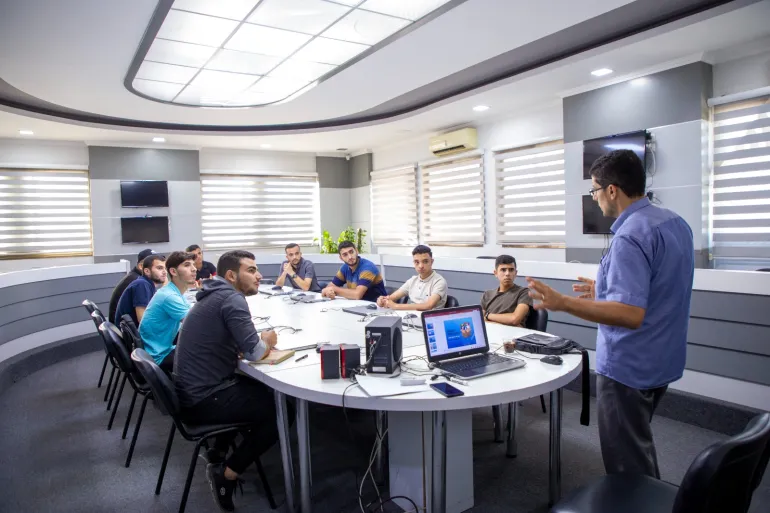
A view of a technology incubator in Gaza before the war, where students received training in technology and innovation [Iyad Al-Qatrawi/Al Jazeera]
“We have capabilities and aspirations that we want to develop, and we try to take advantage of every available opportunity for learning and training,” Hamza tells Al Jazeera.
Hamza hopes the skills that he and his cohort learn in class will benefit his community and provide new opportunities for young people in Gaza.
“The lack of devices and equipment doesn’t mean we’ll stop. It pushes us to look for solutions and make the most of the simple tools we have,” he said.
The challenges facing these students are part of a wider disruption to Gaza’s technology and innovation sector.
Before the war, Gaza had several incubators that supported technology projects and startups. Bahaa al-Masri, head of the training team for the Early Warning Systems and Robotics Project, said it provided a rare bit of hope for children and young adults in the besieged enclave.
“These incubators provided an environment for training and development. They helped innovators and entrepreneurs turn their ideas and projects into prototypes and ventures,” he told Al Jazeera.
The war severely damaged this ecosystem: training spaces were lost, equipment difficult to find, and students and innovators left with limited opportunities to experiment and develop their ideas.
A view of a technology incubator in Gaza prior to the war, which provided an environment for training, incubating tech projects, and supporting students in the fields of technology and innovation [Iyad Al-Qatrawi/Al Jazeera]
Although challenges remain, the trainers are continuing their mission of educating budding tech experts in Gaza.
“We have a generation of students who possess genuine passion and talent in technology and digital systems,” he told Al Jazeera. “They need the environment and tools to develop these abilities and turn their ideas into projects that can serve their community and their future.”
Education pays the price
The near-collapse of Gaza’s technology sector has coincided with the widespread destruction of the education system, with schools, universities and research facilities repeatedly targeted by Israel during the war.
Preliminary estimates from the Government Media Office in Gaza put direct losses to the education sector at approximately $4bn. Seventeen higher education institutions have been completely or partially destroyed since October 2023, preventing about 620,000 high school students and 90,000 university students from continuing their education.
Approximately 20,228 students and 830 teachers and educational staff have also been killed, along with 194 scientists, academics and researchers.
For students seeking to enter technical fields, the loss of such educational facilities and teachers means fewer opportunities to gain practical experience and hone their skills.
Before the war, the IT industry was one of the promising sectors of Gaza’s economy and a rare source of foreign income, said Ahmad Abu Qamar, an economic affairs specialist and board member of the Palestinian Economists Syndicate.
It was also an opportunity for employment for thousands of university graduates entering a job market with high unemployment, with roughly 80 percent of its economic activities directed towards foreign markets.
Abu Qamar estimates that the IT sector now runs at less than 25 percent of pre-war levels, while more than 70 percent of IT companies in Gaza have completely or partially halted operations.
But even if a company’s offices or equipment survived the war on Gaza, damage to digital infrastructure has also made it difficult for companies to continue functioning.
Prices of some technical equipment – including computers, mobile devices, servers, routers, fibre-optic lines, and cabling – used in the industry have increased by more than 600 percent due to the difficulties of importing devices during Israel’s ongoing siege on the enclave.
According to his estimates, about 30,000 IT professionals have lost their jobs since the war began. General unemployment is at nearly 80 percent and poverty at more than 90 percent in the enclave.
UCAS Technology Incubator, one of the most prominent incubators of the University College of Applied Sciences in Gaza, was destroyed during the war, as part of extensive damage to the institutions and structure of the technology and digitisation sector in the Strip [Iyad Al-Qatrawi/Al Jazeera]
Brain drain
A severe shortage of vital IT equipment – such as storage devices, routers, and laptops – has been compounded by the destruction of supporting internet and electricity infrastructure, including primary and secondary networks, according to technology and digital economy expert Abdullah Altahrawi with the UCAS Technology Incubator. This makes the task of rebuilding Gaza’s IT sector an even bigger challenge than before the war, particularly with Israel’s more crippling siege on Gaza.
“The repercussions have extended to dealings with foreign markets, including the purchase of servers and electronic services, the management of digital accounts, the use of cards and e-commerce,” Altahrawi said.
Before the war, Gaza’s five main incubators provided training, mentoring, workspaces and support for tech startups. Perhaps most crucially, it also gave students a place to develop their skills, connect with foreign markets, and find job opportunities.
Just two incubators – the UCAS Technology Incubator, affiliated with the University College of Applied Sciences, and the Ma’an Center for Innovation and Entrepreneurship Incubator, have resumed operations since the October 2025 ceasefire. But their capacity has not managed to exceed 20 percent of pre-2023 levels.
Due to the damage caused by three years of Israeli bombing and a shortage of real estate, just 1 percent of technology companies now have offices, while only 10 percent of business incubators have an operational office space.
Companies looking to rebuild and universities ready to teach a new cohort of tech students have also been hit by a brain drain in the sector, severely hindering development and innovation.
“More than 80 percent of highly skilled and experienced professionals in the technology and digital fields have left the Gaza Strip,” Altahrawi said. “Gaza’s future is inseparable from its ability to restore and develop its technology sector.”
RIYADH: The Hedayathon event — a hackathon organized by the Presidency of Religious Affairs in partnership with the University of Jeddah — recently concluded. Participants were asked to come up with ways to enhance services for visitors to the Grand Mosque and the Prophet’s Mosque.
The Hedayathon aimed to foster innovation and harness scientific and technological capabilities to develop solutions that enhance religious services and enrich visitors’ experiences, according to a report by the Saudi Press Agency.
The event brought together innovators, developers, students, academics, startups, entrepreneurs, and people interested in outreach (da’wah) and religious guidance.
There were three winning projects. First place went to the Madaar team for their Maqam Platform project, which won SR30,000 ($8,000). Second place — and SR20,000 — went to the Tala team for Every Signal is a Recited Verse, an idea aimed at serving people with special needs. Echo Tech’s Sanctuary Translator — a project designed to develop legal translation — took third place, winning SR10,000.
Sheikh Abdulrahman Al-Sudais, president of Religious Affairs at the Grand Mosque and the Prophet’s Mosque, stressed the importance of leveraging technology and innovation to develop religious services and make them accessible to visitors.
In remarks shared on the presidency’s X account, Al-Sudais said: “Serving pilgrims of the Grand Mosque and the Prophet’s Mosque is a tremendous responsibility. It requires intensified efforts and mobilized capabilities to facilitate their access to religious services, enabling them to perform their worship with ease and tranquility.”
Obaid Al-Mudhaff, the university’s president, said the partnership with the presidency represents a model of integration between field expertise, scientific research, and innovation, helping develop quality solutions to serve the Two Holy Mosques and their visitors.
Salem Areej, general supervisor of the Hedayathon event, said the initiative was launched not only as a tech competition, but also to use technology to better serve pilgrims.
The hackathon’s objectives included enriching visitors’ religious experience, developing religious translation solutions, maximizing communications and media impact, developing religious guidance tools, building platforms for teaching the Holy Qur’an and delivering scholarly lessons, answering worshippers’ questions, and facilitating access to religious services for people with disabilities.
Activities included panel discussions, an exhibition, workshops, and consultations.
The presidency also signed a memorandum of understanding with the Saudi Translation Association to enhance cooperation and develop multilingual religious content.
















![A view of a technology incubator in Gaza before the war, where students received training in technology and innovation [Iyad Al-Qatrawi/Al Jazeera]](https://i0.wp.com/occasionaldigest.com/wp-content/uploads/2026/09/1-1789814125.jpeg?w=640&ssl=1)
![A view of a technology incubator in Gaza prior to the war, which provided an environment for training, incubating tech projects, and supporting students in the fields of technology and innovation [Iyad Al-Qatrawi/ Al Jazeera]](https://i0.wp.com/occasionaldigest.com/wp-content/uploads/2026/09/3-1789814366.jpeg?w=640&ssl=1)
![UCAS Technology Incubator, one of the most prominent incubators of the University College of Applied Sciences in Gaza, after its destruction during the war, as part of extensive damage to the institutions and structure of the technology and digitization sector in the Strip [Iyad Al-Qatrawi/Al Jazeera]](https://i0.wp.com/occasionaldigest.com/wp-content/uploads/2026/09/2-1-1789814285.jpg?w=640&ssl=1)