



Paul Mueller approves $15.4M share repurchase program (MUEL:OTCMKTS)
- Paul Mueller Company (MUEL) board approved a tender offer to repurchase up to 35,000 shares of common stock at $440 per share, representing a maximum aggregate purchase price of about $15.4M.
- The tender offer is set to begin on May 8 and expire on June 5, unless extended.
- The company said the move reflects its commitment to returning excess cash to shareholders while providing additional liquidity.

Wardley vs Dubois: Frank Warren on being in both corners for world title fight
Daniel is a very introverted man. He’s not somebody who goes out boasting, and I know he’s taken some stick this week because of that quiet nature.
I am protective of him. I always try to talk to him before we go into any media event, prepare him.
He just doesn’t enjoy that part of the fight game. He’s really not into all the verbals.
Whoever you are, you look at how people behave and what their make-up is. That’s if you want to get the best out of them.
You have to be clever, not sly, in how you deal with it. Good interviewers do that. Daniel does all his talking in the ring.
I don’t think he’ll ever change. His dad is his mentor and that’s all he knows – he’ll look to his dad before answering the question and still usually does.
That family is a tight unit. Some boxers, as they get successful, go partying but he doesn’t do any of that stuff.
After he beat Anthony Joshua, he just wanted to go home.
I had to literally push him into the press room so the world could see him after that magnificent performance.
Our job as promoters is to find something you can bring out and get it to the public, so they want to be on this journey with this fighter.
Sometimes it’s difficult. With Prince Naseem Hamed, for example, it was easy. When I first met Naz, I knew exactly what I was going to do with him and how we were going to promote him.
So some guys are easily promotable, others it can be hard work, but that’s the business we’re in.
But Daniel has come out of his skin a bit lately. The funniest thing for me was when he did the head-to-head with Filip Hrgovic a few fights ago.
Hrgovic said Daniel had no heart, and Daniel just said he was going to knock him out – using an expletive I wouldn’t like to repeat.
I had never heard Daniel even swear before!
Everybody there was like: ‘What is that?’ It was like getting the vicar to swear. He found a voice from within himself.

Thunder pull away from Lakers in NBA playoffs, while Pistons down Cavs | Basketball News
The Oklahoma City Thunder pulled away late to beat the Los Angeles Lakers 125-107 in an NBA playoff thriller, taking a commanding 2-0 lead in their best-of-seven Western Conference semifinal series.
Shai Gilgeous-Alexander, the reigning NBA Most Valuable Player and finalist for the award this season, scored 22 points and the Thunder capitalised on 21 Lakers turnovers on Thursday to hand LeBron James a defeat in his 300th career playoff game.
Recommended Stories
list of 4 itemsend of list
Elsewhere, Eastern Conference top seeds Detroit are also up 2-0 after a 107-97 home win over the Cleveland Cavaliers.
In Oklahoma City, Gilgeous-Alexander was again below his best, but he was amply supported.
Chet Holmgren scored 22 points and pulled down nine rebounds, Ajay Mitchell added 20 points, and Jared McCain delivered 18 points off the bench to help the Thunder withstand a 31-point performance from Austin Reaves.
James, who became the first player to contest 300 postseason games, scored 23 points and handed out six assists, and the Lakers led by five points early in the third quarter.
But with league-leading scorer Luka Doncic still sidelined by injury, the Lakers could not hang on, even with Gilgeous-Alexander on the bench for considerable stretches because of foul trouble.
Oklahoma City produced a 22-5 scoring run to seize control and will aim to keep the pressure on when the series shifts to Los Angeles for games three and four on Saturday and Monday.
“We’ve got to be the aggressor,” Gilgeous-Alexander said. “I feel like they were playing with more force, they were attacking harder, making quicker decisions, playing with a better sense of urgency, especially in the first half.
“As long as we take care of that, we should have our foot in the right direction.”
A bruising contest saw both teams irked by the officiating. Gilgeous-Alexander was whistled for a flagrant foul, and both he and James were sprawled out under the basket after a foul by Reaves late in the game.
Lakers coach JJ Redick took issue with the officiating, saying the Thunder “have a few guys who commit a foul on every possession”.
But, he added, “We didn’t lose because of the refs.”
Cunning thrives in ‘high-stakes’ situation
In Detroit, Cade Cunningham scored 12 of his 25 points in the fourth quarter and handed out 10 assists to lead the Pistons.
They set the defensive tone early but had to rally late after the Cavaliers battled back to take a two-point lead early in the fourth quarter.
“I just want to win games,” Cunningham said of his dominant fourth-quarter performance. “It’s been a lot of games down the stretch where it’s tight … The ball is in my hands and I’ve got to make plays with it.
“The pressure and the moment, it’s high stakes … all of that stuff fuels me.”

Cleveland’s Donovan Mitchell scored a game-high 31 points. Jarrett Allen chipped in 22, but James Harden had just 10 on three-of-13 shooting, and his four turnovers included a costly giveaway in the final minute.
The Cavaliers have a mountain to climb as they head home for game three on Saturday and game four on Monday.
The Pistons, who locked up the top seed in the East with the third-best record in the league, had to fight back from a 3-1 deficit to beat the Orlando Magic in the first round.
In this series, they were determined to hold on to home-court advantage, and game two featured another lockdown defensive display from Detroit, leading to a 54-43 halftime lead.
The Cavaliers responded in the third quarter and took the lead on Evan Mobley’s dunk minutes into the fourth – their first lead since the opening minutes.
But they could not hang on. A Duncan Robinson three-pointer put Detroit back in front, and they would not trail again.
Cunningham said the Pistons will have to “turn up our energy even more” in Cleveland.
“They’re a tough team to beat at home,” he said.

Migration is getting riskier even as progress is made | Migration
As governments gather in New York for the second International Migration Review Forum (IMRF) to assess progress on global migration commitments, a central question looms: is the Global Compact for Migration improving conditions for people on the move?
The answer is yes.
Adopted in 2018, the Global Compact for Safe, Orderly and Regular Migration is the first international agreement aimed at making migration safer and more humane through cooperation. For the Middle East and North Africa, the International Organization for Migration’s Global Overview of Migration Routes (2025), which tracks migration patterns, risks and deaths along major routes worldwide, offers a mixed picture. Some routes are shifting, but the risks people face remain severe, and in some cases are worsening.
Across the Mediterranean, arrival numbers alone can be misleading. In 2025, just more than 66,500 people reached Italy and Malta via the Central Mediterranean Route, almost identical to the year before. Arrivals to Greece, Cyprus and Bulgaria along the Eastern Mediterranean Route fell by about 30 percent, while the Western Mediterranean Route saw a modest rise. The Western African Atlantic Route to the Canary Islands recorded a dramatic 62 percent drop.
Taken in isolation, these figures might suggest reduced pressure on Europe’s borders. But lower arrivals do not automatically mean safer journeys. On the Eastern Mediterranean Route, deaths and disappearances nearly doubled in a single year. On the Western African Atlantic Route, deaths barely declined despite the steep drop in arrivals – meaning the probability of dying at sea increased. And on the Central Mediterranean Route, more than 1,300 people are known to have died in 2025, keeping it among the world’s deadliest migration corridors.
These trends reflect a broader reality: When border controls tighten or routes shift, journeys often become longer, more fragmented and more dangerous. People continue to move, but with fewer options, many are pushed towards irregular and high‑risk pathways.
Sudan illustrates how crises can reshape mobility across an entire region. Three years after the conflict erupted in April 2023, Sudan has become the world’s largest displacement crisis. At the peak, the number of internally displaced people more than tripled, reaching more than 11.5 million. Nearly 4 million people have returned home – often to damaged or partially destroyed housing – but almost 9 million remain displaced. Against this backdrop, it is not surprising that more Sudanese nationals are appearing along both Eastern and Central Mediterranean routes. For many, these journeys are not a first choice but a last resort, when options in Sudan and neighbouring countries are constrained.
The MENA region is also deeply connected to global mobility patterns. Movements from Asia and the Pacific to Europe increased significantly in 2025, with nearly one in three irregular arrivals originating from that region. Many of these journeys intersect with North Africa and the Eastern Mediterranean. A visa policy change in one country, a conflict flare‑up in another, or a new enforcement measure along a corridor can reshape risks across thousands of kilometres.
Meanwhile, the underlying pressures driving mobility in and around MENA are not easing. The region has one of the world’s youngest populations, with youth unemployment often exceeding 20 percent. Climate‑related shocks – droughts, floods, heatwaves – are increasingly interacting with conflict and economic stress. These factors rarely operate in isolation; they compound one another, shaping both internal displacement and cross‑border movement.
What does this mean for policy? Several priorities stand out.
First, search and rescue capacities must adapt to evolving realities. Stabilising or declining arrival numbers should never be mistaken for reduced risk. The sharp rise in deaths on some routes underscores the need for stronger cooperation on distress response, better data on deaths and disappearances, and sustained support for front-line communities. Saving lives at sea and on land is a humanitarian, legal and moral imperative.
Second, safe and regular pathways must be expanded. When regular options are limited, people facing violence, economic hardship or family separation are more likely to turn to irregular routes. Well‑designed labour mobility schemes, family reunification channels and humanitarian pathways can reduce reliance on dangerous journeys while supporting development in both origin and destination countries.
Third, better and shared data are essential. The Global Overview and Sudan displacement figures show the value of combining arrival statistics, intention surveys and information on deaths and missing people. Continued investment in national data systems can help governments anticipate pressures and design more effective policies.
Finally, intensified cooperation is required. In New York this week 130 states from all over the world are engaging in driving forward implementation of the Global Compact, recognising that migration is a phenomenon best governed through principled and constructive partnership.
This IMRF is about collaboration, and clarity about what we will do next. Expand safe and regular pathways. Strengthen fair recruitment and worker protection. Invest in data and protection systems that save lives. And cooperate across borders to take down criminal networks. If we get this right, fewer people will suffer, fewer lives will be lost – and more people, and societies, will thrive. That is the opportunity before us – here, and now. Let us seize it – together.
The views expressed in this article are the author’s own and do not necessarily reflect Al Jazeera’s editorial stance.

My father still hasn’t listened to my music, reveals country star Ashley McBryde as she opens up on Arkansas childhood
IN northern Arkansas on the banks of South Fork Spring River in the region known as the Ozarks, you’ll find a tiny settlement called Saddle.
Today, it comprises a modest Baptist church, an old timber-clad general store turned events venue (now up for sale) — and very little else.
Not so far away, out in the wilds, is the farm where country star Ashley McBryde grew up.
It is the place where she first picked up a guitar and discovered her passion for music, the starting point of her journey to the world stage.
Along the way, she rebelled against her strict preacher father, sang in biker bars, acquired the striking collection of tattoos adorning both arms and fought alcohol addiction.
Yet her inspirational climb has taken her to country music’s spiritual home, the Ryman Auditorium in Nashville and the O2 Arena in London for the C2C festival.
READ MORE ON COUNTRY MUSIC


And next month she will support a titan of the genre, Garth Brooks, at Hyde Park in front of 65,000 people.
Since becoming sober in June 2022, Grammy-winning McBryde is making some of the best music of her life, and she’s doing it by returning to her roots.
On one of the rousing songs on her fifth studio album, the aptly titled Wild, she sings these lines with mighty conviction…
“It’s in my throat, it’s in my bones, it’s on my boots and in my blood. That Ozark streak sureе runs deep and it sticks to me like that Arkansas mud.”
I tell her that my only experience of her childhood stomping ground is the TV series Ozark about a Chicago family who decamp to the area, for money- laundering reasons as you do, where they encounter small-time hillbilly criminals.
“Yeah, I’ve known some characters like those,” says McBryde with a knowing smile. “They did a great job on Ozark.”
She is one of a new breed who has learned to accept “the Nashville machine” while remaining true to themselves.
“I’ve done a good job, not a perfect one, of being inside the machine but also sticking to my guns,” she affirms.
“It’s an industry that asks the brunette to be blonde and the girl that’s 5ft 3in to be 6ft.”
At times, McBryde felt she was “falling short of being shinier, blonder, skinnier” but, she adds hand on heart: “You’re just not getting rid of what’s in here.”
In the same bracket, you will find two big bearded male artists keeping it real — Luke Combs and Chris Stapleton, who are among America’s biggest selling artists right now.
These are the natural successors to the original country “outlaws,” who include McBryde’s hero Kris Kristofferson, fellow Arkansawyer Johnny Cash and last man standing Willie Nelson.
She delivers kick-ass songs, drawing on rock and roll as much as anything, but she can also turn her intuitive talents to tear-stained balladry or a country-pop masterclass like recent single What If We Don’t.
I’m meeting the vivacious 42-year-old during her whistle- stop visit to London, and we find ourselves beside a picture window overlooking Kensington Gardens filled with people catching the glorious spring sunshine.
I can’t help sensing the contrast between the swish hotel suite in a teeming capital city and Ashley McBryde’s isolated upbringing that is, in part, the inspiration for her new album.
Taking my cue from the name of her album, I ask her if she was a “Wild” child.
“I think I was a good kid but I was also in trouble a lot,” she replies.
“I asked a lot of questions that people didn’t want to answer. They didn’t care for a child who wanted to know why things had to be a certain way.
“But I was always out in the woods, dreaming up this or that. I would be one of the X-Men, making swords and guns out of sticks.”
The youngest of six, she paints a picture of her childhood that conjures up classic American literature — Little Women, Tom Sawyer or Little House On The Prairie.
In fact, every night her “angel” of a mother would read her a chapter of the latter book as well as one from the Bible.
“I didn’t own shorts until I was an adult,” continues McBryde.
“Because my legs would get so ate up with tick bites from being out in the briars and thorns. It was a very physical existence.
“We worked real hard. We had cows, chickens and horses but my favourite thing about it was I could go wherever I wanted.
“I could go out walking for a whole day. I remember one time I asked mom if I could camp out for the night.
“She said, ‘Why would you want to do that?’ And I said, ‘I just want to cook my soup on a campfire’.
“She was like, ‘Well, knock yourself out’.”
But there was a duality to life in this rustic idyll because McBryde’s farmer and preacher father, William, imposed his strict religious beliefs at home.
This perhaps explains why she has been singing the late Randall Clay’s storming Rattlesnake Preacher live for several years and why, finally, her studio version opens Wild in such uncompromising fashion.
“There was freedom even though we lived in a very, very rigid household,” says McBryde.
“It was all right as long as what you wanted to do was within the parameters of what was considered to be right.
“So there was nothing wrong with going for a walk or riding a horse or digging a hole or learning to play a guitar. Those things were totally OK.
“But it was very much a case of the man being the head of the family, the way Christ is the head of the church — and anything that went against that could go to hell. There was no break.”
Although she was generally expected to attend church on “Wednesday night, Sunday morning and Sunday night,” sometimes even that was off-limits “if they were doing something that my father deemed not in alignment with his book”.
This brings McBryde to an extraordinary revelation: “To my knowledge, my father has still not listened to my music.”
That said, she admits that he had to hear one of her songs, Bible And A .44, written about him and appearing on her debut EP in 2016, Jalopies & Expensive Guitars.
It includes the lines: “He taught me how to hunt and how to love the Lord/He carried a Bible and a .44/And they just don’t make ’em like that no more.”
McBryde says: “I sang it to him after I wrote it. He told me, ‘You painted me in an awful nice light. I wish all of it could be true.’
“And I said: ‘You don’t see what I see because you’re not looking at what I’m looking at.’
“It was a nice way to give him a break from being the villain because a lot of the time he was. There were really great qualities about him, too.”
As for her beloved mother Martha, she says: “She’s an absolute angel. I don’t think she’s ever done anything wrong.
“She can make you an outfit right now while she’s making you a casserole while she’s praying for someone who has lost a limb.”
It was in this old-school world that McBryde developed her love of making music, becoming enchanted by the songs of the rugged Kristofferson and the more polished John Denver.
“I knew I wanted to be a singer and a songwriter from a really young age, even before I was a teenager.”
She knew she was on the right path when, after leaving home, she “started making enough playing in bars not to wait tables anymore and to keep the lights on in my apartment”.
A rebel at heart, McBryde recalls playing biker dives and, like the clientele, she got tattoos, wore leather and drank heavily.
As she tried to get a foothold in the country music scene, there wasn’t much hope “for a non-blonde who was covered in tattoos”.
“I did meet a lot of friction,” she says. “Some labels were not in any way interested.”
But her irresistible talent was spotted by, among others, Eric Church, another country star who likes to say it how it is.
“He was a great champion,” says McBryde. “A great name to be associated with because of the way he makes records and the way he approaches music.
“For him to say, ‘I like this songwriter’ does open a door.”
Evidence of that door being opened arrived in 2018 when McBryde’s major label debut, Girl Going Nowhere, was released on Warner Nashville, including one of her signature songs, A Little Dive Bar In Dahlonega.
It’s about resilience in the face of a break-up and, among its references to drinking is the line, “We’ve all got a number we don’t wanna drunk dial.”
I guess it alludes to another aspect of McBryde’s life because, running parallel to her early years in the business, was a dependence on alcohol, which she’s finally coming to terms with.
One of her new album’s most captivating songs is the beautifully sung ballad Bottle Tells Me So.
“I didn’t want to have a problem with alcohol but, like it or not, it’s part of my story,’ admits McBryde. “And I didn’t want to talk about it for a long time.
“I was either drinking, drunk or hung over at all times – and that’s really tough.”
In 2022, matters came to a head when, on the advice of her team, McBryde went into rehab.
Now proudly four years sober, she says: “Writing Bottle Tells Me So was a way to acknowledge it without saying, ‘I’m sober and you should be too.’
“You don’t want to preach but life is so much better for me now that I don’t drink.
“In that song, I’m not saying I’m never going to drink again. There’s no shame involved.”
In explaining why a habit that began while “acting cool and hanging with friends”, McBryde says: “I’ve heard it said that the addicts of all types aren’t addicted to any substance.
“They’re addicted to not feeling their feelings. I would say that is spot on for me.
“Not consuming alcohol anymore is probably the simplest part of becoming sober. You have to completely re-meet yourself and rewire everything.”
McBryde says she feels “1000 per cent” better, both physically and mentally. “I look better and I feel better. Despite still feeling anxious, I’m stronger than I knew and that makes me happy.”
She recalls her first show after leaving after getting sober: “I left treatment on Tuesday, got in the bus on Wednesday and was on the stage on Thursday.
“It was my first time being more than 30 days dry and it was the most terrifying, coolest thing I will ever experience.
“I was worried and asked myself, ‘What if I can’t do this?’ But I got out there and was spot on. Bullseye! Now I’m at the top of my game.”
McBryde is undoubtedly dialled in on Wild, produced with sparkle and empathy by John Osborne of country duo Brothers Osborne.
“John’s magical, playful and curious,” she says. “When I try something, he will say, ‘If you love it, we keep it. If you hate it, we toss it.”
It’s a healthy state of affairs for an artist who is increasingly cherished by the country music establishment in Nashville.
She says: “My friends and I always joke, ‘You can never change where the machine is headed unless you climb inside the machine.’
“I want to make music that people will hear. I like being able to make your guts hurt.
‘And the only way to get it heard is to abide by certain rules.”
One her proudest achievements is becoming a member of Grand Ol’ Opry, showcase for the greats from Hank Williams (even if he did get banned) and Patsy Cline onwards.
“I love it,” says McBryde. “Just thinking about it now, I smile so big. My face is complete cheese.”
And there we have it. Ashley McBryde, force of nature, born and raised in the Arkansas Mud but reaching for the stars.
ASHLEY McBRYDE Wild
4.5 STARS

ABTA gives May half term update after flights cancelled in fuel crisis
The Department for Transport has also given its latest advice

Passengers boarding a Ryanair plane
People from the UK heading abroad for the Spring Bank Holiday are being given the latest advice on holidays amid growing fears over jet fuel shortages and flight disruption. Travel experts say flights are continuing to operate “as planned” despite airlines across Europe drawing up contingency measures following soaring fuel prices linked to conflict in the Middle East.
Concerns have grown after reports that some airlines are preparing for possible refuelling stops on long-haul routes if shortages worsen. German airline Lufthansa has reportedly already begun contingency planning after one of its flights was forced to divert for fuel during a recent journey to South Africa.
The airline has also cut thousands of flights from its wider summer schedule as fuel costs continue to rise. However, travel industry figures insist UK holidaymakers should not panic.
Mark Tanzer, Chief Executive of ABTA – The Travel Association, said: “We really don’t want people worrying about their holidays; planes are taking off daily and people are continuing to get away on their holidays. The Government and airlines are clear that there isn’t a problem with fuel supply.
“If you have a holiday booked in for the coming months – including the May half term – we expect it to go ahead as planned.”
He added: “Whilst there have been reports about cancellations globally, these amount to less than one per cent of overall flights.”
According to aviation analytics firm Cirium, around 13,000 flights worldwide have reportedly been cut during May. Munich and Istanbul are believed to be among the worst-affected destinations.
The Department for Transport has also said there is currently “no need” for travellers to change their plans. Officials say UK airlines buy fuel in advance and airports continue to maintain reserves to help prevent disruption.
Passengers are still being advised to check flight updates with airlines before travelling and ensure they have suitable travel insurance in place. Some 120 flights from the UK this month have been cancelled, new figures show, as jet fuel prices surge and fears of shortages grow.
Cirium said airlines have axed 120 of the 22,613 departures initially scheduled from UK airports in May, equivalent to 0.53%. The number of outbound flights planned for June is 36 lower than a week ago. This represents a 0.2% reduction and means capacity for the month has fallen by 7,972 seats.
The final week of May is a peak period for holidays as it is half-time at many schools. For all flights globally, some 13,005 planned for May were cancelled between April 10 and April 21, equivalent to 1.5%. That reduced capacity by almost two million seats.
Julia Lo Bue-Said, chief executive of Advantage Travel Partnership, a network of independent travel agents, said airlines are “assessing poor performance flights and consolidating or cancelling as required”.
She added that UK departures to popular summer hotspots “remain unaffected” and insisted “customers can continue to book with confidence”. Paul Charles, founder of travel consultancy The PC Agency, said: “Airlines are now being forced to cut flights and make difficult decisions ahead of the peak season.
“It is better for them to cancel flights well in advance so that passengers are less inconvenienced than a last-minute change of plan. As the Iran conflict continues, there will need to be many more cancellations as the jet fuel supply is squeezed.”
Lufthansa’s airline group announced in April it would cancel 20,000 flights over the following six months to save fuel. Iran continues to have a stranglehold on tankers passing through the Strait of Hormuz, leading to a surge in oil prices and concerns of jet fuel shortages.
But on Sunday, Transport Secretary Heidi Alexander said summer holiday plans will not face major disruption because of the latter. She revealed that more fuel has been imported from America, while refineries have upped their production.
The Government has also introduced a temporary rule change allowing airlines to group passengers from different flights together on to fewer planes to save fuel.

High school boys’ volleyball: City Section playoff scores
HIGH SCHOOL BOYS VOLLEYBALL PLAYOFFS
Thursday’s Results
CITY SECTION
QUARTERFINALS
DIVISION I
#1 Taft d. #9 East Valley, 25-23, 23-25, 25-8, 25-18
#4 North Hollywood d. #5 VAAS, 3-2
#3 Cleveland d. #6 Vaughn, 25-23, 25-22, 25-23
#2 Sylmar d. #7 Larchmont Charter, 25-20, 25-18, 25-20
DIVISION II
#1 LA Hamilton d. #8 Huntington Park, 3-0
#4 Marquez d. #5 Bernstein, 3-0
#6 Narbonne d. #3 Diego Rivera, 3-0
#7 Panorama d. #2 LA University, 25-16, 24-26, 25-15, 25-20
SECOND ROUND
DIVISION III
#1 New West Charter d. #17 San Fernando, 25-14, 14-25, 26-24, 25-13
#9 Central City Value d. #8 Foshay, 25-16, 13-25, 17-25, 28-26, 16-14
#5 University Prep Value d. #12 Northridge Academy, 23-25, 29-27, 25-23, 25-22
#13 Birmingham d. #4 Sun Valley Magnet, 25-18, 25-21, 25-20
#3 South East d. #14 Fairfax, 25-15, 25-19, 25-16
#11 Monroe d. #6 Reseda, 25-22, 25-23, 18-25, 25-19
#7 Lincoln d. #10 Animo Bunche, 21-25, 25-19, 23-25, 25-22, 15-8
#2 Legacy d. #18 Granada Hills Kennedy, 25-21, 25-22, 25-15
DIVISION IV
#17 Canoga Park d. #1 Hollywood, 25-16, 25-17, 25-20
#8 Annenberg d. #9 LACES, 3-0
#12 Mendez d. #5 Animo South LA, 3-2
#4 Math & Science College d. #20 Chavez, 25-23, 25-18, 29-27
#3 Manual Arts d. #19 West Adams, 3-1
#6 King/Drew d. #11 Animo Robinson, 25-21, 21-25, 19-25, 25-15, 15-11
#7 Maywood CES d. #10 Arleta, 25-23, 24-26, 25-17, 25-16
#2 RFK Community d. #18 Community Charter, 22-25, 26-24, 25-17, 25-22
DIVISION V
#1 WISH Academy d. #17 Garfield, 25-21, 25-14, 25-22
#9 Alliance Levine d. #8 Locke, 25-19, 20-25, 25-23, 25-19
#21 LAAE d. #5 Fulton, 25-20, 24-26, 25-13, 25-20
#13 Rancho Dominguez d. #4 Animo Watts, 22-25, 22-25, 25-22, 25-16, 15-13
#14 Franklin D. #3 Jefferson, 25-16, 25-20, 25-23
#6 Gardena d. #11 Stern, 25-13, 25-17, 25-19
#10 Animo De La Hoya d. #7 Horace Mann UCLA, 25-27, 27-25, 25-20, 26-24
#15 Sotomayor d. #2 Bert Corona, 25-20, 25-20, 25-23
Note: Quarterfinals Divisions III-V May 11; Semifinals Open Division-Division I May 12; Semifinals Divisions II-V May 13; Finals All Divisions May 15-16.
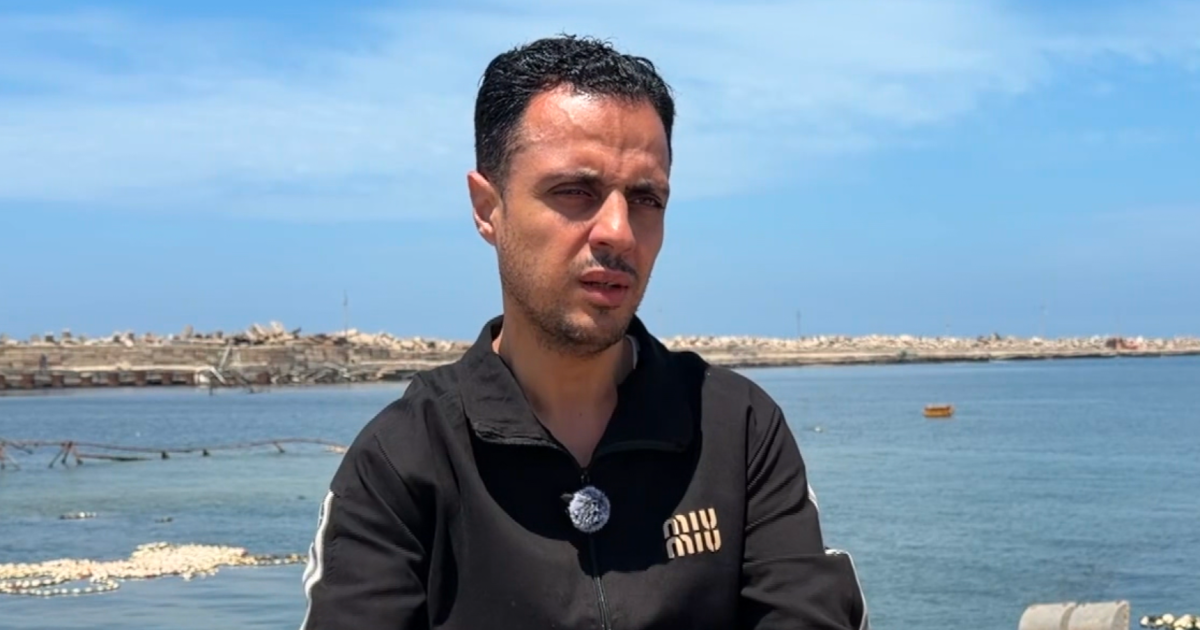
Ex-prisoners recount abuse in Israeli detention centres
Former Palestinian detainees are speaking out about torture and sexual violence they faced in Israeli detention.
Source link

Trump says US-Iran ceasefire still in place after exchange of fire in Strait of Hormuz
Iran accuses the US of violating the truce, alleging it targeted an oil tanker and carried out attacks on coastal areas.
Source link

‘No reservations, no waiter, just great sea views, food and drink’: readers’ favourite beach bars in Europe | Beach holidays
Roll with the lobsters near Derek Jarman’s house in Dungeness, Kent
Dungeness is a place of wild beauty, a stretch of coast that knows fierce winds. Artist and gardener Derek Jarman’s cottage roof blew off at least once and the wind regularly wreaked havoc with his planting. Stubborn plants survive on this vast shingle beach and just as stubborn is the Snack Shack, with its opening times dependent on the weather, as its website says. On fair weather days it’s an ideal place to have lunch as you explore the peninsula. If you’re in luck they will not have run out of lobster rolls among other freshly caught seafood delights. Paying homage to Jarman and eating outdoors here replenishes the soul.
Charlotte
Profile
Readers’ tips: send a tip for a chance to win a £200 voucher for a Coolstays break
Show
Guardian Travel readers’ tips
Every week we ask our readers for recommendations from their travels. A selection of tips will be featured online and may appear in print. To enter the latest competition visit the readers’ tips homepage
–
Captain’s tables on the Brittany coast
Captain Marée, a 30-minute cycle from Vannes in Brittany, is a collection of mismatched tables and chairs beside two shacks on a shellfish farm on the Gulf of Morbihan. Here, you’ll find a simple menu featuring fresh oysters and mussels, all served by welcoming staff. The place offers wonderful views of the gulf and if you are really into your seafood, few places could offer better quality or a friendlier atmosphere.
Kelvin Atkins
Watch for seals on the Isle of Arran
Cladach Beach House is tucked away at the end of the strand in Brodick, on Arran. Outdoor cocktails (with a large dinosaur sculpture) if its sunny, a cosy fire inside the shack by the big windows if the weather closes in. It’s an adorable mix of homemade and glamorous as you watch for seals.
Clara
Select your fish from the daily catch near Narbonne, France
La Perle Gruissanaise lies at the end of the reclaimed wild end of Chalets beach not far from Narbonne in the south of France. Select your fish from the daily catch, and it’ll be expertly cooked by the chefs along with a selection of homemade sides. Then, grab a carafe of local chilled wine and take your seat on the wooden benches. There’s no table service and no reservations, just great food and drink – and uninterrupted views over the Mediterranean to the horizon. Alternatively, they’ll put together a fantastic platter to take away and enjoy at home or on the beach.
Doug
A thatched classic in County Sligo, Ireland
The west of Ireland is a rugged place full of nooks and crannies. In one of them is the Beach Bar at Aughris head, Templeboy. Follow the handmade signs that direct you off the main N59 Sligo road. Eventually, the road peters out at the curving beach overlooked by the thatched Beach Bar. There you can enjoy a bowl of chowder, local seafood and meaty classics, alongside friendly locals. On a fine day, you can sit outside and take in the majestic view across the sea to Sligo and beyond.
Tony Moon
Watch the sunset over the Libyan Sea in Crete
Perched above Matala’s legendary bay in southern Crete, Petra & Votsalo (on Facebook) is a gorgeous beachside taverna. Harris, the owner, greets everyone like family and sets an easy, unhurried tone. Two courses and a cold beer cost about €20. The terrace glows as the sun sets into the Libyan Sea. Order a starter of creamy, flaky tiropita cheese pastries followed by rich, tender stifado and an ice-cold Mythos. Finish with complimentary family-produced raki as waves roll in and light fades over the bay.
James Merriman
Cocktails in a medieval tower on the Adriatic in Croatia
Massimo cocktail bar (on Instagram) is the place to experience sunset on Korčula, Croatia. Space is limited so get there early. And if you don’t like heights or struggle with steep ladders, give it a miss! Your drinks will arrive by pulley from the bar below and, as you sit at your table on top of the medieval tower, you can see for miles across the sea to the neighbouring islands. The margaritas are highly recommended but remember you have to get back down the same way, so best to stick to one or two.
Gill
A beach bar for all seasons near Lisbon
The Bar do Guincho in Cascais near Lisbon is that rare thing, a beach bar for all seasons. It’s perfectly positioned for stunning Atlantic views and combines a rustic, welcoming vibe with a lively atmosphere. I have enjoyed the sunshine and a cocktail on the terrace there after lazing on the beach, but I’ve also cozied up by its blazing log fire in autumn with a warming bowl of fish soup. It’s an easy day trip from Lisbon, too – there are trains every 30 minutes from Cais do Sodré and the journey takes 40 minutes. Then you get the regular No 15 bus or a taxi to beautiful Praia do Guincho, which takes about 20 minutes.
Nicoletta
Seafood shack on the Black Sea, Bulgaria
Where Bulgaria meets Turkey on the Black Sea, you’ll find the sleepy resort of Sinemorets. The place has an eccentric feel, but nowhere more so than the seafood shack Taliana (on Instagram), which sits right on the rugged coastline. Mussels are a must-try, but everything is as fresh as you’d expect from the location – and incredible value. After driving halfway across the country on a slightly ill-advised trek, we arrived a little desperate, bedraggled and starved so it was great to receive a warm welcome and probably the tastiest meal of our whole trip.
Tim Alderson
Winning tip: Puglia perfection, near Gallipoli, Italy
Visible from the wide sandy beach at Lido Conchiglie, near Gallipoli in Puglia, Scapricciatiello (on Facebook) perches on a rocky spur reaching out into the sea. With its plastic chairs and paper tablecloths (which double as menus), it could certainly never be accused of being all style over substance. Yet what it offers instead is hard to beat: delicious, fresh local seafood, enjoyed beside turquoise waters. Adventurous diners can follow local tradition and sample the cozze crude (raw mussels), while other choices include spaghetti with mussels or clams, followed by fritto misto or grilled swordfish.
Katharine

Kim Kardashian’s Met Gala outfit spray-painted in KENT as ‘proud’ garage owner tells all about ‘top secret’ 13-hour job
KIM Kardashian’s Met Gala megaboobs were spray-painted at an auto repair shop in Kent — and its owner said tonight it was an “honour”.
Martyn Smith, 55, spent 13 hours on the orange fibreglass creation at his garage in Lydd on Romney Marsh.
He felt “very proud” at seeing reality star Kim, 45, wear it in New York this week.
The Brit garage owner was asked to do the “top-secret” breastplate paint job — and was only told it was for Kim when he finished.
He said he agreed to drop work after being approached at his auto repair shop on a Kent industrial estate by two local artists.
Against the clock, he spent 13 hours prepping and spraying the orange fibreglass piece, worn two weeks later by Kim at the Met Gala.
Read more on Kim Kardashian


Martyn, who runs MPS Body & Paint, would not say what he charged — but it was “in the hundreds not the thousands”.
He added: “When I saw it, I felt very proud and honoured. I only had 24 hours to do it.”
The breastplate was co-created by Kent artists Patrick Whitaker and Keir Malem, who then went to Martyn after he had repaired their car a few years earlier.
The dad of two, who works at the auto business with sister Nicki Hill, 50, said: “It looked great, but it had imperfections and tiny air holes which I had to fill with stopper.
“It had mould lines which I had to smooth out, before re-priming it and rubbing it down. It then needed a base coat and a lacquer top coat.
“With drying times, it was a lengthy process, but I knew it had to be perfect. I worked all day on it until 8.30pm.
“It was kept hush-hush as they told me it was top secret.
“I thought it might be for Madonna or Gal Gadot given the design.
“When they collected it they finally told me it was for Kim Kardashian.”
Martyn said he knew the name but was more of a fan of her boyfriend, F1 great Sir Lewis Hamilton.
Meanwhile, Nicki discovered Kim would be at the Met Gala on Monday night — her daughter Elli-Jane’s 20th birthday.
“She stayed up to watch it and said: “I was falling asleep as it was late and Elli-Jane shouted, ‘Mum, mum she’s wearing it’.
“She was bouncing up and down with excitement and then I was quite emotional.”
Martyn, who had gone to bed, said his paint job looked “fantastic” when he saw photos the next day, and the reaction since has been “crazy”.
He would welcome similar work but added: “I don’t know many people who have got a breastplate really.”

Enter the Spin Doctors : THE CAMPAIGN OF THE CENTURY: Upton Sinclair’s Race for Governor of California and the Birth of Media Politics, By Greg Mitchell (Random House: $27.50; 582 pp.)
Sigal’s most recent book is “The Secret Defector” (HarperCollins). He teaches journalism at USC
“We don’t go in for that kind of crap that you have back in New York–of being obliged to print both sides. We’re going to beat this son of a bitch Sinclair any way we can. . . . We’re going to kill him.”
The speaker: Kyle Palmer, Los Angeles Times political editor, to Turner Catledge of the New York Times.
The time: 1934, when socialist writer Upton Sinclair, who had just swept the Democratic primary for governor of California, threatened to beat handily the GOP candidate, Frank Merriam, in the November election.
Kyle Palmer, the pope of Southern California right-wing politics, was neither kidding nor exaggerating. Nor was he exceptional in his venom toward Upton Sinclair and his mass movement, End Poverty in California (EPIC). According to Greg Mitchell in his fascinating and valuable study, EPIC “was nothing less than a roundabout route to socialism.” On this point, “Political pundits, financial columnists, and White House aides, for once, agreed: Sinclair’s victory represented the high tide of radicalism in the United States.” This tide had to be pushed back, or California would suffocate under the weight of Sinclair’s “maggot-like horde” of supporters, as the Los Angeles Times called EPICers.
In 1934, a year racked by general strikes and epidemic unemployment, the maverick pamphleteer-novelist Sinclair–author of muckraking tracts like “The Jungle” and the most widely translated American writer abroad–was a menace not only to the so-called Vested Interests. Down deep, he embodied a revulsion felt by many Californians toward the capitalist system. EPIC’s program of production-for-use-not-profit, land colonies, barter exchanges and cooperation versus competition was a potentially deadly blow to the American Dream. It was subversive because it spoke to the misery of desperate, Depression-ruined Americans yearning for relief from the day-to-day savagery of a skewed, inefficient system that seemed to be failing everybody but the very rich. At its height, EPIC enrolled 100,000 members from San Diego to Sacramento, and its newspaper sold 2 million copies.
In “The Campaign of the Century,” Greg Mitchell has chosen to focus not on EPIC itself but “on the cataclysmic response to Sinclair’s emergence as the Democratic nominee.” Thus we learn relatively little about EPIC or about Sinclair, but a lot about the nuts and bolts of the “most astonishing . . . smear campaign ever directed against a major candidate.” Our present-day “media politics” with its emphasis on image over substance, was born in the ferocious, fraudulent anti-Sinclair campaign, says Mitchell.
A subtext of Mitchell’s book is how strongly adherents felt about Sinclair and EPIC. They “came from every strata, although nearly all were white. It was not . . . a poor people’s movement. Most of the activists were middle-class and middle-aged . . . Many were down-on-their-luck businessmen.” Any given EPIC club might include “Utopians, technocrats, Townsendites, progressive Republicans, New Deal Democrats, ex-Socialists and secret Communists, all united by a belief in a perfectible society.” No EPIC, aside from clerical staff, earned a cent from the movement. “Members paid a dollar, penny, or a collar button” to join; “Some EPICs hocked the gold fillings in their teeth to raise money.” Although broad-based and decentralized, “EPIC was far from democratic” and indifferent to unions. And Sinclair’s portrait occupied a holy place in many homes.
In any other state, EPIC might never have flown. But California’s populist tradition, open-mindedness (or wackiness), absence of party bosses or deep ethnic loyalties meant that a challenge to established authority was as relatively easy to mount as it was difficult to organize a counter-revolution. At first, the state’s wealthy were so rattled that their political representatives were caught completely off balance by Sinclair’s spectacular rise. Only loonies had expected him to win the primary, and nobody had been crazy enough to predict he would outpoll all six of his opponents together.
But like a great octopus, California’s Republicans and conservative Democrats, equally terrified of EPIC, slowly thrashed up from the murk of politics-as-usual to deal with the “enemy within.” “The prospect of a socialist governing the nation’s most volatile state,” says Mitchell, “sparked nothing less than a revolution in American politics.”
Spurred by “fear and desperation,” ad men like Albert Lasker and especially Clem Whittaker, hired conservative guns, broke the old rules and “virtually invented the modern media campaign.” Whittaker and his associate Leone Baxter introduced the radical idea that free-lance outsiders like themselves, not party chiefs, would “handle every aspect of a political campaign.” Whittaker’s “cozy relationship” with California’s 700 newspaper publishers meant that local editors were happy to run his press releases “as news stories–even as editorials.” The anti-Sinclair “lie factory” twisted and distorted; but worst of all, his enemies quoted from Upton Sinclair’s own works, in which he had attacked everything from wedded bliss (“marriage plus prostitution”) to religion (“a mighty fortress of graft”) and the Boy Scouts. After his defeat, Sinclair confessed wearily and with justice, “I talk too much. I write too much, too.”
By most accounts, Sinclair was a decent, generous, puritanical man of genuine sweetness. What his blurted half-jokes and honest indiscretions failed to supply, Hollywood and Madison Avenue concocted by way of movie propaganda and, probably even more effectively, radio shots–like an anti-Sinclair “One Man’s Family”-type series. Film studio bosses, alarmed by Sinclair’s not-very-serious threat to socialize movie production, colluded with what a Scripps-Howard reporter called a “reign of unreason bordering on hysteria.” Big-time screenwriters like Carey Wilson and directors like Felix Feist (later of “Peyton Place” fame) were enlisted or dragooned to produce Goebbelsesque films, often using faked footage, that drilled home the message: EPIC equals Armageddon. Studio workers were forced to contribute to Frank Merriam’s campaign. Very few Hollywood stars had the guts to refuse. (Holdouts included James Cagney and Jean Harlow.)
Law ‘n’ order also came to the rescue of the anti-Sinclair forces. Election officials, GOP activists and local district attorneys intimidated EPIC supporters away from the polls by challenging the credentials of at least 150,000 voters and threatening to arrest them. All across the state preachers thundered, “Go and Sinclair no more!” and Aimee Semple McPherson, hungry for respectability after her recent kidnaping hoax, turned against Sinclair, despite the pro-EPIC sympathies of her flock.
Finally, the Democrats themselves carved up EPIC. At first friendly to Sinclair, President Roosevelt, needing conservative support for his faltering New Deal, cut a deal with the Republicans. In return for Frank Merriam converting to a pallid form of New Dealism, the party dumped the divisive Sinclair. Frightened Democrats and “third party” anti-EPICers formed around a candidate named Haight, who may have drawn off enough votes to beat the insurgent–but not by all that much. Final results: Merriam 1,100,000; Sinclair 900,000; Haight 300,000. In defeat, Sinclair received twice as many votes as any previous Democratic candidate for governor.
EPIC soon disappeared in a backlash of internal Red-baiting. (The communists and socialists opposed EPIC, but the Communist Party also tried to take it over.) Sinclair stopped muckraking to write the “Lanny Budd” series of best-sellers. Waves of fright and self-interest quickly covered over EPIC’s writing in the sand. Today, who remembers it?
Later, Sinclair insisted that the EPIC campaign had “changed the whole reactionary tone of the state.” EPIC was “the acorn from which evolved the tree of whatever liberalism we have in California,” claimed state Supreme Court justice Stanley Mosk, a Sinclair supporter in ’34. And as a direct result of EPIC and the studio bosses’ much-resented bullying, “politics in Hollywood moved steadily to the left over the next few years.”
Of course, the Right learned, too. “A number of men who would become legends in California politics, on both sides of the ideological fence, virtually cut their teeth on the ’34 campaign,” writes Mitchell. These included Earl Warren (Merriam’s campaign manager), Asa Call, Edmund G. (Pat) Brown (sending what encoded messages to his son today?), Murray Chotiner, Augustus Hawkins, Cuthbert Olson–a whole generation of pols whose experience taught them just how powerful the rich, who own the media, can be when aroused.
Lessons for liberals are harder to come by in this sizzling, rambunctiously useful book. If we take note of this nation’s recent rash of insurgencies–from Carol Moseley Braun to Ross Perot–maybe one lesson is that nothing good ever completely dies, it just goes to sleep for a while.
BOOK MARK: For an excerpt from “The Campaign of the Century,” see the Opinion section, Page 6.

Lakers again falter after halftime in Game 2 loss to Thunder
OKLAHOMA CITY — The effort was being provided by all the Lakers at a high level and it was being led by LeBron James and Austin Reaves.
But the Lakers are facing the defending NBA champion Oklahoma City Thunder in the Western Conference semifinals and it is a chore that remains too heavy for Los Angeles.
Even with Reaves recovering to score 31 points on 10-for-16 shooting and handing out six assists and James collecting 23 points and six assists, the Lakers still lost Game 2 of the best-of-seven series, 125-107, Thursday night at Paycom Center.
The Lakers trail the series 2-0, with Game 3 back in Los Angeles at Crypto.com Arena on Saturday night.
The odds have now increased against the Lakers winning this series. In NBA history, only 34 teams have recovered from a 2-0 hole to win a best-of-seven series, while 431 teams have gone on to win the series.
The Lakers even did a very good job again on Shai Gilgeous-Alexander, throwing double teams at him to hold the All-Star guard to 22 points.

Lakers forward LeBron James. left, tries to drive past Thunder guard Luguentz Dort during the first half of Game 2 on Tuesday night in Oklahoma City.
(Nate Billings / Associated Press)
Chet Holmgren had another strong game with 22 points, nine rebounds, four steals and two blocks and Ajay Mitchell had 20 points for the Thunder.
The Lakers, who had a one-point lead at halftime, went down 13 points at the end of the third quarter, but a James three-pointer pulled them to within 95-89, forcing the Thunder to call a timeout with 8:57 left.
The Lakers even got to within five points in the fourth quarter, but a 10-2 run by the Thunder put L.A. in a 13-point hole with 5:53 left, this time forcing Lakers coach JJ Redick to call a timeout so his players could collect themselves.
The Lakers could not.
A big play was when Reaves took a charge against Gilgeous-Alexander with 10:34 left in the third quarter, which was his fourth foul. Gilgeous-Alexander was called for a flagrant foul on the play and Alex Caruso was called for a technical foul.
Reaves shot three free throws, making them all for a 66-61 Lakers lead.
Gilgeous-Alexander then took a seat on the bench.
Yet the Lakers were unable to maintain their quality of play against a Thunder team that just kept charging ahead even with Gilgeous-Alexander on the bench.
The Thunder finished the third on an 18-8 run to open a 93-80 lead.
One of the many keys for the Lakers was getting a productive Reaves. It was just his fourth game back after being out a month because of a Grade 2 left hamstring strain, and it showed. Reaves missed 13 of his 16 shots in Game 1 and all five of his three-pointers, and scored just eight points.
Reaves didn’t make any excuses for his poor play.
“He’s got a great sense of self-accountability to where, you know, he’s his own worst critic and he’s going to hold himself to a standard of how he wants to play,” Lakers coach JJ Redick said. “Had a great conversation with him yesterday and today. He’ll be good to go.”

Lakers forward Rui Hachimura, center, pulls up for a shot over Thunder center Chet Holmgren, left, during the first half of Game 2 on Thurday night.
(Nate Billings / Associated Press)
Reaves scored 13 points in the first half while distributing the ball.
He missed his first two shots, but finished the first half five-for-nine shooting.
Along with James scoring 10 points and handing out five assists, Rui Hachimura scoring 11 and Marcus Smart adding eight while doing his part to slow down Gilgeous-Alexander, the Lakers opened a 58-57 lead at the half.
The Lakers sent defenders at Gilgeous-Alexander often, double-teaming the league most valuable player and forcing the other Thunder players to shoot the basketball in the first half.
Gilgeous-Alexander only took nine shots in the first half and made four.
The Thunder shot just 25% from three-point range in the first 24 minutes.
Note: Lakers forward Jarred Vanderbilt was downgraded out for Game 2 because of a dislocated right pinky finger.
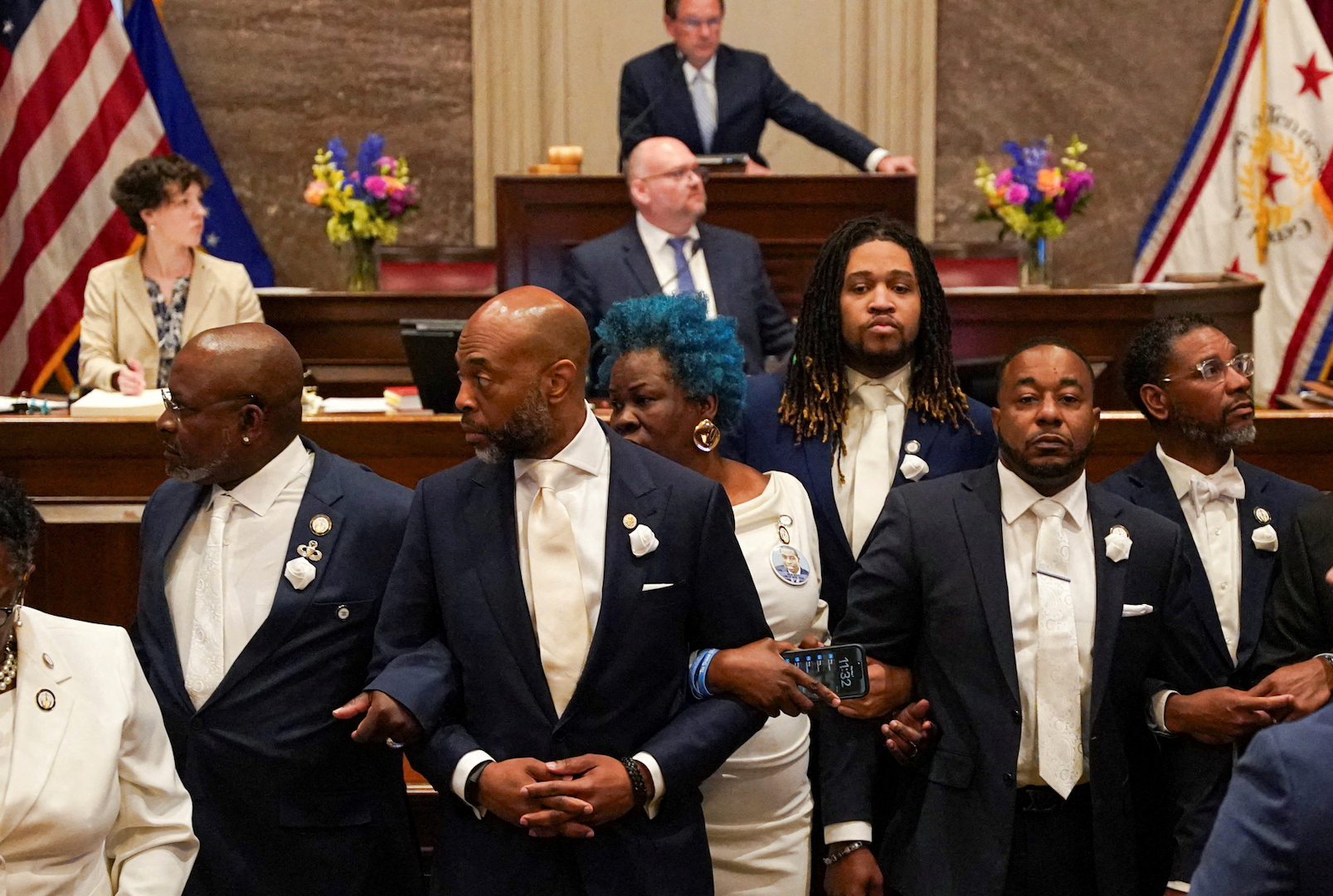
Tennessee approves map dismantling majority-Black district | Elections
Tennessee has approved a new congressional map that breaks apart a majority-Black district centred on Memphis, triggering protests inside the state Capitol and accusations of racial gerrymandering. The move could help Republicans strengthen their narrow majority in the US House ahead of November’s midterm elections.
Published On 8 May 2026

Trump says ceasefire still in effect, but Iran ‘better sign agreement fast’ | Donald Trump
US President Donald Trump says the ceasefire with Iran is still in effect, despite American and Iranian forces trading fire in the Strait of Hormuz on Thursday. Trump threatened pain for Tehran unless it signs a truce quickly.
Published On 8 May 2026

Katie Price reveals plan to get around seventh driving ban after husband Lee’s claims he bought her a Ferrari
KATIE Price is plotting to get around her seventh driving ban after her husband Lee Andrews claimed he bought her a Ferrari.
The former glamour model, 47, has received bans totalling more than six years since she was first disqualified in 2010.
And last month, Katie was banned for a seventh time after failing to respond to police letters about an 80mph speeding ticket.
But the media personality said she is now planning to get an international driving licence – despite her UK driving ban.
Katie shared a life update with her social media fans today.
She was joined by her husband Lee as she filmed a clip from the back of a moving car.


Katie said: “Hey guys, we are just going to the hospital to get my stitches taken out and then we are going to Lee’s dad for a cup of tea.”
She added: “And to get my international driving licence…”
Lee interjected and said: “That’s the easy one, then you’ll see the car,” referring to the £180k Ferrari that Lee claimed he gifted his wife.
But Katie’s followers were quick to correct the star, with one writing: “You cannot drive with an international driving licence with a driving ban. It still stands in other countries, there is no way around it.”
A second said: “I hope Katie realises as I wouldn’t want her to do anything illegal in Dubai.”
A third said: “Not with a ban in the UK, you can’t as the Dubai authorities do checks.”
Another commented: “You cannot get an International Driving Permit or drive in Dubai if you have a current UK driving ban. You must hold a valid full driving licence to apply for an International one and the UK court will have taken her licence so she cannot apply for one.”
This person added: “It appears you cannot legally drive in Dubai with a revoked UK licence.”
According to the GOV UK website, you cannot obtain an International Driving Licence if you are banned from driving in another country.
It is only issued to holders of a valid UK driving licence, which is revoked or suspended when you are banned.
In March, Katie was seen in the driver’s seat of a red Ferrari.
But the motor was completely different from the Ferrari she previously claimed had been a gift from self-confessed multi-millionaire Lee.
She previously told how the flash car, believed to cost around £180,000, had to remain in the UAE.
It is not clear how or when Lee purchased the car and whose name it is in ownership of.
Yet despite previously gushing over the “beautiful” gift it was nowhere to be seen during her recent video.
Lee took charge of filming as Katie got settled behind the wheel and said: “Kate is driving now – is this your first time driving in Dubai?”
She was then heard swearing as she got to grips with the automatic before he assisted and said: “There you go”.
Katie then added: “First time driving in Dubai.
The former glamour girl’s latest run-in with the law comes after a Ford Capri registered to her was caught at 80mph on the A64 near Strutton in North Yorkshire.
CCTV released by the police showed Katie behind the wheel during the incident on October 15, 2025, the same day she appeared on stage with celeb pal Kerry Katona for An Evening with Katie Price & Kerry Katona at Scarborough Spa.
Katie, who was first banned in 2010, was subsequently prosecuted and convicted of failing to respond to police, landing her with a six-month driving ban and a legal bill topping £1,000.
The former pin-up was keen to set the record straight last month.
Speaking on her podcast, The Katie Price Show the star revealed: “I found out I was banned by the papers.
“I am actually livid about that because if I’d got the letters I would have replied to it.”
Revealing what happened, Katie said: “Basically I’ve paid someone to do a job.
“They haven’t done it and… now I’m now banned from driving for six months, but I am gonna go back and see if I can appeal it.”
She then added: ” Yeah, or I just think it’s only six months where I live now, I can walk to the shop. the kids schools are ten minutes up the road.
“I get shopping delivered here anyway, because I’m always at home when I work at home.
“So it’s not like in the past where I’ve been stuck right in the middle of nowhere.”
It comes after Katie’s after new husband Lee claimed he is moving to the UK in May AND revealed details of a second wedding.
Lee popped the question to the star in January, and the couple tied the knot in Dubai just 48 hours later.
However, Katie later revealed they actually officially wed in February.
Abortion Foes Call Bush’s Dred Scott Reference Perfectly Clear
WASHINGTON — President Bush left many viewers mystified last week when, answering a question in his debate with Democratic challenger John F. Kerry, he invoked the 1857 Dred Scott decision that upheld slavery.
The answer seemed to be reaching far back in history to answer the question about what kind of Supreme Court justice Bush would appoint. But to Christian conservatives who have long viewed the Scott decision as a parallel to the 1973 Roe vs. Wade ruling legalizing abortion, the president’s historical reference was perfectly logical — and his message was clear.
Bush, some felt, was giving a subtle nod to the belief of abortion foes, including Supreme Court Justice Antonin Scalia, that just as the high court denied rights to blacks in the Scott case it also shirked the rights of the unborn in Roe, which many conservatives call the Dred Scott case of the modern era.
“It was a poignant moment, a very special gourmet, filet mignon dinner,” said the Rev. Louis P. Sheldon, chairman of the Traditional Values Coalition, a prominent conservative advocacy group based in Washington. “Everyone knows the Dred Scott decision and you don’t have to stretch your mind at all. When he said that, it made it very clear that the ’73 decision was faulty because what it said was that unborn persons in a legal sense have no civil rights.”
Sheldon, who said he confers frequently with Bush and his senior campaign advisors on outreach to religious conservatives, though not in this instance, credited the use of Dred Scott with raising the abortion issue to “a very high level” and “back to the front burner.”
“It didn’t just slip out by accident,” Sheldon said.
Douglas Kmiec, a Pepperdine University constitutional law professor who served as a lawyer in the Reagan and first Bush administrations, said the reference instantly struck him for its appeal to abortion opponents, advocates for judicial restraint and even civil rights advocates who regard the Scott case as the court’s all-time worst moment.
“I thought it had so many constituencies that could applaud that comment; it was one of the most intelligent things that I heard in the debate,” he said.
Bush’s remark Friday came after a questioner in the St. Louis debate — which occurred just miles from the courthouse where Scott filed his lawsuit seeking his freedom — asked whom he might appoint to the court should there be a vacancy.
Kerry and other Democrats, looking to mobilize their base, have warned that Bush would fill vacancies with judges who would overturn Roe. Bush has often said that he believes in appointing justices who would not legislate from the bench.
He repeated that refrain Friday night but did not mention abortion in his answer. Instead, he pointed to Dred Scott as an example of a court action he found objectionable, along with another favorite citation of religious conservatives: the 9th Circuit Court of Appeal’s ruling that the reference to God in the Pledge of Allegiance was unconstitutional.
“Another example would be the Dred Scott case, which is where judges years ago said that the Constitution allowed slavery because of personal property rights,” Bush said. “That’s a personal opinion. That’s not what the Constitution says. The Constitution of the United States says we’re all — you know, it doesn’t say that. It doesn’t speak to the equality of America.”
That answer left many wondering what he meant.
Bush campaign spokesman Scott Stanzel said Tuesday that the president did not intend to draw a parallel between the slavery and abortion cases, but that he was merely giving voters an example of a case in which he felt the court erred.
But Bush has a history of using language with special meaning to religious conservatives, a critical portion of his base that senior strategists have said will assure his reelection only if they turn out in larger numbers than in 2000.
Bush himself is an evangelical Christian, and his speeches are frequently sprinkled with phrases that sound merely poetic to many, but to others sound a more spiritual theme.
His reference in many campaign speeches to his belief in a “culture of life” often draws the loudest applause from his largely conservative audiences.
In his State of the Union this year, he spoke of the nation’s “grace to go on” despite its grief over terrorist attacks, and in a subtle reference to religious texts that refer to divine service as a time “set apart,” he said: “Having come this far, we sense that we live in a time set apart.”
Activists and legal scholars on both sides of the abortion debate said Tuesday they believed the president was sending a signal to that base.
Bush, who opposes abortion, has walked a careful line on the issue in a campaign in which women make up a large portion of undecided voters. Abortion has been overshadowed this year in the culture wars by gay marriage, but activists say it remains a motivating force for many.
Polls show a majority favor abortion rights. Critics say the Dred Scott reference was an attempt by Bush to make his point without alienating moderates who might decide the election.
“The minute he said it, I said to myself, ‘Here he goes,’ ” said Eleanor Smeal, president of the Feminist Majority. “He’s not going to say to anybody that he would pick a Supreme Court justice that’s opposed to Roe vs. Wade because he’s afraid that would cost him. So he’s trying to keep his base riled up in a way that won’t offend moderate women.”
Harvard University law professor Laurence Tribe, a Bush critic who has written extensively about the abortion debate, said Bush was signaling that he believed there was a direct parallel between women who would abort a fetus and slave masters of the 19th century.
Tribe pointed to Scalia’s dissent to a 1992 ruling that upheld Roe, in which the justice drew the parallel. Scalia wrote that both cases focused on issues of “life and death, freedom and subjugation.”
“He’s talking in code, but it’s not obscure code,” Tribe said of Bush. “This has been a fixture in the talking points of the religious right for years.”
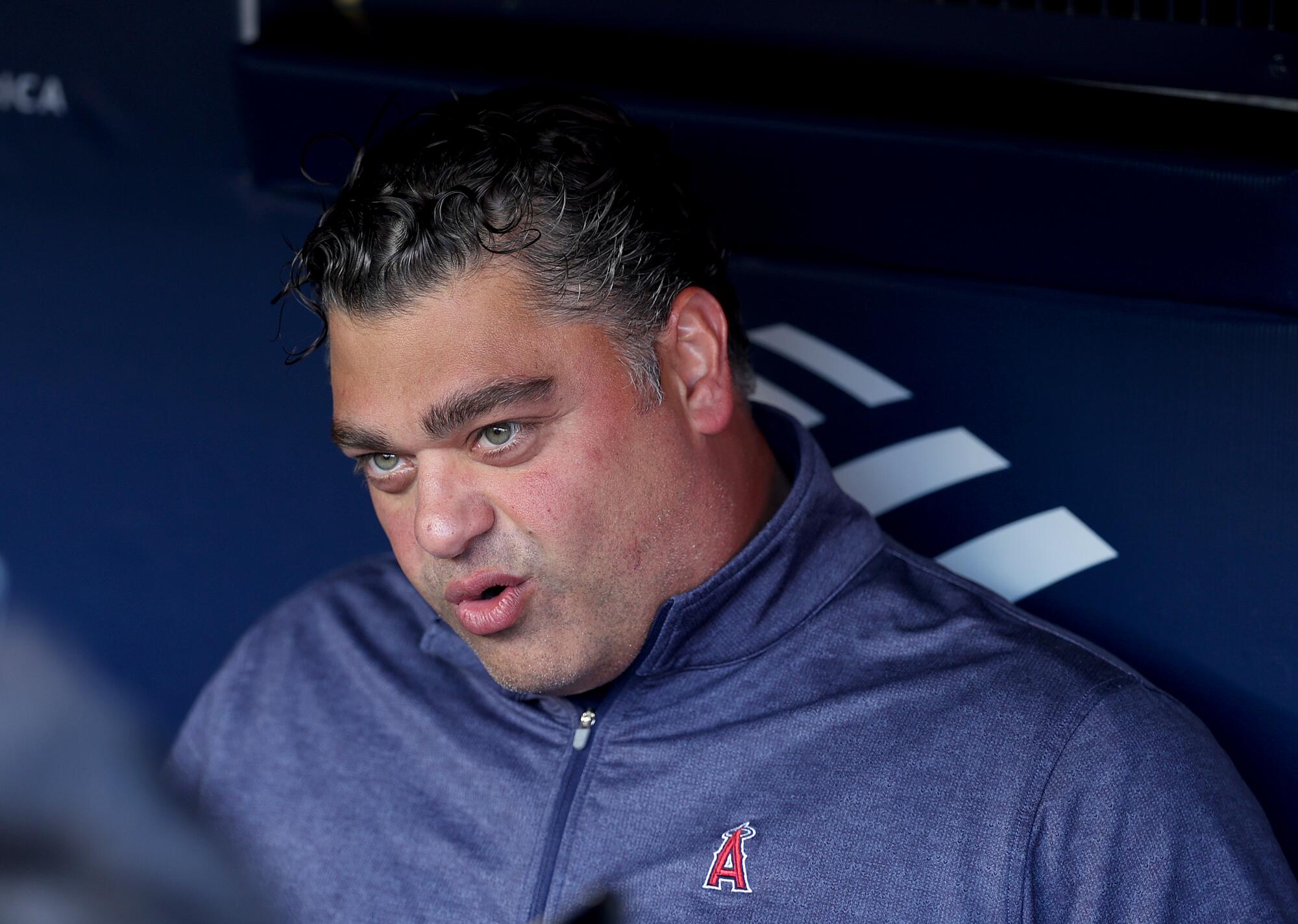
Angels GM says team is ‘very competitive’ but are fans fed up?
I walked around a street fair in Irvine over the weekend, checking out the crowd while waiting for my daughter’s dance team to perform. We were a few short miles from Angel Stadium, but you wouldn’t have known it: lots of people wearing Dodgers caps, someone wearing a Shohei Ohtani cap, someone else wearing an Ohtani jersey, someone else wearing a Clayton Kershaw jersey, a dog wearing a Dodgers bandana, and people repping the Padres, Giants, Athletics and Yankees.
After 25 minutes, someone walked by in an Angels cap.
If the passion wanes, apathy can set in. I wondered if that is where the Angels might find themselves now, with a slice of their fan base finding a more enjoyable way to spend its summers than watching one losing season after another, and with the shadow of baseball’s best team extending ever more securely into Orange County.
Something else happened over the weekend that made me wonder. On the heels of a winless road trip, and on the day before the Angels would claim the worst record in the major leagues, Angels general manager Perry Minasian said this to reporters: “Our best baseball is in front of us. There’s no doubt about that.”
No doubt?

Angels general manager Perry Minasian declined to predict in the team would make the playoffs this season.
(Elsa Garrison / Getty Images)
On the Angels’ broadcast the previous night, reporter Erica Weston presented play-by-play announcer Wayne Randazzo with a birthday gift: a figurine of Grogu, a character in the Star Wars family. Randazzo said he would keep Grogu in the broadcast booth, as a good luck charm for the Angels.
“We certainly could use one,” Randazzo said.
Minasian, the sixth-year general manager, has yet to deliver a team that finished better than 17 games out of first place. On Wednesday, I asked him to explain why he was so confident in saying he had “no doubt” the team’s best days were ahead.
“We’ve been very competitive,” Minasian said. “Our wins and losses aren’t where we want them to be, but we have lost a lot of one-run games, a lot of tough games.”
The Angels have lost six one-run games. So have the Yankees, the team with the best record in the American League.
The Angels’ run differential is minus-14. They are four games behind in the AL West, where the first-place Athletics have a .500 record and a minus-21 run differential. You never know.
So far, however, the Angels’ offense is all about the three true outcomes: They strike out the most of any major league team and rank among the top six in walks and home runs, but they do not rank among the top 10 in runs. Only five teams have given up more runs.
“Going to the bullpen has been a harbinger of danger for the Angels,” Randazzo told viewers. The Angels’ bullpen entered Wednesday with a 5.35 earned-run average, the highest in the AL.
Owner Arte Moreno cut payroll this year, amid the implosion of the FanDuel regional sports networks. Edwin Díaz was not walking through the bullpen door.

Angels owner Arte Moreno.
(Ashley Landis / Associated Press)
But the Dodgers find solid bullpen arms in ways beyond buying them: Evan Phillips was cast off by the Baltimore Orioles during a 110-loss season; Alex Vesia was acquired from the Miami Marlins after putting up an 18.69 ERA in his first five major league games.
“We’ve had guys like that,” Minasian said.
He cited Brock Burke, a waiver claim who gave the Angels two solid seasons in middle relief. Minasian traded him last winter for outfielder Josh Lowe, and any general manager would trade a middle reliever for a middle-of-the-order bat. To this point, Lowe has a .198 on-base percentage and a .287 slugging percentage.
Lowe is but a data point in illustrating this primary point: Minasian’s margin for error is smaller than it otherwise would have been if Moreno had not withdrawn from the market for top-tier free agents or had approved trading Ohtani for elite prospects that would have accelerated rebuilding. Smaller, but other teams do more with less.
“We’ve got to be able to develop our own players,” Minasian said.
On the day Minasian said he had “no doubt” better days were ahead for his team, the Angels, their triple-A affiliate and their double-A affiliate all were in last place.
Analysts perennially rank the Angels’ farm system among baseball’s worst. Minasian said he’ll put his faith in four homegrown starters: José Soriano, Reid Detmers, Jack Kochanowicz and Walbert Ureña. Their combined ERA so far: 2.99.
“When you look at good teams and sustainable winners, they build rotations, whether that’s through trades or free agency or your own,” Minasian said. “We’re doing it with our own. You can’t microwave that overnight.”
You can’t make fans wait forever for October either. Angels fans have heard enough about building a competitive team and needing patience.
They have not seen their team in a playoff game in 12 years. When are they going to see that?

Angels pitcher Walbert Ureña delivers against the New York Mets at Angel Stadium on May 1.
(Luke Hales / Getty Images)
“I’m not in the prediction business,” said Minasian, whose contract expires after this season. “They’re going to see a team that plays hard every day. They’re going to see young, talented players day in and day out.”
That’s fine, but when are they going to see a winning team?
“The proof will be in the pudding,” he said. “It doesn’t matter what I say. I could say all these things. At the end of the day, we’re going to go play 162 games. We’ll see where we end up and who’s done what, and we’ll go from there.”
On Wednesday, the Angels won a series for the first time since April 12. They’re 3-2 with Grogu in the broadcast booth.
The schedule gets more challenging: a trip to Toronto and Cleveland, then back to the Big A to play the Dodgers. The same distant Angel Stadium seat available on the resale market for Wednesday’s game for $5 (fees included) is available for $103 for the opener of the Dodgers series.
Orange County loves a winner. There was a long line at that Irvine street fair to collect souvenirs from one booth — the one for the Anaheim Ducks.

This ‘must-have’ travel gadget can save you up to £200 at the airport

THERE’S nothing worse than getting caught out by dreaded overweight baggage fees at the airport.
Thankfully this nifty gadget can help you avoid forking out up to hundreds in extra luggage charges.

MYCarbon Portable Luggage Scale, £6.98 (was £10.99)
The luggage scale is currently on sale at 36% off. It originally sold at £10.99 and it costs only £6.98 today.
Even if you’ve made sure your bag or suitcase fits within your airline’s sizing limits, that doesn’t mean it won’t become too heavy.
Airlines can charge extortionate fees for overweight luggage.
Read more on travel gadgets


British Airways, for example, charges you a heavy bag charge of £65 even if your luggage is just 1kg over the 23kg weight limit.
This applies to both the way there and the way home, so this expensive mistake could cost you £130.
Jet2 and easyJet charge a fee of £12 per kilo you are over the weight limit.
This means that if you overpack to the 32kg limit for a standard 15kg bag, you would be charged a stinging £204.
That’s twice the cost of some city breaks just to bring your suitcase with you.

MYCarbon Portable Luggage Scale, £6.98 (was £10.99)
Avoid getting caught out and having to fork out a fee by using this nifty at-home luggage scale.
The gadget has nearly 27,000 reviews, the large majority of which are 5-star and praise how easy it is to use.
One happy shopper shared: “I can confidently say it is a must-have for anyone looking to avoid those dreaded “overweight” fees at the airport.
“It’s rare to find a gadget that is both simple and incredibly effective, but this hits the mark.”
He continued to write: “If you want a scale that is sturdy, comfortable to hold, and accurate, look no further. It does exactly what it promises with zero hassle”.
Another delighted reviewer said: “Before discovering this scale, I often faced the stress and uncertainty of whether my luggage would meet airline weight restrictions.”
“With the MYCARBON scale, those worries are a thing of the past”.
While there are luggage scales at some airports, it’s much easier to weigh your bags at home then take out what you don’t need, rather than find out at the airport that it’s already too late.
Plus nobody wants to be stuck buying a new suitcase at the airport, where prices are often hiked for passengers in a pinch left with no choice.
And who wants to essentially pay for their holiday twice just because you forgot to weigh your luggage at home?
It’s even been reported that some airline staff are rewarded with ‘bonuses‘ for catching out passengers with oversized baggage.
Avoid those pesky fees by using this scale – you can even pack it and bring it with you on holiday to make sure that your bags aren’t over the weight limit from any shopping you do abroad.
MYCarbon Portable Luggage Scale, £6.98 (was £10.99)
Prices correct at time of publication.
Oil prices jump as US, Iran trade fire in Strait of Hormuz | Oil and Gas News
Brent crude rises amid clashes in critical waterway.

Published On 8 May 2026
Oil prices have jumped after clashes between United States and Iran in the Strait of Hormuz pushed their tenuous ceasefire to the brink.
Futures for Brent crude rose as much as 7.5 percent during a volatile trading session on Thursday, before easing as Asia’s markets opened on Friday morning.
Recommended Stories
list of 4 itemsend of list
The international benchmark stood at $101.12 per barrel as of 03:00 GMT, down from the day’s high of $103.70.
The latest rise came after the US and Iran exchanged fire in the critical strait, a conduit for about one-fifth of global oil and natural gas supplies, despite the truce announced between the sides on April 7.
US Central Command (CENTCOM) said it launched strikes on Iran after three US Navy guided-missile destroyers came under attack from Iranian missiles, drones and small boats in the strait.
Iran’s Khatam al-Anbiya Central Headquarters earlier accused the US of violating the ceasefire by attacking an Iranian oil tanker and another vessel in the vicinity of the waterway.
The Iranian military headquarters also accused the US of targeting civilian areas, including Qeshm Island.
US President Donald Trump on Thursday appeared to downplay the clashes, saying the ceasefire remained in effect, while Iran’s state-run Press TV said the situation had gone “back to normal”.
Shipping in the strait has been at a near standstill since late February amid the threat of Iranian attacks on the massive oil tankers that usually transport much of the world’s energy supplies.
Brent prices are up about 40 percent compared with before the war amid an estimated shortfall in daily production of 14.5 million barrels.
Asian stock markets opened lower on Friday amid the heightened tensions, with Japan’s benchmark Nikkei 225, South Korea’s KOSPI and Hong Kong’s Hang Seng Index each falling more than 1 percent.
On Wall Street, the benchmark S&P 500 fell about 0.4 percent overnight after hitting an all-time high the previous day.

USAF Is Going To Explore What Will Finally Replace The B-52
With the U.S. Air Force set to still be flying B-52s at least into 2050, at which point the youngest examples will be some 88 years old, it has become common to quip about the bombers staying in service forever. However, the Air Force is now looking to conduct a formal review of its requirements to see whether the development of a successor might be warranted, and potentially sooner rather than later.
The Air Force is asking for $1 million in its budget request for the 2027 Fiscal Year to conduct a New Heavy Bomber Analysis of Alternatives (AoA). Aviation Week was the first to report on the appearance of this AoA in the service’s budget documents. All branches of the U.S. military routinely use the AoA process to assess available options and further refine requirements for new weapon systems and other capabilities.
The Air Force currently has 76 B-52Hs in service. The last of these aircraft rolled off Boeing’s production line in 1962, though they have received numerous upgrades in the decades since then. These bombers continue to be in high demand as conventional long-range strike platforms, as evidenced by their heavy use in the latest conflict with Iran. They also play a key role in the air leg of America’s nuclear triad.

“A Heavy Bomber Analysis of Alternatives will begin in FY27 [Fiscal Year 2027] to analyze the future long range strike requirements to determine future B-52 requirements and costs and/or a new heavy bomber aircraft configuration and costs,” the Air Force’s latest proposed budget explains.
More specifically, the newly requested funding will support “initial planning activities to develop key performance parameters, key system attributes, and additional performance attributes for a follow-on heavy bomber in the USAF,” per the service’s budget documents. “The FY27 work scope will include key planning activities for programmatic, requirements, capabilities, and vendor options that could field [sic] in the future.”
The $1 million in funding for the AoA would come through a line item titled “Advanced Concept Demonstration” contained within the section of the Air Force’s budget for “B-52 System Improvements.” The service did not ask for or receive any money for this particular line item in Fiscal Year 2026, but did get nearly $4 million in funding for it in the preceding fiscal cycle.
The Fiscal Year 2025 funding supported a “classified Proof of Concept demonstration on the B-52,” according to the budget documents.
The Air Force is already in the midst of a massive, multi-billion-dollar modernization effort for the B-52 fleet. In the coming years, the bombers are set to get new engines, radars, communications capabilities, and more, as you can learn about in more detail here. The upgrades are so substantial that the aircraft will be redesignated B-52Js in the process. A host of new ordnance, including advanced hypersonic missiles and new nuclear weapons, is set to be integrated onto the B-52 fleet, as well.

B-52 Future Stratofortress: The Upgrades That Will Transform The B-52H Into The B-52J

Based on the Air Force’s current force structure plans, the B-52 is set to outlast both the B-1 and B-2 bombers, and serve alongside the forthcoming B-21. Despite its age, the B-52’s design has certain unique benefits, especially the space underneath its wings for the carriage of outsized payloads, including very large munitions. This has also led the bombers to play important roles in research and development and test and evaluation efforts in the past, including air-launching large crewed and uncrewed aircraft.


There is really nothing like the B-52 in production today anywhere globally, which has further contributed to its long service life. There is only one company in the United States currently building heavy bombers of any type, Northrop Grumman, with the B-21. The stealthy Raider is a very different aircraft designed to meet a very different set of requirements from the B-52, hence the Air Force’s stated plan to operate the two aircraft together for decades to come.

The Air Force’s budget documents do not specify any particular design or other requirements for a follow-on heavy bomber. One possibility could be an aircraft with a blended wing body (BWB) planform, something the service has already been exploring for other mission sets. A BWB aircraft could offer a limited degree of low-observability (stealthiness), as well as significant internal payload capacity, including the ability to carry outsized stores. This could also be paired with Air Force plans for a next-generation aerial refueling tanker, which we will come back to in a moment.

Whatever design requirements might emerge, a new heavy bomber to supplant the B-52 would not need to be as complex as the B-21. Still, it could involve a costly development cycle and risk, with few, if any, additional customers beyond the Air Force on the horizon. Today, only the United States, Russia, and China fly heavy bombers of any kind. Other countries, such as Australia, could be interested if the aircraft was uniquely cost-effective and could be exported.

The New Heavy Bomber AoA might also consider more radically different options for meeting even just some of the requirements that the B-52 fulfills today. As a tangential example, the Air Force has looked at a very wide array of concepts for next-generation aerial refueling capabilities, including stealthy, BWB, and business jet-based tankers, as well as packaging an aerial refueling boom in a ‘buddy store’ type pod that a fighter could carry.
The Air Force’s desire to conduct this AoA now also raises questions about the future of its existing B-52 modernization plans and the expected service life of the bombers. From what has been publicly disclosed to date, a fully upgraded force of B-52Js is still a decade away, at least, from becoming a reality. The re-engining effort and work on the new radars, the two biggest ticket items in the upgrade package, have also been beset by delays and cost growth.
Deciding to conduct an AoA does not commit the Air Force to pursue any particular course of action. As the budget documents note, the new heavy bomber review is also set to explore “future long range strike requirements to determine future B-52 requirements” that do not necessarily lead directly to a full follow-on program. We do not know what the service may have already concluded in this regard from the results of the classified demonstration in Fiscal Year 2025, either.
Regardless, despite the jokes, the B-52 cannot fly forever. At some point, the airframes will simply age out. The service is now clearly looking to put serious thought into what might come next.
Contact the author: joe@twz.com

James Cameron sued by Q’orianka Kilcher over ‘Avatar’ design
“Yellowstone” and “The New World” actor Q’orianka Kilcher has taken legal action against filmmaker James Cameron, Disney and others she says used her likeness in the wildly lucrative “Avatar” film franchise without her knowledge.
Kilcher, 36, filed her complaint Tuesday in California Central District Court and is suing on numerous counts including misappropriation of likeness, invasion of privacy and interfering with possible financial gain. She is seeking an unspecified amount in damages and a jury trial. The parties involved in the making of the “Avatar” film series “commercially exploited [Kilcher’s] likeness in developing and continuing the Avatar franchise” and “systematically avoided alerting or crediting her,” the lawsuit states.
Disney and a legal representative for Cameron did not immediately respond to a request for comment on Thursday. Cameron’s production company Lightstorm Entertainment, a California-based laser scanning studio and a New Zealand-based VFX firm are also among the co-defendants.
The claim at the core of Kilcher’s lawsuit is that Cameron in 2005 “extracted, replicated and commercially deployed her facial likeness” from a photo of a 14-year-old Kilcher as Pocahontas in the Terrence Malick film “The New World” and used it to inform the facial characteristics of Neytiri, a key character in the “Avatar” franchise played by Zoe Saldaña. Cameron spoke of Kilcher’s influence on the character in an interview with French YouTube channel Konbini. In the video, published in 2024 and noted in the lawsuit, James references the original sketch work for Neytiri. “The source for this was a photograph that was in the L.A. Times as part of the promotion for ‘The New World,’” he said. “It’s a young actress named Q’orianka Kilcher, who played Pocahontas in ‘The New World.’”
He adds in the video: “This is actually her lower face. She had a very interesting face. And I wound up meeting her years later and I gave her a signed print of this [sketch].”
The lawsuit alleges that the final look of Neytiri featured in the “Avatar” films “was not a fleeting inspiration or vague homage; it was a literal transplant of a real teenager’s facial structure into a blockbuster movie character.” In the 2024 interview, Cameron said the model of Neytiri had come to resemble Saldaña after she was cast. The first “Avatar” film was released in 2009 and grossed more than $2.9 billion.
The complaint also claims that the design process for Cameron’s Na’vi character moved on without Kilcher’s consent and that she was not compensated for influencing Neytiri’s design, further alleging that the film team’s actions “violated child performer laws and privacy laws designed to protect minors.” According to the lawsuit, the team behind “Avatar” did not “even attempt to have Plaintiff audition for the role of Neytiri” and refused the actor after her agent attempted to book a reading for the sci-fi epic.
Kilcher accuses Cameron of “creating a misleading narrative that she was simply unavailable” to appear in the original “Avatar” film and of leading her on with the idea of potentially appearing in later “Avatar” movies. Cameron released “Avatar: The Way of Water” in 2022 and “Avatar: Fire and Ash” in 2025.
The lawsuit said Cameron and Kilcher crossed paths at a Hollywood environmental charity event in 2010 and he instructed her to later pick up a “surprise gift” at his production offices. According to the lawsuit, Cameron gifted Kilcher a framed and signed print of the original Neytiri sketch with the note: “Your beauty was my early inspiration for Neytiri. Too bad you were shooting another movie. Next time.” Kilcher said she found the note confusing at the time. She had also contacted Cameron over the years, but “nothing concrete materialized,” according to the lawsuit.
The 99-page complaint describes Kilcher as an Indigenous actor-activist, noting she is of Quechua-Huachipaeri heritage. The lawsuit also alleged Cameron’s actions were hypocritical of his films’ messaging and detailed public backlash Cameron and the films faced for its depictions of Native groups.
“The result was a highly lucrative film franchise that presented itself as sympathetic to Indigenous struggles,” the lawsuit said, “all while silently exploiting a real Indigenous youth behind the scenes.”
According to her complaint, Kilcher “learned of the betrayal Cameron had kept from her” in August 2025, after video of the filmmaker discussing Neytiri’s design came across her social media feed. She “was shocked, heartbroken, and felt utterly betrayed,” and was motivated to reexamine and scrutinize archival “Avatar” materials. That included behind-the-scenes footage featured in a recent Blu-ray DVD release and an “Avatar” production art book, which, according to the lawsuit, did not credit the actor. The suit includes several side-by-side photos of Kilcher in “The New World” and various Na’vi characters from “Avatar” material.
In addition to damages and a jury trial, Kilcher seeks a public statement acknowledging her contributions and correcting “any false or misleading statement about her,” and payment of profits attributable to the “unauthorized” use of the actor’s likeness and identity.