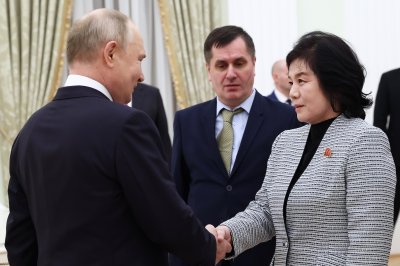

Russian President Vladimir Putin (L) welcomes North Korean Foreign Minister Choe Son Hui (R) during their meeting in the Moscow Kremlin, Russia. Photo by ARTEM GEODAKYAN / EPA-EFE
July 19 (Asia Today) — North Korea is intensifying engagement with China and Russia as South Korea, the United States and Japan broaden their cooperation to include the overseas deployment of small modular reactors.
The diplomatic activity follows events marking the 65th anniversary of the North Korea-China Treaty of Friendship, Cooperation and Mutual Assistance.
North Korea received a senior Chinese delegation for the anniversary and dispatched Foreign Minister Choe Son Hui to Russia, signaling efforts to manage relations with both of its principal partners.
The moves are widely viewed as an attempt to strengthen alignment among North Korea, China and Russia as Seoul, Washington and Tokyo expand their security and economic cooperation.
The three allies recently signed a memorandum aimed at encouraging cooperation among their civilian nuclear industries and supporting the deployment of small modular reactors in third countries.
The Korean Central News Agency said Choe left Pyongyang aboard a government aircraft Saturday at the invitation of Russian Foreign Minister Sergei Lavrov.
Russia’s Foreign Ministry also said Choe was making an official visit to the country.
It was Choe’s first visit to Russia in about nine months and the first major high-level exchange between the countries since the April opening of a memorial in North Korea honoring troops sent to support Russia.
Because the trip was not tied to a major anniversary or previously announced diplomatic event, analysts said Choe could be preparing for a possible visit to Russia by North Korean leader Kim Jong Un.
Russian President Vladimir Putin reportedly invited Kim to visit Russia during their June 2024 summit and again when the leaders attended events in China marking the anniversary of the end of World War II in Asia.
Possible subjects for Choe’s talks include a visit by Kim, recent developments in North Korea-China relations and coordination involving the Tumen River region, where the three countries share geographic and economic interests.
Park Won-gon, a professor of North Korean studies at Ewha Womans University in Seoul, said military and diplomatic accomplishments are easier for Pyongyang to demonstrate than economic achievements.
“If Chinese President Xi Jinping visits North Korea and Kim Jong Un subsequently visits Russia, North Korea could present those events as major diplomatic accomplishments,” Park said.
“Practical trilateral cooperation among North Korea, China and Russia has not progressed smoothly, but the Tumen River project could become a vehicle for cooperation among the three countries.”
China ties show signs of recovery
Relations between North Korea and China also appear to be recovering rapidly around the treaty anniversary.
Kim and Xi exchanged messages, a North Korean delegation traveled to China and Wang Huning, chairman of the Chinese People’s Political Consultative Conference, led a Chinese party and government delegation to North Korea.
The exchanges could expand cooperation in economic affairs, science and technology, public health and culture.
Wang’s visit to the Wonsan Kalma Coastal Tourist Area was particularly notable because the resort is one of Kim’s priority development projects.
Analysts have questioned whether Russian tourists alone can generate enough demand to make the resort financially sustainable.
Wang’s visit has therefore raised the possibility that the two countries discussed bringing larger numbers of Chinese tourists to the site.
Tourism is considered an area in which China may be able to support North Korea without directly violating the main restrictions imposed by U.N. Security Council sanctions.
Oh Gyeong-seop, a senior research fellow at the Korea Institute for National Unification, said attracting Chinese visitors is crucial to the resort’s prospects.
“Bringing in Chinese tourists is an issue that can avoid U.N. Security Council sanctions and is therefore critically important for North Korea,” Oh said.
“Large numbers of Chinese tourists are necessary to revitalize the Wonsan Kalma Coastal Tourist Area, so related discussions are likely to have continued.”
North Korea’s renewed engagement with China and Russia does not necessarily indicate that the three countries have established a formal trilateral alliance.
Their interests frequently differ, and analysts say much of their coordination remains bilateral.
The latest exchanges, however, demonstrate Pyongyang’s effort to strengthen diplomatic, economic and strategic ties with Beijing and Moscow while South Korea, the United States and Japan deepen their own cooperation.
— Reported by Asia Today; translated by UPI
© Asia Today. Unauthorized reproduction or redistribution prohibited.
Original Korean report: https://www.asiatoday.co.kr/kn/view.php?key=20260720010006651