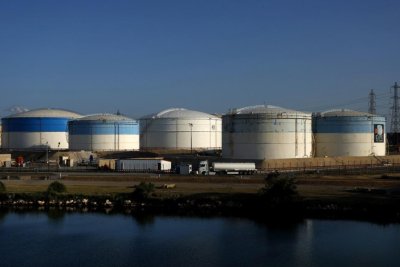

Brent Crude oil was trading at about $93 Friday as prices continue to rise largely because of oil tanker disruption in the Strait of Hormuz. File Photo by Guillaume Horcajuelo/EPA
March 6 (UPI) — The military escalation in the Middle East has shaken global energy markets and put Latin America on alert. The rise in oil prices opens an uncertain scenario if the conflict drags on, but it also generates expectations among the region’s exporting countries.
In that context, Argentina is following the crisis with caution, but also with interest. A more expensive barrel of oil can translate into higher export revenues, which is important for an economy that seeks to increase foreign currency inflows and strengthen its fiscal accounts.
Attention is focused on Vaca Muerta, one of the world’s largest reserves of unconventional oil and gas. The field is in the Neuquén Basin in Argentine Patagonia, and has become the country’s main energy bet.
From there, companies and analysts are closely watching every signal coming from the Middle East. In the sector, a cautious attitude prevails, summed up in the logic of wait and see.
According to data from consulting firm Gas Energy Latin America, the price of a barrel rose from about $64 to nearly $76 after the escalation of the conflict. The jump of around $12 benefits countries that sell crude abroad. Brent Crude was trading at about $93 on Friday as prices continue to rise largely because of oil tanker disruption in the Strait of Hormuz.
Álvaro Ríos Roca, former hydrocarbons minister of Bolivia and director and founder of the firm, told UPI that many Latin American countries depend on selling raw materials such as oil, minerals or agricultural products.
He said these countries earn money mainly from those resources because they do not produce or export much science or technology.
For that reason, when the price of oil rises, countries that produce it earn more money and the state also receives more taxes. That money helps them maintain their public finances, which are often weak.
In this scenario, the analyst identified three clear beneficiaries: Brazil, Guyana and Argentina. All three export more oil than they import, so the price increase is directly reflected in their revenues.
Even so, Ríos Roca believes Argentina has an advantage within the region.
“Argentina has the best prospects in oil and gas. Its exports will continue growing because the international market is demanding more energy,” he said.
Part of that expectation is explained by energy projects already underway. One of them is a mid-scale liquefied natural gas initiative led by Pan American Energy that aims to begin exports in the second half of 2027.
In parallel, another larger project promoted by YPF plans to start large-scale sales between 2030 and 2031. Both projects aim to turn Argentina into a significant exporter of natural gas in the global market.
The situation is different in Brazil. The country exports large volumes of oil, but does not have the same capacity to export gas. Much of the gas it produces is reinjected into oil fields to maintain the pressure that allows crude extraction to continue. Another portion is used in the domestic market.
Argentina, by contrast, bases its production on a technique known as hydraulic fracturing, or fracking. This involves injecting water, sand and chemicals at high pressure to fracture deep rock and release oil and gas trapped underground. It is the same system that fueled the U.S. energy boom over the past decade.
For now, the analyst believes oil prices will continue to be shaped by developments in the Middle East conflict.
“I don’t think it will reach $100. On the other hand, if the crisis eases in the coming weeks, the price could stabilize near $70 per barrel,” Ríos Roca estimated.
Daniel Dreizzen, former secretary of energy planning of Argentina, agrees that rising prices benefit all producing countries.
“Export revenues could increase by about 20%, in line with the rise in oil,” he told UPI.
Deizzen also pointed to a key factor in Argentina’s case: The country’s refining capacity is practically at its limit. That means any additional oil produced will be destined for international markets.
“Argentina cannot refine much more. So the extra crude is exported,” he said.
That scenario also benefits oil companies, which sell the same product at a higher price. If the domestic market follows the so-called “export parity,” internal prices tend to align with international ones. That improves profitability and may encourage new investments in the energy sector.
While some countries gain from the new scenario, others face a more complex outlook. That is the case of Mexico.
According to Ríos Roca, Mexican production will continue declining due to a lack of investment. State-owned Petróleos Mexicanos, or Pemex, carries heavy debt with contractors and has little room to finance new exploration projects.
“Mexico had very strong production for decades, but it has been in decline for years. Even Venezuela now has better prospects,” he said. In Venezuela’s case, some analysts see a possible return of international investment, which could reactivate part of its energy industry.
In contrast, several Latin American countries would be on the losing side if high prices persist. Net energy importers such as Central American countries, as well as Bolivia, Paraguay, Uruguay and Chile, will have to pay more for the fuel they consume. The same applies to many Caribbean economies, where energy costs have a direct impact on inflation and growth.
Beyond the current situation, analysts agree on a global trend: demand for natural gas will continue growing.
“There is no decarbonization of the planet without natural gas,” Ríos Roca said. In that context, liquefied natural gas trade is expanding rapidly and opening opportunities for new exporters.
Argentina seeks to position itself in that market through LNG projects being developed around Vaca Muerta. The same trend could also emerge in Venezuela, where initiatives to export gas in the coming years are under evaluation.
However, the immediate direction of the energy market largely depends on what happens in the Middle East. Both analysts concurred that the key factor is not only the duration of the conflict, but also the damage that oil and transport facilities may suffer.
“Productive infrastructure is being destroyed amid the attacks,” Ríos Roca said. If those facilities are seriously damaged, the effects on the market could last much longer than the conflict itself. In that case, the impact on oil prices would be deeper and more prolonged.