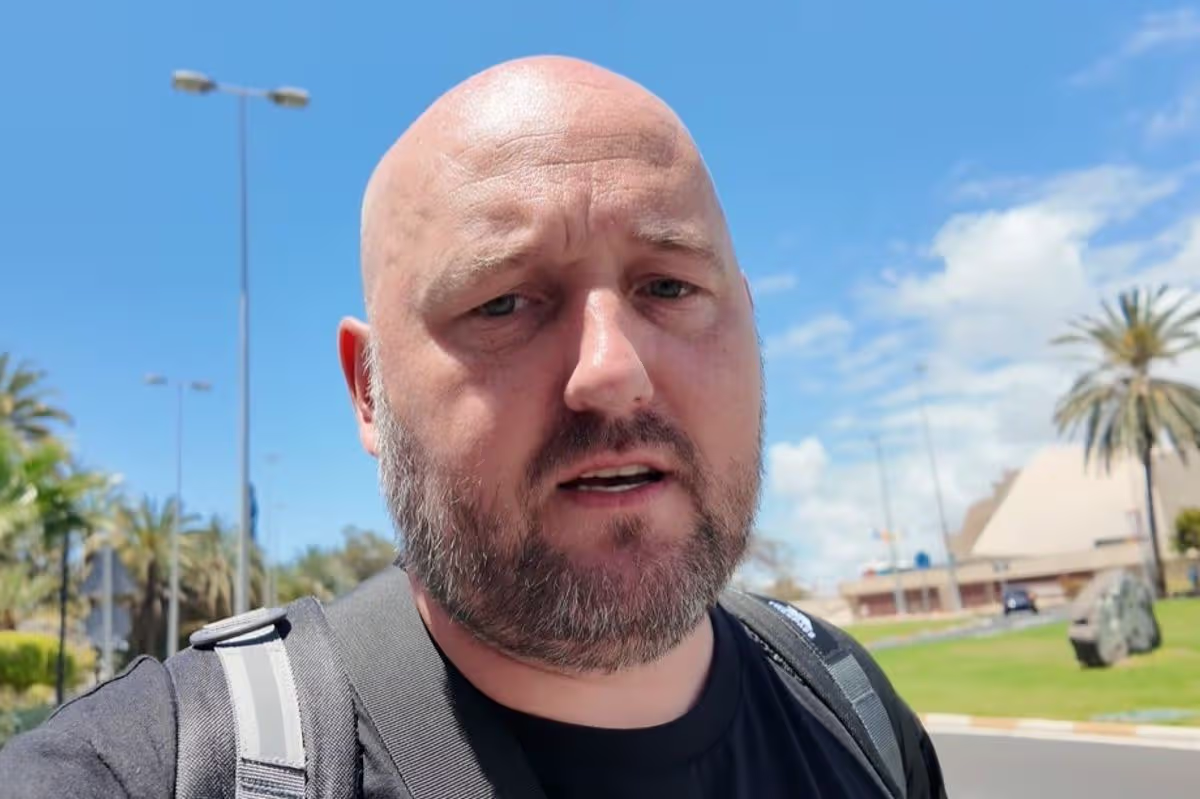
Content creator Just Deano flew from Tenerife to Manchester after his recent holiday where he tested out how long it would take to get past the new EES system that has caused chaos for Brits

Just Deano heading to the airport (Image: Just Deano/YouTube)
A Brit arrived at the airport in Tenerife three hours before his flight home after fearing new travel rules would delay him — only to breeze past the Entry/Exit System (EES) in just 30 seconds.
The travel requirement has led to major disruption across airports in Europe — and some Brits have ended up missing flights. This was after getting stuck in long queues in countries like Spain, Portugal and Poland.
For those who don’t know, new rules require non-EU nationals, which of course includes Brits, to register their biometrics instead of having passports stamped at border control.
It was introduced to replace the passport stamp and it works by automatically checking when a person enters or leaves a country in the EU.
As for what it means practically, Brits will have to register details including fingerprints and facial images before scanning their passports when they first visit a country in the Schengen area.
Content creator Just Deano arrived at Tenerife South Airport earlier than he normally would after hearing “horror stories”.
Some people in recent weeks have claimed that machines have been failing by rejecting fingerprints — while others have missed flights because of the delays this has caused.
One Brit wrote: “The key is to arrive three hours early so at least you are in the front of the queue when problems start.”
Another said: “Love Tenerife but HATE the airport.”
However, speaking about his own experience, Deano said: “That EES system, Entry/Exit system, was a piece of cake, you don’t have to do your fingerprints. We were in and out in 30 seconds. Literally 30 seconds. Straight to the e- gate. Put your passport in, went through no problem.”
But the catch here is that if it is your first time travelling to a European country this year, you will have to register your fingerprints, which is what has caused a lot of the carnage.
As was in Deano’s case, once you have registered your biometrics once, that information is then stored for three years, meaning you won’t have to keep repeating the process on each trip in Europe. However, some passengers have claimed they are having to repeat it and are therefore getting stuck.
Summing up his experience, Deano said: “But let me tell you people, don’t worry about the entry exit system, just forget the fingerprints (if already registered). We walk straight past the machines and just go to the e-gate as if you would as if you were getting your passport stamped. No need to worry. Absolutely fine. Even though it’s busy as anything here.
“I would imagine when all these people that are in here are going through that gate, going through that e-gate, you would get a little bit of a queue, but it takes about 10 seconds per person. So don’t worry at all.”
Despite Deano, who is from Huddersfield, not suffering from the new travel rules, some people wrote underneath the video, which you can watch here, that it wasn’t that easy for everyone.
One person wrote: “I have had my fingerprints taken on a few occasions now, did a full EES in Rome and about 5 times again. Didn’t work in Berlin, so hopefully Poland will be better.”
Another said: “Poor advice that Deano about the EES. Tell those stranded at the airport in Lanzarote yesterday as the plane left without them. I think it comes down to the number of flights departing to the UK at or around the same time. Summer is going to be a disaster.”
A third said: “I used the EES six weeks ago and still had to get in line for it again on Monday.”
One person added: “Lucky you – perhaps the delay did you a favour – we had to wait in a queue for over an hour with passport machines being very temperamental (we had done our fingerprints going into country) but both of still ended getting an actual border guy manually dealing with us and many others due to the machines.”
A fifth simply added: “EES, it is not as easy as you state deano.”