PROTESTS have spread across Europe with cities like Milan and Rome affected – and with more strikes on the horizon, is it still safe to travel to?
Here’s everything you need to know right now about travelling to Italy right now.
Protests have been taking place across Italy over the last few daysCredit: AFPStrikes have been scheduled for next week impacting air travelCredit: Getty
Where are the demonstrations and strikes in Italy?
Following the unrest in France, around 100,000 people in more than 40 cities across Italy took part in a demonstration called “No Meloni Day” last Friday.
Some of the destinations most affected include Rome, Bologna, Milan and Turin.
Sign up for the Travel newsletter
Thank you!
The strikes have been around the rising costs of living, a new government budget plan and students are protesting over school conditions.
Italy has said as a result, it will introduce stricter anti-riot laws. Prime Minister Giorgia Meloni said: “Demonstrating is a right, but destroying our cities is not.”
The new law will impact anyone joining a group of at least five people and will endanger public safety during protests with penalties up to five years in prison and a maximum fine of €20,000 (£16,759).
It’s not just demonstrations – there are strikes across the country for the next few months affecting public transport and air travel.
Ground handling staff at Bologna Airport have confirmed a four-hour walkout listed for October 29 between 12pm to 16pm, according to Italy’s transport ministry strike register.
The largest strike however is scheduled for October 30 which is a 24-hour walkout by workers in many public sectors across the country.
This includes ENIT/ENAV air traffic control and local aviation services at airports such as in Tuscany, Pisa and Florence.
Police clashed with protesters in Milan last weekCredit: AFP
Rail staff will also walkout affecting services on the Metro, on the motorways, staff and toll services are set to strike too.
Dockworkers and port staff are also set to strike and on the day there could be closures at attractions like museums.
Is it safe to travel to Italy right now?
The FCDO recently updated its advice: “Recent demonstrations across northern Italian cities have led to violent riots and looting.
“There is an increased presence of police and military personnel in Milan. Further demonstrations may take place in major cities. See Political demonstrations.
“A national strike is planned for 30 October and is expected to affect transport systems. Check with your travel provider for the latest information.”
However, Italy still remains a safe place to travel.
Are flights still going to Italy?
Currently flights are still going to and from Italy. But there could be problems in the coming days.
Wizz Air has warned its customers that flights to or from Italian airports could face delays because protests and road blockades are disrupting fuel supplies for several airports.
The airline added: “Our operational teams are closely coordinating with airports and fuel suppliers and reviewing alternative arrangements to minimize the impact on our customers, while maintaining safety as our highest priority.”
It’s advising customers to check the status of their flight before travelling to the airport.
On October 30, the planned strikes are scheduled to start at 12am until 11.59pm.
Passengers flying to or from Italy should check their airline’s flight status and monitor updates before travelling.
What if I have a holiday to Italy booked?
The FCDO has advised caution for anyone travelling to Italy, but a ‘do not travel’ warning has not been issued.
Holidaymakers can still visit Italy, and travel insurance should remain valid, but check your policy details.
If you decide not to go on a booked holiday, operators won’t have to give a refund because travel advice says it is still safe for travel.
Flight compensation rules
A look at your rights if a flight is delayed or cancelled, when your entitled to compensation and if your travel insurance can cover the costs.
What are my rights if my flight is cancelled or delayed?
Under UK law, airlines have to provide compensation if your flight arrives at its destination more than three hours late.
If you’re flying to or from the UK, your airline must let you choose a refund or an alternative flight.
You will be able to get your money back for the part of your ticket that you haven’t used yet.
So if you booked a return flight and the outbound leg is cancelled, you can get the full cost of the return ticket refunded.
But if travelling is essential, then your airline has to find you an alternative flight. This could even be with another airline.
When am I not entitled to compensation?
The airline doesn’t have to give you a refund if the flight was cancelled due to reasons beyond their control, such as extreme weather.
Disruptions caused by things like extreme weather, airport or air traffic control employee strikes or other ‘extraordinary circumstances’ are not eligible for compensation.
Some airlines may stretch the definition of “extraordinary circumstances” but you can challenge them through the aviation regulator the Civil Aviation Authority (CAA).
Will my insurance cover me if my flight is cancelled?
If you can’t claim compensation directly through the airline, your travel insurance may refund you.
Policies vary so you should check the small print, but a delay of eight to 12 hours will normally mean you qualify for some money from your insurer.
Remember to get written confirmation of your delay from the airport as your insurer will need proof.
If your flight is cancelled entirely, you’re unlikely to be covered by your insurance.
A British Airways flight from a tourist hotspot was forced to divert in the early hours to land at Gatwick rather than Heathrow
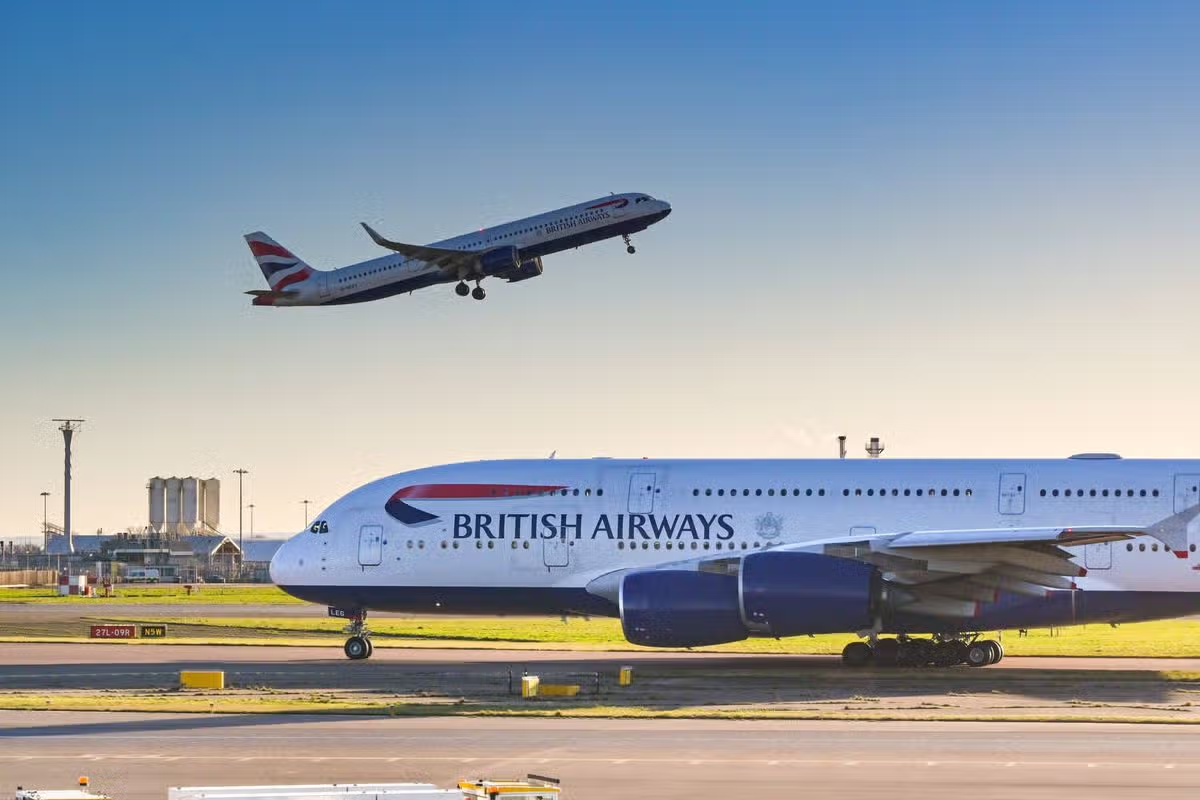
A British Airways jet was forced to land at Gatwick(Image: Ceri Breeze via Getty Images)
A British Airways flight has been forced to divert from Heathrow to Gatwick after falling foul of strict rules over its landing time.
The BA707 flight from holiday hotspot Larnaca was diverted to the London airport after the four hour journey, according to AirNav Radar.
The flight had to be diverted to Gatwick after missing the curfew at Heathrow.
The plane left the Cyprus airport at 9.32pm, over three hours after scheduled take off.
It then landed at Gatwick at 12.12am on Tuesday.
Flights heading to Heathrow are often diverted to Gatwick or other regional hubs if they miss Heathrow’s strict nighttime curfew.
Heathrow enforces rigorous restrictions on movements late at night in order to reduce noice pollution for the millions of residents that live under its flight paths.
The core curfew means that scheduled flights are heavily restricted to land and take off between 11pm and 6am.
The airport operates under a strict ‘night quota’ system between 11pm and 6am which limits both the absolute number of flights allowed to land and the total amount of aircraft noise allowed.
Unless an official emergency is declared then air traffic control will deny landing rights past the curfew, forcing a diversion.
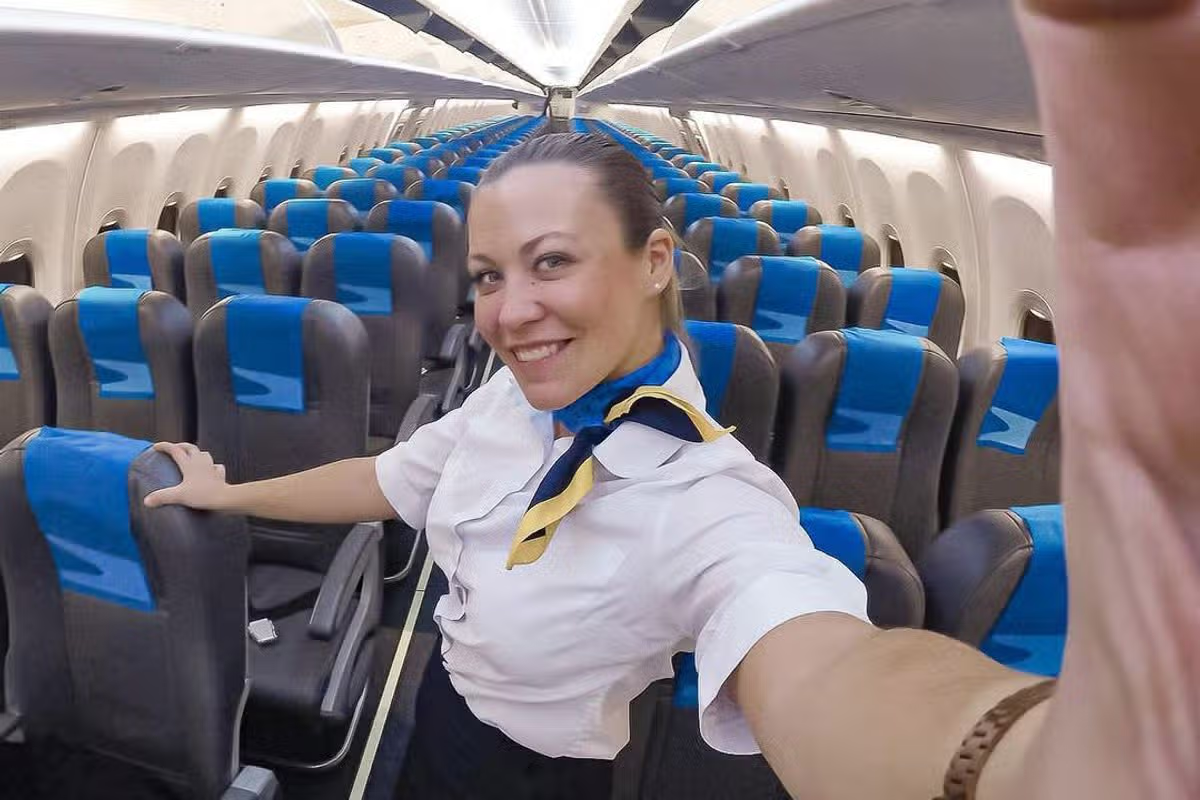
Barbara Bacilieri, who served as a flight attendant for 14 years, shares travel guidance and knowledge with her 5.1m TikTok followers and 2.9m YouTube subscribers
A flight attendant has explained why you should put your suitcase in the hotel bathtub
(Image: Jam Press/@barbiebac.ok)
A flight attendant has disclosed why holidaymakers should position their suitcase in the hotel bathtub and place a shoe on top of the safe upon checking into a room. Barbara Bacilieri, who served as a flight attendant for 14 years, shares guidance and insider knowledge with her 5.1m TikTok followers and 2.9m YouTube subscribers.
She recently urged tourists to leave their luggage in the bathtub immediately upon arrival, instead of setting it down on the bed or carpet. She told creatorzine.com: “Place your suitcase in the hotel bathtub before opening it. Leave it there, closed, while you inspect the room.”
While it may appear an odd location to keep a suitcase, the guidance aims to minimise the risk of transporting unwanted stowaways back home.
“Bed bugs are a very serious problem, and they can sneak into your luggage and come back home with you,” Barbara warned. Bedbugs can lurk in mattresses, bed frames and upholstered furniture, and may crawl into luggage positioned close by.
Placing a suitcase in the bathtub allows travellers sufficient time to examine the room before unpacking their possessions. The hard surface also prevents luggage from being placed directly on fabric-covered spots where the insects might be concealed.
Barbara, 34, recognised online as Barbie Bac, advised: “Look at the mattress seams, headboard and luggage rack. “If you find insects or suspicious signs, keep your bag closed and inform reception to request a room change.”
Another tip concerns the hotel safe, where guests typically store passports, cash, jewellery and other valuables throughout their stay. Barbara’s suggestion is to use a shoe as a prompt to remember to check the safe before departing.
“If you put your passport in the safe, put one shoe inside and leave the other right by the door. This shoe will remind you to check the safe,” she said.
The concept is to create a visual cue that’s virtually impossible to miss when it’s time to leave. A guest preparing to check out will require both shoes before exiting the room, prompting them to collect the one stashed inside the safe.
This should encourage them to open the safe and verify they’ve retrieved everything inside before heading off. Barbara also outlined a range of packing and travel tips gained from her years working as a flight attendant.
Before handing over a bag for check-in, she advises photographing it from multiple angles. “Take pictures of your bag before handing it in. A full picture of the bag, and another of the wheels, handles and corners.
“This way you will have a reference for its condition if they return it damaged,” she said. She also recommended photographing the baggage claim tag and storing the original alongside your passport.
“Upon receiving your bag, inspect it before leaving the airport. If it appears broken, take pictures, notify the airline and keep the report number,” Barbara explained.
She added that photographs can assist with documentation but offer no guarantee of compensation, and advised verifying what travel insurance covers in relation to luggage.
She emphasised the importance of identification inside the bag itself. “The outer card may tear and get lost. Leave another identification card inside the bag where it is easy to see when it is opened.
“Name, phone number with country code, and email address. A contact person you can get in touch with during the trip,” she said. When packing liquids, she advised taking extra precautions.
“Shampoo may leak even if the cap is closed, so keep it in a tightly sealed bag away from clothes. Do the same with other products that may spill. If anything leaks, the bag can contain it and save you from having to wash half the bag,” she explained.
She also proposed making use of the space inside shoes: “Put the socks inside the shoe. If you are carrying perfume, keep it tightly closed and protected inside a bag before putting it away.”
Slippers, she noted, ought to be covered with a transparent plastic cover or shower cap so they don’t come into contact with clean clothing. She takes an empty bag for practical purposes.
“This may be helpful if you encounter a problem when checking in. You may have to rearrange your bag because it is overweight. Upon returning, use it for dirty clothes,” she said.
She reuses her packing list when departing the hotel and sets a particular alarm. “Set an alarm to remind you what needs to be checked. The charger, the safe, the documents. This name is more useful to you than an alarm clock that rings but says nothing.
“Set it a few minutes before leaving the hotel. When it rings, check everything before turning it off,” she said.
Barbara, who hails from Argentina and is based in Spain, has amassed a substantial online following by sharing travel tips and offering insights into life as cabin crew.
Her videos span everything from the day-to-day realities of working aboard an aircraft to practical methods passengers can use to make their journeys smoother.
Ensure our latest travel headlines always appear at the top of your Google Search by making us a Preferred Source. Click here to activate or add us as Preferred Source in your Google search settings
Crew of Austrian Airlines flight OS82 decides to land in Sofia after receiving bomb threat, Bulgarian authorities say.
Published On 18 Oct 202618 Oct 2026
An Airbus A320 flight from Tel Aviv to Vienna has made an emergency landing in Bulgaria following a reported bomb threat, according to the Bulgarian Ministry of Transport.
Austrian Airlines flight OS82 was near the border with Romania when the crew received a bomb threat and decided to land in the Bulgarian capital, Sofia, the Transport Ministry said in a statement on Sunday.
Recommended Stories
list of 3 itemsend of list
Bulgaria’s Ministry of Defence said an air force MiG-29 fighter jet escorted the plane to Sofia airport.
Initial information showed the aircraft carried six crew members and 51 passengers, all of whom have all since disembarked, according to the Transport Ministry’s statement.
The airline told the AFP news agency that a security search of the aircraft was conducted.
“Once the search of the aircraft is complete, the passengers will be rebooked onto alternative flights as quickly as possible,” the airline said.
A crisis response team has been set up, and relevant authorities have launched an investigation into the incident, the Bulgarian Transport Ministry said.
According to aviation and flight tracking site FlightAware, Austrian Airlines 82 left the Ben Gurion airport in Tel Aviv on Sunday at 6:46pm local time (15:46 GMT) and landed about three hours later at Vasil Levski airport in Sofia at 9:43pm (18:43 GMT).
Flightradar24 data showed it entered Romanian airspace at about 9:10pm (18:10 GMT) before turning south and heading back towards Bulgaria.
Information from the flight-tracking platform ADS-B Exchange indicates the aircraft was transmitting squawk code 7700 – a signal for a general emergency – at around the same time.
Flydubai incident
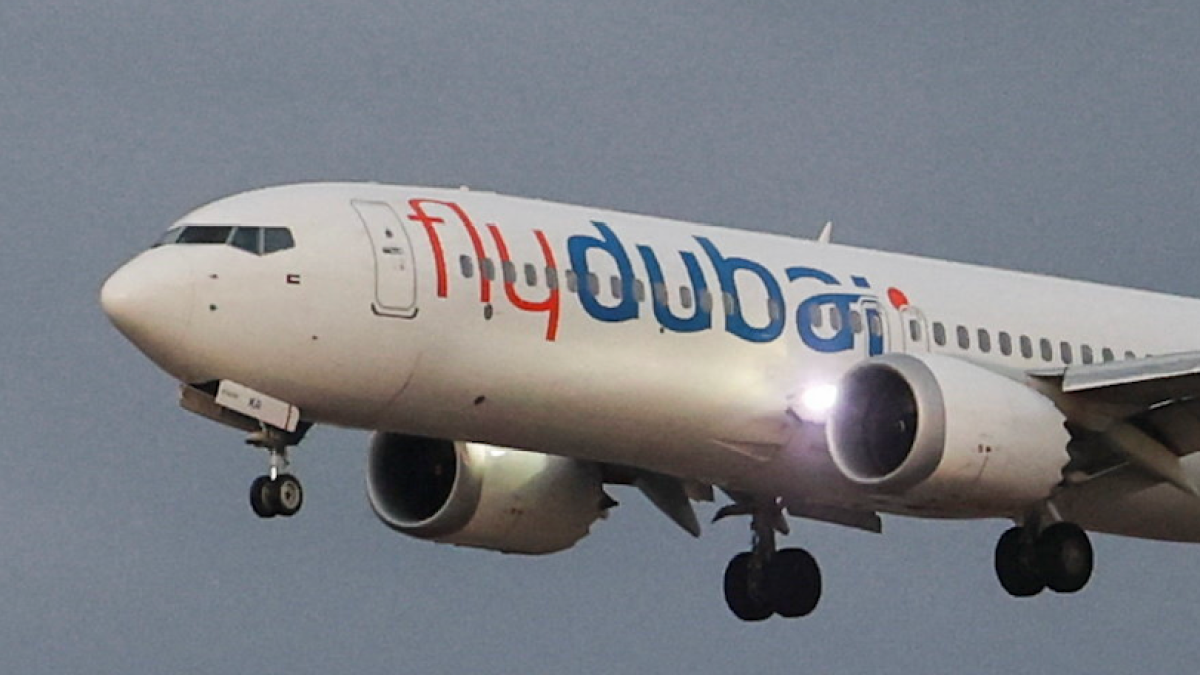
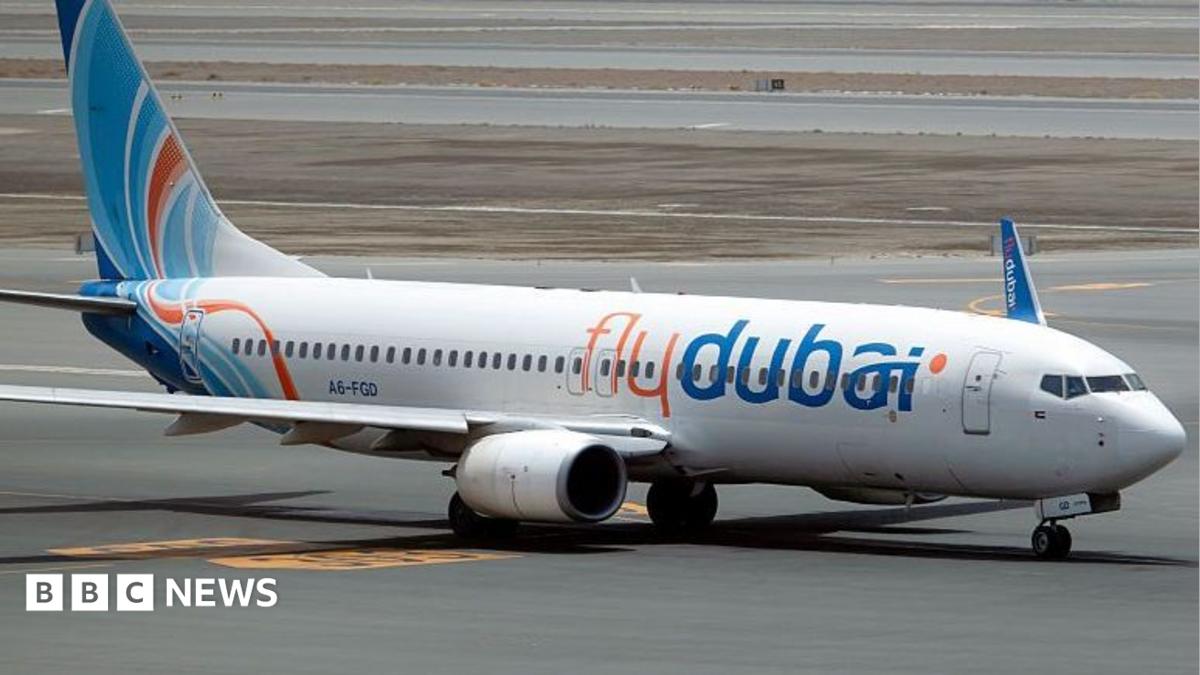
Last month, a Flydubai plane carrying 174 passengers was on its way from the United Arab Emirates to Tel Aviv when a co-pilot allegedly attacked the pilot with an axe in an attempt to crash the plane.
A plane carrying passengers who were on the Flydubai aircraft bound for Israel from the United Arab Emirates, which was diverted to Saudi Arabia following an emergency signal, arrives at the Ben Gurion airport near Tel Aviv, Israel, on September 30, 2026 [Ammar Awad/Reuters]
The aircraft plunged about 17,000 feet (5,180 metres) before it was brought back under control by other Flydubai pilots after passengers and other crew subdued the alleged attacker.
The flight was diverted and forced to make an emergency landing at Prince Sultan bin Abdulaziz International Airport in Tabuk, northwestern Saudi Arabia.
Authorities in the UAE said the co-pilot was on a “suicide” mission to crash the plane at Israel’s Ben Gurion airport in Tel Aviv.
The co-pilot, Hamam Al-Hammami, an Omani national, has since been charged with terrorism offences in the UAE.
The Israeli government responded to the incident by ordering checks on the identities of all pilots flying into the country.
Selma Blair’s team has released a lengthy statement regarding the actor’s recent arrest following an incident while aboard a flight.
“Selma Blair experienced a medical emergency on the flight,” said the statement provided to People on Friday. “There was no attempt to open the door of the aircraft. Selma did not intend to harm anyone.”
The statement is intended to “correct the record on a few points already in public circulation” regarding Blair’s alleged violent conduct aboard a Delta Airlines flight. The Times has reached out to Blair’s reps for comment.
The “Cruel Intentions” star was arrested at John F. Kennedy International Airport late Sunday after an alleged altercation with staff during a flight from Los Angeles. Upon landing, Blair, 54, was taken into custody, then transported to Jamaica Hospital Medical Center. In addition to her alleged actions aboard the flight, the “Legally Blonde” star has been accused of kicking a Port Authority Police Department officer as she was being transported to the hospital, as well as kicking a nurse.
“Since Sunday night, the public account of what happened to Selma aboard a flight to New York has been built almost entirely on a police statement and a decade-old headline,” Blair’s spokesperson said in the Friday statement to People.
The spokesperson called out the lack of “fair reporting” around the situation, adding that they are grateful for the “handful of journalists [who] have taken the time to report on Selma as a human being rather than a headline.”
Blair was charged with two counts of second-degree assault on Monday for her alleged actions involving the police officer and nurse. Blair pleaded not guilty to the charges. At the hearing, her attorney, Shawn Barnes, reportedly told the judge that “this was not an intentional assault” and that the actor had “missed several doses of … a powerful medication that controls severe neurological symptoms,” per the New York Post.
Blair lives with multiple sclerosis, a chronic neurological disorder and autoimmune disease, which she has been open about since 2018.
The statement also addressed Blair’s medical condition — denouncing any who suggest the actor does not have multiple sclerosis — how and why she travels with a service dog, her activism and her busy schedule as an actor and entrepreneur.
“Selma had never been arrested before Sunday night,” the statement said. “There is much more to this story than has been reported, and we ask to consider the entirety of the facts before rushing to judgment, whether in the courtroom or in the court of public opinion.”
BRITS will get more choice of where to go on holiday next year as TUI has announced eight new routes.
These will take-off from London Gatwick to destinations from sunny Spanish cities to North African islands.
TUI is adding eight new routes from London Gatwick for summer 2027Credit: AlamyOne of these routes is to the popular winter sun city of SevilleCredit: arcady_31
For summer 2027, TUI is adding eight new routes which will contribute to its 17 million seats and 84,000 flights planned for next year.
There will be three new routes to Spain, one of which will be to Seville which is popular for winter sun thanks to its year-round sunshine.
Sign up for the Travel newsletter
Thank you!
Even in the winter, Seville can experience highs of 18C.
The city has plenty to see like Royal Alcázar of Seville, Seville Cathedral and Plaza de España which is a cobbled square with four bridges over its small river.
In Greece, one of the new routes is to the Greek city of AthensCredit: Getty
He added: “I climbed Mars Hill to catch the sunset over the city — an experience that’s usually a shoulder-to-shoulder fight in July, but in winter felt like my own private viewing platform.
Another of TUI’s new routes is to Mytilene (Lesvos) which is on the Greek island of Lesbos.
In the city, visitors can explore Mytilene Castle, stroll around Ermou Street Market and enjoy seafood at the tavernas along the waterfront.
It even has its own Statue of Liberty in the harbour.
One of the three Spanish routes is to ValenciaCredit: GettyThe island of Lesvos has bright blue Mediterranean watersCredit: Getty
TUI will also fly to Palermo, the capital of the Italian island of Sicily.
It sits on the northern coast of the country with both sandy and rocky beaches like Mondello Beach and Addaura.
One free attraction is San Domenico Square which is the entrance to La Vucciria a market selling things like food, jewellery and souvenirs.
TUI is also offering a direct route to Tangier in Morocco which sits along the Strait of Gibraltar.
The city itself has plenty to see including its medina, busy souks, and landmarks like the Kasbah and the Caves of Hercules.
The city itself has a blend of cultures; African, French and Spanish.
It has a vibrant café culture thanks to its French influence, tapas culture from Spain.
In the summertime, Tangier sits at around 30C so it’s warm, but still mild enough to explore.
Tangier in Morocco boasts souks and the Cave of HerculesCredit: DoraDaltonDjerba is off the coast of Tunisia and is hot all year-roundCredit: BTWImages
Another route is to Djerba, a large island off Tunisia’s southeastern coast.
It has sandy beaches and for any Star Wars fans, it was the filming location for Star Wars: Episode IV – A New Hope – and there are regular tours too.
Head of Sun Travel, Lisa Minot, visited Djerba last year, she said: “Relatively undiscovered by us Brits, Djerba is a great-value option for those looking to explore beyond the Med favourites.
“Sizzling in summer, temperatures remain high all the way through to November and rarely dip below the 20Cs, even in the depths of winter, making it ideal for out-of-season sunshine.”
The Caribbean country of Jamaica has received its first third-country deportations from the United States, as part of an expanding set of international agreements under President Donald Trump.
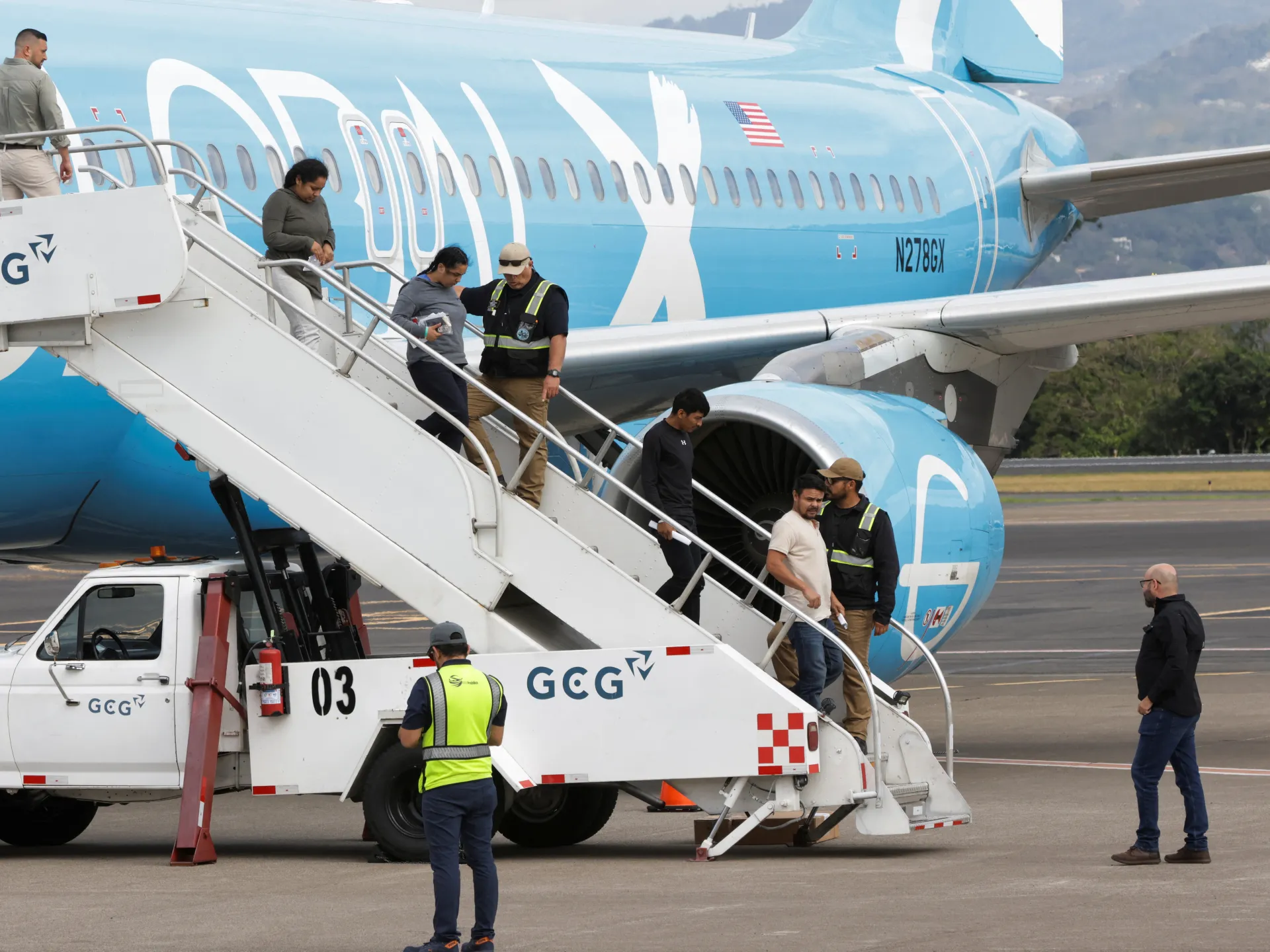
On Tuesday, 22 deportees from the US arrived at Norman Manley International Airport in Kingston, Jamaica.
Recommended Stories
list of 3 itemsend of list
Media reports indicate they were subsequently boarded onto a bus and taken to an undisclosed location.
Such deportations – which often involve non-citizens who have no ties to their destinations – have faced widespread condemnation from human rights groups and advocates who have questioned their legality.
But Jamaica is among a growing number of countries to accept third-country deportations, as part of Trump’s effort to implement the largest mass deportation campaign in US history.
At least 35 countries have entered into third-country deportation agreements with the US, according to Third Country Deportation Watch, an advocacy project affiliated with the groups Refugees International and Human Rights First.
The Washington Post reported last month that the Trump administration has earmarked roughly $410m to support such efforts.
Jamaica signed a bilateral memorandum of understanding in June to receive third-country deportations. Under the plan, Jamaica will transfer any deportees to their home countries or other destinations after their arrival.
The country’s government has also pledged not to accept any deportees with criminal records.
“The government reiterates that this is a transit arrangement intended to facilitate the return of Third Country Nationals to their country of origin or other receiving countries,” Jamaica’s Ministry of National Security and Peace and its Ministry of Foreign Affairs and Foreign Trade said in a joint statement.
It added that care for the deportees will be supported by the International Organization for Migration, a United Nations organisation.
“The arrangement will not be funded by the Government of Jamaica,” the joint statement added.
Opposition leaders in Jamaica, however, spoke out against the deportation, framing the deal as a threat to the island’s security. They also questioned why the agreement had not been debated publicly.
“Jamaicans are being asked to trust a secret document that touches their security, their communities and their public services,” said Fitz Jackson, the opposition spokesperson on national security.
In response to Jackson’s statement, Foreign Minister Kamina Johnson Smith argued that any questions about the deportation deal “have all been answered”. She also indicated that the US has not agreed to make the deal public.
“As I explained before, some countries have agreed to receive criminals, we have not,” she wrote on social media.
“Some countries have had their agreements made public, but our partner has not agreed for this one to be.”
Legal challenges against the third-country deportations are ongoing in the US, where advocates have argued that deportees are being removed from the country without due process of law, the constitutional right to a fair hearing.
Critics have also argued that third-country deportations sometimes send immigrants to countries where they may face danger.
Some of the recipient countries, such as South Sudan, are in the midst of ongoing conflict or have faced accusations of serious human rights abuses.
Opponents have even said the third-country deportations are being used as a backdoor method for circumventing court protection orders.
Such orders may prohibit the US government from returning certain immigrants to their home countries, for fear of violence and persecution.
But by sending immigrants to third countries, critics say the Trump administration avoids violating such protection orders – though in some cases, the third country has then returned the deportee to the country identified in the US protection order.
In a February report by Democrats on the US Senate Foreign Relations Committee, one official said anonymously that the purpose of such far-flung deportations was to instil fear.
“The point is that the administration can threaten people that they will literally be dropped in the middle of nowhere,” the official said. “The point is to scare people.”
The UK is getting colder, but elsewhere in Europe the October sun is still shining and a warm weather holiday is not out of the question.
This beach is known for it’s gorgeous clear waters(Image: Getty)
The UK may be getting chillier, but across Europe the sun is still blazing and a beach getaway remains firmly on the cards. If you’re not quite ready to bid farewell to sun and sand, there’s one destination just four and a half hours from the UK where temperatures are still hitting a pleasant 23C.
Better still, it won’t cost you a fortune. That destination is Cyprus, the Mediterranean island paradise. According to research by airport transfer firm hoppa, this gem ranks as the ultimate choice for an autumn escape in the sunshine.
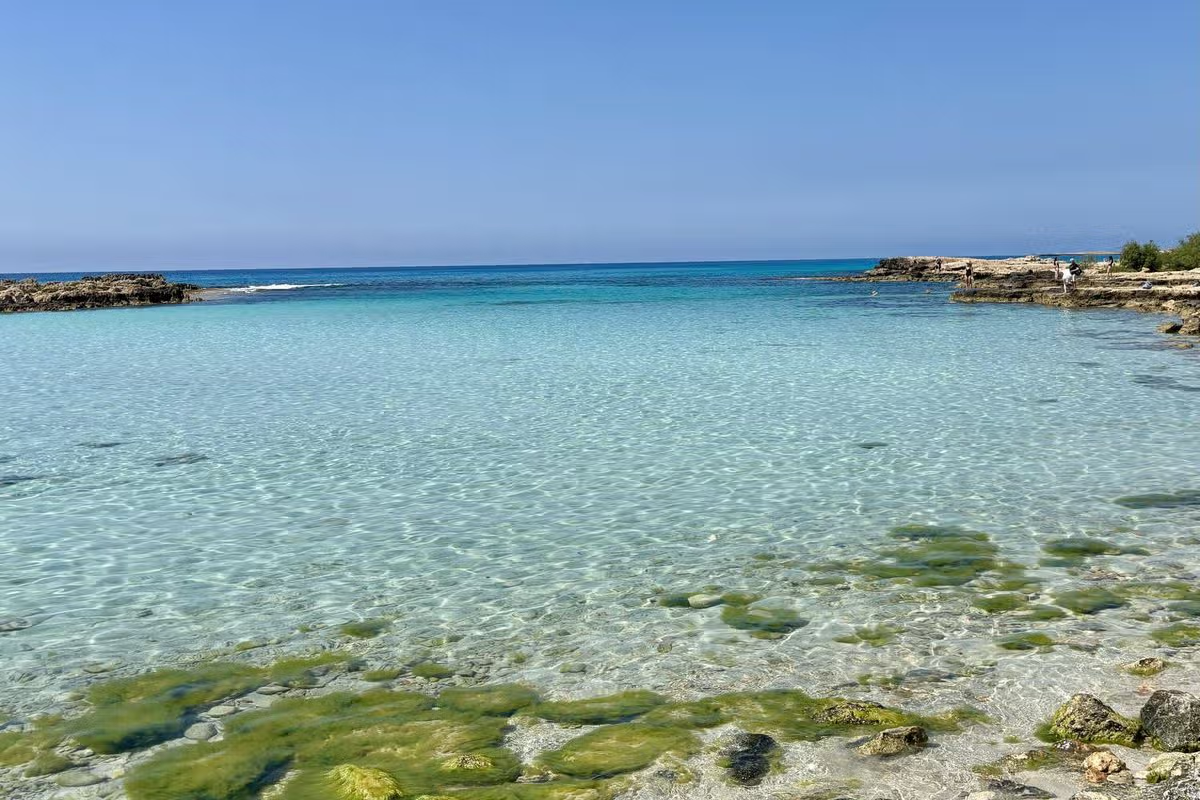
The warmest location is Nissi Beach, nestled on the south-eastern coastline in the resort town of Ayia Napa.
While it’s renowned as a lively party hotspot, there’s far more to discover beyond the buzzing nightlife.
The beach is celebrated for its dazzling turquoise waters and its small offshore island, which visitors can reach by simply wading through the shallow sea.
That island is Nissi itself, the namesake of the beach, and those who venture to its summit are rewarded with spectacular sweeping views across the entire bay.
The beach proudly holds Blue Flag status, with ample sun loungers and parasols available to rent, alongside opportunities to hire jet skis or pedalos for those seeking a dose of adventure.
One holidaymaker took to TripAdvisor to share their thoughts, writing: “Probably one of the most popular beaches in Cyprus-and for good reason.
“Crystal-clear water, beautiful soft sand, and that creamy, turquoise texture that makes you feel like you’re in paradise. Add the amazing atmosphere and beautiful people, and you have the perfect beach experience.”
A second visitor added: “Nissi Beach easily has the most amazing water I have ever swum in!
“Despite being extremely busy, its natural beauty makes it an absolute must-visit.”
While the beach can get extremely crowded during peak summer, visiting during the shoulder season means far fewer tourists to contend with, allowing you to soak up the stunning surroundings in relative peace.
What’s more, according to hoppa, the average nightly rate for a three-star hotel in Ayia Napa comes in at just £79, making it a brilliantly affordable choice for a late burst of October sunshine.
A man from the UK has vanished 5,000 miles away from home after missing his flight back. Bailey Singh did not board his scheduled flight back home.
The 20-year-old’s phone is now reportedly off, and he has not been in contact with family for days. He was reported missing on October 5 and was last seen at Suvarnabhumi Airport, Bangkok, Thailand.
Bailey’s family is now pleading for anyone to come forward with information on his whereabouts. His sister Chardonnay said he may have travelled to the Pattaya area – a hotspot for Brits abroad and expats.
He is described as around 5ft 11 with dark brown eyes, curly brown hair and a goatee beard. Bailey is known to have two distinctive tattoos, including a jigsaw on his left inner arm and one behind his left ear which says ‘eleven’.
It is believed that at the time he vanished, he was wearing a blue tracksuit, a blue top and grey trainers. The family says they have contacted the UK Embassy in Thailand.
They state that they were unable to confirm whether he had been arrested or reported injured. Pleas have been shared across social media and amongst local Thai travel groups.
Mother Lisa Ely said: “He’s in Thailand and not heard from him in two days and his phone is off and his location, which is not like him.”
Chardonnay Ely said: “He has been missing for over a week in Bangkok and have suspicions he’s now in Pattaya. If anyone has any information on him please contact me.
“Me and my family are very worried and concerned for him and just want to make sure he is safe.”
Selma Blair allegedly had a violent episode aboard a Delta Airlines flight.
The “Cruel Intentions” star was taken into custody and transported to a hospital for evaluation on Sunday night after allegedly becoming physically abusive with the flight staff, according to the New York Port Authority. The Port Authority Police Department responded to a call around 11 p.m., when a flight coming from Los Angeles International Airport landed at John F. Kennedy International Airport, and two flight attendants needed medical assistance after an alleged altercation while in flight. One flight attendant was also transported to the hospital for further evaluation.
The FBI is investigating the incident.
According to representatives for Blair, “Selma experienced a medical emergency that led to the alleged conduct. Upon landing, she received immediate medical attention and is currently in stable condition.”
In dispatch audio, obtained by TMZ, a flight attendant suffered a bloody nose and Blair is alleged to have “bashed her head” against an overhead compartment.
A spokesperson for Delta told The Times in an emailed statement, “Delta has zero tolerance for unruly or unlawful behavior, as the safety of our customers and crew always comes first.”
In 2016, Blair was hospitalized after an incident on a flight to Los Angeles International Airport from Cancun, Mexico. She subsequently apologized for the behavior, saying in a statement, “I made a big mistake yesterday. After a lovely trip with my son and his Dad, I mixed alcohol with medication, and that caused me to black out and led me to say and do things that I deeply regret.”
The FBI could not immediately be reached for comment.
SELMA Blair has been arrested after allegedly attacking multiple flight attendants while trying to open a plane’s door mid-flight.
The actress reportedly started mass chaos on a Delta Airlines flight traveling to John F. Kennedy International Airport on Sunday.
Selma Blair has been arrested after allegedly attacking flight attendants while trying to open the plane’s door mid-flights
Selma attempted to open the aircraft door while it was in the air and assaulted several crew members who tried to stop her, according to TMZ who first reported the news.
“Two flight attendants from the airline were injured to the point where they needed further medical care due to an attack from a passenger,” the New York Port Authority confirmed in a statement to The U.S. Sun, though they didn’t mention the Legally Blonde star by name.
Sign up for the Showbiz newsletter
Thank you!
“The person who caused these injuries also repeatedly tried to open the plane door. She was arrested immediately upon landing, and the incident is currently being investigated by federal law enforcement,” they added.
A rep for Selma further told TMZ, “Selma experienced a medical emergency that led to the alleged conduct. Upon landing, she received immediate medical attention and is currently in stable condition.”
It’s unknown what caused Selma’s behavior, but it’s sadly not the first time this happened.
In 2016, the Cruel Intentions star was removed from a flight on a stretcher after having a meltdown in the sky.
More to follow… For the latest news on this story, keep checking back at The U.S. Sun, your go-to destination for the best celebrity news, sports news, real-life stories, jaw-dropping pictures, and must-see videos.
A MAJOR UK airport that sees millions of passengers through its doors each year could come to a complete halt this week.
A strike at Leeds Bradford Airport may mean that no flights will be able to land or depart across two days.
Leeds Bradford Airport is set to come to a complete standstill this weekCredit: GettyAlmost 130 members of staff are staging a walkout over payCredit: Alamy
If it does go ahead as planned, then it will mean no flights will be able to land, depart and passengers won’t be able to pass security.
Nearly 130 workers are staging a walkout at Leeds Bradford Airport in a dispute over pay.
Sign up for the Travel newsletter
Thank you!
Those striking includes a mix of air traffic control workers, security, customer service and cleaners.
The industrial action is set to start on October 16 and last until 6am on Sunday 18.
There have been ongoing talks over pay since December 2025 but Unite members involved said it “didn’t go far enough”.
Unite regional officer Neil Whitaker said they had “no choice but to strike,” and what would be needed to call of the action is a “fair pay rise”.
In a statement from the airport, it said: “Leeds Bradford Airport acknowledges the proposed industrial action due to take place between 16-18 October involving a group of operational colleagues.
“We respect the right of employees to participate in lawful industrial action. However, we are disappointed by this and do not believe strike action is the right way to resolve the issues still under discussion.
“The airport has made what we believe is a fair and responsible offer that is significantly above inflation and reflects both current economic conditions and the need to ensure the long-term sustainability of the business.
“Our priority now is to minimise disruption for customers, many of whom have worked hard and saved for important holidays, family visits and business travel. At this stage we anticipate running near-normal operations during the period.”
Leeds Bradford Airport is set to handle around 4.5million passengers every yearCredit: Getty
“Leeds Bradford Airport plays a vital role in connecting Yorkshire to the world. Industrial action has the potential to cause inconvenience for thousands of customers and local businesses who rely on those connections.
“We remain committed to constructive dialogue with Unite and would welcome continued discussions aimed at reaching a resolution.
“It is important to recognise that any profits generated by Leeds Bradford Airport are reinvested back into the airport and has been for a number of years. Those funds support improvements to facilities, infrastructure, operations and customer experience including the ongoing LBA:REGEN project which saw the opening of a new central search zone and staff welfare facilities this week.”
The terminal was renovated with a modern arrivals process with 83 per cent more seating and two premium lounges.
Flight compensation rules
A look at your rights if a flight is delayed or cancelled, when your entitled to compensation and if your travel insurance can cover the costs.
What are my rights if my flight is cancelled or delayed?
Under UK law, airlines have to provide compensation if your flight arrives at its destination more than three hours late.
If you’re flying to or from the UK, your airline must let you choose a refund or an alternative flight.
You will be able to get your money back for the part of your ticket that you haven’t used yet.
So if you booked a return flight and the outbound leg is cancelled, you can get the full cost of the return ticket refunded.
But if travelling is essential, then your airline has to find you an alternative flight. This could even be with another airline.
When am I not entitled to compensation?
The airline doesn’t have to give you a refund if the flight was cancelled due to reasons beyond their control, such as extreme weather.
Disruptions caused by things like extreme weather, airport or air traffic control employee strikes or other ‘extraordinary circumstances’ are not eligible for compensation.
Some airlines may stretch the definition of “extraordinary circumstances” but you can challenge them through the aviation regulator the Civil Aviation Authority (CAA).
Will my insurance cover me if my flight is cancelled?
If you can’t claim compensation directly through the airline, your travel insurance may refund you.
Policies vary so you should check the small print, but a delay of eight to 12 hours will normally mean you qualify for some money from your insurer.
Remember to get written confirmation of your delay from the airport as your insurer will need proof.
If your flight is cancelled entirely, you’re unlikely to be covered by your insurance.
While none of the routes are new for Brits, more routes also mean lower prices.
The flights are already on sale, with the cheaper options if you book sooner rather than later.
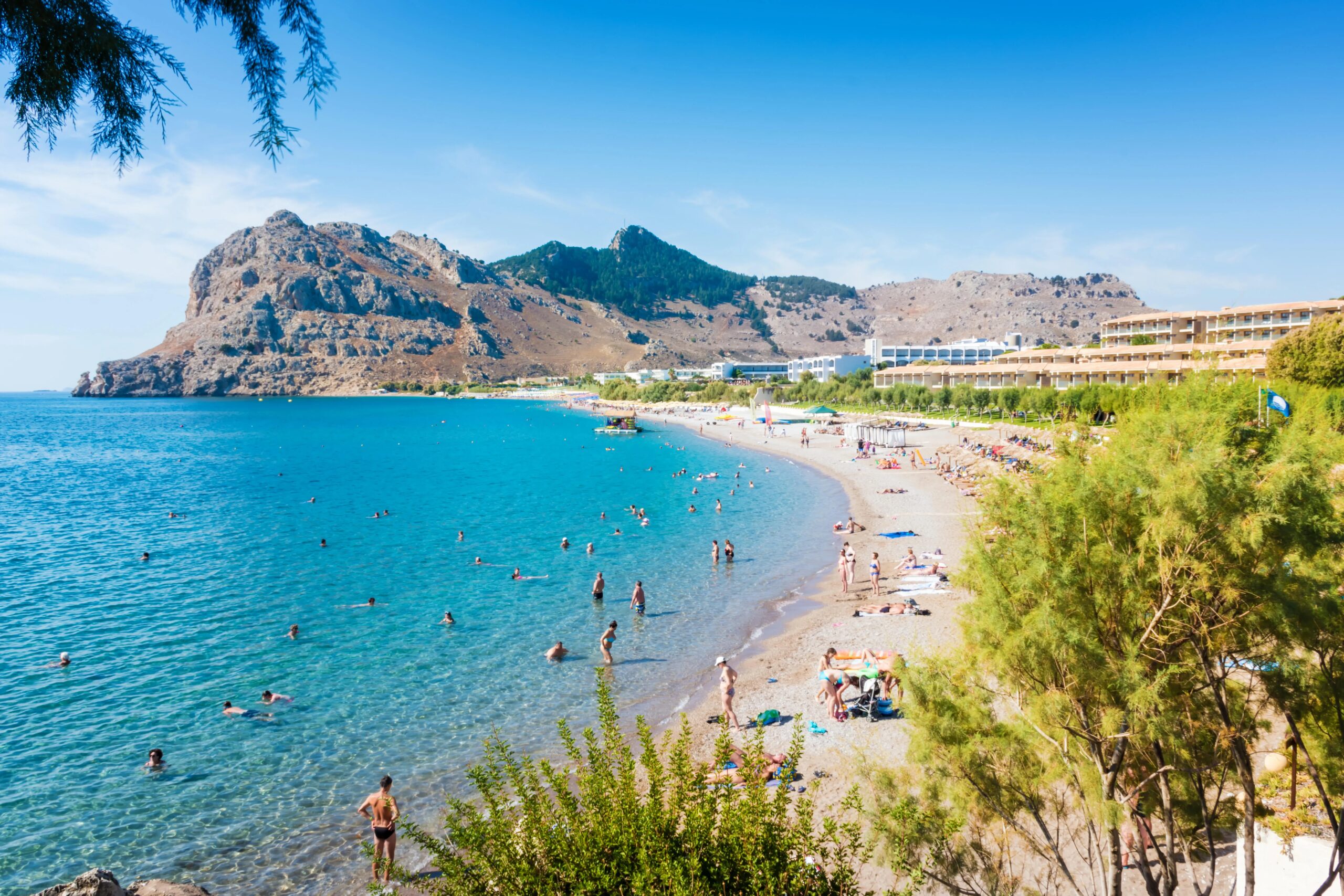
The Greek island of Rhodes is getting two new flight routesCredit: AlamyCity break destinations like Porto will also be easier to get toCredit: Alamy
Ryanair CMO Dara Brady, said: “These are the first of our new Summer 2027 routes to go on sale, with more exciting additions to be announced as Ryanair continues to expand Europe’s largest route network.
“Customers looking to secure the lowest fares for their Summer 2027 travel should head to the Ryanair app/website and book now to get ahead of the curve.”
The testing plan for the U.S. Air Force’s sixth-generation F-47 fighter is continuing to take shape ahead of the type’s expected first flight in 2028. The Air Force Test Center (AFTC) aims to blend developmental and operational test elements, and leverage new tools in the virtual realm, to help accelerate that work. All of this is in support of an aggressive program schedule that aims to see the first production F-47s enter operational service in the early 2030s.
Air Force Brig. Gen. Mark Massaro, head of the AFTC, was asked about how the groundwork is being laid for F-47 testing during a virtual talk the Air & Space Forces Association’s Mitchell Institute for Aerospace Studies hosted yesterday. AFTC is located at Edwards Air Force Base in California, which is the Air Force’s main flight testing hub.
“So, I’ll leave timelines to the [F-47] program office and other folks to talk to, but what I will tell you are some of the things that we’re doing to accelerate our test capabilities to get critical capabilities out the door,” Massaro explained. “Integrated test is a key component.”
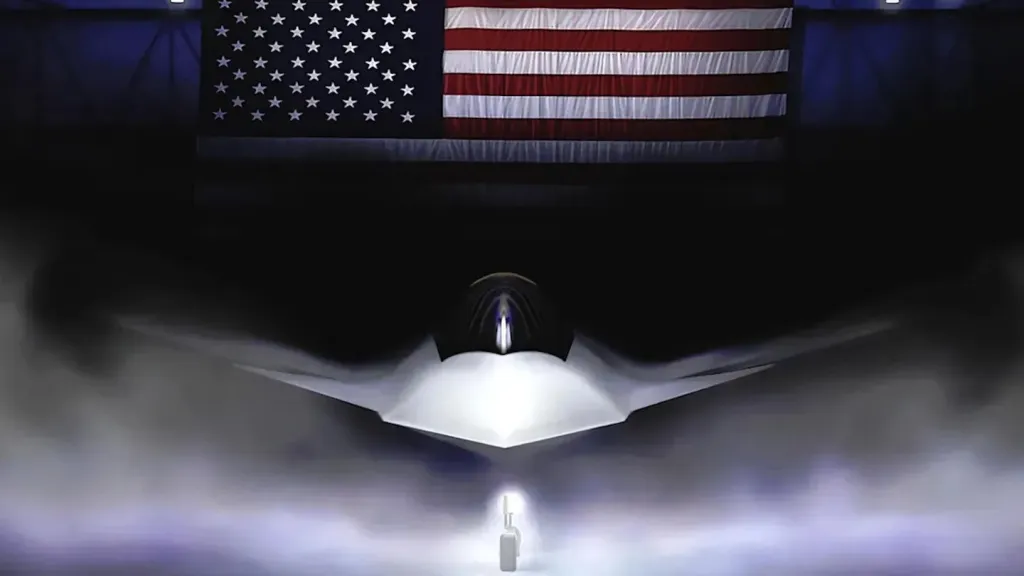
A rendering of the F-47 fighter. USAF
“So, how we mix together the DT [developmental test] and OT [operational test] elements, how we bring our operational test partners in earlier to define the requirements early on in the test planning process,” he continued. “We understand that the information that we can get early on in a program may have applicability to that final operational test requirement to establish whether it’s effective and suitable to the end user. So that’s a key component to accelerating test capabilities.”
There has always been overlap in development and operational test efforts for new U.S. military aircraft, but the Air Force has been taking steps to more deeply integrate these processes in recent years. The F-15EX Eagle II fighter, which reached initial operational capability in 2024, was the first ever Air Force aircraft to be fully tested and fielded through DT and OT efforts conducted in parallel, as you can read more about here. The service has more recently applied these concepts to the B-21 Raider program with test flights where developmental and operational test pilots have shared the cockpit.
A pair of F-15EX test jets. USAFA B-21 Raider seen from a KC-135 aerial refueling tanker during a flight test. USAF
“Another thing that we’ve learned over time too, if you think back to software testing and you think about agile software development, is having an iterative capability that you constantly iterate on,” Brig. Gen. Massaro also highlighted yesterday. “So, thinking about how we can structure our software, or our software testing, our capabilities testing.”
In this way, “we have those opportunities to inform decision makers on a regular cadence on what type of capability they may have at a certain timeline to be able to issue out to a warfighter on a time that might not be a normal milestone chart,” he continued. “We’re really working to incorporate into our test planning processes.”
“Another thing – and I kind of alluded to it a little bit earlier, too – is on the digital front, using our software tools, that super intelligence, graphic processing units, which have a significantly higher capability to process information, to really refine model iteration,” the AFTC head added. “Those models and flight test data [can be used] to update things like computational fluid dynamics when you’re doing tests like loads and high-alpha maneuvering to get information quicker from a flight test back into the program.”
Those “digital tools” can also be used “to accelerate how that information then goes back into a design choice or change if they need to make it,” he continued. “Coming up with those opportunities to use those tools in a test design and in a program” can then further help “to accelerate that final schedule delivery.”
Brig. Gen. Mark Massaro seen during a ceremony marking his assumption of command of the Air Force Test Center on June 30, 2026. USAF
Even very high-fidelity modeling in the digital realm is still not a substitute for real-world flight tests. However, Brig. Gen. Mark Massaro spoke more generally yesterday about how AFTC has been blending digital and live testing to maximize their respective benefits.
“We use models to develop our capabilities, and we need to anchor those models in truth, in physics, and an understanding of what happens in the real world,” the AFTC head stressed. “Outside of a cyber system, all of our capabilities touch the real world and touch physics, and we need to understand those dynamics. So, the models that we use to do design work, to do iterative type[s] of developmental work, and, in ways, operational work, too, need to be anchored in that real world truth.”
At the same time, “we can’t replicate what we need to go and test, and develop tactics and operationally test, in the real world on some of our ranges,” he also noted. “So, from a geographic perspective, just the width and the depth and the height of the ranges to the laydown of the systems that we have to see on the ranges to be able to execute against a threat, [and] the numbers that we might have to be testing.”
Blending real and virtualized elements can therefore be very valuable.
An “element that we’ve done in the developmental world for quite a while, that are [sic] part of this conversation, are plugging in, even though it’s a virtual environment, plugging in real world hardware into that virtual environment,” Massaro offered as one example. “So, you’re getting real-world software, the OFPs [operational flight program software], or you’re getting real-world sensing information coming into that virtual environment and feeding it there.”
Air Force Test Center’s Mission
Virtualized elements can also be added to real-world flight test events in various ways. The Air Force, among others, is also making use of these so-called live, virtual, constructive (LVC) concepts for training purposes for many of the same general reasons, including limited range capacity.
It is also worth noting here that the F-47 program is already benefiting from years of flight testing in secret using full-scale demonstrator aircraft. A substantial amount of simulation and modeling would also already have been done as a byproduct. A simulator likely already exists, as well, which could be used for risk reduction and fine-tuning of the F-47 design, as well as testing flight dynamics.
An F-22 test jet assigned to the 411th Flight Test Squadron, which now serves as the Air Dominance Combined Test Force (AD-CTF). USAF
Though much about the F-47 program remains highly classified, the Air Force has consistently said that the program continues to be on track. Prime contractor Boeing is now building the first flying example, and construction is already well underway to establish a full production line. As mentioned, the target date for a first flight is currently in 2028, ahead of operational fielding in the early 2030s. As an aside, Boeing has also now won the contract to develop the Navy’s sixth-generation carrier-based fighter, currently referred to as F/A-XX.
AFTC is doing its part now to be ready to support the flight testing that will be needed to keep the F-47 program on track in the coming years.
Many of us own one of these common colours for a suitcase but it is worth following simple advice that will stop any problems from arising
09:56, 06 Oct 2026Updated 09:56, 06 Oct 2026
This article contains affiliate links, we will receive a commission on any sales we generate from it. Learn more
Many of us think they can spot their suitcase when it is on a baggage carousel(Image: mtreasure via Getty Images)
Ryanair continues to grow, with the airline carrying a record 208.4 million passengers in its latest full financial year – a four per cent increase on the previous year. However, the budget airline has also been cutting back at some European airports, with Ryanair withdrawing or reducing flights in certain locations.
The airline has pointed to factors including aviation taxes and airport charges. Despite this, the UK remains a key part of Ryanair’s expansion plans.
Its winter 2026 schedule includes 435 routes, with three new services from London Stansted and a new route between London Luton and Venice. A further 18 new routes have also been added from other UK airports.
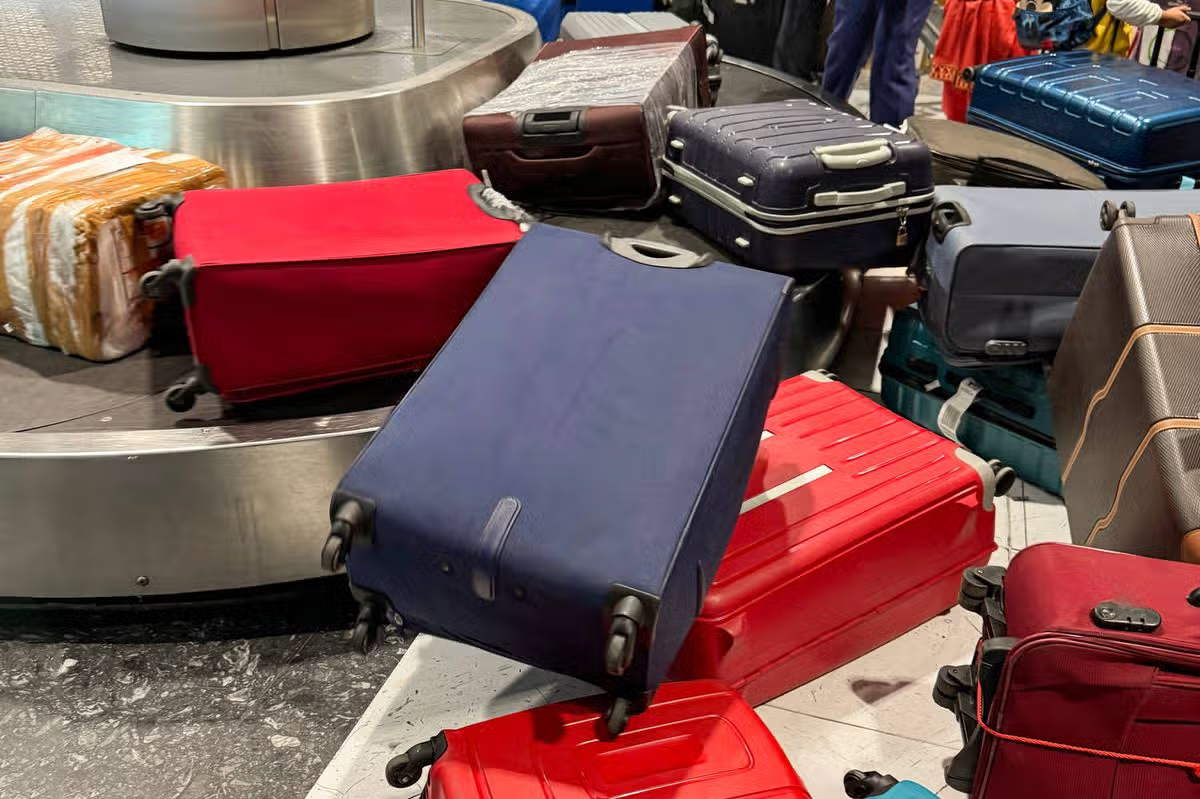
As Brits gear up to the October half term holidays and winter, Ryanair has issued a warning to passengers who typically fly with black, navy or grey suitcases, urging them to ‘change’ their luggage to avoid any confusion when they land.
The budget carrier advised travellers to make their checked-in bags more distinctive on the carousel given the prevalence of these colours.
What Ryanair says
As reports the Express, Ryanair said: “Make it easier to spot your checked-in luggage on the carousel, especially if your luggage is black, navy or grey (like 99.9 percent of the population). Add a colourful luggage tag or ribbon to the handle so that there’s no confusion on arrival.”
Ryanair also recommends passengers create copies of their passport, driving licence, and/or ID card and email them to themselves.
It’s also suggested to photograph these documents and store them on your phone for offline access at your destination,
The well-known budget carrier transports an impressive 52 million passengers to and from the UK annually with its fleet of 107 UK-based aircraft.
In June, Ryanair experienced a spike in passenger numbers with 19.3 million people opting to fly with them across one of their 106,000 flights. This marked the first occasion the airline transported more than 19 million travellers and an 11 per cent rise compared to June 2023.
The airline also pulled out all the stops for England fans during the Three Lions’ Euro 2024 run, laying on over 1,500 extra seats to and from Berlin for the cup final.
On a separate note, if you’re on the hunt for stylish cabin bags and suitcases, Antler is well worth a look. Their Iconic Stripe Case, retailing at £175, is available in seven gorgeous colours, including mist blue.
A flight attendant has shared the thing that she would never wear during a flight abroad, because it can be dangerous, and could have an unexpected physical impact too
14:27, 04 Oct 2026Updated 14:27, 04 Oct 2026
She said that there are some things passengers wear that she wishes they wouldn’t (stock image)(Image: Getty Images/iStockphoto)
Dressing up for the airport is part of the fun for many people, because as much as you want to look comfy while you travel, you also want to look chic. However, when it comes to your footwear, a flight attendant has shared that there’s something you should never wear, even though it might at first seem like the comfiest and best idea you’ve ever had.
Sille shared some advice about what’s best to avoid on a plane, and promised she didn’t intend to pass judgement on people’s clothing choices, rather that she wants everyone to be safe and happy in all potential circumstances.
On TikTok, @sillerydell wrote: “I see this on almost every flight, and I promise it’s not a judgment. Your feet and body will thank you,” as she detailed the things that she’d “skip” when travelling on a plane.
Flip flops
Footwear that could prove to be dangerous on planes are flip-flops. She wrote: “Flip-flops. Feet swell, cabins get cold. And imagine running to your gate in flip flops.”
Shorts or crop tops
“First of all, the aircon is brutal,” she said. “Secondly, you don’t ever want your naked skin near those seats.” You might want to opt for full-length trousers and a proper t-shirt, and perhaps even take a jumper with you in case you get too cold.
Content cannot be displayed without consent
Tight jeans
She warned that “your body swells at altitude,” so if you wear jeans that are too tight, you may end up feeling extremely uncomfortable, and wondering whether it was worth looking good and suffering, especially if you pair them with a crop top.
One thin layer
She shared that wearing one thin layer and hoping for the best isn’t ideal, as “planes can be freezing, even to hot destinations,” so you may want at least a jacket to keep you warm, or a jumper, and you can wear it on the journey back home.
What the flight attendant suggests you wear instead…
She suggested “Something comfy, covered and in layers,” reiterating that she “works on planes so you don’t have to learn this the hard way”.
What did people in the comments say?
In the comments, someone wrote: “Totally agree!!! Flip flops and Crocs should be banned from flights.” Responding to people asking why, they replied they’re “not appropriate footwear”.
Another defended them, however, saying: “I always wear flip flops, BUT I have specific aeroplane socks that I wear on the plane, except to the bathroom, a different pair of flip flops go on for that, and then they get put in the trash. They are throwaway ones.”
A third wrote: “People wear flip flops to make it easier at security, but honestly, that’s so disgusting! I can’t imagine my bare feet touching those floors. Always socks and sneakers when I fly!”
Somebody else shared other things that they think people should stop doing on planes.
They wrote: “Also, stop wearing strong perfumes when flying. It can trigger allergies, migraines, and respiratory issues in a confined cabin space. Wear perfume or cologne when you’re outside the plane.”
Another said that they wear “linen trousers with elastic waistband, a vest top and a long shirt for layer, but I do wear sandals.”
The US coastguard says it has dispatched air and surface crews to search for the plane near Nantucket.
Published On 3 Oct 20263 Oct 2026
An air ambulance has gone missing while carrying six people on a flight from Bermuda to Boston.
The US Federal Aviation Administration told the coastguard early on Saturday that it had lost contact with the plane, a Gulfstream jet, a coastguard spokesperson told the Reuters news agency by email.
Recommended Stories
list of 3 itemsend of list
The coastguard said it dispatched air and surface crews to search for the plane near Nantucket, an island community south of mainland Massachusetts.
The National Transportation Safety Board said it was gathering information about the situation on Saturday morning but had no further update to share.
The Canadian-registered air ambulance jet had four crew members and two passengers on board when it departed Bermuda’s LF Wade International airport overnight for the flight to Massachusetts, according to a statement from the Bermuda airport’s operator, Skyport.
Canada’s Minister of Transport Steven MacKinnon said in a social media post that four Canadians were on the plane.
“We are closely monitoring the situation and are working with the relevant authorities as search and rescue efforts continue,” MacKinnon wrote.
The aircraft, registered to Latitude Air Ambulance, departed Bermuda at 12:41am local time (03:41 GMT), according to data from flight tracking website FlightAware.
The plane was flying at 24,000 feet (7,300 metres) for much of the flight before descending 13,000ft (3,960 metres) in about two minutes shortly before flight controllers lost contact, data showed.
Last communication
Air traffic control audio posted by LiveATC.net offered a glimpse of the flight’s final communications before it went missing.
“Roger, you said you’re coming in blind. Is that what you said?” a controller can be heard asking the pilot.
The pilot’s transmission could not be heard in the recording. The controller later confirmed the pilot was declaring an emergency just before losing contact with the plane.
The Bermuda government is in contact with US authorities and families of the passengers, Bermuda Premier David Burt wrote in a statement posted on Instagram.
“We are praying that all six people will be found safe,” he wrote.
Latitude Air Ambulance is based in Ontario, Canada, and provides medical evacuation services. The company did not immediately respond to a request for comment.
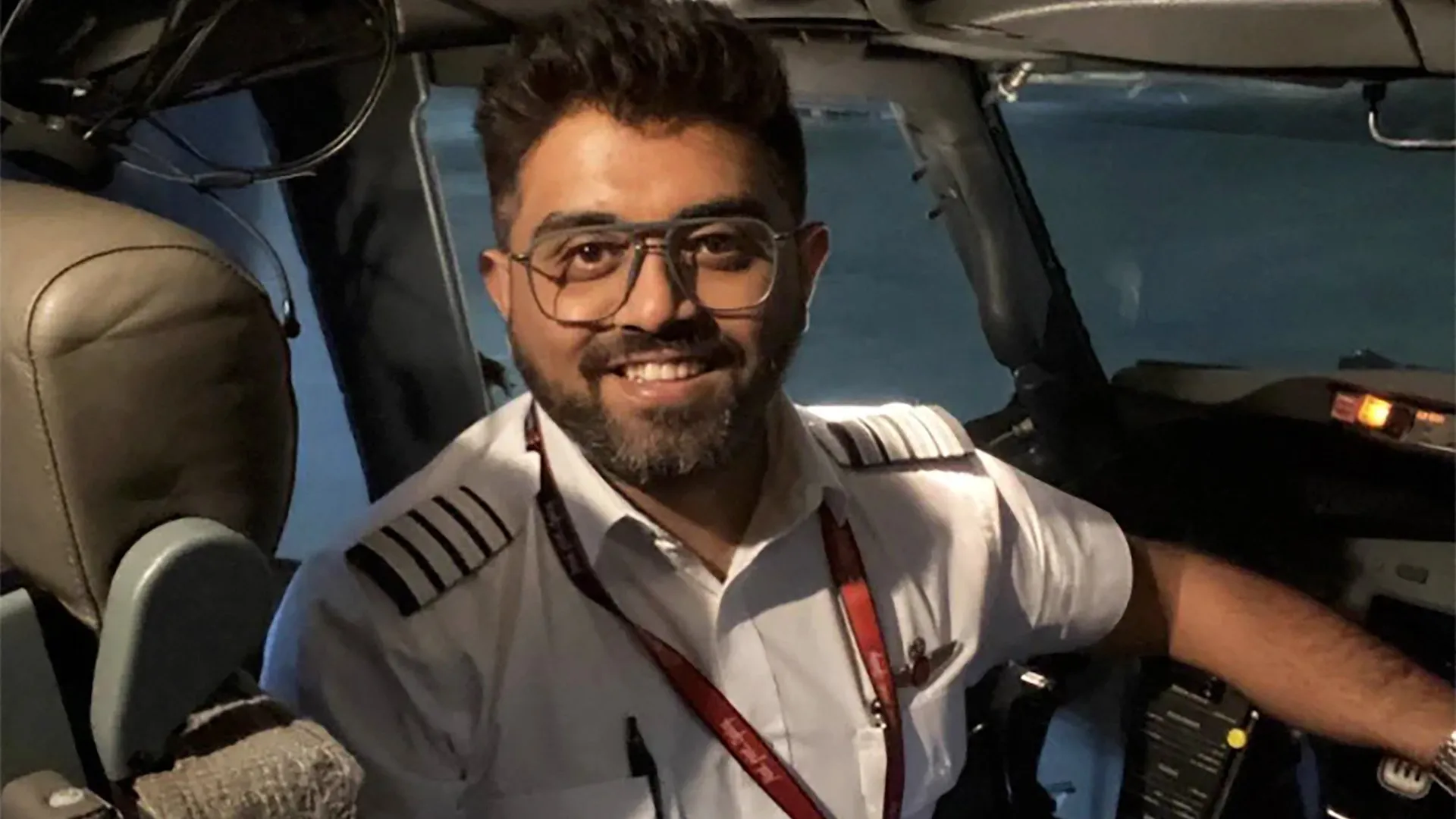
Investigators are examining what happened inside the cockpit of Flydubai flight FZ1073 to Israel after the co-pilot stabbed Captain Smit Machchhar and attempted to take control of the aircraft.
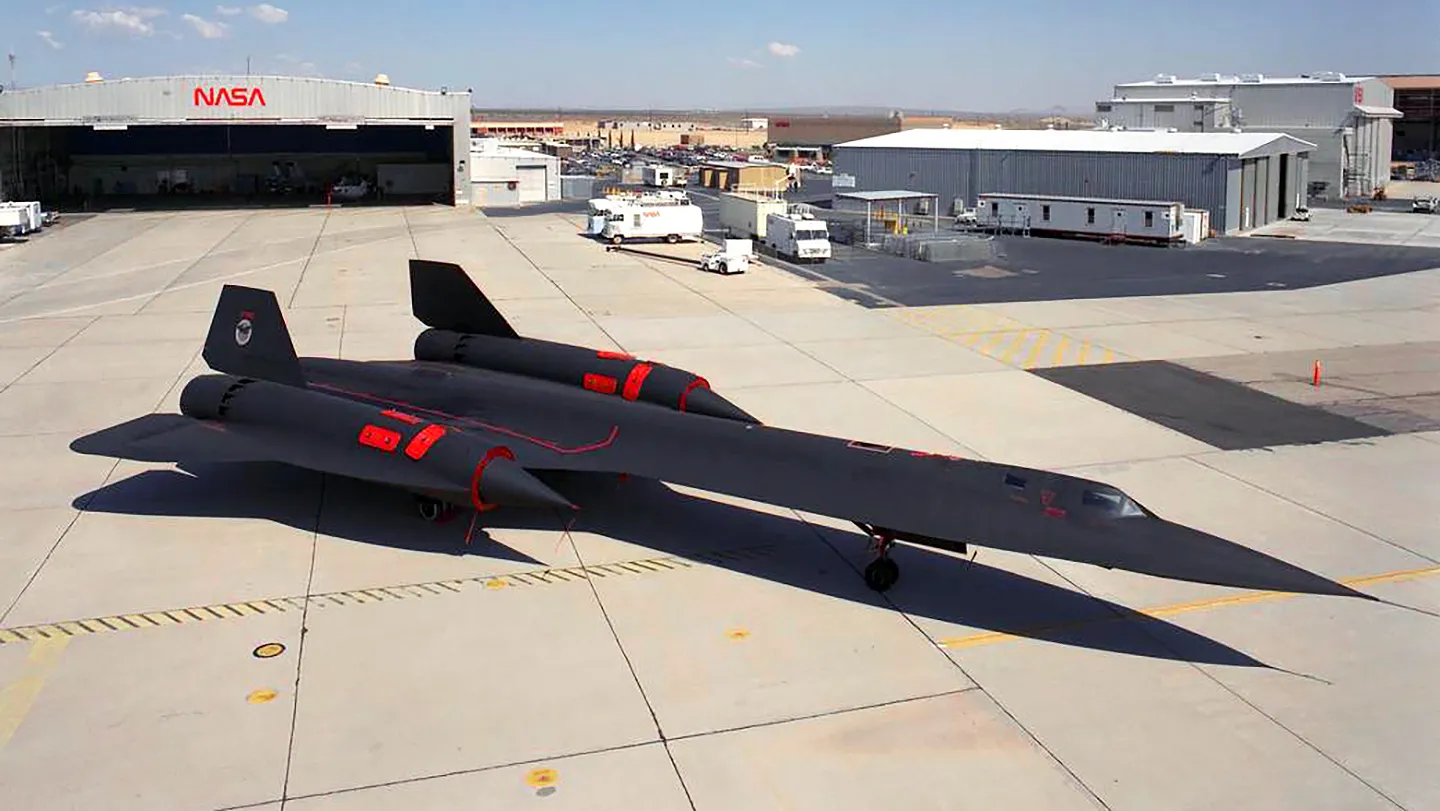
For aerospace aficionados, it’s like we have entered into an alternate dream reality. The idea that we are seriously talking about the possibility of bringing back the SR-71 Blackbird to flight status is hard to comprehend, but amazingly this is where we are at. The biggest question I am getting about all this is why? We touched on the likely primary answer to that in our original reporting — high-speed is back in tactical vogue, and the Blackbird can sustain it in a realm of great interest, between Mach 3 and 4, and do it over and over again. It can also carry very large things and even launch them off its back at those extreme speeds. But those are not the only potential reasons for taking on such a gargantuan, high-profile, and costly technical challenge. Learning from the journey itself could be just as valuable as the actual flight test data a revived SR-71 produces.
Let me explain.
(NASA)
The Blackbird was as close to alien tech as it gets over 60 years ago, and even today, we have nothing like it in known operation. Yet it has been dormant for nearly three decades. Much of the expertise that built, supported, and operated it is sadly gone. But the exercises of reverse engineering and leveraging breakthroughs in additive manufacturing and rapid prototyping, as well as injecting new material sciences, avionics, propulsion and other technologies where applicable, and above all else, building the digital toolkit to make it all happen as fast and efficiently as it can be done, are all of extreme learning value.
I would not be surprised if a ‘digital twin’ is being created right now of the SR-71 using NASA’s SR-71 tail number 844 — the jet in question that has mysteriously disappeared from its display pad. Once such a model exists, breakthroughs in digital engineering can be brought to bear to see how fast the program can be accelerated, both in terms of development and flight testing. This could include not only getting the SR-71 back in the air, but improving its performance and reliability, possibly substantially, using all the new technologies we have today. It’s even possible a clone of sorts leveraging all these advances could be built using digital engineering tools.
The SR-71 served as an integral part of NASA’s flight test fleet at Dryden Flight Research Center, located on the premises of Edwards AFB. (NASA)
This is not necessarily an unprecedented concept. Just look at similar exploratory engineering programs like the X-55. But when it comes to partially reverse-engineering an airframe you have no support for, and few, if any, spare parts, America’s highly-secretive foreign materiel exploitation (FME) community could potentially lend a hand.
Operating in the shadows, they have been able to not only get totally foreign aircraft divorced from American supply chains pieced back together and flying, but they sustained them for years in total secrecy. They also did this long before the advent of rapid prototyping and digital engineering assets that we have today. Imagine what they can do now. They could be a top source for NASA to pull in to help in its far less sensitive but uniquely similar endeavor. This is just one example of many of how government and industry could come together to support and benefit from the SR-71 resurrection program.
Now, about those supply chains. During its heyday, the SR-71’s logistical tail was one of the most exotic ever created. It supported the Blackbird, as well as its progenitor, the A-12, for the better part of half a century. Reestablishing this supply chain would be a highly challenging, but rewarding exercise that could have major impacts across the aerospace industry, as well as others. So, how can we use all the capabilities we have now to jump-start the sustainment of the highest-performing air vehicle from an era of slide rules and drafting tables?
NASA SR-71 on the ramp in the evening. (NASA)
The idea of putting aircraft out of production back into production is not a foreign one to the U.S. military, either. NASA’s SR-71 program could serve as a pathfinder for better evaluating such proposals and their costs, while pushing the envelope forward on exactly how it can be done efficiently. The same can be said for simply keeping aging aircraft (or any vehicle or system for that matter) operating longer and for cheaper, by applying cutting-edge technologies and practices. NASA can create the playbook for doing so, and that playbook could end up being more valuable than the flight testing a reborn SR-71 does.
I think it’s fairly clear that we have lost something when it comes to aerospace engineering as of late. With all our advances and incredible tools even legendary Skunk Works founder Kelly Johnson could have only dreamed of, it seems like we have to relearn even simple lessons from decades ago, and oftentimes that can be a very expensive, time consuming, and even deadly process. In some ways, it seems like we have gone backward, or at least stalled out in certain engineering areas. The simple things become hard and hard things have become simpler. How did they do so much protractors and pencils way back then? Getting a Blackbird flying again can help explore and possibly answer this and other questions, and help mitigate these deficiencies going forward, as well.
NASA Blackbird tail 844 refueling behind the specialized, JP-7-filled KC-135Qs that supported the program. (NASA)
Even if NASA’s dormant SR-71 never ends up getting back in the air, even attempting such a challenge could be considered a success. Doing so could identify core areas across multiple disciplines that could be improved and areas of existing technology that could be better exploited for a whole array of tasks. It can also develop and refine new technologies in the process. All this sits at the core of NASA’s mission, and there is no vehicle on Earth that could drive people and organizations to give it their all for such a comeback dream as the Blackbird. It’s even possible that we could see corporations or even individuals help foot the bill for it.
And yes, all these benefits need to be weighed against cost. Surely there is a limit to how much the government can invest in such a program. Now corporations and individuals, that’s a different story.
So, yes, the main goal of this effort will likely be high-speed flight testing, but so much can be learned in the journey to get there that it must be quantified in the ‘business case’ for reviving the Blackbird.
Israeli passengers tell of the horror onboard the Flydubai flight that was diverted after the pilot stabbed his co-pilot in the cockpit. The plane dropped 17,000 feet during the fight from Dubai to Tel Aviv, but landed safely after being diverted to land in Saudi Arabia.
A flight from Dubai to Tel Aviv was unexpectedly diverted after a physical fight between the pilots, Israeli officials told local media.
The Flydubai plane – which took off from Dubai International Airport in the United Arab Emirates early on Wednesday morning – signalled an emergency code two hours into the journey, flight tracking website Flightradar24 said.
Minutes later it switched to a code used to report a hijacking, but was later turned back to the general emergency signal, the website reported.
The incident was not believed to have been a hijacking, the Israeli prime minister’s office said.
Instead, the signal was thought to be issued following an altercation between the pilot and co-pilot, local media reported citing Israeli defence officials.
The plane – carrying around 150 people, most of whom are Israeli – was due to land at Ben-Gurion Airport but instead landed at Tabuk Airport in northeastern Saudi Arabia.
The Israeli air force dispatched fighter jets in response to the incident and Prime Minister Benjamin Netanyahu held urgent consultations on the incident.






![A plane, carrying passengers who were on the FlyDubai aircraft bound for Israel from the United Arab Emirates, which was diverted to Saudi Arabia following an emergency signal, on the tarmac as it arrives at the Ben Gurion International Airport, in Lod, near Tel Aviv, Israel, September 30, 2026 [Ammar Awad/Reuters]](https://i0.wp.com/occasionaldigest.com/wp-content/uploads/2026/10/2026-10-04T143706Z_234243230_RC2RTNAGNE7D_RTRMADP_3_ISRAEL-GULF-FLIGHT-AUSTRALIA-1792361230.jpg?w=640&ssl=1)