Flight

Ryanair announces major flight schedule update ‘until March 2027’

The UK budget airline has announced that no changes will be made to its summer schedule as jet fuel prices hike due to hedging fuel contracts before the outbreak of war

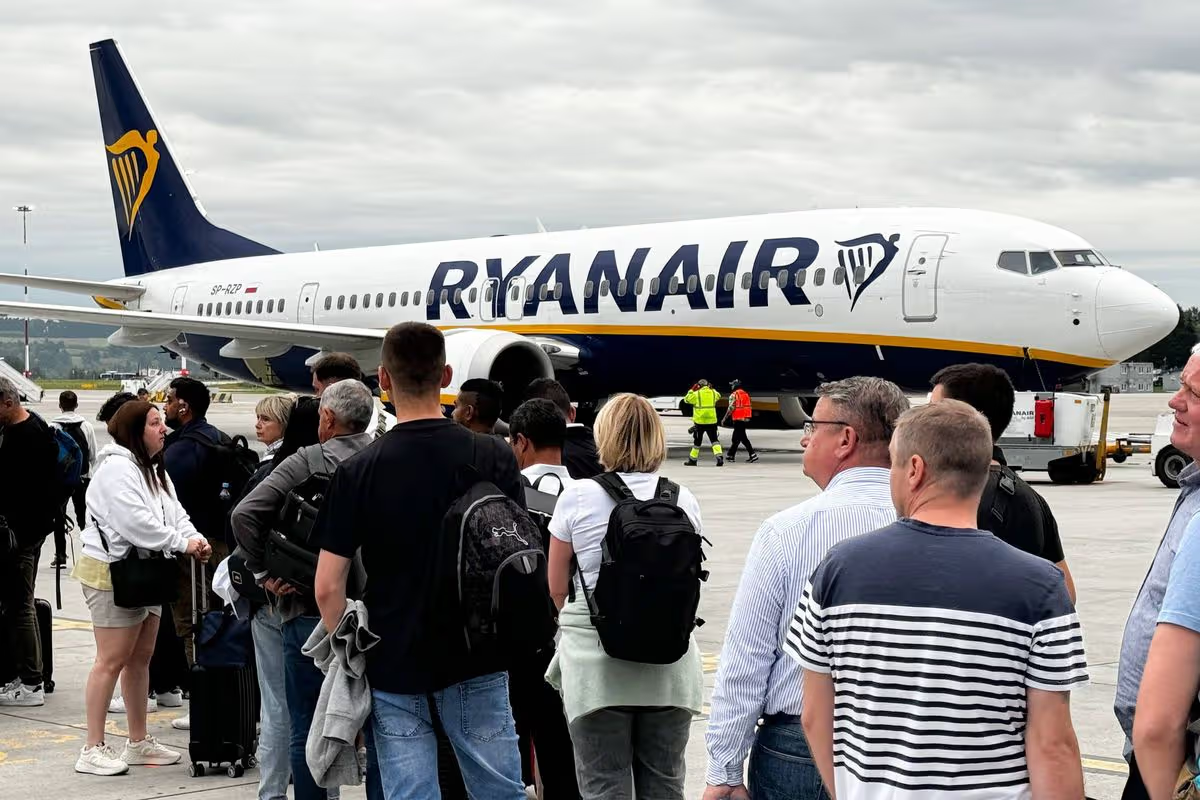
Ryanair has announced that they will not be making any flight changes until March 2027 due to fuel costs.

The budget airline said that its summer schedule will not change because it had hedged its fuel contracts before the Iran war broke out.

The announcement comes after airlines have been given the go ahead to run less flights this holiday season, with several having already made cancellations.

It has been confirmed by the EU transport commissioner that airlines that cancel flights due to fuel shortages will have to compensate passengers under European law, however this could differ in the UK.

Since the outbreak of war on February 28, the cost of fuel has spiked and the closure of the strait of Hormuz has blocked off the shipping passage from the Middle East.

However, Ryanair have confirmed that they have fuel supplies until March 2027 and will not be cutting down flights over the coming months.

A spokesperson for the airline said: “As Ryanair has hedged 80% of our jet fuel to March 2027 at $67 per barrel – less than half current spot prices – we do not plan any cuts to our schedule this summer.”

Elsewhere, plans are being made to put together realistic flight schedules so passengers don’t face last minute disruption.

A UK government spokesperson said: “UK airlines are clear that they are not currently seeing a shortage of jet fuel. Aviation fuel is typically bought in advance and airports and suppliers keep stocks of bunkered fuel to support their resilience.

“We continue to work with fuel suppliers, airports, airlines and international counterparts to keep flights operating. We are also consulting on measures to help airlines plan realistic flight schedules which will avoid last-minute disruption and protect holidays.”

Last week, it emerged that penalties for airlines that cancel UK flights because of jet fuel issues have been eased.

Source link

Camouflaged F-15E Painted To Mark F-111’s Libya Raid Blasts Through Mach Loop On First Flight

A U.S. Air Force F-15E Strike Eagle, specially painted to mark 40 years since Operation Eldorado Canyon, the U.S. raid on Libya, has taken to the air for the first. Hauling a load of eight inert 500-pound GBU-12 laser-guided bombs, today the jet flew the legendary low-level routes that run through Wales, better known as the Mach Loop. The spectacular accompanying photos of the sortie were kindly shared with TWZ by David Lister and Alec Walker.

With a color scheme recalling an F-111F Aardvark of the same unit, the 48th Fighter Wing F-15E serial 91-0311 had first been unveiled in a ceremony at RAF Lakenheath in England, on April 28. However, it seems its first flight in its new look was recorded today.

The F-15E screaming through the Mach Loop earlier today. facebook.com/davidlisterphotography

The jet departed Lakenheath in the morning as EAGLE 31, accompanied by its wingman, EAGLE 32. After taking on fuel from a KC-135 Stratotanker, the jets headed to North Wales. From there, EAGLE flight went to the Holbeach Air Weapons Range on the coast north of Lakenheath, where the inert bombs were dropped. 

A U.S. Air Force F-15E Strike Eagle, specially painted to mark 40 years since Operation Eldorado Canyon, the raid on Libya, has taken to the air.
facebook.com/davidlisterphotography David Lister

Recalling the F-111, the specially painted F-15E has the same camouflage scheme in two shades of green and tan, and the original 494th Tactical Fighter Squadron marking and red band on the tail. The tails of the jet also bear the legend “40 years Eldorado Canyon,” the panther emblem of the 494th, an F-111 silhouette, and the 48th wing’s Statue of Liberty insignia.

Notably, the nose radome is left in its standard gray paint.

The bombed-up F-15E departs Lakenheath earlier today. Stewart Jack
Stewart Jack

Elsewhere on the nose, the Strike Eagle carries another F-111 silhouette and the inscription “Karma 52” in red. This commemorates KARMA 52, the Lakenheath-based F-111F serial 70-2389, which was the only example of the type lost during the Eldorado Canyon raid. The jet, armed with four GBU-10 laser-guided bombs, was flown by pilot Capt. Fernando L. Ribas-Dominicci, and weapons system officer Capt. Paul Lorence. The exact fate of KARMA 52 remains unknown, with the aircraft wreckage never being located after it came down in the Mediterranean.

Capt. Ribas-Dominicci’s body was later washed ashore; the body of Captain Lorence was never recovered. Their mission had been a hazardous one: a single-ship, low-level attack on a heavily defended target at night.

A U.S. Air Force F-15E Strike Eagle aircraft assigned to the 494th Fighter Generation Squadron sits behind a heritage design mock-up at RAF Lakenheath, England, March 18, 2026. During Operation El Dorado Canyon, an F-111F Aardvark “Karma 52” aircraft, the captain and the weapons system officer went missing while flying over the Mediterranean Sea. The markings on the modern paint scheme pay tribute to the personnel and aircraft that were lost during the mission. (U.S. Air Force photo by Airman 1st Class Rilynn Jacobs)
The F-15E sits behind a heritage design mock-up at RAF Lakenheath, England, March 18, 2026. U.S. Air Force photo by Airman 1st Class Rilynn Jacobs Airman 1st Class Rilynn Jacobs

Two dozen F-111s of the 48th Fighter Wing, also based at Lakenheath, were at the forefront of the Air Force’s Eldorado Canyon strikes, conducted in April 1986, together with Navy assets from the aircraft carriers USS America and USS Coral Sea. The raid was launched by U.S. President Ronald Reagan after the bombing of a West Berlin discotheque, in which two U.S. soldiers were killed and over 70 others wounded. Libyan leader Muammar Gaddafi was blamed for the attack.

U.S. airmen prepare a 48th Fighter Tactical Wing F-111F Aardvark aircraft for take-off prior to Operation Eldorado Canyon. National Archives

Ever since, the 48th Fighter Wing at Lakenheath has remained the first choice for a wide variety of critical missions around the globe, most recently Operation Epic Fury over Iran. This campaign has seen four combat losses of the F-15E, three of them to friendly fire. As to the other loss, this led to one of the most dramatic and complex combat search and rescue (CSAR) missions of recent times, before the two crew were safely recovered.

Alec Walker/@phoenixegmh Alec Walker

As of 2025, as you can read about here, the Air Force was planning to return its two squadrons of F-15Es from Lakenheath — the only permanently forward-deployed examples of the aircraft — to the United States.

Currently, Lakenheath is home to the 492nd and 494th Fighter Squadrons flying the Strike Eagle. These squadrons each have a primary aircraft assigned (PAA) complement of 26 aircraft, although this is subject to some fluctuation. Under the 48th Fighter Wing, these operate alongside the 493rd and 495th Fighter Squadrons flying the F-35A, the first of the Air Force’s stealth jets to be based in Europe.

F-35As assigned to the 495th Fighter Squadron at RAF Lakenheath. U.S. Air Force Photo By Tech. Sgt. Rachel Maxwell 

As well as being fitted with the more powerful Dash 229 engines, Lakenheath’s F-15Es have been at the front of the queue to receive a sophisticated new radar warning and electronic warfare suite, the AN/ALQ-250 Eagle Passive/Active Warning Survivability System, or EPAWSS.

With the F-35A now firmly embedded at Lakenheath and apparently also provided with forward-deployed B61-12 thermonuclear gravity bombs, these stealthy jets may well take over entirely the F-15E, provided Congress approves consolidating the Strike Eagles in the United States. It is also possible that the decision to significantly boost the planned F-15EX Eagle II buy may see these plans changed.

In the meantime, the F-35A flies alongside the F-15E at Lakenheath, where these jets and their airmen continue the proud traditions of the 48th Fighter Wing.

Contact the author: thomas@thewarzone.comu

Thomas is a defense writer and editor with over 20 years of experience covering military aerospace topics and conflicts. He’s written a number of books, edited many more, and has contributed to many of the world’s leading aviation publications. Before joining The War Zone in 2020, he was the editor of AirForces Monthly.


Source link

Man spends just 30 seconds queueing for Tenerife flight back home – but there’s catch

Content creator Just Deano flew from Tenerife to Manchester after his recent holiday where he tested out how long it would take to get past the new EES system that has caused chaos for Brits

A Brit arrived at the airport in Tenerife three hours before his flight home after fearing new travel rules would delay him — only to breeze past the Entry/Exit System (EES) in just 30 seconds.

The travel requirement has led to major disruption across airports in Europe — and some Brits have ended up missing flights. This was after getting stuck in long queues in countries like Spain, Portugal and Poland.

For those who don’t know, new rules require non-EU nationals, which of course includes Brits, to register their biometrics instead of having passports stamped at border control.

It was introduced to replace the passport stamp and it works by automatically checking when a person enters or leaves a country in the EU.

As for what it means practically, Brits will have to register details including fingerprints and facial images before scanning their passports when they first visit a country in the Schengen area.

Content creator Just Deano arrived at Tenerife South Airport earlier than he normally would after hearing “horror stories”.

Some people in recent weeks have claimed that machines have been failing by rejecting fingerprints — while others have missed flights because of the delays this has caused.

One Brit wrote: “The key is to arrive three hours early so at least you are in the front of the queue when problems start.”

Another said: “Love Tenerife but HATE the airport.”

However, speaking about his own experience, Deano said: “That EES system, Entry/Exit system, was a piece of cake, you don’t have to do your fingerprints. We were in and out in 30 seconds. Literally 30 seconds. Straight to the e- gate. Put your passport in, went through no problem.”

But the catch here is that if it is your first time travelling to a European country this year, you will have to register your fingerprints, which is what has caused a lot of the carnage.

As was in Deano’s case, once you have registered your biometrics once, that information is then stored for three years, meaning you won’t have to keep repeating the process on each trip in Europe. However, some passengers have claimed they are having to repeat it and are therefore getting stuck.

Summing up his experience, Deano said: “But let me tell you people, don’t worry about the entry exit system, just forget the fingerprints (if already registered). We walk straight past the machines and just go to the e-gate as if you would as if you were getting your passport stamped. No need to worry. Absolutely fine. Even though it’s busy as anything here.

“I would imagine when all these people that are in here are going through that gate, going through that e-gate, you would get a little bit of a queue, but it takes about 10 seconds per person. So don’t worry at all.”

Despite Deano, who is from Huddersfield, not suffering from the new travel rules, some people wrote underneath the video, which you can watch here, that it wasn’t that easy for everyone.

One person wrote: “I have had my fingerprints taken on a few occasions now, did a full EES in Rome and about 5 times again. Didn’t work in Berlin, so hopefully Poland will be better.”

Another said: “Poor advice that Deano about the EES. Tell those stranded at the airport in Lanzarote yesterday as the plane left without them. I think it comes down to the number of flights departing to the UK at or around the same time. Summer is going to be a disaster.”

A third said: “I used the EES six weeks ago and still had to get in line for it again on Monday.”

One person added: “Lucky you – perhaps the delay did you a favour – we had to wait in a queue for over an hour with passport machines being very temperamental (we had done our fingerprints going into country) but both of still ended getting an actual border guy manually dealing with us and many others due to the machines.”

A fifth simply added: “EES, it is not as easy as you state deano.”

Source link

Major airline scraps two popular flight routes until next year

TWO holiday destinations are losing their Virgin flights until next year.

The major airline has confirmed that flights to both Dubai and Seattle will no longer go ahead this year.

Virgin Atlantic planes at the South Terminal of Gatwick Airport, London.
Virgin’s Seattle and Dubai flights have been paused until next year Credit: Alamy
Aerial view of Atlantis The Royal Residences and Palm Jumeirah in Dubai.
Flights to Dubai have been suspended by a number of airlines Credit: Alamy

Flights to Dubai are off the cards for most airlines right now, with the Iran war putting the winter sun destination on the no-travel list.

Virgin Atlantic had already suspended flights from London Heathrow to Dubai, but has now confirmed they would not go ahead until winter 2027.

It comes as its London Heathrow flights to Riyadh were cancelled entirely after just a year.

The airline is also suspending flights to Seattle until March 27, 2027.

PLANE TO SEE

Airline boss warns fuel crisis is WORSE than Covid as costs triple in months


FUEL FEAR

All the airlines that have cancelled flights amid jet fuel shortage holiday fears

A Virgin spokesperson said: “Unfortunately, we have taken the difficult decision to temporarily suspend our seasonal service to Dubai for the winter 2026 season, while services to Seattle will also be temporarily suspended for the winter 2026 season only, before resuming in March 2027.

“Customers can continue to travel to Seattle with our partner Delta Air Lines who will offer daily services from London Heathrow.”

“We’d like to apologise to any affected customers and will be contacting them with their options which include rebooking or a refund.”

The airline is instead adding more flights to two of its destination in Africa.

From October 25, there will be 11 weekly flights to Cape Town, as well as 10 a week to Johannesburg.

They added: “The updated flight schedule enhances convenience for travellers, with earlier morning arrivals into South Africa allowing passengers to maximise their time on the ground, and later evening departures offering a more seamless overnight journey to London.”

Source link

UK families urged not to panic yet about summer holiday flight cancellations

Soaring jet fuel prices and the threat to supplies – amid the Middle East war – has left millions of Brits worrying about whether their summer holiday plans will be disrupted

May could mark the peak in flights being axed due to the Iran war, an expert has declared.

Families were urged not to panic about their summer getaway, despite fears over jet fuel shortages. Data shows airlines have cut 13,000 flights globally this month due to the conflict in the Middle East. In total, nearly two million seats have been removed from flights scheduled for May.

The reductions come ahead of the half-term holidays at the end of the month. Many people have been left worrying what will happen to holiday flights already booked over the peak months ahead.

Aviation analyst John Strickland insisted the 13,000 flights pulled this month amount to about 1% or 2% of all those scheduled. And he warned against assuming the same number – or more – would be impacted in the coming months.

READ MORE: Simon Calder gives surprising verdict on summer travel chaos fears as 13,000 flights axedREAD MORE: Ryanair boss Michael O’Leary wants to BAN early morning pints before boarding flights

“You can’t judge May against the peak summer,” Mr Strickland told the Mirror. “Airlines want to fly their full programme – this is not a wholesale chopping of flights that would disrupt people’s summer holiday plans.”

Mr Strickland said airlines were “relatively confident” they will have enough jet fuel available on a rolling six-week basis, with signs that additional supplies are being sourced from the US and elsewhere to replace those lost from the Gulf.

Some carriers have switched to smaller aircraft or more fuel efficient planes to brace themselves for possible disruption, according to aviation analytics firm Cirium. It says 120 scheduled flights from the UK to global destinations have so far been cancelled in May. While it is still early days, the number of cancellations in June stands at 36, out of just under 22,000 scheduled flights.

It comes after the price of jet fuel doubled in the wake of the US-Israel war with Iran which erupted at the end of February. The conflict has crippled shipments through the key Strait of Hormuz.

German airline Lufthansa has axed 20,000 flights, and warned higher jet fuel prices could cost it £1.5billion this year. It joined around two dozen airlines that have now scaled back operations.

Ryanair boss Michael O’Leary said at the start of April his airline may be forced to cancel 10% of its flights this summer. He told ITV News: “We’re all facing an unknown scenario. And we are certainly looking at maybe having to cancel 5% to 10% of flights through May, June and July.”

British Airways owner IAG is due to issue updated results on Friday.

Transport Secretary Heidi Alexander said she was confident most people travelling this summer would have a similar experience to last year. She said there was currently no disruption to the supply of jet fuel, but “this clearly is an evolving situation”.

Oil prices slumped to two-week lows on Wednesday amid reports that the US and Iran were nearing an initial peace deal. Brent crude fell 7% to $102 a barrel – down a recent peak of more than $120 but still well above the $60 before the war started.

Rory Boland, editor of Which? Travel, said: “It is understandable that holidaymakers are feeling apprehensive about their summer travel plans due to the wave of cancellations.

“The percentage of flights cancelled from the UK remains small, when you consider that the worst airlines cancel over 2% of flights less than a day before departure, even in normal times.

“Our advice for this summer is to book a package holiday, as that is the best way to protect the full cost of your holiday should greater disruption occur.”

Mark Tanzer, chief executive of travel trade body ABTA, said: “We really don’t want people worrying about their holidays; planes are taking off daily and people are continuing to get away on their holidays.

“The Government and airlines are clear that there isn’t a problem with fuel supply. If you have a holiday booked in for the coming months – including the May half term – we expect it to go ahead as planned.

“Whilst there have been reports about cancellations globally, these amount to less than one percent of overall flights.”

Source link

Dozens of British Ryanair passengers miss Spain flight due to ‘airport delays’

68 Ryanair passengers missed their flight to Edinburgh from Lanzarote on Monday, reportedly due to issues with the airport’s new Entry/Exit System (EES) used to register third-country nationals including British travellers

Almost 70 Ryanair passengers missed their flight to Edinburgh from Lanzarote on Monday, reportedly due to delays at border control.

Those travelling back to the Scottish capital were left stranded at Lanzarote Airport on May 4, owing to passport control system failures, with several flights believed to have been affected.

A total of 68 holidaymakers failed to reach the boarding gate before it closed, due to problems with the airport’s new Entry/Exit System (EES), which is used to register third-country nationals – including British citizens.

READ MORE: MV Hondius hantavirus outbreak live: Human transmission fears as three deadREAD MORE: Madeleine McCann suspect Christian Brueckner sends chilling warning to UK police who want to put him on trial

Ryanair confirmed all passengers who presented at the boarding gate before departure were accommodated and travelled without incident.

According to local publication Canarian Weekly, the disruption affected those travelling to destinations outside the European Union, reports Edinburgh Live.

Under the EES, travellers are required to provide biometric data, including fingerprints and a photograph, to establish a digital record valid for three years, replacing the traditional passport stamping system.

The system is intended to streamline passport checks and track how long visa-free travellers remain within the EU, however it has been beset by delays, with lengthy queues reported at passport control across various locations.

Now Lanzarote Airport has become the latest to face disruption. Operations were reportedly thrown into chaos by 11am, “causing delays and confusion in departure areas”. Canarian Weekly reports that the disruption was triggered by “a failure in the passport control system” according to National Police sources, while other sources “suggested a wider disconnection issue across Europe, which slowed systems at multiple airports”. The issue was resolved by midday.

Ryanair has recently pressured EU governments to abandon the EES during the peak travel season, writing to administrations in 29 countries demanding they halt the new entry requirements.

The airline’s chief operations officer Neal McMahon said: “Governments across Europe are attempting to roll out a half-baked IT system in the middle of the busiest travel season of the year, and passengers are paying the price, being forced to endure hours long passport control queues and in some cases, missing flights.

“The solution is simple and already provided for under EU law (EU Reg. 2025/1534) – Governments should suspend EES until September when the peak summer travel season has subsided, just as Greece has done. This would allow passengers – many of whom are travelling with young families – a smoother airport experience for their summer holidays.”

The Spanish National Police Force were contacted for a response.

Source link

United Airlines flight hits truck, light pole on New Jersey Turnpike

May 4 (UPI) — A United Airlines flight hit a delivery truck and a light pole on the New Jersey Turnpike on approach to Newark International Airport in New Jersey, where it landed safely and nobody was hurt.

The National Transportation Safety Board is investigating the Sunday afternoon incident, which “has been classified as an accident due to the extent of the damage to the airplane.”

“An NTSB investigator arrived in Newark this morning to conduct interviews of the flight crew,” the agency said in a statement posted to X.

“The investigation will examine multiple factors, including flight operations, meteorological conditions, human performance, crew resource management, aircraft performance and air traffic traffic control,” it said.

The flight was on approach from Venice, Italy, into Newark but flew too close to traffic, clipping a delivery truck and then hitting a light pole that reportedly struck a Jeep on the highway, CBS Baltimore and WABC reported.

The flight, which was carrying 221 passengers and 10 crew, landed safely at the airport around 2 p.m., with officials from Transportation Secretary Sean Duffy to the bakery that owns the truck noting that they have no idea how the incident happened.

“Upon its final approach into Newark International Airport, United flight 169 came into contact with a light pole,” United said in a statement.

“The aircraft landed safely, taxied to the gate normally and no passengers or crew were injured,” the airline said. “Our maintenance team is evaluating damage to the aircraft and we will investigate how this occurred.”

President Donald Trump signs a series of executive orders in the Oval Office of the White House on Thursday. Trump signed an order to expand workers’ access to retirement accounts. Trump also signed legislation ending a 75-day partial shutdown of the Department of Homeland Security after the House voted in favor of funding. Photo by Aaron Schwartz/UPI | License Photo

Source link

‘Plane passenger’s selfish row delayed my flight and ruined travel plans – I’m livid’

A plane passenger claimed their flight was delayed by an hour because of one other passenger’s selfish act – and it had devastating consequences for people’s travel plans

Finding out your plane is delayed can be a nightmare. No one wants to hang around in an airport for any longer than they need to, especially if you’re trying to go and enjoy a holiday, or aching to get back home. Delays can also be frustrating if you have a connecting flight, as you could end up missing your next plane.

The most common cause for flight delays is weather conditions, which neither the airport nor the airline can control. But one woman on social media was left furious when her plane was delayed by an entire hour – just because of another passenger causing an issue with the flight attendants.

Cassandra Saunders was already sitting in her seat on the flight from Los Angeles, California, to Tampa, Florida, when the incident began, and filmed herself so that she could capture the audio of the fellow passenger complaining to a flight attendant. The passenger was complaining that he couldn’t sit next to his fiancée as they hadn’t booked seats next to each other, and the flight attendant was trying to tell him that he couldn’t just sit in someone else’s seat.

In the video, which was uploaded to Instagram, the man’s voice can be heard asking the flight attendant how he can switch seats, to which she replies he will have to ask the person sitting in the seat he wants to move to. She adds the cabin crew can’t do anything to move people out of their designated seats.

Content cannot be displayed without consent

The man continues to argue, saying there was no one currently in the seat he wanted to sit in, but the flight attendant says boarding hadn’t finished yet. The conversation continues, with Cassandra writing on her clip that the argument delayed their flight by an hour.

She wrote: “My intuition already knew this guy was going to be a problem. This dude delayed our flight by an hour. He kept going to the back and wasn’t respecting the flight attendant’s instructions.”

In the caption, Cassandra said the row over seating meant some passengers were at risk of missing their connecting flights and having their travel plans ruined – and she only made her connecting flight with a mere five seconds to spare after racing through the airport when they eventually landed.

She posted: “Travelling is already chaotic, and this couple was being inconsiderate to everyone on the plane, delaying us by an hour. Several passengers asked them to get off because people had connecting flights. But all he seemed to care about was sitting next to his fiancée. The flight attendant did a great job in handling it. I made it to my connecting [flight with] five minutes to spare – I ran!”

Amazon cabin bag meets Ryanair requirements for less than £15

This article contains affiliate links, we will receive a commission on any sales we generate from it. Learn more
Ryanair bag

£20.99

£14.99

Amazon

See the deal

Travellers keen to beat the bag charges without breaking the budget have made an Amazon travel bag a bestseller. Rated 4.7 stars out of 5 from almost 3,000 reviews, the Xkdoai bag comes in six colours with prices from £14.99, saving 29% on the usual price.

Cassandra later posted the second part of the passenger’s argument with the cabin crew, in which another male voice is heard ordering the passenger to get off the plane. The man’s fiancée is then apparently heard trying to convince the plane staff to let her partner stay on the flight, but is told she is welcome to leave with him.

Adding more context to what happened, Cassandra wrote: “They had a full conversation while everyone was waiting on them. The [fiancée] stayed and then five minutes later decided to get off the plane.”

Commenters on the video were gobsmacked by the “entitlement” of the couple, with many saying that sitting next to someone for a couple of hours on a domestic flight isn’t worth being delayed by an hour. Others said they should have been kicked off the flight sooner, arguing that an hour is far too long to have allowed the dispute to go on.

One person said: “If you want to make sure you’re next to your partner, pay the extra fees and make sure you book the seats together.” Another added: “Any conversation longer than 10 minutes should have been had outside the gate.”

A third fumed: “An HOUR?!!! Nah, they didn’t do their job. Get him off immediately.”

Source link

United Airlines flight strikes turnpike light pole, injuring driver

Travelers walk with a view of a United Airlines airplane at Newark Liberty International Airport on May 22, 2025. On Sunday, the airline said one of its flights struck a light pole on the New Jersey turnpike as it was landing at the airport. File Photo by John Angelillo/UPI | License Photo

May 3 (UPI) — A United Airlines jet struck a light pole while approaching Newark Liberty International Airport on Sunday afternoon, damaging a vehicle traveling on the New Jersey Turnpike, officials said.

United Airlines Flight 169 from Venice, Italy, was on final approach to Newark’s Runway 29 at about 2 p.m. EDT when “the aircraft struck an object over the southbound New Jersey Turnpike, causing damage to a light post and tractor-trailer traveling south on the NJ Turnpike,” the Port Authority Police Department told UPI in an emailed statement.

The driver of the tractor-trailer was taken to the hospital with minor injuries and has been released, the police department said, adding that “minor damage to the aircraft was observed.”

United told UPI that the aircraft, a Boeing 767-400 with 221 passengers and 10 crew onboard, “landed safely, taxied to the gate normally and no passengers or crew were injured.”

“Our maintenance team is evaluating damage to the aircraft,” the carrier said, adding that it will conduct a “rigorous flight safety investigation” into the incident.

“Our crew has been removed from service as part of the process.”

The runway was back to normal operations following an inspection for debris, according to authorities.

The National Transportation Safety Board will lead the federal investigation into the incident, with one of its investigators expected to arrive in Newark on Monday, the agency said in a statement.

United Airlines has been directed to secure and provide both the cockpit voice recorder and flight data recorder to the NTSB as part of its investigation, with a preliminary report expected within 30 days.

New Jersey Gov. Mikie Sherrill said she has been briefed on the incident.

“I’m grateful the aircraft landed safely, and all passengers and crew are unharmed,” she said in a social media statement.

“United is investigating how this occurred.”

Source link

Flight attendant shares real reason they greet passengers and it’s not to be polite

A flight attendant has shared the reason cabin crew greet every passenger boarding the plane, and it has nothing to do with just being polite. There’s a lot more to the simple act

Whenever we board a plane, we inevitably interact with flight attendants who, beyond keeping us safe throughout the journey, are also on hand to offer some genuinely useful guidance. After all, they possess an unrivalled knowledge of air travel safety.

Now, one flight attendant has lifted the lid on a secret that most holidaymakers are likely completely unaware of. She revealed that the greeting you receive as you board the plane actually serves a very specific purpose, and it has nothing to do with being courteous. In fact, cabin crew are carrying out an important assessment of passengers from the very moment they step on board.

This follows further revelations from another flight attendant who recently shared some incredibly handy tips, claiming there is something people should never wear when travelling.

As it turns out, flight attendants are sizing passengers up right from the off, and it’s all been laid bare in a candid TikTok video. Flight attendant Mrs Miva has blown the whistle on one of the industry’s best-kept secrets.

In her viral clip, she revealed the true reason behind the cabin crew’s welcoming routine as passengers make their way on board. It seems that saying “hello” is about far more than simple courtesy.

Over footage of herself, she wrote: “Did you know that your flight attendant greets you not only out of politeness, but also to check whether you are too drunk or sick to fly?”

Content cannot be displayed without consent

The video has since racked up millions of views, leaving countless viewers genuinely stunned. The notion of being discreetly assessed upon boarding came as a complete surprise to many.

One viewer said: “Wait, is there a reason why they always ask me where I sit when I go onboard? ” Another noted: “To see if you’re 1. Safe to fly (not intoxicated) and to see if you could help in an emergency.”

A third also wrote: “And looking for suspicious behaviour.” Meanwhile, a fourth added: “We are also picking out good candidates in the event of an emergency.”

Some even shared their own experiences to back up the theory. One recounted: “I was denied an international flight from England to America because they thought I’d die en route from being so sick.”

Another wrote: “True, and it’s the toughest part of the day. Without being paid!”

What you need to know

While cabin crew clearly aim to be friendly and welcome passengers as they embark on their journey, there’s far more happening when they greet you at the aircraft door than meets the eye. In reality, they’re carrying out a comprehensive head-to-toe safety evaluation of passengers before takeoff.

This process involves checking for intoxicated or disruptive passengers, ensuring travellers are capable of following emergency procedures, identifying potential security risks, and also spotting physically capable individuals who might be able to assist during an emergency. Crew members receive thorough training to enable them to detect any possible threats effectively.

They also watch passengers to gauge whether they can comprehend and follow safety instructions, which becomes vital should an emergency arise. While the assessment can be completed in mere seconds, it plays a really important role in helping to maintain aircraft safety.

Beyond this, it also contributes to fostering a relaxed environment. After all, it helps to establish a welcoming atmosphere for the journey ahead.

Flight attendants carry out genuinely crucial duties, and this simply demonstrates the lengths they go to in order to keep travellers as safe as humanly possible throughout. Now you understand what they’re actually up to.

Source link

UK airlines set to make major flight schedule changes this summer

The Government has instructed airlines to prepare contingency plans for a sustained disruption to jet fuel supplies amid the ongoing Middle East conflict, which could lead to flight schedule changes

Passengers could face major alterations to their flight schedules this summer under new Government proposals aimed at preserving jet fuel supplies.

Ministers have ordered airlines to draw up contingency plans for prolonged disruption due to the ongoing conflict in the Middle East, the Telegraph reports.

Under the measures, the Government will reportedly temporarily ease regulations surrounding airport take-off and landing slots, in an effort to cut down on last-minute cancellations and “ghost flights”.

Transport Secretary Heidi Alexander said the changes would give airlines more flexibility to amend schedules well in advance rather than making decisions at the gate.

She said: “This legislation will give airlines the tools to adjust flights in good time if they need to, which helps protect passengers and businesses.”

“We will do everything we can to insulate our country from the impact of the situation in the Middle East.”

Worries have intensified after data from analysts at Kpler revealed global shipments of jet fuel and kerosene fell below 2.3 million tonnes last week – the lowest level ever recorded.

Supplies have been squeezed following Iran’s closure of the Strait of Hormuz, a vital route that accounts for roughly 41% of Europe’s jet fuel.

Shadow transport secretary Richard Holden claimed holidaymakers could face turmoil. He said: “Families who have booked their summer holiday could find their flight cancelled and themselves herded onto a different plane, at a time of the airline’s choosing.

“The honest message is that Britain is exposed to fuel supply risks that a properly energy-secure country would not face.”

However, industry figures have moved to put travellers’ minds at rest.

Tim Alderslade, chief executive of Airlines UK, confirmed that airlines are currently running as normal and have yet to encounter any fuel supply problems.

He said: “We are planning to take our customers on their well-earned holidays this summer and will always look after them in line with our obligations.

“We welcome the Government’s contingency planning including slot alleviation, which enables airlines to adjust schedules responsibly, avoid unnecessary flying, and continue operating efficiently while protecting connectivity for passengers.”

Source link

New VC-25B Air Force One “Bridge” Aircraft Now Fully Modified And Flight Tested

The U.S. Air Force said its new interim Air Force One jet, dubbed the VC-25B Bridge aircraft, has officially completed modifications and flight testing and is being painted in the red, white and blue livery sought by President Donald Trump. The extremely lavish 747-8i Boeing Business Jet (BBJ) – donated by Qatar to the U.S. last year for use by Trump – is set to serve in the Air Force One role while the White House awaits the delayed delivery from Boeing of two fully-outfitted VC-25B Air Force One aircraft. There are no plans to retire the VC-25As that currently serve as Air Force One until both full-up VC-25Bs are operational.

The Air Force said the VC-25B Bridge aircraft is on schedule to roll out in its new paint scheme and be delivered to the Presidential Airlift Group this summer. It is not clear when it will start flying Trump. The White House referred us to the Air Force for additional information.

A VC-25B Bridge aircraft takes off for flight testing at Greenville, Texas. The aircraft recently completed modification and flight-testing phases, entering maintenance to be painted in red, white, gold and blue livery. The program remains on schedule to deliver the Bridge aircraft to the Presidential Airlift Group no later than summer 2026. (Courtesy photo)

The jet recently underwent flight testing in Texas, which you can see in the following photos that aviation photographer TT-33 operator was kind enough to share with us at the time.

The Qatari-donated 747-8i jet envisioned as a presidential airlifter, had a recent test flight.
The Qatari-donated 747-8i jet envisioned as a presidential airlifter, had a recent test flight. (TT-33 operator photo)
(TT-33 operator)

The USAF now says that with the Boeing VC-25B deliveries delayed far past its initial 2024 target and VC-25A heavy maintenance cycles being extended, an interim capability became “an absolute imperative.” How accurate this claim actually is isn’t clear. Trump has been talking about an interim Air Force One aircraft for some time since deliveries of the new VC-25Bs were pushed back beyond his second term. We heard of no actual requirements originating for this capability from within the USAF prior to the new administration or far in advance of Trump’s deal with the Qataris to source the jet. Very early in the new administration, Elon Musk was even working to find out how to get Trump a new Air Force One as fast as possible, for instance.

The Air Force claimed that in February 2025, a dedicated task force launched a “full-court press” on the VC-25B Bridge program while simultaneously working to accelerate Boeing’s long-term VC-25B production.

The U.S. Air Force has confirmed it is buying two Boeing 747-8 airliners from German flag carrier Lufthansa.
A rendering of a future US Air Force VC-25B Air Force One jet in the red, white and blue livery desired by President Donald Trump. (Boeing) Boeing

Though questions were swirling about the legality and ethics of receiving the gifted plane, the Pentagon last May took delivery of the aircraft and said it would rapidly undertake the required modifications.

It’s one thing to have a donated ultra-luxury jet, but turning it into one safe and connected enough to carry a president is another story.

As TWZ has previously noted, converting any aircraft into one that is secure enough to transport the president is a complex undertaking. The aircraft needs to provide constant, secure communications, including what is needed to order a nuclear strike under extreme conditions. Historically, it also needs to be physically hardened both inside and out to withstand myriad threats, from the electromagnetic pulse of a nuclear weapon going off to incoming surface-to-air missiles to enemy intelligence-gathering efforts. To do this requires significant modifications right down to the aircraft’s outer structure. It is very unlikely, if not impossible, that this aircraft was hardened against EMPs in the timeframe required for fielding it.

The VC-25As are speckled with missile approach warning sensors and many laser countermeasures turrets (DIRCM). They also include the legacy Matador infrared countermeasure system above their jet engines and APU. This is in addition to other defensive features which are less visible and remain closely guarded secrets.

Common Infrared Countermeasures (CIRCM) thumbnail

Common Infrared Countermeasures (CIRCM)


In previous coverage, we noted that at the very least, “this aircraft will have to feature some kind of DIRCM setup to repel shoulder-fired heat-seeking missiles, and modular units are available that can be attached in a canoe to the bottom of the aircraft. These systems, such as Elbit’s C-MUSIC or Northrop Grumman’s Guardian, are in service with foreign VVIP 747s, as well as commercial aircraft, including those flying for Israeli airline El Al. You can read all about these systems here. Still, while they offer far less defensive capacity compared to what is seen under the belly of a VC-25A, they would offer a significant layer of protection.” We still don’t see any evidence of the aircraft being modified with defensive countermeasures.

Northrop Grumman’s Guardian pod is a self-contained DIRCM (includes missile approach and warning sensors and laser pointer) solution for airliner-type aircraft. (Northrop Grumman)

L3Harris, known for its communications systems and aircraft alterations, was selected to undertake the “complex modification of the bridge aircraft,” the Air Force explained. The company already delivers “secure, reliable and resilient communications” for VC-25A and the executive airlift fleet “but has extensive experience with self-protection and customization of VIP aircraft,” the Air Force added. “The accelerated timeline was further made possible by a mission-focused partnership with Boeing, who provided the necessary engineering data to support the required structural modifications.”

In addition, “elite specialists from multiple government agencies developed advanced protocols to detect and – if necessary – neutralize potential technical hazards on previously owned aircraft,” according to the Air Force. “Their rigorous approach on the Bridge aircraft has literally ‘written the book’ and set the benchmark for integrating used airframes into the secure military inventory.”

In response to our question about what modifications the jet received, the Air Force told us the following:

“Safety and security were at the forefront of this program. We deliberately minimized interior aesthetic modifications to focus on modifications for safety, security and mission execution. We assessed which requirements were necessary for an interim capability. We had greater flexibility in developing our mission requirements.

After safety and security, we focused on the mission communications systems.

We have made deliberate decisions such as the reduction of the number of airstairs, less chiller space, and exclusion of the Golden Eagle mission [to fly the remains of former presidents] to minimize structural modifications, while prioritizing modifications focused on safety, security and secure communications.”

We also asked whether this jet will be able to fly overseas and into higher-risk areas, but have not gotten a response. At this point, based on the limited info we have at this time, that seems unlikely. But if this is the case, the question then can be raised why the USAF is spending billions on two full-up Air Force One aircraft if standards have been so relaxed that this simpler aircraft can do all their missions? We will update this story with any pertinent details the USAF provides.

In this February 15, 2025 a Qatari Boeing 747 sits on the tarmac of Palm Beach International airport after US President Donald Trump toured the aircraft on February 15, 2025. Donald Trump plans to accept a luxury Boeing jet from the Qatari royal family for use as Air Force One and then continue flying in it after his tenure, despite strict rules on US presidential gifts, media reported May 11, 2025. Calling the plane a "flying palace," ABC News, which first reported the story, said the Boeing 747-8 jumbo jet would possibly be the most expensive gift ever received by the American government. (Photo by ROBERTO SCHMIDT / AFP) (Photo by ROBERTO SCHMIDT/AFP via Getty Images)
A Qatari Boeing 747 sits on the tarmac of Palm Beach International airport after US President Donald Trump toured the aircraft on February 15, 2025. (Photo by ROBERTO SCHMIDT / AFP) ROBERTO SCHMIDT

To help speed up the delivery process of this interim Air Force One jet, the Air Force said it “constructed an at-scale mockup of the interior, complete with virtual reality views, to enable early commissioning activities for White House staff.”

“Our commitment to providing the president with a secure, resilient and reliable airborne command post is unwavering,” said Chief of Staff of the Air Force Gen. Ken Wilsbach. “The VC-25B Bridge program is a testament to the Air Force’s ability to innovate and rapidly evolve to ensure the continuity of our government under any conditions.”

The Air Force said the estimated delivery of Boeing’s VC-25Bs is now expected in 2028. If that holds up, then this ‘bridge’ aircraft will have served at most around two years until the first full-up VC-25B is delivered.

We will continue to follow developments in this program and provide updates when warranted.

Contact the author: howard@thewarzone.com

Howard is a Senior Staff Writer for The War Zone, and a former Senior Managing Editor for Military Times. Prior to this, he covered military affairs for the Tampa Bay Times as a Senior Writer. Howard’s work has appeared in various publications including Yahoo News, RealClearDefense, and Air Force Times.


Source link

UK tourists to face flight ‘cancellations’ alert as 6 hotspots ‘could be at risk’

Transport Secretary Heidi Alexander is set to ‘level with’ the public as jet fuel shortages continue to affect airlines

British holidaymakers are set to be warned by ministers to prepare for potential flight cancellations. The anticipated warning follows concerns from airline bosses about possible jet fuel supply shortages affecting the UK from as early as next month.

Transport Secretary Heidi Alexander is reportedly preparing to “level with” the public this weekend about the likelihood of disruption and cancellations this summer. She is also expected to outline contingency measures designed to minimise the fallout – as six tourist hotspots have reportedly been identified as being at risk of cancellations.

Government officials are drawing up plans to advise against long-haul travel to specific destinations should tensions in Iran escalate dramatically. Countries including Vietnam, Pakistan, Bangladesh, the Philippines, Myanmar and Ethiopia could be affected, sources told the Times.

Ministers are also set to highlight the “positives” of staycations as anxiety mounts over overseas bookings. A number of major European carriers have recently sounded the alarm about looming jet fuel shortages in the coming weeks, citing disruption to their primary supply route through the Strait of Hormuz.

According to UKOilWatch, Britain currently holds just 34 days’ worth of jet fuel reserves. Roughly three-quarters of Europe’s jet fuel originates from the Middle East and passes through the Strait of Hormuz off Iran. Heathrow Airport confirmed on Wednesday that it anticipates passenger figures for the remainder of the year will be impacted by Middle Eastern tensions.

Lufthansa Group plans to axe 20,000 flights over the next six months in a bid to conserve fuel. Meanwhile, other carriers including Virgin Atlantic have introduced a fuel surcharge, and British Airways has cautioned passengers about potential “pricing adjustments” to their tickets.

Sir Keir Starmer, the Prime Minister, also suggested this week that Brits might need to reconsider “where they go on holiday”. Government ministers insist the UK isn’t currently facing jet fuel shortages, as alternative supply sources remain available.

Michael O’Leary, chief executive of Ryanair, Europe’s largest airline, revealed to The Times that competitors are “desperately” hunting for flights to axe, with cancellations expected to begin within weeks. According to the newspaper, leading fuel suppliers are informing airlines that the UK has the “most limited visibility” across Europe regarding jet fuel availability, largely due to its heavy dependence on Middle Eastern imports.

These suppliers reportedly anticipate May will be manageable. Yet they warn that “mid to late June as the potential start of disruptions” if the Strait of Hormuz near Iran remains closed.

Ryanair and Jet2 reassure passengers

O’Leary explained: “There is a modest improvement in the supply situation through to the end of May, early June, but then nobody would give us any undertakings what happens in mid-June or thereafter.”

He confirmed Ryanair wouldn’t be slashing flights. However, he predicted that other prominent European carriers more “exposed” to soaring costs would likely begin scrapping routes, saying: “They are all desperately trying to take out marginal flights or any growth because they don’t have the fuel for it.

“We were worried there would be disruption to around 10 per cent of our flights but some of those worries have eased because other European airlines have taken out lots of capacity.” It comes as Jet2 has revealed that holidaymakers are increasingly making last-minute bookings following the outbreak of the Iran war, with growing concerns about the conflict’s impact and potential disruptions to jet fuel supplies.

The company reported that summer passenger bookings are currently up 6.2%, driven by growth in both its airline and package holiday operations. However, highlighting rising unease amongst travellers, it noted that the “booking profile has become increasingly close to departure” as a result of the Middle East conflict.

Jet2 confirmed it has strong protection against fuel cost increases triggered by the Iran war for the crucial summer period. It said it is “maintaining frequent dialogue with our fuel suppliers and airport partners on fuel supply”.

British refineries have meanwhile been instructed to maximise jet fuel production as part of government contingency measures amid concerns that the Iran war could lead to aircraft being grounded. Energy minister Michael Shanks said the government is closely monitoring UK jet fuel stocks and liaising with airlines, airports, fuel suppliers and international partners.

“UK airlines typically buy fuel months in advance, and aviation fuel suppliers hold bunkered stocks. The UK imports jet fuel supplies from a range of countries not reliant on the strait, including the United States,” Shanks stated in a ministerial announcement. “Airlines UK have stated that ‘UK airlines continue to operate normally and are not experiencing issues with jet fuel supply.’ The government continues to work with partners to monitor and mitigate potential disruptions,” Shanks added.

Source link

Top UK travel company promises Brits same-day refund on holiday if their flight is cancelled this summer

A TOP travel company has launched a new guarantee for customers that allows them to get a refund the same day their flight is cancelled.

On The Beach has launched a new initiative for travellers this summer, where, if their flight is cancelled, they will get a refund on the same day.

Follow The Sun’s award-winning travel team on Instagram and Tiktok for top holiday tips and inspiration @thesuntravel.

The holiday package provider is the first to offer ‘Cancelled Flight Cover’, and it is included on all On The Beach packages.

The perk will come into play if your flight is either cancelled or rescheduled by 12 hours or more, with On The Beach first trying to find you the “next best flight”.

If this is not possible or you don’t want the alternative flight, a refund will be processed on the very same day for your flight, hotel and any extras you booked.

Read more on travel inspo

GO ON

All the little-known websites for cheap or FREE tickets to gigs, theatre & festivals


HOLLA

Never pay full price for hols again… 25 apps, sites & clubs for huge discounts

It comes as airlines and travellers face uncertainty this summer, with possible cancellations across Europe due to fuel supply concerns.

Some airlines are already cutting flights but other providers usually take up to 14 days to refund customers.

Caspar Nelson, holiday expert at On the Beach, said: “Holidaymakers deserve certainty, especially when disruption strikes.

“We’re proud to be the first package holiday provider to commit to same-day refund processing for cancelled flights, giving customers the confidence to book knowing we’ve got their back when it matters most.

“If the worst happens and a flight is cancelled, we’ll move quickly to either find a new route or return every penny of their holiday money that same day.

“This means they can get a new break booked, make alternative plans fast, and get back to looking forward to their summer instead of worrying about it.”


Source link

Major airline axes flight route from UK airport due to rising fuel costs

A MAJOR airline has scrapped one of its routes from the UK due to rising fuel costs.

Lufthansa has announced that it is axing its route between Glasgow and Frankfurt, Germany, this winter as the Iran War continues to affect fuel prices.

Follow The Sun’s award-winning travel team on Instagram and Tiktok for top holiday tips and inspiration @thesuntravel.

The German flag carrier has already stopped selling flights on the route, with the last direct flight between Glasgow and Frankfurt scheduled for May 31.

A Lufthansa Group spokesman told The Herald: “Following the decision to discontinue Lufthansa CityLine flights effective immediately and to reduce unprofitable flights in the future due to high kerosene prices, the Lufthansa Group’s summer schedule will be reduced by just under one percent of available seat-kilometers.

“To compensate for this, Lufthansa has taken immediate action and will consolidate the flight schedules of all Lufthansa Group airlines, cancelling 20,000 flights by the end of October.

Read more on travel inspo

HOLLA

Never pay full price for hols again… 25 apps, sites & clubs for huge discounts


TRIP UP

The Sun’s travel experts reveal their best EVER holidays & how you can do them too

“As a result of these decisions, flights to Glasgow will no longer be operated by Lufthansa via Frankfurt, but for the time being, by Edelweiss via Zurich offering access to the Swiss International Air Lines network.”

Flights between Glasgow and Frankfurt were first launched back in 2018 and currently there are 13 flights a week.

Lufthansa usually uses an Airbus A320 for this route, with between 168 and 180 seats.

As a result, this would mean the route carries as many as 2,340 passengers a week or 9,360 passengers over a month.

The airline previously announced that it plans to cancel more than 20,000 flights this summer as a result of rising fuel costs.

Most of the routes impacted will be short haul, with the airline also shutting down its subsidiary airline, CityLine.


Source link

‘I’m a pilot – there’s one ritual l do at the airport before every single flight’

Before flying hundreds of people across the world, one pilot has a particular practice he does every single time before he flies – and it’s not what you might expect

Operating an aircraft isn’t your typical 9-5 job, with varied hours and flight schedules at all hours of the day. Yet for one pilot, no matter what time it is, there’s one ritual he always does before every flight.

Waiting at the airport and clocking a member of cabin crew or a pilot confidently walking through the terminal in their pristine uniform and perfectly packed travel bag can sometimes leave the average passenger feeling a little awestruck. It is like you’re spotting a celebrity for the first time or seeing someone you shouldn’t.

It can leave us filled with curiosity about the people who take to the skies for a living, and call a plane their office while cruising at 41,000 feet. Offering an insight into the life of a pilot, Tom Copestake revealed what he gets up to before every flight, whether he’s departing at the early hours of the morning or at night.

READ MORE: ‘I’m a pilot – there’s one key thing everyone needs to know about turbulence’READ MORE: Beautiful overlooked European gem outside Schengen zone has £17 flights and £2 pints

Tom has been a Wizz Air pilot for four years and, during that time, has flown thousands of passengers on more than 750 flights, visiting more than 50 countries. Speaking exclusively to the Mirror about life as a pilot, he disclosed: “Sometimes my alarm goes off at 3am or sometimes I’m not starting work until 6pm in the evening.

“But no matter what, whenever I get to the airport, the first thing I always do is get a vanilla latte and an almond croissant. It somehow resets my mind to say, ‘ok, this is the start of my work day.’ It’s the first thing I do, and I think an airport ritual isn’t a bad idea. “

And the airport isn’t the only place, Tom, who is based at London Luton Airport, can enjoy the tasty treat. “We have some early starts, but having a cup of coffee and a croissant, going over the Alps, with this fabulous view in front of me, nothing beats it.”

While taking in the incredible vistas, Tom added: “There are parts of the earth that we look down on that no one has ever walked on – it’s really cool.

“The way it makes you feel really small, but insignificant somehow. Looking down at this expanse of snow and mountains or sand and desert, but it’s the most exhilarating feeling, I love it.”

Sharing a closer insight into his job as a pilot, Tom acknowledged: “This is a customer service job that happens to be in the aviation industry, and I love the fact that each of the thousands of passengers I’ve flown has a story and a reason to travel.

“It might be for fun, to see family, or we have people who might be working in different countries. It’s really cool, and I love that so much.” He humbly added: “This job is a privilege”.

For more information on Wizz Air flights, or to book your next getaway, visit its website.

Do you have a travel story to share? Email webtravel@reachplc.com

Source link

First US-Venezuela flight lands in Caracas after seven-year suspension | Aviation News

American Airlines has resumed flights as Donald Trump moves to rebuild ties following the abduction of Nicolas Maduro.

The first direct commercial flight between the United States and Venezuela has landed in Caracas, ending a seven-year suspension imposed by the US Department of Homeland Security over security concerns.

Flight AA3599, operated by Envoy Air, a regional subsidiary of American Airlines, departed Miami at 10:11am ET (14:11 GMT) on Thursday, five minutes ahead of schedule, according to airport data.

It arrived in the Venezuelan capital roughly three hours later and was due to return to Florida later in the day. Earlier, the airline said that a second daily flight between Miami and Caracas would start on May 21.

The return of nonstop flights comes months after a dramatic shift in US-Venezuela relations, following Washington’s January operation that led to the abduction of former President Nicolas Maduro, and marks the first direct air link between the two countries since diplomatic ties were severed in 2019. For years, travellers had used indirect routes through other Latin American hubs.

Translation: “For nearly seven years, there were no direct commercial flights between the United States and Venezuela. Under President Trump, we are changing that today. Flights between Miami and Caracas have resumed,” The US State Department posted on X. 

Coffee and arepas in the aeroplane

At Miami International Airport, American Airlines marked the occasion with a small ceremony, decorating the departure gate with Venezuelan flags and balloon displays in the country’s yellow, blue and red colours.

Passengers were served coffee and arepas, a traditional Venezuelan dish, on board the flight.

Thursday’s service was operated by an Embraer E175 regional jet with a capacity for about 75 passengers.

US Transportation Secretary Sean P Duffy said the flight signalled more than the return of an air route.

“Today is about more than just another flight, it’s a critical milestone in strengthening the United States relationship with Venezuela and unleashing economic opportunity in both countries,” Duffy added.

He added that the resumption followed extensive work by the department and praised American Airlines for restoring a route he described as vital, saying more flights are expected in the coming months.

A passengers walks down the jet bridge to board American Airlines Flight AA3599, the first direct commercial flight
A passenger walks down the jet bridge to board American Airlines Flight AA3599, the first direct commercial flight between the United States and Venezuela in seven years [Rebecca Blackwell/AP]

High ticket prices

Despite the celebratory mood, high ticket prices remain a key barrier, alongside strict US visa requirements that have left many potential travellers without the documentation needed to fly.

Recent searches on the airline’s website show return fares for early May starting at more than $1,200, before dropping to just more than $1,000 later in the month, suggesting prices may ease as services expand.

By comparison, flights via Bogota typically range from $390 to $900 round-trip, with Avianca among the main carriers.

American Airlines was the last US carrier operating in Venezuela before suspending flights in 2019, while Delta and United had already withdrawn in 2017 amid a deepening political crisis that drove millions to leave the country.

“Parents will be able to reconnect with children, grandparents with grandchildren, and families with the place they once called home,” Miami-Dade County Mayor Daniella Levine Cava said before the departure. “Miami-Dade is home to the largest Venezuelan community in the United States.”

Passengers line up to check in for a U.S.-bound commercial flight at Simon Bolivar International Airport in Maiquetia,
Passengers line up to check in for a US-bound commercial flight at Simon Bolivar International Airport in Maiquetia, Venezuela [Ariana Cubillos/AP]

Source link

EasyJet launches new UK flight to car-free city with £2 pints

This lesser-known city break destination is less than two-and-a-half hours from the UK, and it’s a great place for people who love walking as its city centre has a huge car-free zone

A new easyJet route will connect London-Luton Airport with an often overlooked European city break destination that’s ideal for long weekends away.

With a flight time of under two-and-a-half hours, this Central European destination may not be on your radar for a short break, yet it offers fairytale castles, a medieval old town, and the opportunity to explore on the river.

The new route to Ljubljana begins on October 26 and prices start at £40.99 one-way. Autumn is a great time to visit this leafy city, or you could book later in the year and visit the Festive Fair Christmas market to enjoy traditional sausages and mulled wine from stalls along the river.

Ljubljana Castle dominates the skyline thanks to its position on a green hill overlooking the city. This medieval fortress looks like something from a child’s storybook, and it’s either accessed by road through a forest trail or on a funicular railway that gives great views across the city.

READ MORE: Ryanair passengers can ‘boost price of flights’ by making 1 booking mistakeREAD MORE: UK tourists face travel disruption on May 12 as new strike action confirmed

Inside, it’s just as spectacular. You’ll find an ornate chapel, vast formal gardens, and even the quirky Museum of Puppetry. There are also restaurants with outdoor terraces where you can sit and watch the sun go down.

If you love simply walking around and exploring new cities, then Ljubljana is perfect as it’s compact and easy to get around. As a bonus, it has the largest car-free zone in the European Union, taking up a large part of the city centre. This means you aren’t navigating your way through traffic and roads when you explore.

Some places to explore on foot include Prešernov Trg Square, famous for the distinctive pink Franciscan Church of the Annunciation. In this cobbled square, you’ll also find Področje lastnega vremena, a unique and interactive artwork that translates as The Area With Ljubljana’s Own Weather. Step onto it and you’ll feel the rain on your face no matter what the weather.

Cross the Tromostovje, or triple bridge, and you’ll find the medieval old town, full of colourful baroque architecture and winding lanes to explore. Another option is to see the city by boat. Old-fashioned wooden boats glide along the river, and can be an excellent way to see the bourgeois townhouses and sights such as the Dragon Bridge with its dramatic sculptures.

Compared to major European city break destinations, Ljubljana can be a more affordable option. According to Numeo, a meal at an inexpensive restaurant can be found for around £13, while local beers cost around £2.60.

READ MORE: I am saving £3,000 on each family holiday by taking the kids away during term-timeREAD MORE: British Airways warns passengers taking certain photos can be kicked off flights

There are lots of accommodation options to choose from right in the car-free centre. Zlata Ladjica Boutique Hotel is a 5-star property that overlooks the river and has individually designed rooms with warm, rustic accents. Rooms start from around £250 a night. Or for a simpler, budget option, try Cacao Rooms, which offers clean, comfortable rooms steps from the historic squares at around £107 a night.

Have a story you want to share? Email us at webtravel@reachplc.com

Source link

Passenger ‘kicked out’ of his booked flight seat and couldn’t believe who took it

Christian Magnuson paid extra for his preferred seat on a Scandinavian Airlines flight, only to find it had been reassigned – moments later, he spotted who was sitting in it

Whether you’re a seasoned globetrotter or preparing to board a plane for the first time in ages, most of us have our tried-and-tested routines for making the journey as pleasant as possible. This might include wearing a particular outfit, grabbing some food or a drink at the terminal, or pre-selecting your favourite seat on the flight. But when these arrangements fall through or take an unexpected turn, it can throw your entire day off.

This was precisely what happened to one passenger named Christian Magnuson, who, despite being a regular flyer who frequently posts snapshots of his journeys on social media, was left utterly bewildered when his seat was abruptly switched without any warning.

Chris went on to show evidence that he’d reserved seat 17C on his Scandinavian Airlines flight, explaining he had paid extra to secure a seat towards the rear of the aircraft on the route from Stockholm Arlanda airport to Kalmar, a city in southern Sweden.

However, when boarding time arrived, Christian discovered his seat had been unexpectedly switched to 5D. The confusion deepened as he stepped onto the aircraft, only to spot his original seat remaining vacant.

Nevertheless, he proceeded to make his way through the plane to his reassigned seat. It was at that moment something wholly unexpected happened.

Content cannot be displayed without consent

“Then a convoy of cars pulled up and the King of Sweden boarded the airplane and sat in my seat,” he revealed in the caption of the post.

The footage captured King Carl XVI Gustav standing on the tarmac as Christian made his way down the aircraft steps after landing. A silver vehicle could be spotted in the distance, presumably waiting to collect the monarch from his journey.

Later that day, the royal family’s official Instagram account, ‘Kungahuset’, posted a photograph of the King alongside his eldest daughter, Crown Princess Victoria, and Swedish Prime Minister Ulf Kristersson, clarifying the reason behind the King’s travels.

“Was it fair of them to kick me out of my seat with no compensation? I will say it was cool that he flew on a regular airplane but he took my seat!” Christian added in the caption of the post.

Viewers quickly flocked to the comments section to voice their opinions, with many praising the Swedish King for choosing to fly commercially. “Happened to me too and I’m just proud to have a monarchy not wasting our resources with a private jet,” one person said.

A second user wrote: “I think it’s awesome that the King flies commercial. Also, you have a cool story.”

Others also questioned why Christian should have received compensation, given he still secured a seat on the flight. “Well, the king is… the king,” one person argued. Someone else added: “Airline employee here, yes its fair since they need security personnel onboard. ARN – KLR is also a really short route.

“I would be happy and proud to give him my seat! It’s for his safety. He did not decide himself,” another user chipped in.

Scandinavian Airlines has been approached for comment.

Source link

Dirk Kempthorne, former Idaho governor and U.S. Interior secretary, dies at 74

Former Idaho Gov. and U.S. Interior Secretary Dirk Kempthorne has died at age 74, his family said in a written statement Saturday.

Kempthorne died Friday evening in Boise, the statement said. No cause was given. He had been diagnosed with colon cancer last year.

“Beyond his public service, he was a devoted husband, father, and grandfather whose greatest joy came from time spent with family and the people he met along the way,” his family said. “He had a rare gift for truly seeing others — remembering names, stories, and the small details that made each person feel known and valued.”

Kempthorne, a moderate Republican, was elected mayor of Boise in 1985 at age 34, and he was credited with revitalizing the downtown by securing an agreement to build a convention center and promoting other development. He served seven years before winning the U.S. Senate seat vacated by Sen. Steve Symms in 1992.

During his time in Washington, he authored legislation — signed by Democratic President Clinton — to end unfunded federal mandates on state and local governments.

Rather than run for reelection in 1998, he entered an open election for governor, trouncing his Democratic opponent by garnering more than two-thirds of the vote.

President George W. Bush appointed him Interior secretary in 2006, a position he held until the end of Bush’s presidency — and during which he lived on a houseboat docked in the Potomac River.

“Dirk was one of the finest public servants I ever knew because he was one of the finest men,” former President George W. Bush said in a written statement Saturday. “He was considerate, smart, and capable. Dirk loved our lands and waters, and as Secretary of the Interior, he was an effective steward of our natural resources.”

He protected polar bears

Environmentalists often found Kempthorne too accommodating to industry, citing his efforts to push oil and gas development in the Gulf of Mexico and off Alaska. More than 100 conservation groups opposed his nomination as Interior secretary, saying that as a senator he had voted to eliminate federal money for recovery of the endangered wolf, to open the Arctic National Wildlife Refuge to oil and gas exploration, and to sell off federal public lands.

Yet in 2008, he bucked other advisers in the White House by insisting that the polar bear should be listed as a threatened species under the Endangered Species Act because of the loss of sea ice in the Arctic. He was prepared to resign over it when Bush decided to back him.

“As Governor, Dirk left an enduring mark on our state,” Idaho Gov. Brad Little said in a written statement. With the partnership of his wife, Patricia, Kempthorne “championed children and families, strengthened public education, and led transformational investments in our transportation system that will benefit Idahoans for generations.”

After leaving the federal government, he became the chief executive of a trade association of life insurance companies.

He helped Afghan refugees

In a 2023 question-and-answer session with the George W. Bush Presidential Center, Kempthorne recalled helping evacuate nearly 400 U.S. citizens and Afghan allies from Afghanistan two years earlier, as many were being sought by the Taliban following the U.S. military’s chaotic withdrawal. Kempthorne and others worked frantically for months to raise money and garner the support of diplomatic channels to charter buses and an Airbus A340 to help resettle the evacuees in the U.S. and Canada.

At one point, with the flight fully booked, the organizers received a list of more people who needed to leave urgently.

“That night, at a total loss for answers, alone, I knelt in prayer,” Kempthorne recalled. “I said, ‘Dear God, we cannot leave these people behind, please give a path forward.’”

He said he then had a vision of Mother Mary holding the infant Jesus. It gave him an idea: The babies on the flight didn’t need their own seats, as their parents could hold them. The organizers confirmed that with the airline and were able to add an additional 50 people to the flight, Kempthorne said.

Kempthorne was born in San Diego and grew up in Spokane, Wash. His father was a regional representative for Maytag, the appliance company. His mother, a homemaker, once worked as a secretary for the Legislature in Nebraska, her home state.

Kempthorne attended San Bernardino Valley College in California before transferring to the University of Idaho, where he served as student body president and met Patricia, his future wife. After graduation he worked as executive assistant to the director of the Idaho Department of Lands before joining the Idaho Home Builders Assn. as the executive vice president.

Kempthorne is survived by his wife, as well as their children Heather and Jeff and their families.

Johnson writes for the Associated Press. Johnson reported from Seattle.

Source link

Closed English airport tests first flight after four years

A UK airport forced to close four years ago has tested its first flight ahead of its planned reopening.

Doncaster Sheffield Airport closed back in 2022, previously operating flights to Europe with airlines such as Wizz Air and TUI.

And the airport has since welcomed a large plane – the first since its closure – which has been praised as being a “deliberate step in the journey to reopen”.

While the flight was not a passenger flight (being a Boeing 727 Oil Spill Response Aircraft), the airport’s Executive Director of Airport Operations praised the move.

Simon Hinchley told local media: “This operation demonstrates that the airport’s core infrastructure remains robust, compliant, and capable of safely supporting jet operations.

“This flight is not just symbolic – it is about operational readiness.

UN-FARE

Ryanair to axe half its flights from European airport – affecting millions


TOTAL MAY-HEM

Major UK airport set for May bank holiday weekend travel chaos

“It confirms that Doncaster Sheffield Airport is moving from planning into practical delivery, and it marks the beginning of a phased programme of testing and activity that will support our safe and sustainable return to full operations.”

The reopening of the airport is expected to cost as much as £193million, with private planes set to trial flights this year.

Passenger flights are expected by 2028, with estimates of as many as four million passengers a year at the airport eventually.

While no airline has confirmed it will open a base at the airport, MP Lee Pitcher said last year that he was in talks with both Ryanair and TUI.

He said: “It was a productive discussion, and we’ll continue to work with TUI, other key stakeholders, and push the Government to keep Doncaster Sheffield Airport firmly on the agenda.”

Here’s another UK airport that was forced to close, but is also looking at reopening.

Source link