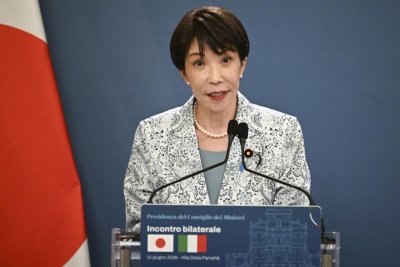

Japanese Prime Minister Sanae Takaichi speaks to the press during her meeting with Italian Premier Meloni at Villa Pamphilij in Rome, Italy, 15 June 2026. Photo by Riccardo Antimiani / EPA
June 18 (Asia Today) — Japanese Prime Minister Sanae Takaichi has left open the possibility of deploying the Self-Defense Forces to the Strait of Hormuz following an agreement between the United States and Iran to end hostilities.
“Nothing has been decided at this point,” Takaichi said Wednesday when asked about a possible deployment during a news conference marking the end of the Group of Seven summit near Évian-les-Bains, France, Japanese media reported Thursday.
Takaichi said Japan must closely examine the U.S.-Iran agreement and conditions in the region before making a decision.
The Strait of Hormuz is a critical shipping route for crude oil from the Middle East. Instability in the waterway could directly affect shipping, energy prices and Japanese industry because the country relies heavily on imported energy.
The U.S.-Iran agreement has shifted Japan’s immediate focus from preventing further fighting to securing freedom of navigation and considering its role in post-conflict efforts.
Even after fighting ends, naval mines and other threats to commercial vessels could remain. Japan would then have to determine whether its involvement should be limited to diplomatic support or include operations by the Maritime Self-Defense Force.
Security in the Strait of Hormuz and other major shipping routes was among the issues discussed at the G7 summit.
Japan faces the challenge of coordinating with its allies and partners while keeping any military involvement within the limits imposed by its pacifist Constitution.
“We will continue every possible diplomatic effort, including those related to reconstruction,” Takaichi said of the situation in the Middle East.
She said Japan would consider necessary measures to secure freedom of navigation through the strait and “steadily carry out what we are capable of doing,” including diplomatic efforts.
Britain, France and other countries have called for the unconditional reopening of the waterway and indicated that mine-clearing operations could be required. Japan has signaled its willingness to participate in a related joint statement.
Takaichi said Japan’s participation in such a statement would remain within constitutional limits.
The central issue is how extensively the Self-Defense Forces could participate.
Article 9 of Japan’s Constitution prohibits the use of force except in circumstances involving the country’s right to self-defense. Mine-clearing operations conducted while fighting continues could therefore be viewed as the use of force against the country that placed the mines.
Clearing mines left behind after a cease-fire, however, may be permitted under Japan’s Self-Defense Forces Act.
Japan deployed Maritime Self-Defense Force minesweepers to the Persian Gulf after the 1991 Gulf War cease-fire. The mission marked the Self-Defense Forces’ first operational deployment overseas and became a turning point in Japan’s debate over its international security role.
Takaichi’s remarks did not amount to an immediate deployment decision. They indicated, however, that Japan could consider participating in maritime security operations depending on implementation of the U.S.-Iran agreement and conditions in the Strait of Hormuz.
Japan’s possible role in the post-conflict Middle East – whether limited to diplomatic and reconstruction support or expanded to include Maritime Self-Defense Force operations – is expected to remain a major foreign and security policy issue.
— Reported by Asia Today; translated by UPI
© Asia Today. Unauthorized reproduction or redistribution prohibited.
Original Korean report: https://www.asiatoday.co.kr/kn/view.php?key=20260618010006401